


Hypha

Encyclopedia
Fungus
A fungus is a member of a large group of eukaryotic organisms that includes microorganisms such as yeasts and molds , as well as the more familiar mushrooms. These organisms are classified as a kingdom, Fungi, which is separate from plants, animals, and bacteria...
, and also of unrelated Actinobacteria
Actinobacteria
Actinobacteria are a group of Gram-positive bacteria with high guanine and cytosine content. They can be terrestrial or aquatic. Actinobacteria is one of the dominant phyla of the bacteria....
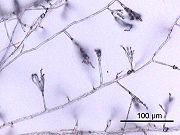
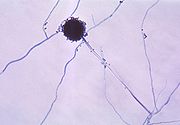
. In most fungi, hyphae are the main mode of vegetative growth, and are collectively called a mycelium
Mycelium
thumb|right|Fungal myceliaMycelium is the vegetative part of a fungus, consisting of a mass of branching, thread-like hyphae. The mass of hyphae is sometimes called shiro, especially within the fairy ring fungi. Fungal colonies composed of mycelia are found in soil and on or within many other...
; yeast
Yeast
Yeasts are eukaryotic micro-organisms classified in the kingdom Fungi, with 1,500 species currently described estimated to be only 1% of all fungal species. Most reproduce asexually by mitosis, and many do so by an asymmetric division process called budding...
s are unicellular fungi that do not grow as hyphae.
Structure
A hypha consists of one or more cellCell (biology)
The cell is the basic structural and functional unit of all known living organisms. It is the smallest unit of life that is classified as a living thing, and is often called the building block of life. The Alberts text discusses how the "cellular building blocks" move to shape developing embryos....
s surrounded by a tubular cell wall
Cell wall
The cell wall is the tough, usually flexible but sometimes fairly rigid layer that surrounds some types of cells. It is located outside the cell membrane and provides these cells with structural support and protection, and also acts as a filtering mechanism. A major function of the cell wall is to...
. In most fungi, hyphae are divided into cells by internal cross-walls called "septa" (singular septum
Septum
In anatomy, a septum is a wall, dividing a cavity or structure into smaller ones.-In human anatomy:...
). Septa are usually perforated by pores large enough for ribosome
Ribosome
A ribosome is a component of cells that assembles the twenty specific amino acid molecules to form the particular protein molecule determined by the nucleotide sequence of an RNA molecule....
s, mitochondria
Mitochondrion
In cell biology, a mitochondrion is a membrane-enclosed organelle found in most eukaryotic cells. These organelles range from 0.5 to 1.0 micrometers in diameter...
and sometimes nuclei
Cell nucleus
In cell biology, the nucleus is a membrane-enclosed organelle found in eukaryotic cells. It contains most of the cell's genetic material, organized as multiple long linear DNA molecules in complex with a large variety of proteins, such as histones, to form chromosomes. The genes within these...
to flow between cells. The major structural polymer in fungal cell walls is typically chitin
Chitin
Chitin n is a long-chain polymer of a N-acetylglucosamine, a derivative of glucose, and is found in many places throughout the natural world...
, in contrast to plants that have cellulosic
Cellulose
Cellulose is an organic compound with the formula , a polysaccharide consisting of a linear chain of several hundred to over ten thousand β linked D-glucose units....
cell walls. Some fungi have aseptate hyphae, meaning their hyphae are not partitioned by septa.
Growth
Hyphae grow at their tips. During tip growth, cell walls are extended by the external assembly and polymerizationPolymerization
In polymer chemistry, polymerization is a process of reacting monomer molecules together in a chemical reaction to form three-dimensional networks or polymer chains...
of cell wall components, and the internal production of new cell membrane. The spitzenkörper
Spitzenkörper
The Spitzenkörper is a structure found in fungal hyphae which is the organizing center for hyphal growth and morphogenesis. It consists of many small vesicles and is present in growing hyphal tips, during spore germination and where branch formation occurs. Its position in the hyphal tip correlates...
is an intracellular organelle associated with tip growth. It is composed of an aggregation of membrane-bound vesicles containing cell wall components. The spitzenkörper is part of the endomembrane system
Endomembrane system
The endomembrane system is composed of the different membranes that are suspended in the cytoplasm within a eukaryotic cell. These membranes divide the cell into functional and structural compartments, or organelles...
of fungi, holding and releasing vesicle
Vesicle (biology)
A vesicle is a bubble of liquid within another liquid, a supramolecular assembly made up of many different molecules. More technically, a vesicle is a small membrane-enclosed sack that can store or transport substances. Vesicles can form naturally because of the properties of lipid membranes , or...
s it receives from the Golgi apparatus
Golgi apparatus
The Golgi apparatus is an organelle found in most eukaryotic cells. It was identified in 1898 by the Italian physician Camillo Golgi, after whom the Golgi apparatus is named....
. These vesicles travel to the cell membrane via the cytoskeleton
Cytoskeleton
The cytoskeleton is a cellular "scaffolding" or "skeleton" contained within a cell's cytoplasm and is made out of protein. The cytoskeleton is present in all cells; it was once thought to be unique to eukaryotes, but recent research has identified the prokaryotic cytoskeleton...
and release their contents outside the cell by the process of exocytosis
Exocytosis
Exocytosis , also known as 'The peni-cytosis', is the durable process by which a cell directs the contents of secretory vesicles out of the cell membrane...
, where it can then be transported to where it is needed. Vesicle membranes contribute to growth of the cell membrane while their contents form new cell wall. The spitzenkörper moves along the apex of the hyphal strand and generates apical growth and branching; the apical growth rate of the hyphal strand parallels and is regulated by the movement of the spitzenkörper.
As a hypha extends, septa
Septum
In anatomy, a septum is a wall, dividing a cavity or structure into smaller ones.-In human anatomy:...
may be formed behind the growing tip to partition each hypha into individual cells. Hyphae can branch through the bifurcation of a growing tip, or by the emergence of a new tip from an established hypha.
Modifications
Hyphae may be modified in many different ways to serve specific functions. Some parasiticParasitism
Parasitism is a type of symbiotic relationship between organisms of different species where one organism, the parasite, benefits at the expense of the other, the host. Traditionally parasite referred to organisms with lifestages that needed more than one host . These are now called macroparasites...
fungi form haustoria
Haustorium
In botany, a haustorium is the appendage or portion of a parasitic fungus or of the root of a parasitic plant that penetrates the host's tissue and draws nutrients from it. Haustoria do not penetrate the host's cell membranes.Fungi in all major divisions form haustoria...
that function in absorption within the host cells. The arbuscules
Arbuscular mycorrhiza
An arbuscular mycorrhiza is a type of mycorrhiza in which the fungus penetrates the cortical cells of the roots of a vascular plant....
of mutualistic mycorrhiza
Mycorrhiza
A mycorrhiza is a symbiotic association between a fungus and the roots of a vascular plant....
l fungi serve a similar function in nutrient exchange, so are important in assisting nutrient and water absorption by plants. Hyphae are found enveloping the gonidia in lichen
Lichen
Lichens are composite organisms consisting of a symbiotic organism composed of a fungus with a photosynthetic partner , usually either a green alga or cyanobacterium...
s, making up a large part of their structure. In nematode-trapping fungi, hyphae may be modified into trapping structures such as constricting rings and adhesive nets. Mycelial cord
Mycelial cord
Mycelial cords are linear aggregations of parallel-oriented hyphae. The mature cords are composed of wide, empty vessel hyphae surrounded by narrower sheathing hyphae...
s can be formed to transfer nutrients over larger distances.
Classification based on cell division
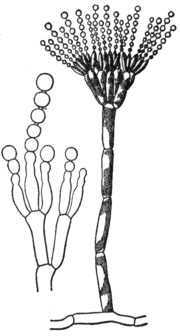
- Septate (with septa)
- AspergillusAspergillusAspergillus is a genus consisting of several hundred mold species found in various climates worldwide. Aspergillus was first catalogued in 1729 by the Italian priest and biologist Pier Antonio Micheli...
and many other species have septate hyphae.
- Aspergillus
- Aseptate or coenocyticCoenocyteA coenocyte is a multinucleate cell. It can result from multiple nuclear divisions without accompanying cell divisions, or from cellular aggregation followed by dissolution of the cell membranes inside the mass. Coenocytes are found in fungi and some protists, such as algae and slime mold. Some...
(without septa)- Non-septate hyphae are associated with MucorMucorMucor is a microbial genus of about 3000 species of moulds commonly found in soil, digestive systems, plant surfaces, and rotten vegetable matter.-Description:...
, some zygomycetesZygomycotaZygomycota, or zygote fungi, is a phylum of fungi. The name comes from zygosporangia, where resistant spherical spores are formed during sexual reproduction. Approximately 1060 species are known. They are mostly terrestrial in habitat, living in soil or on decaying plant or animal material...
, and other fungi.
- Non-septate hyphae are associated with Mucor
- "Pseudohyphae" are distinguished from true hyphae by their method of growth, relative frailty and lack of cytoplasmCytoplasmThe cytoplasm is a small gel-like substance residing between the cell membrane holding all the cell's internal sub-structures , except for the nucleus. All the contents of the cells of prokaryote organisms are contained within the cytoplasm...
ic connection between the cells.- Yeast can form pseudohyphae. They are the result of a sort of incomplete buddingBuddingBudding is a form of asexual reproduction in which a new organism grows on another one. The new organism remains attached as it grows, separating from the parent organism only when it is mature. Since the reproduction is asexual, the newly created organism is a clone and is genetically identical...
where the cells remain attached after division.
- Yeast can form pseudohyphae. They are the result of a sort of incomplete budding
Classification based on cell wall and overall form
Characteristics of hyphae can be important in fungal classification. In basidiomyceteBasidiomycota
Basidiomycota is one of two large phyla that, together with the Ascomycota, comprise the subkingdom Dikarya within the Kingdom Fungi...
taxonomy, hyphae that comprise the fruiting body
Sporocarp (fungi)
In fungi, the sporocarp is a multicellular structure on which spore-producing structures, such as basidia or asci, are borne...
can be identified as generative, skeletal, or binding hyphae.
- Generative hyphae are relatively undifferentiated and can develop reproductive structures. They are typically thin-walled, occasionally developing slightly thickened walls, usually have frequent septa, and may or may not have clamp connectionClamp connectionA clamp connection is a structure formed by growing hyphal cells of certain fungi. It is created to ensure each septum, or segment of hypha separated by crossed walls, receives a set of differing nuclei, which are obtained through mating of hyphae of differing sexual types...
s. They may be embedded in mucilage or gelatinized materials. - Skeletal hyphae are of two basic types. The classical form is thick-walled and very long in comparison to the frequently septate generative hyphae, which are unbranched or rarely branched, with little cell content. They have few septa and lack clamp connections. Fusiform skeletal hyphae are the second form of skeletal hyphae. Unlike typical skeletal hyphae these are swollen centrally and often exceedingly broad, hence giving the hypha a fusiform shape.
- Binding hyphae are thick-walled and frequent branched. Often they resemble deer antlers or defoliated trees because of the many tapering branches.
Based on the generative, skeletal and binding hyphal types, in 1932 E. J. H. Corner
E. J. H. Corner
Edred John Henry Corner FRS was a botanist who occupied the posts of assistant director at the Singapore Botanic Gardens and Professor of Tropical Botany at the University of Cambridge...
applied the terms monomitic, dimitic, and trimitic to hyphal systems, in order to improve the classification of polypore
Polypore
Polypores are a group of tough, leathery poroid mushrooms similar to boletes, but typically lacking a distinct stalk. The technical distinction between the two types of mushrooms is that polypores do not have the spore-bearing tissue continuous along the entire underside of the mushroom. Many...
s.
- Every fungus must contain generative hyphae. A fungus which only contains this type, as do fleshy mushrooms such as agaricAgaricAn agaric is a type of fungal fruiting body characterized by the presence of a pileus that is clearly differentiated from the stipe , with lamellae on the underside of the pileus. "Agaric" can also refer to a basidiomycete species characterized by an agaric-type fruiting body...
s, is referred to as monomitic.
- Skeletal and binding hyphae give leathery and woody fungi such as polyporePolyporePolypores are a group of tough, leathery poroid mushrooms similar to boletes, but typically lacking a distinct stalk. The technical distinction between the two types of mushrooms is that polypores do not have the spore-bearing tissue continuous along the entire underside of the mushroom. Many...
s their tough consistency. If a fungus contains all three types (example: TrametesTrametes versicolorTrametes versicolor — formerly known as Coriolus versicolor and Polyporus versicolor — is an extremely common polypore mushroom which can be found throughout the world. Versicolor means 'of several colours' and it is true that this mushroom is found in a wide variety of different colours. T...
), it is called trimitic.
- If a fungus contains generative hyphae and just one of the other two types, it is called dimitic. In fact dimitic fungi almost always contain generative and skeletal hyphae; there is one exceptional genus, Laetiporus that includes only generative and binding hyphae.
Fungi that form fusiform skeletal hyphae bound by generative hyphae are said to have sarcodimitic hyphal systems. A few fungi form fusiform skeletal hyphae, generative hyphae, and binding hyphae, and these are said to have sarcotrimitic hyphal systems. These terms were introduced as a later refinement by E. J. H. Corner in 1966.
Classification based on refractive appearance
Hyphae are described as "gloeoplerous" ("gloeohyphae") if their high refractive index gives them an oily or granular appearance under the microscope. These cells may be yellowish or clear (hyalineHyaline
The term hyaline denotes a substance with a glass-like appearance.-Histopathology:In histopathological medical usage, a hyaline substance appears glassy and pink after being stained with haematoxylin and eosin — usually it is an acellular, proteinaceous material...
). They can sometimes selectively be coloured by sulphovanillin or other reagents. The specialized cells termed cystidia can also be gloeoplerous.
External links
- Diagram of branching hyphae, emphasizing septa
- Close-up light micrograph of coenocytic hyphae
- MicrobiologyBytes: Introduction to Mycology
- Hyphal growth and branching movies by P.C. Hickey and N. Read, University of Edinburgh
- Fungi Online Fungi Online: An Introduction to the Biology of Fungi