
All Topics  
Crinoid

 
Crinoid

   Email Print
   Bookmark   Link


Crinoid


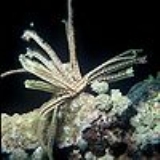
Crinoids, also known as sea lilies or feather-stars, are marine animals that make up the class Crinoidea of the echinoderm
Echinoderm

Echinoderms are a Phylum of Marine animals . Echinoderms are found at every ocean depth, from the intertidal zone to the abyssal zone.Aside from the problematic Arkarua, the first definitive members of the phylum appeared near the start of the Cambrian period....
s (phylum Echinodermata). They live both in shallow water and in depths as great as 6,000 meters.

Crinoids are characterized by a mouth on the top surface that is surrounded by feeding arms. They have a U-shaped gut, and their anus is located next to the mouth.


Discussion
Ask a question about 'Crinoid'
Start a new discussion about 'Crinoid'
Answer questions from other users
Full Discussion Forum


Recent Posts


Encyclopedia


Crinoids, also known as sea lilies or feather-stars, are marine animals that make up the class Crinoidea of the echinoderm
Echinoderm

Echinoderms are a Phylum of Marine animals . Echinoderms are found at every ocean depth, from the intertidal zone to the abyssal zone.Aside from the problematic Arkarua, the first definitive members of the phylum appeared near the start of the Cambrian period....
s (phylum Echinodermata). They live both in shallow water and in depths as great as 6,000 meters.

Crinoids are characterized by a mouth on the top surface that is surrounded by feeding arms. They have a U-shaped gut, and their anus is located next to the mouth. Although the basic echinoderm pattern of five-fold symmetry can be recognized, most crinoids have many more than five arms. Crinoids usually have a stem used to attach themselves to a substrate
Substrate (marine biology)

Stream substrate is the material that rests at the bottom of a stream. There are several classification guides. One is:*Mud ? Comprised of silt and clay....
, but many live attached only as juveniles and become free-swimming as adults.

There are only a few hundred known modern forms, but crinoids were much more numerous both in species and numbers in the past. Some thick limestone
Limestone

File:Limestone Formation In Waitomo.jpgLimestone is a sedimentary rock composed largely of the mineral calcite . The deposition of limestone strata is often a by-product and indicator of biological activity in the geology record....
 beds dating to the mid- to late-Paleozoic
Paleozoic

The Paleozoic or Palaeozoic Era is the earliest of three geology Era of the Phanerozoic Eon . The Paleozoic spanned from roughly , and is subdivided into six period ; from oldest to youngest they are: the Cambrian, Ordovician, Silurian, Devonian period, Carboniferous, and Permian...
 are entirely made up of disarticulated crinoid fragments.

Morphology

Crinoid Drawing
Crinoids comprise three basic sections; the stem, the calyx, and the arms. The stem is composed of highly porous ossicles which are filled with muscular tissue. The Calyx contains the crinoid's digestive and reproductive organs, and the mouth
Mouth

The mouth, buccal cavity, or oral cavity is the first portion of the alimentary canal that receives food and begins digestion by mechanically breaking up the solid food particles into smaller pieces and mixing them with saliva....
 is located at the top of the dorsal cup, while the anus is located peripheral to it. The brachials(arms) display pentameral symmetry and comprise smaller ossicles than the stem and are equipped with cirri
Cirri

* For the famous Italian cellist, see: Giovanni Battista Cirri* For other meanings of Cirri as a plural of Cirrus, see: Cirrus...
 which facilitate feeding by moving the organic media down the arm and into the mouth.

Ecology


Nutrition

Crinoids feed by filtering small particles of food from the sea water with their feather like arms.

Reproduction

Crinoids reproduce sexually by the males releasing their sperm
Sperm

The term sperm is derived from the Greek word sperma and refers to the male reproductive Cell . In the types of sexual reproduction known as anisogamy and oogamy, there is a marked difference in the size of the gametes with the smaller one being termed the "male" or sperm cell....
 and the females releasing their eggs
Ovum

An ovum is a haploid female reproductive cell or gamete. Both animals and embryophytes have ova. The term ovule is used for the young ovum of an animal, as well as the plant structure that carries the female gametophyte and egg cell and develops into a seed after fertilization....
 into the current where they will develop into a bottom-dwelling non-feeding larval stage and then eventually grow a stalk (in the stalked crinoids), and within 10 to 16 months will be able to reproduce. In some cases the female of the species has been known to temporarly brood
Brood

Brood may refer to:* Brood, a collective term for offspring* Brooding, the incubation of bird eggs by their parents* Brood , the young of a beehive...
 the larva
Larva

A larva is a young form of animal with indirect developmental biology, going through or undergoing metamorphosis .The larva can look completely different from the adult form, for example, a caterpillar differs from a butterfly....
.

Mobility

Most modern crinoids are free-swimming and lack a stem. Examples of fossil crinoids that have been interpreted as free-swimming include Marsupitsa, Saccocoma and Uintacrinus.

In 2005, a stalked crinoid was recorded pulling itself along the sea floor off the Grand Bahama Island
Grand Bahama

Grand Bahama is one of the northernmost of the islands of the Bahamas, and the closest major island to the United States, lying just 55 mi off the state of Florida....
. While it has been known that stalked crinoids move, prior to this recording the fastest motion of a crinoid was 0.6 meters/hour (2 ft/h). The 2005 recording showed a crinoid moving at much faster speeds.

Evolution

The earliest known crinoids come from the Ordovician
Ordovician

The Ordovician is a geologic period, the second of six of the Paleozoic era , and covers the time between 488.3?1.7 to 443.7?1.5 million years ago ....
. They are thought to have evolved from primitive echinoderms known as Eocystoids. Confusingly, another early group of echinoderms were also the Eocrinoids, but that group is currently thought to be an ancestor of blastoid
Blastoid

Blastoids are an extinct type of stemmed echinoderm. Often called sea buds, blastoid fossils look like small Hickory. They originated, along with many other echinoderm classes, in the Ordovician period and reached their greatest diversity in the Mississippian epoch of the Carboniferous period....
s rather than of crinoids.

The crinoids underwent two periods of abrupt adaptive radiation
Adaptive radiation

An adaptive radiation is a rapid evolutionary radiation characterized by an increase in the morphological and ecological diversity of a single, rapidly diversifying lineage....
; the first during the Ordovician, the other after they underwent a selective mass extinction at the end of the Permian
Permian

The PermianThe term "Permian" was introduced into geology in 1841 by Sir Roderick Murchison, president of the Geological Society of London, who identified typical strata in extensive Russian explorations undertaken with Edouard de Verneuil; Murchison asserted in 1841 that he named his "Permian system" after the ancient kingdom...
 period. This Triassic radiation resulted in forms possessing flexible arms becoming widespread; motility
Motility

Motility is a biology term which refers to the ability to move spontaneously and actively, consuming energy in the process. It can apply to either single-celled or multicellular organisms....
, predominantly a response to predation pressure, also became far more prevalent. After the end-Permian extinction, crinoids never regained the morphological disparity they enjoyed in the Paleozoic; they occupied a different region of morphospace, employing different ecological strategies from those that had proven so successful in the Paleozoic.

The long and varied geological history of the crinoids demonstrates how well the echinoderms have adapted to filter-feeding. The fossils of other stalked filter-feeding echinoderms, such as blastoids, are also found in the rocks of the Palaeozoic era. These extinct groups can exceed the crinoids in both numbers and variety in certain horizons. However, none of these others survived the crisis at the end of the Permian period.

Fossils of passing interest


Some fossil crinoids, such as Pentacrinites
Pentacrinites

Pentacrinites is an extinct genus of crinoid that lived from the Middle Triassic to the Eocene of Asia, Europe, North America, and New Zealand....
, seem to have lived attached to floating driftwood and complete colonies are often found. Sometimes this driftwood would become waterlogged and sink to the bottom, taking the attached crinoids with it. The stem of Pentacrinites can be several metres long. Modern relatives of Pentacrinites live in gentle currents attached to rocks by the end of their stem, which is fairly short. The largest fossil crinoid on record had a stem 40 m (130 ft) in length.

In 2006, geologists isolated complex organic molecules from 350-million-year-old fossils of crinoids -- the oldest such molecules yet found. Christina O'Malley, a doctoral student in earth sciences at The Ohio State University, found orange and yellow organic molecules inside the fossilized remains of several species of crinoids dating back to the Mississippian period.

Crinoids in pop culture

  • Fossilised crinoid columnals extracted from limestone
    Limestone

    File:Limestone Formation In Waitomo.jpgLimestone is a sedimentary rock composed largely of the mineral calcite . The deposition of limestone strata is often a by-product and indicator of biological activity in the geology record....
     quarried on Lindisfarne
    Lindisfarne

    Lindisfarne is a tidal island off the north-east coast of England also known as Holy Island, the name of the civil parish. It has a population of 162 ...
    , or found washed up along the foreshore, which were threaded into necklace
    Necklace

    A necklace is an article of jewellery which is worn around the neck. Necklaces are frequently formed from a metal chain, often attached to a locket or pendant....
    s or rosaries
    Rosary

    The Rosary is a popular traditional Roman Catholic devotion. The term denotes both a set of prayer beads and the devotional prayer itself, which combines vocal prayer and meditation....
    , became known as St Cuthbert's beads
    St Cuthbert's beads

    St. Cuthbert's beads are fossils. They are circular crinoid columnals, portions of the "stems" of Carboniferous crinoids. Crinoids are a kind of marine echinoderm which are still extant, and which are sometimes known as "sea lilies"....
    .
  • Crinoids are the state fossil of Missouri
    Missouri

    Missouri is a U.S. state in the Midwestern United States of the United States bordered by Iowa, Illinois, Kentucky, Tennessee, Arkansas, Oklahoma, Kansas and Nebraska....
    .
  • The Pokémon
    Pokémon

    is a media franchise owned by the video game company Nintendo and created by Satoshi Tajiri around 1995. Originally released as a pair of interlinkable Game Boy line Console role-playing game video games, Pok?mon has since become the second most successful and lucrative video game-based media franchise in the world, behind only Nintendo's own...
     Lileep and Cradily are based on crinoids.


External links

  • ucmp.berkeley.edu. Retrieved on February 7, 2007.