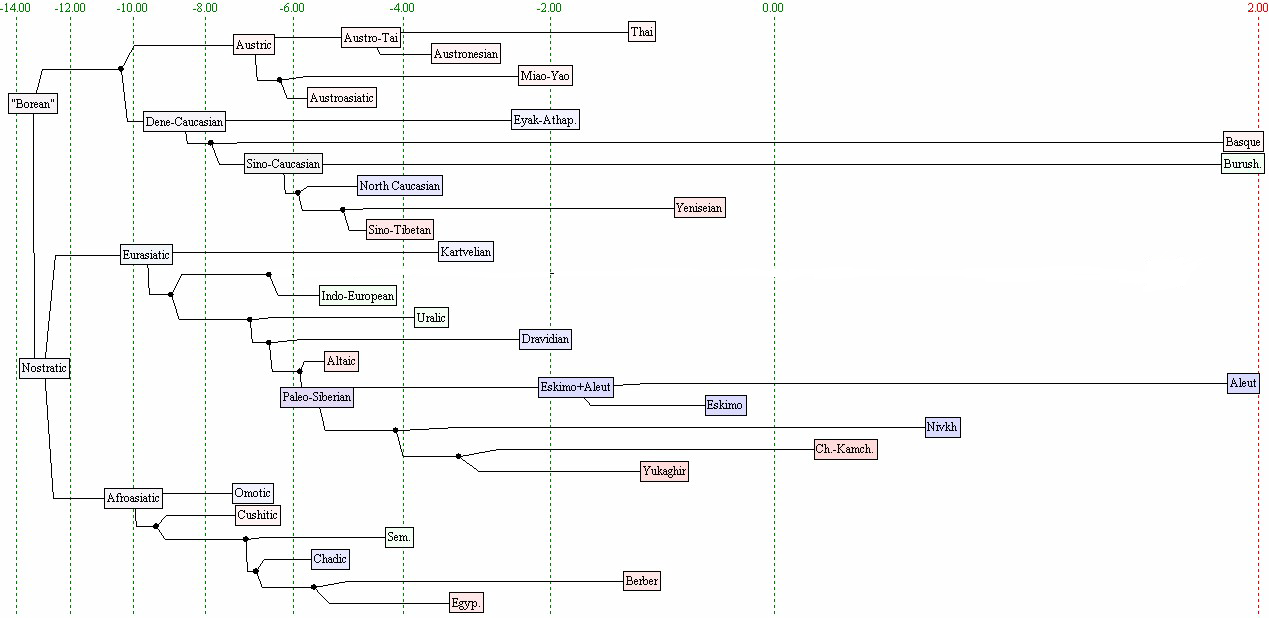
Nostratic languages

Encyclopedia
Nostratic is a proposed language family
(sometimes called a macrofamily
or a superfamily) that includes many of the indigenous language families of Eurasia
, including the Indo-European
, Uralic
and Altaic
as well as Kartvelian
languages. Usually also included are the Afroasiatic languages native to Northern Africa
, Horn of Africa
and the Arabian Peninsula
, and the Dravidian languages
of the Indian Subcontinent
(sometimes extended to Elamo-Dravidian, connecting India and the Persian Plateau). The exact composition and structure of the family varies among proponents.
The hypothetical ancestral language of the Nostratic family is called Proto-Nostratic. Proto-Nostratic would necessarily have been spoken at an earlier time than the language families descended from it, which would place it in the Epipaleolithic
period, close to the end of the last glacial period.
The Nostratic hypothesis originates with Holger Pedersen
in the early 20th century. The name "Nostratic" is due to Pedersen (1903), derived from the Latin nostrates "fellow countrymen". The hypothesis was significantly expanded in the 1960s by Soviet linguists, notably Vladislav Illich-Svitych
and Aharon Dolgopolsky
, termed the "Moscovite school" by Bomhard (2008), and it has received renewed attention in English-speaking academia since the 1990s.
The hypothesis is controversial and has varying degrees of acceptance amongst linguists worldwide.
In Russia
, it is endorsed by a minority of linguists, such as Vladimir Dybo
, but is not a generally accepted hypothesis. Allan Bomhard
is a supporter. Lyle Campbell
presents arguments challenging the hypothesis. Some linguists take an agnostic view. Merritt Ruhlen
endorses Eurasiatic
, a similar but not identical grouping. Eurasiatic was proposed by Joseph Greenberg
(2000), and is taken as a subfamily of Nostratic by Allan Bomhard (2008).
to other language families, such as Finno-Ugric
and Altaic
.
These proposals were taken much farther in 1903 when Holger Pedersen
proposed "Nostratic", a common ancestor for the Indo-European
, Finno-Ugric
, Samoyed
, Turkish
, Mongolian
, Manchu
, Yukaghir
, Eskimo, Semitic
, and Hamitic languages, with the door left open to the eventual inclusion of others.
The name Nostratic derives from the Latin
word nostrās, meaning 'our fellow-countryman' (plural: nostrates) and has been defined, since Pedersen, as consisting of those language families that are related to Indo-European. Merritt Ruhlen
notes that this definition is not properly taxonomic but amorphous, since there are broader and narrower degrees of relatedness, and moreover, some linguists who broadly accept the concept (such as Greenberg and Ruhlen himself) have criticised the name as reflecting the ethnocentrism
frequent among Europeans at the time. Martin Bernal
has described the term as distasteful because it implies that speakers of other language families are excluded from academic discussion. Even so, the concept arguably transcends ethnocentric associations. (Indeed, Pedersen's older contemporary Henry Sweet attributed some of the resistance by Indo-European specialists to hypotheses of wider genetic relationships as "prejudice against dethroning [Indo-European] from its proud isolation and affiliating it to the languages of yellow races".) Proposed alternative names such as Mitian, formed from the characteristic Nostratic first- and second-person pronouns mi 'I' and ti 'you' (exactly 'thou
'), have not attained the same currency.
An early supporter was the French linguist Albert Cuny
—better known for his role in the development of the laryngeal theory
—who published his Recherches sur le vocalisme, le consonantisme et la formation des racines en « nostratique », ancêtre de l'indo-européen et du chamito-sémitique ('Researches on the Vocalism, Consonantism, and Formation of Roots in "Nostratic", Ancestor of Indo-European and Hamito-Semitic') in 1943. Although Cuny enjoyed a high reputation as a linguist, the work was coldly received.
. Working independently at first, Vladislav Illich-Svitych
and Aharon Dolgopolsky
elaborated the first version of the contemporary form of the hypothesis during the 1960s. They expanded it to include additional language families. Illich-Svitych also prepared the first dictionary of the hypothetical language.
A principal source for the items in Illich-Svitych’s dictionary was the earlier work of Alfredo Trombetti
(1866–1929), an Italian linguist who had developed a classification scheme for all the world’s languages, widely reviled at the time and subsequently ignored by almost all linguists. In Trombetti’s time, a widely held view on classifying languages was that similarity in inflections is the surest proof of genetic relationship
. In the interim, the view had taken hold that the comparative method
—previously used as a means of studying languages already known to be related and without any thought of classification—is the most effective means to establish genetic relationship, eventually hardening into the conviction that it is the only legitimate means to do so. This view was basic to the outlook of the new Nostraticists. Although Illich-Svitych adopted many of Trombetti’s etymologies, he sought to validate them by a systematic comparison of the sound systems of the languages concerned.
Also significant was Bomhard's partly critical review of Dolgopolsky's dictionary, in which he argued that only those Nostratic etymologies that are strongest should be included, in contrast to Dolgopolsky's more expansive approach, which includes many etymologies that are possible but not secure.
2008 also saw the opening of a website, Nostratica, devoted to providing important texts in Nostratic studies online.
The three groups universally accepted among Nostraticists are Indo-European, Uralic
, and Altaic; the validity of the Altaic family, while itself controversial, is taken for granted by Nostraticists.
Nearly all also include the Dravidian
and Kartvelian
language families.
Following Pedersen, Illich-Svitych, and Dolgopolsky, most advocates of the theory have included Afroasiatic, though criticisms by Joseph Greenberg
and others from the late 1980s onward suggested a reassessment of this position.
A fairly representative grouping, arranged in rough geographical order (and probable order of phylogenetic branching, following Starostin), would include:
The Sumerian
and Etruscan
languages, usually regarded as language isolate
s, are thought by some to be Nostratic languages as well. Others, however, consider one or both to be members of another macrofamily called Dené–Caucasian.
Another notional isolate, the Elamite language
, also figures in a number of Nostratic classifications. It is frequently grouped with Dravidian as Elamo-Dravidian
.
In 1987 Joseph Greenberg proposed a similar macrofamily which he called Eurasiatic
. It included the same "Euraltaic" core (Indo-European, Uralic, and Altaic), but excluded some of the above-listed families, most notably Afroasiatic. At about this time Russian Nostraticists, notably Sergei Starostin
, constructed a revised version of Nostratic which was slightly broader than Greenberg's grouping but which similarly left out Afroasiatic.
Recently, a consensus has been emerging among proponents of the Nostratic hypothesis. Greenberg basically agreed with the Nostratic concept, though he stressed a deep internal division between its northern 'tier' (his Eurasiatic) and a southern 'tier' (principally Afroasiatic and Dravidian).
The American Nostraticist Allan Bomhard
considers Eurasiatic a branch of Nostratic alongside other branches: Afroasiatic, Elamo-Dravidian, and Kartvelian. Similarly, Georgiy Starostin
(2002) arrives at a tripartite overall grouping: he considers Afroasiatic, Nostratic and Elamite to be roughly equidistant and more closely related to each other than to anything else. Sergei Starostin's school has now re-included Afroasiatic in a broadly defined Nostratic, while reserving the term Eurasiatic to designate the narrower subgrouping which comprises the rest of the macrofamily. Recent proposals thus differ mainly on the precise placement of Dravidian and Kartvelian.
According to Greenberg, Eurasiatic and Amerind
form a genetic node, being more closely related to each other than either is to "the other families of the Old World".
There are a number of hypotheses incorporating Nostratic into an even broader linguistic 'mega-phylum', sometimes called Borean
, which would also include at least the Dené–Caucasian and perhaps the Amerind and Austric
superfamilies. The term SCAN has been used for a group that would include Sino-Caucasian, Amerind, and Nostratic.
are in broad agreement with the earlier conclusions of Illich-Svitych and Dolgopolsky in seeking the Nostratic Urheimat
(original homeland) within the Mesolithic
(or Epipaleolithic
) in the Fertile Crescent
, the stage which directly preceded the Neolithic
and was transitional to it.
Looking at the cultural assemblages of this period, two sequences in particular stand out as possible archeological correlates of the earliest Nostratians or their immediate precursors. Both hypotheses place Proto-Nostratic within the Fertile Crescent
at around the end of the last glacial period.
It has been proposed that the broad spectrum revolution
of Kent Flannery (1969), associated with microlith
s, the use of the bow and arrow
, and the domestication of the dog
, all of which are associated with these cultures, may have been the cultural "motor" that led to their expansion.
Certainly cultures which appeared at Franchthi Cave
in the Aegean and Lepenski Vir
in the Balkans, and the Murzak-Koba (9100–8000 BCE) and Grebenki (8500–7000 BCE) cultures of the Ukrainian steppe, all displayed these adaptations.
Bomhard (2008) suggests a differentiation of Proto-Nostratic by 8,000 BCE, the beginning of the Neolithic Revolution in the Levant, over a territory spanning the entire Fertile Crescent and beyond into the Caucasus (Proto-Kartvelian), Egypt and along the Red Sea to the Horn of Africa (Proto-Afroasiatic), the Iranian Plateau (Proto-Elamo-Dravidian) and into Central Asia (Proto-Eurasiatic, to be further subdivided by 5,000 BCE into Proto-Indo-European
, Proto-Uralic and Proto-Altaic).
s tabulated below are commonly reconstructed for the Proto-Nostratic language (Kaiser and Shevoroshkin 1988). Allan Bomhard (2008), who relies more heavily on Afroasiatic and Dravidian than on Uralic, as do members of the "Moscow School", reconstructs a different vowel system, with three pairs of vowels represented as: /a/~/ə/, /e/~/i/, /o/~/u/, as well as independent /i/, /o/, and /u/. In the first three pairs of vowels, Bomhard is attempting to specify the subphonemic variation involved, inasmuch as that variation led to some of the vowel gradation (ablaut) and vowel harmony
patterning found in various daughter languages.
, which makes traditional PIE voiced stops appeared like glottalized ones. To correct this anomaly, linguists such as Manaster Ramer and Bomhard have proposed to correlate Nostratic voiceless and glottalized stops with PIE ones, so this is done in the table.
Because linguists working on Proto-Indo-European, Proto-Uralic, and Proto-Dravidian do not usually use the IPA
, the transcriptions used in those fields are also given where the letters differ from the IPA symbols. The IPA symbols are between slashes because this is a phonemic
transcription. The exact values of the phoneme "" in Proto-Afroasiatic and Proto-Dravidian are unknown. "0" indicates disappearance without a trace. Hyphens indicate different developments at the beginning and in the interior of words; no consonants ever occurred at the ends of word roots. (Starostin's list of affricate and fricative correspondences does not mention Afroasiatic or Dravidian, and Kaiser and Shevoroshkin don't mention these sounds much; hence the holes in the table.)
Note that, due to lack of research, there are at present several different mutually incompatible reconstructions of Proto-Afroasiatic (see http://www.tufs.ac.jp/ts/personal/ratcliffe/comp%20&%20method-Ratcliffe.pdf for two recent ones). The one used here has been said to be based too strongly on Proto-Semitic
(Yakubovich 1998).
Similarly, the paper by Kaiser and Shevoroshkin is much older than the newest Altaic Etymological Dictionary (2003; see Altaic languages
article) and therefore assumes a somewhat different phonological system for Proto-Altaic.
In addition, Kaiser and Shevoroshkin write the following about Proto-Nostratic grammar (two asterisks are used for reconstructions based on reconstructions; citation format changed):
Proto-Nostratic language had analytic structure
, which he argues by diverging of post- and prepositions of auxiliary words in descendant languages.
Dolgopolsky states three lexical categories to be in Proto-Nostratic language:
Word order was subject–object–verb when the subject
was a noun, and object–verb–subject when it was a pronoun
. Attributive (expressed by a lexical word) preceded its head. Pronominal attributive ('my', 'this') might follow the noun. Auxiliary words are considered to be postpositions.
to be strong is as follows:
s are seldom borrowed between languages. Therefore the many correspondences between Nostratic pronouns are rather strong evidence for the existence of a Proto-Nostratic language. The difficulty of finding Afroasiatic cognate
s is, however, taken by some as evidence that Nostratic has two or three branches, Afroasiatic and Eurasiatic (and possibly Dravidian), and that most or all of the pronouns in the following table can only be traced to Proto-Eurasiatic.
Nivkh
is a living (if moribund) language with an orthography, which is given here. /V/ means that it is not clear which vowel should be reconstructed.
For space reasons, Etruscan
is not included, but the fact that it had /mi/ 'I' and /mini/ 'me' seems to fit the pattern reconstructed for Proto-Nostratic ideally, leading some to argue that the Aegean or Tyrsenian languages
were yet another Nostratic branch.
There is no reconstruction of Proto-Eskimo–Aleut, although the existence of the Eskimo–Aleut family is generally accepted.
using his version of Proto-Nostratic composed a brief poem. (Compare Schleicher's fable
for similar attempts with several different reconstructions of Proto-Indo-European.)
Language family
A language family is a group of languages related through descent from a common ancestor, called the proto-language of that family. The term 'family' comes from the tree model of language origination in historical linguistics, which makes use of a metaphor comparing languages to people in a...
(sometimes called a macrofamily
Macrofamily
In historical linguistics, a macro-family, also called a superfamily or phylum, is defined as a proposed genetic relationship grouping together language families in a larger scale clasification.However, Campbell regards this term as superfluous, preferring language family for those clasifications...
or a superfamily) that includes many of the indigenous language families of Eurasia
Eurasia
Eurasia is a continent or supercontinent comprising the traditional continents of Europe and Asia ; covering about 52,990,000 km2 or about 10.6% of the Earth's surface located primarily in the eastern and northern hemispheres...
, including the Indo-European
Indo-European languages
The Indo-European languages are a family of several hundred related languages and dialects, including most major current languages of Europe, the Iranian plateau, and South Asia and also historically predominant in Anatolia...
, Uralic
Uralic languages
The Uralic languages constitute a language family of some three dozen languages spoken by approximately 25 million people. The healthiest Uralic languages in terms of the number of native speakers are Hungarian, Finnish, Estonian, Mari and Udmurt...
and Altaic
Altaic languages
Altaic is a proposed language family that includes the Turkic, Mongolic, Tungusic, and Japonic language families and the Korean language isolate. These languages are spoken in a wide arc stretching from northeast Asia through Central Asia to Anatolia and eastern Europe...
as well as Kartvelian
South Caucasian languages
The Kartvelian languages are spoken primarily in Georgia, with a large group of ethnic Georgian speakers in Russia, the United States, the European Union, and northeastern parts of Turkey. There are approximately 5.2 million speakers of this language family worldwide.It is not known to be related...
languages. Usually also included are the Afroasiatic languages native to Northern Africa
Africa
Africa is the world's second largest and second most populous continent, after Asia. At about 30.2 million km² including adjacent islands, it covers 6% of the Earth's total surface area and 20.4% of the total land area...
, Horn of Africa
Horn of Africa
The Horn of Africa is a peninsula in East Africa that juts hundreds of kilometers into the Arabian Sea and lies along the southern side of the Gulf of Aden. It is the easternmost projection of the African continent...
and the Arabian Peninsula
Arabian Peninsula
The Arabian Peninsula is a land mass situated north-east of Africa. Also known as Arabia or the Arabian subcontinent, it is the world's largest peninsula and covers 3,237,500 km2...
, and the Dravidian languages
Dravidian languages
The Dravidian language family includes approximately 85 genetically related languages, spoken by about 217 million people. They are mainly spoken in southern India and parts of eastern and central India as well as in northeastern Sri Lanka, Pakistan, Nepal, Bangladesh, Afghanistan, Iran, and...
of the Indian Subcontinent
Indian subcontinent
The Indian subcontinent, also Indian Subcontinent, Indo-Pak Subcontinent or South Asian Subcontinent is a region of the Asian continent on the Indian tectonic plate from the Hindu Kush or Hindu Koh, Himalayas and including the Kuen Lun and Karakoram ranges, forming a land mass which extends...
(sometimes extended to Elamo-Dravidian, connecting India and the Persian Plateau). The exact composition and structure of the family varies among proponents.
The hypothetical ancestral language of the Nostratic family is called Proto-Nostratic. Proto-Nostratic would necessarily have been spoken at an earlier time than the language families descended from it, which would place it in the Epipaleolithic
Epipaleolithic
The Epipaleolithic Age was a period in the development of human technology marked by more advanced stone blades and other tools than the earlier Paleolithic age, although still before the development of agriculture in the Neolithic age...
period, close to the end of the last glacial period.
The Nostratic hypothesis originates with Holger Pedersen
Holger Pedersen (linguist)
Holger Pedersen was a Danish linguist who made significant contributions to language science and wrote about 30 authoritative works concerning several languages....
in the early 20th century. The name "Nostratic" is due to Pedersen (1903), derived from the Latin nostrates "fellow countrymen". The hypothesis was significantly expanded in the 1960s by Soviet linguists, notably Vladislav Illich-Svitych
Vladislav Illich-Svitych
Vladislav Markovich Illich-Svitych was a Russian linguist and accentologist, also a founding father of comparative Nostratic linguistics.Of Ukrainian descent, he was born in Kiev but later moved to work in Moscow. He resuscitated the long-forgotten Nostratic hypothesis, originally expounded by...
and Aharon Dolgopolsky
Aharon Dolgopolsky
Aharon Dolgopolsky is a Russian-born Israeli comparative linguist and one of the modern founders of comparative Nostratic linguistics.Born in Moscow, he arrived at the long-forgotten Nostratic hypothesis in the 1960s, at around the same time but independently of Vladislav Illich-Svitych...
, termed the "Moscovite school" by Bomhard (2008), and it has received renewed attention in English-speaking academia since the 1990s.
The hypothesis is controversial and has varying degrees of acceptance amongst linguists worldwide.
In Russia
Russia
Russia or , officially known as both Russia and the Russian Federation , is a country in northern Eurasia. It is a federal semi-presidential republic, comprising 83 federal subjects...
, it is endorsed by a minority of linguists, such as Vladimir Dybo
Vladimir Dybo
Vladimir Antonovich Dybo is a Russian linguist whose areas of research include the Slavic languages, Indo-European, Nostratic, and Nilo-Saharan....
, but is not a generally accepted hypothesis. Allan Bomhard
Allan R. Bomhard
Allan R. Bomhard is an American linguist.He was educated at Fairleigh Dickinson University, Hunter College, and the City University of New York, and served in the U.S. Army from 1964—1966. He currently resides in Charleston, SC...
is a supporter. Lyle Campbell
Lyle Campbell
Lyle Richard Campbell is a linguist and leading expert on indigenous American languages—especially those of Mesoamerica—and on historical linguistics in general. He also has expertise in Uralic languages. He is presently Professor of Linguistics at the University of Hawaii at Manoa.-Life and...
presents arguments challenging the hypothesis. Some linguists take an agnostic view. Merritt Ruhlen
Merritt Ruhlen
Merritt Ruhlen is an American linguist known for his work on the classification of languages and what this reveals about the origin and evolution of modern humans. Amongst other linguists, Ruhlen's work is recognized as standing outside the mainstream of comparative-historical linguistics...
endorses Eurasiatic
Eurasiatic languages
Eurasiatic is a language macrofamily proposed by Joseph Greenberg that includes many language families historically spoken in northern Eurasia. The eight branches of Eurasiatic are Etruscan, Indo-European, Uralic–Yukaghir, Altaic, Korean-Japanese-Ainu, Gilyak, Chukotian, and Eskimo–Aleut, spoken in...
, a similar but not identical grouping. Eurasiatic was proposed by Joseph Greenberg
Joseph Greenberg
Joseph Harold Greenberg was a prominent and controversial American linguist, principally known for his work in two areas, linguistic typology and the genetic classification of languages.- Early life and career :...
(2000), and is taken as a subfamily of Nostratic by Allan Bomhard (2008).
Origin of the Nostratic hypothesis
The last quarter of the 19th century saw various linguists putting forward proposals linking the Indo-European languagesIndo-European languages
The Indo-European languages are a family of several hundred related languages and dialects, including most major current languages of Europe, the Iranian plateau, and South Asia and also historically predominant in Anatolia...
to other language families, such as Finno-Ugric
Finno-Ugric languages
Finno-Ugric , Finno-Ugrian or Fenno-Ugric is a traditional group of languages in the Uralic language family that comprises the Finno-Permic and Ugric language families....
and Altaic
Altaic languages
Altaic is a proposed language family that includes the Turkic, Mongolic, Tungusic, and Japonic language families and the Korean language isolate. These languages are spoken in a wide arc stretching from northeast Asia through Central Asia to Anatolia and eastern Europe...
.
These proposals were taken much farther in 1903 when Holger Pedersen
Holger Pedersen (linguist)
Holger Pedersen was a Danish linguist who made significant contributions to language science and wrote about 30 authoritative works concerning several languages....
proposed "Nostratic", a common ancestor for the Indo-European
Indo-European
Indo-European may refer to:* Indo-European languages** Aryan race, a 19th century and early 20th century term for those peoples who are the native speakers of Indo-European languages...
, Finno-Ugric
Finno-Ugric languages
Finno-Ugric , Finno-Ugrian or Fenno-Ugric is a traditional group of languages in the Uralic language family that comprises the Finno-Permic and Ugric language families....
, Samoyed
Samoyedic languages
The Samoyedic languages are spoken on both sides of the Ural mountains, in northernmost Eurasia, by approximately 30,000 speakers altogether....
, Turkish
Turkish language
Turkish is a language spoken as a native language by over 83 million people worldwide, making it the most commonly spoken of the Turkic languages. Its speakers are located predominantly in Turkey and Northern Cyprus with smaller groups in Iraq, Greece, Bulgaria, the Republic of Macedonia, Kosovo,...
, Mongolian
Mongolian language
The Mongolian language is the official language of Mongolia and the best-known member of the Mongolic language family. The number of speakers across all its dialects may be 5.2 million, including the vast majority of the residents of Mongolia and many of the Mongolian residents of the Inner...
, Manchu
Manchu language
Manchu is a Tungusic endangered language spoken in Northeast China; it used to be the language of the Manchu, though now most Manchus speak Mandarin Chinese and there are fewer than 70 native speakers of Manchu out of a total of nearly 10 million ethnic Manchus...
, Yukaghir
Yukaghir languages
The Yukaghir languages are a small family of two closely related languages – Tundra and Kolyma Yukaghir – spoken by the Yukaghir in the Russian Far East living in the basin of the Kolyma River. According to the 2002 Russian census, both Yukaghir languages taken together have 604 speakers...
, Eskimo, Semitic
Semitic languages
The Semitic languages are a group of related languages whose living representatives are spoken by more than 270 million people across much of the Middle East, North Africa and the Horn of Africa...
, and Hamitic languages, with the door left open to the eventual inclusion of others.
The name Nostratic derives from the Latin
Latin
Latin is an Italic language originally spoken in Latium and Ancient Rome. It, along with most European languages, is a descendant of the ancient Proto-Indo-European language. Although it is considered a dead language, a number of scholars and members of the Christian clergy speak it fluently, and...
word nostrās, meaning 'our fellow-countryman' (plural: nostrates) and has been defined, since Pedersen, as consisting of those language families that are related to Indo-European. Merritt Ruhlen
Merritt Ruhlen
Merritt Ruhlen is an American linguist known for his work on the classification of languages and what this reveals about the origin and evolution of modern humans. Amongst other linguists, Ruhlen's work is recognized as standing outside the mainstream of comparative-historical linguistics...
notes that this definition is not properly taxonomic but amorphous, since there are broader and narrower degrees of relatedness, and moreover, some linguists who broadly accept the concept (such as Greenberg and Ruhlen himself) have criticised the name as reflecting the ethnocentrism
Ethnocentrism
Ethnocentrism is the tendency to believe that one's ethnic or cultural group is centrally important, and that all other groups are measured in relation to one's own. The ethnocentric individual will judge other groups relative to his or her own particular ethnic group or culture, especially with...
frequent among Europeans at the time. Martin Bernal
Martin Bernal
Martin Gardiner Bernal is a Professor Emeritus of Government and Near Eastern Studies at Cornell University. He is a scholar of modern Chinese political history...
has described the term as distasteful because it implies that speakers of other language families are excluded from academic discussion. Even so, the concept arguably transcends ethnocentric associations. (Indeed, Pedersen's older contemporary Henry Sweet attributed some of the resistance by Indo-European specialists to hypotheses of wider genetic relationships as "prejudice against dethroning [Indo-European] from its proud isolation and affiliating it to the languages of yellow races".) Proposed alternative names such as Mitian, formed from the characteristic Nostratic first- and second-person pronouns mi 'I' and ti 'you' (exactly 'thou
Thou
The word thou is a second person singular pronoun in English. It is now largely archaic, having been replaced in almost all contexts by you. It is used in parts of Northern England and by Scots. Thou is the nominative form; the oblique/objective form is thee , and the possessive is thy or thine...
'), have not attained the same currency.
An early supporter was the French linguist Albert Cuny
Albert Cuny
Albert Cuny was a French linguist known for his attempts to establish phonological correspondences between the Indo-European and Semitic languages and for his contributions to the laryngeal theory....
—better known for his role in the development of the laryngeal theory
Laryngeal theory
The laryngeal theory is a generally accepted theory of historical linguistics which proposes the existence of one, or a set of three , consonant sounds termed "laryngeals" that appear in most current reconstructions of the Proto-Indo-European language...
—who published his Recherches sur le vocalisme, le consonantisme et la formation des racines en « nostratique », ancêtre de l'indo-européen et du chamito-sémitique ('Researches on the Vocalism, Consonantism, and Formation of Roots in "Nostratic", Ancestor of Indo-European and Hamito-Semitic') in 1943. Although Cuny enjoyed a high reputation as a linguist, the work was coldly received.
Moscovite school
While Pedersen's Nostratic hypothesis did not make much headway in the West, it became quite popular in what was then the Soviet UnionSoviet Union
The Soviet Union , officially the Union of Soviet Socialist Republics , was a constitutionally socialist state that existed in Eurasia between 1922 and 1991....
. Working independently at first, Vladislav Illich-Svitych
Vladislav Illich-Svitych
Vladislav Markovich Illich-Svitych was a Russian linguist and accentologist, also a founding father of comparative Nostratic linguistics.Of Ukrainian descent, he was born in Kiev but later moved to work in Moscow. He resuscitated the long-forgotten Nostratic hypothesis, originally expounded by...
and Aharon Dolgopolsky
Aharon Dolgopolsky
Aharon Dolgopolsky is a Russian-born Israeli comparative linguist and one of the modern founders of comparative Nostratic linguistics.Born in Moscow, he arrived at the long-forgotten Nostratic hypothesis in the 1960s, at around the same time but independently of Vladislav Illich-Svitych...
elaborated the first version of the contemporary form of the hypothesis during the 1960s. They expanded it to include additional language families. Illich-Svitych also prepared the first dictionary of the hypothetical language.
A principal source for the items in Illich-Svitych’s dictionary was the earlier work of Alfredo Trombetti
Alfredo Trombetti
Alfredo Trombetti was an Italian linguist active in the early 20th century.He was born in Bologna on January 16, 1866 and died in Venice on July 5, 1929.Trombetti was a professor at the University of Bologna...
(1866–1929), an Italian linguist who had developed a classification scheme for all the world’s languages, widely reviled at the time and subsequently ignored by almost all linguists. In Trombetti’s time, a widely held view on classifying languages was that similarity in inflections is the surest proof of genetic relationship
Genetic relationship (linguistics)
In linguistics, genetic relationship is the usual term for the relationship which exists between languages that are members of the same language family. The term genealogical relationship is sometimes used to avoid confusion with the unrelated use of the term in biological genetics...
. In the interim, the view had taken hold that the comparative method
Comparative method
In linguistics, the comparative method is a technique for studying the development of languages by performing a feature-by-feature comparison of two or more languages with common descent from a shared ancestor, as opposed to the method of internal reconstruction, which analyzes the internal...
—previously used as a means of studying languages already known to be related and without any thought of classification—is the most effective means to establish genetic relationship, eventually hardening into the conviction that it is the only legitimate means to do so. This view was basic to the outlook of the new Nostraticists. Although Illich-Svitych adopted many of Trombetti’s etymologies, he sought to validate them by a systematic comparison of the sound systems of the languages concerned.
21st century
The chief events in Nostratic studies in 2008 were the posting online of the latest version of Dolgopolsky's Nostratic Dictionary and the publication of Allan Bomhard's latest comprehensive treatment of the subject, Reconstructing Proto-Nostratic, in 2 volumes.Also significant was Bomhard's partly critical review of Dolgopolsky's dictionary, in which he argued that only those Nostratic etymologies that are strongest should be included, in contrast to Dolgopolsky's more expansive approach, which includes many etymologies that are possible but not secure.
2008 also saw the opening of a website, Nostratica, devoted to providing important texts in Nostratic studies online.
Constituent language families
The language families proposed for inclusion in Nostratic vary, but all Nostraticists agree on a common core of language families, with differences of opinion appearing over the inclusion of additional families.The three groups universally accepted among Nostraticists are Indo-European, Uralic
Uralic languages
The Uralic languages constitute a language family of some three dozen languages spoken by approximately 25 million people. The healthiest Uralic languages in terms of the number of native speakers are Hungarian, Finnish, Estonian, Mari and Udmurt...
, and Altaic; the validity of the Altaic family, while itself controversial, is taken for granted by Nostraticists.
Nearly all also include the Dravidian
Dravidian languages
The Dravidian language family includes approximately 85 genetically related languages, spoken by about 217 million people. They are mainly spoken in southern India and parts of eastern and central India as well as in northeastern Sri Lanka, Pakistan, Nepal, Bangladesh, Afghanistan, Iran, and...
and Kartvelian
South Caucasian languages
The Kartvelian languages are spoken primarily in Georgia, with a large group of ethnic Georgian speakers in Russia, the United States, the European Union, and northeastern parts of Turkey. There are approximately 5.2 million speakers of this language family worldwide.It is not known to be related...
language families.
Following Pedersen, Illich-Svitych, and Dolgopolsky, most advocates of the theory have included Afroasiatic, though criticisms by Joseph Greenberg
Joseph Greenberg
Joseph Harold Greenberg was a prominent and controversial American linguist, principally known for his work in two areas, linguistic typology and the genetic classification of languages.- Early life and career :...
and others from the late 1980s onward suggested a reassessment of this position.
A fairly representative grouping, arranged in rough geographical order (and probable order of phylogenetic branching, following Starostin), would include:
- Afroasiatic
- KartvelianSouth Caucasian languagesThe Kartvelian languages are spoken primarily in Georgia, with a large group of ethnic Georgian speakers in Russia, the United States, the European Union, and northeastern parts of Turkey. There are approximately 5.2 million speakers of this language family worldwide.It is not known to be related...
- Indo-EuropeanIndo-European languagesThe Indo-European languages are a family of several hundred related languages and dialects, including most major current languages of Europe, the Iranian plateau, and South Asia and also historically predominant in Anatolia...
- UralicUralic languagesThe Uralic languages constitute a language family of some three dozen languages spoken by approximately 25 million people. The healthiest Uralic languages in terms of the number of native speakers are Hungarian, Finnish, Estonian, Mari and Udmurt...
- DravidianDravidian languagesThe Dravidian language family includes approximately 85 genetically related languages, spoken by about 217 million people. They are mainly spoken in southern India and parts of eastern and central India as well as in northeastern Sri Lanka, Pakistan, Nepal, Bangladesh, Afghanistan, Iran, and...
- AltaicAltaic languagesAltaic is a proposed language family that includes the Turkic, Mongolic, Tungusic, and Japonic language families and the Korean language isolate. These languages are spoken in a wide arc stretching from northeast Asia through Central Asia to Anatolia and eastern Europe...
- Eskimo–Aleut
The Sumerian
Sumerian language
Sumerian is the language of ancient Sumer, which was spoken in southern Mesopotamia since at least the 4th millennium BC. During the 3rd millennium BC, there developed a very intimate cultural symbiosis between the Sumerians and the Akkadians, which included widespread bilingualism...
and Etruscan
Etruscan language
The Etruscan language was spoken and written by the Etruscan civilization, in what is present-day Italy, in the ancient region of Etruria and in parts of Lombardy, Veneto, and Emilia-Romagna...
languages, usually regarded as language isolate
Language isolate
A language isolate, in the absolute sense, is a natural language with no demonstrable genealogical relationship with other languages; that is, one that has not been demonstrated to descend from an ancestor common with any other language. They are in effect language families consisting of a single...
s, are thought by some to be Nostratic languages as well. Others, however, consider one or both to be members of another macrofamily called Dené–Caucasian.
Another notional isolate, the Elamite language
Elamite language
Elamite is an extinct language spoken by the ancient Elamites. Elamite was the primary language in present day Iran from 2800–550 BCE. The last written records in Elamite appear about the time of the conquest of the Persian Empire by Alexander the Great....
, also figures in a number of Nostratic classifications. It is frequently grouped with Dravidian as Elamo-Dravidian
Elamo-Dravidian languages
The Elamo-Dravidian languages are a hypothesised language family which links the living or proto Dravidian languages of India to the extinct Elamite language of ancient Elam . Linguist David McAlpin has been a chief proponent of the Elamo-Dravidian Hypothesis...
.
In 1987 Joseph Greenberg proposed a similar macrofamily which he called Eurasiatic
Eurasiatic languages
Eurasiatic is a language macrofamily proposed by Joseph Greenberg that includes many language families historically spoken in northern Eurasia. The eight branches of Eurasiatic are Etruscan, Indo-European, Uralic–Yukaghir, Altaic, Korean-Japanese-Ainu, Gilyak, Chukotian, and Eskimo–Aleut, spoken in...
. It included the same "Euraltaic" core (Indo-European, Uralic, and Altaic), but excluded some of the above-listed families, most notably Afroasiatic. At about this time Russian Nostraticists, notably Sergei Starostin
Sergei Starostin
Dr. Sergei Anatolyevich Starostin was a Russian historical linguist and scholar, best known for his work with hypothetical proto-languages, including his work on the reconstruction of the Proto-Borean language, the controversial theory of Altaic languages and the formulation of the Dené–Caucasian...
, constructed a revised version of Nostratic which was slightly broader than Greenberg's grouping but which similarly left out Afroasiatic.
Recently, a consensus has been emerging among proponents of the Nostratic hypothesis. Greenberg basically agreed with the Nostratic concept, though he stressed a deep internal division between its northern 'tier' (his Eurasiatic) and a southern 'tier' (principally Afroasiatic and Dravidian).
The American Nostraticist Allan Bomhard
Allan R. Bomhard
Allan R. Bomhard is an American linguist.He was educated at Fairleigh Dickinson University, Hunter College, and the City University of New York, and served in the U.S. Army from 1964—1966. He currently resides in Charleston, SC...
considers Eurasiatic a branch of Nostratic alongside other branches: Afroasiatic, Elamo-Dravidian, and Kartvelian. Similarly, Georgiy Starostin
Georgiy Starostin
Georgiy Sergeevich Starostin is a Russian linguistics researcher at the Center of Comparative Studies at the Russian State University for the Humanities, and a participant at the Santa Fe Institute's Evolution of Human Languages project...
(2002) arrives at a tripartite overall grouping: he considers Afroasiatic, Nostratic and Elamite to be roughly equidistant and more closely related to each other than to anything else. Sergei Starostin's school has now re-included Afroasiatic in a broadly defined Nostratic, while reserving the term Eurasiatic to designate the narrower subgrouping which comprises the rest of the macrofamily. Recent proposals thus differ mainly on the precise placement of Dravidian and Kartvelian.
According to Greenberg, Eurasiatic and Amerind
Amerind languages
Amerind is a higher-level language family proposed by Joseph Greenberg in 1960. Greenberg proposed that all of the indigenous languages of the Americas belong to one of three language families, the previously established Eskimo–Aleut and Na–Dene, and with everything else—almost universally believed...
form a genetic node, being more closely related to each other than either is to "the other families of the Old World".
There are a number of hypotheses incorporating Nostratic into an even broader linguistic 'mega-phylum', sometimes called Borean
Borean languages
Borean is a hypothetical linguistic macrofamily that traces the possible genetic relationships of the various languages of Eurasia and adjacent regions with languages spoken in the Upper Paleolithic in the millennia following the Last Glacial Maximum. The name "Borean", based on Greek βορέας,...
, which would also include at least the Dené–Caucasian and perhaps the Amerind and Austric
Austric languages
The Austric language superfamily is a large hypothetical grouping of languages primarily spoken in Southeast Asia, the Pacific, and the eastern Indian subcontinent. It includes the Austronesian language family of Taiwan, the Malay Archipelago, Pacific Islands, and Madagascar, as well as the...
superfamilies. The term SCAN has been used for a group that would include Sino-Caucasian, Amerind, and Nostratic.
Urheimat and differentiation
Allan Bomhard and Colin RenfrewColin Renfrew, Baron Renfrew of Kaimsthorn
Andrew Colin Renfrew, Baron Renfrew of Kaimsthorn, Ph.D., FBA, FSA, HonFSAScot is a prominent British archaeologist and highly regarded academic, noted for his work on radiocarbon dating, the prehistory of languages, archaeogenetics, and the prevention of looting at archaeological sites...
are in broad agreement with the earlier conclusions of Illich-Svitych and Dolgopolsky in seeking the Nostratic Urheimat
Urheimat
Urheimat is a linguistic term denoting the original homeland of the speakers of a proto-language...
(original homeland) within the Mesolithic
Mesolithic
The Mesolithic is an archaeological concept used to refer to certain groups of archaeological cultures defined as falling between the Paleolithic and the Neolithic....
(or Epipaleolithic
Epipaleolithic
The Epipaleolithic Age was a period in the development of human technology marked by more advanced stone blades and other tools than the earlier Paleolithic age, although still before the development of agriculture in the Neolithic age...
) in the Fertile Crescent
Fertile Crescent
The Fertile Crescent, nicknamed "The Cradle of Civilization" for the fact the first civilizations started there, is a crescent-shaped region containing the comparatively moist and fertile land of otherwise arid and semi-arid Western Asia. The term was first used by University of Chicago...
, the stage which directly preceded the Neolithic
Neolithic
The Neolithic Age, Era, or Period, or New Stone Age, was a period in the development of human technology, beginning about 9500 BC in some parts of the Middle East, and later in other parts of the world. It is traditionally considered as the last part of the Stone Age...
and was transitional to it.
Looking at the cultural assemblages of this period, two sequences in particular stand out as possible archeological correlates of the earliest Nostratians or their immediate precursors. Both hypotheses place Proto-Nostratic within the Fertile Crescent
Fertile Crescent
The Fertile Crescent, nicknamed "The Cradle of Civilization" for the fact the first civilizations started there, is a crescent-shaped region containing the comparatively moist and fertile land of otherwise arid and semi-arid Western Asia. The term was first used by University of Chicago...
at around the end of the last glacial period.
- The first of these is focused on the LevantLevantThe Levant or ) is the geographic region and culture zone of the "eastern Mediterranean littoral between Anatolia and Egypt" . The Levant includes most of modern Lebanon, Syria, Jordan, Israel, the Palestinian territories, and sometimes parts of Turkey and Iraq, and corresponds roughly to the...
. The KebaranKebaranThe Kebaran or Kebarian culture was an archaeological culture in the eastern Mediterranean area , named after its type site, Kebara Cave south of Haifa...
culture (18,000–10,500 BCE) not only introduced the microlithMicrolithA microlith is a small stone tool usually made of flint or chert and typically a centimetre or so in length and half a centimetre wide. It is produced from either a small blade or a larger blade-like piece of flint by abrupt or truncated retouching, which leaves a very typical piece of waste,...
ic assemblage into the region, it also has African affinity, specifically with the Ouchtata retouch technique associated with the microlithic Halfan culture of EgyptEgyptEgypt , officially the Arab Republic of Egypt, Arabic: , is a country mainly in North Africa, with the Sinai Peninsula forming a land bridge in Southwest Asia. Egypt is thus a transcontinental country, and a major power in Africa, the Mediterranean Basin, the Middle East and the Muslim world...
(24,000–17,000 BCE). The Kebarans in their turn were directly ancestral to the succeeding Natufian culture (10,500–8500 BCE), which has enormous significance for prehistorians as the clearest evidence of hunters and gatherers in actual transition to Neolithic food production. Both cultures extended their influence outside the region into southern AnatoliaAnatoliaAnatolia is a geographic and historical term denoting the westernmost protrusion of Asia, comprising the majority of the Republic of Turkey...
. For example, in CiliciaCiliciaIn antiquity, Cilicia was the south coastal region of Asia Minor, south of the central Anatolian plateau. It existed as a political entity from Hittite times into the Byzantine empire...
the BelbaşıBelbasiBelbaşı is a cave/rock shelter and a late Paleolithic/Mesolithic site in southern Turkey, located southwest of Antalya.Belbaşı culture is a term sometimes used to describe the prehistoric culture whose clearly identifiable traces in the site were explored in the 1960s, as well as being sometimes...
culture (13,000–10,000 BCE) shows Kebaran influence, while the Beldibi culture (10,000–8500 BCE) shows clear Natufian influence.
- The second possibility as a culture associated with the Nostratic family is the Zarzian (12,400–8500 BCE) culture of the Zagros mountains, stretching northwards into Kobistan in the CaucasusCaucasusThe Caucasus, also Caucas or Caucasia , is a geopolitical region at the border of Europe and Asia, and situated between the Black and the Caspian sea...
and eastwards into IranIranIran , officially the Islamic Republic of Iran , is a country in Southern and Western Asia. The name "Iran" has been in use natively since the Sassanian era and came into use internationally in 1935, before which the country was known to the Western world as Persia...
. In western Iran, the M’lefatian culture (10,500–9000 BCE) was ancestral to the assemblages of Ali Tappah (9000–5000 BCE) and Jeitun (6000–4000 BCE). Still further east, the HissarHisar, IndiaHisar city, previously spelled Hissar, is the administrative headquarters of Hisar district, in the state of Haryana, in northwestern India. Hisar was founded in 1354 CE, as Hissar-e-Firoza by Firoz Shah Tughlaq, who reigned over the Sultanate of Delhi from 1351 to 1388. on the demolished ruins...
culture has been seen as the Mesolithic precursor to the KeltiminarKeltiminarThe Keltiminar culture occupied the semi-desert and desert areas of the Karakum and Kyzyl Kum deserts and the deltas of the Amu Darya and Zeravshan rivers in Central Asia. The Keltiminar people practised a mobile hunting, gathering and fishing subsistence system. Over time, they adopted...
culture (5500–3500 BCE) of the Kyrgyz steppe.
It has been proposed that the broad spectrum revolution
Broad spectrum revolution
The Broad Spectrum Revolution hypothesis, proposed by Kent Flannery in a 1968 paper presented to a London University symposium, suggested that the emergence of the Neolithic in southwest Asia was prefaced by increases in dietary breadth among foraging societies...
of Kent Flannery (1969), associated with microlith
Microlith
A microlith is a small stone tool usually made of flint or chert and typically a centimetre or so in length and half a centimetre wide. It is produced from either a small blade or a larger blade-like piece of flint by abrupt or truncated retouching, which leaves a very typical piece of waste,...
s, the use of the bow and arrow
Bow (weapon)
The bow and arrow is a projectile weapon system that predates recorded history and is common to most cultures.-Description:A bow is a flexible arc that shoots aerodynamic projectiles by means of elastic energy. Essentially, the bow is a form of spring powered by a string or cord...
, and the domestication of the dog
Origin of the domestic dog
The origin of the domestic dog began with the domestication of the gray wolf several tens of thousands of years ago. Domesticated dogs provided early humans with a guard animal, a source of food, fur, and a beast of burden...
, all of which are associated with these cultures, may have been the cultural "motor" that led to their expansion.
Certainly cultures which appeared at Franchthi Cave
Franchthi Cave
Franchthi cave in the Peloponnese, in the southeastern Argolid, is a cave overlooking the Argolic Gulf opposite the Greek village of Koilada....
in the Aegean and Lepenski Vir
Lepenski Vir
Lepenski Vir is an important Mesolithic archaeological site located in Serbia in the central Balkan peninsula. It consists of one large settlement with around ten satellite villages. The evidence suggests the first human presence in the locality around 7000 BC with the culture reaching its peak...
in the Balkans, and the Murzak-Koba (9100–8000 BCE) and Grebenki (8500–7000 BCE) cultures of the Ukrainian steppe, all displayed these adaptations.
Bomhard (2008) suggests a differentiation of Proto-Nostratic by 8,000 BCE, the beginning of the Neolithic Revolution in the Levant, over a territory spanning the entire Fertile Crescent and beyond into the Caucasus (Proto-Kartvelian), Egypt and along the Red Sea to the Horn of Africa (Proto-Afroasiatic), the Iranian Plateau (Proto-Elamo-Dravidian) and into Central Asia (Proto-Eurasiatic, to be further subdivided by 5,000 BCE into Proto-Indo-European
Proto-Indo-European language
The Proto-Indo-European language is the reconstructed common ancestor of the Indo-European languages, spoken by the Proto-Indo-Europeans...
, Proto-Uralic and Proto-Altaic).
Reconstruction of Proto-Nostratic
The following data are taken from Kaiser and Shevoroshkin (1988) and Bengtson (1998) and transcribed into the IPA.Phonology
The phonemePhoneme
In a language or dialect, a phoneme is the smallest segmental unit of sound employed to form meaningful contrasts between utterances....
s tabulated below are commonly reconstructed for the Proto-Nostratic language (Kaiser and Shevoroshkin 1988). Allan Bomhard (2008), who relies more heavily on Afroasiatic and Dravidian than on Uralic, as do members of the "Moscow School", reconstructs a different vowel system, with three pairs of vowels represented as: /a/~/ə/, /e/~/i/, /o/~/u/, as well as independent /i/, /o/, and /u/. In the first three pairs of vowels, Bomhard is attempting to specify the subphonemic variation involved, inasmuch as that variation led to some of the vowel gradation (ablaut) and vowel harmony
Vowel harmony
Vowel harmony is a type of long-distance assimilatory phonological process involving vowels that occurs in some languages. In languages with vowel harmony, there are constraints on which vowels may be found near each other....
patterning found in various daughter languages.
Consonants
| Bilabial Bilabial consonant In phonetics, a bilabial consonant is a consonant articulated with both lips. The bilabial consonants identified by the International Phonetic Alphabet are:... |
Alveolar Alveolar consonant Alveolar consonants are articulated with the tongue against or close to the superior alveolar ridge, which is called that because it contains the alveoli of the superior teeth... or dental |
Alveolo- palatal Alveolo-palatal consonant In phonetics, alveolo-palatal consonants are palatalized postalveolar sounds, usually fricatives and affricates, articulated with the blade of the tongue behind the alveolar ridge, and the body of the tongue raised toward the palate... |
Post- alveolar Postalveolar consonant Postalveolar consonants are consonants articulated with the tongue near or touching the back of the alveolar ridge, further back in the mouth than the alveolar consonants, which are at the ridge itself, but not as far back as the hard palate... |
Palatal Palatal consonant Palatal consonants are consonants articulated with the body of the tongue raised against the hard palate... |
Velar Velar consonant Velars are consonants articulated with the back part of the tongue against the soft palate, the back part of the roof of the mouth, known also as the velum).... |
Uvular Uvular consonant Uvulars are consonants articulated with the back of the tongue against or near the uvula, that is, further back in the mouth than velar consonants. Uvulars may be plosives, fricatives, nasal stops, trills, or approximants, though the IPA does not provide a separate symbol for the approximant, and... |
Pharyngeal Pharyngeal consonant A pharyngeal consonant is a type of consonant which is articulated with the root of the tongue against the pharynx.-Pharyngeal consonants in the IPA:Pharyngeal consonants in the International Phonetic Alphabet :... |
Glottal Glottal consonant Glottal consonants, also called laryngeal consonants, are consonants articulated with the glottis. Many phoneticians consider them, or at least the so-called fricative, to be transitional states of the glottis without a point of articulation as other consonants have; in fact, some do not consider... |
|||
|---|---|---|---|---|---|---|---|---|---|---|---|
| central Central consonant A central or medial consonant is a consonant sound that is produced when air flows across the center of the mouth over the tongue. The class contrasts with lateral consonants, in which air flows over the sides of the tongue rather than down its center.... |
lateral Lateral consonant A lateral is an el-like consonant, in which airstream proceeds along the sides of the tongue, but is blocked by the tongue from going through the middle of the mouth.... |
||||||||||
| Plosive | ejective Ejective consonant In phonetics, ejective consonants are voiceless consonants that are pronounced with simultaneous closure of the glottis. In the phonology of a particular language, ejectives may contrast with aspirated or tenuis consonants... |
||||||||||
| voiceless | |||||||||||
| voiced Voice (phonetics) Voice or voicing is a term used in phonetics and phonology to characterize speech sounds, with sounds described as either voiceless or voiced. The term, however, is used to refer to two separate concepts. Voicing can refer to the articulatory process in which the vocal cords vibrate... |
|||||||||||
| Affricate Affricate consonant Affricates are consonants that begin as stops but release as a fricative rather than directly into the following vowel.- Samples :... |
ejective | ¹ | |||||||||
| voiceless | ¹ | ||||||||||
| voiced | ¹ | ¹ | |||||||||
| Fricative Fricative consonant Fricatives are consonants produced by forcing air through a narrow channel made by placing two articulators close together. These may be the lower lip against the upper teeth, in the case of ; the back of the tongue against the soft palate, in the case of German , the final consonant of Bach; or... |
voiceless | ¹ | |||||||||
| voiced | |||||||||||
| Nasal Nasal consonant A nasal consonant is a type of consonant produced with a lowered velum in the mouth, allowing air to escape freely through the nose. Examples of nasal consonants in English are and , in words such as nose and mouth.- Definition :... |
|||||||||||
| Trill Trill consonant In phonetics, a trill is a consonantal sound produced by vibrations between the articulator and the place of articulation. Standard Spanish <rr> as in perro is an alveolar trill, while in Parisian French it is almost always uvular.... |
¹ | ||||||||||
| Approximant Approximant consonant Approximants are speech sounds that involve the articulators approaching each other but not narrowly enough or with enough articulatory precision to create turbulent airflow. Therefore, approximants fall between fricatives, which do produce a turbulent airstream, and vowels, which produce no... |
|||||||||||
Vowels
| Front Front vowel A front vowel is a type of vowel sound used in some spoken languages. The defining characteristic of a front vowel is that the tongue is positioned as far in front as possible in the mouth without creating a constriction that would be classified as a consonant. Front vowels are sometimes also... |
Central Central vowel A central vowel is a type of vowel sound used in some spoken languages. The defining characteristic of a central vowel is that the tongue is positioned halfway between a front vowel and a back vowel... |
Back Back vowel A back vowel is a type of vowel sound used in spoken languages. The defining characteristic of a back vowel is that the tongue is positioned as far back as possible in the mouth without creating a constriction that would be classified as a consonant. Back vowels are sometimes also called dark... |
|
|---|---|---|---|
| Close Close vowel A close vowel is a type of vowel sound used in many spoken languages. The defining characteristic of a close vowel is that the tongue is positioned as close as possible to the roof of the mouth without creating a constriction that would be classified as a consonant.This term is prescribed by the... |
*/i/ • */y/ | */u/ | |
| Mid Mid vowel A mid vowel is a vowel sound used in some spoken languages. The defining characteristic of a mid vowel is that the tongue is positioned mid-way between an open vowel and a close vowel... |
*/e/ | */o/ | |
| Near-open Near-open vowel A near-open vowel is a type of vowel sound used in some spoken languages. The defining characteristic of a near-open vowel is that the tongue is positioned similarly to an open vowel, but slightly more constricted. Near-open vowels are sometimes described as lax variants of the fully open vowels... |
*/æ/ | ||
| Open Open vowel An open vowel is defined as a vowel sound in which the tongue is positioned as far as possible from the roof of the mouth. Open vowels are sometimes also called low vowels in reference to the low position of the tongue... |
*/a/ | ||
Sound correspondences
The following table is compiled from data given by Kaiser and Shevoroshkin (1988) and Starostin. They follow Illich-Svitych's correspondences in which Nostratic voiceless stops give (traditional) PIE voiced ones, and Nostratic glottalized stops give (traditional) PIE voiceless stops, in contradiction with the PIE glottalic theoryGlottalic theory
The glottalic theory holds that Proto-Indo-European had ejective stops, , but not the murmured ones, , of traditional Proto-Indo-European phonological reconstructions....
, which makes traditional PIE voiced stops appeared like glottalized ones. To correct this anomaly, linguists such as Manaster Ramer and Bomhard have proposed to correlate Nostratic voiceless and glottalized stops with PIE ones, so this is done in the table.
Because linguists working on Proto-Indo-European, Proto-Uralic, and Proto-Dravidian do not usually use the IPA
International Phonetic Alphabet
The International Phonetic Alphabet "The acronym 'IPA' strictly refers [...] to the 'International Phonetic Association'. But it is now such a common practice to use the acronym also to refer to the alphabet itself that resistance seems pedantic...
, the transcriptions used in those fields are also given where the letters differ from the IPA symbols. The IPA symbols are between slashes because this is a phonemic
Phoneme
In a language or dialect, a phoneme is the smallest segmental unit of sound employed to form meaningful contrasts between utterances....
transcription. The exact values of the phoneme "" in Proto-Afroasiatic and Proto-Dravidian are unknown. "0" indicates disappearance without a trace. Hyphens indicate different developments at the beginning and in the interior of words; no consonants ever occurred at the ends of word roots. (Starostin's list of affricate and fricative correspondences does not mention Afroasiatic or Dravidian, and Kaiser and Shevoroshkin don't mention these sounds much; hence the holes in the table.)
Note that, due to lack of research, there are at present several different mutually incompatible reconstructions of Proto-Afroasiatic (see http://www.tufs.ac.jp/ts/personal/ratcliffe/comp%20&%20method-Ratcliffe.pdf for two recent ones). The one used here has been said to be based too strongly on Proto-Semitic
Proto-Semitic language
Proto-Semitic is the hypothetical proto-language ancestral to historical Semitic languages of the Middle East. Locations which have been proposed for its origination include northern Mesopotamia, the Arabian Peninsula, and the Levant with a 2009 study proposing that it may have originated around...
(Yakubovich 1998).
Similarly, the paper by Kaiser and Shevoroshkin is much older than the newest Altaic Etymological Dictionary (2003; see Altaic languages
Altaic languages
Altaic is a proposed language family that includes the Turkic, Mongolic, Tungusic, and Japonic language families and the Korean language isolate. These languages are spoken in a wide arc stretching from northeast Asia through Central Asia to Anatolia and eastern Europe...
article) and therefore assumes a somewhat different phonological system for Proto-Altaic.
| Consonants | |||||||||
|---|---|---|---|---|---|---|---|---|---|
| Proto-Nostratic | Proto-Indo-European | Proto-Kartvelian | Proto-Uralic | Proto-Altaic | Proto-Dravidian | Proto-Afroasiatic | |||
| ""-, | ""-, | ||||||||
| Vowels | |||||||||
| Proto-Nostratic | Proto-Indo-European | Proto-Kartvelian | Proto-Uralic | Proto-Altaic | Proto-Dravidian | Proto-Afroasiatic | |||
Morphology
Because grammar is less easily borrowed than words, grammar is usually considered stronger evidence for language relationships than vocabulary. The following correspondences (slightly modified to account for the reconstruction of Proto-Altaic by Starostin et al. [2003]) have been suggested by Kaiser and Shevoroshkin (1988). /N/ could be any nasal consonant. /V/ could be any vowel. (The above cautionary notes on Afroasiatic and Dravidian apply.)| Proto-Nostratic | Proto-Indo-European | Proto-Kartvelian | Proto-Uralic | Proto-Altaic | Proto-Dravidian | Proto-Afroasiatic |
|---|---|---|---|---|---|---|
| Noun affixes | ||||||
| /na/ "originally a locative particle" | /en/ 'in' | /nu/, /n/ | -/na/ | -/na/ | -/n/ | |
| /Na/ or /Næ/ "animate plural" | -/(e)n/ | -/NV/² | ||||
| -/t/- | -/t/ | -/æt/ | ||||
| -/k/- | -/ka/ | |||||
| Verb affixes | ||||||
| /s(V)/ "causative-desiderative" | -/se/- | -/su/, -/sa/ | -ij | |||
| -t(t)- | -/t/- | -/t/- | /tV/- | |||
| Particles | ||||||
| /mæ/ "prohibitive" | /ma/- | /m(j)/ | ||||
| 'and' | /kwe/ | -/ka/, -kä -/kæ/ | -/ka/ | /k(w)/ | ||
In addition, Kaiser and Shevoroshkin write the following about Proto-Nostratic grammar (two asterisks are used for reconstructions based on reconstructions; citation format changed):
The verb stood at the end of the sentence (SV and SOV type). The 1st p[er]s[on] was formed by adding the 1st ps. pronoun **mi to the verb; similarly, the 2nd ps. was formed by adding **ti. There were no endings for the 3rd ps. present [or at least none can be reconstructed], while the 3rd ps. preterit ending was **-di (Illich-Svitych 1971, pp. 218–19). Verbs could be activeActive voiceActive voice is a grammatical voice common in many of the world's languages. It is the unmarked voice for clauses featuring a transitive verb in nominative–accusative languages, including English and most other Indo-European languages....
and passivePassive voicePassive voice is a grammatical voice common in many of the world's languages. Passive is used in a clause whose subject expresses the theme or patient of the main verb. That is, the subject undergoes an action or has its state changed. A sentence whose theme is marked as grammatical subject is...
, causativeCausativeIn linguistics, a causative is a form that indicates that a subject causes someone or something else to do or be something, or causes a change in state of a non-volitional event....
, desiderativeDesiderativeIn linguistics, a desiderative form is one that has the meaning of "wanting to X". Desiderative forms are often verbs, derived from a more basic verb through a process of morphological derivation.-Sanskrit:...
, and reflective; and there were special markers for most of these categories. Nouns could be animate or inanimate, and plural markers differed for each category. There were subject and object markers, locativeLocative caseLocative is a grammatical case which indicates a location. It corresponds vaguely to the English prepositions "in", "on", "at", and "by"...
and lativeLative caseLative is a case which indicates motion to a location. It corresponds to the English prepositions "to" and "into". The lative case belongs to the group of the general local cases together with the locative and separative case...
encliticCliticIn morphology and syntax, a clitic is a morpheme that is grammatically independent, but phonologically dependent on another word or phrase. It is pronounced like an affix, but works at the phrase level...
particles, etc. Pronouns distinguished direct and oblique forms, animate and inanimate categories, notions of the type 'near':'far', inclusive:exclusive […], etc. Apparently there were no prefixes. Nostratic words were either equal to roots or built by adding endings or suffixes. There are some cases of word composition...
Lexicon
According to DolgopolskyAharon Dolgopolsky
Aharon Dolgopolsky is a Russian-born Israeli comparative linguist and one of the modern founders of comparative Nostratic linguistics.Born in Moscow, he arrived at the long-forgotten Nostratic hypothesis in the 1960s, at around the same time but independently of Vladislav Illich-Svitych...
Proto-Nostratic language had analytic structure
Isolating language
An isolating language is a type of language with a low morpheme-per-word ratio — in the extreme case of an isolating language words are composed of a single morpheme...
, which he argues by diverging of post- and prepositions of auxiliary words in descendant languages.
Dolgopolsky states three lexical categories to be in Proto-Nostratic language:
- Lexical words,
- PronounPronounIn linguistics and grammar, a pronoun is a pro-form that substitutes for a noun , such as, in English, the words it and he...
s, - Auxiliary words.
Word order was subject–object–verb when the subject
Subject (grammar)
The subject is one of the two main constituents of a clause, according to a tradition that can be tracked back to Aristotle and that is associated with phrase structure grammars; the other constituent is the predicate. According to another tradition, i.e...
was a noun, and object–verb–subject when it was a pronoun
Pronoun
In linguistics and grammar, a pronoun is a pro-form that substitutes for a noun , such as, in English, the words it and he...
. Attributive (expressed by a lexical word) preceded its head. Pronominal attributive ('my', 'this') might follow the noun. Auxiliary words are considered to be postpositions.
Core vocabulary
The list of etymologies of lexical words reconstructed by Dolgopolsky that are considered by BomhardAllan R. Bomhard
Allan R. Bomhard is an American linguist.He was educated at Fairleigh Dickinson University, Hunter College, and the City University of New York, and served in the U.S. Army from 1964—1966. He currently resides in Charleston, SC...
to be strong is as follows:
- ~ 'daddy, father'
- 'water'
- (= ) 'foot'
- 'mother'
- 'place' ([in descendant languages] → 'in')
- 'member of one’s clan/family'
- 'to stay, to be' (Illič-Svityč ← 'to settle')
- (or 'to sit', 'seat (body part)' (→ 'foundation, basis')
- 'wild boar'
- 'mother'
- (= or ) 'height, top', 'to climb, to go up'
- 'to suck, to swallow'
- 'to stand upright, to rise'
- 'to flee'
- | 'raincloud, rain'
- 'tree'
- 'white, bright'
- 'to go'
- 'to blow, to inflate', (→ ?) 'to swell'
- 'many, multitude'
- (or ) 'to shine, to be bright'
- 'to tie, to bind'
- 'to grow, to appear, to become'
- 'to stir up (liquid); turbid'
- 'to blow, to inflate'
- 'blind'
- (or ?) ‘to swallow; throat’
- *b∇L[h]∇ ‘leaf, leaves, green plants’
- *ba l ̄[i]ķa ‘to shine’
- *b∇l ̄iʔ|ʕ[∇]ķü ‘to beat, to strike’
- *bôĺX[a] ‘tail, penis’
- *buŋgä ‘thick; to swell’
- *bor∇ ‘mountain, hill’
- *buRu (or *buRü) ‘to break’
- *buR∇ (or *bür∇) ‘flint’ (→ ‘to cut/carve with a flint’)
- *buR∇, *buR[∇-][K]∇ ‘storm, stormy wind’
- *bärʔ∇ ‘to give’
- *berEʔa ‘to give birth to; child’
- *bu|ür[ʔ]∇ ‘lock of hair, down’
- *bôri[ɣ]U ‘loose earth, dust, (?) sand’
- *bArh[ê] ‘to shine’
- *bûrûH∇ ‘eyebrow, eyelash’
- *barq∇ (~ *barX∇) ‘to go, to go away, to step’
- *büryi ‘to cover’
- *b[i]r∇gE ‘high, tall’
- *b[E]R∇[k]∇ ‘knee’
- *b∇R[∇]ķæ ‘to flash, to shine’
- *bôŕ[a] ‘to pierce, to bore’
- *buŕu(-ĶU) [or *buŕü(-ĶU)] ‘to spurt, to gush forth, to boil, to seethe’
- *boŕ[ʔ]û ‘brown, yellow’
- *baţ∇ ‘cold; to feel cold, to freeze’
- *b∇y∇ (or *b∇yʔ∇) ‘bee’
- *čal∇ ‘to beat, to knock down, to fell’
- *čAl∇m∇ ‘orifice, pit’, or ‘breach’
- *čoma ‘wild bovine’
- *č̣[a]r∇ ‘to cut’
- *dub[ʔ]∇ ‘back, hinder part, tail’
- *did∇ ‘large, big’
- *d[i]l ̄a (= *d[i]ļa ?) ‘sunshine, daylight, bright’
- *dul ̄i ‘fire, heat’
- *dalqa|U ‘wave’
- *dæLb∇ ‘to gouge, to dig, to cut through’
- *dûm∇ ‘to be motionless, to be silent, to be quiet’
- *d[û]hm∇ ~ *d[û]mh∇ ‘ (to be) dark’
- *dôǹ∇ ‘to cut’
- *dun̄∇ (or *dün̄∇) ‘to stream, to flow’
- *dar[∇H]∇ ‘to hold, to hold fast, to fasten’
- *doRķæ (~ *doRgæ ?) ‘to bend, to turn, to wrap’
- *d[oy]a (> *da) ‘place’
- *gil ̄[h]o ‘to shine, to glitter, to sparkle’
- *gUļ[E]ħU ‘to be smooth’
- *gûLʒ̍∇ ‘to bend, to twist’
- *giĺ[∇#]ʔ∇[d]∇ ‘ice, frost; to freeze’ (and *giļ∇ ‘ice, frost’)
- *g[A]m∇ (and *g[A]mʕ∇ ?) ‘altogether, full’
- *gAǹ|ń∇ ‘to see, to perceive’
- *genû ‘jaw, cheek’
- *g[o]ʔin̄∇ ‘to beat, to strike’
- *gAr∇ ‘hand’
- *gUR∇ ‘to roll’
- *gæhR∇ ¬ *gæRh∇ ‘sunshine, day, light’
- *girʕ∇ ‘to cut’
- *garHä ‘sharp bough, sharp stick, sharp point’
- *garû[ĉ]a ‘to crush, to break to pieces’ (or *g∇Rûŝ|ĉ∇ ‘to crush’)
- *gE|aRd∇ ‘to plait, to tie, to gird (to wear something around one’s waist) ’
- *gäţâ ‘to grasp, to take, to possess’
- *[h]al[∇ʔ]E ‘on the other side’
- *haw∇ ‘to desire, to love’
- *[H₂]el∇ ‘sprout, twig’
- *Han[g]∇(ţ∇) (or *Haŋ[g]∇(ţ∇) ?) ‘duck’
- *kar∇ ‘to twist, to turn around, to return’
- *ka[ry]∇ ‘to dig’
- *ķäbʔâ ‘to bite’ (→ ‘to eat’)
- *ķUç∇ ‘to cut/chop into small pieces’
- *ĶUm∇ ‘black, dark’
- *Ķumʔ∇ ‘ (to be) hot; to smolder’
Personal pronouns
Personal pronounPersonal pronoun
Personal pronouns are pronouns used as substitutes for proper or common nouns. All known languages contain personal pronouns.- English personal pronouns :English in common use today has seven personal pronouns:*first-person singular...
s are seldom borrowed between languages. Therefore the many correspondences between Nostratic pronouns are rather strong evidence for the existence of a Proto-Nostratic language. The difficulty of finding Afroasiatic cognate
Cognate
In linguistics, cognates are words that have a common etymological origin. This learned term derives from the Latin cognatus . Cognates within the same language are called doublets. Strictly speaking, loanwords from another language are usually not meant by the term, e.g...
s is, however, taken by some as evidence that Nostratic has two or three branches, Afroasiatic and Eurasiatic (and possibly Dravidian), and that most or all of the pronouns in the following table can only be traced to Proto-Eurasiatic.
Nivkh
Nivkh language
Nivkh or Gilyak is a language spoken in Outer Manchuria, in the basin of the Amgun , along the lower reaches of the Amur itself, and on the northern half of Sakhalin. 'Gilyak' is the Manchu appellation...
is a living (if moribund) language with an orthography, which is given here. /V/ means that it is not clear which vowel should be reconstructed.
For space reasons, Etruscan
Etruscan language
The Etruscan language was spoken and written by the Etruscan civilization, in what is present-day Italy, in the ancient region of Etruria and in parts of Lombardy, Veneto, and Emilia-Romagna...
is not included, but the fact that it had /mi/ 'I' and /mini/ 'me' seems to fit the pattern reconstructed for Proto-Nostratic ideally, leading some to argue that the Aegean or Tyrsenian languages
Tyrsenian languages
Tyrsenian , named after the Tyrrhenians , is a closely related ancient language family proposed by Helmut Rix , that consists of the extinct Etruscan language of central Italy, the extinct Raetic language of the Alps, and the extinct Lemnian language of the Aegean Sea.-The...
were yet another Nostratic branch.
There is no reconstruction of Proto-Eskimo–Aleut, although the existence of the Eskimo–Aleut family is generally accepted.
| Proto- Nostratic |
Proto- Indo- European |
Proto- Uralic |
Proto- Altaic |
Proto- Kartvelian |
Proto- Dravidian |
Proto- Yukaghir |
Nivkh Nivkh language Nivkh or Gilyak is a language spoken in Outer Manchuria, in the basin of the Amgun , along the lower reaches of the Amur itself, and on the northern half of Sakhalin. 'Gilyak' is the Manchu appellation... |
Proto- Chukotko- Kamchatkan Chukotko-Kamchatkan languages The Chukotko-Kamchatkan or Chukchi–Kamchatkan languages are a language family of extreme northeastern Siberia. Its speakers are indigenous hunter-gatherers and reindeer-herders.... |
Proto- Eskimo |
Proto- Afro- Asiatic |
|
|---|---|---|---|---|---|---|---|---|---|---|---|
| 'I' (nominative Nominative case The nominative case is one of the grammatical cases of a noun or other part of speech, which generally marks the subject of a verb or the predicate noun or predicate adjective, as opposed to its object or other verb arguments... ) |
, | ||||||||||
| 'me' ~ 'mine' (oblique case Oblique case An oblique case in linguistics is a noun case of synthetic languages that is used generally when a noun is the object of a verb or a preposition... s) |
|||||||||||
| 'thou Thou The word thou is a second person singular pronoun in English. It is now largely archaic, having been replaced in almost all contexts by you. It is used in parts of Northern England and by Scots. Thou is the nominative form; the oblique/objective form is thee , and the possessive is thy or thine... ' (nominative) |
|||||||||||
| 'thee' Thou The word thou is a second person singular pronoun in English. It is now largely archaic, having been replaced in almost all contexts by you. It is used in parts of Northern England and by Scots. Thou is the nominative form; the oblique/objective form is thee , and the possessive is thy or thine... (oblique) |
|||||||||||
| 'we' (inclusive) | 'we' | 'we' | (nom.) (oblique) 'we' |
'we' | 'we' |
'we' | 'we' |
||||
| 'we' (exclusive) | 'we' | 'we' | |||||||||
| 'you' (plural) | ? |
Other words
Below are selected reconstructed etymologies from Kaiser and Shevoroshkin (1988) and Bengtson (1998). Reconstructed ( = unattested) forms are marked with an asterisk. /V/ means that it is not clear which vowel should be reconstructed. Likewise, /E/ could have been any front vowel and /N/ any nasal consonant. Only the consonants are given of Proto-Afroasiatic roots (see above).- Proto-Nostratic or 'who'
- Proto-Indo-European 'who', (with suffix -i-) 'what'. Ancestors of the English wh- words.
- Proto-Afroasiatic and 'who'. The change from ejective to plain consonants in Proto-Afroasiatic is apparently regular in grammatical words (Kaiser and Shevoroshkin 1988; see also instead of above).
- Proto-Altaic ?. The presence of /a/ instead of /o/ is unexplained, but Kaiser and Shevoroshkin (1988) regard this alternation as common among Nostratic languages.
- Proto-Uralic 'who'
- "Yukaghir" (NorthernNorthern Yukaghir languageThe Tundra Yukaghir language is one of only two Yukaghir languages.Last spoken in the tundra belt extending between the lower Indigirka to the lower Kolyma basin...
, Southern, or both?) кин 'who' - Proto-Chukotko-Kamchatkan , 'who'
- Proto-Eskimo–Aleut 'who'
- Proto-Nostratic , , or 'heart ~ chest' (Kaiser and Shevoroshkin [1988]; the Proto-Eskimo form given by Bengtson [1998] may indicate that the vowel was or not).
- Proto-Indo-European 'heart'. The occurrence of instead of is regular: voiceless and aspirated consonants never occur together in the same Proto-Indo-European root.
- Afroasiatic: Proto-Chadic 'chest'
- Proto-Kartvelian (/m/ being a prefix) 'chest ~ breast'
- Proto-Eskimo 'heart ~ breast'. The presence of /q/ instead of /k/ is not clear.
- Proto-Nostratic 'ear ~ hear'
- Proto-Indo-European 'hear'. Ancestor of English listen, loud.
- Proto-Afroasiatic 'hear'
- Proto-Kartvelian 'ear'
- Proto-Altaic 'ear'
- Proto-Uralic (long vowel from fusion of ) 'hear'
- Proto-Dravidian 'hear'. (Must figure out if it's /g/- instead.)
- Proto-Chukotko-Kamchatkan , possibly from earlier 'ear'
- Proto-Nostratic 'stone'
- Afroasiatic: Proto-Chadic 'stone'
- Proto-Kartvelian 'stone'
- Proto-Uralic 'stone'
- Proto-Dravidian 'stone'
- Proto-Chukotko-Kamchatkan 'stone'; KamchadalItelmen languageItelmen, also known as Western Itelmen and formerly known as Kamchadal, is a language belonging to the Chukotko-Kamchatkan family traditionally spoken in the Kamchatka Peninsula. Fewer than a hundred native speakers, mostly elderly, in a few settlements in the southwest of Koryak Autonomous Okrug,...
квал , ков 'stone' - Proto-Eskimo–Aleut 'stone'
- Proto-Nostratic 'water'
- Proto-Indo-European 'water ~ wet'
- Altaic: Proto-Tungusic 'water'
- Proto-Uralic 'water'
- Proto-Dravidian 'wet'
- Proto-Nostratic 'storm'
- Proto-Indo-European 'storm'
- Proto-Afroasiatic (?) 'storm'
- Proto-Altaic 'storm'
- Proto-Uralic 'snow storm ~ smoke' (-/k/- unexplained)
- Proto-Nostratic 'front side'
- Proto-Indo-European 'front side'
- Proto-Afroasiatic 'front side'; the change from to is apparently regular
- Proto-Altaic 'front side'
- Proto-Nostratic 'eat'
- Proto-Indo-European 'satiated'
- Proto-Afroasiatic (?) 'be fed' ~ 'be abundant'
- Proto-Kartvelian 'become sated'
- Proto-Altaic 'eat'
- Proto-Uralic or 'eat'
- Proto-Nostratic 'grasp'
- Proto-Indo-European 'grasp'
- Proto-Dravidian 'grasp'
- Proto-Nostratic 'little'
- Proto-Afroasiatic 'little'
- Proto-Kartvelian 'little'
- Proto-Dravidian 'little'. (Must figure out if plosives correct.)
Sample text
Vladislav Illich-SvitychVladislav Illich-Svitych
Vladislav Markovich Illich-Svitych was a Russian linguist and accentologist, also a founding father of comparative Nostratic linguistics.Of Ukrainian descent, he was born in Kiev but later moved to work in Moscow. He resuscitated the long-forgotten Nostratic hypothesis, originally expounded by...
using his version of Proto-Nostratic composed a brief poem. (Compare Schleicher's fable
Schleicher's fable
Schleicher's fable is an artificial text composed in the reconstructed language Proto-Indo-European , published by August Schleicher in 1868. Schleicher was the first scholar to compose a text in PIE. The fable is entitled Avis akvāsas ka...
for similar attempts with several different reconstructions of Proto-Indo-European.)
| Nostratic (Illich-Svitych's spelling) | |Russian | comparative linguistics Comparative linguistics Comparative linguistics is a branch of historical linguistics that is concerned with comparing languages to establish their historical relatedness.... , Nostratic studies by nature of being based on the comparative method remain within the mainstream of contemporary linguistics from a methodological point of view; it is the scope with which the comparative method is applied rather than the methodology itself that raises eyebrows. Nostraticists tend to refuse to include in their schema language families for which no proto-language has yet been reconstructed. This approach was criticized by Joseph Greenberg Joseph Greenberg Joseph Harold Greenberg was a prominent and controversial American linguist, principally known for his work in two areas, linguistic typology and the genetic classification of languages.- Early life and career :... on the ground that genetic classification is necessarily prior to linguistic reconstruction but this criticism has so far had no effect on Nostraticist theory and practice. Certain critiques have pointed out that the data from individual, established language families that is cited in Nostratic comparisons often involves a high degree of errors; Campbell (1998) demonstrates this for Uralic Uralic languages The Uralic languages constitute a language family of some three dozen languages spoken by approximately 25 million people. The healthiest Uralic languages in terms of the number of native speakers are Hungarian, Finnish, Estonian, Mari and Udmurt... data. Defenders of the Nostratic theory argue that were this to be true, it would remain that in classifying languages genetically, positives count for vastly more than negatives (Ruhlen 1994). The reason for this is that, above a certain threshold, resemblances in sound/meaning correspondences are highly improbable mathematically. The technique of comparing grammatical structures (as opposed to words) has suggested to some that the Nostratic candidates lack interrelatedness. However, Pedersen's original Nostratic proposal synthesized earlier macrofamilies, some of which, including Indo-Uralic Indo-Uralic languages Indo-Uralic is a proposed language family consisting of Indo-European and Uralic.A genetic relationship between Indo-European and Uralic was first proposed by the Danish linguist Vilhelm Thomsen in 1869 but was received with little enthusiasm... , involved extensive comparison of inflections. It is true the Russian Nostraticists and Bomhard initially emphasized lexical comparisons. Bomhard recognized the necessity to explore morphological Morphology (linguistics) In linguistics, morphology is the identification, analysis and description, in a language, of the structure of morphemes and other linguistic units, such as words, affixes, parts of speech, intonation/stress, or implied context... comparisons and has since published extensive work in this area (see especially Bomhard 2008:1.273–386). According to him the breakthrough came with the publication of the first volume of Joseph Greenberg's Eurasiatic work, which provided a massive list of possible morphemic correspondences that has proved fruitful to explore. Other important contributions on Nostratic morphology have been published by John C. Kerns and Vladimir Dybo Vladimir Dybo Vladimir Antonovich Dybo is a Russian linguist whose areas of research include the Slavic languages, Indo-European, Nostratic, and Nilo-Saharan.... . Critics argue that were one to collect all the words from the various known Indo-European languages and dialects which have at least one of any 4 meanings, one could easily form a list that would cover any conceivable combination of two consonants and a vowel (of which there are only about 20*20*5=2000). Nostraticists respond that they do not compare isolated lexical items but reconstructed proto-languages. To include a word for a proto-language it must be found in a number of languages and the forms must be relatable by regular sound changes. In addition, many languages have restrictions on root structure Proto-Indo-European root The roots of the reconstructed Proto-Indo-European language are basic parts of words that carry a lexical meaning, so-called morphemes. PIE roots always have verbal meaning like "to eat" or "to run", as opposed to nouns , adjectives , or other parts of speech. Roots never occur alone in the language... , reducing the number of possible root-forms far below its mathematical maximum. These languages include, among others, Indo-European, Uralic, and Altaic—all the core languages of the Nostratic hypothesis. To understand how the root structures of one language relate to those of another has long been a focus of Nostratic studies. For a highly critical assessment of the work of the Moscow School, especially the work of Illich-Svitych, cf. Campbell and Poser 2008:243-264. It has also been argued that Nostratic comparisons also include Wanderwörter (see Wanderwort Wanderwort A Wanderwort is a word that was spread among numerous languages and cultures, usually in connection with trade, so that it has become very difficult to establish its original etymology, or even its original language... ) and cross-borrowings between branches as if they were true cognates. See also
External links
Nostratic Dictionary by Aharon Dolgopolsky (2006)
The source of this article is wikipedia, the free encyclopedia. The text of this article is licensed under the GFDL.

|
|---|