
The word
thou is a
second personGrammatical person, in linguistics, is deictic reference to a participant in an event; such as the speaker, the addressee, or others. Grammatical person typically defines a language's set of personal pronouns...
singularIn linguistics, grammatical number is a grammatical category of nouns, pronouns, and adjective and verb agreement that expresses count distinctions ....
pronounIn linguistics and grammar, a pronoun is a pro-form that substitutes for a noun , such as, in English, the words it and he...
in
EnglishEnglish is a West Germanic language that arose in the Anglo-Saxon kingdoms of England and spread into what was to become south-east Scotland under the influence of the Anglian medieval kingdom of Northumbria...
. It is now largely
archaicIn language, an archaism is the use of a form of speech or writing that is no longer current. This can either be done deliberately or as part of a specific jargon or formula...
, having been replaced in almost all contexts by
youYou is the second-personpersonal pronoun, both singular and plural, and both nominative and objective case, in Modern English. The oblique/objective form you functioned originally as both accusative and dative)...
. It is used in parts of Northern England and by
ScotsModern Scots describes the varieties of Scots traditionally spoken in Lowland Scotland and parts of Ulster from 1700.Throughout its history, Modern Scots has been undergoing a process of language attrition, whereby successive generations of speakers have adopted more and more features from...
.
Thou is the
nominativeThe nominative case is one of the grammatical cases of a noun or other part of speech, which generally marks the subject of a verb or the predicate noun or predicate adjective, as opposed to its object or other verb arguments...
form; the
obliqueAn oblique case in linguistics is a noun case of synthetic languages that is used generally when a noun is the object of a verb or a preposition...
/
objectiveAn objective pronoun in grammar functions as the target of a verb, as distinguished from a subjective pronoun, which is the initiator of a verb. Objective pronouns are instances of the oblique case....
form is
thee (functioning as both
accusativeThe accusative case of a noun is the grammatical case used to mark the direct object of a transitive verb. The same case is used in many languages for the objects of prepositions...
and
dativeThe dative case is a grammatical case generally used to indicate the noun to whom something is given, as in "George gave Jamie a drink"....
), and the possessive is
thy or
thine. Almost all
verbA verb, from the Latin verbum meaning word, is a word that in syntax conveys an action , or a state of being . In the usual description of English, the basic form, with or without the particle to, is the infinitive...
s following
thou have the endings
-st or
-est; e.g., "thou goest." In
Middle EnglishMiddle English is the stage in the history of the English language during the High and Late Middle Ages, or roughly during the four centuries between the late 11th and the late 15th century....
,
thou was sometimes abbreviated by putting a small "u" over the letter
thornThorn or þorn , is a letter in the Old English, Old Norse, and Icelandic alphabets, as well as some dialects of Middle English. It was also used in medieval Scandinavia, but was later replaced with the digraph th. The letter originated from the rune in the Elder Fuþark, called thorn in the...
: .
Originally,
thou was simply the singular counterpart to the plural pronoun
yeYe was the second-person, plural, personal pronoun , spelled in Old English as "ge". In Middle English and Early Modern English, it was used to direct an equal or superior person...
, derived from an
ancient Indo-EuropeanThe Proto-Indo-European language is the reconstructed common ancestor of the Indo-European languages, spoken by the Proto-Indo-Europeans...
root. Following a process found in other Indo-European languages,
thou was later used to express intimacy, familiarity or even disrespect, while another pronoun,
you, the oblique/objective form of
ye, was used for formal circumstances (see T–V distinction). In the 17th century,
thou fell into disuse in the standard language but persisted, sometimes in altered form, in regional dialects of
EnglandEngland is a country that is part of the United Kingdom. It shares land borders with Scotland to the north and Wales to the west; the Irish Sea is to the north west, the Celtic Sea to the south west, with the North Sea to the east and the English Channel to the south separating it from continental...
and
ScotlandScotland is a country that is part of the United Kingdom. Occupying the northern third of the island of Great Britain, it shares a border with England to the south and is bounded by the North Sea to the east, the Atlantic Ocean to the north and west, and the North Channel and Irish Sea to the...
, as well as in the language of such religious groups as the
Society of FriendsThe Religious Society of Friends, or Friends Church, is a Christian movement which stresses the doctrine of the priesthood of all believers. Members are known as Friends, or popularly as Quakers. It is made of independent organisations, which have split from one another due to doctrinal differences...
. Early English translations of the
BibleThe Bible refers to any one of the collections of the primary religious texts of Judaism and Christianity. There is no common version of the Bible, as the individual books , their contents and their order vary among denominations...
used
thou and never
you as the singular second-person pronoun, with the double effect of rescuing
thou from complete obscurity and also imbuing it with an air of religious solemnity that is antithetical to its former sense of familiarity or disrespect.
The fact that early English translations of the Bible used the familiar form of the second person in no way indicates "disrespect" and is not surprising. The familiar form is used when speaking to God; at least in French, Spanish and Gaelic (all of which maintain the use of an "informal" singular form of the second person in modern speech).
In standard
modern EnglishModern English is the form of the English language spoken since the Great Vowel Shift in England, completed in roughly 1550.Despite some differences in vocabulary, texts from the early 17th century, such as the works of William Shakespeare and the King James Bible, are considered to be in Modern...
,
thou continues to be used only in formal religious contexts, in literature that seeks to reproduce archaic language and in certain fixed phrases such as "holier than thou" and "fare thee well." For this reason, many associate the pronoun with solemnity or formality, connotations at odds with the word's history. Many dialects have compensated for the lack of a singular/plural distinction caused by the disappearance of
thou and
ye through the creation of new plural pronouns or pronominal constructions, such as
you all,
y'allY'all is a contraction of the words "you" and "all". It is used as a plural second-person pronoun. Commonly believed to have originated in the Southern United States, it is primarily associated with Southern American English, African-American Vernacular English, and some dialects of the Western...
,
yinzYinz is a second-person plural pronoun used mainly in southwest Pennsylvania and Pittsburgh, but it is also found throughout the Appalachians....
,
youse,
you lot,
your lot and
you guys. These vary regionally and are usually restricted to colloquial speech.
Grammar
Because
thou has passed out of common use, its traditional forms are often confused by those attempting to imitate older manners of speech.
Declension
The English
personal pronounPersonal pronouns are pronouns used as substitutes for proper or common nouns. All known languages contain personal pronouns.- English personal pronouns :English in common use today has seven personal pronouns:*first-person singular...
s have standardised
declensionIn linguistics, declension is the inflection of nouns, pronouns, adjectives, and articles to indicate number , case , and gender...
according to the following table:
Conjugation
Verb forms used after
thou generally end in
-st or
-est in the indicative mood in both the
presentThe present tense is a grammatical tense that locates a situation or event in present time. This linguistic definition refers to a concept that indicates a feature of the meaning of a verb...
and the
pastThe past tense is a grammatical tense that places an action or situation in the past of the current moment , or prior to some specified time that may be in the speaker's past, present, or future...
tensesA tense is a grammatical category that locates a situation in time, to indicate when the situation takes place.Bernard Comrie, Aspect, 1976:6:...
. These forms are used for both
strong*for the strong inflection in various languages, see strong inflection*for irregular verbs, see irregular verb*for the strong verbs in Germanic languages, see Germanic strong verb...
and
weak verbWeak verb may refer to:*light verb, or "semantically weak verb", verb participating in complex predication that has little semantic content of its own, but provides through inflection some details on the event semantics, such as aspect, mood, or tense...
s.
Typical examples of the standard present and past tense forms follow. The
e in the ending is optional; early English spelling had not yet been standardized. In verse, the choice about whether to use the
e often depended upon considerations of
meterIn poetry, metre is the basic rhythmic structure of a verse or lines in verse. Many traditional verse forms prescribe a specific verse metre, or a certain set of metres alternating in a particular order. The study of metres and forms of versification is known as prosody...
.
- to know: thou knowest, thou knewest
- to drive: thou drivest, thou drovest
- to make: thou makest, thou madest
- to love: thou lovest, thou lovedest
A few verbs have irregular
thou forms:
- to be: thou art (or thou beest), thou wast (or thou wert; originally thou were)
- to have: thou hast, thou hadst
- to do: thou dost /dʌst/ (or thou doest in non-auxiliary
In linguistics, an auxiliary verb is a verb that gives further semantic or syntactic information about a main or full verb. In English, the extra meaning provided by an auxiliary verb alters the basic meaning of the main verb to make it have one or more of the following functions: passive voice,...
use) and thou didst
- shall: thou shalt
- will: thou wilt
In old English, the second-person singular verb inflection was -es. This came down unchanged from
Indo-EuropeanThe Indo-European languages are a family of several hundred related languages and dialects, including most major current languages of Europe, the Iranian plateau, and South Asia and also historically predominant in Anatolia...
and can be seen in quite distantly related Indo-European languages:
RussianRussian is a Slavic language used primarily in Russia, Belarus, Uzbekistan, Kazakhstan, Tajikistan and Kyrgyzstan. It is an unofficial but widely spoken language in Ukraine, Moldova, Latvia, Turkmenistan and Estonia and, to a lesser extent, the other countries that were once constituent republics...
знаешь,
znayesh, thou knowest;
LatinLatin is an Italic language originally spoken in Latium and Ancient Rome. It, along with most European languages, is a descendant of the ancient Proto-Indo-European language. Although it is considered a dead language, a number of scholars and members of the Christian clergy speak it fluently, and...
amas, thou lovest. (This is parallel to the history of the third-person form, in Old English -eþ, Russian, знает,
znayet, he knoweth, Latin
amat he loveth.) The anomalous development from -es to modern English -est, which took place separately at around the same time in the closely related
GermanGerman is a West Germanic language, related to and classified alongside English and Dutch. With an estimated 90 – 98 million native speakers, German is one of the world's major languages and is the most widely-spoken first language in the European Union....
and
FrisianWest Frisian is a language spoken mostly in the province of Friesland in the north of the Netherlands. West Frisian is the name by which this language is usually known outside the Netherlands, to distinguish it from the closely related Frisian languages of Saterland Frisian and North Frisian,...
languages, is understood to be caused by an assimilation of the
consonantIn articulatory phonetics, a consonant is a speech sound that is articulated with complete or partial closure of the vocal tract. Examples are , pronounced with the lips; , pronounced with the front of the tongue; , pronounced with the back of the tongue; , pronounced in the throat; and ,...
of the pronoun, which often followed the verb. This is most readily observed in German: liebes du > liebstu > liebst du (lovest thou). The three languages belong to the
West Germanic branchThe West Germanic languages constitute the largest of the three traditional branches of the Germanic family of languages and include languages such as German, English, Dutch, Afrikaans, the Frisian languages, and Yiddish...
of the Indo-European languages, of which Frisian is the closest to English.
Comparison
! Early Modern EnglishEarly Modern English is the stage of the English language used from about the end of the Middle English period to 1650. Thus, the first edition of the King James Bible and the works of William Shakespeare both belong to the late phase of Early Modern English...
! Modern West FrisianWest Frisian is a language spoken mostly in the province of Friesland in the north of the Netherlands. West Frisian is the name by which this language is usually known outside the Netherlands, to distinguish it from the closely related Frisian languages of Saterland Frisian and North Frisian,...
! Modern GermanNew High German is the term used for the most recent period in the history of the German language. It is a translation of the German Neuhochdeutsch...
! Modern EnglishModern English is the form of the English language spoken since the Great Vowel Shift in England, completed in roughly 1550.Despite some differences in vocabulary, texts from the early 17th century, such as the works of William Shakespeare and the King James Bible, are considered to be in Modern...
>
| Thou hast
|
doː hast
|
duː hast
| You have
juː>
| She hath
|
[zɛi hat]
|
[ziː hat]
| She has
ʃ>
| What hast thou?
|
[vat hast̬o]
|
[vas hast duː]
| What do you have?
hw>
| What hath she?
|
[vat hat zɛi]
|
[vas hat ziː]
| What does she have?
hw>
| Thou goest
|
[doː ɡiəst]
|
[duː ɡeːst]
| You go
juː>
| Thou dost
|
[doː doxst]
|
[duː tuːst]
| You do
juː>
| Thou be'st
(variant thou art)
|
[doː bɪst]
|
[duː bɪst]
| You are
juː>
In the
subjunctiveIn grammar, the subjunctive mood is a verb mood typically used in subordinate clauses to express various states of irreality such as wish, emotion, possibility, judgment, opinion, necessity, or action that has not yet occurred....
and imperative moods, the ending in
-(e)st is dropped, although it is generally retained in
thou wert, the second-person singular past subjunctive of the verb "to be." The subjunctive forms are used when a statement is doubtful or contrary to fact; as such, they frequently occur after "if" and the poetic "and."
- If thou be Johan, I tell it thee, right with a good advice . . .;
- Be Thou my vision, O Lord of my heart . . .
- I do wish thou wert a dog, that I might love thee something . . .
- And thou bring Alexander and his paramour before the Emperor, I'll be Actaeon . . .
- O WERT thou in the cauld blast, . . . I'd shelter thee . . .
In modern regional English dialects that use
thou or some variant, it often takes the third person form of the verb
-s. This comes from a merging of
Early Modern EnglishEarly Modern English is the stage of the English language used from about the end of the Middle English period to 1650. Thus, the first edition of the King James Bible and the works of William Shakespeare both belong to the late phase of Early Modern English...
second person singular ending
-st and third person singular ending
-s into
-s.
Etymology
Thou originates from
Old EnglishOld English or Anglo-Saxon is an early form of the English language that was spoken and written by the Anglo-Saxons and their descendants in parts of what are now England and southeastern Scotland between at least the mid-5th century and the mid-12th century...
, and ultimately via
Grimm's lawGrimm's law , named for Jacob Grimm, is a set of statements describing the inherited Proto-Indo-European stops as they developed in Proto-Germanic in the 1st millennium BC...
from the
Proto-Indo-EuropeanThe Proto-Indo-European language is the reconstructed common ancestor of the Indo-European languages, spoken by the Proto-Indo-Europeans...
*
tu, with the expected Germanic
vowelIn phonetics, a vowel is a sound in spoken language, such as English ah! or oh! , pronounced with an open vocal tract so that there is no build-up of air pressure at any point above the glottis. This contrasts with consonants, such as English sh! , where there is a constriction or closure at some...
lengthening in open syllables.
Thou is therefore
cognateIn linguistics, cognates are words that have a common etymological origin. This learned term derives from the Latin cognatus . Cognates within the same language are called doublets. Strictly speaking, loanwords from another language are usually not meant by the term, e.g...
with
IcelandicIcelandic is a North Germanic language, the main language of Iceland. Its closest relative is Faroese.Icelandic is an Indo-European language belonging to the North Germanic or Nordic branch of the Germanic languages. Historically, it was the westernmost of the Indo-European languages prior to the...
and
Old NorseOld Norse is a North Germanic language that was spoken by inhabitants of Scandinavia and inhabitants of their overseas settlements during the Viking Age, until about 1300....
,
GermanGerman is a West Germanic language, related to and classified alongside English and Dutch. With an estimated 90 – 98 million native speakers, German is one of the world's major languages and is the most widely-spoken first language in the European Union....
,
NorwegianNorwegian is a North Germanic language spoken primarily in Norway, where it is the official language. Together with Swedish and Danish, Norwegian forms a continuum of more or less mutually intelligible local and regional variants .These Scandinavian languages together with the Faroese language...
,
SwedishSwedish is a North Germanic language, spoken by approximately 10 million people, predominantly in Sweden and parts of Finland, especially along its coast and on the Åland islands. It is largely mutually intelligible with Norwegian and Danish...
and
DanishDanish is a North Germanic language spoken by around six million people, principally in the country of Denmark. It is also spoken by 50,000 Germans of Danish ethnicity in the northern parts of Schleswig-Holstein, Germany, where it holds the status of minority language...
,
LatinLatin is an Italic language originally spoken in Latium and Ancient Rome. It, along with most European languages, is a descendant of the ancient Proto-Indo-European language. Although it is considered a dead language, a number of scholars and members of the Christian clergy speak it fluently, and...
,
SpanishSpanish , also known as Castilian , is a Romance language in the Ibero-Romance group that evolved from several languages and dialects in central-northern Iberia around the 9th century and gradually spread with the expansion of the Kingdom of Castile into central and southern Iberia during the...
,
FrenchFrench is a Romance language spoken as a first language in France, the Romandy region in Switzerland, Wallonia and Brussels in Belgium, Monaco, the regions of Quebec and Acadia in Canada, and by various communities elsewhere. Second-language speakers of French are distributed throughout many parts...
,
PortuguesePortuguese is a Romance language that arose in the medieval Kingdom of Galicia, nowadays Galicia and Northern Portugal. The southern part of the Kingdom of Galicia became independent as the County of Portugal in 1095...
,
CatalanCatalan is a Romance language, the national and only official language of Andorra and a co-official language in the Spanish autonomous communities of Catalonia, the Balearic Islands and Valencian Community, where it is known as Valencian , as well as in the city of Alghero, on the Italian island...
,
ItalianItalian is a Romance language spoken mainly in Europe: Italy, Switzerland, San Marino, Vatican City, by minorities in Malta, Monaco, Croatia, Slovenia, France, Libya, Eritrea, and Somalia, and by immigrant communities in the Americas and Australia...
,
IrishIrish , also known as Irish Gaelic, is a Goidelic language of the Indo-European language family, originating in Ireland and historically spoken by the Irish people. Irish is now spoken as a first language by a minority of Irish people, as well as being a second language of a larger proportion of...
,
KurdishKurdish is a dialect continuum spoken by the Kurds in western Asia. It is part of the Iranian branch of the Indo-Iranian group of Indo-European languages....
,
LithuanianLithuanian is the official state language of Lithuania and is recognized as one of the official languages of the European Union. There are about 2.96 million native Lithuanian speakers in Lithuania and about 170,000 abroad. Lithuanian is a Baltic language, closely related to Latvian, although they...
,
LatvianLatvian is the official state language of Latvia. It is also sometimes referred to as Lettish. There are about 1.4 million native Latvian speakers in Latvia and about 150,000 abroad. The Latvian language has a relatively large number of non-native speakers, atypical for a small language...
and
RomanianRomanian Romanian Romanian (or Daco-Romanian; obsolete spellings Rumanian, Roumanian; self-designation: română, limba română ("the Romanian language") or românește (lit. "in Romanian") is a Romance language spoken by around 24 to 28 million people, primarily in Romania and Moldova...
or ,
GreekGreek is an independent branch of the Indo-European family of languages. Native to the southern Balkans, it has the longest documented history of any Indo-European language, spanning 34 centuries of written records. Its writing system has been the Greek alphabet for the majority of its history;...
, ,
SlavicThe Slavic languages , a group of closely related languages of the Slavic peoples and a subgroup of Indo-European languages, have speakers in most of Eastern Europe, in much of the Balkans, in parts of Central Europe, and in the northern part of Asia.-Branches:Scholars traditionally divide Slavic...
ты /
ty or ти /
ti, ArmenianThe Armenian language is an Indo-European language spoken by the Armenian people. It is the official language of the Republic of Armenia as well as in the region of Nagorno-Karabakh. The language is also widely spoken by Armenian communities in the Armenian diaspora...
,
HindiStandard Hindi, or more precisely Modern Standard Hindi, also known as Manak Hindi , High Hindi, Nagari Hindi, and Literary Hindi, is a standardized and sanskritized register of the Hindustani language derived from the Khariboli dialect of Delhi...
तू ,
BengaliBengali or Bangla is an eastern Indo-Aryan language. It is native to the region of eastern South Asia known as Bengal, which comprises present day Bangladesh, the Indian state of West Bengal, and parts of the Indian states of Tripura and Assam. It is written with the Bengali script...
: তুই (
tui),
PersianPersian is an Iranian language within the Indo-Iranian branch of the Indo-European languages. It is primarily spoken in Iran, Afghanistan, Tajikistan and countries which historically came under Persian influence...
and
SanskritSanskrit , is a historical Indo-Aryan language and the primary liturgical language of Hinduism, Jainism and Buddhism.Buddhism: besides Pali, see Buddhist Hybrid Sanskrit Today, it is listed as one of the 22 scheduled languages of India and is an official language of the state of Uttarakhand...
त्वम् . A cognate form of this pronoun exists in almost every other Indo-European language.
History
In Old English,
thou was governed by a simple rule:
thou addressed one person, and
yeYe was the second-person, plural, personal pronoun , spelled in Old English as "ge". In Middle English and Early Modern English, it was used to direct an equal or superior person...
more than one. After the
Norman ConquestThe Norman conquest of England began on 28 September 1066 with the invasion of England by William, Duke of Normandy. William became known as William the Conqueror after his victory at the Battle of Hastings on 14 October 1066, defeating King Harold II of England...
, which marks the beginning of the
FrenchFrench is a Romance language spoken as a first language in France, the Romandy region in Switzerland, Wallonia and Brussels in Belgium, Monaco, the regions of Quebec and Acadia in Canada, and by various communities elsewhere. Second-language speakers of French are distributed throughout many parts...
vocabulary influence that characterized the
Middle EnglishMiddle English is the stage in the history of the English language during the High and Late Middle Ages, or roughly during the four centuries between the late 11th and the late 15th century....
period,
thou was gradually replaced by the plural
ye as the form of address for a superior person and later for an equal. For a long time, however,
thou remained the most common form for addressing an inferior person.
The practice of matching singular and plural forms with informal and formal connotations is called the
T-V distinctionIn sociolinguistics, a T–V distinction is a contrast, within one language, between second-person pronouns that are specialized for varying levels of politeness, social distance, courtesy, familiarity, or insult toward the addressee....
, and in English is largely due to the influence of French. This began with the practice of addressing
kingsA monarch is the person who heads a monarchy. This is a form of government in which a state or polity is ruled or controlled by an individual who typically inherits the throne by birth and occasionally rules for life or until abdication...
and other
aristocratsAristocracy , is a form of government in which a few elite citizens rule. The term derives from the Greek aristokratia, meaning "rule of the best". In origin in Ancient Greece, it was conceived of as rule by the best qualified citizens, and contrasted with monarchy...
in the
pluralIn linguistics, plurality or [a] plural is a concept of quantity representing a value of more-than-one. Typically applied to nouns, a plural word or marker is used to distinguish a value other than the default quantity of a noun, which is typically one...
. Eventually, this was generalized, as in French, to address any social superior or stranger with a plural pronoun, which was felt to be more polite. In French,
tu was eventually considered either intimate or condescending (and, to a stranger, potentially insulting), while the plural form
vous was reserved and formal.
In the 18th century,
Samuel JohnsonSamuel Johnson , often referred to as Dr. Johnson, was an English author who made lasting contributions to English literature as a poet, essayist, moralist, literary critic, biographer, editor and lexicographer...
, in
A Grammar of the English Tongue, wrote: "...in the language of ceremony... the second person plural is used for the second person singular," implying that the second person singular was still in everyday use. By contrast,
The Merriam Webster Dictionary of English UsageMerriam–Webster's Dictionary of English Usage is a usage dictionary published by Merriam-Webster, Inc., of Springfield, Massachusetts. It is currently available in a reprint edition ISBN 0-87779-132-5 or ISBN 978-0877791324. Merriam–Webster's Dictionary of English Usage is a usage...
says that for most speakers of southern British English,
thou had fallen out of everyday use, even in familiar speech, by sometime around 1650.
Thou persisted in a number of religious, literary and regional contexts, and those pockets of continued use of the pronoun tended to undermine the obsolescence of the
T-V distinction. (Samuel Johnson himself was born and raised not in the south of England, but in
LichfieldLichfield is a cathedral city, civil parish and district in Staffordshire, England. One of eight civil parishes with city status in England, Lichfield is situated roughly north of Birmingham...
, Staffordshire, where the usage of
thou persists until the present day, see below, so it is not surprising that he would consider it entirely ordinary, and describe it as such, as he indeed does in his grammar. This would seem to resolve the apparent contradiction above.)
One notable consequence of the decline in use of the second person singular pronouns
thou,
thy, and
thee is the obfuscation of certain sociocultural elements of
Early Modern EnglishEarly Modern English is the stage of the English language used from about the end of the Middle English period to 1650. Thus, the first edition of the King James Bible and the works of William Shakespeare both belong to the late phase of Early Modern English...
texts, such as many character interactions in
ShakespeareWilliam Shakespeare was an English poet and playwright, widely regarded as the greatest writer in the English language and the world's pre-eminent dramatist. He is often called England's national poet and the "Bard of Avon"...
's plays. In
Richard IIIRichard III is a history play by William Shakespeare, believed to have been written in approximately 1591. It depicts the Machiavellian rise to power and subsequent short reign of Richard III of England. The play is grouped among the histories in the First Folio and is most often classified...
, for instance, the conversation between the Duke of Clarence and the two murderers takes on a very different tone if it is read in light of the social connotations of the pronouns used by the characters.
Use as a verb
Many Indo-European languages contain verbs meaning "to address with the informal pronoun," such as Dutch
tutoyeren, German
duzen, French
tutoyer, Spanish
tutear, Swedish
dua, Russian
тыкать (tykat'), Polish
tykać, Romanian
tutui, etc. Although uncommon in English, the usage did appear, such as at the trial of Sir
Walter RaleighSir Walter Raleigh was an English aristocrat, writer, poet, soldier, courtier, spy, and explorer. He is also well known for popularising tobacco in England....
in 1603, when Sir
Edward CokeSir Edward Coke SL PC was an English barrister, judge and politician considered to be the greatest jurist of the Elizabethan and Jacobean eras. Born into a middle class family, Coke was educated at Trinity College, Cambridge before leaving to study at the Inner Temple, where he was called to the...
, prosecuting for the Crown, reportedly sought to
insultAn insult is an expression, statement which is considered degrading and offensive. Insults may be intentional or accidental...
Raleigh by saying,
- I thou thee, thou traitor!
here using
thou as a verb meaning "to call thee." Although the practice never took root in Standard English (although in theory it should be readily understood, since it is nothing more than an instance of verbing), it occurs in dialectal speech in the north of England. A formerly common refrain in
YorkshireYorkshire is a historic county of northern England and the largest in the United Kingdom. Because of its great size in comparison to other English counties, functions have been increasingly undertaken over time by its subdivisions, which have also been subject to periodic reform...
, which admonished overly familiar children, declared:
- Don't thee tha them as thas thee!
And similar in
LancashireLancashire is a non-metropolitan county of historic origin in the North West of England. It takes its name from the city of Lancaster, and is sometimes known as the County of Lancaster. Although Lancaster is still considered to be the county town, Lancashire County Council is based in Preston...
dialect:
- Don't thee me, thee; I's you to thee!
Religious uses
As
William TyndaleWilliam Tyndale was an English scholar and translator who became a leading figure in Protestant reformism towards the end of his life. He was influenced by the work of Desiderius Erasmus, who made the Greek New Testament available in Europe, and by Martin Luther...
translated the BibleThe Tyndale Bible generally refers to the body of biblical translations by William Tyndale. Tyndale’s Bible is credited with being the first English translation to work directly from Hebrew and Greek texts. Furthermore it was the first English biblical translation that was mass produced as a result...
into English in the early 16th century, he sought to preserve the singular and plural distinctions that he found in his
HebrewBiblical Hebrew , also called Classical Hebrew , is the archaic form of the Hebrew language, a Canaanite Semitic language spoken in the area known as Canaan between the Jordan River and the Mediterranean Sea. Biblical Hebrew is attested from about the 10th century BCE, and persisted through...
and
GreekKoine Greek is the universal dialect of the Greek language spoken throughout post-Classical antiquity , developing from the Attic dialect, with admixture of elements especially from Ionic....
originals. Therefore, he consistently used
thou for the singular and
ye for the plural regardless of the relative status of the speaker and the
addresseeIn linguistics, an addressee is an intended direct recipient of the speaker's communication. A listener is either an addressee or a bystander.Second-person pronouns refer to an addressee or a group including an addressee...
. By doing so, he probably saved
thou from utter obscurity and gave it an air of solemnity that sharply distinguished it from its original meaning. Tyndale's usage was followed in the King James Bible, and remained familiar because of that translation.
The 1662
Book of Common PrayerThe Book of Common Prayer is the short title of a number of related prayer books used in the Anglican Communion, as well as by the Continuing Anglican, "Anglican realignment" and other Anglican churches. The original book, published in 1549 , in the reign of Edward VI, was a product of the English...
, which is still an authorized form of worship in the
Church of EnglandThe Church of England is the officially established Christian church in England and the Mother Church of the worldwide Anglican Communion. The church considers itself within the tradition of Western Christianity and dates its formal establishment principally to the mission to England by St...
, also uses the word
thou to refer to the singular second person.
QuakersThe Religious Society of Friends, or Friends Church, is a Christian movement which stresses the doctrine of the priesthood of all believers. Members are known as Friends, or popularly as Quakers. It is made of independent organisations, which have split from one another due to doctrinal differences...
formerly used
thee as an ordinary pronoun; the stereotype has them saying
thee for both nominative and accusative cases. This was started at the beginning of the Quaker movement by
George FoxGeorge Fox was an English Dissenter and a founder of the Religious Society of Friends, commonly known as the Quakers or Friends.The son of a Leicestershire weaver, Fox lived in a time of great social upheaval and war...
, who called it "plain speaking," as an attempt to preserve the
egalitarianEgalitarianism is a trend of thought that favors equality of some sort among moral agents, whether persons or animals. Emphasis is placed upon the fact that equality contains the idea of equity of quality...
familiarity associated with the pronoun. Most Quakers have abandoned this usage. At its beginning, the Quaker movement was particularly strong in the northwestern areas of England and particularly in the
north MidlandsThe North Midlands is a loosely-defined area of England. It is typically held to include South Yorkshire and the northern parts of Derbyshire and Nottinghamshire, and in some definitions also covers southern Cheshire and parts of Lincolnshire and Staffordshire. The region's largest city is Sheffield...
area. The preservation of
thee in Quaker speech may relate to this history. Modern Quakers who choose to use this manner of "plain speaking" often use the "thee" form without any corresponding change in verb form, for example,
is thee or
was thee.
In Latter-day Saint prayer tradition, the terms "thee" and "thou" are always and exclusively used to address
GodGod is the English name given to a singular being in theistic and deistic religions who is either the sole deity in monotheism, or a single deity in polytheism....
, as a mark of respect.
In the English translations of the
scriptureBahá'í literature, like much religious text, covers a variety of topics and forms, including scripture and inspiration, interpretation, history and biography, introduction and study materials, and apologia...
of the
Bahá'í FaithThe Bahá'í Faith is a monotheistic religion founded by Bahá'u'lláh in 19th-century Persia, emphasizing the spiritual unity of all humankind. There are an estimated five to six million Bahá'ís around the world in more than 200 countries and territories....
, the terms
thou and
thee are also used.
Shoghi EffendiShoghí Effendí Rabbání , better known as Shoghi Effendi, was the Guardian and appointed head of the Bahá'í Faith from 1921 until his death in 1957...
, the Guardian of the Bahá'í Faith, adopted a style that was somewhat removed from everyday discourse when translating the texts from their original Arabic or
PersianPersian is an Iranian language within the Indo-Iranian branch of the Indo-European languages. It is primarily spoken in Iran, Afghanistan, Tajikistan and countries which historically came under Persian influence...
to capture some of the poetic and metaphorical nature of the text in the original languages and to convey the idea that the text was to be considered holy.
The
Revised Standard VersionThe Revised Standard Version is an English translation of the Bible published in the mid-20th century. It traces its history to William Tyndale's New Testament translation of 1525. The RSV is an authorized revision of the American Standard Version of 1901...
of the Bible, which first appeared in 1946, retained the pronoun
thou exclusively to address
GodGod is the English name given to a singular being in theistic and deistic religions who is either the sole deity in monotheism, or a single deity in polytheism....
, using
you in other places. This was done to preserve the tone, at once intimate and reverent, that would be familiar to those who knew the King James Version and read the
PsalmsThe Book of Psalms , commonly referred to simply as Psalms, is a book of the Hebrew Bible and the Christian Bible...
and similar text in devotional use. The
New American Standard BibleThe New American Standard Bible , also informally called New American Standard Version , is an English translation of the Bible....
(1971) made the same decision, but the revision of 1995
(New American Standard Bible, Updated edition) reversed it. Similarly, the 1989
Revised English BibleThe Revised English Bible is a 1989 English language translation of the Bible and updates the New English Bible, of 1970. As with its predecessor, it is published by the publishing houses of both Oxford University and Cambridge University....
dropped all forms of
thou that had appeared in the earlier
New English BibleThe New English Bible is a translation of the Bible into modern English directly from the original Greek, Hebrew, and Aramaic texts . The New Testament was published in 1961...
(1970). The
New Revised Standard VersionThe New Revised Standard Version of the Bible is an English translation of the Bible released in 1989 in the USA. It is a thorough revision of the Revised Standard Version .There are three editions of the NRSV:...
(1989) omits
thou entirely and claims that it is incongruous and contrary to the original intent of the use of
thou in
Bible translationThe Bible has been translated into many languages from the biblical languages of Hebrew, Aramaic and Greek. Indeed, the full Bible has been translated into over 450 languages, although sections of the Bible have been translated into over 2,000 languages....
to adopt a distinctive pronoun to address the Deity. When referring to God, "thou" is often capitalized for clarity and reverence. While Greek, Hebrew and
AramaicAramaic is a group of languages belonging to the Afroasiatic language phylum. The name of the language is based on the name of Aram, an ancient region in central Syria. Within this family, Aramaic belongs to the Semitic family, and more specifically, is a part of the Northwest Semitic subfamily,...
(the languages of the Bible) do not have a special orthography (such as
capitalizationCapitalization is writing a word with its first letter as a majuscule and the remaining letters in minuscules . This of course only applies to those writing systems which have a case distinction...
) for indicating that the Deity is being referred to, their grammars are more successful than English in making noun/pronoun agreement unambiguous.
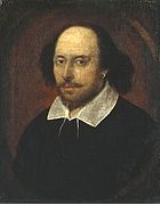
Shakespeare
Like his contemporaries
William ShakespeareWilliam Shakespeare was an English poet and playwright, widely regarded as the greatest writer in the English language and the world's pre-eminent dramatist. He is often called England's national poet and the "Bard of Avon"...
uses
thou both in the intimate, French style sense, and also to emphasize differences of rank, but he is by no means consistent in using the word, and friends and lovers sometimes call each other
ye or
you as often as they call each other
thou, sometimes in ways that can be analysed for meaning, but often apparently at random.
For example, in the following passage from
Henry IVHenry IV, Part 1 is a history play by William Shakespeare, believed to have been written no later than 1597. It is the second play in Shakespeare's tetralogy dealing with the successive reigns of Richard II, Henry IV , and Henry V...
, Shakespeare has
FalstaffSir John Falstaff is a fictional character who appears in three plays by William Shakespeare. In the two Henry IV plays, he is a companion to Prince Hal, the future King Henry V. A fat, vain, boastful, and cowardly knight, Falstaff leads the apparently wayward Prince Hal into trouble, and is...
use both forms while jesting with Prince Henry. First, Falstaff addresses "Hal" as an intimate comrade, emphasizing "you"; then he switches to a facetiously contrasted "thou" for a future majestic but still graceless King.
- PRINCE: Thou art so fat-witted with drinking of old sack, and unbuttoning thee after supper, and sleeping upon benches after noon, that thou hast forgotten to demand that truly which thou wouldest truly know. What a devil hast thou to do with the time of the day? …
- FALSTAFF: Indeed, you come near me now, Hal … And, I prithee
Prithee is an archaic English interjection formed from a corruption of the phrase pray thee, which was initially an exclamation of contempt used to indicate a subject's triviality...
, sweet wag, when thou art a king, as God save thy Grace – Majesty, I should say; for grace thou wilt have none –
More recent uses
Except where everyday use survives in some regions of England, the air of informal familiarity once suggested by the use of
thou has disappeared; it is used in solemn
ritualA ritual is a set of actions, performed mainly for their symbolic value. It may be prescribed by a religion or by the traditions of a community. The term usually excludes actions which are arbitrarily chosen by the performers....
occasions, in readings from the King James Bible, in Shakespeare and in formal literary compositions that intentionally seek to echo these older styles. Since becoming obsolete in most dialects of spoken English, it has nevertheless been used by more recent writers to address exalted beings such as
GodGod is the English name given to a singular being in theistic and deistic religions who is either the sole deity in monotheism, or a single deity in polytheism....
, a
skylarkThe Skylark is a small passerine bird species. This lark breeds across most of Europe and Asia and in the mountains of north Africa. It is mainly resident in the west of its range, but eastern populations are more migratory, moving further south in winter. Even in the milder west of its range,...
,
AchillesIn Greek mythology, Achilles was a Greek hero of the Trojan War, the central character and the greatest warrior of Homer's Iliad.Plato named Achilles the handsomest of the heroes assembled against Troy....
, and even
The Mighty ThorThor is a fictional superhero who appears in publications published by Marvel Comics. The character first appeared in Journey into Mystery #83 and was created by editor-plotter Stan Lee, scripter Larry Lieber, and penciller Jack Kirby....
. In
Star Wars: The Empire Strikes BackStar Wars Episode V: The Empire Strikes Back is a 1980 American epic space opera film directed by Irvin Kershner. The screenplay, based on a story by George Lucas, was written by Leigh Brackett and Lawrence Kasdan...
, Darth VaderDarth Vader is a central character in the Star Wars saga, appearing as one of the main antagonists in the original trilogy and as the main protagonist in the prequel trilogy....
addresses the
EmperorPalpatine is a fictional character and the main antagonist of the Star Wars saga, portrayed by Ian McDiarmid in the feature films.Palpatine first appeared as the unnamed Emperor of the Galactic Empire in the 1980 film Star Wars Episode V: The Empire Strikes Back...
with the words: "What is thy bidding, my master?" In Leonard Cohen's song "
Bird on the Wire"Bird on the Wire" is one of Leonard Cohen's signature songs. It was recorded 26 September 1968 in Nashville and included on his 1969 album Songs from a Room. A May 1968 recording produced by David Crosby, entitled "Like a Bird", was added to the 2007 remastered CD...
," he promises his beloved that he'll reform, saying "I will make it all up to thee." The
Kaiser ChiefsKaiser Chiefs are an English indie rock band from Leeds who formed in 1996. They were named after the South African football club Kaizer Chiefs....
song "I Predict a Riot" is mentioned below. In Diana Ross's song "
Upside Down"Upside Down" is a hit song by Diana Ross released on the Motown label. It was the first single taken from her 1980 album diana and hit number one on the Billboard Hot 100 on September 6, 1980. It also hit number one on the Billboard Disco/Dance and R&B charts...
" we hear the lyric "Respectfully I say to thee I'm aware that you're cheatin'." These recent uses of the pronoun suggest something far removed from intimate familiarity or condescension, while they could be seen as mirroring the mode of address used with the Deity in the Bible as discussed above; or in the case of "Upside Down," may simply allow a catchy rhyme.
Most modern writers have no experience using
thou in daily speech; they are therefore vulnerable to confusion of the traditional
verb formsIn linguistics, conjugation is the creation of derived forms of a verb from its principal parts by inflection . Conjugation may be affected by person, number, gender, tense, aspect, mood, voice, or other grammatical categories...
. The most common mistake in artificially archaic modern writing is the use of the old third person singular ending
-eth with
thou, for example
thou thinketh. The converse—the use of the second person singular ending
-est for the third person—also occurs ("So sayest Thor!"—spoken by Thor). This usage often shows up in modern
parodyA parody , in current usage, is an imitative work created to mock, comment on, or trivialise an original work, its subject, author, style, or some other target, by means of humorous, satiric or ironic imitation...
and
pasticheA pastiche is a literary or other artistic genre or technique that is a "hodge-podge" or imitation. The word is also a linguistic term used to describe an early stage in the development of a pidgin language.-Hodge-podge:...
in an attempt to make speech appear either archaic or formal. The latter is ironic as
thou was historically informal,
you being the formal form. The forms
thou and
thee are often transposed (as in
Wallace StegnerWallace Earle Stegner was an American historian, novelist, short story writer, and environmentalist, often called "The Dean of Western Writers"...
's
Angle of ReposeThe angle of repose or, more precisely, the critical angle of repose, of a granular material is the steepest angle of descent or dip of the slope relative to the horizontal plane when material on the slope face is on the verge of sliding. This angle is in the range 0°–90°.When bulk granular...
).
In the fictional teenage
argotAn Argot is a secret language used by various groups—including, but not limited to, thieves and other criminals—to prevent outsiders from understanding their conversations. The term argot is also used to refer to the informal specialized vocabulary from a particular field of study, hobby, job,...
nadsatNadsat is a fictional register or argot used by the teenagers in Anthony Burgess' novel A Clockwork Orange. In addition to being a novelist, Burgess was also a linguist and he used this background to depict his characters as speaking a form of Russian-influenced English...
, invented for
Anthony BurgessJohn Burgess Wilson – who published under the pen name Anthony Burgess – was an English author, poet, playwright, composer, linguist, translator and critic. The dystopian satire A Clockwork Orange is Burgess's most famous novel, though he dismissed it as one of his lesser works...
's novel
A Clockwork OrangeA Clockwork Orange is a 1962 dystopian novella by Anthony Burgess. The novel contains an experiment in language: the characters often use an argot called "Nadsat", derived from Russian....
(and the
film adaptationA Clockwork Orange is a 1971 film adaptation of Anthony Burgess's 1962 novel of the same name. It was written, directed and produced by Stanley Kubrick...
),
AlexAlex is a fictional character in Anthony Burgess' novel A Clockwork Orange and the film adaptation, in which he is played by Malcolm McDowell. In this film adaption, Alex's surname is DeLarge, in relation to Alex's reference to himself as "Alexander the Large" in the novel. This, in itself, is an...
and his
droogs regularly use "thou," which fits in with their semi-Edwardian clothing. For example, when fighting a rival gang, Alex addresses them thus (note the mixing of "you" and "thou" for the second person):
- Well if it isn't fat stinking billygoat Billyboy in poison! How art thou, thou globby bottle of cheap stinking chip-oil? Come and get one in the yarbles, if you have any yarbles, you eunuch jelly thou!
Some translators render the T-V distinction in English with "thou" and "you," particularly in places where
you appears in the place of expected
thou, or vice versa. This practice has largely fallen out of use.
Ernest HemingwayErnest Miller Hemingway was an American author and journalist. His economic and understated style had a strong influence on 20th-century fiction, while his life of adventure and his public image influenced later generations. Hemingway produced most of his work between the mid-1920s and the...
, in his novel
For Whom the Bell TollsFor Whom the Bell Tolls is a novel by Ernest Hemingway published in 1940. It tells the story of Robert Jordan, a young American in the International Brigades attached to a republican guerrilla unit during the Spanish Civil War. As an expert in the use of explosives, he is assigned to blow up a...
, uses the forms "thou" and "you" in order to reflect the relationships between his Spanish-speaking characters.
In reading passages with
thou and
thee, many modern readers stress the pronouns and the verb endings. Traditionally, however, the
e in
-est ought to be unstressed, and
thou and
thee should be no more stressed than
you.
Current usage
You is now the standard English second-person pronoun and encompasses both the singular and plural senses. In some dialects, however, "thou" has persisted, and in others the vacuum created by the loss of a distinction has led to the creation of new forms of the second-person plural. The forms vary across the English-speaking world and between literature and the spoken language.
Persistence of second-person singular
In traditional dialects,
thou is used in the counties of
WestmorlandWestmorland is an area of North West England and one of the 39 historic counties of England. It formed an administrative county from 1889 to 1974, after which the entirety of the county was absorbed into the new county of Cumbria.-Early history:...
,
DurhamDurham is a city in north east England. It is within the County Durham local government district, and is the county town of the larger ceremonial county...
,
LancashireLancashire is a non-metropolitan county of historic origin in the North West of England. It takes its name from the city of Lancaster, and is sometimes known as the County of Lancaster. Although Lancaster is still considered to be the county town, Lancashire County Council is based in Preston...
,
YorkshireYorkshire is a historic county of northern England and the largest in the United Kingdom. Because of its great size in comparison to other English counties, functions have been increasingly undertaken over time by its subdivisions, which have also been subject to periodic reform...
,
StaffordshireStaffordshire is a landlocked county in the West Midlands region of England. For Eurostat purposes, the county is a NUTS 3 region and is one of four counties or unitary districts that comprise the "Shropshire and Staffordshire" NUTS 2 region. Part of the National Forest lies within its borders...
,
DerbyshireDerbyshire is a county in the East Midlands of England. A substantial portion of the Peak District National Park lies within Derbyshire. The northern part of Derbyshire overlaps with the Pennines, a famous chain of hills and mountains. The county contains within its boundary of approx...
and some western parts of
NottinghamshireNottinghamshire is a county in the East Midlands of England, bordering South Yorkshire to the north-west, Lincolnshire to the east, Leicestershire to the south, and Derbyshire to the west...
. Such dialects normally also preserve distinct verb forms for the singular second person, for example
thee coost (standard English:
you could, archaic:
thou couldst) in northern Staffordshire. Throughout rural Yorkshire, the old distinction between nominative and objective is preserved. The possessive is often written as
thy in local dialect writings, but is pronounced as an unstressed
tha, and the possessive form of
tha has in modern usage almost exclusively followed other English dialects in becoming
yours or the local word
your'n (from
your one):
|
|
Nominative |
Objective |
Genitive |
Possessive |
| 2nd Person |
singular |
tha |
thee |
thy (tha) |
yours / your'n |
The apparent incongruity between the archaic nominative, objective and genitive forms of this pronoun on the one hand and the modern possessive form on the other may be a signal that the linguistic drift of Yorkshire dialect is causing
tha to fall into disuse; however, a measure of local pride in the dialect may be counteracting this.
Some other variants are specific to certain areas. In
SheffieldSheffield is a city and metropolitan borough of South Yorkshire, England. Its name derives from the River Sheaf, which runs through the city. Historically a part of the West Riding of Yorkshire, and with some of its southern suburbs annexed from Derbyshire, the city has grown from its largely...
, the pronunciation of the word was somewhere in between a /d/ and a /th/ sound, with the tongue at the bottom of the mouth; this led to the nickname of the "dee-dahs" for people from Sheffield. In Lancashire and West Yorkshire,
ta was used as an unstressed shortening of
thou, which can be found in the song "On Ilkla Moor Baht 'at." These variants are no longer in use.
The use of the word "thee" in the hit song "
I Predict a Riot"I Predict a Riot" is a song by Kaiser Chiefs, appearing on their debut album Employment. It was originally released as their second single on 1 November 2004, and was the band's first release on the B-Unique label. It entered at #22 on the UK Singles Chart, a move which started the band's rise to...
" by
LeedsLeeds is a city and metropolitan borough in West Yorkshire, England. In 2001 Leeds' main urban subdivision had a population of 443,247, while the entire city has a population of 798,800 , making it the 30th-most populous city in the European Union.Leeds is the cultural, financial and commercial...
band
Kaiser ChiefsKaiser Chiefs are an English indie rock band from Leeds who formed in 1996. They were named after the South African football club Kaizer Chiefs....
("Watching the people get lairy / is not very pretty, I tell thee") caused some comment by people who were unaware that the word is still in use in the
Yorkshire dialectThe Yorkshire dialect refers to the varieties of English used in the Northern England historic county of Yorkshire. Those varieties are often referred to as Broad Yorkshire or Tyke. The dialect has roots in older languages such as Old English and Old Norse; it should not be confused with modern slang...
.
The use persists somewhat in the
West Country dialectsThe West Country dialects and West Country accents are generic terms applied to any of several English dialects and accents used by much of the indigenous population of South West England, the area popularly known as the West Country....
, albeit somewhat affected. Some of
the WurzelsThe Wurzels are a British Scrumpy and Western band...
songs include "Drink Up Thy
ZiderCider or cyder is a fermented alcoholic beverage made from apple juice. Cider varies in alcohol content from 2% abv to 8.5% abv or more in traditional English ciders. In some regions, such as Germany and America, cider may be termed "apple wine"...
" and "Sniff Up Thy Snuff."
Thoo has also been used in the
OrcadianOrcadian dialect is a dialect of Insular Scots, itself a dialect of the Scots language. It is derived from Lowland Scots with a degree of influence from the Norn language, which is an extinct North Germanic language. Orcadian is spoken in Orkney, north of mainland Scotland.The other Insular Scots...
ScotsScots is the Germanic language variety spoken in Lowland Scotland and parts of Ulster . It is sometimes called Lowland Scots to distinguish it from Scottish Gaelic, the Celtic language variety spoken in most of the western Highlands and in the Hebrides.Since there are no universally accepted...
dialect in place of the singular informal
thou. In
ShetlandicShetlandic, usually referred to as Shetland by native speakers, is spoken in the Shetland Islands north of mainland Scotland and is, like Orcadian, a dialect of Insular Scots...
, the other form of
Insular ScotsInsular Scots comprises varieties of Lowland Scots generally subdivided into:*Shetlandic*OrcadianBoth dialects share much Norn vocabulary, Shetlandic more so, than does any other Scots dialect, perhaps because they both were under strong Scandinavian influence in their recent past.It should not be...
,
du is used.
Further reading
- Brown, Roger and Gilman, Albert. Pronouns of Power and Solidarity, 1960, reprinted in: Sociolinguistics: the Essential Readings, Wiley-Blackwell, 2003, ISBN 0631227172, 780631227175
- Byrne, St. Geraldine. Shakespeare's use of the pronoun of address: its significance in characterization and motivation, Catholic University of America, 1936 (reprinted Haskell House, 1970)
- Quirk, Raymond. Shakespeare and the English Language, in Kenneth Muir and Sam Schoenbaum, eds, A New Companion to Shakespeare Studies*, 1971, Cambridge UP
- Wales, Katie. Personal Pronouns in Present-Day English. ISBN 0-521-47102-8
- Walker, Terry. Thou and you in early modern English dialogues: trials, depositions, and drama comedy, John Benjamins Publishing Company, 2007, ISBN 902725401X, 9789027254016
External links