

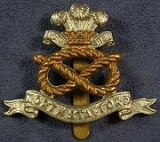
North Staffordshire Regiment

Encyclopedia
The North Staffordshire Regiment (Prince of Wales's) was an infantry
regiment of the British Army
, which was in existence between 1881 and 1959. It can date its lineage back to 1756 with the formation of a second battalion by the 11th Regiment of Foot, which shortly after became the 64th (2nd Staffordshire) Regiment of Foot
. In 1881, the 64th Foot was merged with the 98th (Prince of Wales's) Regiment of Foot
(originally raised in 1824) to form the new regiment.
Formed at a time when the British Empire
was reaching its peak, the Regiment served all over the Empire, in times of both peace and war, and in many theatres of war outside the Empire. It fought in World War I
and World War II
, as well as in other smaller conflicts around the world. These other wars included the Second Sudanese War, the Second Boer War
, the Anglo-Irish War
and the Third Anglo-Afghan War
.
In 1959, as part of a defence review, the regiment was amalgamated with the South Staffordshire Regiment
to form the Staffordshire Regiment (Prince of Wales's). Today the traditions of the Regiment are continued by the 3rd Battalion, the Mercian Regiment
.
on 1 July 1881, by the amalgamation of the 64th (2nd Staffordshire) Regiment of Foot
and 98th (Prince of Wales's) Regiment of Foot
. These two regular regiments became, respectively, the 1st and 2nd Battalions of the new regiment. The militia
and Rifle Volunteers
forces of North Staffordshire were also incorporated into this new regiment, and a permanent depot
was established at Whittington Barracks, Lichfield
, which also housed the newly formed South Staffordshire Regiment
.
The 64th Foot was originally raised in 1756 as the 2nd Battalion of the 11th (Devonshire) Foot, and was renumbered the 64th in 1758. It had a long history of overseas service with much less time spent in Europe. It had served in the West Indies during the Seven Years War, America during the American War of Independence, South America, the West Indies and Canada during the Napoleonic Wars
. Subsequent long periods were spent in Ireland and the West Indies before action was seen in India during the Indian Mutiny. At the time of the forming of the amalgamation with the 98th Foot, the 64th was based in Ireland.
The 98th Foot, raised in 1824 in Chichester
, had a much shorter history, but like the 64th had spent the majority of its time overseas spending a long time in South Africa before seeing action in China in the First Anglo-Chinese (or Opium) War
and India on the North West Frontier
. It was based in Afghanistan when the amalgamation occurred.
The battalions that formed as part of the regiment in 1881 were as follows:
The reserve battalions of the regiment were reorganised in 1908 by the Territorial and Reserve Forces Act 1907
, with the two militia battalions being redesignated the 3rd and 4th "Special Reserve" Battalions, and the volunteer battalions being redesignated as Territorial Force
and renumbered as the 5th and 6th Battalions (TF).
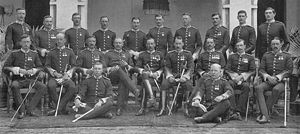 The 1st Battalion was in Ireland
at the time of the amalgamation. It moved to England in 1883, and the following year to the West Indies, based mainly in Barbados
, but with detachments on other islands. It moved to Natal
in 1887, to Mauritius
in 1890, to Malta
in 1893 and to Egypt
in 1895. From there the 1st Battalion took part in operations in the Second Sudanese War under Lord Kitchener
. During the campaign, the 1st battalion were based initially at Wadi Halfa
but moved to Gemai to avoid a cholera
outbreak. In September the battalion took part in the action against the Dervish
Army at Hafir, which was decisive in ending the campaign. As a result, the North Staffordshire Regiment received the unique “Hafir" battle honour
, given to no other British regiment.
in 1881 when the North Staffordshire Regiment was formed, and remained there until 1886. During this time period, it took part in an expedition to the Zhob
Valley in 1884, thus making it the first battalion in the regiment to see active service. In 1886, it returned to England via Aden
, and then deployed to Ireland in 1893. In 1899, 2nd Battalion mobilised and moved to South Africa
, where it took part in the Second Boer War
. Forming part of 15th Brigade in the 7th Division, the majority of the battalion saw little action throughout the conflict, being mostly occupied in garrison duties in Johannesburg
in 1900. In 1901, the battalion was part of a mobile column under Brigadier-General Dartnell in the Eastern Transvaal
which carried out a scorched earth
campaign, and it also took part in the subsequent blockhouse occupation of the Transvaal.
More action was seen by the mounted infantry
company
of the regiment that had been formed on arrival in South Africa. In January 1900 Lord Roberts
, commander of the British forces in South Africa, ordered that every infantry battalion in South Africa was to raise a company of mounted infantry. These companies were to be detached from their parent units and operate as part of eight independent mounted infantry battalions. The North Staffs company thus formed became part of the 8th Battalion, Mounted Infantry. This unit was involved in the pursuit of Koos de la Rey
and was present when he was captured at Wildfontein. The militia and volunteer battalions also saw service in the Second Boer War. The 4th Battalion was deployed in the Cape Colony and later the Bechuanaland Protectorate before being replaced by the 3rd Battalion. Additionally, the two volunteer companies which formed from the 1st and 2nd Volunteer Battalions served alongside the 2nd Battalion at various times. As a result of these contributions and those of the two regular battalions, the regiment was awarded the "South Africa 1900–1902" battle honour.
At the war's end in 1902, the battalion returned briefly to England. In the following year, it returned to India, remaining there until 1919.
, and over the course of the conflict, was expanded to 18 battalions, some by duplication of the Territorial Force battalions and others, labelled "service" battalions raised as part of Field Marshal Kitchener's New Army
. These battalions saw service in a number of theatres including on the Western Front
, at Gallipoli, in the Middle East
, and India. The following list details the involvement of these battalions:
The numbering of the Territorial Force battalions was laid down by War Office instructions issued in 1914 and 1915. On joining the Territorial Force men were asked if the would serve overseas (foreign service) or just volunteered for service in the United Kingdom (home service) and their service records amended accordingly. At the declaration of war all Territorial battalions were mobilised and on 15 August 1914 the War Office issued instructions for those men who had volunteered for foreign service to be separated out into what were called first line battalions. Home service men were placed in second line battalions. Thus there would now be a first line 5th Battalion and a second line 5th Battalion. On 24 November 1914, as the first line battalions began to go overseas, additional instructions were issued allowing the raising of a third line battalion once the first line battalion was on foreign service. In January 1915 these designations were simplified and the battalions called the 1/5th, 2/5th and 3/5th battalions respectively.
The battalions that served in France took part in many of the major actions of the war including the Battle of Neuve Chapelle
, the Battle of Loos
, the Battle of the Somme, the Third Battle of Ypres and the Battle of Amiens.
being based in the Armentieres sector on the southern flank of the battle. In October 1915 17th Brigade was exchanged with 71st Brigade of 24th Division. Immediately on joining 24th Division, the battalion was moved to 72nd Brigade within the division. It was to remain as part of this formation until the end of the war.
The 24th division took part in the Battle of the Somme in the fighting around Guillemont
and later Delville Wood
suffering over 240 casualties during the fighting.
During the Third Battle of Ypres, the 1st Battalion took part in the initial assault on 31 July 1917. Its objectives were to capture the German frontline trench called Jehovah trench, the second line trench called Jordan trench and the remains of Bulgar Wood. These three objectives were 1000 yards, 1500 yards and 1750 yards from the British front line. The battalion managed to capture both the trenches and a platoon reached Bulgar Wood before events around them forced a retreat from Bulgar Wood and Jordan trench. The battalion dug in on the Jehovah trench line having lost 11 officers and 258 other ranks as casualties, almost 50% of the battalion strength. After the war, the anniversary of this attack became the main Regimental Day.
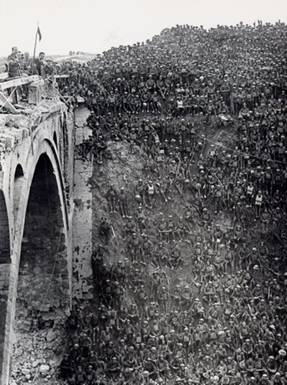 The 2nd Battalion was one of only eight Regular battalions of the British Army to remain in India throughout the war. It took part in operations on the North West Frontier in 1915. Amusingly, the commanding officer
at this time was Major
Fox and the adjutant
Captain
Squirell. Although it was a Regular Army battalion, it received very few replacements during the war. From a pre-war establishment strength of a HQ plus eight companies, after the 1915 North West Frontier campaign the battalion comprised only a HQ company and four rifle companies. This cannot be attributed to war casualties as the battalion suffered less than 100 casualties throughout the entire war.
The 1/5th and 1/6th Battalions arrived in France in February 1915 as part of 137th (Staffordshire) Brigade of 46th (North Midland) Division. Among the first territorial units to go to France, these two battalions took part in the Battle of Loos
, especially the battles around the Hohenzollern Redoubt
in 1915, and at Gommecourt on the northern flank of the Battle of the Somme.
By September 1918 the 1/5th Battalion had been reduced to a cadre and had been transferred away from 46th Division, but the 1/6th remained and with the rest of 137th Brigade took part in the storming of the St Quentin Canal.
The 12th Battalion formed part of 40th Division and served in France on the River Lys during the advance in Flanders (18 August to 6 September 1918) and the Fifth Battle of Ypres
, and in France and Belgium during the final weeks of the war.
es were awarded to men of the regiment during World War I:
after the armistice, becoming involved in the Irish War of Independence
until 1922, when it moved to Gibraltar
. In the following year it was moved to Thrace
, where it played a peace-keeping role in the conflict between Greek and Turkish forces. In 1923 it moved to India and remained in the Far East until 1948.
The 2nd Battalion was stationed in India in 1919 when Afghan forces crossed the border and occupied some Indian territory, sparking the brief Third Anglo-Afghan War
. During this conflict, the battalion was involved very early on, firstly in the investing of Peshawar City
, where Afghan sympathisers were mooting a holy war and on 11 May 1919 when they were involved in a bayonet charge on the Afghan forces at Bagh, near Landi Kotal. For their involvement, the regiment received the battle honour "Afghanistan NWF 1919". It returned to England via Egypt and the Sudan in 1921, and was quickly redeployed to Ireland. On the establishment of the Irish Free State
in 1922, it returned to the regimental depot at Lichfield
. Until 1939, it spent time in "home stations". Apart from England, this included service in Gibraltar
from 1930 to 1932 and a year in Palestine
in 1936–7.
The 3rd and 4th (Special Reserve) Battalions were placed in suspended animation in 1921, finally being disbanded in 1953. The Territorial Force was reconstituted as the Territorial Army in 1920, and the 5th and 6th Battalions were reformed. In 1936, the 5th Battalion was converted to an anti-aircraft unit of the Royal Engineers
as 41st (North Staffordshire Regiment) Anti-Aircraft Battalion and thus ceased to be a part of the regiment. However the affiliation with the regiment was retained and the battalion number was reinstated when the 41st Anti-Aircraft Battalion was transferred to the Royal Artillery in 1940 as the 41st (5th North Staffordshire) Searchlight Regiment TA. In 1939 the size of the Territorial Army was doubled, and the remaining 6th Battalion formed a duplicate 7th Battalion.
In 1921, the regimental title was altered to The North Staffordshire Regiment (The Prince of Wales's). In 1937, the black facings formerly worn by the 64th Foot were restored, replacing the white colour that had been imposed on all non-royal English regiments in 1881.
The London, Midland and Scottish Railway
renamed one of their Royal Scot class locomotives, number 6141 (formerly Caledonian), after the regiment.
, the regiment was expanded as it had been during the First World War. This expansion, however, was limited this time only to the addition of two more battalions — the 8th and 9th Battalions, raised in 1940. The roles of the two regular battalions were reversed this time, with the 1st Battalion serving in India and Burma throughout the war, while the 2nd Battalion remained in Europe and North Africa.
The 1st Battalion saw no action until 1942, when one company that was stationed on the Andaman Islands
were involved in the defence of the islands during the Japanese invasion
. In 1943, the battalion served for six months in Burma
before being withdrawn to India again. For the rest of the war, the battalion was employed on internal security duties.
The 2nd Battalion went to France in September 1939 as part of 1st Division of the British Expeditionary Force
, and was involved in the Battle of France
before eventually being evacuated from Dunkirk on 1 June 1940. Following that, it remained in the United Kingdom until 1943 when, still as part of 1st Division, it sailed to North Africa and took part in the Tunisian Campaign
. The battalion did not participate in the invasion of Sicily
or the initial invasion of Italy
but was one of the lead units for the Anzio landings
. As part of 15th Army, the 2nd Battalion continued to serve in Italy until January 1945 when the battalion and the rest of 1st Division were transferred to Palestine.
The two Territorial battalions both formed part of 176th Brigade of 59th (Staffordshire) Division. The division spent several years training until it landed in Normandy in June 1944
. Only the 6th Battalion landed in France as the 7th Battalion had been transferred in 1942. The 6th Battalion had been in France for less than two months when, in August 1944, along with all the other infantry units of 59th Division, it was broken up to supply replacements to other units. The 7th Battalion, upon leaving 59th Division, served with the 228th
and 207th Infantry Brigades in the Orkney and Shetland islands in 1943–1945, before being transferred to Italy in 1945 as an administrative unit in the 183rd Infantry brigade within the 61st (South Midland) Infantry Division. The battalion was disbanded in 1947. The 8th and 9th Battalions were initially raised as training battalions. The 8th Battalion was converted to artillery in March 1942 becoming the 180th Field Artillery Regiment, RA
. This unit was disbanded in August 1944. The 9th Battalion transferred to the Royal Armoured Corps
(RAC) in December 1941 becoming 154th Regiment RAC. This unit was disbanded in July 1943.
The regiment was awarded 22 battle honours for the war but, as at the end of the First World War, only 10 could be displayed on the colours.
. In 1953, the battalion was transferred to Korea
, where they were stationed on garrison duties as part of the United Nations
force established at the end of the Korean War
. In 1954, it moved to Hong Kong
, where the regiment's 200th anniversary was celebrated in 1956.
was announced, which resulted in the amalgamation of the North Staffordshire Regiment with The South Staffordshire Regiment, with the new regiment becoming part of the new administrative Mercian Brigade
. The amalgamation of the 1st Battalions of the two regiments took place on 31 January 1959 at Minden, Germany, to form the 1st Battalion, The Staffordshire Regiment (The Prince of Wales's).
The 6th Battalion continued as a Territorial unit of the new regiment without a change of title. In 1961, it merged with the 441st Light Anti Aircraft Regiment, Royal Artillery
, the successor to the 5th North Staffords, to become the 5th/6th Battalion. The combined battalion was abolished in 1967 on the creation of the Territorial Army and Volunteer Reserve in 1967.
The Staffordshire Regiment only had a separate existence from 1959–2007. As part of the reforms proposed in the 2003 Defence White Paper, Delivering Security in a Changing World
, the regiment was merged with the Cheshire Regiment
and the Worcestershire and Sherwood Foresters Regiment
to form the Mercian Regiment
. The amalgamation took place on 1 September 2007 when the Staffordshire Regiment became the 3rd Battalion, the Mercian Regiment.
Prior to 1914 all battle honours awarded to a unit were displayed upon the colours. However the number of battle honours awarded during the First World War was such that it was ordered that no more than 24 honours were to be carried on the colours, of which no more than 10 were to be honours relating to the First World War. Similarly, following the Second World War it was ordered that up to 10 honours relating to that conflict could be displayed on the colours, in addition to honours already carried. The choice of the honours to be displayed were at the discretion of regimental committees.
The honours chosen by the North Staffordshire Regiment to be carried on the colours are shown in capitals in the following list.
Infantry
Infantrymen are soldiers who are specifically trained for the role of fighting on foot to engage the enemy face to face and have historically borne the brunt of the casualties of combat in wars. As the oldest branch of combat arms, they are the backbone of armies...
regiment of the British Army
British Army
The British Army is the land warfare branch of Her Majesty's Armed Forces in the United Kingdom. It came into being with the unification of the Kingdom of England and Scotland into the Kingdom of Great Britain in 1707. The new British Army incorporated Regiments that had already existed in England...
, which was in existence between 1881 and 1959. It can date its lineage back to 1756 with the formation of a second battalion by the 11th Regiment of Foot, which shortly after became the 64th (2nd Staffordshire) Regiment of Foot
64th (2nd Staffordshire) Regiment of Foot
The 64th Regiment of Foot was an infantry regiment of the British Army. The regiment was created as the 2nd Battalion, 11th Regiment of Foot in 1756, redesignated as the 64th Regiment of Foot in 1758, and took a county title as the 64th Regiment of Foot in 1782...
. In 1881, the 64th Foot was merged with the 98th (Prince of Wales's) Regiment of Foot
98th (Prince of Wales's) Regiment of Foot
- External links :*...
(originally raised in 1824) to form the new regiment.
Formed at a time when the British Empire
British Empire
The British Empire comprised the dominions, colonies, protectorates, mandates and other territories ruled or administered by the United Kingdom. It originated with the overseas colonies and trading posts established by England in the late 16th and early 17th centuries. At its height, it was the...
was reaching its peak, the Regiment served all over the Empire, in times of both peace and war, and in many theatres of war outside the Empire. It fought in World War I
World War I
World War I , which was predominantly called the World War or the Great War from its occurrence until 1939, and the First World War or World War I thereafter, was a major war centred in Europe that began on 28 July 1914 and lasted until 11 November 1918...
and World War II
World War II
World War II, or the Second World War , was a global conflict lasting from 1939 to 1945, involving most of the world's nations—including all of the great powers—eventually forming two opposing military alliances: the Allies and the Axis...
, as well as in other smaller conflicts around the world. These other wars included the Second Sudanese War, the Second Boer War
Second Boer War
The Second Boer War was fought from 11 October 1899 until 31 May 1902 between the British Empire and the Afrikaans-speaking Dutch settlers of two independent Boer republics, the South African Republic and the Orange Free State...
, the Anglo-Irish War
Irish War of Independence
The Irish War of Independence , Anglo-Irish War, Black and Tan War, or Tan War was a guerrilla war mounted by the Irish Republican Army against the British government and its forces in Ireland. It began in January 1919, following the Irish Republic's declaration of independence. Both sides agreed...
and the Third Anglo-Afghan War
Third Anglo-Afghan War
The Third Anglo-Afghan War began on 6 May 1919 and ended with an armistice on 8 August 1919. It was a minor tactical victory for the British. For the British, the Durand Line was reaffirmed as the political boundary between the Emirate of Afghanistan and British India and the Afghans agreed not to...
.
In 1959, as part of a defence review, the regiment was amalgamated with the South Staffordshire Regiment
South Staffordshire Regiment
The South Staffordshire Regiment was an infantry regiment of the British Army formed in 1881 by the amalgamation of the 38th Regiment of Foot and the 80th Regiment of Foot. In 1959 the regiment was amlagamated with the North Staffordshire Regiment to form the Staffordshire Regiment...
to form the Staffordshire Regiment (Prince of Wales's). Today the traditions of the Regiment are continued by the 3rd Battalion, the Mercian Regiment
Mercian Regiment
The Mercian Regiment is an infantry regiment of the British Army, formed by the amalgamation of three existing regiments on 1 September 2007.The regiment has three regular army battalion's and one Territorial Army or reserve battalion...
.
Formation history
The Prince of Wales's (North Staffordshire) Regiment was formed under the Childers ReformsChilders Reforms
The Childers Reforms restructured the infantry regiments of the British army. The reforms were undertaken by Secretary of State for War Hugh Childers in 1881, and were a continuation of the earlier Cardwell reforms....
on 1 July 1881, by the amalgamation of the 64th (2nd Staffordshire) Regiment of Foot
64th (2nd Staffordshire) Regiment of Foot
The 64th Regiment of Foot was an infantry regiment of the British Army. The regiment was created as the 2nd Battalion, 11th Regiment of Foot in 1756, redesignated as the 64th Regiment of Foot in 1758, and took a county title as the 64th Regiment of Foot in 1782...
and 98th (Prince of Wales's) Regiment of Foot
98th (Prince of Wales's) Regiment of Foot
- External links :*...
. These two regular regiments became, respectively, the 1st and 2nd Battalions of the new regiment. The militia
Militia
The term militia is commonly used today to refer to a military force composed of ordinary citizens to provide defense, emergency law enforcement, or paramilitary service, in times of emergency without being paid a regular salary or committed to a fixed term of service. It is a polyseme with...
and Rifle Volunteers
Volunteer Force (Great Britain)
The Volunteer Force was a citizen army of part-time rifle, artillery and engineer corps, created as a popular movement in 1859. Originally highly autonomous, the units of volunteers became increasingly integrated with the British Army after the Childers Reforms in 1881, before forming part of the...
forces of North Staffordshire were also incorporated into this new regiment, and a permanent depot
Regimental depot
The regimental depot of a regiment is the regimental headquarters and normally also the place where recruits are assembled and trained. It is also where soldiers and officers awaiting discharge or postings are based, and where injured soldiers return to full fitness after discharge from hospital...
was established at Whittington Barracks, Lichfield
Lichfield
Lichfield is a cathedral city, civil parish and district in Staffordshire, England. One of eight civil parishes with city status in England, Lichfield is situated roughly north of Birmingham...
, which also housed the newly formed South Staffordshire Regiment
South Staffordshire Regiment
The South Staffordshire Regiment was an infantry regiment of the British Army formed in 1881 by the amalgamation of the 38th Regiment of Foot and the 80th Regiment of Foot. In 1959 the regiment was amlagamated with the North Staffordshire Regiment to form the Staffordshire Regiment...
.
The 64th Foot was originally raised in 1756 as the 2nd Battalion of the 11th (Devonshire) Foot, and was renumbered the 64th in 1758. It had a long history of overseas service with much less time spent in Europe. It had served in the West Indies during the Seven Years War, America during the American War of Independence, South America, the West Indies and Canada during the Napoleonic Wars
Napoleonic Wars
The Napoleonic Wars were a series of wars declared against Napoleon's French Empire by opposing coalitions that ran from 1803 to 1815. As a continuation of the wars sparked by the French Revolution of 1789, they revolutionised European armies and played out on an unprecedented scale, mainly due to...
. Subsequent long periods were spent in Ireland and the West Indies before action was seen in India during the Indian Mutiny. At the time of the forming of the amalgamation with the 98th Foot, the 64th was based in Ireland.
The 98th Foot, raised in 1824 in Chichester
Chichester
Chichester is a cathedral city in West Sussex, within the historic County of Sussex, South-East England. It has a long history as a settlement; its Roman past and its subsequent importance in Anglo-Saxon times are only its beginnings...
, had a much shorter history, but like the 64th had spent the majority of its time overseas spending a long time in South Africa before seeing action in China in the First Anglo-Chinese (or Opium) War
First Opium War
The First Anglo-Chinese War , known popularly as the First Opium War or simply the Opium War, was fought between the United Kingdom and the Qing Dynasty of China over their conflicting viewpoints on diplomatic relations, trade, and the administration of justice...
and India on the North West Frontier
North-West Frontier (military history)
The North-West Frontier was the most difficult area, from a military point of view, of the former British India in the Indian sub-continent. It remains the frontier of present-day Pakistan, extending from the Pamir Knot in the north to the Koh-i-Malik Siah in the west, and separating the...
. It was based in Afghanistan when the amalgamation occurred.
The battalions that formed as part of the regiment in 1881 were as follows:
- 1st Battalion: the 64th (2nd Staffordshire) Regiment of Foot;
- 2nd Battalion: the 98th (Prince of Wales's) Regiment of Foot;
- 3rd (Militia) Battalion: The King's Own (2nd Staffordshire) Light Infantry Militia, based in StaffordStaffordStafford is the county town of Staffordshire, in the West Midlands region of England. It lies approximately north of Wolverhampton and south of Stoke-on-Trent, adjacent to the M6 motorway Junction 13 to Junction 14...
; - 4th (Militia) Battalion: The King's Own (3rd Staffordshire) Rifles Militia, based in Newcastle-under-LymeNewcastle-under-LymeNewcastle-under-Lyme is a market town in Staffordshire, England, and is the principal town of the Borough of Newcastle-under-Lyme. It is part of The Potteries Urban Area and North Staffordshire. In the 2001 census the town had a population of 73,944...
; - 1st Volunteer Battalion: 2nd Staffordshire (Staffordshire Rangers) Rifle Volunteer Corps, based in Stoke-on-TrentStoke-on-TrentStoke-on-Trent , also called The Potteries is a city in Staffordshire, England, which forms a linear conurbation almost 12 miles long, with an area of . Together with the Borough of Newcastle-under-Lyme Stoke forms The Potteries Urban Area...
; - 2nd Volunteer Battalion: 5th Staffordshire Rifle Volunteer Corps, based in Lichfield but later moved to Burton-on-Trent.
The reserve battalions of the regiment were reorganised in 1908 by the Territorial and Reserve Forces Act 1907
Territorial and Reserve Forces Act 1907
The Territorial and Reserve Forces Act 1907 was an Act of the Parliament of the United Kingdom that reformed the auxiliary forces of the British Army by transferring existing Volunteer and Yeomanry units into a new Territorial Force ; and disbanding the Militia to form a new Special Reserve of the...
, with the two militia battalions being redesignated the 3rd and 4th "Special Reserve" Battalions, and the volunteer battalions being redesignated as Territorial Force
Territorial Force
The Territorial Force was the volunteer reserve component of the British Army from 1908 to 1920, when it became the Territorial Army.-Origins:...
and renumbered as the 5th and 6th Battalions (TF).
Garrison duties and the Mahdist War
Ireland
Ireland is an island to the northwest of continental Europe. It is the third-largest island in Europe and the twentieth-largest island on Earth...
at the time of the amalgamation. It moved to England in 1883, and the following year to the West Indies, based mainly in Barbados
Barbados
Barbados is an island country in the Lesser Antilles. It is in length and as much as in width, amounting to . It is situated in the western area of the North Atlantic and 100 kilometres east of the Windward Islands and the Caribbean Sea; therein, it is about east of the islands of Saint...
, but with detachments on other islands. It moved to Natal
Colony of Natal
The Colony of Natal was a British colony in south-eastern Africa. It was proclaimed a British colony on May 4, 1843 after the British government had annexed the Boer Republic of Natalia, and on 31 May 1910 combined with three other colonies to form the Union of South Africa, as one of its...
in 1887, to Mauritius
Mauritius
Mauritius , officially the Republic of Mauritius is an island nation off the southeast coast of the African continent in the southwest Indian Ocean, about east of Madagascar...
in 1890, to Malta
Malta
Malta , officially known as the Republic of Malta , is a Southern European country consisting of an archipelago situated in the centre of the Mediterranean, south of Sicily, east of Tunisia and north of Libya, with Gibraltar to the west and Alexandria to the east.Malta covers just over in...
in 1893 and to Egypt
Egypt
Egypt , officially the Arab Republic of Egypt, Arabic: , is a country mainly in North Africa, with the Sinai Peninsula forming a land bridge in Southwest Asia. Egypt is thus a transcontinental country, and a major power in Africa, the Mediterranean Basin, the Middle East and the Muslim world...
in 1895. From there the 1st Battalion took part in operations in the Second Sudanese War under Lord Kitchener
Herbert Kitchener, 1st Earl Kitchener
Field Marshal Horatio Herbert Kitchener, 1st Earl Kitchener KG, KP, GCB, OM, GCSI, GCMG, GCIE, ADC, PC , was an Irish-born British Field Marshal and proconsul who won fame for his imperial campaigns and later played a central role in the early part of the First World War, although he died halfway...
. During the campaign, the 1st battalion were based initially at Wadi Halfa
Wadi Halfa
Wadi Halfa is a city in the state of Northern, in northern Sudan, on the shores of Lake Nubia . It is the terminus of a rail line from Khartoum and the point where goods are transferred from rail to ferries going down the Lake Nasser...
but moved to Gemai to avoid a cholera
Cholera
Cholera is an infection of the small intestine that is caused by the bacterium Vibrio cholerae. The main symptoms are profuse watery diarrhea and vomiting. Transmission occurs primarily by drinking or eating water or food that has been contaminated by the diarrhea of an infected person or the feces...
outbreak. In September the battalion took part in the action against the Dervish
Dervish
A Dervish or Darvesh is someone treading a Sufi Muslim ascetic path or "Tariqah", known for their extreme poverty and austerity, similar to mendicant friars in Christianity or Hindu/Buddhist/Jain sadhus.-Etymology:The Persian word darvīsh is of ancient origin and descends from a Proto-Iranian...
Army at Hafir, which was decisive in ending the campaign. As a result, the North Staffordshire Regiment received the unique “Hafir" battle honour
Battle honour
A battle honour is an award of a right by a government or sovereign to a military unit to emblazon the name of a battle or operation on its flags , uniforms or other accessories where ornamentation is possible....
, given to no other British regiment.
Second Boer War
The 2nd Battalion was stationed in IndiaIndia
India , officially the Republic of India , is a country in South Asia. It is the seventh-largest country by geographical area, the second-most populous country with over 1.2 billion people, and the most populous democracy in the world...
in 1881 when the North Staffordshire Regiment was formed, and remained there until 1886. During this time period, it took part in an expedition to the Zhob
Zhob
-Roads:Zhob is 333 kilometers from Quetta, 225 kilometers from Dera Ismail Khan. However, the road linking with Dera Ismail Khan is for most part fair nowadays track passing through water streams and almost complete road is metalloid....
Valley in 1884, thus making it the first battalion in the regiment to see active service. In 1886, it returned to England via Aden
Aden
Aden is a seaport city in Yemen, located by the eastern approach to the Red Sea , some 170 kilometres east of Bab-el-Mandeb. Its population is approximately 800,000. Aden's ancient, natural harbour lies in the crater of an extinct volcano which now forms a peninsula, joined to the mainland by a...
, and then deployed to Ireland in 1893. In 1899, 2nd Battalion mobilised and moved to South Africa
South Africa
The Republic of South Africa is a country in southern Africa. Located at the southern tip of Africa, it is divided into nine provinces, with of coastline on the Atlantic and Indian oceans...
, where it took part in the Second Boer War
Second Boer War
The Second Boer War was fought from 11 October 1899 until 31 May 1902 between the British Empire and the Afrikaans-speaking Dutch settlers of two independent Boer republics, the South African Republic and the Orange Free State...
. Forming part of 15th Brigade in the 7th Division, the majority of the battalion saw little action throughout the conflict, being mostly occupied in garrison duties in Johannesburg
Johannesburg
Johannesburg also known as Jozi, Jo'burg or Egoli, is the largest city in South Africa, by population. Johannesburg is the provincial capital of Gauteng, the wealthiest province in South Africa, having the largest economy of any metropolitan region in Sub-Saharan Africa...
in 1900. In 1901, the battalion was part of a mobile column under Brigadier-General Dartnell in the Eastern Transvaal
South African Republic
The South African Republic , often informally known as the Transvaal Republic, was an independent Boer-ruled country in Southern Africa during the second half of the 19th century. Not to be confused with the present-day Republic of South Africa, it occupied the area later known as the South African...
which carried out a scorched earth
Scorched earth
A scorched earth policy is a military strategy or operational method which involves destroying anything that might be useful to the enemy while advancing through or withdrawing from an area...
campaign, and it also took part in the subsequent blockhouse occupation of the Transvaal.
More action was seen by the mounted infantry
Mounted infantry
Mounted infantry were soldiers who rode horses instead of marching, but actually fought on foot . The original dragoons were essentially mounted infantry...
company
Company
A company is a form of business organization. It is an association or collection of individual real persons and/or other companies, who each provide some form of capital. This group has a common purpose or focus and an aim of gaining profits. This collection, group or association of persons can be...
of the regiment that had been formed on arrival in South Africa. In January 1900 Lord Roberts
Frederick Roberts, 1st Earl Roberts
Field Marshal Frederick Sleigh Roberts, 1st Earl Roberts, Bt, VC, KG, KP, GCB, OM, GCSI, GCIE, KStJ, PC was a distinguished Indian born British soldier who regarded himself as Anglo-Irish and one of the most successful British commanders of the 19th century.-Early life:Born at Cawnpore, India, on...
, commander of the British forces in South Africa, ordered that every infantry battalion in South Africa was to raise a company of mounted infantry. These companies were to be detached from their parent units and operate as part of eight independent mounted infantry battalions. The North Staffs company thus formed became part of the 8th Battalion, Mounted Infantry. This unit was involved in the pursuit of Koos de la Rey
Koos de la Rey
General Jacobus Herculaas de la Rey , known as Koos de la Rey, was a Boer general during the Second Boer War and is widely regarded as being one of the strongest military leaders during that conflict....
and was present when he was captured at Wildfontein. The militia and volunteer battalions also saw service in the Second Boer War. The 4th Battalion was deployed in the Cape Colony and later the Bechuanaland Protectorate before being replaced by the 3rd Battalion. Additionally, the two volunteer companies which formed from the 1st and 2nd Volunteer Battalions served alongside the 2nd Battalion at various times. As a result of these contributions and those of the two regular battalions, the regiment was awarded the "South Africa 1900–1902" battle honour.
At the war's end in 1902, the battalion returned briefly to England. In the following year, it returned to India, remaining there until 1919.
Meeting in India
The 1st Battalion was subsequently stationed in India from 1897 until 1903. Here, the 1st and 2nd Battalions met for the first time, and no fewer than 590 men from the 1st Battalion were transferred to the 2nd Battalion. Thus 1st Battalion was reduced to a small cadre, which served for nine years upon its return to Lichfield and other stations in England, before moving to Ireland in 1912.First World War (1914–1918)
The North Staffordshire Regiment was heavily committed to the fighting during the First World WarWorld War I
World War I , which was predominantly called the World War or the Great War from its occurrence until 1939, and the First World War or World War I thereafter, was a major war centred in Europe that began on 28 July 1914 and lasted until 11 November 1918...
, and over the course of the conflict, was expanded to 18 battalions, some by duplication of the Territorial Force battalions and others, labelled "service" battalions raised as part of Field Marshal Kitchener's New Army
Kitchener's Army
The New Army, often referred to as Kitchener's Army or, disparagingly, Kitchener's Mob, was an all-volunteer army formed in the United Kingdom following the outbreak of hostilities in the First World War...
. These battalions saw service in a number of theatres including on the Western Front
Western Front (World War I)
Following the outbreak of World War I in 1914, the German Army opened the Western Front by first invading Luxembourg and Belgium, then gaining military control of important industrial regions in France. The tide of the advance was dramatically turned with the Battle of the Marne...
, at Gallipoli, in the Middle East
Middle Eastern theatre of World War I
The Middle Eastern theatre of World War I was the scene of action between 29 October 1914, and 30 October 1918. The combatants were the Ottoman Empire, with some assistance from the other Central Powers, and primarily the British and the Russians among the Allies of World War I...
, and India. The following list details the involvement of these battalions:
- 1st Battalion – served in France from September 1914 until November 1918;
- 2nd Battalion – served in India throughout the war;
- 3rd (Reserve) Battalion – operated as a training battalion in the United Kingdom throughout the war;
- 4th (Extra Reserve) Battalion – garrison battalion in Guernsey 1914–1916. Returned to United Kingdom in 1916. Served in France 1917–1918;
- 1/5th Battalion Territorial Force (TF) – mobilised in 1914, and served in France from 1915 to 1918;
- 1/6th Battalion TF – mobilised in 1914, served in France from 1915 to 1918;
- 2/5th Battalion TF – formed in 1914, moved to Ireland in 1916 where it was involved in the Easter RisingEaster RisingThe Easter Rising was an insurrection staged in Ireland during Easter Week, 1916. The Rising was mounted by Irish republicans with the aims of ending British rule in Ireland and establishing the Irish Republic at a time when the British Empire was heavily engaged in the First World War...
, served in France 1917–1918. Merged with 1/5th Battalion in February 1918; - 2/6th Battalion TF – formed in 1914, moved to Ireland in 1916 where it was involved in the Easter Rising, served in France 1917–1918. Merged with 1/6th Battalion in July 1918;
- 3/5th Battalion TF – formed in 1915. Renamed 5th (Reserve) Battalion in April 1916. Served as a training battalion in England 1915–1918;
- 3/6th Battalion TF – formed in 1915. Renamed 6th (Reserve) Battalion in April 1916. Merged with 5th (Reserve) Battalion in September 1916;
- 7th (Service) Battalion – formed in 1914. Took part in Gallipoli Campaign July 1915 – January 1916. Evacuated to Egypt. Served in Mesopotamia from February 1916. From July 1918 were part of North Persia Force (Dunsterforce) and ended the war in Baku, Armenia.
- 8th (Service) Battalion – formed in 1914. Served in France 1915–1918;
- 9th (Service) Battalion (Pioneers) – formed as a service battalion in 1914. Became a pioneer battalion in 1915. Served in France 1915–1918;
- 10th (Reserve) Battalion – formed as a service battalion in 1914. Became a reserve battalion in 1915. Renamed as 3rd Training Reserve Battalion of 1st Reserve Brigade in 1916;
- 11th (Reserve) Battalion – formed as a service battalion in 1914. Became a reserve battalion in 1915. Renamed as 4th Training Reserve Battalion of 1st Reserve Brigade in 1916;
- 12th (Service) Battalion – formed 1918 in France from 11th Garrison Guard Battalion. Renamed as a service battalion and continued to serve in France;
- 1st (Garrison) Battalion – formed in 1916. Served in France 1916–1918. Renamed 13th (Garrison) Battalion in July 1918;
- 2nd (Home Service Garrison) Battalion – formed in 1916. Became 17th Battalion Royal Defence CorpsRoyal Defence CorpsThe Royal Defence Corps was a corps of the British Army formed in August 1917 and disbanded in 1936.It was initially formed by converting the Garrison battalions of line infantry regiments...
in 1917.
The numbering of the Territorial Force battalions was laid down by War Office instructions issued in 1914 and 1915. On joining the Territorial Force men were asked if the would serve overseas (foreign service) or just volunteered for service in the United Kingdom (home service) and their service records amended accordingly. At the declaration of war all Territorial battalions were mobilised and on 15 August 1914 the War Office issued instructions for those men who had volunteered for foreign service to be separated out into what were called first line battalions. Home service men were placed in second line battalions. Thus there would now be a first line 5th Battalion and a second line 5th Battalion. On 24 November 1914, as the first line battalions began to go overseas, additional instructions were issued allowing the raising of a third line battalion once the first line battalion was on foreign service. In January 1915 these designations were simplified and the battalions called the 1/5th, 2/5th and 3/5th battalions respectively.
The battalions that served in France took part in many of the major actions of the war including the Battle of Neuve Chapelle
Battle of Neuve Chapelle
The Battles of Neuve Chapelle and Artois was a battle in the First World War. It was a British offensive in the Artois region and broke through at Neuve-Chapelle but they were unable to exploit the advantage.The battle began on 10 March 1915...
, the Battle of Loos
Battle of Loos
The Battle of Loos was one of the major British offensives mounted on the Western Front in 1915 during World War I. It marked the first time the British used poison gas during the war, and is also famous for the fact that it witnessed the first large-scale use of 'new' or Kitchener's Army...
, the Battle of the Somme, the Third Battle of Ypres and the Battle of Amiens.
Military service
The 1st Battalion went to France in September 1914 as part of 17th Brigade in 6th Division. It took part in the First Battle of YpresFirst Battle of Ypres
The First Battle of Ypres, also called the First Battle of Flanders , was a First World War battle fought for the strategic town of Ypres in western Belgium...
being based in the Armentieres sector on the southern flank of the battle. In October 1915 17th Brigade was exchanged with 71st Brigade of 24th Division. Immediately on joining 24th Division, the battalion was moved to 72nd Brigade within the division. It was to remain as part of this formation until the end of the war.
The 24th division took part in the Battle of the Somme in the fighting around Guillemont
Battle of Guillemont
The Battle of Guillemont was a British assault on the German-held village of Guillemont during the 1916 Battle of the Somme. Guillemont lay on the right flank of the British sector where it linked with French forces and by holding it, the Germans prevented the Allied armies from operating in...
and later Delville Wood
Delville Wood
The Battle of Delville Wood was one of the early engagements in the 1916 Battle of the Somme in the First World War. It took place between 14 July and 3 September, between the armies of the German Empire and allied British and South African forces...
suffering over 240 casualties during the fighting.
During the Third Battle of Ypres, the 1st Battalion took part in the initial assault on 31 July 1917. Its objectives were to capture the German frontline trench called Jehovah trench, the second line trench called Jordan trench and the remains of Bulgar Wood. These three objectives were 1000 yards, 1500 yards and 1750 yards from the British front line. The battalion managed to capture both the trenches and a platoon reached Bulgar Wood before events around them forced a retreat from Bulgar Wood and Jordan trench. The battalion dug in on the Jehovah trench line having lost 11 officers and 258 other ranks as casualties, almost 50% of the battalion strength. After the war, the anniversary of this attack became the main Regimental Day.
Commanding officer
The commanding officer is the officer in command of a military unit. Typically, the commanding officer has ultimate authority over the unit, and is usually given wide latitude to run the unit as he sees fit, within the bounds of military law...
at this time was Major
Major
Major is a rank of commissioned officer, with corresponding ranks existing in almost every military in the world.When used unhyphenated, in conjunction with no other indicator of rank, the term refers to the rank just senior to that of an Army captain and just below the rank of lieutenant colonel. ...
Fox and the adjutant
Adjutant
Adjutant is a military rank or appointment. In some armies, including most English-speaking ones, it is an officer who assists a more senior officer, while in other armies, especially Francophone ones, it is an NCO , normally corresponding roughly to a Staff Sergeant or Warrant Officer.An Adjutant...
Captain
Captain (British Army and Royal Marines)
Captain is a junior officer rank of the British Army and Royal Marines. It ranks above Lieutenant and below Major and has a NATO ranking code of OF-2. The rank is equivalent to a Lieutenant in the Royal Navy and to a Flight Lieutenant in the Royal Air Force...
Squirell. Although it was a Regular Army battalion, it received very few replacements during the war. From a pre-war establishment strength of a HQ plus eight companies, after the 1915 North West Frontier campaign the battalion comprised only a HQ company and four rifle companies. This cannot be attributed to war casualties as the battalion suffered less than 100 casualties throughout the entire war.
The 1/5th and 1/6th Battalions arrived in France in February 1915 as part of 137th (Staffordshire) Brigade of 46th (North Midland) Division. Among the first territorial units to go to France, these two battalions took part in the Battle of Loos
Battle of Loos
The Battle of Loos was one of the major British offensives mounted on the Western Front in 1915 during World War I. It marked the first time the British used poison gas during the war, and is also famous for the fact that it witnessed the first large-scale use of 'new' or Kitchener's Army...
, especially the battles around the Hohenzollern Redoubt
Hohenzollern Redoubt
The Hohenzollern Redoubt, near to Auchy-les-Mines in France, was a German fortification on the Western Front in World War I.-Introduction:The British first attacked the Redoubt on September 25, 1915, the first day of the Battle of Loos...
in 1915, and at Gommecourt on the northern flank of the Battle of the Somme.
By September 1918 the 1/5th Battalion had been reduced to a cadre and had been transferred away from 46th Division, but the 1/6th remained and with the rest of 137th Brigade took part in the storming of the St Quentin Canal.
The 12th Battalion formed part of 40th Division and served in France on the River Lys during the advance in Flanders (18 August to 6 September 1918) and the Fifth Battle of Ypres
Fifth Battle of Ypres
The Fifth Battle of Ypres is the unofficial name used to identify a series of battles in northern France and southern Belgium from late September through October 1918....
, and in France and Belgium during the final weeks of the war.
Awards and decorations
Altogether, the regiment was awarded 52 battle honours, but it was ruled that only ten could be carried on the colours.Victoria Crosses
Four Victoria CrossVictoria Cross
The Victoria Cross is the highest military decoration awarded for valour "in the face of the enemy" to members of the armed forces of various Commonwealth countries, and previous British Empire territories....
es were awarded to men of the regiment during World War I:
- Sergeant John CarmichaelJohn CarmichaelJohn Carmichael VC MM was a Scottish recipient of the Victoria Cross, the highest and most prestigious award for gallantry in the face of the enemy that can be awarded to British and Commonwealth forces....
, 9th Battalion; for gallantry on 8 September 1917 during the Third battle of Ypres; - Lance-Corporal William Harold ColtmanWilliam Harold ColtmanWilliam Harold Coltman VC, DCM & Bar, MM & Bar was an English recipient of the Victoria Cross , the highest award for gallantry in the face of the enemy that can be awarded to British and Commonwealth forces...
, 1/6th Battalion; for gallantry on the nights of 3 & 4 October 1918 near SequehartSequehartSequehart is a commune in the Aisne department in Picardy in northern France....
, France; - Acting Lieutenant-Colonel Edward Elers Delaval HendersonEdward Elers Delaval HendersonLieutenant-Colonel Edward Elers Delaval Henderson VC was a British recipient of the Victoria Cross, the highest and most prestigious award for gallantry in the face of the enemy that can be awarded to British and Commonwealth forces.Henderson was educated at Dunstable Grammar School...
, 7th Battalion (attached 9th Battalion Royal Warwickshire Regiment); for gallantry on 25 January 1917 in MesopotamiaMesopotamiaMesopotamia is a toponym for the area of the Tigris–Euphrates river system, largely corresponding to modern-day Iraq, northeastern Syria, southeastern Turkey and southwestern Iran.Widely considered to be the cradle of civilization, Bronze Age Mesopotamia included Sumer and the...
. This award was made posthumously; - Lance-Corporal John ThomasJohn Thomas (VC)John Thomas VC was an English recipient of the Victoria Cross, the highest and most prestigious award for gallantry in the face of the enemy that can be awarded to British and Commonwealth forces.- Details :...
, 2/5th Battalion for gallantry on 30 November 1917 during the Battle of Cambrai.
Interwar years (1918–1939)
The 1st Battalion was posted to The Curragh, IrelandIreland
Ireland is an island to the northwest of continental Europe. It is the third-largest island in Europe and the twentieth-largest island on Earth...
after the armistice, becoming involved in the Irish War of Independence
Irish War of Independence
The Irish War of Independence , Anglo-Irish War, Black and Tan War, or Tan War was a guerrilla war mounted by the Irish Republican Army against the British government and its forces in Ireland. It began in January 1919, following the Irish Republic's declaration of independence. Both sides agreed...
until 1922, when it moved to Gibraltar
Gibraltar
Gibraltar is a British overseas territory located on the southern end of the Iberian Peninsula at the entrance of the Mediterranean. A peninsula with an area of , it has a northern border with Andalusia, Spain. The Rock of Gibraltar is the major landmark of the region...
. In the following year it was moved to Thrace
Thrace
Thrace is a historical and geographic area in southeast Europe. As a geographical concept, Thrace designates a region bounded by the Balkan Mountains on the north, Rhodope Mountains and the Aegean Sea on the south, and by the Black Sea and the Sea of Marmara on the east...
, where it played a peace-keeping role in the conflict between Greek and Turkish forces. In 1923 it moved to India and remained in the Far East until 1948.
The 2nd Battalion was stationed in India in 1919 when Afghan forces crossed the border and occupied some Indian territory, sparking the brief Third Anglo-Afghan War
Third Anglo-Afghan War
The Third Anglo-Afghan War began on 6 May 1919 and ended with an armistice on 8 August 1919. It was a minor tactical victory for the British. For the British, the Durand Line was reaffirmed as the political boundary between the Emirate of Afghanistan and British India and the Afghans agreed not to...
. During this conflict, the battalion was involved very early on, firstly in the investing of Peshawar City
Peshawar
Peshawar is the capital of Khyber-Pakhtunkhwa and the administrative center and central economic hub for the Federally Administered Tribal Areas of Pakistan....
, where Afghan sympathisers were mooting a holy war and on 11 May 1919 when they were involved in a bayonet charge on the Afghan forces at Bagh, near Landi Kotal. For their involvement, the regiment received the battle honour "Afghanistan NWF 1919". It returned to England via Egypt and the Sudan in 1921, and was quickly redeployed to Ireland. On the establishment of the Irish Free State
Irish Free State
The Irish Free State was the state established as a Dominion on 6 December 1922 under the Anglo-Irish Treaty, signed by the British government and Irish representatives exactly twelve months beforehand...
in 1922, it returned to the regimental depot at Lichfield
Lichfield
Lichfield is a cathedral city, civil parish and district in Staffordshire, England. One of eight civil parishes with city status in England, Lichfield is situated roughly north of Birmingham...
. Until 1939, it spent time in "home stations". Apart from England, this included service in Gibraltar
Gibraltar
Gibraltar is a British overseas territory located on the southern end of the Iberian Peninsula at the entrance of the Mediterranean. A peninsula with an area of , it has a northern border with Andalusia, Spain. The Rock of Gibraltar is the major landmark of the region...
from 1930 to 1932 and a year in Palestine
Palestine
Palestine is a conventional name, among others, used to describe the geographic region between the Mediterranean Sea and the Jordan River, and various adjoining lands....
in 1936–7.
The 3rd and 4th (Special Reserve) Battalions were placed in suspended animation in 1921, finally being disbanded in 1953. The Territorial Force was reconstituted as the Territorial Army in 1920, and the 5th and 6th Battalions were reformed. In 1936, the 5th Battalion was converted to an anti-aircraft unit of the Royal Engineers
Royal Engineers
The Corps of Royal Engineers, usually just called the Royal Engineers , and commonly known as the Sappers, is one of the corps of the British Army....
as 41st (North Staffordshire Regiment) Anti-Aircraft Battalion and thus ceased to be a part of the regiment. However the affiliation with the regiment was retained and the battalion number was reinstated when the 41st Anti-Aircraft Battalion was transferred to the Royal Artillery in 1940 as the 41st (5th North Staffordshire) Searchlight Regiment TA. In 1939 the size of the Territorial Army was doubled, and the remaining 6th Battalion formed a duplicate 7th Battalion.
In 1921, the regimental title was altered to The North Staffordshire Regiment (The Prince of Wales's). In 1937, the black facings formerly worn by the 64th Foot were restored, replacing the white colour that had been imposed on all non-royal English regiments in 1881.
The London, Midland and Scottish Railway
London, Midland and Scottish Railway
The London Midland and Scottish Railway was a British railway company. It was formed on 1 January 1923 under the Railways Act of 1921, which required the grouping of over 120 separate railway companies into just four...
renamed one of their Royal Scot class locomotives, number 6141 (formerly Caledonian), after the regiment.
Second World War (1939–1945)
In September 1939, the North Staffordshire Regiment consisted of two regular and two Territorial battalions — the 1st, 2nd and 6th and 7th Battalions. Following the outbreak of the Second World WarWorld War II
World War II, or the Second World War , was a global conflict lasting from 1939 to 1945, involving most of the world's nations—including all of the great powers—eventually forming two opposing military alliances: the Allies and the Axis...
, the regiment was expanded as it had been during the First World War. This expansion, however, was limited this time only to the addition of two more battalions — the 8th and 9th Battalions, raised in 1940. The roles of the two regular battalions were reversed this time, with the 1st Battalion serving in India and Burma throughout the war, while the 2nd Battalion remained in Europe and North Africa.
The 1st Battalion saw no action until 1942, when one company that was stationed on the Andaman Islands
Andaman Islands
The Andaman Islands are a group of Indian Ocean archipelagic islands in the Bay of Bengal between India to the west, and Burma , to the north and east...
were involved in the defence of the islands during the Japanese invasion
Invasion and Occupation of the Andaman Islands during World War II
The Japanese occupation of the Andaman Islands occurred in 1942 during World War II. The Andaman and Nicobar Islands , are a group of islands situated in the Bay of Bengal at about 780 miles from Kolkata, 740 miles from Chennai and 120 miles from Cape Nargis in Burma...
. In 1943, the battalion served for six months in Burma
Burma Campaign 1942-1943
The Burma Campaign in the South-East Asian Theatre of World War II took place over four years from 1942 to 1945. During the first year of the campaign, the Imperial Japanese Army had driven British forces and Chinese forces out of Burma, and occupied the country...
before being withdrawn to India again. For the rest of the war, the battalion was employed on internal security duties.
The 2nd Battalion went to France in September 1939 as part of 1st Division of the British Expeditionary Force
British Expeditionary Force (World War II)
The British Expeditionary Force was the British force in Europe from 1939–1940 during the Second World War. Commanded by General Lord Gort, the BEF constituted one-tenth of the defending Allied force....
, and was involved in the Battle of France
Battle of France
In the Second World War, the Battle of France was the German invasion of France and the Low Countries, beginning on 10 May 1940, which ended the Phoney War. The battle consisted of two main operations. In the first, Fall Gelb , German armoured units pushed through the Ardennes, to cut off and...
before eventually being evacuated from Dunkirk on 1 June 1940. Following that, it remained in the United Kingdom until 1943 when, still as part of 1st Division, it sailed to North Africa and took part in the Tunisian Campaign
Tunisia Campaign
The Tunisia Campaign was a series of battles that took place in Tunisia during the North African Campaign of the Second World War, between Axis and Allied forces. The Allies consisted of British Imperial Forces, including Polish and Greek contingents, with American and French corps...
. The battalion did not participate in the invasion of Sicily
Allied invasion of Sicily
The Allied invasion of Sicily, codenamed Operation Husky, was a major World War II campaign, in which the Allies took Sicily from the Axis . It was a large scale amphibious and airborne operation, followed by six weeks of land combat. It launched the Italian Campaign.Husky began on the night of...
or the initial invasion of Italy
Allied invasion of Italy
The Allied invasion of Italy was the Allied landing on mainland Italy on September 3, 1943, by General Harold Alexander's 15th Army Group during the Second World War. The operation followed the successful invasion of Sicily during the Italian Campaign...
but was one of the lead units for the Anzio landings
Operation Shingle
Operation Shingle , during the Italian Campaign of World War II, was an Allied amphibious landing against Axis forces in the area of Anzio and Nettuno, Italy. The operation was commanded by Major General John P. Lucas and was intended to outflank German forces of the Winter Line and enable an...
. As part of 15th Army, the 2nd Battalion continued to serve in Italy until January 1945 when the battalion and the rest of 1st Division were transferred to Palestine.
The two Territorial battalions both formed part of 176th Brigade of 59th (Staffordshire) Division. The division spent several years training until it landed in Normandy in June 1944
D-Day
D-Day is a term often used in military parlance to denote the day on which a combat attack or operation is to be initiated. "D-Day" often represents a variable, designating the day upon which some significant event will occur or has occurred; see Military designation of days and hours for similar...
. Only the 6th Battalion landed in France as the 7th Battalion had been transferred in 1942. The 6th Battalion had been in France for less than two months when, in August 1944, along with all the other infantry units of 59th Division, it was broken up to supply replacements to other units. The 7th Battalion, upon leaving 59th Division, served with the 228th
228th Infantry Brigade (United Kingdom)
The 228th Brigade was formed in both the First and Second World Wars. The World War I brigade was formed as part of the 28th Division in March 1917 under Brigadier General W. C. Ross and disbanded in October 1917. The World War II brigade was formed in February 1943....
and 207th Infantry Brigades in the Orkney and Shetland islands in 1943–1945, before being transferred to Italy in 1945 as an administrative unit in the 183rd Infantry brigade within the 61st (South Midland) Infantry Division. The battalion was disbanded in 1947. The 8th and 9th Battalions were initially raised as training battalions. The 8th Battalion was converted to artillery in March 1942 becoming the 180th Field Artillery Regiment, RA
Royal Artillery
The Royal Regiment of Artillery, commonly referred to as the Royal Artillery , is the artillery arm of the British Army. Despite its name, it comprises a number of regiments.-History:...
. This unit was disbanded in August 1944. The 9th Battalion transferred to the Royal Armoured Corps
Royal Armoured Corps
The Royal Armoured Corps is currently a collection of ten regular regiments, mostly converted from old horse cavalry regiments, and four Yeomanry regiments of the Territorial Army...
(RAC) in December 1941 becoming 154th Regiment RAC. This unit was disbanded in July 1943.
The regiment was awarded 22 battle honours for the war but, as at the end of the First World War, only 10 could be displayed on the colours.
Postwar service (1945–1959)
Following the independence of India in 1947, all infantry regiments in the British Army were reduced to a single regular battalion. Accordingly the 1st Battalion left India to take part in a ceremony officially amalgamating with the 2nd Battalion in Egypt in 1948. The new 1st Battalion remained in Egypt until 1950, when it returned to the depot in Staffordshire. A year later, the battalion was posted to the disputed port city of TriesteTrieste
Trieste is a city and seaport in northeastern Italy. It is situated towards the end of a narrow strip of land lying between the Adriatic Sea and Italy's border with Slovenia, which lies almost immediately south and east of the city...
. In 1953, the battalion was transferred to Korea
South Korea
The Republic of Korea , , is a sovereign state in East Asia, located on the southern portion of the Korean Peninsula. It is neighbored by the People's Republic of China to the west, Japan to the east, North Korea to the north, and the East China Sea and Republic of China to the south...
, where they were stationed on garrison duties as part of the United Nations
United Nations
The United Nations is an international organization whose stated aims are facilitating cooperation in international law, international security, economic development, social progress, human rights, and achievement of world peace...
force established at the end of the Korean War
Korean War
The Korean War was a conventional war between South Korea, supported by the United Nations, and North Korea, supported by the People's Republic of China , with military material aid from the Soviet Union...
. In 1954, it moved to Hong Kong
Hong Kong
Hong Kong is one of two Special Administrative Regions of the People's Republic of China , the other being Macau. A city-state situated on China's south coast and enclosed by the Pearl River Delta and South China Sea, it is renowned for its expansive skyline and deep natural harbour...
, where the regiment's 200th anniversary was celebrated in 1956.
Amalgamation
In July 1957, a defence review1957 Defence White Paper
The 1957 White Paper on Defence was a British white paper setting forth the perceived future of the British military. It had profound effects on all aspects of the defence industry but probably the most affected was the British aircraft industry...
was announced, which resulted in the amalgamation of the North Staffordshire Regiment with The South Staffordshire Regiment, with the new regiment becoming part of the new administrative Mercian Brigade
Mercian Brigade
The Mercian Brigade was an administrative formation of the British Army from 1948 to 1964. The Brigade administered the regular infantry from the area of England between the Trent, Mersey and Severn rivers that roughly corresponded to the ancient kingdom of Mercia.After the Second World War the...
. The amalgamation of the 1st Battalions of the two regiments took place on 31 January 1959 at Minden, Germany, to form the 1st Battalion, The Staffordshire Regiment (The Prince of Wales's).
The 6th Battalion continued as a Territorial unit of the new regiment without a change of title. In 1961, it merged with the 441st Light Anti Aircraft Regiment, Royal Artillery
Royal Artillery
The Royal Regiment of Artillery, commonly referred to as the Royal Artillery , is the artillery arm of the British Army. Despite its name, it comprises a number of regiments.-History:...
, the successor to the 5th North Staffords, to become the 5th/6th Battalion. The combined battalion was abolished in 1967 on the creation of the Territorial Army and Volunteer Reserve in 1967.
The Staffordshire Regiment only had a separate existence from 1959–2007. As part of the reforms proposed in the 2003 Defence White Paper, Delivering Security in a Changing World
Delivering Security in a Changing World
The 2003 Defence White Paper, titled Delivering Security in a Changing World, set out the future structure of the British military, and was preceded by the 1998 Strategic Defence Review and the 2002 SDR New Chapter, which responded to the immediate challenges to security in the aftermath of the...
, the regiment was merged with the Cheshire Regiment
Cheshire Regiment
The Cheshire Regiment was an infantry regiment of the British Army, part of the Prince of Wales' Division.The regiment was created in 1881 as part of the Childers reforms by the linking of the 22nd Regiment of Foot and the militia and rifle volunteers of Cheshire...
and the Worcestershire and Sherwood Foresters Regiment
Worcestershire and Sherwood Foresters
The Worcestershire and Sherwood Foresters Regiment was an infantry regiment of the British Army, part of the Prince of Wales' Division...
to form the Mercian Regiment
Mercian Regiment
The Mercian Regiment is an infantry regiment of the British Army, formed by the amalgamation of three existing regiments on 1 September 2007.The regiment has three regular army battalion's and one Territorial Army or reserve battalion...
. The amalgamation took place on 1 September 2007 when the Staffordshire Regiment became the 3rd Battalion, the Mercian Regiment.
Battle honours
The following lists all battle honours awarded to the Regiment or inherited by the regiment from the 64th Foot and 98th Foot.Prior to 1914 all battle honours awarded to a unit were displayed upon the colours. However the number of battle honours awarded during the First World War was such that it was ordered that no more than 24 honours were to be carried on the colours, of which no more than 10 were to be honours relating to the First World War. Similarly, following the Second World War it was ordered that up to 10 honours relating to that conflict could be displayed on the colours, in addition to honours already carried. The choice of the honours to be displayed were at the discretion of regimental committees.
The honours chosen by the North Staffordshire Regiment to be carried on the colours are shown in capitals in the following list.
Honours awarded to the 64th Foot
- GUADALOUPE 1759
- MARTINIQUE 1794Battle of Martinique (1794)The Battle of Martinique was a successful British invasion in 1794 of the island of Martinique in the West Indies, during the French Revolutionary Wars. On 5 February, a fleet under the command of Admiral Sir John Jervis landed troops under the command of General Charles Grey. The invasion was...
- ST LUCIA 1803
- SURINAM
- RESHIREAnglo-Persian WarThe Anglo-Persian War lasted between November 1, 1856 and April 4, 1857, and was fought between the United Kingdom of Great Britain and Ireland and Persia . In the war, the British opposed an attempt by Persia to reacquire the city of Herat...
- BUSHIREAnglo-Persian WarThe Anglo-Persian War lasted between November 1, 1856 and April 4, 1857, and was fought between the United Kingdom of Great Britain and Ireland and Persia . In the war, the British opposed an attempt by Persia to reacquire the city of Herat...
- KOOSH-ABAnglo-Persian WarThe Anglo-Persian War lasted between November 1, 1856 and April 4, 1857, and was fought between the United Kingdom of Great Britain and Ireland and Persia . In the war, the British opposed an attempt by Persia to reacquire the city of Herat...
- PERSIA
- LUCKNOW
Honours awarded to the 98th Foot
- The DRAGON superscribed CHINA
- PUNJAUBFirst Anglo-Sikh WarThe First Anglo-Sikh War was fought between the Sikh Empire and the British East India Company between 1845 and 1846. It resulted in partial subjugation of the Sikh kingdom.-Background and causes of the war:...
1881–1914
- HAFIR
- SOUTH AFRICA 1900–1902Second Boer WarThe Second Boer War was fought from 11 October 1899 until 31 May 1902 between the British Empire and the Afrikaans-speaking Dutch settlers of two independent Boer republics, the South African Republic and the Orange Free State...
1914–1919
- ARMENTIERES 1914Race to the SeaThe Race to the Sea is a name given to the period early in the First World War when the two sides were still engaged in mobile warfare on the Western Front. With the German advance stalled at the First Battle of the Marne, the opponents continually attempted to outflank each other through...
- SOMME 1916, 1918Operation MichaelOperation Michael was a First World War German military operation that began the Spring Offensive on 21 March 1918. It was launched from the Hindenburg Line, in the vicinity of Saint-Quentin, France...
- ARRAS 1917
- MESSINES 1917, 1918Battle of MessinesThe Battle of Messines was a battle of the Western front of the First World War. It began on 7 June 1917 when the British Second Army under the command of General Herbert Plumer launched an offensive near the village of Mesen in West Flanders, Belgium...
- YPRES, 1918Fifth Battle of YpresThe Fifth Battle of Ypres is the unofficial name used to identify a series of battles in northern France and southern Belgium from late September through October 1918....
- ST. QUENTIN CANAL
- SELLEBattle of Cambrai (1918)The Battle of Cambrai was a battle between troops of the British First, Third and Fourth Armies and German Empire forces during the Hundred Days Offensive of the First World War. The battle took place in and around the French city of Cambrai, between 8 and 10 October 1918...
- SARI BAIRBattle of Sari BairThe Battle of Sari Bair , also known as the August Offensive, was the final attempt made by the British in August 1915 to seize control of the Gallipoli peninsula from the Ottoman Empire during First World War.The Battle of Gallipoli had raged on two fronts, Anzac and Helles, for three months since...
- KUT AL AMARA 1917Second Battle of KutThe Second Battle of Kut was fought on February 23, 1917, between British and Ottoman forces at Kut, Mesopotamia .The battle was part of the British advance to Baghdad begun in December 1916 by a 50,000-man British force organized in two army corps.The British, led by Frederick Stanley Maude,...
- NORTH-WEST FRONTIER INDIA 1915North-West Frontier (military history)The North-West Frontier was the most difficult area, from a military point of view, of the former British India in the Indian sub-continent. It remains the frontier of present-day Pakistan, extending from the Pamir Knot in the north to the Koh-i-Malik Siah in the west, and separating the...
- AFGHANISTAN NWF 1919
- Aisne 1914First Battle of the AisneThe First Battle of the Aisne was the Allied follow-up offensive against the right wing of the German First Army & Second Army as they retreated after the First Battle of the Marne earlier in September 1914...
, 1918Third Battle of the AisneThe Third Battle of the Aisne was a battle of the German Spring Offensive during World War I that focused on capturing the Chemin des Dames Ridge before the American Expeditionary Force could arrive completely in France. It was one of a series of desperate offensives, known as the Kaiserschlacht,... - LoosBattle of LoosThe Battle of Loos was one of the major British offensives mounted on the Western Front in 1915 during World War I. It marked the first time the British used poison gas during the war, and is also famous for the fact that it witnessed the first large-scale use of 'new' or Kitchener's Army...
- Albert 1916Battle of Albert (1916)The Battle of Albert, 1 July – 13 July 1916, was the opening phase of the British and French offensive that became the Battle of the Somme.-Haig's desire to break through versus Rawlinson's "bite and hold":...
, 1918Second Battle of the Somme (1918)During the First World War, the Second Battle of the Somme of 1918 was fought on the Western Front from the end of the summer, in the basin of the Somme River...
- BazentinBattle of Bazentin RidgeThe Battle of Bazentin Ridge, launched by the British Fourth Army at dawn on 14 July 1916, marked the start of the second phase of the Battle of the Somme. Dismissed beforehand by one French commander as "an attack organized for amateurs by amateurs", it turned out to be "hugely successful" for...
- Delville Wood
- PozièresBattle of PozièresThe Battle of Pozières was a two week struggle for the French village of Pozières and the ridge on which it stands, during the middle stages of the 1916 Battle of the Somme. Though British divisions were involved in most phases of the fighting, Pozières is primarily remembered as an Australian battle...
- GuillemontBattle of GuillemontThe Battle of Guillemont was a British assault on the German-held village of Guillemont during the 1916 Battle of the Somme. Guillemont lay on the right flank of the British sector where it linked with French forces and by holding it, the Germans prevented the Allied armies from operating in...
- Ancre HeightsBattle of the Ancre HeightsThe Battle of the Ancre Heights was a prolonged battle of attrition in October 1916 during the Battle of the Somme. Lieutenant General Hubert Gough's Reserve Army had finally managed to break out of the positions it had occupied since the start of the Somme fighting and Gough intended to maintain...
- Ancre 1916Battle of the AncreThe Battle of the Ancre was the final act of the 1916 Battle of the Somme. Launched on 13 November 1916 by the British Fifth Army of Lieutenant General Hubert Gough, the objective of the battle was as much political as military.-Prelude:The Allied commanders were due to meet at Chantilly on 15...
- Scarpe 1917
- Arleux
- Pilckem
- Langemarck 1917
- Menin Road
- Polygon WoodBattle of Polygon WoodThe Battle of Polygon Wood took place during the second phase of the Battle of Passchendaele in World War I. The battle was fought near Ypres, Belgium, in an area named the Polygon Wood after the layout of the area...
- BroodseindeBattle of BroodseindeThe Battle of Broodseinde was the most successful attack of the Battle of Passchendaele. Using the "bite and hold" tactic , the Allied forces conducted an attack on well-entrenched German forces and showed that it was possible for the allies to overcome even the stoutest German...
- PoelcapelleBattle of PoelcappelleThe Battle of Poelcappelle marked the end of highly successful British attacks during the Battle of Passchendaele. Pitting the attacking forces against relatively intact German defences in rain and muddy conditions like those in August, the main attack was a failure and only the diversionary attack...
- Passchendaele
- Cambrai 1917, 1918Battle of Cambrai (1918)The Battle of Cambrai was a battle between troops of the British First, Third and Fourth Armies and German Empire forces during the Hundred Days Offensive of the First World War. The battle took place in and around the French city of Cambrai, between 8 and 10 October 1918...
- St Quentin
- Bapaume 1918Second Battle of the Somme (1918)During the First World War, the Second Battle of the Somme of 1918 was fought on the Western Front from the end of the summer, in the basin of the Somme River...
- RosièresSecond Battle of the Somme (1918)During the First World War, the Second Battle of the Somme of 1918 was fought on the Western Front from the end of the summer, in the basin of the Somme River...
- AvreSecond Battle of the Somme (1918)During the First World War, the Second Battle of the Somme of 1918 was fought on the Western Front from the end of the summer, in the basin of the Somme River...
- Lys
- Bailleul
- Kemmel
- Hindenburg LineHindenburg LineThe Hindenburg Line was a vast system of defences in northeastern France during World War I. It was constructed by the Germans during the winter of 1916–17. The line stretched from Lens to beyond Verdun...
- HavrincourtBattle of Havrincourt- Notes :# - a mistake on the part either of Byng or of Repington, as it was actually the 62nd Division....
- Canal du NordBattle of the Canal du NordThe Battle of Canal du Nord was part of a general Allied offensive against German positions on the Western Front during the Hundred Days Offensive of World War I. The battle took place in the Nord-Pas-de-Calais region of France, along an incomplete portion of the Canal du Nord and on the outskirts...
- Beau-revoir
- CourtraiBattle of Cambrai (1918)The Battle of Cambrai was a battle between troops of the British First, Third and Fourth Armies and German Empire forces during the Hundred Days Offensive of the First World War. The battle took place in and around the French city of Cambrai, between 8 and 10 October 1918...
- Valenciennes
- SambreBattle of the Sambre (1918)The Second Battle of the Sambre was part of the final European Allied offensives of World War I.-Background:...
- France and Flanders 1914–18Western Front (World War I)Following the outbreak of World War I in 1914, the German Army opened the Western Front by first invading Luxembourg and Belgium, then gaining military control of important industrial regions in France. The tide of the advance was dramatically turned with the Battle of the Marne...
- SuvlaLanding at Suvla BayThe landing at Suvla Bay was an amphibious landing made at Suvla on the Aegean coast of Gallipoli peninsula in the Ottoman Empire as part of the August Offensive, the final British attempt to break the deadlock of the Battle of Gallipoli...
- Gallipoli 1915–16
- Egypt 1916
- Tigris 1916Battle of Wadi (1916)The Battle of Wadi, occurring on 13 January 1916, was an unsuccessful attempt by British forces fighting in present-day Iraq during World War I to relieve beleaguered forces under Sir Charles Townshend then under siege by the Ottoman Sixth Army at Kut-al-Amara.Pushed by regional British...
- Baghdad
- Mesopotamia 1916–18Mesopotamian CampaignThe Mesopotamian campaign was a campaign in the Middle Eastern theatre of World War I fought between the Allies represented by the British Empire, mostly troops from the Indian Empire, and the Central Powers, mostly of the Ottoman Empire.- Background :...
- BakuBattle of BakuThe Battle of Baku in June – September 1918 was a clash between coalitions of Ottoman–Azerbaijani forces led by Nuri Pasha and Bolshevik–Dashnak Baku Soviet forces, later succeeded by British–Armenian–White Russian forces led by Lionel Dunsterville as part of the final battle of the Caucasus...
- Persia 1918Persian CampaignThe Persian Campaign or Invasion of Persia was a series of engagements at northern Persian Azerbaijan and western Persia between the British Empire and the Russian Empire against the Ottoman Empire, beginning in December 1914 and ending with the Armistice of Mudros on October 30, 1918 as part of...
1939–1945
- DYLE
- YPRES-COMINES CANAL
- CAENOperation CharnwoodOperation Charnwood was a Second World War Anglo-Canadian offensive that took place from 8–9 July 1944, during the Battle of Normandy. The operation was intended to at least partially capture the German-occupied French city of Caen , which was an important Allied objective during the opening stages...
- BRIEUX BRIDGEHEADOperation BluecoatOperation Bluecoat was an attack by the British Second Army at the Battle of Normandy during the Second World War, from 30 July – 7 August 1944. The geographical objectives of the attack were to secure the key road junction of Vire and the high ground of Mont Pinçon...
- MEDJEZ PLAINTunisia CampaignThe Tunisia Campaign was a series of battles that took place in Tunisia during the North African Campaign of the Second World War, between Axis and Allied forces. The Allies consisted of British Imperial Forces, including Polish and Greek contingents, with American and French corps...
- NORTH AFRICA 1943Tunisia CampaignThe Tunisia Campaign was a series of battles that took place in Tunisia during the North African Campaign of the Second World War, between Axis and Allied forces. The Allies consisted of British Imperial Forces, including Polish and Greek contingents, with American and French corps...
- ANZIOOperation ShingleOperation Shingle , during the Italian Campaign of World War II, was an Allied amphibious landing against Axis forces in the area of Anzio and Nettuno, Italy. The operation was commanded by Major General John P. Lucas and was intended to outflank German forces of the Winter Line and enable an...
- ROMEItalian Campaign (World War II)The Italian Campaign of World War II was the name of Allied operations in and around Italy, from 1943 to the end of the war in Europe. Joint Allied Forces Headquarters AFHQ was operationally responsible for all Allied land forces in the Mediterranean theatre, and it planned and commanded the...
- MARRADI
- BURMA 1943
- Defence of EscautBattle of FranceIn the Second World War, the Battle of France was the German invasion of France and the Low Countries, beginning on 10 May 1940, which ended the Phoney War. The battle consisted of two main operations. In the first, Fall Gelb , German armoured units pushed through the Ardennes, to cut off and...
- Orne
- Noyers
- Mont PinçonOperation BluecoatOperation Bluecoat was an attack by the British Second Army at the Battle of Normandy during the Second World War, from 30 July – 7 August 1944. The geographical objectives of the attack were to secure the key road junction of Vire and the high ground of Mont Pinçon...
- North-West Europe 1940Battle of FranceIn the Second World War, the Battle of France was the German invasion of France and the Low Countries, beginning on 10 May 1940, which ended the Phoney War. The battle consisted of two main operations. In the first, Fall Gelb , German armoured units pushed through the Ardennes, to cut off and...
, 1944 - Djebel Kess Kiss
- Gueriat al Atach Ridge
- Gab Gab Gap
- Carroceto
- Advance to TiberGothic LineThe Gothic Line formed Field Marshal Albert Kesselring's last major line of defence in the final stages of World War II along the summits of the Apennines during the fighting retreat of German forces in Italy against the Allied Armies in Italy commanded by General Sir Harold Alexander.Adolf Hitler...
- Gothic LineGothic LineThe Gothic Line formed Field Marshal Albert Kesselring's last major line of defence in the final stages of World War II along the summits of the Apennines during the fighting retreat of German forces in Italy against the Allied Armies in Italy commanded by General Sir Harold Alexander.Adolf Hitler...
- Italy 1944–5Italian Campaign (World War II)The Italian Campaign of World War II was the name of Allied operations in and around Italy, from 1943 to the end of the war in Europe. Joint Allied Forces Headquarters AFHQ was operationally responsible for all Allied land forces in the Mediterranean theatre, and it planned and commanded the...