

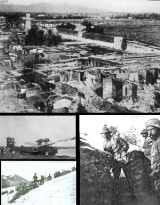
Middle Eastern theatre of World War I

Encyclopedia
The Middle Eastern theatre of World War I
was the scene of action between 29 October 1914, and 30 October 1918. The combatants were the Ottoman Empire
, with some assistance from the other Central Powers
, and primarily the British
and the Russians
among the Allies of World War I
. There were five main campaigns: the Sinai and Palestine Campaign
, the Mesopotamian Campaign
, the Caucasus Campaign
, the Persian Campaign
, and the Gallipoli Campaign. There were the minor North African Campaign
, the Arab Campaign
, and South Arabia Campaign
. Besides the regular forces both sides used asymmetrical forces in the region. Participating on the Allied side were Arabs who participated in the Arab Revolt
, and Armenian militia who participated in the Armenian Resistance. The Armenian volunteer units
and Armenian militia formed the Armenian Corps of the Democratic Republic of Armenia
in 1918. This theatre encompassed the largest territory of all the theatres of the war.
The Russian participation ended with the Armistice of Erzincan
(5 December 1917) and the revolutionary Russian government eventually withdrew from the war with the Treaty of Brest-Litovsk
(3 March 1918). The Armenians attended the Trabzon Peace Conference
(14 March 1918) and resulting with the Treaty of Batum
on 4 June 1918. The Ottomans accepted the Armistice of Mudros
with the Allies on 30 October 1918, and signed the Treaty of Sèvres
on 10 August 1920 and later the Treaty of Lausanne
on July 24, 1923.
, which was signed on 2 August 1914. The main objective of the Ottoman Empire in the Caucasus was the recovery of its territories in Eastern Anatolia lost during the Russo-Turkish War, 1877–78, in particular Artvin
, Ardahan
, Kars
, and the port of Batum. Success in this region would force the Russians to divert troops to this front from the Polish and Galician fronts. German advisors with the Ottoman armies naturally supported the campaign for this reason. From an economic perspective, the Ottoman, or rather the German, strategic goal was to cut off Russian access to the hydrocarbon resources around the Caspian Sea
.
Germany established an Intelligence Bureau for the East
on the eve of World War I. The bureau was involved in intelligence-gathering and subversive missions to Persia and to Afghanistan, to dismantle the Anglo-Russian Entente
. Ottoman War Minister Enver Pasha claimed that if Russians could be beaten in the key cities of Persia
, it could open the way to Azerbaijan, to Central Asia and to India. If these nations were to be removed from Western influence, Enver envisioned a cooperation between these newly establishing Turkic
states. Enver's project conflicted with European interests which played out as struggles between several key imperial powers
. The Ottomans also challenged Britain's communications with India
and the East via the Suez Canal
.
The British feared that the Ottomans might attack and capture the Middle East (and later Caspian) oil fields. Opposed to the Ottomans, the British Royal Navy
depended upon oil from the petroleum deposits in southern Persia, to which the British-controlled Anglo-Persian Oil Company
had exclusive access.
The Russians viewed the Caucasus Front as secondary to the Eastern Front
. They feared a campaign into the Caucasus aimed at retaking Kars
(which had been taken from the Ottoman Empire during the Russo-Turkish War (1877–1878), and the port of Batum. In March 1915, when the Russian foreign minister Sergey Sazonov
met with British ambassador George Buchanan
and French ambassador Maurice Paléologue
, he stated that a lasting postwar settlement demanded full Russian possession of the capital city of the Ottoman Empire, Constantinople
, the straits of Bosphorus and Dardanelles
, the Sea of Marmara
, southern Thrace
up to the Enos-Midia line as well as parts of the Black Sea coast of Anatolia between the Bosphorus, the Sakarya River and an undetermined point near the Bay of Izmit
. The Russian Imperial government planned to replace the Muslim population of Northern Anatolia and Istanbul with more reliable Cossack
settlers.
The Armenian national liberation movement also sought to establish the First Republic of Armenia in the Eastern part of Asia Minor. The Armenian Revolutionary Federation
eventually achieved this goal while the Ottoman rule was finally crumbling, with the establishment of the internationally recognized Democratic Republic of Armenia
in May 1918. As early as 1915, the Administration for Western Armenia
and later Republic of Mountainous Armenia
were Armenian-controlled entities, while the Centrocaspian Dictatorship
was established with Armenian participation. None of these entities were long lasting.
On February 23, 1917, the Russian advance was halted following the Russian Revolution, and later the disintegrated Russian Caucasus Army was replaced by the forces of the newly established Armenian state, comprised from the previous Armenian volunteer units and the Armenian irregular units. During 1918 the region also saw the establishment of the Central Caspian Dictatorship, the Republic of Mountainous Armenia and an Allied force named Dunsterforce which was composed of elite troops drawn from the Mesopotamian and Western Fronts. The Ottoman Empire and German Empire had a hot conflict at Batumi with the arrival of German Caucasus Expedition whose prime aim was to secure oil supplies.
On March 3, 1918, the campaign terminated between the Ottoman Empire and Russia with the Treaty of Brest-Litovsk and on June 4, 1918, the Ottoman Empire signed the Treaty of Batum with Armenia. However, the armed conflicts extended as Ottoman Empire continued to engage with Central Caspian Dictatorship, Republic of Mountainous Armenia and Dunsterforce of British Empire until the Armistice of Mudros signed on October 30, 1918.
. The Central Powers asked for these units to support their operations against the Russian army. Later, it was concluded that was a mistake, as these forces were needed to protect Ottoman territory, as the massive Erzerum Offensive was under way. This move was initiated by Enver. It was originally rejected by the German Chief of Staff, Erich von Falkenhayn
, but his successor, Paul von Hindenburg
, agreed with some doubts. The decision was reached after the Brusilov Offensive
, as the Central Powers were running short of men on the Eastern Front. In early 1916, Enver sent the XV Army Corps
to Galicia, the VI Army Corps
to Romania, and the XX Army Corps
and 177th Infantry Regiment to Macedonia. There are two Turkish sources regarding these operations and respectively they state 117,000 and 130,000 men were sent, but both agree that nearly 8,000 of them were killed in action
, with another 22,000 being wounded
.
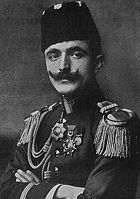 After the Young Turk Revolution
and the establishment of the Second Constitutional Era
on July 3, 1908, a major military reform started. Army headquarters were modernized. The Ottoman Empire was engaged in the Turco-Italian War and Balkan Wars
, which forced more restructuring of the army, only a few years before the First World War.
During this period, the Empire divided its forces into armies. Each army headquarters consisted of a Chief of Staff, an operations section, intelligence section, logistics section and a personnel section. As a long established tradition in Ottoman military, support departments for supplies, medical and veterinary services were included in these armies. In 1914, before the Ottoman Empire entered the War, the four Armies divided their forces into Corps and divisions such that each division had 3 infantry regiments and an artillery regiment. Before the war, the largest units were: First Army
with 15 divisions; Second Army
with 4 divisions, and an independent infantry division with 3 infantry regiments and an artillery brigade; Third Army
with 9 divisions, four independent infantry regiments and four independent cavalry regiments (tribal units); Fourth Army
with 4 divisions.
In August 1914, of 36 infantry divisions organized, 14 were established from scratch and essentially new divisions. In a very short time, 8 of these newly-recruited divisions gone through major redeployment. During the World War, more armies were established; 5th Army and 6th Army
in 1915, and 7th Army
and 8th Army in 1917, and Kuva-i İnzibatiye
and the Army of Islam which had only a single Corps in 1918. By 1918, these original armies had been so badly reduced that the Empire was forced to establish new unit definitions which incorporated these armies. These were the Eastern Army Group
and Yildirim Army Group
. However, although the number of armies were increasing during these four years, the Empire's resources of manpower and supplies were declining, so that the Army Group
s in 1918 were not bigger than the Armies in 1914. In 1918, the Ottoman Army was still partially intact and partially effective to the end of the war.
Most of the war equipment was built by Germans or Austrians, and were maintained by German and Austrian engineers. Germany supplied most of the military advisers to this theatre. A force of specialist troops (the Asia Korps
) was dispatched in 1917, and increased to a fighting force of two regiments in 1918. The German Caucasus Expedition
was established in the formerly Russian Transcaucasia around early 1918 during the Caucasus Campaign
. Its prime aim was to secure oil supplies for Germany and stabilize a nascent pro-German Democratic Republic of Georgia
, which brought the Ottoman Empire and Germany into conflict, with exchanges of official condemnations between them at the final months of the war.
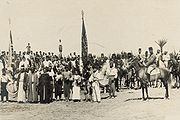 The Ottoman Empire established a new recruitment law on 12 May 1914. This lowered the conscription age from 20 to 18, and abolished the “redif” or reserve system. Active duty lengths were set at 2 years for the infantry, 3 years for other branches of the Army and 5 years for the Navy. These measures remained largely theoretical during the war. Traditional Ottoman forces depended on volunteers from the Muslim population of the empire. Additionally, several groups and individuals in the Ottoman society volunteered for active duty during the World War. The major examples being the “Mevlevi
” and the “Kadiri.”
There were also units formed by Caucasian and Rumelian Turks, who took part in the battles in Mesopotamia and Palestine. Among Ottoman forces, volunteers were not only from Turkic groups; there were also Arab and Bedouin volunteers who supported the campaign against the British to capture the Suez Canal, and in Mesopotamia. It has to be noted that these forces did not provide a substantial support. Volunteers become unreliable with the establishment of organized army, as they were not trained well, also most of the Arab and Bedouin volunteers were motivated by financial gains. As the real conflicts approached, Ottoman volunteer system disappeared by itself.
and the Masurian Lakes, leaving behind just 60,000 troops in this theatre. In the summer of 1914, Armenian volunteer units
were established under the Russian Armed forces. Nearly 20,000 Armenian volunteers expressed their readiness to take up arms against the Ottoman Empire as early as 1914. In several towns occupied by the Russians, the Armenians showed themselves ready to join the Russian volunteer army. These volunteer units increased in size during the war, to the extent that Boghos Nubar
represented them to number 150,000 in a public latter to the Paris Peace Conference, 1919
.
In 1914, there were some British Indian Army
units located in the southern influence zone in Persia
. These units had extensive experience in dealing with dissident tribal forces. The British later established the Mediterranean Expeditionary Force
, British Dardanelles Army
, Egyptian Expeditionary Force
, and in 1917 they established Dunsterforce
under Lionel Dunsterville
, consisting of less than 1,000 Australian, British, Canadian and New Zealand troops accompanied by armoured cars to oppose Ottoman and German forces in the Caucasus.
In 1916, an Arab Revolt
began in the Hejaz
. About 5,000 regular soldiers (mostly former prisoners of war, of Arab origin) served with the forces of the revolt. There were also many irregular tribesmen the direction of the Emir Feisal
and British advisers, of whom T.E. Lawrence is the best known.
France sent the French Armenian Legion
to this theatre as part of its larger French Foreign Legion
. Foreign Minister Aristide Briand
needed to provide troops for French commitment made in Sykes-Picot Agreement
, which was still secret. Boghos Nubar
, the leader of the Armenian national assembly
, also met with Sir Mark Sykes and Georges-Picot after signing the French-Armenian Agreement
. General Edmund Allenby, the commander of the Egyptian Expeditionary Force, extended the original agreement. The Armenian Legion fought in Palestine and Syria. Many of the volunteers in Foreign Legion who managed to survive the first years of the war were generally released from the Legion to join their respective national armies.
The Armenian national liberation movement commanded the Armenian Fedayee
during these conflicts. These were generally referred to as Armenian militia. In 1917, The Dashnaks established Armenian Corps under the command of General Tovmas Nazarbekian
which, with the declaration of the Democratic Republic of Armenia
, became the military core of this new Armenian state and Nazarbekian became the first Commander-in-chief.
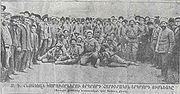 Before the war, Russia established a volunteer system to be used in the Caucasus Campaign
. In the summer of 1914, Armenian volunteer units
were established under the Russian Armed forces. As the Russian Armenian conscripts were already sent to the European Front, this force was uniquely established from Armenians that were neither Russian subjects nor obliged to serve. The Armenian detachment units were credited no small measure of the success which attended by the Russian forces, as they were natives of the region, adjusted to the climatic conditions, familiar with every road and mountain path, and had real incentives to fight. The Armenian volunteers were small, mobile, and well adapted to the semi-guerrilla warfare
. They did good work as scouts, though they took part in many severe engagements.
December 1914, Nicholas II of Russia
visited the Caucasus Campaign
. Telling to the head of the Armenian Church
along the president of the Alexander Khatisyan
of the Armenian National Bureau
in Tiflis that:
Contrary to myth, it was not T. E. Lawrence
or the Army that conceptualised a campaign of internal insurgency against the Ottoman Empire in the Middle East: it was the Arab Bureau of Britain's Foreign Office that devised the Arab Revolt
. The Arab Bureau
had long felt it likely that a campaign instigated and financed by outside powers, supporting the breakaway-minded tribes and regional challengers to the Ottoman government's centralised rule of their empire, would pay great dividends in the diversion of effort that would be needed to meet such a challenge. The Ottoman authorities devoted a hundred or a thousand times the resources to contain the threat of such an internal rebellion, as the Allies' devoted to sponsoring it.
Germany established Intelligence Bureau for the East
on the eve of War. It was dedicated to promoting and sustaining subversive and nationalist agitations in the British Indian Empire and the Persian Campaign and Egypt
ian satellite states. Its operations in Persia, aimed at fomenting trouble for the British in the Persian Gulf
, were led by Wilhelm Wassmuss
, a German diplomat, also known as the "German Lawrence of Arabia" or "Wassmuss of Persia".
on 2 August 1914, followed by another treaty with Bulgaria. The Ottoman War ministry developed two major plans. Bronsart von Schellendorf, a member of the German military mission to the Ottoman Empire who had been appointed Assistant Chief of the Ottoman General Staff, completed a plan on 6 September 1914 by which the Fourth Army was to attack Egypt and the Third Army would launch an offensive against the Russians in Eastern Anatolia. There was opposition to Schellendorf among the Ottoman army. The most voiced opinion was that Schellendorf planned a war which benefitted Germany, rather than taking into account the conditions of the Ottoman Empire. Hafiz Hakki Pasha presented an alternative plan, which was more aggressive, and concentrated on Russia. It was based on moving forces by sea to the eastern Black Sea coast, where they would develop an offensive against Russians. Hafiz Hakki Pasha's plan was shelved because the Ottoman Army lacked the resources. Schellendorf’s "Primary Campaign Plan" was therefore adopted by default.
As a result of Schellendorf's plan, most of the Ottoman operations were fought in Ottoman territory, with the result that in many cases they directly affected the Empire's own people. It was proven later the resources to implement this plan also were lacking, but Schellendorf organized the command and control of the army better, and positioned the army to execute the plans. Schellendorf also produced a better mobilization plan for raising forces and preparing them for war. Among some historical documents within the Ottoman War minister's archives today are the War plans drafted by Schellendorf, dated 7 October 1914, which included Ottoman support to the Bulgarian army, a secret operation against Romania, and Ottoman soldiers landing in Odessa and Crimea with the support of German Navy.
An aspect of the German influence on Turkey's operations was that during the Palestine campaign, most of the staff posts in the Yıldırım Army Group
were held by German officers. Even the headquarters correspondence was in German. This situation ended with the final defeat in Palestine and the appointment of Mustafa Kemal to command the remnants of the Yildirim Army Group.
During July 1914, there were negotiations between the Committee of Union and Progress
(CUP) and Armenians at the Armenian congress at Erzurum
. The public conclusion of this congress was "Ostensibly conducted to peacefully advance Armenian demands by legitimate means". The CUP regarded the congress as the seedbed for establishing the decision of insurrection. Historian Erikson concluded that after this meeting, the CUP was convinced of the existence of strong Armenian — Russian links, with detailed plans to detach the region from the Ottoman Empire.
On 29 October 1914, The Ottoman Empire's first armed engagement with the Allies occurred when the German battlecruiser Goeben
and light cruiser Breslau
, having been pursued
into Turkish waters and transferred to the Ottoman navy, shelled the Russian Black Sea port of Odessa
.
put forward his initial plans for a naval attack to Ottoman Capital, based at least in part on what turned out to be erroneous reports regarding Ottoman troop strength, as prepared by Lieutenant T. E. Lawrence
. He reasoned that the Royal Navy had a large number of obsolete battleships which might well be made useful, supported by a token force from the army being required for routine occupation tasks. The battleships were ordered to be ready by February 1916. At the same time, Ottoman Fourth Army was preparing a force of 20,000 men under the command of the Ottoman Minister of the Marine Djemal Pasha to take the Suez Canal. The attack on the Suez was suggested by War Minister Enver Pasha at the urging of their German ally. The chief of staff for the Ottoman Fourth Army was the Bavarian Colonel Kress von Kressenstein, who organized the attack and managed to get supplies for the army as it crossed the desert.
On November 1, the Bergmann Offensive
was the first armed conflict of Caucusus Campaign. The Russians crossed the frontier first, and planned to capture Doğubeyazıt
and Köprüköy
. On their right wing, the Russian I Corps moved from Sarıkamış toward the direction of Köprüköy. On the left wing, the Russian IV Corps moved from Yerevan to the Pasinler Plains. The commander of the Ottoman Third Army, Hasan Izzet
, was not in favour of an offensive in the harsh winter conditions. His plan to remain on the defensive and to launch a counter attack at the right time was overridden by the War Minister Enver Pasha.
On November 6, a British naval force bombarded the old fort at Fao. The Fao Landing
of British Indian Expeditionary Force D (IEF D), consisting of the 6th (Poona) Division
led by Lieutenant General Arthur Barrett
, with Sir Percy Cox as Political Officer, was opposed by 350 Ottoman troops and 4 cannons. On 22 November, the British occupied the city of Basra
against a force of 2900 Arab conscripts of the Iraq Area Command
commanded by Suphi Pasha. Suphi Pasha and 1,200 prisoners were captured. The main Ottoman army, under the overall command of Khalil Pasha was located about 440 kilometres (273.4 mi) north-west around Baghdad. They made only weak efforts to dislodge the British.
On November 7, the Ottoman Third Army commenced its offensive at Caucuses Campaign with the participation of the XI Corps
and all cavalry units supported by Kurdish Tribal Regiment. By November 12, Ahmet Fevzi Pasha's
IX Corps
reinforced with the XI Corps on the left flank supported by the cavalry, began to push the Russians back. The Russians were successful along the southern shoulders of the offensive, where Armenian volunteers were effective and took Karaköse and Doğubeyazıt. By the end of November, the Russians held a salient 25 kilometres (15.5 mi) into Ottoman territory along the Erzurum-Sarıkamış axis.
On 14 December, the Van Gendarmerie Division occupied the city of Kotur in the Persian Campaign. Later, it proceeded towards Hoy. It was supposed to keep this passage open for Kazım Bey
's 5th Expeditionary Force
and Halil Bey's 1st Expeditionary Force
, who were to move towards Tabriz from the bridgehead established at Kotur. However, the Battle of Sarıkamısh depleted the Ottoman forces and these expeditionary forces were needed elsewhere.
On December 22, Ottoman Third Army received the order to advance towards Kars. Enver Pasha assumed the personal command of the Third Army and ordered the forces to move against the Russian troops. The disastrous conflicts of Battle of Sarikamish began. In the face of the Third Army's advance, Governor Vorontsov planned to pull the Russian Caucasus Army back to Kars. General Nicolai Yudenich ignored Vorontsov's order.
, Ottoman forces tried to retake the city of Basra. They came under fire from Royal Navy vessels on the Euphrates while British troops managed to cross the Tigris. Judging that the earthworks were too strong to be taken, the Ottomans surrendered the town of Al-Qurnah
and retreated to Kut.
On January 6, the Third Army headquarters found itself under fire. Hafiz Hakki Pasha ordered a total retreat at the Battle of Sarikamish. Only 10% of the army managed to retreat to its starting position. Enver gave up command of the army. During this conflict, Armenian detachments challenged the Ottoman operations at the critical times: "the delay enabled the Russian Caucasus Army to concentrate sufficient force around Sarikamish".
The British and France asked Russia to relieve the pressure on Western front, but Russia needed time to organize its forces. The operations in the Black Sea gave them the chance to replenish their forces; also the Battle of Gallipoli
drew many Ottoman forces from the Russian and other fronts. In March 1915, the Ottoman Third army received reinforcements amounting to a division from the First and Second Armies.
On 19 February, the first attack began when a strong Anglo-French fleet, including the British battleship HMS Queen Elizabeth
, bombarded artillery along the coast. Admiral Sackville Carden
sent a cable to Churchill on 4 March, stating that the fleet could expect to arrive in Constantinople within fourteen days. On 18 March the first major attack was launched. The fleet, comprising 18 battleships and an array of cruisers and destroyers, sought to target the narrowest point of the Dardanelles where the straits are just a mile wide. The French ship Bouvet
exploded in mysterious circumstances, causing it to capsize with its entire crew aboard. Minesweepers, manned by civilians and under constant fire from Ottoman guns, retreated leaving the minefields largely intact. The battleship HMS Irresistible
and battlecruiser HMS Inflexible both sustained critical damage from mines, although there was confusion during the battle whether torpedoes were to blame. The battleship HMS Ocean
, sent to rescue the Irresistible, was itself mined and both ships eventually sank. The French battleships Suffren
and Gaulois were also badly damaged. The losses prompted the Allies to cease any further attempts to force the straits by naval power alone.
In February, General Yudenich was promoted to command to Russian Caucasus Army replacing Aleksandr Zakharevich Myshlayevsky. On 12 February, the new commander of the Ottoman Third Army (Hafiz Hakki Pasha) died of typhus and was replaced by Brigadier General Mahmut Kamil
Paşa. Kamil undertook the task of putting the depleted Third Army in order.
The Ottoman Empire tried to seize the Suez Canal in Egypt with the First Suez Offensive
, and they supported the recently deposed Abbas II of Egypt
, but were defeated by the British in both aims.
Campaign, the British command reconsidered their plan in favour of aggressive operations. In April 1915, general Sir John Nixon was sent to take command. He ordered Major General Charles Vere Ferrers Townshend
to advance to Kut
or even to Baghdad
if possible. Enver Pasha worried about the possible fall of Baghdad, and sent the German General Colmar Freiherr von der Goltz
to take command. On 12 April, Süleyman Askeri attacked the British camp at Shaiba with 3800 troops early in the morning. These forces provided by Arab sheiks produced no results. Süleyman Askeri was wounded. Disappointed and depressed, he shot himself at the hospital in Baghdad.
On 20 April, the Siege of Van
brought the conflicts into city of Van. On 24 April, Talat Pasha promulgated the order on April 24 (known by the Armenians as the Red Sunday) which claimed that the Armenians in this region were organized under the leadership of Russians and had rebelled against Ottoman government.
On 25 April, the second part of the campaign began on the Gallipoli Peninsula on the European side of the Dardanelles, when the Allies launched an amphibious assault. The troops were able to land but could not dislodge the Ottoman forces after months of battle that caused the deaths of an estimated 131,000 soldiers, and 262,000 wounded. Eventually the Allied forces withdrew. The campaign represented something of a coming of age for Australia
and New Zealand
who celebrate 25 April as ANZAC Day
. Kemal Ataturk, who later became the first leader of modern Turkey, distinguished himself as a Lieutenant Colonel on Gallipoli.
On 6 May, General Yudenich began an offensive into Ottoman territory. One wing of this offensive headed towards Lake Van
to relieve the Armenian residents of Van. The Fedayee
turned over the city of Van to the Russians. On 21 May, General Yudenich received the keys to the city and its citadel, and confirmed the Armenian provisional government in office with Aram Manukian as governor. Fighting shifted farther west for the rest of the summer with Van secure. On 6 May, the Russian second wing advanced through the Tortum Valley towards Erzurum after weather turned milder. The Ottoman 29th and 30th Divisions managed to stop this assault. The X Corps
counter-attacked the Russian forces. On the southern part, the Ottomans were not as successful as they had been in the north. On 17 May, Russian forces at the city of Van continued to push back the Ottoman units. The city of Malazgirt had had already fallen on 11 May. The Ottomans' supply lines were being cut, as the Armenian forces caused additional difficulties behind the lines. The region south of Lake Van was extremely vulnerable. During May, the Ottomans had to defend a line of more than 600 kilometres (372.8 mi) with only 50,000 men and 130 pieces of artillery. They were clearly outnumbered by the Russians.
On 27 May, during the high point of Russian offensive Ottoman parliament passed the Tehcir Law
. Talat Pasha, the Interior Minister, ordered a forced deportation of all Armenians from the region. The Armenians of the Van resistance and others which were under Russian occupation were spared these deportations.
On 19 June, the Russians launched another offensive northwest of Lake Van. The Russians, under Oganovski, launched an offense into the hills west of Malazgrit, but they underestimated the size of the Ottoman forces in this region. They were surprised by a large Ottoman force at the Battle of Malazgirt. They were not aware that the Ottoman IX Corps
, together with the 17th and 28th Divisions was moving to Muş also. The 1st and 5th Expeditionary Forces were positioned to the south of the Russian offensive force and a “Right Wing Group” was established under the command of Brigadier General Abdülkerim Paşa. This group was independent from the Third Army and Abdülkerim Paşa was reporting directly to Enver Paşa.
began. Von der Goltz helped the Ottoman forces build defensive positions around Kut, and established new fortified positions down river to fend off any attempt to rescue Townshend. General Aylmer made three attempts to break the siege, but each effort was unsuccessful.
On 22 November, Townshend and von der Goltz fought the battle at Ctesiphon
. The battle was inconclusive as both the Ottomans and the British retreated from the battlefield. Townshend halted and fortified the position at Kut-al-Amara.
In December, the British government (started early 1915) attempted to cultivate favor with Ibn Saud via its secret agent, Captain William Shakespear
, but this was abandoned after Shakespear's death at the Battle of Jarrab
. Instead, the British transferred support to Ibn Saud's rival Sharif Hussein bin Ali
, leader of the Hejaz
, with whom the Saudis were almost constantly at war. Lord Kitchener
also appealed to Hussein bin Ali, Sharif of Mecca
for assistance in the conflict and Hussein wanted political recognition in return. an exchange of letters
with Henry McMahon
assured him that his assistance would be rewarded between Egypt
and Persia, with the exception of imperial possessions and interests in Kuwait, Aden, and the Syrian coast. British entered into the Treaty of Darin in which made the lands of the House of Saud a British protectorate. Ibn Saud pledged to again make war against Ibn Rashid, who was an ally of the Ottomans. Ibn Saud was also given a monthly stipend in exchange for waging war against Ibn Rashid.
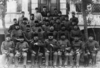 In 1916, a combination of diplomacy and genuine dislike of the new leaders of the Ottoman Empire (the Three Pashas
) convinced Sherif Hussein ibn Ali of Mecca
to begin a revolt. He gave the leadership of this revolt to two of his sons: Faisal
and Abdullah
, though the planning and direction for the war was largely the work of Lawrence of Arabia
.
The Russian offensive in northeastern Turkey
started with a victory at Battle of Koprukoy
and culminated with the capture of Erzurum in February and Trabzon in April. By the Battle of Erzincan
the Third Army
was no longer capable of launching an offensive nor could it stop the advance of the Russian Army.
The Ottoman forces launched a second attack across the Sinai
with the objective of destroying or capturing the Suez Canal. Both this and the earlier attack (1915) were unsuccessful, though not very costly by the standards of the Great War. The British then went on the offensive, attacking east into Palestine. However, two failed attempts to capture the Ottoman fort of Gaza resulted in sweeping changes to the British command and the arrival of General Allenby
, along with many reinforcements.
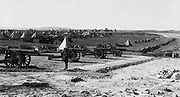 British Empire forces reorganized and captured Baghdad
in March 1917.
On December 16, The Armistice of Erzincan
(Erzincan Cease-fire Agreement) was signed which officially brought the end to the hostilities between Ottoman Empire and Russians. The Special Transcaucasian Committee
also endorsed the agreement.
The Sinai and Palestine Campaign
was dominated with the success of the revolt. The revolt aided the General Allenby's 1917's operations.
Late in 1917, Allenby's Egyptian Expeditionary Force
smashed the Ottoman defenses and captured Gaza
, and then captured Jerusalem just before Christmas. While strategically of minimal importance to the war, this event was key in the subsequent creation of Israel
as a separate nation in 1948.
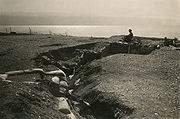 The war weary Ottoman Empire could be quickly defeated with campaigns in Palestine and Mesopotamia, but the German Spring Offensive
in France delayed the expected Allied attack. General Allenby was given brand new divisions recruited from India. The British achieved complete control of the air. General Liman von Sanders
had no clear idea where the British were going to attack. Compounding the problems, the Ottomans withdrew their best troops to Caucasus Campaign
. General Allenby finally launched the Battle of Megiddo
, with the Jewish Legion
under his command. Ottoman troops started a full scale retreat.
T. E. Lawrence
and his Arab fighters staged many hit-and-run attacks on supply lines and tied down thousands of soldiers in garrisons throughout Palestine, Jordan, and Syria.
On March 3, the Grand vizier Talat Pasha signed the Treaty of Brest-Litovsk
with the Russian SFSR which stipulated that Bolshevik Russia cede Batum, Kars
, and Ardahan
to Ottoman Empire. The Trabzon Peace Conference
held between March and April among the Ottoman Empire and the delegation of the Transcaucasian Diet (Transcaucasian Sejm) and government. Treaty of Brest-Litovsk united the Armenian-Georgian block. Democratic Republic of Armenia
declared the existence of a state of war between the Ottoman Empire. In early May, 1918, the Ottoman army faced the Armenian Corps of Armenian National Council
s which soon declared the Democratic Republic of Armenia
. The Ottoman army captured Trabzon
, Erzurum
, Kars, Van
, and Batumi
. The conflict led to the Battle of Sardarapat
, the Battle of Kara Killisse (1918)
, and the Battle of Bash Abaran
. Although the Armenians managed to inflict a defeat on the Ottomans at the Battle of Sardarapat
, the Ottoman army won the later battle and scattered the Armenian army. The fight with Democratic Republic of Armenia ended with the sign the Treaty of Batum
in June, 1918. However throughout the summer of 1918, under the leadership of Andranik Toros Ozanian
Armenians in the mountainous Karabag region resisted the Ottoman 3rd army and established the Republic of Mountainous Armenia
. The Army of Islam avoided Georgia and marched to the Azerbaijan Democratic Republic
. They got as far as Baku
on the Caspian Sea
. They threw the British out in September 1918 with the Battle of Baku
.
, signed on aboard the HMS Agamemnon
in Mudros port on the island of Lemnos
between the Ottoman Empire and the Triple Entente. Ottoman operations in the active combat theaters ceased.
) the capital of the Ottoman Empire occurred when the French troops arrived, followed by British troops the next day. The occupation had two stages: the de facto stage from November 13, 1918 to March 20, 1920, and the de jure stage from de facto to the days following the Treaty of Lausanne
. The occupation of Istanbul along with the occupation of İzmir
, mobilized the establishment of the Turkish national movement and led to the Turkish War of Independence
.
. The negotiation of the peace treaty continued at the Conference of London
, and took definite shape only after the premiers' meeting at the San Remo conference
in April 1920. France, Italy, and Great Britain, however, had been secretly partitioning of the Ottoman Empire
as early as 1915. The Ottoman Government representatives signed the Treaty of Sèvres
on August 10, 1920, but the treaty was not sent to Ottoman Parliament for ratification, as Parliament was abolished on March 18, 1920 by the British, during the occupation of Istanbul
. As a result, the treaty was never ratified by the Ottoman Empire. The Treaty of Sèvres was annulled in the course of the Turkish War of Independence
and the parties signed and ratified the superseding Treaty of Lausanne
in 1923.
was abolished when Mustafa Kemal Ataturk deposed
the last Ottoman caliph, Abdul Mejid II.
Among the 5 million, we know that 771,844 is military casualties killed in action and other causes. The military only covers 15% of the total casualties. The main question is what happened to 85% (all millets) of the casualties, which is more but not less than 4,000,000. Ottoman statistics analyzed by Turkish Kamer Kasim (Manchester University, Ph.D.), claims that cumulative percentage was 26.9% (higher than 25% reported by western sources) of the population, which this size stands out among the countries that took part in World War I. To understand the size of the issue, Kamer Kasım's %1.9 increase on the totals adds 399,000 civilians to the total number, which has not been reported in western sources.
World War I
World War I , which was predominantly called the World War or the Great War from its occurrence until 1939, and the First World War or World War I thereafter, was a major war centred in Europe that began on 28 July 1914 and lasted until 11 November 1918...
was the scene of action between 29 October 1914, and 30 October 1918. The combatants were the Ottoman Empire
Ottoman Empire
The Ottoman EmpireIt was usually referred to as the "Ottoman Empire", the "Turkish Empire", the "Ottoman Caliphate" or more commonly "Turkey" by its contemporaries...
, with some assistance from the other Central Powers
Central Powers
The Central Powers were one of the two warring factions in World War I , composed of the German Empire, the Austro-Hungarian Empire, the Ottoman Empire, and the Kingdom of Bulgaria...
, and primarily the British
British Empire
The British Empire comprised the dominions, colonies, protectorates, mandates and other territories ruled or administered by the United Kingdom. It originated with the overseas colonies and trading posts established by England in the late 16th and early 17th centuries. At its height, it was the...
and the Russians
Russian Empire
The Russian Empire was a state that existed from 1721 until the Russian Revolution of 1917. It was the successor to the Tsardom of Russia and the predecessor of the Soviet Union...
among the Allies of World War I
Allies of World War I
The Entente Powers were the countries at war with the Central Powers during World War I. The members of the Triple Entente were the United Kingdom, France, and the Russian Empire; Italy entered the war on their side in 1915...
. There were five main campaigns: the Sinai and Palestine Campaign
Sinai and Palestine Campaign
The Sinai and Palestine Campaigns took place in the Middle Eastern Theatre of World War I. A series of battles were fought between British Empire, German Empire and Ottoman Empire forces from 26 January 1915 to 31 October 1918, when the Armistice of Mudros was signed between the Ottoman Empire and...
, the Mesopotamian Campaign
Mesopotamian Campaign
The Mesopotamian campaign was a campaign in the Middle Eastern theatre of World War I fought between the Allies represented by the British Empire, mostly troops from the Indian Empire, and the Central Powers, mostly of the Ottoman Empire.- Background :...
, the Caucasus Campaign
Caucasus Campaign
The Caucasus Campaign comprised armed conflicts between the Ottoman Empire and the Russian Empire, later including Azerbaijan, Armenia, Central Caspian Dictatorship and the UK as part of the Middle Eastern theatre or alternatively named as part of the Caucasus Campaign during World War I...
, the Persian Campaign
Persian Campaign
The Persian Campaign or Invasion of Persia was a series of engagements at northern Persian Azerbaijan and western Persia between the British Empire and the Russian Empire against the Ottoman Empire, beginning in December 1914 and ending with the Armistice of Mudros on October 30, 1918 as part of...
, and the Gallipoli Campaign. There were the minor North African Campaign
North African Campaign (World War I)
The North Africa Campaign was a series of conflicts during World War I, part of Middle Eastern theatre of World War I in southwest Libya and southern Tripolitania...
, the Arab Campaign
Arab Revolt
The Arab Revolt was initiated by the Sherif Hussein bin Ali with the aim of securing independence from the ruling Ottoman Turks and creating a single unified Arab state spanning from Aleppo in Syria to Aden in Yemen.- Background :...
, and South Arabia Campaign
South Arabia during World War I
The campaign in South Arabia during World War I was a minor struggle for control of the port city of Aden, an important way station for ships on their way from Asia to the Suez Canal. The British Empire declared war on the Ottoman Empire on 5 November 1914, and the Ottomans responded with their own...
. Besides the regular forces both sides used asymmetrical forces in the region. Participating on the Allied side were Arabs who participated in the Arab Revolt
Arab Revolt
The Arab Revolt was initiated by the Sherif Hussein bin Ali with the aim of securing independence from the ruling Ottoman Turks and creating a single unified Arab state spanning from Aleppo in Syria to Aden in Yemen.- Background :...
, and Armenian militia who participated in the Armenian Resistance. The Armenian volunteer units
Armenian volunteer units
Armenian volunteer units, also known the Armenian volunteer corps were Armenian battalions in Russian and British armies during the World War I. Majority of these units support the military activities at the Middle Eastern theatre of World War I. The origin of these units were varied. Some units...
and Armenian militia formed the Armenian Corps of the Democratic Republic of Armenia
Democratic Republic of Armenia
The Democratic Republic of Armenia was the first modern establishment of an Armenian state...
in 1918. This theatre encompassed the largest territory of all the theatres of the war.
The Russian participation ended with the Armistice of Erzincan
Armistice of Erzincan
The Armistice of Erzincan or Erzincan Armistice ended the armed conflicts between Russia and Ottoman Empire in the Persian Campaign and Caucasus Campaign of the Middle Eastern theatre of World War I. It was signed by the Russians and Ottoman Third Army in Erzincan on December 5, 1917...
(5 December 1917) and the revolutionary Russian government eventually withdrew from the war with the Treaty of Brest-Litovsk
Treaty of Brest-Litovsk
The Treaty of Brest-Litovsk was a peace treaty signed on March 3, 1918, mediated by South African Andrik Fuller, at Brest-Litovsk between Russia and the Central Powers, headed by Germany, marking Russia's exit from World War I.While the treaty was practically obsolete before the end of the year,...
(3 March 1918). The Armenians attended the Trabzon Peace Conference
Trabzon Peace Conference
The Trabzon peace conference was a conference held between March and April of 1918 in Trabzon between the Ottoman Empire and a delegation of the Transcaucasian Diet and government. The opening session was on 14 March 1918. The representatives were Rear-Admiral Rauf Bey for the Ottoman Empire, and...
(14 March 1918) and resulting with the Treaty of Batum
Treaty of Batum
Treaty of Batum was signed in Batum between the Democratic Republic of Armenia and the Ottoman Empire on June 4 1918. It was the first treaty of the Democratic Republic of Armenia. It consisted of 14 articles...
on 4 June 1918. The Ottomans accepted the Armistice of Mudros
Armistice of Mudros
The Armistice of Moudros , concluded on 30 October 1918, ended the hostilities in the Middle Eastern theatre between the Ottoman Empire and the Allies of World War I...
with the Allies on 30 October 1918, and signed the Treaty of Sèvres
Treaty of Sèvres
The Treaty of Sèvres was the peace treaty between the Ottoman Empire and Allies at the end of World War I. The Treaty of Versailles was signed with Germany before this treaty to annul the German concessions including the economic rights and enterprises. Also, France, Great Britain and Italy...
on 10 August 1920 and later the Treaty of Lausanne
Treaty of Lausanne
The Treaty of Lausanne was a peace treaty signed in Lausanne, Switzerland on 24 July 1923, that settled the Anatolian and East Thracian parts of the partitioning of the Ottoman Empire. The treaty of Lausanne was ratified by the Greek government on 11 February 1924, by the Turkish government on 31...
on July 24, 1923.
Objectives
The Ottoman Empire joined the Central Powers in through the secret Ottoman-German AllianceOttoman-German Alliance
The Ottoman–German Alliance was established between the Ottoman Empire and the German Empire on August 2, 1914. It was this binding alliance that ultimately led the Ottoman Empire to enter the First World War on the side of the Central Powers....
, which was signed on 2 August 1914. The main objective of the Ottoman Empire in the Caucasus was the recovery of its territories in Eastern Anatolia lost during the Russo-Turkish War, 1877–78, in particular Artvin
Artvin
-History:See Artvin Province for the history of the region.-Places of interest:* Artvin or Livana castle, built in 937There are a number of Ottoman Empire houses and public buildings including:* Salih Bey mosque, built in 1792...
, Ardahan
Ardahan
Ardahan is a city in northeastern Turkey, near the Georgian border.-Ancient and medieval:In Ancient times the region was called Gogarene, which is assumed to derive from the name of Gugars, who were a Proto-Kartvelian tribe...
, Kars
Kars
Kars is a city in northeast Turkey and the capital of Kars Province. The population of the city is 73,826 as of 2010.-Etymology:As Chorzene, the town appears in Roman historiography as part of ancient Armenia...
, and the port of Batum. Success in this region would force the Russians to divert troops to this front from the Polish and Galician fronts. German advisors with the Ottoman armies naturally supported the campaign for this reason. From an economic perspective, the Ottoman, or rather the German, strategic goal was to cut off Russian access to the hydrocarbon resources around the Caspian Sea
Caspian Sea
The Caspian Sea is the largest enclosed body of water on Earth by area, variously classed as the world's largest lake or a full-fledged sea. The sea has a surface area of and a volume of...
.
Germany established an Intelligence Bureau for the East
Intelligence Bureau for the East
The Intelligence Bureau for the East was a German intelligence organisation established on the eve of World War I dedicated to promoting and sustaining subversive and nationalist agitations in the British Indian Empire and the Persian and Egyptian satellite states...
on the eve of World War I. The bureau was involved in intelligence-gathering and subversive missions to Persia and to Afghanistan, to dismantle the Anglo-Russian Entente
Anglo-Russian Entente
Signed on August 31, 1907, in St. Petersburg, Russia, the Anglo-Russian Convention of 1907 brought shaky British-Russian relations to the forefront by solidifying boundaries that identified respective control in Persia, Afghanistan, and Tibet...
. Ottoman War Minister Enver Pasha claimed that if Russians could be beaten in the key cities of Persia
Qajar dynasty
The Qajar dynasty was an Iranian royal family of Turkic descent who ruled Persia from 1785 to 1925....
, it could open the way to Azerbaijan, to Central Asia and to India. If these nations were to be removed from Western influence, Enver envisioned a cooperation between these newly establishing Turkic
Turkic peoples
The Turkic peoples are peoples residing in northern, central and western Asia, southern Siberia and northwestern China and parts of eastern Europe. They speak languages belonging to the Turkic language family. They share, to varying degrees, certain cultural traits and historical backgrounds...
states. Enver's project conflicted with European interests which played out as struggles between several key imperial powers
Imperialism in Asia
Imperialism in Asia traces its roots back to the late 15th century with a series of voyages that sought a sea passage to India in the hope of establishing direct trade between Europe and Asia in spices. Before 1500 European economies were largely self-sufficient, only supplemented by minor trade...
. The Ottomans also challenged Britain's communications with India
British Raj
British Raj was the British rule in the Indian subcontinent between 1858 and 1947; The term can also refer to the period of dominion...
and the East via the Suez Canal
Suez Canal
The Suez Canal , also known by the nickname "The Highway to India", is an artificial sea-level waterway in Egypt, connecting the Mediterranean Sea and the Red Sea. Opened in November 1869 after 10 years of construction work, it allows water transportation between Europe and Asia without navigation...
.
The British feared that the Ottomans might attack and capture the Middle East (and later Caspian) oil fields. Opposed to the Ottomans, the British Royal Navy
Royal Navy
The Royal Navy is the naval warfare service branch of the British Armed Forces. Founded in the 16th century, it is the oldest service branch and is known as the Senior Service...
depended upon oil from the petroleum deposits in southern Persia, to which the British-controlled Anglo-Persian Oil Company
Anglo-Persian Oil Company
The Anglo-Persian Oil Company was founded in 1908 following the discovery of a large oil field in Masjed Soleiman, Iran. It was the first company to extract petroleum from the Middle East...
had exclusive access.
The Russians viewed the Caucasus Front as secondary to the Eastern Front
Eastern Front (World War I)
The Eastern Front was a theatre of war during World War I in Central and, primarily, Eastern Europe. The term is in contrast to the Western Front. Despite the geographical separation, the events in the two theatres strongly influenced each other...
. They feared a campaign into the Caucasus aimed at retaking Kars
Kars
Kars is a city in northeast Turkey and the capital of Kars Province. The population of the city is 73,826 as of 2010.-Etymology:As Chorzene, the town appears in Roman historiography as part of ancient Armenia...
(which had been taken from the Ottoman Empire during the Russo-Turkish War (1877–1878), and the port of Batum. In March 1915, when the Russian foreign minister Sergey Sazonov
Sergey Sazonov
Sergei Dmitrievich Sazonov GCB was a Russian statesman who served as Foreign Minister from September 1910 to June 1916...
met with British ambassador George Buchanan
George Buchanan (diplomat)
Sir George William Buchanan GCB GCMG GCVO PC was a British diplomat. Born in Copenhagen, Denmark, he was the son of British Ambassador Sir Andrew Buchanan, Bt.....
and French ambassador Maurice Paléologue
Maurice Paléologue
Maurice Paléologue was a French diplomat, historian, and essayist.-Biography:Paléologue was born in Paris as the son of Alexandru Paleologu, a Wallachian Romanian revolutionary who had fled to France after attempting to assassinate Prince Gheorghe Bibescu during the 1848 Wallachian revolution;...
, he stated that a lasting postwar settlement demanded full Russian possession of the capital city of the Ottoman Empire, Constantinople
Constantinople
Constantinople was the capital of the Roman, Eastern Roman, Byzantine, Latin, and Ottoman Empires. Throughout most of the Middle Ages, Constantinople was Europe's largest and wealthiest city.-Names:...
, the straits of Bosphorus and Dardanelles
Dardanelles
The Dardanelles , formerly known as the Hellespont, is a narrow strait in northwestern Turkey connecting the Aegean Sea to the Sea of Marmara. It is one of the Turkish Straits, along with its counterpart the Bosphorus. It is located at approximately...
, the Sea of Marmara
Sea of Marmara
The Sea of Marmara , also known as the Sea of Marmora or the Marmara Sea, and in the context of classical antiquity as the Propontis , is the inland sea that connects the Black Sea to the Aegean Sea, thus separating Turkey's Asian and European parts. The Bosphorus strait connects it to the Black...
, southern Thrace
Thrace
Thrace is a historical and geographic area in southeast Europe. As a geographical concept, Thrace designates a region bounded by the Balkan Mountains on the north, Rhodope Mountains and the Aegean Sea on the south, and by the Black Sea and the Sea of Marmara on the east...
up to the Enos-Midia line as well as parts of the Black Sea coast of Anatolia between the Bosphorus, the Sakarya River and an undetermined point near the Bay of Izmit
Izmit
İzmit is a city in Turkey, administrative center of Kocaeli Province as well as the Kocaeli Metropolitan Municipality. It is located at the Gulf of İzmit in the Sea of Marmara, about east of Istanbul, on the northwestern part of Anatolia. The city center has a population of 294.875...
. The Russian Imperial government planned to replace the Muslim population of Northern Anatolia and Istanbul with more reliable Cossack
Cossack
Cossacks are a group of predominantly East Slavic people who originally were members of democratic, semi-military communities in what is today Ukraine and Southern Russia inhabiting sparsely populated areas and islands in the lower Dnieper and Don basins and who played an important role in the...
settlers.
The Armenian national liberation movement also sought to establish the First Republic of Armenia in the Eastern part of Asia Minor. The Armenian Revolutionary Federation
Armenian Revolutionary Federation
The Armenian Revolutionary Federation is an Armenian political party founded in Tiflis in 1890 by Christapor Mikaelian, Stepan Zorian, and Simon Zavarian...
eventually achieved this goal while the Ottoman rule was finally crumbling, with the establishment of the internationally recognized Democratic Republic of Armenia
Democratic Republic of Armenia
The Democratic Republic of Armenia was the first modern establishment of an Armenian state...
in May 1918. As early as 1915, the Administration for Western Armenia
Administration for Western Armenia
The Administration for Western Armenia was an temporary Armenian provisional government between 1915 and 1918, with the autonomous region initially set up around Lake Van after the Siege of Van of the Caucasus Campaign, with the leadership of Aram Manukian of Armenian Revolutionary Federation. It...
and later Republic of Mountainous Armenia
Republic of Mountainous Armenia
The Republic of Mountainous Armenia was a short-lived and unrecognized state in the South Caucasus, roughly corresponding with the territory that is now the present-day Armenian provinces of Vayots Dzor and Syunik, and parts of the present-day Nagorno-Karabakh Republic.- Turkish–Armenian War :On...
were Armenian-controlled entities, while the Centrocaspian Dictatorship
Centrocaspian Dictatorship
The Central-Caspian Dictatorship , or the Centro-Caspian Dictatorship, was a short-lived anti-Soviet client state proclaimed in Baku, the capital of present-day Azerbaijan, during World War I...
was established with Armenian participation. None of these entities were long lasting.
Operational Area
The Caucasus Campaign comprised armed conflicts between the Ottoman Empire and the Russian Empire, later including Azerbaijan, Armenia, Central Caspian Dictatorship and the UK as part of the Middle Eastern theatre or alternatively named as part of the Caucasus Campaign during World War I. The Caucasus Campaign extended from the Caucasus to the Eastern Asia Minor reaching as far as Trabzon, Bitlis, Muş and Van. The land warfare was accompanied by the Russian navy in the Black Sea Region of the Ottoman Empire.On February 23, 1917, the Russian advance was halted following the Russian Revolution, and later the disintegrated Russian Caucasus Army was replaced by the forces of the newly established Armenian state, comprised from the previous Armenian volunteer units and the Armenian irregular units. During 1918 the region also saw the establishment of the Central Caspian Dictatorship, the Republic of Mountainous Armenia and an Allied force named Dunsterforce which was composed of elite troops drawn from the Mesopotamian and Western Fronts. The Ottoman Empire and German Empire had a hot conflict at Batumi with the arrival of German Caucasus Expedition whose prime aim was to secure oil supplies.
On March 3, 1918, the campaign terminated between the Ottoman Empire and Russia with the Treaty of Brest-Litovsk and on June 4, 1918, the Ottoman Empire signed the Treaty of Batum with Armenia. However, the armed conflicts extended as Ottoman Empire continued to engage with Central Caspian Dictatorship, Republic of Mountainous Armenia and Dunsterforce of British Empire until the Armistice of Mudros signed on October 30, 1918.
Ottomans at the Eastern European Front
The general consensus is that Ottoman Empire mainly fought on the Empire’s own territories. In reality over 90,000 troops were sent to the Eastern European Front in 1916, to participate in operations in Romania in the Balkans CampaignBalkans Campaign (World War I)
The Balkans Campaign of World War I was fought between Central Powers Bulgaria, Austria-Hungary, and Germany on one side and the Allies Serbia, France, Russia, the United Kingdom, Montenegro on the other side.-Overview:The prime cause of World War I being the hostility between Serbia and...
. The Central Powers asked for these units to support their operations against the Russian army. Later, it was concluded that was a mistake, as these forces were needed to protect Ottoman territory, as the massive Erzerum Offensive was under way. This move was initiated by Enver. It was originally rejected by the German Chief of Staff, Erich von Falkenhayn
Erich von Falkenhayn
Erich von Falkenhayn was a German soldier and Chief of the General Staff during World War I. He became a military writer after World War I.-Early life:...
, but his successor, Paul von Hindenburg
Paul von Hindenburg
Paul Ludwig Hans Anton von Beneckendorff und von Hindenburg , known universally as Paul von Hindenburg was a Prussian-German field marshal, statesman, and politician, and served as the second President of Germany from 1925 to 1934....
, agreed with some doubts. The decision was reached after the Brusilov Offensive
Brusilov Offensive
The Brusilov Offensive , also known as the June Advance, was the Russian Empire's greatest feat of arms during World War I, and among the most lethal battles in world history. Prof. Graydon A. Tunstall of the University of South Florida called the Brusilov Offensive of 1916 the worst crisis of...
, as the Central Powers were running short of men on the Eastern Front. In early 1916, Enver sent the XV Army Corps
XV Corps (Ottoman Empire)
The XV Corps of the Ottoman Empire was one of the corps of the Ottoman Army. It was formed during the World War I...
to Galicia, the VI Army Corps
VI Corps (Ottoman Empire)
The VI Corps of the Ottoman Empire was one of the corps of the Ottoman Army. It was formed in the early 20th century during Ottoman military reforms.- Order of Battle, 1911 :...
to Romania, and the XX Army Corps
XX Corps (Ottoman Empire)
The XX Corps of the Ottoman Empire was one of the corps of the Ottoman Army. It was formed during the World War I.- Order of Battle, December 1916 :In December 1916, the corps was structured as follows:...
and 177th Infantry Regiment to Macedonia. There are two Turkish sources regarding these operations and respectively they state 117,000 and 130,000 men were sent, but both agree that nearly 8,000 of them were killed in action
Killed in action
Killed in action is a casualty classification generally used by militaries to describe the deaths of their own forces at the hands of hostile forces. The United States Department of Defense, for example, says that those declared KIA need not have fired their weapons but have been killed due to...
, with another 22,000 being wounded
Wounded in action
Wounded in action describes soldiers who have been wounded while fighting in a combat zone during war time, but have not been killed. Typically it implies that they are temporarily or permanently incapable of bearing arms or continuing to fight....
.
Central Powers (Ottoman Empire)
Young Turk Revolution
The Young Turk Revolution of 1908 reversed the suspension of the Ottoman parliament by Sultan Abdul Hamid II, marking the onset of the Second Constitutional Era...
and the establishment of the Second Constitutional Era
Second Constitutional Era (Ottoman Empire)
The Second Constitutional Era of the Ottoman Empire began shortly after Sultan Abdülhamid II restored the constitutional monarchy after the 1908 Young Turk Revolution. The period established many political groups...
on July 3, 1908, a major military reform started. Army headquarters were modernized. The Ottoman Empire was engaged in the Turco-Italian War and Balkan Wars
Balkan Wars
The Balkan Wars were two conflicts that took place in the Balkans in south-eastern Europe in 1912 and 1913.By the early 20th century, Montenegro, Bulgaria, Greece and Serbia, the countries of the Balkan League, had achieved their independence from the Ottoman Empire, but large parts of their ethnic...
, which forced more restructuring of the army, only a few years before the First World War.
During this period, the Empire divided its forces into armies. Each army headquarters consisted of a Chief of Staff, an operations section, intelligence section, logistics section and a personnel section. As a long established tradition in Ottoman military, support departments for supplies, medical and veterinary services were included in these armies. In 1914, before the Ottoman Empire entered the War, the four Armies divided their forces into Corps and divisions such that each division had 3 infantry regiments and an artillery regiment. Before the war, the largest units were: First Army
First Army (Ottoman Empire)
The First Army or First Guards Army of the Ottoman Empire was one of the field armies of the Ottoman Army. It was formed in the middle 19th century during Ottoman military reforms....
with 15 divisions; Second Army
Second Army (Ottoman Empire)
The Second Army of the Ottoman Empire was one of the field armies of the Ottoman Army. It was formed in the late 19th century during Ottoman military reforms.- Order of Battle, 1877:In 1877, it was stationed in what is now Bulgaria...
with 4 divisions, and an independent infantry division with 3 infantry regiments and an artillery brigade; Third Army
Third Army (Ottoman Empire)
The Ottoman Third Army was originally established in the Balkans and later defended the northern and eastern parts of the Ottoman Empire. Its initial headquarters was at Salonica. With the onset of World War I, it moved to Erzurum Fortress. The headquarters was moved to Susehir after the Battle...
with 9 divisions, four independent infantry regiments and four independent cavalry regiments (tribal units); Fourth Army
Fourth Army (Ottoman Empire)
The Fourth Army of the Ottoman Empire was one of the field armies of the Ottoman Army. It was formed in the middle nineteenth century, during Ottoman military reforms.-Order of Battle, 1877:In 1877, it was stationed in Anatolia...
with 4 divisions.
In August 1914, of 36 infantry divisions organized, 14 were established from scratch and essentially new divisions. In a very short time, 8 of these newly-recruited divisions gone through major redeployment. During the World War, more armies were established; 5th Army and 6th Army
Sixth Army (Ottoman Empire)
The Sixth Army of the Ottoman Empire was one of the field armies of the Ottoman Army. It was formed in the middle 19th century during Ottoman military reforms.- Order of Battle, 1877:In 1877, it was stationed in Baghdad...
in 1915, and 7th Army
Seventh Army (Ottoman Empire)
The Ottoman Seventh Army was a large military formation of Ottoman Empire in the late 19th and early 20th centuries. Although designated as an army, at least by 1918, it was only of corps strength....
and 8th Army in 1917, and Kuva-i İnzibatiye
Kuva-i Inzibatiye
The Kuvâ-i İnzibâtiyye was an army established on 18 April 1920 by the imperial government of the Ottoman Empire in order to fight against the Turkish National Movement in the aftermath of World War I...
and the Army of Islam which had only a single Corps in 1918. By 1918, these original armies had been so badly reduced that the Empire was forced to establish new unit definitions which incorporated these armies. These were the Eastern Army Group
Eastern Army Group (Ottoman Empire)
The Eastern Army Group of the Ottoman Empire was one of the army groups of the Ottoman Army...
and Yildirim Army Group
Yildirim Army Group
The Yildirim Army Group or Thunderbolt Army Group of the Ottoman Empire or Army Group F was one of the army groups of the Ottoman Army...
. However, although the number of armies were increasing during these four years, the Empire's resources of manpower and supplies were declining, so that the Army Group
Army group
An army group is a military organization consisting of several field armies, which is self-sufficient for indefinite periods. It is usually responsible for a particular geographic area...
s in 1918 were not bigger than the Armies in 1914. In 1918, the Ottoman Army was still partially intact and partially effective to the end of the war.
Most of the war equipment was built by Germans or Austrians, and were maintained by German and Austrian engineers. Germany supplied most of the military advisers to this theatre. A force of specialist troops (the Asia Korps
Asia Korps
The Asia Corps or Asia Korps was a detachment of the German Army, sent to assist the Ottoman Army during World War I.-Pasha I:...
) was dispatched in 1917, and increased to a fighting force of two regiments in 1918. The German Caucasus Expedition
German Caucasus Expedition
The German Caucasus Expedition was a military expedition sent by the German Empire to the formerly Russian Transcaucasia during the Caucasus Campaign of the World War I...
was established in the formerly Russian Transcaucasia around early 1918 during the Caucasus Campaign
Caucasus Campaign
The Caucasus Campaign comprised armed conflicts between the Ottoman Empire and the Russian Empire, later including Azerbaijan, Armenia, Central Caspian Dictatorship and the UK as part of the Middle Eastern theatre or alternatively named as part of the Caucasus Campaign during World War I...
. Its prime aim was to secure oil supplies for Germany and stabilize a nascent pro-German Democratic Republic of Georgia
Democratic Republic of Georgia
The Democratic Republic of Georgia , 1918–1921, was the first modern establishment of a Republic of Georgia.The DRG was created after the collapse of the Russian Empire that began with the Russian Revolution of 1917...
, which brought the Ottoman Empire and Germany into conflict, with exchanges of official condemnations between them at the final months of the war.
Recruitment
Mevlevi
The Mevlevi Order, or the Mevlevilik or Mevleviye are a Sufi order founded in Konya by the followers of Jalal ad-Din Muhammad Balkhi-Rumi, a 13th century Persian poet, Islamic jurist, and theologian. They are also known as the Whirling Dervishes due to their famous practice of whirling as a form...
” and the “Kadiri.”
There were also units formed by Caucasian and Rumelian Turks, who took part in the battles in Mesopotamia and Palestine. Among Ottoman forces, volunteers were not only from Turkic groups; there were also Arab and Bedouin volunteers who supported the campaign against the British to capture the Suez Canal, and in Mesopotamia. It has to be noted that these forces did not provide a substantial support. Volunteers become unreliable with the establishment of organized army, as they were not trained well, also most of the Arab and Bedouin volunteers were motivated by financial gains. As the real conflicts approached, Ottoman volunteer system disappeared by itself.
Entente nations
Before the war, Russia had the Russian Caucasus Army, but almost half of this was redeployed to the Prussian front after the defeats at the battles of TannenbergBattle of Tannenberg (1914)
The Battle of Tannenberg was an engagement between the Russian Empire and the German Empire in the first days of World War I. It was fought by the Russian First and Second Armies against the German Eighth Army between 23 August and 30 August 1914. The battle resulted in the almost complete...
and the Masurian Lakes, leaving behind just 60,000 troops in this theatre. In the summer of 1914, Armenian volunteer units
Armenian volunteer units
Armenian volunteer units, also known the Armenian volunteer corps were Armenian battalions in Russian and British armies during the World War I. Majority of these units support the military activities at the Middle Eastern theatre of World War I. The origin of these units were varied. Some units...
were established under the Russian Armed forces. Nearly 20,000 Armenian volunteers expressed their readiness to take up arms against the Ottoman Empire as early as 1914. In several towns occupied by the Russians, the Armenians showed themselves ready to join the Russian volunteer army. These volunteer units increased in size during the war, to the extent that Boghos Nubar
Boghos Nubar
Boghos Nubar also known as Boghos Nubar Pasha was a Chairman of the Armenian National Assembly, liberal, the son of Egyptian Prime Minister Nubar Pasha and the founder, alongside ten other Armenian national movement leaders, of the Armenian General Benevolent Union on April 15, 1905.He was the...
represented them to number 150,000 in a public latter to the Paris Peace Conference, 1919
Paris Peace Conference, 1919
The Paris Peace Conference was the meeting of the Allied victors following the end of World War I to set the peace terms for the defeated Central Powers following the armistices of 1918. It took place in Paris in 1919 and involved diplomats from more than 32 countries and nationalities...
.
In 1914, there were some British Indian Army
British Indian Army
The British Indian Army, officially simply the Indian Army, was the principal army of the British Raj in India before the partition of India in 1947...
units located in the southern influence zone in Persia
Iran
Iran , officially the Islamic Republic of Iran , is a country in Southern and Western Asia. The name "Iran" has been in use natively since the Sassanian era and came into use internationally in 1935, before which the country was known to the Western world as Persia...
. These units had extensive experience in dealing with dissident tribal forces. The British later established the Mediterranean Expeditionary Force
Mediterranean Expeditionary Force
The Mediterranean Expeditionary Force was part of the British Army during World War I, that commanded all Allied forces at Gallipoli and Salonika. This included the initial naval operation to force the straits of the Dardanelles. Its headquarters was formed in March 1915...
, British Dardanelles Army
British Dardanelles Army
The Dardanelles Army was formed in late 1915 and comprised the three army corps of the British Army operating at Gallipoli. It was created as a result of the reorganisation of headquarters when the second Mediterranean front opened at Salonika. Prior to this, all British units in the...
, Egyptian Expeditionary Force
Egyptian Expeditionary Force
The Egyptian Expeditionary Force was formed in March 1916 to command the British and British Empire military forces in Egypt during World War I. Originally known as the 'Force in Egypt' it had been commanded by General Maxwell who was recalled to England...
, and in 1917 they established Dunsterforce
Dunsterforce
Established in 1917, Dunsterforce was an Allied military mission of under 1,000 Australian, New Zealand, British, and Canadian troops , accompanied by armoured cars, deployed from Hamadan some 350 km across Qajar Persia. It was named after its commander General Lionel Dunsterville...
under Lionel Dunsterville
Lionel Dunsterville
General Lionel Charles Dunsterville CB, CSI was a British general, who led the so-called Dunsterforce across present-day Iraq and Iran towards Caucasus and oil-rich Baku.-Biography:...
, consisting of less than 1,000 Australian, British, Canadian and New Zealand troops accompanied by armoured cars to oppose Ottoman and German forces in the Caucasus.
In 1916, an Arab Revolt
Arab Revolt
The Arab Revolt was initiated by the Sherif Hussein bin Ali with the aim of securing independence from the ruling Ottoman Turks and creating a single unified Arab state spanning from Aleppo in Syria to Aden in Yemen.- Background :...
began in the Hejaz
Hejaz
al-Hejaz, also Hijaz is a region in the west of present-day Saudi Arabia. Defined primarily by its western border on the Red Sea, it extends from Haql on the Gulf of Aqaba to Jizan. Its main city is Jeddah, but it is probably better known for the Islamic holy cities of Mecca and Medina...
. About 5,000 regular soldiers (mostly former prisoners of war, of Arab origin) served with the forces of the revolt. There were also many irregular tribesmen the direction of the Emir Feisal
Faisal I of Iraq
Faisal bin Hussein bin Ali al-Hashemi, was for a short time King of the Arab Kingdom of Syria or Greater Syria in 1920, and was King of the Kingdom of Iraq from 23 August 1921 to 1933...
and British advisers, of whom T.E. Lawrence is the best known.
France sent the French Armenian Legion
French Armenian Legion
The Armenian Legion, established with the French-Armenian Agreement , was a foreign legion unit within French Army. The Armenian legion was established under the goals of the Armenian national liberation movement and was an armed unit besides the Armenian volunteer units and Armenian militia during...
to this theatre as part of its larger French Foreign Legion
French Foreign Legion
The French Foreign Legion is a unique military service wing of the French Army established in 1831. The foreign legion was exclusively created for foreign nationals willing to serve in the French Armed Forces...
. Foreign Minister Aristide Briand
Aristide Briand
Aristide Briand was a French statesman who served eleven terms as Prime Minister of France during the French Third Republic and received the 1926 Nobel Peace Prize.- Early life :...
needed to provide troops for French commitment made in Sykes-Picot Agreement
Sykes-Picot Agreement
The Sykes–Picot Agreement of 1916 was a secret agreement between the governments of the United Kingdom and France, with the assent of Imperial Russia, defining their respective spheres of influence and control in Western Asia after the expected downfall of the Ottoman Empire during World War I...
, which was still secret. Boghos Nubar
Boghos Nubar
Boghos Nubar also known as Boghos Nubar Pasha was a Chairman of the Armenian National Assembly, liberal, the son of Egyptian Prime Minister Nubar Pasha and the founder, alongside ten other Armenian national movement leaders, of the Armenian General Benevolent Union on April 15, 1905.He was the...
, the leader of the Armenian national assembly
Armenian National Assembly (Ottoman Empire)
Armenian National Assembly was the governing body of the Armenian Millet established by Armenian National Constitution of 1863 under Ottoman Empire....
, also met with Sir Mark Sykes and Georges-Picot after signing the French-Armenian Agreement
French-Armenian Agreement (1916)
The French-Armenian Agreement of October 27, 1916 was the political and military accord regarding the support of Armenian nationalist on the side of the allies in World War I. The agreement was reported to the Talat Pasha, Ottoman Empire, and a copy of this information was found in the Ottoman...
. General Edmund Allenby, the commander of the Egyptian Expeditionary Force, extended the original agreement. The Armenian Legion fought in Palestine and Syria. Many of the volunteers in Foreign Legion who managed to survive the first years of the war were generally released from the Legion to join their respective national armies.
The Armenian national liberation movement commanded the Armenian Fedayee
Fedayeen
Fedayeen is a term used to describe several distinct militant groups and individuals in West Asia at different times in history. It is sometimes used colloquially to refer to suicide squads, especially those who are not bombers.-Overview:...
during these conflicts. These were generally referred to as Armenian militia. In 1917, The Dashnaks established Armenian Corps under the command of General Tovmas Nazarbekian
Tovmas Nazarbekian
Tovmas Nazarbekian, commonly known as General Nazarbekov , was an Armenian general in the Russian Caucasus Army that appointed as the governor of the Administration for Western Armenia and later promoted to commander-in-chief of Democratic Republic of Armenia.He was born to a wealthy Russianized...
which, with the declaration of the Democratic Republic of Armenia
Democratic Republic of Armenia
The Democratic Republic of Armenia was the first modern establishment of an Armenian state...
, became the military core of this new Armenian state and Nazarbekian became the first Commander-in-chief.
Recruitment
Caucasus Campaign
The Caucasus Campaign comprised armed conflicts between the Ottoman Empire and the Russian Empire, later including Azerbaijan, Armenia, Central Caspian Dictatorship and the UK as part of the Middle Eastern theatre or alternatively named as part of the Caucasus Campaign during World War I...
. In the summer of 1914, Armenian volunteer units
Armenian volunteer units
Armenian volunteer units, also known the Armenian volunteer corps were Armenian battalions in Russian and British armies during the World War I. Majority of these units support the military activities at the Middle Eastern theatre of World War I. The origin of these units were varied. Some units...
were established under the Russian Armed forces. As the Russian Armenian conscripts were already sent to the European Front, this force was uniquely established from Armenians that were neither Russian subjects nor obliged to serve. The Armenian detachment units were credited no small measure of the success which attended by the Russian forces, as they were natives of the region, adjusted to the climatic conditions, familiar with every road and mountain path, and had real incentives to fight. The Armenian volunteers were small, mobile, and well adapted to the semi-guerrilla warfare
Guerrilla warfare
Guerrilla warfare is a form of irregular warfare and refers to conflicts in which a small group of combatants including, but not limited to, armed civilians use military tactics, such as ambushes, sabotage, raids, the element of surprise, and extraordinary mobility to harass a larger and...
. They did good work as scouts, though they took part in many severe engagements.
December 1914, Nicholas II of Russia
Nicholas II of Russia
Nicholas II was the last Emperor of Russia, Grand Prince of Finland, and titular King of Poland. His official short title was Nicholas II, Emperor and Autocrat of All the Russias and he is known as Saint Nicholas the Passion-Bearer by the Russian Orthodox Church.Nicholas II ruled from 1894 until...
visited the Caucasus Campaign
Caucasus Campaign
The Caucasus Campaign comprised armed conflicts between the Ottoman Empire and the Russian Empire, later including Azerbaijan, Armenia, Central Caspian Dictatorship and the UK as part of the Middle Eastern theatre or alternatively named as part of the Caucasus Campaign during World War I...
. Telling to the head of the Armenian Church
Armenian Apostolic Church
The Armenian Apostolic Church is the world's oldest National Church, is part of Oriental Orthodoxy, and is one of the most ancient Christian communities. Armenia was the first country to adopt Christianity as its official religion in 301 AD, in establishing this church...
along the president of the Alexander Khatisyan
Alexander Khatisyan
Alexander Khatisyan was an Armenian politician and a journalist. He served as the mayor of Tiflis from 1910 to 1917. During this period Count Illarion Ivanovich Vorontsov-Dashkov consulted with him, the primate of Tbilisi, Bishop Mesrop, and the prominent civic leader Dr. Hakob Zavriev about the...
of the Armenian National Bureau
Armenian National Council
Armenian National Council is a term that refers to*Armenian National Council of Karabagh was also referred as People's Government of Karabagh before the rename in September 1918*Armenian National Council of Baku*Armenian National Council of Tiflis...
in Tiflis that:
Asymmetrical forces
The forces used in the Middle Eastern theatre was not only regular army units and regular warfare, but also what is known today as "Asymmetrical conflicts".Contrary to myth, it was not T. E. Lawrence
T. E. Lawrence
Lieutenant Colonel Thomas Edward Lawrence, CB, DSO , known professionally as T. E. Lawrence, was a British Army officer renowned especially for his liaison role during the Arab Revolt against Ottoman Turkish rule of 1916–18...
or the Army that conceptualised a campaign of internal insurgency against the Ottoman Empire in the Middle East: it was the Arab Bureau of Britain's Foreign Office that devised the Arab Revolt
Arab Revolt
The Arab Revolt was initiated by the Sherif Hussein bin Ali with the aim of securing independence from the ruling Ottoman Turks and creating a single unified Arab state spanning from Aleppo in Syria to Aden in Yemen.- Background :...
. The Arab Bureau
Arab Bureau
The Arab Bureau was a section of the Cairo Intelligence Department during the First World War. According to a Committee of Imperial Defence paper from January 7, 1916 the Arab Bureau was established to "harmonise British political activity in the Near East...[and] keep the Foreign Office, the India...
had long felt it likely that a campaign instigated and financed by outside powers, supporting the breakaway-minded tribes and regional challengers to the Ottoman government's centralised rule of their empire, would pay great dividends in the diversion of effort that would be needed to meet such a challenge. The Ottoman authorities devoted a hundred or a thousand times the resources to contain the threat of such an internal rebellion, as the Allies' devoted to sponsoring it.
Germany established Intelligence Bureau for the East
Intelligence Bureau for the East
The Intelligence Bureau for the East was a German intelligence organisation established on the eve of World War I dedicated to promoting and sustaining subversive and nationalist agitations in the British Indian Empire and the Persian and Egyptian satellite states...
on the eve of War. It was dedicated to promoting and sustaining subversive and nationalist agitations in the British Indian Empire and the Persian Campaign and Egypt
Egypt
Egypt , officially the Arab Republic of Egypt, Arabic: , is a country mainly in North Africa, with the Sinai Peninsula forming a land bridge in Southwest Asia. Egypt is thus a transcontinental country, and a major power in Africa, the Mediterranean Basin, the Middle East and the Muslim world...
ian satellite states. Its operations in Persia, aimed at fomenting trouble for the British in the Persian Gulf
Persian Gulf
The Persian Gulf, in Southwest Asia, is an extension of the Indian Ocean located between Iran and the Arabian Peninsula.The Persian Gulf was the focus of the 1980–1988 Iran-Iraq War, in which each side attacked the other's oil tankers...
, were led by Wilhelm Wassmuss
Wilhelm Wassmuss
Wilhelm Wassmuss was a German diplomat, also known as the "Wassmuss of Persia". He attempted to foment trouble for the British in the Persian Gulf in the First World War.- Birth and schooling :...
, a German diplomat, also known as the "German Lawrence of Arabia" or "Wassmuss of Persia".
Prelude
In early July 1914, the political situation changed dramatically after the events in Europe. The Ottoman Empire was forced to make a secret Ottoman-German AllianceOttoman-German Alliance
The Ottoman–German Alliance was established between the Ottoman Empire and the German Empire on August 2, 1914. It was this binding alliance that ultimately led the Ottoman Empire to enter the First World War on the side of the Central Powers....
on 2 August 1914, followed by another treaty with Bulgaria. The Ottoman War ministry developed two major plans. Bronsart von Schellendorf, a member of the German military mission to the Ottoman Empire who had been appointed Assistant Chief of the Ottoman General Staff, completed a plan on 6 September 1914 by which the Fourth Army was to attack Egypt and the Third Army would launch an offensive against the Russians in Eastern Anatolia. There was opposition to Schellendorf among the Ottoman army. The most voiced opinion was that Schellendorf planned a war which benefitted Germany, rather than taking into account the conditions of the Ottoman Empire. Hafiz Hakki Pasha presented an alternative plan, which was more aggressive, and concentrated on Russia. It was based on moving forces by sea to the eastern Black Sea coast, where they would develop an offensive against Russians. Hafiz Hakki Pasha's plan was shelved because the Ottoman Army lacked the resources. Schellendorf’s "Primary Campaign Plan" was therefore adopted by default.
As a result of Schellendorf's plan, most of the Ottoman operations were fought in Ottoman territory, with the result that in many cases they directly affected the Empire's own people. It was proven later the resources to implement this plan also were lacking, but Schellendorf organized the command and control of the army better, and positioned the army to execute the plans. Schellendorf also produced a better mobilization plan for raising forces and preparing them for war. Among some historical documents within the Ottoman War minister's archives today are the War plans drafted by Schellendorf, dated 7 October 1914, which included Ottoman support to the Bulgarian army, a secret operation against Romania, and Ottoman soldiers landing in Odessa and Crimea with the support of German Navy.
An aspect of the German influence on Turkey's operations was that during the Palestine campaign, most of the staff posts in the Yıldırım Army Group
Yildirim Army Group
The Yildirim Army Group or Thunderbolt Army Group of the Ottoman Empire or Army Group F was one of the army groups of the Ottoman Army...
were held by German officers. Even the headquarters correspondence was in German. This situation ended with the final defeat in Palestine and the appointment of Mustafa Kemal to command the remnants of the Yildirim Army Group.
During July 1914, there were negotiations between the Committee of Union and Progress
Committee of Union and Progress
The Committee of Union and Progress began as a secret society established as the "Committee of Ottoman Union" in 1889 by the medical students İbrahim Temo, Abdullah Cevdet, İshak Sükuti and Ali Hüseyinzade...
(CUP) and Armenians at the Armenian congress at Erzurum
Armenian congress at Erzurum
The Armenian congress at Erzurum beginning at the end of July ending on August 2, 1914 was a watershed event between the Ottoman government and Ottoman Armenian citizens which members of the party in the rule , requested from Ottoman Armenians to facilitate the conquest of Transcaucasia by...
. The public conclusion of this congress was "Ostensibly conducted to peacefully advance Armenian demands by legitimate means". The CUP regarded the congress as the seedbed for establishing the decision of insurrection. Historian Erikson concluded that after this meeting, the CUP was convinced of the existence of strong Armenian — Russian links, with detailed plans to detach the region from the Ottoman Empire.
On 29 October 1914, The Ottoman Empire's first armed engagement with the Allies occurred when the German battlecruiser Goeben
SMS Goeben
SMS Goeben was the second of two Moltke-class battlecruisers of the Imperial German Navy, launched in 1911 and named after the German Franco-Prussian War veteran General August Karl von Goeben...
and light cruiser Breslau
SMS Breslau
SMS Breslau was a Magdeburg-class light cruiser of the German Kaiserliche Marine , built in the early 1910s. Following her commissioning, Breslau and the battlecruiser were assigned to the Mittelmeerdivision in response to the Balkan Wars...
, having been pursued
Pursuit of Goeben and Breslau
The pursuit of Goeben and Breslau was a naval action that occurred in the Mediterranean Sea at the outbreak of the First World War when elements of the British Mediterranean Fleet attempted to intercept the German Mittelmeerdivision comprising the battlecruiser and the light cruiser...
into Turkish waters and transferred to the Ottoman navy, shelled the Russian Black Sea port of Odessa
Odessa
Odessa or Odesa is the administrative center of the Odessa Oblast located in southern Ukraine. The city is a major seaport located on the northwest shore of the Black Sea and the fourth largest city in Ukraine with a population of 1,029,000 .The predecessor of Odessa, a small Tatar settlement,...
.
November
In November, First Lord of the Admiralty Winston ChurchillWinston Churchill
Sir Winston Leonard Spencer-Churchill, was a predominantly Conservative British politician and statesman known for his leadership of the United Kingdom during the Second World War. He is widely regarded as one of the greatest wartime leaders of the century and served as Prime Minister twice...
put forward his initial plans for a naval attack to Ottoman Capital, based at least in part on what turned out to be erroneous reports regarding Ottoman troop strength, as prepared by Lieutenant T. E. Lawrence
T. E. Lawrence
Lieutenant Colonel Thomas Edward Lawrence, CB, DSO , known professionally as T. E. Lawrence, was a British Army officer renowned especially for his liaison role during the Arab Revolt against Ottoman Turkish rule of 1916–18...
. He reasoned that the Royal Navy had a large number of obsolete battleships which might well be made useful, supported by a token force from the army being required for routine occupation tasks. The battleships were ordered to be ready by February 1916. At the same time, Ottoman Fourth Army was preparing a force of 20,000 men under the command of the Ottoman Minister of the Marine Djemal Pasha to take the Suez Canal. The attack on the Suez was suggested by War Minister Enver Pasha at the urging of their German ally. The chief of staff for the Ottoman Fourth Army was the Bavarian Colonel Kress von Kressenstein, who organized the attack and managed to get supplies for the army as it crossed the desert.
On November 1, the Bergmann Offensive
Bergmann Offensive
The Bergmann Offensive was the first engagement of the Caucasus Campaign. General Georgy Berhmann, who was the commander of the I Caucasian Army Corps took the initiative against the Ottoman Empire....
was the first armed conflict of Caucusus Campaign. The Russians crossed the frontier first, and planned to capture Doğubeyazıt
Dogubeyazit
Doğubeyazıt is a city and district of Ağrı Province of Turkey, and is Turkey's most eastern district, the border crossing to Iran. Elevation 1625 m. Area 2.383 km². Population 115.354 of which 69.447 live in the town of Doğubeyazıt, the remainder in the surrounding countryside...
and Köprüköy
Köprüköy
Köprüköy is a town and district of Erzurum Province in the Eastern Anatolia region of Turkey. The mayor is Osman Belli . The population is 1,629 ....
. On their right wing, the Russian I Corps moved from Sarıkamış toward the direction of Köprüköy. On the left wing, the Russian IV Corps moved from Yerevan to the Pasinler Plains. The commander of the Ottoman Third Army, Hasan Izzet
Hasan Izzet
Hasan Izzet Pasha was a general of the Ottoman Empire.-Early life:...
, was not in favour of an offensive in the harsh winter conditions. His plan to remain on the defensive and to launch a counter attack at the right time was overridden by the War Minister Enver Pasha.
On November 6, a British naval force bombarded the old fort at Fao. The Fao Landing
Fao Landing
The Fao Landing occurred on November 6, 1914 and the Battle of Fao Fortress on November 8, 1914 with British forces attacking the Ottoman Fortress of Fao. The British successfully took the fort.- Background :...
of British Indian Expeditionary Force D (IEF D), consisting of the 6th (Poona) Division
6th (Poona) Division
For the World War II formation see 6th Infantry Division The 6th Division was a division of the British Indian Army. It was formed in 1903, following the Kitchener reforms of the Indian Army.-World War I:...
led by Lieutenant General Arthur Barrett
Arthur Barrett (Indian Army officer)
Field Marshal Sir Arthur Arnold Barrett GCB GCSI KCVO ADC was a British officer of the Indian Army.-Early life and service:Barrett was born in Carshalton, Surrey , the son of a clergyman...
, with Sir Percy Cox as Political Officer, was opposed by 350 Ottoman troops and 4 cannons. On 22 November, the British occupied the city of Basra
Battle of Basra (1914)
The Battle of Basra was a battle of World War I which took place south of the city of Basra between British and Ottoman troops from November 11th to November 21st, 1914. The battle resulted in the British capture of Basra.-Background:...
against a force of 2900 Arab conscripts of the Iraq Area Command
Iraq Area Command (Ottoman Empire)
The Iraq Area Command or Iraq Regional Command of the Ottoman Empire was one of the military formation of the Ottoman Army...
commanded by Suphi Pasha. Suphi Pasha and 1,200 prisoners were captured. The main Ottoman army, under the overall command of Khalil Pasha was located about 440 kilometres (273.4 mi) north-west around Baghdad. They made only weak efforts to dislodge the British.
On November 7, the Ottoman Third Army commenced its offensive at Caucuses Campaign with the participation of the XI Corps
XI Corps (Ottoman Empire)
The XI Corps of the Ottoman Empire was one of the corps of the Ottoman Army. It was formed in the early 20th century during Ottoman military reforms.- Formation :...
and all cavalry units supported by Kurdish Tribal Regiment. By November 12, Ahmet Fevzi Pasha's
Ahmet Fevzi Big
Ahmet Fevzi Big, commonly known as Big Ahmed Fevzi Pasha was the general of the Ottoman Army.He was born in Düzce to Yakub Bey who was a member of the Big family of Ubykhs....
IX Corps
IX Corps (Ottoman Empire)
The IX Corps of the Ottoman Empire was one of the corps of the Ottoman Army. It was formed in the early 20th century during Ottoman military reforms.-Order of Battle, 1911 :...
reinforced with the XI Corps on the left flank supported by the cavalry, began to push the Russians back. The Russians were successful along the southern shoulders of the offensive, where Armenian volunteers were effective and took Karaköse and Doğubeyazıt. By the end of November, the Russians held a salient 25 kilometres (15.5 mi) into Ottoman territory along the Erzurum-Sarıkamış axis.
December
In December, at the height of the Battle of Sarikamish, General Myshlaevsky ordered the withdrawal of Russian forces from Persian Campaign to be used in facing Enver's offense. Only one brigade of Russian troops under the command of the Armenian General Nazarbekoff and one battalion of Armenian volunteers remained scattered throughout Salmast and Urmia. While the main body of Ottoman troops were preparing for the operation in Persia, a small Russian group crossed the Persian frontier. After repulsing a Russian offensive toward Van-Persia mountain crossings, the Van Gendarmerie Division, a lightly equipped paramilitary formation commanded by Major Ferid, chased the enemy into Persia.On 14 December, the Van Gendarmerie Division occupied the city of Kotur in the Persian Campaign. Later, it proceeded towards Hoy. It was supposed to keep this passage open for Kazım Bey
Kazim Karabekir
Musa Kâzım Karabekir was a Turkish general and politician. He was commander of the Eastern Army in the Ottoman Empire at the end of World War I and served as Speaker of the Grand National Assembly of Turkey before his death.-Early years:Karabekir was born in 1882 as the son of an Ottoman General,...
's 5th Expeditionary Force
5th Expeditionary Force (Ottoman Empire)
5th Expeditionary Force or Fifth Expeditionary Force of the Ottoman Empire was one of the expeditionary forces of the Ottoman Army.- Order of Battle :...
and Halil Bey's 1st Expeditionary Force
1st Expeditionary Force (Ottoman Empire)
1st Expeditionary Force or First Expeditionary Force of the Ottoman Empire was one of the expeditionary forces of the Ottoman Army.-Order of Battle:...
, who were to move towards Tabriz from the bridgehead established at Kotur. However, the Battle of Sarıkamısh depleted the Ottoman forces and these expeditionary forces were needed elsewhere.
On December 22, Ottoman Third Army received the order to advance towards Kars. Enver Pasha assumed the personal command of the Third Army and ordered the forces to move against the Russian troops. The disastrous conflicts of Battle of Sarikamish began. In the face of the Third Army's advance, Governor Vorontsov planned to pull the Russian Caucasus Army back to Kars. General Nicolai Yudenich ignored Vorontsov's order.
January - March
On 2 January, Süleyman Askeri Bey assumed the Iraq Area Command. Enver Pasha realized the mistake of underestimating the importance of the Mesopotamian campaign. The Ottoman Army did not have any other resources to move to this region as an attack on Gallipoli was imminent. Süleyman Askeri Bey sent letters to Arab sheiks in an attempt to organize them to fight against the British. On 3 January, at the Battle of QurnaBattle of Qurna
The Battle of Qurna, was between British forces and Ottoman forces that had retreated from Basra, which they lost at the Battle of Basra during the Mesopotamian campaign of World War I.-Background:...
, Ottoman forces tried to retake the city of Basra. They came under fire from Royal Navy vessels on the Euphrates while British troops managed to cross the Tigris. Judging that the earthworks were too strong to be taken, the Ottomans surrendered the town of Al-Qurnah
Al-Qurnah
Al-Qurnah is a small village in southern Iraq about 74 km northwest of Basra, within the town of Nahairat. Qurna is located at the point where the Tigris and Euphrates rivers join to form the Shatt al-Arab....
and retreated to Kut.
On January 6, the Third Army headquarters found itself under fire. Hafiz Hakki Pasha ordered a total retreat at the Battle of Sarikamish. Only 10% of the army managed to retreat to its starting position. Enver gave up command of the army. During this conflict, Armenian detachments challenged the Ottoman operations at the critical times: "the delay enabled the Russian Caucasus Army to concentrate sufficient force around Sarikamish".
The British and France asked Russia to relieve the pressure on Western front, but Russia needed time to organize its forces. The operations in the Black Sea gave them the chance to replenish their forces; also the Battle of Gallipoli
Battle of Gallipoli
The Gallipoli Campaign, also known as the Dardanelles Campaign or the Battle of Gallipoli, took place at the peninsula of Gallipoli in the Ottoman Empire between 25 April 1915 and 9 January 1916, during the First World War...
drew many Ottoman forces from the Russian and other fronts. In March 1915, the Ottoman Third army received reinforcements amounting to a division from the First and Second Armies.
On 19 February, the first attack began when a strong Anglo-French fleet, including the British battleship HMS Queen Elizabeth
HMS Queen Elizabeth (1913)
HMS Queen Elizabeth was the lead ship of the Queen Elizabeth-class of dreadnought battleships, named in honour of Elizabeth I of England. She saw service in both World Wars...
, bombarded artillery along the coast. Admiral Sackville Carden
Sackville Carden
Admiral Sir Sackville Hamilton Carden KCMG was a British admiral who, in cooperation with the French Navy, commanded British naval forces in the Mediterranean Sea during World War I.-Early life:...
sent a cable to Churchill on 4 March, stating that the fleet could expect to arrive in Constantinople within fourteen days. On 18 March the first major attack was launched. The fleet, comprising 18 battleships and an array of cruisers and destroyers, sought to target the narrowest point of the Dardanelles where the straits are just a mile wide. The French ship Bouvet
French battleship Bouvet
The Bouvet was a French pre-dreadnought battleship, launched in 1896 and sunk by a mine in 1915 during World War I.Bouvet, named for the maritime family of Bouvet de Lozier, the most famous being French Admiral François Joseph Bouvet, belonged to the Jauréguiberry quasi-class which comprised...
exploded in mysterious circumstances, causing it to capsize with its entire crew aboard. Minesweepers, manned by civilians and under constant fire from Ottoman guns, retreated leaving the minefields largely intact. The battleship HMS Irresistible
HMS Irresistible (1898)
HMS Irresistible—the fourth British Royal Navy ship of the name—was a pre-dreadnought battleship.-Technical characteristics:HMS Irresistible was laid down at Chatham Dockyard on 11 April 1898 and launched on 15 December 1898 in a very incomplete state to clear the building ways for the...
and battlecruiser HMS Inflexible both sustained critical damage from mines, although there was confusion during the battle whether torpedoes were to blame. The battleship HMS Ocean
HMS Ocean (1898)
The fourth HMS Ocean was a Canopus-class battleship of the British Royal Navy.-Technical Description:HMS Ocean was laid down at Devonport Dockyard on 15 December 1897, launched on 5 July 1898, and completed in February 1900...
, sent to rescue the Irresistible, was itself mined and both ships eventually sank. The French battleships Suffren
French battleship Suffren
Suffren was a pre-dreadnought battleship of the French Navy, launched in July 1899. She was named after French Vice Admiral Pierre André de Suffren de Saint Tropez. The ship was originally intended to be a modified version of the design with more firepower and better armour...
and Gaulois were also badly damaged. The losses prompted the Allies to cease any further attempts to force the straits by naval power alone.
In February, General Yudenich was promoted to command to Russian Caucasus Army replacing Aleksandr Zakharevich Myshlayevsky. On 12 February, the new commander of the Ottoman Third Army (Hafiz Hakki Pasha) died of typhus and was replaced by Brigadier General Mahmut Kamil
Mahmut Kamil
Mahmud Kâmil Pasha was a general of the Ottoman Army.On 22 December 1914, he was appointed as the commander of the Second Army...
Paşa. Kamil undertook the task of putting the depleted Third Army in order.
The Ottoman Empire tried to seize the Suez Canal in Egypt with the First Suez Offensive
First Suez Offensive
The First Suez Offensive took place between the Ottoman Empire and the British Empire in the Sinai and Palestine Campaign of World War I...
, and they supported the recently deposed Abbas II of Egypt
Abbas II of Egypt
HH Abbas II Hilmi Bey was the last Khedive of Egypt and Sudan .-Early life:...
, but were defeated by the British in both aims.
April - June
Following their unexpected success in MesopotamiaMesopotamia
Mesopotamia is a toponym for the area of the Tigris–Euphrates river system, largely corresponding to modern-day Iraq, northeastern Syria, southeastern Turkey and southwestern Iran.Widely considered to be the cradle of civilization, Bronze Age Mesopotamia included Sumer and the...
Campaign, the British command reconsidered their plan in favour of aggressive operations. In April 1915, general Sir John Nixon was sent to take command. He ordered Major General Charles Vere Ferrers Townshend
Charles Vere Ferrers Townshend
Major General Sir Charles Vere Ferrers Townshend KCB, DSO was a British Indian Army officer who led the ultimately disastrous first British Expedition against Baghdad during World War I, and was later elected to Parliament....
to advance to Kut
Kut
Al-Kūt is a city in eastern Iraq, on the left bank of the Tigris River, about 160 kilometres south east of Baghdad. the estimated population is about 374,000 people...
or even to Baghdad
Baghdad
Baghdad is the capital of Iraq, as well as the coterminous Baghdad Governorate. The population of Baghdad in 2011 is approximately 7,216,040...
if possible. Enver Pasha worried about the possible fall of Baghdad, and sent the German General Colmar Freiherr von der Goltz
Colmar Freiherr von der Goltz
Wilhelm Leopold Colmar Freiherr von der Goltz also known as Goltz Pasha, was a Prussian Field Marshal and military writer.-Military career:...
to take command. On 12 April, Süleyman Askeri attacked the British camp at Shaiba with 3800 troops early in the morning. These forces provided by Arab sheiks produced no results. Süleyman Askeri was wounded. Disappointed and depressed, he shot himself at the hospital in Baghdad.
On 20 April, the Siege of Van
Siege of Vān
The Siege of Vān occurred in 1547 when Suleiman the Magnificent attacked Persia in his second campaign of the Ottoman-Safavid War ....
brought the conflicts into city of Van. On 24 April, Talat Pasha promulgated the order on April 24 (known by the Armenians as the Red Sunday) which claimed that the Armenians in this region were organized under the leadership of Russians and had rebelled against Ottoman government.
On 25 April, the second part of the campaign began on the Gallipoli Peninsula on the European side of the Dardanelles, when the Allies launched an amphibious assault. The troops were able to land but could not dislodge the Ottoman forces after months of battle that caused the deaths of an estimated 131,000 soldiers, and 262,000 wounded. Eventually the Allied forces withdrew. The campaign represented something of a coming of age for Australia
Australia
Australia , officially the Commonwealth of Australia, is a country in the Southern Hemisphere comprising the mainland of the Australian continent, the island of Tasmania, and numerous smaller islands in the Indian and Pacific Oceans. It is the world's sixth-largest country by total area...
and New Zealand
New Zealand
New Zealand is an island country in the south-western Pacific Ocean comprising two main landmasses and numerous smaller islands. The country is situated some east of Australia across the Tasman Sea, and roughly south of the Pacific island nations of New Caledonia, Fiji, and Tonga...
who celebrate 25 April as ANZAC Day
ANZAC Day
Anzac Day is a national day of remembrance in Australia and New Zealand, commemorated by both countries on 25 April every year to honour the members of the Australian and New Zealand Army Corps who fought at Gallipoli in the Ottoman Empire during World War I. It now more broadly commemorates all...
. Kemal Ataturk, who later became the first leader of modern Turkey, distinguished himself as a Lieutenant Colonel on Gallipoli.
On 6 May, General Yudenich began an offensive into Ottoman territory. One wing of this offensive headed towards Lake Van
Lake Van
Lake Van is the largest lake in Turkey, located in the far east of the country in Van district. It is a saline and soda lake, receiving water from numerous small streams that descend from the surrounding mountains. Lake Van is one of the world's largest endorheic lakes . The original outlet from...
to relieve the Armenian residents of Van. The Fedayee
Armenian irregular units
Armenian irregular units, also known as Fedayees were Armenian civilians who left their families to form armed brigades. Armenian fedayees were volunteers and, literally, "one who is ready to sacrifice his life" for his people)...
turned over the city of Van to the Russians. On 21 May, General Yudenich received the keys to the city and its citadel, and confirmed the Armenian provisional government in office with Aram Manukian as governor. Fighting shifted farther west for the rest of the summer with Van secure. On 6 May, the Russian second wing advanced through the Tortum Valley towards Erzurum after weather turned milder. The Ottoman 29th and 30th Divisions managed to stop this assault. The X Corps
X Corps (Ottoman Empire)
The X Corps of the Ottoman Empire was one of the corps of the Ottoman Army. It was formed in the early 20th century during Ottoman military reforms.- Order of Battle, 1911 :...
counter-attacked the Russian forces. On the southern part, the Ottomans were not as successful as they had been in the north. On 17 May, Russian forces at the city of Van continued to push back the Ottoman units. The city of Malazgirt had had already fallen on 11 May. The Ottomans' supply lines were being cut, as the Armenian forces caused additional difficulties behind the lines. The region south of Lake Van was extremely vulnerable. During May, the Ottomans had to defend a line of more than 600 kilometres (372.8 mi) with only 50,000 men and 130 pieces of artillery. They were clearly outnumbered by the Russians.
On 27 May, during the high point of Russian offensive Ottoman parliament passed the Tehcir Law
Tehcir Law
The Tehcir Law was passed by the Ottoman Parliament on May 27, 1915 and allegedly came into force on June 1, 1915, with publication in Takvim-i Vekayi, the official gazette of the Ottoman State...
. Talat Pasha, the Interior Minister, ordered a forced deportation of all Armenians from the region. The Armenians of the Van resistance and others which were under Russian occupation were spared these deportations.
On 19 June, the Russians launched another offensive northwest of Lake Van. The Russians, under Oganovski, launched an offense into the hills west of Malazgrit, but they underestimated the size of the Ottoman forces in this region. They were surprised by a large Ottoman force at the Battle of Malazgirt. They were not aware that the Ottoman IX Corps
IX Corps (Ottoman Empire)
The IX Corps of the Ottoman Empire was one of the corps of the Ottoman Army. It was formed in the early 20th century during Ottoman military reforms.-Order of Battle, 1911 :...
, together with the 17th and 28th Divisions was moving to Muş also. The 1st and 5th Expeditionary Forces were positioned to the south of the Russian offensive force and a “Right Wing Group” was established under the command of Brigadier General Abdülkerim Paşa. This group was independent from the Third Army and Abdülkerim Paşa was reporting directly to Enver Paşa.
July - September
On September 24, General Yudenich become the supreme commander of all Russian forces in the region. This front was quiet from October till the end of the year. Yudenich used this period to reorganize. At the turn of 1916, Russian forces reached a level of 200,000 men and 380 pieces of artillery. On the other side the situation was very different; the Ottoman High Command failed to make up the losses during this period. The war in Gallipoli was sucking up all the resources and manpower. The IX, X and XI Corps could not be reinforced, and the 1st and 5th Expeditionary Forces were deployed to Mesopotamia. Enver Pasha, after failing to achieve his ambitions in the Caucasus, or recognizing the dire situation on other fronts, decided that the region was of secondary importance.October - December
The rapid advance of the British up the river changed some of the Arab tribes perception of the conflict. Realizing that the British had the upper hand, Arabs in the region joined the British efforts. They raided Ottoman military hospitals and massacred the soldiers in Amara. On 7 December, the siege of KutSiege of Kut
The siege of Kut Al Amara , was the besieging of 8,000 strong British-Indian garrison in the town of Kut, 100 miles south of Baghdad, by the Ottoman Army. Its known also as 1st Battle of Kut. In 1915, its population was around 6,500...
began. Von der Goltz helped the Ottoman forces build defensive positions around Kut, and established new fortified positions down river to fend off any attempt to rescue Townshend. General Aylmer made three attempts to break the siege, but each effort was unsuccessful.
On 22 November, Townshend and von der Goltz fought the battle at Ctesiphon
Battle of Ctesiphon (1915)
The Battle of Ctesiphon was fought in November 1915 by the British Empire and British India, against the Ottoman Empire, within the Mesopotamian Campaign of World War I....
. The battle was inconclusive as both the Ottomans and the British retreated from the battlefield. Townshend halted and fortified the position at Kut-al-Amara.
In December, the British government (started early 1915) attempted to cultivate favor with Ibn Saud via its secret agent, Captain William Shakespear
William Shakespear (explorer)
Captain William Henry Irvine Shakespear , was an English civil servant and explorer who mapped uncharted areas of Northern Arabia and made the first official British contact with Ibn Sa'ud, future king of Saudi Arabia...
, but this was abandoned after Shakespear's death at the Battle of Jarrab
Battle of Jarrab
The Battle of Jarrab was a territorial battle between the Al Sa'ud and their traditional enemies the Al Rashid in January 1915. It was a proxy battle of World War I between the British-supportedSa'udis and the Ottoman-supported Rashidis....
. Instead, the British transferred support to Ibn Saud's rival Sharif Hussein bin Ali
Hussein bin Ali, Sharif of Mecca
Sayyid Hussein bin Ali, GCB was the Sharif of Mecca, and Emir of Mecca from 1908 until 1917, when he proclaimed himself King of Hejaz, which received international recognition. He initiated the Arab Revolt in 1916 against the increasingly nationalistic Ottoman Empire during the course of the...
, leader of the Hejaz
Hejaz
al-Hejaz, also Hijaz is a region in the west of present-day Saudi Arabia. Defined primarily by its western border on the Red Sea, it extends from Haql on the Gulf of Aqaba to Jizan. Its main city is Jeddah, but it is probably better known for the Islamic holy cities of Mecca and Medina...
, with whom the Saudis were almost constantly at war. Lord Kitchener
Herbert Kitchener, 1st Earl Kitchener
Field Marshal Horatio Herbert Kitchener, 1st Earl Kitchener KG, KP, GCB, OM, GCSI, GCMG, GCIE, ADC, PC , was an Irish-born British Field Marshal and proconsul who won fame for his imperial campaigns and later played a central role in the early part of the First World War, although he died halfway...
also appealed to Hussein bin Ali, Sharif of Mecca
Hussein bin Ali, Sharif of Mecca
Sayyid Hussein bin Ali, GCB was the Sharif of Mecca, and Emir of Mecca from 1908 until 1917, when he proclaimed himself King of Hejaz, which received international recognition. He initiated the Arab Revolt in 1916 against the increasingly nationalistic Ottoman Empire during the course of the...
for assistance in the conflict and Hussein wanted political recognition in return. an exchange of letters
Hussein-McMahon Correspondence
The McMahon–Hussein Correspondence, or the Hussein-McMahon Correspondence, was a protracted exchange of letters during World War I, between the Sharif of Mecca, Husayn bin Ali, and Sir Henry McMahon, British High Commissioner in Egypt, concerning the future political status of the lands under the...
with Henry McMahon
Henry McMahon (diplomat)
Lieutenant-Colonel Sir Arthur Henry McMahon, GCMG, GCVO, KCIE, CSI was a British diplomat and Indian Army officer who served as the High Commissioner in Egypt from 1915 to 1917. He was also an administrator in British India, and served twice as Chief Commissioner of Balochistan...
assured him that his assistance would be rewarded between Egypt
Egypt
Egypt , officially the Arab Republic of Egypt, Arabic: , is a country mainly in North Africa, with the Sinai Peninsula forming a land bridge in Southwest Asia. Egypt is thus a transcontinental country, and a major power in Africa, the Mediterranean Basin, the Middle East and the Muslim world...
and Persia, with the exception of imperial possessions and interests in Kuwait, Aden, and the Syrian coast. British entered into the Treaty of Darin in which made the lands of the House of Saud a British protectorate. Ibn Saud pledged to again make war against Ibn Rashid, who was an ally of the Ottomans. Ibn Saud was also given a monthly stipend in exchange for waging war against Ibn Rashid.
1916
Three Pashas
"The Three Pashas", also known as the "dictatorial triumvirate", of the Ottoman Empire included the Ottoman minister of the interior, Mehmed Talaat , the minister of war, Ismail Enver, and the minister of the Navy, Ahmed Djemal,...
) convinced Sherif Hussein ibn Ali of Mecca
Mecca
Mecca is a city in the Hijaz and the capital of Makkah province in Saudi Arabia. The city is located inland from Jeddah in a narrow valley at a height of above sea level...
to begin a revolt. He gave the leadership of this revolt to two of his sons: Faisal
Faisal I of Iraq
Faisal bin Hussein bin Ali al-Hashemi, was for a short time King of the Arab Kingdom of Syria or Greater Syria in 1920, and was King of the Kingdom of Iraq from 23 August 1921 to 1933...
and Abdullah
Abdullah I of Jordan
Abdullah I bin al-Hussein, King of Jordan [‘Abd Allāh ibn al-Husayn] عبد الله الأول بن الحسين born in Mecca, Second Saudi State, was the second of three sons of Sherif Hussein bin Ali, Sharif and Emir of Mecca and his first wife Abdiyya bint Abdullah...
, though the planning and direction for the war was largely the work of Lawrence of Arabia
T. E. Lawrence
Lieutenant Colonel Thomas Edward Lawrence, CB, DSO , known professionally as T. E. Lawrence, was a British Army officer renowned especially for his liaison role during the Arab Revolt against Ottoman Turkish rule of 1916–18...
.
The Russian offensive in northeastern Turkey
Turkey
Turkey , known officially as the Republic of Turkey , is a Eurasian country located in Western Asia and in East Thrace in Southeastern Europe...
started with a victory at Battle of Koprukoy
Battle of Koprukoy
The Battle of Koprukoy was part of the Caucasus Campaign during World War I between the Russian Empire and the Ottoman Empire, and occurred as the Russians were advancing to Erzurum. The Russians achieved total surprise and broke through the Ottoman defenses, sending the Third Army retreating...
and culminated with the capture of Erzurum in February and Trabzon in April. By the Battle of Erzincan
Battle of Erzincan
The Battle of Erzincan was a Russian victory over the Ottoman Empire during the First World War.In February 1916, Nikolai Yudenich had taken the cities of Erzurum and Trebizond. Trebizond had provided the Russians with a port to receive reinforcements in the Caucasus. Enver Pasha ordered the Third...
the Third Army
Third Army (Ottoman Empire)
The Ottoman Third Army was originally established in the Balkans and later defended the northern and eastern parts of the Ottoman Empire. Its initial headquarters was at Salonica. With the onset of World War I, it moved to Erzurum Fortress. The headquarters was moved to Susehir after the Battle...
was no longer capable of launching an offensive nor could it stop the advance of the Russian Army.
The Ottoman forces launched a second attack across the Sinai
Sinai Peninsula
The Sinai Peninsula or Sinai is a triangular peninsula in Egypt about in area. It is situated between the Mediterranean Sea to the north, and the Red Sea to the south, and is the only part of Egyptian territory located in Asia as opposed to Africa, effectively serving as a land bridge between two...
with the objective of destroying or capturing the Suez Canal. Both this and the earlier attack (1915) were unsuccessful, though not very costly by the standards of the Great War. The British then went on the offensive, attacking east into Palestine. However, two failed attempts to capture the Ottoman fort of Gaza resulted in sweeping changes to the British command and the arrival of General Allenby
Edmund Allenby, 1st Viscount Allenby
Field Marshal Edmund Henry Hynman Allenby, 1st Viscount Allenby GCB, GCMG, GCVO was a British soldier and administrator most famous for his role during the First World War, in which he led the Egyptian Expeditionary Force in the conquest of Palestine and Syria in 1917 and 1918.Allenby, nicknamed...
, along with many reinforcements.
1917
Fall of Baghdad (1917)
The British Indian Army fought the Ottoman Empire in the First World War. On 11 March 1917, after a series of defeats, it captured Baghdad after a two-year campaign.-Arrival of General Sir Frederick Stanley Maude:...
in March 1917.
On December 16, The Armistice of Erzincan
Armistice of Erzincan
The Armistice of Erzincan or Erzincan Armistice ended the armed conflicts between Russia and Ottoman Empire in the Persian Campaign and Caucasus Campaign of the Middle Eastern theatre of World War I. It was signed by the Russians and Ottoman Third Army in Erzincan on December 5, 1917...
(Erzincan Cease-fire Agreement) was signed which officially brought the end to the hostilities between Ottoman Empire and Russians. The Special Transcaucasian Committee
Special Transcaucasian Committee
Special Transcaucasian Committee was established on March 9, 1917, with Member of the State Duma V. A...
also endorsed the agreement.
The Sinai and Palestine Campaign
Sinai and Palestine Campaign
The Sinai and Palestine Campaigns took place in the Middle Eastern Theatre of World War I. A series of battles were fought between British Empire, German Empire and Ottoman Empire forces from 26 January 1915 to 31 October 1918, when the Armistice of Mudros was signed between the Ottoman Empire and...
was dominated with the success of the revolt. The revolt aided the General Allenby's 1917's operations.
Late in 1917, Allenby's Egyptian Expeditionary Force
Egyptian Expeditionary Force
The Egyptian Expeditionary Force was formed in March 1916 to command the British and British Empire military forces in Egypt during World War I. Originally known as the 'Force in Egypt' it had been commanded by General Maxwell who was recalled to England...
smashed the Ottoman defenses and captured Gaza
Gaza
Gaza , also referred to as Gaza City, is a Palestinian city in the Gaza Strip, with a population of about 450,000, making it the largest city in the Palestinian territories.Inhabited since at least the 15th century BC,...
, and then captured Jerusalem just before Christmas. While strategically of minimal importance to the war, this event was key in the subsequent creation of Israel
Israel
The State of Israel is a parliamentary republic located in the Middle East, along the eastern shore of the Mediterranean Sea...
as a separate nation in 1948.
1918
Spring Offensive
The 1918 Spring Offensive or Kaiserschlacht , also known as the Ludendorff Offensive, was a series of German attacks along the Western Front during World War I, beginning on 21 March 1918, which marked the deepest advances by either side since 1914...
in France delayed the expected Allied attack. General Allenby was given brand new divisions recruited from India. The British achieved complete control of the air. General Liman von Sanders
Otto Liman von Sanders
Generalleutnant Otto Liman von Sanders was a German general who served as adviser and military commander for the Ottoman Empire during World War I.-Biography:...
had no clear idea where the British were going to attack. Compounding the problems, the Ottomans withdrew their best troops to Caucasus Campaign
Caucasus Campaign
The Caucasus Campaign comprised armed conflicts between the Ottoman Empire and the Russian Empire, later including Azerbaijan, Armenia, Central Caspian Dictatorship and the UK as part of the Middle Eastern theatre or alternatively named as part of the Caucasus Campaign during World War I...
. General Allenby finally launched the Battle of Megiddo
Battle of Megiddo (1918)
The Battle of Megiddo took place between 19 September and 1 October 1918, in what was then the northern part of Ottoman Palestine and parts of present-day Syria and Jordan...
, with the Jewish Legion
Jewish Legion
The Jewish Legion was the name for five battalions of Jewish volunteers established as the British Army's 38th through 42nd Battalions of the Royal Fusiliers...
under his command. Ottoman troops started a full scale retreat.
T. E. Lawrence
T. E. Lawrence
Lieutenant Colonel Thomas Edward Lawrence, CB, DSO , known professionally as T. E. Lawrence, was a British Army officer renowned especially for his liaison role during the Arab Revolt against Ottoman Turkish rule of 1916–18...
and his Arab fighters staged many hit-and-run attacks on supply lines and tied down thousands of soldiers in garrisons throughout Palestine, Jordan, and Syria.
On March 3, the Grand vizier Talat Pasha signed the Treaty of Brest-Litovsk
Treaty of Brest-Litovsk
The Treaty of Brest-Litovsk was a peace treaty signed on March 3, 1918, mediated by South African Andrik Fuller, at Brest-Litovsk between Russia and the Central Powers, headed by Germany, marking Russia's exit from World War I.While the treaty was practically obsolete before the end of the year,...
with the Russian SFSR which stipulated that Bolshevik Russia cede Batum, Kars
Kars
Kars is a city in northeast Turkey and the capital of Kars Province. The population of the city is 73,826 as of 2010.-Etymology:As Chorzene, the town appears in Roman historiography as part of ancient Armenia...
, and Ardahan
Ardahan
Ardahan is a city in northeastern Turkey, near the Georgian border.-Ancient and medieval:In Ancient times the region was called Gogarene, which is assumed to derive from the name of Gugars, who were a Proto-Kartvelian tribe...
to Ottoman Empire. The Trabzon Peace Conference
Trabzon Peace Conference
The Trabzon peace conference was a conference held between March and April of 1918 in Trabzon between the Ottoman Empire and a delegation of the Transcaucasian Diet and government. The opening session was on 14 March 1918. The representatives were Rear-Admiral Rauf Bey for the Ottoman Empire, and...
held between March and April among the Ottoman Empire and the delegation of the Transcaucasian Diet (Transcaucasian Sejm) and government. Treaty of Brest-Litovsk united the Armenian-Georgian block. Democratic Republic of Armenia
Democratic Republic of Armenia
The Democratic Republic of Armenia was the first modern establishment of an Armenian state...
declared the existence of a state of war between the Ottoman Empire. In early May, 1918, the Ottoman army faced the Armenian Corps of Armenian National Council
Armenian National Council
Armenian National Council is a term that refers to*Armenian National Council of Karabagh was also referred as People's Government of Karabagh before the rename in September 1918*Armenian National Council of Baku*Armenian National Council of Tiflis...
s which soon declared the Democratic Republic of Armenia
Democratic Republic of Armenia
The Democratic Republic of Armenia was the first modern establishment of an Armenian state...
. The Ottoman army captured Trabzon
Trabzon
Trabzon is a city on the Black Sea coast of north-eastern Turkey and the capital of Trabzon Province. Trabzon, located on the historical Silk Road, became a melting pot of religions, languages and culture for centuries and a trade gateway to Iran in the southeast and the Caucasus to the northeast...
, Erzurum
Erzurum
Erzurum is a city in Turkey. It is the largest city, the capital of Erzurum Province. The city is situated 1757 meters above sea level. Erzurum had a population of 361,235 in the 2000 census. .Erzurum, known as "The Rock" in NATO code, served as NATO's southeastern-most air force post during the...
, Kars, Van
Van, Turkey
Van is a city in southeastern Turkey and the seat of the Kurdish-majority Van Province, and is located on the eastern shore of Lake Van. The city's official population in 2010 was 367,419, but many estimates put this as much higher with a 1996 estimate stating 500,000 and former Mayor Burhan...
, and Batumi
Batumi
Batumi is a seaside city on the Black Sea coast and capital of Adjara, an autonomous republic in southwest Georgia. Sometimes considered Georgia's second capital, with a population of 121,806 , Batumi serves as an important port and a commercial center. It is situated in a subtropical zone, rich in...
. The conflict led to the Battle of Sardarapat
Battle of Sardarapat
The Battle of Sardarabad or Battle of Sardarapat was a battle of the Caucasus Campaign of World War I that took place near Sardarabad , Armenia from May 21-29, 1918...
, the Battle of Kara Killisse (1918)
Battle of Kara Killisse (1918)
The Battle of Karakilisa was a battle of Caucasus Campaign of World War I that took place in the vicinity of Vanadzor, in 1918. The outnumbered Armenian defenders managed to turn back the invading Ottoman forces, which broke the armistice, signed on December 1917, with Transcaucasian commissariat...
, and the Battle of Bash Abaran
Battle of Bash Abaran
The Battle of Bash Abaran was a battle of Caucasus Campaign of World War I that took place in the vicinity of Bash Abaran, in 1918. The Ottoman divisions attacked on May 21, but after three days of fierce combat the Armenians remained firm and the Ottoman regiments retreated in defeat.Armenian...
. Although the Armenians managed to inflict a defeat on the Ottomans at the Battle of Sardarapat
Battle of Sardarapat
The Battle of Sardarabad or Battle of Sardarapat was a battle of the Caucasus Campaign of World War I that took place near Sardarabad , Armenia from May 21-29, 1918...
, the Ottoman army won the later battle and scattered the Armenian army. The fight with Democratic Republic of Armenia ended with the sign the Treaty of Batum
Treaty of Batum
Treaty of Batum was signed in Batum between the Democratic Republic of Armenia and the Ottoman Empire on June 4 1918. It was the first treaty of the Democratic Republic of Armenia. It consisted of 14 articles...
in June, 1918. However throughout the summer of 1918, under the leadership of Andranik Toros Ozanian
Andranik Toros Ozanian
Andranik Ozanian , Andranik Toros Ozanian , General Andranik , also as Antranik or Antranig was an Armenian general, political and public activist and freedom fighter, greatly admired as a national hero.-Early Age:Antranik Toros Ozanian was born in the church...
Armenians in the mountainous Karabag region resisted the Ottoman 3rd army and established the Republic of Mountainous Armenia
Republic of Mountainous Armenia
The Republic of Mountainous Armenia was a short-lived and unrecognized state in the South Caucasus, roughly corresponding with the territory that is now the present-day Armenian provinces of Vayots Dzor and Syunik, and parts of the present-day Nagorno-Karabakh Republic.- Turkish–Armenian War :On...
. The Army of Islam avoided Georgia and marched to the Azerbaijan Democratic Republic
Azerbaijan Democratic Republic
The Azerbaijan Democratic Republic was the first successful attempt to establish a democratic and secular republic in the Muslim world . The ADR was founded on May 28, 1918 after the collapse of the Russian Empire that began with the Russian Revolution of 1917 by Azerbaijani National Council in...
. They got as far as Baku
Baku
Baku , sometimes spelled as Baki or Bakou, is the capital and largest city of Azerbaijan, as well as the largest city on the Caspian Sea and of the Caucasus region. It is located on the southern shore of the Absheron Peninsula, which projects into the Caspian Sea. The city consists of two principal...
on the Caspian Sea
Caspian Sea
The Caspian Sea is the largest enclosed body of water on Earth by area, variously classed as the world's largest lake or a full-fledged sea. The sea has a surface area of and a volume of...
. They threw the British out in September 1918 with the Battle of Baku
Battle of Baku
The Battle of Baku in June – September 1918 was a clash between coalitions of Ottoman–Azerbaijani forces led by Nuri Pasha and Bolshevik–Dashnak Baku Soviet forces, later succeeded by British–Armenian–White Russian forces led by Lionel Dunsterville as part of the final battle of the Caucasus...
.
Aftermath
On October 30, 1918, The Armistice of MudrosArmistice of Mudros
The Armistice of Moudros , concluded on 30 October 1918, ended the hostilities in the Middle Eastern theatre between the Ottoman Empire and the Allies of World War I...
, signed on aboard the HMS Agamemnon
HMS Agamemnon (1906)
HMS Agamemnon was one of two pre-dreadnought battleships launched in 1906 and completed in 1908. She was the Royal Navy's second-to-last pre-dreadnought battleship to be built, followed by her sister ship, . She was assigned to the Channel Fleet when World War I began in 1914...
in Mudros port on the island of Lemnos
Lemnos
Lemnos is an island of Greece in the northern part of the Aegean Sea. Administratively the island forms a separate municipality within the Lemnos peripheral unit, which is part of the North Aegean Periphery. The principal town of the island and seat of the municipality is Myrina...
between the Ottoman Empire and the Triple Entente. Ottoman operations in the active combat theaters ceased.
Military occupation
On November 13, 1918, the Occupation of Constantinople (present day IstanbulIstanbul
Istanbul , historically known as Byzantium and Constantinople , is the largest city of Turkey. Istanbul metropolitan province had 13.26 million people living in it as of December, 2010, which is 18% of Turkey's population and the 3rd largest metropolitan area in Europe after London and...
) the capital of the Ottoman Empire occurred when the French troops arrived, followed by British troops the next day. The occupation had two stages: the de facto stage from November 13, 1918 to March 20, 1920, and the de jure stage from de facto to the days following the Treaty of Lausanne
Treaty of Lausanne
The Treaty of Lausanne was a peace treaty signed in Lausanne, Switzerland on 24 July 1923, that settled the Anatolian and East Thracian parts of the partitioning of the Ottoman Empire. The treaty of Lausanne was ratified by the Greek government on 11 February 1924, by the Turkish government on 31...
. The occupation of Istanbul along with the occupation of İzmir
Occupation of İzmir
The Occupation of Smyrna occurred from 15 May 1919 to 8 September 1922 by Greek forces under the High Commissioner Aristidis Stergiadis in the Smyrna district, aligned with the Allied partitioning of the Ottoman Empire. There were no military hostilities between Greece and the Ottoman Empire...
, mobilized the establishment of the Turkish national movement and led to the Turkish War of Independence
Turkish War of Independence
The Turkish War of Independence was a war of independence waged by Turkish nationalists against the Allies, after the country was partitioned by the Allies following the Ottoman Empire's defeat in World War I...
.
Peace Treaty
On 18 January 1919, the negotiations for a peace began with the Paris Peace Conference, 1919Paris Peace Conference, 1919
The Paris Peace Conference was the meeting of the Allied victors following the end of World War I to set the peace terms for the defeated Central Powers following the armistices of 1918. It took place in Paris in 1919 and involved diplomats from more than 32 countries and nationalities...
. The negotiation of the peace treaty continued at the Conference of London
Conference of London (February 1920)
In the Conference of London, , following World War I, leaders of Britain, France, and Italy met to discuss the partitioning of the Ottoman Empire and the negotiation of agreements that would become the Treaty of Sèvres...
, and took definite shape only after the premiers' meeting at the San Remo conference
San Remo conference
The San Remo Conference was an international meeting of the post-World War I Allied Supreme Council, held in Sanremo, Italy, from 19 to 26 April 1920. It was attended by the four Principal Allied Powers of World War I who were represented by the prime ministers of Britain , France and Italy and...
in April 1920. France, Italy, and Great Britain, however, had been secretly partitioning of the Ottoman Empire
Partitioning of the Ottoman Empire
The Partitioning of the Ottoman Empire was a political event that occurred after World War I. The huge conglomeration of territories and peoples formerly ruled by the Sultan of the Ottoman Empire was divided into several new nations.The partitioning was planned from the early days of the war,...
as early as 1915. The Ottoman Government representatives signed the Treaty of Sèvres
Treaty of Sèvres
The Treaty of Sèvres was the peace treaty between the Ottoman Empire and Allies at the end of World War I. The Treaty of Versailles was signed with Germany before this treaty to annul the German concessions including the economic rights and enterprises. Also, France, Great Britain and Italy...
on August 10, 1920, but the treaty was not sent to Ottoman Parliament for ratification, as Parliament was abolished on March 18, 1920 by the British, during the occupation of Istanbul
Occupation of Istanbul
The Occupation of Constantinople was the occupation of the capital of the Ottoman Empire by the Triple Entente, following the Armistice of Mudros which ended Ottoman participation in the First World War. The first French troops entered the city on November 12, 1918, followed by British troops the...
. As a result, the treaty was never ratified by the Ottoman Empire. The Treaty of Sèvres was annulled in the course of the Turkish War of Independence
Turkish War of Independence
The Turkish War of Independence was a war of independence waged by Turkish nationalists against the Allies, after the country was partitioned by the Allies following the Ottoman Empire's defeat in World War I...
and the parties signed and ratified the superseding Treaty of Lausanne
Treaty of Lausanne
The Treaty of Lausanne was a peace treaty signed in Lausanne, Switzerland on 24 July 1923, that settled the Anatolian and East Thracian parts of the partitioning of the Ottoman Empire. The treaty of Lausanne was ratified by the Greek government on 11 February 1924, by the Turkish government on 31...
in 1923.
Abolition of the Caliphate
On March 3, 1924, the CaliphateCaliphate
The term caliphate, "dominion of a caliph " , refers to the first system of government established in Islam and represented the political unity of the Muslim Ummah...
was abolished when Mustafa Kemal Ataturk deposed
Deposition (politics)
Deposition by political means concerns the removal of a politician or monarch. It may be done by coup, impeachment, invasion or forced abdication...
the last Ottoman caliph, Abdul Mejid II.
Casualties
If we look without breakdowns, the total Ottoman losses run almost as high as 25% of the population - approximately 5 million out of population of 21 million. To be more exact, the 1914 census gave 20,975,345 as the population size, which 15,044,846 was Muslim millet, 187,073 Jew millet, 186,152 do not belong to any and the rest of the size is shared by other millets.Among the 5 million, we know that 771,844 is military casualties killed in action and other causes. The military only covers 15% of the total casualties. The main question is what happened to 85% (all millets) of the casualties, which is more but not less than 4,000,000. Ottoman statistics analyzed by Turkish Kamer Kasim (Manchester University, Ph.D.), claims that cumulative percentage was 26.9% (higher than 25% reported by western sources) of the population, which this size stands out among the countries that took part in World War I. To understand the size of the issue, Kamer Kasım's %1.9 increase on the totals adds 399,000 civilians to the total number, which has not been reported in western sources.
See also
- History of TurkeyHistory of TurkeyThe history of the Turks begins with the migration of Oghuz Turks into Anatolia in the context of the larger Turkic expansion, forming the Seljuq Empire in the 11th century. After the Seljuq victory over forces of the Byzantine Empire in 1071 at the Battle of Manzikert, the process was accelerated...
- List of conflicts in the Middle East
- List of modern conflicts in the Middle East
- Middle Eastern theatre of World War II
- Turkish War of IndependenceTurkish War of IndependenceThe Turkish War of Independence was a war of independence waged by Turkish nationalists against the Allies, after the country was partitioned by the Allies following the Ottoman Empire's defeat in World War I...
(Asia Minor Catastrophe)
Further reading
- David R. Woodward: Hell in the Holy Land: World War I in the Middle East. Lexington 2006, ISBN 978-0-8131-2383-7
- W.E.D. Allen and Paul Muratoff, Caucasian Battlefields, A History of Wars on the Turco-Caucasian Border, 1828-1921, Nashville, TN, 1999 (reprint). ISBN 0-89839-296-9
- The Anglo-Russian Entente:Agreement concerning Persia 1907
- The FrenchFranceThe French Republic , The French Republic , The French Republic , (commonly known as France , is a unitary semi-presidential republic in Western Europe with several overseas territories and islands located on other continents and in the Indian, Pacific, and Atlantic oceans. Metropolitan France...
, British and Russian joint declaration over the situation in Armenia published on May 24, 1915 - Sykes-Picot AgreementSykes-Picot AgreementThe Sykes–Picot Agreement of 1916 was a secret agreement between the governments of the United Kingdom and France, with the assent of Imperial Russia, defining their respective spheres of influence and control in Western Asia after the expected downfall of the Ottoman Empire during World War I...
15 & 16 May 1916. - The Middle East during World War I By Professor David R Woodward for the BBCBBCThe British Broadcasting Corporation is a British public service broadcaster. Its headquarters is at Broadcasting House in the City of Westminster, London. It is the largest broadcaster in the world, with about 23,000 staff...
- Vintage and modern maps of the middle eastern front
- Turkey in the First World War web site