

Battle of Messines

Encyclopedia
The Battle of Messines was a battle of the Western front
of the First World War. It began on 7 June 1917 when the British
Second Army under the command of General Herbert Plumer
launched an offensive near the village of Mesen
(Messines) in West Flanders, Belgium
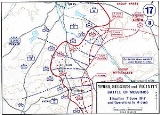
. The target of the offensive was a ridge running north from Messines village past Wytschaete village which created a natural stronghold southeast of Ypres
. One of the key features of the battle was the detonation of 19 mines immediately prior to the infantry assault, a tactic which disrupted German defences and allowed the advancing troops to secure their objectives in rapid fashion. The attack was also a prelude to the much larger Third Battle of Ypres, known as Passchendaele, which began on 11 July 1917.
would not succeed, General Douglas Haig
instructed the Second Army to undertake the operation to capture the Messines—Wytschaete Ridge, to force the Germans to move troops from the front at Vimy—Arras and as the prelude to a larger assault in the Ypres sector and ordered Plumer to proceed with the attack as soon as possible. The capture of Messines Ridge would give the British control of strategically important ground and flatten out the southern flank of the Ypres Salient
. This would reduce the manpower needed to maintain the front and reduce the German strategic and tactical advantages in the area.
trenches
and laid 22 mines totaling 455 tonnes of ammonal
explosive. Several compliments were given to the military geologists who planned the tunnels. “It was said that one reason for the great success of the British operations at Messines ridge, where fifty or more mines were exploded, was the skill of the geologist who planned their location; for in some cases they were so surrounded by quicksands that the Germans could not countermine. I cannot vouch for the truthfulness of this, but, knowing the men concerned, I believe it.” After the war, an examination of the lessons learned in military geology to reorganize the German Army also reviewed this incident: "Starting early in 1916 the British conducted a most extensive and persistent mining offensive against the “Wytschaete Salient”. After March 1916, they had the advice of two military geologists in this undertaking; sub-surface conditions here were especially complex: several different Tertiary and Quaternary formations with separate ground water tables made mining most troublesome, but the advice of the British geologists helped to overcome many technical difficulties. Starting from a long distance away, their sappers drifted galleries several hundred metres long (5454 m altogether) to points deep underneath the German front lines; moreover, they diverted the attention of German sappers from their deepest attack galleries by making countless secondary attacks using the upper mine galleries. Thus the military geologists on the British side proved themselves to be “indispensible and extremely valuable.” To solve the problem of wet soil, the tunnels were made in the layer of "blue clay
", 80–120 feet (25–30 m) below the surface. The galleries dug in order to lay these mines totalled over 8,000 metres in length, and had been constructed in the face of tenacious German counter-mining efforts. On several occasions, German tunnellers were within metres of large British mine "chambers". One mine was found by the Germans and the chamber was wrecked by a countermine.
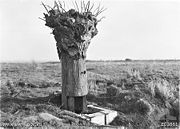
The largest of the 22 Messines mines was at Spanbroekmolen; the "Lone Tree Crater" formed by the blast was approximately 250 feet (80 m) in diameter and 40 feet (12 m) deep. The mine consisted of 41 tons of ammonal
explosive, in a chamber dug 88 feet (27 m) below ground.
The evening before the attack, General Plumer remarked to his staff, "Gentlemen, we may not make history tomorrow, but we shall certainly change the geography."
, commanded by Lietenant-General Sir Thomas Morland
with the 23rd, 47th, 41st Divisions and 24th Division
in reserve. In the centre was the British IX Corps commanded by Sir Alexander Hamilton-Gordon with 19th British, 16th Irish, 36th Ulster Divisions and 11th (Northern) Division in reserve. To the southeast, Lieutenant-General Sir Alexander Godley
commanded the II Anzac Corps
with 25th British
, 1st New Zealand
, 3rd Australian Divisions with 4th Australian Division in reserve. II Brigade, Heavy Branch Machine-Gun Corps was in support, mainly to attack on the flanks at Dam Strasse in the north and Messines in the south, while XIV Corps was held in reserve with Guards, 1st, 8th and 32nd Divisions.
Opposing Plumer's Second Army was Gruppe Wijtschate, under General Von Laffert of the German Fourth Army
, commanded by Friedrich Bertram Sixt von Armin
. To the northeast, the 204th (Wurrtemberg) and 35th divisions defended Hill 60 and Battle Wood. In the centre, the 2nd Division 40th (Saxon) and 3rd Bavarian Division
defended the Wijschatebogen (Messines and Wytschaete ridge). In the southeast, the southern banks of the River Douve were defended by the 4th Bavarian Division
. The German defenses relied on an "elastic" defense method; the front-lines were lightly defended, with defensive fortifications distributed up to half a mile behind the front line. A captured Corps Order from Gruppe Wijtshate received by Sir Douglas Haig on 1 June read,
while the British plan envisaged an advance to the 'Oosttaverne Line' a maximum depth of 3,000 yards.
 The plan for the attack on Messines Ridge called for heavy artillery fire before zero hour. At 03:00am, the mines would be detonated, followed by a frontal assault of nine infantry divisions aimed at securing the ridge. In the week before the attack, some 2,230 guns bombarded the German trenches and conducted counter-battery fire against the 630 German guns and howitzers (236 field guns, 108 field howitzers, 54 100mm-130mm guns, 24 150 mm guns, 174 medium howitzers, 40 heavy howitzers and four heavy 210mm and 240mm guns) with 3,561,530 shells. Equipped with new highly detailed maps of the battlefield, British artillery succeeded in destroying close to 90% of the German field-gun positions on Messines Ridge.The German Official Account records that by the morning of 7 June Gruppe Wytschaete had lost a quarter of its field artillery and half of its heavy artillery.
The 'blue line' was to be occupied by zero + 1.40 with a two hour pause. At zero + 3.40 the advance to the 'black line' would begin and consolidation was to start by zero + 5. Fresh troops would pass through to the attack on the Oosttaverne line at zero + 10. As soon as the black line was captured all guns were to be emplyed to bombard the Oosttaverne Line, on counter-battery fire and on a standing barrage before the black line. All tanks still operational were to join with the 24 held in reserve to support the infantry advance to the Oosttaverne line.
and Dublin. To make matters worse for the Germans, the explosions occurred while the front line troops were being relieved, meaning both groups (relieving and relieved) were caught in the blasts.
While determining the power of explosions is difficult, the 1917 Messines mines detonation was probably the largest planned explosion in history prior to the Trinity atomic weapon test in July 1945 and the largest non-nuclear planned explosion before the British explosive efforts on the Heligoland Islands
in April 1947. With approximately 10,000 killed, the Messines detonation is history's deadliest non-nuclear man-made explosion.
to fire a creeping barrage
of shrapnel immediately ahead of the advance, while the other field guns
and 4.5 inch howitzers
fired a standing barrage some 700 yards (640.1 m) further ahead. The standing barrage was aligned with German positions and lifted to the next target when the advance got within 400 yards (365.8 m) of it. As each objective was taken by the infantry, the creeping barrage would pause 150 to 300 yd (137.2 to 274.3 m) ahead of them and become a standing barrage, protecting the newly gained positions from counterattack while the infantry consolidated. During this time the pace of fire slackened to one round per gun a minute, enabling the guns and the crews a respite, before resuming full intensity as the barrage moved on. The heavy and super-heavy artillery fired on German rear areas and over 700 machine guns participated in the barrage, firing over the heads of the advancing troops.
, IX Corps and X Corps
advanced on the Messines salient from three sides. The front lines were overrun without opposition. German troops surrendered "in droves" and the first objectives had been secured almost entirely within three hours. Advancing on the southern flank, the New Zealand Division
captured the village of Messines
proper, despite intricate layers of fortifications beyond the front line.
In the centre, 5 kilometres (3.1 mi) further north, the 36th (Ulster) Division and 16th (Irish) Division advanced in tandem, the Irish capturing the village of Wytschaete and pushing forward to secure their objectives. Many considered this joint effort to be of considerable political significance, given the turmoil in Ireland at the time. The Irish Nationalist Party
MP Major William Redmond
was fatally wounded in this action. The most serious resistance was in the northern sector, where the 47th (1/2nd London) Division had to navigate the Ypres-Comines canal. This obstacle slowed the advance considerably but the Londoners had secured all their objectives by mid-morning and the goals of the first phase were achieved by 10:00am at all points on the line of attack.
Once the first objectives were secured, more than forty batteries of artillery were brought forward to support the second phase of the attack. Bombardment continued for several hours and at approximately 3:00pm the reserve divisions, supported by tank
s, advanced towards the second line of objectives. In just over an hour, all these were secured. At 11:00AM, German troops counterattacked at several points along the new British lines. Although British troops had had very little time to consolidate their positions, the German attacks were easily repulsed and ultimately resulted in further territorial gains. Heavy British artillery bombardments on 10 June meant that further counterattacks never materialized.
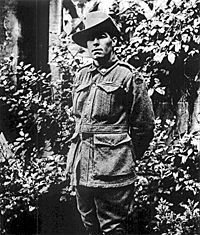
There were four Victoria Cross
es awarded during the battle, two in the Australian 3rd Division (to Private
John Carroll
and Captain Robert Cuthbert Grieve
), one in the New Zealand Division
(to Lance-Corporal Samuel Frickleton
) and one in the 25th Division
(to Private William Ratcliffe
).
 The operation was a great success. Meticulously planned and well executed, the assault secured its objectives in less than twelve hours, took 7,354 prisoners,48 guns, 218 machine-guns and 60 trench mortars for a relatively modest (by WWI standards) 24,562 casualties, 1 - 12 June. The German Official Account gives 23,000 casualties (less 'wounded likely to return to duty within a reasonable time' which the British Official Historian considered to amount to another 30%, although this has been disputed ever since) including 10,000 missing, 21 May - 10 June. The combination of tactics proven in other sectors—notably the use of mines, creeping barrages and small-unit tactics—allowed for surprise and rapid infantry advances. The offensive also secured the southern end of the Ypres salient in preparation for the offensive in that area.
Although the operation was successful, it had the effect of inflating expectations for the Passchendaele offensive. While Messines led Haig and other British commanders to believe that success could be had relatively cheaply in the main offensive as well, the circumstances of the operations were substantially different and attempts to apply similar tactics would result in a general failure.
Two of the 21 mines did not go off on time. On 17 July 1955, lightning set off one of these mines, killing a cow. The 21st mine—the mine abandoned as a result of its discovery by German counter-miners—is believed to have been found but no attempt has been made to remove it.
Western Front (World War I)
Following the outbreak of World War I in 1914, the German Army opened the Western Front by first invading Luxembourg and Belgium, then gaining military control of important industrial regions in France. The tide of the advance was dramatically turned with the Battle of the Marne...
of the First World War. It began on 7 June 1917 when the British
United Kingdom
The United Kingdom of Great Britain and Northern IrelandIn the United Kingdom and Dependencies, other languages have been officially recognised as legitimate autochthonous languages under the European Charter for Regional or Minority Languages...
Second Army under the command of General Herbert Plumer
Herbert Plumer, 1st Viscount Plumer
Field Marshal Herbert Charles Onslow Plumer, 1st Viscount Plumer, GCB, GCMG, GCVO, GBE was a British colonial official and soldier born in Torquay who commanded the British Second Army in World War I and later served as High Commissioner of the British Mandate for Palestine.-Military...
launched an offensive near the village of Mesen
Mesen
Mesen is a city located in the Belgian province of West Flanders. The municipality only comprises the town of Mesen proper. On January 1, 2006, Mesen had a total population of 988. The total area is 3.58 km² which gives a population density of 276 inhabitants per km².Mesen is the smallest city in...
(Messines) in West Flanders, Belgium
Belgium
Belgium , officially the Kingdom of Belgium, is a federal state in Western Europe. It is a founding member of the European Union and hosts the EU's headquarters, and those of several other major international organisations such as NATO.Belgium is also a member of, or affiliated to, many...
. The target of the offensive was a ridge running north from Messines village past Wytschaete village which created a natural stronghold southeast of Ypres
Ypres
Ypres is a Belgian municipality located in the Flemish province of West Flanders. The municipality comprises the city of Ypres and the villages of Boezinge, Brielen, Dikkebus, Elverdinge, Hollebeke, Sint-Jan, Vlamertinge, Voormezele, Zillebeke, and Zuidschote...
. One of the key features of the battle was the detonation of 19 mines immediately prior to the infantry assault, a tactic which disrupted German defences and allowed the advancing troops to secure their objectives in rapid fashion. The attack was also a prelude to the much larger Third Battle of Ypres, known as Passchendaele, which began on 11 July 1917.
Background
The assault on Messines Ridge was conceived in early 1916, as Plumer sought ways to break German control of important strategic locations in the Ypres area. When it became apparent that the French offensive on the River AisneSecond Battle of the Aisne
The Second Battle of the Aisne , was the massive main assault of the French military's Nivelle Offensive or Chemin des Dames Offensive in 1917 during World War I....
would not succeed, General Douglas Haig
Douglas Haig, 1st Earl Haig
Field Marshal Douglas Haig, 1st Earl Haig, KT, GCB, OM, GCVO, KCIE, ADC, was a British senior officer during World War I. He commanded the British Expeditionary Force from 1915 to the end of the War...
instructed the Second Army to undertake the operation to capture the Messines—Wytschaete Ridge, to force the Germans to move troops from the front at Vimy—Arras and as the prelude to a larger assault in the Ypres sector and ordered Plumer to proceed with the attack as soon as possible. The capture of Messines Ridge would give the British control of strategically important ground and flatten out the southern flank of the Ypres Salient
Ypres Salient
The Ypres Salient is the area around Ypres in Belgium which was the scene of some of the biggest battles in World War I.In military terms, a salient is a battlefield feature that projects into enemy territory. Therefore, the salient is surrounded by the enemy on three sides, making the troops...
. This would reduce the manpower needed to maintain the front and reduce the German strategic and tactical advantages in the area.
Mining operations
Co-ordinated by the tunnelling companies of the Royal Engineers, over a period beginning more than a year before the attack, Canadian, Australian, New Zealand and British engineers tunnelled under the GermanGerman Empire
The German Empire refers to Germany during the "Second Reich" period from the unification of Germany and proclamation of Wilhelm I as German Emperor on 18 January 1871, to 1918, when it became a federal republic after defeat in World War I and the abdication of the Emperor, Wilhelm II.The German...
trenches
Trench warfare
Trench warfare is a form of occupied fighting lines, consisting largely of trenches, in which troops are largely immune to the enemy's small arms fire and are substantially sheltered from artillery...
and laid 22 mines totaling 455 tonnes of ammonal
Ammonal
Ammonal is an explosive made up of ammonium nitrate, trinitrotoluene , and aluminium powder.The ammonium nitrate functions as an oxidizer and aluminium as a power enhancer. To some extent the aluminium makes it more sensitive to detonation...
explosive. Several compliments were given to the military geologists who planned the tunnels. “It was said that one reason for the great success of the British operations at Messines ridge, where fifty or more mines were exploded, was the skill of the geologist who planned their location; for in some cases they were so surrounded by quicksands that the Germans could not countermine. I cannot vouch for the truthfulness of this, but, knowing the men concerned, I believe it.” After the war, an examination of the lessons learned in military geology to reorganize the German Army also reviewed this incident: "Starting early in 1916 the British conducted a most extensive and persistent mining offensive against the “Wytschaete Salient”. After March 1916, they had the advice of two military geologists in this undertaking; sub-surface conditions here were especially complex: several different Tertiary and Quaternary formations with separate ground water tables made mining most troublesome, but the advice of the British geologists helped to overcome many technical difficulties. Starting from a long distance away, their sappers drifted galleries several hundred metres long (5454 m altogether) to points deep underneath the German front lines; moreover, they diverted the attention of German sappers from their deepest attack galleries by making countless secondary attacks using the upper mine galleries. Thus the military geologists on the British side proved themselves to be “indispensible and extremely valuable.” To solve the problem of wet soil, the tunnels were made in the layer of "blue clay
Clay
Clay is a general term including many combinations of one or more clay minerals with traces of metal oxides and organic matter. Geologic clay deposits are mostly composed of phyllosilicate minerals containing variable amounts of water trapped in the mineral structure.- Formation :Clay minerals...
", 80–120 feet (25–30 m) below the surface. The galleries dug in order to lay these mines totalled over 8,000 metres in length, and had been constructed in the face of tenacious German counter-mining efforts. On several occasions, German tunnellers were within metres of large British mine "chambers". One mine was found by the Germans and the chamber was wrecked by a countermine.
The largest of the 22 Messines mines was at Spanbroekmolen; the "Lone Tree Crater" formed by the blast was approximately 250 feet (80 m) in diameter and 40 feet (12 m) deep. The mine consisted of 41 tons of ammonal
Ammonal
Ammonal is an explosive made up of ammonium nitrate, trinitrotoluene , and aluminium powder.The ammonium nitrate functions as an oxidizer and aluminium as a power enhancer. To some extent the aluminium makes it more sensitive to detonation...
explosive, in a chamber dug 88 feet (27 m) below ground.
The evening before the attack, General Plumer remarked to his staff, "Gentlemen, we may not make history tomorrow, but we shall certainly change the geography."
Opposing forces
The assault on a 17,000 yard front was conducted by the three corps of Plumer's British Second Army. On the northern edge of the sector was British X CorpsX Corps (United Kingdom)
The X Corps was a British Army formation in the First World War and was later reformed in 1942 during the North African campaign of the Second World War as part of the Eighth Army.- First World War :...
, commanded by Lietenant-General Sir Thomas Morland
Thomas Morland
General Sir Thomas Lethbridge Napier Morland KCMG, DSO was a British general during the First World War.-Biography:Born in Montreal, Canada East, Morland was the son of Thomas Morland and Helen Servante...
with the 23rd, 47th, 41st Divisions and 24th Division
24th Division
In military terms, 24th Division may refer to:Infantry divisions:*24th Division *24th Reserve Division *24th Division *24th Rifle Division - now a Ukrainian Ground Forces brigade...
in reserve. In the centre was the British IX Corps commanded by Sir Alexander Hamilton-Gordon with 19th British, 16th Irish, 36th Ulster Divisions and 11th (Northern) Division in reserve. To the southeast, Lieutenant-General Sir Alexander Godley
Alexander Godley
General Sir Alexander John Godley GCB, KCMG was a First World War general, best known for his role as commander of the New Zealand Expeditionary Force...
commanded the II Anzac Corps
II Anzac Corps
The II ANZAC Corps was an Australian and New Zealand First World War army corps formed in Egypt in February 1916 as part of the reorganization of the Australian Imperial Force following the evacuation of Gallipoli in November 1915, under the command of William Birdwood...
with 25th British
25th Division (United Kingdom)
The 25th Division of the British Army was raised for the Third New Army during September 1914. It served on the Western Front for most of the First World War. The component units were assembled around Salisbury and moved to Aldershot in May 1915 to complete their training...
, 1st New Zealand
New Zealand Division
The New Zealand Division was a World War I infantry division formed in Egypt in January 1916 following the evacuation of Gallipoli. At the outbreak of war the New Zealand Expeditionary Force contained a single infantry brigade which was combined with the unattached Australian 4th Infantry Brigade...
, 3rd Australian Divisions with 4th Australian Division in reserve. II Brigade, Heavy Branch Machine-Gun Corps was in support, mainly to attack on the flanks at Dam Strasse in the north and Messines in the south, while XIV Corps was held in reserve with Guards, 1st, 8th and 32nd Divisions.
Opposing Plumer's Second Army was Gruppe Wijtschate, under General Von Laffert of the German Fourth Army
German Fourth Army
The 4th Army was a field army of Imperial Germany during World War I and of the Wehrmacht during World War II-World War I:At the outset of war, the Fourth Army, with the Fifth Army, formed the center of the German armies on the Western Front, moving through Luxembourg and Belgium in support of the...
, commanded by Friedrich Bertram Sixt von Armin
Friedrich Bertram Sixt von Armin
Friedrich Bertram Sixt von Armin was a German general during the First World War.- Early life :...
. To the northeast, the 204th (Wurrtemberg) and 35th divisions defended Hill 60 and Battle Wood. In the centre, the 2nd Division 40th (Saxon) and 3rd Bavarian Division
3rd Royal Bavarian Division
The 3rd Royal Bavarian Division was a unit of the Royal Bavarian Army which served alongside the Prussian Army as part of the Imperial German Army. The division was formed on November 27, 1815 as an Infantry Division of the Würzburg General Command...
defended the Wijschatebogen (Messines and Wytschaete ridge). In the southeast, the southern banks of the River Douve were defended by the 4th Bavarian Division
4th Royal Bavarian Division
The 4th Royal Bavarian Division was a unit of the Royal Bavarian Army which served alongside the Prussian Army as part of the Imperial German Army. The division was formed on November 27, 1815 as an Infantry Division of the Würzburg General Command...
. The German defenses relied on an "elastic" defense method; the front-lines were lightly defended, with defensive fortifications distributed up to half a mile behind the front line. A captured Corps Order from Gruppe Wijtshate received by Sir Douglas Haig on 1 June read,
- 2(a) The unconditional retention of the independent strong points, Wytschaete and Messines, is of increased importance for the domination of the whole Wytschaete salient. These strong points must therefore not fall even temporarily into the enemy's hands.
while the British plan envisaged an advance to the 'Oosttaverne Line' a maximum depth of 3,000 yards.
Battle
The 'blue line' was to be occupied by zero + 1.40 with a two hour pause. At zero + 3.40 the advance to the 'black line' would begin and consolidation was to start by zero + 5. Fresh troops would pass through to the attack on the Oosttaverne line at zero + 10. As soon as the black line was captured all guns were to be emplyed to bombard the Oosttaverne Line, on counter-battery fire and on a standing barrage before the black line. All tanks still operational were to join with the 24 held in reserve to support the infantry advance to the Oosttaverne line.
Detonation of the mines
At 02:50am on 7 June, the artillery bombardment ceased. Expecting an immediate infantry assault, German defenders returned to their forward positions. At 3:10am, the mines were detonated, killing approximately 10,000 German soldiers and destroying most of the fortifications on the ridge, as well as the village of Messines. Reports were made that the shockwave from the explosion was heard as far away as LondonLondon
London is the capital city of :England and the :United Kingdom, the largest metropolitan area in the United Kingdom, and the largest urban zone in the European Union by most measures. Located on the River Thames, London has been a major settlement for two millennia, its history going back to its...
and Dublin. To make matters worse for the Germans, the explosions occurred while the front line troops were being relieved, meaning both groups (relieving and relieved) were caught in the blasts.
While determining the power of explosions is difficult, the 1917 Messines mines detonation was probably the largest planned explosion in history prior to the Trinity atomic weapon test in July 1945 and the largest non-nuclear planned explosion before the British explosive efforts on the Heligoland Islands
Heligoland
Heligoland is a small German archipelago in the North Sea.Formerly Danish and British possessions, the islands are located in the Heligoland Bight in the south-eastern corner of the North Sea...
in April 1947. With approximately 10,000 killed, the Messines detonation is history's deadliest non-nuclear man-made explosion.
Artillery plan
Artillery fire resumed at the same moment as the explosion of the mines. The fireplan called for most of the 18-pounder field gunsOrdnance QF 18 pounder
The Ordnance QF 18 pounder, or simply 18-pounder Gun, was the standard British Army field gun of the World War I era. It formed the backbone of the Royal Field Artillery during the war, and was produced in large numbers. It was also used by British and Commonwealth Forces in all the main theatres,...
to fire a creeping barrage
Barrage (artillery)
A barrage is a line or barrier of exploding artillery shells, created by the co-ordinated aiming of a large number of guns firing continuously. Its purpose is to deny or hamper enemy passage through the line of the barrage, to attack a linear position such as a line of trenches or to neutralize...
of shrapnel immediately ahead of the advance, while the other field guns
Field artillery
Field artillery is a category of mobile artillery used to support armies in the field. These weapons are specialized for mobility, tactical proficiency, long range, short range and extremely long range target engagement....
and 4.5 inch howitzers
QF 4.5 inch Howitzer
The Ordnance QF 4.5 inch Howitzer was the standard British Empire field howitzer of the First World War era. It replaced the BL 5 inch Howitzer and equipped some 25% of the field artillery. It entered service in 1910 and remained in service through the interwar period and was last used in...
fired a standing barrage some 700 yards (640.1 m) further ahead. The standing barrage was aligned with German positions and lifted to the next target when the advance got within 400 yards (365.8 m) of it. As each objective was taken by the infantry, the creeping barrage would pause 150 to 300 yd (137.2 to 274.3 m) ahead of them and become a standing barrage, protecting the newly gained positions from counterattack while the infantry consolidated. During this time the pace of fire slackened to one round per gun a minute, enabling the guns and the crews a respite, before resuming full intensity as the barrage moved on. The heavy and super-heavy artillery fired on German rear areas and over 700 machine guns participated in the barrage, firing over the heads of the advancing troops.
Assault
Immediately after the mine explosions and closely following the creeping artillery barrage, British, Australian and New Zealand troops from the II ANZAC CorpsII Anzac Corps
The II ANZAC Corps was an Australian and New Zealand First World War army corps formed in Egypt in February 1916 as part of the reorganization of the Australian Imperial Force following the evacuation of Gallipoli in November 1915, under the command of William Birdwood...
, IX Corps and X Corps
X Corps (United Kingdom)
The X Corps was a British Army formation in the First World War and was later reformed in 1942 during the North African campaign of the Second World War as part of the Eighth Army.- First World War :...
advanced on the Messines salient from three sides. The front lines were overrun without opposition. German troops surrendered "in droves" and the first objectives had been secured almost entirely within three hours. Advancing on the southern flank, the New Zealand Division
New Zealand Division
The New Zealand Division was a World War I infantry division formed in Egypt in January 1916 following the evacuation of Gallipoli. At the outbreak of war the New Zealand Expeditionary Force contained a single infantry brigade which was combined with the unattached Australian 4th Infantry Brigade...
captured the village of Messines
Mesen
Mesen is a city located in the Belgian province of West Flanders. The municipality only comprises the town of Mesen proper. On January 1, 2006, Mesen had a total population of 988. The total area is 3.58 km² which gives a population density of 276 inhabitants per km².Mesen is the smallest city in...
proper, despite intricate layers of fortifications beyond the front line.
In the centre, 5 kilometres (3.1 mi) further north, the 36th (Ulster) Division and 16th (Irish) Division advanced in tandem, the Irish capturing the village of Wytschaete and pushing forward to secure their objectives. Many considered this joint effort to be of considerable political significance, given the turmoil in Ireland at the time. The Irish Nationalist Party
Irish Parliamentary Party
The Irish Parliamentary Party was formed in 1882 by Charles Stewart Parnell, the leader of the Nationalist Party, replacing the Home Rule League, as official parliamentary party for Irish nationalist Members of Parliament elected to the House of Commons at...
MP Major William Redmond
William Hoey Kearney Redmond
William Hoey Kearney Redmond was an Irish nationalist politician. He was a Member of Parliament in the Irish Parliamentary Party for 34 years, a land reform agitator imprisoned three times, a determined advocate of Irish Home Rule, a barrister and a First World War fatality.-Family background:He...
was fatally wounded in this action. The most serious resistance was in the northern sector, where the 47th (1/2nd London) Division had to navigate the Ypres-Comines canal. This obstacle slowed the advance considerably but the Londoners had secured all their objectives by mid-morning and the goals of the first phase were achieved by 10:00am at all points on the line of attack.
Once the first objectives were secured, more than forty batteries of artillery were brought forward to support the second phase of the attack. Bombardment continued for several hours and at approximately 3:00pm the reserve divisions, supported by tank
Tank
A tank is a tracked, armoured fighting vehicle designed for front-line combat which combines operational mobility, tactical offensive, and defensive capabilities...
s, advanced towards the second line of objectives. In just over an hour, all these were secured. At 11:00AM, German troops counterattacked at several points along the new British lines. Although British troops had had very little time to consolidate their positions, the German attacks were easily repulsed and ultimately resulted in further territorial gains. Heavy British artillery bombardments on 10 June meant that further counterattacks never materialized.
There were four Victoria Cross
Victoria Cross
The Victoria Cross is the highest military decoration awarded for valour "in the face of the enemy" to members of the armed forces of various Commonwealth countries, and previous British Empire territories....
es awarded during the battle, two in the Australian 3rd Division (to Private
Private (rank)
A Private is a soldier of the lowest military rank .In modern military parlance, 'Private' is shortened to 'Pte' in the United Kingdom and other Commonwealth countries and to 'Pvt.' in the United States.Notably both Sir Fitzroy MacLean and Enoch Powell are examples of, rare, rapid career...
John Carroll
John Carroll (VC)
John Carroll VC was an Australian recipient of the Victoria Cross, the highest and most prestigious award for gallantry in the face of the enemy that can be awarded to British and Commonwealth forces....
and Captain Robert Cuthbert Grieve
Robert Cuthbert Grieve
Robert Cuthbert Grieve VC was an Australian recipient of the Victoria Cross, the highest award for gallantry "in the face of the enemy", during the First World War...
), one in the New Zealand Division
New Zealand Division
The New Zealand Division was a World War I infantry division formed in Egypt in January 1916 following the evacuation of Gallipoli. At the outbreak of war the New Zealand Expeditionary Force contained a single infantry brigade which was combined with the unattached Australian 4th Infantry Brigade...
(to Lance-Corporal Samuel Frickleton
Samuel Frickleton
Samuel Frickleton VC was a non-commissioned officer in the New Zealand Expeditionary Force, and recipient of the Victoria Cross, the highest award of the British Commonwealth for gallantry "in the face of the enemy", during the First World War.-Biography:Frickleton was born in Slamannan,...
) and one in the 25th Division
25th Division (United Kingdom)
The 25th Division of the British Army was raised for the Third New Army during September 1914. It served on the Western Front for most of the First World War. The component units were assembled around Salisbury and moved to Aldershot in May 1915 to complete their training...
(to Private William Ratcliffe
William Ratcliffe
William Ratcliffe VC MM was an English recipient of the Victoria Cross, the highest and most prestigious award for gallantry in the face of the enemy that can be awarded to British and Commonwealth forces....
).
Aftermath
Although the operation was successful, it had the effect of inflating expectations for the Passchendaele offensive. While Messines led Haig and other British commanders to believe that success could be had relatively cheaply in the main offensive as well, the circumstances of the operations were substantially different and attempts to apply similar tactics would result in a general failure.
Two of the 21 mines did not go off on time. On 17 July 1955, lightning set off one of these mines, killing a cow. The 21st mine—the mine abandoned as a result of its discovery by German counter-miners—is believed to have been found but no attempt has been made to remove it.
See also
- Western Front (World War I)Western Front (World War I)Following the outbreak of World War I in 1914, the German Army opened the Western Front by first invading Luxembourg and Belgium, then gaining military control of important industrial regions in France. The tide of the advance was dramatically turned with the Battle of the Marne...
- Third Battle of Ypres
- Ronald SkirthRonald SkirthJohn Ronald Skirth served in the Royal Garrison Artillery during the First World War. His experiences during the Battle of Messines and the Battle of Passchendaele led him to resolve not to take human life, and for the rest of his army service he made deliberate errors in targeting calculations...
, British pacifist artilleryman, vowed not to take another human life after the Battle of Messines
Further reading
- Bean, C.E.W.; "The Battle of Messines", Chapter 15 in The Official History of Australia in the War of 1914–1918, Vol IV, The AIF in France: 1917, 1941.
- Passingham, Ian; Pillars of Fire: the Battle of Messines Ridge, June 1917, 1998.
- Stewart, H; "The Battle of Messines", Chapter V in The New Zealand Division 1916–1919: A Popular History based on Official Records, 1921.
External links
- No Man's Land The European Group for Great War Archaeology, "Plug Street Project" : Report on Archaeological Excavations in St Yvon area. 2007
- The Plugstreet Archaeology Project http://www.plugstreet-archaeology.com
- The Battle for Messines Ridge
- First World War.com - A more detailed overview of the battle with links to present day pictures of the battlefield
- An account of the experiences of an ordinary soldier at Messines ridge, as recounted in his letters home
- Battle for Messines (NZHistory.net.nz) includes film and interactive showing the creeping barrage
- Farmer who is sitting on a bomb - The Daily TelegraphThe Daily TelegraphThe Daily Telegraph is a daily morning broadsheet newspaper distributed throughout the United Kingdom and internationally. The newspaper was founded by Arthur B...
- WWI underground: Unearthing the hidden tunnel war BBC News (10 June 2011)