

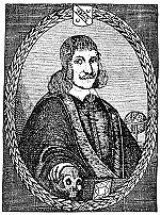
Nicholas Culpeper

Encyclopedia
Nicholas Culpeper was an English
botanist
, herbalist
, physician
, and astrologer
. His published books include The English Physician (1652) and the Complete Herbal (1653), which contain a rich store of pharmaceutical and herbal knowledge, and Astrological Judgement of Diseases from the Decumbiture of the Sick (1655), which is one of the most detailed documents we have on the practice of medical astrology
in Early Modern Europe
.
Culpeper spent the greater part of his life in the English outdoors cataloging hundreds of medicinal herbs. He criticized what he considered the unnatural methods of his contemporaries, writing: "This not being pleasing, and less profitable to me, I consulted with my two brothers, DR. REASON and DR. EXPERIENCE, and took a voyage to visit my mother NATURE, by whose advice, together with the help of Dr. DILIGENCE, I at last obtained my desire; and, being warned by MR. HONESTY, a stranger in our days, to publish it to the world, I have done it."
Culpeper came from a long line of notable people including Thomas Culpeper
, the lover of Catherine Howard (also a distant relative) who was sentenced to death by Catherine's husband, King Henry VIII.
man. Culpeper studied at Cambridge
, and afterwards became apprenticed to an apothecary
. After seven years his master absconded with the money paid for the indenture, and soon after this, Culpeper's mother died of breast cancer. Culpeper married the daughter of a wealthy merchant, which allowed him to set up a pharmacy
in the halfway house
in Spitalfields
, London, outside the authority of the City of London
at a time when medical facilities in London were at breaking point. Arguing that "no man deserved to starve to pay an insulting, insolent physician", and obtaining his herbal supplies from the nearby countryside, Culpeper was able to provide his services for free. This, and a willingness to examine patients in person rather than simply examining their urine (in his opinion, "as much piss as the Thames might hold" did not help in diagnosis), Culpeper was extremely active, sometimes seeing as many as forty people in one morning. Using a combination of experience and astrology
, Culpeper devoted himself to using herbals to treat the illnesses of his patients.
During the early months of the English Civil War
he was accused of witchcraft and the Society of Apothecaries tried to rein in his practice. Alienated and radicalised he joined a trainband
in August 1643 and fought at the First Battle of Newbury
, where he carried out battlefield surgery
. Culpeper was taken back to London after sustaining a serious chest injury from which he never recovered. There, in co-operation with the Republican astrologer
William Lilly
, he wrote the work 'A Prophesy of the White King', which predicted the king’s death.
He died of tuberculosis
in London
on 10 January 1654 at the age of 38. Only one of his eight children, Mary, survived to adulthood.
, who said no authority was above question, Culpeper became a radical republican
and opposed the "closed shop" of medicine enforced by the censors of the College of Physicians. In his youth, Culpeper translated medical and herbal texts such as the 'London Pharmacopaeia' from the Latin
for his master. It was during the political turmoil of the English civil war
, when the College of Physicians was unable to enforce their ban on the publication of medical texts, that Culpeper deliberately chose to publish his translations in vernacular English
as self-help medical guides for use by the poor who could not afford the medical help of expensive physicians. Follow-up publications included a manual on childbirth
and his main work, 'The English Physician', which was deliberately sold very cheaply, eventually becoming available as far afield as colonial America
. It is the most successful non-religious English text ever, and has been in print continuously since the 17th century.
Culpeper believed medicine was a public asset rather than a commercial secret, and the prices physicians charged were far too expensive compared to the cheap and universal availability of nature's medicine. He felt the use of Latin and expensive fees charged by doctors, lawyers and priests worked to keep power and freedom from the general public.
Culpeper was a radical in his time, angering his fellow physicians by condemning their greed, unwillingness to stray from Galen
and their use of harmful practices such as toxic remedies and bloodletting
. The Society of Apothecaries were similarly incensed by the fact that he suggested cheap herbal remedies as opposed to their expensive concoctions. His influence is demonstrated by the existence of a chain of "Culpeper" herb and spice shops in the United Kingdom
, India
and beyond, and by the continued popularity of his remedies among New Age and alternative holistic medicine practitioners.
Culpeper's emphasis on reason rather than tradition is reflected in the introduction to his Complete Herbal, though his definition of reason was not that different from the Romantic philosophies of the era presenting nature as refuge. Culpeper paired the plants and diseases with planetary influences, countering illnesses with nostroms that were paired with an opposing planetary influence. Combining remedial care with Galen
ic humoral philosophy and questionable astrology, he forged a strangely workable system of medicine; combined with his "Singles" forceful commentaries, Culpeper was a widely read source for medical treatment in his time.
from England. Culpeper also described the medical use of foxglove, the botanical precursor to digitalis
, used to treat heart conditions.
Nicholas is famously featured as main protagonist in Rudyard Kipling
's story "Doctor of Medicine", part of "Puck of Pook's Hill
" series.
England
England is a country that is part of the United Kingdom. It shares land borders with Scotland to the north and Wales to the west; the Irish Sea is to the north west, the Celtic Sea to the south west, with the North Sea to the east and the English Channel to the south separating it from continental...
botanist
Botany
Botany, plant science, or plant biology is a branch of biology that involves the scientific study of plant life. Traditionally, botany also included the study of fungi, algae and viruses...
, herbalist
Herbalist
An herbalist is:#A person whose life is dedicated to the economic or medicinal uses of plants.#One skilled in the harvesting and collection of medicinal plants ....
, physician
Physician
A physician is a health care provider who practices the profession of medicine, which is concerned with promoting, maintaining or restoring human health through the study, diagnosis, and treatment of disease, injury and other physical and mental impairments...
, and astrologer
Astrology
Astrology consists of a number of belief systems which hold that there is a relationship between astronomical phenomena and events in the human world...
. His published books include The English Physician (1652) and the Complete Herbal (1653), which contain a rich store of pharmaceutical and herbal knowledge, and Astrological Judgement of Diseases from the Decumbiture of the Sick (1655), which is one of the most detailed documents we have on the practice of medical astrology
Medical astrology
Medical astrology is an ancient medical system that associates various parts of the body, diseases, and drugs as under the influence of the sun, moon, and planets, along with the twelve astrological signs. Each of the astrological signs is associated with different parts of the human body...
in Early Modern Europe
Early modern Europe
Early modern Europe is the term used by historians to refer to a period in the history of Europe which spanned the centuries between the end of the Middle Ages and the beginning of the Industrial Revolution, roughly the late 15th century to the late 18th century...
.
Culpeper spent the greater part of his life in the English outdoors cataloging hundreds of medicinal herbs. He criticized what he considered the unnatural methods of his contemporaries, writing: "This not being pleasing, and less profitable to me, I consulted with my two brothers, DR. REASON and DR. EXPERIENCE, and took a voyage to visit my mother NATURE, by whose advice, together with the help of Dr. DILIGENCE, I at last obtained my desire; and, being warned by MR. HONESTY, a stranger in our days, to publish it to the world, I have done it."
Culpeper came from a long line of notable people including Thomas Culpeper
Thomas Culpeper
Sir Thomas Culpeper was a courtier of Henry VIII and the lover of Henry's fifth queen, Catherine Howard. He was born to Alexander Culpeper of Bedgebury, to the south of Maidstone in Kent, and his second wife, Constance Harper. He was the middle child and his older brother, also named Thomas, was a...
, the lover of Catherine Howard (also a distant relative) who was sentenced to death by Catherine's husband, King Henry VIII.
Biography
Culpeper was the son of Nicholas Culpeper (Senior), a clergyClergy
Clergy is the generic term used to describe the formal religious leadership within a given religion. A clergyman, churchman or cleric is a member of the clergy, especially one who is a priest, preacher, pastor, or other religious professional....
man. Culpeper studied at Cambridge
Cambridge
The city of Cambridge is a university town and the administrative centre of the county of Cambridgeshire, England. It lies in East Anglia about north of London. Cambridge is at the heart of the high-technology centre known as Silicon Fen – a play on Silicon Valley and the fens surrounding the...
, and afterwards became apprenticed to an apothecary
Apothecary
Apothecary is a historical name for a medical professional who formulates and dispenses materia medica to physicians, surgeons and patients — a role now served by a pharmacist and some caregivers....
. After seven years his master absconded with the money paid for the indenture, and soon after this, Culpeper's mother died of breast cancer. Culpeper married the daughter of a wealthy merchant, which allowed him to set up a pharmacy
Pharmacy
Pharmacy is the health profession that links the health sciences with the chemical sciences and it is charged with ensuring the safe and effective use of pharmaceutical drugs...
in the halfway house
Halfway house
The purpose of a halfway house, also called a recovery house or sober house, is generally to allow people to begin the process of reintegration with society, while still providing monitoring and support; this is generally believed to reduce the risk of recidivism or relapse when compared to a...
in Spitalfields
Spitalfields
Spitalfields is a former parish in the borough of Tower Hamlets, in the East End of London, near to Liverpool Street station and Brick Lane. The area straddles Commercial Street and is home to many markets, including the historic Old Spitalfields Market, founded in the 17th century, Sunday...
, London, outside the authority of the City of London
City of London
The City of London is a small area within Greater London, England. It is the historic core of London around which the modern conurbation grew and has held city status since time immemorial. The City’s boundaries have remained almost unchanged since the Middle Ages, and it is now only a tiny part of...
at a time when medical facilities in London were at breaking point. Arguing that "no man deserved to starve to pay an insulting, insolent physician", and obtaining his herbal supplies from the nearby countryside, Culpeper was able to provide his services for free. This, and a willingness to examine patients in person rather than simply examining their urine (in his opinion, "as much piss as the Thames might hold" did not help in diagnosis), Culpeper was extremely active, sometimes seeing as many as forty people in one morning. Using a combination of experience and astrology
Astrology
Astrology consists of a number of belief systems which hold that there is a relationship between astronomical phenomena and events in the human world...
, Culpeper devoted himself to using herbals to treat the illnesses of his patients.
During the early months of the English Civil War
English Civil War
The English Civil War was a series of armed conflicts and political machinations between Parliamentarians and Royalists...
he was accused of witchcraft and the Society of Apothecaries tried to rein in his practice. Alienated and radicalised he joined a trainband
Trainband
Trainbands were companies of militia in England or the Americas, first organized in the 16th century and dissolved in the 18th. The term was used after this time to describe the London militia. In the early American colonies the trainband was the most basic tactical unit. However, no standard...
in August 1643 and fought at the First Battle of Newbury
First Battle of Newbury
The First Battle of Newbury was a battle of the First English Civil War that was fought on 20 September 1643 between a Royalist army, under the personal command of King Charles, and a Parliamentarian force led by the Earl of Essex...
, where he carried out battlefield surgery
Battlefield medicine
Battlefield medicine, also called field surgery and later combat casualty care, is the treatment of wounded soldiers in or near an area of combat. Civilian medicine has been greatly advanced by procedures that were first developed to treat the wounds inflicted during combat...
. Culpeper was taken back to London after sustaining a serious chest injury from which he never recovered. There, in co-operation with the Republican astrologer
Astrologer
An astrologer practices one or more forms of astrology. Typically an astrologer draws a horoscope for the time of an event, such as a person's birth, and interprets celestial points and their placements at the time of the event to better understand someone, determine the auspiciousness of an...
William Lilly
William Lilly
William Lilly , was an English astrologer famed during his time. Lilly was particularly adept at interpreting the astrological charts drawn up for horary questions, as this was his speciality....
, he wrote the work 'A Prophesy of the White King', which predicted the king’s death.
He died of tuberculosis
Tuberculosis
Tuberculosis, MTB, or TB is a common, and in many cases lethal, infectious disease caused by various strains of mycobacteria, usually Mycobacterium tuberculosis. Tuberculosis usually attacks the lungs but can also affect other parts of the body...
in London
London
London is the capital city of :England and the :United Kingdom, the largest metropolitan area in the United Kingdom, and the largest urban zone in the European Union by most measures. Located on the River Thames, London has been a major settlement for two millennia, its history going back to its...
on 10 January 1654 at the age of 38. Only one of his eight children, Mary, survived to adulthood.
Political beliefs
Influenced during his apprenticeship by the radical preacher John GoodwinJohn Goodwin (preacher)
John Goodwin was an English preacher, theologian and prolific author of significant books.-Early life:Goodwin was born in Norfolk and educated at Queens' College, Cambridge, where he graduated M.A. and obtained a fellowship on 10 November 1617. He left the university and married, took orders and...
, who said no authority was above question, Culpeper became a radical republican
Republicanism
Republicanism is the ideology of governing a nation as a republic, where the head of state is appointed by means other than heredity, often elections. The exact meaning of republicanism varies depending on the cultural and historical context...
and opposed the "closed shop" of medicine enforced by the censors of the College of Physicians. In his youth, Culpeper translated medical and herbal texts such as the 'London Pharmacopaeia' from the Latin
Latin
Latin is an Italic language originally spoken in Latium and Ancient Rome. It, along with most European languages, is a descendant of the ancient Proto-Indo-European language. Although it is considered a dead language, a number of scholars and members of the Christian clergy speak it fluently, and...
for his master. It was during the political turmoil of the English civil war
English Civil War
The English Civil War was a series of armed conflicts and political machinations between Parliamentarians and Royalists...
, when the College of Physicians was unable to enforce their ban on the publication of medical texts, that Culpeper deliberately chose to publish his translations in vernacular English
English language
English is a West Germanic language that arose in the Anglo-Saxon kingdoms of England and spread into what was to become south-east Scotland under the influence of the Anglian medieval kingdom of Northumbria...
as self-help medical guides for use by the poor who could not afford the medical help of expensive physicians. Follow-up publications included a manual on childbirth
Childbirth
Childbirth is the culmination of a human pregnancy or gestation period with the birth of one or more newborn infants from a woman's uterus...
and his main work, 'The English Physician', which was deliberately sold very cheaply, eventually becoming available as far afield as colonial America
United States
The United States of America is a federal constitutional republic comprising fifty states and a federal district...
. It is the most successful non-religious English text ever, and has been in print continuously since the 17th century.
Culpeper believed medicine was a public asset rather than a commercial secret, and the prices physicians charged were far too expensive compared to the cheap and universal availability of nature's medicine. He felt the use of Latin and expensive fees charged by doctors, lawyers and priests worked to keep power and freedom from the general public.
Culpeper was a radical in his time, angering his fellow physicians by condemning their greed, unwillingness to stray from Galen
Galen
Aelius Galenus or Claudius Galenus , better known as Galen of Pergamon , was a prominent Roman physician, surgeon and philosopher...
and their use of harmful practices such as toxic remedies and bloodletting
Bloodletting
Bloodletting is the withdrawal of often little quantities of blood from a patient to cure or prevent illness and disease. Bloodletting was based on an ancient system of medicine in which blood and other bodily fluid were considered to be "humors" the proper balance of which maintained health...
. The Society of Apothecaries were similarly incensed by the fact that he suggested cheap herbal remedies as opposed to their expensive concoctions. His influence is demonstrated by the existence of a chain of "Culpeper" herb and spice shops in the United Kingdom
United Kingdom
The United Kingdom of Great Britain and Northern IrelandIn the United Kingdom and Dependencies, other languages have been officially recognised as legitimate autochthonous languages under the European Charter for Regional or Minority Languages...
, India
India
India , officially the Republic of India , is a country in South Asia. It is the seventh-largest country by geographical area, the second-most populous country with over 1.2 billion people, and the most populous democracy in the world...
and beyond, and by the continued popularity of his remedies among New Age and alternative holistic medicine practitioners.
Philosophy of herbalism
Culpeper attempted to make medical treatments more accessible to laypersons by educating them about maintaining their health. Ultimately his ambition was to reform the system of medicine by questioning traditional methods and knowledge and exploring new solutions for ill health. The systematisation of the use of herbals by Culpeper was a key development in the evolution of modern pharmaceuticals, most of which originally had herbal origins.Culpeper's emphasis on reason rather than tradition is reflected in the introduction to his Complete Herbal, though his definition of reason was not that different from the Romantic philosophies of the era presenting nature as refuge. Culpeper paired the plants and diseases with planetary influences, countering illnesses with nostroms that were paired with an opposing planetary influence. Combining remedial care with Galen
Galen
Aelius Galenus or Claudius Galenus , better known as Galen of Pergamon , was a prominent Roman physician, surgeon and philosopher...
ic humoral philosophy and questionable astrology, he forged a strangely workable system of medicine; combined with his "Singles" forceful commentaries, Culpeper was a widely read source for medical treatment in his time.
Legacy
Culpeper's translations and approach to using herbals have had an extensive impact on medicine in early North American colonies, and even modern medications. Culpeper was one of the first to translate documents discussing medicinal plants found in the Americas from Latin. In addition, his Herbal was held in such esteem that species he described were introduced into the New WorldNew World
The New World is one of the names used for the Western Hemisphere, specifically America and sometimes Oceania . The term originated in the late 15th century, when America had been recently discovered by European explorers, expanding the geographical horizon of the people of the European middle...
from England. Culpeper also described the medical use of foxglove, the botanical precursor to digitalis
Digitalis
Digitalis is a genus of about 20 species of herbaceous perennials, shrubs, and biennials that are commonly called foxgloves. This genus was traditionally placed in the figwort family Scrophulariaceae, but recent reviews of phylogenetic research have placed it in the much enlarged family...
, used to treat heart conditions.
Nicholas is famously featured as main protagonist in Rudyard Kipling
Rudyard Kipling
Joseph Rudyard Kipling was an English poet, short-story writer, and novelist chiefly remembered for his celebration of British imperialism, tales and poems of British soldiers in India, and his tales for children. Kipling received the 1907 Nobel Prize for Literature...
's story "Doctor of Medicine", part of "Puck of Pook's Hill
Puck of Pook's Hill
Puck of Pook's Hill is a historical fantasy book by Rudyard Kipling, published in 1906, containing a series of short stories set in different periods of English history. The stories are all narrated to two children living near Burwash, in the area of Kipling's own house Bateman's, by people...
" series.
Examples from The English Physician
The following herbs, their uses and preparations are discussed in The English Physitian.- AnemoneAnemoneAnemone , is a genus of about 120 species of flowering plants in the buttercup family Ranunculaceae in the north and south temperate zones...
, as a juice applied externally to clean ulcerations, infections and cure leprosy or inhaled to clear the nostrils. - Bedstraw, boiled in oil and applied externally as a stimulant, consumed as an aphrodisiacAphrodisiacAn aphrodisiac is a substance that increases sexual desire. The name comes from Aphrodite, the Greek goddess of sexuality and love. Throughout history, many foods, drinks, and behaviors have had a reputation for making sex more attainable and/or pleasurable...
, or externally raw to stimulate clottingCoagulationCoagulation is a complex process by which blood forms clots. It is an important part of hemostasis, the cessation of blood loss from a damaged vessel, wherein a damaged blood vessel wall is covered by a platelet and fibrin-containing clot to stop bleeding and begin repair of the damaged vessel...
. - BurdockBurdockBurdock is any of a group of biennial thistles in the genus Arctium, family Asteraceae. Native to the Old World, several species have been widely introduced worldwide....
, crushed and mixed with salt, useful in treating dog bites, and taken inwardly to help pass flatulenceFlatulenceFlatulence is the expulsion through the rectum of a mixture of gases that are byproducts of the digestion process of mammals and other animals. The medical term for the mixture of gases is flatus, informally known as a fart, or simply gas...
, an analgesicAnalgesicAn analgesic is any member of the group of drugs used to relieve pain . The word analgesic derives from Greek an- and algos ....
for tooth pain and to strengthen the back. - Cottonweed, boiled in lye can be used to treat head liceHead louseThe head louse is an obligate ectoparasite of humans. Head lice are wingless insects spending their entire life on human scalp and feeding exclusively on human blood...
or infestations in cloth or clothing. Inhaled, it acts as an analgesic for headaches and reduces coughing. - DittanyDittanyDittany can refer to three different plants, the first two with similar medical properties, the second two closely related:* Dictamnus albus of the rue family...
, as an abortifacientAbortifacientAn abortifacient is a substance that induces abortion. Abortifacients for animals that have mated undesirably are known as mismating shots....
, to induce labourInduction (birth)Labor induction is a method of artificially or prematurely stimulating childbirth in a woman.-Indications:Common suggested reasons for induction include:* Postterm pregnancy, i.e. if the pregnancy has gone past the 42 week mark....
, as a treatment for poisoned weapons, to draw out splinters and broken bones, and the smell drives away 'venomous beasts'. - FleabaneFleabaneFleabane is a common name for some flowering plants in the family Asteraceae.Most are in the subfamily Asteroideae:* Conyza * Erigeron * Inula...
, helps with bites from 'venomous beasts' and its smoke can kill gnats and fleas. Can be dangerous for pregnant women. - HelleboreHelleboreCommonly known as hellebores, members of the genus Helleborus comprise approximately 20 species of herbaceous perennial flowering plants in the family Ranunculaceae, within which it gave its name to the tribe of Helleboreae...
, causes sneezing if ground and inhaled, kills rodents if mixed with food. - Mugwort, induces labour, assists in birth and afterbirth and eases labour pains.
- PennyroyalPennyroyalPennyroyal refers to two plants in the mint family, Lamiaceae. For the American species, see American pennyroyal. The European pennyroyal, Mentha pulegium, , is a plant in the mint genus, within the family Lamiaceae. Crushed Pennyroyal leaves exhibit a very strong fragrance similar to spearmint...
, strengthens the backs of women, assists with vertigoVertigo (medical)Vertigo is a type of dizziness, where there is a feeling of motion when one is stationary. The symptoms are due to a dysfunction of the vestibular system in the inner ear...
and helps expel gas. - Savory, help expel gas, excellent mixed with peas and beans for this reason.
- Wood BetonyStachys officinalisStachys officinalis, is commonly known as Purple Betony, Betaine , Betonie , Bishopwort, Lousewort, Wild hop, Wood betony , or Bishop's wort....
, helps with 'falling sicknessEpilepsyEpilepsy is a common chronic neurological disorder characterized by seizures. These seizures are transient signs and/or symptoms of abnormal, excessive or hypersynchronous neuronal activity in the brain.About 50 million people worldwide have epilepsy, and nearly two out of every three new cases...
' and headaches, anti-anoreticAnorexia (symptom)Anorexia is the decreased sensation of appetite...
, 'helps sour belchings', cramps, convulsions, bruises, afterbirth and goutGoutGout is a medical condition usually characterized by recurrent attacks of acute inflammatory arthritis—a red, tender, hot, swollen joint. The metatarsal-phalangeal joint at the base of the big toe is the most commonly affected . However, it may also present as tophi, kidney stones, or urate...
, and kills worms.
Partial list of works
- A Physical Directory, or a Translation of the London Directory (1649) - translation of the Pharmacopoeia Londonesis of the Royal College of Physicians.
- Directory for Midwives (1651)
- Semeiotics Uranica, or (An Astrological Judgement of Diseases) (1651)
- Catastrophe Magnatum or (The Fall of Monarchy) (1652)
- The English Physitian (1652)
- The Complete Herbal (1653)
- Astrological Judgement of Diseases from the Decumbiture of the Sick (1655)
- A Treatise on Aururn Potabile (1656)
See also
- Alternative medicineAlternative medicineAlternative medicine is any healing practice, "that does not fall within the realm of conventional medicine." It is based on historical or cultural traditions, rather than on scientific evidence....
- HerbalismHerbalismHerbalism is a traditional medicinal or folk medicine practice based on the use of plants and plant extracts. Herbalism is also known as botanical medicine, medical herbalism, herbal medicine, herbology, herblore, and phytotherapy...
- Medical astrologyMedical astrologyMedical astrology is an ancient medical system that associates various parts of the body, diseases, and drugs as under the influence of the sun, moon, and planets, along with the twelve astrological signs. Each of the astrological signs is associated with different parts of the human body...
- History of scienceHistory of scienceThe history of science is the study of the historical development of human understandings of the natural world and the domains of the social sciences....
- MedicationMedicationA pharmaceutical drug, also referred to as medicine, medication or medicament, can be loosely defined as any chemical substance intended for use in the medical diagnosis, cure, treatment, or prevention of disease.- Classification :...
- PharmacognosyPharmacognosyPharmacognosy is the study of medicines derived from natural sources. The American Society of Pharmacognosy defines pharmacognosy as "the study of the physical, chemical, biochemical and biological properties of drugs, drug substances or potential drugs or drug substances of natural origin as well...
- List of plants in The English Physitian (1652 book)