
All Topics  
Burdock

 
Burdock

   Email Print
   Bookmark   Link


Burdock


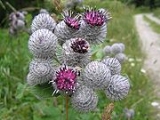
Burdock is any of a group of biennial
Biennial plant

A biennial plant is a flowering plant that takes two years to complete its biological lifecycle. In the first year the plant grows leaves, stems, and roots , then it enters a period of dormancy over the colder months....
 thistle
Thistle

Thistle is the common name of a group of flowering plants characterised by leaf with sharp prickles on the margins, mostly in the plant family Asteraceae....
s in the genus
Genus

A genus is a low-level taxonomic rank used in the classification of living and fossil organisms. The taxonomic ranks are domain , kingdom , phylum, class , order , family , genus, and species....
 Arctium, family Asteraceae. Native to the Old World
Old World

The Old World consists of those parts of Earth known to Europeans, Asians, and Africans in the 15th century....
, several species have been widely introduced worldwide.

Plants of the genus Arctium have dark green leaves that can grow up to 18" (45 cm) long. They are generally large, coarse and ovate, with the lower ones being heart-shaped. They are woolly underneath. The leafstalks are generally hollow.


Discussion
Ask a question about 'Burdock'
Start a new discussion about 'Burdock'
Answer questions from other users
Full Discussion Forum


Recent Posts


Encyclopedia


Burdock is any of a group of biennial
Biennial plant

A biennial plant is a flowering plant that takes two years to complete its biological lifecycle. In the first year the plant grows leaves, stems, and roots , then it enters a period of dormancy over the colder months....
 thistle
Thistle

Thistle is the common name of a group of flowering plants characterised by leaf with sharp prickles on the margins, mostly in the plant family Asteraceae....
s in the genus
Genus

A genus is a low-level taxonomic rank used in the classification of living and fossil organisms. The taxonomic ranks are domain , kingdom , phylum, class , order , family , genus, and species....
 Arctium, family Asteraceae. Native to the Old World
Old World

The Old World consists of those parts of Earth known to Europeans, Asians, and Africans in the 15th century....
, several species have been widely introduced worldwide.

Plants of the genus Arctium have dark green leaves that can grow up to 18" (45 cm) long. They are generally large, coarse and ovate, with the lower ones being heart-shaped. They are woolly underneath. The leafstalks are generally hollow. Arctium species generally flower from July through to October.

The prickly heads of these plants are noted for easily catching on to fur and clothing (being the inspiration for Velcro
Velcro

Velcro is a brand name of fabric hook-and-loop fasteners. It consists of two layers: a "hook" side, which is a piece of fabric covered with tiny hooks, and a "loop" side, which is covered with even smaller and "hairier" loops....
), thus providing an excellent mechanism for seed dispersal
Seed dispersal

Seed dispersal is the movement or transport of seeds away from the parent plant. Plants have limited mobility and consequently rely upon a variety of dispersal vectors to transport their propagules, including both abiotic and biotic vectors....
. Burr
Burr (fruit)

A burr is a seed or dry fruit in which the seeds bear hooks or teeth which attach themselves to fur or clothing of passing animals or people....
s cause local irritation and can possibly cause intestinal hairballs in pets. However, most animals avoid ingesting these plants.

A large number of species have been placed in genus Arctium at one time or another, but most of them are now classified in the related genus Cousinia
Cousinia

The genus Cousinia of the tribe Cardueae is in its current circumscription one ofthe larger genera in the Asteraceae, with approximately 600-700 species distributed in central and western Asia....
. The precise limits between Arctium and Cousinia are hard to define; there is an exact correlation between their molecular phylogeny. The burdocks are sometimes confused with the cocklebur
Cocklebur

Cockleburs are a genus of flowering plants in the family Asteraceae, native to the Americas and eastern Asia.They are coarse, herbaceous annual plants growing to 50-120 cm tall....
s (genus Xanthium) and rhubarb
Rhubarb

Rheum is a genus of perennial plants that grows from thick short rhizomes. The genus is in the family Polygonaceae, and includes the vegetable rhubarb The plants have large leaf that are somewhat triangular shaped with long fleshy Petiole s....
 (genus Rheum).

The root
Root

In vascular plants, the root is the organ of a plant body that typically lies below the surface of the soil. This is not always the case, however, since a root can also be aerial root or aerating ....
s of burdock, among other plants, are eaten by the larva
Larva

A larva is a young form of animal with indirect developmental biology, going through or undergoing metamorphosis .The larva can look completely different from the adult form, for example, a caterpillar differs from a butterfly....
 of the Ghost Moth
Ghost Moth

The Ghost Moth , also known as the Ghost Swift, is a moth of the family Hepialidae. It is common throughout Europe except for the far south-east....
 (Hepialus humuli). The plant is used as a food plant by other Lepidoptera
Lepidoptera

Lepidoptera is an order of insect that includes moths and butterfly. It is one of the most speciose orders in the class Insecta, encompassing moths and the three superfamilies of butterfly, skipper , and Hedylidae....
 including Brown-tail
Brown-tail

The Brown-tail is a moth of the family Lymantriidae. It is distributed throughout Europe.The wings of this species are pure white, as is the body, apart from a tuft of brown hairs at the end of the abdomen....
, Coleophora paripennella
Coleophora

Coleophora is a very large genus of moths of the family Coleophoridae with around 1000 described species. The genus is represented on all continents but the majority are found in the Nearctic and Palaearctic regions....
, Coleophora peribenanderi
Coleophora

Coleophora is a very large genus of moths of the family Coleophoridae with around 1000 described species. The genus is represented on all continents but the majority are found in the Nearctic and Palaearctic regions....
, The Gothic
Gothic (moth)

The Gothic is a moth of the family Noctuidae. It is distributed throughout most of Europe.This species has a wingspan of 36?46 mm. The forewings are broader than most other noctuids, blackish with a network of fine white lines ....
, Lime-speck Pug
Lime-speck Pug

The Lime-speck Pug is a moth of the family Geometer moth. It is a common species throughout the Palearctic region, the Near East and North Africa....
 and Scalloped Hazel
Scalloped Hazel

The Scalloped Hazel is a moth of the family Geometridae. It is a common species of northern and central Europe including the British Isles.This is a very variable species with the insect wing colour ranging from whitish through buff and brown to black, sometimes with variegation, but it is always easily identifiable by the white discal spo...
.

The green, above-ground portions may cause contact dermatitis
Contact dermatitis

Contact dermatitis or Irritant dermatitis is a term for a skin reaction resulting from exposure to allergens or Irritation . Phototoxic dermatitis occurs when the allergen or irritant is activated by sunlight....
 in humans due to the lactone
Lactone

A lactone is a cyclic ester in organic chemistry . It is the condensation reaction product of an alcohol functional group and a carboxylic acid group in the same molecule....
s the plant produces.

Uses


Food and drink

The taproot
Taproot

A plant's taproot is a somewhat straight tapering root that grows vertically downward. It forms a center from which other roots sprout laterally....
 of young burdock plants can be harvested and eaten as a root vegetable
Root vegetable

Root vegetables are plant roots used as vegetables. Other underground plants are often, erroneously, called root vegetables. Root vegetables include both true roots such as tuberous roots and taproots, but exclude non-roots such as tubers, rhizomes, corms, and bulbs....
. While generally out of favour in modern European cuisine
Cuisine

Cuisine is a specific set of cooking traditions and practices, often associated with a specific culture. A cuisine is primarily influenced by the ingredients that are available locally or through trade....
, it remains popular in Asia, particularly in Japan
Japanese cuisine

Japanese cuisine has developed over the centuries as a result of many political and social changes. The cuisine eventually changed with the advent of the Medieval age which ushered in a shedding of elitism with the age of Shogun rule....
 where A. lappa (Greater burdock
Greater burdock

Greater burdock, Edible burdock, or Lappa Burdock is a biennial plant of the Arctium genus in the Asteraceae family, cultivated in gardens for its root used as a vegetable....
)
is called gobo (?? or ???). Plants are cultivated for their slender roots, which can grow about 1 metre long and 2 cm across. Burdock root is very crisp and has a sweet, mild, and pungent flavour with a little muddy harshness that can be reduced by soaking julienne
Julienne

Julienne, Francophone given name, may refer to:* Julienne, Charente, a commune of the Charente d?partement in France* Julienning, a technique of shredding vegetables or other food into long, thin strips...
/shredded roots in water for five to ten minutes. Immature flower stalks may also be harvested in late spring, before flowers appear; the taste resembles that of artichoke
Globe artichoke

The Globe Artichoke is a Perennial plant thistle originating in southern Europe around the Mediterranean. It grows to 1.5-2 m tall, with arching, deeply lobed, silvery glaucous-green leaf 50?82 cm long....
, to which the burdock is related. A popular Japanese dish is kinpira
Kinpira

Kinpira is a Japanese cooking style that can be summarised as a technique of "saut?eing and simmer". It is commonly used to cook root vegetables such as carrot, Greater burdock and lotus root, seaweeds such as arame and hijiki and other foods including tofu and wheat gluten ....
 gobo
, julienned or shredded burdock root and carrot
Carrot

The carrot is a root vegetable, usually orange or white, or red-white blend in colour, with a crisp texture when fresh. The edible part of a carrot is a taproot....
, braised with soy sauce
Soy sauce

Soy sauce , soya sauce , or shoyu is a fermentation sauce made from soybeans , roasted cereal, water and Sodium chloride. Soy sauce was invented in China, where it has been used as a condiment for close to 2,500 years....
, sugar
Sugar

Sugar is a class of edible crystalline substances, mainly sucrose, lactose, and fructose. Human taste buds interpret its flavor as sweet. Sugar as a basic food carbohydrate primarily comes from sugar cane and from sugar beet, but also appears in fruit, honey, sorghum, sugar maple , and in many other sources....
, mirin
Mirin

is an essential condiment used in Japanese cuisine, consisting of 40%?50% sugar. It is a kind of rice wine similar to sake, but with a lower alcohol content?14% instead of 20%....
 and/or sake
Sake

Sake is a Japanese alcoholic beverage made from rice.This beverage is called sake in English, but in Japanese language, sake or Honorific speech in Japanese refers to alcoholic drinks in general....
, and sesame oil
Sesame oil

Sesame oil is an edible vegetable oil derived from sesame seeds. Besides being used as a cooking oil in South India, it is often used as a flavor enhancer in Chinese cuisine, Taiwanese cuisine, Korean cuisine, and to a lesser extent, Southeast Asian cuisine....
; another is burdock makizushi
Sushi

In Japanese cuisine, is vinegared rice, usually topped with other ingredients, including fish dishes. In Japan, sliced raw fish alone is called sashimi and is distinct from sushi, as sashimi is the raw fish component, not the rice component....
 (sushi
Sushi

In Japanese cuisine, is vinegared rice, usually topped with other ingredients, including fish dishes. In Japan, sliced raw fish alone is called sashimi and is distinct from sushi, as sashimi is the raw fish component, not the rice component....
 filled with pickled burdock root; the burdock root is often artificially coloured orange to resemble a carrot). In the second half of the 20th century, burdock achieved international recognition for its culinary use due to the increasing popularity of the macrobiotic diet
Macrobiotic diet

A macrobiotic diet , from the Greek language "macro" and "bios" , is a diet that involves eating Cereal as a staple food supplemented with other foodstuffs such as vegetables and beans, and avoiding the use of highly processed or refined foods....
, which advocates its consumption. It also contains a fair amount of gobo dietary fiber
Dietary fiber

Dietary fiber, sometimes called "roughage", is the indigestible portion of plant foods that pushes food through the digestive system, absorbing water and easing defecation....
 (GDF, 6g per 100g), calcium, potassium, amino acids, and is also low calorie. It also contains polyphenol
Polyphenol

Polyphenols are a group of chemical substances found in plants, characterized by the presence of more than one phenol unit or building block per molecule....
s that causes darkened surface and muddy harshness by formation of tannin
Tannin

Tannins are astringent, bitter plant polyphenols that either bind and Precipitation or shrink proteins. The astringency from the tannins is what causes the dry and puckery feeling in the mouth following the consumption of red wine or an unripened fruit....
-iron complexes though the harshness shows excellent harmonization with pork
Pork

Pork is the culinary name for meat from the domestic pig . The word, pork, is often meant to denote specifically the fresh meat of the pig, but it can be used as an all-inclusive term, to include cured, smoked, or processed meats It is one of the most-commonly consumed meats worldwide, with evidence of pig animal husbandry dating back...
 in miso soup (tonjiru) and Japanese-style pilaf
Pilaf

Pilaf, also called polao, pilau, or pulao, is a dish in which a grain, such as rice or cracked wheat, is browned in oil, and then cooked in a seasoned broth....
 (takikomi gohan
Takikomi gohan

Takikomi gohan is a Cuisine of Japan rice dish seasoned with dashi and soy sauce along with mushrooms, vegetables, meat, or fish. It is often called gomoku gohan. Loosely translated it means "five ingredients mixed rice." The contents often revolve around seasonal availability and can include matsutake mushrooms, bamboo shoots, fresh...
).

Dandelion and burdock

Dandelion and burdock is a traditional United Kingdom soft drink, drunk in the British Isles since about 1265. Traditionally it is made from fermented dandelion and burdock roots, and is naturally fizzy....
 is a soft drink
Soft drink

A soft drink is a beverage that does not contain alcohol. Carbonated soft drinks are commonly known as soda, soda pop, pop, coke or tonic in various parts of the United States, pop in Canada, fizzy drinks in the United Kingdom and Australia and sometimes minerals in Ireland....
 that has long been popular in the United Kingdom
United Kingdom

The United Kingdom of Great Britain and Northern Ireland, commonly known as the United Kingdom , the UK or Britain,is a sovereign state located off the northwestern coast of continental Europe....
. Burdock is believed to be a galactagogue
Galactagogue

A galactagogue is a substance that induces lactation.The most commonly cited galactagogues are herbal. Clinical evidence for their efficacy is often lacking....
, a substance that increases lactation
Lactation

Lactation describes the secretion of milk from the mammary glands, the process of providing that milk to the young, and the period of time that a mother lactates to feed her young....
.

Italian Americans are known to use the peeled stems of the burdock. Referred to as "cardune", these stems are prepared in a battered frittata, a common dish on a Saint Joseph's Day table.

Traditional medicine

Folk herbalists consider dried burdock to be a diuretic
Diuretic

A diuretic is any drug that elevates the rate of urination and thus provides a means of forced diuresis. There are several categories of diuretics....
, diaphoretic, and a blood
Blood

Blood is a specialized bodily fluid that delivers necessary substances to the body's Cell s ? such as nutrients and oxygen ? and transports waste products away from those same cells....
 purifying agent. The seeds of A. lappa are used in traditional Chinese medicine
Traditional Chinese medicine

Traditional Chinese medicine includes a range of traditional medicine practices originating in China. Although well accepted in the mainstream of medical care throughout East Asia, it is considered an alternative medicine system in much of the western world....
, under the name niupangzi (; Some dictionaries list the Chinese as just ?? niúbàng.)

Burdock is a traditional medicinal herb that is used for many ailments. Burdock root oil extract, also called Bur oil, is popular in Europe as a scalp treatment applied to improve hair strength, shine and body, help reverse scalp conditions such as dandruff
Dandruff

Dandruff is due to the excessive shedding of dead skin cells from the scalp. As it is normal for skin cell s to die and flake off, a small amount of flaking is normal and in fact quite common....
, and combat hair loss. Modern studies indicate that Burdock root oil extract is rich in phytosterols and essential fatty acids (including rare long-chain EFAs), the nutrients required to maintain a healthy scalp and promote natural hair growth. It combines an immediate relieving effect with nutritional support of normal functions of sebaceous glands and hair follicles According to some European herbalists, combining Burdock root oil with a Nettle root oil and massaging these two oils into the scalp every day has a greater effect than Bur oil alone.

Burdock has been used for centuries as a blood purifier clearing the bloodstream of some toxins, and as a diuretic (helping rid the body of excess water by increasing urine output), and as a topical remedy for skin problems such as acne, eczema, rosacea and psoriasis.

Burdock and Velcro


After taking his dog for a walk one day in the early 1940s, George de Mestral, a Swiss inventor, became curious about the seeds of the burdock plant that had attached themselves to his clothes and to the dog's fur. Under a microscope, he looked closely at the hook-and-loop system that the seeds use to hitchhike on passing animals aiding seed dispersal, and he realised that the same approach could be used to join other things together. The result was Velcro
Velcro

Velcro is a brand name of fabric hook-and-loop fasteners. It consists of two layers: a "hook" side, which is a piece of fabric covered with tiny hooks, and a "loop" side, which is covered with even smaller and "hairier" loops....
.

Tolstoy


The Russia
Russia

Russia , or the Russian Federation , is a list of countries spanning more than one continent country extending over much of northern Eurasia....
n writer Leo Tolstoy
Leo Tolstoy

Leo Tolstoy, or Count Lev Nikolayevich Tolstoy Tolstoy's further talents as essayist, dramatist and Education reform made him the most influential member of the aristocracy Tolstoy....
 wrote in his journal, in 1896, about a tiny shoot of burdock he saw in a plough
Plough

The plough is a tool used in farming for initial cultivation of soil in preparation for sowing seed or planting. It has been a basic instrument for most of recorded history, and represents one of the major advances in agriculture....
ed field, “black from dust but still alive and red in the center … It makes me want to write. It asserts life to the end, and alone in the midst of the whole field, somehow or other had asserted it.”

Species

  • Arctium lappa : Greater Burdock
    Greater burdock

    Greater burdock, Edible burdock, or Lappa Burdock is a biennial plant of the Arctium genus in the Asteraceae family, cultivated in gardens for its root used as a vegetable....
    , Gobo
  • Arctium minus : Lesser Burdock
    Lesser Burdock

    The Lesser Burdock, Arctium minus, is a Biennial plant thistle, also known as Burweed, Louse-bur, and Button-bur. This plant is native to Europe, but is now widespread....
    , Burweed, Louse-bur, Button-bur
    • Arctium minus nemorosum (=Arctium vulgare) : Woodland Burdock, Wood Burdock
  • Arctium pubens : Common Burdock
  • Arctium tomentosum : Downy Burdock, Woolly Burdock


Safety


Because the roots of burdock closely resemble those of Deadly nightshade
Deadly nightshade

Atropa belladonna or Atropa bella-donna, commonly known as belladonna or deadly nightshade, is a perennial plant herbaceous plant in the family Solanaceae, native to Europe, North Africa, and Western Asia....
 (also known as belladonna or Atropa belladonna), there is a risk that burdock preparations may be contaminated with these potentially dangerous herbs. Be sure to buy products from established companies with good reputations. Do not gather burdock in the wild unless you know what you are doing.