

Spitalfields

Encyclopedia
Spitalfields is a former parish in the borough
of Tower Hamlets
, in the East End
of London
, near to Liverpool Street station
and Brick Lane
. The area straddles Commercial Street
and is home to many markets, including the historic Old Spitalfields Market
, founded in the 17th century, Sunday UpMarket, and the various other Brick Lane Market
s on Brick Lane and Cheshire Street
.
thoroughfare in 1197. Before that time the area was apparently known as Lollesworth. The original Spital Field is depicted, and labelled as such, at the top right hand corner of the sixteenth century Civitas Londinium
map of Ralph Agas
.
: the main highway to the north from Londinium. The presence of a Roman
cemetery here was noticed by the antiquarian
John Stow
as far back as 1576 and became the focus of a major archaeological excavation in the 1990s, following the redevelopment of Spitalfields Market. Perhaps the most spectacular find was the discovery in 1999 of a sarcophagus
containing the remains of a high status, silk clad, Roman lady, complete with jet accessories
and a unique glass phial.
In 1197 the former Roman cemetery became the site of a priory called "The New Hospital of St Mary without Bishopgate", latterly known as St Mary Spital, founded by Walter Brunus and his wife Roisia. This religious foundation was one of the biggest hospitals in medieval England and was the focus of a large medieval
cemetery which included a stone charnel house
and mortuary chapel. This latter has recently been uncovered by archaeologists and preserved for public viewing. The Priory and Hospital were dissolved
in 1539 under Henry VIII
. Although the chapel and monastic buildings were mostly demolished, the area of the inner precinct of the priory
maintained an autonomous administrative status as the Liberty of Norton Folgate
. The adjacent outer precincts of the priory, to the south, were re-used as an Artillery Ground
and placed under the special jurisdiction of the Tower of London
as one of the Tower liberties
. Other parts of the former priory area were utilised for residential purposes by London dwellers seeking a rural retreat and by the mid seventeenth century further development extended eastward into the erstwhile open farmland of the Spital Field.
In 1729 Spitalfields was detached from the parish of Mile End
and organised as a Civil Parish
divided into two ecclesiastical subdivisions, namely; Christchurch Spitalfields and St. Stephen's Spitalfields. The church of St. Stephen Spitalfields was built in 1860 by public subscription but was demolished in 1930. The adjacent vicarage is all that remains. In 1911 the parish of St. Mary Spital (the merged former ex-parochial liberties of Norton Folgate and the Old Artillery Ground) became part of the civil parish of Spitalfields. Spitalfields as a civil parish was abolished in 1965 upon the establishment of the London Borough of Tower Hamlets
.
industry was established by French Protestant (Huguenots) refugees who settled in this area after the Revocation of the Edict of Nantes
in 1685. By settling here, outside the bounds of the City of London
, they hoped to avoid the restrictive legislation of the City Guilds
. The Huguenots brought with them little, apart from their skills, and an Order in Council of 16 April 1687 raised £200,000 for the relief of their poverty. In December 1687, the first report of the committee set up to administer the funds reported that 13,050 French refugees were settled in London, primarily around Spitalfields, but also in the nearby settlements of Bethnal Green
, Shoreditch
, Whitechapel
and Mile End New Town
.
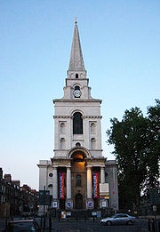
The late 17th and 18th centuries saw an estate of well-appointed terraced houses, built to accommodate the master weavers controlling the silk industry, and grand urban mansions built around the newly created Spital Square. Christ Church, Spitalfields on Fournier Street
, designed by the architect Nicholas Hawksmoor
, was built during the reign of Queen Anne
to demonstrate the power of the established church to the dissenting
Huguenots, who had built ten of their own chapels in the area. More humble weavers dwellings were congregated in the Tenterground
.
There has been a market on the site since 1638 when Charles I
gave a licence for flesh, fowl and roots to be sold in what was then known as Spittle Fields. The Market currently receives around 25,000 visitors every week.
From the 1730s Irish weavers came here, after a decline in the Irish linen industry to take up work in the silk trade. The 18th century saw periodic crises in the silk industry, bought on by imports of French silk – in a lull between the wars between the two rivals; and imports of printed calicos. The depression in the trade, and thence the prices paid to weavers, led to protests. In 1769, the Spitalfield Riots
occurred, where attempts were made to break up meetings of weavers, called to discuss the threat to wages, caused by another downturn in the market for silk. This ended with an Irish and a Huguenot weaver being hanged in front of the Salmon and Ball public house at Bethnal Green
.
Price controls on amounts master weavers could pay journeymen for each piece were established. This removed all incentive to pay higher wages during good times. During bad time workers had no work. As the price was per piece, there was incentive for using machinery, as master would have to pay for the machine and still pay the same price per piece to journeymen. By 1822 labour rates were so above market labour rates, that much of the employment in silk manufacture had moved to the country. Remaining manufacture tended to focus on expensive fashion items, which required proximity to court and had higher margins.
, the silk industry had entered a long decline and the old merchant dwellings had degenerated into multi-occupied slums. Spitalfields became a by-word for urban deprivation, and, by 1832, concern at a London cholera
epidemic led The Poor Man's Guardian
(18 February 1832) to write of Spitalfields:
In 1860, a treaty was established with France
, allowing the import of cheaper French silks. This left the many weavers in Spitalfields, and neighbouring Bethnal Green and Shoreditch
indigent. New trades such as furniture and boot making came to the area; and the large windowed Huguenot houses were found suitable for tailoring, attracting a new population of Jewish refugees drawn to live and work in the textile industry.
By the later 19th century inner Spitalfields had eclipsed rival claimants to the dubious distinction of being the worst criminal rookery
of London with common lodging-house
s in the Flower and Dean Street
area being a focus for the activities of robbers and prostitutes. The latter street was dubbed in 1881 as being "perhaps the foulest and most dangerous street in the metropolis". Another claimant to the distinction of being "the worst street in London" was nearby Dorset Street
, which was highlighted by the brutal killing and mutilation of a young woman named Mary Kelly
in her lodgings here by the serial killer known as Jack the Ripper
in the autumn of 1888. This was the climax of a whole series of slayings of local prostitutes that became known as the Whitechapel Murders
. The sanguinary activities of "Jack" was one of the factors which prompted the demolition of some of the worst streets in the area 1891-94. Deprivation, however, continued and was brought to notice by social commentators such as Jack London
in his The People of the Abyss
(1903). He highlighted 'Itchy Park', next to Christ Church, Spitalfields, as a notorious rendezvous for homeless vagrants.
immigrants, who also worked in the local textile industry
and made Brick Lane
the curry
capital of London.
Another development, from the 1960s onwards, has been a campaign to save the housing stock of old merchant terraces to the west of Brick Lane from demolition. Many have been conserved by exponents of a 'New Georgian
' ethos, such as the architectural historian and TV pundit Dan Cruickshank
. Such gentrification
has, however, caused massive inflation in house prices and the removal of the last of the vagrants from this area.
Current 'urban regeneration' has also seen the erection of large modern office blocks, between Bishopsgate and Spitalfields Market. These represent, in effect, an expansion of the City of London, northwards, beyond its traditional bounds, into this area. However, a rear-guard action by conservationists has resulted in the preservation of Old Spitalfields Market and the provision of shopping, leisure amenities and a new plaza behind the city blocks.
The area within Tower Hamlets now forms part of the council ward of Spitalfields and Banglatown. Its name represents the modern association of the Bangladeshi community with this area and neighbouring Brick Lane.
of the 18th century, is now open to the public. In 2009, Raven Row, a non-profit contemporary art centre, opened to the public at 56 Artillery Lane. Constructed within a pair of 18th century silk merchants' houses, onto which London practice 6a Architects added two contemporary galleries, it stands on the part of the street know until 1895 as Raven Row. Whitechapel Art Gallery is located at the bottom of Brick Lane.
Amongst the many well known artists living in Spitalfields are Gilbert and George
, Tracey Emin
and Stuart Brisley
. TV presenter, architecture expert and Georgian
fanatic Dan Cruickshank was an active campaigner for Spitalfields, and continues to live in the area. Writer Jeanette Winterson
turned a derelict Georgian house into an organic food shop, Verde's, as part of the Slow Food
movement.
about Jack the Ripper. This included a reconstruction (in Prague
) of the notorious Ten Bells
pub (still extant on Commercial Street
): alleged to have been a rendezvous of some of the Ripper's prostitute victims, before they were murdered. In the film Johnny Depp
(as Inspector Abberline
) is seen drinking there with Ripper victim Mary Jane Kelly
.
station.
The nearest London Overground station
is Shoreditch High Street
London borough
The administrative area of Greater London contains thirty-two London boroughs. Inner London comprises twelve of these boroughs plus the City of London. Outer London comprises the twenty remaining boroughs of Greater London.-Functions:...
of Tower Hamlets
London Borough of Tower Hamlets
The London Borough of Tower Hamlets is a London borough to the east of the City of London and north of the River Thames. It is in the eastern part of London and covers much of the traditional East End. It also includes much of the redeveloped Docklands region of London, including West India Docks...
, in the East End
East End of London
The East End of London, also known simply as the East End, is the area of London, England, United Kingdom, east of the medieval walled City of London and north of the River Thames. Although not defined by universally accepted formal boundaries, the River Lea can be considered another boundary...
of London
London
London is the capital city of :England and the :United Kingdom, the largest metropolitan area in the United Kingdom, and the largest urban zone in the European Union by most measures. Located on the River Thames, London has been a major settlement for two millennia, its history going back to its...
, near to Liverpool Street station
Liverpool Street station
Liverpool Street railway station, also known as London Liverpool Street or simply Liverpool Street, is both a central London railway terminus and a connected London Underground station in the north-eastern corner of the City of London, England...
and Brick Lane
Brick Lane
Brick Lane is a street in the London Borough of Tower Hamlets, in the East End of London. It runs from Swanfield Street in the northern part of Bethnal Green, crosses Bethnal Green Road, passes through Spitalfields and is linked to Whitechapel High Street to the south by the short stretch of...
. The area straddles Commercial Street
Commercial Street (London)
Commercial Street is a road in Tower Hamlets, east London that runs north to south from Shoreditch High Street to Whitechapel High Street through the East End district of Spitalfields...
and is home to many markets, including the historic Old Spitalfields Market
Old Spitalfields market
Old Spitalfields Market is a covered market in Spitalfields, just outside the City of London. It is in the London Borough of Tower Hamlets....
, founded in the 17th century, Sunday UpMarket, and the various other Brick Lane Market
Brick Lane Market
Brick Lane Market is a London market centred around Brick Lane, Tower Hamlets. It is located at the northern end of Brick Lane and along Cheshire Street in east London. It operates every Sunday from around 8am to 2pm....
s on Brick Lane and Cheshire Street
Cheshire Street
Cheshire Street is a street in east London linking Brick Lane with Bethnal Green and Whitechapel.It has had various names in its history, such as Hare Street, and today forms part of Brick Lane Market on Sundays...
.
Etymology
The name Spitalfields is a contraction of 'hospital fields', in reference to the open land which lay behind and to the east of "The New Hospital of St Mary without Bishopgate" erected on the east side of the BishopsgateBishopsgate
Bishopsgate is a road and ward in the northeast part of the City of London, extending north from Gracechurch Street to Norton Folgate. It is named after one of the original seven gates in London Wall...
thoroughfare in 1197. Before that time the area was apparently known as Lollesworth. The original Spital Field is depicted, and labelled as such, at the top right hand corner of the sixteenth century Civitas Londinium
Civitas Londinium
Civitas Londinium is the title of what is probably the earliest proper map of London....
map of Ralph Agas
Ralph Agas
Ralph Agas , English land surveyor, was born at Stoke-by-Nayland, Suffolk, about 1540, and entered upon the practice of his profession in 1566....
.
Origins
Spitalfields was the location of one of Roman London's large extramural cemeteries, situated to the east of the Bishopsgate thoroughfare, which roughly follows the line of Ermine StreetErmine Street
Ermine Street is the name of a major Roman road in England that ran from London to Lincoln and York . The Old English name was 'Earninga Straete' , named after a tribe called the Earningas, who inhabited a district later known as Armingford Hundred, around Arrington, Cambridgeshire and Royston,...
: the main highway to the north from Londinium. The presence of a Roman
Roman Britain
Roman Britain was the part of the island of Great Britain controlled by the Roman Empire from AD 43 until ca. AD 410.The Romans referred to the imperial province as Britannia, which eventually comprised all of the island of Great Britain south of the fluid frontier with Caledonia...
cemetery here was noticed by the antiquarian
Antiquarian
An antiquarian or antiquary is an aficionado or student of antiquities or things of the past. More specifically, the term is used for those who study history with particular attention to ancient objects of art or science, archaeological and historic sites, or historic archives and manuscripts...
John Stow
John Stow
John Stow was an English historian and antiquarian.-Early life:The son of Thomas Stow, a tallow-chandler, he was born about 1525 in London, in the parish of St Michael, Cornhill. His father's whole rent for his house and garden was only 6s. 6d. a year, and Stow in his youth fetched milk every...
as far back as 1576 and became the focus of a major archaeological excavation in the 1990s, following the redevelopment of Spitalfields Market. Perhaps the most spectacular find was the discovery in 1999 of a sarcophagus
Sarcophagus
A sarcophagus is a funeral receptacle for a corpse, most commonly carved or cut from stone. The word "sarcophagus" comes from the Greek σαρξ sarx meaning "flesh", and φαγειν phagein meaning "to eat", hence sarkophagus means "flesh-eating"; from the phrase lithos sarkophagos...
containing the remains of a high status, silk clad, Roman lady, complete with jet accessories
Jet (lignite)
Jet is a geological material and is considered to be a minor gemstone. Jet is not considered a true mineral, but rather a mineraloid as it has an organic origin, being derived from decaying wood under extreme pressure....
and a unique glass phial.
In 1197 the former Roman cemetery became the site of a priory called "The New Hospital of St Mary without Bishopgate", latterly known as St Mary Spital, founded by Walter Brunus and his wife Roisia. This religious foundation was one of the biggest hospitals in medieval England and was the focus of a large medieval
Middle Ages
The Middle Ages is a periodization of European history from the 5th century to the 15th century. The Middle Ages follows the fall of the Western Roman Empire in 476 and precedes the Early Modern Era. It is the middle period of a three-period division of Western history: Classic, Medieval and Modern...
cemetery which included a stone charnel house
Charnel house
A charnel house is a vault or building where human skeletal remains are stored. They are often built near churches for depositing bones that are unearthed while digging graves...
and mortuary chapel. This latter has recently been uncovered by archaeologists and preserved for public viewing. The Priory and Hospital were dissolved
Dissolution of the Monasteries
The Dissolution of the Monasteries, sometimes referred to as the Suppression of the Monasteries, was the set of administrative and legal processes between 1536 and 1541 by which Henry VIII disbanded monasteries, priories, convents and friaries in England, Wales and Ireland; appropriated their...
in 1539 under Henry VIII
Henry VIII of England
Henry VIII was King of England from 21 April 1509 until his death. He was Lord, and later King, of Ireland, as well as continuing the nominal claim by the English monarchs to the Kingdom of France...
. Although the chapel and monastic buildings were mostly demolished, the area of the inner precinct of the priory
Priory
A priory is a house of men or women under religious vows that is headed by a prior or prioress. Priories may be houses of mendicant friars or religious sisters , or monasteries of monks or nuns .The Benedictines and their offshoots , the Premonstratensians, and the...
maintained an autonomous administrative status as the Liberty of Norton Folgate
Liberty of Norton Folgate
Norton Folgate or Liberty of Norton Folgate may refer to:* Norton Folgate, a street in central London* Liberty of Norton Folgate, an ancient administrative area in central London...
. The adjacent outer precincts of the priory, to the south, were re-used as an Artillery Ground
Old Artillery Ground
The Old Artillery Ground is an area of land in Spitalfields, London formerly designated one of the Liberties of the Tower of London and Crown Land....
and placed under the special jurisdiction of the Tower of London
Tower of London
Her Majesty's Royal Palace and Fortress, more commonly known as the Tower of London, is a historic castle on the north bank of the River Thames in central London, England. It lies within the London Borough of Tower Hamlets, separated from the eastern edge of the City of London by the open space...
as one of the Tower liberties
Liberties of the Tower of London
The Liberties of the Tower, or the Tower Liberty was an area adjoining the Tower of London, which was outside the jurisdiction of either the City of London or the County of Middlesex....
. Other parts of the former priory area were utilised for residential purposes by London dwellers seeking a rural retreat and by the mid seventeenth century further development extended eastward into the erstwhile open farmland of the Spital Field.
In 1729 Spitalfields was detached from the parish of Mile End
Mile End
Mile End is an area within the East End of London, England, and part of the London Borough of Tower Hamlets. It is located east-northeast of Charing Cross...
and organised as a Civil Parish
Civil parish
In England, a civil parish is a territorial designation and, where they are found, the lowest tier of local government below districts and counties...
divided into two ecclesiastical subdivisions, namely; Christchurch Spitalfields and St. Stephen's Spitalfields. The church of St. Stephen Spitalfields was built in 1860 by public subscription but was demolished in 1930. The adjacent vicarage is all that remains. In 1911 the parish of St. Mary Spital (the merged former ex-parochial liberties of Norton Folgate and the Old Artillery Ground) became part of the civil parish of Spitalfields. Spitalfields as a civil parish was abolished in 1965 upon the establishment of the London Borough of Tower Hamlets
London Borough of Tower Hamlets
The London Borough of Tower Hamlets is a London borough to the east of the City of London and north of the River Thames. It is in the eastern part of London and covers much of the traditional East End. It also includes much of the redeveloped Docklands region of London, including West India Docks...
.
Huguenots
Spitalfields' historic association with the silkSilk
Silk is a natural protein fiber, some forms of which can be woven into textiles. The best-known type of silk is obtained from the cocoons of the larvae of the mulberry silkworm Bombyx mori reared in captivity...
industry was established by French Protestant (Huguenots) refugees who settled in this area after the Revocation of the Edict of Nantes
Edict of Fontainebleau
The Edict of Fontainebleau was an edict issued by Louis XIV of France, also known as the Revocation of the Edict of Nantes. The Edict of Nantes of 1598, had granted the Huguenots the right to practice their religion without persecution from the state...
in 1685. By settling here, outside the bounds of the City of London
City of London
The City of London is a small area within Greater London, England. It is the historic core of London around which the modern conurbation grew and has held city status since time immemorial. The City’s boundaries have remained almost unchanged since the Middle Ages, and it is now only a tiny part of...
, they hoped to avoid the restrictive legislation of the City Guilds
Livery Company
The Livery Companies are 108 trade associations in the City of London, almost all of which are known as the "Worshipful Company of" the relevant trade, craft or profession. The medieval Companies originally developed as guilds and were responsible for the regulation of their trades, controlling,...
. The Huguenots brought with them little, apart from their skills, and an Order in Council of 16 April 1687 raised £200,000 for the relief of their poverty. In December 1687, the first report of the committee set up to administer the funds reported that 13,050 French refugees were settled in London, primarily around Spitalfields, but also in the nearby settlements of Bethnal Green
Bethnal Green
Bethnal Green is a district of the East End of London, England and part of the London Borough of Tower Hamlets, with the far northern parts falling within the London Borough of Hackney. Located northeast of Charing Cross, it was historically an agrarian hamlet in the ancient parish of Stepney,...
, Shoreditch
Shoreditch
Shoreditch is an area of London within the London Borough of Hackney in England. It is a built-up part of the inner city immediately to the north of the City of London, located east-northeast of Charing Cross.-Etymology:...
, Whitechapel
Whitechapel
Whitechapel is a built-up inner city district in the London Borough of Tower Hamlets, London, England. It is located east of Charing Cross and roughly bounded by the Bishopsgate thoroughfare on the west, Fashion Street on the north, Brady Street and Cavell Street on the east and The Highway on the...
and Mile End New Town
Mile End New Town
Mile End New Town is a former hamlet within the East End of London. Its area is now part of the London Borough of Tower Hamlets.Following a period of rapid growth it became a hamlet within the large ancient parish of Stepney from 1690, and was split off as a separate ecclesiastical parish in 1841...
.
The late 17th and 18th centuries saw an estate of well-appointed terraced houses, built to accommodate the master weavers controlling the silk industry, and grand urban mansions built around the newly created Spital Square. Christ Church, Spitalfields on Fournier Street
Fournier Street
Fournier Street, formerly Church Street, is a street of 18th century houses in Spitalfields, in the London Borough of Tower Hamlets. It runs between Commercial Street and Brick Lane....
, designed by the architect Nicholas Hawksmoor
Nicholas Hawksmoor
Nicholas Hawksmoor was a British architect born in Nottinghamshire, probably in East Drayton.-Life:Hawksmoor was born in Nottinghamshire in 1661, into a yeoman farming family, almost certainly in East Drayton, Nottinghamshire. On his death he was to leave property at nearby Ragnall, Dunham and a...
, was built during the reign of Queen Anne
Anne of Great Britain
Anne ascended the thrones of England, Scotland and Ireland on 8 March 1702. On 1 May 1707, under the Act of Union, two of her realms, England and Scotland, were united as a single sovereign state, the Kingdom of Great Britain.Anne's Catholic father, James II and VII, was deposed during the...
to demonstrate the power of the established church to the dissenting
English Dissenters
English Dissenters were Christians who separated from the Church of England in the 16th, 17th and 18th centuries.They originally agitated for a wide reaching Protestant Reformation of the Established Church, and triumphed briefly under Oliver Cromwell....
Huguenots, who had built ten of their own chapels in the area. More humble weavers dwellings were congregated in the Tenterground
Tenterground
A tenterground or tenter ground was an area used for drying newly manufactured cloth after fulling. The wet cloth was hooked onto frames called tenters and stretched taut so that the cloth would dry flat and square....
.
There has been a market on the site since 1638 when Charles I
Charles I of England
Charles I was King of England, King of Scotland, and King of Ireland from 27 March 1625 until his execution in 1649. Charles engaged in a struggle for power with the Parliament of England, attempting to obtain royal revenue whilst Parliament sought to curb his Royal prerogative which Charles...
gave a licence for flesh, fowl and roots to be sold in what was then known as Spittle Fields. The Market currently receives around 25,000 visitors every week.
From the 1730s Irish weavers came here, after a decline in the Irish linen industry to take up work in the silk trade. The 18th century saw periodic crises in the silk industry, bought on by imports of French silk – in a lull between the wars between the two rivals; and imports of printed calicos. The depression in the trade, and thence the prices paid to weavers, led to protests. In 1769, the Spitalfield Riots
Spitalfield Riots
The Spitalfield Riots occurred in 1769, during a downturn in the silk weaving industry, centred on Spitalfields in the East End of London. The weavers organised to attempt to ensure that the rates of pay paid for their piece work was not cut beneath the level at which they could feed themselves,...
occurred, where attempts were made to break up meetings of weavers, called to discuss the threat to wages, caused by another downturn in the market for silk. This ended with an Irish and a Huguenot weaver being hanged in front of the Salmon and Ball public house at Bethnal Green
Bethnal Green
Bethnal Green is a district of the East End of London, England and part of the London Borough of Tower Hamlets, with the far northern parts falling within the London Borough of Hackney. Located northeast of Charing Cross, it was historically an agrarian hamlet in the ancient parish of Stepney,...
.
Price controls on amounts master weavers could pay journeymen for each piece were established. This removed all incentive to pay higher wages during good times. During bad time workers had no work. As the price was per piece, there was incentive for using machinery, as master would have to pay for the machine and still pay the same price per piece to journeymen. By 1822 labour rates were so above market labour rates, that much of the employment in silk manufacture had moved to the country. Remaining manufacture tended to focus on expensive fashion items, which required proximity to court and had higher margins.
Victorian era
By the Victorian eraVictorian era
The Victorian era of British history was the period of Queen Victoria's reign from 20 June 1837 until her death on 22 January 1901. It was a long period of peace, prosperity, refined sensibilities and national self-confidence...
, the silk industry had entered a long decline and the old merchant dwellings had degenerated into multi-occupied slums. Spitalfields became a by-word for urban deprivation, and, by 1832, concern at a London cholera
Cholera
Cholera is an infection of the small intestine that is caused by the bacterium Vibrio cholerae. The main symptoms are profuse watery diarrhea and vomiting. Transmission occurs primarily by drinking or eating water or food that has been contaminated by the diarrhea of an infected person or the feces...
epidemic led The Poor Man's Guardian
The Poor Man's Guardian
The Poor Man's Guardian was a penny weekly newspaper published in London, England by Henry Hetherington from July 1831 to December 1835.Hetherington published his Poor Man's Guardian, a successor to his earlier penny daily Penny Papers for the People, as an outright challenge to authority...
(18 February 1832) to write of Spitalfields:
The low houses are all huddled together in close and dark lanes and alleys, presenting at first sight an appearance of non-habitation, so dilapidated are the doors and windows:- in every room of the houses, whole families, parents, children and aged grandfathers swarm together.
In 1860, a treaty was established with France
France
The French Republic , The French Republic , The French Republic , (commonly known as France , is a unitary semi-presidential republic in Western Europe with several overseas territories and islands located on other continents and in the Indian, Pacific, and Atlantic oceans. Metropolitan France...
, allowing the import of cheaper French silks. This left the many weavers in Spitalfields, and neighbouring Bethnal Green and Shoreditch
Shoreditch
Shoreditch is an area of London within the London Borough of Hackney in England. It is a built-up part of the inner city immediately to the north of the City of London, located east-northeast of Charing Cross.-Etymology:...
indigent. New trades such as furniture and boot making came to the area; and the large windowed Huguenot houses were found suitable for tailoring, attracting a new population of Jewish refugees drawn to live and work in the textile industry.
By the later 19th century inner Spitalfields had eclipsed rival claimants to the dubious distinction of being the worst criminal rookery
Rookery (slum)
A rookery was the colloquial British English term given in the 18th and 19th centuries to a city slum occupied by poor people...
of London with common lodging-house
Common lodging-house
A Common lodging-house is Victorian term for a form of cheap accommodation in which inhabitants are lodged together in one or more rooms in common with the rest of the inmates, who are not members of one family, whether for eating or sleeping. The slang term flophouse is roughly the equivalent of...
s in the Flower and Dean Street
Flower and Dean Street
Flower and Dean Street was a road situated at the heart of the Spitalfields rookery in the East End of London. It was one of the most notorious slum areas of the Victorian era and was closely associated with the victims of Jack the Ripper...
area being a focus for the activities of robbers and prostitutes. The latter street was dubbed in 1881 as being "perhaps the foulest and most dangerous street in the metropolis". Another claimant to the distinction of being "the worst street in London" was nearby Dorset Street
Dorset Street, London
For the Dublin street of the same name, see Dorset Street Dorset Street was situated at the heart of the Spitalfields rookery in the East End of London, England. It should not be confused with the road of the same name in Marylebone, in London's West End...
, which was highlighted by the brutal killing and mutilation of a young woman named Mary Kelly
Mary Jane Kelly
Mary Jane Kelly , also known as "Marie Jeanette" Kelly, "Fair Emma", "Ginger" and "Black Mary", is widely believed to be the fifth and final victim of the notorious unidentified serial killer Jack the Ripper, who killed and mutilated prostitutes in the Whitechapel area of London from late August to...
in her lodgings here by the serial killer known as Jack the Ripper
Jack the Ripper
"Jack the Ripper" is the best-known name given to an unidentified serial killer who was active in the largely impoverished areas in and around the Whitechapel district of London in 1888. The name originated in a letter, written by someone claiming to be the murderer, that was disseminated in the...
in the autumn of 1888. This was the climax of a whole series of slayings of local prostitutes that became known as the Whitechapel Murders
The Whitechapel Murders (1888-91)
The Whitechapel murders were committed in or near the impoverished Whitechapel District in the East End of London between 3 April 1888 and 13 February 1891. Eleven women were killed; the crimes remain unsolved...
. The sanguinary activities of "Jack" was one of the factors which prompted the demolition of some of the worst streets in the area 1891-94. Deprivation, however, continued and was brought to notice by social commentators such as Jack London
Jack London
John Griffith "Jack" London was an American author, journalist, and social activist. He was a pioneer in the then-burgeoning world of commercial magazine fiction and was one of the first fiction writers to obtain worldwide celebrity and a large fortune from his fiction alone...
in his The People of the Abyss
The People of the Abyss
The People of the Abyss is a book by Jack London about life in the East End of London in 1902. He wrote this first-hand account by living in the East End for several months, sometimes staying in workhouses or sleeping on the streets...
(1903). He highlighted 'Itchy Park', next to Christ Church, Spitalfields, as a notorious rendezvous for homeless vagrants.
Modern Spitalfields
In the late 20th century the Jewish presence diminished, to be replaced by an influx of BangladeshiBengali people
The Bengali people are an ethnic community native to the historic region of Bengal in South Asia. They speak Bengali , which is an Indo-Aryan language of the eastern Indian subcontinent, evolved from the Magadhi Prakrit and Sanskrit languages. In their native language, they are referred to as বাঙালী...
immigrants, who also worked in the local textile industry
Textile industry
The textile industry is primarily concerned with the production of yarn, and cloth and the subsequent design or manufacture of clothing and their distribution. The raw material may be natural, or synthetic using products of the chemical industry....
and made Brick Lane
Brick Lane
Brick Lane is a street in the London Borough of Tower Hamlets, in the East End of London. It runs from Swanfield Street in the northern part of Bethnal Green, crosses Bethnal Green Road, passes through Spitalfields and is linked to Whitechapel High Street to the south by the short stretch of...
the curry
Curry
Curry is a generic description used throughout Western culture to describe a variety of dishes from Indian, Pakistani, Bangladeshi, Sri Lankan, Thai or other Southeast Asian cuisines...
capital of London.
Another development, from the 1960s onwards, has been a campaign to save the housing stock of old merchant terraces to the west of Brick Lane from demolition. Many have been conserved by exponents of a 'New Georgian
Georgian architecture
Georgian architecture is the name given in most English-speaking countries to the set of architectural styles current between 1720 and 1840. It is eponymous for the first four British monarchs of the House of Hanover—George I of Great Britain, George II of Great Britain, George III of the United...
' ethos, such as the architectural historian and TV pundit Dan Cruickshank
Dan Cruickshank
Dan Cruickshank is an art historian and BBC television presenter.-Early life:As a young child he lived for some years in Poland...
. Such gentrification
Gentrification
Gentrification and urban gentrification refer to the changes that result when wealthier people acquire or rent property in low income and working class communities. Urban gentrification is associated with movement. Consequent to gentrification, the average income increases and average family size...
has, however, caused massive inflation in house prices and the removal of the last of the vagrants from this area.
Current 'urban regeneration' has also seen the erection of large modern office blocks, between Bishopsgate and Spitalfields Market. These represent, in effect, an expansion of the City of London, northwards, beyond its traditional bounds, into this area. However, a rear-guard action by conservationists has resulted in the preservation of Old Spitalfields Market and the provision of shopping, leisure amenities and a new plaza behind the city blocks.
The area within Tower Hamlets now forms part of the council ward of Spitalfields and Banglatown. Its name represents the modern association of the Bangladeshi community with this area and neighbouring Brick Lane.
Arts scene
The area is well known for its arts scene. Dennis Severs forswore modern comforts at 18 Folgate Street, living a unique life. The house, a time capsuleTime capsule
A time capsule is an historic cache of goods or information, usually intended as a method of communication with future people and to help future archaeologists, anthropologists, or historians...
of the 18th century, is now open to the public. In 2009, Raven Row, a non-profit contemporary art centre, opened to the public at 56 Artillery Lane. Constructed within a pair of 18th century silk merchants' houses, onto which London practice 6a Architects added two contemporary galleries, it stands on the part of the street know until 1895 as Raven Row. Whitechapel Art Gallery is located at the bottom of Brick Lane.
Amongst the many well known artists living in Spitalfields are Gilbert and George
Gilbert and George
Gilbert & George are two artists who work together as a collaborative duo. Gilbert Proesch and George Passmore have become famous for their distinctive, highly formal appearance and manner and their brightly coloured graphic-style photo-based artworks.-Early life:Gilbert Proesch was...
, Tracey Emin
Tracey Emin
Tracey Karima Emin RA is a British artist of English and Turkish Cypriot origin. She is part of the group known as Britartists or YBAs ....
and Stuart Brisley
Stuart Brisley
Stuart Brisley is widely regarded as the seminal figure of British performance art. Over a career of half a century Stuart Brisley has come to the conclusion, as stated in his recent novel "" that 'what goes down comes up'...
. TV presenter, architecture expert and Georgian
Georgian era
The Georgian era is a period of British history which takes its name from, and is normally defined as spanning the reigns of, the first four Hanoverian kings of Great Britain : George I, George II, George III and George IV...
fanatic Dan Cruickshank was an active campaigner for Spitalfields, and continues to live in the area. Writer Jeanette Winterson
Jeanette Winterson
Jeanette Winterson OBE is a British novelist.-Early years:Winterson was born in Manchester and adopted on 21 January 1960. She was raised in Accrington, Lancashire, by Constance and John William Winterson...
turned a derelict Georgian house into an organic food shop, Verde's, as part of the Slow Food
Slow Food
Slow Food is an international movement founded by Carlo Petrini in 1986. Promoted as an alternative to fast food, it strives to preserve traditional and regional cuisine and encourages farming of plants, seeds and livestock characteristic of the local ecosystem. It was the first established part of...
movement.
In literature
Spitalfields figures in many classic and contemporary works of literature, which reflect its sense of mystery and its fascinating multicultural heritage, including:- A New Wonder, a Woman Never VexedA New Wonder, a Woman Never VexedA New Wonder, a Woman Never Vexed is a Jacobean era stage play, often classified as a city comedy. Its authorship was traditionally attributed to William Rowley, though modern scholarship has questioned Rowley's sole authorship; Thomas Heywood and George Wilkins have been proposed as possible...
(performed 1610-14; printed 1632) by William RowleyWilliam RowleyWilliam Rowley was an English Jacobean dramatist, best known for works written in collaboration with more successful writers. His date of birth is estimated to have been c. 1585; he was buried on 11 February 1626...
- this is a dramatisation of the foundation of St Mary Spital by Walter Brunus - Children of the Ghetto (1893) by Israel ZangwillIsrael ZangwillIsrael Zangwill was a British humorist and writer.-Biography:Zangwill was born in London on January 21, 1864 in a family of Jewish immigrants from Czarist Russia, to Moses Zangwill from what is now Latvia and Ellen Hannah Marks Zangwill from what is now Poland. He dedicated his life to championing...
- The People of the AbyssThe People of the AbyssThe People of the Abyss is a book by Jack London about life in the East End of London in 1902. He wrote this first-hand account by living in the East End for several months, sometimes staying in workhouses or sleeping on the streets...
(1903), the journalistic memoir by Jack LondonJack LondonJohn Griffith "Jack" London was an American author, journalist, and social activist. He was a pioneer in the then-burgeoning world of commercial magazine fiction and was one of the first fiction writers to obtain worldwide celebrity and a large fortune from his fiction alone... - HawksmoorHawksmoor (novel)Hawksmoor is a 1985 novel by the English writer Peter Ackroyd. It won Best Novel at the 1985 Whitbread Awards.-Story:Set in the late seventeenth century, architect Nicholas Dyer is progressing work on several churches in London's East End...
(1985) by Peter AckroydPeter AckroydPeter Ackroyd CBE is an English biographer, novelist and critic with a particular interest in the history and culture of London. For his novels about English history and culture and his biographies of, among others, Charles Dickens, T. S. Eliot and Sir Thomas More he won the Somerset Maugham Award... - The Satanic VersesThe Satanic VersesThe Satanic Verses is Salman Rushdie's fourth novel, first published in 1988 and inspired in part by the life of Prophet Muhammad. As with his previous books, Rushdie used magical realism and relied on contemporary events and people to create his characters...
(1988) by Salman Rushdie - City of the Mind (1991) by Penelope LivelyPenelope LivelyPenelope Lively CBE, FRSL is a prolific, popular and critically acclaimed author of fiction for both children and adults. She has been shortlisted three times for the Booker Prize, winning once for Moon Tiger in 1987.-Personal:...
- Downriver (1991) by Iain SinclairIain SinclairIain Sinclair FRSL is a British writer and filmmaker. Much of his work is rooted in London, most recently within the influences of psychogeography.-Life and work:...
- Rodinsky's RoomRodinsky's RoomRodinsky's Room is a non-fiction book by Rachel Lichtenstein and Iain Sinclair. It is an oral history of the neighbourhood of Spitalfields in the East End of London...
(1999) by Iain Sinclair and Rachel LichtensteinRachel LichtensteinRachel Lichtenstein is a writer, artist and archivist.In 1999 she wrote, with Iain Sinclair Rodinsky's Room, since then she has published Rodinsky's Whitechapel , and On Brick Lane... - The PowerBook (2000) by Jeanette WintersonJeanette WintersonJeanette Winterson OBE is a British novelist.-Early years:Winterson was born in Manchester and adopted on 21 January 1960. She was raised in Accrington, Lancashire, by Constance and John William Winterson...
- Brick Lane (2003) by Monica AliMonica AliMonica Ali is a British writer of Bangladeshi origin. She is the author of Brick Lane, her debut novel, which was shortlisted for the Man Booker Prize for Fiction in 2003...
- The QuincunxThe QuincunxThe Quincunx is the epic first novel of Charles Palliser. It takes the form of a Dickensian mystery set in early 19th century England, but Palliser has added the modern attributes of an ambiguous ending and unreliable narrators...
(1991) by Charles PalliserCharles PalliserCharles Palliser is a best-selling novelist, American-born but British-based. His most well-known novel, "The Quincunx", has sold over a million copies internationally. He is the elder brother of the late author and freelance journalist Marcus Palliser.-Life and career:Born in New England he is...
In film
19th century Spitalfields was recreated as the setting for the film From HellFrom Hell (film)
From Hell is a 2001 American crime drama horror mystery film directed by the Hughes brothers. It is an adaptation of the comic book series of the same name by Alan Moore and Eddie Campbell about the Jack the Ripper murders.-Plot:...
about Jack the Ripper. This included a reconstruction (in Prague
Prague
Prague is the capital and largest city of the Czech Republic. Situated in the north-west of the country on the Vltava river, the city is home to about 1.3 million people, while its metropolitan area is estimated to have a population of over 2.3 million...
) of the notorious Ten Bells
Ten Bells (public house)
The Ten Bells is a Victorian public house at the corner of Commercial Street and Fournier Street in Spitalfields in the East End of London. It is notable for its association with two victims of Jack the Ripper; Annie Chapman and Mary Kelly....
pub (still extant on Commercial Street
Commercial Street (London)
Commercial Street is a road in Tower Hamlets, east London that runs north to south from Shoreditch High Street to Whitechapel High Street through the East End district of Spitalfields...
): alleged to have been a rendezvous of some of the Ripper's prostitute victims, before they were murdered. In the film Johnny Depp
Johnny Depp
John Christopher "Johnny" Depp II is an American actor, producer and musician. He has won the Golden Globe Award and Screen Actors Guild award for Best Actor. Depp rose to prominence on the 1980s television series 21 Jump Street, becoming a teen idol...
(as Inspector Abberline
Frederick Abberline
Frederick George Abberline was a Chief Inspector for the London Metropolitan Police and was a prominent police figure in the investigation into the Jack the Ripper murders of 1888.-Early life:...
) is seen drinking there with Ripper victim Mary Jane Kelly
Mary Jane Kelly
Mary Jane Kelly , also known as "Marie Jeanette" Kelly, "Fair Emma", "Ginger" and "Black Mary", is widely believed to be the fifth and final victim of the notorious unidentified serial killer Jack the Ripper, who killed and mutilated prostitutes in the Whitechapel area of London from late August to...
.
Notable people associated with Spitalfields
- Nicholas CulpeperNicholas CulpeperNicholas Culpeper was an English botanist, herbalist, physician, and astrologer. His published books include The English Physician and the Complete Herbal , which contain a rich store of pharmaceutical and herbal knowledge, and Astrological Judgement of Diseases from the Decumbiture of the Sick ,...
(1616–1654), botanist, herbalist, physician, and astrologer was born locally at the Red Lion Inn, when the area was still semi-rural. - Sir Benjamin TrumanBenjamin TrumanSir Benjamin Truman was a notable English entrepreneur and brewer during the 18th century. He is notable for the expansion of the Truman Brewery in the Spitalfields area of east London.-Biography:...
(1699/1700–1780), brewer. - Jack SheppardJack SheppardJack Sheppard was a notorious English robber, burglar and thief of early 18th-century London. Born into a poor family, he was apprenticed as a carpenter but took to theft and burglary in 1723, with little more than a year of his training to complete...
(1702–1724), highwayman and multiple absconder, born in New Fashion Street, now known as White's Row. - Obadiah ShuttleworthObadiah ShuttleworthObadiah Shuttleworth , English composer, violinist and organist, was the son of Thomas Shuttleworth of Spitalfields in London. Thomas was a professional music copyist and harpsichord player.The exact date of Obadiah's birth is uncertain....
(d.1734), musician - Jeremy BenthamJeremy BenthamJeremy Bentham was an English jurist, philosopher, and legal and social reformer. He became a leading theorist in Anglo-American philosophy of law, and a political radical whose ideas influenced the development of welfarism...
(1748–1832), philosopher, born locally. - Mary WollstonecraftMary WollstonecraftMary Wollstonecraft was an eighteenth-century British writer, philosopher, and advocate of women's rights. During her brief career, she wrote novels, treatises, a travel narrative, a history of the French Revolution, a conduct book, and a children's book...
(1759–1797), early feminist, born locally, possibly at 21 Hanbury Street. - George PeabodyGeorge PeabodyGeorge Peabody was an American-British entrepreneur and philanthropist who founded the Peabody Trust in Britain and the Peabody Institute in Baltimore, and was responsible for many other charitable initiatives.-Biography:...
(1795-1869), established the Peabody Donation Fund, which continues to this day, as the Peabody TrustPeabody TrustPeabody Trust , founded in 1862, is one of London's oldest and largest housing associations with over 19,000 properties. It also a charity and urban regeneration agency...
, to provide good quality housing "for the deserving poor" in London - Jack the RipperJack the Ripper"Jack the Ripper" is the best-known name given to an unidentified serial killer who was active in the largely impoverished areas in and around the Whitechapel district of London in 1888. The name originated in a letter, written by someone claiming to be the murderer, that was disseminated in the...
: all of his victims or presumed victims lived in Spitalfields and two (Chapman and Kelly) were murdered there (the others being murdered in nearby WhitechapelWhitechapelWhitechapel is a built-up inner city district in the London Borough of Tower Hamlets, London, England. It is located east of Charing Cross and roughly bounded by the Bishopsgate thoroughfare on the west, Fashion Street on the north, Brady Street and Cavell Street on the east and The Highway on the...
):- Annie ChapmanAnnie ChapmanAnnie Chapman , born Eliza Ann Smith, was a victim of the notorious unidentified serial killer Jack the Ripper, who killed and mutilated five women in the Whitechapel area of London from late August to early November 1888.-Life and background:Annie Chapman was born Eliza Ann Smith...
(c. 1841 - 1888), resided at a common lodging house at 35 Dorset StreetDorset Street, LondonFor the Dublin street of the same name, see Dorset Street Dorset Street was situated at the heart of the Spitalfields rookery in the East End of London, England. It should not be confused with the road of the same name in Marylebone, in London's West End...
. Her body was found at 29 Hanbury StreetHanbury StreetHanbury Street is a street in Spitalfields, London Borough of Tower Hamlets, in the East End of London. It runs east from Commercial Street to a cul-de-sac at the east end. It was laid out in the seventeenth century, and was originally known as Browne's Lane after the original developer... - Mary Jane KellyMary Jane KellyMary Jane Kelly , also known as "Marie Jeanette" Kelly, "Fair Emma", "Ginger" and "Black Mary", is widely believed to be the fifth and final victim of the notorious unidentified serial killer Jack the Ripper, who killed and mutilated prostitutes in the Whitechapel area of London from late August to...
(c. 1863–1888), lived and was murdered at 13 Millers Court, just off Dorset Street - Martha TabramMartha TabramMartha Tabram was an English prostitute whose killing was the second of the Whitechapel murders in late 19th century London...
(1849–1888), resided at a common lodging house at 19 George Street. - Mary Ann NicholsMary Ann NicholsMary Ann "Polly" Nichols was one of the Whitechapel murder victims. Her death has been attributed to the notorious unidentified serial killer Jack the Ripper, who is believed to have killed and mutilated five women in the Whitechapel area of London from late August to early November 1888.- Life...
(1845–1888), resided at a common lodging house at 18 Thrawl Street. - Elizabeth StrideElizabeth StrideElizabeth "Long Liz" Stride is believed to be the third victim of the notorious unidentified serial killer called Jack the Ripper, who killed and mutilated prostitutes in the Whitechapel area of London from late August to early November 1888.She was nicknamed "Long Liz"...
(1843–1888), resided at a common lodging house at 32 Flower and Dean Street. - Catherine EddowesCatherine EddowesCatherine Eddowes was one of the victims in the Whitechapel murders. She was the second person killed on the night of Sunday 30 September 1888, a night which already had seen the murder of Elizabeth Stride less than an hour earlier...
(1842–1888), resided with her partner John Kelly at Cooney's common lodging house at 55 Flower and Dean Street.
- Annie Chapman
- Basil HenriquesBasil HenriquesSir Basil Lucas Quixano Henriques was a Jewish philanthropist of Portuguese origins, concentrating his work in the East End of London during the first half of the 20th century....
(1890–1961), for whom Henriques StreetHenriques StreetHenriques Street, formerly known as Berner Street, is a narrow East End street off Commercial Road in the London Borough of Tower Hamlets.-Landmarks:...
(formerly Berner Street) is named. - Joe LossJoe LossJoshua Alexander "Joe" Loss LVO OBE was a British musician and founder of the Joe Loss Orchestra.-Life:Loss was born in Spitalfields, London, the youngest of four children. His parents, Israel and Ada Loss, were Russian Jews and first cousins. His father was a cabinet-maker who had an office...
LVO OBE (1909–1990), born locally, founder of the Joe Loss Orchestra. - Wolf MankowitzWolf MankowitzCyril Wolf Mankowitz was an English writer, playwright and screenwriter of Russian Jewish descent.-Early life:...
(1924–1998), writer, playwright and screenwriter, of Russian Jewish descent, was born in Fashion Street. - Gilbert & GeorgeGilbert and GeorgeGilbert & George are two artists who work together as a collaborative duo. Gilbert Proesch and George Passmore have become famous for their distinctive, highly formal appearance and manner and their brightly coloured graphic-style photo-based artworks.-Early life:Gilbert Proesch was...
(1943 - ;1942 - ), artists, reside in Fournier Street. - Dennis Severs (1944–1999), lived at 18 Folgate Street 1979 - 1999.
- Sandra Esquilant (1948 - ), landlady of The Golden Heart, listed among the 100 most influential people in art.
- Dan CruickshankDan CruickshankDan Cruickshank is an art historian and BBC television presenter.-Early life:As a young child he lived for some years in Poland...
(1949 - ), art and architectural historian. - Jeanette WintersonJeanette WintersonJeanette Winterson OBE is a British novelist.-Early years:Winterson was born in Manchester and adopted on 21 January 1960. She was raised in Accrington, Lancashire, by Constance and John William Winterson...
(1959 - ), writer, lives on Brushfield Street where she also runs a delicatessen. - Tracey EminTracey EminTracey Karima Emin RA is a British artist of English and Turkish Cypriot origin. She is part of the group known as Britartists or YBAs ....
(1963 - ), artist, resides in Fournier StreetFournier StreetFournier Street, formerly Church Street, is a street of 18th century houses in Spitalfields, in the London Borough of Tower Hamlets. It runs between Commercial Street and Brick Lane....
. - Joe WrightJoe WrightJoe Wright is an English film director best known for Pride and Prejudice, Atonement and Hanna.-Early life and career:...
(1972 - ), film director, recent addition to Wilkes Street. - Samantha MortonSamantha MortonSamantha Jane Morton is an English actress and film director. She began her performing career with guest roles in television shows such as Soldier Soldier and Boon before making her film debut in the 1997 drama film This Is the Sea, playing the character of Hazel Stokes...
, actor, lives on the corner of Fournier and Wilkes. - Emdadur Choudhury, activist and Remembrance DayRemembrance DayRemembrance Day is a memorial day observed in Commonwealth countries since the end of World War I to remember the members of their armed forces who have died in the line of duty. This day, or alternative dates, are also recognized as special days for war remembrances in many non-Commonwealth...
protester. - John Nicolson, Journalist & Broadcaster, resides on Fournier Street in a house he restored and renovated himself.
- Keith MansfieldKeith Mansfield (writer)Keith Mansfield, born in Scunthorpe, England in 1965, is an English writer and publisher. He is the author of the Johnny Mackintosh series of novels, has scripted several television programmes and is also the publisher for mathematics books at Oxford University Press.His first novel, Johnny...
, writer and publisher, lives locally.
Transport
The nearest London Underground station is Liverpool Street. London Liverpool Street is also a National RailNational Rail
National Rail is a title used by the Association of Train Operating Companies as a generic term to define the passenger rail services operated in Great Britain...
station.
The nearest London Overground station
London Overground
London Overground is a suburban rail network in London and Hertfordshire. It has been operated by London Overground Rail Operations since 2007 as part of the National Rail network, under the franchise control and branding of Transport for London...
is Shoreditch High Street
Shoreditch High Street railway station
Shoreditch High Street is a railway station in Shoreditch, London. The station is located on Bethnal Green Road close to Shoreditch High Street and is served by London Overground services running on the extended East London Line under the control of the London Rail division of Transport for London...
See also
- Bethlem Royal HospitalBethlem Royal HospitalThe Bethlem Royal Hospital is a psychiatric hospital located in London, United Kingdom and part of the South London and Maudsley NHS Foundation Trust. Although no longer based at its original location, it is recognised as the world's first and oldest institution to specialise in mental illnesses....
- List of schools in the London Borough of Tower Hamlets
- Old Truman BreweryOld Truman BreweryThe Old Truman Brewery is the former Black Eagle brewery complex located around Brick Lane in the Spitalfields area, in the London Borough of Tower Hamlets. It was established by the brewers Truman's which subsequently became Truman, Hanbury and Buxton...
- The Black Eagle Brewery on Brick Lane, and into surrounding streets. - Spitalfield RiotsSpitalfield RiotsThe Spitalfield Riots occurred in 1769, during a downturn in the silk weaving industry, centred on Spitalfields in the East End of London. The weavers organised to attempt to ensure that the rates of pay paid for their piece work was not cut beneath the level at which they could feed themselves,...
- Spitalfields Festival
- Stepney Historical Trust
External links
- Spitalfields Life Daily blog that tells the stories of Spitalfields residents, past and present.
- London Metropolitan University East End Archive: The Paul Trevor Collection - photographs of the Spitalfields area from the 1970s to the 1990s.
- The Priory of St Mary Spital
- spitalfields.org TH Council website
- Brief History of Spitalfields
- Spitalfields City Farm
- 19 Princelet Street Unrestored Huguenot Master weaver's house, with synagogue. Rarely open to the public at present, but eventually to become a museum of immigration & diversity.
- Dennis Severs' House 18th century time capsule
- Nighttime photos of Spitalfields, Whitechapel, etc.; a German language website, but mostly photos
- Kinetica Museum