
All Topics  
Spotted Hyena

 
Spotted Hyena

   Email Print
   Bookmark   Link


Spotted Hyena


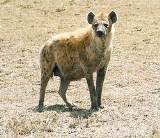
The Spotted Hyena, or Laughing Hyena, (Crocuta crocuta) is a carnivorous
Carnivora

The diverse Order Carnivora includes over 260 species of eutheria mammals. Its members are formally referred to as carnivorans, while the word "carnivore" can refer to any meat-eating animal....
 mammal
Mammal

Mammals are a class of vertebrate animals whose name is derived from their distinctive feature, mammary glands, with which they feed their young....
 of the family hyaenidae. It is the largest of the hyenas, and is native to sub-Sahara
Sahara

The Sahara is the world's largest hot desert. At over 9,000,000 square kilometers , it covers most of Northern Africa, making it almost as large as the United States or the continent of Europe....
n Africa
Africa

Africa is the world's second-largest and second most-populous continent, after Asia. At about 30.2 million km? including adjacent islands, it covers 6% of the Earth's total surface area and 20.4% of the total land area....
, save for the Congo basin. It occurs in many different habitats, from extremely hot and arid lowland areas in its northern and southern ranges, to cold, mountainous terrains in East Africa and Ethiopia. The species can also survive near human habitations.

The species is best known for one of its vocalisations, which resembles the sound of hysterical human laughter.


Discussion
Ask a question about 'Spotted Hyena'
Start a new discussion about 'Spotted Hyena'
Answer questions from other users
Full Discussion Forum


Recent Posts


Encyclopedia


The Spotted Hyena, or Laughing Hyena, (Crocuta crocuta) is a carnivorous
Carnivora

The diverse Order Carnivora includes over 260 species of eutheria mammals. Its members are formally referred to as carnivorans, while the word "carnivore" can refer to any meat-eating animal....
 mammal
Mammal

Mammals are a class of vertebrate animals whose name is derived from their distinctive feature, mammary glands, with which they feed their young....
 of the family hyaenidae. It is the largest of the hyenas, and is native to sub-Sahara
Sahara

The Sahara is the world's largest hot desert. At over 9,000,000 square kilometers , it covers most of Northern Africa, making it almost as large as the United States or the continent of Europe....
n Africa
Africa

Africa is the world's second-largest and second most-populous continent, after Asia. At about 30.2 million km? including adjacent islands, it covers 6% of the Earth's total surface area and 20.4% of the total land area....
, save for the Congo basin. It occurs in many different habitats, from extremely hot and arid lowland areas in its northern and southern ranges, to cold, mountainous terrains in East Africa and Ethiopia. The species can also survive near human habitations.

The species is best known for one of its vocalisations, which resembles the sound of hysterical human laughter. Though often labeled incorrectly as a scavenger, the spotted hyena is actually a powerful hunter, the majority of its nourishment being derived from live prey. The extinct Cave Hyena
Cave Hyena

The Cave Hyena is an extinct subspecies of spotted hyena native to Eurasia, ranging from Northern China to Spain and into the British Isles. Though originally described as a separate species from the spotted hyena due to large differences in fore and hind extremities, genetic analysis indicates no sizeable differences in DNA between Pleisto...
 has been classified as a subspecies of spotted hyena.

Taxonomy and evolution

The Spotted Hyena was formally described by German naturalist Johann Christian Polycarp Erxleben
Johann Christian Polycarp Erxleben

Johann Christian Polycarp Erxleben was a Germany natural history from Quedlinburg.Erxleben was Professor of physics and veterinary medicine at the University of G?ttingen....
 in 1777. The Greek
Ancient Greek

Ancient Greek is the historical stage in the development of the Greek language spanning across the Archaic Greece , Classical Greece , and Hellenistic civilization periods of ancient Greece and the classical antiquity....
 root (krokoutas) of its scientific name was used by Pliny the Elder
Pliny the Elder

Gaius Plinius Secundus , better known as Pliny the Elder, was an ancient author, naturalist or natural philosopher and naval and military commander of some importance who wrote Natural History ....
 for a semi-legendary animal
Crocotta

The crocotta , is a mythical dog-wolf of India or Ethiopia, said to be a deadly enemy of men and dogs....
 said to resemble a wolf-dog
Dog

The dog is a domesticated subspecies of the Gray Wolf, a member of the Canidae family of the order Carnivora. The term is used for both feral and pet varieties....
 hybrid
Hybrid

In biology, hybrid has two meanings. The first meaning is the result of interbreeding between two animals or plants of different Taxon. Hybrids between different species within the same genus are sometimes known as interspecific hybrids or crosses....
 with powerful jaws that lived in Ethiopia
Ethiopia

Ethiopia , officially the Federal Democratic Republic of Ethiopia, is a landlocked country situated in the Horn of Africa. Ethiopia is bordered by Eritrea to the north, Sudan to the west, Kenya to the south, Somalia to the east and Djibouti to the northeast....
 and India
India

India, officially the Republic of India , is a country in South Asia. It is the List of countries and outlying territories by total area country by geographical area, the List of countries by population country, and the most populous liberal democracy in the world....
. The term is derived from crocus
Crocus

Crocus is a genus of perennial plant flowering plants, native to a large area from coastal and subalpine areas of central and southern Europe , North Africa and the Middle East, across Central Asia to western China....
, commonly used in the ancient world as a yellow dye. Literally, it means "the saffron
Saffron

Saffron is a spice derived from the dried gynoecium of the flower of the saffron crocus , a species of crocus in the family Iridaceae. The flower has three Carpels, which are the anatomical terms of location ends of the plant's carpels....
-colored one".

It is thought that the ancestors of the spotted hyena branched off from the true hyenas (striped hyena
Striped Hyena

The Striped Hyena is an omnivore mammal of the biological family hyaenidae. It lives in Africa, the Middle East, Pakistan and western India....
s) during the Pliocene
Pliocene

The Pliocene epoch is the period in the geologic timescale that extends from 5.332 million to 1.806 million years before present.The Pliocene is the second epoch of the Neogene period in the Cenozoic era....
 era, 5.332 million to 1.806 million years ago. Curiously, the place where the species first evolved
Evolution

In biology, evolution is change in the heritability trait of a population of organisms from one generation to the next. These changes are caused by a combination of three main processes: variation, reproduction, and selection....
 seems to be the Indian Subcontinent
Indian subcontinent

The Indian subcontinent is a large section of the Asian continent consisting of the land lying substantially on the Indian Plate. The subcontinent includes parts of various countries in South Asia, including those on the continental crust , an Island#Continental islands country on the continental shelf , and an Island#Oceanic islands countr...
, according to the fossil record, while that of the striped hyena
Striped Hyena

The Striped Hyena is an omnivore mammal of the biological family hyaenidae. It lives in Africa, the Middle East, Pakistan and western India....
 resides in Africa. From India the spotted hyenas colonized the Middle East
Middle East

File:GreaterMiddleEast1.pngThe Middle East is a region that spans southwestern Asia, western Asia, and northeastern Africa. It has no clear boundaries, often used as a synonym to Near East, in opposition to Far East....
, Africa and the Ice Age
Ice age

The general term "ice age" or, more precisely, "glacial age" denotes a geological period of long-term reduction in the temperature of the Earth's surface and atmosphere, resulting in an expansion of continental ice sheets, polar ice sheets and alpine glaciers....
 plains of Eurasia
Eurasia

Eurasia is a large landmass covering about 53,990,000 km? or about 10.6% of the Earth's surface . Often considered a single continent, Eurasia comprises the traditional continents of Europe and Asia, concepts which date back to classical antiquity and the borders for which are somewhat arbitrary....
 extending from Atlantic Europe
Atlantic Europe

[Image:Atlantic-Europe.jpg|right|thumb|250px|Atlantic EuropeAtlantic Europe is a geography and anthropology term for the western portion of Europe which borders the Atlantic Ocean....
 to China
China

China is a Culture of China, an ancient civilization, and, depending on perspective, a national or multinational entity extending over a large area in East Asia....
 where a large subspecies known as C. c. spelaea or "cave hyena
Cave Hyena

The Cave Hyena is an extinct subspecies of spotted hyena native to Eurasia, ranging from Northern China to Spain and into the British Isles. Though originally described as a separate species from the spotted hyena due to large differences in fore and hind extremities, genetic analysis indicates no sizeable differences in DNA between Pleisto...
" developed as a respond to cold climate before disappearing at the end of the Pleistocene
Pleistocene

The Pleistocene is the epoch from 1.8 million to 10,000 years Before Present covering the world's recent period of repeated glaciations. The name pleistocene is derived from the Greek and ....
. The spotted hyena only vanished from the Middle East in the early Holocene
Holocene

The Holocene is a geological Epoch which began approximately 11,700 years ago . According to traditional geological thinking, the Holocene continues to the present....
, around 8000 years ago, and was replaced in this region by the striped hyena. Since then, it has been confined to Sub-Saharian Africa only.

As the sabre-toothed cats began to die out and be replaced by short fanged felids which were more efficient eaters, some hyenas began to hunt for themselves rather than scavenge and began evolving into new species, the modern spotted hyena being among them.

Physiology


Physical characteristics

Adult spotted hyenas are typically 1.3 m (4.3 ft) in length, with a shoulder height of 0.75 m (2.5 ft). Average weight ranges from 45 kg
Kilogram

The kilogram or kilogrammeThe spelling kilogram is used by the International Committee for Weights and Measures and the U.S....
 (99 lb
Pound (mass)

The pound or pound-mass is a Units of measurement of massused in the Imperial unit, United States customary units and other systems of measurement....
) for males and 55 kg (121 lb) for females in East Africa, to more than 70 kg (154 lb) in southern Africa. A maximum size of 90 kg (200 lb) has been reported.

The fur
Fur

Fur is a Hair of any non-human mammal, also known as the pelage. It may consist of short ground hair, long guard hair, and, in some cases, medium awn hair....
's background colour is a cream to light brown, with irregular dark spots that fade with age. The muzzle is black. They have long, heavily muscled necks, lined with a coarse mane of reversed fur.

The forequarters are more heavily built than the hindquarters, giving the hyena a distinctively sloping bear
Bear

Bears are mammals of the family Ursidae. Bears are classified as caniforms, or doglike carnivorans, with the pinnipeds being their closest living relatives....
-like gait. Hyenas are built for endurance, possessing a very large heart
Heart

The heart is a muscle organ in all vertebrates responsible for pumping blood through the blood vessels by repeated, rhythmic contractions, or a similar structure in annelids, mollusks, and arthropods....
 which allows them to trot at 10 km/h (6 mph) without tiring. During chases, hyenas have been clocked at running speeds of up to 50 km/h (30 mph) for over 3 km. They are good swimmers, capable of controlling their buoyancy and walking at the bottom of pools whilst holding their breath.

Hyenas have extremely strong jaws in relation to their body size. In 2005, Dr. Brady Barr
Brady Barr

Brady Barr is the host of National Geographic Channel's Reptile Wild, Dangerous Encounters, and Croc Chronicles With Dr Brady Barr....
 of the National Geographic measured the bite forces of many different animals, including spotted hyenas for the documentary Dangerous Encounters: Bite Force. A one year old cub had a bite measured at 603 pounds-force (2.68 kN), leading to the postulation that a full grown adult could bite at over 1,000 pounds-force (4.4 kN). This mandibular power, combined with its large pyramid shaped molars allows it to easily crush bone, even those of elephants. An experiment conducted in 1955 showed that the spotted hyena easily outclassed the much larger brown bear
Brown Bear

The Brown Bear is a large bear distributed across much of northern Eurasia and North America. It weighs 100 to 700 kg and its larger populations such as the Kodiak bear match the Polar bear as the largest extant land predator....
 in bone crushing ability. It is often asserted in television and print that hyenas have the most powerful bite for their overall body mass when compared to other animals, although there is no scientific basis for this claim.

In the wild, the spotted hyena has an average lifespan of 12 years. It can be extended to 25 in captivity.

Reproduction

The female Spotted Hyena's urogenital system is unique among mammals; the female's clitoris is elongated to form a fully erectile phallus, and the vaginal opening is at the tip of this phallus. Only the shape of the glans
Glans

The glans is a vascular structure located at the tip of the penis in men or a homology genital structure of the clitoris in women....
 at the tip of the phallus makes it possible to differentiate the sexes. The female urinates, mates and gives birth through this pseudo-penis
Pseudo-penis

A pseudo-penis is a term used of any structure found on an animal that while superficially appearing to be a penis, is derived from a different developmental path....
. Since it is impossible to penetrate without the female's cooperation, female hyenas have full control over whom they choose to mate with. The male hyena's penis lacks a baculum
Baculum

The baculum is a bone found in the penis of most mammals. It is absent in humans, equidae, marsupials, lagomorphs, and hyenas, and cetaceans among others....
, a bone found in the genitals of most mammals.

Birth is very difficult: the internal birth canal extends almost to the subcaudal location of the vulva
Vulva

The vulva refers to the external sex organ of the female. In colloquial speech, the term vagina is often used to refer to the female genitals generally, although, strictly speaking, the vagina is a specific internal structure, whereas the vulva is the whole exterior genitalia....
 (which in Crocuta is fused to form a scrotum
Scrotum

In some male mammals the scrotum is a protuberance of skin and muscle containing the testicles. It is an extension of the abdomen, and is located between the penis and anus....
 containing fatty pseudo-testes) before turning abruptly towards the clitoris, and the clitoris itself is narrow (although it ruptures with the first parturition, making subsequent births easier). In a female giving birth for the first time the pseudopenis may tear as much as 15cm along its length to accommodate the passage of the baby. In captivity, many cubs of first time mothers are stillborn because of the long labour times involved, and in the wild, it is estimated that 10% of first time mothers die during labour. Spotted hyenas usually have 2 cubs at a time and they are raised for about 10 months.

Researchers originally thought that one of the things that causes this characteristic of the genitals is androgens that are expressed to the fetus very early on in its development. However, it was discovered that when the androgens are held back from the fetus, the development of the female genitalia was not altered. Other hyena species lack this adaptation, making it a fairly recent one in the hyena line. Masculinised female genitalia also appears in some lemur
Lemur

Lemurs make up the infraorder Lemuriformes and are members of a group of primates known as prosimians. The term "lemur" is derived from the Latin word lemures, meaning "spirits of the night" or "ghosts"....
s, spider monkey
Spider monkey

Found in tropical forests from southern Mexico to Brazil, spider monkeys belong to the genus Ateles; the closely related woolly spider monkeys, are in the genus Brachyteles....
s, and the Binturong
Binturong

The Binturong , also known as the Asian Bearcat, the Palawan Bearcat, or simply the Bearcat, is a species of the family Viverridae, which includes the civets and genet s....
 but the fused vulva is unique to the hyena.

Hyenas are born with their eyes open and teeth already fully developed after a 4 month gestation period. At birth, the cubs weigh 1 to 1.6 kg (2.2–3.6 lb), and are among the few mammals to commit neonatal siblicide
Siblicide

Siblicide , the death of an individual by its close relatives may occur directly between siblings or indirectly across the parent-offspring relationship and is seen to have beneficial indirect results for the Genetics viability of a population or direct results for the recipient individuals....
. A same sexed litter will result in vicious fighting between the cubs, often resulting in death. This siblicide is estimated to contribute to 25% of hyena cub mortality. Since a single cub will receive more food and mature faster, this behavior is probably adaptive. Spotted hyena milk is very rich, having the highest protein content (14.9%) of any terrestrial carnivore, and the fat content (14.1%) is second only to the polar bear
Polar Bear

The polar bear is a bear native to the Arctic Ocean and its surrounding seas. The world's largest carnivore found on land, and shares the title of largest land predator with the Kodiak Bear, an adult male weighs around , while an adult female is about half that size....
, so unlike lions and wild dogs, they can leave their cubs for about a week without feeding them. Two to six weeks after whelping, young are transported to the communal den. Young depend entirely on milk for about 8 months and are not weaned until 12 to 16 months old. Maturation is at three years, females later than males. Female offspring remain in their natal clan while males leave at around two years.

Behaviour

Spotted hyenas mark their territories by excreting an oily, yellow substance from their anal glands onto surrounding bushes and grass. To do this, the anal pouch is turned inside out, or everted. The anal glands are everted also as a submissive posture to dominant hyenas. Scent marking is also done by scraping the ground with the paws, which deposits scent from glands on the bottoms of the feet.

Group organization

Studies strongly suggest convergent evolution
Convergent evolution

Convergent evolution describes the acquisition of the same biological trait in unrelated lineages.The wing is a classic example of convergent evolution in action....
 in hyena and primate
Primate

A primate is a member of the biological order Primates , the group that contains lemurs, the Aye-aye, Lorisidaes, galagos, tarsiers, monkeys, and apes, with the last category including humans....
 intelligence. Spotted hyena societies are more complex than those of other carnivorous mammals, and have been reported to be remarkably similar to those of cercopithecine primates in respect to group size, structure, competition and cooperation. Like primates, spotted hyenas use multiple sensory modalities, recognise individual conspecifics, they are conscious that some clan-mates may be more reliable than others, they recognise 3rd party
3rd Party

3rd Party was a three-member dance-pop group that released a single album in 1997. It is best known for their dance hit "Can U Feel It," and for the song "Waiting for Tonight," which was remade by Jennifer Lopez....
 kin and rank relationships among clan-mates and adaptively use this knowledge during social decision making. Also like cercopithecine primates, dominance ranks in hyena societies are not correlated with size or aggression, but with ally networks. Compared to other hyenas, spotted hyenas show a greater relative amount of frontal cortex exclusive to motor control functions. Spotted hyenas frequently deposit their droppings in "latrine
Latrine

A latrine is a structure for defecation and urination. Latrines allow for safer and more hygienic disposal of human waste than open defecation....
s" which are usually situated at clan boundraries.

Group size
Group size measures

Many animals, including humans, tend to live in groups, herds, flock , bands, Pack , parties, or Bird colony of conspecific individuals. The size of these groups, as expressed by the number of participant individuals, is an important aspect of their social environment....
 is variable, a "clan" of spotted hyenas can include 5–90 members and is led by a single alpha female called the matriarch. Clan life is centered around a communal den, however only cubs live within the den itself. Each clan is a permanent social group called a fission-fusion society
Fission-fusion society

In primatology, a fission-fusion society is one in which the social group, e.g. bonobo collectives of 100-strong, sleep in one locality together, but forage in small groups going off in different directions during the day....
. A complicated social hierarchy
Social hierarchy

Social hierarchy is a multi-tiered pyramid-like social or functional structure having an apex as the centralization of power. The term can also be applied to animal societies, but the term dominance hierarchy is preferred most times....
 governs the clan, which cubs often learn before they begin to walk. Females are the dominant members, followed in rank by cubs, while adult males rank lower than the lowest ranking female, with the fully matured males forming the lowest ranking group throughout the clan. The society is highly structured, with dominance relationship between the matrilines (the groups of females descended from a single mother) that endure for generations. Social behavior is very complex, involving frequent alliances and shifting social ties. In this hyenas are more similar to many old world primates than they are to other social carnivores. Male hyenas, which are usually smaller and less aggressive than females, often leave the clan when they are about two years old, while females stay within their birth clan.

Subordinate members of the clan lick the pseudo-penis of a higher ranked female as a sign of submission. The matriarch's pseudo-penis is licked by all members of the clan, while male's penises are rarely licked because the highest ranked male is subordinate to the lowest ranked female.

Females tend to mate with males from other clans, thereby preventing inbreeding
Inbreeding

Inbreeding is biological reproduction between close Kinships, whether plant or animal. If practiced repeatedly, it leads to an increase in homozygosity of a population....
. Female hyenas very rarely mate with highly aggressive males. Instead, calmer and more docile males are selected. Patience is especially important since courtship
Courtship

Courtship is the traditional dating period before engagement and marriage. During a courtship, a couple dates to get to know each other and decide if there will be an engagement....
 can last as long as a year. For this reason, dominant and impatient males have difficulty finding mates. Despite the complicated courtship, the female raises her pups without the male. Infanticide is common. "Prior to the mother's return, another adult female (a full sister to the new mother) arrived and methodically killed both newborns with crushing bites to the head" (Paula A. White)

Hyenas within the same clan rarely fight in a way that can damage them seriously. Most bickering is settled quickly, even by members that have similar ranking in the social hierarchy. Some loud noises and a couple of light bites is usually enough, and if the fight ever gets out of hand, it is quite normal for a hyena of a higher rank to step in and interrupt the fight.

Even hyenas that are strangers to each other would rather avoid battle than recklessly try to kill each other. Usually, scent marking territories avoids conflicts: if a lone hyena should enter a hostile territory anyway, it keeps a low profile and stays near the borders. Female hyenas are treated with more hostility than males, since males from different clans are needed for breeding in the clan. Strangers are rarely accepted in a clan, but if so, they are usually placed at the bottom of the ranking system. When large scale confrontations do occur (with lions or other hyena clans), hyena form a distinctive "wall" by standing shoulder to shoulder and advancing on the threat as a group.

Like many social carnivores, spotted hyenas are playful, especially when young. In captivity they can become very tame, and both native Africans and Europeans living in Africa have sometimes successfully made pets
PETS

PETS may be an acronym for:* Pet passport, which allows animals to travel internationally without quarantine*Pets Evacuation and Transportation Standards Act...
 of them.

Hunting and diet

Although spotted hyenas are better adapted to a scavenging lifestyle than any other predators in their range, they obtain the majority of their nourishment through hunting. Their teeth are not as specialised to a solely scavenging lifestyle like the striped and brown hyenas, having further developed them to be more "all purpose". Spotted hyenas tend to target medium-sized ungulates such as wildebeest
Wildebeest

The wildebeest , also called the gnu , is an antelope of the genus Connochaetes. It is a hooved mammal.Connochaetes includes two species, both native to Africa: the Black Wildebeest, or white-tailed gnu , and the Blue Wildebeest, or brindled gnu ....
 or zebra
Zebra

Zebras are African equids best known for their distinctive white and black stripes. Their stripes come in different patterns unique to each individual....
, rather than larger ones such as Cape buffalo or smaller ones such as Thomson's gazelle
Thomson's Gazelle

The Thomson's gazelle is one of the best-known gazelles. It is named after explorer Joseph Thomson , and is often referred to as the "tommy"....
. Unlike wolves, spotted hyenas rely more on sight than smell in selecting prey. They will readily chase after prey that retreats in deep water. Like African wild dog
African Wild Dog

The African Wild Dog is a Carnivore mammal of the Canidae family, found only in Africa, especially in scrub savanna and other lightly wooded areas....
s, spotted hyenas chase their prey over long distances, until the selected quarry exhausts itself. Because of their hunting methods, spotted hyenas are typically more likely to select the physically least able of a herd. When attacking large prey, they bite the animal's hind quarters and tear open the abdomen. The entrails and leg muscles are usually eaten first. If the victim is a pregnant female, then the fetus is among the first things to be eaten. The head is always left last. Spotted hyenas can consume at least 14.5 kg at a meal, up to a third of their own body weight, which is an exceptionally high figure for mammals. They have a very powerful digestive system with highly acidic fluids. This makes them capable of eating and digesting their entire prey, including skin, teeth, horns, bones and even hooves. This results in them having crusty white droppings, due to the amount of calcium
Calcium

Calcium is the chemical element with the symbol Ca and atomic number 20. It has an atomic mass of 40.078 amu. Calcium is a soft grey alkaline earth metal, and is the fifth most abundant element by mass in the earth's Crust ....
 they ingest. The spotted hyena's digestive system is so efficient, it can even derive nourishment from mummified corpses. There are reports of hyenas entering campsites and consuming aluminium
Aluminium

Aluminium or aluminum is a silvery white and ductile member of the boron group of chemical elements. It has the symbol Al; its atomic number is 13....
 pots and pans. Indigestible parts are vomited in the form of pellets. In areas with high spotted hyena densities, discarded bones are rarely found except during the wildebeest calving season when some hyenas consume so much, that they only eat the choiciest parts of their prey. When eating together, spotted hyenas compete with one another through speed of eating rather than fighting. One pack was recorded to have completely consumed an adult zebra in 36 minutes. Rare accounts of surplus killing
Surplus killing

Surplus killing is the behavior predators exhibit when they kill more prey than they can immediately use. They may partially consume, cache, or abandon intact prey....
 have been reported, one example being in 1966, in which during one storm ridden night, a group of hyenas killed 110 Thomson's gazelle and ate only a small proportion of the victims.

Spotted hyenas catch adult wildebeest usually after 5 km chases at speeds of up to 60 km/h. Chases are usually initiated by one hyena, and with the exception of cows with calves, there is little active defense by the wildebeest herd. Wildebeest will sometimes attempt to escape hyenas by taking to water, though in such cases, the hyenas almost invariably catch them. Though hyenas commonly hunt in packs, a single hyena is sometimes sufficient to kill an adult bull wildebeest. Zebras require different hunting methods to those used for wildebeest, due to their habit of running in tight groups and aggressive defence from stallion
Stallion

A Stallion is a male horse.Stallion may also refer to:* Stallion , an American pop rock group* Stallion , a figure in the Gobot toyline...
s. Typical zebra hunting groups consist of 10-25 hyenas who indulge in activities such as scent marking before setting off. During a chase, zebras typically move in tight bunches, with the hyenas pursuing behind in a crescent
Crescent

In art and symbolism, a crescent is generally the shape produced when a circle disk has a segment of another circle removed from its edge, so that what remains is a shape enclosed by two circular arcs of different diameters which intersect at two points ....
 formation. Chases are usually relatively slow, with an average speed of 15-30 km/h. A stallion will attempt to place themselves between the hyenas and the herd, though once a zebra falls behind the protective formation, it is immediately set upon, usually after a chase of 3 km. Though hyenas may harass the stallion, they usually only concentrate on the herd and attempt to dodge the stallion's assaults. Unlike stallions, mares typically only react aggressively to hyenas when their foals are threatened. Unlike wildebeest, zebras rarely take to water when escaping hyenas. Spotted hyenas rarely attack cape buffalo, due to differences in habitat preferences, though hyenas have been recorded to kill fully grown bulls. Other recorded prey items include fish
Fish

A fish is any marine biology vertebrate animal that is typically ectothermic , covered with scale , and equipped with two sets of paired fins and several unpaired fins....
, tortoise
Tortoise

Tortoises or land turtles are land-dwelling reptiles of the family of Testudinidae, order Turtle. Like their marine cousins, the sea turtles, tortoises are shielded from predators by a shell....
s, black rhino, hippo
Hippopotamus

The hippopotamus or hippo is a large, mostly herbivore African mammal, one of only two Extant taxon species in the scientific classification Hippopotamidae ....
 calves, elephant
Elephant

Elephants are large land mammals of the order Proboscidea and the family Elephantidae. There are three living species: the African Bush Elephant, the African Forest Elephant and the Asian Elephant ....
 calves, pangolin
Pangolin

Pangolins or scaly anteaters or Trenggiling are mammals in the Scientific classification Pholidota. There is only one extant family and one genus of pangolins, comprising eight species....
s, pythons, jackal
Jackal

A jackal is a member of any of three small to medium-sized species of the family Canidae, found in Africa, Asia and southeastern Europe. Jackals fill a similar ecological niche to the coyote in North America, that of predators of small to medium-sized animals, scavengers, and omnivores....
s, lion
Lion

The lion is a member of the family Felidae and one of four big cats in the genus Panthera. With exceptionally large males exceeding 250 kg in weight, it is the second-largest living cat after the tiger....
s, livestock
Livestock

Livestock is the term used to refer to a domesticated animal intentionally reared in an agricultural setting to produce things such as food or fibre, or for its labour....
, dog
Dog

The dog is a domesticated subspecies of the Gray Wolf, a member of the Canidae family of the order Carnivora. The term is used for both feral and pet varieties....
s and human
Human

A human being, also human or man, is a member of a species of bipedalism primates in the family Hominidae . Mitochondrial DNA evidence indicates that modern humans originated in east Africa about 200,000 years ago....
s.

Spotted hyenas tend to scavenge more in daylight hours, thus facilitating the spotting of alighting vultures, to which they react quicker than most other carnivores. They are more likely to stay near a lion kill or human settlement than any other African predators except jackals. Spotted hyenas will sometimes cache
Cache

In computer science, a cache is a collection of data duplicating original values stored elsewhere or computed earlier, where the original data is expensive to fetch or to compute, compared to the cost of reading the cache....
 food for later consumption. Some spotted hyenas have been reported to store food underwater. Spotted hyenas consume very little water, usually spending no more than 30 seconds drinking.

Interspecific predatory relationships

The relationship between hyenas and lion
Lion

The lion is a member of the family Felidae and one of four big cats in the genus Panthera. With exceptionally large males exceeding 250 kg in weight, it is the second-largest living cat after the tiger....
s in areas where they coexist is unique in its complexity and intensity. Lions and hyenas are both apex predator
Apex predator

Apex predators are predators that, as adults, are not normally preyed upon in the wild by other large animals in significant parts of their range....
s which feed on the same prey, and are therefore in direct competition with one other. As such, they will often fight over and steal each others' kills. Though it is popularly assumed that hyenas are opportunistic scavengers which profit from the lion's hunting abilities, it is quite often the case that the reversal is true. In Tanzania's Ngorongoro Crater, the hyena population greatly exceeds that of the resident lions, which obtain a large proportion of their food by pirating hyena prey. The feud between the two species does however seem to encompass more than just battles over food. In the animal kingdom, the territorial boundaries of another species are usually disregarded. Hyenas and lions are an exception to this seeing as they set boundaries against each other as they would against members of their same species. Male lions are extremely aggressive toward hyenas, and have been observed to hunt and kill hyenas without eating them. Conversely, hyenas are major predators of lion cubs. When attacking adults, hyenas go after groups of females or better yet, a single female. However, healthy adult males, even single ones, are generally avoided. In April 1999, a particularly bloody "war" between lions and hyenas lasting two weeks was reported in Gobele desert of Ethiopia. Lions eventually drove hyenas off the region after killing around 35 hyenas while losing six of their own.

Spotted hyenas typically dominate solitary feline
Feline

Feline can refer to:* Felidae - the cat family, which includes lions, tigers and Black panther.* Felinae - the subfamily of Felidae that includes domestic cats and smaller wild cats....
s like leopard
Leopard

The leopard is a member of the Felidae biological family and the smallest of the four "Panthera" in the genus Panthera; the other three are the tiger, lion and jaguar....
s and cheetah
Cheetah

The cheetah is an atypical member of the cat family that is unique in its speed, while lacking climbing abilities. Therefore it is placed in its own genus, Acinonyx....
s. Although the diet of leopards and cheetahs shows little overlap with that of hyenas, hyenas will often follow the cats in an attempt at stealing their kills. A single hyena is usually sufficient at driving a leopard or cheetah from its kill, though some male leopards have been recorded to occasionally kill hyenas for food.

In areas where spotted hyenas and African wild dog
African Wild Dog

The African Wild Dog is a Carnivore mammal of the Canidae family, found only in Africa, especially in scrub savanna and other lightly wooded areas....
s are sympatric, the former often trail wild dog packs in order to steal their kills. Hyenas have been shown to be attracted to large numbers of wild dogs, even when no kill is present. Though adult hyenas physically outmatch wild dogs, a pack of wild dogs can hold its own against a group of hyenas due to their habit of working more in unison.

Vocalizations

The spotted hyena is among the most vocal African mammals, with over 11 different sounds being recorded.

  • Groans/soft squeals – Often exchanged during greeting.
  • Whoop – A contact call, varying in pitch and intensity. A fast whoop is a rallying cry given by excited hyenas during conflict or at a kill site. Apparently, calls emitted by males are usually ignored. Calls emitted by females however are responded to immediately.
  • Lowing – A sound made by impatient hyenas, usually when waiting for their turn at a kill.
  • Grunting – A very low growl with the mouth closed that accompanies aggressive behaviour.
  • Growling – A deep, resonating rumble made by defensive hyenas threatening to bite.
  • Rattling growl – A low-pitched, soft, staccato grunt given as an alarm call.
  • Giggling – A high pitched, cackling laugh, typically emitted by hyena being chased; expresses intense fear.
  • Yelling – A roaring scream voiced by hyenas attempting to escape attackers.


Body language

  • Phallic inspection – An affectionate greeting ceremony between clan members, usually initiated by lower ranking individuals. After mutually sniffing the nose, mouth, head, and neck, the two hyenas stand head-to-tail and sniff/touch each other's extended phallus for up to half a minute with their back leg cocked. This greeting is performed by both sexes from the age of one month onwards. Adult males rarely greet females in this manner.
  • Social grooming – Licking and nibble-grooming between mothers and offspring, though rarely between adults.
  • Courtship – The male approaches the female from behind with his head bowed and penis extended. He will paw the ground behind her, depositing his scent with his toe glands.


Relationships with humans


Historical perceptions

The Ancient Greeks believed that hyenas were hermaphrodites, though this assertion was later challenged by Aristotle
Aristotle

Aristotle was a Greeks philosopher, a student of Plato and teacher of Alexander the Great. He wrote on many subjects, including physics, metaphysics, Poetics , theater, music, logic, rhetoric, politics, government, ethics, biology and zoology....
. It is however doubtful he had any first hand experience with spotted hyenas to begin with, considering his physical descriptions match those of the striped hyena which does not share its spotted cousin's sexual anomalies.

Through the early days of the Christian era to the end of the Middle Ages
Middle Ages

File:Karl 1 mit papst gelasius gregor1 sacramentar v karl d kahlen.jpgThe Middle Ages of European history are a period in history which lasted for roughly a millennium, commonly dated from the fall of the Roman Empire in the 5th century to the beginning of the Early Modern Period in the 16th century, marked by the division of Western Christi...
, hyenas were thought to annually change sex and habitually rob graves. The former charge was traditionally linked by medieval Christians to the Jews. Sir Walter Raleigh, in his 1614 History of the World believed that hyenas were not present in Noah's Ark
Noah's Ark

Noah's Ark is a large vessel featured in the mythology of Abrahamic religions. Narratives that include the Ark are found in the Hebrew Bible and the Qur'an ....
, as he believed them to be mixed animals like mule
Mule

In its common modern meaning, a mule is the offspring of a male donkey and a female horse.Mules are classified as an F1 hybrid.The term "mule" was formerly applied to the infertile offspring of any two creatures of different species....
s, and thus could easily be recreated.

1656 was the year of the first predator culling legislation in South Africa. The hyena was known as "wolf", and rewards of up to four realen were given to those who managed to kill them. Predator culling was a common practice in the early African game reserves until the mid 20th century. In the Kruger National Park
Kruger National Park

Kruger National Park is the largest game reserve in South Africa. It covers 18,989 square km and extends 350 km from north to south and 60 km from east to west....
 between 1903 and 1927, 18,428 predators were killed in an effort to protect game herds. Spotted hyenas accounted for 521 of the killed predators.

In African folklore

Spotted hyenas vary in their folkloric and mythological depictions, depending on the ethnic group from which the tales originate. In East Africa, Tabwa mythology portrays the spotted hyena as a solar animal that first brought the sun to warm the cold earth, while West African folklore generally shows the hyena as symbolizing immorality, dirty habits, the reversal of normal activities, and other negative traits. The Kaguru
Kaguru

The Kaguru, or Kagulu, are an ethnic and linguistic group based in central Tanzania. In 1987 the Kaguru population was estimated to number 217,000....
 of Tanzania
Tanzania

Tanzania , officially the United Republic of Tanzania , is a country in East Africa that is bordered by Kenya and Uganda on the north, Rwanda, Burundi and the Democratic Republic of the Congo on the west, and Zambia, Malawi and Mozambique on the south....
 and the Kujamaat of Southern Senegal
Senegal

Senegal , officially the Republic of Senegal, is a country south of the S?n?gal River in West Africa. Senegal is bounded by the Atlantic Ocean to the west, Mauritania to the north, Mali to the east, and Guinea and Guinea-Bissau to the south....
 view hyenas as inedible
Inedible

Excess long comment to prevent listing on...
 and greedy hermaphrodites. A mythical African tribe called the Bouda is reputed to house members able to transform into hyenas. Belief in "werehyenas" is so entrenched within the traditional lore of the Bornu
Bornu

Bornu may refer to:* Bornu Empire, a historical state of West Africa* Borno State, Nigeria...
 people of north-eastern Nigeria
Nigeria

Nigeria, officially the Federal Republic of Nigeria, is a federation constitutional republic comprising States of Nigeria and one Federal Capital Territory, Nigeria....
, that their language even contains a special word bultungin which translates as "I change myself into a hyena".

Attacks on humans

While hyenas, in general, do not hunt humans, some attacks occurred and even caused human death. Spotted hyenas are widely feared in Malawi
Malawi

The Republic of Malawi is a landlocked country in southeast Africa that was formerly known as Nyasaland. It is bordered by Zambia to the northwest, Tanzania to the northeast and Mozambique, which surrounds it on the east, south and west....
, where they have been known to occasionally attack people at night, particularly during the hot season when people sleep outside. Hyena attacks were widely reported in Malawi's Phalombe plain, to the north of Michesi Mountain. Five deaths were recorded in 1956, five in 1957 and six in 1958. This pattern continued until 1961 when eight people were killed. Attacks occurred most commonly in September, when people slept outdoors, and bush fires made the hunting of wild game difficult for the hyenas.

External links