

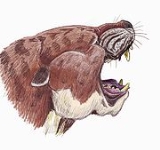
Creodonta

Encyclopedia
The creodonts are an extinct order
of mammal
s that lived from the Paleocene
to the Miocene
epochs. They shared a common ancestor with the Carnivora
.
Creodonts were an important group of carnivorous mammals from in the ecosystems of Africa
, Eurasia
and North America
. In Oligocene
Africa, they were the dominant predatory group. They competed with the Mesonychid
s and the Entelodont
s and ultimately outlasted them by the start of the Oligocene and by the middle of the Miocene
respectively, but lost ground to the carnivorans. The last genus went extinct , and carnivorans now occupy their ecological niches.
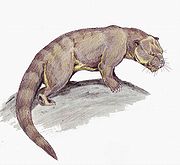 Creodonts were traditionally considered ancestors to Carnivora, but are now considered to have shared a common ancestor further back - possibly a Cimolesta
such as Cimolestes
. They share with the Carnivora the carnassial shear, a modification of teeth that evolved to slice meat in a manner like scissors and gave both orders the tools to dominate the niche
. Some researchers argue that the creodonts represent a group of mammals of diverse biological ancestry that resemble one another via convergent evolution
, rather than being the descendants of a single common ancestor. Their origins lie at least as far back as the late Cretaceous
, though they did not radiate
much until the Cenozoic
. Creodonts were the dominant carnivorous mammals from , peaking in diversity and prevalence during the Eocene
. By the mid Oligocene
, Creodonts supplanted both the Mesonychids, and giant flightless predatory birds entirely in North America
, Eurasia
and Africa
, and in turn, competed with their own relatives, the Carnivorans. The last genus, Dissopsalis
, went extinct about .
, Eurasia
and Africa
, in forms that resemble those of some modern carnivores. Amongst their number was Sarkastodon
, one of the largest mammalian land predators of all time, weighing an estimated 800 kg. Their dominance over the early Carnivora, known as miacids, began to wane after . The creodonts survived until ; the last form, Dissopsalis
, died out in Pakistan
. Bear
s, cat
s, mustelids
, hyena
s, canids
such as wolves and other Carnivora now occupy the former creodont niches.
 It is not known exactly why the creodonts were replaced by Carnivora. It may be because of their smaller brains and their locomotion
, which was somewhat less energy-efficient (especially while running). Their limb structure limited leg movement to a vertical plane, as in horses; they were unable to turn their wrists and forearms inward to trip, slash, or grab prey as modern carnivores can. Creodonts had to depend entirely on their jaws to capture prey, which may be why most creodonts had much larger heads than carnivores of the same body size. The creodont lumbosacral spine was not arranged as efficiently for running as in Carnivora. The arrangement of the teeth was also somewhat different. In the miacids (and so in the modern Carnivora), the last upper premolar
and the first lower molar
are the carnassial
s, allowing grinding teeth to be retained behind for feeding on non-meat foods (the Canidae
are the closest modern analog to miacid dentition). In creodonts, the carnassials were further back - either first upper and second lower molars, or second upper and third lower molars. This committed them to eating meat almost exclusively. These limits may have created important disadvantages over millions of years.
In the most strictly carnivorous family of modern Carnivora, the Felidae
, the second and third molars have disappeared completely, and the first upper molars behind the carnassials have become vestigial. Modern cats thus eat plant food only incidentally.
Order (biology)
In scientific classification used in biology, the order is# a taxonomic rank used in the classification of organisms. Other well-known ranks are life, domain, kingdom, phylum, class, family, genus, and species, with order fitting in between class and family...
of mammal
Mammal
Mammals are members of a class of air-breathing vertebrate animals characterised by the possession of endothermy, hair, three middle ear bones, and mammary glands functional in mothers with young...
s that lived from the Paleocene
Paleocene
The Paleocene or Palaeocene, the "early recent", is a geologic epoch that lasted from about . It is the first epoch of the Palaeogene Period in the modern Cenozoic Era...
to the Miocene
Miocene
The Miocene is a geological epoch of the Neogene Period and extends from about . The Miocene was named by Sir Charles Lyell. Its name comes from the Greek words and and means "less recent" because it has 18% fewer modern sea invertebrates than the Pliocene. The Miocene follows the Oligocene...
epochs. They shared a common ancestor with the Carnivora
Carnivora
The diverse order Carnivora |Latin]] carō "flesh", + vorāre "to devour") includes over 260 species of placental mammals. Its members are formally referred to as carnivorans, while the word "carnivore" can refer to any meat-eating animal...
.
Creodonts were an important group of carnivorous mammals from in the ecosystems of Africa
Africa
Africa is the world's second largest and second most populous continent, after Asia. At about 30.2 million km² including adjacent islands, it covers 6% of the Earth's total surface area and 20.4% of the total land area...
, Eurasia
Eurasia
Eurasia is a continent or supercontinent comprising the traditional continents of Europe and Asia ; covering about 52,990,000 km2 or about 10.6% of the Earth's surface located primarily in the eastern and northern hemispheres...
and North America
North America
North America is a continent wholly within the Northern Hemisphere and almost wholly within the Western Hemisphere. It is also considered a northern subcontinent of the Americas...
. In Oligocene
Oligocene
The Oligocene is a geologic epoch of the Paleogene Period and extends from about 34 million to 23 million years before the present . As with other older geologic periods, the rock beds that define the period are well identified but the exact dates of the start and end of the period are slightly...
Africa, they were the dominant predatory group. They competed with the Mesonychid
Mesonychid
Mesonychia are an extinct order of medium to large-sized carnivorous mammals that were closely related to artiodactyls and to cetaceans...
s and the Entelodont
Entelodont
Entelodonts, sometimes nicknamed hell pigs or terminator pigs, is an extinct family of pig-like omnivores endemic to forests and plains of North America, Europe, and Asia from the middle Eocene to early Miocene epochs , existing for approximately .-Taxonomy:Entelodontidae was named by Richard...
s and ultimately outlasted them by the start of the Oligocene and by the middle of the Miocene
Miocene
The Miocene is a geological epoch of the Neogene Period and extends from about . The Miocene was named by Sir Charles Lyell. Its name comes from the Greek words and and means "less recent" because it has 18% fewer modern sea invertebrates than the Pliocene. The Miocene follows the Oligocene...
respectively, but lost ground to the carnivorans. The last genus went extinct , and carnivorans now occupy their ecological niches.
Evolution and taxonomy
Cimolesta
Cimolesta is an extinct order of mammals. A few experts place the pangolins within Cimolesta, though most other experts prefer to place the pangolins within their own order, Pholidota....
such as Cimolestes
Cimolestes
Cimolestes is a genus of early eutherians. Fossils have been found in North America, where they first appeared during the Late Cretaceous, and died out during the Paleocene....
. They share with the Carnivora the carnassial shear, a modification of teeth that evolved to slice meat in a manner like scissors and gave both orders the tools to dominate the niche
Ecological niche
In ecology, a niche is a term describing the relational position of a species or population in its ecosystem to each other; e.g. a dolphin could potentially be in another ecological niche from one that travels in a different pod if the members of these pods utilize significantly different food...
. Some researchers argue that the creodonts represent a group of mammals of diverse biological ancestry that resemble one another via convergent evolution
Convergent evolution
Convergent evolution describes the acquisition of the same biological trait in unrelated lineages.The wing is a classic example of convergent evolution in action. Although their last common ancestor did not have wings, both birds and bats do, and are capable of powered flight. The wings are...
, rather than being the descendants of a single common ancestor. Their origins lie at least as far back as the late Cretaceous
Cretaceous
The Cretaceous , derived from the Latin "creta" , usually abbreviated K for its German translation Kreide , is a geologic period and system from circa to million years ago. In the geologic timescale, the Cretaceous follows the Jurassic period and is followed by the Paleogene period of the...
, though they did not radiate
Adaptive radiation
In evolutionary biology, adaptive radiation is the evolution of ecological and phenotypic diversity within a rapidly multiplying lineage. Starting with a recent single ancestor, this process results in the speciation and phenotypic adaptation of an array of species exhibiting different...
much until the Cenozoic
Cenozoic
The Cenozoic era is the current and most recent of the three Phanerozoic geological eras and covers the period from 65.5 mya to the present. The era began in the wake of the Cretaceous–Tertiary extinction event at the end of the Cretaceous that saw the demise of the last non-avian dinosaurs and...
. Creodonts were the dominant carnivorous mammals from , peaking in diversity and prevalence during the Eocene
Eocene
The Eocene Epoch, lasting from about 56 to 34 million years ago , is a major division of the geologic timescale and the second epoch of the Paleogene Period in the Cenozoic Era. The Eocene spans the time from the end of the Palaeocene Epoch to the beginning of the Oligocene Epoch. The start of the...
. By the mid Oligocene
Oligocene
The Oligocene is a geologic epoch of the Paleogene Period and extends from about 34 million to 23 million years before the present . As with other older geologic periods, the rock beds that define the period are well identified but the exact dates of the start and end of the period are slightly...
, Creodonts supplanted both the Mesonychids, and giant flightless predatory birds entirely in North America
North America
North America is a continent wholly within the Northern Hemisphere and almost wholly within the Western Hemisphere. It is also considered a northern subcontinent of the Americas...
, Eurasia
Eurasia
Eurasia is a continent or supercontinent comprising the traditional continents of Europe and Asia ; covering about 52,990,000 km2 or about 10.6% of the Earth's surface located primarily in the eastern and northern hemispheres...
and Africa
Africa
Africa is the world's second largest and second most populous continent, after Asia. At about 30.2 million km² including adjacent islands, it covers 6% of the Earth's total surface area and 20.4% of the total land area...
, and in turn, competed with their own relatives, the Carnivorans. The last genus, Dissopsalis
Dissopsalis
Dissopsalis is a genus of extinct predatory mammals of the order Creodonta. The older species, D. pyroclasticus, lived in Kenya during the middle Miocene, while the type species, D. carnifex, ranged from, Pakistan, India to China during the middle to late Miocene .Dissopsalis is the last known...
, went extinct about .
Habitat
The creodonts ranged across North AmericaNorth America
North America is a continent wholly within the Northern Hemisphere and almost wholly within the Western Hemisphere. It is also considered a northern subcontinent of the Americas...
, Eurasia
Eurasia
Eurasia is a continent or supercontinent comprising the traditional continents of Europe and Asia ; covering about 52,990,000 km2 or about 10.6% of the Earth's surface located primarily in the eastern and northern hemispheres...
and Africa
Africa
Africa is the world's second largest and second most populous continent, after Asia. At about 30.2 million km² including adjacent islands, it covers 6% of the Earth's total surface area and 20.4% of the total land area...
, in forms that resemble those of some modern carnivores. Amongst their number was Sarkastodon
Sarkastodon
Sarkastodon is an extinct genus within the family Oxyaenidae that lived during the upper Eocene, approximately 35 million years ago. It was a large, carnivorous animal that lived in what is today Mongolia...
, one of the largest mammalian land predators of all time, weighing an estimated 800 kg. Their dominance over the early Carnivora, known as miacids, began to wane after . The creodonts survived until ; the last form, Dissopsalis
Dissopsalis
Dissopsalis is a genus of extinct predatory mammals of the order Creodonta. The older species, D. pyroclasticus, lived in Kenya during the middle Miocene, while the type species, D. carnifex, ranged from, Pakistan, India to China during the middle to late Miocene .Dissopsalis is the last known...
, died out in Pakistan
Pakistan
Pakistan , officially the Islamic Republic of Pakistan is a sovereign state in South Asia. It has a coastline along the Arabian Sea and the Gulf of Oman in the south and is bordered by Afghanistan and Iran in the west, India in the east and China in the far northeast. In the north, Tajikistan...
. Bear
Bear
Bears are mammals of the family Ursidae. Bears are classified as caniforms, or doglike carnivorans, with the pinnipeds being their closest living relatives. Although there are only eight living species of bear, they are widespread, appearing in a wide variety of habitats throughout the Northern...
s, cat
Cat
The cat , also known as the domestic cat or housecat to distinguish it from other felids and felines, is a small, usually furry, domesticated, carnivorous mammal that is valued by humans for its companionship and for its ability to hunt vermin and household pests...
s, mustelids
Mustelidae
Mustelidae , commonly referred to as the weasel family, are a family of carnivorous mammals. Mustelids are diverse and the largest family in the order Carnivora, at least partly because in the past it has been a catch-all category for many early or poorly differentiated taxa...
, hyena
Hyena
Hyenas or Hyaenas are the animals of the family Hyaenidae of suborder feliforms of the Carnivora. It is the fourth smallest biological family in the Carnivora , and one of the smallest in the mammalia...
s, canids
Canidae
Canidae is the biological family of carnivorous and omnivorous mammals that includes wolves, foxes, jackals, coyotes, and domestic dogs. A member of this family is called a canid . The Canidae family is divided into two tribes: Canini and Vulpini...
such as wolves and other Carnivora now occupy the former creodont niches.
Reasons for extinction
Animal locomotion
Animal locomotion, which is the act of self-propulsion by an animal, has many manifestations, including running, swimming, jumping and flying. Animals move for a variety of reasons, such as to find food, a mate, or a suitable microhabitat, and to escape predators...
, which was somewhat less energy-efficient (especially while running). Their limb structure limited leg movement to a vertical plane, as in horses; they were unable to turn their wrists and forearms inward to trip, slash, or grab prey as modern carnivores can. Creodonts had to depend entirely on their jaws to capture prey, which may be why most creodonts had much larger heads than carnivores of the same body size. The creodont lumbosacral spine was not arranged as efficiently for running as in Carnivora. The arrangement of the teeth was also somewhat different. In the miacids (and so in the modern Carnivora), the last upper premolar
Premolar
The premolar teeth or bicuspids are transitional teeth located between the canine and molar teeth. In humans, there are two premolars per quadrant, making eight premolars total in the mouth. They have at least two cusps. Premolars can be considered as a 'transitional tooth' during chewing, or...
and the first lower molar
Molar (tooth)
Molars are the rearmost and most complicated kind of tooth in most mammals. In many mammals they grind food; hence the Latin name mola, "millstone"....
are the carnassial
Carnassial
Carnassials are large teeth found in many carnivorous mammals, used for shearing flesh and bone in a scissor- or shear-like way. In the Carnivora, the carnassials are the modified last upper premolar and the first molar, but in the prehistoric creodonts, the carnassials were further back in the...
s, allowing grinding teeth to be retained behind for feeding on non-meat foods (the Canidae
Canidae
Canidae is the biological family of carnivorous and omnivorous mammals that includes wolves, foxes, jackals, coyotes, and domestic dogs. A member of this family is called a canid . The Canidae family is divided into two tribes: Canini and Vulpini...
are the closest modern analog to miacid dentition). In creodonts, the carnassials were further back - either first upper and second lower molars, or second upper and third lower molars. This committed them to eating meat almost exclusively. These limits may have created important disadvantages over millions of years.
In the most strictly carnivorous family of modern Carnivora, the Felidae
Felidae
Felidae is the biological family of the cats; a member of this family is called a felid. Felids are the strictest carnivores of the thirteen terrestrial families in the order Carnivora, although the three families of marine mammals comprising the superfamily pinnipedia are as carnivorous as the...
, the second and third molars have disappeared completely, and the first upper molars behind the carnassials have become vestigial. Modern cats thus eat plant food only incidentally.