

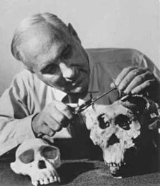
Louis Leakey

Encyclopedia
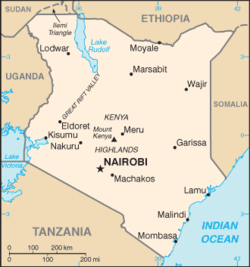
Archaeology
Archaeology, or archeology , is the study of human society, primarily through the recovery and analysis of the material culture and environmental data that they have left behind, which includes artifacts, architecture, biofacts and cultural landscapes...
and naturalist whose work was important in establishing human evolution
Human evolution
Human evolution refers to the evolutionary history of the genus Homo, including the emergence of Homo sapiens as a distinct species and as a unique category of hominids and mammals...
ary development in Africa. He also played a major role in creating organizations for future research in Africa and for protecting wildlife there. Having been a prime mover in establishing a tradition of palaeoanthropological
Paleoanthropology
Paleoanthropology, which combines the disciplines of paleontology and physical anthropology, is the study of ancient humans as found in fossil hominid evidence such as petrifacted bones and footprints.-19th century:...
inquiry, he was able to motivate the next generation to continue it, notably within his own family
Leakey
Leakey may refer to:people:*Colin Leakey , English botanist*David Leakey , British military general*Jonathan Leakey, businessman and former archaeologist*Louis Leakey , Kenyan archaeologist and naturalist...
, many of whom also became prominent. Leakey participated in national events of British East Africa and Kenya
Kenya
Kenya , officially known as the Republic of Kenya, is a country in East Africa that lies on the equator, with the Indian Ocean to its south-east...
during the 1950s.
In natural philosophy
Natural philosophy
Natural philosophy or the philosophy of nature , is a term applied to the study of nature and the physical universe that was dominant before the development of modern science...
he asserted Charles Darwin
Charles Darwin
Charles Robert Darwin FRS was an English naturalist. He established that all species of life have descended over time from common ancestry, and proposed the scientific theory that this branching pattern of evolution resulted from a process that he called natural selection.He published his theory...
's theory of evolution
Evolution
Evolution is any change across successive generations in the heritable characteristics of biological populations. Evolutionary processes give rise to diversity at every level of biological organisation, including species, individual organisms and molecules such as DNA and proteins.Life on Earth...
unswervingly and set about to prove Darwin's hypothesis that man arose in Africa; he was also a devout Christian
Christian
A Christian is a person who adheres to Christianity, an Abrahamic, monotheistic religion based on the life and teachings of Jesus of Nazareth as recorded in the Canonical gospels and the letters of the New Testament...
.
Background
| "When I think back ... of the serval cat and a baboon that I had as pets in my childhood days−and that eventually I had to house in large cages−it makes me sad. It makes me sadder still, however, and also very angry, when I think of the innumerable adult animals and birds deliberately caught and locked up for the so-called 'pleasure' and 'education' of thoughtless human beings. ... surely there are today so many first-class films ... that the cruelty of keeping wild creatures in zoos should no longer be tolerated." |
| From L.S.B. Leakey, By the Evidence, Chapter 4. |
Louis' parents, Harry and Mary Bazett Leakey (called May by her friends), were British missionaries of the Christian
Christian
A Christian is a person who adheres to Christianity, an Abrahamic, monotheistic religion based on the life and teachings of Jesus of Nazareth as recorded in the Canonical gospels and the letters of the New Testament...
faith in then British East Africa, now Kenya
Kenya
Kenya , officially known as the Republic of Kenya, is a country in East Africa that lies on the equator, with the Indian Ocean to its south-east...
. Harry had taken a previously established post of the Church Mission Society
Church Mission Society
The Church Mission Society, also known as the Church Missionary Society, is a group of evangelistic societies working with the Anglican Communion and Protestant Christians around the world...
among the Kikuyu at Kabete
Kabete
Kabete is a town just outside Nairobi borders in the Central Province of Kenya. Administratively, Kabete is a location in the Kikuyu division of the Kiambu District. Kabete is also name for one of the five constituencies in the Kiambu district....
. The station was at that time a hut and two tents in the highlands north of Nairobi
Nairobi
Nairobi is the capital and largest city of Kenya. The city and its surrounding area also forms the Nairobi County. The name "Nairobi" comes from the Maasai phrase Enkare Nyirobi, which translates to "the place of cool waters". However, it is popularly known as the "Green City in the Sun" and is...
. Louis' earliest home had an earthen floor, a leaky thatched roof, rodents and insects, and no heating system except for charcoal braziers. The facilities improved but slowly. The mission, a center of activity, set up a clinic in one of the tents, and later a girl's school for African women. Harry was working on a translation of the Bible into the Kenyan language, Kikuyu
Gikuyu language
Gikuyu or Kikuyu is a language of the Bantu family spoken primarily by the Kikuyu people of Kenya. Numbering about 6 million , they are the largest ethnic group in Kenya. Gikuyu is spoken in the area between Nyeri and Nairobi. Gikuyu is one of the five languages of the Thagichu subgroup of the...
.
Louis had a younger brother, Douglas, and two older sisters, Gladys Leakey Beecher and Julia Leakey Barham. Louis' primary family came to contain also Miss Oakes (a governess) Miss Higgenbotham (another missionary), and Mariamu (a Kikuyu nurse). Inevitably, Louis grew up, played, and learned to hunt with Africans. He also learned to walk with the distinctive gait of the Kikuyu and speak their language fluently, as did his siblings. He was initiated into the Kikuyu ethnic group, an event of which he never spoke, as he was sworn to secrecy.
Louis requested and was given permission to build and move into a hut, Kikuyu style, at the end of the garden. It was home to his personal collection of natural objects, such as birds' eggs and skulls. All the children developed a keen interest in and appreciation of the pristine natural surroundings in which they found themselves. They raised baby animals, later turning them over to zoos. Louis read a gift book, Days Before History, by H. R. Hall (1907), a juvenile fictional work illustrating the prehistory of Britain. He began to collect tools and was further encouraged in this activity by a role model, Arthur Loveridge
Arthur Loveridge
Arthur Loveridge was a British biologist and herpetologist who wrote about animals in East Africa, particularly Tanzania, and New Guinea. He gave the scientific name to several gecko species in the region....
, first curator (1914) of the Natural History Museum in Nairobi, predecessor of the Coryndon Museum
National Museums of Kenya
The National Museums of Kenya is a State Corporation that manages Museums, Sites and Monuments in Kenya. It also practices scientific research. Its headquarters and the National Museum are located on Museum Hill, near Uhuru Highway between Central Business District and Westlands in Nairobi...
. This interest may have predisposed him toward a career in archaeology.
Neither Harry nor May were of strong constitution. From 1904-1906 the entire family lived at May's mother's house in Reading, Berkshire
Reading, Berkshire
Reading is a large town and unitary authority area in England. It is located in the Thames Valley at the confluence of the River Thames and River Kennet, and on both the Great Western Main Line railway and the M4 motorway, some west of London....
, England, while Harry recovered from neurasthenia
Neurasthenia
Neurasthenia is a psycho-pathological term first used by George Miller Beard in 1869 to denote a condition with symptoms of fatigue, anxiety, headache, neuralgia and depressed mood...
, and again in 1911-1913, while May recovered from general frailty and exhaustion. During the latter stay, Harry bought a house in Boscombe
Boscombe
Boscombe is a suburb of Bournemouth. Located to the east of Bournemouth town centre and west of Southbourne, It developed rapidly from a small village as a seaside resort alongside Bournemouth after the first Boscombe pier was built in 1888...
.
His father's example
In Britain the Leakey children attended elementary school; in Africa they had a tutor, Miss Laing. They sat out World War I in Africa. When the sea lanes opened again, they returned to Boscombe, where Louis was sent to Weymouth Secondary SchoolWeymouth College
Weymouth College is a Further Education college located in Weymouth, England.The college has over 7,000 students, studying on a wide range of practical and academic courses in many different subjects...
, a private boy's school in 1919 at age 16. In three years there he did not do well, and complained of rules he considered an infringement on his freedom and hazing by the other boys. Advised by one teacher to seek employment in a bank, he appealed to his English teacher, Mr. Tunstall, who started him in the application process to Cambridge. His excellent scores on the entrance exams won him a scholarship.
Louis matriculated at his father's alma mater, Cambridge University
University of Cambridge
The University of Cambridge is a public research university located in Cambridge, United Kingdom. It is the second-oldest university in both the United Kingdom and the English-speaking world , and the seventh-oldest globally...
, in 1922, intent on becoming a missionary to British East Africa.
For the rest of his life he would dine out on the story of his finals. When he had arrived in Britain he had notified the register of people with a knowledge of rare languages that he was fluent in Swahili
Swahili language
Swahili or Kiswahili is a Bantu language spoken by various ethnic groups that inhabit several large stretches of the Mozambique Channel coastline from northern Kenya to northern Mozambique, including the Comoro Islands. It is also spoken by ethnic minority groups in Somalia...
. When he came to his finals he asked to be examined in this and after some hesitation the authorities agreed. Then one day he received two letters. One instructed him to report at a certain time and place for a viva-voce
Viva voce
Viva voce is a Latin phrase literally meaning "with living voice," but most often translated as "by word of mouth."It may also refer to:*Italian for "live voice."*Voice vote in a deliberative assembly...
examination in Swahili. The other asked if, at the same time and place, he would examine a candidate in Swahili.
His son says:
- "Louis was in his early twenties when he decided to pursue a fossil-hunting career. Until then, he had intended to follow his father's example and be a Christian missionary in Kenya."
He preached Christian zeal to his fellow students and otherwise impressed Cambridge society with behavior that was considered eccentric. He was also an evolutionist and befriended some future naturalists. In 1923 his usual zeal led him into a severe concussion in a game of Rugby union
Rugby union
Rugby union, often simply referred to as rugby, is a full contact team sport which originated in England in the early 19th century. One of the two codes of rugby football, it is based on running with the ball in hand...
. He was relieved of his academic duties. Rest and the outdoors were prescribed.
Diversion from missionary work
In that year a position became available that pushed all thought of rest into the background. In 1922 the British had been awarded German East AfricaGerman East Africa
German East Africa was a German colony in East Africa, which included what are now :Burundi, :Rwanda and Tanganyika . Its area was , nearly three times the size of Germany today....
as part of the settlement of World War I, subsequently applying the name Tanganyika
Tanganyika Territory
Tanganyika Territory was a British colony between 1919 and 1961. Prior to the end of the First World War was part of the German colony of German East Africa. After the war had broke out, the British invaded the German East Africa, but were unable to defeat the German Army...
. Within its territory the Germans had discovered a site rich in dinosaur
Dinosaur
Dinosaurs are a diverse group of animals of the clade and superorder Dinosauria. They were the dominant terrestrial vertebrates for over 160 million years, from the late Triassic period until the end of the Cretaceous , when the Cretaceous–Paleogene extinction event led to the extinction of...
fossils, Tendaguru
Tendaguru
The Tendaguru Beds are a fossil-rich formation in Tanzania. It has been considered the richest of Late Jurassic strata in Africa. Continental reconstructions show Tendaguru to have been in the southern hemisphere during the Late Jurassic. Tendaguru is similar to the Morrison Formation except in...
. Louis was told by C. W. Hobley
Charles William Hobley
Charles William Hobley, CMG — known as C. W. Hobley — was a pioneering British Colonial administrator in Kenya...
, a friend of the family, that the British Museum of Natural History was going to send a fossil-hunting expedition to it. Louis applied and was hired to locate the site and manage the administrative details. In 1924 the party under William E. Cutler departed for Africa. They never found a complete dinosaur skeleton. Louis was recalled from the site by Cambridge in 1925, while Cutler contracted blackwater fever
Blackwater fever
Blackwater fever is a complication of malaria in which red blood cells burst in the bloodstream , releasing hemoglobin directly into the blood vessels and into the urine, frequently leading to kidney failure...
and died nine months later.
This critical experience changed Louis' career decision. Switching courses to anthropology, he found a new mentor in Alfred Cort Haddon
Alfred Cort Haddon
Alfred Cort Haddon, Sc.D., FRS, FRGS was an influential British anthropologist and ethnologist.Initially a biologist, who achieved his most notable fieldwork, with W.H.R. Rivers, C.G. Seligman, Sidney Ray, Anthony Wilkin on the Torres Strait Islands...
, head of the department. In 1926 he graduated with a "double first", or high honours, in anthropology and archaeology. He had used some of his preexisting qualifications; for example, Kikuyu was offered and accepted as the second modern language in which he was required to be proficient, even though no one there could test him on it. The university accepted an affidavit from a Kikuyu chief signed with a thumbprint.
From 1925 on Louis lectured and wrote on African archaeological and palaeontological topics. On graduation he was such a respected figure that Cambridge sent him to East Africa to study prehistoric African humans. He excavated dozens of sites, undertaking for the first time a systematic study of the artifacts. Some of his culture names are still in use; for example, Elmenteitan.
Research fellow

Lake Elmenteita
Lake Elmenteita, also spelled Elementaita, is a soda lake, in the eastern limb of East Africa's Great Rift Valley, about 120 km northwest of Nairobi, Kenya.- Geography :...
, by two young ladies on a holiday, one of whom was Henrietta Wilfreda "Frida" Avern. She had done some course work in archaeology. Louis and she talked the entire night. They continued the relationship on his return to Cambridge and in 1928 they were married and set off together for Elmenteita. At that time he discovered the Acheulean
Acheulean
Acheulean is the name given to an archaeological industry of stone tool manufacture associated with early humans during the Lower Palaeolithic era across Africa and much of West Asia, South Asia and Europe. Acheulean tools are typically found with Homo erectus remains...
site of Kariandusi
Kariandusi
Kariandus is a settlement in Kenya's Rift Valley Province....
, which he excavated in 1928, after collecting a team of interested associates.
On the strength of his work there he obtained a research fellowship at St. John's College
St John's College, Cambridge
St John's College is a constituent college of the University of Cambridge. The college's alumni include nine Nobel Prize winners, six Prime Ministers, three archbishops, at least two princes, and three Saints....
and returned to Cambridge in 1929 to do post-graduate work and to classify and prepare the finds from Elmenteita. His patron and mentor Cambridge was now Arthur Keith
Arthur Keith
Sir Arthur Keith was a Scottish anatomist and anthropologist, who became a fellow of the Royal College of Surgeons of England and Hunterian Professor and conservator of the Hunterian Museum of the Royal College of Surgeons in London...
. While cleaning two skeletons he had found he noticed a similarity to one found in Olduvai Gorge by Professor Hans Reck, a German national, whom Louis had met in 1925 in Germany while on business for Keith.
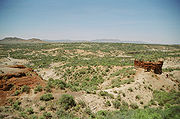
Pleistocene
The Pleistocene is the epoch from 2,588,000 to 11,700 years BP that spans the world's recent period of repeated glaciations. The name pleistocene is derived from the Greek and ....
. The public was not ready for this news. Man must have evolved or have been created long after then, was the general belief. Reck became involved in a media uproar. He was barred from going back to settle the question by the war and then the terms of the transfer of Tanganyika from Germany to Britain. In 1929 Louis visited Berlin to talk to the now skeptical Reck. Noting an Acheulean
Acheulean
Acheulean is the name given to an archaeological industry of stone tool manufacture associated with early humans during the Lower Palaeolithic era across Africa and much of West Asia, South Asia and Europe. Acheulean tools are typically found with Homo erectus remains...
tool in Reck's collection of artifacts from Olduvai, he bet Reck he could find ancient stone tools at Olduvai within 24 hours.
Meanwhile Frida worked on illustrations for The Stone Age Culture of Kenya Colony. Louis was given the PhD in 1930 at age 27. His first child, a daughter, Priscilla Muthoni Leakey, was born in 1931. His headaches and epilepsy returned in the excitement and he was prescribed Luminal
Phenobarbital
Phenobarbital or phenobarbitone is a barbiturate, first marketed as Luminal by Friedr. Bayer et comp. It is the most widely used anticonvulsant worldwide, and the oldest still commonly used. It also has sedative and hypnotic properties but, as with other barbiturates, has been superseded by the...
, which he took the rest of his life.
The Defense of Reck
In November, 1931, Louis led an expedition to Olduvai, including Reck, whom he allowed to enter the gorge first. Louis did find Acheulean tools within the first 24 hours, costing Reck ten pounds on the bet. They verified the provenance of the 1913 find, now Olduvai Man. Non-humanoid fossils and tools were extracted from the ground in large numbers. Frida delayed joining him and was less enthusiastic about him on behalf of Priscilla. She did arrive eventually, however, and Louis put her to work. Frida's site became FLK, for Frida Leakey's karongo ("gully").Back in Cambridge, the skeptics were not impressed. To find supporting evidence of the antiquity of Reck's Olduvai Man, Louis returned to Africa, excavating at Kanam and Kanjera. He easily found more fossils, which he named Homo kanamensis. While he was gone, the opposition worked up some "evidence" of the intrusion of Olduvai Man into an earlier layer, evidence that seemed convincing at the time, but is missing and unverifiable now. On his return Louis' finds were carefully examined by a committee of 26 scientists and were tentatively accepted as valid.
Scandal
With Frida's dowry money, the Leakeys bought a large brick house in GirtonGirton, Cambridgeshire
Girton is a village of about 1,600 households, and 4,500 people in Cambridgeshire, England. It lies about two miles to the northwest of Cambridge, and is the home of Cambridge University's Girton College, a pioneer in women's education, which was moved there from a previous site in Hertfordshire in...
near Cambridge, which they named "the Close." She suffered from morning sickness most of the time and was unable to work on the illustrations for Louis' second book, Adam's Ancestors. At a dinner party given in his honor after a lecture of his at the Royal Anthropological Institute, Gertrude Caton-Thompson introduced him to her own illustrator, the twenty-year-old Mary Nicol
Mary Leakey
Mary Leakey was a British archaeologist and anthropologist, who discovered the first skull of a fossil ape on Rusinga Island and also a noted robust Australopithecine called Zinjanthropus at Olduvai. For much of her career she worked together with her husband, Louis Leakey, in Olduvai Gorge,...
.
Louis convinced Mary to take on the illustration of his book. A few months later companionship turned to romance. Colin Leakey
Colin Leakey
Colin Louis Avern Leakey is a leading plant scientist in the United Kingdom, a Fellow of King's College, Cambridge and of the Institute of Biology, and a world authority on beans.-Background:...
was born in December, 1933, and in January, 1934, Louis asked Frida for a divorce. She would not sue for divorce until 1936.
A panel at Cambridge investigated his morals. Grants dried up, but his mother raised enough money for another expedition to Olduvai, Kanam and Kanjera, the latter two on the Winam Gulf
Winam Gulf
Winam Gulf is a significant extension of northeastern Lake Victoria into western Kenya.Formerly known as Kavirondo Gulf, Nyanza Gulf, and Lake Nyanza Gulf, it is a shallow inlet and is connected to the main lake by Rusinga Channel , which is partly masked from the main body of the lake by islands...
. His previous work there was questioned by P. G. H. Boswell
Percy George Hamnall Boswell
Professor Percy George Hamnall Boswell FRS was a British geologist.He was Professor of Geology at Liverpool University and Head of the Department of Geology at the Imperial College of Science, London. He was elected a Fellow of the Royal Society in May, 1931...
, whom he invited to verify the sites for himself. Arriving at Kanam and Kanjera in 1935, they found that the iron markers Louis had used to mark the sites had been removed by the Luo
Luo (family of ethnic groups)
The Luo are an ethnic linguistic group located in an area that stretches from South Sudan and Ethiopia through northern Uganda and eastern Congo , into western Kenya, and ending in the upper tip of Tanzania. These people speak an Eastern Sudanic language, a branch of the Nilo-Saharan language...
tribe for use as harpoons and the sites could not now be located. To make matters worse, all the photos Louis took were ruined by a light leak in the camera. After an irritating and fruitless two-month search, Boswell left for England, promising, as Louis understood it, not to publish a word until Louis returned.
Boswell immediately set out to publish as many words as he was able, beginning with an article in Nature dated 9 March 1935, destroying Reck's and Louis' dates of the fossils and questioning Louis' competence. Louis on his return accused Boswell of treachery, but Boswell now had public opinion on his side. Louis was not only forced to retract the accusation but also to recant his support of Reck. Louis was through at Cambridge. Even his mentors turned on him.
On the road in Africa
Meeting Mary in Africa, he proceeded to Olduvai with a small party. Mary joined him under a stigma but her skill and competence eventually won over the other participants. Louis' parents continued to urge him to return to Frida, and would pay for everyone in the party, but not Mary. Louis and his associates did the groundwork for future excavation at Olduvai, uncovering dozens of sites for a broad sampling, as was his method. They were named after the excavator: SHK (Sam Howard's karongo), BK (Peter Bell's), SWK (Sam White's), MNK (Mary Nicol's). Louis and Mary conducted a temporary clinic for the Maasai, made preliminary investigations of LaetoliLaetoli
Laetoli is a site in Tanzania, dated to the Plio-Pleistocene and famous for its hominin footprints, preserved in volcanic ash . The site of the Laetoli footprints is located 45 km south of Olduvai gorge.-Date:...
, and ended by studying the rock paintings at the Kisese
Kisese
Kisese is an administrative ward in the Kondoa district of the Dodoma Region of Tanzania. According to the 2002 census, the ward has a total population of 9,810.-References:...
/Cheke region.
The Village of Nasty
Louis and Mary returned to England in 1935 without positions or any place to stay except Mary's mother's apartment. They soon leased Steen Cottage in Great MundenGreat Munden
Great Munden is a village and civil parish in Hertfordshire, England. The parish, in the district of East Hertfordshire, spans , of which are arable land, are permanent grass and are wood. It has a population of 477 and is situated north of the town of Ware. The village includes the church of...
and lived without heat, electricity, or plumbing, fetching water from a well, huddling before a fireplace and writing by oil lantern. They lived happily in poverty for eighteen months at this low point of their fortunes, visited at first only by Mary's relatives. Louis gardened for subsistence and exercise and improved the house and grounds. He appealed at last to the Royal Society
Royal Society
The Royal Society of London for Improving Natural Knowledge, known simply as the Royal Society, is a learned society for science, and is possibly the oldest such society in existence. Founded in November 1660, it was granted a Royal Charter by King Charles II as the "Royal Society of London"...
, who relented with a small grant to continue work on his collection.
The Return of the Native Son
Finally, Frida divorced Louis and he and Mary were married on Christmas Eve, 1936, in a civil ceremony at the registry office of Ware. The witness, Peter Koinange, the son of a Kikuyu chief, was in Britain doing postgraduate studies at St. John's. Louis got some royalties and advances on books, and delivered the Munro lectures at Edinburgh University for 1936.Louis had already involved himself in Kikuyu tribal affairs in 1928, taking a stand against female genital cutting
Female genital cutting
Female genital mutilation , also known as female genital cutting and female circumcision, is defined by the World Health Organization as "all procedures that involve partial or total removal of the external female genitalia, or other injury to the female genital organs for non-medical reasons."FGM...
. He got into a shouting match in Kikuyu one evening with Jomo Kenyatta
Jomo Kenyatta
Jomo Kenyattapron.] served as the first Prime Minister and President of Kenya. He is considered the founding father of the Kenyan nation....
, who was lecturing on the topic. R. Copeland at Oxford recommended he apply to the Rhodes Trust for a grant to write a study of the Kikuyu and it was given late in 1936 along with a salary for two years. In January 1937 the Leakeys shook the dust off their feet and travelled to Kenya. Colin would not see his father for 20 years.
Louis returned to Kiambaa near Nairobi
Nairobi
Nairobi is the capital and largest city of Kenya. The city and its surrounding area also forms the Nairobi County. The name "Nairobi" comes from the Maasai phrase Enkare Nyirobi, which translates to "the place of cool waters". However, it is popularly known as the "Green City in the Sun" and is...
and persuaded Senior Chief Koinange, who designated a committee of chiefs, to help him describe the Kikuyu the way they had been. Mary excavated at Waterfall Cave. She fell ill with double pneumonia and lay at death's door for two weeks in the hospital in Nairobi, during which time her mother was sent for. Contrary to expectation she recovered and began another excavation at Hyrax Hill and then Ngoro River Cave. Louis got an extension of his grant, which he used partially for fossil-hunting. Leakey discoveries began to appear in the newspapers again.
Tensions between the Kikuyu and the settlers increased alarmingly. Louis jumped into the fray as an exponent of the middle ground. In Kenya: Contrasts and Problems, he angered the settlers by proclaiming Kenya could never be a "white man's country."
The fossil police
The government offered Louis work as a policeman in intelligence, which he could not afford to refuse. He traveled the country as a pedlar, reporting on the talk. When Britain went to war in September, 1939, the Kenyan government drafted Louis into its African intelligence service. Apart from some bumbling around, during which he and some settlers stalked each other as possible saboteurs of the Sagana Railway Bridge, his first task was to supply and arm Ethiopian guerrillas against the Italian invaders of their country. He created a clandestine network using his childhood friends among the Kikuyu. They also hunted fossils on the sly.Louis conducted interrogations, analyzed handwriting, wrote radio broadcasts and took on regular police investigations. He loved a good mystery of any sort. The white leadership of the King's African Rifles used him extensively to clear up many cultural mysteries; for example, he helped an officer remove a curse he had inadvertently put on his men.
Mary continued to find and excavate sites. Jonathan Leakey
Jonathan Leakey
Jonathan Harry Erskine Leakey is a businessman and former palaeoanthropologist. He is the first son of famed anthropologists Louis and Mary Leakey....
was born in 1940. She worked in the Coryndon Memorial Museum (later called the National Museums of Kenya
National Museums of Kenya
The National Museums of Kenya is a State Corporation that manages Museums, Sites and Monuments in Kenya. It also practices scientific research. Its headquarters and the National Museum are located on Museum Hill, near Uhuru Highway between Central Business District and Westlands in Nairobi...
) where Louis joined her as an unpaid honorary curator in 1941. Their life was a menage of police work and archaeology. They investigated Rusinga Island
Rusinga Island
Rusinga Island, with an elongated shape approx. 10 miles from end to end and 3 miles at its widest point, lies in the eastern part of Lake Victoria at the mouth of the Winam Gulf...
and Olorgesailie
Olorgesailie
Olorgesailie is a geological formation in East Africa containing a group of Lower Paleolithic archaeological sites. It is on the floor of the Eastern Rift Valley in southern Kenya, southwest of Nairobi along the road to Lake Magadi. Olorgesailie is noted for the large number of Acheulean hand...
. At the latter site they were assisted by a team of Italian experts recruited from the prisoners of war and paroled for the purpose.
In 1942 the Italian menace ended, but the Japanese began to reconnoiter with a view toward landing in force. Louis found himself in counter-intelligence work, which he performed with zest and imagination. Deborah was born, but died at three months. They lived in a rundown and bug infested Nairobi home, provided by the museum. Jonathan was attacked by army ants in his crib.
The turn of the tide
In 1944 Richard LeakeyRichard Leakey
Richard Erskine Frere Leakey is a politician, paleoanthropologist and conservationist. He is second of the three sons of the archaeologists Louis Leakey and Mary Leakey, and is the younger brother of Colin Leakey...
was born. In 1945 the family's income from police work all but vanished. By now Louis was getting plenty of job offers but he chose to stay on in Kenya as Curator of the Coryndon Museum, with an annual salary and a house, but more importantly, to continue palaeoanthropological research.
In January, 1947, Louis conducted the first Pan-African Congress of Prehistory at Nairobi. Sixty scientists from 26 countries attended, delivering papers and visiting the Leakey sites. The conference restored Louis to the scientific fold and made him a major figure in it. With the money that now poured in Louis undertook the famous expeditions of 1948 and beyond at Rusinga Island
Rusinga Island
Rusinga Island, with an elongated shape approx. 10 miles from end to end and 3 miles at its widest point, lies in the eastern part of Lake Victoria at the mouth of the Winam Gulf...
in Lake Victoria
Lake Victoria
Lake Victoria is one of the African Great Lakes. The lake was named for Queen Victoria of the United Kingdom, by John Hanning Speke, the first European to discover this lake....
, where Mary discovered the most complete Proconsul fossil up to that time.
Charles Boise donated money for a boat to be used for transport on Lake Victoria, "The Miocene Lady." Its famous skipper, Hassan Salimu, was later to deliver Jane Goodall
Jane Goodall
Dame Jane Morris Goodall, DBE , is a British primatologist, ethologist, anthropologist, and UN Messenger of Peace. Considered to be the world's foremost expert on chimpanzees, Goodall is best known for her 45-year study of social and family interactions of wild chimpanzees in Gombe Stream National...
to Gombe. Philip Leakey
Philip Leakey
Philip Leakey was educated at Leighton Park School and is a former member of the Kenyan Parliament. He represented the KANU party led by then president Daniel Arap Moi. He was an MP of Langata Constituency from 1979 and served as a cabinet minister for a short stint...
was born in 1949. In 1950, Louis was awarded an honorary doctorate by Oxford University.
Kenyan affairs
| ""... I sought a personal interview with the governor, hoping to make him appreciate that it was no longer possible to continue along the lines of the old colonial regime. ... Colonial governors and senior civil servants are not easy people to argue with; and, of course, I was not popular, because of my criticism of the colonial service ... Had it been possible to make the government open its eyes to the realities of the situation, I believe that the whole miserable episode of what is frequently spoken of as 'the Mau Mau rebellion' need never have taken place." |
| From L.S.B. Leakey, By the Evidence, Chapter 18. |
While the Leakeys were at Lake Victoria, the Kikuyu struck at the European settlers of the Kenyan highlands, who seemed to have the upper hand and were insisting on a "white" government of a "white" Africa. In 1949 the Kikuyu formed a secret society, the Mau Mau, which attacked settlers and especially loyalist Kikuyu.
Louis had attempted to warn Sir Philip Mitchell
Philip Euen Mitchell
Sir Philip Euen Mitchell was a British Colonial administrator who served as Governor of Uganda , Governor of Fiji and Governor of Kenya .-Birth and education:...
, governor of the colony, that nocturnal meetings and forced oaths were not Kikuyu customs and forboded violence, but was ignored. Now he found himself pulled away from anthropology to investigate the Mau Mau. During this period his life was threatened and a reward placed on his head. The Leakeys began to pack pistols, termed "European National Dress." The government placed him under 24-hour guard.
In 1952, after a massacre of loyal chiefs, the government arrested Jomo Kenyatta
Jomo Kenyatta
Jomo Kenyattapron.] served as the first Prime Minister and President of Kenya. He is considered the founding father of the Kenyan nation....
, president of the Kenya African Union
Kenya African Union
Kenya African Union was a political organization formed in 1944to articulate Kenyan grievances against the British colonial administration of the time...
. Louis was summoned to be a court interpreter, but withdrew after an accusation of mistranslation because of prejudice against the defendant. He returned on request to translate documents only. Because of lack of evidence linking Kenyatta to the Mau Mau, although convicted, he did not receive the death penalty, but was sentenced to several years of hard labor and banned from Kenya.
The government brought in British troops and formed a home guard of 20,000 Kikuyu. During this time Louis played a difficult and contradictory role. He sided with the settlers, serving as their spokesman and intelligence officer, helping to ferret out bands of guerrillas. On the other hand he continued to advocate for the Kikuyu in his book, Defeating Mau Mau and numerous talks and articles. He recommended a multi-racial government, land reform in the highlands, a wage hike for the Kikuyu, and many other reforms, most of which were eventually adopted.
The British realized the rebellion was being directed from urban centers, instituted military law and rounded up the committees. Following Louis' suggestion, thousands of Kikuyu were placed in re-education camps and resettled in new villages. The rebellion continued from bases under Mt. Kenya until 1956, when, deprived of its leadership and supplies, it had to disperse. The state of emergency lasted until 1960. In 1963 Kenya became independent, with Jomo Kenyatta as prime minister.
Vindication at Olduvai
| "We know from the study of evolution that, again and again, various branches of animal stock have become over-specialized, and that over-specialization has led to their extinction. Present-day Homo sapiens is in many physical respects still very unspecialized− ... But in one thing man, as we know him today, is over-specialized. His brain power is very over-specialized compared to the rest of his physical make-up, and it may well be that this over-specialization will lead, just as surely, to his extinction. ... if we are to control our future, we must first understand the past better." |
| From L.S.B. Leakey, Adam's Ancestors, Fourth Edition, final page. |
Louis and Mary spent all the time they could at Olduvai, starting in 1951. So far they had discovered only tools. A trial trench in Bed II at BK in 1951 was followed by a more extensive excavation in 1952. They found what Louis termed an Olduwan "slaughter-house", an ancient bog where animals had been trapped and butchered. Louis was so carried away that he worked without his hat and his hair was bleached white from the sun. They stopped in 1953.
In 1955 they excavated again with Jean Brown. She related that he preferred to be called Louis, was absent-minded, once had everyone looking for spectacles that were around his neck, wore pants with the buttons off and shoes with holes in them, charged about everywhere and once collapsed unconscious. He was completely happy.
In 1959 they decided to excavate Bed I. While Louis was sick in camp, Mary discovered the fossilized skull OH 5
OH 5
OH 5 is a fossilized cranium and the holotype of the species Paranthropus boisei. It was discovered in Olduvai Gorge, Tanzania, by archaeologist-paleontologist Mary Leakey in 1959...
at FLK, which Mary called "Our Man", and became "Dear Boy" and "Zinj." The question was whether it was a previous genus discovered by Robert Broom
Robert Broom
Professor Robert Broom was a Scottish South African doctor and paleontologist. He qualified as a medical practitioner in 1895 and received his DSc in 1905 from the University of Glasgow...
, Paranthropus
Paranthropus
The robust australopithecines, members of the extinct hominin genus Paranthropus , were bipedal hominids that probably descended from the gracile australopithecine hominids...
, which Broom had taken not to be in the human line, or a different one, in it. Louis opted for Zinj, a decision opposed by Wilfrid Le Gros Clark
Wilfrid Le Gros Clark
Sir Wilfrid Edward Le Gros Clark was a British anatomist surgeon, primatologist and palaeoanthropologist, today best remembered for his contribution to the study of human evolution....
, but one which attracted the attention of Melville Bell Grosvenor
Melville Bell Grosvenor
Melville Bell Grosvenor was the president of the National Geographic Society and editor of National Geographic Magazine from 1957 to 1969...
, president of the National Geographic Society
National Geographic Society
The National Geographic Society , headquartered in Washington, D.C. in the United States, is one of the largest non-profit scientific and educational institutions in the world. Its interests include geography, archaeology and natural science, the promotion of environmental and historical...
. That contact resulted in an article in National Geographic and a hefty grant to continue work at Olduvai.
Also in 1960 Jack Evernden and Garniss Curtis
Garniss Curtis
Garniss H. Curtis is a professor emeritus of geology at the University of California, Berkeley, geochronologist, volcanologist, geophysicist, and founder of the Berkeley Geochronology Center...
, young geophysicists, dated Bed I to 1.75 mya. The world was stunned. Zinj was far older than anyone had imagined. Scientists swarmed to Africa. Reck and Louis were completely vindicated, too late for Reck, who had died in 1937. Louis had proved Darwin right.
The Leakey circus
In 1960, unable to leave the museum except on weekends, Louis appointed Mary director of excavation at Olduvai. She brought in a staff of KambaKamba
The Kamba are a Bantu ethnic group who live in the semi-arid Eastern Province of Kenya stretching east from Nairobi to Tsavo and north up to Embu, Kenya. This land is called Ukambani. Sources vary on whether they are the third, fourth or the fifth largest ethnic group in Kenya...
tribesmen, instead of Kikuyu, who, she felt, took advantage of Louis. The first, Muteva Musomba, had kept her children's ponies. He recruited Kamoya Kimeu
Kamoya Kimeu
Kamoya Kimeu, is one of the world's most successful fossil collectors who, together with paleontologists Meave Leakey and Richard Leakey, is responsible for some of the most significant paleoanthropological discoveries...
among others. Mary set up Camp 5 under Jonathan's direction. He was 19. From then on she had her own staff and associates.
Mary picked and sieved at the site from early morning dressed in old clothes, chain smoking cigarettes, always surrounded by her Dalmatian dogs. She and Louis communicated by radio. On weekends he drove non-stop at high speed the 357 miles between Olduvai and Nairobi. The teenage boys, Richard and Philip, were on site holidays and vacations. Louis invited them and Irven DeVore
Irven DeVore
Irven DeVore is an anthropologist and evolutionary biologist, and Curator of Primatology at Harvard University's Peabody Museum of Archaeology and Ethnology...
to eat a raw rat so that he could compare the result to some Hominid coprolites. He said to DeVore, "My dear boy, let me make you famous." DeVore and the boys demurred.
Their home in Nairobi was a circus, figuratively speaking, when they were there. Dinner guests were frequent. Important guests stayed for weeks if they could stand it. They shared the quarters and the dinner table with the Dalmatians
Dalmatian (dog)
The Dalmatian is a breed of dog whose roots are often said to trace back to Dalmatia, a region of Croatia where the first illustrations of the dog have been found. The Dalmatian is noted for its unique black- or brown-spotted coat and was mainly used as a carriage dog in its early days...
, hyrax
Hyrax
A hyrax is any of four species of fairly small, thickset, herbivorous mammals in the order Hyracoidea. The rock hyrax Procavia capensis, the yellow-spotted rock hyrax Heterohyrax brucei, the western tree hyrax Dendrohyrax dorsalis, and the southern tree hyrax, Dendrohyrax arboreus live in Africa...
es, a monkey, a civet cat
Civet cat
Civet cat is an imprecise term that is used for a variety of cat-like creatures including:*Civets, of the families Viverridae and Nandiniidae*Ring-tailed Cat or North American Civet Cat , related to the raccoons...
, an African eagle owl, tropical fish, snakes, such as vipers, and a python. The extended families of twenty African staff lived in cinderblock huts in the yard. Mary had switched to cigars and the ashes often fell into the food. Both Louis and Mary cooked. Louis never stopped talking; his stories were endless. He literally ran through the day, making long lists of things to be done, which he never completed. He drove recklessly through the streets of Nairobi, often reading and writing as he drove.
Floruit
Jonathan Leakey achieved some brief fame before he quit palaeoanthropology altogether. He started his own site, "Jonny's site" in the Leakey lingo, FLK-NN. There he discovered two skull fragments without the AustralopithecineAustralopithecine
The term australopithecine refers generally to any species in the related genera Australopithecus or Paranthropus. These species occurred in the Plio-Pleistocene era, and were bipedal and dentally similar to humans, but with a brain size not much larger than modern apes, lacking the...
sagittal crest
Sagittal crest
A sagittal crest is a ridge of bone running lengthwise along the midline of the top of the skull of many mammalian and reptilian skulls, among others....
, which Mary connected with Broom's and Robinson's Telanthropus. The problem with it was its contemporaneity with Zinj. Mailed photographs, Le Gros Clark retorted casually "Shades of Piltdown
Piltdown Man
The Piltdown Man was a hoax in which bone fragments were presented as the fossilised remains of a previously unknown early human. These fragments consisted of parts of a skull and jawbone, said to have been collected in 1912 from a gravel pit at Piltdown, East Sussex, England...
." Louis cabled him immediately and had some strong words at this suggestion of his incompetence. Clark apologized.
Not long after in 1960 Louis, his son Philip and Ray Pickering discovered a fossil he termed "Chellean Man", as it was in context with Olduwan tools, the first such find. After reconstruction Louis and Mary called it "Pinhead." It was subsequently included with Homo erectus and was in fact contemporaneous with Paranthropus
Paranthropus
The robust australopithecines, members of the extinct hominin genus Paranthropus , were bipedal hominids that probably descended from the gracile australopithecine hominids...
, which on that account cannot have been in the human line. For many years Louis believed erectus was the user of the tools and Australopithecus
Australopithecus
Australopithecus is a genus of hominids that is now extinct. From the evidence gathered by palaeontologists and archaeologists, it appears that the Australopithecus genus evolved in eastern Africa around 4 million years ago before spreading throughout the continent and eventually becoming extinct...
was not. It is now conceded that both Hominids used them.
In 1961 Louis got a salary as well as a grant from National Geographic and turned over the acting directorship of Coryndon to a subordinate. He created the Centre for Prehistory and Paleontology on the same grounds, moved his collections to it, and appointed himself director. This was his new operations center. He opened another excavation at Fort Ternan
Fort Ternan
Fort Ternan is a small town in Nyando District, Nyanza Province, Kenya located 50 kilometres east of Kisumu and five kilometres east of Koru. Fort Ternan is located adjacent the western border of Rift Valley Province . Fort Ternan forms a ward of Muhoroni Constituency and Muhoroni town council...
on Lake Victoria. Shortly after, Heselon discovered Kenyapithecus wickeri
Kenyapithecus wickeri
Kenyapithecus wickeri was a fossil ape discovered by Louis Leakey in 1961 at a site called Fort Ternan in Kenya. The upper jaw and teeth were dated to 14 million years ago....
, the species name from the owner of the property, which Louis promptly celebrated with George Gaylord Simpson
George Gaylord Simpson
George Gaylord Simpson was an American paleontologist. Simpson was perhaps the most influential paleontologist of the twentieth century, and a major participant in the modern evolutionary synthesis, contributing Tempo and mode in evolution , The meaning of evolution and The major features of...
, who happened to be present, aboard the Miocene Lady with Leakey Safari Specials, a drink made of condensed milk
Condensed milk
Condensed milk, also known as sweetened condensed milk, is cow's milk from which water has been removed and to which sugar has been added, yielding a very thick, sweet product which when canned can last for years without refrigeration if unopened. The two terms, condensed milk and sweetened...
and cognac
Cognac
Cognac is a commune in the Charente department in southwestern France. It is a sub-prefecture of the department.-Geography:Cognac is situated on the river Charente between the towns of Angoulême and Saintes. The majority of the town has been built on the river's left bank, with the smaller right...
.
In 1962 Louis was visiting Olduvai when Ndibo Mbuika discovered the first tooth of Homo habilis
Homo habilis
Homo habilis is a species of the genus Homo, which lived from approximately at the beginning of the Pleistocene period. The discovery and description of this species is credited to both Mary and Louis Leakey, who found fossils in Tanzania, East Africa, between 1962 and 1964. Homo habilis Homo...
at MNK. Louis and Mary thought it was female and named her Cinderella, or Cindy. Phillip Tobias identified Jonny's Child with it and Raymond Dart
Raymond Dart
Raymond Arthur Dart was an Australian anatomist and anthropologist, best known for his involvement in the 1924 discovery of the first fossil ever found of Australopithecus africanus, an extinct hominid closely related to humans, at Taung in the North of South Africa in the province...
came up with the name Homo habilis at Louis' request, which Tobias translated as "handyman." It was seen as intermediary between gracile Australopithecus
Australopithecus
Australopithecus is a genus of hominids that is now extinct. From the evidence gathered by palaeontologists and archaeologists, it appears that the Australopithecus genus evolved in eastern Africa around 4 million years ago before spreading throughout the continent and eventually becoming extinct...
and Homo.
Leakey's Angels
One of Louis's greatest legacies stems from his role in fostering field research of primates in their natural habitats, which he understood as key to unraveling the mysteries of human evolution. He personally chose three female researchers, Jane GoodallJane Goodall
Dame Jane Morris Goodall, DBE , is a British primatologist, ethologist, anthropologist, and UN Messenger of Peace. Considered to be the world's foremost expert on chimpanzees, Goodall is best known for her 45-year study of social and family interactions of wild chimpanzees in Gombe Stream National...
, Dian Fossey
Dian Fossey
Dian Fossey was an American zoologist who undertook an extensive study of gorilla groups over a period of 18 years. She studied them daily in the mountain forests of Rwanda, initially encouraged to work there by famous anthropologist Louis Leakey...
, and Birute Galdikas
Birute Galdikas
Birutė Marija Filomena Galdikas, OC , is a primatologist, conservationist, ethologist, and author of several books relating to the endangered orangutan, particularly the Bornean orangutan. Well known in the field of modern primatology, Galdikas is recognized as a leading authority on orangutans...
, who were later dubbed 'Leakey's Angels
Leakey's Angels
Leakey's Angels is a relatively recent name given to three women sent by archaeologist Louis Leakey to study primates in their natural environments. The three are Jane Goodall, Dian Fossey, and Birutė Galdikas...
' and each went on to become important scholars in the field of primatology.
The last years
Kenya became independent at noon on 12 December 1963, with Jomo Kenyatta as the first prime minister. The settlers were already leaving the country in large numbers. Kenyatta saw that he had to act swiftly to prevent a descent into chaos. He took a conciliatory view. There were a few deportations, but no reprisals. Louis had felt considerable trepidation about the future of palaeoanthropology in Kenya. A meeting was arranged between him and Jomo at the suggestion of the last colonial governor, Malcom MacDonald. He was introduced by his old friend, Peter Koinange. They spoke in Kikuyu. The meeting ended with an embrace and reassurances.During his final years Louis became famous as a lecturer in the United States and United Kingdom. He brought audiences cheering to their feet. He did not personally excavate any longer, as he was crippled with arthritis
Arthritis
Arthritis is a form of joint disorder that involves inflammation of one or more joints....
, for which he had a hip replacement in 1968. He raised funds and directed his family and associates. In Kenya he was an indispensable facilitator for the hundreds of scientists then exploring the East African Rift
East African Rift
The East African Rift is an active continental rift zone in eastern Africa that appears to be a developing divergent tectonic plate boundary. It is part of the larger Great Rift Valley. The rift is a narrow zone in which the African Plate is in the process of splitting into two new tectonic plates...
system for fossils. Without his say-so, permits could not be obtained and access to museum collections was denied. Once he gave permission, his advice was invaluable.
In 1963 he helped Ruth De Ette get started at a site in the Calico Hills of the Mojave Desert in California. The date then accepted for the arrival of humans in the Americas was about 12,000 BCE. On the basis of the time required for the evolution and distribution of native American languages, Louis hypothesized that the arrival must have been thousands of years previously. He encouraged Ruth to view the apparent artifacts she was finding as older than 100,000 years.
Mary did not share his visionary view. She was increasingly disrespectful, viewing him as incompetent, from 1963 on. The old intimacy was gone. Her professional opposition began over Calico Man. Under the rationale of trying to stop Louis from making a mistake that would tarnish his reputation, she persuaded the National Geographic Society to refrain from publishing Calico and pull funding from the project, but Louis found other means. On 26 March 1968, Alan and Helen O'Brien of Newport Beach, California, and some prominent Californians formed the Leakey Foundation. When Louis stayed with them when he was in California, the O'Briens noticed that he was very much underpaid on the lecture circuit. From then on Louis worked with them in fund-raising.
Mary's opposition soon turned into a major schism in the palaeoanthropological village. For example, in 1968 Louis refused an honorary doctorate from the University of Witwatersrand in Johannesburg, primarily because of apartheid in South Africa. Mary accepted one. Now it was Louis' turn to be concerned about her reputation. The two still cared about each other, but were apart and conducted different professional lives.
In the last few years Louis' health began to fail more seriously. He had his first heart attacks and spent six months in the hospital. An empathy over health brought him and Dian Fossey
Dian Fossey
Dian Fossey was an American zoologist who undertook an extensive study of gorilla groups over a period of 18 years. She studied them daily in the mountain forests of Rwanda, initially encouraged to work there by famous anthropologist Louis Leakey...
together for a brief romance, which she broke off. Richard began to assume more and more of his father's responsibilities, which Louis resisted, but in the end was forced to accept. Everything bad seemed to happen to him in a run of unfortunate luck: he had more heart problems, he was swarmed by bees and nearly killed, he had a stroke, he was involved in controversy over Calico man, and he had to brook Mary's opposition. One good thing that happened is that he found increasing support and comfort in his friend, Vanne Goodall (mother of Jane Goodall
Jane Goodall
Dame Jane Morris Goodall, DBE , is a British primatologist, ethologist, anthropologist, and UN Messenger of Peace. Considered to be the world's foremost expert on chimpanzees, Goodall is best known for her 45-year study of social and family interactions of wild chimpanzees in Gombe Stream National...
), whose London apartment Louis visited when he could.
Death
On 1 October 1972, Louis was stricken with a heart attackMyocardial infarction
Myocardial infarction or acute myocardial infarction , commonly known as a heart attack, results from the interruption of blood supply to a part of the heart, causing heart cells to die...
in Vanne Goodall's (Jane Goodall's mother) apartment in London
London
London is the capital city of :England and the :United Kingdom, the largest metropolitan area in the United Kingdom, and the largest urban zone in the European Union by most measures. Located on the River Thames, London has been a major settlement for two millennia, its history going back to its...
. Vanne sat up all night with him in St. Stephen's Hospital and left at 9:00 a.m and then 30 minutes following he died at the age of 69.
Mary wanted to cremate Louis and fly the ashes back to Nairobi. Richard intervened. As Louis was a Kikuyu, he ought to be buried in Kikuyuland. He was flown home and interred at Limuru
Limuru
Limuru is a town in central Kenya. It is also the name of a parliamentary constituency and an administrative division. Current 2004 population is about 4800....
near the graves of his parents.
In denial, the family did not face the question of a memorial marker for a year. When Richard went to place a stone on the grave he found one already there, courtesy of Rosalie Osborn. The inscription was signed with the letters, ILYFA, "I'll love you forever always", which Rosalie used to place on her letters to him. Richard left it in place.
Prominent organizations
- 1958. Louis founded the Tigoni Primate research Center with Cynthia Booth on her farm north of Nairobi. Later it was the National Primate Research Center, currently the Institute of Primate Research, now in Nairobi. As the Tigoni center, it funded Leakey's Angels.
- 1961. Louis created the Centre for Prehistory and Paleontology on the same grounds as Coryndon Museum, appointing himself director.
- 1968. Louis assisted with the founding of The Leakey Foundation, to ensure the legacy of his life's work in the study of human origins. The Leakey Foundation exists today as the number one funder of human origins research in the United States.
Prominent family members
Louis Leakey was married to Mary LeakeyMary Leakey
Mary Leakey was a British archaeologist and anthropologist, who discovered the first skull of a fossil ape on Rusinga Island and also a noted robust Australopithecine called Zinjanthropus at Olduvai. For much of her career she worked together with her husband, Louis Leakey, in Olduvai Gorge,...
, who made the noteworthy discovery of fossil footprints at Laetoli
Laetoli
Laetoli is a site in Tanzania, dated to the Plio-Pleistocene and famous for its hominin footprints, preserved in volcanic ash . The site of the Laetoli footprints is located 45 km south of Olduvai gorge.-Date:...
. Found preserved in volcanic ash in Tanzania
Tanzania
The United Republic of Tanzania is a country in East Africa bordered by Kenya and Uganda to the north, Rwanda, Burundi, and the Democratic Republic of the Congo to the west, and Zambia, Malawi, and Mozambique to the south. The country's eastern borders lie on the Indian Ocean.Tanzania is a state...
, they are the earliest record of bipedal gait.
He is also the father of paleoanthropologist
Paleoanthropology
Paleoanthropology, which combines the disciplines of paleontology and physical anthropology, is the study of ancient humans as found in fossil hominid evidence such as petrifacted bones and footprints.-19th century:...
Richard Leakey
Richard Leakey
Richard Erskine Frere Leakey is a politician, paleoanthropologist and conservationist. He is second of the three sons of the archaeologists Louis Leakey and Mary Leakey, and is the younger brother of Colin Leakey...
and the botanist Colin Leakey
Colin Leakey
Colin Louis Avern Leakey is a leading plant scientist in the United Kingdom, a Fellow of King's College, Cambridge and of the Institute of Biology, and a world authority on beans.-Background:...
. Louis' cousin, Nigel Gray Leakey
Nigel Gray Leakey
Nigel Gray Leakey VC was a Kenyan recipient of the Victoria Cross, the highest and most prestigious award for gallantry in the face of the enemy that can be awarded to British and Commonwealth forces.-Details:...
, was a recipient of the Victoria Cross
Victoria Cross
The Victoria Cross is the highest military decoration awarded for valour "in the face of the enemy" to members of the armed forces of various Commonwealth countries, and previous British Empire territories....
during World War II
World War II
World War II, or the Second World War , was a global conflict lasting from 1939 to 1945, involving most of the world's nations—including all of the great powers—eventually forming two opposing military alliances: the Allies and the Axis...
.
Books by Louis Leakey
Louis's books are listed below. The gaps between books are filled by too many articles to list. It was Louis who began the Leakey tradition of publishing in NatureNature (journal)
Nature, first published on 4 November 1869, is ranked the world's most cited interdisciplinary scientific journal by the Science Edition of the 2010 Journal Citation Reports...
.
| First Publication Date | Title | Notes |
|---|---|---|
| 1931 | The Stone Age Culture of Kenya Colony | Written in 1929. Illustrated by Frida Leakey. |
| 1934 | Adam's Ancestors: The Evolution of Man and His Culture | Multiple editions with rewrites, the 4th in 1955. Illustrated by Mary Leakey. Book reviews: |
| 1935 | The Stone Age races of Kenya | Proposes Homo kanamensis. |
| 1936 | Kenya: Contrasts and Problems | Written in 1935. |
| 1936 | Stone Age Africa: an Outline of Prehistory in Africa | Ten chapters consisting of the ten Munro Lectures delivered in 1936 by Louis to Edinburgh University and intended by him as a textbook. Illustrated by Mary. |
| 1937 | White African: an Early Autobiography | Louis described it as a "pot-boiler" written in 1936 for Hodder & Stoughton. |
| 1951 | The Miocene Hominoidea of East Africa | With Wilfrid Le Gros Clark Wilfrid Le Gros Clark Sir Wilfrid Edward Le Gros Clark was a British anatomist surgeon, primatologist and palaeoanthropologist, today best remembered for his contribution to the study of human evolution.... . Volume I of the series Fossil Mammals of Africa published by the British Museum of Natural History. |
| 1951 | Olduvai Gorge: A Report on the Evolution of the Hand-Axe Culture in Beds I-IV | Started in 1935. Names the Olduwan Olduwan The Oldowan, often spelled Olduwan or Oldawan, is the archaeological term used to refer to the stone tool industry that was used by Hominines during the Lower Paleolithic period... Culture. |
| 1952 | Mau Mau and the Kikuyu | Online at Quaestia. |
| 1953 | Animals in Africa | Photographs by Ylla Ylla Ylla was the pseudonym of Camilla Koffler , a Hungarian photographer who specialized in animal photography. At the time of her death she "was generally considered the most proficient animal photographer in the world."... . |
| 1954 | Defeating Mau Mau | With Peter Schmidt. Online at Quaestia. |
| 1965 | Olduvai Gorge: A Preliminary Report on the Geology and Fauna, 1951-61 | Volume 1. |
| 1969 | Unveiling Man's Origins | With Vanne Morris Goodall. |
| 1969 | Animals of East Africa: The Wild realm | |
| 1970 | Olduvai Gorge, 1965-1967 | |
| 1974 | By the Evidence: Memoirs, 1932-1951 | Written in 1972 and published posthumously. Louis finished writing on the day before his death. |
| 1977 | The Southern Kikuyu before 1903 | Published posthumously. The manuscript remained in Louis' safe for decades for lack of a publisher. It was 3 volumes. He refused to follow editorial advice and shorten it. |
See also
- Calico Early Man SiteCalico Early Man SiteThe Calico Early Man Site is a series of stone tool workshop and quarry sites located near Barstow in San Bernardino County in the central Mojave Desert of southern California...
- Leakey familyLeakeyLeakey may refer to:people:*Colin Leakey , English botanist*David Leakey , British military general*Jonathan Leakey, businessman and former archaeologist*Louis Leakey , Kenyan archaeologist and naturalist...
- List of fossil sites (with link directory)
- List of hominina (hominid) fossils (with images)
External links
- LeakeyFoundation.org – The Leakey Foundation: a non-profit organization committed to increasing scientific knowledge, education, and public understanding of human origins, evolution, behavior and survival.
- http://www.talkorigins.org/faqs/homs/lleakey.htmlTalkOrigins ArchiveTalkOrigins ArchiveThe TalkOrigins Archive is a website that presents mainstream science perspectives on the antievolution claims of young-earth, old-earth, and "intelligent design" creationists...
– Louis Leakey] - Louis S. B. Leakey, the leakey.com biography.
- Louis Leakey, article by Brian M. Fagan in CD Groliers Encyclopedia.
- Louis Seymour Bazett Leakey (1903-1972)