

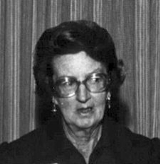
Mary Leakey

Encyclopedia
Mary Leakey was a British archaeologist and anthropologist, who discovered the first skull of a fossil
ape
on Rusinga Island
and also a noted robust Australopithecine called Zinjanthropus at Olduvai. For much of her career she worked together with her husband, Louis Leakey
, in Olduvai Gorge, uncovering the tool
s and fossils of ancient hominines. She developed a system for classifying
the stone tools found at Olduvai. She also discovered the Laetoli footprints. In 1960 she became director of excavation at Olduvai and subsequently took it over, building her own staff. After the death of her husband she became a leading palaeoanthropologist, helping to establish the Leakey tradition by training her son, Richard
, in the field.
, England
to Erskine Edward Nicol and Cecilia Marion (Frere) Nicol. Since Erskine worked as a painter, specializing in watercolor landscapes, the Nicol family would move from place to place, visiting numerous locations in France
, Italy
, and Egypt
where Erskine painted scenes to be sold in England. Erskine Nicol developed an amateur enthusiasm for Egyptology
during his travels. Mary Leakey was a direct descendant of antiquarian, John Frere
, and cousin to archaeologist, Sheppard Frere
, on her mother's side. The Frere family had been active abolitionists in the British colonial empire during the nineteenth century and established several communities for freed slaves. Three of these communities remained in existence as of Mrs. Leakey's 1984 autobiography: Freretown, Kenya, Freretown, South Africa, and Freretown, India. She also was a distant relative of baronet
Henry Bartle Frere
.
The Nicols spent much of their time in southern France. Mary became fluent in French. She identified more with the adventurous spirit of her father, going for long walks and explorations with him and having long talks. She disliked her governess and had less sympathy for her mother.
In 1925, when Mary was 12, the Nicols stayed at Les Eyzies at a time when Elie Peyrony was excavating one of the caves there. Peyrony did not understand the significance of much of what he found, and was not excavating scientifically during that early stage of archaeology. Mary received permission to go through his dump. It was there that her interest in prehistory
was sparked. She started a collection of points, scrapers, and blades from the dump and developed her first system of classification.
That winter, the family moved to Cabrerets
, a village of Dordogne
, France. There she met Abbé Lemozi, the village priest, who befriended her and became her mentor for a time. The two toured Pech Merle
cave to view the prehistoric paintings of bison and horses.
. She placed Mary in a local Catholic
convent to be educated, following the example of her own life. Later, Mary boasted of never passing an examination there. Mary could not even excel at French
, although she spoke it fluently, because her teacher frowned upon her provincial accent. She was expelled for refusing to recite poetry, and then expelled from a second convent school for causing an explosion in a chemistry laboratory.
After the second expulsion her mother hired two tutors, who were no more successful than the nuns, and mother and daughter visited Stonehenge
. Mary's only particular interests were drawing and archaeology. Formal university admission was impossible with Mary's academic record. Her mother contacted a professor at Oxford University about possible admission. After being informed that it was not even worth her time applying, Mary had no further contact with the university until it awarded her an honorary doctoral degree in 1951. So the small family moved to Kensington
where she could attend lectures unregistered in archaeology and related subjects at University College London
and the London Museum
, where she studied under Mortimer Wheeler
.
She applied to a number of excavations to be held in the summer. Wheeler was the first to accept her for a dig at St. Albans at the Roman
site of Verulamium
. Mary's second dig was at Hembury
, a Neolithic
site, under Dorothy Liddell, who coached her for four years. Mary's illustration
s of tools for Dorothy drew the attention of Gertrude Caton-Thompson, and in late 1932 she entered the field as an illustrator for Caton-Thompson's book, The Desert Fayoum.
 Through Gertrude, Mary met Louis Leakey
, who was in need of an illustrator for his book, Adam's Ancestors. While she was doing that work they became romantically attached. They shared common interests and values: a love of freedom and dislike for rules, an egalitarian frame of mind extending even to animals, a desire for adventure, and a passion for archaeology. Louis was still married when he started living with Mary, which caused a scandal that ruined his career at Cambridge University. They were married when Louis' wife Frida divorced him in 1936.
From then until about 1962 Louis and Mary faced trying circumstances together. Early in their relationship he nursed her through double pneumonia. They had three sons: Jonathan
in 1940, Richard
in 1944, and Philip
in 1949. The boys received much of their early childhood care at various anthropological sites. Whenever possible the Leakeys excavated and explored as a family. The boys grew up with the same love of freedom their parents had. Mary would not even allow guests to shoo away the pet hyrax
es that helped themselves to food and drink at the dinner table. She smoked very much, first cigarettes and then cigars, and dressed as though on excavation.
Louis was not always faithful to Mary, as he had not been to Frida. In 1960 they agreed that Mary would become director of excavations at Olduvai. From then on she operated more or less independently, taking over the dig. After Louis became known as a womanizer the intimate side of the marriage was effectively over. For example, Louis became briefly involved with Dian Fossey
. Meanwhile, Mary's life consisted mainly of her children, her dogs, and her archaeology. Louis died on 1 October 1972 of a heart attack. Mary continued the family's archaeological work.
 Leakey served her apprenticeship in archaeology under Dorothy Liddell at Hembury
in Devon
, England, 1930-1934, for whom she also did illustrations. In 1934 she was part of a dig at Swanscombe
where she discovered the largest elephant tooth known up to that time in Britain, but needed assistance to identify it.
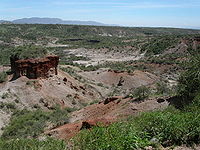
The years 1935 to 1959, spent at Olduvai Gorge in the Serengeti
plains of Northern Tanzania
, yielded many stone tools from primitive stone-chopping instruments to multi-purpose hand axes. These finds came from Stone Age
cultures dated as far back as 100,000 to two million years ago.
The Leakeys unearthed a Proconsul africanus
skull on Rusinga Island
, in October 1948. This skull was the first skull of a fossil ape ever to be found and, to this day, only three specimens of these apes are known.
Their next discovery, in 1959, was a 1.75 million-year-old Australopithecus boisei
skull, catalogued as OH 5
. They also found a less robust Homo habilis
skull and bones of a hand. After reconstructing the hand, it was proven the hand was capable of precise manipulation. Many more remains were found at this site. In 1965 the husband and wife team uncovered a Homo erectus
skull, dated at one million years old.
After Mary's husband died, she continued her work at Olduvai and Laetoli
. It was here, at the Laetoli site, that she discovered Hominin fossils that were more than 3.75 million-years-old. She also discovered fifteen new species
of other animals and one new genus
.
From 1976 to 1981 Leakey and her staff worked to uncover the Laetoli hominid footprint trail which was left in volcanic ash
es some 3.6 million years ago. The years that followed this discovery were filled with research at Olduvai and Laetoli, the follow-up work to discoveries and preparing publications.
Fossil
Fossils are the preserved remains or traces of animals , plants, and other organisms from the remote past...
ape
Ape
Apes are Old World anthropoid mammals, more specifically a clade of tailless catarrhine primates, belonging to the biological superfamily Hominoidea. The apes are native to Africa and South-east Asia, although in relatively recent times humans have spread all over the world...
on Rusinga Island
Buvuma Island
Buvuma Island refers to a Lake Victorian island chain and the chain's largest island.-Location:This chain of more than fifty islands is located a few kilometres off the northern shore of Lake Victoria, Uganda in the Napoleon Gulf. Buvuma lies some 25 km south of the major city of Jinja, and...
and also a noted robust Australopithecine called Zinjanthropus at Olduvai. For much of her career she worked together with her husband, Louis Leakey
Louis Leakey
Louis Seymour Bazett Leakey was a British archaeologist and naturalist whose work was important in establishing human evolutionary development in Africa. He also played a major role in creating organizations for future research in Africa and for protecting wildlife there...
, in Olduvai Gorge, uncovering the tool
Tool
A tool is a device that can be used to produce an item or achieve a task, but that is not consumed in the process. Informally the word is also used to describe a procedure or process with a specific purpose. Tools that are used in particular fields or activities may have different designations such...
s and fossils of ancient hominines. She developed a system for classifying
Taxonomy
Taxonomy is the science of identifying and naming species, and arranging them into a classification. The field of taxonomy, sometimes referred to as "biological taxonomy", revolves around the description and use of taxonomic units, known as taxa...
the stone tools found at Olduvai. She also discovered the Laetoli footprints. In 1960 she became director of excavation at Olduvai and subsequently took it over, building her own staff. After the death of her husband she became a leading palaeoanthropologist, helping to establish the Leakey tradition by training her son, Richard
Richard Leakey
Richard Erskine Frere Leakey is a politician, paleoanthropologist and conservationist. He is second of the three sons of the archaeologists Louis Leakey and Mary Leakey, and is the younger brother of Colin Leakey...
, in the field.
Childhood
Mary Leakey was born Mary Douglas Nicol on 6 February 1913 in LondonLondon
London is the capital city of :England and the :United Kingdom, the largest metropolitan area in the United Kingdom, and the largest urban zone in the European Union by most measures. Located on the River Thames, London has been a major settlement for two millennia, its history going back to its...
, England
England
England is a country that is part of the United Kingdom. It shares land borders with Scotland to the north and Wales to the west; the Irish Sea is to the north west, the Celtic Sea to the south west, with the North Sea to the east and the English Channel to the south separating it from continental...
to Erskine Edward Nicol and Cecilia Marion (Frere) Nicol. Since Erskine worked as a painter, specializing in watercolor landscapes, the Nicol family would move from place to place, visiting numerous locations in France
France
The French Republic , The French Republic , The French Republic , (commonly known as France , is a unitary semi-presidential republic in Western Europe with several overseas territories and islands located on other continents and in the Indian, Pacific, and Atlantic oceans. Metropolitan France...
, Italy
Italy
Italy , officially the Italian Republic languages]] under the European Charter for Regional or Minority Languages. In each of these, Italy's official name is as follows:;;;;;;;;), is a unitary parliamentary republic in South-Central Europe. To the north it borders France, Switzerland, Austria and...
, and Egypt
Egypt
Egypt , officially the Arab Republic of Egypt, Arabic: , is a country mainly in North Africa, with the Sinai Peninsula forming a land bridge in Southwest Asia. Egypt is thus a transcontinental country, and a major power in Africa, the Mediterranean Basin, the Middle East and the Muslim world...
where Erskine painted scenes to be sold in England. Erskine Nicol developed an amateur enthusiasm for Egyptology
Egyptology
Egyptology is the study of ancient Egyptian history, language, literature, religion, and art from the 5th millennium BC until the end of its native religious practices in the AD 4th century. A practitioner of the discipline is an “Egyptologist”...
during his travels. Mary Leakey was a direct descendant of antiquarian, John Frere
John Frere
John Frere was an English antiquary and a pioneering discoverer of Old Stone Age or Palaeolithic tools in association with large extinct animals at Hoxne, Suffolk in 1797.-Life:...
, and cousin to archaeologist, Sheppard Frere
Sheppard Frere
Professor Sheppard Sunderland Frere, CBE, FSA, FBA is a former British historian and archaeologist who studied the Roman Empire.-Biography:...
, on her mother's side. The Frere family had been active abolitionists in the British colonial empire during the nineteenth century and established several communities for freed slaves. Three of these communities remained in existence as of Mrs. Leakey's 1984 autobiography: Freretown, Kenya, Freretown, South Africa, and Freretown, India. She also was a distant relative of baronet
Baronet
A baronet or the rare female equivalent, a baronetess , is the holder of a hereditary baronetcy awarded by the British Crown...
Henry Bartle Frere
Henry Bartle Frere
Sir Henry Bartle Edward Frere, 1st Baronet, GCB, GCSI, was a British colonial administrator.-Early life:Frere was born at Clydach House, Clydach, Monmouthshire, the son of Edward Frere, manager of Clydach Ironworks...
.
The Nicols spent much of their time in southern France. Mary became fluent in French. She identified more with the adventurous spirit of her father, going for long walks and explorations with him and having long talks. She disliked her governess and had less sympathy for her mother.
In 1925, when Mary was 12, the Nicols stayed at Les Eyzies at a time when Elie Peyrony was excavating one of the caves there. Peyrony did not understand the significance of much of what he found, and was not excavating scientifically during that early stage of archaeology. Mary received permission to go through his dump. It was there that her interest in prehistory
Prehistory
Prehistory is the span of time before recorded history. Prehistory can refer to the period of human existence before the availability of those written records with which recorded history begins. More broadly, it refers to all the time preceding human existence and the invention of writing...
was sparked. She started a collection of points, scrapers, and blades from the dump and developed her first system of classification.
That winter, the family moved to Cabrerets
Cabrerets
Cabrerets is a commune in the Lot department in south-western France.The village of Cabrerets derives its name from cabre, meaning goat in the Occitan language.-Geography:...
, a village of Dordogne
Dordogne
Dordogne is a départment in south-west France. The départment is located in the region of Aquitaine, between the Loire valley and the High Pyrénées named after the great river Dordogne that runs through it...
, France. There she met Abbé Lemozi, the village priest, who befriended her and became her mentor for a time. The two toured Pech Merle
Pech Merle
Pech Merle is a cave which opens onto a hillside at Cabrerets in the Lot département of the Midi-Pyrénées region in France, about 35 minutes by road east of Cahors. It is the home of one of the few prehistoric cave painting sites in France which remain open to the general public...
cave to view the prehistoric paintings of bison and horses.
Education
In the spring of 1926, in Mary's 13th year, her father died of cancer. The services were read by Lemozi. Erskine's brother, Percy, came to take them back to London. Cecilia sold Erskine's paintings and moved to a boardinghouse in KensingtonKensington
Kensington is a district of west and central London, England within the Royal Borough of Kensington and Chelsea. An affluent and densely-populated area, its commercial heart is Kensington High Street, and it contains the well-known museum district of South Kensington.To the north, Kensington is...
. She placed Mary in a local Catholic
Catholic
The word catholic comes from the Greek phrase , meaning "on the whole," "according to the whole" or "in general", and is a combination of the Greek words meaning "about" and meaning "whole"...
convent to be educated, following the example of her own life. Later, Mary boasted of never passing an examination there. Mary could not even excel at French
French language
French is a Romance language spoken as a first language in France, the Romandy region in Switzerland, Wallonia and Brussels in Belgium, Monaco, the regions of Quebec and Acadia in Canada, and by various communities elsewhere. Second-language speakers of French are distributed throughout many parts...
, although she spoke it fluently, because her teacher frowned upon her provincial accent. She was expelled for refusing to recite poetry, and then expelled from a second convent school for causing an explosion in a chemistry laboratory.
After the second expulsion her mother hired two tutors, who were no more successful than the nuns, and mother and daughter visited Stonehenge
Stonehenge
Stonehenge is a prehistoric monument located in the English county of Wiltshire, about west of Amesbury and north of Salisbury. One of the most famous sites in the world, Stonehenge is composed of a circular setting of large standing stones set within earthworks...
. Mary's only particular interests were drawing and archaeology. Formal university admission was impossible with Mary's academic record. Her mother contacted a professor at Oxford University about possible admission. After being informed that it was not even worth her time applying, Mary had no further contact with the university until it awarded her an honorary doctoral degree in 1951. So the small family moved to Kensington
Kensington
Kensington is a district of west and central London, England within the Royal Borough of Kensington and Chelsea. An affluent and densely-populated area, its commercial heart is Kensington High Street, and it contains the well-known museum district of South Kensington.To the north, Kensington is...
where she could attend lectures unregistered in archaeology and related subjects at University College London
University College London
University College London is a public research university located in London, United Kingdom and the oldest and largest constituent college of the federal University of London...
and the London Museum
London Museum
The London Museum was inaugurated on 21 March 1912 by King George V with Queen Mary and Princess Mary and Prince George at Kensington Palace. It opened for public visitation on 8 April, admitting more than 13.000 visitors during the day. Two years later the collections were removed to Lancaster...
, where she studied under Mortimer Wheeler
Mortimer Wheeler
Brigadier Sir Robert Eric Mortimer Wheeler CH, CIE, MC, FBA, FSA , was one of the best-known British archaeologists of the twentieth century.-Education and career:...
.
She applied to a number of excavations to be held in the summer. Wheeler was the first to accept her for a dig at St. Albans at the Roman
Rome
Rome is the capital of Italy and the country's largest and most populated city and comune, with over 2.7 million residents in . The city is located in the central-western portion of the Italian Peninsula, on the Tiber River within the Lazio region of Italy.Rome's history spans two and a half...
site of Verulamium
Verulamium
Verulamium was an ancient town in Roman Britain. It was sited in the southwest of the modern city of St Albans in Hertfordshire, Great Britain. A large portion of the Roman city remains unexcavated, being now park and agricultural land, though much has been built upon...
. Mary's second dig was at Hembury
Hembury
Hembury is a Neolithic causewayed enclosure near Honiton in Devon. It dates from the late fifth and early fourth millennia BC onwards to the Roman Invasion. The fort is situated on a promontory to the North of and overlooking the River Otter Valley at approx 178 Metres above Sea Level.It has given...
, a Neolithic
Neolithic
The Neolithic Age, Era, or Period, or New Stone Age, was a period in the development of human technology, beginning about 9500 BC in some parts of the Middle East, and later in other parts of the world. It is traditionally considered as the last part of the Stone Age...
site, under Dorothy Liddell, who coached her for four years. Mary's illustration
Illustration
An illustration is a displayed visualization form presented as a drawing, painting, photograph or other work of art that is created to elucidate or dictate sensual information by providing a visual representation graphically.- Early history :The earliest forms of illustration were prehistoric...
s of tools for Dorothy drew the attention of Gertrude Caton-Thompson, and in late 1932 she entered the field as an illustrator for Caton-Thompson's book, The Desert Fayoum.
Matriarch
Louis Leakey
Louis Seymour Bazett Leakey was a British archaeologist and naturalist whose work was important in establishing human evolutionary development in Africa. He also played a major role in creating organizations for future research in Africa and for protecting wildlife there...
, who was in need of an illustrator for his book, Adam's Ancestors. While she was doing that work they became romantically attached. They shared common interests and values: a love of freedom and dislike for rules, an egalitarian frame of mind extending even to animals, a desire for adventure, and a passion for archaeology. Louis was still married when he started living with Mary, which caused a scandal that ruined his career at Cambridge University. They were married when Louis' wife Frida divorced him in 1936.
From then until about 1962 Louis and Mary faced trying circumstances together. Early in their relationship he nursed her through double pneumonia. They had three sons: Jonathan
Jonathan Leakey
Jonathan Harry Erskine Leakey is a businessman and former palaeoanthropologist. He is the first son of famed anthropologists Louis and Mary Leakey....
in 1940, Richard
Richard Leakey
Richard Erskine Frere Leakey is a politician, paleoanthropologist and conservationist. He is second of the three sons of the archaeologists Louis Leakey and Mary Leakey, and is the younger brother of Colin Leakey...
in 1944, and Philip
Philip Leakey
Philip Leakey was educated at Leighton Park School and is a former member of the Kenyan Parliament. He represented the KANU party led by then president Daniel Arap Moi. He was an MP of Langata Constituency from 1979 and served as a cabinet minister for a short stint...
in 1949. The boys received much of their early childhood care at various anthropological sites. Whenever possible the Leakeys excavated and explored as a family. The boys grew up with the same love of freedom their parents had. Mary would not even allow guests to shoo away the pet hyrax
Hyrax
A hyrax is any of four species of fairly small, thickset, herbivorous mammals in the order Hyracoidea. The rock hyrax Procavia capensis, the yellow-spotted rock hyrax Heterohyrax brucei, the western tree hyrax Dendrohyrax dorsalis, and the southern tree hyrax, Dendrohyrax arboreus live in Africa...
es that helped themselves to food and drink at the dinner table. She smoked very much, first cigarettes and then cigars, and dressed as though on excavation.
Louis was not always faithful to Mary, as he had not been to Frida. In 1960 they agreed that Mary would become director of excavations at Olduvai. From then on she operated more or less independently, taking over the dig. After Louis became known as a womanizer the intimate side of the marriage was effectively over. For example, Louis became briefly involved with Dian Fossey
Dian Fossey
Dian Fossey was an American zoologist who undertook an extensive study of gorilla groups over a period of 18 years. She studied them daily in the mountain forests of Rwanda, initially encouraged to work there by famous anthropologist Louis Leakey...
. Meanwhile, Mary's life consisted mainly of her children, her dogs, and her archaeology. Louis died on 1 October 1972 of a heart attack. Mary continued the family's archaeological work.
Floruit
Mary carried on after Louis, becoming a powerful and respected figure. By then Richard had decided to become a palaeoanthropologist. She helped his career significantly. The other two boys had opted to follow other interests.Death
Mary died on 9 December 1996 at the age of 83, a renowned palaeoanthropologist, who had not only conducted significant research of her own, but had been invaluable to the research careers of her husband Louis Leakey and their sons Richard, Philip and Jonathan.Excavations
Hembury
Hembury is a Neolithic causewayed enclosure near Honiton in Devon. It dates from the late fifth and early fourth millennia BC onwards to the Roman Invasion. The fort is situated on a promontory to the North of and overlooking the River Otter Valley at approx 178 Metres above Sea Level.It has given...
in Devon
Devon
Devon is a large county in southwestern England. The county is sometimes referred to as Devonshire, although the term is rarely used inside the county itself as the county has never been officially "shired", it often indicates a traditional or historical context.The county shares borders with...
, England, 1930-1934, for whom she also did illustrations. In 1934 she was part of a dig at Swanscombe
Swanscombe
Swanscombe is a small town, part of the Borough of Dartford on the north Kent coast in England. It is part of the civil parish of Swanscombe and Greenhithe.-Prehistory:...
where she discovered the largest elephant tooth known up to that time in Britain, but needed assistance to identify it.
The years 1935 to 1959, spent at Olduvai Gorge in the Serengeti
Serengeti
The Serengeti ecosystem is a geographical region in Africa. It is located in north Tanzania and extends to south-western Kenya between latitudes 1 and 3 S and longitudes 34 and 36 E. It spans some ....
plains of Northern Tanzania
Tanzania
The United Republic of Tanzania is a country in East Africa bordered by Kenya and Uganda to the north, Rwanda, Burundi, and the Democratic Republic of the Congo to the west, and Zambia, Malawi, and Mozambique to the south. The country's eastern borders lie on the Indian Ocean.Tanzania is a state...
, yielded many stone tools from primitive stone-chopping instruments to multi-purpose hand axes. These finds came from Stone Age
Stone Age
The Stone Age is a broad prehistoric period, lasting about 2.5 million years , during which humans and their predecessor species in the genus Homo, as well as the earlier partly contemporary genera Australopithecus and Paranthropus, widely used exclusively stone as their hard material in the...
cultures dated as far back as 100,000 to two million years ago.
The Leakeys unearthed a Proconsul africanus
Proconsul africanus
Proconsul africanus is the first species of the oligocene-era fossil genus of primate to be discovered and was named by Arthur Hopwood, an associate of Louis Leakey, in 1933.- Discovery :...
skull on Rusinga Island
Rusinga Island
Rusinga Island, with an elongated shape approx. 10 miles from end to end and 3 miles at its widest point, lies in the eastern part of Lake Victoria at the mouth of the Winam Gulf...
, in October 1948. This skull was the first skull of a fossil ape ever to be found and, to this day, only three specimens of these apes are known.
Their next discovery, in 1959, was a 1.75 million-year-old Australopithecus boisei
Paranthropus boisei
Paranthropus boisei was an early hominin and described as the largest of the Paranthropus species...
skull, catalogued as OH 5
OH 5
OH 5 is a fossilized cranium and the holotype of the species Paranthropus boisei. It was discovered in Olduvai Gorge, Tanzania, by archaeologist-paleontologist Mary Leakey in 1959...
. They also found a less robust Homo habilis
Homo habilis
Homo habilis is a species of the genus Homo, which lived from approximately at the beginning of the Pleistocene period. The discovery and description of this species is credited to both Mary and Louis Leakey, who found fossils in Tanzania, East Africa, between 1962 and 1964. Homo habilis Homo...
skull and bones of a hand. After reconstructing the hand, it was proven the hand was capable of precise manipulation. Many more remains were found at this site. In 1965 the husband and wife team uncovered a Homo erectus
Homo erectus
Homo erectus is an extinct species of hominid that lived from the end of the Pliocene epoch to the later Pleistocene, about . The species originated in Africa and spread as far as India, China and Java. There is still disagreement on the subject of the classification, ancestry, and progeny of H...
skull, dated at one million years old.
After Mary's husband died, she continued her work at Olduvai and Laetoli
Laetoli
Laetoli is a site in Tanzania, dated to the Plio-Pleistocene and famous for its hominin footprints, preserved in volcanic ash . The site of the Laetoli footprints is located 45 km south of Olduvai gorge.-Date:...
. It was here, at the Laetoli site, that she discovered Hominin fossils that were more than 3.75 million-years-old. She also discovered fifteen new species
Species
In biology, a species is one of the basic units of biological classification and a taxonomic rank. A species is often defined as a group of organisms capable of interbreeding and producing fertile offspring. While in many cases this definition is adequate, more precise or differing measures are...
of other animals and one new genus
Genus
In biology, a genus is a low-level taxonomic rank used in the biological classification of living and fossil organisms, which is an example of definition by genus and differentia...
.
From 1976 to 1981 Leakey and her staff worked to uncover the Laetoli hominid footprint trail which was left in volcanic ash
Volcanic ash
Volcanic ash consists of small tephra, which are bits of pulverized rock and glass created by volcanic eruptions, less than in diameter. There are three mechanisms of volcanic ash formation: gas release under decompression causing magmatic eruptions; thermal contraction from chilling on contact...
es some 3.6 million years ago. The years that followed this discovery were filled with research at Olduvai and Laetoli, the follow-up work to discoveries and preparing publications.
Books
- Excavations at Njoro River Cave, 1950, with Louis.
- Olduvai Gorge: Excavations in Beds I and II, 1960-1963, 1971.
- Olduvai Gorge: My Search for Early Man, 1979
- Africa's Vanishing Art: The Rock Paintings of Tanzania, 1983
See also
- Leakey familyLeakeyLeakey may refer to:people:*Colin Leakey , English botanist*David Leakey , British military general*Jonathan Leakey, businessman and former archaeologist*Louis Leakey , Kenyan archaeologist and naturalist...
- List of fossil sites (with link directory)
- List of hominina (hominid) fossils (with images)