
All Topics  
Kamba


   Email Print
   Bookmark   Link


Kamba


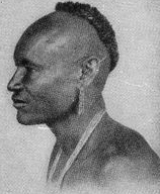
The Kamba (Akamba in the plural) are a Bantu ethnic group who live in the semi-arid Eastern Province of Kenya
Kenya

The Republic of Kenya is a country in East Africa. It is bordered by Ethiopia to the north, Somalia to the northeast, Tanzania to the south, Uganda to the west, and Sudan to the northwest, with the Indian Ocean running along the southeast border....
 stretching east from Nairobi
Nairobi

Nairobi is the capital city and largest city of Kenya. The city and its surrounding area also forms the Nairobi Province. The name "Nairobi" comes from the Maasai language phrase Enkare Nyirobi, which translates to "the place of cool waters"....
 to Tsavo
Tsavo

Tsavo is a region of Kenya located at the crossing of the Uganda Railway over the Tsavo River, close to where it meets the Athi-Galana-Sabaki River....
 and north up to Embu, Kenya
Embu, Kenya

Embu is a large town in Kenya, located approximately 120 kilometers northeast of Nairobi towards Mount Kenya. Embu serves as the provincial headquarters of Eastern Province in Kenya and is also the district headquarters of Embu District....
. This land is called Ukambani. Sources vary on whether they are the third, fourth or the fifth largest ethnic group in Kenya. They speak the Kikamba language.

Anthropologists believe that the Akamba are a mixture of several East African people, and bear traits of the Bantu farmers (Kikuyu
Kikuyu

The Kikuyu are Kenya's most populous ethnic group. 'Kikuyu' is the anglicised form of the proper name and pronunciation of Gikuyu although they refer to themselves as the Agikuyu people....
, Taita
Taita

*Taita , a Kenyan ethnic group, being about 0.7 % of the population; also Taita .*An alternative name for injera, a bread common in the Horn of Africa....
) as well as those of the Nilotic
Nilotic

Nilotic people or Nilotes, in its contemporary usage, refers to some ethnic groups mainly in southern Sudan, Uganda, Kenya, and northern Tanzania, who speak Nilotic languages, a large sub-group of the Nilo-Saharan languages....
 pastoralists (Maasai
Maasai

The Maasai are an Indigenous peoples African ethnic group of semi-nomadic people located in Kenya and northern Tanzania. Due to their distinctive customs and dress and residence near the many game parks of East Africa, they are among the most well-known African ethnic groups internationally....
, Kalenjin
Kalenjin

Kalenjin is an ethnic group of Nilotic origin living in the Great Rift Valley in western Kenya. The Kalenjin population is estimated at roughly 3 million....
, Borana
Borana

The Borana Oromo, also called the Boran, are a Pastoralism ethnic group living in southern Ethiopia and northern Kenya....
, etc) and the cushi
Cushi

The word Cushi, also spelled Kushi is a Hebrew term generally used to refer to a dark skinned person usually of African descent and is very similar in its usage to the English language word Negro....
te communities with whom they share borders, to the east of Tsavo.


Discussion
Ask a question about 'Kamba'
Start a new discussion about 'Kamba'
Answer questions from other users
Full Discussion Forum


Recent Posts


Encyclopedia


The Kamba (Akamba in the plural) are a Bantu ethnic group who live in the semi-arid Eastern Province of Kenya
Kenya

The Republic of Kenya is a country in East Africa. It is bordered by Ethiopia to the north, Somalia to the northeast, Tanzania to the south, Uganda to the west, and Sudan to the northwest, with the Indian Ocean running along the southeast border....
 stretching east from Nairobi
Nairobi

Nairobi is the capital city and largest city of Kenya. The city and its surrounding area also forms the Nairobi Province. The name "Nairobi" comes from the Maasai language phrase Enkare Nyirobi, which translates to "the place of cool waters"....
 to Tsavo
Tsavo

Tsavo is a region of Kenya located at the crossing of the Uganda Railway over the Tsavo River, close to where it meets the Athi-Galana-Sabaki River....
 and north up to Embu, Kenya
Embu, Kenya

Embu is a large town in Kenya, located approximately 120 kilometers northeast of Nairobi towards Mount Kenya. Embu serves as the provincial headquarters of Eastern Province in Kenya and is also the district headquarters of Embu District....
. This land is called Ukambani. Sources vary on whether they are the third, fourth or the fifth largest ethnic group in Kenya. They speak the Kikamba language.

Anthropologists believe that the Akamba are a mixture of several East African people, and bear traits of the Bantu farmers (Kikuyu
Kikuyu

The Kikuyu are Kenya's most populous ethnic group. 'Kikuyu' is the anglicised form of the proper name and pronunciation of Gikuyu although they refer to themselves as the Agikuyu people....
, Taita
Taita

*Taita , a Kenyan ethnic group, being about 0.7 % of the population; also Taita .*An alternative name for injera, a bread common in the Horn of Africa....
) as well as those of the Nilotic
Nilotic

Nilotic people or Nilotes, in its contemporary usage, refers to some ethnic groups mainly in southern Sudan, Uganda, Kenya, and northern Tanzania, who speak Nilotic languages, a large sub-group of the Nilo-Saharan languages....
 pastoralists (Maasai
Maasai

The Maasai are an Indigenous peoples African ethnic group of semi-nomadic people located in Kenya and northern Tanzania. Due to their distinctive customs and dress and residence near the many game parks of East Africa, they are among the most well-known African ethnic groups internationally....
, Kalenjin
Kalenjin

Kalenjin is an ethnic group of Nilotic origin living in the Great Rift Valley in western Kenya. The Kalenjin population is estimated at roughly 3 million....
, Borana
Borana

The Borana Oromo, also called the Boran, are a Pastoralism ethnic group living in southern Ethiopia and northern Kenya....
, etc) and the cushi
Cushi

The word Cushi, also spelled Kushi is a Hebrew term generally used to refer to a dark skinned person usually of African descent and is very similar in its usage to the English language word Negro....
te communities with whom they share borders, to the east of Tsavo. The Akamba are often found engaged in different professions: some are agriculturalists, others hunters, and a surprisingly large number are pastoralists. Barter
Barter

Barter is a type of trade in which product or Service are directly exchanged for other goods and/or services, without the use of Money. It can be bilateral or multilateral, and usually exists parallel to monetary systems in most developed countries, though to a very limited extent....
 trade with the Kikuyu, Maasai, Meru
Meru

Meru may refer to:In geography:* Meru, Kenya, a central town, associated with:** Meru Central District** Meru North District** Meru South District...
 and Embu
Embu

Embu, also Embu das Artes, is a Brazilian city in the State of S?o Paulo . It is a suburb of the capital. The population in 2006 was 245,855 inhabitants....
 people in the interior and the Mijikenda
Mijikenda

The Mijikenda are the nine ethnic groups along the coast of Kenya from the border of Somalia in the north to the border of Tanzania in the south....
 and Arab
Arab

An Arab is a person who Identity as such on linguistic or cultural grounds. The plural form, Arabs , refers to the Ethnocultural group at large....
 people of the coast was also practiced by the Akamba who straddled the eastern plains of Kenya.

Over time, the Akamba extended their commercial activity and wielded economic control across the central part of the land that was later to be known as Kenya (from the Kikamba, 'Kiinyaa', meaning 'the Ostrich Country'), from the Indian Ocean in the east to Lake Victoria in the west, and all the way up to Lake Turkana on the northern frontier. The Akamba traded in locally-produced goods such as cane beer, ivory, brass amulets, tools and weapons, millet, and cattle. The food obtained from trading helped offset shortages caused by droughts and famines. They also traded in medicinal products known as 'Miti' (literally: plants), made from various parts of the numerous medicinal plants found on the East African plains. The Akamba are still known for their fine work in basketry and pottery. Their artistic inclination is evidenced in the sculpture work that is on display in many craft shops and galleries in the major cities and towns of Kenya.

In the mid-eighteenth century, a large number of Akamba pastoral groups moved eastwards from the Tsavo and Kibwezi areas to the coast. This migration was the result of extensive drought and lack of pasture for their cattle. They settled in the Mariakani, Kisauni and Kinango areas of the coast of Kenya, creating the beginnings of urban settlement. They are still found in large numbers in these towns, and have been absorbed into the cultural, economic and political life of the modern-day Coast Province. Several notable politicians, businessmen and women, as well as professional men and women are direct descendants of these itinerant pastoralists.

Colonialism and the 19th century

In the latter part of the 19th century the Arabs took over the coastal trade from the Akamba, who then acted as middlemen between the Arab and Swahili traders and the tribes further upcountry. Their trade and travel made them ideal guides for the caravans gathering slaves for the Middle East
Middle East

File:GreaterMiddleEast1.pngThe Middle East is a region that spans southwestern Asia, western Asia, and northeastern Africa. It has no clear boundaries, often used as a synonym to Near East, in opposition to Far East....
ern and India
India

India, officially the Republic of India , is a country in South Asia. It is the List of countries and outlying territories by total area country by geographical area, the List of countries by population country, and the most populous liberal democracy in the world....
n markets. Early Europe
Europe

Europe is, conventionally, one of the world's seven continents. Comprising the westernmost peninsula of Eurasia, Europe is generally divided from Asia to its east by the water divide of the Ural Mountains, the Ural , the Caspian Sea, and by the Caucasus Mountains to the southeast....
an explorers also used them as guides in their expeditions to explore East Africa
East Africa

East Africa or Eastern Africa is the easterly region of the African continent, variably defined by geography or geopolitics. In the UN subregion, 19 territories constitute Eastern Africa:...
 due to their wide knowledge of the land and neutral standing with many of the other tribes they traded with.

Akamba resistance to colonialism
Colonialism

Colonialism is the extension of a nation's sovereignty over Territory beyond its borders by the establishment of either settler or exploitation colony in which Indigenous people populations are direct rule, Population transfers, or Genocide....
 was mostly non-violent in nature. Some of the best known Akamba resistance leaders to colonialism were: Syokimau, Syotune wa Kathukye, Muindi Mbingu, and later Paul Ngei
Paul Ngei

The Honourable Paul Joseph Ngei was a Kenyan politician who was imprisoned for his role in the anti-colonial movement but went on to hold several ministerial positions....
, JD Kali, and Malu of Kilungu. Ngei and Kali were imprisoned by the colonial government for their anti-colonial protests. Syotune wa Kathukye led a peaceful protest to recover cattle confiscated by the British colonial government during one of their punitive expeditions on the local populations. Muindi Mbingu was arrested for leading another protest march to recover stolen land around the Mua Hills in Masaku district, which the British settlers eventually appropriated for themselves. JD Kali, along with Paul Ngei
Paul Ngei

The Honourable Paul Joseph Ngei was a Kenyan politician who was imprisoned for his role in the anti-colonial movement but went on to hold several ministerial positions....
, joined the Mau Mau movement to recover Kenya for the Kenyan people. He was imprisoned in Kismayu during the fighting between the then government and the freedom fighters.

The Kikamba family

In Kikamba culture, the family plays a central role in the community. The Kamba extended family or clan is called 'mbai'. The man, who is the head of the family, is usually engaged in an economic activity popular among the community like trading, hunting, cattle-herding or farming. He is known as 'Nau', 'Tata'or 'Asa'.

The woman, whatever her husband's occupation, works on her plot of land, which she is given upon joining her husband's household. She supplies the bulk of the food consumed by her family. She grows maize, millet, sweet potatoes, pumpkin, beans, pigeon peas, greens, arrow root, cassava, and in the cooler regions such as Kangundo, yam. It is the mother's role to bring up the children. Even children that have grown up into adults are expected to never contradict the mother's wishes. The mother is known as 'Mwaitu' ('our One').

Very little distinction is made between one's children and nieces and nephews. They address their maternal uncle as 'ma-ma' and their paternal aunt as 'mwendwau'. They address their paternal cousins as 'wasa', and the maternal cousins as 'mwendya'. Children often move from one household to another with ease, and are made to feel at home by their aunts and uncles who, while in charge of their nephews/nieces, are their de facto parents.

Grandparents (Susu, umau) help with the less strenuous chores around the home, such as rope-making, tanning leather, cleaning calabashes and making arrows. Older women continue to work the land, as this is seen as a source of independence and economic security. They also carry out trade in the local markets, though not exclusively. In the modern Kikamba family, the women, especially in the urban regions, practice professions such as teaching, secretarial work, management, tailoring etc in accordance with Kenya's socioeconomic evolution.

Culture and beliefs

Naming is an important aspect of the Akamba people. Children are often affectionately called Musumbi (meaning "king"), and Muthoki/Nthoki (meaning "long awaited one"). Akamba children are named for/after time or events surrounding their birth. For example, Nduku is a name given to a baby girl born at night and Mutuku to a baby boy born at night. Children born when it is raining may be named Mumbua (feminine) or Wambua (masculine).

Traditionally the Akamba did not name after living ancestors. This tradition has been heavily diluted in contemporary times due to inter ethnic marriages, most commonly those with the Kikuyu who insist on naming after living relatives in a systematic order. Historically, however, the Akamba were a very superstitious people, and to name after a living relative was thought to be a curse upon the living namesake to wish them dead and was heavily frowned upon.

Like the Maasai
Maasai

The Maasai are an Indigenous peoples African ethnic group of semi-nomadic people located in Kenya and northern Tanzania. Due to their distinctive customs and dress and residence near the many game parks of East Africa, they are among the most well-known African ethnic groups internationally....
 and the Agikuyu, the Akamba believe in a monotheistic, invisible and transcendental God, Ngai or Mulungu, who lives up in the sky ('yayayani'). Another venerable name for God is Asa, or the Father. He is also known as Mwatuangi. He is perceived as the omnipotent creator of life on earth and as a merciful, if distant, entity. The traditional Akamba perceive the spirits of their departed ones, the 'Aimu'/'Maimu', as the intercessors between themselves and Ngai Mulungu. They are remembered in family rituals and offerings / libations at individual altars.

The kamba royalty was often not talked about and the history behind the royalty is not well known although the name Mwanzwii is liked with royalty or leadership. Not much is known about this Family or mentioned in any available documentation. Royalty may not be the best term to describe these people. Their role was more of leadership and performance of certain public, social, spiritual or ceremonial functions. They refrained from any involvement in electoral politics or the actual governance of their people. Some royal families have lost their "royalty" through social changes over a long period of time.

Kikamba music

The Akamba people's love of music and dance is evidenced in their spectacular performances at many events in their daily lives or on occasions of regional and national importance. In their dances they display agility and athletic skills as they perform acrobatics and body movements. The Akamba dance techniques and style resemble those of the Batutsi of Rwanda-Burundi and the Aembu of Kenya.

The following are some of the varieties of traditional dance styles of the Akamba community:

  • Mwali (pl: Myali) which is a dance accompanying a song, the latter which is usually made to criticize anti-social behaviour.
  • Kilumi and Ngoma, religious dances, performed at healing and rain-making ceremonies;
  • Mwilu is a circumcision dance;
  • Mbalya, or Ngutha is a dance for young people who meet to entertain themselves after the day's chores are done.
  • Kamandiko', (Irish or Scottish Ceilidh) or the modern disco usually held after a wedding party.


Dances are usually accompanied by songs composed for the occasion (marriage, birth, nationally important occasion), and reflect the traditional structure of the Kikamba song, sung on a pentatonic scale. The singing is lively and tuneful. Songs are composed satirizing deviant behavior, anti-social activity, etc. The Akamba have famous work songs, such as 'Ngulu Mwelela', sung while work, such as digging, is going on. Herdsmen and boys have different songs, as do young people and old. During the Mbalya dances the dance leader will compose love songs and satirical numbers, to tease and entertain his / her dancers.

Clothing and costumery

The Akamba of the modern times, like most people in Kenya, dress rather conventionally in western / European clothing. The men wear trousers and shirts. Young boys will, as a rule, wear shorts and short-sleeved shirts, usually in cotton, or tee-shirts. Traditionally, Akamba men wore leather short kilts made from animal skins or tree bark. They wore copious jewelry, mainly of copper and brass. It consisted of neck-chains, bracelets, and anklets.

The women in modern Akamba society also dress in the European fashion, taking their pick from dresses, skirts, trousers, jeans and shorts, made from the wide range of fabrics available in Kenya. Primarily, however, skirts are the customary and respectable mode of dress. In the past, the women were attired in knee-length leather or bark skirts, embellished with bead work. They wore necklaces made of beads, these obtained from the Swahili and Arab traders. They shaved their heads clean, and wore a head band intensively decorated with beads. The various kilumi or dance groups wore similar colors and patterns on their bead work to distinguish themselves from other groups.

Traditionally, both men and women wore leather sandals especially when they ventured out of their neighborhoods to go to the market or on visits. While at home or working in their fields, however, they remained barefoot.

School children, male and female, shave their heads to maintain the spirit of uniformity and equality.

List of Prominent Akamba


See List of Notable Akamba

Resources