


Condensed milk

Encyclopedia
Water
Water is a chemical substance with the chemical formula H2O. A water molecule contains one oxygen and two hydrogen atoms connected by covalent bonds. Water is a liquid at ambient conditions, but it often co-exists on Earth with its solid state, ice, and gaseous state . Water also exists in a...
has been removed and to which sugar
Sugar
Sugar is a class of edible crystalline carbohydrates, mainly sucrose, lactose, and fructose, characterized by a sweet flavor.Sucrose in its refined form primarily comes from sugar cane and sugar beet...
has been added, yielding a very thick, sweet product which when canned
Tin can
A tin can, tin , steel can, or a can, is a sealed container for the distribution or storage of goods, composed of thin metal. Many cans require opening by cutting the "end" open; others have removable covers. Cans hold diverse contents: foods, beverages, oil, chemicals, etc."Tin" cans are made...
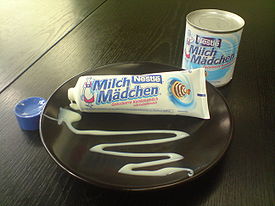
can last for years without refrigeration if unopened. The two terms, condensed milk and sweetened condensed milk, have become synonymous in the English language. Though there have been unsweetened condensed milk products, they spoiled far more easily and are uncommon today. Condensed milk is used in numerous dessert dishes in many countries, including Brazil
Brazil
Brazil , officially the Federative Republic of Brazil , is the largest country in South America. It is the world's fifth largest country, both by geographical area and by population with over 192 million people...
, Hong Kong SAR
Hong Kong
Hong Kong is one of two Special Administrative Regions of the People's Republic of China , the other being Macau. A city-state situated on China's south coast and enclosed by the Pearl River Delta and South China Sea, it is renowned for its expansive skyline and deep natural harbour...
, Russia
Russia
Russia or , officially known as both Russia and the Russian Federation , is a country in northern Eurasia. It is a federal semi-presidential republic, comprising 83 federal subjects...
, where it is known as "сгущёнка" (sguschyonka, literally "[that which is] thickened") and Sri Lanka
Sri Lanka
Sri Lanka, officially the Democratic Socialist Republic of Sri Lanka is a country off the southern coast of the Indian subcontinent. Known until 1972 as Ceylon , Sri Lanka is an island surrounded by the Indian Ocean, the Gulf of Mannar and the Palk Strait, and lies in the vicinity of India and the...
where it is called "tinkiri" (canned milk).
A related product is evaporated milk
Evaporated milk
Evaporated milk, also known as dehydrated milk, is a shelf-stable canned milk product with about 60% of the water removed from fresh milk. It differs from sweetened condensed milk, which contains added sugar. Sweetened condensed milk requires less processing since the added sugar inhibits ...
, which has undergone a more complex process and which is not sweetened. Local tastes in most countries prefer one or the other; for example in Germany unsweetened evaporated milk is far more common than sweetened condensed milk, while the situation is reversed in the United States, however in Peru both are equally common.
History
According to the writings of Marco PoloMarco Polo
Marco Polo was a Venetian merchant traveler from the Venetian Republic whose travels are recorded in Il Milione, a book which did much to introduce Europeans to Central Asia and China. He learned about trading whilst his father and uncle, Niccolò and Maffeo, travelled through Asia and apparently...
, the Tartars were able to condense milk. Ten pounds (4.5 kg) of milk paste was carried by each man who would mix the product with water. However, this probably refers to the soft Tartar curd which can be made into a drink ("ayran
Ayran
Ayran or laban is a cold beverage of yogurt mixed with cold water and sometimes salt; it is popular in many Central Asian, Middle Eastern and South-eastern European countries....
") by diluting it, and therefore refers to fermented, not fresh, milk concentrate.
Nicolas Appert
Nicolas Appert
Nicolas Appert , was the French inventor of airtight food preservation. Appert, known as the "father of canning", was a confectioner.-Biography:...
condensed milk in France in 1820,
and Gail Borden, Jr. in the United States
United States
The United States of America is a federal constitutional republic comprising fifty states and a federal district...
in 1853 in reaction to difficulties in storing milk for more than a few hours. Before this development milk
Milk
Milk is a white liquid produced by the mammary glands of mammals. It is the primary source of nutrition for young mammals before they are able to digest other types of food. Early-lactation milk contains colostrum, which carries the mother's antibodies to the baby and can reduce the risk of many...
could only be kept fresh for a short while and was only available in the immediate vicinity of a cow. While returning from a trip to England
England
England is a country that is part of the United Kingdom. It shares land borders with Scotland to the north and Wales to the west; the Irish Sea is to the north west, the Celtic Sea to the south west, with the North Sea to the east and the English Channel to the south separating it from continental...
in 1851, Borden was devastated by the death of several children, apparently due to poor milk from shipboard cows. With less than a year of schooling and following in a wake of failures, both of his own and of others, Borden was inspired by the vacuum pan
Vacuum evaporation
Vacuum evaporation is the process of causing the pressure in a liquid-filled container to be reduced below the vapor pressure of the liquid, causing the liquid to evaporate at a lower temperature than normal...
he had seen being used by Shakers
Shakers
The United Society of Believers in Christ’s Second Appearing, known as the Shakers, is a religious sect originally thought to be a development of the Religious Society of Friends...
to condense fruit juice and was at last able to reduce milk without scorching or curd
Curd
Curds are a dairy product obtained by curdling milk with rennet or an edible acidic substance such as lemon juice or vinegar, and then draining off the liquid portion. The increased acidity causes the milk proteins to tangle into solid masses, or curds. The remaining liquid, which contains only...
ling it. Even then his first two factories failed and only the third, built with his new partner, Jeremiah Milbank
Jeremiah Milbank
Jeremiah Milbank American businessman, was a successful dry goods commission merchant, speculator in Texas territorial bonds, manufacturer, and railroad investor. His most successful business efforts were the New York Condensed Milk Company which he co-founded with inventor Gail Borden and the...
in Wassaic, New York
Wassaic, New York
Wassaic is a hamlet in the Town of Amenia, Dutchess County, New York in the United States.Wassaic is located in southeast New York State and surrounded by the East and West Mountains and along the Tenmile River....
, produced a usable milk derivative that was long-lasting and needed no refrigeration.
Probably of equal importance for the future of milk were Borden's requirements (the "Dairyman's Ten Commandments") for farmers who wanted to sell him raw milk: they were required to wash udder
Udder
An udder is an organ formed of the mammary glands of female quadruped mammals, especially ruminants such as cattle, goats, sheep and deer. The udder is a single mass hanging beneath the animal, consisting of pairs of mammary glands...
s before milking, keep barns swept clean, and scald and dry their strainers morning and night. By 1858 Borden's milk, sold as Eagle Brand, had gained a reputation for purity, durability and economy.
In 1864, Gail Borden's New York Condensed Milk Company constructed the New York Milk Condensery in Brewster, New York
Brewster, New York
Brewster is a village within the town of Southeast in Putnam County, New York, United States. Its population was 2,162 at the 2000 census. The village is the most densely populated portion of the town...
. This condensery was the largest and most advanced milk factory and was Borden's first commercially successful plant. Over 200 dairy farmers supplied 20,000 gallons (76,000 litres) of milk daily to the Brewster plant as demand was driven by the Civil War.
The U.S. government
Federal government of the United States
The federal government of the United States is the national government of the constitutional republic of fifty states that is the United States of America. The federal government comprises three distinct branches of government: a legislative, an executive and a judiciary. These branches and...
ordered huge amounts of it as a field ration for Union soldiers during the American Civil War
American Civil War
The American Civil War was a civil war fought in the United States of America. In response to the election of Abraham Lincoln as President of the United States, 11 southern slave states declared their secession from the United States and formed the Confederate States of America ; the other 25...
. This was an extraordinary field ration for the nineteenth century: a typical 14 oz (300 ml) can contains 1,300 calories (5440 kJ), 1 oz (30 g) each of protein and fat, and more than 7 oz (200 g) of carbohydrate.
Soldiers returning home from the Civil War soon spread the word. By the late 1860s, condensed milk was a major product. The first Canadian condensery was built at Truro, Nova Scotia, in 1871. In 1899, E. B. Stuart opened the first Pacific Coast Condensed Milk Company (later known as the Carnation Milk Products Company) plant in Kent, Washington
Kent, Washington
Kent is a city located in King County, Washington, United States, and is the third largest city in King County and the sixth largest in the state. An outlying suburb of Seattle, Kent is also the corporate home for companies such as REI and Oberto Sausage...
. Unfortunately, the condensed milk market developed a bubble. Too many manufacturers chased too little demand. By 1912, stocks of condensed milk were large and the price dropped. Many condenseries went out of business. In 1911, Nestlé constructed the world's largest condensed milk plant in Dennington, Victoria, Australia.
In 1914, Professor Otto F Hunziker
Otto Frederick Hunziker
Otto Frederick Hunziker was a pioneer in the American and international dairy industry, as both an educator and a technical innovator. Otto Hunziker was born and raised in Switzerland, emigrated to the U.S., and studied at Cornell University. He started and developed the dairy program at Purdue...
, head of Purdue University
Purdue University
Purdue University, located in West Lafayette, Indiana, U.S., is the flagship university of the six-campus Purdue University system. Purdue was founded on May 6, 1869, as a land-grant university when the Indiana General Assembly, taking advantage of the Morrill Act, accepted a donation of land and...
's dairy department, self-published Condensed milk and milk powder: prepared for the use of milk condenseries, dairy students and pure food departments. This text, along with additional work of Professor Hunziker and others involved with the American Dairy Science Association
American Dairy Science Association
The American Dairy Science Association is a non-profit professional organization for the advancement of dairy science. ADSA is headquartered in Savoy, Illinois, located near the Urbana-Champaign, Illinois area....
, standardized and improved condensery operations in the U.S. and internationally. Hunziker's book was republished in a seventh edition in October 2007 by Cartwright Press.
The first World War regenerated interest in, and a market for, condensed milk, primarily due to its storage and transportation benefits. In the U.S., the higher price for raw milk paid by condenseries created significant problems for the cheese
Cheese
Cheese is a generic term for a diverse group of milk-based food products. Cheese is produced throughout the world in wide-ranging flavors, textures, and forms....
industry.
Production
Raw milk is clarified and standardized, and then is heated to 85-90 °C for several seconds. This heating destroys some microorganisms, decreases fat separation and inhibits oxidation. Some water is evaporated from the milk and sugar is added to approximately 45%. This sugar is what extends the shelf life of sweetened condensed milk. Sucrose increases the liquid's osmotic pressureOsmotic pressure
Osmotic pressure is the pressure which needs to be applied to a solution to prevent the inward flow of water across a semipermeable membrane....
, which prevents microorganism growth. The sweetened evaporated milk is cooled and lactose crystallization is induced.
Current use
Condensed milk is used in recipes for the popular Brazilian candy brigadeiroBrigadeiro
Brigadeiro is a simple Brazilian chocolate bonbon, created in the 1940s and named after Brigadier Eduardo Gomes, whose shape is reminiscent of that of some varieties of chocolate truffles...
, in which condensed milk is the main ingredient (the most famous condensed milk brand in Brazil is Moça ˈmosɐ, local version of Swiss Milch Mädchen marketed by Nestlé
Nestlé
Nestlé S.A. is the world's largest food and nutrition company. Founded and headquartered in Vevey, Switzerland, Nestlé originated in a 1905 merger of the Anglo-Swiss Milk Company, established in 1867 by brothers George Page and Charles Page, and Farine Lactée Henri Nestlé, founded in 1866 by Henri...
), lemon meringue pie
Lemon meringue pie
Lemon meringue pie is a type of baked pie, usually served for dessert, made with a crust usually made of shortcrust or shortbread pastry, lemon curd filling and a fluffy meringue topping. Lemon meringue pie is typically prepared with a bottom pie crust, but with no upper crust: i.e. the meringue is...
, key lime pie
Key lime pie
Key lime pie is an American dessert made of key lime juice, egg yolks, and sweetened condensed milk in a pie crust. The traditional Conch version uses the egg whites to make a meringue topping. The dish is named after the small key limes that are naturalized throughout the Florida Keys...
, caramel candies, and other desserts.
In parts of Asia and Europe, sweetened condensed milk is the preferred milk to be added to coffee or tea. Many countries in South East Asia, such as Vietnam, use condensed milk to flavor their coffee; in Malaysia Teh Tarik
Teh tarik
Teh tarik is a hot Malaysian tea beverage which can be commonly found in restaurants, outdoor stalls and kopi tiams in southeastern Asian country such as Malaysia. Its name is derived from the pouring process of "pulling" the drink during preparation...
is made from tea mixed with condensed milk; and condensed milk is an integral element in Hong Kong tea culture
Hong Kong tea culture
The tea-drinking habits of Hong Kong residents derive from Chinese tea culture. After more than 150 years of British rule, however, they have changed somewhat to become unique in the world...
. In the Canary Islands it is served as the bottom stripe in a glass of the local "Café con leche". A popular treat in Asia is to put condensed milk on toast and eat it in a similar way as jam and toast. In West Yorkshire, in the years after World War II, condensed milk was an alternative to jam.
Nestlé has even produced a squeeze bottle similar to Smucker's jam squeeze bottles for this very purpose. Condensed milk is a major ingredient in many Indian desserts and sweets. While most Indians start with normal milk to reduce and sweeten it, packaged condensed milk has also become popular.
In New Orleans, it is commonly used as a topping on top of a chocolate or similar cream flavor snowball. In Scotland
Scotland
Scotland is a country that is part of the United Kingdom. Occupying the northern third of the island of Great Britain, it shares a border with England to the south and is bounded by the North Sea to the east, the Atlantic Ocean to the north and west, and the North Channel and Irish Sea to the...
, it is mixed with sugar and some butter and baked to form a popular, sweet candy called a Tablet or Swiss-Milk-Tablet, this recipe being very similar to another version of the Brazilian candy brigadeiro called branquinho. In some parts of the Southern U.S., condensed milk is a key ingredient in lemon ice box pie
Lemon ice box pie
Lemon ice box pie is a dessert consisting of lemon juice, eggs, and condensed milk in a pie crust, frequently made of graham crackers and butter...
, a sort of cream pie
Cream pie
A cream pie is a type of pie filled with a rich custard or pudding that is made from milk, cream, flour, and eggs. It can come in many forms, including vanilla, lemon, lime, peanut butter, banana, coconut, and chocolate. A constant feature of all cream pies is the whipped cream topping...
. In the Philippines
Philippines
The Philippines , officially known as the Republic of the Philippines , is a country in Southeast Asia in the western Pacific Ocean. To its north across the Luzon Strait lies Taiwan. West across the South China Sea sits Vietnam...
, condensed milk is mixed with some evaporated milk
Evaporated milk
Evaporated milk, also known as dehydrated milk, is a shelf-stable canned milk product with about 60% of the water removed from fresh milk. It differs from sweetened condensed milk, which contains added sugar. Sweetened condensed milk requires less processing since the added sugar inhibits ...
and eggs, spooned into shallow metal containers over liquid caramelized sugar, and then steamed to make a stiffer and more filling version of crème caramel known as leche flan, also common in Brazil under the name pudim de leite.
In Mexico
Mexico
The United Mexican States , commonly known as Mexico , is a federal constitutional republic in North America. It is bordered on the north by the United States; on the south and west by the Pacific Ocean; on the southeast by Guatemala, Belize, and the Caribbean Sea; and on the east by the Gulf of...
, sweetened condensed milk is one of the main ingredients of the cold cake dessert (The leading brand is "La Lechera", the local version of Swiss Milch Mädchen by Nestlé), combined with evaporated milk
Evaporated milk
Evaporated milk, also known as dehydrated milk, is a shelf-stable canned milk product with about 60% of the water removed from fresh milk. It differs from sweetened condensed milk, which contains added sugar. Sweetened condensed milk requires less processing since the added sugar inhibits ...
, Marie biscuits, lemon juice
Lemon juice
The lemon fruit, from a citrus plant, provides a useful liquid when squeezed. Lemon juice, either in natural strength or concentrated, is sold as a bottled product, usually with the addition of preservatives and a small amount of lemon oil.-Uses:...
, and tropical fruit. In Brazil
Brazil
Brazil , officially the Federative Republic of Brazil , is the largest country in South America. It is the world's fifth largest country, both by geographical area and by population with over 192 million people...
, this recipe is also done exchanging fruit for puddings, most commonly vanilla
Vanilla
Vanilla is a flavoring derived from orchids of the genus Vanilla, primarily from the Mexican species, Flat-leaved Vanilla . The word vanilla derives from the Spanish word "", little pod...
and chocolate
Chocolate
Chocolate is a raw or processed food produced from the seed of the tropical Theobroma cacao tree. Cacao has been cultivated for at least three millennia in Mexico, Central and South America. Its earliest documented use is around 1100 BC...
, known as torta de bolacha. It is also used to make homemade dulce de leche
Dulce de leche
Dulce de leche is a thick,creamy, caramel-like milk-based sauce or spread.Literally translated, dulce de leche means "sweet from milk". It is prepared by slowly heating sweetened milk to create a product that derives its taste from caramelised sugar. It is a popular sweet in Latin America, where...
by baking it in an oven. In Brazil, it is common to do this by baking the closed can in a bain-marie
Bain-marie
A bain-marie is a French term for a piece of equipment used in science, industry, and cooking to heat materials gently and gradually to fixed temperatures, or to keep materials warm over a period of time.- Description :...
, the result being doce de leite. In Britain and Ireland, the contents of a boiled can is used as the layer between biscuit base and the banana and cream level in Banoffee.
During the communism era in Poland
Poland
Poland , officially the Republic of Poland , is a country in Central Europe bordered by Germany to the west; the Czech Republic and Slovakia to the south; Ukraine, Belarus and Lithuania to the east; and the Baltic Sea and Kaliningrad Oblast, a Russian exclave, to the north...
, it was common to boil a can of condensed milk in water for about 2 hours. The resulting product, essentially the same as dulce de leche, is called kaymak - a sweet semi-liquid substance which can be used as a cake icing or put between dry wafers. It is less common nowadays but recently some manufactures of condensed milk introduced canned ready-made kaymak. In Russia
Russia
Russia or , officially known as both Russia and the Russian Federation , is a country in northern Eurasia. It is a federal semi-presidential republic, comprising 83 federal subjects...
, the same product is called just "boiled sguschyonka" and the name kaymak is reserved for the product similar to the Devonshire cream. It is now widely commercially produced, and is a national favorite for the sweets fillings. Boiling the can in this way is central to the making of Banoffee pie
Banoffee pie
Banoffee pie is an English pastry-based dessert made from bananas, cream, toffee from boiled condensed milk , either on a pastry base or one made from crumbled biscuits and butter...
and homemade dulce de leche. In the southern United States, the product of boiling sealed cans of sweetened condensed milk is also called "Danger Pudding."
It is also used in cakes and pies.
Substitutions
Condensed milk can be made from evaporated milkEvaporated milk
Evaporated milk, also known as dehydrated milk, is a shelf-stable canned milk product with about 60% of the water removed from fresh milk. It differs from sweetened condensed milk, which contains added sugar. Sweetened condensed milk requires less processing since the added sugar inhibits ...
by mixing 1 measure of evaporated milk with 1¼ measures of sugar in a saucepan, then heating and stirring the mixture until the sugar is completely dissolved, before cooling. It can be made by simmering regular milk
Milk
Milk is a white liquid produced by the mammary glands of mammals. It is the primary source of nutrition for young mammals before they are able to digest other types of food. Early-lactation milk contains colostrum, which carries the mother's antibodies to the baby and can reduce the risk of many...
until it is reduced by 60%, then adding sugar.
Condensed milk companies
- AmulAmulAmul , formed in 1946, is a dairy cooperative in India. It is a brand name managed by an apex cooperative organisation, Gujarat Co-operative Milk Marketing Federation Ltd...
(Milk Company) - Arla FoodsArla FoodsArla Foods is a Swedish-Danish cooperative based in Århus, Denmark, and the largest producer of dairy products in Scandinavia. Arla Foods was formed as the result of a merger between the Swedish dairy cooperative Arla and the Danish dairy company MD Foods on 17 April 2000.Arla Foods is the seventh...
(Canned Cream & Milk Company) - Atlantic Supermarkets (Hellas SA)
- Borden Food Corporation (New York Condensed Milk Company)
- Carnation Evaporated Milk Company (Pacific Coast Condensed Milk Company, Mohawk Milk Company)
- Dairymen’s League Cooperative Association
- Foremost Condensery (Western Condensing)
- FrieslandCampina
- Milk Producers Cooperative Marketing Company
- NestléNestléNestlé S.A. is the world's largest food and nutrition company. Founded and headquartered in Vevey, Switzerland, Nestlé originated in a 1905 merger of the Anglo-Swiss Milk Company, established in 1867 by brothers George Page and Charles Page, and Farine Lactée Henri Nestlé, founded in 1866 by Henri...
(Anglo/Swiss Condensed Milk Company) - Northern Condensed Milk Company
- Northern FoodsNorthern FoodsNorthern Foods Ltd is a British food manufacturer headquartered in Leeds, England. It was formerly listed on the London Stock Exchange and was a constituent of the FTSE SmallCap Index. The company was scheduled to merge with Greencore Group in 2011 to form Essenta Foods, the group being...
plc - Panda Dairy (www.pandadairy.com)
- Pet Milk CompanyPet, Inc.Pet, Inc., was an American company that was the first to commercially produce evaporated milk as a shelf-stable consumer product and later became a multi-brand food products conglomerate. Its signature product, PET Evaporated Milk, is now a product of The J.M. Smucker Co...
(Helvetia Milk Condensing Company, Utah Condensed Milk Company) - Santini Foods, Inc.
- Wisconsin Condensed Milk Company (R. G. Fraser & Company)
See also
- Baked milkBaked milkBaked milk is a variety of boiled milk that has been particularly popular in Russia and Ukraine. It is made by simmering milk on low heat for eight hours or longer....
- Dulce de lecheDulce de lecheDulce de leche is a thick,creamy, caramel-like milk-based sauce or spread.Literally translated, dulce de leche means "sweet from milk". It is prepared by slowly heating sweetened milk to create a product that derives its taste from caramelised sugar. It is a popular sweet in Latin America, where...
- Evaporated milkEvaporated milkEvaporated milk, also known as dehydrated milk, is a shelf-stable canned milk product with about 60% of the water removed from fresh milk. It differs from sweetened condensed milk, which contains added sugar. Sweetened condensed milk requires less processing since the added sugar inhibits ...
- Powdered milkPowdered milkPowdered milk is a manufactured dairy product made by evaporating milk to dryness. One purpose of drying milk is to preserve it; milk powder has a far longer shelf life than liquid milk and does not need to be refrigerated, due to its low moisture content. Another purpose is to reduce its bulk for...
- Scalded milkScalded milkScalded milk is milk that has been heated to . At this temperature, bacteria and enzymes in the milk are destroyed. Since most milk sold today is pasteurized, which accomplishes both of these goals, milk is typically scalded simply to increase its temperature, or to change the consistency due to...