


Tekhelet

Encyclopedia
Tekhelet, Tekheleth, Techelet or Techeiles is a blue dye mentioned 50 times in the Hebrew Bible
(Tanakh
) and translated by the Septuagint as hyakinthinos . Its uses include the clothing of the High Priest, the tapestries in the Tabernacle
, and the tassels (Hebrew tzitzit
) to be affixed to the corners of one's garments. Following the destruction of the Temple in Jerusalem
by the Romans, the sole use of the blue dyed strings was in the tzitzit. Tzitzit are tassels composed of 4 strings for which Rabbinic Judaism
offers three opinions as to how many are to be blue: 2 strings; 1 string; 1 half string.
, 44 refer to the priesthood or temple. The remaining 6 in Esther, Jeremiah and Ezekiel are secular uses; such as when Mordechai puts on "blue and white" "royal clothing" in Esther. The colour could be used in combination with other colours such as 2 Chronicles 3:14 where veil of Solomon's Temple
is made of blue (tekhelet), purple (Hebrew argaman אַרְגָּמָן) and crimson (Hebrew karmiyl כַּרְמִיל). Various shellfish have been suggested for the source of the dye. Ezekiel 27:7 may indicate the source of the shellfish to have been the Aegean region.
teaches that the source for the blue dye is a marine creature known as the khillazon , translated as "snail" in Modern Hebrew. The Talmud also mentions a counterfeit dye from a plant called Kela-Ilan, known as Indigofera tinctoria
, the ubiquitous source of blue dye in the ancient world. The Talmud explains that it is absolutely forbidden to use this counterfeit dye intentionally (i.e., if one was duped, the strings are still kosher, however they simply do not fulfill the religious requirement for tekhelet strings). The Tosefta
explains that Kela Ilan is not the only invalid dye source, but in fact everything but the hillazon is unacceptable for making the blue dye.
, Tractate Menachot
44a, the khillazon is described as follows:
Other criteria (with Talmudic references):
The stripes on prayer shawls
, often black, but also blue or purple, are believed to symbolize the lost tekhelet which is referred to by various sources as being "black as midnight", "blue as the midday sky", and even purple. These stripes of tekhelet inspired the design of the flag of Israel
.
, Murex trunculus, known by the modern name Hexaplex trunculus
is thought to be the most likely source of the biblical blue dye. Most Rabbinical Jews continue to wear only white tzitziyot, following their poskim (deciders of Jewish law).
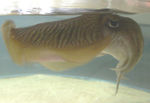
 In 1887, Grand Rabbi Gershon Henoch Leiner, the Radziner Rebbe
, researched the subject and concluded that the Sepia officinalis (common cuttlefish
) met many of the criteria. Within a year, Radziner chassidim began wearing tzitzit dyed with a colorant produced from this cephalopod
. The Breslov
Hasidim also adopted this custom due to Rebbi Nachman of Breslov
's pronouncement on the great importance of wearing tekhelet blue.
Rabbi Yitzhak HaLevi Herzog
(1889–1959) obtained a sample of this dye and had it chemically analyzed. The chemists concluded that it was a well-known synthetic dye "Prussian blue
" whose color is produced from iron
filings, with the cuttlefish merely supplying nitrogen which could have as easily been supplied from a vast array of organic sources (e.g., ox blood). Rav Herzog thus rejected the cuttlefish as the chilazon and some suggest that had the Grand Rabbi Gershon Henoch Leiner known this fact, he too would have rejected it based on his explicit criterion that the blue color must come from the animal and that all other additives are permitted solely to aid the color in adhering to the wool.
as a not improbable identification”. Although blue dye has indeed been obtained from the Murex trunculus snail, in 2002 Dr. S. W. Kaplan of Rehovot
, Israel proclaimed that he was able to dye wool with the extract of Janthina
. This claim has to date not been substantiated.
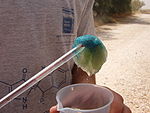 The Murex trunculus, a sea snail (also known as the Hexaplex trunculus
), is popularly advanced as the source of the coveted dye. Rabbi Herzog (mentioned above) wrote his doctoral thesis in 1913 on the subject and named the Murex snail as the most likely candidate for the dye's source. Though the Murex fulfilled many of the Talmudic criteria, Rabbi Herzog's inability to consistently obtain blue dye (sometimes the dye was purple) from the snail precluded him from proclaiming that the dye source had been found. In the 1980s, Otto Elsner, a chemist from the Shenkar College of Fibers in Israel discovered that if a solution of the dye was exposed to sunlight, blue instead of purple was consistently produced. In 1988 Rabbi Eliyahu Tavger dyed tekhelet from Murex trunculus for the mitzvah (commandment) of tzitzit for the first time in over 1300 Years. Based on his groundbreaking work, four years later, the Ptil Tekhelet Organization was founded to educate about the lost making of tekhelet blue and to make authentic tekhelet blue available for all who desire to perform the mitzvah.
Biological scientists Dr Kirsten Benkendorff and Dr Catherine Abbott, investigating the anti-cancer potential of the local species of sea snail Dicathais orbita or Australian dogwhelks found the bioactive compounds involved in the production of a purple dye which have many possible medicinal uses, including a novel anti-cancer agent that proved effective in curing breast cancer
. They announced in October 2008 that the research into Murex purpurea will also be conducted which has an active ingredient sourced from the same family of mollusc as the Australian Dogwhelk.
Hebrew Bible
The Hebrew Bible is a term used by biblical scholars outside of Judaism to refer to the Tanakh , a canonical collection of Jewish texts, and the common textual antecedent of the several canonical editions of the Christian Old Testament...
(Tanakh
Tanakh
The Tanakh is a name used in Judaism for the canon of the Hebrew Bible. The Tanakh is also known as the Masoretic Text or the Miqra. The name is an acronym formed from the initial Hebrew letters of the Masoretic Text's three traditional subdivisions: The Torah , Nevi'im and Ketuvim —hence...
) and translated by the Septuagint as hyakinthinos . Its uses include the clothing of the High Priest, the tapestries in the Tabernacle
Tabernacle
The Tabernacle , according to the Hebrew Torah/Old Testament, was the portable dwelling place for the divine presence from the time of the Exodus from Egypt through the conquering of the land of Canaan. Built to specifications revealed by God to Moses at Mount Sinai, it accompanied the Israelites...
, and the tassels (Hebrew tzitzit
Tzitzit
The Hebrew noun tzitzit is the name for specially knotted ritual fringes worn by observant Jews. Tzitzit are attached to the four corners of the tallit and tallit katan.-Etymology:The word may derive from the semitic root N-TZ-H...
) to be affixed to the corners of one's garments. Following the destruction of the Temple in Jerusalem
Temple in Jerusalem
The Temple in Jerusalem or Holy Temple , refers to one of a series of structures which were historically located on the Temple Mount in the Old City of Jerusalem, the current site of the Dome of the Rock. Historically, these successive temples stood at this location and functioned as the centre of...
by the Romans, the sole use of the blue dyed strings was in the tzitzit. Tzitzit are tassels composed of 4 strings for which Rabbinic Judaism
Rabbinic Judaism
Rabbinic Judaism or Rabbinism has been the mainstream form of Judaism since the 6th century CE, after the codification of the Talmud...
offers three opinions as to how many are to be blue: 2 strings; 1 string; 1 half string.
Hebrew Bible
Of the 50 uses in the Masoretic TextMasoretic Text
The Masoretic Text is the authoritative Hebrew text of the Jewish Bible and is regarded as Judaism's official version of the Tanakh. While the Masoretic Text defines the books of the Jewish canon, it also defines the precise letter-text of these biblical books, with their vocalization and...
, 44 refer to the priesthood or temple. The remaining 6 in Esther, Jeremiah and Ezekiel are secular uses; such as when Mordechai puts on "blue and white" "royal clothing" in Esther. The colour could be used in combination with other colours such as 2 Chronicles 3:14 where veil of Solomon's Temple
Solomon's Temple
Solomon's Temple, also known as the First Temple, was the main temple in ancient Jerusalem, on the Temple Mount , before its destruction by Nebuchadnezzar II after the Siege of Jerusalem of 587 BCE....
is made of blue (tekhelet), purple (Hebrew argaman אַרְגָּמָן) and crimson (Hebrew karmiyl כַּרְמִיל). Various shellfish have been suggested for the source of the dye. Ezekiel 27:7 may indicate the source of the shellfish to have been the Aegean region.
Talmudic source
The TalmudTalmud
The Talmud is a central text of mainstream Judaism. It takes the form of a record of rabbinic discussions pertaining to Jewish law, ethics, philosophy, customs and history....
teaches that the source for the blue dye is a marine creature known as the khillazon , translated as "snail" in Modern Hebrew. The Talmud also mentions a counterfeit dye from a plant called Kela-Ilan, known as Indigofera tinctoria
Indigofera tinctoria
Indigofera tinctoria bears the common name True indigo. The plant was one of the original sources of indigo dye. It has been naturalized to tropical and temperate Asia, as well as parts of Africa, but its native habitat is unknown since it has been in cultivation worldwide for many centuries. Today...
, the ubiquitous source of blue dye in the ancient world. The Talmud explains that it is absolutely forbidden to use this counterfeit dye intentionally (i.e., if one was duped, the strings are still kosher, however they simply do not fulfill the religious requirement for tekhelet strings). The Tosefta
Tosefta
The Tosefta is a compilation of the Jewish oral law from the period of the Mishnah.-Overview:...
explains that Kela Ilan is not the only invalid dye source, but in fact everything but the hillazon is unacceptable for making the blue dye.
Description of the shellfish khillazon in the Talmud
In the TalmudTalmud
The Talmud is a central text of mainstream Judaism. It takes the form of a record of rabbinic discussions pertaining to Jewish law, ethics, philosophy, customs and history....
, Tractate Menachot
Kodashim
Kodashim or Qodhashim is the fifth Order in the Mishna . Of the six Orders of the Mishna, it is the third longest...
44a, the khillazon is described as follows:
- Its body is similar to the sea.
- Its form is like a fish.
- It comes up once in 70 years,
- With its "blood" one dyes tekhelet,
- Therefore: It is expensive.
Other criteria (with Talmudic references):
- The fishers of the khillazon are from HaifaHaifaHaifa is the largest city in northern Israel, and the third-largest city in the country, with a population of over 268,000. Another 300,000 people live in towns directly adjacent to the city including the cities of the Krayot, as well as, Tirat Carmel, Daliyat al-Karmel and Nesher...
to the ladder of Tyre (Shabbat 26a) - The color of the khillazon dye is identical to that produced from the dye of the kela ilan plant (Indigofera tinctoriaIndigofera tinctoriaIndigofera tinctoria bears the common name True indigo. The plant was one of the original sources of indigo dye. It has been naturalized to tropical and temperate Asia, as well as parts of Africa, but its native habitat is unknown since it has been in cultivation worldwide for many centuries. Today...
), which served as a counterfeit source of the dye (Baba Metzia 61b) - Cracking open the shell of the khillazon on ShabbatShabbatShabbat is the seventh day of the Jewish week and a day of rest in Judaism. Shabbat is observed from a few minutes before sunset on Friday evening until a few minutes after when one would expect to be able to see three stars in the sky on Saturday night. The exact times, therefore, differ from...
violates the laws of ShabbatShabbatShabbat is the seventh day of the Jewish week and a day of rest in Judaism. Shabbat is observed from a few minutes before sunset on Friday evening until a few minutes after when one would expect to be able to see three stars in the sky on Saturday night. The exact times, therefore, differ from...
(Shabbat 75a) - The shell of the khillazon grows together with it (MidrashMidrashThe Hebrew term Midrash is a homiletic method of biblical exegesis. The term also refers to the whole compilation of homiletic teachings on the Bible....
Song of Songs Rabbah 4:11) - It is an invertebrateInvertebrateAn invertebrate is an animal without a backbone. The group includes 97% of all animal species – all animals except those in the chordate subphylum Vertebrata .Invertebrates form a paraphyletic group...
(Jerusalem TalmudJerusalem TalmudThe Jerusalem Talmud, talmud meaning "instruction", "learning", , is a collection of Rabbinic notes on the 2nd-century Mishnah which was compiled in the Land of Israel during the 4th-5th century. The voluminous text is also known as the Palestinian Talmud or Talmud de-Eretz Yisrael...
Sabbath 1:38a)
Lost knowledge
At some point following the Roman exile of the Jews from the land of Israel, the actual identity of the source of the dye was lost and as a result the Jews have worn only plain white tassles.The stripes on prayer shawls
Tallit
A tallit pl. tallitot is a Jewish prayer shawl. The tallit is worn over the outer clothes during the morning prayers on weekdays, Shabbat and holidays...
, often black, but also blue or purple, are believed to symbolize the lost tekhelet which is referred to by various sources as being "black as midnight", "blue as the midday sky", and even purple. These stripes of tekhelet inspired the design of the flag of Israel
Flag of Israel
The flag of Israel was adopted on October 28, 1948, five months after the country's establishment. It depicts a blue Star of David on a white background, between two horizontal blue stripes...
.
Rediscovery
Over the last two centuries, attempts have been made to identify the ancient source of the dye by comparing Talmudic sources to physical evidence. Three types of mollusks have been proposed as the lost khillazon. None have been universally accepted, though the MurexMurex
Murex is a genus of medium to large sized predatory tropical sea snails. These are carnivorous marine gastropod molluscs in the family Muricidae, commonly calle "murexes" or "rock snails"...
, Murex trunculus, known by the modern name Hexaplex trunculus
Hexaplex trunculus
Hexaplex trunculus is a medium-sized species of sea snail, a marine gastropod mollusk in the family Muricidae, the murex shells or rock snails....
is thought to be the most likely source of the biblical blue dye. Most Rabbinical Jews continue to wear only white tzitziyot, following their poskim (deciders of Jewish law).
Sepia officinalis
Rebbe
Rebbe , which means master, teacher, or mentor, is a Yiddish word derived from the Hebrew word Rabbi. It often refers to the leader of a Hasidic Jewish movement...
, researched the subject and concluded that the Sepia officinalis (common cuttlefish
Cuttlefish
Cuttlefish are marine animals of the order Sepiida. They belong to the class Cephalopoda . Despite their name, cuttlefish are not fish but molluscs....
) met many of the criteria. Within a year, Radziner chassidim began wearing tzitzit dyed with a colorant produced from this cephalopod
Cephalopod
A cephalopod is any member of the molluscan class Cephalopoda . These exclusively marine animals are characterized by bilateral body symmetry, a prominent head, and a set of arms or tentacles modified from the primitive molluscan foot...
. The Breslov
Breslov (Hasidic dynasty)
Breslov is a branch of Hasidic Judaism founded by Rebbe Nachman of Breslov a great-grandson of the Baal Shem Tov, founder of Hasidism...
Hasidim also adopted this custom due to Rebbi Nachman of Breslov
Nachman of Breslov
Nachman of Breslov , also known as Reb Nachman of Bratslav, Reb Nachman Breslover , Nachman from Uman , was the founder of the Breslov Hasidic movement....
's pronouncement on the great importance of wearing tekhelet blue.
Rabbi Yitzhak HaLevi Herzog
Yitzhak HaLevi Herzog
Rabbi Yitzhak HaLevi Herzog , also known as Isaac Herzog, was the first Chief Rabbi of Ireland, his term lasting from 1921 to 1936...
(1889–1959) obtained a sample of this dye and had it chemically analyzed. The chemists concluded that it was a well-known synthetic dye "Prussian blue
Prussian blue
Prussian blue is a dark blue pigment with the idealized formula Fe718. Another name for the color Prussian blue is Berlin blue or, in painting, Parisian blue. Turnbull's blue is the same substance but is made from different reagents....
" whose color is produced from iron
Iron
Iron is a chemical element with the symbol Fe and atomic number 26. It is a metal in the first transition series. It is the most common element forming the planet Earth as a whole, forming much of Earth's outer and inner core. It is the fourth most common element in the Earth's crust...
filings, with the cuttlefish merely supplying nitrogen which could have as easily been supplied from a vast array of organic sources (e.g., ox blood). Rav Herzog thus rejected the cuttlefish as the chilazon and some suggest that had the Grand Rabbi Gershon Henoch Leiner known this fact, he too would have rejected it based on his explicit criterion that the blue color must come from the animal and that all other additives are permitted solely to aid the color in adhering to the wool.
Janthina
Within his doctoral research on the subject tekhelet, Rav Herzog placed great hopes on demonstrating that the Murex trunculus was the genuine snail khillazon. However, having failed to consistently achieve blue dye from the Murex trunculus, he wrote: “If for the present all hope is to be abandoned of rediscovering the hillazon shel tekhelet in some species of the genera Murex and Purpura we could do worse than suggest the JanthinaJanthina
Janthina is a genus of small to medium-sized pelagic or planktonic sea snails, marine gastropod molluscs in the family Janthinidae, commonly known as the "purple snails" or the "violet shells". -Description:...
as a not improbable identification”. Although blue dye has indeed been obtained from the Murex trunculus snail, in 2002 Dr. S. W. Kaplan of Rehovot
Rehovot
Rehovot is a city in the Center District of Israel, about south of Tel Aviv. According to the Israel Central Bureau of Statistics , at the end of 2009 the city had a total population of 112,700. Rehovot's official website estimates the population at 114,000.Rehovot was built on the site of Doron,...
, Israel proclaimed that he was able to dye wool with the extract of Janthina
Janthina
Janthina is a genus of small to medium-sized pelagic or planktonic sea snails, marine gastropod molluscs in the family Janthinidae, commonly known as the "purple snails" or the "violet shells". -Description:...
. This claim has to date not been substantiated.
Murex trunculus
Hexaplex trunculus
Hexaplex trunculus is a medium-sized species of sea snail, a marine gastropod mollusk in the family Muricidae, the murex shells or rock snails....
), is popularly advanced as the source of the coveted dye. Rabbi Herzog (mentioned above) wrote his doctoral thesis in 1913 on the subject and named the Murex snail as the most likely candidate for the dye's source. Though the Murex fulfilled many of the Talmudic criteria, Rabbi Herzog's inability to consistently obtain blue dye (sometimes the dye was purple) from the snail precluded him from proclaiming that the dye source had been found. In the 1980s, Otto Elsner, a chemist from the Shenkar College of Fibers in Israel discovered that if a solution of the dye was exposed to sunlight, blue instead of purple was consistently produced. In 1988 Rabbi Eliyahu Tavger dyed tekhelet from Murex trunculus for the mitzvah (commandment) of tzitzit for the first time in over 1300 Years. Based on his groundbreaking work, four years later, the Ptil Tekhelet Organization was founded to educate about the lost making of tekhelet blue and to make authentic tekhelet blue available for all who desire to perform the mitzvah.
Other applications
The Australian Flinders UniversityFlinders University
Flinders University, , is a public university in Adelaide, South Australia. Founded in 1966, it was named in honour of navigator Matthew Flinders, who explored and surveyed the South Australian coastline in the early 19th century.The university has established a reputation as a leading research...
Biological scientists Dr Kirsten Benkendorff and Dr Catherine Abbott, investigating the anti-cancer potential of the local species of sea snail Dicathais orbita or Australian dogwhelks found the bioactive compounds involved in the production of a purple dye which have many possible medicinal uses, including a novel anti-cancer agent that proved effective in curing breast cancer
Breast cancer
Breast cancer is cancer originating from breast tissue, most commonly from the inner lining of milk ducts or the lobules that supply the ducts with milk. Cancers originating from ducts are known as ductal carcinomas; those originating from lobules are known as lobular carcinomas...
. They announced in October 2008 that the research into Murex purpurea will also be conducted which has an active ingredient sourced from the same family of mollusc as the Australian Dogwhelk.
External links
- http://www.tekhelet.com
- http://www.tchelet-net.022.co.il
- http://www.nytimes.com/2011/02/28/world/middleeast/28blue.html