


John Hampden

Encyclopedia
John Hampden was an English
politician, the eldest son of William Hampden, of Hampden House
, Great Hampden
in Buckinghamshire
, (b. 1570), son of Griffith Hampden and Anne Cavea and descendant of a very ancient family of that county, said to have been established there before the Norman conquest, and of Elizabeth, second daughter of Sir Henry Cromwell, and aunt of Oliver Cromwell
. The towns of Hampden, Maryland, Hamden, Connecticut
and Hampden, Maine, as well as the county of Hampden
, Massachusetts
are named in his honour. Hampden-Sydney College
in Virginia
is also named in honour of John Hampden and of Algernon Sydney
, another English patriot.
. He was educated at Lord Williams's School
at Thame
, and on 30 March 1610 became a commoner
of Magdalen College, Oxford
. In 1613 he was admitted as a student of the Inner Temple
.
for the borough of Grampound
, Cornwall
in 1621. Later, he represented Wendover
in the first three parliaments of Charles I
. In April 1640 he was elected MP for Buckinghamshire
in the Short Parliament
and was re-elected MP for Buckinghamshire for the Long Parliament
in November 1640. He sat until his death in 1643.
In the early days of his parliamentary career, he was content to be overshadowed by John Eliot
, as in its later days he was content to be overshadowed by John Pym
and to be commanded by Essex
.
. It is Hampden whose statue rather than that of Eliot or Pym that was selected by the Victorians as a symbol to take its place at the entrance to the Central Lobby in Palace of Westminster
as the noblest type of the parliamentary opposition, sword at his side, ready to defend Parliament's rights and privileges by any means necessary. His statue stands opposite Earl of Clarendon
in his Lord Chancellor's
robes, a symbol of the respect for the law and royalism
.
. But it is hardly possible that even resistance to ship money would have so distinguished him but for the mingled massiveness and modesty of his character, his dislike of all pretences in himself or others, his brave contempt of danger, and his charitable readiness to shield others as far as possible from the evil consequences of their actions. Nor was he wanting in that skill which enabled him to influence men towards the ends at which he aimed, and which was spoken of as subtlety by those who disliked his ends.
work, for which he seems to have had a special aptitude. In 1626 he took an active part in the preparation of the charges against Buckingham
. In January 1627 he was bound over to answer at the council board for his refusal to pay the forced loan. Later in the year he was committed to the gatehouse, and then sent into confinement in Hampshire
, from which he was liberated just before the meeting of the third parliament of the reign, in which he once more rendered useful but unobtrusive assistance to his leaders.
When the breach came in 1629 Hampden was found corresponding with the imprisoned Eliot, discussing with him the prospects of the Massachusetts Bay Colony
. Hampden was one of the persons to whom the Earl of Warwick
granted land in Connecticut
in what was then referred to as the Saybrook Colony
and today as Old Saybrook, Connecticut
. While some claim there is no foundation but anecdote that Hampen attempted emigration to the colonies with Cromwell, others assert that Oliver Cromwell
and other future architects of the English Civil War, including Hampden, may have been close to moving to America in the 1630's. The author Kevin Phillips
points out that, "Even in the 1770's, residents of Old Saybrook still talked about which prominent Parliamentarian
was to have had which town lot."
It was not until 1637, however, that his resistance to the payment of ship money gained him wide fame. Seven out of the twelve judges sided against him, but the connection between the rights of property and the parliamentary system became firmly established in the popular mind. The tax had been justified, says Clarendon
, who expresses his admiration at Hampden's "rare temper and modesty" at this crisis, "upon such grounds and reasons as every standerby was able to swear was not law" (Hist. i. 150, vii. 82).
that started on 13th April of 1640, Hampden stood forth amongst the leaders. He guided the House in the debate on 4 May in its opposition to the grant of twelve subsidies in return for the surrender of ship money. Parliament was dissolved the next day, and on the 6th of May an unsuccessful search was made among the papers of Hampden and of other chiefs of the party to discover incriminating correspondence with the Scots
. During the eventful months which followed, when Strafford was striving in vain to force England, in spite of its visible reluctance, to support the king in his Scottish war
, rumour has much to tell of Hampden's activity in rousing opposition. It is likely enough that the rumour is in the main true, but we are not possessed of any satisfactory evidence on the subject.
, though Hampden was by no means a frequent speaker, it is possible to trace his course with sufficient distinctness. His power consisted in his personal influence, and as a debater rather than as an orator. "He was not a man of many words," says Clarendon, "and rarely began the discourse or made the first entrance upon any business that was assumed, but a very weighty speaker, and after he had heard a full debate and observed how the House was likely to be inclined, took up the argument and shortly and clearly and craftily so stated it that he commonly conducted it to the conclusion he desired; and if he found he could not do that, he never was without the dexterity to divert the debate to another time, and to prevent the determining anything in the negative which might prove inconvenient in the future" (Hist. iii. 31). Unwearied in attendance upon committees, he was in all things ready to second Pym, whom he plainly regarded as his leader.
Hampden was one of the eight managers of Strafford's prosecution. Like Pym, he was in favour of the more legal and regular procedure by impeachment
rather than by attainder
, which at the later stage was supported by the majority of the Commons; and through his influence a compromise was effected by which, while an attainder was subsequently adopted, Strafford's counsel were heard as in the case of an impeachment, and thus a serious breach between the two Houses, which threatened to cause the breakdown of the whole proceedings, was averted.
unaltered, whilst the majority were at least willing to consider the question of abolishing the one and modifying the other. On this subject the parties which ultimately divided the House and the country itself were fully formed as early as 8 February 1641. It is enough to say that Hampden fully shared in the counsels of the opponents of episcopacy. It is not that he was a theoretical Presbyterian
, but the bishop
s had been in his days so fully engaged in the imposition of ceremonies regarded by the Puritans as verging on Papacy that it was difficult, if not impossible, to dissociate them from the cause in which they were embarked. Closely connected with Hampden's distrust of the bishops was his distrust of monarchy as it then existed. The dispute about the church therefore soon attained the form of an attack upon monarchy
, and, when the majority of the House of Lords
arrayed itself on the side of episcopacy and the Prayer Book, of an attack upon the House of Lords as well.
 No serious importance therefore can be attached to the offers of advancement made from time to time to Hampden and his friends. Charles would gladly have given them office if they had been ready to desert their principles. Every day Hampden's conviction grew stronger that Charles would never surrender a position which he had taken up. In August 1641 Hampden was one of the four commissioners who attended Charles in Scotland, and the king's conduct there, connected with such events as the "Incident", must have proved to a man far less sagacious than Hampden that the time for compromise had gone by. He was therefore a warm supporter of the Grand Remonstrance
, and was marked out as one of the five impeached members (the others being Pym
, Arthur Haselrig
, Denzil Holles and William Strode
) whose attempted arrest brought at last the opposing parties into open collision. In the angry scene which arose on the proposal to print the Grand Remonstrance, it was Hampden's personal intervention which prevented an actual conflict, and it was after the impeachment had been attempted that Hampden laid down the two conditions under which resistance to the king became the duty of a good subject. Those conditions were:
There can be no doubt that Hampden fully believed that both those conditions were fulfilled at the opening of 1642.
began, Hampden was appointed a member of the committee for safety, levied a regiment
of Buckinghamshire
men for the parliamentary cause, and in his capacity of deputy-lieutenant carried out the parliamentary Militia Ordinance
in the county. In the earlier operations of the war he bore himself gallantly and well. He took no actual part in the Battle of Edgehill
(23 October 1642). His troops in the rear, however, arrested Prince Rupert of the Rhine
's charge at Kineton
, and he urged Essex to renew the attack here, and also after the disaster at Brentford
. In 1643 he was present at the siege and capture of Reading
.
. In the military struggle which followed he saw, as Cromwell saw afterwards, that the one thing necessary was to beat the enemy. He protested at once against Essex's hesitations and compromises. In the formation of the confederacy of the six associated counties, which was to supply a basis for Cromwell's operations, he took an active part. His influence was felt alike in parliament and in the field. But he was not in supreme command, and he had none of that impatience which often leads able men to fail in the execution of orders of which they disapprove.
against superior numbers of Prince Rupert's forces until reinforcements arrived, he was mortally wounded in the shoulder (some sources claim by two carbine balls, others by shrapnel from his own pistol exploding). Leaving the field he reached Thame, survived six days, and died on 24 June.
By his first wife he had nine children (three sons and six daughters) one of whom, Richard
(1631–1695) was chancellor of the exchequer
in William III
's reign; from two of his daughters are descended the families of Trevor Hampden and Hobart-Hampden, the descent in the male line becoming apparently extinct in 1754 in the person of John Hampden
.
They lived at Hartwell House, Buckinghamshire, now a National Trust property.
he died in 2000
, the home ground of Queen's Park F.C.
and the Scotland national football team
, is indirectly named after John Hampden.
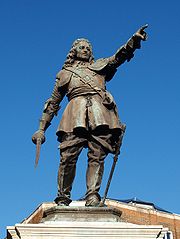
He now has two schools in Buckinghamshire, one in Hertfordshire and one primary school in Thame named after him, as well as an older persons' mental health unit based at Stoke Mandeville Hospital. There is also a statue of him in Aylesbury
town centre (illustrated above) pointing to his home in Great Hampden
. Aylesbury Vale District Council use an image of the statue as their logo.
Hampden, a community in Baltimore
City, Maryland
, is also named after him, and Hampden-Sydney College
in Virginia
is named after him and Algernon Sydney
.
England
England is a country that is part of the United Kingdom. It shares land borders with Scotland to the north and Wales to the west; the Irish Sea is to the north west, the Celtic Sea to the south west, with the North Sea to the east and the English Channel to the south separating it from continental...
politician, the eldest son of William Hampden, of Hampden House
Hampden House
Hampden House is a country house in the village of Great Hampden, between Great Missenden and Princes Risborough in Buckinghamshire. It is named after the Hampden family. The Hampdens are recorded as owning the site from before the Norman conquest...
, Great Hampden
Great Hampden
Great and Little Hampden is a civil parish in Buckinghamshire, England, about three miles south-east of Princes Risborough. It incorporates the villages of Great Hampden and Little Hampden, and the hamlets of Green Hailey and Hampden Row...
in Buckinghamshire
Buckinghamshire
Buckinghamshire is a ceremonial and non-metropolitan home county in South East England. The county town is Aylesbury, the largest town in the ceremonial county is Milton Keynes and largest town in the non-metropolitan county is High Wycombe....
, (b. 1570), son of Griffith Hampden and Anne Cavea and descendant of a very ancient family of that county, said to have been established there before the Norman conquest, and of Elizabeth, second daughter of Sir Henry Cromwell, and aunt of Oliver Cromwell
Oliver Cromwell
Oliver Cromwell was an English military and political leader who overthrew the English monarchy and temporarily turned England into a republican Commonwealth, and served as Lord Protector of England, Scotland, and Ireland....
. The towns of Hampden, Maryland, Hamden, Connecticut
Hamden, Connecticut
Hamden is a town in New Haven County, Connecticut, United States. The town's nickname is "The Land of the Sleeping Giant." Hamden is home to Quinnipiac University. The population was 58,180 according to the Census Bureau's 2005 estimates...
and Hampden, Maine, as well as the county of Hampden
Hampden County, Massachusetts
-Demographics:As of the census of 2004, there were 461,228 people, 175,288 households, and 115,690 families residing in the county. The population density was 738 people per square mile . There were 185,876 housing units at an average density of 301 per square mile...
, Massachusetts
Massachusetts
The Commonwealth of Massachusetts is a state in the New England region of the northeastern United States of America. It is bordered by Rhode Island and Connecticut to the south, New York to the west, and Vermont and New Hampshire to the north; at its east lies the Atlantic Ocean. As of the 2010...
are named in his honour. Hampden-Sydney College
Hampden-Sydney College
Hampden–Sydney College is a liberal arts college for men located in Hampden Sydney, Virginia, United States. Founded in 1775, Hampden–Sydney is the oldest private charter college in the Southern U.S., the last college founded before the American Revolution, and one of only three four-year,...
in Virginia
Virginia
The Commonwealth of Virginia , is a U.S. state on the Atlantic Coast of the Southern United States. Virginia is nicknamed the "Old Dominion" and sometimes the "Mother of Presidents" after the eight U.S. presidents born there...
is also named in honour of John Hampden and of Algernon Sydney
Algernon Sydney
Algernon Sidney or Sydney was an English politician, republican political theorist, colonel, and opponent of King Charles II of England, who became involved in a plot against the King and was executed for treason.-Early life:Sidney's father was Robert Sidney, 2nd Earl of Leicester, a direct...
, another English patriot.
Early life
By his father's death, when he was still a child, he became the owner of a large estate and a ward of the crownThe Crown
The Crown is a corporation sole that in the Commonwealth realms and any provincial or state sub-divisions thereof represents the legal embodiment of governance, whether executive, legislative, or judicial...
. He was educated at Lord Williams's School
Lord Williams's School
Lord Williams's School is a co-educational secondary school in Thame, Oxfordshire, United Kingdom. It is a comprehensive school, which takes children from the age of 11 through to the age of 18...
at Thame
Thame
Thame is a town and civil parish in Oxfordshire, about southwest of the Buckinghamshire town of Aylesbury. It derives its toponym from the River Thame which flows past the north side of the town....
, and on 30 March 1610 became a commoner
Commoner
In British law, a commoner is someone who is neither the Sovereign nor a peer. Therefore, any member of the Royal Family who is not a peer, such as Prince Harry of Wales or Anne, Princess Royal, is a commoner, as is any member of a peer's family, including someone who holds only a courtesy title,...
of Magdalen College, Oxford
Magdalen College, Oxford
Magdalen College is one of the constituent colleges of the University of Oxford in England. As of 2006 the college had an estimated financial endowment of £153 million. Magdalen is currently top of the Norrington Table after over half of its 2010 finalists received first-class degrees, a record...
. In 1613 he was admitted as a student of the Inner Temple
Inner Temple
The Honourable Society of the Inner Temple, commonly known as Inner Temple, is one of the four Inns of Court in London. To be called to the Bar and practise as a barrister in England and Wales, an individual must belong to one of these Inns...
.
English Parliament
Hampden first sat in ParliamentParliament of England
The Parliament of England was the legislature of the Kingdom of England. In 1066, William of Normandy introduced a feudal system, by which he sought the advice of a council of tenants-in-chief and ecclesiastics before making laws...
for the borough of Grampound
Grampound (UK Parliament constituency)
Grampound in Cornwall, was a borough constituency of the House of Commons of the Parliament of England, then of the Parliament of Great Britain from 1707 to 1800 and of the Parliament of the United Kingdom from 1801 to 1821. It was represented by two Members of Parliament.-History:Grampound's...
, Cornwall
Cornwall
Cornwall is a unitary authority and ceremonial county of England, within the United Kingdom. It is bordered to the north and west by the Celtic Sea, to the south by the English Channel, and to the east by the county of Devon, over the River Tamar. Cornwall has a population of , and covers an area of...
in 1621. Later, he represented Wendover
Wendover (UK Parliament constituency)
Wendover was a borough constituency of the House of Commons of the Parliament of England then of the Parliament of Great Britain from 1707 to 1800 and of the Parliament of the United Kingdom from 1801 to 1832...
in the first three parliaments of Charles I
Charles I of England
Charles I was King of England, King of Scotland, and King of Ireland from 27 March 1625 until his execution in 1649. Charles engaged in a struggle for power with the Parliament of England, attempting to obtain royal revenue whilst Parliament sought to curb his Royal prerogative which Charles...
. In April 1640 he was elected MP for Buckinghamshire
Buckinghamshire (UK Parliament constituency)
Buckinghamshire is a former United Kingdom Parliamentary constituency. It was a constituency of the House of Commons of the Parliament of England then of the Parliament of Great Britain from 1707 to 1800 and of the Parliament of the United Kingdom from 1801 to 1885.Its most prominent member was...
in the Short Parliament
Short Parliament
The Short Parliament was a Parliament of England that sat from 13 April to 5 May 1640 during the reign of King Charles I of England, so called because it lasted only three weeks....
and was re-elected MP for Buckinghamshire for the Long Parliament
Long Parliament
The Long Parliament was made on 3 November 1640, following the Bishops' Wars. It received its name from the fact that through an Act of Parliament, it could only be dissolved with the agreement of the members, and those members did not agree to its dissolution until after the English Civil War and...
in November 1640. He sat until his death in 1643.
In the early days of his parliamentary career, he was content to be overshadowed by John Eliot
John Eliot (statesman)
Sir John Eliot was an English statesman who was serially imprisoned in the Tower of London, where he eventually died, by King Charles I for advocating the rights and privileges of Parliament.-Family and early life:...
, as in its later days he was content to be overshadowed by John Pym
John Pym
John Pym was an English parliamentarian, leader of the Long Parliament and a prominent critic of James I and then Charles I.- Early life and education :...
and to be commanded by Essex
Robert Devereux, 3rd Earl of Essex
Robert Devereux, 3rd Earl of Essex was an English Parliamentarian and soldier during the first half of the seventeenth century. With the start of the English Civil War in 1642 he became the first Captain-General and Chief Commander of the Parliamentarian army, also known as the Roundheads...
.
English Revolution
Yet for many it is Hampden, and not Eliot or Pym, who is seen as the central figure at the start of the English RevolutionEnglish Revolution
"English Revolution" has been used to describe two different events in English history. The first to be so called—by Whig historians—was the Glorious Revolution of 1688, whereby James II was replaced by William III and Mary II as monarch and a constitutional monarchy was established.In the...
. It is Hampden whose statue rather than that of Eliot or Pym that was selected by the Victorians as a symbol to take its place at the entrance to the Central Lobby in Palace of Westminster
Palace of Westminster
The Palace of Westminster, also known as the Houses of Parliament or Westminster Palace, is the meeting place of the two houses of the Parliament of the United Kingdom—the House of Lords and the House of Commons...
as the noblest type of the parliamentary opposition, sword at his side, ready to defend Parliament's rights and privileges by any means necessary. His statue stands opposite Earl of Clarendon
Edward Hyde, 1st Earl of Clarendon
Edward Hyde, 1st Earl of Clarendon was an English historian and statesman, and grandfather of two English monarchs, Mary II and Queen Anne.-Early life:...
in his Lord Chancellor's
Lord Chancellor
The Lord High Chancellor of Great Britain, or Lord Chancellor, is a senior and important functionary in the government of the United Kingdom. He is the second highest ranking of the Great Officers of State, ranking only after the Lord High Steward. The Lord Chancellor is appointed by the Sovereign...
robes, a symbol of the respect for the law and royalism
Cavalier
Cavalier was the name used by Parliamentarians for a Royalist supporter of King Charles I and son Charles II during the English Civil War, the Interregnum, and the Restoration...
.
Views on Ship Money
Something of Hampden's fame no doubt is owing to the position which he took up as the opponent of ship moneyShip money
Ship money refers to a tax that Charles I of England tried to levy without the consent of Parliament. This tax, which was only applied to coastal towns during a time of war, was intended to offset the cost of defending that part of the coast, and could be paid in actual ships or the equivalent value...
. But it is hardly possible that even resistance to ship money would have so distinguished him but for the mingled massiveness and modesty of his character, his dislike of all pretences in himself or others, his brave contempt of danger, and his charitable readiness to shield others as far as possible from the evil consequences of their actions. Nor was he wanting in that skill which enabled him to influence men towards the ends at which he aimed, and which was spoken of as subtlety by those who disliked his ends.
Committee Work
During these first parliaments Hampden did not, so far as we know, speak in public debate, but he was increasingly employed in committeeCommittee
A committee is a type of small deliberative assembly that is usually intended to remain subordinate to another, larger deliberative assembly—which when organized so that action on committee requires a vote by all its entitled members, is called the "Committee of the Whole"...
work, for which he seems to have had a special aptitude. In 1626 he took an active part in the preparation of the charges against Buckingham
George Villiers, 1st Duke of Buckingham
George Villiers, 1st Duke of Buckingham KG was the favourite, claimed by some to be the lover, of King James I of England. Despite a very patchy political and military record, he remained at the height of royal favour for the first two years of the reign of Charles I, until he was assassinated...
. In January 1627 he was bound over to answer at the council board for his refusal to pay the forced loan. Later in the year he was committed to the gatehouse, and then sent into confinement in Hampshire
Hampshire
Hampshire is a county on the southern coast of England in the United Kingdom. The county town of Hampshire is Winchester, a historic cathedral city that was once the capital of England. Hampshire is notable for housing the original birthplaces of the Royal Navy, British Army, and Royal Air Force...
, from which he was liberated just before the meeting of the third parliament of the reign, in which he once more rendered useful but unobtrusive assistance to his leaders.
When the breach came in 1629 Hampden was found corresponding with the imprisoned Eliot, discussing with him the prospects of the Massachusetts Bay Colony
Massachusetts Bay Colony
The Massachusetts Bay Colony was an English settlement on the east coast of North America in the 17th century, in New England, situated around the present-day cities of Salem and Boston. The territory administered by the colony included much of present-day central New England, including portions...
. Hampden was one of the persons to whom the Earl of Warwick
Robert Rich, 2nd Earl of Warwick
Robert Rich, 2nd Earl of Warwick was an English colonial administrator, admiral, and puritan.Rich was the eldest son of Robert Rich, 1st Earl of Warwick and his wife Penelope Devereux, Lady Rich, and succeeded to his father's title in 1619...
granted land in Connecticut
Connecticut
Connecticut is a state in the New England region of the northeastern United States. It is bordered by Rhode Island to the east, Massachusetts to the north, and the state of New York to the west and the south .Connecticut is named for the Connecticut River, the major U.S. river that approximately...
in what was then referred to as the Saybrook Colony
Saybrook Colony
The Saybrook Colony was established in late 1635 at the mouth of the Connecticut River in present day Old Saybrook, Connecticut by John Winthrop, the Younger, son of John Winthrop, the Governor of Massachusetts. The former was designated Governor by the original settlers which included Colonel...
and today as Old Saybrook, Connecticut
Old Saybrook, Connecticut
Old Saybrook is a town in Middlesex County, Connecticut, United States. The population was 10,367 at the 2000 census. It contains the incorporated borough of Fenwick, as well as the census-designated places of Old Saybrook Center and Saybrook Manor.-History:...
. While some claim there is no foundation but anecdote that Hampen attempted emigration to the colonies with Cromwell, others assert that Oliver Cromwell
Oliver Cromwell
Oliver Cromwell was an English military and political leader who overthrew the English monarchy and temporarily turned England into a republican Commonwealth, and served as Lord Protector of England, Scotland, and Ireland....
and other future architects of the English Civil War, including Hampden, may have been close to moving to America in the 1630's. The author Kevin Phillips
Kevin Phillips
Kevin Phillips may refer to:*Kevin Phillips , American political commentator and writer*Kevin Phillips , Blackpool and former England international football player*Kevin Phillips , American actor...
points out that, "Even in the 1770's, residents of Old Saybrook still talked about which prominent Parliamentarian
Member of Parliament
A Member of Parliament is a representative of the voters to a :parliament. In many countries with bicameral parliaments, the term applies specifically to members of the lower house, as upper houses often have a different title, such as senate, and thus also have different titles for its members,...
was to have had which town lot."
It was not until 1637, however, that his resistance to the payment of ship money gained him wide fame. Seven out of the twelve judges sided against him, but the connection between the rights of property and the parliamentary system became firmly established in the popular mind. The tax had been justified, says Clarendon
Edward Hyde, 1st Earl of Clarendon
Edward Hyde, 1st Earl of Clarendon was an English historian and statesman, and grandfather of two English monarchs, Mary II and Queen Anne.-Early life:...
, who expresses his admiration at Hampden's "rare temper and modesty" at this crisis, "upon such grounds and reasons as every standerby was able to swear was not law" (Hist. i. 150, vii. 82).
Short Parliament
In the Short ParliamentShort Parliament
The Short Parliament was a Parliament of England that sat from 13 April to 5 May 1640 during the reign of King Charles I of England, so called because it lasted only three weeks....
that started on 13th April of 1640, Hampden stood forth amongst the leaders. He guided the House in the debate on 4 May in its opposition to the grant of twelve subsidies in return for the surrender of ship money. Parliament was dissolved the next day, and on the 6th of May an unsuccessful search was made among the papers of Hampden and of other chiefs of the party to discover incriminating correspondence with the Scots
Scotland
Scotland is a country that is part of the United Kingdom. Occupying the northern third of the island of Great Britain, it shares a border with England to the south and is bounded by the North Sea to the east, the Atlantic Ocean to the north and west, and the North Channel and Irish Sea to the...
. During the eventful months which followed, when Strafford was striving in vain to force England, in spite of its visible reluctance, to support the king in his Scottish war
Bishops' Wars
The Bishops' Wars , were conflicts, both political and military, which occurred in 1639 and 1640 centred around the nature of the governance of the Church of Scotland, and the rights and powers of the Crown...
, rumour has much to tell of Hampden's activity in rousing opposition. It is likely enough that the rumour is in the main true, but we are not possessed of any satisfactory evidence on the subject.
Long Parliament
In the Long ParliamentLong Parliament
The Long Parliament was made on 3 November 1640, following the Bishops' Wars. It received its name from the fact that through an Act of Parliament, it could only be dissolved with the agreement of the members, and those members did not agree to its dissolution until after the English Civil War and...
, though Hampden was by no means a frequent speaker, it is possible to trace his course with sufficient distinctness. His power consisted in his personal influence, and as a debater rather than as an orator. "He was not a man of many words," says Clarendon, "and rarely began the discourse or made the first entrance upon any business that was assumed, but a very weighty speaker, and after he had heard a full debate and observed how the House was likely to be inclined, took up the argument and shortly and clearly and craftily so stated it that he commonly conducted it to the conclusion he desired; and if he found he could not do that, he never was without the dexterity to divert the debate to another time, and to prevent the determining anything in the negative which might prove inconvenient in the future" (Hist. iii. 31). Unwearied in attendance upon committees, he was in all things ready to second Pym, whom he plainly regarded as his leader.
Hampden was one of the eight managers of Strafford's prosecution. Like Pym, he was in favour of the more legal and regular procedure by impeachment
Impeachment
Impeachment is a formal process in which an official is accused of unlawful activity, the outcome of which, depending on the country, may include the removal of that official from office as well as other punishment....
rather than by attainder
Attainder
In English criminal law, attainder or attinctura is the metaphorical 'stain' or 'corruption of blood' which arises from being condemned for a serious capital crime . It entails losing not only one's property and hereditary titles, but typically also the right to pass them on to one's heirs...
, which at the later stage was supported by the majority of the Commons; and through his influence a compromise was effected by which, while an attainder was subsequently adopted, Strafford's counsel were heard as in the case of an impeachment, and thus a serious breach between the two Houses, which threatened to cause the breakdown of the whole proceedings, was averted.
Debate on Episcopacy
There was another point on which there was no agreement. A large minority wished to retain episcopacy, and to keep the Book of Common PrayerBook of Common Prayer
The Book of Common Prayer is the short title of a number of related prayer books used in the Anglican Communion, as well as by the Continuing Anglican, "Anglican realignment" and other Anglican churches. The original book, published in 1549 , in the reign of Edward VI, was a product of the English...
unaltered, whilst the majority were at least willing to consider the question of abolishing the one and modifying the other. On this subject the parties which ultimately divided the House and the country itself were fully formed as early as 8 February 1641. It is enough to say that Hampden fully shared in the counsels of the opponents of episcopacy. It is not that he was a theoretical Presbyterian
Presbyterianism
Presbyterianism refers to a number of Christian churches adhering to the Calvinist theological tradition within Protestantism, which are organized according to a characteristic Presbyterian polity. Presbyterian theology typically emphasizes the sovereignty of God, the authority of the Scriptures,...
, but the bishop
Bishop
A bishop is an ordained or consecrated member of the Christian clergy who is generally entrusted with a position of authority and oversight. Within the Catholic Church, Eastern Orthodox, Oriental Orthodox Churches, in the Assyrian Church of the East, in the Independent Catholic Churches, and in the...
s had been in his days so fully engaged in the imposition of ceremonies regarded by the Puritans as verging on Papacy that it was difficult, if not impossible, to dissociate them from the cause in which they were embarked. Closely connected with Hampden's distrust of the bishops was his distrust of monarchy as it then existed. The dispute about the church therefore soon attained the form of an attack upon monarchy
Monarchy
A monarchy is a form of government in which the office of head of state is usually held until death or abdication and is often hereditary and includes a royal house. In some cases, the monarch is elected...
, and, when the majority of the House of Lords
House of Lords
The House of Lords is the upper house of the Parliament of the United Kingdom. Like the House of Commons, it meets in the Palace of Westminster....
arrayed itself on the side of episcopacy and the Prayer Book, of an attack upon the House of Lords as well.
Grand Remonstrance
The Grand Remonstrance was a list of grievances presented to King Charles I of England by the English Parliament on 1 December 1641, but passed by the House of Commons on the 22nd of November 1641, during the Long Parliament; it was one of the chief events which were to precipitate the English...
, and was marked out as one of the five impeached members (the others being Pym
John Pym
John Pym was an English parliamentarian, leader of the Long Parliament and a prominent critic of James I and then Charles I.- Early life and education :...
, Arthur Haselrig
Arthur Haselrig
Sir Arthur Haselrig, 2nd Baronet was an English politician who sat in the House of Commons between 1640 and 1659. He was one of the five members of Parliament whom King Charles I tried to arrest in 1642, an event which led to the start of the English Civil War...
, Denzil Holles and William Strode
William Strode
William Strode was an English politician who sat in the House of Commons of England variously between 1624 and 1645. He was one of the five members impeached by King Charles and fought on the Parliamentarian side in the English Civil War.-Life:...
) whose attempted arrest brought at last the opposing parties into open collision. In the angry scene which arose on the proposal to print the Grand Remonstrance, it was Hampden's personal intervention which prevented an actual conflict, and it was after the impeachment had been attempted that Hampden laid down the two conditions under which resistance to the king became the duty of a good subject. Those conditions were:
- an attack upon religion and
- an attack upon the fundamental laws.
There can be no doubt that Hampden fully believed that both those conditions were fulfilled at the opening of 1642.
English Civil War
When the English Civil WarEnglish Civil War
The English Civil War was a series of armed conflicts and political machinations between Parliamentarians and Royalists...
began, Hampden was appointed a member of the committee for safety, levied a regiment
Regiment
A regiment is a major tactical military unit, composed of variable numbers of batteries, squadrons or battalions, commanded by a colonel or lieutenant colonel...
of Buckinghamshire
Buckinghamshire
Buckinghamshire is a ceremonial and non-metropolitan home county in South East England. The county town is Aylesbury, the largest town in the ceremonial county is Milton Keynes and largest town in the non-metropolitan county is High Wycombe....
men for the parliamentary cause, and in his capacity of deputy-lieutenant carried out the parliamentary Militia Ordinance
Militia Ordinance
The Militia Ordinance was a piece of legislation passed by the Long Parliament of England in March 1642, which was a major step towards the Civil War between the King and Parliament of England. Previously the King had the sole right to appoint the Lord Lieutenants, who were in charge of the county...
in the county. In the earlier operations of the war he bore himself gallantly and well. He took no actual part in the Battle of Edgehill
Battle of Edgehill
The Battle of Edgehill was the first pitched battle of the First English Civil War. It was fought near Edge Hill and Kineton in southern Warwickshire on Sunday, 23 October 1642....
(23 October 1642). His troops in the rear, however, arrested Prince Rupert of the Rhine
Prince Rupert of the Rhine
Rupert, Count Palatine of the Rhine, Duke of Bavaria, 1st Duke of Cumberland, 1st Earl of Holderness , commonly called Prince Rupert of the Rhine, KG, FRS was a noted soldier, admiral, scientist, sportsman, colonial governor and amateur artist during the 17th century...
's charge at Kineton
Kineton
Kineton is a village and civil parish on the River Dene in south-eastern Warwickshire, England. The village is part of Stratford-on-Avon district, and in the 2001 census it had a population of 2,278....
, and he urged Essex to renew the attack here, and also after the disaster at Brentford
Battle of Brentford (1642)
The Battle of Brentford was a small pitched battle which took place on 12 November 1642, between a detachment of the Royalist army, under the command of Prince Rupert and two infantry regiments of Parliamentarians with some horse in support...
. In 1643 he was present at the siege and capture of Reading
Reading, Berkshire
Reading is a large town and unitary authority area in England. It is located in the Thames Valley at the confluence of the River Thames and River Kennet, and on both the Great Western Main Line railway and the M4 motorway, some west of London....
.
Regimental Officer
But it is not on his skill as a regimental officer that Hampden's fame rests. In war as in peace his distinction lay in his power of disentangling the essential part from the non-essential. In the previous constitutional struggle he had seen that the one thing necessary was to establish the supremacy of the House of CommonsBritish House of Commons
The House of Commons is the lower house of the Parliament of the United Kingdom, which also comprises the Sovereign and the House of Lords . Both Commons and Lords meet in the Palace of Westminster. The Commons is a democratically elected body, consisting of 650 members , who are known as Members...
. In the military struggle which followed he saw, as Cromwell saw afterwards, that the one thing necessary was to beat the enemy. He protested at once against Essex's hesitations and compromises. In the formation of the confederacy of the six associated counties, which was to supply a basis for Cromwell's operations, he took an active part. His influence was felt alike in parliament and in the field. But he was not in supreme command, and he had none of that impatience which often leads able men to fail in the execution of orders of which they disapprove.
Death
On 18 June 1643, when he was holding out on Chalgrove FieldBattle of Chalgrove Field
The Battle of Chalgrove was a small battle during the English Civil War in the county of Oxfordshire. It took place around 09:00 hours on the morning of 18 June 1643 in Chalgrove Field, northeast of Chalgrove in Oxfordshire...
against superior numbers of Prince Rupert's forces until reinforcements arrived, he was mortally wounded in the shoulder (some sources claim by two carbine balls, others by shrapnel from his own pistol exploding). Leaving the field he reached Thame, survived six days, and died on 24 June.
Personal life
Hampden married:- Elizabeth, daughter of Edmund Symeon of PyrtonPyrtonPyrton is a village and civil parish in Oxfordshire about north of the small town of Watlington and south of Thame.The toponym is from Old English meaning "pear-tree farm".-Archaeology:...
, OxfordshireOxfordshireOxfordshire is a county in the South East region of England, bordering on Warwickshire and Northamptonshire , Buckinghamshire , Berkshire , Wiltshire and Gloucestershire ....
, in 1619, and - in 1640, Lettice (or Letitia), daughter of Sir Francis KnollysFrancis Knollys (admiral)Sir Francis Knollys was an English privateer and politician who sat in the House of Commons at various times between 1575 and 1648....
"the Young", widow of Sir Thomas Vachell of Coley ParkColey ParkColey Park is a suburb of the town of Reading in the English county of Berkshire. It is largely built on the estate of a country house of the same name.-Location:...
, ReadingReading, BerkshireReading is a large town and unitary authority area in England. It is located in the Thames Valley at the confluence of the River Thames and River Kennet, and on both the Great Western Main Line railway and the M4 motorway, some west of London....
. Her father was son of the elder Sir Francis KnollysFrancis Knollys (the elder)Sir Francis Knollys , of Greys Court, in Oxfordshire, KG was an English courtier in the service and favour of Henry VIII, Edward VI and Elizabeth I of England, and was a Member of Parliament for a number of constituencies....
and his wife, Catherine CareyCatherine CareyKatherine Carey, often spelt Catherine Carey, after her marriage Katherine Knollys and later Lady Knollys, pronounced "Noles" Katherine Carey, often spelt Catherine Carey, after her marriage Katherine Knollys and later Lady Knollys, pronounced "Noles" Katherine Carey, often spelt Catherine Carey,...
.
By his first wife he had nine children (three sons and six daughters) one of whom, Richard
Richard Hampden
Richard Hampden was an English Whig politician and son of John Hampden. He was sworn a Privy Counsellor in 1689 and was Chancellor of the Exchequer from 18 March 1690 until 10 May 1694....
(1631–1695) was chancellor of the exchequer
Chancellor of the Exchequer
The Chancellor of the Exchequer is the title held by the British Cabinet minister who is responsible for all economic and financial matters. Often simply called the Chancellor, the office-holder controls HM Treasury and plays a role akin to the posts of Minister of Finance or Secretary of the...
in William III
William III of England
William III & II was a sovereign Prince of Orange of the House of Orange-Nassau by birth. From 1672 he governed as Stadtholder William III of Orange over Holland, Zeeland, Utrecht, Guelders, and Overijssel of the Dutch Republic. From 1689 he reigned as William III over England and Ireland...
's reign; from two of his daughters are descended the families of Trevor Hampden and Hobart-Hampden, the descent in the male line becoming apparently extinct in 1754 in the person of John Hampden
John Hampden (1696-1754)
John Hampden , an English politician, was the second son of John Hampden.He was a founding governor of London's Foundling Hospital, a charity dedicated to the salvation of the capital's abandoned children....
.
They lived at Hartwell House, Buckinghamshire, now a National Trust property.
he died in 2000
Legacy
Hampden ParkHampden Park
Hampden Park is a football stadium in the Mount Florida area of Glasgow, Scotland. The 52,063 capacity venue serves as the national stadium of football in Scotland...
, the home ground of Queen's Park F.C.
Queen's Park F.C.
Queen's Park Football Club are an association football club based in Glasgow, Scotland. The club are currently the only amateur club in the Scottish League; their amateur status is reflected by their motto, Ludere Causa Ludendi – to play for the sake of playing.Queen's Park are the oldest...
and the Scotland national football team
Scotland national football team
The Scotland national football team represents Scotland in international football and is controlled by the Scottish Football Association. Scotland are the joint oldest national football team in the world, alongside England, whom they played in the world's first international football match in 1872...
, is indirectly named after John Hampden.
He now has two schools in Buckinghamshire, one in Hertfordshire and one primary school in Thame named after him, as well as an older persons' mental health unit based at Stoke Mandeville Hospital. There is also a statue of him in Aylesbury
Aylesbury
Aylesbury is the county town of Buckinghamshire in South East England. However the town also falls into a geographical region known as the South Midlands an area that ecompasses the north of the South East, and the southern extremities of the East Midlands...
town centre (illustrated above) pointing to his home in Great Hampden
Great Hampden
Great and Little Hampden is a civil parish in Buckinghamshire, England, about three miles south-east of Princes Risborough. It incorporates the villages of Great Hampden and Little Hampden, and the hamlets of Green Hailey and Hampden Row...
. Aylesbury Vale District Council use an image of the statue as their logo.
Hampden, a community in Baltimore
Baltimore
Baltimore is the largest independent city in the United States and the largest city and cultural center of the US state of Maryland. The city is located in central Maryland along the tidal portion of the Patapsco River, an arm of the Chesapeake Bay. Baltimore is sometimes referred to as Baltimore...
City, Maryland
Maryland
Maryland is a U.S. state located in the Mid Atlantic region of the United States, bordering Virginia, West Virginia, and the District of Columbia to its south and west; Pennsylvania to its north; and Delaware to its east...
, is also named after him, and Hampden-Sydney College
Hampden-Sydney College
Hampden–Sydney College is a liberal arts college for men located in Hampden Sydney, Virginia, United States. Founded in 1775, Hampden–Sydney is the oldest private charter college in the Southern U.S., the last college founded before the American Revolution, and one of only three four-year,...
in Virginia
Virginia
The Commonwealth of Virginia , is a U.S. state on the Atlantic Coast of the Southern United States. Virginia is nicknamed the "Old Dominion" and sometimes the "Mother of Presidents" after the eight U.S. presidents born there...
is named after him and Algernon Sydney
Algernon Sydney
Algernon Sidney or Sydney was an English politician, republican political theorist, colonel, and opponent of King Charles II of England, who became involved in a plot against the King and was executed for treason.-Early life:Sidney's father was Robert Sidney, 2nd Earl of Leicester, a direct...
.
Further reading
- The John Hampden Society
- John Hampden Grammar School, High Wycombe, Bucks
- John Hampden Primary School, Thame, Oxon
- John Hampden Secondary Modern School, Barnet, Herts
- Hampden-Sydney College, Virginia, United States