


Saybrook Colony

Encyclopedia
Connecticut River
The Connecticut River is the largest and longest river in New England, and also an American Heritage River. It flows roughly south, starting from the Fourth Connecticut Lake in New Hampshire. After flowing through the remaining Connecticut Lakes and Lake Francis, it defines the border between the...
in present day Old Saybrook, Connecticut
Old Saybrook, Connecticut
Old Saybrook is a town in Middlesex County, Connecticut, United States. The population was 10,367 at the 2000 census. It contains the incorporated borough of Fenwick, as well as the census-designated places of Old Saybrook Center and Saybrook Manor.-History:...
by John Winthrop, the Younger
John Winthrop, the Younger
John Winthrop , generally known as John Winthrop the Younger, was governor of Connecticut.He was born in Groton, England, the son of John Winthrop, founding governor of the Massachusetts Bay Colony...
, son of John Winthrop
John Winthrop
John Winthrop was a wealthy English Puritan lawyer, and one of the leading figures in the founding of the Massachusetts Bay Colony, the first major settlement in New England after Plymouth Colony. Winthrop led the first large wave of migrants from England in 1630, and served as governor for 12 of...
, the Governor of Massachusetts. The former was designated Governor by the original settlers which included Colonel George Fenwick
George Fenwick (Parliamentarian)
-Early life:Fenwick was the son of George Fenwick of Brinkburn, Northumberland, and Dorothy, daughter of John Forster of Newham, was born about 1603. Fenwick was called to the bar at Gray's Inn on 21 November 1631, and admitted ancient on 24 May 1650....
and Captain Lion Gardiner. They claimed possession of the land via a deed of conveyance from Robert Rich, 2nd Earl of Warwick
Robert Rich, 2nd Earl of Warwick
Robert Rich, 2nd Earl of Warwick was an English colonial administrator, admiral, and puritan.Rich was the eldest son of Robert Rich, 1st Earl of Warwick and his wife Penelope Devereux, Lady Rich, and succeeded to his father's title in 1619...
. The colony was named in honor of Puritan Lords Saye, or William Fiennes, 1st Viscount Saye and Sele
William Fiennes, 1st Viscount Saye and Sele
William Fiennes, 1st Viscount Saye and Sele was born at the family home of Broughton Castle near Banbury, in Oxfordshire. He was the only son of Richard Fiennes, seventh Baron Saye and Sele...
and Robert Greville, 2nd Baron Brooke
Robert Greville, 2nd Baron Brooke
Robert Greville, 2nd Baron Brooke was an English Civil War Roundhead General.Greville was the cousin and adopted son of Fulke Greville, 1st Baron Brooke, and thus became 2nd Lord Brooke, and owner of Warwick Castle. He was born in 1607, and entered parliament for Warwickshire in 1628...
, prominent Parlamentarians, hence the name, Saybrooke.
Early settlers of the colony were ardent supporters of Oliver Cromwell
Oliver Cromwell
Oliver Cromwell was an English military and political leader who overthrew the English monarchy and temporarily turned England into a republican Commonwealth, and served as Lord Protector of England, Scotland, and Ireland....
and democracy. In the 1630s in what would become Connecticut, it was rumored that Cromwell’s emigration from England to Saybrooke was imminent, along with the departure from Old England of other prominent Puritan sponsors of the colony, including John Pym
John Pym
John Pym was an English parliamentarian, leader of the Long Parliament and a prominent critic of James I and then Charles I.- Early life and education :...
, John Hampden
John Hampden
John Hampden was an English politician, the eldest son of William Hampden, of Hampden House, Great Hampden in Buckinghamshire, John Hampden (ca. 15951643) was an English politician, the eldest son of William Hampden, of Hampden House, Great Hampden in Buckinghamshire, John Hampden (ca. 15951643)...
, Arthur Haselrig
Arthur Haselrig
Sir Arthur Haselrig, 2nd Baronet was an English politician who sat in the House of Commons between 1640 and 1659. He was one of the five members of Parliament whom King Charles I tried to arrest in 1642, an event which led to the start of the English Civil War...
, and Lords Saye and Brooke. Even as late as the 1770s, residents of Old Saybrook still talked about which town lots would be given to prominent Parlamentarians
Roundhead
"Roundhead" was the nickname given to the supporters of the Parliament during the English Civil War. Also known as Parliamentarians, they fought against King Charles I and his supporters, the Cavaliers , who claimed absolute power and the divine right of kings...
.
Settlement preparations included sending a ship with an unusual cargo: ironwork for a portcullis and drawbridges, even an experienced military engineer.[2] Saybook’s fort was to be the strongest in New England. However, they soon ". . . found the countrie (England) full of reports of their going . . ." and were worried they’d not be allowed to sell their estates and take ship. By 1638 the plans for Saybrook were moot. As for Cromwell, his financial difficulties had been cleared up by an inheritance and he moved from Huntingdon
Huntingdon
Huntingdon is a market town in Cambridgeshire, England. The town was chartered by King John in 1205. It is the traditional county town of Huntingdonshire, and is currently the seat of the Huntingdonshire district council. It is known as the birthplace in 1599 of Oliver Cromwell.-History:Huntingdon...
to nearby Ely
Ely, Cambridgeshire
Ely is a cathedral city in Cambridgeshire, England, 14 miles north-northeast of Cambridge and about by road from London. It is built on a Lower Greensand island, which at a maximum elevation of is the highest land in the Fens...
. Thus the sponsors remained in England and played their respective seminal political and military roles in the English Civil War
English Civil War
The English Civil War was a series of armed conflicts and political machinations between Parliamentarians and Royalists...
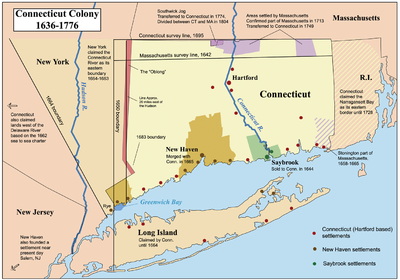
and its aftermath. As a consequence the colony struggled and by 1644, Fenwick agreed to merge the colony with the more vibrant Connecticut Colony
Connecticut Colony
The Connecticut Colony or Colony of Connecticut was an English colony located in British America that became the U.S. state of Connecticut. Originally known as the River Colony, it was organized on March 3, 1636 as a haven for Puritan noblemen. After early struggles with the Dutch, the English...
a few miles up river.
See also
- Lower Connecticut River ValleyLower Connecticut River ValleyThe Lower Connecticut River Valley is a region of the state of Connecticut focused around the juncture where the Connecticut River meets Long Island Sound. It includes towns in southern Middlesex County and the western edge of New London County...
— Connecticut planning region covering the area
Further reading
- Ward, Harry M. The United Colonies of New England, 1643-90 (Vantage Press, 1961).
- Andrews, Charles McLean. The Colonial Period of American History (Vol. II) - The Beginnings of Connecticut 1632-1662 (Tercentenary Commission Publication Vol. XXXII 1934).