

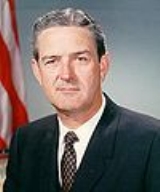
John Connally

Encyclopedia
John Bowden Connally, Jr. (February 27, 1917 June 15, 1993), was an influential American politician
, serving as the 39th governor of Texas
, Secretary of the Navy under President John F. Kennedy
, and as Secretary of the Treasury under President Richard M. Nixon. While he was Governor in 1963, Connally was a passenger in the car in which President Kennedy was assassinated
. Connally was seriously wounded during the shooting.
, the seat of Wilson County
southeast of San Antonio. He was one of seven children born to Lela (née Wright) and John Bowden Connally, Sr., a dairy and tenant farmer
. At the time, Connally was among the few Floresville High School graduates who attended college. He graduated from the University of Texas at Austin
, where he was the student body president and a member of the Friar Society
. He subsequently graduated from the University of Texas School of Law
and was admitted to the bar by examination.
Connally served in the United States Navy
during World War II
, first as an aide to James V. Forrestal, then as part of the planning staff for the invasion of Africa by General
Dwight D. Eisenhower
. He transferred to the South Pacific Theater
, where he served with distinction. He was a fighter-plane director aboard the aircraft carrier
USS Essex
and won a Bronze Star
for bravery. He was shifted to another carrier, the USS Bennington
and won a Legion of Merit
. He was also involved in the campaigns in the Gilbert
, Marshall
, Ryukyu, and Philippine islands. He was discharged in 1946 at the rank of lieutenant commander
.
On his release from the Navy, Connally practiced law but soon returned to Washington, D.C.
, to serve as a key aide to Lyndon Baines Johnson, then a U.S. Representative. He maintained close ties with Johnson until the former president's death in 1973.
tycoon Sid W. Richardson
and Perry Bass, Richardson's nephew
and partner, both of Fort Worth
. Richardson's empire at the time was estimated at $200 million to $1 billion. Under Richardson's tutelage, Connally gained experience in a variety of enterprises and received tips on real estate purchases. The work required the Connallys to relocate to Fort Worth. When Richardson died in 1959, Connally was named to the lucrative position as co-executor of the estate.
Connally was also involved in a reported clandestine deal to place the Texas Democrat Robert Anderson
on the 1956 Republican ticket as vice president. Though the idea fell through when Dwight Eisenhower retained Richard Nixon
in the second slot, Anderson received a million dollars for his efforts and a subsequent appointment as treasury secretary, the same position that Connally would fill for Nixon fourteen years later in 1971. Moreover, in another irony, Anderson had been Eisenhower's first Navy secretary, the post that Connally filled for John F. Kennedy
in 1961.
, if nominated and elected, would be unable to serve as president for a full term because of Addison's disease
and dependence on cortisone
. Kennedy, however, had wrapped up the needed delegates for nomination before the convention even opened. Kennedy realized that he could not be elected without support of traditional Southern Democratic votes, many of whom had backed Johnson. Therefore, Johnson was offered the vice-presidential nomination.
Connally directed the Sixth Fleet in the Mediterranean Sea
on a new kind of "gunboat diplomacy
." The USS Forrestal landed in Naples
, Italy
, and brought gifts to children in an orphanage
. Connally ordered gifts also to a hospital in Cannes, France, which treated children with bone diseases; to poor Greek children on the island of Rhodes
; and for spastic children in Palermo
, Italy. Presents were also sent to Turkish children in Cyprus
and to a camp in Beirut
for homeless Palestinian refugee
s.
Connally fought hard to protect the Navy's role in the national space program, having vigorously opposed assigning most space research to the United States Air Force
. Time
magazine
termed Connally's year as Navy secretary "a first-rate appointment." Critics noted, however, that the brevity of Connally's tenure precluded any sustained or comprehensive achievements.
of 1961 that he was leaving the position of Navy secretary to return to Texas to seek the 1962 Democratic gubernatorial nomination. He would have to compete against the incumbent Marion Price Daniel, Sr.
, who was running for a fourth consecutive two-year term. Daniel was in political trouble following the enactment of a two-cent state sales tax
in 1961, which had soured many voters on his administration. Daniel had let the tax become law without his signature but could have vetoed the measure. Former state Attorney General
Will Wilson
, who had run for the U.S. Senate seat vacated by Lyndon B. Johnson
in 1961, also entered the gubernatorial campaign and was particularly critical of Johnson, whom he claimed engineered Connally's candidacy. Other primary candidates were highway commissioner Marshall Formby
of Plainview
, another party conservative, and General Edwin A. Walker, who made anti-communism
the centerpiece of his campaign. Connally waged the most active campaign of any of the Democrats, having traveled more than 22,000 miles across the state. He made forty-three major speeches and appeared on multiple statewide and local telecasts.
Connally ran as a conservative Democrat. He was placed in a primary runoff election against the liberal attorney from Houston
favored by organized labor, Don Yarborough
, no relation to Connally's long-term party nemesis U.S. Senator Ralph W. Yarborough. After winning the runoff against Yarborough by a close vote, Connally faced a determined bid by the conservative Republican
and oilfield equipment executive Jack Cox
, also of Houston. Cox, a former state representative from his native Stephens County
, had run unsuccessfully two years earlier in the Democratic primary against Daniel. Connally received 847,036 ballots (54 percent) to Cox's 715,025 (45.6 percent). In the campaign, Connally made an issue of Cox's switching to the Republican Party (GOP) the previous year. Eleven years later, Connally made the same switch. Cox, as it turned out, was the strongest Republican gubernatorial candidate in Texas since 1924. Not until 1972, when Henry Grover
carried the GOP banner, did the Republicans make a better showing for governor.
Connally was a master campaign professional. He believed in the entourage and advance men, the practice of having staff aides checking out events and having press interviews on the run to demonstrate Connally's heavy schedule of commitments. Biographer Charles Ashman claims that Connally would have aides telephone airports which he would shortly visit and ask to page him for an urgent message. Such manipulation, he believed, impressed airport patrons, many of whom would also be Texas voters.
at Dealey Plaza
in Dallas
when the president was assassinated
. He recovered from wounds in his chest, wrist and thigh. The ten-month investigation by the Warren Commission
of 1963–1964, the United States House Select Committee on Assassinations
(HSCA) of 1977–1978, and other government investigations concluded that the President was assassinated by Lee Harvey Oswald
.
Connally did not dispute this conclusion but did for the rest of his life question the single bullet theory
. Warren Commission
exhibit CE 1891 states that Mrs. Virginia Hale of Fortune Road, employed in the Fort Worth office of the Texas Employment Commission
, sent Lee Harvey Oswald
to a job location at the Leslie Welding Company in July 1962. Robert Hale
was the son of Virginia Hale. He earlier had been cleared by a coroner's jury in Florida
of responsibility related to the April 1959 shooting death of his teenaged wife of only forty-four days, Kathleen Connally Hale, the daughter of John Connally.
In the campaigns of 1964 and 1966, Connally defeated weak Republican challenges offered by Jack Crichton
, a Dallas oil industrialist, and Thomas Everton Kennerly, Sr. (1903–2000), of Houston, respectively. He prevailed with margins of 73.8 percent and 72.8 percent, respectively, giving him greater influence with the nearly all-Democratic legislature.
Connally was governor during a time of great expansion of higher education in Texas. He signed into law the creation of the Texas Higher Education Coordinating Board. He appointed regents who backed the entry of women into previously all-male Texas A&M University
in College Station
, having been prompted to take such action by State Senator William T. "Bill" Moore
of Bryan
, who in 1953 had first proposed the admission of women to the institution.
In 1965, Connally appointed Speaker
Byron M. Tunnell
to the Texas Railroad Commission, upon the retirement of 32-year veteran Ernest O. Thompson
, a former mayor
of Amarillo
. This appointment enabled the future Connally business associate Ben Barnes of De Leon
in Comanche County
to succeed Tunnell and become the youngest Speaker in Texas history.
On August 1, 1966, Charles Joseph Whitman, perched from the University of Texas Tower in Austin, fired at people on the grounds and the surrounding community for more than ninety minutes. Governor Connally assembled a commission which determined that Whitman had been suffering from a glioblastoma brain tumor
, amphetamine
abuse, and family troubles. All of the preceding issues contributed to the killing of sixteen on the campus and the wounding of many others. Whitman also killed his wife and mother in the early morning hours of August 1. He was killed by Houston McCoy, a former office of the Austin Police Department.
As governor, Connally promoted HemisFair '68
, the world's fair held in San Antonio, he believed would net the state an additional $12 million in direct taxes. A permanent Institute of Texan Cultures museum
was an outgrowth of the fair. It was designed to be "a dramatic showcase, not only to Texans, but to all the world, of the host of diverse peoples from many lands whose blood and dreams built our state."
During the Vietnam War
, Connally hawkishly
urged Johnson to "finish" the engagement by any military means necessary. Johnson, however, was more moderate in his conduct of the war than the hawkish Connally advised.
There was some talk of Connally being selected as Hubert Humphrey
's running mate in 1968, but the liberal Senator Edmund Muskie
of Maine
was instead chosen. Connally endorsed Humphrey and greeted the nominee at the Fort Worth airport and even reconciled for a month with intraparty rival Ralph Yarborough. Ashman, however, claims that Connally was "privately helping Nixon, recruiting a number of influential Texans, members of both parties, to work for the Republican candidate." Ben Barnes recounts a story that Connally shouted Hubert Humphrey in a private meeting at the 1968 Democratic National Convention
in Chicago and accused the vice president of being disloyal to President Johnson by trying to soft-pedal Johnson's osition regarding Vietnam. Barnes said that the "tongue-lashing" Connally gave Humphrey was "an epic... He orally spanked that man as hard as I've ever seen anyone chastised. He either strengthened Hubert's backbone, or gave him some, or scared him half to death."
Connally was succeeded as governor by Lieutenant Governor
Preston Smith
, a theater owner from Lubbock
, who twice defeated the Republican attorney Paul Eggers
in 1968 and 1970. Eggers, a friend and later associate of Republican Senator John G. Tower, served as general counsel in the Treasury Department from 1969–1970, before Connally joined the Nixon Cabinet.
that Connally's insistence saved Bush's political career because the then former U.S. representative and twice-defeated Senate candidate relied on appointed offices to build a resume by which to seek the presidency in 1980 and again in 1988. Nixon hence named Bush as ambassador to the United Nations
in order to secure Connally's services at treasury. Barnes also said that he doubted George W. Bush
could have become president in 2001 had Bush's father not first been given the string of federal appointments during the 1970s to strengthen the family's political viability.
On taking the treasury post, Connally famously told a delegation of Europeans worried about exchange rate fluctuations that the American dollar "is our currency, but your problem."
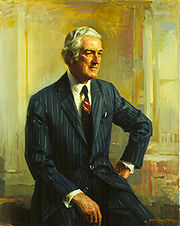 Secretary Connally defended a $50 billion increase in the debt ceiling and a $35 to $40 billion budget deficit as an essential "fiscal stimulus" at a time when five million Americans were unemployed. He unveiled Nixon's program of raising the price of gold
and formally devaluing the dollar—finally leaving the old gold standard
entirely, a process begun in 1934 by Franklin D. Roosevelt
. Prices continued to increase during 1971, and Nixon allowed wage and price guidelines, which Congress had authorized on a stand-by basis, to be implemented. Connally later shied away from his role in recommending the failed wage and price controls. Connally announced guaranteed loans for the ailing Lockheed
aircraft company. He fought a lonely battle too against growing balance-of-payment problems with the nation's trading partners. He also undertook important foreign diplomatic trips for Nixon through his role as Treasury Secretary.
Historian Bruce Schulman wrote that Nixon was "awed" by the handsome, urbane Texan who was also a tough political fighter. Schulman added that Henry Kissinger
, Nixon's National Security Advisor
, noted that Connally was the only cabinet member that Nixon did not disparage behind his back, and that this was high praise indeed.
", a group funded by Republicans. Connally's old mentor, Lyndon Johnson, stood behind Democratic presidential nominee George S. McGovern of South Dakota
, although McGovern had long opposed Johnson's foreign and defense policies. It was the first time that Connally and Johnson were on opposite sides of a general election campaign. Connally's brother, Golfrey Connally, an economics
professor at a junior college
in San Antonio, also endorsed McGovern. Some evidence even suggests that Connally was "privately" for Eisenhower in 1952 and 1956, instead of the Democratic candidate Adlai E. Stevenson of Illinois
, for whom Johnson campaigned with considerable loyalty. During the war, Connally had served on Eisenhower's planning staff for the invasion of North Africa.
In the 1972 U.S. Senate election in Texas, Connally endorsed the Democratic Harold Barefoot Sanders, later a federal judge
from Dallas, rather than the Republican incumbent John G. Tower, also of Dallas. Connally had considered running against Tower in 1966, but chose to run for a third term as governor. Tower then defeated a Connally ally, state Attorney General
Waggoner Carr
of Lubbock
.
Tower, Nixon's choice in the Senate race, won handily over Sanders, but the Republican candidate for governor, Henry Grover
of Houston, a victim of intraparty maneuvering, fell short and lost to Democrat Dolph Briscoe
of Uvalde
, a city in South Texas
.
 In January 1973, Lyndon Johnson died of heart disease
. He and Connally had been friends since 1938. Connally took part in eulogizing Johnson during interment services at the LBJ Ranch
in Gillespie County
, along with the Rev. Billy Graham, who officiated at the service.
resigned five months later because of scandal, Connally was one of Nixon's potential choices to fill the vacancy. Nixon tapped Gerald Rudolph Ford, Jr.
, the House Minority Leader from Grand Rapids
, Michigan
, because he believed that the moderate Ford could be easily confirmed by both houses of Congress, as required by the 25th Amendment to the United States Constitution. A Connally nomination presumably could have been blocked by liberal Democratic opposition. The weakened Nixon did not want a fight for the vice-presidential selection.
Connally's party bolt left a sour taste in the mouth of at least one prominent Texas Democrat who stood with George McGovern in 1972: Bob Bullock
, the Hillsboro
native who served as Texas secretary of state, comptroller
and lieutenant governor: "...I got some ideas on Mr. Connally. He ain't never done nothin' but get shot in Dallas. He got the silver bullet. He needs to come back here and get hisself [sic] shot once every six months. I attack Connally on his vanity. He's terribly bad [sic] vain, y'know..."
In 1975, Connally was accused of pocketing $10,000 for influencing a milk
price decision by Texas lawyer Jake Jacobsen. At his trial, he called as character witnesses Jackie Kennedy, Lady Bird Johnson
, Barbara Jordan
(the first African American woman state senator in Texas history), Dean Rusk
, Robert McNamara
, and Billy Graham
. Connally was acquitted.
. He was considered a great orator and strong leader and was featured on the cover of Time with the heading "Hot on the Trail". His wheeler-dealer image remained a liability. Connally raised more money than any other candidate, but he was never able to overtake the popular conservative front runner Ronald Reagan
of California
. Connally spent his money nationally, while George H. W. Bush
, like Connally from Houston, targeted his time and money in early states and won the Iowa caucus
. The Houston political activist Clymer Wright
rejected both Connally and Bush and served as Reagan's finance chairman in Texas. Bush's status as a challenger to Reagan was at first heightened by his victory in Iowa.
Connally focused on South Carolina
, an early primary state in which he had the support of popular U.S. Senator Strom Thurmond
, but he lost there to Reagan 55 to 30 percent and withdrew from the contest. After spending $11 million during the campaign, Connally secured the support of only a single delegate, Ada Mills
of Clarksville
, Arkansas
, who became nationally known for a brief time as the "$11 million delegate".
Connally quickly endorsed Reagan, appeared with the former governor at the Dallas-Fort Worth Airport, and helped Reagan to win a narrow primary victory over Bush in Texas.
Connally said that he and Bush despised each other. The statement seemed to contradict Connally's earlier insistence that President Nixon name Bush to a post in the administration as a pre-condition for Connally's agreeing to become treasury secretary. Rumors also abounded in 1964 that Connally personally voted for Bush for senator because of his greater dislike for Bush's then opponent, Senator Ralph Yarborough
. Charles Keating
once contributed to Connally's campaign for President.
as a result of a string of business losses in Houston.
In December 1990, Connally and Oscar Wyatt
, chairman of the Coastal Oil Corporation, met with President Saddam Hussein
of Iraq
. Hussein had been holding foreigners as hostages (or "guests" as Hussein called them) at strategic military sites in Iraq. After the meeting Hussein agreed to release the hostages.
Connally was known as an immaculate dresser who wore expensive and stylish suits wherever he went. Biographer Charles Ashman related a story about Connally's carrying a cigarette lighter in his pocket and lighting cigarettes as a courtesy only for very wealthy men who might be inclined to contribute to his political causes or retain him as a consultant on business arrangements.
In one of his last political acts, Connally endorsed then Republican U.S. Representative Jack Fields
of Houston in the special election called in May 1993 to fill the vacancy left by U.S. Senator Lloyd Bentsen of Houston. Bentsen was appointed Treasury Secretary in the new administration of Bill Clinton
. Fields finished fourth in the special election and left Congress thereafter. Republican Kay Bailey Hutchison
, for whom Connally's daughter had been employed in the state treasurer's office, won the seat by a wide margin in the special election runoff against the appointed Democratic Senator Robert Krueger.
, a progressive scarring of the lungs. His funeral was held at the First United Methodist Church of Austin where he and his wife, Nellie Connally
, had been members since their days living one block to the south in the Texas Governors Mansion, 1963-1969. The Connallys are interred at the Texas State Cemetery
in Austin.
Former President Nixon left the bedside of his wife, Pat Nixon
, who died a week later, and flew to Austin to attend Connally's funeral. The Connally Loop (Interstate Inner Loop 410) in San Antonio is named in his honor. The Connally Memorial Medical Center in Floresville is named for John, Wayne, and Merrill Connally. The John Connally Unit
of the Texas Corrections Department south of Kenedy
in Karnes County
is named in his honor. There is also a Connally Plaza, with a life-sized statue of Connally, in downtown Houston.
Politics of the United States
The United States is a federal constitutional republic, in which the President of the United States , Congress, and judiciary share powers reserved to the national government, and the federal government shares sovereignty with the state governments.The executive branch is headed by the President...
, serving as the 39th governor of Texas
Governor of Texas
The governor of Texas is the head of the executive branch of Texas's government and the commander-in-chief of the state's military forces. The governor has the power to either approve or veto bills passed by the Texas Legislature, and to convene the legislature...
, Secretary of the Navy under President John F. Kennedy
John F. Kennedy
John Fitzgerald "Jack" Kennedy , often referred to by his initials JFK, was the 35th President of the United States, serving from 1961 until his assassination in 1963....
, and as Secretary of the Treasury under President Richard M. Nixon. While he was Governor in 1963, Connally was a passenger in the car in which President Kennedy was assassinated
John F. Kennedy assassination
John Fitzgerald Kennedy, the thirty-fifth President of the United States, was assassinated at 12:30 p.m. Central Standard Time on Friday, November 22, 1963, in Dealey Plaza, Dallas, Texas...
. Connally was seriously wounded during the shooting.
Early years, education, and military service
Connally was born into a large family in FloresvilleFloresville, Texas
Floresville is a city in Wilson County, Texas, United States. The population was 5,868 at the 2000 census. It is the county seat of Wilson County. The city is also part of the San Antonio Metropolitan Statistical Area....
, the seat of Wilson County
Wilson County, Texas
Wilson County is a county located in the U.S. state of Texas. In 2000, its population was 32,408. Its county seat is Floresville. The county is named after James Charles Wilson....
southeast of San Antonio. He was one of seven children born to Lela (née Wright) and John Bowden Connally, Sr., a dairy and tenant farmer
Tenant farmer
A tenant farmer is one who resides on and farms land owned by a landlord. Tenant farming is an agricultural production system in which landowners contribute their land and often a measure of operating capital and management; while tenant farmers contribute their labor along with at times varying...
. At the time, Connally was among the few Floresville High School graduates who attended college. He graduated from the University of Texas at Austin
University of Texas at Austin
The University of Texas at Austin is a state research university located in Austin, Texas, USA, and is the flagship institution of the The University of Texas System. Founded in 1883, its campus is located approximately from the Texas State Capitol in Austin...
, where he was the student body president and a member of the Friar Society
Friar Society
The Friar Society is the oldest honor society at the University of Texas at Austin.-Origins:The Friar Society was founded in 1911 by Curtice Rosser and Marion Levy. Eight members were initially selected in the charter group...
. He subsequently graduated from the University of Texas School of Law
University of Texas School of Law
The University of Texas School of Law, also known as UT Law, is an ABA-certified American law school located on the University of Texas at Austin campus. The law school has been in operation since the founding of the University in 1883. It was one of only two schools at the University when it was...
and was admitted to the bar by examination.
Connally served in the United States Navy
United States Navy
The United States Navy is the naval warfare service branch of the United States Armed Forces and one of the seven uniformed services of the United States. The U.S. Navy is the largest in the world; its battle fleet tonnage is greater than that of the next 13 largest navies combined. The U.S...
during World War II
World War II
World War II, or the Second World War , was a global conflict lasting from 1939 to 1945, involving most of the world's nations—including all of the great powers—eventually forming two opposing military alliances: the Allies and the Axis...
, first as an aide to James V. Forrestal, then as part of the planning staff for the invasion of Africa by General
General (United States)
In the United States Army, United States Air Force, and United States Marine Corps, general is a four-star general officer rank, with the pay grade of O-10. General ranks above lieutenant general and below General of the Army or General of the Air Force; the Marine Corps does not have an...
Dwight D. Eisenhower
Dwight D. Eisenhower
Dwight David "Ike" Eisenhower was the 34th President of the United States, from 1953 until 1961. He was a five-star general in the United States Army...
. He transferred to the South Pacific Theater
Pacific Theater of Operations
The Pacific Theater of Operations was the World War II area of military activity in the Pacific Ocean and the countries bordering it, a geographic scope that reflected the operational and administrative command structures of the American forces during that period...
, where he served with distinction. He was a fighter-plane director aboard the aircraft carrier
Aircraft carrier
An aircraft carrier is a warship designed with a primary mission of deploying and recovering aircraft, acting as a seagoing airbase. Aircraft carriers thus allow a naval force to project air power worldwide without having to depend on local bases for staging aircraft operations...
USS Essex
USS Bennington (CV-20)
USS Bennington was one of 24 s built during World War II for the United States Navy. The ship was the second US Navy ship to bear the name, and was named for the Revolutionary War Battle of Bennington...
and won a Bronze Star
Bronze Star Medal
The Bronze Star Medal is a United States Armed Forces individual military decoration that may be awarded for bravery, acts of merit, or meritorious service. As a medal it is awarded for merit, and with the "V" for valor device it is awarded for heroism. It is the fourth-highest combat award of the...
for bravery. He was shifted to another carrier, the USS Bennington
USS Bennington (CV-20)
USS Bennington was one of 24 s built during World War II for the United States Navy. The ship was the second US Navy ship to bear the name, and was named for the Revolutionary War Battle of Bennington...
and won a Legion of Merit
Legion of Merit
The Legion of Merit is a military decoration of the United States armed forces that is awarded for exceptionally meritorious conduct in the performance of outstanding services and achievements...
. He was also involved in the campaigns in the Gilbert
Gilbert Islands
The Gilbert Islands are a chain of sixteen atolls and coral islands in the Pacific Ocean. They are the main part of Republic of Kiribati and include Tarawa, the site of the country's capital and residence of almost half of the population.-Geography:The atolls and islands of the Gilbert Islands...
, Marshall
Marshall Islands
The Republic of the Marshall Islands , , is a Micronesian nation of atolls and islands in the middle of the Pacific Ocean, just west of the International Date Line and just north of the Equator. As of July 2011 the population was 67,182...
, Ryukyu, and Philippine islands. He was discharged in 1946 at the rank of lieutenant commander
Lieutenant Commander
Lieutenant Commander is a commissioned officer rank in many navies. The rank is superior to a lieutenant and subordinate to a commander...
.
On his release from the Navy, Connally practiced law but soon returned to Washington, D.C.
Washington, D.C.
Washington, D.C., formally the District of Columbia and commonly referred to as Washington, "the District", or simply D.C., is the capital of the United States. On July 16, 1790, the United States Congress approved the creation of a permanent national capital as permitted by the U.S. Constitution....
, to serve as a key aide to Lyndon Baines Johnson, then a U.S. Representative. He maintained close ties with Johnson until the former president's death in 1973.
Lawyer for Sid Richardson
Two of Connally's principal legal clients were the Texas oilOil
An oil is any substance that is liquid at ambient temperatures and does not mix with water but may mix with other oils and organic solvents. This general definition includes vegetable oils, volatile essential oils, petrochemical oils, and synthetic oils....
tycoon Sid W. Richardson
Sid W. Richardson
Sid Williams Richardson was a Texas oilman, cattleman, and philanthropist known for his association with the city of Fort Worth....
and Perry Bass, Richardson's nephew
Nephew
Nephew is a son of one's sibling or sibling-in-law, and niece is a daughter of one's sibling or a sibling-in-law. Sons and daughters of siblings-in-law are also informally referred to as nephews and nieces respectively, even though there is no blood relation...
and partner, both of Fort Worth
Fort Worth, Texas
Fort Worth is the 16th-largest city in the United States of America and the fifth-largest city in the state of Texas. Located in North Central Texas, just southeast of the Texas Panhandle, the city is a cultural gateway into the American West and covers nearly in Tarrant, Parker, Denton, and...
. Richardson's empire at the time was estimated at $200 million to $1 billion. Under Richardson's tutelage, Connally gained experience in a variety of enterprises and received tips on real estate purchases. The work required the Connallys to relocate to Fort Worth. When Richardson died in 1959, Connally was named to the lucrative position as co-executor of the estate.
Connally was also involved in a reported clandestine deal to place the Texas Democrat Robert Anderson
Robert Bernard Anderson
Robert Bernard Anderson was an American administrator and businessman. He served as the Secretary of the Navy between February 1953 and March 1954. He also served as the Secretary of the Treasury from 1957 until 1961....
on the 1956 Republican ticket as vice president. Though the idea fell through when Dwight Eisenhower retained Richard Nixon
Richard Nixon
Richard Milhous Nixon was the 37th President of the United States, serving from 1969 to 1974. The only president to resign the office, Nixon had previously served as a US representative and senator from California and as the 36th Vice President of the United States from 1953 to 1961 under...
in the second slot, Anderson received a million dollars for his efforts and a subsequent appointment as treasury secretary, the same position that Connally would fill for Nixon fourteen years later in 1971. Moreover, in another irony, Anderson had been Eisenhower's first Navy secretary, the post that Connally filled for John F. Kennedy
John F. Kennedy
John Fitzgerald "Jack" Kennedy , often referred to by his initials JFK, was the 35th President of the United States, serving from 1961 until his assassination in 1963....
in 1961.
From Navy Secretary to Governor
At the 1960 Democratic convention in Los Angeles, Connally led supporters of Senator Lyndon Johnson. He claimed that John F. KennedyJohn F. Kennedy
John Fitzgerald "Jack" Kennedy , often referred to by his initials JFK, was the 35th President of the United States, serving from 1961 until his assassination in 1963....
, if nominated and elected, would be unable to serve as president for a full term because of Addison's disease
Addison's disease
Addison’s disease is a rare, chronic endocrine disorder in which the adrenal glands do not produce sufficient steroid hormones...
and dependence on cortisone
Cortisone
Cortisone is a steroid hormone. It is one of the main hormones released by the adrenal gland in response to stress. In chemical structure, it is a corticosteroid closely related to corticosterone. It is used to treat a variety of ailments and can be administered intravenously, orally,...
. Kennedy, however, had wrapped up the needed delegates for nomination before the convention even opened. Kennedy realized that he could not be elected without support of traditional Southern Democratic votes, many of whom had backed Johnson. Therefore, Johnson was offered the vice-presidential nomination.
Secretary of the Navy
At Johnson's request, in 1961 President Kennedy named Connally Secretary of the Navy. Connally resigned eleven months later to run for the Texas governorship. He had managed one of the largest employers in the world, as the Navy had more than 600,000 in uniform and 650,000 civilian workers, stationed at 222 bases in the United States and 53 abroad. It had a budget of $14 billion.Connally directed the Sixth Fleet in the Mediterranean Sea
Mediterranean Sea
The Mediterranean Sea is a sea connected to the Atlantic Ocean surrounded by the Mediterranean region and almost completely enclosed by land: on the north by Anatolia and Europe, on the south by North Africa, and on the east by the Levant...
on a new kind of "gunboat diplomacy
Gunboat diplomacy
In international politics, gunboat diplomacy refers to the pursuit of foreign policy objectives with the aid of conspicuous displays of military power — implying or constituting a direct threat of warfare, should terms not be agreeable to the superior force....
." The USS Forrestal landed in Naples
Naples
Naples is a city in Southern Italy, situated on the country's west coast by the Gulf of Naples. Lying between two notable volcanic regions, Mount Vesuvius and the Phlegraean Fields, it is the capital of the region of Campania and of the province of Naples...
, Italy
Italy
Italy , officially the Italian Republic languages]] under the European Charter for Regional or Minority Languages. In each of these, Italy's official name is as follows:;;;;;;;;), is a unitary parliamentary republic in South-Central Europe. To the north it borders France, Switzerland, Austria and...
, and brought gifts to children in an orphanage
Orphanage
An orphanage is a residential institution devoted to the care of orphans – children whose parents are deceased or otherwise unable or unwilling to care for them...
. Connally ordered gifts also to a hospital in Cannes, France, which treated children with bone diseases; to poor Greek children on the island of Rhodes
Rhodes
Rhodes is an island in Greece, located in the eastern Aegean Sea. It is the largest of the Dodecanese islands in terms of both land area and population, with a population of 117,007, and also the island group's historical capital. Administratively the island forms a separate municipality within...
; and for spastic children in Palermo
Palermo
Palermo is a city in Southern Italy, the capital of both the autonomous region of Sicily and the Province of Palermo. The city is noted for its history, culture, architecture and gastronomy, playing an important role throughout much of its existence; it is over 2,700 years old...
, Italy. Presents were also sent to Turkish children in Cyprus
Cyprus
Cyprus , officially the Republic of Cyprus , is a Eurasian island country, member of the European Union, in the Eastern Mediterranean, east of Greece, south of Turkey, west of Syria and north of Egypt. It is the third largest island in the Mediterranean Sea.The earliest known human activity on the...
and to a camp in Beirut
Beirut
Beirut is the capital and largest city of Lebanon, with a population ranging from 1 million to more than 2 million . Located on a peninsula at the midpoint of Lebanon's Mediterranean coastline, it serves as the country's largest and main seaport, and also forms the Beirut Metropolitan...
for homeless Palestinian refugee
Palestinian refugee
Palestinian refugees or Palestine refugees are the people and their descendants, predominantly Palestinian Arabic-speakers, who fled or were expelled from their homes during and after the 1948 Palestine War, within that part of the British Mandate of Palestine, that after that war became the...
s.
Connally fought hard to protect the Navy's role in the national space program, having vigorously opposed assigning most space research to the United States Air Force
United States Air Force
The United States Air Force is the aerial warfare service branch of the United States Armed Forces and one of the American uniformed services. Initially part of the United States Army, the USAF was formed as a separate branch of the military on September 18, 1947 under the National Security Act of...
. Time
Time (magazine)
Time is an American news magazine. A European edition is published from London. Time Europe covers the Middle East, Africa and, since 2003, Latin America. An Asian edition is based in Hong Kong...
magazine
Magazine
Magazines, periodicals, glossies or serials are publications, generally published on a regular schedule, containing a variety of articles. They are generally financed by advertising, by a purchase price, by pre-paid magazine subscriptions, or all three...
termed Connally's year as Navy secretary "a first-rate appointment." Critics noted, however, that the brevity of Connally's tenure precluded any sustained or comprehensive achievements.
Running for governor
Connally announced two weeks before ChristmasChristmas
Christmas or Christmas Day is an annual holiday generally celebrated on December 25 by billions of people around the world. It is a Christian feast that commemorates the birth of Jesus Christ, liturgically closing the Advent season and initiating the season of Christmastide, which lasts twelve days...
of 1961 that he was leaving the position of Navy secretary to return to Texas to seek the 1962 Democratic gubernatorial nomination. He would have to compete against the incumbent Marion Price Daniel, Sr.
Price Daniel
Marion Price Daniel, Sr. , was a Democratic U.S. Senator and the 38th Governor of the state of Texas. He was appointed by President Lyndon B. Johnson to be a member of the National Security Council, Director of the Office of Emergency Preparedness, and Assistant to the President for Federal-State...
, who was running for a fourth consecutive two-year term. Daniel was in political trouble following the enactment of a two-cent state sales tax
Sales taxes in the United States
There is no federal sales or use tax in the United States. 45 states and the District of Columbia impose sales and use taxes on the retail sale, lease and rental of many goods, as well as some services. Many cities, counties, transit authorities and special purpose districts impose additional local...
in 1961, which had soured many voters on his administration. Daniel had let the tax become law without his signature but could have vetoed the measure. Former state Attorney General
Texas Attorney General
The Texas Attorney General is the chief legal officer of the State of Texas.The department has offices at the William P. Clements State Office Building at 300 West 15th Street in Austin.-History:...
Will Wilson
Will Wilson
Will Reid Wilson, Sr. was a prominent Democratic politician in his native Texas best known for his service as attorney general of Texas from 1957-1963. In 1968, he joined the Republican Party to support the election of Richard M. Nixon as U.S. President. Nixon thereafter named Wilson an assistant...
, who had run for the U.S. Senate seat vacated by Lyndon B. Johnson
Lyndon B. Johnson
Lyndon Baines Johnson , often referred to as LBJ, was the 36th President of the United States after his service as the 37th Vice President of the United States...
in 1961, also entered the gubernatorial campaign and was particularly critical of Johnson, whom he claimed engineered Connally's candidacy. Other primary candidates were highway commissioner Marshall Formby
Marshall Formby
Marshall Clinton Formby, Jr. , was a Texas attorney, newspaper publisher, radio executive, and a Democratic politician who served a term in the Texas State Senate from District 30 from 1941 to 1945. He was a defender of West Texas interests and entitled a 1962 book, These Are My People...
of Plainview
Plainview, Texas
Plainview is a city in and the county seat of Hale County, Texas, United States. The population was 22,336 at the 2000 census.-Geography:Plainview is located at ....
, another party conservative, and General Edwin A. Walker, who made anti-communism
Anti-communism
Anti-communism is opposition to communism. Organized anti-communism developed in reaction to the rise of communism, especially after the 1917 October Revolution in Russia and the beginning of the Cold War in 1947.-Objections to communist theory:...
the centerpiece of his campaign. Connally waged the most active campaign of any of the Democrats, having traveled more than 22,000 miles across the state. He made forty-three major speeches and appeared on multiple statewide and local telecasts.
Connally ran as a conservative Democrat. He was placed in a primary runoff election against the liberal attorney from Houston
Houston, Texas
Houston is the fourth-largest city in the United States, and the largest city in the state of Texas. According to the 2010 U.S. Census, the city had a population of 2.1 million people within an area of . Houston is the seat of Harris County and the economic center of , which is the ...
favored by organized labor, Don Yarborough
Don Yarborough
Donald Howard Yarborough, known as Don Yarborough , was a liberal Democratic politician who was reportedly the first Southern politician to endorse the Civil Rights Act of 1964. Yarborough, an attorney in Houston, Texas, ran for governor of Texas in 1962, 1964, and 1968...
, no relation to Connally's long-term party nemesis U.S. Senator Ralph W. Yarborough. After winning the runoff against Yarborough by a close vote, Connally faced a determined bid by the conservative Republican
Republican Party (United States)
The Republican Party is one of the two major contemporary political parties in the United States, along with the Democratic Party. Founded by anti-slavery expansion activists in 1854, it is often called the GOP . The party's platform generally reflects American conservatism in the U.S...
and oilfield equipment executive Jack Cox
Jack Cox (Texas)
Jack M. Cox was an oil equipment executive from Houston and the 1962 Republican gubernatorial nominee in the state of Texas.-Early years:...
, also of Houston. Cox, a former state representative from his native Stephens County
Stephens County, Texas
As of the census of 2000, there were 9,674 people, 3,661 households, and 2,591 families residing in the county. The population density was 11 people per square mile . There were 4,893 housing units at an average density of 6 per square mile...
, had run unsuccessfully two years earlier in the Democratic primary against Daniel. Connally received 847,036 ballots (54 percent) to Cox's 715,025 (45.6 percent). In the campaign, Connally made an issue of Cox's switching to the Republican Party (GOP) the previous year. Eleven years later, Connally made the same switch. Cox, as it turned out, was the strongest Republican gubernatorial candidate in Texas since 1924. Not until 1972, when Henry Grover
Henry Grover
Henry Cushing "Hank" Grover , was a conservative politician from the U.S. state of Texas best known for his relatively narrow defeat as the Republican gubernatorial nominee in 1972. Grover was born in Corpus Christi. He died in Houston of Alzheimer's disease.Grover lived as a youth in San Antonio...
carried the GOP banner, did the Republicans make a better showing for governor.
Connally was a master campaign professional. He believed in the entourage and advance men, the practice of having staff aides checking out events and having press interviews on the run to demonstrate Connally's heavy schedule of commitments. Biographer Charles Ashman claims that Connally would have aides telephone airports which he would shortly visit and ask to page him for an urgent message. Such manipulation, he believed, impressed airport patrons, many of whom would also be Texas voters.
Governor of Texas
Connally served as governor from 1963-1969. On November 22, 1963, he was seriously wounded while riding in President Kennedy's carMotorcade
A motorcade is a procession of vehicles. The term motorcade was coined by Lyle Abbot , and is formed after cavalcade on the false notion that "-cade" was a suffix meaning "procession"...
at Dealey Plaza
Dealey Plaza
Dealey Plaza , in the historic West End district of downtown Dallas, Texas , is the location of the assassination of John F. Kennedy on November 22, 1963...
in Dallas
Dallas, Texas
Dallas is the third-largest city in Texas and the ninth-largest in the United States. The Dallas-Fort Worth Metroplex is the largest metropolitan area in the South and fourth-largest metropolitan area in the United States...
when the president was assassinated
John F. Kennedy assassination
John Fitzgerald Kennedy, the thirty-fifth President of the United States, was assassinated at 12:30 p.m. Central Standard Time on Friday, November 22, 1963, in Dealey Plaza, Dallas, Texas...
. He recovered from wounds in his chest, wrist and thigh. The ten-month investigation by the Warren Commission
Warren Commission
The President's Commission on the Assassination of President Kennedy, known unofficially as the Warren Commission, was established on November 27, 1963, by Lyndon B. Johnson to investigate the assassination of United States President John F. Kennedy on November 22, 1963...
of 1963–1964, the United States House Select Committee on Assassinations
United States House Select Committee on Assassinations
The United States House of Representatives Select Committee on Assassinations ' was established in 1976 to investigate the assassinations of John F. Kennedy and Martin Luther King, Jr. and the shooting of Governor George Wallace. The Committee investigated until 1978, and in 1979 issued its final...
(HSCA) of 1977–1978, and other government investigations concluded that the President was assassinated by Lee Harvey Oswald
Lee Harvey Oswald
Lee Harvey Oswald was, according to four government investigations,These were investigations by: the Federal Bureau of Investigation , the Warren Commission , the House Select Committee on Assassinations , and the Dallas Police Department. the sniper who assassinated John F...
.
Connally did not dispute this conclusion but did for the rest of his life question the single bullet theory
Single bullet theory
The single bullet theory was introduced by the Warren Commission in its investigation of the assassination of President John F. Kennedy to explain what happened to the bullet which struck Kennedy in the back and exited through his throat...
. Warren Commission
Warren Commission
The President's Commission on the Assassination of President Kennedy, known unofficially as the Warren Commission, was established on November 27, 1963, by Lyndon B. Johnson to investigate the assassination of United States President John F. Kennedy on November 22, 1963...
exhibit CE 1891 states that Mrs. Virginia Hale of Fortune Road, employed in the Fort Worth office of the Texas Employment Commission
Texas Workforce Commission
The Texas Workforce Commission is a governmental agency in the U.S. state of Texas that provides unemployment benefits and services related to employment to eligible individuals and businesses....
, sent Lee Harvey Oswald
Lee Harvey Oswald
Lee Harvey Oswald was, according to four government investigations,These were investigations by: the Federal Bureau of Investigation , the Warren Commission , the House Select Committee on Assassinations , and the Dallas Police Department. the sniper who assassinated John F...
to a job location at the Leslie Welding Company in July 1962. Robert Hale
Robert Hale (Alaska)
Robert Allen Hale, also known as Papa Pilgrim was an American criminal who mentally, physically, and sexually abused his wife and 15 children in the Alaskan wilderness.-Early life:...
was the son of Virginia Hale. He earlier had been cleared by a coroner's jury in Florida
Florida
Florida is a state in the southeastern United States, located on the nation's Atlantic and Gulf coasts. It is bordered to the west by the Gulf of Mexico, to the north by Alabama and Georgia and to the east by the Atlantic Ocean. With a population of 18,801,310 as measured by the 2010 census, it...
of responsibility related to the April 1959 shooting death of his teenaged wife of only forty-four days, Kathleen Connally Hale, the daughter of John Connally.
In the campaigns of 1964 and 1966, Connally defeated weak Republican challenges offered by Jack Crichton
Jack Crichton (Texas businessman)
John Alston Crichton, known as Jack Crichton , was an oil and natural gas industrialist from Dallas, Texas, who was among the first of his ranks to recognize the importance of petroleum reserves in the Middle East. In 1964, he carried the Republican banner in a fruitless campaign against the...
, a Dallas oil industrialist, and Thomas Everton Kennerly, Sr. (1903–2000), of Houston, respectively. He prevailed with margins of 73.8 percent and 72.8 percent, respectively, giving him greater influence with the nearly all-Democratic legislature.
Connally was governor during a time of great expansion of higher education in Texas. He signed into law the creation of the Texas Higher Education Coordinating Board. He appointed regents who backed the entry of women into previously all-male Texas A&M University
Texas A&M University
Texas A&M University is a coeducational public research university located in College Station, Texas . It is the flagship institution of the Texas A&M University System. The sixth-largest university in the United States, A&M's enrollment for Fall 2011 was over 50,000 for the first time in school...
in College Station
College Station, Texas
College Station is a city in Brazos County, Texas, situated in East Central Texas in the heart of the Brazos Valley. The city is located within the most populated region of Texas, near three of the 10 largest cities in the United States - Houston, Dallas, and San Antonio...
, having been prompted to take such action by State Senator William T. "Bill" Moore
William T. Moore (Texas politician)
William Tyler Moore, Sr., known as W. T. 'Bill' Moore , was an attorney and businessman in Bryan, Texas, who was a conservative Democratic member of the Texas State Senate from District 5 from 1967 until 1981.Moore originally represented District 14 from 1949 to 1953 and then revised District 11...
of Bryan
Bryan, Texas
Bryan is a city in Brazos County, Texas, United States. As of the 2010 census, the city had a total population of 76,201. It is the county seat of Brazos County and is located in the heart of the Brazos Valley . It shares its border with the city of College Station, which lies to its south...
, who in 1953 had first proposed the admission of women to the institution.
In 1965, Connally appointed Speaker
Speaker of the Texas House of Representatives
The Speaker of the Texas House of Representatives is the presiding officer of the Texas House of Representatives. The Speaker's main duties are to conduct meetings of the House, appoint committees, and enforce the Rules of the House...
Byron M. Tunnell
Byron M. Tunnell
Byron Milton Tunnell was a state representative from 1957–1965, Speaker of the Texas House of Representatives from 1963 to 1965, and a member of the elected Texas Railroad Commission from 1965-1973....
to the Texas Railroad Commission, upon the retirement of 32-year veteran Ernest O. Thompson
Ernest O. Thompson
Ernest Othmer Thompson was a general in the United States Army during World War I, a mayor of Amarillo, Texas, an attorney, a businessman , and a 32-year member of the Texas Railroad Commission. He was recognized as a world authority on petroleum and natural gas production and conservation...
, a former mayor
Mayor
In many countries, a Mayor is the highest ranking officer in the municipal government of a town or a large urban city....
of Amarillo
Amarillo, Texas
Amarillo is the 14th-largest city, by population, in the state of Texas, the largest in the Texas Panhandle, and the seat of Potter County. A portion of the city extends into Randall County. The population was 190,695 at the 2010 census...
. This appointment enabled the future Connally business associate Ben Barnes of De Leon
De Leon, Texas
De Leon is a city located in Comanche County in the U.S. state of Texas. The population was 2,433 at the time of the 2000 census.The town was laid out in April 1881 by surveying crews of the Texas Central Railway as it constructed a line from Ross, just north of Waco, to an undecided destination in...
in Comanche County
Comanche County, Texas
Comanche County is a county located on the Edwards Plateau in Central Texas. In 2000, its population was 14,026. Comanche was founded in 1856. Comanche is named for the Comanche Native American tribe...
to succeed Tunnell and become the youngest Speaker in Texas history.
On August 1, 1966, Charles Joseph Whitman, perched from the University of Texas Tower in Austin, fired at people on the grounds and the surrounding community for more than ninety minutes. Governor Connally assembled a commission which determined that Whitman had been suffering from a glioblastoma brain tumor
Brain tumor
A brain tumor is an intracranial solid neoplasm, a tumor within the brain or the central spinal canal.Brain tumors include all tumors inside the cranium or in the central spinal canal...
, amphetamine
Amphetamine
Amphetamine or amfetamine is a psychostimulant drug of the phenethylamine class which produces increased wakefulness and focus in association with decreased fatigue and appetite.Brand names of medications that contain, or metabolize into, amphetamine include Adderall, Dexedrine, Dextrostat,...
abuse, and family troubles. All of the preceding issues contributed to the killing of sixteen on the campus and the wounding of many others. Whitman also killed his wife and mother in the early morning hours of August 1. He was killed by Houston McCoy, a former office of the Austin Police Department.
As governor, Connally promoted HemisFair '68
HemisFair '68
HemisFair '68 was the first officially designated world's fair held in the southwestern United States. San Antonio, Texas hosted the fair from April 6 through October 6, 1968. More than thirty nations hosted pavilions at the fair. The fair was held in conjunction with the 250th anniversary of the...
, the world's fair held in San Antonio, he believed would net the state an additional $12 million in direct taxes. A permanent Institute of Texan Cultures museum
Museum
A museum is an institution that cares for a collection of artifacts and other objects of scientific, artistic, cultural, or historical importance and makes them available for public viewing through exhibits that may be permanent or temporary. Most large museums are located in major cities...
was an outgrowth of the fair. It was designed to be "a dramatic showcase, not only to Texans, but to all the world, of the host of diverse peoples from many lands whose blood and dreams built our state."
During the Vietnam War
Vietnam War
The Vietnam War was a Cold War-era military conflict that occurred in Vietnam, Laos, and Cambodia from 1 November 1955 to the fall of Saigon on 30 April 1975. This war followed the First Indochina War and was fought between North Vietnam, supported by its communist allies, and the government of...
, Connally hawkishly
War Hawk
War Hawk is a term originally used to describe members of the Twelfth Congress of the United States who advocated waging war against the British in the War of 1812...
urged Johnson to "finish" the engagement by any military means necessary. Johnson, however, was more moderate in his conduct of the war than the hawkish Connally advised.
There was some talk of Connally being selected as Hubert Humphrey
Hubert Humphrey
Hubert Horatio Humphrey, Jr. , served under President Lyndon B. Johnson as the 38th Vice President of the United States. Humphrey twice served as a United States Senator from Minnesota, and served as Democratic Majority Whip. He was a founder of the Minnesota Democratic-Farmer-Labor Party and...
's running mate in 1968, but the liberal Senator Edmund Muskie
Edmund Muskie
Edmund Sixtus "Ed" Muskie was an American politician from Rumford, Maine. He served as Governor of Maine from 1955 to 1959, as a member of the United States Senate from 1959 to 1980, and as Secretary of State under Jimmy Carter from 1980 to 1981...
of Maine
Maine
Maine is a state in the New England region of the northeastern United States, bordered by the Atlantic Ocean to the east and south, New Hampshire to the west, and the Canadian provinces of Quebec to the northwest and New Brunswick to the northeast. Maine is both the northernmost and easternmost...
was instead chosen. Connally endorsed Humphrey and greeted the nominee at the Fort Worth airport and even reconciled for a month with intraparty rival Ralph Yarborough. Ashman, however, claims that Connally was "privately helping Nixon, recruiting a number of influential Texans, members of both parties, to work for the Republican candidate." Ben Barnes recounts a story that Connally shouted Hubert Humphrey in a private meeting at the 1968 Democratic National Convention
1968 Democratic National Convention
The 1968 Democratic National Convention of the U.S. Democratic Party was held at the International Amphitheatre in Chicago, Illinois, from August 26 to August 29, 1968. Because Democratic President Lyndon Johnson had announced he would not seek a second term, the purpose of the convention was to...
in Chicago and accused the vice president of being disloyal to President Johnson by trying to soft-pedal Johnson's osition regarding Vietnam. Barnes said that the "tongue-lashing" Connally gave Humphrey was "an epic... He orally spanked that man as hard as I've ever seen anyone chastised. He either strengthened Hubert's backbone, or gave him some, or scared him half to death."
Connally was succeeded as governor by Lieutenant Governor
Lieutenant Governor of Texas
The Lieutenant Governor of Texas is the second-highest executive office in the government of Texas, a state in the U.S. It is the second most powerful post in Texas government because its occupant controls the work of the Texas Senate and controls the budgeting process as a leader of the...
Preston Smith
Preston Smith (Texas)
Preston Earnest Smith was the 40th Governor of Texas from 1969 to 1973, who earlier served as the lieutenant governor from 1963 to 1969.-Early life:...
, a theater owner from Lubbock
Lubbock, Texas
Lubbock is a city in and the county seat of Lubbock County, Texas, United States. The city is located in the northwestern part of the state, a region known historically as the Llano Estacado, and the home of Texas Tech University and Lubbock Christian University...
, who twice defeated the Republican attorney Paul Eggers
Paul Eggers
Paul Walter Eggers is an Indiana native who was the Republican nominee for governor of Texas in both 1968 and 1970, when the state still had two-year gubernatorial terms. Eggers' races for governor were his only attempts at elected office...
in 1968 and 1970. Eggers, a friend and later associate of Republican Senator John G. Tower, served as general counsel in the Treasury Department from 1969–1970, before Connally joined the Nixon Cabinet.
Secretary of the Treasury
In 1971, Republican President Nixon appointed the then Democrat Connally as Treasury Secretary. Before agreeing to take the appointment, however, Connally told Nixon that the president must find a position in the administration for George H.W. Bush, the Republican who had been defeated in November 1970 in a hard-fought U.S. Senate race against Democrat Lloyd M. Bentsen. Connally told Nixon that his taking the treasury post would embarrass Bush, who had "labored in the vineyards" for Nixon's election as president, while Connally had supported Humphrey. Ben Barnes, then the lieutenant governor and originally a Connally ally, claims in his autobiographyAutobiography
An autobiography is a book about the life of a person, written by that person.-Origin of the term:...
that Connally's insistence saved Bush's political career because the then former U.S. representative and twice-defeated Senate candidate relied on appointed offices to build a resume by which to seek the presidency in 1980 and again in 1988. Nixon hence named Bush as ambassador to the United Nations
United Nations
The United Nations is an international organization whose stated aims are facilitating cooperation in international law, international security, economic development, social progress, human rights, and achievement of world peace...
in order to secure Connally's services at treasury. Barnes also said that he doubted George W. Bush
George W. Bush
George Walker Bush is an American politician who served as the 43rd President of the United States, from 2001 to 2009. Before that, he was the 46th Governor of Texas, having served from 1995 to 2000....
could have become president in 2001 had Bush's father not first been given the string of federal appointments during the 1970s to strengthen the family's political viability.
On taking the treasury post, Connally famously told a delegation of Europeans worried about exchange rate fluctuations that the American dollar "is our currency, but your problem."
Gold
Gold is a chemical element with the symbol Au and an atomic number of 79. Gold is a dense, soft, shiny, malleable and ductile metal. Pure gold has a bright yellow color and luster traditionally considered attractive, which it maintains without oxidizing in air or water. Chemically, gold is a...
and formally devaluing the dollar—finally leaving the old gold standard
Gold standard
The gold standard is a monetary system in which the standard economic unit of account is a fixed mass of gold. There are distinct kinds of gold standard...
entirely, a process begun in 1934 by Franklin D. Roosevelt
Franklin D. Roosevelt
Franklin Delano Roosevelt , also known by his initials, FDR, was the 32nd President of the United States and a central figure in world events during the mid-20th century, leading the United States during a time of worldwide economic crisis and world war...
. Prices continued to increase during 1971, and Nixon allowed wage and price guidelines, which Congress had authorized on a stand-by basis, to be implemented. Connally later shied away from his role in recommending the failed wage and price controls. Connally announced guaranteed loans for the ailing Lockheed
Lockheed Corporation
The Lockheed Corporation was an American aerospace company. Lockheed was founded in 1912 and later merged with Martin Marietta to form Lockheed Martin in 1995.-Origins:...
aircraft company. He fought a lonely battle too against growing balance-of-payment problems with the nation's trading partners. He also undertook important foreign diplomatic trips for Nixon through his role as Treasury Secretary.
Historian Bruce Schulman wrote that Nixon was "awed" by the handsome, urbane Texan who was also a tough political fighter. Schulman added that Henry Kissinger
Henry Kissinger
Heinz Alfred "Henry" Kissinger is a German-born American academic, political scientist, diplomat, and businessman. He is a recipient of the Nobel Peace Prize. He served as National Security Advisor and later concurrently as Secretary of State in the administrations of Presidents Richard Nixon and...
, Nixon's National Security Advisor
National Security Advisor (United States)
The Assistant to the President for National Security Affairs, commonly referred to as the National Security Advisor , serves as the chief advisor to the President of the United States on national security issues...
, noted that Connally was the only cabinet member that Nixon did not disparage behind his back, and that this was high praise indeed.
Democrats for Nixon
Connally stepped down as treasury secretary in 1972 to head "Democrats for NixonDemocrats for Nixon
Democrats for Nixon was a campaign to promote Democratic support for the then-incumbent Republican President Richard Nixon in the 1972 presidential election...
", a group funded by Republicans. Connally's old mentor, Lyndon Johnson, stood behind Democratic presidential nominee George S. McGovern of South Dakota
South Dakota
South Dakota is a state located in the Midwestern region of the United States. It is named after the Lakota and Dakota Sioux American Indian tribes. Once a part of Dakota Territory, South Dakota became a state on November 2, 1889. The state has an area of and an estimated population of just over...
, although McGovern had long opposed Johnson's foreign and defense policies. It was the first time that Connally and Johnson were on opposite sides of a general election campaign. Connally's brother, Golfrey Connally, an economics
Economics
Economics is the social science that analyzes the production, distribution, and consumption of goods and services. The term economics comes from the Ancient Greek from + , hence "rules of the house"...
professor at a junior college
Junior college
The term junior college refers to different educational institutions in different countries.-India:In India, most states provide schooling through 12th grade...
in San Antonio, also endorsed McGovern. Some evidence even suggests that Connally was "privately" for Eisenhower in 1952 and 1956, instead of the Democratic candidate Adlai E. Stevenson of Illinois
Illinois
Illinois is the fifth-most populous state of the United States of America, and is often noted for being a microcosm of the entire country. With Chicago in the northeast, small industrial cities and great agricultural productivity in central and northern Illinois, and natural resources like coal,...
, for whom Johnson campaigned with considerable loyalty. During the war, Connally had served on Eisenhower's planning staff for the invasion of North Africa.
In the 1972 U.S. Senate election in Texas, Connally endorsed the Democratic Harold Barefoot Sanders, later a federal judge
Judge
A judge is a person who presides over court proceedings, either alone or as part of a panel of judges. The powers, functions, method of appointment, discipline, and training of judges vary widely across different jurisdictions. The judge is supposed to conduct the trial impartially and in an open...
from Dallas, rather than the Republican incumbent John G. Tower, also of Dallas. Connally had considered running against Tower in 1966, but chose to run for a third term as governor. Tower then defeated a Connally ally, state Attorney General
Attorney General
In most common law jurisdictions, the attorney general, or attorney-general, is the main legal advisor to the government, and in some jurisdictions he or she may also have executive responsibility for law enforcement or responsibility for public prosecutions.The term is used to refer to any person...
Waggoner Carr
Waggoner Carr
Vincent Waggoner Carr was a Democratic Speaker of the Texas House of Representatives and Attorney General of Texas.-Early years, education, military service:...
of Lubbock
Lubbock, Texas
Lubbock is a city in and the county seat of Lubbock County, Texas, United States. The city is located in the northwestern part of the state, a region known historically as the Llano Estacado, and the home of Texas Tech University and Lubbock Christian University...
.
Tower, Nixon's choice in the Senate race, won handily over Sanders, but the Republican candidate for governor, Henry Grover
Henry Grover
Henry Cushing "Hank" Grover , was a conservative politician from the U.S. state of Texas best known for his relatively narrow defeat as the Republican gubernatorial nominee in 1972. Grover was born in Corpus Christi. He died in Houston of Alzheimer's disease.Grover lived as a youth in San Antonio...
of Houston, a victim of intraparty maneuvering, fell short and lost to Democrat Dolph Briscoe
Dolph Briscoe
Dolph Briscoe, Jr. was a Uvalde, Texas rancher and businessman who was the 41st Governor of Texas between 1973 and 1979....
of Uvalde
Uvalde, Texas
Uvalde is a city in and the county seat of Uvalde County, Texas, United States. The population was 14,929 at the 2000 census.Uvalde was founded by Reading Wood Black in 1853 as the town of Encina. In 1856, when the county was organized, the town was renamed Uvalde for Spanish governor Juan de...
, a city in South Texas
South Texas
South Texas is a region of the U.S. state of Texas that lies roughly south of and including San Antonio. The southern and western boundary is the Rio Grande River, and to the east it is the Gulf of Mexico. The population of this region is about 3.7 million. The southern portion of this region is...
.
Heart disease
Heart disease, cardiac disease or cardiopathy is an umbrella term for a variety of diseases affecting the heart. , it is the leading cause of death in the United States, England, Canada and Wales, accounting for 25.4% of the total deaths in the United States.-Types:-Coronary heart disease:Coronary...
. He and Connally had been friends since 1938. Connally took part in eulogizing Johnson during interment services at the LBJ Ranch
Lyndon B. Johnson National Historical Park
Lyndon B. Johnson National Historical Park is a United States National Historical Park in central Texas about 50 miles west of Austin in the Texas Hill Country. The park protects the birthplace, home, ranch and final resting place of Lyndon B. Johnson, 36th President of the United States...
in Gillespie County
Gillespie County, Texas
Gillespie County is a county located on the Edwards Plateau in the U.S. state of Texas. In 2010, its population was 24,837. It is located in the heart of the Texas Hill Country. Gillespie is named for Robert Addison Gillespie, who came to Texas in 1837. He was a Texas Ranger, an Indian fighter, a...
, along with the Rev. Billy Graham, who officiated at the service.
Switching parties
In May 1973, Connally joined the Republican Party. When Vice President Spiro AgnewSpiro Agnew
Spiro Theodore Agnew was the 39th Vice President of the United States , serving under President Richard Nixon, and the 55th Governor of Maryland...
resigned five months later because of scandal, Connally was one of Nixon's potential choices to fill the vacancy. Nixon tapped Gerald Rudolph Ford, Jr.
Gerald Ford
Gerald Rudolph "Jerry" Ford, Jr. was the 38th President of the United States, serving from 1974 to 1977, and the 40th Vice President of the United States serving from 1973 to 1974...
, the House Minority Leader from Grand Rapids
Grand Rapids, Michigan
Grand Rapids is a city in the U.S. state of Michigan. The city is located on the Grand River about 40 miles east of Lake Michigan. As of the 2010 census, the city population was 188,040. In 2010, the Grand Rapids metropolitan area had a population of 774,160 and a combined statistical area, Grand...
, Michigan
Michigan
Michigan is a U.S. state located in the Great Lakes Region of the United States of America. The name Michigan is the French form of the Ojibwa word mishigamaa, meaning "large water" or "large lake"....
, because he believed that the moderate Ford could be easily confirmed by both houses of Congress, as required by the 25th Amendment to the United States Constitution. A Connally nomination presumably could have been blocked by liberal Democratic opposition. The weakened Nixon did not want a fight for the vice-presidential selection.
Connally's party bolt left a sour taste in the mouth of at least one prominent Texas Democrat who stood with George McGovern in 1972: Bob Bullock
Bob Bullock
Robert Douglas Bullock, known as Bob Bullock , was a Democratic politician from Texas, whose career spanned four decades. His service culminated in his term as Lieutenant Governor of Texas from January 15, 1991–January 19, 1999 during the terms of Governors Ann Richards and George W...
, the Hillsboro
Hillsboro, Texas
Hillsboro is a city in and the county seat of Hill County in Central Texas. The population was 8,232 at the 2000 census.Hillsboro, located on Interstate 35 where I-35E and I-35W meet south of the Dallas-Fort Worth Metroplex, is the primary center for trade and commerce in Hill County...
native who served as Texas secretary of state, comptroller
Texas Comptroller of Public Accounts
The Texas Comptroller of Public Accounts is an executive branch position created by the Texas Constitution. As with nearly every other executive branch head, the Comptroller is popularly elected every four years concurrently with the Governor and the other elected executive branch positions...
and lieutenant governor: "...I got some ideas on Mr. Connally. He ain't never done nothin' but get shot in Dallas. He got the silver bullet. He needs to come back here and get hisself [sic] shot once every six months. I attack Connally on his vanity. He's terribly bad [sic] vain, y'know..."
In 1975, Connally was accused of pocketing $10,000 for influencing a milk
Milk
Milk is a white liquid produced by the mammary glands of mammals. It is the primary source of nutrition for young mammals before they are able to digest other types of food. Early-lactation milk contains colostrum, which carries the mother's antibodies to the baby and can reduce the risk of many...
price decision by Texas lawyer Jake Jacobsen. At his trial, he called as character witnesses Jackie Kennedy, Lady Bird Johnson
Lady Bird Johnson
Claudia Alta "Lady Bird" Taylor Johnson was First Lady of the United States from 1963 to 1969 during the presidency of her husband Lyndon B. Johnson. Throughout her life, she was an advocate for beautification of the nation's cities and highways and conservation of natural resources and made that...
, Barbara Jordan
Barbara Jordan
Barbara Charline Jordan was an American politician who was both a product and a leader, of the Civil Rights movement. She was the first African American elected to the Texas Senate after Reconstruction and the first southern black female elected to the United States House of Representatives...
(the first African American woman state senator in Texas history), Dean Rusk
Dean Rusk
David Dean Rusk was the United States Secretary of State from 1961 to 1969 under presidents John F. Kennedy and Lyndon B. Johnson. Rusk is the second-longest serving U.S...
, Robert McNamara
Robert McNamara
Robert Strange McNamara was an American business executive and the eighth Secretary of Defense, serving under Presidents John F. Kennedy and Lyndon B. Johnson from 1961 to 1968, during which time he played a large role in escalating the United States involvement in the Vietnam War...
, and Billy Graham
Billy Graham
William Franklin "Billy" Graham, Jr. is an American evangelical Christian evangelist. As of April 25, 2010, when he met with Barack Obama, Graham has spent personal time with twelve United States Presidents dating back to Harry S. Truman, and is number seven on Gallup's list of admired people for...
. Connally was acquitted.
Running for President
Connally announced in January 1979 that he would seek the Republican nomination for President in 1980United States presidential election, 1980
The United States presidential election of 1980 featured a contest between incumbent Democrat Jimmy Carter and his Republican opponent, Ronald Reagan, as well as Republican Congressman John B. Anderson, who ran as an independent...
. He was considered a great orator and strong leader and was featured on the cover of Time with the heading "Hot on the Trail". His wheeler-dealer image remained a liability. Connally raised more money than any other candidate, but he was never able to overtake the popular conservative front runner Ronald Reagan
Ronald Reagan
Ronald Wilson Reagan was the 40th President of the United States , the 33rd Governor of California and, prior to that, a radio, film and television actor....
of California
California
California is a state located on the West Coast of the United States. It is by far the most populous U.S. state, and the third-largest by land area...
. Connally spent his money nationally, while George H. W. Bush
George H. W. Bush
George Herbert Walker Bush is an American politician who served as the 41st President of the United States . He had previously served as the 43rd Vice President of the United States , a congressman, an ambassador, and Director of Central Intelligence.Bush was born in Milton, Massachusetts, to...
, like Connally from Houston, targeted his time and money in early states and won the Iowa caucus
Iowa caucus
The Iowa caucuses are an electoral event in which residents of the U.S. state of Iowa meet in precinct caucuses in all of Iowa's 1784 precincts and elect delegates to the corresponding county conventions. There are 99 counties in Iowa and thus 99 conventions...
. The Houston political activist Clymer Wright
Clymer Wright
Clymer Lewis Wright. Jr. , was a Texas conservative political activist and a crusading journalist later credited with bringing term limits to Houston municipal government and encouraging Ronald W...
rejected both Connally and Bush and served as Reagan's finance chairman in Texas. Bush's status as a challenger to Reagan was at first heightened by his victory in Iowa.
Connally focused on South Carolina
South Carolina
South Carolina is a state in the Deep South of the United States that borders Georgia to the south, North Carolina to the north, and the Atlantic Ocean to the east. Originally part of the Province of Carolina, the Province of South Carolina was one of the 13 colonies that declared independence...
, an early primary state in which he had the support of popular U.S. Senator Strom Thurmond
Strom Thurmond
James Strom Thurmond was an American politician who served as a United States Senator. He also ran for the Presidency of the United States in 1948 as the segregationist States Rights Democratic Party candidate, receiving 2.4% of the popular vote and 39 electoral votes...
, but he lost there to Reagan 55 to 30 percent and withdrew from the contest. After spending $11 million during the campaign, Connally secured the support of only a single delegate, Ada Mills
Ada Mills
Ada Belle Parks Mills was a Republican political activist in the U.S. state of Arkansas who in 1980 was the only delegate initially committed to the candidacy for president of former Governor John B. Connally, Jr., of Texas. Connally spent some $11 million in his 13-month primary campaign, which...
of Clarksville
Clarksville, Arkansas
Clarksville is a city in Johnson County, Arkansas, United States. The population was approximately 9,300 at the 2010 census. The city is the county seat of Johnson County.. Clarksville is nestled between the Arkansas River and the foot hills of the Ozark Mountains and Interstate 40 and US Hwy 64...
, Arkansas
Arkansas
Arkansas is a state located in the southern region of the United States. Its name is an Algonquian name of the Quapaw Indians. Arkansas shares borders with six states , and its eastern border is largely defined by the Mississippi River...
, who became nationally known for a brief time as the "$11 million delegate".
Connally quickly endorsed Reagan, appeared with the former governor at the Dallas-Fort Worth Airport, and helped Reagan to win a narrow primary victory over Bush in Texas.
Connally said that he and Bush despised each other. The statement seemed to contradict Connally's earlier insistence that President Nixon name Bush to a post in the administration as a pre-condition for Connally's agreeing to become treasury secretary. Rumors also abounded in 1964 that Connally personally voted for Bush for senator because of his greater dislike for Bush's then opponent, Senator Ralph Yarborough
Ralph Yarborough
Ralph Webster Yarborough was a Texas Democratic politician who served in the United States Senate and was a leader of the progressive or liberal wing of his party in his many races for statewide office...
. Charles Keating
Charles Keating
Charles Humphrey Keating Jr. is an American athlete, lawyer, real estate developer, banker, and financier, most known for his role in the savings and loan scandal of the late 1980s....
once contributed to Connally's campaign for President.
Later years
In 1986, Connally filed for bankruptcyBankruptcy
Bankruptcy is a legal status of an insolvent person or an organisation, that is, one that cannot repay the debts owed to creditors. In most jurisdictions bankruptcy is imposed by a court order, often initiated by the debtor....
as a result of a string of business losses in Houston.
In December 1990, Connally and Oscar Wyatt
Oscar Wyatt
Oscar Sherman Wyatt, Jr. is an American businessman. He was the founder of Coastal Corporation. In 2007 he pled guilty in a U.S. federal court to illegally sending payments to Iraq under the Oil for Food program.-Early history:...
, chairman of the Coastal Oil Corporation, met with President Saddam Hussein
Saddam Hussein
Saddam Hussein Abd al-Majid al-Tikriti was the fifth President of Iraq, serving in this capacity from 16 July 1979 until 9 April 2003...
of Iraq
Iraq
Iraq ; officially the Republic of Iraq is a country in Western Asia spanning most of the northwestern end of the Zagros mountain range, the eastern part of the Syrian Desert and the northern part of the Arabian Desert....
. Hussein had been holding foreigners as hostages (or "guests" as Hussein called them) at strategic military sites in Iraq. After the meeting Hussein agreed to release the hostages.
Connally was known as an immaculate dresser who wore expensive and stylish suits wherever he went. Biographer Charles Ashman related a story about Connally's carrying a cigarette lighter in his pocket and lighting cigarettes as a courtesy only for very wealthy men who might be inclined to contribute to his political causes or retain him as a consultant on business arrangements.
In one of his last political acts, Connally endorsed then Republican U.S. Representative Jack Fields
Jack Fields
Jack Milton Fields, Jr. , is a Texas businessman and a former Republican member of the United States House of Representatives from a Houston-based district....
of Houston in the special election called in May 1993 to fill the vacancy left by U.S. Senator Lloyd Bentsen of Houston. Bentsen was appointed Treasury Secretary in the new administration of Bill Clinton
Bill Clinton
William Jefferson "Bill" Clinton is an American politician who served as the 42nd President of the United States from 1993 to 2001. Inaugurated at age 46, he was the third-youngest president. He took office at the end of the Cold War, and was the first president of the baby boomer generation...
. Fields finished fourth in the special election and left Congress thereafter. Republican Kay Bailey Hutchison
Kay Bailey Hutchison
Kathryn Ann Bailey Hutchison, known as Kay Bailey Hutchison , is the senior United States Senator from Texas.She is a member of the Republican Party. In 2001, she was named one of the thirty most powerful women in America by Ladies Home Journal. The first woman to represent Texas in the U.S....
, for whom Connally's daughter had been employed in the state treasurer's office, won the seat by a wide margin in the special election runoff against the appointed Democratic Senator Robert Krueger.
Death
Connally died of pulmonary fibrosisPulmonary fibrosis
Pulmonary fibrosis is the formation or development of excess fibrous connective tissue in the lungs. It is also described as "scarring of the lung".-Symptoms:Symptoms of pulmonary fibrosis are mainly:...
, a progressive scarring of the lungs. His funeral was held at the First United Methodist Church of Austin where he and his wife, Nellie Connally
Nellie Connally
Idanell Brill "Nellie" Connally was the First Lady of Texas from 1963 to 1969.-First Lady of Texas:Born in Austin, Texas, she was wife of John Connally, who served as Governor of Texas and later as Secretary of the Treasury.-Death of President Kennedy:At the time of her death in 2006, she was the...
, had been members since their days living one block to the south in the Texas Governors Mansion, 1963-1969. The Connallys are interred at the Texas State Cemetery
Texas State Cemetery
The Texas State Cemetery is a cemetery located on about just east of downtown Austin, the capital of Texas. Originally the burial place of Edward Burleson, Texas Revolutionary general and Vice-President of the Republic of Texas, it was expanded into a Confederate cemetery during the Civil War...
in Austin.
Former President Nixon left the bedside of his wife, Pat Nixon
Pat Nixon
Thelma Catherine "Pat" Ryan Nixon was the wife of Richard Nixon, 37th President of the United States, and was First Lady of the United States from 1969 to 1974. She was commonly known as Patricia or Pat Nixon.Born in Nevada, Pat Ryan grew up in Los Angeles, California...
, who died a week later, and flew to Austin to attend Connally's funeral. The Connally Loop (Interstate Inner Loop 410) in San Antonio is named in his honor. The Connally Memorial Medical Center in Floresville is named for John, Wayne, and Merrill Connally. The John Connally Unit
John Connally Unit
The John B. Connally Unit is a maximum-security prison for males located in unincorporated Karnes County, Texas, United States. It is located on Texas State Highway 181 south of the city of Kenedy. The prison, with about of space, is operated by the Correctional Institutions Division of the Texas...
of the Texas Corrections Department south of Kenedy
Kenedy, Texas
Kenedy is a city in Karnes County, Texas, United States, named for Mifflin Kenedy, who bought and wanted to develop a new town that would carry his name...
in Karnes County
Karnes County, Texas
Karnes County is a county located in the U.S. state of Texas. As of 2000, the population was 15,446. Its county seat is Karnes City. Karnes County is named for Henry Karnes, a soldier in the Texas Revolution.-Geography:...
is named in his honor. There is also a Connally Plaza, with a life-sized statue of Connally, in downtown Houston.
See also
- List of U.S. political appointments that crossed party lines