
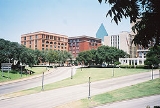
Dealey Plaza in the historic
West EndThe West End Historic District is an area in northwest downtown Dallas, Texas , generally north of Commerce, east of I-35E, west of Lamar and south of Woodall Rodgers Freeway. It is south of Victory Park, west of the Arts, City Center, and Main Street districts, and north of the Government and...
district of
downtownDowntown Dallas is the Central Business District in Dallas, Texas USA, located in the geographic center of the city. The area termed "Downtown" has traditionally been defined as bounded by the downtown freeway loop: bounded on the east by I-345 Downtown Dallas is the Central Business District...
DallasDallas is the third-largest city in Texas and the ninth-largest in the United States. The Dallas-Fort Worth Metroplex is the largest metropolitan area in the South and fourth-largest metropolitan area in the United States...
,
TexasTexas is the second largest U.S. state by both area and population, and the largest state by area in the contiguous United States.The name, based on the Caddo word "Tejas" meaning "friends" or "allies", was applied by the Spanish to the Caddo themselves and to the region of their settlement in...
(
U.S.The United States of America is a federal constitutional republic comprising fifty states and a federal district...
), is the location of the
assassination of John F. KennedyJohn Fitzgerald Kennedy, the thirty-fifth President of the United States, was assassinated at 12:30 p.m. Central Standard Time on Friday, November 22, 1963, in Dealey Plaza, Dallas, Texas...
on November 22, 1963. The
Dealey Plaza Historic District was named a
National Historic LandmarkA National Historic Landmark is a building, site, structure, object, or district, that is officially recognized by the United States government for its historical significance...
in 1993 to preserve Dealey Plaza, street rights-of-way, and buildings and structures by the plaza visible from the assassination site, that have been identified as witness locations or as possible assassin locations.
History
Dealey Plaza is a Dallas city park, land donated by early Dallas philanthropist and business person, Sarah Horton Cockrell, completed in 1940 as a
WPAThe Works Progress Administration was the largest and most ambitious New Deal agency, employing millions of unskilled workers to carry out public works projects, including the construction of public buildings and roads, and operated large arts, drama, media, and literacy projects...
project on the west edge of downtown Dallas where three streets converge (
Main StreetThe Main Street District of downtown Dallas, Texas runs along Main Street and is bounded by Lamar Street, Elm Street,the US 75/I-45 elevated highway and Commerce Street. The district is the spine of downtown Dallas, and connects many of the adjoining business and entertainment districts.- About...
, Elm Street, and Commerce Street) to pass under a railroad bridge known locally as the triple underpass. The plaza is named for
George Bannerman DealeyGeorge Bannerman Dealey was a Dallas, Texas, businessman.Dealey was the long-time publisher of The Dallas Morning News. He used his influence to accomplish many goals but will always be remembered primarily for one of them. He crusaded for the redevelopment of a particularly blighted area near...
(1859–1946), an early publisher of the
Dallas Morning NewsThe Dallas Morning News is the major daily newspaper serving the Dallas, Texas area, with a circulation of 264,459 subscribers, the Audit Bureau of Circulations reported in September 2010...
and civic leader, and the man who had campaigned for the area's revitalization. Many assume the monuments outlining the plaza are there to honor
PresidentThe President of the United States of America is the head of state and head of government of the United States. The president leads the executive branch of the federal government and is the commander-in-chief of the United States Armed Forces....
Kennedy, but they actually honor previous prominent Dallas residents and predate President Kennedy's visit by many years. The actual Dallas monument to Kennedy, in the form of a
cenotaphA cenotaph is an "empty tomb" or a monument erected in honour of a person or group of people whose remains are elsewhere. It can also be the initial tomb for a person who has since been interred elsewhere. The word derives from the Greek κενοτάφιον = kenotaphion...
, is located one block away.
Kennedy assassination
Dealey Plaza is bounded on the south, east, and north sides by 100+ foot (30+ m) tall buildings. One of those buildings is the former
Texas School Book DepositoryThe Texas School Book Depository is the former name of a seven-floor building facing Dealey Plaza in Dallas, Texas . Located on the northwest corner of Elm and North Houston Streets, at the western end of downtown Dallas, its address is 411 Elm Street. The building is notable for its connection to...
building, from which, both the
Warren CommissionThe President's Commission on the Assassination of President Kennedy, known unofficially as the Warren Commission, was established on November 27, 1963, by Lyndon B. Johnson to investigate the assassination of United States President John F. Kennedy on November 22, 1963...
and the House Select Committee on Assassinations concluded,
Lee Harvey OswaldLee Harvey Oswald was, according to four government investigations,These were investigations by: the Federal Bureau of Investigation , the Warren Commission , the House Select Committee on Assassinations , and the Dallas Police Department. the sniper who assassinated John F...
fired a rifle that killed President John F. Kennedy. There is also a grassy knoll on the northwest side of the plaza, from which, the House Select Committee on Assassinations determined, based on controversial and disputed acoustic analysis, there was a "high probability" that a second gunman also fired at President Kennedy, but missed. At the plaza's west perimeter is a triple underpass beneath a railroad bridge, under which the motorcade raced after the shots were fired.
Today, the plaza is typically filled with tourists visiting the assassination site and The Sixth Floor Museum that now occupies the top two floors of the seven story former Book Depository. Since 1989, more than 6 million people have visited the museum.
The
National Park ServiceThe National Park Service is the U.S. federal agency that manages all national parks, many national monuments, and other conservation and historical properties with various title designations...
designated Dealey Plaza a National Historic Landmark District in 1993, roughly encompassing the area between Pacific Avenue, Market and Jackson Streets and the former railroad tracks. Therefore, nothing of significance has been torn down or rebuilt in the immediate area. (A small plaque commemorating the assassination exists in the plaza.)
Visitors to Dealey Plaza today will see street lights and street signs that were in use in 1963, though some have been moved to different locations and others removed entirely. Buildings immediately surrounding the plaza have not been changed since 1963, presenting a stark contrast to the ultra-modern Dallas skyline that rises behind it.
Over the last 40+ years, Elm Street has been resurfaced several times; street lane stripes have been relocated; sidewalk lamp posts have been moved and added; trees, bushes and hedges have grown; and some traffic sign locations have been changed, relocated or removed. In late 2003, the city of Dallas approved construction project plans to restore Dealey Plaza to its exact appearance on November 22, 1963. , voters had approved
US$The United States dollar , also referred to as the American dollar, is the official currency of the United States of America. It is divided into 100 smaller units called cents or pennies....
500,000 of the $3,000,000 needed.
Grassy knoll
The grassy
knollA hillock or knoll is a small hill, usually separated from a larger group of hills such as a range. Hillocks are similar in their distribution and size to small mesas or buttes. The term is largely a British one...
of Dealey Plaza is a small, sloping hill inside the plaza that became famous following the
John F. Kennedy assassinationJohn Fitzgerald Kennedy, the thirty-fifth President of the United States, was assassinated at 12:30 p.m. Central Standard Time on Friday, November 22, 1963, in Dealey Plaza, Dallas, Texas...
. The knoll was above
President KennedyJohn Fitzgerald "Jack" Kennedy , often referred to by his initials JFK, was the 35th President of the United States, serving from 1961 until his assassination in 1963....
and to his right (west and north) during the assassination on November 22, 1963.
The north grassy knoll is bounded by the former Texas School Book Depository building along the Elm Street abutment side street to the northeast, Elm Street and a sidewalk to the south, a parking lot to the north and east and a railroad bridge atop the triple underpass convergence of Commerce, Main and Elm streets to the west.
Located near the north grassy knoll on November 22, 1963, were several witnesses, three large traffic signposts, four sidewalk lamp posts, the
John Neely BryanJohn Neely Bryan was a Presbyterian farmer, lawyer, and tradesman in the United States and founder of the city of Dallas, Texas.- Early life :...
north
pergolaA pergola, arbor or arbour is a garden feature forming a shaded walkway, passageway or sitting area of vertical posts or pillars that usually support cross-beams and a sturdy open lattice, often upon which woody vines are trained...
concrete structure including its two enclosed shelters, a tool shed, one 3.3 foot (1 m) high concrete wall connected to each of the pergola shelters, ten tall, wide, low-hanging live oak trees, a 5 foot (1.5 m) tall, wooden, cornered, stockade fenceline approximately 169 feet (53.6 m) long, six street curb sewers openings, their sewer manholes and their interconnecting large pipes and numerous 2 to 6 foot (0.6 to 1.8 m) tall bushes, trees and hedges.
Behind the stockade fence was a train control tower in which
Lee BowersLee Edward Bowers, Jr. was a key witness to the assassination of John F. Kennedy in Dallas, Texas in 1963. At the moment of the assassination he was operating the Union Terminal Company's two-story interlocking tower, overlooking the parking lot just north of the grassy knoll and west of the Texas...
was working during the assassination. Bowers testified to the Warren Commission that at the time the motorcade went by on Elm Street, he saw two men in the area of the stockade fence, standing 10 to 15 feet (3 to 5 m) apart near the triple underpass, who did not appear to know each other. One or both were still there when the first police officer arrived "immediately" after the shooting. Two years later, in an interview for the documentary film
Rush to JudgmentRush to Judgment is a book by American lawyer Mark Lane. It is about the assassination of U.S. President John F. Kennedy and takes issue with the conclusions of the Warren Commission, suggesting there was a conspiracy to assassinate John F...
, Bowers clarified that the two men were standing between the pergola and the stockade fence, and that no one was behind the fence at the time the shots were fired.
On the knoll itself were nine witnesses: groundskeeper
Emmett HudsonEmmett Joseph Hudson was a witness to the assassination of U.S. President John F. Kennedy in Dallas, Texas, on 22 November 1963....
, and two unidentified men, standing on the stairs of a walk going from Elm Street to a parking lot; an unidentified young couple having lunch on a bench in an alcove along that same walk, who may have left prior to the assassination;
Abraham ZapruderAbraham Zapruder was an American manufacturer of women's clothing. He was filming with a home-movie camera as U.S. President John F...
and his employee
Marilyn SitzmanMarilyn Sitzman was a witness to the assassination of U.S. President John F. Kennedy in Dallas, Texas on November 22, 1963...
, standing on a pedestal on the west end of the pergola; and Zapruder employee Beatrice Hester and her husband Charles, standing by and sitting on a bench at the other end of the pergola. Emmett Hudson, Charles Hester, and Marilyn Sitzman, the three witnesses on the grassy knoll who are on record about the direction of shots, all said that the shots came from the direction of the Texas School Book Depository.
Of the 104 earwitness reports published by the Commission and elsewhere, 56 recorded testimony to the effect that they heard shots from the direction of the Depository to the rear of the President, 35 recorded testimony of shots from the direction of the knoll or the triple underpass to the right or front of the President, and five earwitnesses were reported testifying that the shots came from two directions.
Persistent Grassy Knoll theories stem also from studies of recorded police-radio transmissions, which recorded sounds from Dealey Plaza in the moments during and after the assassination.
Because of persistent debate, answered and unanswered questions, and conspiracy theories surrounding the Kennedy assassination and the possible related role of the grassy knoll, the term "grassy knoll" has come to also be a modern
slangSlang is the use of informal words and expressions that are not considered standard in the speaker's language or dialect but are considered more acceptable when used socially. Slang is often to be found in areas of the lexicon that refer to things considered taboo...
expression indicating suspicion, conspiracy, or a cover-up.
Further reading
(Best summary of not only the how of the assassination, but more important, the motive for removing JFK from office -- he had changed his mind on the Cold War and nuclear arms race). (includes history of Dealey Plaza). (pp. 238–242, unraveling of acoustic evidence in JFK conspiracy finding). (pp. 1,648. The most complete, exhaustive study of every angle and conspiracy theory about the assassination, winner of the Edgar Award True Fact/Crime category in 2007).
External links

- Cirrusimage.com, Dealey Plaza stock photography, Creative Commons licensed.
- TexasTwisted.com, : JFK Assassination Tour with color photos of Dealey Plaza.
- Imageshack.us, Roberdeau scaled map of Dealey Plaza.
- Bravehost.com, Bronson photo #5 of the eastern half of the grassy knoll during the assassination.
- Bravehost.com, Willis photo #5 of the western two-thirds of the grassy knoll during the assassination.
- MU.edu, Dallas to Dealey: The History of Dallas and Dealey Plaza.
- Prodigy.net, Dr. Thomas study of the grassy knoll shot, November 2001.
- Prodigy.net, Dr. Thomas study of the grassy knoll shot, September 2002.
- OOcities.com, Dr. Thomas study of the grassy knoll shot, November 2002.
- Prodigy.net, Dr. Thomas study of the grassy knoll shot, December 2003; Court-tv rebuttal.
- MU.edu, The Man Who Named the Grassy Knoll, by Gary Mack of Sixth Floor Museum at Dealey Plaza.
- Assassinationscience.com, Composite panorama of Dealey Plaza, by John Costella, using Zapruder film frames, Dallas Police Department photos taken in 1963, and photos by Jack White.
- http://www.escapekeygraphics.com/panoramics/dealey_plaza/zapruder_perch/, Panoramic photo shot from Zapruder's Perch.
- http://www.escapekeygraphics.com/panoramics/dealey_plaza/grassy_knoll/, Panoramic photo shot from The Grassy Knoll.