

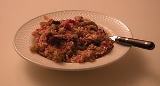
Jambalaya

Encyclopedia
Jambalaya is a Louisiana Creole dish of Spanish and French influence. 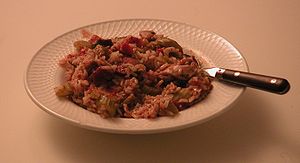
. It is also a close cousin to the saffron colored paella
found in Spanish culture. There are two primary methods of making jambalaya.
The first and most common is Creole
jambalaya (also called "red jambalaya"). First, meat is added to the trinity
of celery, peppers, and onions; the meat is usually chicken
and sausage
such as andouille
or smoked sausage. Next vegetables and tomatoes are added to cook, followed by seafood
. Rice and stock
are added in equal proportions at the very end. The mixture is brought to a boil and left to simmer for 20 to 60 minutes, depending on the recipe, with infrequent stirring. Towards the end of the cooking process, stirring usually ceases.
Some versions call for the jambalaya to be baked after the cooking of all the ingredients.
The second style, more characteristic of southwestern and south-central Louisiana, is Cajun
jambalaya, which contains no tomatoes (the idea being the closer to New Orleans one gets, the more common tomatoes are in dishes). The meat is browned in a cast-iron pot. The bits of meat that stick to the bottom of the pot are what give a Cajun jambalaya its brown color. A little vegetable oil is added if there is not enough fat in the pot. The trinity (of 50% onions, 25% celery
, and 25% green bell pepper
, although proportions can be altered to suit one's taste) is added and sautéed until soft. Stock and seasonings are added in the next step, and then the meats are returned to the pot. This mixture is then simmered, covered, for at least one hour. Lastly, the mixture is brought to a boil and rice is added to the pot. It is then covered and left to simmer over very low heat for at least 1/2 hour without stirring. The dish is finished when the rice has cooked.
A third method is less common. In this version, meat and vegetables are cooked separately from the rice. At the same time, rice is cooked in a savory stock. It is added to the meat and vegetables before serving. This is called "white jambalaya." This dish is rare in Louisiana as it is seen as a "quick" attempt to make jambalaya, popularized outside the state to shorten cooking time.
Jambalaya is considered by most Louisianans to be a filling but simple-to-prepare rice dish; gumbo
s, étouffée
s, and creoles
are considered more difficult to perfect. Most often a long grain white rice is used in making jambalaya.
Jambalaya is differentiated from gumbo and étouffée by the way in which the rice is included. In these dishes, the rice is cooked separately and is served as a bed on which the main dish is served. In the usual method of preparing jambalaya, a rich stock is created from vegetables, meat, and seafood; raw rice is then added to the broth and the flavor is absorbed by the grains as the rice cooks.
of New Orleans, in the original European sector. It was an attempt by the Spanish to make paella
in the New World, where saffron
was not readily available due to import costs. Tomatoes became the substitute for saffron. As time went on, French influence became strong in New Orleans, and spices from the Caribbean
changed this New World paella into a unique dish. In modern Louisiana, the dish has evolved along a variety of different lines. Creole jambalaya, or red jambalaya as it is called by Cajuns, is found primarily in and around New Orleans, where it is simply known as 'jambalaya'. Creole jambalaya includes tomatoes, whereas Cajun jambalaya does not.
Cajun Jambalaya originates from Louisiana's rural, low-lying swamp
country where crawfish, shrimp
, oysters, alligator
, duck
, turtle
, boar
, venison
, nutria
and other game
were readily available. Any variety or combination of meats, including chicken
or turkey
may be used to make jambalaya. Cajun jambalaya is known as 'Brown jambalaya' in the New Orleans area; to Cajuns it is simply known as 'jambalaya.' Cajun jambalaya has more of a smoky and spicy flavor than its cousin Creole jambalaya. The white French Creoles introduced jambalaya to the Cajuns, but since tomatoes were rarely used in Cajun cooking, they omitted them, browning the meat for color instead.
The first appearance in print of any variant of the word 'jambalaya' in any language occurred in Leis amours de Vanus; vo, Lou paysan oou théâtré, by Fortuné (Fortunat) Chailan, first published in Provençal in 1837. The earliest appearance of the word in print in English occurs in the May 1849 issue of the American Agriculturalist, page 161, where Solon Robinson refers to a recipe for 'Hopping Johnny (jambalaya)'. Jambalaya did not appear in a cookbook until 1878, when The Gulf City Cook Book, by the ladies of the St. Francis Street Methodist Church
, was printed in South Mobile, Alabama
. It contains a recipe for "JAM BOLAYA".
Jambalaya experienced a brief jump in popularity during the 1920s and 1930s because of its flexible recipe. The dish was little more than the rice and vegetables the populace could afford, but the recipe grew from humble roots.
During the third term of President Franklin D. Roosevelt
, the dish caused a feud between the president and friends of the Presidential family, the Richardsons of Virginia, because the family sent a dish to FDR, and the man had to refuse it, citing that he was allergic to crawfish.
In 1968, Louisiana Governor John J. McKeithen proclaimed Gonzales, Louisiana
, the Jambalaya Capital of the World. Every Spring
, the annual Jambalaya Festival is held in Gonzales.
The Oxford English Dictionary
indicates that 'jambalaya' comes from the Provençal word 'jambalaia', meaning a mish mash, or mixup, and also meaning a pilau (pilaf
) of rice. This is supported by the fact that the first printed appearance of the word is in a Provençal poem published in 1837.
There are many myths about the origin of the name 'jambalaya.' One commonly repeated folklore
is that the word derives from the combination of the French
'jambon' meaning ham, the French article 'à la', a contraction of 'à la manière de' meaning "in the style of", and 'ya', thought to be of West African origin meaning rice. Hence, the dish was named jamb à la ya. European explorers had imported rice from Asia
and Africa
. Enslaved Africans already had a native name for this crop; they called it 'ya'. As Europeans learned the term 'ya' for rice, it became included in the name of the dish. However, this theory is largely discredited. Ham is not the signature element of the dish, so there is no reason why it would be featured in the name. Furthermore, there is no known African language in which 'ya' means "rice."
Another popular source suggests that the word comes from the Spanish
'jamon' ("ham") + 'paella', a noted Spanish rice dish. However, the evidence for this idea is also thin. Again, ham is not a featured element of the dish, and Spanish speakers would call a ham paella 'paella con jamon', not 'jamon paella.'
The Dictionary of American Food and Drink offers this creative old wives' tale
about the origin of the word:
Jambalaya varieties
Jambalaya is traditionally made in three parts, with meats and vegetables, and is completed by adding stock and riceRice
Rice is the seed of the monocot plants Oryza sativa or Oryza glaberrima . As a cereal grain, it is the most important staple food for a large part of the world's human population, especially in East Asia, Southeast Asia, South Asia, the Middle East, and the West Indies...
. It is also a close cousin to the saffron colored paella
Paella
Paella is a Valencian rice dish that originated in its modern form in the mid-19th century near lake Albufera, a lagoon in Valencia, on the east coast of Spain. Many non-Spaniards view paella as Spain's national dish, but most Spaniards consider it to be a regional Valencian dish...
found in Spanish culture. There are two primary methods of making jambalaya.
The first and most common is Creole
Louisiana Creole cuisine
Louisiana Creole cuisine is a style of cooking originating in Louisiana which blends French, Spanish, Portuguese, Italian, Greek, Asian Indian, Native American, and African influences, as well as general Southern cuisine...
jambalaya (also called "red jambalaya"). First, meat is added to the trinity
Holy trinity (cuisine)
The holy trinity is the Cajun and Louisiana Creole variant of mirepoix: onions, bell peppers, and celery in roughly equal quantities. This mirepoix is the base for much of the cooking in the regional cuisines of Louisiana...
of celery, peppers, and onions; the meat is usually chicken
Chicken
The chicken is a domesticated fowl, a subspecies of the Red Junglefowl. As one of the most common and widespread domestic animals, and with a population of more than 24 billion in 2003, there are more chickens in the world than any other species of bird...
and sausage
Sausage
A sausage is a food usually made from ground meat , mixed with salt, herbs, and other spices, although vegetarian sausages are available. The word sausage is derived from Old French saussiche, from the Latin word salsus, meaning salted.Typically, a sausage is formed in a casing traditionally made...
such as andouille
Andouille
Andouille is defined as a coarse-grained smoked sausage made using pork, pepper, onions, wine, and seasonings. Andouille is French in origin, and was later brought to the United States through Louisiana by French immigrants. In the United States, the sausage is most often associated with Cajun...
or smoked sausage. Next vegetables and tomatoes are added to cook, followed by seafood
Seafood
Seafood is any form of marine life regarded as food by humans. Seafoods include fish, molluscs , crustaceans , echinoderms . Edible sea plants, such as some seaweeds and microalgae, are also seafood, and are widely eaten around the world, especially in Asia...
. Rice and stock
Stock (food)
Stock is a flavoured water preparation. It forms the basis of many dishes, particularly soups and sauces.- Preparation :Stock is made by simmering various ingredients in water, including some or all of the following...
are added in equal proportions at the very end. The mixture is brought to a boil and left to simmer for 20 to 60 minutes, depending on the recipe, with infrequent stirring. Towards the end of the cooking process, stirring usually ceases.
Some versions call for the jambalaya to be baked after the cooking of all the ingredients.
The second style, more characteristic of southwestern and south-central Louisiana, is Cajun
Cajun
Cajuns are an ethnic group mainly living in the U.S. state of Louisiana, consisting of the descendants of Acadian exiles...
jambalaya, which contains no tomatoes (the idea being the closer to New Orleans one gets, the more common tomatoes are in dishes). The meat is browned in a cast-iron pot. The bits of meat that stick to the bottom of the pot are what give a Cajun jambalaya its brown color. A little vegetable oil is added if there is not enough fat in the pot. The trinity (of 50% onions, 25% celery
Celery
Apium graveolens is a plant species in the family Apiaceae commonly known as celery or celeriac , depending on whether the petioles or roots are eaten: celery refers to the former and celeriac to the latter. Apium graveolens grows to 1 m tall...
, and 25% green bell pepper
Bell pepper
Bell pepper, also known as sweet pepper or a pepper and capsicum , is a cultivar group of the species Capsicum annuum . Cultivars of the plant produce fruits in different colors, including red, yellow, orange and green. Bell peppers are sometimes grouped with less pungent pepper varieties as...
, although proportions can be altered to suit one's taste) is added and sautéed until soft. Stock and seasonings are added in the next step, and then the meats are returned to the pot. This mixture is then simmered, covered, for at least one hour. Lastly, the mixture is brought to a boil and rice is added to the pot. It is then covered and left to simmer over very low heat for at least 1/2 hour without stirring. The dish is finished when the rice has cooked.
A third method is less common. In this version, meat and vegetables are cooked separately from the rice. At the same time, rice is cooked in a savory stock. It is added to the meat and vegetables before serving. This is called "white jambalaya." This dish is rare in Louisiana as it is seen as a "quick" attempt to make jambalaya, popularized outside the state to shorten cooking time.
Jambalaya is considered by most Louisianans to be a filling but simple-to-prepare rice dish; gumbo
Gumbo
Gumbo is a stew or soup that originated in southern Louisiana during the 18th century. It consists primarily of a strongly-flavored stock, meat or shellfish, a thickener, and the vegetable holy trinity of celery, bell peppers, and onions...
s, étouffée
Étouffée
Étouffée or etouffee is a dish found in both Cajun and creole cusine typically served with shellfish over rice. It is most popular in New Orleans and in the bayou country of the southernmost half of Louisiana.-Etymology:...
s, and creoles
Shrimp Creole
Shrimp creole is a dish of Louisiana Creole origin , consisting of cooked shrimp in a mixture of whole or diced tomatoes, onion, celery and bell pepper, spiced with Tabasco sauce or another hot pepper sauce and/or cayenne-based seasoning, and served over steamed or boiled white rice...
are considered more difficult to perfect. Most often a long grain white rice is used in making jambalaya.
Jambalaya is differentiated from gumbo and étouffée by the way in which the rice is included. In these dishes, the rice is cooked separately and is served as a bed on which the main dish is served. In the usual method of preparing jambalaya, a rich stock is created from vegetables, meat, and seafood; raw rice is then added to the broth and the flavor is absorbed by the grains as the rice cooks.
History
Creole jambalaya originates from the French QuarterFrench Quarter
The French Quarter, also known as Vieux Carré, is the oldest neighborhood in the city of New Orleans. When New Orleans was founded in 1718 by Jean-Baptiste Le Moyne de Bienville, the city was originally centered on the French Quarter, or the Vieux Carré as it was known then...
of New Orleans, in the original European sector. It was an attempt by the Spanish to make paella
Paella
Paella is a Valencian rice dish that originated in its modern form in the mid-19th century near lake Albufera, a lagoon in Valencia, on the east coast of Spain. Many non-Spaniards view paella as Spain's national dish, but most Spaniards consider it to be a regional Valencian dish...
in the New World, where saffron
Saffron
Saffron is a spice derived from the flower of Crocus sativus, commonly known as the saffron crocus. Crocus is a genus in the family Iridaceae. Each saffron crocus grows to and bears up to four flowers, each with three vivid crimson stigmas, which are each the distal end of a carpel...
was not readily available due to import costs. Tomatoes became the substitute for saffron. As time went on, French influence became strong in New Orleans, and spices from the Caribbean
Caribbean
The Caribbean is a crescent-shaped group of islands more than 2,000 miles long separating the Gulf of Mexico and the Caribbean Sea, to the west and south, from the Atlantic Ocean, to the east and north...
changed this New World paella into a unique dish. In modern Louisiana, the dish has evolved along a variety of different lines. Creole jambalaya, or red jambalaya as it is called by Cajuns, is found primarily in and around New Orleans, where it is simply known as 'jambalaya'. Creole jambalaya includes tomatoes, whereas Cajun jambalaya does not.
Cajun Jambalaya originates from Louisiana's rural, low-lying swamp
Swamp
A swamp is a wetland with some flooding of large areas of land by shallow bodies of water. A swamp generally has a large number of hammocks, or dry-land protrusions, covered by aquatic vegetation, or vegetation that tolerates periodical inundation. The two main types of swamp are "true" or swamp...
country where crawfish, shrimp
Shrimp
Shrimp are swimming, decapod crustaceans classified in the infraorder Caridea, found widely around the world in both fresh and salt water. Adult shrimp are filter feeding benthic animals living close to the bottom. They can live in schools and can swim rapidly backwards. Shrimp are an important...
, oysters, alligator
Alligator
An alligator is a crocodilian in the genus Alligator of the family Alligatoridae. There are two extant alligator species: the American alligator and the Chinese alligator ....
, duck
Duck
Duck is the common name for a large number of species in the Anatidae family of birds, which also includes swans and geese. The ducks are divided among several subfamilies in the Anatidae family; they do not represent a monophyletic group but a form taxon, since swans and geese are not considered...
, turtle
Turtle
Turtles are reptiles of the order Testudines , characterised by a special bony or cartilaginous shell developed from their ribs that acts as a shield...
, boar
Boar
Wild boar, also wild pig, is a species of the pig genus Sus, part of the biological family Suidae. The species includes many subspecies. It is the wild ancestor of the domestic pig, an animal with which it freely hybridises...
, venison
Venison
Venison is the meat of a game animal, especially a deer but also other animals such as antelope, wild boar, etc.-Etymology:The word derives from the Latin vēnor...
, nutria
Coypu
The coypu , , also known as the river rat, and nutria, is a large, herbivorous, semiaquatic rodent and the only member of the family Myocastoridae. Originally native to subtropical and temperate South America, it has since been introduced to North America, Europe, Asia, and Africa, primarily by...
and other game
Game (food)
Game is any animal hunted for food or not normally domesticated. Game animals are also hunted for sport.The type and range of animals hunted for food varies in different parts of the world. This will be influenced by climate, animal diversity, local taste and locally accepted view about what can or...
were readily available. Any variety or combination of meats, including chicken
Chicken
The chicken is a domesticated fowl, a subspecies of the Red Junglefowl. As one of the most common and widespread domestic animals, and with a population of more than 24 billion in 2003, there are more chickens in the world than any other species of bird...
or turkey
Turkey
Turkey , known officially as the Republic of Turkey , is a Eurasian country located in Western Asia and in East Thrace in Southeastern Europe...
may be used to make jambalaya. Cajun jambalaya is known as 'Brown jambalaya' in the New Orleans area; to Cajuns it is simply known as 'jambalaya.' Cajun jambalaya has more of a smoky and spicy flavor than its cousin Creole jambalaya. The white French Creoles introduced jambalaya to the Cajuns, but since tomatoes were rarely used in Cajun cooking, they omitted them, browning the meat for color instead.
The first appearance in print of any variant of the word 'jambalaya' in any language occurred in Leis amours de Vanus; vo, Lou paysan oou théâtré, by Fortuné (Fortunat) Chailan, first published in Provençal in 1837. The earliest appearance of the word in print in English occurs in the May 1849 issue of the American Agriculturalist, page 161, where Solon Robinson refers to a recipe for 'Hopping Johnny (jambalaya)'. Jambalaya did not appear in a cookbook until 1878, when The Gulf City Cook Book, by the ladies of the St. Francis Street Methodist Church
St. Francis Street Methodist Church
St. Francis Street Methodist Church, officially St. Francis Street United Methodist Church, is a historic United Methodist Church building in Mobile, Alabama, United States. The current structure was built in 1896 by the architectural firm of Watkins and Johnson. It was placed on the National...
, was printed in South Mobile, Alabama
Mobile, Alabama
Mobile is the third most populous city in the Southern US state of Alabama and is the county seat of Mobile County. It is located on the Mobile River and the central Gulf Coast of the United States. The population within the city limits was 195,111 during the 2010 census. It is the largest...
. It contains a recipe for "JAM BOLAYA".
Jambalaya experienced a brief jump in popularity during the 1920s and 1930s because of its flexible recipe. The dish was little more than the rice and vegetables the populace could afford, but the recipe grew from humble roots.
During the third term of President Franklin D. Roosevelt
Franklin D. Roosevelt
Franklin Delano Roosevelt , also known by his initials, FDR, was the 32nd President of the United States and a central figure in world events during the mid-20th century, leading the United States during a time of worldwide economic crisis and world war...
, the dish caused a feud between the president and friends of the Presidential family, the Richardsons of Virginia, because the family sent a dish to FDR, and the man had to refuse it, citing that he was allergic to crawfish.
In 1968, Louisiana Governor John J. McKeithen proclaimed Gonzales, Louisiana
Gonzales, Louisiana
Gonzales is a city in Ascension Parish, Louisiana, United States. The population was 8,156 at the 2000 census. It has been called the "jambalaya capital of the world" and is famous for its annual Jambalaya Festival. Gonzales is part of the Baton Rouge Metropolitan Statistical Area.State...
, the Jambalaya Capital of the World. Every Spring
Spring (season)
Spring is one of the four temperate seasons, the transition period between winter and summer. Spring and "springtime" refer to the season, and broadly to ideas of rebirth, renewal and regrowth. The specific definition of the exact timing of "spring" varies according to local climate, cultures and...
, the annual Jambalaya Festival is held in Gonzales.
Etymology
Oxford English Dictionary
The Oxford English Dictionary , published by the Oxford University Press, is the self-styled premier dictionary of the English language. Two fully bound print editions of the OED have been published under its current name, in 1928 and 1989. The first edition was published in twelve volumes , and...
indicates that 'jambalaya' comes from the Provençal word 'jambalaia', meaning a mish mash, or mixup, and also meaning a pilau (pilaf
Pilaf
Pilaf is a dish in which rice is cooked in a seasoned broth . In some cases, the rice may also attain its brown color by being stirred with bits of cooked onion, as well as a large mix of spices...
) of rice. This is supported by the fact that the first printed appearance of the word is in a Provençal poem published in 1837.
There are many myths about the origin of the name 'jambalaya.' One commonly repeated folklore
Folklore
Folklore consists of legends, music, oral history, proverbs, jokes, popular beliefs, fairy tales and customs that are the traditions of a culture, subculture, or group. It is also the set of practices through which those expressive genres are shared. The study of folklore is sometimes called...
is that the word derives from the combination of the French
French language
French is a Romance language spoken as a first language in France, the Romandy region in Switzerland, Wallonia and Brussels in Belgium, Monaco, the regions of Quebec and Acadia in Canada, and by various communities elsewhere. Second-language speakers of French are distributed throughout many parts...
'jambon' meaning ham, the French article 'à la', a contraction of 'à la manière de' meaning "in the style of", and 'ya', thought to be of West African origin meaning rice. Hence, the dish was named jamb à la ya. European explorers had imported rice from Asia
Asia
Asia is the world's largest and most populous continent, located primarily in the eastern and northern hemispheres. It covers 8.7% of the Earth's total surface area and with approximately 3.879 billion people, it hosts 60% of the world's current human population...
and Africa
Africa
Africa is the world's second largest and second most populous continent, after Asia. At about 30.2 million km² including adjacent islands, it covers 6% of the Earth's total surface area and 20.4% of the total land area...
. Enslaved Africans already had a native name for this crop; they called it 'ya'. As Europeans learned the term 'ya' for rice, it became included in the name of the dish. However, this theory is largely discredited. Ham is not the signature element of the dish, so there is no reason why it would be featured in the name. Furthermore, there is no known African language in which 'ya' means "rice."
Another popular source suggests that the word comes from the Spanish
Spanish language
Spanish , also known as Castilian , is a Romance language in the Ibero-Romance group that evolved from several languages and dialects in central-northern Iberia around the 9th century and gradually spread with the expansion of the Kingdom of Castile into central and southern Iberia during the...
'jamon' ("ham") + 'paella', a noted Spanish rice dish. However, the evidence for this idea is also thin. Again, ham is not a featured element of the dish, and Spanish speakers would call a ham paella 'paella con jamon', not 'jamon paella.'
The Dictionary of American Food and Drink offers this creative old wives' tale
Old wives' tale
An old wives' tale is a type of urban legend, similar to a proverb, which is generally passed down by old wives to a younger generation. Such "tales" usually consist of superstition, folklore or unverified claims with exaggerated and/or untrue details. Today old wives' tales are still common among...
about the origin of the word:
Late one evening a traveling gentleman stopped by a New Orleans inn which had little food remaining from the evening meal. The traveler instructed the cook, "Jean, balayez!" or "Jean, sweep something together!" in the local dialect. The guest pronounced the resulting hodge-podge dish as "Jean balayez."
Native American claim
The Atakapa tribe claims the origin of the name. The original word "Sham, pal ha! Ya!" means "Be full, not skinny! Eat Up!" with a French equivalent of "Bon appetit!". Spanish influence resulted in the current spelling of the name.See also
Similar dishes:- Arroz con PolloArroz con polloArroz con pollo is a traditional dish of Latin America and the Caribbean, especially in Cuba, Colombia, Ecuador, Panama, Peru, Puerto Rico, Costa Rica, Honduras and the Dominican Republic....
, Arroz con gandulesArroz con gandulesArroz con gandules is a combination of rice, pigeon peas and pork, cooked in the same pot with Puerto Rican-style sofrito. This is the signature dish of Puerto Rican culture and also has become very popular throughout Latin America and the Caribbean....
(Latin AmericaLatin AmericaLatin America is a region of the Americas where Romance languages – particularly Spanish and Portuguese, and variably French – are primarily spoken. Latin America has an area of approximately 21,069,500 km² , almost 3.9% of the Earth's surface or 14.1% of its land surface area...
) - Biriani (South AsiaSouth AsiaSouth Asia, also known as Southern Asia, is the southern region of the Asian continent, which comprises the sub-Himalayan countries and, for some authorities , also includes the adjoining countries to the west and the east...
) - Fried RiceFried riceFried rice is a popular component of Asian cuisine, especially Chinese food. It is made from steamed rice stir-fried in a wok, often with other ingredients such as eggs, vegetables, and meat. It is sometimes served as the penultimate dish in Chinese banquets...
(East AsiaEast AsiaEast Asia or Eastern Asia is a subregion of Asia that can be defined in either geographical or cultural terms...
) - Jollof riceJollof riceJollof rice, also called 'Benachin' meaning one pot in the Wolof language, is a popular dish all over West Africa. It is thought to have originated in The Gambia but has since spread to the whole of West Africa, especially Nigeria and Ghana amongst members of the Wolof ethnic group.There are many...
(West AfricaWest AfricaWest Africa or Western Africa is the westernmost region of the African continent. Geopolitically, the UN definition of Western Africa includes the following 16 countries and an area of approximately 5 million square km:-Flags of West Africa:...
) - KabsaKabsaKabsa is a family of rice dishes that are served mostly in Saudi Arabia — where it is commonly regarded as a national dish — and the other Arab states of the Persian Gulf. Kabsa, though, is believed to be indigenous to Yemen...
(Saudi ArabiaSaudi ArabiaThe Kingdom of Saudi Arabia , commonly known in British English as Saudi Arabia and in Arabic as as-Sa‘ūdiyyah , is the largest state in Western Asia by land area, constituting the bulk of the Arabian Peninsula, and the second-largest in the Arab World...
) - KedgereeKedgereeKedgeree is a dish consisting of cooked, flaked fish , boiled rice, parsley, hard-boiled eggs, curry powder, butter or cream and occasionally sultanas.Kedgeree is thought to have originated with an Indian rice-and-bean or rice-and-lentil dish Khichri, traced back to 1340 or...
(United KingdomUnited KingdomThe United Kingdom of Great Britain and Northern IrelandIn the United Kingdom and Dependencies, other languages have been officially recognised as legitimate autochthonous languages under the European Charter for Regional or Minority Languages...
) - Nasi GorengNasi gorengNasi goreng, literally meaning "fried rice" in Indonesian, can refer simply to fried pre-cooked rice, a meal including stir fried rice in small amount of cooking oil or margarine, typically spiced with kecap manis , shallot, garlic, tamarind and chilli and accompanied with other ingredients,...
(IndonesiaIndonesiaIndonesia , officially the Republic of Indonesia , is a country in Southeast Asia and Oceania. Indonesia is an archipelago comprising approximately 13,000 islands. It has 33 provinces with over 238 million people, and is the world's fourth most populous country. Indonesia is a republic, with an...
) - PaellaPaellaPaella is a Valencian rice dish that originated in its modern form in the mid-19th century near lake Albufera, a lagoon in Valencia, on the east coast of Spain. Many non-Spaniards view paella as Spain's national dish, but most Spaniards consider it to be a regional Valencian dish...
(SpainSpainSpain , officially the Kingdom of Spain languages]] under the European Charter for Regional or Minority Languages. In each of these, Spain's official name is as follows:;;;;;;), is a country and member state of the European Union located in southwestern Europe on the Iberian Peninsula...
) - PilafPilafPilaf is a dish in which rice is cooked in a seasoned broth . In some cases, the rice may also attain its brown color by being stirred with bits of cooked onion, as well as a large mix of spices...
/Pilau (GreeceGreeceGreece , officially the Hellenic Republic , and historically Hellas or the Republic of Greece in English, is a country in southeastern Europe....
, BalkansBalkansThe Balkans is a geopolitical and cultural region of southeastern Europe...
, TurkeyTurkeyTurkey , known officially as the Republic of Turkey , is a Eurasian country located in Western Asia and in East Thrace in Southeastern Europe...
, IranIranIran , officially the Islamic Republic of Iran , is a country in Southern and Western Asia. The name "Iran" has been in use natively since the Sassanian era and came into use internationally in 1935, before which the country was known to the Western world as Persia...
, Central AsiaCentral AsiaCentral Asia is a core region of the Asian continent from the Caspian Sea in the west, China in the east, Afghanistan in the south, and Russia in the north...
, South AsiaSouth AsiaSouth Asia, also known as Southern Asia, is the southern region of the Asian continent, which comprises the sub-Himalayan countries and, for some authorities , also includes the adjoining countries to the west and the east...
) - Rice and peasRice and peasRice and Peas also called Moros de guandules con coco in the Dominican Republic.-Dominican Republic:Moros de guandules con coco is a traditional coconut rice and pigeon pea dish served on Christmas. Moros in Dominican cuisine is very similar to Jamaican rice and peas...
(CaribbeanCaribbeanThe Caribbean is a crescent-shaped group of islands more than 2,000 miles long separating the Gulf of Mexico and the Caribbean Sea, to the west and south, from the Atlantic Ocean, to the east and north...
) - RisottoRisottoRisotto is a class of Italian dishes of rice cooked in broth to a creamy consistency. The broth may be meat-, fish-, or vegetable-based; many kinds include Parmesan cheese, butter, and onion...
(ItalyItalyItaly , officially the Italian Republic languages]] under the European Charter for Regional or Minority Languages. In each of these, Italy's official name is as follows:;;;;;;;;), is a unitary parliamentary republic in South-Central Europe. To the north it borders France, Switzerland, Austria and...
)