

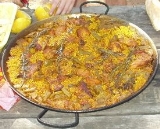
Paella

Encyclopedia
Paella is a Valencian
rice
dish that originated in its modern form in the mid-19th century near lake Albufera
, a lagoon
in Valencia, on the east coast of Spain
. Many non-Spaniards view paella as Spain's national dish
, but most Spaniards consider it to be a regional Valencian dish. Valencians, in turn, regard paella as one of their identifying symbols.
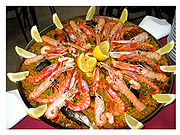
There are three widely known types of paella: Valencian paella , seafood paella and mixed paella , but there are many others as well. Valencian paella consists of white rice
, green vegetables, meat (rabbit
, chicken
, duck
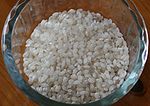
), land snails, beans and seasoning. Seafood paella replaces meat and snails with seafood and omits beans and green vegetables. Mixed paella is a free-style combination of meat, seafood, vegetables, and sometimes beans. Most paella chefs use calasparra
or bomba rices for this dish. Other key ingredients include saffron
and olive oil
.
word which derives from the Old French
word paelle for pan which in turn comes from the Latin word patella for pan as well. Patella is also akin to the modern French
poêle, the Welsh
padell, the Italian
padella, the Old Spanish
padilla, the Polish
patelnia, and the New Mexican Spanish
puela.
Valencians use the word paella for all pans
, including the specialized shallow pan used for cooking paellas. However, in most of Spain and throughout Latin America, the term paellera is more commonly used for this pan, though both terms are correct, as stated by the Royal Spanish Academy
, the body responsible for regulating the Spanish language. Paelleras are traditionally round, shallow and made of polished steel with two handles.
A popular but inaccurate belief in Arabic-speaking countries
is that the word paella derives from the Arabic
word for leftovers, baqiyah, (Arabic script: بقية) because it was customary among Arab sailors to combine leftovers of previous meals which purportedly led to a paella-like creation in Moorish Spain
.
 The people of Moorish Spain
often made casserole
s of rice, fish and spices for family gatherings and religious feasts, thus establishing the custom of eating rice in Spain. This led to rice becoming a staple by the 15th century when Spanish Catholics
expelled the Muslims
. Afterwards, it became customary for cooks to combine rice with vegetables, beans and dry cod, providing an acceptable meal for Lent
. Fish always predominated with rice along Spain's eastern coast.
. Water vole meat was one of the main ingredients of early paellas, along with eel
and butter beans. Novelist Vicente Blasco Ibáñez
described the Valencian custom of eating water voles in Cañas y Barro (1902), a realistic novel about life among the fishermen and peasants near lake Albufera.
Living standards rose with the sociological changes of the late 19th century in Spain, giving rise to reunions and outings in the countryside. This led to a change of paella's ingredients as well, these being rabbit
, chicken
, duck
and sometimes snails. This dish became so popular that in 1840 a local Spanish newspaper first used the word paella to refer to the recipe rather than the pan.
The most widely used, complete ingredient list of this era was as follows: short-grain white rice, chicken, rabbit, snails (optional), duck (optional), butter beans, great northern beans, runner beans, artichoke
(a substitute for runner beans in the winter), tomatoes, fresh rosemary
, sweet paprika
, saffron, garlic (optional), salt
, olive oil and water. (Poorer Valencians, however, sometimes used nothing more than snails for meat.) Valencians insist that only these ingredients go into making modern Valencian paella.
coast, Valencians used seafood instead of meat and beans to make paella. Valencians regard this recipe as authentic as well. Later, however, Spaniards living outside of Valencia combined these two recipes and mixed paella was born.
During the 20th century, paella's popularity spread past Spain's borders. As other cultures set out to make paella, the dish invariably acquired regional influences. Consequently, paella recipes went from being relatively simple to including a wide variety of seafood, meat, sausage, (even chorizo
)vegetables and many different seasonings. However, the most globally popular recipe is seafood paella.
In Spain, but not in Valencia, mixed paella is very popular. Some restaurants in Spain (and many in the United States) that serve this mixed version, refer to it as Valencian paella. However, Valencians insist only the original two Valencian recipes are authentic. They generally view all others as inferior, not genuine or even grotesque.
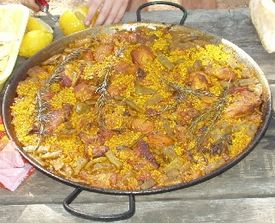 This recipe is standardized
because Valencians consider it traditional and very much part of their culture. Rice in Valencian paella is never braised in oil, as pilau
, though the paella made further southwest of Valencia often is.
 Recipes for this dish vary somewhat, even in Valencia. Below is a recipe by Juanry Segui, a prominent Valencian chef.
Valencian restaurateur Juan Galbis claims to have made the world's largest paella with help from a team of workers on 2 October 2001. This paella fed about 110,000 people according to Galbis' former website. Galbis says this paella was even larger than his earlier world-record paella made on 8 March 1992 which fed about 100,000 people. Galbis's record-breaking 1992 paella is listed in Guinness World Records
.
 Traditional Valencian cuisine offers recipes similar to paella valenciana and paella de marisco such as arròs negre, arròs al forn, arròs a banda and arròs amb fesols i naps. Fideuà
is a noodle dish variation of the paella cooked in a similar fashion, though it may be served with allioli
sauce.
The following is a list of other similar rice dishes:
Valencian Community
The Valencian Community is an autonomous community of Spain located in central and south-eastern Iberian Peninsula. Its capital and largest city is Valencia...
rice
Rice
Rice is the seed of the monocot plants Oryza sativa or Oryza glaberrima . As a cereal grain, it is the most important staple food for a large part of the world's human population, especially in East Asia, Southeast Asia, South Asia, the Middle East, and the West Indies...
dish that originated in its modern form in the mid-19th century near lake Albufera
Albufera
The Albufera is a saltwater lagoon and estuary on the Gulf of Valencia coast of the Valencian Community in eastern Spain. It is the main porton of the Parc Natural de l'Albufera , with a surface area of...
, a lagoon
Lagoon
A lagoon is a body of shallow sea water or brackish water separated from the sea by some form of barrier. The EU's habitat directive defines lagoons as "expanses of shallow coastal salt water, of varying salinity or water volume, wholly or partially separated from the sea by sand banks or shingle,...
in Valencia, on the east coast of Spain
Spain
Spain , officially the Kingdom of Spain languages]] under the European Charter for Regional or Minority Languages. In each of these, Spain's official name is as follows:;;;;;;), is a country and member state of the European Union located in southwestern Europe on the Iberian Peninsula...
. Many non-Spaniards view paella as Spain's national dish
National dish
A national dish is a dish, food or a drink that is considered to represent a particular country, nation or region.A dish can become a national dish for a variety of reasons. It can be the national dish because it is a staple daily food for the majority of the population. It can also be the national...
, but most Spaniards consider it to be a regional Valencian dish. Valencians, in turn, regard paella as one of their identifying symbols.
There are three widely known types of paella: Valencian paella , seafood paella and mixed paella , but there are many others as well. Valencian paella consists of white rice
White rice
White rice is the name given to milled rice that has had its husk, bran, and germ removed. This alters the flavour, texture and appearance of the rice and helps prevent spoilage and extend its storage life. After milling, the rice is polished, resulting in a seed with a bright, white, shiny...
, green vegetables, meat (rabbit
Rabbit
Rabbits are small mammals in the family Leporidae of the order Lagomorpha, found in several parts of the world...
, chicken
Chicken
The chicken is a domesticated fowl, a subspecies of the Red Junglefowl. As one of the most common and widespread domestic animals, and with a population of more than 24 billion in 2003, there are more chickens in the world than any other species of bird...
, duck
Duck (food)
Duck refers to the meat of several species of bird in the Anatidae family, found in both fresh and salt water. Duck is eaten in many cuisines around the world.-Types of ducks:The most common duck meat consumed in the United States is the Pekin duck...
), land snails, beans and seasoning. Seafood paella replaces meat and snails with seafood and omits beans and green vegetables. Mixed paella is a free-style combination of meat, seafood, vegetables, and sometimes beans. Most paella chefs use calasparra
Calasparra
Calasparra is a municipality in the autonomous community of Murcia, Spain.- Geography :Calasparra has an area of 193 km² and a population of 9,700 . Between 2004 and 2006 more than 2,000 British immigrants bought new homes off-plan, built on 3 new urbanisations sateliting the town, with more...
or bomba rices for this dish. Other key ingredients include saffron
Saffron
Saffron is a spice derived from the flower of Crocus sativus, commonly known as the saffron crocus. Crocus is a genus in the family Iridaceae. Each saffron crocus grows to and bears up to four flowers, each with three vivid crimson stigmas, which are each the distal end of a carpel...
and olive oil
Olive oil
Olive oil is an oil obtained from the olive , a traditional tree crop of the Mediterranean Basin. It is commonly used in cooking, cosmetics, pharmaceuticals, and soaps and as a fuel for traditional oil lamps...
.
Etymology
Paella is a CatalanCatalan language
Catalan is a Romance language, the national and only official language of Andorra and a co-official language in the Spanish autonomous communities of Catalonia, the Balearic Islands and Valencian Community, where it is known as Valencian , as well as in the city of Alghero, on the Italian island...
word which derives from the Old French
Old French
Old French was the Romance dialect continuum spoken in territories that span roughly the northern half of modern France and parts of modern Belgium and Switzerland from the 9th century to the 14th century...
word paelle for pan which in turn comes from the Latin word patella for pan as well. Patella is also akin to the modern French
French language
French is a Romance language spoken as a first language in France, the Romandy region in Switzerland, Wallonia and Brussels in Belgium, Monaco, the regions of Quebec and Acadia in Canada, and by various communities elsewhere. Second-language speakers of French are distributed throughout many parts...
poêle, the Welsh
Welsh language
Welsh is a member of the Brythonic branch of the Celtic languages spoken natively in Wales, by some along the Welsh border in England, and in Y Wladfa...
padell, the Italian
Italian language
Italian is a Romance language spoken mainly in Europe: Italy, Switzerland, San Marino, Vatican City, by minorities in Malta, Monaco, Croatia, Slovenia, France, Libya, Eritrea, and Somalia, and by immigrant communities in the Americas and Australia...
padella, the Old Spanish
Old Spanish language
Old Spanish, also known as Old Castilian or Mediaeval Spanish , is an early form of the Spanish language that was spoken on the Iberian Peninsula from the tenth century until roughly the beginning of the fifteenth century, before a consonantic readjustment gave rise to the evolution of modern...
padilla, the Polish
Polish language
Polish is a language of the Lechitic subgroup of West Slavic languages, used throughout Poland and by Polish minorities in other countries...
patelnia, and the New Mexican Spanish
New Mexican Spanish
New Mexican Spanish is a variant or dialect of Spanish spoken in the United States, primarily in the northern part of the state of New Mexico and the southern part of the state of Colorado...
puela.
Valencians use the word paella for all pans
PANS
PANS can refer to:*Panin Sekuritas *Parasympathetic Autonomic Nervous System*Procedures for Air Navigation Services...
, including the specialized shallow pan used for cooking paellas. However, in most of Spain and throughout Latin America, the term paellera is more commonly used for this pan, though both terms are correct, as stated by the Royal Spanish Academy
Real Academia Española
The Royal Spanish Academy is the official royal institution responsible for regulating the Spanish language. It is based in Madrid, Spain, but is affiliated with national language academies in twenty-one other hispanophone nations through the Association of Spanish Language Academies...
, the body responsible for regulating the Spanish language. Paelleras are traditionally round, shallow and made of polished steel with two handles.
A popular but inaccurate belief in Arabic-speaking countries
Arab world
The Arab world refers to Arabic-speaking states, territories and populations in North Africa, Western Asia and elsewhere.The standard definition of the Arab world comprises the 22 states and territories of the Arab League stretching from the Atlantic Ocean in the west to the Arabian Sea in the...
is that the word paella derives from the Arabic
Arabic language
Arabic is a name applied to the descendants of the Classical Arabic language of the 6th century AD, used most prominently in the Quran, the Islamic Holy Book...
word for leftovers, baqiyah, (Arabic script: بقية) because it was customary among Arab sailors to combine leftovers of previous meals which purportedly led to a paella-like creation in Moorish Spain
Al-Andalus
Al-Andalus was the Arabic name given to a nation and territorial region also commonly referred to as Moorish Iberia. The name describes parts of the Iberian Peninsula and Septimania governed by Muslims , at various times in the period between 711 and 1492, although the territorial boundaries...
.
Moorish influence
Al-Andalus
Al-Andalus was the Arabic name given to a nation and territorial region also commonly referred to as Moorish Iberia. The name describes parts of the Iberian Peninsula and Septimania governed by Muslims , at various times in the period between 711 and 1492, although the territorial boundaries...
often made casserole
Casserole
A casserole, from the French for "saucepan", is a large, deep dish used both in the oven and as a serving vessel. The word casserole is also used for the food cooked and served in such a vessel, with the cookware itself called a casserole dish or casserole pan...
s of rice, fish and spices for family gatherings and religious feasts, thus establishing the custom of eating rice in Spain. This led to rice becoming a staple by the 15th century when Spanish Catholics
History of Roman Catholicism in Spain
Spain, it has been observed, is a nation-state born out of religious struggle between Catholicism, Islam, Judaism, and Protestantism. Most of the Iberian Peninsula was first Christianized while still part of the Roman Empire.-Visigoths:...
expelled the Muslims
Reconquista
The Reconquista was a period of almost 800 years in the Middle Ages during which several Christian kingdoms succeeded in retaking the Muslim-controlled areas of the Iberian Peninsula broadly known as Al-Andalus...
. Afterwards, it became customary for cooks to combine rice with vegetables, beans and dry cod, providing an acceptable meal for Lent
Lent
In the Christian tradition, Lent is the period of the liturgical year from Ash Wednesday to Easter. The traditional purpose of Lent is the preparation of the believer – through prayer, repentance, almsgiving and self-denial – for the annual commemoration during Holy Week of the Death and...
. Fish always predominated with rice along Spain's eastern coast.
Valencian paella
On special occasions, 18th century Valencians used paelleras to cook rice in the open air of their orchards near lake AlbuferaAlbufera
The Albufera is a saltwater lagoon and estuary on the Gulf of Valencia coast of the Valencian Community in eastern Spain. It is the main porton of the Parc Natural de l'Albufera , with a surface area of...
. Water vole meat was one of the main ingredients of early paellas, along with eel
Eel
Eels are an order of fish, which consists of four suborders, 20 families, 111 genera and approximately 800 species. Most eels are predators...
and butter beans. Novelist Vicente Blasco Ibáñez
Vicente Blasco Ibáñez
Vicente Blasco Ibáñez was a Spanish realist novelist writing in Spanish, a screenwriter and occasional film director....
described the Valencian custom of eating water voles in Cañas y Barro (1902), a realistic novel about life among the fishermen and peasants near lake Albufera.
Living standards rose with the sociological changes of the late 19th century in Spain, giving rise to reunions and outings in the countryside. This led to a change of paella's ingredients as well, these being rabbit
Rabbit
Rabbits are small mammals in the family Leporidae of the order Lagomorpha, found in several parts of the world...
, chicken
Chicken (food)
Chicken is the most common type of poultry in the world, and is prepared as food in a wide variety of ways, varying by region and culture.- History :...
, duck
Duck (food)
Duck refers to the meat of several species of bird in the Anatidae family, found in both fresh and salt water. Duck is eaten in many cuisines around the world.-Types of ducks:The most common duck meat consumed in the United States is the Pekin duck...
and sometimes snails. This dish became so popular that in 1840 a local Spanish newspaper first used the word paella to refer to the recipe rather than the pan.
The most widely used, complete ingredient list of this era was as follows: short-grain white rice, chicken, rabbit, snails (optional), duck (optional), butter beans, great northern beans, runner beans, artichoke
Artichoke
-Plants:* Globe artichoke, a partially edible perennial thistle originating in southern Europe around the Mediterranean* Jerusalem artichoke, a species of sunflower with an edible tuber...
(a substitute for runner beans in the winter), tomatoes, fresh rosemary
Rosemary
Rosemary, , is a woody, perennial herb with fragrant, evergreen, needle-like leaves and white, pink, purple or blue flowers, native to the Mediterranean region. It is a member of the mint family Lamiaceae, which includes many other herbs, and is one of two species in the genus Rosmarinus...
, sweet paprika
Paprika
Paprika is a spice made from the grinding of dried fruits of Capsicum annuum . In many European languages, the word paprika refers to bell peppers themselves. The seasoning is used in many cuisines to add color and flavor to dishes. Paprika can range from mild to hot...
, saffron, garlic (optional), salt
Salt
In chemistry, salts are ionic compounds that result from the neutralization reaction of an acid and a base. They are composed of cations and anions so that the product is electrically neutral...
, olive oil and water. (Poorer Valencians, however, sometimes used nothing more than snails for meat.) Valencians insist that only these ingredients go into making modern Valencian paella.
Seafood and mixed paella
On the MediterraneanMediterranean Sea
The Mediterranean Sea is a sea connected to the Atlantic Ocean surrounded by the Mediterranean region and almost completely enclosed by land: on the north by Anatolia and Europe, on the south by North Africa, and on the east by the Levant...
coast, Valencians used seafood instead of meat and beans to make paella. Valencians regard this recipe as authentic as well. Later, however, Spaniards living outside of Valencia combined these two recipes and mixed paella was born.
During the 20th century, paella's popularity spread past Spain's borders. As other cultures set out to make paella, the dish invariably acquired regional influences. Consequently, paella recipes went from being relatively simple to including a wide variety of seafood, meat, sausage, (even chorizo
Chorizo
Chorizo is a term encompassing several types of pork sausages originating from the Iberian Peninsula.In English, it is usually pronounced , , or , but sometimes ....
)vegetables and many different seasonings. However, the most globally popular recipe is seafood paella.
In Spain, but not in Valencia, mixed paella is very popular. Some restaurants in Spain (and many in the United States) that serve this mixed version, refer to it as Valencian paella. However, Valencians insist only the original two Valencian recipes are authentic. They generally view all others as inferior, not genuine or even grotesque.
Basic cooking methods
According to tradition in Valencia, paella is cooked by men over an open fire, fueled by orange and pine branches along with pine cones. This produces an aromatic smoke which infuses the paella. Also, dinner guests traditionally eat directly out of the paellera.Valencian paella
because Valencians consider it traditional and very much part of their culture. Rice in Valencian paella is never braised in oil, as pilau
Pilaf
Pilaf is a dish in which rice is cooked in a seasoned broth . In some cases, the rice may also attain its brown color by being stirred with bits of cooked onion, as well as a large mix of spices...
, though the paella made further southwest of Valencia often is.
- Heat oil in a paellera.
- Sauté meat after seasoning with salt.
- Add green vegetables and sauté until soft.
- Add garlic (optional), grated tomatoes, beans and sauté.
- Add paprika and sauté.
- Add water, saffron (and/or food coloring), snails and rosemary.
- Boil to make brothBrothBroth is a liquid food preparation, typically consisting of either water or an already flavored stock, in which bones, meat, fish, cereal grains, or vegetables have been simmered. Broth is used as a basis for other edible liquids such as soup, gravy, or sauce. It can be eaten alone or with garnish...
and allow it to reduce by half. - Add rice and simmer until rice is cooked.
- Garnish with more fresh rosemary.
Seafood paella
- Make a seafood broth from shrimp heads, onions, garlic and bay leaves.
- Heat oil in a paellera.
- Add mussels. Cook until they open and then remove.
- Sauté Norway lobsterNorway lobsterNephrops norvegicus, known variously as the Norway lobster, Dublin Bay prawn, or scampi, is a slim, orange-pink lobster which grows up to long, and is "the most important commercial crustacean in Europe"...
and whole, deep-water rose shrimp. Then remove both the lobster and shrimp. - Add chopped cuttlefishCuttlefishCuttlefish are marine animals of the order Sepiida. They belong to the class Cephalopoda . Despite their name, cuttlefish are not fish but molluscs....
and sauté. - Add shrimp tails and sauté.
- Add garlic and sauté.
- Add grated tomato and sauté.
- Add rice and braise in sofritoSofritoSofrito is a combination of aromatic ingredients which have been cut in very small pieces, and slowly sauteed or braised in cooking oil for 15-30 minutes....
. - Add paprika and sauté.
- Add seafood broth and then saffron (and/or food coloring).
- Add salt to taste.
- Replace the deep-water rose shrimp, mussels and Norway lobster.
- Simmer until rice is cooked.
Mixed paella
There are countless mixed paella recipes. The following method is common to most of these. Seasoning depends greatly on individual preferences and regional influences. However, salt, saffron and garlic are almost always included.- Make a broth from seafood, chicken, onions, garlic, bell peppers and bay leaf.
- Heat oil in a paellera.
- Sear red bell pepper strips and set aside.
- Sear crustaceanCrustaceanCrustaceans form a very large group of arthropods, usually treated as a subphylum, which includes such familiar animals as crabs, lobsters, crayfish, shrimp, krill and barnacles. The 50,000 described species range in size from Stygotantulus stocki at , to the Japanese spider crab with a leg span...
s and set aside. - Season meat lightly with salt and sauté meat until golden brown.
- Add onions, garlic and bell peppers. Sauté until vegetables are tender.
- Add grated tomatoes and sauté.
- Add dry seasonings except for salt.
- Add rice.
- Braise rice until covered with sofrito.
- Add broth.
- Add salt to taste.
- Add saffron (and/or food coloring) and mix well.
- Simmer until rice is almost cooked.
- Replace crustaceans.
- Continue simmering until rice and crustaceans are finished cooking.
- Garnish with seared red bell pepper strips.
For all recipes
Paella usually has a layer of toasted rice at the bottom of the pan called socarrat in Spain. This is considered a delicacy there and is essential to a good paella. The toasted rice develops on its own if the paella is cooked over a burner or open fire. If cooked in an oven, however, it will not. To correct this, place the paellera over a high flame while listening to the rice toast at the bottom of the pan. Once the aroma of toasted rice wafts upwards, remove it from the heat. The paella must then sit for about five minutes (most recipes recommend the paella be covered with a towel at this point) to absorb the remaining broth.Competitions and records
It has become a custom at mass gatherings in the Valencian Community (festivals, political campaigns, protests, etc.) to prepare enormous paellas, sometimes to win mention in the Guinness Book of World Records. Chefs use gargantuan paelleras for these events.Valencian restaurateur Juan Galbis claims to have made the world's largest paella with help from a team of workers on 2 October 2001. This paella fed about 110,000 people according to Galbis' former website. Galbis says this paella was even larger than his earlier world-record paella made on 8 March 1992 which fed about 100,000 people. Galbis's record-breaking 1992 paella is listed in Guinness World Records
Guinness World Records
Guinness World Records, known until 2000 as The Guinness Book of Records , is a reference book published annually, containing a collection of world records, both human achievements and the extremes of the natural world...
.
Similar dishes
Fideuà
Fideuà or Fideuada is a dish typical of the Valencian Community, in Spain. It originated in the 1960s in the city of Gandia when thin noodles like vermicelli were used instead of rice in the popular dish paella....
is a noodle dish variation of the paella cooked in a similar fashion, though it may be served with allioli
Aioli
Aioli ) is a traditional sauce made of garlic, olive oil, and egg. There are many variations, such as the addition of mustard or, in Catalonia, pears. It is usually served at room temperature. The name aioli comes from Provençal alh 'garlic' is a traditional sauce made of garlic, olive oil,...
sauce.
The following is a list of other similar rice dishes:
- ThieboudienneThieboudienneThieboudienne, or ceebu jen, is a traditional dish from Senegal. It is made from fish, rice and tomato sauce. Its other ingredients include onions and peanut oil. Its ingredients are common in the country. The name of the dish comes from Wolof, meaning rice and fish....
- Biriyani
- Arroz a la valencianaArroz a la valencianaArroz a la valenciana or Arroz à valenciana is a typical Latin American dish, and sometimes used in Filipino cuisine...
- Arroz con polloArroz con polloArroz con pollo is a traditional dish of Latin America and the Caribbean, especially in Cuba, Colombia, Ecuador, Panama, Peru, Puerto Rico, Costa Rica, Honduras and the Dominican Republic....
- Arròs negre
- JambalayaJambalayaJambalaya is a Louisiana Creole dish of Spanish and French influence. -Jambalaya varieties:Jambalaya is traditionally made in three parts, with meats and vegetables, and is completed by adding stock and rice. It is also a close cousin to the saffron colored paella found in Spanish culture...
- PilafPilafPilaf is a dish in which rice is cooked in a seasoned broth . In some cases, the rice may also attain its brown color by being stirred with bits of cooked onion, as well as a large mix of spices...
- RisottoRisottoRisotto is a class of Italian dishes of rice cooked in broth to a creamy consistency. The broth may be meat-, fish-, or vegetable-based; many kinds include Parmesan cheese, butter, and onion...
- Jollof RiceJollof riceJollof rice, also called 'Benachin' meaning one pot in the Wolof language, is a popular dish all over West Africa. It is thought to have originated in The Gambia but has since spread to the whole of West Africa, especially Nigeria and Ghana amongst members of the Wolof ethnic group.There are many...
See also
- Valencian cuisineValencian cuisinethumb|250px|[[Coca |Coques de Mullador]], or ratatouille cocas.Valencian cuisine is a Mediterranean cuisine as cooked in the Valencian Community, Spain. Its basic ingredients are vegetables, seafood and meat. It is famous worldwide for its rices, such as paella, and its citrus fruits...
- Spanish cuisineSpanish cuisineSpanish cuisine consists of a variety of dishes, which stem from differences in geography, culture and climate. It is heavily influenced by seafood available from the waters that surround the country, and reflects the country's deep maritime roots...
- Hispanic cuisine
- Mediterranean cuisine