


Italy in World War I

Encyclopedia
This article is about Italian military operations in World War I
.
Italy, though nominally allied with Germany
and Austria-Hungary
, refused to join them when the war started. Instead Italy entered the war on the Allied
side in May 1915.
The war was initially a big failure for Italy. The Italian army repeatedly attacked Austria, making little progress and suffering heavy losses, and being routed in 1917 by an Austrian counteroffensive.
In October 1918, the Italians attacked again. The Austrian army broke down, and the Italians drove deep into Austrian territory. Fighting ended on 3 November.
with Germany and Austria-Hungary. Despite this, in the years before the war Italy had enhanced its diplomatic efforts towards the United Kingdom
and France
. This was because the Italian government had grown convinced that support of Austria (the traditional enemy of Italy during the 19th century Risorgimento) would not gain Italy the territories she wanted: Trieste
, Istria
, Zara
and Dalmatia
, all Austrian possessions. In fact, a secret agreement signed with France in 1902 practically nullified Italy's membership in the Triple Alliance.
A few days after the outbreak of the war, on 3 August 1914, the government, led by the conservative Antonio Salandra
, declared that Italy would not commit its troops, maintaining that the Triple Alliance had only a defensive stance, whereas Austria-Hungary had been the aggressor. In reality, both Salandra and the minister of Foreign Affairs, Sidney Sonnino
, started diplomatic activities to probe which side was ready to grant the best reward for Italy's entrance in the war. Although the majority of the cabinet (including former Prime Minister Giovanni Giolitti
) was firmly contrary to the intervention, numerous intellectuals, including socialists
such as Ivanoe Bonomi
, Leonida Bissolati
, and Mussolini, declared in favour of the intervention, which was then mostly supported by the Nationalist and the Liberal parties.
The diplomatic moves led to the London Pact
(26 April 1915), signed by Sonnino without the approval of the Italian Parliament. By the Pact, after the victory Italy was to get Trentino and the South Tyrol
up to the Brenner Pass
, the entire Austrian Littoral
(with Trieste]], Gorizia and Gradisca
(Eastern Friuli) and Istria, but without Fiume), parts of western Carniola
(Idrija
and Ilirska Bistrica
) and north-western Dalmatia
with Zara and most of the islands, but without Split
. Other agreements concerned the sovereignty of the port of Valona
, the province of Antalya
in Turkey
and part of the German colonies in Africa.
Germany and Austria-Hungary had only advanced the possibility of negotiating parts of the Trentino and Eastern Friuli, without Gorizia
and Trieste. The offer of the French colony of Tunisia
was deemed unsatisfactory.
By the London Pact, Italy joined the Entente
. On 3 May 1915 Italy officially revoked the Triple Alliance. In the following days Giolitti and the neutralist majority of the Parliament opposed declaring war, while nationalist crowds demonstrated in public areas for it. (The nationalist poet Gabriele D'Annunzio
called this period le radiose giornate di Maggio - "the sunny days of May"). On 13 May Salandra offered his resignation to King Victor Emmanuel III. But Giolitti, fearful of nationalist disorder that might break into open rebellion, declined to succeed as prime minister. Salandra remained in office, and got his declaration of war against Austria-Hungary on 23 May 1915. (Italy declared war on Germany fifteen months later.) Italy thus entered the war under the impetus of a relative minority of its population and politicians.
Pass to the Adriatic Sea
. Militarily, the Italians had numerical superiority. This advantage, however, was negated by the difficult terrain. Also, the Italians lacked strategic and tactical leadership. The Italian commander-in-chief was Luigi Cadorna
, a staunch proponent of the frontal assault whose tactics cost the lives of hundreds of thousands of Italian soldiers. His plan was to attack on the Isonzo front
, with the dream of breaking over the Karst Plateau into the Carniola
n Basin, taking Ljubljana
and threatening Vienna
. It was a Napoleonic plan, which had no realistic chance of success in an age of barbed wire, machine gun
s, and indirect artillery fire, combined with hilly and mountainous terrain.
The first shells were fired in the dawn of 24 May against the enemy positions of Cervignano del Friuli
, which was captured a few hours later. In the same day the Austro-Hungarian fleet bombarded the railway stations of Manfredonia
and Ancona
. The first Italian casualty was Riccardo Di Giusto.
The main effort was to be concentrated in the Isonzo and Vipava
valleys and on the Kras
plateau, in the direction of Ljubljana. The Italian troops managed to obtain some initial successes, but, as in the Western Front
, the campaign soon turned into a trench warfare. The main difference was the fact that, instead of in the mud, the trenches had to be dug in the Alpine rocks and glaciers, often up to 3000 m (9,842.5 ft) of altitude.
In the first months of the war Italy launched the following offensives:
In these first four battles the Italian Army registered 60,000 fatalities and more than 150,000 wounded, equivalent to around one fourth of the mobilized forces. Also to be mentioned is the offensive in the upper Cadore
, near the Col di Lana
. Though secondary, this move blocked large Austro-Hungarian contingents, since it menaced their main logistic lines in Tyrol
.
, lasting for eight days from 11 March 1916. This attempt was also fruitless.
In June the Austro-Hungarian counter-offensive (dubbed Strafexpedition
, "Punishment Expedition") broke through in Trentino and occupied the whole Altopiano di Asiago. The Italian Army managed however to contain the offensive and the enemy retreated in order to strengthen its position in the Carso. On 4 August began the Sixth Battle of the Isonzo
which, five days later, led to the Italian conquest of Gorizia
, at the cost of 20,000 dead and 50,000 wounded. The year ended with three new offensives:
The price was a further 37,000 dead and 88,000 wounded for the Italians, again for no remarkable conquest. In late 1916 the Italian army advanced for some kilometers in Trentino, while, for the whole 1916–1917 winter the situation in the Isonzo front remained stationary.
In 12–28 1917 there took place the Tenth Battle of the Isonzo
. The Battle of Mount Ortigara
(10–25 June) was Cadorna's attempt to conquer back some territories in Trentino which had remained under Austro-Hungarian control. On 18 August 1917 began the most important Italian offensive, the Eleventh Battle of the Isonzo
. This time the Italian advance was initially successful as the Bainsizza Plateau southeast of Tolmino was captured. But the Italian army outran its artillery and supply lines, thus preventing the further advance that may have finally succeeded in breaking the Austro-Hungarian army. Thus the Austro-Hungarian line ultimately held and the attack was abandoned on 12 September 1917.
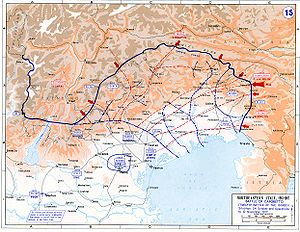
Though the last Italian offensive had proven inconclusive, the Austrians were in strong need of reinforcements. These became available when Russia crumbled and German troops from the Eastern front were sent to the Isonzo front.
On 24 October 1917 the Central Powers troops broke through the Italian lines in the upper Isonzo, converging on Caporetto (the modern Kobarid
) and surrounding the 2nd Italian Army. The Italian army commander, Luigi Capello, had been informed of a probable enemy attack, but had underestimated it.
From that area the Austro-Hungarians advanced for 150 km (93.2 mi) south-west, reaching Udine
after only four days. The defeat of Caporetto caused the disintegration of the whole Italian front of the Isonzo. The situation was re-established by forming a stop line on the Tagliamento and then on the Piave
rivers, but at the price of 700,000 dead, wounded and prisoners. Cadorna, who had tried to attribute the causes of the disasters to the 2nd Army, was fired. On 8 November 1917 he was replaced by Armando Diaz
.
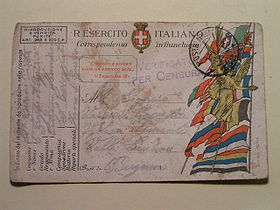 The severe (often unreasonably harsh) discipline imposed by Cadorna, the long months spent in the trenches and the words of Pope Benedict XV
about the "useless massacre" of the war, had weakened the Italian army's morale, were among the causes of the defeat of Caporetto. The Italian morale was however boosted by the need to save Italy itself from invasion. Further, the re-organization of the front, a changed tactical stance, allowed Diaz to concentrate his forces on a more defendable front.
The Austro-Hungarians stopped their attacks to prepare an offensive for the Spring of 1918. New reinforcements joined in after the end of the war against Russia. The offensive began on 15 June 1918 (see Battle of the Piave River
) with six divisions. The Italians resisted the assault. The failure of the offensive marked the swan song of Austria-Hungary on the Italian front. The Central Powers proved finally unable to sustain further the war effort, while the multi-ethnical entities of the Austrian Empire were on the verge of rebellion. The Italians rescheduled their planned 1919 counter-offensive to October 1918, in order to prevent Austria-Hungary's recovery.
The Italian attack with the help of French and British troops was started on 24 October from Vittorio Veneto
. The Austro-Hungarians fought tenaciously for 4 days, but the army began to disintegrate after the troops heard of revolutions and indepedence proclamations in the lands of the Dual Monarchy. Austria asked for an armistice on October 29. The armistice was signed on 3 November at Villa Giusti, near Padua
. Italian soldiers entered Trento while Bersaglieri
landed in Trieste. The following day the Istrian cities of Rovigno and Parenzo, the Dalmatian island of Lissa
, the Dalmatian cities of Zara
and Fiume
were occupied: the latter not included in the territories originally promised to Italy in case of victory, but the Italians decided to intervene in reply to a local National Council, formed after the flight of the Hungarians, and which had announced the union to Italy.
The Italian army was also marching towards Ljubljana
, but was halted by Serb troops. In the meantime the Regia Marina
occupied Pola
and Sebenico
, which became the capital of the Military Government of Dalmatia.
was far from being pacified, and in Cyrenaica
the Italian forces were confined to some separated points on the coast. In Tripolitania
and Fezzan
, the story has a different beginning. On August 1914 the Italian forces reached Ghat, that is, conquered most of western Libya. But in November 1914, this advance turned into a general retreat, and on 7 April and 28 April, they suffered two reverses at Wadi Marsit (near Mizda) and al-Qurdabiya (near Sirte
) respectively. By August 1915, the situation in Tripolitania was similar to that of Cyrenaica. The conquest of Libya was not resumed until January 1922.
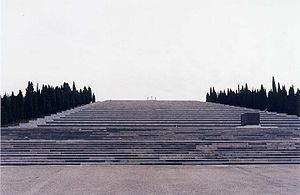 The territorial gains were small in comparison to the cost of the war for Italy. The debt contracted to pay the war expenses was paid back only in the 1970s. The uncertain socio-economic situation caused heavy social strife which led to the Biennio rosso
and later the rise of Fascism
.
World War I
World War I , which was predominantly called the World War or the Great War from its occurrence until 1939, and the First World War or World War I thereafter, was a major war centred in Europe that began on 28 July 1914 and lasted until 11 November 1918...
.
Italy, though nominally allied with Germany
German Empire
The German Empire refers to Germany during the "Second Reich" period from the unification of Germany and proclamation of Wilhelm I as German Emperor on 18 January 1871, to 1918, when it became a federal republic after defeat in World War I and the abdication of the Emperor, Wilhelm II.The German...
and Austria-Hungary
Austria-Hungary
Austria-Hungary , more formally known as the Kingdoms and Lands Represented in the Imperial Council and the Lands of the Holy Hungarian Crown of Saint Stephen, was a constitutional monarchic union between the crowns of the Austrian Empire and the Kingdom of Hungary in...
, refused to join them when the war started. Instead Italy entered the war on the Allied
Allies of World War I
The Entente Powers were the countries at war with the Central Powers during World War I. The members of the Triple Entente were the United Kingdom, France, and the Russian Empire; Italy entered the war on their side in 1915...
side in May 1915.
The war was initially a big failure for Italy. The Italian army repeatedly attacked Austria, making little progress and suffering heavy losses, and being routed in 1917 by an Austrian counteroffensive.
In October 1918, the Italians attacked again. The Austrian army broke down, and the Italians drove deep into Austrian territory. Fighting ended on 3 November.
From neutrality to the intervention in the war
Italy was officially a member of the Triple AllianceTriple Alliance (1882)
The Triple Alliance was the military alliance between Germany, Austria–Hungary, and Italy, , that lasted from 1882 until the start of World War I in 1914...
with Germany and Austria-Hungary. Despite this, in the years before the war Italy had enhanced its diplomatic efforts towards the United Kingdom
United Kingdom
The United Kingdom of Great Britain and Northern IrelandIn the United Kingdom and Dependencies, other languages have been officially recognised as legitimate autochthonous languages under the European Charter for Regional or Minority Languages...
and France
France
The French Republic , The French Republic , The French Republic , (commonly known as France , is a unitary semi-presidential republic in Western Europe with several overseas territories and islands located on other continents and in the Indian, Pacific, and Atlantic oceans. Metropolitan France...
. This was because the Italian government had grown convinced that support of Austria (the traditional enemy of Italy during the 19th century Risorgimento) would not gain Italy the territories she wanted: Trieste
Trieste
Trieste is a city and seaport in northeastern Italy. It is situated towards the end of a narrow strip of land lying between the Adriatic Sea and Italy's border with Slovenia, which lies almost immediately south and east of the city...
, Istria
Istria
Istria , formerly Histria , is the largest peninsula in the Adriatic Sea. The peninsula is located at the head of the Adriatic between the Gulf of Trieste and the Bay of Kvarner...
, Zara
Zadar
Zadar is a city in Croatia on the Adriatic Sea. It is the centre of Zadar county and the wider northern Dalmatian region. Population of the city is 75,082 citizens...
and Dalmatia
Dalmatia
Dalmatia is a historical region on the eastern coast of the Adriatic Sea. It stretches from the island of Rab in the northwest to the Bay of Kotor in the southeast. The hinterland, the Dalmatian Zagora, ranges from fifty kilometers in width in the north to just a few kilometers in the south....
, all Austrian possessions. In fact, a secret agreement signed with France in 1902 practically nullified Italy's membership in the Triple Alliance.
A few days after the outbreak of the war, on 3 August 1914, the government, led by the conservative Antonio Salandra
Antonio Salandra
Antonio Salandra was a conservative Italian politician who served as the 33rd Prime Minister of Italy between 1914 and 1916...
, declared that Italy would not commit its troops, maintaining that the Triple Alliance had only a defensive stance, whereas Austria-Hungary had been the aggressor. In reality, both Salandra and the minister of Foreign Affairs, Sidney Sonnino
Sidney Sonnino
Baron Sidney Costantino Sonnino was an Italian politician.Sonnino was born in Pisa to an Italian father of Jewish heritage and a Welsh mother...
, started diplomatic activities to probe which side was ready to grant the best reward for Italy's entrance in the war. Although the majority of the cabinet (including former Prime Minister Giovanni Giolitti
Giovanni Giolitti
Giovanni Giolitti was an Italian statesman. He was the 19th, 25th, 29th, 32nd and 37th Prime Minister of Italy between 1892 and 1921. A left-wing liberal, Giolitti's periods in office were notable for the passage of a wide range of progressive social reforms which improved the living standards of...
) was firmly contrary to the intervention, numerous intellectuals, including socialists
Italian Socialist Party
The Italian Socialist Party was a socialist and later social-democratic political party in Italy founded in Genoa in 1892.Once the dominant leftist party in Italy, it was eclipsed in status by the Italian Communist Party following World War II...
such as Ivanoe Bonomi
Ivanoe Bonomi
Ivanoe Bonomi was an Italian politician and statesman before and after World War II.Bonomi was born in Mantua. He was elected to the Italian Chamber of Deputies in 1909, representing Mantua as a member of the Italian Socialist Party...
, Leonida Bissolati
Leonida Bissolati
Leonida Bissolati was a leading exponent of the Italian socialist movement at the turn of the nineteenth century.- Biography :...
, and Mussolini, declared in favour of the intervention, which was then mostly supported by the Nationalist and the Liberal parties.
The diplomatic moves led to the London Pact
London Pact
London Pact , or more correctly, the Treaty of London, 1915, was a secret pact between Italy and Triple Entente, signed in London on 26 April 1915 by the Kingdom of Italy, Great Britain, France and Russia....
(26 April 1915), signed by Sonnino without the approval of the Italian Parliament. By the Pact, after the victory Italy was to get Trentino and the South Tyrol
South Tyrol
South Tyrol , also known by its Italian name Alto Adige, is an autonomous province in northern Italy. It is one of the two autonomous provinces that make up the autonomous region of Trentino-Alto Adige/Südtirol. The province has an area of and a total population of more than 500,000 inhabitants...
up to the Brenner Pass
Brenner Pass
- Roadways :The motorway E45 leading from Innsbruck via Bolzano to Verona and Modena uses this pass, and is one of the most important north-south connections in Europe...
, the entire Austrian Littoral
Austrian Littoral
The Austrian Littoral was established as a crown land of the Austrian Empire in 1849. In 1861 it was divided into the three crown lands of the Imperial Free City of Trieste and its suburbs, the Margraviate of Istria, and the Princely County of Gorizia and Gradisca, which each had separate...
(with Trieste]], Gorizia and Gradisca
Gorizia and Gradisca
The County of Gorizia and Gradisca was a Habsburg county in Central Europe, in what is now a multilingual border area of Italy and Slovenia. It was named for its two major urban centers, Gorizia and Gradisca d'Isonzo.-Province of the Habsburg Empire:...
(Eastern Friuli) and Istria, but without Fiume), parts of western Carniola
Carniola
Carniola was a historical region that comprised parts of what is now Slovenia. As part of Austria-Hungary, the region was a crown land officially known as the Duchy of Carniola until 1918. In 1849, the region was subdivided into Upper Carniola, Lower Carniola, and Inner Carniola...
(Idrija
Idrija
Idrija is a small town and municipality in the Goriška region of Slovenia. It is known for its mercury mine and lace....
and Ilirska Bistrica
Ilirska Bistrica
Ilirska Bistrica is a town and a municipality in Slovenia. It belongs to the traditional region of Primorska.The town of Ilirska Bistrica is the major economic centre of the district of the same name...
) and north-western Dalmatia
Dalmatia
Dalmatia is a historical region on the eastern coast of the Adriatic Sea. It stretches from the island of Rab in the northwest to the Bay of Kotor in the southeast. The hinterland, the Dalmatian Zagora, ranges from fifty kilometers in width in the north to just a few kilometers in the south....
with Zara and most of the islands, but without Split
Split (city)
Split is a Mediterranean city on the eastern shores of the Adriatic Sea, centered around the ancient Roman Palace of the Emperor Diocletian and its wide port bay. With a population of 178,192 citizens, and a metropolitan area numbering up to 467,899, Split is by far the largest Dalmatian city and...
. Other agreements concerned the sovereignty of the port of Valona
Vlorë
Vlorë is one of the biggest towns and the second largest port city of Albania, after Durrës, with a population of about 94,000 . It is the city where the Albanian Declaration of Independence was proclaimed on November 28, 1912...
, the province of Antalya
Antalya
Antalya is a city on the Mediterranean coast of southwestern Turkey. With a population 1,001,318 as of 2010. It is the eighth most populous city in Turkey and country's biggest international sea resort.- History :...
in Turkey
Turkey
Turkey , known officially as the Republic of Turkey , is a Eurasian country located in Western Asia and in East Thrace in Southeastern Europe...
and part of the German colonies in Africa.
Germany and Austria-Hungary had only advanced the possibility of negotiating parts of the Trentino and Eastern Friuli, without Gorizia
Gorizia
Gorizia is a town and comune in northeastern Italy, in the autonomous region of Friuli Venezia Giulia. It is located at the foot of the Julian Alps, bordering Slovenia. It is the capital of the Province of Gorizia, and it is a local center of tourism, industry, and commerce. Since 1947, a twin...
and Trieste. The offer of the French colony of Tunisia
Tunisia
Tunisia , officially the Tunisian RepublicThe long name of Tunisia in other languages used in the country is: , is the northernmost country in Africa. It is a Maghreb country and is bordered by Algeria to the west, Libya to the southeast, and the Mediterranean Sea to the north and east. Its area...
was deemed unsatisfactory.
By the London Pact, Italy joined the Entente
Triple Entente
The Triple Entente was the name given to the alliance among Britain, France and Russia after the signing of the Anglo-Russian Entente in 1907....
. On 3 May 1915 Italy officially revoked the Triple Alliance. In the following days Giolitti and the neutralist majority of the Parliament opposed declaring war, while nationalist crowds demonstrated in public areas for it. (The nationalist poet Gabriele D'Annunzio
Gabriele D'Annunzio
Gabriele D'Annunzio or d'Annunzio was an Italian poet, journalist, novelist, and dramatist...
called this period le radiose giornate di Maggio - "the sunny days of May"). On 13 May Salandra offered his resignation to King Victor Emmanuel III. But Giolitti, fearful of nationalist disorder that might break into open rebellion, declined to succeed as prime minister. Salandra remained in office, and got his declaration of war against Austria-Hungary on 23 May 1915. (Italy declared war on Germany fifteen months later.) Italy thus entered the war under the impetus of a relative minority of its population and politicians.
Entrance in the war
The front on the Austrian border was 650 km (403.9 mi) long, stretching from the StelvioStelvio
Stelvio may refer to* Stelvio, the Italian name for the municipality of Stilfs in South Tyrol* Stelvio Pass, mountain road named after the village* Stelvio National Park, a national park of Italy* Stelvio , a cheese named after the village...
Pass to the Adriatic Sea
Adriatic Sea
The Adriatic Sea is a body of water separating the Italian Peninsula from the Balkan peninsula, and the system of the Apennine Mountains from that of the Dinaric Alps and adjacent ranges...
. Militarily, the Italians had numerical superiority. This advantage, however, was negated by the difficult terrain. Also, the Italians lacked strategic and tactical leadership. The Italian commander-in-chief was Luigi Cadorna
Luigi Cadorna
Luigi Cadorna GCB was an ItalianField Marshal, most famous for being thechief of staff of the Italian army during the first part of World War I.-Biography:...
, a staunch proponent of the frontal assault whose tactics cost the lives of hundreds of thousands of Italian soldiers. His plan was to attack on the Isonzo front
Battles of the Isonzo
The Battles of the Isonzo were a series of 12 battles between the Austro-Hungarian and Italian armies in World War I. They were fought along the Soča River on the eastern sector of the Italian Front between June 1915 and November 1917...
, with the dream of breaking over the Karst Plateau into the Carniola
Carniola
Carniola was a historical region that comprised parts of what is now Slovenia. As part of Austria-Hungary, the region was a crown land officially known as the Duchy of Carniola until 1918. In 1849, the region was subdivided into Upper Carniola, Lower Carniola, and Inner Carniola...
n Basin, taking Ljubljana
Ljubljana
Ljubljana is the capital of Slovenia and its largest city. It is the centre of the City Municipality of Ljubljana. It is located in the centre of the country in the Ljubljana Basin, and is a mid-sized city of some 270,000 inhabitants...
and threatening Vienna
Vienna
Vienna is the capital and largest city of the Republic of Austria and one of the nine states of Austria. Vienna is Austria's primary city, with a population of about 1.723 million , and is by far the largest city in Austria, as well as its cultural, economic, and political centre...
. It was a Napoleonic plan, which had no realistic chance of success in an age of barbed wire, machine gun
Machine gun
A machine gun is a fully automatic mounted or portable firearm, usually designed to fire rounds in quick succession from an ammunition belt or large-capacity magazine, typically at a rate of several hundred rounds per minute....
s, and indirect artillery fire, combined with hilly and mountainous terrain.
The first shells were fired in the dawn of 24 May against the enemy positions of Cervignano del Friuli
Cervignano del Friuli
Cervignano del Friuli is a comune in the province of Udine, Italy. the most important town of Bassa Friulana. It lies at about 12 km from the Laguna di Grado and at about 18 km from the Adriatic Sea; from the point of view of viability, its position is peculiar since it lies at the...
, which was captured a few hours later. In the same day the Austro-Hungarian fleet bombarded the railway stations of Manfredonia
Manfredonia
Manfredonia is a town and comune of Puglia, Italy, in the province of Foggia, from which it is 35 kilometres northeast by rail. Manfredonia is situated on the coast, facing east, to the south of Monte Gargano, and giving its name to the gulf to the east of it...
and Ancona
Ancona
Ancona is a city and a seaport in the Marche region, in central Italy, with a population of 101,909 . Ancona is the capital of the province of Ancona and of the region....
. The first Italian casualty was Riccardo Di Giusto.
The main effort was to be concentrated in the Isonzo and Vipava
Vipava Valley
The Vipava Valley is a valley located in the Slovenian Littoral, between the towns of Nova Gorica and Vipava.-Geography:It is a narrow valley, serving as the main passage between Friulian lowland and central Slovenia, and thus also an important corridor connecting Northern Italy to Central Europe...
valleys and on the Kras
Kras
Karst ; also known as the Karst Plateau, is a limestone borderline plateau region extending in southwestern Slovenia and northeastern Italy. It lies between the Vipava Valley, the low hills surrounding the valley, the westernmost part of the Brkini Hills, northern Istria, and the Gulf of Trieste...
plateau, in the direction of Ljubljana. The Italian troops managed to obtain some initial successes, but, as in the Western Front
Western Front (World War I)
Following the outbreak of World War I in 1914, the German Army opened the Western Front by first invading Luxembourg and Belgium, then gaining military control of important industrial regions in France. The tide of the advance was dramatically turned with the Battle of the Marne...
, the campaign soon turned into a trench warfare. The main difference was the fact that, instead of in the mud, the trenches had to be dug in the Alpine rocks and glaciers, often up to 3000 m (9,842.5 ft) of altitude.
In the first months of the war Italy launched the following offensives:
- First Battle of the IsonzoFirst Battle of the IsonzoThe First Battle of the Isonzo was fought between the Armies of Italy and Austria-Hungary on the Italian Front in World War I, between June 23 and July 7, 1915....
(23 June–7 July) - Second Battle of the IsonzoSecond Battle of the IsonzoThe Second Battle of the Isonzo was fought between the armies of the Kingdom of Italy and of Austria-Hungary in the Italian Front in World War I, between 18 July and 3 August 1915.-Overview:...
(18 July–4 August) - Third Battle of the IsonzoThird Battle of the IsonzoThe Third Battle of the Isonzo was fought from October 18 through November 3 of 1915 between the armies of Italy and Austria-Hungary.- Background :...
(18 October–4 November) - Fourth Battle of the IsonzoFourth Battle of the IsonzoThe Fourth Battle of the Isonzo was fought between the armies of Kingdom of Italy and those of Austria-Hungary on the Italian Front in World War I, between November 10 and December 2, 1915.-Overview:...
(10 November)
In these first four battles the Italian Army registered 60,000 fatalities and more than 150,000 wounded, equivalent to around one fourth of the mobilized forces. Also to be mentioned is the offensive in the upper Cadore
Cadore
Cadore is a "comunità montana" in the Italian region of Veneto, in the northernmost part of the province of Belluno bordering on Austria, the Trentino-Alto Adige/Südtirol and Friuli-Venezia Giulia. It is watered by the Piave River poured forth from the Carnic Alps...
, near the Col di Lana
Col di Lana
The Col di Lana is a mountain of the Fanes Group in the Italian Dolomites, situated in Livinallongo del Col di Lana , a municipality of the Province of Belluno, in the Italian region of Veneto....
. Though secondary, this move blocked large Austro-Hungarian contingents, since it menaced their main logistic lines in Tyrol
County of Tyrol
The County of Tyrol, Princely County from 1504, was a State of the Holy Roman Empire, from 1814 a province of the Austrian Empire and from 1867 a Cisleithanian crown land of Austria-Hungary...
.
1916–1917 Italian offensives
This stalemate situation dragged on for the whole 1916. While the Austro-Hungarians amassed large forces in Trentino, the Italian command launched the Fifth Battle of the IsonzoFifth Battle of the Isonzo
The Fifth Battle of the Isonzo was fought from March 9-15, 1916 between the armies of the Kingdom of Italy and those of Austria-Hungary. The Italians, under immense pressure from the French commanders, had decided to launch another offensive on the Soča River.-Background:After four attempts to...
, lasting for eight days from 11 March 1916. This attempt was also fruitless.
In June the Austro-Hungarian counter-offensive (dubbed Strafexpedition
Battle of Asiago
The Battle of Asiago ' or the Trentino Offensive , nicknamed Strafexpedition by the Austrians, was a counteroffensive launched by the Austro-Hungarians on the Italian Front on 15 May 1916, during World War I...
, "Punishment Expedition") broke through in Trentino and occupied the whole Altopiano di Asiago. The Italian Army managed however to contain the offensive and the enemy retreated in order to strengthen its position in the Carso. On 4 August began the Sixth Battle of the Isonzo
Sixth Battle of the Isonzo
The Sixth Battle of the Isonzo also known as the Battle of Gorizia was the most successful Italian offensive along the Soča River during World War I.- Background :...
which, five days later, led to the Italian conquest of Gorizia
Gorizia
Gorizia is a town and comune in northeastern Italy, in the autonomous region of Friuli Venezia Giulia. It is located at the foot of the Julian Alps, bordering Slovenia. It is the capital of the Province of Gorizia, and it is a local center of tourism, industry, and commerce. Since 1947, a twin...
, at the cost of 20,000 dead and 50,000 wounded. The year ended with three new offensives:
- Seventh Battle of the IsonzoSeventh Battle of the IsonzoThe Seventh Battle of the Isonzo was fought from September 14-17, 1916 between the armies of the Kingdom of Italy and those of Austria-Hungary.- Battle :...
(14–16 September) - Eighth Battle of the IsonzoEighth Battle of the IsonzoThe Eighth Battle of the Isonzo was fought from October 10-12, 1916 between Italy and Austria-Hungary.- Battle :The Eighth Battle of the Isonzo, fought briefly from 10-12 October 1916, was essentially a continuation of attempts made during the Seventh Battle of the Isonzo to extend the bridgehead...
(1 November) - Ninth Battle of the IsonzoNinth Battle of the IsonzoThe Ninth Battle of the Isonzo was an Italian offensive against Austria-Hungary in the course World War I. Including a triumvirate of battles launched after the Italians' successful seizure of Gorizia in August 1916 to extend their bridgehead to the left of the town, it ended in further failure for...
(4 November)
The price was a further 37,000 dead and 88,000 wounded for the Italians, again for no remarkable conquest. In late 1916 the Italian army advanced for some kilometers in Trentino, while, for the whole 1916–1917 winter the situation in the Isonzo front remained stationary.
In 12–28 1917 there took place the Tenth Battle of the Isonzo
Tenth Battle of the Isonzo
The Tenth Battle of the Isonzo was an Italian offensive against Austria-Hungary in the course of World War I.-Background:With nine largely unsuccessful Isonzo battles conducted within an eighteen month period to date, Italian Chief of Staff Luigi Cadorna - responsible for launching all nine -...
. The Battle of Mount Ortigara
Battle of Mount Ortigara
The Battle of Mount Ortigara was fought from 10 to 25 June 1917 between the Italian and Austro-Hungarian armies for possession of Mount Ortigara, in the Asiago Plateau.- Background :...
(10–25 June) was Cadorna's attempt to conquer back some territories in Trentino which had remained under Austro-Hungarian control. On 18 August 1917 began the most important Italian offensive, the Eleventh Battle of the Isonzo
Eleventh Battle of the Isonzo
The Eleventh Battle of the Isonzo was a World War I battle fought by the Italian and Austro-Hungarian Armies on the Italian Front between August 18 and September 12, 1917.- Background :...
. This time the Italian advance was initially successful as the Bainsizza Plateau southeast of Tolmino was captured. But the Italian army outran its artillery and supply lines, thus preventing the further advance that may have finally succeeded in breaking the Austro-Hungarian army. Thus the Austro-Hungarian line ultimately held and the attack was abandoned on 12 September 1917.
The rout of Caporetto
Though the last Italian offensive had proven inconclusive, the Austrians were in strong need of reinforcements. These became available when Russia crumbled and German troops from the Eastern front were sent to the Isonzo front.
On 24 October 1917 the Central Powers troops broke through the Italian lines in the upper Isonzo, converging on Caporetto (the modern Kobarid
Kobarid
Kobarid is a town and a municipality in the upper Soča valley, western Slovenia, near the Italian border.Kobarid is known for the famous Battle of Caporetto, where the Italian retreat was documented by Ernest Hemingway in his novel A Farewell to Arms. The battle is well documented in the museum in...
) and surrounding the 2nd Italian Army. The Italian army commander, Luigi Capello, had been informed of a probable enemy attack, but had underestimated it.
From that area the Austro-Hungarians advanced for 150 km (93.2 mi) south-west, reaching Udine
Udine
Udine is a city and comune in northeastern Italy, in the middle of Friuli-Venezia Giulia region, between the Adriatic sea and the Alps , less than 40 km from the Slovenian border. Its population was 99,439 in 2009, and that of its urban area was 175,000.- History :Udine is the historical...
after only four days. The defeat of Caporetto caused the disintegration of the whole Italian front of the Isonzo. The situation was re-established by forming a stop line on the Tagliamento and then on the Piave
Piave
Piave can refer to:* Francesco Maria Piave, Italian librettist and composer* Piave * Piave * Battle of the Piave River* 10 Motorised Division Piave An Italian division of World War II...
rivers, but at the price of 700,000 dead, wounded and prisoners. Cadorna, who had tried to attribute the causes of the disasters to the 2nd Army, was fired. On 8 November 1917 he was replaced by Armando Diaz
Armando Diaz
Armando Diaz, 1st Duca della Vittoria was an Italian general and a Marshal of Italy.Born in Naples, Diaz began his military career as a student at the Military Academy of Turin, where he became an artillery officer. He was a colonel commanding the 93rd infantry during the Italo-Turkish War, and...
.
From Caporetto to the end of the war
The Central Powers ended 1917 with a general offensive on the Piave, the Altopiano di Asiago and the Monte Grappa. The Italian army was forced to call the 1899 levy, while that of 1900 was left for an hypothetical final effort for 1919.Pope Benedict XV
Pope Benedict XV , born Giacomo Paolo Giovanni Battista della Chiesa, reigned as Pope from 3 September 1914 to 22 January 1922...
about the "useless massacre" of the war, had weakened the Italian army's morale, were among the causes of the defeat of Caporetto. The Italian morale was however boosted by the need to save Italy itself from invasion. Further, the re-organization of the front, a changed tactical stance, allowed Diaz to concentrate his forces on a more defendable front.
The Austro-Hungarians stopped their attacks to prepare an offensive for the Spring of 1918. New reinforcements joined in after the end of the war against Russia. The offensive began on 15 June 1918 (see Battle of the Piave River
Battle of the Piave River
The Battle of the Piave River , known in Italy as Battaglia del Solstizio , Battaglia di Mezzo Giugno , or Seconda Battaglia del Piave , was a decisive victory for the Italian Army during World War...
) with six divisions. The Italians resisted the assault. The failure of the offensive marked the swan song of Austria-Hungary on the Italian front. The Central Powers proved finally unable to sustain further the war effort, while the multi-ethnical entities of the Austrian Empire were on the verge of rebellion. The Italians rescheduled their planned 1919 counter-offensive to October 1918, in order to prevent Austria-Hungary's recovery.
The Italian attack with the help of French and British troops was started on 24 October from Vittorio Veneto
Battle of Vittorio Veneto
The Battle of Vittorio Veneto was fought between 24 October and 3 November 1918, near Vittorio Veneto, during the Italian Campaign of World War I...
. The Austro-Hungarians fought tenaciously for 4 days, but the army began to disintegrate after the troops heard of revolutions and indepedence proclamations in the lands of the Dual Monarchy. Austria asked for an armistice on October 29. The armistice was signed on 3 November at Villa Giusti, near Padua
Padua
Padua is a city and comune in the Veneto, northern Italy. It is the capital of the province of Padua and the economic and communications hub of the area. Padua's population is 212,500 . The city is sometimes included, with Venice and Treviso, in the Padua-Treviso-Venice Metropolitan Area, having...
. Italian soldiers entered Trento while Bersaglieri
Bersaglieri
The Bersaglieri are a corps of the Italian Army originally created by General Alessandro La Marmora on 18 June 1836 to serve in the Piedmontese Army, later to become the Royal Italian Army...
landed in Trieste. The following day the Istrian cities of Rovigno and Parenzo, the Dalmatian island of Lissa
Vis (island)
Vis is the most outerly lying larger Croatian island in the Adriatic Sea, and is part of the Central Dalmatian group of islands, with an area of 90.26 km² and a population of 3,617 . Of all the inhabited Croatian islands, it is the farthest from the coast...
, the Dalmatian cities of Zara
Zadar
Zadar is a city in Croatia on the Adriatic Sea. It is the centre of Zadar county and the wider northern Dalmatian region. Population of the city is 75,082 citizens...
and Fiume
Rijeka
Rijeka is the principal seaport and the third largest city in Croatia . It is located on Kvarner Bay, an inlet of the Adriatic Sea and has a population of 128,735 inhabitants...
were occupied: the latter not included in the territories originally promised to Italy in case of victory, but the Italians decided to intervene in reply to a local National Council, formed after the flight of the Hungarians, and which had announced the union to Italy.
The Italian army was also marching towards Ljubljana
Ljubljana
Ljubljana is the capital of Slovenia and its largest city. It is the centre of the City Municipality of Ljubljana. It is located in the centre of the country in the Ljubljana Basin, and is a mid-sized city of some 270,000 inhabitants...
, but was halted by Serb troops. In the meantime the Regia Marina
Regia Marina
The Regia Marina dates from the proclamation of the Kingdom of Italy in 1861 after Italian unification...
occupied Pola
Pula
Pula is the largest city in Istria County, Croatia, situated at the southern tip of the Istria peninsula, with a population of 62,080 .Like the rest of the region, it is known for its mild climate, smooth sea, and unspoiled nature. The city has a long tradition of winemaking, fishing,...
and Sebenico
Šibenik
Šibenik is a historic town in Croatia, with population of 51,553 . It is located in central Dalmatia where the river Krka flows into the Adriatic Sea...
, which became the capital of the Military Government of Dalmatia.
Military situation in the colonies
As Italy entered the war on 23 May 1915, the situation of her forces in the colonies was critical. Italian SomalilandItalian Somaliland
Italian Somaliland , also known as Italian Somalia, was a colony of the Kingdom of Italy from the 1880s until 1936 in the region of modern-day Somalia. Ruled in the 19th century by the Somali Sultanate of Hobyo and the Majeerteen Sultanate, the territory was later acquired by Italy through various...
was far from being pacified, and in Cyrenaica
Cyrenaica
Cyrenaica is the eastern coastal region of Libya.Also known as Pentapolis in antiquity, it was part of the Creta et Cyrenaica province during the Roman period, later divided in Libia Pentapolis and Libia Sicca...
the Italian forces were confined to some separated points on the coast. In Tripolitania
Tripolitania
Tripolitania or Tripolitana is a historic region and former province of Libya.Tripolitania was a separate Italian colony from 1927 to 1934...
and Fezzan
Fezzan
Fezzan is a south western region of modern Libya. It is largely desert but broken by mountains, uplands, and dry river valleys in the north, where oases enable ancient towns and villages to survive deep in the otherwise inhospitable Sahara.-Name:...
, the story has a different beginning. On August 1914 the Italian forces reached Ghat, that is, conquered most of western Libya. But in November 1914, this advance turned into a general retreat, and on 7 April and 28 April, they suffered two reverses at Wadi Marsit (near Mizda) and al-Qurdabiya (near Sirte
Sirte
Sirte is a city in LibyaSirte may also refer to:* Sirte Declaration, a 1999 resolution to create the African Union* Sirte Oil Company, a Libyan oil companyIn geography:* Gulf of Sirte, alias for Gulf of Sidra on Libya's coast...
) respectively. By August 1915, the situation in Tripolitania was similar to that of Cyrenaica. The conquest of Libya was not resumed until January 1922.
Consequences
Biennio rosso
The Biennio Rosso was a two year period, between 1919 and 1920, of intense social conflict in Italy. The Biennio Rosso was followed by the extremely violent reaction of the Fascist blackshirts militia and eventually by the March on Rome of Benito Mussolini in 1922...
and later the rise of Fascism
Fascism
Fascism is a radical authoritarian nationalist political ideology. Fascists seek to rejuvenate their nation based on commitment to the national community as an organic entity, in which individuals are bound together in national identity by suprapersonal connections of ancestry, culture, and blood...
.
See also
- Austria–Hungary
- Bollettino della Vittoria
- Italian Campaign (World War I)Italian Campaign (World War I)The Italian campaign refers to a series of battles fought between the armies of Austria-Hungary and Italy, along with their allies, in northern Italy between 1915 and 1918. Italy hoped that by joining the countries of the Triple Entente against the Central Powers it would gain Cisalpine Tyrol , the...
- History of AustriaHistory of AustriaThe history of Austria covers the history of the current country of Austria and predecessor states, from the Iron Age, through to a sovereign state, annexation by the German Third Reich, partition after the Second World War and later developments until the present day...
- History of ItalyHistory of ItalyItaly, united in 1861, has significantly contributed to the political, cultural and social development of the entire Mediterranean region. Many cultures and civilizations have existed there since prehistoric times....
- History of SloveniaHistory of SloveniaThe history of Slovenia chronicles the period of the Slovene territory from the 5th Century BC to the present times. In the Early Bronze Age, Proto-Illyrian tribes settled an area stretching from present-day Albania to the city of Trieste. The Holy Roman Empire controlled the land for nearly 1,000...
- World War IWorld War IWorld War I , which was predominantly called the World War or the Great War from its occurrence until 1939, and the First World War or World War I thereafter, was a major war centred in Europe that began on 28 July 1914 and lasted until 11 November 1918...
Further reading
- Page, Thomas Nelson, (1920) Italy and the World War. New York, Charles Scribner's Sons, Full Text Available Online.