

Kras

Encyclopedia
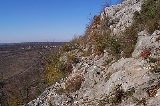
Karst; also known as the Karst Plateau, is a limestone borderline plateau
region extending in southwestern Slovenia
and northeastern Italy
. It lies between the Vipava Valley
, the low hills surrounding the valley, the westernmost part of the Brkini Hills, northern Istria
, and the Gulf of Trieste
. The western edge of the plateau also marks the traditional ethnic border between Italians and Slovenes.
The region is famous for having given the name to karst topography
. For this reason, it is also referred to as the Classical Karst.
 The plateau rises quite steeply above the neighboring landscape, except for its northeastern side, where the steepness is less pronounced. The plateau gradually descends from the southeast to the southwest. On average it lies 334 m above sea level. Its western edge, known as the Karst Rim , is a continuation of the Učka
mountain range in eastern Istria
, and rises to the east and southeast of Trieste
, ending in steep cliffs between Aurisina and Duino
. Many interesting geological phenomena occur along the Karst Rim, including the picturesque Rosandra Valley
(also known as Glinščica).
Because the Karst steeply descends towards the Adriatic Sea
, it is less exposed to the beneficial climatological effects of the Mediterranean. In the past, the main vegetation on the plateau was oak
s, but these were replaced by pine
forests in the 19th and 20th centuries. Forest
s now cover only one-third of the Karst. Starting the Middle Ages
, the plateau suffered radical deforestation for economic reasons. Although much of the wood for the closely spaced piles
that support the island city of Venice
, Italy
came from this region, Venice carefully managed the Karst forests as a reserve for naval timber. The most radical deforestation occurred in the mid-nineteenth century due to clear-cutting by local farmers and conversion of the land into pastures for sheep.
The Karst is famous for its cave
s. In Slovenia, they include Vilenica Cave (the oldest show cave
in Europe), Lipica Cave, Divača Cave, Kačna Cave, Postojna Cave
, and Škocjan Caves
(a UNESCO World Heritage Site
), and Grotta Gigante
in Italy (the largest show cave in the world).
Most of the Karst is located in the Slovenian Littoral
, covering an area of 429 square kilometres, with a population of about 19,000 people. The Karst as a whole has exactly 100 settlements. The town of Sežana
is the center of the region on the Slovene side of the border. The main rural centers are the settlements of Divača
, Dutovlje
, and Komen
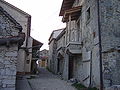
. Štanjel
is a picturesque clustered settlement at the top of the northern rim of the plateau
; its houses are tightly clustered around Turn Hill, giving it the appearance of a medieval town. On the Italian side of the border, important settlements include Opicina, Duino
, and Aurisina.
Natural conditions, including the bora
wind, and the local way of life all shaped the elements of Karst architecture
, creating simple but well-defined forms. The Karst is renowned for its strong red wine
, known as teran, and prosciutto
. One of the main tourist centers in the area is Lipica
, with its stud farm
(the home of the Lipizzan
horse breed) as well as other tourist facilities.
 Prominent persons that were born or lived in this region include the poets Srečko Kosovel
, Igo Gruden
, Ciril Zlobec
and Branka Jurca, social activist Danilo Dolci
, architect Max Fabiani
, painters Avgust Černigoj
and Lojze Spacal, writers Alojz Rebula
, Igor Torkar
, and Bogomir Magajna
, theologian Anton Mahnič
, politicians Drago Marušič, Josip Ferfolja
and Majda Širca
, economist Milko Brezigar
, and actress Ita Rina
. The picturesque Karst landscape inspired numerous artist that were not from this region, including the poets Rainer Maria Rilke
, Alojz Gradnik
, and Edvard Kocbek
, essayists Scipio Slataper
and Marjan Rožanc
, writers Italo Svevo
, Fulvio Tomizza
and Susanna Tamaro
, and film director Jan Cvitkovič
. Many artists and authors settled in the area, including Josip Osti
and Taras Kermauner
.
Sometimes, the region around Pivka
and Postojna
is also included.
Plateau
In geology and earth science, a plateau , also called a high plain or tableland, is an area of highland, usually consisting of relatively flat terrain. A highly eroded plateau is called a dissected plateau...
region extending in southwestern Slovenia
Slovenia
Slovenia , officially the Republic of Slovenia , is a country in Central and Southeastern Europe touching the Alps and bordering the Mediterranean. Slovenia borders Italy to the west, Croatia to the south and east, Hungary to the northeast, and Austria to the north, and also has a small portion of...
and northeastern Italy
Italy
Italy , officially the Italian Republic languages]] under the European Charter for Regional or Minority Languages. In each of these, Italy's official name is as follows:;;;;;;;;), is a unitary parliamentary republic in South-Central Europe. To the north it borders France, Switzerland, Austria and...
. It lies between the Vipava Valley
Vipava Valley
The Vipava Valley is a valley located in the Slovenian Littoral, between the towns of Nova Gorica and Vipava.-Geography:It is a narrow valley, serving as the main passage between Friulian lowland and central Slovenia, and thus also an important corridor connecting Northern Italy to Central Europe...
, the low hills surrounding the valley, the westernmost part of the Brkini Hills, northern Istria
Istria
Istria , formerly Histria , is the largest peninsula in the Adriatic Sea. The peninsula is located at the head of the Adriatic between the Gulf of Trieste and the Bay of Kvarner...
, and the Gulf of Trieste
Gulf of Trieste
The Gulf of Trieste is a shallow bay of the Adriatic Sea, in the extreme northern part of the Mediterranean Sea. It is part of the Gulf of Venice and is shared by Italy, Slovenia and Croatia...
. The western edge of the plateau also marks the traditional ethnic border between Italians and Slovenes.
The region is famous for having given the name to karst topography
Karst topography
Karst topography is a geologic formation shaped by the dissolution of a layer or layers of soluble bedrock, usually carbonate rock such as limestone or dolomite, but has also been documented for weathering resistant rocks like quartzite given the right conditions.Due to subterranean drainage, there...
. For this reason, it is also referred to as the Classical Karst.
Geographical position
Ucka
The Učka is a mountain range that rises behind Opatija riviera, on the Istrian peninsula, in northwestern Croatia. It forms a single morphological unit together with the Čičarija range which streches from the bay of Trieste to Rijeka...
mountain range in eastern Istria
Istria
Istria , formerly Histria , is the largest peninsula in the Adriatic Sea. The peninsula is located at the head of the Adriatic between the Gulf of Trieste and the Bay of Kvarner...
, and rises to the east and southeast of Trieste
Trieste
Trieste is a city and seaport in northeastern Italy. It is situated towards the end of a narrow strip of land lying between the Adriatic Sea and Italy's border with Slovenia, which lies almost immediately south and east of the city...
, ending in steep cliffs between Aurisina and Duino
Duino
Duino is a town at the Adriatic coast in the municipality of Duino-Aurisina, part of the region of Friuli – Venezia Giulia in the province of Trieste, north-eastern Italy....
. Many interesting geological phenomena occur along the Karst Rim, including the picturesque Rosandra Valley
Val Rosandra
Val Rosandra is a valley centered on the river with the same name in the municipality of Dolina in the Italian region of Friuli Venezia Giulia, between the city of Trieste and the border with Slovenia. It is also included into a natural park, mostly set around the river Rosandra and the...
(also known as Glinščica).
Because the Karst steeply descends towards the Adriatic Sea
Adriatic Sea
The Adriatic Sea is a body of water separating the Italian Peninsula from the Balkan peninsula, and the system of the Apennine Mountains from that of the Dinaric Alps and adjacent ranges...
, it is less exposed to the beneficial climatological effects of the Mediterranean. In the past, the main vegetation on the plateau was oak
Oak
An oak is a tree or shrub in the genus Quercus , of which about 600 species exist. "Oak" may also appear in the names of species in related genera, notably Lithocarpus...
s, but these were replaced by pine
Pine
Pines are trees in the genus Pinus ,in the family Pinaceae. They make up the monotypic subfamily Pinoideae. There are about 115 species of pine, although different authorities accept between 105 and 125 species.-Etymology:...
forests in the 19th and 20th centuries. Forest
Forest
A forest, also referred to as a wood or the woods, is an area with a high density of trees. As with cities, depending where you are in the world, what is considered a forest may vary significantly in size and have various classification according to how and what of the forest is composed...
s now cover only one-third of the Karst. Starting the Middle Ages
Middle Ages
The Middle Ages is a periodization of European history from the 5th century to the 15th century. The Middle Ages follows the fall of the Western Roman Empire in 476 and precedes the Early Modern Era. It is the middle period of a three-period division of Western history: Classic, Medieval and Modern...
, the plateau suffered radical deforestation for economic reasons. Although much of the wood for the closely spaced piles
Deep foundation
A deep foundation is a type of foundation distinguished from shallow foundations by the depth they are embedded into the ground. There are many reasons a geotechnical engineer would recommend a deep foundation over a shallow foundation, but some of the common reasons are very large design loads, a...
that support the island city of Venice
Venice
Venice is a city in northern Italy which is renowned for the beauty of its setting, its architecture and its artworks. It is the capital of the Veneto region...
, Italy
Italy
Italy , officially the Italian Republic languages]] under the European Charter for Regional or Minority Languages. In each of these, Italy's official name is as follows:;;;;;;;;), is a unitary parliamentary republic in South-Central Europe. To the north it borders France, Switzerland, Austria and...
came from this region, Venice carefully managed the Karst forests as a reserve for naval timber. The most radical deforestation occurred in the mid-nineteenth century due to clear-cutting by local farmers and conversion of the land into pastures for sheep.
The Karst is famous for its cave
Cave
A cave or cavern is a natural underground space large enough for a human to enter. The term applies to natural cavities some part of which is in total darkness. The word cave also includes smaller spaces like rock shelters, sea caves, and grottos.Speleology is the science of exploration and study...
s. In Slovenia, they include Vilenica Cave (the oldest show cave
Show cave
Show caves — also called tourist caves, public caves, and in the United States, commercial caves — are caves that are managed by a government or commercial organization and made accessible to the general public, usually for an entrance fee...
in Europe), Lipica Cave, Divača Cave, Kačna Cave, Postojna Cave
Postojna Cave
Postojna Cave is a 20,570 m long Karst cave system near Postojna, Slovenia. It is the longest cave system in the country as well as one of its top tourism sites.-History:The caves were created by the Pivka River....
, and Škocjan Caves
Škocjan Caves
Skocjan Caves is a cave system in Slovenia. Due to its exceptional significance, Škocjan Caves was entered on UNESCO’s list of natural and cultural world heritage sites in 1986. International scientific circles have thus acknowledged the importance of the caves as one of the natural treasures of...
(a UNESCO World Heritage Site
World Heritage Site
A UNESCO World Heritage Site is a place that is listed by the UNESCO as of special cultural or physical significance...
), and Grotta Gigante
Grotta Gigante
Grotta Gigante , also known as Riesengrotte or as Grotta di Brisciachi, is a giant cave on the Italian side of the Trieste Carso, in the municipality of Sgonico...
in Italy (the largest show cave in the world).
Most of the Karst is located in the Slovenian Littoral
Slovenian Littoral
The Slovenian Littoral is a historical region of Slovenia. Its name recalls the historical Habsburg crown land of the Austrian Littoral, of which the Slovenian Littoral was a part....
, covering an area of 429 square kilometres, with a population of about 19,000 people. The Karst as a whole has exactly 100 settlements. The town of Sežana
Sežana
Sežana is a town and a municipality in the Slovenian Littoral region of Slovenia, near the border with Italy. According to the census of 2008, it has a population of 12,470, of which around 5,332 live in the town of Sežana and the rest in the neighbouring rural areas.Sežana is located about on the...
is the center of the region on the Slovene side of the border. The main rural centers are the settlements of Divača
Divaca
Divača is a small town and municipality in the Littoral region of Slovenia, a few kilometres from the Italian border.The Parish Church in the settlement is dedicated to Saint Anthony the Hermit and belongs to the Diocese of Koper....
, Dutovlje
Dutovlje
Dutovlje is a settlement in the Sežana Municipality in the Littoral region of Slovenia close to the border with Italy.The Parish Church in the settlement is dedicated to Saint George and belongs to the Diocese of Koper.-External links:*...
, and Komen
Komen
Komen is a settlement and a municipality in Slovenia. It is located on the Kras plateau in the Slovenian Littoral.-History:In the Middle Ages, it was first part of the Duchy of Friuli and in the 13th century it was included in the County of Gorizia. Komen was first mentioned in a document from 1247...
. Štanjel
Štanjel
Štanjel is a village in the Komen Municipality in the Littoral region of Slovenia. It is located on the Kras plateau overlooking the Vipava Valley. In the 17th century it was fortificated to defend it against Ottoman raids...
is a picturesque clustered settlement at the top of the northern rim of the plateau
Plateau
In geology and earth science, a plateau , also called a high plain or tableland, is an area of highland, usually consisting of relatively flat terrain. A highly eroded plateau is called a dissected plateau...
; its houses are tightly clustered around Turn Hill, giving it the appearance of a medieval town. On the Italian side of the border, important settlements include Opicina, Duino
Duino
Duino is a town at the Adriatic coast in the municipality of Duino-Aurisina, part of the region of Friuli – Venezia Giulia in the province of Trieste, north-eastern Italy....
, and Aurisina.
Natural conditions, including the bora
Bora (wind)
Bora or Bura is a northern to north-eastern katabatic wind in the Adriatic, Bosnia and Herzegovina, Croatia, Montenegro, Italy, Greece, Slovenia, and Turkey....
wind, and the local way of life all shaped the elements of Karst architecture
Architecture
Architecture is both the process and product of planning, designing and construction. Architectural works, in the material form of buildings, are often perceived as cultural and political symbols and as works of art...
, creating simple but well-defined forms. The Karst is renowned for its strong red wine
Wine
Wine is an alcoholic beverage, made of fermented fruit juice, usually from grapes. The natural chemical balance of grapes lets them ferment without the addition of sugars, acids, enzymes, or other nutrients. Grape wine is produced by fermenting crushed grapes using various types of yeast. Yeast...
, known as teran, and prosciutto
Prosciutto
Prosciutto |ham]]) or Parma ham is a dry-cured ham that is usually thinly sliced and served uncooked; this style is called prosciutto crudo in Italian and is distinguished from cooked ham, prosciutto cotto....
. One of the main tourist centers in the area is Lipica
Lipica
Lipica is a village in the Municipality of Sežana in the Littoral region of Slovenia, close to the border with Italy.Lipica is one of the main tourist centers of the Slovenia's Karst region. It is the origin of the Lipizzaner horses. The Lipica stud farm was established in 1580 by Charles II,...
, with its stud farm
Stud farm
A stud farm or stud in animal husbandry, is an establishment for selective breeding of livestock. The word "stud" comes from the Old English stod meaning "herd of horses, place where horses are kept for breeding" Historically, documentation of the breedings that occur on a stud farm leads to the...
(the home of the Lipizzan
Lipizzan
The Lipizzan or Lipizzaner , is a breed of horse closely associated with the Spanish Riding School of Vienna, Austria, where the finest representatives demonstrate the haute école or "high school" movements of classical dressage, including the highly controlled, stylized jumps and other movements...
horse breed) as well as other tourist facilities.
Prominent natives and residents
Srecko Kosovel
Srečko Kosovel was a Slovene expressionist poet who evolved towards avant-garde forms. Since the 1960s, Kosovel has become a poetic icon, in the league of the most prestigious Slovene literates like France Prešeren and Ivan Cankar. Together with Edvard Kocbek, he is considered as the most...
, Igo Gruden
Igo Gruden
Igo Gruden was a Slovene poet and translator.He was born as Ignacij Gruden in the small fishermen village of Nabrežina near Trieste, then part of the Austro-Hungarian County of Gorizia and Gradisca as first of ten children of Franc Gruden and Justina Košuta...
, Ciril Zlobec
Ciril Zlobec
Ciril Zlobec is a Slovene poet, writer, translator, journalist and former politician. He is best known for his poems and has published several volumes of poetry...
and Branka Jurca, social activist Danilo Dolci
Danilo Dolci
Danilo Dolci was an Italian social activist, sociologist, popular educator and poet. He is best known for his opposition to poverty, social exclusion and the Mafia on Sicily, and is considered to be one of the protagonists of the non-violence movement in Italy...
, architect Max Fabiani
Max Fabiani
Max Fabiani, was a Slovene-Italian architect from the Gorizia region. Together with Ciril Metod Koch, he introduced the Vienna Secession style of architecture in the Slovene Lands.-Life:...
, painters Avgust Černigoj
Avgust Cernigoj
Avgust Černigoj, also known in Italian as Augusto Cernigoi was a Italian painter, known for his avant-garde experiments in Constructivism....
and Lojze Spacal, writers Alojz Rebula
Alojz Rebula
Alojz Rebula is a Slovene writer, playwright, essayist and translator, who lives and works in the Province of Trieste, Italy. He is a member of the Slovenian Academy of Sciences and Arts.-Life:...
, Igor Torkar
Igor Torkar
Igor Torkar was the pen name of Boris Fakin was a Slovenian writer, playwright and poet, most famous for his literary descriptions of Communist repression in Yugoslavia after World War II.- Life :...
, and Bogomir Magajna
Bogomir Magajna
Bogomir Magajna was a Slovene writer and psychiatrist.- Biography :Magajna was born in 1904 into a farming family in Gornje Vreme near Divača in what was then the Austrian Littoral. He began his schooling in Vremski Britof and was later sent to the Collegium Marianum , Catholic boarding-school in...
, theologian Anton Mahnič
Anton Mahnič
Dr. Anton Mahnič, also spelled as Antun Mahnić in Croatian ortography , was a Slovene and Croatian Roman Catholic bishop, theologian and philosopher, founder and the main leader of the Croatian Catholic movement....
, politicians Drago Marušič, Josip Ferfolja
Josip Ferfolja
Josip Ferfolja was a Slovene lawyer and Social democratic politician, and human rights activist from the Province of Gorizia...
and Majda Širca
Majda Širca
Majda Širca Ravnikar is a Slovenian art historian, journalist and politician. She is currently serving as Minister of Culture in the left-wing government of Borut Pahor....
, economist Milko Brezigar
Milko Brezigar
Milko Brezigar was a Slovene and Yugoslav liberal economist.Born to a Slovene family the village of Doberdò del Lago in the Austrian Littoral , he attended the State gymnasium in Gorizia. He studied law at the universities of Graz and Vienna, graduating in 1910...
, and actress Ita Rina
Ita Rina
Italina Lida "Ida" Kravanja , known under her pseudonym Ita Rina, was a Yugoslav film actress and beauty queen. She was one of the major film stars in Germany and Czechoslovakia in late 1920s and early 1930...
. The picturesque Karst landscape inspired numerous artist that were not from this region, including the poets Rainer Maria Rilke
Rainer Maria Rilke
René Karl Wilhelm Johann Josef Maria Rilke , better known as Rainer Maria Rilke, was a Bohemian–Austrian poet. He is considered one of the most significant poets in the German language...
, Alojz Gradnik
Alojz Gradnik
Alojz Gradnik was a Slovenian poet and translator.-Life:Gradnik was born in the village of Medana in the Goriška Brda region, in what was then the Austro-Hungarian Empire and is today in the Goriška province of Slovenia. His father was a Slovene from Trieste who came from a poor working family...
, and Edvard Kocbek
Edvard Kocbek
Edvard Kocbek was a Slovenian poet, writer, essayist, translator, political activist, and resistance fighter. He is considered as one of the best authors who have written in Slovene, and one of the best Slovene poets after Prešeren...
, essayists Scipio Slataper
Scipio Slataper
Scipio Slataper was an Italian language writer from Trieste, most famous for his lyrical essay My Karst. He is considered, alongside Italo Svevo, as the initiator of the prolific tradition of Italian literature in Trieste....
and Marjan Rožanc
Marjan Rožanc
Marjan Rožanc was a Slovenian author, playwright and journalist. He is mostly known for his essays, and is considered one of the foremost essayists in the Slovene language, along with Ivan Cankar, Jože Javoršek and Drago Jančar, and as a great master of style.He was born in a working-class suborb...
, writers Italo Svevo
Italo Svevo
Aron Ettore Schmitz , better known by the pseudonym Italo Svevo, was an Italian writer and businessman, author of novels, plays, and short stories.- Biography :...
, Fulvio Tomizza
Fulvio Tomizza
Fulvio Tomizza was an Italian language writer. He was born in Giurizzani in Kingdom of Italy ....
and Susanna Tamaro
Susanna Tamaro
Susanna Tamaro is an Italian novelist. She has also worked as a scientific documentarist and movie maker direction assistant.-Biography:Susanna Tamaro was born in a family of middle class...
, and film director Jan Cvitkovič
Jan Cvitkovic
Jan Cvitkovič is a critically acclaimed Slovenian film director, screenwriter and actor. As of April 2007 he has already won a total of 12 awards and 3 nominations at various film festivals for his work, including the San Sebastian Film Festival and the Venice Film Festival.-Biography:After one...
. Many artists and authors settled in the area, including Josip Osti
Josip Osti
Josip Osti is a Bosnian poet, prose writer and essayist, literary critic, anthologist and translator.Osti was born in Sarajevo, Bosnia and Herzegovina. He graduated from the Faculty of Philosophy at the University of Sarajevo...
and Taras Kermauner
Taras Kermauner
Taras Kermauner was a Slovenian literary historian, critic, philosopher, essayist, playwright and translator.- Life :...
.
Geographical extension
The municipalities that are completely or partially in the Karst include:- ItalyItalyItaly , officially the Italian Republic languages]] under the European Charter for Regional or Minority Languages. In each of these, Italy's official name is as follows:;;;;;;;;), is a unitary parliamentary republic in South-Central Europe. To the north it borders France, Switzerland, Austria and...
- Savogna d'IsonzoSavogna d'IsonzoSavogna d'Isonzo is a comune in the Province of Gorizia in the Italian region Friuli-Venezia Giulia, located about 35 km northwest of Trieste and about 3 km southwest of Gorizia, on the border with Slovenia. It is located at the conjunctions Kras Plateau and the Vipava Valley. The vast...
(partially) - Doberdò del LagoDoberdò del LagoDoberdò del Lago is a comune in the Province of Gorizia in the Italian region Friuli-Venezia Giulia, located about 30 km northwest of Trieste and about 11 km southwest of Gorizia...
- SagradoSagradoSagrado is a comune in the Province of Gorizia in the Italian region Friuli-Venezia Giulia, located about 35 km northwest of Trieste and about 13 km southwest of Gorizia....
(partially) - MonfalconeMonfalconeMonfalcone is a town and comune of the province of Gorizia , located on the coast of the Gulf of Trieste. Monfalcone means "Mount of Falcon" in Italian....
(partially) - Duino-AurisinaDuino-AurisinaDuino-Aurisina is a comune in the Province of Trieste in the Italian region of Friuli-Venezia Giulia. Lying near the border with Slovenia, it has a substantial Slovene population...
- SgonicoSgonicoSgonico is a comune in the Province of Trieste in the Italian region Friuli-Venezia Giulia, located about 12 km northwest of Trieste, on the border with Slovenia. , it had a population of 2,130 and an area of 31.3 km²...
- MonrupinoMonrupinoMonrupino is a comune in the Province of Trieste in the Italian region Friuli-Venezia Giulia, located about 9 km north of Trieste, on the border with Slovenia. , it had a population of 848 and an area of 12.7 km²...
- TriesteTriesteTrieste is a city and seaport in northeastern Italy. It is situated towards the end of a narrow strip of land lying between the Adriatic Sea and Italy's border with Slovenia, which lies almost immediately south and east of the city...
(partially) - San Dorligo della ValleSan Dorligo della ValleSan Dorligo della Valle is a comune in the Province of Trieste in the Italian region Friuli-Venezia Giulia, located about 4 km southeast of Trieste, on the border with Slovenia. As of 31 December 2004, it had a population of 6,019 and an area of 24.5 km²...
(partially)
- Savogna d'Isonzo
- SloveniaSloveniaSlovenia , officially the Republic of Slovenia , is a country in Central and Southeastern Europe touching the Alps and bordering the Mediterranean. Slovenia borders Italy to the west, Croatia to the south and east, Hungary to the northeast, and Austria to the north, and also has a small portion of...
- Miren-KostanjevicaMiren-KostanjevicaMiren-Kostanjevica is a municipality in western Slovenia, on the border with Italy. It is part of the Goriška region of the Slovene Littoral. The municipality's main settlements are Miren and Kostanjevica na Krasu...
(partially) - KomenKomenKomen is a settlement and a municipality in Slovenia. It is located on the Kras plateau in the Slovenian Littoral.-History:In the Middle Ages, it was first part of the Duchy of Friuli and in the 13th century it was included in the County of Gorizia. Komen was first mentioned in a document from 1247...
- SežanaSežanaSežana is a town and a municipality in the Slovenian Littoral region of Slovenia, near the border with Italy. According to the census of 2008, it has a population of 12,470, of which around 5,332 live in the town of Sežana and the rest in the neighbouring rural areas.Sežana is located about on the...
- DivačaDivacaDivača is a small town and municipality in the Littoral region of Slovenia, a few kilometres from the Italian border.The Parish Church in the settlement is dedicated to Saint Anthony the Hermit and belongs to the Diocese of Koper....
- Hrpelje-KozinaHrpelje-KozinaHrpelje-Kozina is a municipality in the Littoral region of Slovenia. Its main settlements are Hrpelje and Kozina.A major border crossing to Italy is located in the municipality at the village of Krvavi Potok. It connects to Pese di Grozzana in the San Dorligo della Valle comune near Trieste on the...
(partially)
- Miren-Kostanjevica
Sometimes, the region around Pivka
Pivka
Pivka is a small town and a municipality in Slovenia in the Pivka Basin in the Kras region. It was first mentioned in 1300 as Sancti Petri super Piucha . Until 1952 it was called Šentpeter na Krasu...
and Postojna
Postojna
Postojna is a town and a municipality in the traditional region of Inner Carniola, from Trieste, in southwestern Slovenia. Population 14,581 .-History:...
is also included.
See also
- Geography of SloveniaGeography of SloveniaSlovenia is situated in Central Europe touching the Alps and bordering the Mediterranean. The Alps — including the Julian Alps, the Kamnik-Savinja Alps and the Karavanke chain, as well as the Pohorje massif — dominate Northern Slovenia along its long border to Austria. Slovenia's...
- Geography of ItalyGeography of ItalyItaly is located in southern Europe and comprises the long, boot-shaped Italian Peninsula, the land between the peninsula and the Alps, and a number of islands including Sicily and Sardinia . Its total area is , of which is land and...
- Slovenian wineSlovenian wineSlovenian wine is wine from the Central European country of Slovenia. Viticulture and winemaking has existed in this region since the time of the Celts and Illyrians tribes, long before the Romans would introduce winemaking to the lands of France, Spain and Germany...
- Battles of the IsonzoBattles of the IsonzoThe Battles of the Isonzo were a series of 12 battles between the Austro-Hungarian and Italian armies in World War I. They were fought along the Soča River on the eastern sector of the Italian Front between June 1915 and November 1917...
- Gorizia and GradiscaGorizia and GradiscaThe County of Gorizia and Gradisca was a Habsburg county in Central Europe, in what is now a multilingual border area of Italy and Slovenia. It was named for its two major urban centers, Gorizia and Gradisca d'Isonzo.-Province of the Habsburg Empire:...
External links
- Karst in Slovenia. Slovenia: a geographical overview. Nadja Zupan Hajna
- PR Office of the Slovenian Government - Kras and Karst
- The Kras and Brkini Region
Sources
- Rosanna Bubola, Vivere il Carso edito dalla Pro Loco di Trieste (Basadello di Campoformico (UdineUdineUdine is a city and comune in northeastern Italy, in the middle of Friuli-Venezia Giulia region, between the Adriatic sea and the Alps , less than 40 km from the Slovenian border. Its population was 99,439 in 2009, and that of its urban area was 175,000.- History :Udine is the historical...
): La tipografica, 2006) - Massimo Gobessi& Sergio Dolce, Il Carso in tasca (Trieste: Edizioni Luglio, 2006)
- Elio Forznarič et al., Kras je krasen: vodnik po občinah Kraške gorske skupnosti (Trieste: Kraška gorska skupnost/ Comunità montana del Carso, 1991)
- Daniel Jarc, Il patrimonio culturale del Carso goriziano/ Kulturna dediščina goriškega Krasa (Trieste: SLORI, 1997)
- Miran Lapanje, Sežanski Kras (Sežana: Jamarsko društvo, 1984)
- Mojca Osvald et al., Kras in slovenska Istra (LjubljanaLjubljanaLjubljana is the capital of Slovenia and its largest city. It is the centre of the City Municipality of Ljubljana. It is located in the centre of the country in the Ljubljana Basin, and is a mid-sized city of some 270,000 inhabitants...
: Gimnazija Bežigrad, 2007) - Matjaž Žnidaršič, Slovenski Kras: umetnostna dediščina (CerknicaCerknicaCerknica is a town and municipality in the Kras region of southwestern Slovenia, with a population of 10,284 . It belongs to the traditional region of Inner Carniola....
: Naklo, d.o.o, 1996)