
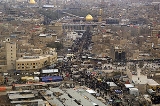
Karbala is a city in
IraqIraq ; officially the Republic of Iraq is a country in Western Asia spanning most of the northwestern end of the Zagros mountain range, the eastern part of the Syrian Desert and the northern part of the Arabian Desert....
, located about 100 km (62.1 mi) southwest of
BaghdadBaghdad is the capital of Iraq, as well as the coterminous Baghdad Governorate. The population of Baghdad in 2011 is approximately 7,216,040...
. Karbala is the capital of
Karbala Governorate, and has an estimated population of 572,300 people (2003).
The city, best known as the location of the
Battle of KarbalaThe Battle of Karbala took place on Muharram 10, in the year 61 of the Islamic calendar in Karbala, in present day Iraq. On one side of the highly uneven battle were a small group of supporters and relatives of Muhammad's grandson Husain ibn Ali, and on the other was a large military detachment...
(680), is amongst the holiest cities for Shī‘ah Muslims after
MakkahMecca is a city in the Hijaz and the capital of Makkah province in Saudi Arabia. The city is located inland from Jeddah in a narrow valley at a height of above sea level...
,
MadinahMedina , or ; also transliterated as Madinah, or madinat al-nabi "the city of the prophet") is a city in the Hejaz region of western Saudi Arabia, and serves as the capital of the Al Madinah Province. It is the second holiest city in Islam, and the burial place of the Islamic Prophet Muhammad, and...
, and
NajafNajaf is a city in Iraq about 160 km south of Baghdad. Its estimated population in 2008 is 560,000 people. It is the capital of Najaf Governorate...
. The city contains the
Imam Husayn ShrineThe Shrine of Husayn ibn ‘Alī is one of the oldest mosques on Earth and a holy site of Shīah Islām in the city of Karbalā, Iraq. It stands on the site of the grave of Husayn ibn ‘Alī, the second grandson of Muhammad, near the place where he was killed during the Battle of Karbalā in 680 C.E....
which is considered sacred by Shias, as well as the shrine of his half brother, al-Abbas ibn 'Ali.
Etymology
There are several theories as to the origin of the name Karbala. One traditional hypothesis is Turkish geographer
Yaqut al-HamawiYāqūt ibn-'Abdullah al-Rūmī al-Hamawī) was an Islamic biographer and geographer renowned for his encyclopedic writings on the Muslim world. "al-Rumi" refers to his Greek descent; "al-Hamawi" means that he is from Hama, Syria, and ibn-Abdullah is a reference to his father's name, Abdullah...
's belief that the name is an alternate
ArabicArabic is a name applied to the descendants of the Classical Arabic language of the 6th century AD, used most prominently in the Quran, the Islamic Holy Book...
feminine version of
karbalah "soft earth". Another theory is that the name came from the
AramaicAramaic is a group of languages belonging to the Afroasiatic language phylum. The name of the language is based on the name of Aram, an ancient region in central Syria. Within this family, Aramaic belongs to the Semitic family, and more specifically, is a part of the Northwest Semitic subfamily,...
root
Karb or
Qarb; meaning "Near", and
Alah; meaning God. Hence, the word 'Karbala' signifies 'Near God'.
Alternatively, it has been said to be derived from the
AramaicAramaic is a group of languages belonging to the Afroasiatic language phylum. The name of the language is based on the name of Aram, an ancient region in central Syria. Within this family, Aramaic belongs to the Semitic family, and more specifically, is a part of the Northwest Semitic subfamily,...
word
Kora, meaning place for making bricks, for the nearby ancient city of
BabilBabylon was an Akkadian city-state of ancient Mesopotamia, the remains of which are found in present-day Al Hillah, Babil Province, Iraq, about 85 kilometers south of Baghdad...
, hence
Karbabil, which became
Karbala by
contractionA contraction is a shortened version of the written and spoken forms of a word, syllable, or word group, created by omission of internal letters....
.
According to Shī‘ah belief, the true meaning of the name Karbalā was narrated to
MuhammadMuhammad |ligature]] at U+FDF4 ;Arabic pronunciation varies regionally; the first vowel ranges from ~~; the second and the last vowel: ~~~. There are dialects which have no stress. In Egypt, it is pronounced not in religious contexts...
by the archangel
GabrielIn Abrahamic religions, Gabriel is an Archangel who typically serves as a messenger to humans from God.He first appears in the Book of Daniel, delivering explanations of Daniel's visions. In the Gospel of Luke Gabriel foretells the births of both John the Baptist and of Jesus...
as being, "the land which will cause many agonies (
karb) and afflictions (
balā)."
About the city
The city is one of Iraq's wealthiest, profiting both from religious visitors and agricultural produce, especially dates. It is made up of two districts, "Old Karbala," the religious centre, and "New Karbala," the residential district containing Islamic schools and government buildings.
At the centre of the old city is the Masjid al-Husayn, the tomb of
Husayn ibn ‘AliHussein ibn ‘Alī ibn Abī Ṭālib was the son of ‘Alī ibn Abī Ṭālib and Fātimah Zahrā...
, grandson of
MuhammadMuhammad |ligature]] at U+FDF4 ;Arabic pronunciation varies regionally; the first vowel ranges from ~~; the second and the last vowel: ~~~. There are dialects which have no stress. In Egypt, it is pronounced not in religious contexts...
by his daughter Fatima tuz-Zahra and
‘Alī ibn Abu Tālib' |Ramaḍān]], 40 AH; approximately October 23, 598 or 600 or March 17, 599 – January 27, 661).His father's name was Abu Talib. Ali was also the cousin and son-in-law of the Islamic prophet Muhammad, and ruled over the Islamic Caliphate from 656 to 661, and was the first male convert to Islam...
. Hussein's tomb is a place of pilgrimage for many Shī‘ī Muslims, especially on the anniversary of the battle, the
Day of ‘ĀshūrāThe Day of Ashura is on the 10th day of Muharram in the Islamic calendar and marks the climax of the Remembrance of Muharram.It is commemorated by Shia Muslims as a day of mourning for the martyrdom of Husayn ibn Ali, the grandson of the Islamic Prophet Muhammad at the Battle of Karbala on 10...
. Many elderly pilgrims travel there to await death, as they believe the tomb to be one of the gates to paradise. Another focal point of the Shī‘ī pilgrimage to Karbala is
al-Makhayam, traditionally believed to be the location of Husayn's camp, where the martyrdom of Husayn and his followers is publicly commemorated. Many pious Shi'a ask to be buried in and around Karbala and a good portion of Karbala's economy is wrapped up in the corpse and funeral business.
The city's association with Shī‘a Islām have made it a centre of religious place as well as worship; it has more than 100 mosques and 23 religious schools, of which possibly the most famous is that of Ibn Fahid, constructed some 440 years ago.
The city sprang up around the two shrines of al-Hussayn and his brother al-Abbas, and as such the layout of the city is centered around the shrines. In 1994, Saddam Hussein destroyed the houses between the shrines in order to created a huge concrete highway between the two.
History
Karbala's prominence in Shīa traditions is the result of the
Battle of KarbalaThe Battle of Karbala took place on Muharram 10, in the year 61 of the Islamic calendar in Karbala, in present day Iraq. On one side of the highly uneven battle were a small group of supporters and relatives of Muhammad's grandson Husain ibn Ali, and on the other was a large military detachment...
, fought on the site of the modern city on October 10, 680 AD (10 Muharram 61 AH). Both Husayn and his brother
ʻAbbās ibn ʻAlīAl-‘Abbās ibn ‘Ali was the son of ‘Alī ibn Abī Tālib and fourth Rashidun Caliph) and Fātimah bint Hizam al-Kilabiyyah .Al-‘Abbās is revered by Muslims for his loyalty to his half-brother Husayn ibn ‘Alī, his respect for the...
were buried by the local Banī Asad tribe at what later became known as the
Mashhad Al-Hussein. The battle itself occurred as a result of al-Husayn's refusal to accept the Umayyad Yazid ibn Mu'awiya as caliph. The Kufan governor, Ubaydallah ibn Ziyad, sent thousands of horsemen against al-Husayn as he traveled to Kufa. The horsemen, under 'Umar ibn Sa'd, were ordered to deny al-Husayn and his followers water until al-Husayn agreed to give an oath of allegiance. On 9 Muharram, al-Husayn refused and asked to be given the night to pray. On 10 Muharram, al-Husayn prayed the morning prayer and led his troops into battle along with his brother al-Abbas. All of al-Husayn's followers, including all of his present sons, were slaughtered.
In 63 AH (682 AD), Yazid ibn Mu'awiya released the surviving members of al-Husayn's family from prison. On their way to the Hijaz, they stopped at the site of the battle. There is record of Sulayman ibn Surad going on pilgrimage to the site as early as 65 AH (685 AD). The city began as a tomb and shrine to al-Husayn and grew as a city in order to meet the needs of pilgrims.
The city and tombs were greatly expanded by successive Muslim rulers, but suffered repeated destruction from attacking armies. The original shrine was destroyed by the
AbbasidThe Abbasid Caliphate or, more simply, the Abbasids , was the third of the Islamic caliphates. It was ruled by the Abbasid dynasty of caliphs, who built their capital in Baghdad after overthrowing the Umayyad caliphate from all but the al-Andalus region....
Caliph
al-MutawakkilAl-Mutawakkil ʻAlā Allāh Jaʻfar ibn al-Muʻtasim was an Abbasid caliph who reigned in Samarra from 847 until 861...
in 850 but was rebuilt in its present form around 979, only to be partly destroyed by fire in 1086 and rebuilt yet again.
Like
NajafNajaf is a city in Iraq about 160 km south of Baghdad. Its estimated population in 2008 is 560,000 people. It is the capital of Najaf Governorate...
, the city suffered from severe water shortages that were only resolved in the early 18th century by building a dam at the head of the Hussayniyya Canal. In 1737, the city replaced
IsfahanIsfahan , historically also rendered in English as Ispahan, Sepahan or Hispahan, is the capital of Isfahan Province in Iran, located about 340 km south of Tehran. It has a population of 1,583,609, Iran's third largest city after Tehran and Mashhad...
in
IranIran , officially the Islamic Republic of Iran , is a country in Southern and Western Asia. The name "Iran" has been in use natively since the Sassanian era and came into use internationally in 1935, before which the country was known to the Western world as Persia...
as the main centre of Shī'a scholarship. In the mid-eighteenth century it was dominated by the dean of scholarship,
Yusuf Al BahraniYusuf ibn Ahmed al-Bahrani was a Bahraini theologian and a key figure in the intellectual development of Twelver Shia Islam.Al-Bahrani grew up in Safavid-ruled Bahrain, at a time of intellectual ferment between Akhbari and Usuli Shi'ah Islam. His family were Usuli clerics who also worked as pearl...
, a key proponent of the
AkhbariThe Akhbārīs are Twelver Shī‘a Muslims who reject the use of reasoning in deriving verdicts, and believe only the Qur'an, aḥadīth, and consensus should be used as sources to derive verdicts . The term Akhbārī is used in contrast to Usūlī...
tradition of Shī'a thought, until his death in 1772, after which the more state-centric Usuli school became more influential. It suffered severe damage in 1802 when an invading Wahhabi army
sacked the cityThe Wahhabi sack of Karbala occurred in 1801, during the period of the First Saudi State, which was led by Abdul Aziz ibn Muhammad ibn Saud at that time.-See also:* Second Saudi State* Saudi Arabia...
.
After the Wahhabi invasion, the city enjoyed semi-autonomy during Ottoman rule, governed by a group of gangs and mafia variously allied with members of the 'ulama. In order to reassert their authority, the Ottoman army laid siege to the city and killed many of its inhabitants in January 1843. This prompted many students and scholars to move to
NajafNajaf is a city in Iraq about 160 km south of Baghdad. Its estimated population in 2008 is 560,000 people. It is the capital of Najaf Governorate...
, which became the main Shī'a religious centre. Between 1850 and 1903, Karbala enjoyed a generous influx of money through the Oudh Bequest. The Shi'a ruled Indian Province of Awadh, known by the British as Oudh, had always sent money and pilgrims to the holy city. The Oudh money, 10 million rupees, originated in 1825 from the Awadh king Ghazi al-Din Haydar. One third was to go to his wives, and the other two thirds went to holy cities of Karbala and Najaf. When his wives died in 1850, the money piled up with interest in the hands of the British
East India CompanyThe East India Company was an early English joint-stock company that was formed initially for pursuing trade with the East Indies, but that ended up trading mainly with the Indian subcontinent and China...
. The EIC sent the money to Karbala and Najaf per the wives' wishes, in the hopes of influencing the 'ulama in Britain's favor. This effort to curry favor is generally considered to have been a failure.
Karbala's development was strongly influenced by the
PersiansThe Persian people are part of the Iranian peoples who speak the modern Persian language and closely akin Iranian dialects and languages. The origin of the ethnic Iranian/Persian peoples are traced to the Ancient Iranian peoples, who were part of the ancient Indo-Iranians and themselves part of...
, who were the dominant community for many years (making up 75%of the city's population by the early 20th century). The Kammouna family (originally from Persians descendants) were custodians of the shrines for many years and effectively ran the city until it fell under the control of the
British EmpireThe British Empire comprised the dominions, colonies, protectorates, mandates and other territories ruled or administered by the United Kingdom. It originated with the overseas colonies and trading posts established by England in the late 16th and early 17th centuries. At its height, it was the...
in 1915. The Persian influence was deliberately reduced under British rule, with a series of nationality laws (such as a prohibition on foreigners occupying government posts) being introduced to squeeze out the Persian community. By 1957, they accounted for only 12% of the city's population. They were subsequently assimilated into the Iraqi population, accepting Iraqi nationality.
The association of the city with Shīʻa religious traditions led to it being treated with suspicion by Iraq's Sunni rulers. Under
Saddam HusseinSaddam Hussein Abd al-Majid al-Tikriti was the fifth President of Iraq, serving in this capacity from 16 July 1979 until 9 April 2003...
's rule, Shīʻa religious observances in the city were greatly restricted and many non-Iraqi Shīʻa were not permitted to travel there at all.
In March 1991, the city was badly damaged and many killed when a
rebellion by local ShīʻaThe Shiite Uprising in Karbala was one of many major points of unrest in Iraq following the Gulf War. The uprising started after demoralized troops throughout Iraq began to rebel against Saddam Hussein. From March 5 to March 19, 1991, the city of Karbala became chaotic battlefield between the...
was put down with great brutality by
SaddamSaddam Hussein Abd al-Majid al-Tikriti was the fifth President of Iraq, serving in this capacity from 16 July 1979 until 9 April 2003...
's regime. The shrines and surrounding Shi'a houses, cemeteries, and hospitals became riddled with machine gun fire and military shelling. By April 1991, Saddam Hussein began an intense demolition project around the shrines in order to create a concrete perimeter. This "sanitary zone" created a wide open space in between and around the shrines. The shrines were rebuilt by 1994. The 2004 pilgrimage was the largest for decades, with over a million people attending. It was marred by bomb attacks on March 2, 2004, now known as the Ashoura massacre, which killed and wounded hundreds despite tight security in the city.
A big
ShiaShia Islam is the second largest denomination of Islam. The followers of Shia Islam are called Shi'ites or Shias. "Shia" is the short form of the historic phrase Shīʻatu ʻAlī , meaning "followers of Ali", "faction of Ali", or "party of Ali".Like other schools of thought in Islam, Shia Islam is...
festival passed off peacefully amid fears of possible violence that brought thousands of troops and police into the city. Hundreds of thousands of Shia pilgrims who had come together to celebrate the Shaabaniya ritual began leaving the southern city after September 9, 2006 climax ended days of chanting, praying and feasting. Heavy presence by police and Iraqi troops seemed to have kept out Wahhabi/
TakfiriA Takfiri is a Muslim who practices Takfir, which is to accuse other Muslims of apostasy. The term Takfir derives from the word kafir and is described as when "...one who is, or claims to be, a Muslim is declared impure." Those to whom Takfir is applied are considered excommunicated in the eyes...
Al-QaedaAl-Qaeda is a global broad-based militant Islamist terrorist organization founded by Osama bin Laden sometime between August 1988 and late 1989. It operates as a network comprising both a multinational, stateless army and a radical Sunni Muslim movement calling for global Jihad...
suicide bombers who have disrupted previous rituals.
On April 14, 2007, a car bomb exploded about 600 ft (182.9 m) from the shrine, killing 47 and wounding over 150.
On January 19, 2008, 2 million
IraqIraq ; officially the Republic of Iraq is a country in Western Asia spanning most of the northwestern end of the Zagros mountain range, the eastern part of the Syrian Desert and the northern part of the Arabian Desert....
i Shia
pilgrimA pilgrim is a traveler who is on a journey to a holy place. Typically, this is a physical journeying to some place of special significance to the adherent of a particular religious belief system...
s marched through Karbala city,
IraqIraq ; officially the Republic of Iraq is a country in Western Asia spanning most of the northwestern end of the Zagros mountain range, the eastern part of the Syrian Desert and the northern part of the Arabian Desert....
to commemorate
AshuraThe Day of Ashura is on the 10th day of Muharram in the Islamic calendar and marks the climax of the Remembrance of Muharram.It is commemorated by Shia Muslims as a day of mourning for the martyrdom of Husayn ibn Ali, the grandson of the Islamic Prophet Muhammad at the Battle of Karbala on 10...
. 20,000 Iraqi troops and police guarded the event amid tensions due to clashes between Iraqi troops and Shia Muslims which left 263 people dead (in
BasraBasra is the capital of Basra Governorate, in southern Iraq near Kuwait and Iran. It had an estimated population of two million as of 2009...
and Nasiriya).
Shia beliefs
Only the Shia believe that Karbalā is one of the holiest places on Earth according to the following traditions (among others):
- The angel Gabriel
In Abrahamic religions, Gabriel is an Archangel who typically serves as a messenger to humans from God.He first appears in the Book of Daniel, delivering explanations of Daniel's visions. In the Gospel of Luke Gabriel foretells the births of both John the Baptist and of Jesus...
narrated to MuhammadMuhammad |ligature]] at U+FDF4 ;Arabic pronunciation varies regionally; the first vowel ranges from ~~; the second and the last vowel: ~~~. There are dialects which have no stress. In Egypt, it is pronounced not in religious contexts...
that:
- The fourth Shī‘ah Imām, ‘Alī Zaynul ‘Ābidīn narrated:
- In this regard, Imam Jafar Sadiq narrates, 'Allah, the Almighty, has made the dust of my ancestor's grave - Imam Husain (a.s.) as a cure for every sickness and safety from every fear.'
- It is narrated from Imam Jafar Sadiq that: "The earth of the pure and holy grave of Imam Husain (a.s.) is a pure and blessed musk. For those who consume it from among our Shias, it is a cure for every ailment, and if our enemy uses it then he will melt the way fat melts, when you intend to consume that pure earth recite the following supplication"
Karbala in Art, Film, and Literature
"Karbala" in culture generally refers to the
Battle of KarbalaThe Battle of Karbala took place on Muharram 10, in the year 61 of the Islamic calendar in Karbala, in present day Iraq. On one side of the highly uneven battle were a small group of supporters and relatives of Muhammad's grandson Husain ibn Ali, and on the other was a large military detachment...
. al-Hussayn's martyrdom is a constant theme in Shi'a literature and culture. al-Husayn is often depicted on a white horse impaled by arrows. Films about the events of Karbala exist in both animated and realistic form (see external links "Karbala: When the Skies Wept Blood"; "Safar-e-Karbala").
Video footage of the actual city exists in a British documentary entitled "Saddam's Killing Fields." The documentary shows the March 1991 destruction of the city by Saddam's army through the video camera of two brothers who lived in the city.
Climate
Karbala experiences a hot
desert climateA desert climate , also known as an arid climate, is a climate that does not meet the criteria to be classified as a polar climate, and in which precipitation is too low to sustain any vegetation at all, or at most a very scanty scrub.An area that features this climate usually experiences less than...
(
Köppen climate classificationThe Köppen climate classification is one of the most widely used climate classification systems. It was first published by Crimea German climatologist Wladimir Köppen in 1884, with several later modifications by Köppen himself, notably in 1918 and 1936...
BWh) with extremely hot, dry summers and cool winters. Almost all of the yearly precipitation is received between November and April, though no month is truly wet.
See also
- Arba'een
Arba'een or Chelom , is one of the largest pilgrimage gatherings on Earth, in which over 10 million people go to the city of Karbala in Iraq. As it is known by Persian-speaking and Urdu-speaking Muslims in Central and South Asia, Arba'een is a Shia Muslim religious observation that occurs 40 days...
- Battle of Karbala
The Battle of Karbala took place on Muharram 10, in the year 61 of the Islamic calendar in Karbala, in present day Iraq. On one side of the highly uneven battle were a small group of supporters and relatives of Muhammad's grandson Husain ibn Ali, and on the other was a large military detachment...
- 1991 Uprising in Karbala
The Shiite Uprising in Karbala was one of many major points of unrest in Iraq following the Gulf War. The uprising started after demoralized troops throughout Iraq began to rebel against Saddam Hussein. From March 5 to March 19, 1991, the city of Karbala became chaotic battlefield between the...
- 2003 Karbala bombings
The 2003 Karbala bombings consisted of four suicide attacks on the coalition military barracks in Karbala, Iraq, south of Baghdad on December 27, 2003....
- 2004 Iraq Ashura bombings
- 2007 Karbala bombings
The 2007 Karbala bombings refer to a series of bombings in Karbala, Iraq in April 2007.-Imam Hussein Mosque bombing:A suicide bomber killed at least 42 people in Karbala on 14 April and injured more than 160...
External links