


Shirvanshah

Encyclopedia
Shirvanshah also spelled as Shīrwān Shāh or Sharwān Shāh, was the title in mediaeval Islamic times of an Arab in Ethnos but speedily Persianized
dynasty within their culturally Persian environment. The Shirvanshah established a native state in Shirvan
(located in modern Azerbaijan
). The Shirwanshahs were also known by the title of Kasranids in certain periods.
mentions the Shirvanshah as the local ruler who received the title from Sassanid emperor Ardashir. Al-Baladhuri also mentions that Shirvanshah, together with the adjacent potentate, Layzanshah were encountered by Arab invaders of the region and records that Shirwan submitted during the time of Caliph Uthman to the commander Salman b. Rab'ia Al-Bahili.
From the end of the 2nd/8th century, Shirvan was under the rule of the members of the Arab family of Yazid b. Mazyad Shaybani (d. 185/801).
By origin, the Yazidids were Arabs of the Shaybani tribe and belonged to high ranking generals and governors of the Abbassid army. They held a firm grip also on the wider region of Azarbaijan
, Arran
, Armenia
and eastern Caucasus regions. After the death of the Caliph Al-Mutawakkil
, the door for emancipation from the caliphate were slowly opened. The great-grandson of Yazid b. Mazyad Shaybani was Haytham b. Muhammad and he assumed the ancient title of Shirvanshah. The dynasty continuously ruled the area of Shirvan either as an independent state or a vassal state until the Safavid times.
One of the important books in the early history of this dynasty is the anonymous Taʾrikh Bab al-Abwab, preserved by the Ottoman historian Munejjim-Bashi (Chief Astronomer), the last date of which concerning the dynasty is 468/1075. A translation of this important work into English language was published by the orientalist Vladimir Minorsky in 1958. We know from this book that the history of the Shirvan Shahs was closely tied with that of the Arab Hashimid family in Darband (Bab al-Abwab) and intermarriage between the two Arab families was common with Yazidis often ruling for various periods in the latter town.
By the time of the anonymous work Hodud al-Alam
(c. 982 AD), the Shirvan Shahs, from their capital of Yazīdiyya (very probably the later Shamakha), had absorbed neighbouring kingdoms north of the Kur river and thus acquired the additional titles of Layzan Shah and Khursan Shah. We can also discern the progressive Persianisation of this originally Arab family. According to Encyclopedia of Islam: After the Shah Yazid b. Ahmad (381-418/991-1028), Arab names give way to Persian ones like Manūčihr, Ḳubādh, Farīdūn, etc., very likely as a reflection of marriage links with local families, and possibly with that of the ancient rulers in Shābarān, the former capital, and the Yazidids now began to claim a nasab going back to Sassanid kings Bahrām Gūr or to Khusraw Anushirwan.. According to Vladimir Minorsky, the most likely explanation of the Iranicisation of this Arab family could be marriage link with the family of the ancient rulers of Shabaran. He further states: The attraction of a Sassanian pedigree proved stronger than the recollection of Shaybani lineage..
Shirvanshahs built many defensive castles across all of Shirvan to resist many foreign invasions. From the walled city of Baku with its Maiden Tower (XII) and many medieval castles in Absheron to impregnable strongholds all over mountains of Shirvan and Shaki, there are many great examples of medieval military architecture. However, Shirvan was greatly devastated by Mongol invasion in 1235, from which it was not able to fully recover for the next century.
The Shirvanshahs dynasty, existing as independent or a vassal state, from 861 until 1538; longer than any other dynasty in Islamic world, are known for their support of culture. There were two periods of an independent and strong Shirvan state: first in 12th century, under sultans Manuchehr and Ahsitan who built the stronghold of Baku, and second in 15th century under Derbendid dynasty. In the 13th and 14th centuries Shirvan was a vassal of stronger Mongol and Timurid empires.
Shirvanshah Ibrahim I
revived the country's fortunes, and through his cunning politics managed to resist Timurid conquest, letting the state go with paying a tribute.
Shirvanshahs Khalilullah I
and Farrukh Yassar
resided over most successful period in a history of Shirvan. Architectural complex of "Shirvanshah palace" in Baku that was also a burial site of the dynasty and Halwatiyya Sufi khaneqa, was built during the reign of those two rulers in mid 15th centuries. The Shirvanshah rulers were more or less Sunni. In 1462 Sheykh Junayd, the leader of Safaviyya, was killed in a battle against Shirvanishans near the town of Khachmaz
- an event that Safavids never forgot. By 1500, significantly weakened Shirvan suffered the onslaught of avenging Safavids.
Shah Ismail I sacked Baku in 1501, and, avenging his grandfather, exhumed bodies of Shirvanshahs, buried in the mausoleum and burned them. Most of Baku population was forcibly converted to Shi'ism thereafter.
The vassal Shirvan state managed to hang on until 1538, when, weakened by internal conflict and a Qalandari dervish uprising, it became an easy prey to Shah Ismail's son Tahmasp I
. He gave Shirvan to his brother Alqas Mirza to rule as a province.
, an anthology compiled by Jamal Khalil Shirvani
.
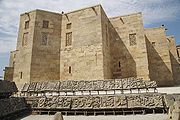
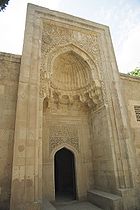
(or Shirvanshahs' Palace) is the biggest monument of the Shirvan-Absheron branch of architecture, situated in the Inner City of Baku
. The complex contains the main building of the palace, Divanhane, the burial-vaults, the shah's mosque with a minaret, Seyid Yahya Bakuvi's mausoleum, a portal in the east - Murad's gate, a reservoir and the remnants of the bath-house.

 (note b. is the shortened for the Arabic ibn (son) ).
The list is mainly taken from with some pronunciation differences on names due to Minorsky's book.
... (some information is lacking on this period)
Nowadays - after occupation families of some Shirvanshah princes moved to Turkey and Europe and some stayed in Shamakhi. Nowadays there are some in Shamakhi and Baku.
Persian people
The Persian people are part of the Iranian peoples who speak the modern Persian language and closely akin Iranian dialects and languages. The origin of the ethnic Iranian/Persian peoples are traced to the Ancient Iranian peoples, who were part of the ancient Indo-Iranians and themselves part of...
dynasty within their culturally Persian environment. The Shirvanshah established a native state in Shirvan
Shirvan
Shirvan , also spelled as Shirwan, Shervan, Sherwan and Šervān, is a historical region in the eastern Caucasus, known by this name in both Islamic and modern times...
(located in modern Azerbaijan
Azerbaijan
Azerbaijan , officially the Republic of Azerbaijan is the largest country in the Caucasus region of Eurasia. Located at the crossroads of Western Asia and Eastern Europe, it is bounded by the Caspian Sea to the east, Russia to the north, Georgia to the northwest, Armenia to the west, and Iran to...
). The Shirwanshahs were also known by the title of Kasranids in certain periods.
Origin and history
The title Shirvanshah dates back to pre-Islamic times. Ibn KhordadbehIbn Khordadbeh
Abu'l Qasim Ubaid'Allah ibn Khordadbeh , author of the earliest surviving Arabic book of administrative geography, was a Persian geographer and bureaucrat of the 9th century...
mentions the Shirvanshah as the local ruler who received the title from Sassanid emperor Ardashir. Al-Baladhuri also mentions that Shirvanshah, together with the adjacent potentate, Layzanshah were encountered by Arab invaders of the region and records that Shirwan submitted during the time of Caliph Uthman to the commander Salman b. Rab'ia Al-Bahili.
From the end of the 2nd/8th century, Shirvan was under the rule of the members of the Arab family of Yazid b. Mazyad Shaybani (d. 185/801).
By origin, the Yazidids were Arabs of the Shaybani tribe and belonged to high ranking generals and governors of the Abbassid army. They held a firm grip also on the wider region of Azarbaijan
Azerbaijan (Iran)
Azerbaijan or Azarbaijan , also Iranian Azerbaijan, Persian Azarbaijan is a region in northwestern Iran. It is also historically known as Atropatene and Aturpatakan....
, Arran
Arran (Azerbaijan)
Arran , also known as Aran, Ardhan , Al-Ran , Aghvank and Alvank , or Caucasian Albania , was a geographical name used in ancient and medieval times to signify the territory which lies within the triangle of land, lowland in the east and mountainous in the west, formed by the junction of Kura and...
, Armenia
Armenia
Armenia , officially the Republic of Armenia , is a landlocked mountainous country in the Caucasus region of Eurasia...
and eastern Caucasus regions. After the death of the Caliph Al-Mutawakkil
Al-Mutawakkil
Al-Mutawakkil ʻAlā Allāh Jaʻfar ibn al-Muʻtasim was an Abbasid caliph who reigned in Samarra from 847 until 861...
, the door for emancipation from the caliphate were slowly opened. The great-grandson of Yazid b. Mazyad Shaybani was Haytham b. Muhammad and he assumed the ancient title of Shirvanshah. The dynasty continuously ruled the area of Shirvan either as an independent state or a vassal state until the Safavid times.
One of the important books in the early history of this dynasty is the anonymous Taʾrikh Bab al-Abwab, preserved by the Ottoman historian Munejjim-Bashi (Chief Astronomer), the last date of which concerning the dynasty is 468/1075. A translation of this important work into English language was published by the orientalist Vladimir Minorsky in 1958. We know from this book that the history of the Shirvan Shahs was closely tied with that of the Arab Hashimid family in Darband (Bab al-Abwab) and intermarriage between the two Arab families was common with Yazidis often ruling for various periods in the latter town.
By the time of the anonymous work Hodud al-Alam
Hudud ul-'alam min al-mashriq ila al-maghrib
Ḥudūd al-ʿĀlam , meaning The Limits of The World, is a tenth century geography book written in Persian by an unknown author from Jōzjān.- Contents :...
(c. 982 AD), the Shirvan Shahs, from their capital of Yazīdiyya (very probably the later Shamakha), had absorbed neighbouring kingdoms north of the Kur river and thus acquired the additional titles of Layzan Shah and Khursan Shah. We can also discern the progressive Persianisation of this originally Arab family. According to Encyclopedia of Islam: After the Shah Yazid b. Ahmad (381-418/991-1028), Arab names give way to Persian ones like Manūčihr, Ḳubādh, Farīdūn, etc., very likely as a reflection of marriage links with local families, and possibly with that of the ancient rulers in Shābarān, the former capital, and the Yazidids now began to claim a nasab going back to Sassanid kings Bahrām Gūr or to Khusraw Anushirwan.. According to Vladimir Minorsky, the most likely explanation of the Iranicisation of this Arab family could be marriage link with the family of the ancient rulers of Shabaran. He further states: The attraction of a Sassanian pedigree proved stronger than the recollection of Shaybani lineage..
Shirvanshahs built many defensive castles across all of Shirvan to resist many foreign invasions. From the walled city of Baku with its Maiden Tower (XII) and many medieval castles in Absheron to impregnable strongholds all over mountains of Shirvan and Shaki, there are many great examples of medieval military architecture. However, Shirvan was greatly devastated by Mongol invasion in 1235, from which it was not able to fully recover for the next century.
The Shirvanshahs dynasty, existing as independent or a vassal state, from 861 until 1538; longer than any other dynasty in Islamic world, are known for their support of culture. There were two periods of an independent and strong Shirvan state: first in 12th century, under sultans Manuchehr and Ahsitan who built the stronghold of Baku, and second in 15th century under Derbendid dynasty. In the 13th and 14th centuries Shirvan was a vassal of stronger Mongol and Timurid empires.
Shirvanshah Ibrahim I
Ibrahim I of Shirvan
Ibrahim I of Shirvan Shirvanshah was a ruler of Shirvan from the Derbendid dynasty.After the death of Shirvanshah Hushang in 1382, Ibrahim I was selected to be the ruler by the local nobility. At the time, he was an impoverished noble living in Shaki...
revived the country's fortunes, and through his cunning politics managed to resist Timurid conquest, letting the state go with paying a tribute.
Shirvanshahs Khalilullah I
Khalilullah I
Khalilullah I was ruler of Shirvan and son of Ibrahim I of Shirvan. He was succeeded by Shirvanshah Farrukh Yassar, his son....
and Farrukh Yassar
Farrukh Yassar
Farrukh Yassar Shirvanshah of Shirvan .In 1488 Shaykh Haydar of Safaviyya moved through Shirvan towards Derbend, supposedly to wage jihad against Circassians, but instead laid siege to Derbent. Farrukh Yassar was not able to mount defense and asked Sultan Yagub of Kara Koyunlu to the rescue...
resided over most successful period in a history of Shirvan. Architectural complex of "Shirvanshah palace" in Baku that was also a burial site of the dynasty and Halwatiyya Sufi khaneqa, was built during the reign of those two rulers in mid 15th centuries. The Shirvanshah rulers were more or less Sunni. In 1462 Sheykh Junayd, the leader of Safaviyya, was killed in a battle against Shirvanishans near the town of Khachmaz
Khachmaz
Khachmaz is a city in Northeastern Azerbaijan's Khachmaz region. It is located about 10 km from the Caspian Sea, below Khudat, and to the east of Quba. It is located at 41-28N, 48-48E at an elevation of 27m. Khachmaz is 170 kilometres north of the capital Baku...
- an event that Safavids never forgot. By 1500, significantly weakened Shirvan suffered the onslaught of avenging Safavids.
Shah Ismail I sacked Baku in 1501, and, avenging his grandfather, exhumed bodies of Shirvanshahs, buried in the mausoleum and burned them. Most of Baku population was forcibly converted to Shi'ism thereafter.
The vassal Shirvan state managed to hang on until 1538, when, weakened by internal conflict and a Qalandari dervish uprising, it became an easy prey to Shah Ismail's son Tahmasp I
Tahmasp I
Tahmasp or Tahmasb I was an influential Shah of Iran, who enjoyed the longest reign of any member of the Safavid dynasty...
. He gave Shirvan to his brother Alqas Mirza to rule as a province.
Persian poetry
The Shirvanshah dynasty are known for their patronage of Persian poetry. Amongst famous poets who either appeared at their court or dedicated poetry to them are Khaghani and Nizami. Nizami composed in Persian poetry the Arab origined epic Lili o Majnoon for Abul-Muzaffar Jalal ad-din Shirvanshah Akhsatan. He also sent his son to be educated with the son of Shirvanshah. Khaghani himself in his youth used the poetic title Haqiqi. After dedicating himself to the court of Fakhr ad-din Manuchehr Fereydoon Shirvanshah (also known as the Khaghan Akbar), he chose the pen name Khaghani and also served as a court poet for, Akhsatan, the son of Fakhr ad-din Manuchehr Fereydoon. Other poets and writers who appeared during the rule of the Shirvanshahs include Falaki Shirvani, Aziz Shirvani, Jamal Khalil Shirvani, Bakhtiyar Shirvani and multitude of others mentioned in the book Nozhat al-MajalesNozhat al-Majales
Noz'hat al-Majāles is an anthology which contains around 4,100 Persian quatrains by some 300 poets of the 5th to 7th11th-13th centuries. The anthology was compiled around the middle of the 7th/13th century by the Persian poet Jamal al-Din Khalil Shirvani...
, an anthology compiled by Jamal Khalil Shirvani
Nozhat al-Majales
Noz'hat al-Majāles is an anthology which contains around 4,100 Persian quatrains by some 300 poets of the 5th to 7th11th-13th centuries. The anthology was compiled around the middle of the 7th/13th century by the Persian poet Jamal al-Din Khalil Shirvani...
.
Architecture
Palace of the ShirvanshahsPalace of the Shirvanshahs
Palace of the Shirvanshahs is the biggest monument of the Shirvan-Absheron branch of the Azerbaijan architecture, situated in the Inner City of Baku...
(or Shirvanshahs' Palace) is the biggest monument of the Shirvan-Absheron branch of architecture, situated in the Inner City of Baku
Baku
Baku , sometimes spelled as Baki or Bakou, is the capital and largest city of Azerbaijan, as well as the largest city on the Caspian Sea and of the Caucasus region. It is located on the southern shore of the Absheron Peninsula, which projects into the Caspian Sea. The city consists of two principal...
. The complex contains the main building of the palace, Divanhane, the burial-vaults, the shah's mosque with a minaret, Seyid Yahya Bakuvi's mausoleum, a portal in the east - Murad's gate, a reservoir and the remnants of the bath-house.
The First line of Yazidi Shahs(861-1382)
The list is mainly taken from with some pronunciation differences on names due to Minorsky's book.
- 799 AD - Yazid b. Mazyad al-Shaybani, governor of Azerbaijan, Armenia, Arran, Sharvan and Bab al-Abwab , d. 801 AD.
- 820 AD - Khalid b. Yazid, died 843 or 845.
- 845 AD - Muhammed b. Khalid, governor of Armenia, Azerbaijan, Arran and Sharwan, resident in Arran, d. 845.
- Haytham b. Khalid, independent in Sharvan as the Sharvan Shah.
- Muhammad b. Haytham, in Layzan
- Haytham b. Muhammad, in Layzan
- Before 913 AD - Ali b. Haytham, in Layzan, deposed in 917.
- 916 AD - Yazid b. Muhammad b. Yazid, Abu Tahir, in Sharvan, latterly also n Bab al-Abwab(DarbandDarbandDarband may refer to:* Darband, Khyber Pakhtunkhwa, a Union Council of Mansehra District, Pakistan* Darband , a town or district in Tajikistan's Region of Republican Subordination* Darband , a village attached to Iran's capital Tehran...
) - 948 AD - Muhammad b. Yazid
- 956 AD - Ahmad b. Muhammad
- 981 AD - Muhammad b. Ahmad
- 991 AD - Yazid b. Ahmad
- 1028 AD - Manuchihr b. Yazid
- 1034 AD - Ali b. Yazid, Abu Mansur
- 1043 AD - Qubadh b. Yazid
- 1049 AD - Bukhtnassar Ali b. Ahmad b. Yazid
- 1053 AD - Sallar b. Yazid
- 1063 AD - Fariburz b. Sallar b. Yazid
- 1094 AD - Fereydun b. Fariburz, d. 1120 AD.
- 1094 AD - Manuchehr II b. Fariburz, immediate predecessor or successor of Fariburz or possibly contemporaneous ruler of Sharwan during the time of Fereydun.
- 1120 AD - Manuchehr III b. Fereydun
- 1160 AD - Akhsatan I ibn Manuchehr III, died between 1197 and 1204.
- 1179 AD - Shahanshah b. Manuchehr III, possibly a contemporaneous ruler with Akhsatan, do 1204 AD.
- 1187 AD - Fereydun II b. Manuchehr III, possibly a contemporaneous ruler with his brother, to 1204 AD.
- After 1187 AD - Fariburz II b. Fereydun II, also a possible contemporaneous ruler with his father and/or uncles.
- After 1187 AD - Farrukhzad I b. Manuchehr III, also a possible contemporaneous ruler with his nephew and/or brothers to 1225 AD.
- after 1204 AD - Garrshasp I b. Farrukhzad
- 1255 AD - AkhsatanII b. Fariburz III
- 1258 AD - Garshasp II or Gushnasp b. Akhsatan II
- 1265 AD - Farrukhzad II b. Akhsatan II
... (some information is lacking on this period)
- 1345 AD - Kay Qubadh
- 1348 AD - Kay Kawus b. Kay Qubadh
- 1372 or 1378 or 1382 AD - Hushang b. Kay Kawus
The second line of Shahs (1382-1538)
- 1378 AD - Ibrahim I b. Muhammad b. Kay Qubadh
- 1418 AD - Khalil b. Ibrahim IIbrahim I of ShirvanIbrahim I of Shirvan Shirvanshah was a ruler of Shirvan from the Derbendid dynasty.After the death of Shirvanshah Hushang in 1382, Ibrahim I was selected to be the ruler by the local nobility. At the time, he was an impoverished noble living in Shaki...
- 1463 AD - Farrukhsiyar b. Khalil IKhalilullah IKhalilullah I was ruler of Shirvan and son of Ibrahim I of Shirvan. He was succeeded by Shirvanshah Farrukh Yassar, his son....
- 1500 AD - Bayram/Bahram b. Farrukhsiyar
- 1502 AD - Ghazi b. FarrukhsiyarFarrukh YassarFarrukh Yassar Shirvanshah of Shirvan .In 1488 Shaykh Haydar of Safaviyya moved through Shirvan towards Derbend, supposedly to wage jihad against Circassians, but instead laid siege to Derbent. Farrukh Yassar was not able to mount defense and asked Sultan Yagub of Kara Koyunlu to the rescue...
- 1503 AD - Mahmud b. Ghazi
- 1503 AD - Ibrahim II or Shaykh Shah, uncle of Mahmud b. Ghazi
- 1524 AD - Khalil II b. Ibrahim II
- 1535 AD - Shah Rukh b. Farrukh b. Ibrahim II, k. 1539
- 1538 AD - Safawid occupation
- 1544 AD - Abortive revanche by Burhan b. Ali b. Khalil II, d. 1551.
- 1551 AD - Safawid occupation.
- 1579 AD - Abu Bakr b. Burhan Ali as governor for the Ottomons.
- 1607 AD - Safawid rule definitely established.
Nowadays - after occupation families of some Shirvanshah princes moved to Turkey and Europe and some stayed in Shamakhi. Nowadays there are some in Shamakhi and Baku.
See also
- History of AzerbaijanHistory of AzerbaijanAzerbaijan or Azarbaijan is a country in the Caucasus region of Eurasia. It's bounded by Caspian Sea to the east, Russia's Daghestan region to the north, Georgia to the northwest, Armenia and Turkey to the southwest, and Iran to the south...
- ShirvanShirvanShirvan , also spelled as Shirwan, Shervan, Sherwan and Šervān, is a historical region in the eastern Caucasus, known by this name in both Islamic and modern times...
- ShamakhiShamakhiShamakhi or Shamakhy is a rayon of the Republic of Azerbaijan, and a town in the rayon. It is the historical center of the region of Shirvan.The town is west of Baku. It has more than 20,000 inhabitants, among them Azerbaijanis and Russians...
- List of Sunni Muslim dynasties