
All Topics  
Force


   Email Print
   Bookmark   Link


Force


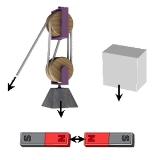
In physics
Physics

Physics is the natural science which examines basic concepts such as energy, force, and spacetime and all that derives from these, such as mass, charge, matter and its Motion ....
, a force is that which can cause an object with mass
Mass

In physical science, mass refers to the degree of acceleration a body acquires when subject to a force: bodies with greater mass are accelerated less by the same force....
 to change its velocity
Velocity

In physics, velocity is defined as the Derivative of Position vector. It is a vector physical quantity; both speed and direction are required to define it....
. Force has both magnitude and direction
Direction (geometry, geography)

Direction is the information contained in the relative position of one point with respect to another point without the distance information. Directions may be either Relative direction to some indicated reference , or absolute according to some previously agreed upon frame of reference ....
, making it a vector quantity. Newton's second law states that an object with a constant mass will accelerate in proportion to the net force
Net force

A net force, Fnet = F1 + F2 + ? is a Vector produced when two or more forces act upon a single object....
 acting upon and in inverse proportion to its mass. Equivalently, the net force on an object equals the rate
Time derivative

A time derivative is a derivative of a function with respect to time, usually interpreted as the rate of change of the value of the function. The variable denoting time is usually written as ....
 at which its momentum
Momentum

In classical mechanics, momentum is the product of the mass and velocity of an object . For more accurate measures of momentum, see the section Momentum#Modern definitions of momentum on this page....
 changes.

Forces acting on three-dimensional objects may also cause them to rotate or deform
Deformation

In materials science, deformation is a change in the shape or size of an object due to an applied force . This can be a result of tensile strength forces, compressive strength forces, Simple shear, bending or torsion ....
, or result in a change in pressure
Pressure

Pressure is the force per unit area applied to an object in a direction surface normal to the surface. Gauge pressure is the pressure relative to the local atmospheric or ambient pressure....
 or even change volume in some cases.


Discussion
Ask a question about 'Force'
Start a new discussion about 'Force'
Answer questions from other users
Full Discussion Forum


Quotations


...who overcomes by foce, hath overcome but half his foe.

John Milton, Paradise Lost (1667)

A man may build himself a throne of bayonets, but he cannot sit upon it.

William Ralph Inge, Philosophy of Plotinus (1923)

A riot is at the bottom the language of the unheard.

Martin Luther King, Chaos or Community (1967)

Force is not a remedy.

John Bright, in a speech (1880)

Let there be no violence in religion.

Koran, Chapter 2

There is a homely old adage which runs, 'Speak softly and carry a big stick; you will go far.'.

Theodore Roosevelt, speech (1903)


Encyclopedia


In physics
Physics

Physics is the natural science which examines basic concepts such as energy, force, and spacetime and all that derives from these, such as mass, charge, matter and its Motion ....
, a force is that which can cause an object with mass
Mass

In physical science, mass refers to the degree of acceleration a body acquires when subject to a force: bodies with greater mass are accelerated less by the same force....
 to change its velocity
Velocity

In physics, velocity is defined as the Derivative of Position vector. It is a vector physical quantity; both speed and direction are required to define it....
. Force has both magnitude and direction
Direction (geometry, geography)

Direction is the information contained in the relative position of one point with respect to another point without the distance information. Directions may be either Relative direction to some indicated reference , or absolute according to some previously agreed upon frame of reference ....
, making it a vector quantity. Newton's second law states that an object with a constant mass will accelerate in proportion to the net force
Net force

A net force, Fnet = F1 + F2 + ? is a Vector produced when two or more forces act upon a single object....
 acting upon and in inverse proportion to its mass. Equivalently, the net force on an object equals the rate
Time derivative

A time derivative is a derivative of a function with respect to time, usually interpreted as the rate of change of the value of the function. The variable denoting time is usually written as ....
 at which its momentum
Momentum

In classical mechanics, momentum is the product of the mass and velocity of an object . For more accurate measures of momentum, see the section Momentum#Modern definitions of momentum on this page....
 changes.

Forces acting on three-dimensional objects may also cause them to rotate or deform
Deformation

In materials science, deformation is a change in the shape or size of an object due to an applied force . This can be a result of tensile strength forces, compressive strength forces, Simple shear, bending or torsion ....
, or result in a change in pressure
Pressure

Pressure is the force per unit area applied to an object in a direction surface normal to the surface. Gauge pressure is the pressure relative to the local atmospheric or ambient pressure....
 or even change volume in some cases. The tendency of a force to cause changes in rotational speed
Angular acceleration

Angular acceleration is the rate of change of angular velocity over time. In SI units, it is measured in radians per second squared , and is usually denoted by the Greek letter alpha ....
 about an axis is called torque
Torque

Torque is the tendency of a force to rotate an object about an axis . Just as a force is a push or a pull, a torque can be thought of as a twist....
. Deformation and pressure are the result of stress
Stress (physics)

In continuum mechanics, stress is a measure of the average amount of force exerted per unit area. It is a measure of the intensity of the total internal forces acting within a body across imaginary internal surfaces, as a reaction to external applied forces and body forces....
 forces within an object.

Since antiquity, scientists have used the concept of force in the study of stationary
Statics

Statics is the branch of mechanics concerned with the analysis of loads on physical systems in static equilibrium, that is, in a state where the relative positions of subsystems do not vary over time, or where components and structures are at a constant velocity....
 and moving objects. The study of forces advanced with descriptions made by the third century BC philosopher Archimedes
Archimedes

Archimedes of Syracuse was a Greek mathematics, physicist, engineer, inventor, and astronomer. Although few details of his life are known, he is regarded as one of the leading scientists in classical antiquity....
 of how forces interact in simple machines
Simple Machines

Simple Machines was a record label that operated out of Arlington, Virginia. The label was masterminded by Jenny Toomey and Kristin Thomson and, at its peak, had four paid workers- Jenny Toomey, Thomson, Pat Graham and Mickey Menard....
. Prior to this, descriptions of forces by Aristotle
Aristotle

Aristotle was a Greeks philosopher, a student of Plato and teacher of Alexander the Great. He wrote on many subjects, including physics, metaphysics, Poetics , theater, music, logic, rhetoric, politics, government, ethics, biology and zoology....
 incorporated fundamental misunderstandings. By the seventeenth century, Sir Issac Newton
Isaac Newton

Sir Isaac Newton, Fellow of the Royal Society was an English people physicist, mathematician, Astronomy, Natural philosophy, Alchemy, and Theology and one of the the 100 in human history....
 corrected these misunderstandings with mathematical insight that remained unchanged for nearly three hundred years. By the early 20th century, Einstein in his theory of general relativity successfully predicted the failure of Newton's model for gravity by ushering in the concept of a space-time
Spacetime

In physics, spacetime is any mathematical model that combines space and Time in physics into a single continuum . Spacetime is usually interpreted with space being Three-dimensional space and time playing the role of a fourth dimension that is of a different sort than the spatial dimensions....
 continuum.

The recent theory of particle physics
Particle physics

Particle physics is a branch of physics that studies the elementary particle constituents of matter and radiation, and the interactions between them....
 known as the Standard Model
Standard Model

The Standard Model of particle physics is a theory of three of the four known fundamental interactions and the elementary particles that take part in these interactions....
 associate forces at the level of quantum mechanics
Quantum mechanics

Quantum mechanics is a set of principles underlying the most fundamental known description of all physical systems at the microscopic scale . Notable amongst these principles are both a dual wave-like and particle-like behavior of matter and radiation, and prediction of probabilities in situations where classical physics predicts certaintie...
. The Standard Model predicts that exchange particles called gauge boson
Gauge boson

In particle physics, gauge bosons are bosonic particles that act as carriers of the fundamental interactions of nature. More specifically, elementary particles whose interactions are described by gauge theory exert forces on each other by the exchange of gauge bosons, usually as virtual particles....
s are the fundamental means by which forces are emitted and absorbed. Only four main interactions are known: in order of decreasing strength, they are: strong, electromagnetic
Electromagnetic force

In physics, the electromagnetic force is the force that the electromagnetic field exerts on electrically charged particles. It is the electromagnetic force that holds electrons and protons together in atoms, and which hold atoms together to make molecules....
, weak, and gravitational. High-energy particle physics observation
Observation

Observation is either an activity of a living being , consisting of receiving knowledge of the outside world through the senses, or the recording of data using scientific instruments....
s made during the 1970s and 1980s confirmed that the weak and electromagnetic forces are expressions of a more fundamental electroweak interaction.

Pre-Newtonian concepts

Since antiquity, the concept of force has been recognized as integral to the functioning of each of the simple machine
Simple machine

A simple machine is a mechanical device that changes the direction or magnitude of a force.In general, they can be defined as the simplest mechanisms that use mechanical advantage to multiply force....
s. The mechanical advantage
Mechanical advantage

In physics and engineering, mechanical advantage is the factor by which a mechanism multiplies the force or torque put into it. Generally, the mechanical advantage is calculated as follows:...
 given by a simple machine allowed for less force to be used in exchange for that force acting over a greater distance. Analysis of the characteristics of forces ultimately culminated in the work of Archimedes
Archimedes

Archimedes of Syracuse was a Greek mathematics, physicist, engineer, inventor, and astronomer. Although few details of his life are known, he is regarded as one of the leading scientists in classical antiquity....
 who was especially famous for formulating a treatment of buoyant forces inherent in fluid
Fluid

A fluid is defined as a substance that continually deforms under an applied shear stress. All liquids and all gases are fluids. Fluids are a subset of the Phase and include liquids, gas, Plasma physics and, to some extent, plasticity ....
s.

Aristotle
Aristotle

Aristotle was a Greeks philosopher, a student of Plato and teacher of Alexander the Great. He wrote on many subjects, including physics, metaphysics, Poetics , theater, music, logic, rhetoric, politics, government, ethics, biology and zoology....
 provided a philosophical
Philosophy

Philosophy is the study of general problems concerning matters such as existence, knowledge, truth, beauty, justice, validity, mind, and language....
 discussion of the concept of a force as an integral part of Aristotelian cosmology
Physics (Aristotle)

Physics is a key text in the philosophy of Aristotle. It stands at the head of the current Andronicus of Rhodes order, the long series of Aristotle's physical, cosmological and biological works, and is foundational to them....
. In Aristotle's view, the natural world
Nature

File:Jungle in Punjab.JPGNature, in the broadest sense, is equivalent to the natural world, physical universe, material world or material universe....
 held four elements
Four elements

Four elements may refer to:* Classical elements, such as air, fire, earth and water* 4 Elements, an album by Chronic Future* Group 4 element, one of the chemical elements in Group 4 of the periodic table...
 that existed in "natural states". Aristotle believed that it was the natural state of objects with mass on Earth
Earth

Earth is the third planet from the Sun. Earth is the largest of the terrestrial planets in the Solar System in diameter, mass and density. It is also referred to as the World and Wiktionary:Terra.Note that by International Astronomical Union convention, the term "Terra" is used for naming extensive land masses, rather...
, such as the elements water and earth, to be motionless on the ground and that they tended towards that state if left alone. He distinguished between the innate tendency of objects to find their "natural place" (e.g., for heavy bodies to fall), which led to "natural motion", and unnatural or forced motion, which required continued application of a force. This theory, based on the everyday experience of how objects move, such as the constant application of a force needed to keep a cart moving, had conceptual trouble accounting for the behavior of projectile
Projectile

A projectile is any object propelled through space by the exertion of a force, which ceases after launch. In a general sense, even a Football or baseball may be considered a projectile....
s, such as the flight of arrows. The place where forces were applied to projectiles was only at the start of the flight, and while the projectile sailed through the air, no discernible force acts on it. Aristotle was aware of this problem and proposed that the air displaced through the projectile's path provided the needed force to continue the projectile moving. This explanation demands that air is needed for projectiles and that, for example, in a vacuum
Vacuum

A vacuum is a volume of space that is essentially empty of matter, such that its gaseous pressure is much less than atmospheric pressure. The word comes from the Latin term for "empty," but in reality, no volume of space can ever be perfectly empty....
, no projectile would move after the initial push. Additional problems with the explanation include the fact that air resists the motion of the projectiles.

These shortcomings would not be fully explained and corrected until the seventeenth century work of Galileo Galilei
Galileo Galilei

Galileo Galilei was a Grand Duchy of Tuscany physicist, mathematician, astronomer, and philosopher who played a major role in the Scientific Revolution....
, who was influenced by the late medieval idea that objects in forced motion carried an innate force of impetus. Galileo constructed an experiment in which stones and cannonballs were both rolled down an incline to disprove the Aristotelian theory of motion early in the seventeenth century. He showed that the bodies were accelerated by gravity to an extent which was independent of their mass and argued that objects retain their velocity
Velocity

In physics, velocity is defined as the Derivative of Position vector. It is a vector physical quantity; both speed and direction are required to define it....
 unless acted on by a force, for example friction
Friction

File:Friction alt.svgFriction is the force resisting the relative lateral motion of solid surfaces, fluid layers, or material elements in contact....
.

Newtonian mechanics


Sir Isaac Newton sought to describe the motion of all objects using the concepts of inertia
Inertia

File:192447main 017 law of inertia.oggInertia is the resistance of an object to a change in its state of motion. The principle of inertia is one of the fundamental principles of classical physics which are used to describe the Motion of matter and how it is affected by applied forces....
 and force, and in doing so, he found that they obey certain conservation laws. In 1687, Newton went on to publish his thesis Philosophiae Naturalis Principia Mathematica
Philosophiae Naturalis Principia Mathematica

The Philosophi? Naturalis Principia Mathematica is a three-volume work by Isaac Newton published on 5 July 1687. It contains the statement of Newton's laws of motion forming the foundation of classical mechanics, as well as his Newton's law of universal gravitation and a derivation of Kepler's laws of planetary motion for the motion of...
. In this work, Newton set out three laws of motion that to this day are the way forces are described in physics. The general definition of net force can be found in Newton's second law of motion, and it is equal to rate of change of momentum:

.

Newton's first law


Newton's first law of motion states that objects continue to move in a state of constant velocity unless acted upon by an external net force
Net force

A net force, Fnet = F1 + F2 + ? is a Vector produced when two or more forces act upon a single object....
 or resultant force. This law is an extension of Galileo's insight that constant velocity was associated with a lack of net force (see a more detailed description of this below). Newton proposed that every object with mass has an innate inertia
Inertia

File:192447main 017 law of inertia.oggInertia is the resistance of an object to a change in its state of motion. The principle of inertia is one of the fundamental principles of classical physics which are used to describe the Motion of matter and how it is affected by applied forces....
 that functions as the fundamental equilibrium "natural state" in place of the Aristotelian idea of the "natural state of rest". That is, the first law contradicts the intuitive Aristotelian belief that a net force is required to keep an object moving with constant velocity. By making rest physically indistinguishable from non-zero constant velocity, Newton's first law directly connects inertia with the concept of relative velocities. Specifically, in systems where objects are moving with different velocities, it is impossible to determine which object is "in motion" and which object is "at rest". In other words, to phrase matters more technically, the laws of physics are the same in every inertial frame of reference
Inertial frame of reference

In physics, an inertial frame of reference is a frame of reference, tied to the state of motion of an Observer , with the property that each physical law portrays itself in the same form in every inertial frame....
, that is, in all frames related by a Galilean transformation
Galilean transformation

The Galilean transformation is used to transform between the coordinates of two reference frames which differ only by constant relative motion within the constructs of Newtonian physics....
.

For example, while traveling in a moving vehicle at a constant velocity
Velocity

In physics, velocity is defined as the Derivative of Position vector. It is a vector physical quantity; both speed and direction are required to define it....
, the laws of physics do not change from being at rest. A person can throw a ball straight up in the air and catch it as it falls down without worrying about applying a force in the direction the vehicle is moving. This is true even though another person who is observing the moving vehicle pass by also observes the ball follow a curving parabolic path
Parabola

In mathematics, the parabola is a conic section, the intersection of a right circular conical surface and a plane parallel to a generating straight line of that surface....
 in the same direction as the motion of the vehicle. It is the inertia of the ball associated with its constant velocity in the direction of the vehicle's motion that ensures the ball continues to move forward even as it is thrown up and falls back down. From the perspective of the person in the car, the vehicle and every thing inside of it is at rest: It is the outside world that is moving with a constant speed in the opposite direction. Since there is no experiment that can distinguish whether it is the vehicle that is at rest or the outside world that is at rest, the two situations are considered to be physically indistinguishable. Inertia therefore applies equally well to constant velocity motion as it does to rest.

The concept of inertia can be further generalized to explain the tendency of objects to continue in many different forms of constant motion, even those that are not strictly constant velocity. The rotational inertia of planet Earth is what fixes the constancy of the length of a day
Day

A day is a units of measurement of time equivalent to approximately 24 hours. It is not an International System of Units unit but it is accepted for use with SI....
 and the length of a year
Year

A year is the time between two recurrences of an event related to the orbit of the Earth around the Sun. By extension, this can be applied to any planet: for example, a "Martian year" is the time in which Mars completes its own orbit....
. Albert Einstein extended the principle of inertia further when he explained that reference frames subject to constant acceleration, such as those free-falling toward a gravitating object, were physically equivalent to inertial reference frames. This is why, for example, astronauts experience weightlessness
Weightlessness

Weightlessness is a phenomenon experienced by people during free-fall. Although the term #Zero gravity is often used as a synonym, weightlessness in orbit is not the result of the force of gravity being eliminated or even significantly reduced ....
 when in free-fall orbit around the Earth, and why Newton's Laws of Motion are more easily discernible in such environments. If an astronaut places an object with mass in mid-air next to herself, it will remain stationary with respect to the astronaut due to its inertia. This is the same thing that would occur if the astronaut and the object were in intergalactic space with no net force of gravity acting on their shared reference frame. This principle of equivalence was one of the foundational underpinnings for the development of the general theory of relativity.

Godfreykneller Isaacnewton 1689

Newton's second law


A modern statement of Newton's second law is a vector differential equation
Differential equation

A differential equation is a mathematics equation for an unknown function of one or several variable that relates the values of the function itself and its derivatives of various orders....
: where is the momentum
Momentum

In classical mechanics, momentum is the product of the mass and velocity of an object . For more accurate measures of momentum, see the section Momentum#Modern definitions of momentum on this page....
 of the system, and is the net (vector sum) force. In equilibrium, there is zero net force by definition, but (balanced) forces may be present nevertheless (say, resulting in opposite and equal change of momentum). In contrast, the second law states an unbalanced force acting on an object will result in the object's momentum changing over time.

By the definition of momentum
Momentum

In classical mechanics, momentum is the product of the mass and velocity of an object . For more accurate measures of momentum, see the section Momentum#Modern definitions of momentum on this page....
, where m is the mass
Mass

In physical science, mass refers to the degree of acceleration a body acquires when subject to a force: bodies with greater mass are accelerated less by the same force....
 and is the velocity
Velocity

In physics, velocity is defined as the Derivative of Position vector. It is a vector physical quantity; both speed and direction are required to define it....
. In the case of constant mass
Mass

In physical science, mass refers to the degree of acceleration a body acquires when subject to a force: bodies with greater mass are accelerated less by the same force....
 it can be pulled out of the time derivative

.

and the algebraic version of Newton's second law is derived:

It is sometimes called the "second most famous formula in physics". Newton never explicitly stated the formula in the final form above.

For cases in which mass is not constant, the Product Rule shows that .

Newton's second law asserts the proportionality of acceleration and mass to force. Accelerations can be defined through kinematic
Kinematics

Kinematics is a branch of classical mechanics which describes the motion of objects without consideration of the causes leading to the motion....
 measurements. However, while kinematics are well-described through reference frame
Frame of reference

A frame of reference in physics, may refer to a coordinate system or Cartesian coordinate system within which to measure the position, orientation , and other properties of objects in it, or it may refer to an observational reference frame tied to the state of motion of an Observer ....
 analysis in advanced physics, there are still deep questions that remain as to what is the proper definition of mass. General relativity
General relativity

General relativity or the general theory of relativity is the Geometry Theoretical physics of gravitation published by Albert Einstein in 1916....
 offers an equivalence between space-time and mass, but lacking a coherent theory of quantum gravity
Quantum gravity

Quantum gravity is the field of theoretical physics attempting to unify quantum mechanics, which describes three of the Fundamental interaction , with general relativity, the theory of the fourth fundamental force: Gravitation....
, it is unclear as to how or whether this connection is relevant on microscales. With some justification, Newton's second law can be taken as a quantitative definition of mass by writing the law as an equality; the relative units of force and mass then are fixed.

The use of Newton's second law as a definition of force has been disparaged in some of the more rigorous textbooks, because it is essentially a mathematical truism
Truism

A truism is a claim that is so obvious or self-evidence as to be hardly worth mentioning, except as a reminder or as a rhetorical deviceal or literary device....
. The equality between the abstract idea of a "force" and the abstract idea of a "changing momentum vector" ultimately has no observational significance because one cannot be defined without simultaneously defining the other. What a "force" or "changing momentum" is must either be referred to an intuitive understanding of our direct perception, or be defined implicitly through a set of self-consistent mathematical formulas. Notable physicists, philosophers and mathematicians who have sought a more explicit definition of the concept of "force" include Ernst Mach
Ernst Mach

Ernst Mach was an Austrians physicist and philosopher and is the namesake for the Mach number and the optical illusion known as Mach bands....
, Clifford Truesdell
Clifford Truesdell

Clifford Ambrose Truesdell III, was an American mathematician, natural philosopher, historian of science, and polemicist.Truesdell was born in Los Angeles, California....
 and Walter Noll
Walter Noll

Walter Noll is a mathematician, and Professor Emeritus at Carnegie Mellon University. He is best known for developing mathematical tools of classical mechanics and thermodynamics....
.

Newton's second law can be used to measure the strength of forces. For instance, knowledge of the masses of planet
Planet

A planet , as 2006 definition of planet by the International Astronomical Union , is a celestial body orbiting a star or Stellar evolution#Stellar remnants that is massive enough to be rounded by its own gravity, is not massive enough to cause thermonuclear fusion, and has cleared the neighbourhood of planetesimals....
s along with the accelerations of their orbit
ORBit

ORBit is a Common Object Request Broker Architecture 2.4 compliant Object Request Broker . It features mature C , C++ and Python bindings, and less developed bindings for Perl, Lisp , Pascal , Ruby , and Tcl....
s allows scientists to calculate the gravitational forces on planets.

Newton's third law


Newton's third law is a result of applying symmetry
Symmetry

Symmetry generally conveys two primary meanings. The first is an imprecise sense of harmonious or aesthetically-pleasing proportionality and balance; such that it reflects beauty or perfection....
 to situations where forces can be attributed to the presence of different objects. For any two objects (call them 1 and 2), Newton's third law states that any force that is applied to object 1 due to the action of object 2 is automatically accompanied by a force applied to object 2 due to the action of object 1.

This law implies that forces always occur in action-and-reaction pairs. If object 1 and object 2 are considered to be in the same system, then the net force on the system due to the interactions between objects 1 and 2 is zero since

.

This means that in a closed system
Closed system

A closed system is a system in the state of being isolated from its surrounding. It is often used to refer to a theoretical system where perfect closure is an assumption, however in practice no system can be completely closed; there are only varying degrees of closure....
 of particles, there are no internal forces that are unbalanced. That is, action-and-reaction pairs of forces shared between any two objects in a closed system will not cause the center of mass
Center of mass

The center of mass of a system of wiktionary:Particles is a specific point at which, for many purposes, the system's mass behaves as if it were concentrated....
 of the system to accelerate. The constituent objects only accelerate with respect to each other, the system itself remains unaccelerated. Alternatively, if an external force acts on the system, then the center of mass will experience an acceleration proportional to the magnitude of the external force divided by the mass of the system.

Combining Newton's second and third laws, it is possible to show that the linear momentum of a system is conserved. Using

and integrating
Integral

Integration is an important concept in mathematics, specifically in the field of calculus and, more broadly, mathematical analysis. Given a function ƒ of a Real number variable x and an interval [ab] of the real line, the integral...
 with respect to time, the equation:

is obtained. For a system which includes objects 1 and 2,

which is the conservation of linear momentum. Using the similar arguments, it is possible to generalizing this to a system of an arbitrary number of particles. This shows that exchanging momentum between constituent objects will not affect the net momentum of a system. In general, as long as all forces are due to the interaction of objects with mass, it is possible to define a system such that net momentum is never lost nor gained.

Descriptions

Since forces are perceived as pushes or pulls, this can provide an intuitive understanding for describing forces. As with other physical concepts (e.g. temperature
Temperature

In physics, temperature is a physical property of a Physical system that underlies the common notions of hot and cold; something that feels hotter generally has the greater temperature....
), the intuitive understanding of forces is quantified using precise operational definition
Operational definition

Operational definition is a demonstration of a process — such as a variable, terminology, or object — relative in terms of the specific process or set of Formal verification used to determine its presence and quantity....
s that are consistent with direct observations and compared to a standard measurement scale
Measurement

Measurement is the process of assigning a number to an attribute according to a rule or set of rules. The term can also be used to refer to the result obtained after performing the process....
. Through experimentation, it is determined that laboratory measurements of forces are fully consistent with the conceptual definition
Conceptual definition

A conceptual definition is an element of the scientific research Process , in which a specific concept is defined as a measurable occurrence. It basically gives you the meaning of the concept....
 of force offered by Newtonian mechanics.

Forces act in a particular direction and have sizes
Magnitude

Magnitude may refer to: Hose Before Bros* Magnitude , the relative size of a mathematical object* Order of magnitude, the class of scale having a fixed value ratio to the preceding class...
 dependent upon how strong the push or pull is. Because of these characteristics, forces are classified as "vector quantities
Vector

Vector may refer to:...
". This means that forces follow a different set of mathematical rules than physical quantities that do not have direction (denoted scalar
Scalar (physics)

In physics, a scalar is a simple physical quantity that is not changed by coordinate system rotations or translations , or by Lorentz transformations or space-time translations ....
 quantities). For example, when determining what happens when two forces act on the same object, it is necessary to know both the magnitude and the direction of both forces to calculate the result
Resultant

In mathematics, the resultant of two monic polynomials and over a Field_ is defined as the productof the differences of their roots, where and take on values in the algebraic closure of ....
. If both of these pieces of information are not known for each force, the situation is ambiguous. For example, if you know that two people are pulling on the same rope with known magnitudes of force but you do not know which direction either person is pulling, it is impossible to determine what the acceleration of the rope will be. The two people could be pulling against each other as in tug of war
Tug of war

Tug of war, tug o' war, or tug war, also known as rope pulling, is a sport that directly puts two teams against each other in a test of strength....
 or the two people could be pulling in the same direction. In this simple one-dimensional example, without knowing the direction of the forces it is impossible to decide whether the net force is the result of adding the two force magnitudes or subtracting one from the other. Associating forces with vectors avoids such problems.

Historically, forces were first quantitatively investigated in conditions of static equilibrium where several forces canceled each other out. Such experiments demonstrate the crucial properties that forces are additive vector quantities: they have magnitude
Magnitude (mathematics)

The magnitude of a mathematical object is its size: a property by which it can be larger or smaller than other objects of the same kind; in technical terms, an ordering of the class of objects to which it belongs....
 and direction. When two forces act on an object, the resulting force, the resultant, can be determined by following the parallelogram rule of vector addition: the addition of two vectors represented by sides of a parallelogram, gives an equivalent resultant vector which is equal in magnitude and direction to the transversal of the parallelogram.. The magnitude of the resultant varies from the difference of the magnitudes of the two forces to their sum, depending on the angle between their lines of action.

Free-body diagrams can be used as a convenient way to keep track of forces acting on a system. Ideally, these diagrams are drawn with the angles and relative magnitudes of the force vectors preserved so that graphical vector addition can be done to determine the resultant.

As well as being added, forces can also be resolved into independent components at right angle
Right angle

In geometry and trigonometry, a right angle is an angle of 90 degree s, corresponding to a quarter turn . It can be defined; as the angle such that twice that angle amounts to a half turn, or 180?....
s to each other. A horizontal force pointing northeast can therefore be split into two forces, one pointing north, and one pointing east. Summing these component forces using vector addition yields the original force. Resolving force vectors into components of a set of basis vectors is often a more mathematically clean way to describe forces than using magnitudes and directions. This is because, for orthogonal components, the components of the vector sum are uniquely determined by the scalar addition of the components of the individual vectors. Orthogonal components are independent of each other; forces acting at ninety degrees to each other have no effect on each other. Choosing a set of orthogonal basis vectors is often done by considering what set of basis vectors will make the mathematics most convenient. Choosing a basis vector that is in the same direction as one of the forces is desirable, since that force would then have only one non-zero component. Force vectors can also be three-dimensional, with the third component at right-angles to the two other components.

Equilibria

Equilibrium
Mechanical equilibrium

A standard definition of is:This is a strict definition, and often the term "static equilibrium" is used in a more relaxed manner interchangeably with "mechanical equilibrium", as defined next....
 occurs when the resultant force acting on an object is zero (that is, the vector sum of all forces is zero). There are two kinds of equilibrium: static equilibrium and dynamic equilibrium
Dynamic equilibrium

A system in dynamic equilibrium is a particular example of a system in a steady state. In a steady state the rate of inputs is equal to the rate of outputs so that the composition of the system is unchanging in time....
.

Static equilibrium
Static equilibrium was understood well before the invention of classical mechanics. Objects which are at rest have zero net force acting on them.

The simplest case of static equilibrium occurs when two forces are equal in magnitude but opposite in direction. For example, an object on a level surface is pulled (attracted) downward toward the center of the Earth by the force of gravity. At the same time, surface forces resist the downward force with equal upward force (called the normal force
Normal force

In physics, the normal force is the component, perpendicular to the surface of contact, of the contact force exerted by, for example, the surface of a floor or wall, on an object, preventing the object from entering the floor or wall....
). The situation is one of zero net force and no acceleration.

Pushing against an object on a frictional surface can result in a situation where the object does not move because the applied force is opposed by static friction, generated between the object and the table surface. For a situation with no movement, the static friction force exactly balances the applied force resulting in no acceleration. The static friction increases or decreases in response to the applied force up to an upper limit determined by the characteristics of the contact between the surface and the object.

A static equilibrium between two forces is the most usual way of measuring forces, using simple devices such as weighing scale
Weighing scale

A weighing scale is a measuring instrument for measuring the weight or mass of an object. They use one of two techniques. A spring scale measures weight by the distance a spring deflects under its load....
s and spring balances. For example, an object suspended on a vertical spring scale
Spring scale

A spring scale is a weighing scale used to measure force, such as the force of gravity, exerted on a mass or the force of a person's grip or the force exerted by a towing vehicle....
 experiences the force of gravity acting on the object balanced by a force applied by the "spring reaction force" which equals object's weight. Using such tools, some quantitative force laws were discovered: that the force of gravity is proportional to volume for objects of constant density
Density

The density of a material is defined as its mass per unit volume. The symbol of density is ....
 (widely exploited for millennia to define standard weights); Archimedes' principle for buoyancy; Archimedes' analysis of the lever
Lever

In physics, a lever is a rigid object that is used with an appropriate fulcrum or wiktionary:pivot point to multiply the mechanical force that can be applied to another object....
; Boyle's law
Boyle's law

Boyle's law is one of several gas laws and a special case of the ideal gas law. Boyle's law describes the inversely proportional relationship between the absolute pressure and volume of a gas, if the temperature is kept constant within a closed system....
 for gas pressure; and Hooke's law
Hooke's law

In mechanics, and physics, Hooke's law of theory of elasticity is an approximation that states that the extension of a spring is in direct proportion with the load added to it as long as this load does not exceed the elastic limit....
 for springs. These were all formulated and experimentally verified before Isaac Newton expounded his three laws of motion
Newton's laws of motion

Newton's laws of motion are three physical laws that form the basis for classical mechanics, Direct relationship the forces acting on a Physical body to the motion of the body....
.

Dynamical equilibrium
Galileo
Dynamical equilibrium was first described by Galileo who noticed that certain assumptions of Aristotelian physics were contradicted by observations and logic
Logic

Logic is the study of the principles of valid demonstration and inference. Logic is a branch of philosophy, a part of the classical Trivium . The word derives from Greek language ?????? , fem....
. Galileo realized that simple velocity addition demands that the concept of an "absolute rest frame
Rest frame

In special relativity the rest frame of a particle is the coordinate system in which the particle is at rest.The rest frame of compound objects is taken to be the frame of reference in which the average momentum of the particles which make up the substance is zero ....
" did not exist. Galileo concluded that motion in a constant velocity
Velocity

In physics, velocity is defined as the Derivative of Position vector. It is a vector physical quantity; both speed and direction are required to define it....
 was completely equivalent to rest. This was contrary to Aristotle's notion of a "natural state" of rest that objects with mass naturally approached. Simple experiments showed that Galileo's understanding of the equivalence of constant velocity and rest to be correct. For example, if a mariner dropped a cannonball from the crow's nest of a ship moving at a constant velocity, Aristotelian physics would have the cannonball fall straight down while the ship moved beneath it. Thus, in an Aristotelian universe, the falling cannonball would land behind the foot of the mast of a moving ship. However, when this experiment is actually conducted, the cannonball always falls at the foot of the mast, as if the cannonball knows to travel with the ship despite being separated from it. Since there is no forward horizontal force being applied on the cannonball as it falls, the only conclusion left is that the cannonball continues to move with the same velocity as the boat as it falls. Thus, no force is required to keep the cannonball moving at the constant forward velocity.

Moreover, any object traveling at a constant velocity must be subject to zero net force (resultant force). This is the definition of dynamical equilibrium: when all the forces on an object balance but it still moves at a constant velocity.

A simple case of dynamical equilibrium occurs in constant velocity motion across a surface with kinetic friction. In such a situation, a force is applied in the direction of motion while the kinetic friction force exactly opposes the applied force. This results in a net zero force, but since the object started with a non-zero velocity, it continues to move with a non-zero velocity. Aristotle misinterpreted this motion as being caused by the applied force. However, when kinetic friction is taken into consideration it is clear that there is no net force causing constant velocity motion.

Feynman diagrams

In modern particle physics
Particle physics

Particle physics is a branch of physics that studies the elementary particle constituents of matter and radiation, and the interactions between them....
, forces and the acceleration of particles are explained as the exchange of momentum-carrying gauge boson
Gauge boson

In particle physics, gauge bosons are bosonic particles that act as carriers of the fundamental interactions of nature. More specifically, elementary particles whose interactions are described by gauge theory exert forces on each other by the exchange of gauge bosons, usually as virtual particles....
s. With the development of quantum field theory
Quantum field theory

Quantum field theory or QFT provides a theoretical framework for constructing quantum mechanics models of systems classically described by field or of Many-body problem....
 and general relativity
General relativity

General relativity or the general theory of relativity is the Geometry Theoretical physics of gravitation published by Albert Einstein in 1916....
, it was realized that "force" is a redundant concept arising from conservation of momentum (4-momentum in relativity and momentum of virtual particle
Virtual particle

In physics, a virtual particle is a particle that exists for a limited time and space, introducing uncertainty in their energy and momentum due to the Heisenberg Uncertainty Principle....
s in quantum electrodynamics
Quantum electrodynamics

Quantum electrodynamics is a relativity theory quantum field theory of electrodynamics. QED was developed by a number of physicists, beginning in the late 1920s....
). The conservation of momentum, from Noether's theorem
Noether's theorem

Noether's theorem states that any derivative Symmetry in physics of the action of a physical system has a corresponding conservation law. The action of a physical system is an integral of a so-called Lagrangian function, from which the system's behavior can be determined by the principle of least action....
, can be directly derived from the symmetry
Symmetry in physics

Symmetry in physics includes all features of a physical system that exhibit the property of symmetry?that is, under certain transformation , aspects of these systems are "unchanged", according to a particular observation....
 of space
Space

Space is the boundless, three-dimensional extent in which Physical body and events occur and have relative position and direction. Physical space is often conceived in three linear dimensions, although modern physics usually consider it, with time, to be part of the boundless four-dimensional continuum known as spacetime....
 and so is usually considered more fundamental than the concept of a force. Thus the currently known fundamental forces are considered more accurately to be "fundamental interactions". When particle A emits (creates) or absorbs (annihilates) particle B, a force accelerates particle A in response to the momentum of particle B, thereby conserving momentum as a whole. This description applies for all forces arising from fundamental interactions. While sophisticated mathematical descriptions are needed to predict, in full detail, the nature of such interactions, there is a conceptually simple way to describe such interactions through the use of Feynman diagrams. In a Feynman diagram, each matter particle is represented as a straight line (see world line
World line

In physics, the world line of an object is the unique path of that object as it travels through 4-dimensional spacetime.The concept of "world line" is distinguished from the concept of "orbit" or "trajectory" by the time dimension, and typically encompasses a large area of spacetime wherein perception straight paths are recalculated to...
) traveling through time which normally increases up or to the right in the diagram. Matter and anti-matter particles are identical except for their direction of propagation through the Feynman diagram. World lines of particles intersect at interaction vertices, and the Feynman diagram represents any force arising from an interaction as occurring at the vertex with an associated instantaneous change in the direction of the particle world lines. Gauge bosons are emitted away from the vertex as wavy lines (similar to waves) and, in the case of virtual particle exchange, are absorbed at an adjacent vertex.

The utility of Feynman diagrams is that other types of physical phenomena that are part of the general picture of fundamental interaction
Fundamental interaction

In physics, a fundamental interaction or fundamental force is a process by which elementary particles interact with each other. An interaction is often described as a field , and is mediated by the exchange of gauge bosons between particles....
s but are conceptually separate from forces can also be described using the same rules. For example, a Feynman diagram can describe in succinct detail how a neutron
Neutron

The neutron is a subatomic particle with no net electric charge and a mass slightly larger than that of a proton.Neutrons are usually found in atomic nucleus....
 decays
Beta decay

In nuclear physics, beta decay is a type of radioactive decay in which a beta particle is emitted. In the case of electron emission, it is referred to as beta minus , while in the case of a positron emission as beta plus ....
 into an electron
Electron

The electron is a subatomic particle that carries a negative electric charge. It has elementary particle and is believed to be a point particle....
, proton
Proton

The proton is a subatomic particle with an electric charge of +1 elementary charge. It is found in the nucleus of each atom but is also stable by itself and has a second identity as the hydrogen ion, H+....
, and neutrino
Neutrino

Neutrinos are elementary particles that travel close to the speed of light, lack an electric charge, are able to pass through ordinary matter almost undisturbed and are thus extremely difficult to detect....
, an interaction mediated by the same gauge boson that is responsible for the weak nuclear force.

Special relativity

In the special theory of relativity mass and energy
Energy

In physics, energy is a scalar physical quantity that describes the amount of Work_ that can be performed by a force. Energy is an attribute of objects and systems that is subject to a conservation law....
 are equivalent (as can be seen by calculating the work required to accelerate an object). When an object's velocity increases so does its energy and hence its mass equivalent (inertia). It thus requires more force to accelerate it the same amount than it did at a lower velocity. Newton's second law

remains valid due to the fact that it is a mathematical definition. But in order to be conserved, relativistic momentum must be redefined as:

where

is the velocity and

is the speed of light
Speed of light

The speed of light in an free space is an important physical constant usually written as c, with a value of 299,792,458 metres per second....
.

The relativistic expression relating force and acceleration for a particle with constant non-zero rest mass moving in the direction is:

where the Lorentz factor
Lorentz factor

The Lorentz factor or Lorentz term appears in several equations in special relativity, including time dilation, length contraction, and the relativistic mass formula....


In some cases, rest mass is not held constant. The relativistic force in these situations can be derived using the Product Rule for 3 factors and the Chain Rule. The result is that the force in the direction of the velocity is given by

Relativistic force does not produce a constant acceleration, but an ever decreasing acceleration as the object approaches the speed of light. Note that is undefined
Division by zero

In mathematics, a division is called a division by zero if the divisor is 0 . Such a division can be formally expressed as a/0 where a is the dividend....
 for an object with a non zero rest mass
Invariant mass

The invariant mass, intrinsic mass, proper mass or just mass is a characteristic of the total energy and momentum of an object or a system of objects that is the Invariant ....
 at the speed of light, and the theory yields no prediction at that speed.

One can however restore the form of

for use in relativity through the use of four-vectors. This relation is correct in relativity when is the four-force
Four-force

In the special theory of relativity four-force is a four-vector that replaces the classical force; the four-force is the four-vector defined as the change in four-momentum over the particle's own Proper Time:...
, m is the invariant mass
Invariant mass

The invariant mass, intrinsic mass, proper mass or just mass is a characteristic of the total energy and momentum of an object or a system of objects that is the Invariant ....
, and is the four-acceleration
Four-acceleration

In special relativity, four-acceleration is a four-vector and is defined as the change in four-velocity over the particle's proper time:where...
.

Fundamental models

All the forces in the universe are based on four fundamental forces. The strong and weak forces act only at very short distances, and are responsible for holding certain nucleons and compound nuclei
Atomic nucleus

The nucleus of an atom is the very dense region, consisting of nucleons , at the center of an atom. Although the size of the nucleus varies considerably according to the mass of the atom, the size of the entire atom is comparatively constant....
 together. The electromagnetic force acts between electric charge
Electric charge

Electric charge is a fundamental conserved property of some subatomic particles, which determines their electromagnetic interaction. Electrically charged matter is influenced by, and produces, electromagnetic fields....
s and the gravitational force acts between masses. All other forces are based on the existence of the four fundamental interactions. For example, friction is a manifestation of the electromagnetic
Electromagnetic

Electromagnetic may refer to:* Electromagnetic radiation* Electromagnetism...
 force acting between the atom
Atom

|-! bgcolor=gray | Properties|-||}The atom is a basic unit of matter consisting of a dense, central atomic nucleus surrounded by a electron cloud of electric charge electrons....
s of two surface
Surface

In mathematics, specifically in topology, a surface is a two-dimensional topological manifold. The most familiar examples are those that arise as the boundaries of solid objects in ordinary three-dimensional Euclidean space E3....
s, and the Pauli Exclusion Principle, which does not allow atoms to pass through each other. The forces in springs
Spring (device)

A spring is an Elasticity object used to store mechanical energy. Springs are usually made out of hardened steel. Small springs can be wound from pre-hardened stock, while larger ones are made from annealing steel and hardened after fabrication....
, modeled by Hooke's law
Hooke's law

In mechanics, and physics, Hooke's law of theory of elasticity is an approximation that states that the extension of a spring is in direct proportion with the load added to it as long as this load does not exceed the elastic limit....
, are also the result of electromagnetic forces and the Exclusion Principle acting together to return the object to its equilibrium position. Centrifugal forces are acceleration forces which arise simply from the acceleration of rotating frames of reference.

The development of fundamental theories for forces proceeded along the lines of unification
Unified field theory

In physics, a unified field theory is a type of field theory that allows all of the fundamental forces between elementary particles to be written in terms of a single field ....
 of disparate ideas. For example, Isaac Newton unified the force responsible for objects falling at the surface of the Earth with the force responsible for the orbits of celestial mechanics in his universal theory of gravitation. Michael Faraday
Michael Faraday

Michael Faraday, Fellow of the Royal Society was an English chemist and physicist who contributed to the fields of electromagnetism and electrochemistry....
 and James Clerk Maxwell
James Clerk Maxwell

James Clerk Maxwell was a Scotland Mathematical physics. His most significant achievement was the development of the classical electromagnetic theory, synthesizing all previous unrelated observations, experiments and equations of electricity, magnetism and even optics into a consistent theory....
 demonstrated that electric and magnetic forces were unified through one consistent theory of electromagnetism. In the twentieth century, the development of quantum mechanics
Quantum mechanics

Quantum mechanics is a set of principles underlying the most fundamental known description of all physical systems at the microscopic scale . Notable amongst these principles are both a dual wave-like and particle-like behavior of matter and radiation, and prediction of probabilities in situations where classical physics predicts certaintie...
 led to a modern understanding that the first three fundamental forces (all except gravity) are manifestations of matter (fermions) interacting by exchanging virtual particles called gauge boson
Gauge boson

In particle physics, gauge bosons are bosonic particles that act as carriers of the fundamental interactions of nature. More specifically, elementary particles whose interactions are described by gauge theory exert forces on each other by the exchange of gauge bosons, usually as virtual particles....
s. This standard model
Standard Model

The Standard Model of particle physics is a theory of three of the four known fundamental interactions and the elementary particles that take part in these interactions....
 of particle physics posits a similarity between the forces and led scientists to predict the unification of the weak and electromagnetic forces in electroweak theory subsequently confirmed by observation. The complete formulation of the standard model predicts an as yet unobserved Higgs mechanism
Higgs mechanism

In quantum field theory, the Higgs mechanism is a way that the massless gauge bosons in a gauge theory get a mass by interacting with a background Higgs field....
, but observations such as neutrino oscillation
Neutrino oscillation

Neutrino oscillation is a quantum mechanics phenomenon predicted by Bruno Pontecorvo whereby a neutrino created with a specific lepton flavor can later be Quantum measurement to have a different flavor....
s indicate that the standard model is incomplete. A grand unified theory allowing for the combination of the electroweak interaction with the strong force is held out as a possibility with candidate theories such as supersymmetry
Supersymmetry

In particle physics, supersymmetry is a symmetry that relates elementary particles of one Spin to another particle that differs by half a unit of spin and are known as superpartners....
 proposed to accommodate some of the outstanding unsolved problems in physics
Unsolved problems in physics

This is a list of some of the major List of unsolved problems in physics. Some of these problems are theory, meaning that existing theories seem incapable of explaining a certain observed phenomenon or experimental result....
. Physicists are still attempting to develop self-consistent unification models that would combine all four fundamental interactions into a theory of everything
Theory of everything

The theory of everything is a putative theory of theoretical physics that fully explains and links together all known physical phenomena. Initially, the term was used with an ironic connotation to refer to various overgeneralized theories....
. Einstein tried and failed at this endeavor, but currently the most popular approach to answering this question is string theory
String theory

String theory is a developing branch of theoretical physics that combines quantum mechanics and general relativity into a quantum gravity. The String s of string theory are one-dimensional oscillating lines, but they are no longer considered fundamental to the theory, which can be formulated in terms of points or surfaces too....
.

Gravity

What we now call gravity was not identified as a universal force until the work of Isaac Newton. Before Newton, the tendency for objects to fall towards the Earth was not understood to be related to the motions of celestial objects. Galileo was instrumental in describing the characteristics of falling objects by determining that the acceleration
Acceleration

File:Acceleration.JPGFile:Acceleration components.JPGIn physics, and more specifically kinematics, acceleration is the change in velocity over time....
 of every object in free-fall
Free-fall

Free fall is motion with no acceleration other than that provided by gravity. Since this definition does not specify velocity, it also applies to objects initially moving upward....
 was constant and independent of the mass of the object. Today, this acceleration due to gravity
Acceleration due to gravity

Acceleration due to gravity can refer to:*Gravitational acceleration, the acceleration due to the gravitational attraction of massive bodies, in particular that due to the Earth's gravity...
 towards the surface of the Earth is usually designated as and has a magnitude of about 9.81 meters per second
Second

The second , sometimes abbreviated sec., is the name of a units of measurement of time, and is the International System of Units SI base unit of time....
 squared (this measurement is taken from sea level and may vary depending on location), and points toward the center of the Earth. This observation means that the force of gravity on an object at the Earth's surface is directly proportional to the object's mass. Thus an object that has a mass of will experience a force:

In free-fall, this force is unopposed and therefore the net force on the object is its weight. For objects not in free-fall, the force of gravity is opposed by the reactions of their supports. For example, a person standing on the ground experiences zero net force, since his weight is balanced by a normal force
Normal force

In physics, the normal force is the component, perpendicular to the surface of contact, of the contact force exerted by, for example, the surface of a floor or wall, on an object, preventing the object from entering the floor or wall....
 exerted by the ground.

Newton's contribution to gravitational theory was to unify the motions of heavenly bodies, which Aristotle had assumed were in a natural state of constant motion, with falling motion observed on the Earth. He proposed a law of gravity that could account for the celestial motions that had been described earlier using Kepler's Laws of Planetary Motion
Kepler's laws of planetary motion

In astronomy, Kepler's three laws of planetary motion are*"The orbit of every planet is an ellipse with the sun at a Focus ."*"A line joining a planet and the sun sweeps out equal areas during equal intervals of time."...
.

Newton came to realize that the effects of gravity might be observed in different ways at larger distances. In particular, Newton determined that the acceleration of the Moon around the Earth could be ascribed to the same force of gravity if the acceleration due to gravity decreased as an inverse square law. Further, Newton realized that the acceleration due to gravity is proportional to the mass of the attracting body. Combining these ideas gives a formula that relates the mass and the radius of the Earth to the gravitational acceleration:

where the vector direction is given by , the unit vector
Unit vector

In mathematics, a unit vector in a normed vector space is a Vector space whose Norm is 1 . A unit vector is often denoted by a lowercase letter with a superscribed caret or ?hat?, like this: ....
 directed outward from the center of the Earth.

In this equation, a dimensional constant is used to describe the relative strength of gravity. This constant has come to be known as Newton's Universal Gravitation Constant
Gravitational constant

The gravitational constant, denoted G, is an empirical physical constant involved in the calculation of the gravitation between objects with mass....
, though its value was unknown in Newton's lifetime. Not until 1798 was Henry Cavendish
Henry Cavendish

Henry Cavendish, Fellow of the Royal Society was a British scientist noted for his discovery of hydrogen or what he called "inflammable air". He described the density of inflammable air, which formed water on combustion, in a 1766 paper "On Factitious Airs"....
 able to make the first measurement of using a torsion balance; this was widely reported in the press as a measurement of the mass of the Earth since knowing the could allow one to solve for the Earth's mass given the above equation. Newton, however, realized that since all celestial bodies followed the same laws of motion, his law of gravity had to be universal. Succinctly stated, Newton's Law of Gravitation states that the force on a spherical object of mass due to the gravitational pull of mass is

where is the distance between the two objects' centers of mass and is the unit vector pointed in the direction away from the center of the first object toward the center of the second object.

This formula was powerful enough to stand as the basis for all subsequent descriptions of motion within the solar system until the twentieth century. During that time, sophisticated methods of perturbation analysis were invented to calculate the deviations of orbit
ORBit

ORBit is a Common Object Request Broker Architecture 2.4 compliant Object Request Broker . It features mature C , C++ and Python bindings, and less developed bindings for Perl, Lisp , Pascal , Ruby , and Tcl....
s due to the influence of multiple bodies on a planet
Planet

A planet , as 2006 definition of planet by the International Astronomical Union , is a celestial body orbiting a star or Stellar evolution#Stellar remnants that is massive enough to be rounded by its own gravity, is not massive enough to cause thermonuclear fusion, and has cleared the neighbourhood of planetesimals....
, moon
Moon

The Moon is Earth's only natural satellite and the List of natural satellites by diameter satellite in the Solar System. The average centre-to-centre distance from the Earth to the Moon is km, about thirty times the diameter of the Earth....
, comet
Comet

A comet is a Small Solar System body that orbits the Sun and, when close enough to the Sun, exhibits a visible coma or a tail?both primarily from the effects of solar radiation upon the Comet nucleus....
, or asteroid
Asteroid

Asteroids, sometimes called minor planets or planetoids, are small Solar System bodies in orbit around the Sun, smaller than planets but larger than meteoroids....
. The formalism was exact enough to allow mathematicians to predict the existence of the planet Neptune
NEPTUNE

=Overview=The project, along with sister project, VENUS, offers a unique approach to ocean science. Traditionally, ocean scientists have relied on infrequent ship cruises or space-based satellites to carry out their research....
 before it was observed.

It was only the orbit of the planet Mercury
Mercury (planet)

Mercury is the innermost and smallest planet in the Solar System, orbiting the Sun once every 88 days. The orbit of Mercury has the highest Orbital eccentricity of all the Solar System planets, and it has the smallest axial tilt....
 that Newton's Law of Gravitation seemed not to fully explain. Some astrophysicists predicted the existence of another planet (Vulcan
Vulcan (hypothetical planet)

Vulcan was a small planet proposed to exist in an orbit between Mercury and the Sun. There were some things about Mercury's orbit that astronomers couldn't explain, and in the 19th-century someone hypothesized that they were the result of another planet, which he named Vulcan....
) that would explain the discrepancies; however, despite some early indications, no such planet could be found. When Albert Einstein
Albert Einstein

Albert Einstein was a Germany-born theoretical physics. He is best known for his theory of relativity and specifically mass?energy equivalence, expressed by the equation E = mc2....
 finally formulated his theory of general relativity
General relativity

General relativity or the general theory of relativity is the Geometry Theoretical physics of gravitation published by Albert Einstein in 1916....
 (GR) he turned his attention to the problem of Mercury's orbit and found that his theory added a correction which could account for the discrepancy
Tests of general relativity

At its introduction in 1915, the general relativity did not have a solid empirical foundation. It was known that it correctly accounted for the "anomalous" precession of the perihelion of Mercury and on philosophical grounds it was considered satisfying that it was able to unify Isaac Newton's law of universal gravitation with special relativity....
. This was the first time that Newton's Theory of Gravity had been shown to be less correct than an alternative.

Since then, and so far, general relativity has been acknowledged as the theory which best explains gravity. In GR, gravitation is not viewed as a force, but rather, objects moving freely in gravitational fields travel under their own inertia in straight lines
Geodesic

In mathematics, a geodesic [jee-uh-des-ik, -dee-sik] is a generalization of the notion of a "Line " to "manifolds".In presence of a Metric , geodesics are defined to be the shortest path between points on the space....
 through curved space-time – defined as the shortest space-time path between two space-time events. From the perspective of the object, all motion occurs as if there were no gravitation whatsoever. It is only when observing the motion in a global sense that the curvature of space-time can be observed and the force is inferred from the object's curved path. Thus, the straight line path in space-time is seen as a curved line in space, and it is called the ballistic
External ballistics

External ballistics is the part of the science of ballistics that deals with the behaviour of a non-powered projectile in flight. External ballistics is frequently associated with firearms, and deals with the behaviour of the bullet after it exits the barrel and before it hits the target....
 trajectory
Trajectory

Trajectory is the path of a moving object that it follows through space. The object might be a projectile or a satellite, for example. It thus includes the meaning of orbit - the path of a planet, an asteroid or a comet as it travels around a central mass....
 of the object. For example, a basketball
Basketball

Basketball is a team sport in which two teams of five active players each try to score points against one another by propelling a basketball through a 10 feet  high hoop under organized rules....
 thrown from the ground moves in a parabola
Parabola

In mathematics, the parabola is a conic section, the intersection of a right circular conical surface and a plane parallel to a generating straight line of that surface....
, as it is in a uniform gravitational field. Its space-time trajectory (when the extra ct dimension is added) is almost a straight line, slightly curved (with the radius of curvature
Radius of curvature

The distance from the center of a sphere or ellipsoid to its surface is its radius. The equivalent "surface radius" that is described by radial distances at points along the body's surface is its radius of curvature ....
 of the order of few light-year
Light-year

A light-year or light year is a Units of measurement of length, equal to just under ten orders_of_magnitude_%28numbers%29#1012 kilometres....
s). The time derivative of the changing momentum of the object is what we label as "gravitational force".

Electromagnetic forces


The electrostatic force was first described in 1784 by Coulomb as a force which existed intrinsically between two charges
Electric charge

Electric charge is a fundamental conserved property of some subatomic particles, which determines their electromagnetic interaction. Electrically charged matter is influenced by, and produces, electromagnetic fields....
. The properties of the electrostatic force were that it varied as an inverse square law directed in the radial direction, was both attractive and repulsive (there was intrinsic polarity
Polarity

In physics, polarity is a description of an attribute, typically a binary attribute , or a vector . For example:* An electric charge has a polarity of either positive or negative....
), was independent of the mass of the charged objects, and followed the law of superposition
Law of superposition

The law of superposition is a key axiom based on observations of natural history that is a foundational principle of sedimentary stratigraphy and so of other geology dependent natural sciences:...
. Coulomb's Law
Coulomb's law

Coulomb's law, sometimes called the Coulomb law, is an equation describing the electrostatic force between electric charges. It was developed in the 1780s by French physicist Charles Augustin de Coulomb and was essential to the development of the classical electromagnetism....
 unifies all these observations into one succinct statement.

Subsequent mathematicians and physicists found the construct of the electric field
Electric field

In physics, the space surrounding an electric charge or in the presence of a time-varying magnetic field has a property called an electric field ....
 to be useful for determining the electrostatic force on an electric charge at any point in space. The electric field was based on using a hypothetical "test charge" anywhere in space and then using Coulomb's Law to determine the electrostatic force. Thus the electric field anywhere in space is defined as

where is the magnitude of the hypothetical test charge.

Meanwhile, the Lorentz force
Lorentz force

In physics, the Hendrik Lorentz force is the force on a point charge due to electromagnetic fields. It is given by the following equation in terms of the electric field and magnetic fields:...
 of magnetism
Magnetism

In physics, magnetism is one of the phenomena by which materials exert attractive or repulsive forces on other materials. Some well-known materials that exhibit easily detectable magnetic properties are nickel, iron, cobalt, and their alloys; however, all materials are influenced to greater or lesser degree by the presence of a magnetic fiel...
 was discovered to exist between two electric current
Electric current

Electric current is the flow of electric charge. The electric charge may be either electrons or ions.The International System of Units unit of electric current intensity is the ampere....
s. It has the same mathematical character as Coulomb's Law with the proviso that like currents attract and unlike currents repel. Similar to the electric field, the magnetic field
Magnetic field

A magnetism field is a vector field which can exert a magnetic force on moving electric charges and on magnetic dipoles . When placed in a magnetic field, magnetic dipoles tend to align their axes parallel to the magnetic field....
 can be used to determine the magnetic force on an electric current at any point in space. In this case, the magnitude of the magnetic field was determined to be

where is the magnitude of the hypothetical test current and is the length of hypothetical wire through which the test current flows. The magnetic field exerts a force on all magnet
Magnet

A magnet is a material or object that produces a magnetic field. This magnetic field is invisible but is responsible for the most notable property of a magnet: a force that pulls on other ferromagnetic materials and attracts or repels other magnets....
s including, for example, those used in compass
Compass

A compass, magnetic compass or mariner's compass is a navigational instrument for determining direction relative to the earth's magnetic poles....
es. The fact that the Earth's magnetic field is aligned closely with the orientation of the Earth's axis
Rotation

A rotation is a movement of an object in a circular motion. A two-dimensional object rotates around a center of rotation. A Three-dimensional space object rotates around a line called an axis....
 causes compass magnets to become oriented
Orientation

Orientation may refer to:* Orientation , a function of the mind* Orientation , determining ones location in ones surroundings* Orientation , a 1996 short film produced by the Church of Scientology...
 because of the magnetic force pulling on the needle.

Through combining the definition of electric current as the time rate of change of electric charge, a rule of vector multiplication
Cross product

In mathematics, the cross product is a binary operation on two vector s in a three-dimensional Euclidean space that results in another vector which is orthogonal to the plane containing the two input vectors....
 called Lorentz's Law
Lorentz force

In physics, the Hendrik Lorentz force is the force on a point charge due to electromagnetic fields. It is given by the following equation in terms of the electric field and magnetic fields:...
 describes the force on a charge moving in an magnetic field. The connection between electricity and magnetism allows for the description of a unified electromagnetic force that acts on a charge. This force can be written as a sum of the electrostatic force (due to the electric field) and the magnetic force (due to the magnetic field). Fully stated, this is the law:

where is the electromagnetic force, is the magnitude of the charge of the particle, is the electric field, is the velocity
Velocity

In physics, velocity is defined as the Derivative of Position vector. It is a vector physical quantity; both speed and direction are required to define it....
 of the particle which is crossed
Cross product

In mathematics, the cross product is a binary operation on two vector s in a three-dimensional Euclidean space that results in another vector which is orthogonal to the plane containing the two input vectors....
 with the magnetic field .

The origin of electric and magnetic fields would not be fully explained until 1864 when James Clerk Maxwell
James Clerk Maxwell

James Clerk Maxwell was a Scotland Mathematical physics. His most significant achievement was the development of the classical electromagnetic theory, synthesizing all previous unrelated observations, experiments and equations of electricity, magnetism and even optics into a consistent theory....
 unified a number of earlier theories into a succinct set of four equations. These "Maxwell Equations" fully described the sources of the fields as being stationary and moving charges, and the interactions of the fields themselves. This led Maxwell to discover that electric and magnetic fields could be "self-generating" through a wave that traveled at a speed which he calculated to be the speed of light
Speed of light

The speed of light in an free space is an important physical constant usually written as c, with a value of 299,792,458 metres per second....
. This insight united the nascent fields of electromagnetic theory with optics
Optics

Optics is the study of the behavior and properties of light including its optical phenomena with matter and its imaging by optical instruments....
 and led directly to a complete description of the electromagnetic spectrum
Electromagnetic spectrum

The electromagnetic spectrum is the range of all possible electromagnetic radiation frequencies. The "electromagnetic spectrum" of an object is the characteristic distribution of electromagnetic radiation from that particular object....
.

However, attempting to reconcile electromagnetic theory with two observations, the photoelectric effect
Photoelectric effect

The photoelectric effect is a phenomenon in which electrons are emitted from matter after the absorption of energy from electromagnetic wave such as x-rays or visible light....
, and the nonexistence of the ultraviolet catastrophe
Ultraviolet catastrophe

The ultraviolet catastrophe, also called the Rayleigh-Jeans catastrophe, was a prediction of early 20th century classical physics that an ideal black body at thermodynamic equilibrium will emit radiation with infinite power....
, proved troublesome. Through the work of leading theoretical physicists, a new theory of electromagnetism was developed using quantum mechanics. This final modification to electromagnetic theory ultimately led to quantum electrodynamics
Quantum electrodynamics

Quantum electrodynamics is a relativity theory quantum field theory of electrodynamics. QED was developed by a number of physicists, beginning in the late 1920s....
 (or QED), which fully describes all electromagnetic phenomena as being mediated by wave particles known as photon
Photon

In physics, the photon is an elementary particle, the quantum of the electromagnetic field and the basic unit of light and all other forms of electromagnetic radiation....
s. In QED, photons are the fundamental exchange particle which described all interactions relating to electromagnetism including the electromagnetic force.

It is a common misconception to ascribe the stiffness and rigidity of solid matter to the repulsion of like charges under the influence of the electromagnetic force. However, these characteristics actually result from the Pauli Exclusion Principle
Pauli exclusion principle

The Pauli exclusion principle is a quantum mechanics principle formulated by Wolfgang Pauli in 1925. It states that no two identical particles fermions may occupy the same quantum state simultaneously....
. Since electrons are fermion
Fermion

In particle physics, fermions are subatomic particle which obey Fermi-Dirac statistics; they are named after Enrico Fermi. In contrast to bosons, which have Bose-Einstein statistics, only one fermion can occupy a quantum state at a given time; this is the Pauli Exclusion Principle....
s, they cannot occupy the same quantum mechanical state
Wavefunction

A wave function or wavefunction is a mathematical tool used in quantum mechanics to describe any physical system. It is a function from a mathematical space that maps the possible states of the system into the complex numbers....
 as other electrons. When the electrons in a material are densely packed together, there are not enough lower energy quantum mechanical states for them all, so some of them must be in higher energy states. This means that it takes energy to pack them together. While this effect is manifested macroscopically as a structural "force", it is technically only the result of the existence of a finite set of electron states.

Nuclear forces

There are two "nuclear forces" which today are usually described as interactions that take place in quantum theories of particle physics. The strong nuclear force is the force responsible for the structural integrity of atomic nuclei
Atomic nucleus

The nucleus of an atom is the very dense region, consisting of nucleons , at the center of an atom. Although the size of the nucleus varies considerably according to the mass of the atom, the size of the entire atom is comparatively constant....
 while the weak nuclear force is responsible for the decay of certain nucleon
Nucleon

In physics, a nucleon is a collective name for two baryons: the neutron and the proton. They are constituents of the atomic nucleus and until the 1960s were thought to be elementary particles....
s into lepton
Lepton

Leptons are a family of elementary particles, alongside quarks and gauge bosons . Like quarks, leptons are fermions and are subject to the electromagnetic force, the gravitational force, and weak interaction....
s and other types of hadron
Hadron

In particle physics, a hadron is a bound state of quarks. Hadrons are held together by the strong interaction, similarly to how molecules are held together by the electromagnetic force....
s.

The strong force is today understood to represent the interaction
Interaction

Interaction is a kind of action that occurs as two or more objects have an effect upon one another. The idea of a two-way effect is essential in the concept of interaction, as opposed to a one-way causal effect....
s between quark
Quark

Quarks are a type of elementary particle and major constituents of matter. They are the only particles in the Standard Model to experience all four fundamental interaction, which are also known as fundamental interactions....
s and gluon
Gluon

Gluons are elementary particles that cause quarks to interact, and are indirectly responsible for the binding of protons and neutrons together in atomic nuclei....
s as detailed by the theory of quantum chromodynamics
Quantum chromodynamics

Quantum chromodynamics is a theory of the strong interaction , a fundamental force describing the interactions of the quarks and gluons making up hadrons ....
 (QCD). The strong force is the fundamental force mediated by gluons, acting upon quarks, antiquarks
Antiparticle

Corresponding to most kinds of particle physics, there is an associated antiparticle with the same mass and opposite electric charge. For example, the antiparticle of the electron is the positively charged antielectron, or positron, which is produced naturally in certain types of radioactive decay....
, and the gluon
Gluon

Gluons are elementary particles that cause quarks to interact, and are indirectly responsible for the binding of protons and neutrons together in atomic nuclei....
s themselves. The strong interaction is the most powerful of the four fundamental forces.

The strong force only acts directly upon elementary particles. However, a residual of the force is observed between hadron
Hadron

In particle physics, a hadron is a bound state of quarks. Hadrons are held together by the strong interaction, similarly to how molecules are held together by the electromagnetic force....
s (the best known example being the force that acts between nucleon
Nucleon

In physics, a nucleon is a collective name for two baryons: the neutron and the proton. They are constituents of the atomic nucleus and until the 1960s were thought to be elementary particles....
s in atomic nuclei) as the nuclear force
Nuclear force

The nuclear force is the force between two or more nucleons. It is responsible for binding of protons and neutrons into Atomic nucleus. To a large extent, this force can be understood in terms of the exchange of virtual light mesons, such as the pions....
. Here the strong force acts indirectly, transmitted as gluons which form part of the virtual pi and rho mesons which classically transmit the nuclear force (see this topic for more). The failure of many searches for free quarks has shown that the elementary particles affected are not directly observable. This phenomenon is called colour confinement
Colour confinement

Color confinement, often called just confinement, is the physics phenomenon that color charged particles cannot be isolated singularly, and therefore cannot be directly observed....
.

The weak force is due to the exchange of the heavy W and Z bosons
W and Z bosons

The W and Z bosons are the elementary particles that mediate the weak force. Their discovery has been heralded as a major success for the Standard Model of particle physics....
. Its most familiar effect is beta decay
Beta decay

In nuclear physics, beta decay is a type of radioactive decay in which a beta particle is emitted. In the case of electron emission, it is referred to as beta minus , while in the case of a positron emission as beta plus ....
 (of neutrons in atomic nuclei) and the associated radioactivity. The word "weak" derives from the fact that the field strength is some 1013 times less than that of the strong force. Still, it is stronger than gravity over short distances. A consistent electroweak theory has also been developed which shows that electromagnetic forces and the weak force are indistinguishable at a temperatures in excess of approximately 1015 Kelvin
Kelvin

The kelvin is a Units of measurement of temperature and is one of the seven SI base units. The Kelvin scale is a Thermodynamic temperature scale where absolute zero, the theoretical absence of all thermal energy, is zero ....
. Such temperatures have been probed in modern particle accelerator
Particle accelerator

A particle accelerator is a device that uses electric fields to propel electric charge Elementary particles to high speeds and to contain them....
s and show the conditions of the universe
Universe

The universe is defined as everything that physically exists: the entirety of space and time, all forms of matter, energy and momentum, and the physical laws and physical constants that govern them....
 in the early moments of the Big Bang
Big Bang

The Big Bang is the physical cosmology model of the initial conditions and subsequent development of the universe supported by the most comprehensive and accurate explanations from current scientific method and observation....
.

Non-fundamental forces

Some forces are consequences of fundamental. In such situations, idealized models can be utilized to gain physical insight.

Normal force


The normal force is the repulsive force of interaction between atoms at close contact. When their electron clouds overlap, Pauli repulsion (due to fermion
Fermion

In particle physics, fermions are subatomic particle which obey Fermi-Dirac statistics; they are named after Enrico Fermi. In contrast to bosons, which have Bose-Einstein statistics, only one fermion can occupy a quantum state at a given time; this is the Pauli Exclusion Principle....
ic nature of electron
Electron

The electron is a subatomic particle that carries a negative electric charge. It has elementary particle and is believed to be a point particle....
s) follows resulting in the force which acts normal to the surface interface between two objects. The normal force, for example, is responsible for the structural integrity of tables and floors as well as being the force that responds whenever an external force pushes on a solid object. An example of the normal force in action is the impact force on an object crashing into an immobile surface.

Friction


Friction is a surface force that opposes motion. The frictional force is directly related to the normal force which acts to keep two solid objects separated at the point of contact. There are two broad classifications of frictional forces: static friction and kinetic friction.

The static friction force will exactly oppose forces applied to an object parallel to a surface contact up to the limit specified by the coefficient of static friction multiplied by the normal force . In other words the magnitude of the static friction force satisfies the inequality:

.

The kinetic friction force is independent of both the forces applied and the movement of the object. Thus, the magnitude of the force equals:

,

where is the coefficient of kinetic friction. For most surface interfaces, the coefficient of kinetic friction is less than the coefficient of static friction.

Continuum mechanics

Newton's laws and Newtonian mechanics in general were first developed to describe how forces affect idealized point particle
Point particle

A point particle is an idealized object heavily used in physics. Its defining feature is that it lacks dimension extension: being zero-dimensional, it does not take up space....
s rather than three-dimensional objects. However, in real life, matter has extended structure and forces that act on one part of an object might affect other parts of an object. For situations where lattice holding together the atoms in an object is able to flow, contract, expand, or otherwise change shape, the theories of continuum mechanics
Continuum mechanics

Continuum mechanics is a branch of mechanics that deals with the analysis of the kinematics and mechanical behavior of materials modeled as a continuum, e.g., solids and fluids ....
 describe the way forces affect the material. For example, in extended fluids
Fluid mechanics

Fluid mechanics is the study of how fluids move and the forces on them. Fluid mechanics can be divided into fluid statics, the study of fluids at rest, and fluid dynamics, the study of fluids in motion....
, differences in pressure
Pressure

Pressure is the force per unit area applied to an object in a direction surface normal to the surface. Gauge pressure is the pressure relative to the local atmospheric or ambient pressure....
 result in forces being directed along the pressure gradient
Gradient

In vector calculus, the gradient of a scalar field is a vector field which points in the direction of the greatest rate of increase of the scalar field, and whose magnitude is the greatest rate of change....
s as follows:

where is the volume of the object in the fluid and is the scalar function that describes the pressure at all locations in space. Pressure gradients and differentials result in the buoyant force
Buoyancy

In physics, buoyancy is the upward force that keeps things afloat. The net upward buoyancy force is equal to the magnitude of the weight of fluid displaced by the body....
 for fluids suspended in gravitational fields, wind
WIND

The Global Geospace Science WIND satellite is a NASA science spacecraft launched at 04:31:00 EST on November 1, 1994 from launch pad 17B at Cape Canaveral Air Force Station in Merritt_Island%2C_Florida, Florida aboard a McDonnell Douglas Delta II 7925-10 rocket....
s in atmospheric science, and the lift associated with aerodynamics
Aerodynamics

Aerodynamics is a branch of Dynamics concerned with studying the motion of air, particularly when it interacts with a moving object. Aerodynamics is a subfield of fluid dynamics and gas dynamics, with much theory shared between them....
 and flight
Flight

Flight is the process by which an object moves either through the air, or movement beyond earth's atmosphere , by aerodynamically generating Lift , propulsion or Lighter than air using buoyancy, or by simple ballistic movement....
.

A specific instance of such a force that is associated with dynamic pressure is fluid resistance: a body force that resists the motion of an object through a fluid due to viscosity
Viscosity

Viscosity is a measure of the Drag of a fluid which is being deformed by either shear stress or extensional stress. In everyday terms , viscosity is "thickness"....
. For so-called "Stokes' drag
Drag (physics)

The term drag is widely used in Physics and Engineering and is central to the field of fluid dynamics. "Drag" refers to forces that oppose the motion of a solid object through a fluid ....
" the force is approximately proportional to the velocity, but opposite in direction:

where: is a constant that depends on the properties of the fluid and the dimensions of the object (usually the cross-sectional area), and is the velocity of the object.

More formally, forces in continuum mechanics
Continuum mechanics

Continuum mechanics is a branch of mechanics that deals with the analysis of the kinematics and mechanical behavior of materials modeled as a continuum, e.g., solids and fluids ....
 are fully described by a stress
Stress (physics)

In continuum mechanics, stress is a measure of the average amount of force exerted per unit area. It is a measure of the intensity of the total internal forces acting within a body across imaginary internal surfaces, as a reaction to external applied forces and body forces....
 tensor
Tensor

A tensor is an object which extends the notion of Scalar , Vector , and Matrix . The term has slightly different meanings in mathematics and physics....
 with terms that are roughly defined as

where is the relevant cross-sectional area for the volume for which the stress-tensor is being calculated. This formalism includes pressure terms associated with forces that act normal to the cross-sectional area (the matrix diagonals
Diagonal matrix

In linear algebra, a diagonal matrix is a square matrix in which the entries outside the main diagonal are all zero. The diagonal entries themselves may or may not be zero....
 of the tensor) as well as shear
Shear stress

File:Shear stress.JPGA shear stress, denoted , is defined as a stress which is applied parallel or tangent to a face of a material, as opposed to a normal stress which is applied perpendicularly....
 terms associated with forces that act parallel
Parallel

From Greek language: pa???????? Parallel may refer to:...
 to the cross-sectional area (the off-diagonal elements). The stress tensor accounts for forces that cause all deformations including also tensile stresses and compression
Compression

Compression may refer to:In physical science:*Physical compression, the result of the subjection of a material to compressive stress**Compression member, a class of structural elements, of which a column is the most common specific example...
s.

Tension


Tension forces can be modeled using ideal strings which are massless, frictionless, unbreakable, and unstretchable. They can be combined with ideal pulley
Pulley

A pulley is a mechanism composed of a wheel with a Groove between two flanges around the wheel's circumference. A rope, cable or belt usually runs inside the groove....
s which allow ideal strings to switch physical direction. Ideal strings transmit tension forces instantaneously in action-reaction pairs so that if two objects are connected by an ideal string, any force directed along the string by the first object is accompanied by a force directed along the string in the opposite direction by the second object. By connecting the same string multiple times to the same object through the use of a set-up that uses movable pulleys, the tension force on a load can be multiplied. For every string that acts on a load, another factor of the tension force in the string acts on the load. However, even though such machines allow for an increase in force
Mechanical advantage

In physics and engineering, mechanical advantage is the factor by which a mechanism multiplies the force or torque put into it. Generally, the mechanical advantage is calculated as follows:...
, there is a corresponding increase in the length of string that must be displaced in order to move the load. These tandem effects result ultimately in the conservation of mechanical energy
Energy conservation

Energy conservation is the practice of decreasing the quantity of energy used. It may be achieved through efficient energy use, in which case energy use is decreased while achieving a similar outcome, or by reduced consumption of energy services....
 since the work done on the load is the same no matter how complicated the machine.

Elastic force

An elastic force acts to return a spring
Spring (device)

A spring is an Elasticity object used to store mechanical energy. Springs are usually made out of hardened steel. Small springs can be wound from pre-hardened stock, while larger ones are made from annealing steel and hardened after fabrication....
 to its natural length. An ideal spring is taken to be massless, frictionless, unbreakable, and infinitely stretchable. Such springs exert forces that push when contracted, or pull when extended, in proportion to the displacement
Displacement

Displacement may refer to:...
 of the spring from its equilibrium position. This linear relationship was described by Robert Hooke
Robert Hooke

Robert Hooke, Fellow of the Royal Society was an England natural philosopher and polymath who played an important role in the scientific revolution, through both experimental and theoretical work....
 in 1676, for whom Hooke's law
Hooke's law

In mechanics, and physics, Hooke's law of theory of elasticity is an approximation that states that the extension of a spring is in direct proportion with the load added to it as long as this load does not exceed the elastic limit....
 is named. If is the displacement, the force exerted by an ideal spring equals:

where is the spring constant (or force constant), which is particular to the spring. The minus sign accounts for the tendency of the elastic force to act in opposition to the applied load.

Centripetal force


For an object accelerating in circular motion, the unbalanced force acting on the object equals:

where is the mass of the object, is the velocity of the object and is the distance to the center of the circular path and is the unit vector
Unit vector

In mathematics, a unit vector in a normed vector space is a Vector space whose Norm is 1 . A unit vector is often denoted by a lowercase letter with a superscribed caret or ?hat?, like this: ....
 pointing in the radial direction outwards from the center. This means that the unbalanced centripetal force felt by any object is always directed toward the center of the curving path. Such forces act perpendicular to the velocity vector associated with the motion of an object, and therefore do not change the speed
Speed

Speed is the rate of Motion , or equivalently the rate of change of distance.Speed is a Scalar quantity with dimensions length/time; the equivalent Vector quantity to speed is velocity....
 of the object (magnitude of the velocity), but only the direction of the velocity vector. The unbalanced force that accelerates an object can be resolved into a component that is perpendicular to the path, and one that is tangential to the path. This yields both the tangential force which accelerates the object by either slowing it down or speeding it up and the radial (centripetal) force which changes its direction.

Fictitious forces


There are forces which are frame dependent, meaning that they appear due to the adoption of non-Newtonian (that is, non-inertial) reference frames
Frame of reference

A frame of reference in physics, may refer to a coordinate system or Cartesian coordinate system within which to measure the position, orientation , and other properties of objects in it, or it may refer to an observational reference frame tied to the state of motion of an Observer ....
. Such forces include the centrifugal force and the Coriolis force. These forces are considered fictitious because they do not exist in frames of reference that are not accelerating.

In general relativity
General relativity

General relativity or the general theory of relativity is the Geometry Theoretical physics of gravitation published by Albert Einstein in 1916....
, gravity becomes a fictitious force that arises in situations where spacetime deviates from a flat geometry. As an extension, Kaluza-Klein theory and string theory
String theory

String theory is a developing branch of theoretical physics that combines quantum mechanics and general relativity into a quantum gravity. The String s of string theory are one-dimensional oscillating lines, but they are no longer considered fundamental to the theory, which can be formulated in terms of points or surfaces too....
 ascribe electromagnetism and the other fundamental forces
Fundamental interaction

In physics, a fundamental interaction or fundamental force is a process by which elementary particles interact with each other. An interaction is often described as a field , and is mediated by the exchange of gauge bosons between particles....
 respectively to the curvature of differently scaled dimensions, which would ultimately imply that all forces are fictitious.

Rotations and torque

Torque Animation
Forces that cause extended objects to rotate are associated with torque
Torque

Torque is the tendency of a force to rotate an object about an axis . Just as a force is a push or a pull, a torque can be thought of as a twist....
s. Mathematically, the torque on a particle is defined as the cross-product:

where is the particle's position vector
Position vector

clude>A position, location or radius vector is a vector which represents the position of an object in Space#Classical_mechanics in relation to an arbitrary reference Point_....
 relative to a pivot
Pivot

Pivot may refer to* Pivot, the fulcrum as part of a lever* Pivot joint, a kind of joint between bones in the body* Pivot turn, a dance move...
is the force acting on the particle.

Torque is the rotation equivalent of force in the same way that angle
Angle

In geometry and trigonometry, an angle is the figure formed by two Ray sharing a common endpoint, called the vertex of the angle . The magnitude of the angle is the "amount of rotation" that separates the two rays, and can be measured by considering the length of circular arc swept out when one ray is rotated about the vertex to coincide...
 is the rotational equivalent for position
Position

Position may refer to:* A location in a coordinate system, usually in two or more dimensions; the science of position and its generalizations is topology...
, angular velocity
Angular velocity

In physics, the angular velocity is a vector quantity which specifies the angular speed, and axis about which an object is rotating. The SI unit of angular velocity is radians per second, although it may be measured in other units such as degrees per second, revolutions per second, degrees per hour, etc....
 for velocity
Velocity

In physics, velocity is defined as the Derivative of Position vector. It is a vector physical quantity; both speed and direction are required to define it....
, and angular momentum
Angular momentum

In physics, the angular momentum of a particle about an origin is a vector quantity related to rotation, equal to the mass of the particle multiplied by the cross product of the position vector of the particle with its velocity vector....
 for momentum
Momentum

In classical mechanics, momentum is the product of the mass and velocity of an object . For more accurate measures of momentum, see the section Momentum#Modern definitions of momentum on this page....
. All the formal treatments of Newton's Laws that applied to forces equivalently apply to torques. Thus, as a consequence of Newton's First Law of Motion, there exists rotational inertia that ensures that all bodies maintain their angular momentum unless acted upon by an unbalanced torque. Likewise, Newton's Second Law of Motion can be used to derive an alternative definition of torque:

where is the moment of inertia
Moment of inertia

Moment of inertia, also called mass moment of inertia or the angular mass, is a measure of an object's resistance to changes in its rotation rate....
 of the particle is the angular acceleration of the particle.

This provides a definition for the moment of inertia which is the rotational equivalent for mass. In more advanced treatments of mechanics, the moment of inertia acts as a tensor
Moment of inertia

Moment of inertia, also called mass moment of inertia or the angular mass, is a measure of an object's resistance to changes in its rotation rate....
 that, when properly analyzed, fully determines the characteristics of rotations including precession
Precession

Precession refers to a change in the direction of the axis of a rotation object. In physics, there are two types of precession, torque-free and torque-induced, the latter being discussed here in more detail....
 and nutation
Nutation

Nutation is a slight irregular motion in the axis of rotation of a largely axially symmetric object, such as a gyroscope or a planet.Nutation is also the name of one of the Euler_angles#Euler_rotations, the Euler rotation that measures the change in angle due to the "nodding" mentioned above....
.

Equivalently, the differential form of Newton's Second Law provides an alternative definition of torque:

where is the angular momentum of the particle.

Newton's Third Law of Motion requires that all objects exerting torques themselves experience equal and opposite torques, and therefore also directly implies the conservation of angular momentum for closed systems that experience rotations and revolution
Revolution

A revolution is a fundamental social change in power or organizational structures that takes place in a relatively short period of time....
s through the action of internal torques.

Kinematic integrals

Forces can be used to define a number of physical concepts by integrating with respect to kinematic variables
Kinematics

Kinematics is a branch of classical mechanics which describes the motion of objects without consideration of the causes leading to the motion....
. For example, integrating with respect to time gives the definition of impulse
Impulse

In classical mechanics, an impulse is defined as the integral of a force with respect to time. When a force is applied to a rigid body it changes the momentum of that body....
:

which, by Newton's Second Law, must be equivalent to the change in momentum (yielding the Impulse momentum theorem).

Similarly, integrating with respect to position gives a definition for the work done by a force:

which is equivalent to changes in kinetic energy
Kinetic energy

The kinetic energy of an object is the extra energy which it possesses due to its motion. It is defined as the mechanical work needed to accelerate a body of a given mass from rest to its current velocity....
 (yielding the work energy theorem).

Power
Power (physics)

In physics, power is the rate at which mechanical work is performed or energy is transmitted, or the amount of energy required or expended for a given unit of time....
 P is the rate of change dW/dt of the work W, as the trajectory
Trajectory

Trajectory is the path of a moving object that it follows through space. The object might be a projectile or a satellite, for example. It thus includes the meaning of orbit - the path of a planet, an asteroid or a comet as it travels around a central mass....
 is extended by a position change in a time interval dt:

with the velocity
Velocity

In physics, velocity is defined as the Derivative of Position vector. It is a vector physical quantity; both speed and direction are required to define it....
.

Potential energy

Instead of a force, often the mathematically related concept of a potential energy
Potential energy

Potential energy can be thought of as energy stored within a physical system. It is called potential energy because it has the potential to be converted into other forms of energy, such as kinetic energy, and to do Mechanical work in the process....
 field can be used for convenience. For instance, the gravitational force acting upon an object can be seen as the action of the gravitational field
Gravitational field

A gravitational field is a scientific model used within physics to explain how gravitation exists in the universe. In its original concept, gravity was a force between point masses....
 that is present at the object's location. Restating mathematically the definition of energy (via the definition of work
Mechanical work

In physics, mechanical work is the amount of energy transferred by a force acting through a distance. Like energy, it is a scalar quantity, with SI of joules....
), a potential scalar field
Scalar field

In mathematics and physics, a scalar field associates a scalar value, which can be either scalar in definition, or scalar , to every point in space....
  is defined as that field whose gradient
Gradient

In vector calculus, the gradient of a scalar field is a vector field which points in the direction of the greatest rate of increase of the scalar field, and whose magnitude is the greatest rate of change....
 is equal and opposite to the force produced at every point:

Forces can be classified as conservative
Conservative force

A conservative force is defined as a force with the following property: when an object moves from one location to another, the force changes the potential energy of the object by an amount that does not depend on the path taken....
 or nonconservative. Conservative forces are equivalent to the gradient of a potential
Potential

*The mathematical study of potentials is known as potential theory; it is the study of harmonic functions on manifolds. This mathematical formulation arises from the fact that, in physics, the scalar potential is irrotational, and thus has a vanishing Laplacian ? the very definition of a harmonic function....
 while non-conservative forces are not.

Conservative forces

A conservative force that acts on a closed system
Closed system

A closed system is a system in the state of being isolated from its surrounding. It is often used to refer to a theoretical system where perfect closure is an assumption, however in practice no system can be completely closed; there are only varying degrees of closure....
 has an associated mechanical work that allows energy to convert only between kinetic
Kinetic energy

The kinetic energy of an object is the extra energy which it possesses due to its motion. It is defined as the mechanical work needed to accelerate a body of a given mass from rest to its current velocity....
 or potential
Potential energy

Potential energy can be thought of as energy stored within a physical system. It is called potential energy because it has the potential to be converted into other forms of energy, such as kinetic energy, and to do Mechanical work in the process....
 forms. This means that for a closed system, the net mechanical energy
Mechanical energy

In physics, mechanical energy describes the potential energy and kinetic energy present in the components of a mechanical system....
 is conserved whenever a conservative force acts on the system. The force, therefore, is related directly to the difference in potential energy between two different locations in space, and can be considered to be an artifact of the potential field in the same way that the direction and amount of a flow of water can be considered to be an artifact of the contour map of the elevation of an area.

Conservative forces include gravity, the electromagnetic
Electromagnetism

Electromagnetism is the physics of the electromagnetic field, a field which exerts a force on Elementary particles with the property of electric charge and which is reciprocally affected by the presence and motion of such particles....
 force, and the spring
Hooke's law

In mechanics, and physics, Hooke's law of theory of elasticity is an approximation that states that the extension of a spring is in direct proportion with the load added to it as long as this load does not exceed the elastic limit....
 force. Each of these forces has models which are dependent on a position often given as a radial vector
RADIUS

Remote Authentication Dial In User Service is a networking protocol that provides centralized access, authorization and accounting management for people or computers to connect and use a network service....
  emanating from spherically symmetric potentials. Examples of this follow:

For gravity:

where is the gravitational constant
Gravitational constant

The gravitational constant, denoted G, is an empirical physical constant involved in the calculation of the gravitation between objects with mass....
, and is the mass of object n.

For electrostatic forces:

where is electric permittivity of free space
Permittivity

Permittivity is a physical quantity that describes how an electric field affects, and is affected by a dielectric medium, and is determined by the ability of a material to polarization in response to the field, and thereby reduce the total electric field inside the material....
, and is the electric charge
Electric charge

Electric charge is a fundamental conserved property of some subatomic particles, which determines their electromagnetic interaction. Electrically charged matter is influenced by, and produces, electromagnetic fields....
 of object n.

For spring forces:

where is the spring constant.

Nonconservative forces

For certain physical scenarios, it is impossible to model forces as being due to gradient of potentials. This is often due to macrophysical considerations which yield forces as arising from a macroscopic statistical average of microstates
Microstate (statistical mechanics)

In statistical mechanics, a microstate describes a specific detailed microscopic configuration of a system, that the system visits in the course of its temperature....
. For example, friction is caused by the gradients of numerous electrostatic potentials between the atoms, but manifests as a force model which is independent of any macroscale position vector. Nonconservative forces other than friction include other contact force
Contact force

In physics, a contact force is a force between two objects that are in contact with each other. This is distinct from a non-contact force , such as gravity or magnetism attraction/repulsion....
s, tension, compression
Physical compression

Physical compression is the result of the subjection of a material to compressive stress, resulting in reduction of volume. The opposite of compression is tension ....
, and drag
Drag (physics)

The term drag is widely used in Physics and Engineering and is central to the field of fluid dynamics. "Drag" refers to forces that oppose the motion of a solid object through a fluid ....
. However, for any sufficiently detailed description, all these forces are the results of conservative ones since each of these macroscopic forces are the net results of the gradients of microscopic potentials.

The connection between macroscopic non-conservative forces and microscopic conservative forces is described by detailed treatment with statistical mechanics
Statistical mechanics

Statistical mechanics is the application of probability theory, which includes Mathematics tools for dealing with large populations, to the field of mechanics, which is concerned with the motion of particles or objects when subjected to a force....
. In macroscopic closed systems, nonconservative forces act to change the internal energies
Internal energy

In thermodynamics, the internal energy of a thermodynamic system, or a physical body with well-defined dimension, denoted by U, or sometimes E, is the total of the kinetic energy due to the motion of molecules and the potential energy associated with the vibrational and electricity energy of atoms within molecules or crysta...
 of the system, and are often associated with the transfer of heat
Heat

In physics and thermodynamics, heat is any transfer of energy from one body or thermodynamic system to another due to a difference in temperature....
. According to the Second Law of Thermodynamics
Second law of thermodynamics

The second law of thermodynamics is an expression of the universal law of increasing entropy, stating that the entropy of an isolated system which is not in Thermodynamic equilibrium will tend to increase over time, approaching a maximum value at equilibrium....
, nonconservative forces necessarily result in energy transformations within closed systems from ordered to more random conditions as entropy
Entropy

In many branches of science, entropy is a measure of the disorder of a system. The concept of entropy is particularly notable as it is applied across physics, information theory and mathematics....
 increases.

Units of measurement

The SI
Si

Si, si, or SI may refer to :...
 unit of force is the newton
Newton

The newton is the International System of Units SI derived unit of force, named after Isaac Newton in recognition of his work on classical mechanics....
 (symbol N), which is the force required to accelerate a one kilogram mass at a rate of one meter per second squared, or kg·m·s−2. The corresponding CGS unit is the dyne
Dyne

In physics, the dyne is a Units of measurement of Force specified in the Centimetre gram second system of units system of units, a predecessor of the modern International System of Units....
, the force required to accelerate a one gram mass by one centimeter per second squared, or g·cm·s−2. A newton is thus equal to 100,000 dyne.

The gravitational foot-pound-second English unit
English unit

English units refers to the historical units of measurement in medieval England, which evolved as a combination of the Anglo-Saxons and Ancient Roman units of measurement systems of units....
 of force is the pound-force
Pound-force

The pound-force or simply pound is a Units of measurement of force....
 (lbf), defined as the force exerted by gravity on a pound-mass in the standard gravitational
Standard gravity

Standard gravity, usually denoted by g0 or gn, is the nominal acceleration due to Earth's gravity at the Earth's surface at sea level....
 field of 9.80665 m·s−2. The pound-force provides an alternate unit of mass: one slug
Slug (mass)

The slug is an English unit of mass. It is a mass that accelerates by 1 ft/s? when a force of one pound-force is exerted on it. Therefore a slug has a mass of 32.17405 pounds or 14.5939 kg....
 is the mass that will accelerate by one foot per second squared when acted on by one pound-force.

An alternate unit of force in a different foot-pound-second system, the absolute fps system, is the poundal
Poundal

The poundal is a non-SI Units of measurement of force. It is a part of the foot-pound-second system of units, a coherent subsystem of English units introduced in 1879, and one of several specialized subsystems of mechanical units used as aids in calculations....
, defined as the force required to accelerate a one pound mass at a rate of one foot per second squared. The units of slug
Slug (mass)

The slug is an English unit of mass. It is a mass that accelerates by 1 ft/s? when a force of one pound-force is exerted on it. Therefore a slug has a mass of 32.17405 pounds or 14.5939 kg....
 and poundal
Poundal

The poundal is a non-SI Units of measurement of force. It is a part of the foot-pound-second system of units, a coherent subsystem of English units introduced in 1879, and one of several specialized subsystems of mechanical units used as aids in calculations....
 are designed to avoid a constant of proportionality in Newton's Second Law.

The pound-force has a metric counterpart, less commonly used than the newton: the kilogram-force
Kilogram-force

The unit kilogram-force or kilopond is defined as the magnitude of the force exerted on one kilogram of mass by a gravitational field ....
 (kgf) (sometimes kilopond), is the force exerted by standard gravity on one kilogram of mass. The kilogram-force leads to an alternate, but rarely used unit of mass: the metric slug (sometimes mug
Mug

A mug is a sturdily built type of Drinkware often used for drinking hot beverages, such as coffee, tea, or hot chocolate. Mugs, by definition, have handles and often hold a larger amount of fluid than other types of cup....
 or hyl) is that mass which accelerates at 1 m·s−2 when subjected to a force of 1 kgf. The kilogram-force is not a part of the modern SI system, and is generally deprecated; however it still sees use for some purposes as expressing jet thrust, bicycle spoke tension, torque wrench settings and engine output torque. Other arcane units of force include the sthène
Sthène

The sth?ne is the unit of force in the metre-tonne-second system of units , invented in France and used in the Soviet Union 1933-1955. The symbol is sn. It is also used to measure thrust....
 which is equivalent to 1000 N and the kip which is equivalent to 1000 lbf.

See also

  • central force
    Central force

    In classical mechanics, a central force is a force whose magnitude only depends on the distance r of the object from the origin and is directed along the line joining them: ...
  • Modified Newtonian dynamics
    Modified Newtonian dynamics

    In physics, Modified Newtonian dynamics is a theory that proposes a modification of Newton%27s_laws_of_motion#Newton.27s_second_law:_law_of_resultant_force to explain the galaxy rotation curve....


Bibliography


External links

  • by Walter Lewin
    Walter Lewin

    Walter H. G. Lewin is currently a professor of physics at the Massachusetts Institute of Technology ....
     from MIT OpenCourseWare
    MIT OpenCourseWare

    MIT OpenCourseWare is an initiative of the Massachusetts Institute of Technology to put all of the educational materials from its Post-secondary education- and Quaternary education courses online, Public domain and Open access to anyone, anywhere, by the end of the year 2007....