

External ballistics

Encyclopedia
External ballistics is the part of the science of ballistics
that deals with the behaviour of a non-powered projectile in flight. External ballistics is frequently associated with firearm
s, and deals with the behaviour of the bullet
after it exits the barrel and before it hits the target.
s acting on the projectile
are gravity, drag
and if present wind
. Gravity imparts a downward acceleration on the projectile, causing it to drop from the line of sight
. Drag
or the air resistance decelerates the projectile with a force proportional to the square of the velocity. Wind makes the projectile deviate from its trajectory. During flight, gravity, drag and wind have a major impact on the path of the projectile, and must be accounted for when predicting how the projectile will travel.
For medium to longer ranges and flight times, besides gravity, air resistance and wind, several meso variables described in the external factors paragraph have to be taken into account. Meso variables can become significant for firearms users that have to deal with angled shot scenarios or extended ranges, but are seldom relevant at common hunting and target shooting distances.
For long to very long ranges and flight times, minor effects and forces such as the ones described in the long range factors paragraph become important and have to be taken into account. The practical effects of these variables are generally irrelevant for most firearms users, since normal group scatter at short and medium ranges prevails over the influence these effects exert on firearms projectiles trajectories.
At extremely long ranges, artillery
must fire projectiles along trajectories that are not even approximately straight; they are closer to parabolic
, although air resistance affects this.
In the case of ballistic missile
s, the altitudes involved have a significant effect as well, with part of the flight taking place in a near-vacuum.
 The effect of gravity on a projectile in flight is often referred to as bullet drop. It is important to understand the effect of gravity when zeroing
the sighting components of a gun. To plan for bullet drop and compensate properly, one must understand parabolic
shaped trajectories.
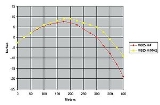
Due to the near parabolic shape of the projectile path, the line of sight or horizontal sighting plane will cross the projectiles trajectory at two points called the near zero and far zero in case the projectile starts its trajectory (slightly) inclined upward in relation to the sighting device horizontal plane, causing part of the bullet path to appear to rise above the horizontal sighting plane. The distance at which the firearm is zeroed, and the vertical distance between the sighting device axis and barrel bore axis, determine the apparent severity of the "rise" in both the X and Y axes (how far above the horizontal sighting plane the rise goes, and over what distance it lasts).
Many firearms ballistics tables and graphs show a rise in trajectory at distances shorter than the one (far zero) used for sight-in. This apparent "rise" of the projectile in the first part of its trajectory is relative only to the sighting plane, and is not actually a rise. The laws of physics dictate that the projectile will begin to be pulled down by gravity as soon as it leaves the support of the barrel bore at the muzzle, and can never rise above the axis of the bore. The apparent "rise" is caused by the separation of the plane of the sighting device axis and that of the bore axis and the fact that the projectile rarely leaves the bore perfectly horizontally. If a firearm is zeroed at 100 meters, then the far horizontal sighting plane and the projectile path must "cross" at that distance; the sighting line must be adjusted to intersect with the projectile path at 100 meters. In the case of a bore axis that is maintained in a perfectly horizontal position, the sighting device must be inclined downward to achieve this intersection. The axial separation distance between the line of sight and the bore axis and trajectory of the projectile dictate the amount of angular declination required to achieve the required intersection.
s for calculating the effects of drag or air resistance are quite complex and often unreliable beyond about 500 meters, so the most reliable method of establishing trajectories
is still by empirical measurement.
, or BC, which combines the air resistance of the bullet shape (the drag coefficient
) and its sectional density
(a function of mass and bullet diameter).
The deceleration due to drag
that a projectile with mass m, velocity v, and diameter d will experience is proportional to 1/BC, 1/m, v² and d². The BC gives the ratio of ballistic efficiency compared to the standard G1 projectile, which is a 1 pound (454 g), 1 inch (25.4 mm) diameter bullet with a flat base, a length of 3 inches (76.2 mm), and a 2 inch (50.8 mm) radius tangential curve for the point.
The G1 standard projectile originates from the "C" standard reference projectile defined by the German steel, ammunition and armaments manufacturer Krupp
in 1881. The G1 model standard projectile has a BC of 1. The French Gavre Commission decided to use this projectile as their first reference projectile, giving the G1 name.
Sporting bullets, with a calibre d ranging from 0.177 to 0.50 inches (4.50 to 12.7 mm
), have G1 BC’s in the range 0.12 to slightly over 1.00, with 1.00 being the most aerodynamic, and 0.12 being the least. Very-low-drag bullet
s with BC's ≥ 1.10 can be designed and produced on CNC precision lathes out of mono-metal rods, but they often have to be fired from custom made full bore rifles with special barrels.
Sectional density
is a very important aspect of a bullet, and is the ratio of frontal surface area (half the bullet diameter squared, times pi
) to bullet mass. Since, for a given bullet shape, frontal surface increases as the square of the calibre, and mass increases as the cube of the diameter, then sectional density grows linearly with bore diameter. Since BC combines shape and sectional density, a half scale model
of the G1 projectile will have a BC of 0.5, and a quarter scale model will have a BC of 0.25.
Since different projectile shapes will respond differently to changes in velocity (particularly between supersonic
and subsonic
velocities), a BC provided by a bullet manufacturer will be an average BC that represents the common range of velocities for that bullet. For rifle
bullets, this will probably be a supersonic
velocity, for pistol bullets it will be probably be subsonic. For projectiles that travel through the supersonic
, transonic
and subsonic flight regimes BC is not well approximated by a single constant, but is considered to be a function
BC(M) of the Mach number
M; here M equals the projectile velocity divided by the speed of sound
. During the flight of the projectile the M will decrease, and therefore (in most cases) the BC will also decrease.
Most ballistic tables or software takes for granted that one specific drag function correctly describes the drag and hence the flight characteristics of a bullet related to its ballistics coefficient. Those models do not differentiate between wadcutter
, flat-based, spitzer, boat-tail, very-low-drag
, etc. bullet types or shapes. They assume one invariable drag function as indicated by the published BC.
Several drag curve models optimized for several standard projectile shapes are however available. The resulting fixed drag curve models for several standard projectile shapes or types are referred to as the:
How different speed regimes affect .338 calibre rifle bullets can be seen in the .338 Lapua Magnum product brochure which states Doppler radar established G1 BC data. The reason for publishing data like in this brochure is that the Siacci/Mayevski G1 model can not be tuned for the drag behaviour of a specific projectile whose shape significantly deviates from the used reference projectile shape. Some ballistic software designers, who based their programs on the Siacci/Mayevski G1 model, give the user the possibility to enter several different G1 BC constants for different speed regimes to calculate ballistic predictions that closer match a bullets flight behaviour at longer ranges compared to calculations that use only one BC constant.
The above example illustrates the central problem fixed drag curve models have. These models will only yield satisfactory accurate predictions as long as the projectile of interest has the same shape as the reference projectile or a shape that closely resembles the reference projectile. Any deviation from the reference projectile shape will result in less accurate predictions.
The Pejsa model is an analytic closed-form solution that does not use any tables or fixed drag curves generated for standard-shaped projectiles. The Pejsa method uses the G1-based ballistic coefficient as published, and incorporates this in a Pejsa retardation coefficient function in order to model the retardation behaviour of the specific projectile. Since it effectively uses an analytic function (drag coefficient
modelled as a function of the Mach number
) in order to match the drag behaviour of the specific bullet the Pesja method does not need to rely on any prefixed assumption.
Besides the mathematical retardation coefficient function, the Pejsa model adds an extra slope constant factor that accounts for the more subtle change in retardation rate downrange of different bullet shapes and sizes. It ranges from 0.1 (flat-nose bullets) to 0.9 (very-low-drag bullet
s). If this deceleration constant factor is unknown a default value of 0.5 will predict the flight behaviour of most modern spitzer-type rifle bullets quite well. With the help of test firing measurements the slope constant for a particular bullet/rifle system/shooter combination can be determined. These test firings should preferably be executed at 60% and for extreme long range ballistic predictions also at 80% to 90% of the supersonic range of the projectiles of interest, staying away from erratic transonic effects. With this the Pejsa model can easily be tuned for the specific drag behaviour of a specific projectile, making significant better ballistic predictions for ranges beyond 500 m (547 yd) possible.
Some software developers offer commercial software which is based on the Pejsa drag model enhanced and improved with refinements to account for normally minor effects (Coriolis, gyroscopic drift, etc.) that come in to play at long range. The developers of these enhanced Pejsa models designed these programs for ballistic predictions beyond 1,000 m (1,094 yd).
with relatively modest computing power. 6 DOF is generally used by military organizations that study the ballistic behaviour of a limited number of (intended) military issue projectiles. Calculated 6 DOF trends can be incorporated as correction tables in more conventional ballistic software applications.
-measurements are required. Weibel
1000e Doppler radar
s are used by governments, professional ballisticians, defence forces and a few ammunition manufacturers to obtain real world data of the flight behaviour of projectiles of their interest. Correctly established state of the art Doppler radar measurements can determine the flight behaviour of projectiles as small as airgun pellets in three-dimensional space to within a few millimetres accuracy. The gathered data regarding the projectile deceleration can be derived and expressed in several ways, such as ballistic coefficients (BC) or drag coefficient
s (Cd).
Doppler radar measurement results for a lathe-turned monolithic solid .50 BMG very-low-drag bullet
(Lost River J40 .510-773 grain monolithic solid bullet / twist rate 1:15 in) look like this:
The initial rise in the BC value is attributed to a projectile's always present yaw and precession out of the bore. The test results were obtained from many shots not just a single shot. The bullet was assigned 1.062 for its BC number by the bullet's manufacturer Lost River Ballistic Technologies.
Doppler radar measurement results for a Lapua GB528 Scenar 19.44 g (300 gr) 8.59 mm (0.338 in) calibre very-low-drag bullet
look like this:
This tested bullet experiences its maximum drag coefficient when entering the transonic flight regime around Mach 1.200.
(Cd) or ballistic coefficient
(BC) than a round nosed bullet, and a round nosed bullet will have a better Cd or BC than a flat point bullet. Large radius curves, resulting in a shallower point angle, will produce lower drags, particularly at supersonic velocities. Hollow point bullet
s behave much like a flat point of the same point diameter. Bullets designed for supersonic use often have a slight taper at the rear, called a boat tail, which further reduces drag. Cannelures, which are recessed rings around the bullet used to crimp the bullet securely into the case, will cause an increase in drag.
muzzle velocity approaches the speed of sound it enters the transonic
region (about Mach
1.2–0.8). In the transonic region, the centre of pressure (CP) of most bullets shifts forward as the bullet decelerates. That CP shift affects the (dynamic) stability of the bullet. If the bullet is not well stabilized, it can not remain pointing forward through the transonic region (the bullets starts to exhibit an unwanted precession
or coning motion that, if not damped out, can eventually end in uncontrollable tumbling along the length axis). However, even if the bullet has sufficient stability (static and dynamic) to be able to fly through the transonic region and stays pointing forward, it is still affected. The erratic and sudden CP shift and (temporary) decrease of dynamic stability can cause significant dispersion (and hence significant accuracy decay), even if the bullet's flight becomes well behaved again when it enters the subsonic
region. This makes accurately predicting the ballistic behaviour of bullets in the transonic region very difficult. Further the ambient air density has a significant effect on dynamic stability during transonic transition. Though the ambient air density is a variable environmental factor, adverse transonic transition effects can be negated better by bullets traveling through less dense air, than when traveling through denser air. Because of this, marksmen normally restrict themselves to engaging targets within the supersonic range of the bullet used.
sea level conditions (air density ρ = 1.225 kg/m³). To check how well the software predicts the trajectory at shorter to medium range, field tests at 20, 40 and 60% of the supersonic range have to be conducted. At those shorter to medium ranges, transonic problems and hence unbehaved bullet flight should not occur, and the BC is less likely to be transient. Testing the predicative qualities of software at (extreme) long ranges is expensive because it consumes ammunition; the actual muzzle velocity of all shots fired must be measured to be able to make statistically dependable statements. Sample groups of less than 24 shots do not obtain statistically dependable data.
s (Cd) of projectiles with the general public.
In January 2009 the Finnish ammunition manufacturer Lapua published Doppler radar test-derived drag coefficient data for most of their rifle projectiles. With this Cd data engineers can create algorithms that utilize both known mathematical ballistic models as well as test specific, tabular data in unison. When used by predicative software like QuickTARGET Unlimited
, Lapua Edition this data can be used for more accurate external ballistic predictions.
Some of the Lapua-provided drag coefficient data shows drastic increases in the measured drag around or below the Mach 1 flight velocity region. This behaviour was observed for most of the measured small calibre bullets, and not so much for the larger calibre bullets. This implies some (mostly smaller calibre) rifle bullets exhibited coning and/or tumbling in the transonic/subsonic flight velocity regime.
The information regarding unfavourable transonic/subsonic flight behaviour for some of the tested projectiles is important. This is a limiting factor for extended range shooting use, because the effects of coning and tumbling are not easily predictable and potentially catastrophic for the best ballistic prediction models and software.
Presented Cd data can not be simply used for every gun-ammunition combination, since it was measured for the barrels, rotational (spin) velocities
and ammunition lots the Lapua testers used during their test firings. Variables like differences in rifling (number of grooves, depth, width and other dimensional properties), twist rates and/or muzzle velocities impart different rotational (spin) velocities and rifling marks on projectiles. Changes in such variables and projectile production lot variations can yield different downrange interaction with the air the projectile passes through that can result in (minor) changes in flight behaviour. This particular field of external ballistics is currently (2009) not elaborately studied nor well understood.
sea level conditions (air density ρ = 1.225 kg/m³), Mach 1 = 340.3 m/s), predicted this for the projectile velocity and time of flight from 0 to 3,000 m (0 to 3,281 yd):
The table shows that the traditional Siacci/Mayevski G1 drag curve model prediction method generally yields more optimistic results compared to the modern Doppler radar test derived drag coefficients (Cd) prediction method. At 300 m (328 yd) range the differences will be hardly noticeable, but at 600 m (656 yd) and beyond the differences grow over 10 m/s (32.8 ft/s) projectile velocity and gradually become significant.
At 1,500 m (1,640 yd) range the projectile velocity predictions deviate 25 m/s (82.0 ft/s), which equates to a predicted total drop difference of 125.6 cm (49.4 in) or 0.83 mrad
(2.87 MOA
) at 50° latitude.
The Pejsa drag analytic closed-form solution prediction method, without slope constant factor fine tuning, yields very similar results in the supersonic flight regime compared to the Doppler radar test derived drag coefficients (Cd) prediction method. At 1,500 m (1,640 yd) range the projectile velocity predictions deviate 10 m/s (32.8 ft/s), which equates to a predicted total drop difference of 23.6 cm (9.3 in) or 0.16 mrad
(0.54 MOA
) at 50° latitude.
The G7 drag curve model prediction method (recommended by some manufacturers for very-low-drag shaped rifle bullets) when using a G7 ballistic coefficient (BC) of 0.377 yields very similar results in the supersonic flight regime compared to the Doppler radar test derived drag coefficients (Cd) prediction method. At 1,500 m (1,640 yd) range the projectile velocity predictions have their maximum deviation of 10 m/s (32.8 ft/s). The predicted total drop difference at 1,500 m (1,640 yd) is 0.4 cm (0.16 in) at 50° latitude. The predicted total drop difference at 1,800 m (1,969 yd) is 45.0 cm (17.7 in), which equates to 0.25 mrad
(0.86 MOA
).
A somewhat less obvious effect is caused by head or tailwinds. A headwind will slightly increase the relative velocity
of the projectile, and increase drag and the corresponding drop. A tailwind will reduce the drag and the bullet drop. In the real world pure head or tailwinds are rare, since wind seldom is constant in force and direction and normally interacts with the terrain it is blowing over. This often makes ultra long range shooting in head or tailwind conditions difficult.
(or elevation
) of a shot will also affect the trajectory of the shot. Ballistic tables for small calibre projectiles (fired from pistols or rifles) assume that gravity is acting nearly perpendicular to the bullet path. If the angle is up or down, then the perpendicular acceleration will actually be less. The effect of the path wise acceleration component will be negligible, so shooting up or downhill will both result in a similar decrease in bullet drop.
Often mathematical ballistic prediction models are limited to "flat fire" scenario's based on the rifleman's rule
, meaning they can not produce adequately accurate predictions when combined with steep elevation angles over -15 to 15 degrees and longer ranges. There are however several mathematical prediction models for inclined fire scenarios available which yield rather varying accuracy expectation levels.
, pressure
, and humidity
variations make up the ambient air density. Humidity has a counter intuitive impact. Since water vapor
has a density of 0.8 grams per litre, while dry air averages about 1.225 grams per litre, higher humidity actually decreases the air density, and therefore decreases the drag.
This is because the projectile's longitudinal axis (its axis of rotation) and the direction of the velocity of the center of gravity (CG) deviate by a small angle, which is said to be the equilibrium yaw
or the yaw of repose. For right-handed (clockwise) spin bullets, the bullet's axis of symmetry points to the right and a little bit upward with respect to the direction of the velocity vector as the projectile rotates through its ballistic arc on a long range trajectory.
As an effect of this small inclination, there is a continuous air stream, which tends to deflect the bullet to the right. Thus the occurrence of the yaw of repose is the reason for bullet drift to the right (for right-handed spin) or to the left (for left-handed spin).
This means that the bullet is "skidding" sideways at any given moment, and thus experiencing a sideways component.
The following variables affect the magnitude of gyroscopic drift:
Doppler radar measurement results for the gyroscopic drift of several US military and other very-low-drag bullet
s at 1000 yards (914.4 m) look like this:
The table shows that the gyroscopic drift is rather variable and no clear trend is easily distinguishable.
, whereby the spin of the bullet creates a force acting either up or down, perpendicular to the sideways vector of the wind.
In the simple case of horizontal wind, and a right hand (clockwise) direction of rotation, the Magnus effect induced pressure differences around the bullet cause a downward (wind from the right) or upward (wind from the left) force to act on the projectile, affecting its point of impact. The vertical deflection value tends to be
small in comparison with the horizontal wind induced deflection component, but it may nevertheless be significant in winds that exceed 4 m/s (14.4 km/h or 9 mph).
Paradoxically, very-low-drag bullet
s due to their length have a tendency to exhibit greater Magnus destabilizing errors because they have a greater surface area to present to the oncoming air they are travelling through, thereby reducing their aerodynamic efficiency. This subtle effect is one of the reasons why a calculated Cd or BC based on shape and sectional density is of limited use.
This simple explanation is quite popular. There is, however, no evidence to show that increased pressure means increased friction and unless this is so, there can be no effect. Even if it does exist it must be quite insignificant compared with the gyroscopic and Coriolis drifts.
Both the Poisson and Magnus Effects will reverse their directions of drift if the nose falls below the trajectory. When the nose is off to one side, as in equilibrium yaw, these effects will make minute alterations in range.
and the Eötvös effect
. These effects cause drift related to the spin of the Earth, known as Coriolis drift. Coriolis drift can be up, down, left or right. Coriolis drift is not an aerodynamic effect; it is a consequence of flying from one point to another across the surface of a rotating planet (Earth).
The direction of Coriolis drift depends on the firer's and target's location or latitude
on the planet Earth, and the azimuth of firing. The magnitude of the drift depends on the firing and target location, azimuth, and time of flight.
causes subtle trajectory variations caused by a rotating reference frame
.
The coordinate system
that is used to specify the location of the point of firing and the location of the target is the system of latitudes and longitudes, which is in fact a rotating coordinate system, since the planet Earth is a rotating sphere. During its flight, the projectile moves in a straight line (not counting gravitation and air resistance for now). Since the target is co-rotating with the Earth, it is in fact a moving target, relative to the projectile, so in order to hit it the gun must be aimed to the point where the projectile and the target will arrive simultaneously.
When the straight path of the projectile is plotted in the rotating coordinate system that is used, then this path appears as curvilinear. The fact that the coordinate system is rotating must be taken into account, and this is achieved by adding terms for a "centrifugal force" and a "Coriolis effect
" to the equations of motion
. When the appropriate Coriolis term is added to the equation of motion the predicted path with respect to the rotating coordinate system is curvilinear, corresponding to the actual straight line motion of the projectile.
For an observer with his frame of reference in the northern hemisphere Coriolis makes the projectile appear to curve over to the right. Actually it is not the projectile swinging to the right but the earth (frame of reference) rotating to the left which produces this result. The opposite will seem to happen in the southern hemisphere.
The Coriolis effect is at its maximum at the poles and negligible at the equator
of the Earth
.
The reason for this is that the Coriolis effect depends on the vector of the angular velocity of the Earth's rotation with respect to xyz - coordinate system (frame of reference).
For small arms
, the Coriolis effect is generally insignificant, but for ballistic projectiles with long flight times, such as extreme long-range rifle projectiles, artillery
and intercontinental ballistic missiles, it is a significant factor in calculating the trajectory.
changes the apparent gravitational pull on a moving object based on the relationship between the direction of movement and the direction of the Earth's rotation. It causes subtle trajectory variations.
It is not an aerodynamic effect and is latitude dependent, being at its most significant at equatorial latitude. Eastward-traveling objects will be deflected upwards (feel lighter), while westward-traveling objects will be deflected downwards (feel heavier). In addition, objects traveling upwards or downwards will be deflected to the west or east respectively. The principle behind these counterintuitive variations during flight are explained in more detail in the equivalence principle
article dealing with the physics
of general relativity
.
For small arms
, the Eötvös effect is generally insignificant, but for long range ballistic projectiles with long flight times it can become a significant factor in accurately calculating the trajectory.
when a projectile leaves a gun barrel. If present it causes dispersion. The effect is unpredictable, since it is generally small and varies from projectile to projectile, round to round and/or gun barrel to gun barrel.
and especially high-powered sniper rifle
s depends mainly on the aerodynamic or ballistic efficiency of the spin stabilised projectiles used. Long-range shooters must also collect relevant information to calculate elevation and windage corrections to be able to achieve first shot strikes at point targets. The data to calculate these fire control corrections has a long list of variables including:
The ambient air density is at its maximum at Arctic sea level conditions. Cold gunpowder
also produces lower pressures and hence lower muzzle velocities than warm powder. This means that the maximum practical range of rifles will be at it shortest at Arctic sea level conditions.
The ability to hit a point target at great range has a lot to do with the ability to tackle environmental and meteorological factors and a good understanding of exterior ballistics and the limitations of equipment. Without (computer) support and highly accurate laser rangefinders and meteorological measuring equipment as aids to determine ballistic solutions, long-range shooting beyond 1000 m (1100 yd) at unknown ranges becomes guesswork for even the most expert long-range marksmen.
Interesting further reading: Marksmanship Wikibook
This table demonstrates that, even with a fairly aerodynamic bullet fired at high velocity, the "bullet drop" or change in the point of impact is significant. This change in point of impact has two important implications. Firstly, estimating the distance to the target is critical at longer ranges, because the difference in the point of impact between 400 and 500 yd (457.2 m) is 25–32 in (depending on zero), in other words if the shooter estimates that the target is 400 yd away when it is in fact 500 yd away the shot will impact 25–32 in (635–813 mm) below where it was aimed, possibly missing the target completely. Secondly, the rifle should be zeroed to a distance appropriate to the typical range of targets, because the shooter might have to aim so far above the target to compensate for a large bullet drop that he may lose sight of the target completely (for instance being outside the field of view of a telescopic sight). In the example of the rifle zeroed at 200 yd (182.9 m), the shooter would have to aim 49 in or more than 4 ft (1.2 m) above the point of impact for a target at 500 yd.
Small arms external ballistics
Artillery external ballistics
Ballistics
Ballistics is the science of mechanics that deals with the flight, behavior, and effects of projectiles, especially bullets, gravity bombs, rockets, or the like; the science or art of designing and accelerating projectiles so as to achieve a desired performance.A ballistic body is a body which is...
that deals with the behaviour of a non-powered projectile in flight. External ballistics is frequently associated with firearm
Firearm
A firearm is a weapon that launches one, or many, projectile at high velocity through confined burning of a propellant. This subsonic burning process is technically known as deflagration, as opposed to supersonic combustion known as a detonation. In older firearms, the propellant was typically...
s, and deals with the behaviour of the bullet
Bullet
A bullet is a projectile propelled by a firearm, sling, or air gun. Bullets do not normally contain explosives, but damage the intended target by impact and penetration...
after it exits the barrel and before it hits the target.
Forces acting on the projectile
When in flight, the main forceForce
In physics, a force is any influence that causes an object to undergo a change in speed, a change in direction, or a change in shape. In other words, a force is that which can cause an object with mass to change its velocity , i.e., to accelerate, or which can cause a flexible object to deform...
s acting on the projectile
Projectile
A projectile is any object projected into space by the exertion of a force. Although a thrown baseball is technically a projectile too, the term more commonly refers to a weapon....
are gravity, drag
Drag (physics)
In fluid dynamics, drag refers to forces which act on a solid object in the direction of the relative fluid flow velocity...
and if present wind
Wind
Wind is the flow of gases on a large scale. On Earth, wind consists of the bulk movement of air. In outer space, solar wind is the movement of gases or charged particles from the sun through space, while planetary wind is the outgassing of light chemical elements from a planet's atmosphere into space...
. Gravity imparts a downward acceleration on the projectile, causing it to drop from the line of sight
Line-of-sight propagation
Line-of-sight propagation refers to electro-magnetic radiation or acoustic wave propagation. Electromagnetic transmission includes light emissions traveling in a straight line...
. Drag
Drag (physics)
In fluid dynamics, drag refers to forces which act on a solid object in the direction of the relative fluid flow velocity...
or the air resistance decelerates the projectile with a force proportional to the square of the velocity. Wind makes the projectile deviate from its trajectory. During flight, gravity, drag and wind have a major impact on the path of the projectile, and must be accounted for when predicting how the projectile will travel.
For medium to longer ranges and flight times, besides gravity, air resistance and wind, several meso variables described in the external factors paragraph have to be taken into account. Meso variables can become significant for firearms users that have to deal with angled shot scenarios or extended ranges, but are seldom relevant at common hunting and target shooting distances.
For long to very long ranges and flight times, minor effects and forces such as the ones described in the long range factors paragraph become important and have to be taken into account. The practical effects of these variables are generally irrelevant for most firearms users, since normal group scatter at short and medium ranges prevails over the influence these effects exert on firearms projectiles trajectories.
At extremely long ranges, artillery
Artillery
Originally applied to any group of infantry primarily armed with projectile weapons, artillery has over time become limited in meaning to refer only to those engines of war that operate by projection of munitions far beyond the range of effect of personal weapons...
must fire projectiles along trajectories that are not even approximately straight; they are closer to parabolic
Parabola
In mathematics, the parabola is a conic section, the intersection of a right circular conical surface and a plane parallel to a generating straight line of that surface...
, although air resistance affects this.
In the case of ballistic missile
Ballistic missile
A ballistic missile is a missile that follows a sub-orbital ballistic flightpath with the objective of delivering one or more warheads to a predetermined target. The missile is only guided during the relatively brief initial powered phase of flight and its course is subsequently governed by the...
s, the altitudes involved have a significant effect as well, with part of the flight taking place in a near-vacuum.
Stabilizing non-spherical projectiles during flight
Two methods can be employed to stabilize non-spherical projectiles during flight:- Projectiles like arrowArrowAn arrow is a shafted projectile that is shot with a bow. It predates recorded history and is common to most cultures.An arrow usually consists of a shaft with an arrowhead attached to the front end, with fletchings and a nock at the other.- History:...
s or sabotSabotA sabot is a device used in a firearm or cannon to fire a projectile, such as a bullet, that is smaller than the bore diameter, or which must be held in a precise position. The term is also applied to a battery stub case, a device used similarly to make a small electrical battery usable in a...
s like the M829 Armor-Piercing, Fin-Stabilized, Discarding Sabot (APFSDS) achieve stability by forcing their center of pressureCenter of pressureThe center of pressure is the point on a body where the total sum of a pressure field acts, causing a force and no moment about that point. The total force vector acting at the center of pressure is the value of the integrated vectorial pressure field. The resultant force and center of pressure...
(CP) behind their center of gravityCenter of gravityIn physics, a center of gravity of a material body is a point that may be used for a summary description of gravitational interactions. In a uniform gravitational field, the center of mass serves as the center of gravity...
(CG) with tail surfaces. The CP behind the CG condition yields stable projectile flight, meaning the projectile will not overturn during flight through the atmosphere due to aerodynamic forces. - Projectiles like small arms bullets and artillery shells must deal with their CP being in front of their CG, which destabilizes these projectiles during flight. To stabilize such projectiles the projectile is spun around its longitudinal (leading to trailing) axis. The spinning mass makes the bullets length axis resistant to the destabilizing overturning torque of the CP being in front of the CG.
Bullet drop
Calibration
Calibration is a comparison between measurements – one of known magnitude or correctness made or set with one device and another measurement made in as similar a way as possible with a second device....
the sighting components of a gun. To plan for bullet drop and compensate properly, one must understand parabolic
Parabola
In mathematics, the parabola is a conic section, the intersection of a right circular conical surface and a plane parallel to a generating straight line of that surface...
shaped trajectories.
Due to the near parabolic shape of the projectile path, the line of sight or horizontal sighting plane will cross the projectiles trajectory at two points called the near zero and far zero in case the projectile starts its trajectory (slightly) inclined upward in relation to the sighting device horizontal plane, causing part of the bullet path to appear to rise above the horizontal sighting plane. The distance at which the firearm is zeroed, and the vertical distance between the sighting device axis and barrel bore axis, determine the apparent severity of the "rise" in both the X and Y axes (how far above the horizontal sighting plane the rise goes, and over what distance it lasts).
Many firearms ballistics tables and graphs show a rise in trajectory at distances shorter than the one (far zero) used for sight-in. This apparent "rise" of the projectile in the first part of its trajectory is relative only to the sighting plane, and is not actually a rise. The laws of physics dictate that the projectile will begin to be pulled down by gravity as soon as it leaves the support of the barrel bore at the muzzle, and can never rise above the axis of the bore. The apparent "rise" is caused by the separation of the plane of the sighting device axis and that of the bore axis and the fact that the projectile rarely leaves the bore perfectly horizontally. If a firearm is zeroed at 100 meters, then the far horizontal sighting plane and the projectile path must "cross" at that distance; the sighting line must be adjusted to intersect with the projectile path at 100 meters. In the case of a bore axis that is maintained in a perfectly horizontal position, the sighting device must be inclined downward to achieve this intersection. The axial separation distance between the line of sight and the bore axis and trajectory of the projectile dictate the amount of angular declination required to achieve the required intersection.
Drag resistance modeling and measuring
Mathematical modelMathematical model
A mathematical model is a description of a system using mathematical concepts and language. The process of developing a mathematical model is termed mathematical modeling. Mathematical models are used not only in the natural sciences and engineering disciplines A mathematical model is a...
s for calculating the effects of drag or air resistance are quite complex and often unreliable beyond about 500 meters, so the most reliable method of establishing trajectories
Trajectory
A trajectory is the path that a moving object follows through space as a function of time. The object might be a projectile or a satellite, for example. It thus includes the meaning of orbit—the path of a planet, an asteroid or a comet as it travels around a central mass...
is still by empirical measurement.
Fixed drag curve models generated for standard-shaped projectiles
Use of ballistics tables or ballistics software based on the Siacci/Mayevski G1 drag model, introduced in 1881, are the most common method used to work with external ballistics. Bullets are described by a ballistic coefficientBallistic coefficient
In ballistics, the ballistic coefficient of a body is a measure of its ability to overcome air resistance in flight. It is inversely proportional to the negative acceleration—a high number indicates a low negative acceleration. BC is a function of mass, diameter, and drag coefficient...
, or BC, which combines the air resistance of the bullet shape (the drag coefficient
Drag coefficient
In fluid dynamics, the drag coefficient is a dimensionless quantity that is used to quantify the drag or resistance of an object in a fluid environment such as air or water. It is used in the drag equation, where a lower drag coefficient indicates the object will have less aerodynamic or...
) and its sectional density
Sectional density
Sectional density is the ratio of an object's mass to its cross-sectional area. It conveys how well an object's mass is distributed to overcome resistance. For illustration, a needle can penetrate a target medium with less force than a coin of the same mass...
(a function of mass and bullet diameter).
The deceleration due to drag
Drag (physics)
In fluid dynamics, drag refers to forces which act on a solid object in the direction of the relative fluid flow velocity...
that a projectile with mass m, velocity v, and diameter d will experience is proportional to 1/BC, 1/m, v² and d². The BC gives the ratio of ballistic efficiency compared to the standard G1 projectile, which is a 1 pound (454 g), 1 inch (25.4 mm) diameter bullet with a flat base, a length of 3 inches (76.2 mm), and a 2 inch (50.8 mm) radius tangential curve for the point.
The G1 standard projectile originates from the "C" standard reference projectile defined by the German steel, ammunition and armaments manufacturer Krupp
Krupp
The Krupp family , a prominent 400-year-old German dynasty from Essen, have become famous for their steel production and for their manufacture of ammunition and armaments. The family business, known as Friedrich Krupp AG Hoesch-Krupp, was the largest company in Europe at the beginning of the 20th...
in 1881. The G1 model standard projectile has a BC of 1. The French Gavre Commission decided to use this projectile as their first reference projectile, giving the G1 name.
Sporting bullets, with a calibre d ranging from 0.177 to 0.50 inches (4.50 to 12.7 mm
.50 BMG
The .50 Browning Machine Gun or 12.7×99mm NATO is a cartridge developed for the Browning .50 caliber machine gun in the late 1910s. Entering service officially in 1921, the round is based on a greatly scaled-up .30-06 cartridge...
), have G1 BC’s in the range 0.12 to slightly over 1.00, with 1.00 being the most aerodynamic, and 0.12 being the least. Very-low-drag bullet
Very-low-drag bullet
Very-low-drag bullets are primarily a small arms ballistics development of the 1980s–1990s, driven by shooters' desire for bullets that will give a higher degree of accuracy and kinetic efficiency, especially at extended ranges. To achieve this the projectile must minimize air resistance in flight...
s with BC's ≥ 1.10 can be designed and produced on CNC precision lathes out of mono-metal rods, but they often have to be fired from custom made full bore rifles with special barrels.
Sectional density
Sectional density
Sectional density is the ratio of an object's mass to its cross-sectional area. It conveys how well an object's mass is distributed to overcome resistance. For illustration, a needle can penetrate a target medium with less force than a coin of the same mass...
is a very important aspect of a bullet, and is the ratio of frontal surface area (half the bullet diameter squared, times pi
Pi
' is a mathematical constant that is the ratio of any circle's circumference to its diameter. is approximately equal to 3.14. Many formulae in mathematics, science, and engineering involve , which makes it one of the most important mathematical constants...
) to bullet mass. Since, for a given bullet shape, frontal surface increases as the square of the calibre, and mass increases as the cube of the diameter, then sectional density grows linearly with bore diameter. Since BC combines shape and sectional density, a half scale model
Scale model
A scale model is a physical model, a representation or copy of an object that is larger or smaller than the actual size of the object, which seeks to maintain the relative proportions of the physical size of the original object. Very often the scale model is used as a guide to making the object in...
of the G1 projectile will have a BC of 0.5, and a quarter scale model will have a BC of 0.25.
Since different projectile shapes will respond differently to changes in velocity (particularly between supersonic
Supersonic
Supersonic speed is a rate of travel of an object that exceeds the speed of sound . For objects traveling in dry air of a temperature of 20 °C this speed is approximately 343 m/s, 1,125 ft/s, 768 mph or 1,235 km/h. Speeds greater than five times the speed of sound are often...
and subsonic
Speed of sound
The speed of sound is the distance travelled during a unit of time by a sound wave propagating through an elastic medium. In dry air at , the speed of sound is . This is , or about one kilometer in three seconds or approximately one mile in five seconds....
velocities), a BC provided by a bullet manufacturer will be an average BC that represents the common range of velocities for that bullet. For rifle
Rifle
A rifle is a firearm designed to be fired from the shoulder, with a barrel that has a helical groove or pattern of grooves cut into the barrel walls. The raised areas of the rifling are called "lands," which make contact with the projectile , imparting spin around an axis corresponding to the...
bullets, this will probably be a supersonic
Supersonic
Supersonic speed is a rate of travel of an object that exceeds the speed of sound . For objects traveling in dry air of a temperature of 20 °C this speed is approximately 343 m/s, 1,125 ft/s, 768 mph or 1,235 km/h. Speeds greater than five times the speed of sound are often...
velocity, for pistol bullets it will be probably be subsonic. For projectiles that travel through the supersonic
Supersonic
Supersonic speed is a rate of travel of an object that exceeds the speed of sound . For objects traveling in dry air of a temperature of 20 °C this speed is approximately 343 m/s, 1,125 ft/s, 768 mph or 1,235 km/h. Speeds greater than five times the speed of sound are often...
, transonic
Transonic
Transonic speed is an aeronautics term referring to the condition of flight in which a range of velocities of airflow exist surrounding and flowing past an air vehicle or an airfoil that are concurrently below, at, and above the speed of sound in the range of Mach 0.8 to 1.2, i.e. 600–900 mph...
and subsonic flight regimes BC is not well approximated by a single constant, but is considered to be a function
Function (mathematics)
In mathematics, a function associates one quantity, the argument of the function, also known as the input, with another quantity, the value of the function, also known as the output. A function assigns exactly one output to each input. The argument and the value may be real numbers, but they can...
BC(M) of the Mach number
Mach number
Mach number is the speed of an object moving through air, or any other fluid substance, divided by the speed of sound as it is in that substance for its particular physical conditions, including those of temperature and pressure...
M; here M equals the projectile velocity divided by the speed of sound
Speed of sound
The speed of sound is the distance travelled during a unit of time by a sound wave propagating through an elastic medium. In dry air at , the speed of sound is . This is , or about one kilometer in three seconds or approximately one mile in five seconds....
. During the flight of the projectile the M will decrease, and therefore (in most cases) the BC will also decrease.
Most ballistic tables or software takes for granted that one specific drag function correctly describes the drag and hence the flight characteristics of a bullet related to its ballistics coefficient. Those models do not differentiate between wadcutter
Wadcutter
A wadcutter is a special-purpose bullet specially designed for shooting paper targets, usually at close range and at subsonic velocities typically under 800 ft/s . They are often used in handgun and airgun competitions...
, flat-based, spitzer, boat-tail, very-low-drag
Very-low-drag bullet
Very-low-drag bullets are primarily a small arms ballistics development of the 1980s–1990s, driven by shooters' desire for bullets that will give a higher degree of accuracy and kinetic efficiency, especially at extended ranges. To achieve this the projectile must minimize air resistance in flight...
, etc. bullet types or shapes. They assume one invariable drag function as indicated by the published BC.
Several drag curve models optimized for several standard projectile shapes are however available. The resulting fixed drag curve models for several standard projectile shapes or types are referred to as the:
- G1 or Ingalls (by far the most popular)
- G2 (Aberdeen J projectile)
- G5 (short 7.5° boat-tail, 6.19 calibers long tangent ogive)
- G6 (flatbase, 6 calibers long secant ogive)
- G7 ((long 7.5° boat-tail, 10 calibers tangent ogive, preferred by some manufacturers for very-low-drag bullets)
- G8 (flatbase, 10 calibers long secant ogive)
- GL (blunt lead nose)
How different speed regimes affect .338 calibre rifle bullets can be seen in the .338 Lapua Magnum product brochure which states Doppler radar established G1 BC data. The reason for publishing data like in this brochure is that the Siacci/Mayevski G1 model can not be tuned for the drag behaviour of a specific projectile whose shape significantly deviates from the used reference projectile shape. Some ballistic software designers, who based their programs on the Siacci/Mayevski G1 model, give the user the possibility to enter several different G1 BC constants for different speed regimes to calculate ballistic predictions that closer match a bullets flight behaviour at longer ranges compared to calculations that use only one BC constant.
The above example illustrates the central problem fixed drag curve models have. These models will only yield satisfactory accurate predictions as long as the projectile of interest has the same shape as the reference projectile or a shape that closely resembles the reference projectile. Any deviation from the reference projectile shape will result in less accurate predictions.
Pejsa model
Besides the traditional drag curve models for several standard projectile shapes or types other more advanced drag models exist. The most prominent alternative ballistic model is probably the model presented in 1980 by Dr. Arthur J. Pejsa. Mr. Pejsa claims on his website that his method was consistently capable of predicting (supersonic) rifle bullet trajectories within 2.5 mm (0.1 in) and bullet velocities within 0.3 m/s (1 ft/s) out to 914 m (1,000 yd) when compared to dozens of actual measurements.The Pejsa model is an analytic closed-form solution that does not use any tables or fixed drag curves generated for standard-shaped projectiles. The Pejsa method uses the G1-based ballistic coefficient as published, and incorporates this in a Pejsa retardation coefficient function in order to model the retardation behaviour of the specific projectile. Since it effectively uses an analytic function (drag coefficient
Drag coefficient
In fluid dynamics, the drag coefficient is a dimensionless quantity that is used to quantify the drag or resistance of an object in a fluid environment such as air or water. It is used in the drag equation, where a lower drag coefficient indicates the object will have less aerodynamic or...
modelled as a function of the Mach number
Mach number
Mach number is the speed of an object moving through air, or any other fluid substance, divided by the speed of sound as it is in that substance for its particular physical conditions, including those of temperature and pressure...
) in order to match the drag behaviour of the specific bullet the Pesja method does not need to rely on any prefixed assumption.
Besides the mathematical retardation coefficient function, the Pejsa model adds an extra slope constant factor that accounts for the more subtle change in retardation rate downrange of different bullet shapes and sizes. It ranges from 0.1 (flat-nose bullets) to 0.9 (very-low-drag bullet
Very-low-drag bullet
Very-low-drag bullets are primarily a small arms ballistics development of the 1980s–1990s, driven by shooters' desire for bullets that will give a higher degree of accuracy and kinetic efficiency, especially at extended ranges. To achieve this the projectile must minimize air resistance in flight...
s). If this deceleration constant factor is unknown a default value of 0.5 will predict the flight behaviour of most modern spitzer-type rifle bullets quite well. With the help of test firing measurements the slope constant for a particular bullet/rifle system/shooter combination can be determined. These test firings should preferably be executed at 60% and for extreme long range ballistic predictions also at 80% to 90% of the supersonic range of the projectiles of interest, staying away from erratic transonic effects. With this the Pejsa model can easily be tuned for the specific drag behaviour of a specific projectile, making significant better ballistic predictions for ranges beyond 500 m (547 yd) possible.
Some software developers offer commercial software which is based on the Pejsa drag model enhanced and improved with refinements to account for normally minor effects (Coriolis, gyroscopic drift, etc.) that come in to play at long range. The developers of these enhanced Pejsa models designed these programs for ballistic predictions beyond 1,000 m (1,094 yd).
6 degrees of freedom (6 DOF) model
There are also advanced professional ballistic models like PRODAS available. These are based on 6 Degrees Of Freedom (6 DOF) calculations. 6 DOF modelling needs such elaborate input, knowledge of the employed projectiles and long calculation time on computers that it is impractical for non-professional ballisticians and field use where calculations generally have to be done on the fly on PDAsPersonal digital assistant
A personal digital assistant , also known as a palmtop computer, or personal data assistant, is a mobile device that functions as a personal information manager. Current PDAs often have the ability to connect to the Internet...
with relatively modest computing power. 6 DOF is generally used by military organizations that study the ballistic behaviour of a limited number of (intended) military issue projectiles. Calculated 6 DOF trends can be incorporated as correction tables in more conventional ballistic software applications.
Doppler radar-measurements
For the precise establishment of drag or air resistance effects on projectiles, Doppler radarDoppler radar
A Doppler radar is a specialized radar that makes use of the Doppler effect to produce velocity data about objects at a distance. It does this by beaming a microwave signal towards a desired target and listening for its reflection, then analyzing how the frequency of the returned signal has been...
-measurements are required. Weibel
Weibel
Weibel is a Danish designer and manufacturer of doppler radars. It is located in Allerød, Denmark. All Weibel radars operate in the X band and are continuous wave doppler radars. NASA recently purchased some of Weibel's radars, and uses them to detect debris coming off the space shuttle during...
1000e Doppler radar
Doppler radar
A Doppler radar is a specialized radar that makes use of the Doppler effect to produce velocity data about objects at a distance. It does this by beaming a microwave signal towards a desired target and listening for its reflection, then analyzing how the frequency of the returned signal has been...
s are used by governments, professional ballisticians, defence forces and a few ammunition manufacturers to obtain real world data of the flight behaviour of projectiles of their interest. Correctly established state of the art Doppler radar measurements can determine the flight behaviour of projectiles as small as airgun pellets in three-dimensional space to within a few millimetres accuracy. The gathered data regarding the projectile deceleration can be derived and expressed in several ways, such as ballistic coefficients (BC) or drag coefficient
Drag coefficient
In fluid dynamics, the drag coefficient is a dimensionless quantity that is used to quantify the drag or resistance of an object in a fluid environment such as air or water. It is used in the drag equation, where a lower drag coefficient indicates the object will have less aerodynamic or...
s (Cd).
Doppler radar measurement results for a lathe-turned monolithic solid .50 BMG very-low-drag bullet
Very-low-drag bullet
Very-low-drag bullets are primarily a small arms ballistics development of the 1980s–1990s, driven by shooters' desire for bullets that will give a higher degree of accuracy and kinetic efficiency, especially at extended ranges. To achieve this the projectile must minimize air resistance in flight...
(Lost River J40 .510-773 grain monolithic solid bullet / twist rate 1:15 in) look like this:
| Range (m) | 500 | 600 | 700 | 800 | 900 | 1000 | 1100 | 1200 | 1300 | 1400 | 1500 | 1600 | 1700 | 1800 | 1900 | 2000 |
|---|---|---|---|---|---|---|---|---|---|---|---|---|---|---|---|---|
| Ballistic coefficient | 1.040 | 1.051 | 1.057 | 1.063 | 1.064 | 1.067 | 1.068 | 1.068 | 1.068 | 1.066 | 1.064 | 1.060 | 1.056 | 1.050 | 1.042 | 1.032 |
The initial rise in the BC value is attributed to a projectile's always present yaw and precession out of the bore. The test results were obtained from many shots not just a single shot. The bullet was assigned 1.062 for its BC number by the bullet's manufacturer Lost River Ballistic Technologies.
Doppler radar measurement results for a Lapua GB528 Scenar 19.44 g (300 gr) 8.59 mm (0.338 in) calibre very-low-drag bullet
Very-low-drag bullet
Very-low-drag bullets are primarily a small arms ballistics development of the 1980s–1990s, driven by shooters' desire for bullets that will give a higher degree of accuracy and kinetic efficiency, especially at extended ranges. To achieve this the projectile must minimize air resistance in flight...
look like this:
| Mach number Mach number Mach number is the speed of an object moving through air, or any other fluid substance, divided by the speed of sound as it is in that substance for its particular physical conditions, including those of temperature and pressure... |
0.000 | 0.400 | 0.500 | 0.600 | 0.700 | 0.800 | 0.825 | 0.850 | 0.875 | 0.900 | 0.925 | 0.950 | 0.975 | 1.000 | 1.025 | 1.050 | 1.075 | 1.100 | 1.150 | 1.200 | 1.300 | 1.400 | 1.500 | 1.600 | 1.800 | 2.000 | 2.200 | 2.400 |
|---|---|---|---|---|---|---|---|---|---|---|---|---|---|---|---|---|---|---|---|---|---|---|---|---|---|---|---|---|
| Drag coefficient | 0.230 | 0.229 | 0.200 | 0.171 | 0.164 | 0.144 | 0.141 | 0.137 | 0.137 | 0.142 | 0.154 | 0.177 | 0.236 | 0.306 | 0.334 | 0.341 | 0.345 | 0.347 | 0.348 | 0.348 | 0.343 | 0.336 | 0.328 | 0.321 | 0.304 | 0.292 | 0.282 | 0.270 |
This tested bullet experiences its maximum drag coefficient when entering the transonic flight regime around Mach 1.200.
General trends in drag or ballistic coefficient
In general, a pointed bullet will have a better drag coefficientDrag coefficient
In fluid dynamics, the drag coefficient is a dimensionless quantity that is used to quantify the drag or resistance of an object in a fluid environment such as air or water. It is used in the drag equation, where a lower drag coefficient indicates the object will have less aerodynamic or...
(Cd) or ballistic coefficient
Ballistic coefficient
In ballistics, the ballistic coefficient of a body is a measure of its ability to overcome air resistance in flight. It is inversely proportional to the negative acceleration—a high number indicates a low negative acceleration. BC is a function of mass, diameter, and drag coefficient...
(BC) than a round nosed bullet, and a round nosed bullet will have a better Cd or BC than a flat point bullet. Large radius curves, resulting in a shallower point angle, will produce lower drags, particularly at supersonic velocities. Hollow point bullet
Hollow point bullet
A hollow point is an expanding bullet that has a pit or hollowed out shape in its tip, generally intended to cause the bullet to thin upon entering a target in order to decrease penetration and disrupt more tissue as it travels through the target. It is also used for controlled penetration, where...
s behave much like a flat point of the same point diameter. Bullets designed for supersonic use often have a slight taper at the rear, called a boat tail, which further reduces drag. Cannelures, which are recessed rings around the bullet used to crimp the bullet securely into the case, will cause an increase in drag.
The transonic problem
When the velocity of a rifle bullet fired at supersonicSupersonic
Supersonic speed is a rate of travel of an object that exceeds the speed of sound . For objects traveling in dry air of a temperature of 20 °C this speed is approximately 343 m/s, 1,125 ft/s, 768 mph or 1,235 km/h. Speeds greater than five times the speed of sound are often...
muzzle velocity approaches the speed of sound it enters the transonic
Transonic
Transonic speed is an aeronautics term referring to the condition of flight in which a range of velocities of airflow exist surrounding and flowing past an air vehicle or an airfoil that are concurrently below, at, and above the speed of sound in the range of Mach 0.8 to 1.2, i.e. 600–900 mph...
region (about Mach
Mach number
Mach number is the speed of an object moving through air, or any other fluid substance, divided by the speed of sound as it is in that substance for its particular physical conditions, including those of temperature and pressure...
1.2–0.8). In the transonic region, the centre of pressure (CP) of most bullets shifts forward as the bullet decelerates. That CP shift affects the (dynamic) stability of the bullet. If the bullet is not well stabilized, it can not remain pointing forward through the transonic region (the bullets starts to exhibit an unwanted precession
Precession
Precession is a change in the orientation of the rotation axis of a rotating body. It can be defined as a change in direction of the rotation axis in which the second Euler angle is constant...
or coning motion that, if not damped out, can eventually end in uncontrollable tumbling along the length axis). However, even if the bullet has sufficient stability (static and dynamic) to be able to fly through the transonic region and stays pointing forward, it is still affected. The erratic and sudden CP shift and (temporary) decrease of dynamic stability can cause significant dispersion (and hence significant accuracy decay), even if the bullet's flight becomes well behaved again when it enters the subsonic
Speed of sound
The speed of sound is the distance travelled during a unit of time by a sound wave propagating through an elastic medium. In dry air at , the speed of sound is . This is , or about one kilometer in three seconds or approximately one mile in five seconds....
region. This makes accurately predicting the ballistic behaviour of bullets in the transonic region very difficult. Further the ambient air density has a significant effect on dynamic stability during transonic transition. Though the ambient air density is a variable environmental factor, adverse transonic transition effects can be negated better by bullets traveling through less dense air, than when traveling through denser air. Because of this, marksmen normally restrict themselves to engaging targets within the supersonic range of the bullet used.
Testing the predictive qualities of software
Due to the practical inability to know in advance and compensate for all the variables of flight, no software simulation, however advanced, will yield predictions that will always perfectly match real world trajectories. It is however possible to obtain predictions that are very close to actual flight behaviour.Empirical measurement method
Ballistic prediction computer programs intended for (extreme) long ranges can be evaluated by conducting field tests at the supersonic to subsonic transition range (the last 10 to 20 % of the supersonic range of the rifle/cartridge/bullet combination). For a typical .338 Lapua Magnum rifle for example, shooting standard 16.2 gram (250 gr) Lapua Scenar GB488 bullets at 905 m/s (2969 ft/s) muzzle velocity, field testing of the software should be done at ≈ 1200–1300 meters (1312 - 1422 yd) under International Standard AtmosphereInternational Standard Atmosphere
The International Standard Atmosphere is an atmospheric model of how the pressure, temperature, density, and viscosity of the Earth's atmosphere change over a wide range of altitudes. It has been established to provide a common reference for temperature and pressure and consists of tables of...
sea level conditions (air density ρ = 1.225 kg/m³). To check how well the software predicts the trajectory at shorter to medium range, field tests at 20, 40 and 60% of the supersonic range have to be conducted. At those shorter to medium ranges, transonic problems and hence unbehaved bullet flight should not occur, and the BC is less likely to be transient. Testing the predicative qualities of software at (extreme) long ranges is expensive because it consumes ammunition; the actual muzzle velocity of all shots fired must be measured to be able to make statistically dependable statements. Sample groups of less than 24 shots do not obtain statistically dependable data.
Doppler radar measurement method
Governments, professional ballisticians, defence forces and a few ammunition manufacturers can use Doppler radars to obtain precise real world data regarding the flight behaviour of the specific projectiles of their interest and thereupon compare the gathered real world data against the predictions calculated by ballistic computer programs. The normal shooting or aerodynamics enthusiast, however, has no access to such expensive professional measurement devices. Authorities and projectile manufacturers are generally reluctant to share the results of Doppler radar tests and the test derived drag coefficientDrag coefficient
In fluid dynamics, the drag coefficient is a dimensionless quantity that is used to quantify the drag or resistance of an object in a fluid environment such as air or water. It is used in the drag equation, where a lower drag coefficient indicates the object will have less aerodynamic or...
s (Cd) of projectiles with the general public.
In January 2009 the Finnish ammunition manufacturer Lapua published Doppler radar test-derived drag coefficient data for most of their rifle projectiles. With this Cd data engineers can create algorithms that utilize both known mathematical ballistic models as well as test specific, tabular data in unison. When used by predicative software like QuickTARGET Unlimited
QuickLOAD
QuickLOAD is an internal ballistics predictor computer program for fire arms.For computations apart from other parameters* the cartridge* the used projectile * the gunbarrel length* the cartridge overall length* the used propellant...
, Lapua Edition this data can be used for more accurate external ballistic predictions.
Some of the Lapua-provided drag coefficient data shows drastic increases in the measured drag around or below the Mach 1 flight velocity region. This behaviour was observed for most of the measured small calibre bullets, and not so much for the larger calibre bullets. This implies some (mostly smaller calibre) rifle bullets exhibited coning and/or tumbling in the transonic/subsonic flight velocity regime.
The information regarding unfavourable transonic/subsonic flight behaviour for some of the tested projectiles is important. This is a limiting factor for extended range shooting use, because the effects of coning and tumbling are not easily predictable and potentially catastrophic for the best ballistic prediction models and software.
Presented Cd data can not be simply used for every gun-ammunition combination, since it was measured for the barrels, rotational (spin) velocities
Angular velocity
In physics, the angular velocity is a vector quantity which specifies the angular speed of an object and the axis about which the object is rotating. The SI unit of angular velocity is radians per second, although it may be measured in other units such as degrees per second, revolutions per...
and ammunition lots the Lapua testers used during their test firings. Variables like differences in rifling (number of grooves, depth, width and other dimensional properties), twist rates and/or muzzle velocities impart different rotational (spin) velocities and rifling marks on projectiles. Changes in such variables and projectile production lot variations can yield different downrange interaction with the air the projectile passes through that can result in (minor) changes in flight behaviour. This particular field of external ballistics is currently (2009) not elaborately studied nor well understood.
Predictions of several drag resistance modelling and measuring methods
The method employed to model and predict external ballistic behaviour can yield differing results with increasing range and time of flight. To illustrate this several external ballistic behaviour prediction methods for the Lapua Scenar GB528 19.44 g (300 gr) very-low-drag rifle bullet with a manufacturer stated G1 ballistic coefficient (BC) of 0.785 fired at 830 m/s (2723 ft/s) muzzle velocity under International Standard AtmosphereInternational Standard Atmosphere
The International Standard Atmosphere is an atmospheric model of how the pressure, temperature, density, and viscosity of the Earth's atmosphere change over a wide range of altitudes. It has been established to provide a common reference for temperature and pressure and consists of tables of...
sea level conditions (air density ρ = 1.225 kg/m³), Mach 1 = 340.3 m/s), predicted this for the projectile velocity and time of flight from 0 to 3,000 m (0 to 3,281 yd):
| Range (m) | 0 | 300 | 600 | 900 | 1,200 | 1,500 | 1,800 | 2,100 | 2,400 | 2,700 | 3,000 |
|---|---|---|---|---|---|---|---|---|---|---|---|
| Radar test derived drag coefficients method V (m/s) | 830 | 711 | 604 | 507 | 422 | 349 | 311 | 288 | 267 | 247 | 227 |
| Time of flight (s) | 0.0000 | 0.3918 | 0.8507 | 1.3937 | 2.0435 | 2.8276 | 3.7480 | 4.7522 | 5.8354 | 7.0095 | 8.2909 |
| Total drop (m) | 0.000 | 0.715 | 3.203 | 8.146 | 16.571 | 30.035 | 50.715 | 80.529 | 121.023 | 173.998 | 241.735 |
| G1 drag model method V (m/s) | 830 | 718 | 615 | 522 | 440 | 374 | 328 | 299 | 278 | 261 | 248 |
| Time of flight (s) | 0.0000 | 0.3897 | 0.8423 | 1.3732 | 2.0009 | 2.7427 | 3.6029 | 4.5642 | 5.6086 | 6.7276 | 7.9183 |
| Total drop (m) | 0.000 | 0.710 | 3.157 | 7.971 | 16.073 | 28.779 | 47.810 | 75.205 | 112.136 | 160.739 | 222.430 |
| Pejsa drag model method V (m/s) | 830 | 712 | 603 | 504 | 413 | 339 | 297 | 270 | 247 | 227 | 208 |
| Time of flight (s) | 0.0000 | 0.3902 | 0.8479 | 1.3921 | 2.0501 | 2.8556 | 3.8057 | 4.8682 | 6.0294 | 7.2958 | 8.6769 |
| Total drop (m) | 0.000 | 0.719 | 3.198 | 8.129 | 16.580 | 30.271 | 51.582 | 82.873 | 126.870 | 185.318 | 260.968 |
| G7 drag model method V (m/s) | 830 | 713 | 606 | 508 | 418 | 339 | 303 | 283 | 265 | 249 | 235 |
| Time of flight (s) | 0.0000 | 0.3912 | 0.8487 | 1.3901 | 2.0415 | 2.8404 | 3.7850 | 4.8110 | 5.9099 | 7.0838 | 8.3369 |
| Total drop (m) | 0.000 | 0.714 | 3.191 | 8.109 | 16.503 | 30.039 | 51.165 | 81.863 | 123.639 | 178.082 | 246.968 |
The table shows that the traditional Siacci/Mayevski G1 drag curve model prediction method generally yields more optimistic results compared to the modern Doppler radar test derived drag coefficients (Cd) prediction method. At 300 m (328 yd) range the differences will be hardly noticeable, but at 600 m (656 yd) and beyond the differences grow over 10 m/s (32.8 ft/s) projectile velocity and gradually become significant.
At 1,500 m (1,640 yd) range the projectile velocity predictions deviate 25 m/s (82.0 ft/s), which equates to a predicted total drop difference of 125.6 cm (49.4 in) or 0.83 mrad
Angular mil
An angular mil, also mil, is a unit of angle. All versions of the angular mil are approximately the same size as a trigonometric milliradian.-History:The milliradian was first identified in the mid nineteenth Century...
(2.87 MOA
Minute of arc
A minute of arc, arcminute, or minute of angle , is a unit of angular measurement equal to one sixtieth of one degree. In turn, a second of arc or arcsecond is one sixtieth of one minute of arc....
) at 50° latitude.
The Pejsa drag analytic closed-form solution prediction method, without slope constant factor fine tuning, yields very similar results in the supersonic flight regime compared to the Doppler radar test derived drag coefficients (Cd) prediction method. At 1,500 m (1,640 yd) range the projectile velocity predictions deviate 10 m/s (32.8 ft/s), which equates to a predicted total drop difference of 23.6 cm (9.3 in) or 0.16 mrad
Angular mil
An angular mil, also mil, is a unit of angle. All versions of the angular mil are approximately the same size as a trigonometric milliradian.-History:The milliradian was first identified in the mid nineteenth Century...
(0.54 MOA
Minute of arc
A minute of arc, arcminute, or minute of angle , is a unit of angular measurement equal to one sixtieth of one degree. In turn, a second of arc or arcsecond is one sixtieth of one minute of arc....
) at 50° latitude.
The G7 drag curve model prediction method (recommended by some manufacturers for very-low-drag shaped rifle bullets) when using a G7 ballistic coefficient (BC) of 0.377 yields very similar results in the supersonic flight regime compared to the Doppler radar test derived drag coefficients (Cd) prediction method. At 1,500 m (1,640 yd) range the projectile velocity predictions have their maximum deviation of 10 m/s (32.8 ft/s). The predicted total drop difference at 1,500 m (1,640 yd) is 0.4 cm (0.16 in) at 50° latitude. The predicted total drop difference at 1,800 m (1,969 yd) is 45.0 cm (17.7 in), which equates to 0.25 mrad
Angular mil
An angular mil, also mil, is a unit of angle. All versions of the angular mil are approximately the same size as a trigonometric milliradian.-History:The milliradian was first identified in the mid nineteenth Century...
(0.86 MOA
Minute of arc
A minute of arc, arcminute, or minute of angle , is a unit of angular measurement equal to one sixtieth of one degree. In turn, a second of arc or arcsecond is one sixtieth of one minute of arc....
).
Wind
Wind has a range of effects, the first being the effect of making the bullet deviate to the side. From a scientific perspective, the "wind pushing on the side of the bullet" is not what causes wind drift. What causes wind drift is drag. Drag makes the bullet turn into the wind, keeping the centre of air pressure on its nose. This causes the nose to be cocked (from your perspective) into the wind, the base is cocked (from your perspective) "downwind." So, (again from your perspective), the drag is pushing the bullet downwind making bullets follow the wind.A somewhat less obvious effect is caused by head or tailwinds. A headwind will slightly increase the relative velocity
Relative velocity
In non-relativistic kinematics, relative velocity is the vector difference between the velocities of two objects, as evaluated in terms of a single coordinate system....
of the projectile, and increase drag and the corresponding drop. A tailwind will reduce the drag and the bullet drop. In the real world pure head or tailwinds are rare, since wind seldom is constant in force and direction and normally interacts with the terrain it is blowing over. This often makes ultra long range shooting in head or tailwind conditions difficult.
Vertical angles
The vertical angleVertical (angles)
In geometry, a pair of angles is said to be vertical if the angles are formed from two intersecting lines and the angles are not adjacent. The two angles share a vertex...
(or elevation
Elevation (ballistics)
In ballistics, the elevation is the angle between the horizontal plane and the direction of the barrel of a gun, mortar or heavy artillery. Originally, elevation was a linear measure of how high the gunners had to physically lift the muzzle of a gun up from the gun carriage to hit targets at a...
) of a shot will also affect the trajectory of the shot. Ballistic tables for small calibre projectiles (fired from pistols or rifles) assume that gravity is acting nearly perpendicular to the bullet path. If the angle is up or down, then the perpendicular acceleration will actually be less. The effect of the path wise acceleration component will be negligible, so shooting up or downhill will both result in a similar decrease in bullet drop.
Often mathematical ballistic prediction models are limited to "flat fire" scenario's based on the rifleman's rule
Rifleman's rule
Rifleman's rule is a "rule of thumb" that allows a rifleman to accurately fire a rifle that has been calibrated for horizontal targets at uphill or downhill targets. The rule provides an equivalent horizontal range setting for engaging a target at a known uphill or downhill distance from the rifle...
, meaning they can not produce adequately accurate predictions when combined with steep elevation angles over -15 to 15 degrees and longer ranges. There are however several mathematical prediction models for inclined fire scenarios available which yield rather varying accuracy expectation levels.
Ambient air density
Air temperatureTemperature
Temperature is a physical property of matter that quantitatively expresses the common notions of hot and cold. Objects of low temperature are cold, while various degrees of higher temperatures are referred to as warm or hot...
, pressure
Pressure
Pressure is the force per unit area applied in a direction perpendicular to the surface of an object. Gauge pressure is the pressure relative to the local atmospheric or ambient pressure.- Definition :...
, and humidity
Humidity
Humidity is a term for the amount of water vapor in the air, and can refer to any one of several measurements of humidity. Formally, humid air is not "moist air" but a mixture of water vapor and other constituents of air, and humidity is defined in terms of the water content of this mixture,...
variations make up the ambient air density. Humidity has a counter intuitive impact. Since water vapor
Water vapor
Water vapor or water vapour , also aqueous vapor, is the gas phase of water. It is one state of water within the hydrosphere. Water vapor can be produced from the evaporation or boiling of liquid water or from the sublimation of ice. Under typical atmospheric conditions, water vapor is continuously...
has a density of 0.8 grams per litre, while dry air averages about 1.225 grams per litre, higher humidity actually decreases the air density, and therefore decreases the drag.
Gyroscopic drift (Spin drift)
Even in completely calm air, with no sideways air movement at all, a spin-stabilized projectile will experience a spin-induced sideways component. For a right hand (clockwise) direction of rotation this component will always be to the right. For a left hand (counterclockwise) direction of rotation this component will always be to the left.This is because the projectile's longitudinal axis (its axis of rotation) and the direction of the velocity of the center of gravity (CG) deviate by a small angle, which is said to be the equilibrium yaw
Flight dynamics
Flight dynamics is the science of air vehicle orientation and control in three dimensions. The three critical flight dynamics parameters are the angles of rotation in three dimensions about the vehicle's center of mass, known as pitch, roll and yaw .Aerospace engineers develop control systems for...
or the yaw of repose. For right-handed (clockwise) spin bullets, the bullet's axis of symmetry points to the right and a little bit upward with respect to the direction of the velocity vector as the projectile rotates through its ballistic arc on a long range trajectory.
As an effect of this small inclination, there is a continuous air stream, which tends to deflect the bullet to the right. Thus the occurrence of the yaw of repose is the reason for bullet drift to the right (for right-handed spin) or to the left (for left-handed spin).
This means that the bullet is "skidding" sideways at any given moment, and thus experiencing a sideways component.
The following variables affect the magnitude of gyroscopic drift:
- Projectile or bullet length: longer projectiles experience more gyroscopic drift because they produce more lateral "lift" for a given yaw angle.
- Spin rate: faster spin rates will produce more gyroscopic drift because the nose ends up pointing farther to the side.
- Range, time of flight and trajectory height: gyroscopic drift increases with all of these variables.
Doppler radar measurement results for the gyroscopic drift of several US military and other very-low-drag bullet
Very-low-drag bullet
Very-low-drag bullets are primarily a small arms ballistics development of the 1980s–1990s, driven by shooters' desire for bullets that will give a higher degree of accuracy and kinetic efficiency, especially at extended ranges. To achieve this the projectile must minimize air resistance in flight...
s at 1000 yards (914.4 m) look like this:
| Bullet type | US military M193 Ball | US military M118 Special Ball | Palma Sierra MatchKing | LRBT J40 Match | Sierra MatchKing | Sierra MatchKing | LRBT J40 Match | LRBT J40 Match |
|---|---|---|---|---|---|---|---|---|
| Projectile weight (in grain) | 55 gr | 173 gr | 155 gr | 190 gr | 220 gr | 300 gr | 350 gr | 419 gr |
| Projectile diameter (in inches and mm) | .223 in / 5.56 mm | .308 in / 7.62 mm | .308 in / 7.62 mm | .308 in / 7.62 mm | .308 in / 7.62 mm | .338 in / 8.59 mm | .375 in / 9.53 mm | .408 in / 10.36 mm |
| Gyroscopic drift (in inches and mm) | 23.00 in / 584 mm | 11.50 in / 292 mm | 12.75 in / 324 mm | 3.00 in / 76 mm | 7.75 in / 197 mm | 6.5 in / 165 mm | 0.87 in / 22 mm | 1.90 in / 48 mm |
The table shows that the gyroscopic drift is rather variable and no clear trend is easily distinguishable.
Magnus effect
Spin stabilized projectiles are affected by the Magnus effectMagnus effect
The Magnus effect is the phenomenon whereby a spinning object flying in a fluid creates a whirlpool of fluid around itself, and experiences a force perpendicular to the line of motion...
, whereby the spin of the bullet creates a force acting either up or down, perpendicular to the sideways vector of the wind.
In the simple case of horizontal wind, and a right hand (clockwise) direction of rotation, the Magnus effect induced pressure differences around the bullet cause a downward (wind from the right) or upward (wind from the left) force to act on the projectile, affecting its point of impact. The vertical deflection value tends to be
small in comparison with the horizontal wind induced deflection component, but it may nevertheless be significant in winds that exceed 4 m/s (14.4 km/h or 9 mph).
Magnus effect and bullet stability
The Magnus effect has a significant role in bullet stability because the Magnus force does not act upon the bullet's center of gravity, but the center of pressure affecting the yaw of the bullet. The Magnus effect will act as a destabilizing force on any bullet with a center of pressure located ahead of the center of gravity, while conversely acting as a stabilizing force on any bullet with the center of pressure located behind the center of gravity. The location of the center of pressure depends on the flow field structure, in other words, depending on whether the bullet is in supersonic, transonic or subsonic flight. What this means in practice depends on the shape and other attributes of the bullet, in any case the Magnus force greatly affects stability because it tries to "twist" the bullet along its flight path.Paradoxically, very-low-drag bullet
Very-low-drag bullet
Very-low-drag bullets are primarily a small arms ballistics development of the 1980s–1990s, driven by shooters' desire for bullets that will give a higher degree of accuracy and kinetic efficiency, especially at extended ranges. To achieve this the projectile must minimize air resistance in flight...
s due to their length have a tendency to exhibit greater Magnus destabilizing errors because they have a greater surface area to present to the oncoming air they are travelling through, thereby reducing their aerodynamic efficiency. This subtle effect is one of the reasons why a calculated Cd or BC based on shape and sectional density is of limited use.
Poisson effect
Another minor cause of drift, which depends on the nose of the projectile being above the trajectory, is the Poisson Effect. This, if it occurs at all, acts in the same direction as the gyroscopic drift and is even less important than the Magnus effect. It supposes that the uptilted nose of the projectile causes an air cushion to build up underneath it. It further supposes that there is an increase of friction between this cushion and the projectile so that the latter, with its spin, will tend to roll off the cushion and move sideways.This simple explanation is quite popular. There is, however, no evidence to show that increased pressure means increased friction and unless this is so, there can be no effect. Even if it does exist it must be quite insignificant compared with the gyroscopic and Coriolis drifts.
Both the Poisson and Magnus Effects will reverse their directions of drift if the nose falls below the trajectory. When the nose is off to one side, as in equilibrium yaw, these effects will make minute alterations in range.
Coriolis drift
Coriolis drift is caused by the Coriolis effectCoriolis effect
In physics, the Coriolis effect is a deflection of moving objects when they are viewed in a rotating reference frame. In a reference frame with clockwise rotation, the deflection is to the left of the motion of the object; in one with counter-clockwise rotation, the deflection is to the right...
and the Eötvös effect
Eötvös effect
The Eötvös effect is the change in perceived gravitational force caused by the change in centrifugal acceleration resulting from eastbound or westbound velocity...
. These effects cause drift related to the spin of the Earth, known as Coriolis drift. Coriolis drift can be up, down, left or right. Coriolis drift is not an aerodynamic effect; it is a consequence of flying from one point to another across the surface of a rotating planet (Earth).
The direction of Coriolis drift depends on the firer's and target's location or latitude
Latitude
In geography, the latitude of a location on the Earth is the angular distance of that location south or north of the Equator. The latitude is an angle, and is usually measured in degrees . The equator has a latitude of 0°, the North pole has a latitude of 90° north , and the South pole has a...
on the planet Earth, and the azimuth of firing. The magnitude of the drift depends on the firing and target location, azimuth, and time of flight.
Coriolis effect
The Coriolis effectCoriolis effect
In physics, the Coriolis effect is a deflection of moving objects when they are viewed in a rotating reference frame. In a reference frame with clockwise rotation, the deflection is to the left of the motion of the object; in one with counter-clockwise rotation, the deflection is to the right...
causes subtle trajectory variations caused by a rotating reference frame
Rotating reference frame
A rotating frame of reference is a special case of a non-inertial reference frame that is rotating relative to an inertial reference frame. An everyday example of a rotating reference frame is the surface of the Earth. A rotating frame of reference is a special case of a non-inertial reference...
.
The coordinate system
Coordinate system
In geometry, a coordinate system is a system which uses one or more numbers, or coordinates, to uniquely determine the position of a point or other geometric element. The order of the coordinates is significant and they are sometimes identified by their position in an ordered tuple and sometimes by...
that is used to specify the location of the point of firing and the location of the target is the system of latitudes and longitudes, which is in fact a rotating coordinate system, since the planet Earth is a rotating sphere. During its flight, the projectile moves in a straight line (not counting gravitation and air resistance for now). Since the target is co-rotating with the Earth, it is in fact a moving target, relative to the projectile, so in order to hit it the gun must be aimed to the point where the projectile and the target will arrive simultaneously.
When the straight path of the projectile is plotted in the rotating coordinate system that is used, then this path appears as curvilinear. The fact that the coordinate system is rotating must be taken into account, and this is achieved by adding terms for a "centrifugal force" and a "Coriolis effect
Coriolis effect
In physics, the Coriolis effect is a deflection of moving objects when they are viewed in a rotating reference frame. In a reference frame with clockwise rotation, the deflection is to the left of the motion of the object; in one with counter-clockwise rotation, the deflection is to the right...
" to the equations of motion
Equation of motion
Equations of motion are equations that describe the behavior of a system in terms of its motion as a function of time...
. When the appropriate Coriolis term is added to the equation of motion the predicted path with respect to the rotating coordinate system is curvilinear, corresponding to the actual straight line motion of the projectile.
For an observer with his frame of reference in the northern hemisphere Coriolis makes the projectile appear to curve over to the right. Actually it is not the projectile swinging to the right but the earth (frame of reference) rotating to the left which produces this result. The opposite will seem to happen in the southern hemisphere.
The Coriolis effect is at its maximum at the poles and negligible at the equator
Equator
An equator is the intersection of a sphere's surface with the plane perpendicular to the sphere's axis of rotation and containing the sphere's center of mass....
of the Earth
Earth
Earth is the third planet from the Sun, and the densest and fifth-largest of the eight planets in the Solar System. It is also the largest of the Solar System's four terrestrial planets...
.
The reason for this is that the Coriolis effect depends on the vector of the angular velocity of the Earth's rotation with respect to xyz - coordinate system (frame of reference).
For small arms
Small arms
Small arms is a term of art used by armed forces to denote infantry weapons an individual soldier may carry. The description is usually limited to revolvers, pistols, submachine guns, carbines, assault rifles, battle rifles, multiple barrel firearms, sniper rifles, squad automatic weapons, light...
, the Coriolis effect is generally insignificant, but for ballistic projectiles with long flight times, such as extreme long-range rifle projectiles, artillery
Artillery
Originally applied to any group of infantry primarily armed with projectile weapons, artillery has over time become limited in meaning to refer only to those engines of war that operate by projection of munitions far beyond the range of effect of personal weapons...
and intercontinental ballistic missiles, it is a significant factor in calculating the trajectory.
Eötvös effect
The Eötvös effectEötvös effect
The Eötvös effect is the change in perceived gravitational force caused by the change in centrifugal acceleration resulting from eastbound or westbound velocity...
changes the apparent gravitational pull on a moving object based on the relationship between the direction of movement and the direction of the Earth's rotation. It causes subtle trajectory variations.
It is not an aerodynamic effect and is latitude dependent, being at its most significant at equatorial latitude. Eastward-traveling objects will be deflected upwards (feel lighter), while westward-traveling objects will be deflected downwards (feel heavier). In addition, objects traveling upwards or downwards will be deflected to the west or east respectively. The principle behind these counterintuitive variations during flight are explained in more detail in the equivalence principle
Equivalence principle
In the physics of general relativity, the equivalence principle is any of several related concepts dealing with the equivalence of gravitational and inertial mass, and to Albert Einstein's assertion that the gravitational "force" as experienced locally while standing on a massive body is actually...
article dealing with the physics
Physics
Physics is a natural science that involves the study of matter and its motion through spacetime, along with related concepts such as energy and force. More broadly, it is the general analysis of nature, conducted in order to understand how the universe behaves.Physics is one of the oldest academic...
of general relativity
General relativity
General relativity or the general theory of relativity is the geometric theory of gravitation published by Albert Einstein in 1916. It is the current description of gravitation in modern physics...
.
For small arms
Small arms
Small arms is a term of art used by armed forces to denote infantry weapons an individual soldier may carry. The description is usually limited to revolvers, pistols, submachine guns, carbines, assault rifles, battle rifles, multiple barrel firearms, sniper rifles, squad automatic weapons, light...
, the Eötvös effect is generally insignificant, but for long range ballistic projectiles with long flight times it can become a significant factor in accurately calculating the trajectory.
Equipment factors
Though not forces acting on projectile trajectories there are some equipment related factors that influence trajectories. Since these factors can cause otherwise unexplainable external ballistic flight behaviour they have to be briefly mentioned.Lateral jump
Lateral jump is caused by a slight lateral and rotational movement of a gun barrel at the instant of firing. It has the effect of a small error in bearing. The effect is ignored, since it is small and varies from round to round.Lateral throw-off
Lateral throw-off is caused by mass imbalance in applied spin stabilized projectiles or pressure imbalances during the transitorily flight phaseTransitional ballistics
Transitional ballistics, also known as intermediate ballistics, is the study of a projectile's behavior from the time it leaves the muzzle until the pressure behind the projectile is equalized, so it lies between internal ballistics and external ballistics.-The transitional period:Transitional...
when a projectile leaves a gun barrel. If present it causes dispersion. The effect is unpredictable, since it is generally small and varies from projectile to projectile, round to round and/or gun barrel to gun barrel.
Maximum effective small arms range
The maximum practical range of all small armsSmall arms
Small arms is a term of art used by armed forces to denote infantry weapons an individual soldier may carry. The description is usually limited to revolvers, pistols, submachine guns, carbines, assault rifles, battle rifles, multiple barrel firearms, sniper rifles, squad automatic weapons, light...
and especially high-powered sniper rifle
Sniper rifle
In military and law enforcement terminology, a sniper rifle is a precision-rifle used to ensure more accurate placement of bullets at longer ranges than other small arms. A typical sniper rifle is built for optimal levels of accuracy, fitted with a telescopic sight and chambered for a military...
s depends mainly on the aerodynamic or ballistic efficiency of the spin stabilised projectiles used. Long-range shooters must also collect relevant information to calculate elevation and windage corrections to be able to achieve first shot strikes at point targets. The data to calculate these fire control corrections has a long list of variables including:
- ballistic coefficientBallistic coefficientIn ballistics, the ballistic coefficient of a body is a measure of its ability to overcome air resistance in flight. It is inversely proportional to the negative acceleration—a high number indicates a low negative acceleration. BC is a function of mass, diameter, and drag coefficient...
of the bullets used - height of the sighting components above the rifle bore axis
- the zero range at which the sighting components and rifle combination were sighted in
- bullet weight
- actual muzzle velocityMuzzle velocityMuzzle velocity is the speed a projectile has at the moment it leaves the muzzle of the gun. Muzzle velocities range from approximately to in black powder muskets , to more than in modern rifles with high-performance cartridges such as the .220 Swift and .204 Ruger, all the way to for tank guns...
(powder temperature affects muzzle velocity, primer ignition is also temperature dependent) - range to target
- supersonic range of the employed gun, cartridge and bullet combination
- inclination angle in case of uphill/downhill firing
- target speed and direction
- windWindWind is the flow of gases on a large scale. On Earth, wind consists of the bulk movement of air. In outer space, solar wind is the movement of gases or charged particles from the sun through space, while planetary wind is the outgassing of light chemical elements from a planet's atmosphere into space...
speed and direction (main cause for horizontal projectile deflection and generally the hardest ballistic variable to measure and judge correctly. Wind effects can also cause vertical deflection.) - air temperatureTemperatureTemperature is a physical property of matter that quantitatively expresses the common notions of hot and cold. Objects of low temperature are cold, while various degrees of higher temperatures are referred to as warm or hot...
, pressurePressurePressure is the force per unit area applied in a direction perpendicular to the surface of an object. Gauge pressure is the pressure relative to the local atmospheric or ambient pressure.- Definition :...
, altitudeAltitudeAltitude or height is defined based on the context in which it is used . As a general definition, altitude is a distance measurement, usually in the vertical or "up" direction, between a reference datum and a point or object. The reference datum also often varies according to the context...
and humidityHumidityHumidity is a term for the amount of water vapor in the air, and can refer to any one of several measurements of humidity. Formally, humid air is not "moist air" but a mixture of water vapor and other constituents of air, and humidity is defined in terms of the water content of this mixture,...
variations (these make up the ambient air density) - Earth's gravityEarth's gravityThe gravity of Earth, denoted g, refers to the acceleration that the Earth imparts to objects on or near its surface. In SI units this acceleration is measured in metres per second per second or equivalently in newtons per kilogram...
(changes slightly with latitudeLatitudeIn geography, the latitude of a location on the Earth is the angular distance of that location south or north of the Equator. The latitude is an angle, and is usually measured in degrees . The equator has a latitude of 0°, the North pole has a latitude of 90° north , and the South pole has a...
and altitudeAltitudeAltitude or height is defined based on the context in which it is used . As a general definition, altitude is a distance measurement, usually in the vertical or "up" direction, between a reference datum and a point or object. The reference datum also often varies according to the context...
) - gyroscopic drift (horizontal and vertical plane gyroscopic effect — often known as spin driftMagnus effectThe Magnus effect is the phenomenon whereby a spinning object flying in a fluid creates a whirlpool of fluid around itself, and experiences a force perpendicular to the line of motion...
- induced by the barrels twist direction and twist rate) - Coriolis effectCoriolis effectIn physics, the Coriolis effect is a deflection of moving objects when they are viewed in a rotating reference frame. In a reference frame with clockwise rotation, the deflection is to the left of the motion of the object; in one with counter-clockwise rotation, the deflection is to the right...
drift (latitudeLatitudeIn geography, the latitude of a location on the Earth is the angular distance of that location south or north of the Equator. The latitude is an angle, and is usually measured in degrees . The equator has a latitude of 0°, the North pole has a latitude of 90° north , and the South pole has a...
, direction of fire and northern or southern hemisphereNorthern HemisphereThe Northern Hemisphere is the half of a planet that is north of its equator—the word hemisphere literally means “half sphere”. It is also that half of the celestial sphere north of the celestial equator...
data dictate this effect) - Eötvös effectEötvös effectThe Eötvös effect is the change in perceived gravitational force caused by the change in centrifugal acceleration resulting from eastbound or westbound velocity...
(interrelated with the Coriolis effect, latitude and direction of fire dictate this effect) - lateral throw-off (dispersion that is caused by mass imbalance in the applied projectile)
- aerodynamic jump (dispersion that is caused by lateral (wind) impulses activated during free flight at or very near the muzzle)
- the inherent potential accuracy and adjustment range of the sighting components
- the inherent potential accuracy of the rifle
- the inherent potential accuracy of the ammunition
- the inherent potential accuracy of the computer program and other firing control components used to calculate the trajectory
The ambient air density is at its maximum at Arctic sea level conditions. Cold gunpowder
Gunpowder
Gunpowder, also known since in the late 19th century as black powder, was the first chemical explosive and the only one known until the mid 1800s. It is a mixture of sulfur, charcoal, and potassium nitrate - with the sulfur and charcoal acting as fuels, while the saltpeter works as an oxidizer...
also produces lower pressures and hence lower muzzle velocities than warm powder. This means that the maximum practical range of rifles will be at it shortest at Arctic sea level conditions.
The ability to hit a point target at great range has a lot to do with the ability to tackle environmental and meteorological factors and a good understanding of exterior ballistics and the limitations of equipment. Without (computer) support and highly accurate laser rangefinders and meteorological measuring equipment as aids to determine ballistic solutions, long-range shooting beyond 1000 m (1100 yd) at unknown ranges becomes guesswork for even the most expert long-range marksmen.
Interesting further reading: Marksmanship Wikibook
Using ballistics data
Here is an example of a ballistic table for a .30 calibre Speer 169 grain (11 g) pointed boat tail match bullet, with a BC of 0.480. It assumes sights 1.5 inches (38 mm) above the bore line, and sights adjusted to result in point of aim and point of impact matching 200 yards (183 m) and 300 yards (274 m) respectively.| Range | 0 | 100 yd (91 m) |
200 yd (183 m) |
300 yd (274 m) |
400 yd (366 m) |
500 yd (457 m) |
|
|---|---|---|---|---|---|---|---|
| Velocity | ft/s Feet per second The foot per second is a unit of both speed and velocity . It expresses the distance in feet traveled or displaced, divided by the time in seconds... |
2700 | 2512 | 2331 | 2158 | 1992 | 1834 |
| m/s | 823 | 766 | 710 | 658 | 607 | 559 | |
| Zeroed for 200 yards (184 m) | |||||||
| Height | in | -1.5 | 2.0 | 0 | -8.4 | -24.3 | -49.0 |
| mm | -38 | 51 | 0 | -213 | -617 | -1245 | |
| Zeroed for 300 yards (274 m) | |||||||
| Height | in | -1.5 | 4.8 | 5.6 | 0 | -13.1 | -35.0 |
| mm | -38 | 122 | 142 | 0 | -333 | -889 | |
This table demonstrates that, even with a fairly aerodynamic bullet fired at high velocity, the "bullet drop" or change in the point of impact is significant. This change in point of impact has two important implications. Firstly, estimating the distance to the target is critical at longer ranges, because the difference in the point of impact between 400 and 500 yd (457.2 m) is 25–32 in (depending on zero), in other words if the shooter estimates that the target is 400 yd away when it is in fact 500 yd away the shot will impact 25–32 in (635–813 mm) below where it was aimed, possibly missing the target completely. Secondly, the rifle should be zeroed to a distance appropriate to the typical range of targets, because the shooter might have to aim so far above the target to compensate for a large bullet drop that he may lose sight of the target completely (for instance being outside the field of view of a telescopic sight). In the example of the rifle zeroed at 200 yd (182.9 m), the shooter would have to aim 49 in or more than 4 ft (1.2 m) above the point of impact for a target at 500 yd.
Freeware small arms external ballistics software
- GNU Exterior Ballistics Computer (GEBC) - An open source 3DOF ballistics computer for Windows, Linux, and Mac - Supports the G1, G2, G5, G6, G7, and G8 drag models. Created and maintained by Derek Yates.
- 6mmbr.com ballistics section links to / hosts 4 freeware external ballistics computer programs.
- 2DOF & 3DOF R.L. McCoy - Gavre exterior ballistics (zip file) - Supports the G1, G2, G5, G6, G7, G8, GS, GL, GI, GB and RA4 drag models
- PointBlank Ballistics (zip file) - Siacci/Mayevski G1 drag model.
- Remington Shoot! A ballistic calculator for Remington factory ammunition (based on Pinsoft's Shoot! software). - Siacci/Mayevski G1 drag model.
- JBM's small-arms ballistics calculators Online trajectory calculators - Supports the G1, G2, G5, G6, G7 (for some projectiles experimentally measured G7 ballistic coefficients), G8, GI, GL and for some projectiles doppler radar-test derived (Cd) drag models.
- Pejsa Ballistics (MS Excel spreadsheet) - Pejsa model.
- Sharpshooter Friend (Palm PDA software) - Pejsa model.
- Quick Target Unlimited, Lapua Edition - A version of QuickTARGET Unlimited ballistic software (requires free registration to download) - Supports the G1, G2, G5, G6, G7, G8, GL, GS Spherical 9/16"SAAMI, GS Spherical Don Miller, RA4, Soviet 1943, British 1909 Hatches Notebook and for some Lapua projectiles doppler radar-test derived (Cd) drag models.
- BfX - Ballistics for Excel Set of MS Excel add-ins functions - Supports the G1, G2, G5, G6, G7 G8 and RA4 and Pejsa drag models as well as one for air rifle pellets. Able to handle user supplied models, e.g. Lapua projectiles doppler radar-test derived (Cd) ones.
- GunSim "GunSim" free browser-based ballistics simulator program for Windows and Mac.
- BallisticSimulator "Ballistic Simulator" free ballistics simulator program for Windows.
- ChairGun Pro free ballistics for rim fire and pellet guns.
See also
- Internal ballisticsInternal ballisticsInternal ballistics, a subfield of ballistics, is the study of a projectile's behavior from the time its propellant's igniter is initiated until it exits the gun barrel...
- The behaviour of the projectile and propellant before it leaves the barrel. - Terminal ballisticsTerminal ballisticsTerminal ballistics, a sub-field of ballistics, is the study of the behavior of a projectile when it hits its target. It is often referred to as stopping power when dealing with human or other living targets. Terminal ballistics is relevant both for small caliber projectiles as well as for large...
- The behaviour of the projectile upon impact with the target. - Trajectory of a projectileTrajectory of a projectileIn physics, the ballistic trajectory of a projectile is the path that a thrown or launched projectile will take under the action of gravity, neglecting all other forces, such as friction from air resistance, without propulsion....
- Basic external ballistics mathematic formulas. - Rifleman's ruleRifleman's ruleRifleman's rule is a "rule of thumb" that allows a rifleman to accurately fire a rifle that has been calibrated for horizontal targets at uphill or downhill targets. The rule provides an equivalent horizontal range setting for engaging a target at a known uphill or downhill distance from the rifle...
- Procedures or "rules" for a rifleman to accurately engage targets at a distance either uphill or downhill.
External links
General external ballistics (Simplified calculation of the motion of a projectile under a drag force proportional to the square of the velocity) - basketball ballistics.Small arms external ballistics
- Software for calculating ball ballistics
- How do bullets fly? by Ruprecht Nennstiel, Wiesbaden, Germany
- Exterior Ballistics.com articles
- A Short Course in External Ballistics
- Articles on long range shooting by Bryan Litz
- Weite Schüsse - part 4, Basic explanation of the Pejsa model by Lutz Möller
- Patagonia Ballistics ballistics mathematical software engine
- JBM Small Arms Ballistics with online ballistics calculators
- Bison Ballistics Point Mass Online Ballistics Calculator
Artillery external ballistics