
All Topics  
Nitroglycerin


   Email Print
   Bookmark   Link


Nitroglycerin


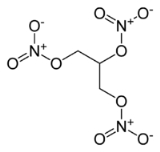
Nitroglycerin (NG), (United States
United States

The United States of America is a Federal government constitutional republic comprising U.S. state and a federal district. The country is situated mostly in central North America, where its Contiguous United States and Washington, D.C., the Capital districts and territories, lie between the Pacific Ocean and Atlantic Oceans, Borders of the U...
 spelling) also known as nitroglycerine, (UK Spelling), trinitroglycerin, trinitroglycerine, 1,2,3-trinitroxypropane and glyceryl trinitrate, is a heavy, colorless, oily, explosive liquid obtained by nitrating
Nitration

Nitration is a general chemical process for the introduction of a nitro compound into a chemical compound. Examples of nitrations are the conversion of glycerin to nitroglycerin and the conversion of toluene to trinitrotoluene....
 glycerol
Glycerol

Glycerol is a chemical compound also commonly called glycerin or glycerine. It is a colorless, odorless, Viscosity liquid that is widely used in pharmaceutical formulations....
. Since the 1860s, it has been used as an active ingredient in the manufacture of explosives, specifically dynamite
Dynamite

Dynamite is an Explosive material based on the explosive potential of nitroglycerin, initially using diatomaceous earth or another absorbent substance such as sawdust as an adsorbent....
, and as such is employed in the construction
Construction

In the fields of architecture and civil engineering, construction is a process that consists of the building or assembling of infrastructure. Far from being a single activity, large scale construction is a feat of multitasking....
 and demolition
Demolition

Demolition is the antonym of construction: the tearing-down of buildings and other structures. It contrasts with deconstruction , which is the taking down of a building while carefully preserving valuable elements for re-use....
 industries.


Discussion
Ask a question about 'Nitroglycerin'
Start a new discussion about 'Nitroglycerin'
Answer questions from other users
Full Discussion Forum


Encyclopedia


Nitroglycerin (NG), (United States
United States

The United States of America is a Federal government constitutional republic comprising U.S. state and a federal district. The country is situated mostly in central North America, where its Contiguous United States and Washington, D.C., the Capital districts and territories, lie between the Pacific Ocean and Atlantic Oceans, Borders of the U...
 spelling) also known as nitroglycerine, (UK Spelling), trinitroglycerin, trinitroglycerine, 1,2,3-trinitroxypropane and glyceryl trinitrate, is a heavy, colorless, oily, explosive liquid obtained by nitrating
Nitration

Nitration is a general chemical process for the introduction of a nitro compound into a chemical compound. Examples of nitrations are the conversion of glycerin to nitroglycerin and the conversion of toluene to trinitrotoluene....
 glycerol
Glycerol

Glycerol is a chemical compound also commonly called glycerin or glycerine. It is a colorless, odorless, Viscosity liquid that is widely used in pharmaceutical formulations....
. Since the 1860s, it has been used as an active ingredient in the manufacture of explosives, specifically dynamite
Dynamite

Dynamite is an Explosive material based on the explosive potential of nitroglycerin, initially using diatomaceous earth or another absorbent substance such as sawdust as an adsorbent....
, and as such is employed in the construction
Construction

In the fields of architecture and civil engineering, construction is a process that consists of the building or assembling of infrastructure. Far from being a single activity, large scale construction is a feat of multitasking....
 and demolition
Demolition

Demolition is the antonym of construction: the tearing-down of buildings and other structures. It contrasts with deconstruction , which is the taking down of a building while carefully preserving valuable elements for re-use....
 industries. Similarly, since the 1880s, it has been used by the military as an active ingredient, and a gellatinizer for nitrocellulose
Nitrocellulose

Nitrocellulose is a highly flammable compound formed by nitrating cellulose through exposure to nitric acid or another powerful nitrating agent....
, in some solid propellant
Propellant

A propellant is a material that is used to move an object. This will often involve a chemical reaction. It may be a gas, liquid, Plasma , or, before the chemical reaction, a solid....
s, such as Cordite
Cordite

Cordite is a family of smokeless powder developed and produced in the United Kingdom from 1889 to replace gunpowder as a military propellant....
 and Ballistite
Ballistite

Ballistite is a smokeless powder made from two high explosives, nitrocellulose and nitroglycerin , nitroglycerin . It was developed and patented by Alfred Nobel in the late 19th century....
.

Nitroglycerin is also used medically
Glyceryl trinitrate (pharmacology)

Glyceryl trinitrate is an alternate name for the chemical nitroglycerine, which has been used to treat Angina pectoris and heart failure since at least 1870....
 as a vasodilator to treat heart
Heart

The heart is a muscle organ in all vertebrates responsible for pumping blood through the blood vessels by repeated, rhythmic contractions, or a similar structure in annelids, mollusks, and arthropods....
 conditions, such as angina and chronic heart failure.

History

Nitroglycerin was the first easily developed explosive stronger than black powder. It was discovered by chemist Ascanio Sobrero
Ascanio Sobrero

Ascanio Sobrero , was the Italy chemist, born in Casale Monferrato, who discovered nitroglycerine in 1847. He was studying under Th?ophile-Jules Pelouze at the University of Turin, who had worked with the explosive material guncotton....
 in 1847, working under TJ Pelouze at the University of Turin
University of Turin

The University of Turin is a university in the city of Turin in the Piedmont region of north-western Italy. It is considered the 4th most important university in Italy....
. He initially called his discovery pyroglycerine, and warned vigorously against its use in his private letters and in a journal article, stating that it was extremely dangerous and impossible to handle.

One of Sobrero's fellow students was Alfred Nobel
Alfred Nobel

was a Sweden chemist, engineer, innovator, armaments manufacturer and the inventor of dynamite. He owned Bofors, a major armaments manufacturer, which he had redirected from its previous role as an iron and steel mill....
, who took the formula home to Sweden and experimented with safer ways to handle the dangerous substance; his younger brother Emil
Emil Oskar Nobel

Emil Nobel was the youngest son of Immanuel Nobel and the youngest brother of Robert Nobel, Ludvig Nobel and Alfred Nobel. He died at an explosion on 3 September 1864 in his father's factory Heleneborg in Stockholm....
 and several workers were killed in 1864 in a nitroglycerin explosion at the family's armaments factory in Heleneborg
Heleneborg

Heleneborg is an estate on S?dermalm, a part of the city of Stockholm, Sweden. It is opposite L?ngholmen island .The property was bought in 1669 by Jonas ?sterling and was used by the Swedish tobacco manufacturing company for tobacco production....
. A year later, Nobel founded Alfred Nobel & Company
Dynamit Nobel AG

Dynamite Nobel AG was a Germany chemical and weapons company whose headquarters was based in Troisdorf. It was founded in 1865 by Alfred Nobel....
 in Germany, building an isolated factory in the Krümmel hills of Geesthacht
Geesthacht

Geesthacht is the largest city in the Lauenburg in Schleswig-Holstein in Northern Germany, 34 km southeast of Hamburg on the banks of the River Elbe....
 near Hamburg. This business exported a liquid combination of nitroglycerin and gunpowder
Gunpowder

Gunpowder, also called black powder, is an explosive mixture of sulfur, charcoal and potassium nitrate, KNO3 that burns rapidly, producing volumes of hot solids and gases which can be used as a propellant in firearms and as a pyrotechnic composition in fireworks....
 known as "Blasting Oil", but it was extremely unstable and difficult to transport, as shown in numerous catastrophes. The buildings of the Krümmel factory itself were destroyed on two occasions.

In April 1866, three crates of nitroglycerin were shipped to California for the Central Pacific Railroad
Central Pacific Railroad

The Central Pacific Railroad was the California-to-Utah portion of the First transcontinental railroad in North America. Many proposals to build a transcontinental railroad failed because of the disputes over slavery in Washington; with the secession of the South, the modernizers in the Republican party took over Congress and passed the ne...
, who wished to experiment with its blasting capability to speed the construction of the 1,659-foot (506 m) Summit Tunnel through the Sierra Nevada. One of the crates exploded, destroying a Wells Fargo
Wells Fargo

Wells Fargo & Co. is a diversified financial services company with operations around the world. Wells Fargo is the 4th largest bank in the US by assets and the second largest bank by market cap....
 office in San Francisco and killing fifteen people, leading to a complete ban on the transport of liquid nitroglycerin in California. The on-site manufacture of nitroglycerin was thus required for the remaining hard-rock drilling and blasting
Drilling and blasting

Before the advent of tunnel boring machines, drilling and blasting was the only economical way of excavating long tunnels through hard rock, where digging is not possible....
 required for the completion of America's First Transcontinental Railroad
First Transcontinental Railroad

The First Transcontinental Railroad is the popular name of the United States rail transport line completed in 1869 between Council Bluffs, Iowa/Omaha, Nebraska and Alameda, California....
.

Liquid nitroglycerin was widely banned elsewhere as well and this finally led to Alfred Nobel & Company's development of dynamite
Dynamite

Dynamite is an Explosive material based on the explosive potential of nitroglycerin, initially using diatomaceous earth or another absorbent substance such as sawdust as an adsorbent....
 in 1867, made by mixing the nitroglycerin with the diatomaceous earth
Diatomaceous earth

Diatomaceous earth ? also known as DE, TSS, diatomite, diahydro, kieselguhr, kieselgur or celite ? is a naturally occurring, soft, chalk-like sedimentary rock that is easily crumbled into a fine white to off-white powder....
 (kieselguhr) found in the Krümmel hills. Similar mixtures, such as dualine (1867), lithofracteur (1869), and gelignite
Gelignite

Gelignite, also known as blasting gelatin, is an explosive material consisting of collodion-cotton dissolved in nitroglycerine and mixed with wood pulp and sodium nitrate or potassium nitrate....
 (1875), mixed nitroglycerin with other inert absorbents -- many different combinations were tried in order to get around Nobel's tightly controlled patents. Dynamites containing nitrocellulose
Nitrocellulose

Nitrocellulose is a highly flammable compound formed by nitrating cellulose through exposure to nitric acid or another powerful nitrating agent....
, which increase the viscosity of the mix, are commonly known as "gelatins."

Following discoveries that amyl nitrite
Amyl nitrite

Amyl nitrite is the chemical compound with the chemical formula C5H11ONO. A variety of isomers are known, but they all feature an amyl group attached to the nitrito functional group....
 helped to alleviate chest pain, Doctor William Murrell experimented with the use of nitroglycerin to alleviate angina pectoris and reduce blood pressure
Blood pressure

Blood pressure is the pressure exerted by circulating blood on the walls of blood vessels, and constitutes one of the principal vital signs. The pressure of the circulating blood decreases as it moves away from the heart through artery and capillary, and toward the heart through veins....
. He began treating patients with small doses in 1878, and it was soon adopted into widespread use after he published his results in The Lancet
The Lancet

The Lancet is a peer-reviewed general medical journal, published weekly by Elsevier, part of Reed Elsevier.One of the world's best-known and most respected general medical journals, with editorial offices in London and New York, The Lancet was founded in 1823 by Thomas Wakley, who named it after the surgical instrument called a lanc...
 in 1879. The medical establishment used the name "glyceryl trinitrate" or "trinitrin" to avoid alarming patients who associated nitroglycerin with explosions.

Instability and desensitization

In its pure form, it is a primary contact explosive
Contact explosive

Contact explosive generally refers to any substance that will explosion when relatively small quantities of energy are applied to the chemical substance, whether that be heat, light, sound, or physical pressure and even Alpha radiation....
 (physical shock can cause it to explode) and degrades over time to even more unstable forms. This makes it highly dangerous to transport or use. In this undiluted form, it is one of the more powerful explosives, comparable to the more recently developed RDX
RDX

Cyclotrimethylenetrinitramine, also known as RDX, cyclonite, hexogen, and T4, is an explosive nitroamine widely used in military and industrial applications....
 and PETN
PETN

Pentaerythritol tetranitrate is one of the most powerful explosive material known, with a relative effectiveness factor of 1.66....
, as well as the plastic explosive
Plastic explosive

Plastic explosive is a specialised form of explosive material. It is soft and hand moldable solid material. Plastic explosives are properly known as Use forms of explosives within the field of explosives engineering....
 C-4
C-4 (explosive)

C-4 or Composition 4 is a common variety of military plastic explosive.The term composition is used for any stable explosive, and "Composition A" and "Composition B" are other known variants....
—which contains over 90% RDX
RDX

Cyclotrimethylenetrinitramine, also known as RDX, cyclonite, hexogen, and T4, is an explosive nitroamine widely used in military and industrial applications....
 as its active ingredient.

Early in the history of this explosive it was discovered that liquid nitroglycerin can be "desensitized" by cooling to 5 to 10 °C
Celsius

Celsius is a temperature scale that is named after the Swedish astronomer Anders Celsius , who developed a similar temperature scale two years before his death....
 (40 to 50 °F
Fahrenheit

Fahrenheit is a temperature scale named after the physicist Daniel Gabriel Fahrenheit , who proposed it in 1724. Today, the scale has largely been replaced by the Celsius scale; it is still in use for non-scientific purposes in the United States and a few other countries such as Belize....
), at which temperature it freezes, contracting upon solidification. However, later thawing can be extremely sensitizing, especially if impurities are present or if warming is too rapid. It is possible to chemically "desensitize" nitroglycerin to a point where it can be considered approximately as "safe" as modern high explosive
Explosive material

File:M112 Demolition Charge.jpgAn explosive material is a material that either is chemistry or otherwise energetically unstable or produces a sudden expansion of the material usually accompanied by the production of heat and large changes in pressure upon initiation; this is called the explosion....
 formulations, by the addition of approximately 10-30% ethanol
Ethanol

Ethanol, also called ethyl alcohol, pure alcohol, grain alcohol, or drinking alcohol, is a volatility , flammable, colorless liquid....
, acetone
Acetone

Acetone is the organic compound with the chemical formula OC2. This colorless, mobile, flammable liquid is the simplest example of the ketones....
, or dinitrotoluene
Dinitrotoluene

Dinitrotoluene or Dinitro is an explosive with the formula C6H32. At room temperature it is a pale yellow to orange crystalline solid....
 (percentage varies with the desensitizing agent used). Desensitization requires extra effort to reconstitute the "pure" product. Failing this, it must be assumed that desensitized nitroglycerin is substantially more difficult to detonate, possibly rendering it useless as an explosive for practical application.

A serious problem in the use of nitroglycerin results from its high freezing point 13 °C
Celsius

Celsius is a temperature scale that is named after the Swedish astronomer Anders Celsius , who developed a similar temperature scale two years before his death....
 (55 °F
Fahrenheit

Fahrenheit is a temperature scale named after the physicist Daniel Gabriel Fahrenheit , who proposed it in 1724. Today, the scale has largely been replaced by the Celsius scale; it is still in use for non-scientific purposes in the United States and a few other countries such as Belize....
). Solid nitroglycerin is much less sensitive to shock than the liquid, a feature common in explosives; in the past it was often shipped in the frozen state, but this resulted in a high number of accidents during the thawing process by the end user just prior to use. This disadvantage is overcome by using mixtures of nitroglycerin with other polynitrates; for example, a mixture of nitroglycerin and ethylene glycol dinitrate
Ethylene glycol dinitrate

Ethylene glycol dinitrate , also known as nitroglycol, is a chemical compound a yellowish, oily explosive liquid obtained by nitration ethylene glycol....
 freezes at -29 °C
Celsius

Celsius is a temperature scale that is named after the Swedish astronomer Anders Celsius , who developed a similar temperature scale two years before his death....
 (-20 °F
Fahrenheit

Fahrenheit is a temperature scale named after the physicist Daniel Gabriel Fahrenheit , who proposed it in 1724. Today, the scale has largely been replaced by the Celsius scale; it is still in use for non-scientific purposes in the United States and a few other countries such as Belize....
).

Detonation

Nitroglycerin and any dilutents can certainly deflagrate, i.e. burn. However, the explosive power of nitroglycerin is derived from detonation: energy from the initial decomposition causes a pressure wave or gradient that detonates the surrounding fuel. This is a self-sustained shock-wave that propagates through the explosive medium at some 20 times the speed of sound as a near-instantaneous pressure-induced decomposition of the fuel into a white hot gas. This is totally different from deflagration, which depends solely upon available fuel regardless of pressure or shock.

Manufacturing

The industrial manufacturing process often uses a nearly 50:50 mixture of sulfuric acid
Sulfuric acid

Sulfuric acid, hydrogen2sulfuroxygen4, is a strong mineral acid. It is soluble in water at all concentrations. Sulfuric acid has many applications, and is one of the top products of the chemical industry....
 and nitric acid
Nitric acid

Nitric acid , also known as aqua fortis and spirit of nitre, is a highly corrosion and toxic strong acid that can cause severe burns....
. This can be produced by mixing white fuming nitric acid (quite costly pure nitric acid in which oxides of nitrogen have been removed, as opposed to red fuming nitric acid) and concentrated sulfuric acid. More often, this mixture is attained by the cheaper method of mixing fuming sulfuric acid, also known as oleum, (sulfuric acid containing excess sulfur trioxide
Sulfur trioxide

Sulfur trioxide is the chemical compound with the formula SO3. In the gaseous form, this species is a significant pollutant, being the primary agent in acid rain....
) and azeotropic nitric acid (consisting of around 70% nitric acid, the rest being water).

The sulfuric acid produces protonated nitric acid species, which are attacked by glycerin's nucleophilic
Nucleophile

In chemistry, a nucleophile is a reagent that forms a chemical bond to its reaction partner by donating both bonding electrons. Because nucleophiles donate electrons, they are by definition Lewis bases ....
 oxygen
Oxygen

Oxygen no O2 produced; 2) O2 produced, but absorbed in oceans & seabed rock; 3) O2 starts to gas out of the oceans, but is absorbed by land surfaces and formation of ozone layer; 4-5) O2 sinks filled and the gas accumulates]]...
 atoms. The nitro
Nitro

Nitro may refer to:...
 group
Functional group

In organic chemistry, functional groups are specific groups of atoms within molecules that are responsible for the characteristic chemical reactions of those molecules....
 is thus added as an ester C-O-NO2 and water is produced. This is different from an aromatic nitration reaction in which nitronium ion
Nitronium ion

The nitronium ion , 2+ is a generally unstable cation created by the removal of an electron from the paramagnetic nitrogen dioxide molecule, or the protonation of nitric acid....
s are the active species in an electrophilic attack of the molecules' ring system.

The addition of glycerin results in an exothermic reaction
Chemical reaction

A chemical reaction is a process that always results in the interconversion of chemical substances. The substance or substances initially involved in a chemical reaction are called reactants....
 (i.e., heat is produced), as usual for mixed acid nitrations. However, if the mixture becomes too hot, it results in runaway, a state of accelerated nitration accompanied by the destructive oxidizing of organic materials of nitric acid and the release of very poisonous brown nitrogen dioxide
Nitrogen dioxide

Nitrogen dioxide is the chemical compound with the chemical formula NitrogenOxygen2. One of several nitrogen oxides, NO2 is an intermediate in the industrial synthesis of nitric acid, millions of tons of which are produced each year....
 gas at high risk of an explosion. Thus, the glycerin mixture is added slowly to the reaction vessel containing the mixed acid (not acid to glycerin). The nitrator is cooled with cold water or some other coolant mixture and maintained throughout the glycerin addition at about 22 °C, much below which the esterification occurs too slowly to be useful. The nitrator vessel, often constructed of iron or lead and generally stirred with compressed air, has an emergency trap door at its base, which hangs over a large pool of very cold water and into which the whole reaction mixture (called the charge) can be dumped to prevent an explosion, a process referred to as drowning. If the temperature of the charge exceeds about 30 °C (actual value varying by country) or brown fumes are seen in the nitrator's vent, then it is immediately drowned.

Use as an explosive and a propellant

The main use of nitroglycerin, by tonnage, is in explosives such as dynamite and in propellants.

Alfred Nobel
Alfred Nobel

was a Sweden chemist, engineer, innovator, armaments manufacturer and the inventor of dynamite. He owned Bofors, a major armaments manufacturer, which he had redirected from its previous role as an iron and steel mill....
 developed the use of nitroglycerin as a blasting explosive by mixing the nitroglycerine with inert absorbents
Chemistry

Chemistry is the science concerned with the composition, structure, and properties of matter, as well as the changes it undergoes during chemical reactions....
 particularly diatomaceous earth
Diatomaceous earth

Diatomaceous earth ? also known as DE, TSS, diatomite, diahydro, kieselguhr, kieselgur or celite ? is a naturally occurring, soft, chalk-like sedimentary rock that is easily crumbled into a fine white to off-white powder....
. He named this explosive dynamite
Dynamite

Dynamite is an Explosive material based on the explosive potential of nitroglycerin, initially using diatomaceous earth or another absorbent substance such as sawdust as an adsorbent....
 and patented it in 1867. It was supplied ready for use in the form of sticks, individually wrapped in grease proof paper. Dynamite and similar explosives were widely adopted for civil engineering tasks, such as building railway tunnels and cuttings; and for quarrying.

Nitroglycerin was also adapted as a military propellant, for use in guns and rifles. Poudre B
Poudre B

Poudre B or Vieille powder, was the first smokeless powder gunpowder.It was invented in 1886 by a France chemist called Paul Vieille. It was made out of two forms of nitrocellulose softened with ethanol and diethyl ether and kneaded together....
, invented in France
France

France , officially the French Republic , is a country whose Metropolitan France is located in Western Europe and that also comprises various Overseas departments and territories of France....
 in 1886, was one of the first military propellants to replace gunpowder
Gunpowder

Gunpowder, also called black powder, is an explosive mixture of sulfur, charcoal and potassium nitrate, KNO3 that burns rapidly, producing volumes of hot solids and gases which can be used as a propellant in firearms and as a pyrotechnic composition in fireworks....
; but it was based on nitrocellulose, not nitroglycerin. It was later found to be unstable.

Alfred Nobel then developed ballistite
Ballistite

Ballistite is a smokeless powder made from two high explosives, nitrocellulose and nitroglycerin , nitroglycerin . It was developed and patented by Alfred Nobel in the late 19th century....
, by combining nitroglycerin and guncotton. He patented it in 1887. Ballistite was adopted by a number of European governments, as a military propellant. Italy
Italy

Italy , officially the Italian Republic , is a country located on the Italian Peninsula in Southern Europe and on the two largest islands in the Mediterranean Sea, Sicily and Sardinia....
 was the first to adopt it. However, it was not adopted by the British Government. They, together with the British Commonwealth countries, adopted cordite
Cordite

Cordite is a family of smokeless powder developed and produced in the United Kingdom from 1889 to replace gunpowder as a military propellant....
, which had been developed by Sir Frederick Abel and Sir James Dewar, in 1889. The original Cordite Mk I consisted of 58% nitroglycerine, 37% guncotton and 5% petroleum jelly
Petroleum jelly

Petroleum jelly, petrolatum or soft paraffin is a semi-solid mixture of hydrocarbons , originally promoted as a topical ointment for its healing properties....
. Ballistite and cordite were both manufactured in the forms of cords.

Smokeless powder
Smokeless powder

Smokeless powder is the name given to a number of propellants used in firearms and artillery which produce negligible smoke when fired, unlike the older gunpowder which they replaced....
s were originally developed using nitrocellulose as the sole explosive ingredient; and were therefore known as single base propellants. A range of smokeless powders that contain both nitrocellulose and nitroglycerin, known as double base propellants, were also developed. Smokeless powders were originally supplied only for military use; however they were also soon developed for civilian use and were quickly adopted for sport. Some are known as sporting powders.

Blasting gelatin, also known as gelignite
Gelignite

Gelignite, also known as blasting gelatin, is an explosive material consisting of collodion-cotton dissolved in nitroglycerine and mixed with wood pulp and sodium nitrate or potassium nitrate....
, was invented by Nobel in 1875, using nitroglycerine, wood pulp, and sodium or potassium nitrates. This was an early low-cost, flexible explosive.

War time production rates

Large quantities of nitroglycerin were manufactured in both World Wars for use in military propellants.

World War I

In World War I
World War I

World War I, or the First World War , was a global military conflict which involved the Great powers, organized into two opposing military alliances: the Allies of World War I and the Central Powers....
 HM Factory, Gretna
HM Factory, Gretna

His Majesty's Factory, Gretna, or H.M. Factory, Gretna as it was usually known, was a United Kingdom government World War I Cordite factory, adjacent to the Solway Firth, near Gretna, Dumfries and Galloway....
, the largest propellant factory in the United Kingdom was producing 800 ton
Ton

Units of massThere are several similar units of mass or volume called the ton:Others*The long ton is used for petroleum products such as aviation fuel....
s (812 tonne
Tonne

A tonne or metric ton , also referred to as a metric tonne, is a measurement of mass equal to 1,000 kilograms, or 2204.6226 pounds....
) of Cordite RDB per week. This required 336 tons of nitroglycerin per week (assuming no losses in production). The Royal Navy
Royal Navy

The Royal Navy of the United Kingdom is the oldest of the British Armed Forces . From the mid-18th century until well into the 20th century, it was the most powerful navy in the world, playing a key part in establishing the British Empire as the dominant world power from 1815 until the early 1940s....
 had its own factory at Royal Navy Cordite Factory, Holton Heath
Royal Navy Cordite Factory, Holton Heath

The Royal Navy Cordite Factory, Holton Heath, , was set up at Holton Heath, Dorset in World War I to manufacture Cordite for the Royal Navy....
.

A large cordite factory was also built in Canada
Canada

Canada is a country occupying most of northern North America, extending from the Atlantic Ocean in the east to the Pacific Ocean in the west and northward into the Arctic Ocean....
 in World War I. The Canadian Explosives Limited
Canadian Industries Limited

Canadian Industries Limited, also known as C-I-L is a Canadian chemicals manufacturer. Products include paints, fertilizers and pesticides, and explosives....
 Cordite factory at Nobel, Ontario
Nobel, Ontario

Nobel is a village located on the picturesque shores of Parry Sound, Ontario. It is located in the McDougall, Ontario in the Parry Sound District, Ontario....
 was designed to produce 1,500,000 lb (681 tonne) of Cordite per month. It required 286 tonnes of nitroglycerin per month.

Medical implications


Medical use

Nitroglycerin in medicine
Medicine

Medicine is the art and science of healing. It encompasses a range of health care practices evolved to maintain and restore health by the prevention and treatment of illness....
, where it is generally called glyceryl trinitrate, is used as a heart
Heart

The heart is a muscle organ in all vertebrates responsible for pumping blood through the blood vessels by repeated, rhythmic contractions, or a similar structure in annelids, mollusks, and arthropods....
 medication (under the trade names Nitrospan, Nitrostat, and Tridil, amongst others). It is used as a medicine for angina pectoris (ischaemic heart disease
Coronary heart disease

Coronary artery disease is the end result of the accumulation of atheroma within the walls of the Coronary circulation that supply the myocardium with oxygen and nutrients....
) in tablets, ointment, solution for intravenous use, transdermal patches (Trinipatch, Transderm Nitro, Nitro-Dur), or sprays administered sublingual
Sublingual

Sublingual, literally 'under the tongue', from Latin, refers to the pharmacological route of administration by which medications diffuse into the blood through tissues under the tongue....
ly (Nitrolingual Pump Spray, Natispray). It is also used quite frequently to increase the effect of sildenafil
Sildenafil

Sildenafil citrate, sold as Viagra, Revatio and under various other trade names, is a Medication used to treat erectile dysfunction and pulmonary hypertension ....
. The principal action of nitroglycerin is vasodilation
Vasodilation

Vasodilation refers to the widening of blood vessels resulting from relaxation of smooth muscle cells within the vessel walls, particularly in the large arteries, smaller arterioles and large veins....
—widening of the blood vessel
Blood vessel

The blood vessels are the part of the circulatory system that transport blood throughout the body. There are three major types of blood vessels: the artery, which carry the blood away from the heart, the capillary, which enable the actual exchange of water and chemicals between the blood and the tissues; and the veins, which carry blood from...
s. Nitroglycerin will dilate veins more than arteries, decreasing cardiac preload and leading to the following therapeutic effects during episodes of angina pectoris:
  • subsiding of chest pain
  • decrease of blood pressure
    Blood pressure

    Blood pressure is the pressure exerted by circulating blood on the walls of blood vessels, and constitutes one of the principal vital signs. The pressure of the circulating blood decreases as it moves away from the heart through artery and capillary, and toward the heart through veins....
  • increase of heart rate.
  • orthostatic hypotension
    Orthostatic hypotension

    Orthostatic hypotension is a form of hypotension in which there is a sudden fall in blood pressure, typically greater than 20/10 mm Hg, that occurs when a person assumes a standing , usually after a prolonged period of rest....


These effects arise because nitroglycerin is converted to nitric oxide
Nitric oxide

Nitric oxide or nitrogen monoxide is a chemical compound with chemical formula NitrogenOxygen. This gas is an important signaling molecule in the body of mammals, including humans, and is an extremely important intermediate in the chemical industry....
 in the body by mitochondrial aldehyde dehydrogenase
Aldehyde dehydrogenase

Aldehyde dehydrogenases, E.C. 1.2.1.3, are a group of enzymes that catalyse the oxidation of aldehydes.Mitochondrial Aldehyde Dehydrogenase is a polymorphic enzyme #Crabb2004 responsible for the oxidation of aldehydes to carboxylic acids, which leave the liver and are metabolized by the body?s muscle and heart #Crabb2004....
, and nitric oxide is a natural vasodilator. Recently, it has also become popular in an off-label use at reduced (0.2%) concentration in ointment form as an effective treatment for anal fissure
Anal fissure

An anal fissure is an unnatural crack or tear in the skin of the anal canal. Anal fissures may be noticed by bright red anal bleeding on the toilet paper, sometimes in the toilet....
.

The side effects of Nitroglycerin include lack of sexual desire, head ache, painful urination and increased Bowel Movements.

Industrial exposure

Infrequent exposure to high doses of nitroglycerin can cause severe headaches known as "NG head". These headaches can be severe enough to incapacitate some people; however, humans develop a tolerance to and dependence on nitroglycerin after long-term exposure. Withdrawal can (rarely) be fatal; withdrawal symptoms include headaches and heart problems; with re-exposure to nitroglycerin, these symptoms may disappear.

For workers in nitroglycerin (NTG) manufacturing facilities, this can result in a "Monday morning headache" phenomenon for those who experience regular nitroglycerin exposure in the workplace leading to the development of NTG tolerance for the vasodilating effects. Over the weekend the workers lose the tolerance to NTG and when they are reexposed on Monday the prominent vasodilation
Vasodilation

Vasodilation refers to the widening of blood vessels resulting from relaxation of smooth muscle cells within the vessel walls, particularly in the large arteries, smaller arterioles and large veins....
 produces tachycardia
Tachycardia

The word tachycardia comes from the Greek words tachys and kardia .Tachycardia typically refers to a heartrate that exceeds the range of the normal resting heartrate, based upon age:...
, dizziness, and a headache.

See also

  • Mannitol hexanitrate
  • Xylitol pentanitrate
    Xylitol pentanitrate

    Xylitol pentanitrate is a rarely-used liquid explosive compound with extremely high viscosity formed by completely nitration xylitol, a sugar alcohol compound with five carbon atoms....
  • Erythritol tetranitrate
    Erythritol tetranitrate

    Erythritol tetranitrate is an explosive compound chemically similar to PETN. It is however thought to be 1/3 more sensitive to friction and impact....
  • Ethylene glycol dinitrate
    Ethylene glycol dinitrate

    Ethylene glycol dinitrate , also known as nitroglycol, is a chemical compound a yellowish, oily explosive liquid obtained by nitration ethylene glycol....
  • Nitromethane
    Nitromethane

    Nitromethane is an organic compound with the chemical formula CH3NO2. It is the simplest organic nitro compound. It is a slightly viscous, highly polar liquid commonly used as a solvent in a variety of industrial applications such as in extractions, as a reaction medium, and as a cleaning solvent....


External links

  • Detailed and horrific stories of the historical use of nitroglycerin-filled torpedoes to restart petroleum wells.