


Council of Clermont

Encyclopedia
Synod
A synod historically is a council of a church, usually convened to decide an issue of doctrine, administration or application. In modern usage, the word often refers to the governing body of a particular church, whether its members are meeting or not...
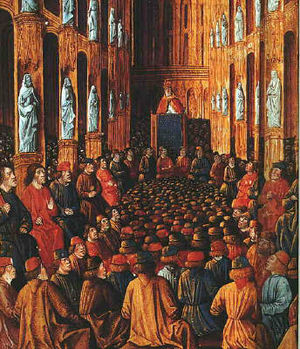
of ecclesiastics and laymen of the Catholic Church, which was held from November 18 to November 28, 1095 at Clermont, France
Clermont-Ferrand
Clermont-Ferrand is a city and commune of France, in the Auvergne region, with a population of 140,700 . Its metropolitan area had 409,558 inhabitants at the 1999 census. It is the prefecture of the Puy-de-Dôme department...
. Pope Urban II's speech on November 27 was the starting point of the First Crusade
First Crusade
The First Crusade was a military expedition by Western Christianity to regain the Holy Lands taken in the Muslim conquest of the Levant, ultimately resulting in the recapture of Jerusalem...
.
Background
In 1095 Byzantine emperor Alexius I Comnenus sent envoys to the west requesting military assistance against the Seljuk Turks. The message was received by Pope Urban IIPope Urban II
Pope Urban II , born Otho de Lagery , was Pope from 12 March 1088 until his death on July 29 1099...
at the Council of Piacenza
Council of Piacenza
The Council of Piacenza was a mixed synod of ecclesiastics and laymen of the Roman Catholic Church, which took place from March 1 to March 5, 1095, at Piacenza....
; later that year, in November, Urban called the Council of Clermont to discuss the matter further. In convoking the council, Urban urged the bishop
Bishop
A bishop is an ordained or consecrated member of the Christian clergy who is generally entrusted with a position of authority and oversight. Within the Catholic Church, Eastern Orthodox, Oriental Orthodox Churches, in the Assyrian Church of the East, in the Independent Catholic Churches, and in the...
s and abbot
Abbot
The word abbot, meaning father, is a title given to the head of a monastery in various traditions, including Christianity. The office may also be given as an honorary title to a clergyman who is not actually the head of a monastery...
s whom he addressed directly, to bring with them the prominent lords in their provinces.
The Council lasted from November 19 to November 28, and was attended by about 300 clerics from throughout France
France
The French Republic , The French Republic , The French Republic , (commonly known as France , is a unitary semi-presidential republic in Western Europe with several overseas territories and islands located on other continents and in the Indian, Pacific, and Atlantic oceans. Metropolitan France...
. Urban discussed Cluniac reforms
Cluniac Reforms
The Cluniac Reforms were a series of changes within medieval monasticism of West focused on restoring the traditional monastic life, encouraging art, and caring for the poor. The movement is named for the Abbey of Cluny in Burgundy, where it started within the Benedictine order. The reforms were...
of the Church, and also extended the excommunication
Excommunication
Excommunication is a religious censure used to deprive, suspend or limit membership in a religious community. The word means putting [someone] out of communion. In some religions, excommunication includes spiritual condemnation of the member or group...
of Philip I of France
Philip I of France
Philip I , called the Amorous, was King of France from 1060 to his death. His reign, like that of most of the early Direct Capetians, was extraordinarily long for the time...
for his adulterous remarriage to Bertrade of Montfort. On November 27, Urban spoke for the first time about the problems in the east, as he urged Western Christians fight against the Muslims who had occupied the Holy Land and were attacking the Eastern Roman Empire.
There are six main sources of information about this portion of the council: the anonymous Gesta Francorum
Gesta Francorum
The so-called Gesta Francorum or in full De Gesta Francorum et aliorum Hierosolimitanorum is a Latin chronicle of the First Crusade written in circa 1100-1101 by an anonymous author connected with Bohemund I of Antioch.It narrates the events of the First Crusade from the inception in November...
("The Deeds of the Franks" dated c. 1100/1101), which influenced all versions of the speech except that by Fulcher of Chartres
Fulcher of Chartres
Fulcher of Chartres was a chronicler of the First Crusade. He wrote in Latin.- Life :His appointment as chaplain of Baldwin of Boulogne in 1097 suggests that he had been trained as a priest, most likely at the school in Chartres...
, who was present at the council; Robert the Monk
Robert the Monk
Robert the Monk or Robert of Rheims was a chronicler of the First Crusade. He did not participate in the expedition, but rewrote the Gesta Francorum at the request of his abbot, who was appalled at the 'rustic' style of the Gesta....
, who may have been present; Baldric, archbishop of Dol; and Guibert de Nogent, who were not present at the council. All of these accounts were written down quite a bit later than the council, and all differ widely from one another. More important than the five composed speeches from the later sources, which tend to be colored by the authors' own views of crusading, is a letter that was written by Urban himself in December of 1095 referring to the council.
According to Fulcher of Chartres who wrote a version of the speech in Gesta Francorum Jerusalem Expugnantium, Urban addressed various abuses of the church such as simony
Simony
Simony is the act of paying for sacraments and consequently for holy offices or for positions in the hierarchy of a church, named after Simon Magus , who appears in the Acts of the Apostles 8:9-24...
and the lack of adherence to the Peace of God:
In Fulcher's version of the speech, Urban does not mention Jerusalem at all. Urban does however cite the need of the eastern Byzantine Empire
Byzantine Empire
The Byzantine Empire was the Eastern Roman Empire during the periods of Late Antiquity and the Middle Ages, centred on the capital of Constantinople. Known simply as the Roman Empire or Romania to its inhabitants and neighbours, the Empire was the direct continuation of the Ancient Roman State...
for aid against Muslim attack:
In Gesta Dei per Francos by Robert the Monk, writing about twenty years after the council, an extended version of the speech presents the call to the "race of the Franks" as a peroration climaxing Urban's call for orthodoxy, reform and submission to the Church. Robert records that the pope asked western Christians, poor and rich, to come to the aid of the Greeks
Byzantine Empire
The Byzantine Empire was the Eastern Roman Empire during the periods of Late Antiquity and the Middle Ages, centred on the capital of Constantinople. Known simply as the Roman Empire or Romania to its inhabitants and neighbours, the Empire was the direct continuation of the Ancient Roman State...
in the east, because "Deus vult
Deus vult
Deus vult was the cry of the people at the declaration of the First Crusade by Pope Urban II at the Council of Clermont in 1095...
," ("God wills it"), the rousing cry with which Urban ended his final address. Robert records that Urban promised remission of sins
Absolution
Absolution is a traditional theological term for the forgiveness experienced in the Sacrament of Reconciliation. This concept is found in the Roman Catholic Church, as well as the Eastern Orthodox churches, the Anglican churches, and most Lutheran churches....
for those who went to the east, although the 'Liber Lamberti', a source based on the notes of Bishop Lambert of Arras, who attended the Council, indicates that Urban offered the remission of all penance due from sins, what later came to be called an indulgence
Indulgence
In Catholic theology, an indulgence is the full or partial remission of temporal punishment due for sins which have already been forgiven. The indulgence is granted by the Catholic Church after the sinner has confessed and received absolution...
. Robert makes Urban emphasize reconquering the Holy Land
Holy Land
The Holy Land is a term which in Judaism refers to the Kingdom of Israel as defined in the Tanakh. For Jews, the Land's identifiction of being Holy is defined in Judaism by its differentiation from other lands by virtue of the practice of Judaism often possible only in the Land of Israel...
more than aiding the Greeks; the intervening decades and the events of the First Crusade
First Crusade
The First Crusade was a military expedition by Western Christianity to regain the Holy Lands taken in the Muslim conquest of the Levant, ultimately resulting in the recapture of Jerusalem...
had certainly shifted the emphasis. According to Robert, Urban listed various gruesome offenses of the Muslim
Muslim
A Muslim, also spelled Moslem, is an adherent of Islam, a monotheistic, Abrahamic religion based on the Quran, which Muslims consider the verbatim word of God as revealed to prophet Muhammad. "Muslim" is the Arabic term for "submitter" .Muslims believe that God is one and incomparable...
s: They circumcise the Christians, and the blood of the circumcision they either spread upon the altars or pour into the vases of the baptismal font.
and more alleged atrocities expressed in inflammatory images that were derived from hagiography
Hagiography
Hagiography is the study of saints.From the Greek and , it refers literally to writings on the subject of such holy people, and specifically to the biographies of saints and ecclesiastical leaders. The term hagiology, the study of hagiography, is also current in English, though less common...
. Perhaps with the wisdom of hindsight, Robert makes Urban advise that none but knight
Knight
A knight was a member of a class of lower nobility in the High Middle Ages.By the Late Middle Ages, the rank had become associated with the ideals of chivalry, a code of conduct for the perfect courtly Christian warrior....
s should go, not the old and feeble, nor priest
Priest
A priest is a person authorized to perform the sacred rites of a religion, especially as a mediatory agent between humans and deities. They also have the authority or power to administer religious rites; in particular, rites of sacrifice to, and propitiation of, a deity or deities...
s without the permission of their bishops, "for such are more of a hindrance than aid, more of a burden than advantage... nor ought women to set out at all, without their husbands or brothers or legal guardians."
About the same time, Baldrick, archbishop of Dol, also basing his account generally on Gesta Francorum, focused on the offenses of the Muslims and the reconquest of the Holy Land
Holy Land
The Holy Land is a term which in Judaism refers to the Kingdom of Israel as defined in the Tanakh. For Jews, the Land's identifiction of being Holy is defined in Judaism by its differentiation from other lands by virtue of the practice of Judaism often possible only in the Land of Israel...
in terms likely to appeal to chivalry
Chivalry
Chivalry is a term related to the medieval institution of knighthood which has an aristocratic military origin of individual training and service to others. Chivalry was also the term used to refer to a group of mounted men-at-arms as well as to martial valour...
. Like Fulcher he also recorded that Urban deplored the violence of the Christian knights of Gaul
Gaul
Gaul was a region of Western Europe during the Iron Age and Roman era, encompassing present day France, Luxembourg and Belgium, most of Switzerland, the western part of Northern Italy, as well as the parts of the Netherlands and Germany on the left bank of the Rhine. The Gauls were the speakers of...
. "It is less wicked to brandish your sword against Saracens," Baldrick's Urban cries, comparing them to the Amalekites. The violence of knights he wanted to see ennobled in the service of Christ, defending the churches of the East as if defending a mother. Baldrick asserts that Urban, there on the spot, appointed the bishop of Puy to lead the crusade.
Guibert, abbot of Nogent
Guibert of Nogent
Guibert of Nogent was a Benedictine historian, theologian and author of autobiographical memoirs. Guibert was relatively unknown in his own time, going virtually unmentioned by his contemporaries...
also made that Urban emphasize the reconquest of the Holy Land more than help to the Greeks or other Christians there. This emphasis may, as in the case of Robert and Baldric, be due to the influence of the Gesta Francorum's account of Jerusalem's reconquest. Urban's speech, in Nogent's version, emphasized the sanctity of the Holy Land, which must be in Christian possession so that prophecies
Prophecy
Prophecy is a process in which one or more messages that have been communicated to a prophet are then communicated to others. Such messages typically involve divine inspiration, interpretation, or revelation of conditioned events to come as well as testimonies or repeated revelations that the...
about the end of the world could be fulfilled.
On the last day of the council, a general call was sent out to the knights and nobles of France. Urban apparently knew in advance of the day that Raymond IV of Toulouse
Raymond IV of Toulouse
Raymond IV of Toulouse , sometimes called Raymond of St Gilles, was Count of Toulouse, Duke of Narbonne, and Margrave of Provence and one of the leaders of the First Crusade. He was a son of Pons of Toulouse and Almodis de La Marche...
, exemplary for courage and piety, was fully prepared to take up arms. Urban himself spent a few months preaching the Crusade in France, while papal legate
Papal legate
A papal legate – from the Latin, authentic Roman title Legatus – is a personal representative of the pope to foreign nations, or to some part of the Catholic Church. He is empowered on matters of Catholic Faith and for the settlement of ecclesiastical matters....
s spread the word in the south of Italy, during which time the focus presumably turned from helping Alexius to taking Jerusalem; the general population, upon hearing about the Council, probably understood this to be the point of the Crusade in the first place.
Urban's own letter, addressed to the faithful "waiting in Flanders
Flanders
Flanders is the community of the Flemings but also one of the institutions in Belgium, and a geographical region located in parts of present-day Belgium, France and the Netherlands. "Flanders" can also refer to the northern part of Belgium that contains Brussels, Bruges, Ghent and Antwerp...
," does lament the fact that Turks, in addition to ravaging the "churches of God in the eastern regions," have seized "the Holy City of Christ, embellished by his passion and resurrection—and blasphemy to say it—have sold her and her churches into abominable slavery." Yet he does not explicitly call for the reconquest of Jerusulem. Rather he explicitly calls for the military "liberation" of the Eastern Churches, and appoints Adhemar of Le Puy
Adhemar of Le Puy
Adhemar de Monteil , one of the principal figures of the First Crusade, was bishop of Puy-en-Velay from before 1087...
to lead the Crusade, to set out on the day of the Assumption of Mary
Assumption of Mary
According to the belief of Christians of the Roman Catholic Church, Eastern Orthodoxy, Oriental Orthodoxy, and parts of the Anglican Communion and Continuing Anglicanism, the Assumption of Mary was the bodily taking up of the Virgin Mary into Heaven at the end of her life...
, August 15.
External links
- Medieval Sourcebook: Five versions of Urban's sermon
- Council Of Clermont - Paradoxically, the Crusades Enlarge the Life and Culture of Western Europe