

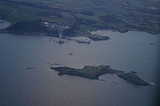
Inchcolm

Encyclopedia
Inchcolm is an island
in the Firth of Forth
in Scotland
. Repeatedly attacked by English raiders during the Wars of Scottish Independence
, it was fortified during both World Wars to defend nearby Edinburgh
. Inchcolm now attracts visitors to its former Augustinian
Abbey.
 Inchcolm lies in the Firth of Forth off the south coast of Fife opposite Braefoot Bay, east of the Forth Bridge, south of Aberdour
, Fife
, and north of the City of Edinburgh
. It is separated from the Fife mainland by a stretch of water known as Mortimer's Deep. The island forms part of the parish of Aberdour, and lies a quarter of a mile from the shore. In the days when people were compelled to cross the Firth of Forth
by boat as opposed to bridge, the island was a great deal less isolated, and on the ferry routes between Leith
/Lothian
and Fife
.
The island can be broadly divided into three sections: the east, where its military defensive operations were centered during the Second World War
, the lower central part, with the small natural harbour and shop, and a larger western end.
Between Aberdour and Inchcolm is the channel called "Mortimer's Deep". It is believed that this was named after William de Mortimer.

fleet in some capacity, as they had a strong presence at Cramond
for a few years, and had to travel to the Antonine Wall
.
It was supposedly visited by St Columba
(an Irish
missionary monk) in 567, and was named after him in the 12th century. It may have served the monks of the Columban family as an "Iona
of the east" from early times. A primitive stone-roofed building survived on the island, preserved and given a vaulted roof by the monks of the later abbey, probably served as a hermit
's oratory
and cell in the 12th century, if not earlier. Fragments of carved stonework from the Dark Ages testify to an early Christian presence on the island. A hogback
stone, preserved in the abbey's visitor centre, can be dated to the late 10th century, making it probably Scotland
's earliest type of monument originating among Danish
settlers in northern England
. A 16th century source states that a stone cross was situated nearby, although no features could be found which related to the monument.
The island gets a mention in Shakespeare's
Macbeth
The reference in Shakespeare
is because Inchcolm was long used as an exclusive burial site (much like Iona
). A Danish
force under king Sweyn, the father of Canute
raided the island and Fife with an English force. In the play, Macbeth
buys off the Danes with a "great summe of gold", and told the Danes they could bury their dead there for "ten thousand dollars". Hector Boece
corroborates the claim that the Danes paid good money to have their dead buried there in the 11th century. The practice of burying dead on islands in Scotland is long established – and was partly a deterrent to feral
dogs and wolves (still found in Scotland at that point) who might dig up the corpses and eat them.
Like other centres of Culdee
activity, the island was used as a home for hermits. The nearby Inchmickery
’s name also commemorates a probable hermit
. Textual evidence suggests that this was the case in the 12th century, when King Alexander I was marooned on the island, and was said to have been looked after by one in 1123. Alexander decided to make the island the site of an Augustinian monastery
. The earliest known charter is in 1162, when the canons were already well established, and it was raised to the status of an abbey in 1235. Its buildings, including a widely visible square tower, largely ruined church, cloister
s, refectory and small chapter house
, are the best-preserved of any Scottish medieval monastic house. The ruins are under the care of Historic Scotland
(entrance charge; ferry from South Queensferry
).
Walter Bower
, Abbot 1418-49, was the author of the Latin
Scotichronicon
, one of Scotland
's most important medieval historical sources. The island was part of the medieval diocese of Dunkeld
(also dedicated to St Columba
), and several of the medieval bishops were buried within the Abbey church.
and the Isle of May
, Inchcolm was attacked repeatedly by English
raiders in the 14th century. This was the period of the Scottish Wars of Independence
were in full swing, and decisive battles were being fought in the Lothian
s and in the Stirling
/Bannockburn
region, and so the island was effectively in the route of any supply or raiding vessels.
In 1335, there was an especially bad raid by an English ship when the abbey’s treasures were stolen, along with a statue of Columba. The story goes that the ship was nearly wrecked on Inchkeith
and had to dock at Kinghorn
. The sailors taking a religious turn, thought that this was due to the wrath of Columba, and returned the statue and treasures to the island, and experienced good weather on their outward journey.
In 1384, an English raid attempted to set alight Inchcolm Abbey, but this again was foiled by the weather – in this case a strong wind blew out the flames.
, Inchcolm was fortified by the English, like nearby Inchgarvie
- while Inchkeith
was occupied by their Italian
mercenaries
for two years. Sir John Luttrell
garrisoned the island with 100 hagbutters
and 50 labourers on Saturday 17 September 1547. Early in October 1547, the Earl of Angus
attempted to recapture the island with five ships. An inventory of 8 January 1548
lists the English armaments on the island as; one culverin
; one demi-culverin; 3 iron sakers
; a brass saker; 2 iron falcons
; 3 brass falcons; 4 fowlers
; 2 port pieces; 14 bases
; 90 arquebus
es, 2 chests of bows; 50 pikes
; and 40 bills
. The English commander, John Luttrell, abandoned the island and destroyed the fortifications he had made at the end of April 1548.
The island was also used as a kind of prison. Amongst those interned here were, Archbishop Patrick Graham of St Andrews
, along with Euphemia/Affrica (Oighrig), mother of Alexander, Lord of the Isles
.
Due to their island location, Inchcolm’s religious buildings are in better condition than most of those on the mainland as they could not be so easily destroyed by the "rascally mob" of proactive Reformers
.
In the 16th century it became the property of Sir
James Stewart
, whose grandson became third Earl of Moray
by virtue of his marriage to the elder daughter of the first earl
. From it comes the earl's title of Lord St Colme (1611).
In the 1880s, a skeleton was found built into one of the abbey’s walls. It was standing upright and is of unknown date.
and the Second World War
, Inchcolm was fortified, like many of the other islands of the Forth in order to defend Edinburgh
-Leith
and the naval base at Rosyth
. In addition to the battery of guns, 576 Cornwall Works Company, Royal Engineers
, built a tunnel under the hill at the east end of the island. The tunnel is dated 1916-17. The remains of a NAAFI still remain, and are used as a small shop by Historic Scotland
.
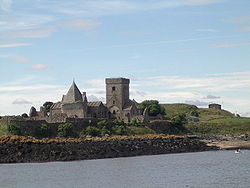 There are currently two ferry services that operate trips to Inchcolm island, and allow passengers 1.5 hours to explore the island. The Maid of the Forth http://www.maidoftheforth.co.uk/ and the Forth Belle http://www.forthtours.com/ both operate from the Hawes Pier in South Queensferry between Easter and late October.
The main feature of the island is the former Augustinian Inchcolm Abbey
(Historic Scotland
), Scotland
's most complete surviving monastic house. In former times, and perhaps partly due to its dedication to Columba
, it was sometimes nicknamed 'Iona
of the East'. The well-preserved abbey and ruins of the 9th-century hermit's cells attract visitors to the island.
It was the home of a religious community linked with St Colm or St Columba, the 6th-century Abbot of Iona
. King Alexander I was storm-bound on the island for three days in 1123 and in recognition of the shelter given to him by the hermit
s, promised to establish a monastic settlement in honour of St Columba. Though the king died before the promise could be fulfilled, his brother David I
later founded a priory
here for monks of the Augustinian order; the priory was erected into an abbey in 1223.
 The west end of the island is home to a large colony of seagulls and fulmar
s. Seals
are commonly spotted around the island and basking on neighbouring outcrops. There are no stoat
s or hedgehog
s on the island; thus, eggs can often be found on the ground.
Today the island is inhabited by two Historic Scotland
stewards who maintain the island and run the shop.
Island
An island or isle is any piece of sub-continental land that is surrounded by water. Very small islands such as emergent land features on atolls can be called islets, cays or keys. An island in a river or lake may be called an eyot , or holm...
in the Firth of Forth
Firth of Forth
The Firth of Forth is the estuary or firth of Scotland's River Forth, where it flows into the North Sea, between Fife to the north, and West Lothian, the City of Edinburgh and East Lothian to the south...
in Scotland
Scotland
Scotland is a country that is part of the United Kingdom. Occupying the northern third of the island of Great Britain, it shares a border with England to the south and is bounded by the North Sea to the east, the Atlantic Ocean to the north and west, and the North Channel and Irish Sea to the...
. Repeatedly attacked by English raiders during the Wars of Scottish Independence
Wars of Scottish Independence
The Wars of Scottish Independence were a series of military campaigns fought between the independent Kingdom of Scotland and the Kingdom of England in the late 13th and early 14th centuries....
, it was fortified during both World Wars to defend nearby Edinburgh
Edinburgh
Edinburgh is the capital city of Scotland, the second largest city in Scotland, and the eighth most populous in the United Kingdom. The City of Edinburgh Council governs one of Scotland's 32 local government council areas. The council area includes urban Edinburgh and a rural area...
. Inchcolm now attracts visitors to its former Augustinian
Canons Regular
Canons Regular are members of certain bodies of Canons living in community under the Augustinian Rule , and sharing their property in common...
Abbey.
Geography
Aberdour
Aberdour is a scenic and historic village on the south coast of Fife, Scotland. It is on the north shore of the Firth of Forth, looking south to the island of Inchcolm and its Abbey, and to Leith and Edinburgh beyond. According to the 2006 population estimate, the village has a population of...
, Fife
Fife
Fife is a council area and former county of Scotland. It is situated between the Firth of Tay and the Firth of Forth, with inland boundaries to Perth and Kinross and Clackmannanshire...
, and north of the City of Edinburgh
Edinburgh
Edinburgh is the capital city of Scotland, the second largest city in Scotland, and the eighth most populous in the United Kingdom. The City of Edinburgh Council governs one of Scotland's 32 local government council areas. The council area includes urban Edinburgh and a rural area...
. It is separated from the Fife mainland by a stretch of water known as Mortimer's Deep. The island forms part of the parish of Aberdour, and lies a quarter of a mile from the shore. In the days when people were compelled to cross the Firth of Forth
Firth of Forth
The Firth of Forth is the estuary or firth of Scotland's River Forth, where it flows into the North Sea, between Fife to the north, and West Lothian, the City of Edinburgh and East Lothian to the south...
by boat as opposed to bridge, the island was a great deal less isolated, and on the ferry routes between Leith
Leith
-South Leith v. North Leith:Up until the late 16th century Leith , comprised two separate towns on either side of the river....
/Lothian
Lothian
Lothian forms a traditional region of Scotland, lying between the southern shore of the Firth of Forth and the Lammermuir Hills....
and Fife
Fife
Fife is a council area and former county of Scotland. It is situated between the Firth of Tay and the Firth of Forth, with inland boundaries to Perth and Kinross and Clackmannanshire...
.
The island can be broadly divided into three sections: the east, where its military defensive operations were centered during the Second World War
World War II
World War II, or the Second World War , was a global conflict lasting from 1939 to 1945, involving most of the world's nations—including all of the great powers—eventually forming two opposing military alliances: the Allies and the Axis...
, the lower central part, with the small natural harbour and shop, and a larger western end.
Between Aberdour and Inchcolm is the channel called "Mortimer's Deep". It is believed that this was named after William de Mortimer.
History
Early history
Inchcolm was anciently known as Emona, Aemonia or Innis Choluim. It may have been used by the RomanRoman Empire
The Roman Empire was the post-Republican period of the ancient Roman civilization, characterised by an autocratic form of government and large territorial holdings in Europe and around the Mediterranean....
fleet in some capacity, as they had a strong presence at Cramond
Cramond
Cramond is a seaside village now part of suburban Edinburgh, Scotland, located in the north-west corner of the city at the mouth of the River Almond where it enters the Firth of Forth....
for a few years, and had to travel to the Antonine Wall
Antonine Wall
The Antonine Wall is a stone and turf fortification built by the Romans across what is now the Central Belt of Scotland, between the Firth of Forth and the Firth of Clyde. Representing the northernmost frontier barrier of the Roman Empire, it spanned approximately 39 miles and was about ten feet ...
.
It was supposedly visited by St Columba
Columba
Saint Columba —also known as Colum Cille , Colm Cille , Calum Cille and Kolban or Kolbjørn —was a Gaelic Irish missionary monk who propagated Christianity among the Picts during the Early Medieval Period...
(an Irish
Irish people
The Irish people are an ethnic group who originate in Ireland, an island in northwestern Europe. Ireland has been populated for around 9,000 years , with the Irish people's earliest ancestors recorded having legends of being descended from groups such as the Nemedians, Fomorians, Fir Bolg, Tuatha...
missionary monk) in 567, and was named after him in the 12th century. It may have served the monks of the Columban family as an "Iona
Iona
Iona is a small island in the Inner Hebrides off the western coast of Scotland. It was a centre of Irish monasticism for four centuries and is today renowned for its tranquility and natural beauty. It is a popular tourist destination and a place for retreats...
of the east" from early times. A primitive stone-roofed building survived on the island, preserved and given a vaulted roof by the monks of the later abbey, probably served as a hermit
Hermit
A hermit is a person who lives, to some degree, in seclusion from society.In Christianity, the term was originally applied to a Christian who lives the eremitic life out of a religious conviction, namely the Desert Theology of the Old Testament .In the...
's oratory
Oratory (worship)
An oratory is a Christian room for prayer, from the Latin orare, to pray.-Catholic church:In the Roman Catholic Church, an oratory is a structure other than a parish church, set aside by ecclesiastical authority for prayer and the celebration of Mass...
and cell in the 12th century, if not earlier. Fragments of carved stonework from the Dark Ages testify to an early Christian presence on the island. A hogback
Hogback (sculpture)
Hogbacks are stone carved Anglo-Scandinavian sculptures from 10th-12th century England and Scotland. Their function is generally accepted as grave markers.-Geography and description:...
stone, preserved in the abbey's visitor centre, can be dated to the late 10th century, making it probably Scotland
Scotland
Scotland is a country that is part of the United Kingdom. Occupying the northern third of the island of Great Britain, it shares a border with England to the south and is bounded by the North Sea to the east, the Atlantic Ocean to the north and west, and the North Channel and Irish Sea to the...
's earliest type of monument originating among Danish
Denmark
Denmark is a Scandinavian country in Northern Europe. The countries of Denmark and Greenland, as well as the Faroe Islands, constitute the Kingdom of Denmark . It is the southernmost of the Nordic countries, southwest of Sweden and south of Norway, and bordered to the south by Germany. Denmark...
settlers in northern England
England
England is a country that is part of the United Kingdom. It shares land borders with Scotland to the north and Wales to the west; the Irish Sea is to the north west, the Celtic Sea to the south west, with the North Sea to the east and the English Channel to the south separating it from continental...
. A 16th century source states that a stone cross was situated nearby, although no features could be found which related to the monument.
The island gets a mention in Shakespeare's
William Shakespeare
William Shakespeare was an English poet and playwright, widely regarded as the greatest writer in the English language and the world's pre-eminent dramatist. He is often called England's national poet and the "Bard of Avon"...
Macbeth
Macbeth
The Tragedy of Macbeth is a play by William Shakespeare about a regicide and its aftermath. It is Shakespeare's shortest tragedy and is believed to have been written sometime between 1603 and 1607...
-
- That now Sweno, the NorwayNorwayNorway , officially the Kingdom of Norway, is a Nordic unitary constitutional monarchy whose territory comprises the western portion of the Scandinavian Peninsula, Jan Mayen, and the Arctic archipelago of Svalbard and Bouvet Island. Norway has a total area of and a population of about 4.9 million...
es King,
- That now Sweno, the Norway
- Craves composition:
- Nor would we deigne him buriall of his men,
- Till he disbursed, at Saint Colmes ynch,
- Ten thousand Dollars, to our generall use
The reference in Shakespeare
William Shakespeare
William Shakespeare was an English poet and playwright, widely regarded as the greatest writer in the English language and the world's pre-eminent dramatist. He is often called England's national poet and the "Bard of Avon"...
is because Inchcolm was long used as an exclusive burial site (much like Iona
Iona
Iona is a small island in the Inner Hebrides off the western coast of Scotland. It was a centre of Irish monasticism for four centuries and is today renowned for its tranquility and natural beauty. It is a popular tourist destination and a place for retreats...
). A Danish
Denmark
Denmark is a Scandinavian country in Northern Europe. The countries of Denmark and Greenland, as well as the Faroe Islands, constitute the Kingdom of Denmark . It is the southernmost of the Nordic countries, southwest of Sweden and south of Norway, and bordered to the south by Germany. Denmark...
force under king Sweyn, the father of Canute
Canute the Great
Cnut the Great , also known as Canute, was a king of Denmark, England, Norway and parts of Sweden. Though after the death of his heirs within a decade of his own and the Norman conquest of England in 1066, his legacy was largely lost to history, historian Norman F...
raided the island and Fife with an English force. In the play, Macbeth
Macbeth of Scotland
Mac Bethad mac Findlaích was King of the Scots from 1040 until his death...
buys off the Danes with a "great summe of gold", and told the Danes they could bury their dead there for "ten thousand dollars". Hector Boece
Hector Boece
Hector Boece , known in Latin as Hector Boecius or Boethius, was a Scottish philosopher and first Principal of King's College in Aberdeen, a predecessor of the University of Aberdeen.-Biography:He was born in Dundee where he attended school...
corroborates the claim that the Danes paid good money to have their dead buried there in the 11th century. The practice of burying dead on islands in Scotland is long established – and was partly a deterrent to feral
Feral
A feral organism is one that has changed from being domesticated to being wild or untamed. In the case of plants it is a movement from cultivated to uncultivated or controlled to volunteer. The introduction of feral animals or plants to their non-native regions, like any introduced species, may...
dogs and wolves (still found in Scotland at that point) who might dig up the corpses and eat them.
Like other centres of Culdee
Culdee
Céli Dé or Culdees were originally members of ascetic Christian monastic and eremitical communities of Ireland, Scotland and England in the Middle Ages. The term is used of St. John the Apostle, of a missioner from abroad recorded in the Annals of the Four Masters at the year 806, and of Óengus...
activity, the island was used as a home for hermits. The nearby Inchmickery
Inchmickery
Inchmickery is a small island in the Firth of Forth in Scotland. It is about a mile north of Edinburgh.Its name comes from the Scottish Gaelic, Innis nam Bhiocaire, meaning Isle of the Vicar, implying that there may have been an old ecclesiastical or Culdee settlement here, as in nearby Inchcolm...
’s name also commemorates a probable hermit
Hermit
A hermit is a person who lives, to some degree, in seclusion from society.In Christianity, the term was originally applied to a Christian who lives the eremitic life out of a religious conviction, namely the Desert Theology of the Old Testament .In the...
. Textual evidence suggests that this was the case in the 12th century, when King Alexander I was marooned on the island, and was said to have been looked after by one in 1123. Alexander decided to make the island the site of an Augustinian monastery
Monastery
Monastery denotes the building, or complex of buildings, that houses a room reserved for prayer as well as the domestic quarters and workplace of monastics, whether monks or nuns, and whether living in community or alone .Monasteries may vary greatly in size – a small dwelling accommodating only...
. The earliest known charter is in 1162, when the canons were already well established, and it was raised to the status of an abbey in 1235. Its buildings, including a widely visible square tower, largely ruined church, cloister
Cloister
A cloister is a rectangular open space surrounded by covered walks or open galleries, with open arcades on the inner side, running along the walls of buildings and forming a quadrangle or garth...
s, refectory and small chapter house
Chapter house
A chapter house or chapterhouse is a building or room attached to a cathedral or collegiate church in which meetings are held. They can also be found in medieval monasteries....
, are the best-preserved of any Scottish medieval monastic house. The ruins are under the care of Historic Scotland
Historic Scotland
Historic Scotland is an executive agency of the Scottish Government, responsible for historic monuments in Scotland.-Role:As its website states:...
(entrance charge; ferry from South Queensferry
South Queensferry
South Queensferry , also called Queensferry, is a former Royal Burgh in West Lothian now part of the City of Edinburgh, Scotland. It is located some ten miles to the north west of the city centre, on the shore of the Firth of Forth between the Forth Bridge and the Forth Road Bridge, approximately 8...
).
Walter Bower
Walter Bower
Walter Bower , Scottish chronicler, was born about 1385 at Haddington, East Lothian.He was abbot of Inchcolm Abbey from 1418, was one of the commissioners for the collection of the ransom of James I, King of Scots, in 1423 and 1424, and in 1433 one of the embassy to Paris on the business of the...
, Abbot 1418-49, was the author of the Latin
Latin
Latin is an Italic language originally spoken in Latium and Ancient Rome. It, along with most European languages, is a descendant of the ancient Proto-Indo-European language. Although it is considered a dead language, a number of scholars and members of the Christian clergy speak it fluently, and...
Scotichronicon
Scotichronicon
The Scotichronicon is a 15th-century chronicle or legendary account, by the Scottish historian Walter Bower. It is a continuation of historian-priest John of Fordun's earlier work Chronica Gentis Scotorum beginning with the founding of Scotland of mediaeval legend, by Scota with Goídel...
, one of Scotland
Scotland
Scotland is a country that is part of the United Kingdom. Occupying the northern third of the island of Great Britain, it shares a border with England to the south and is bounded by the North Sea to the east, the Atlantic Ocean to the north and west, and the North Channel and Irish Sea to the...
's most important medieval historical sources. The island was part of the medieval diocese of Dunkeld
Dunkeld
Dunkeld is a small town in Strathtay, Perth and Kinross, Scotland. It is about 15 miles north of Perth on the eastern side of the A9 road into the Scottish Highlands and on the opposite side of the Tay from the Victorian village of Birnam. Dunkeld and Birnam share a railway station, on the...
(also dedicated to St Columba
Columba
Saint Columba —also known as Colum Cille , Colm Cille , Calum Cille and Kolban or Kolbjørn —was a Gaelic Irish missionary monk who propagated Christianity among the Picts during the Early Medieval Period...
), and several of the medieval bishops were buried within the Abbey church.
English raids
Like nearby InchkeithInchkeith
Inchkeith is an island in the Firth of Forth, Scotland. It is part of the council area of Fife.Inchkeith has had a colourful history as a result of its proximity to Edinburgh and strategic location for use as home for a lighthouse and for military purposes defending the Firth of Forth for attack...
and the Isle of May
Isle of May
The Isle of May is located in the north of the outer Firth of Forth, approximately off the coast of mainland Scotland. It is 1.8 km long and less than half a kilometre wide...
, Inchcolm was attacked repeatedly by English
England
England is a country that is part of the United Kingdom. It shares land borders with Scotland to the north and Wales to the west; the Irish Sea is to the north west, the Celtic Sea to the south west, with the North Sea to the east and the English Channel to the south separating it from continental...
raiders in the 14th century. This was the period of the Scottish Wars of Independence
Wars of Scottish Independence
The Wars of Scottish Independence were a series of military campaigns fought between the independent Kingdom of Scotland and the Kingdom of England in the late 13th and early 14th centuries....
were in full swing, and decisive battles were being fought in the Lothian
Lothian
Lothian forms a traditional region of Scotland, lying between the southern shore of the Firth of Forth and the Lammermuir Hills....
s and in the Stirling
Stirling
Stirling is a city and former ancient burgh in Scotland, and is at the heart of the wider Stirling council area. The city is clustered around a large fortress and medieval old-town beside the River Forth...
/Bannockburn
Bannockburn
Bannockburn is a village immediately south of the city of Stirling in Scotland. It is named after the Bannock Burn, a burn running through the village before flowing into the River Forth.-History:...
region, and so the island was effectively in the route of any supply or raiding vessels.
In 1335, there was an especially bad raid by an English ship when the abbey’s treasures were stolen, along with a statue of Columba. The story goes that the ship was nearly wrecked on Inchkeith
Inchkeith
Inchkeith is an island in the Firth of Forth, Scotland. It is part of the council area of Fife.Inchkeith has had a colourful history as a result of its proximity to Edinburgh and strategic location for use as home for a lighthouse and for military purposes defending the Firth of Forth for attack...
and had to dock at Kinghorn
Kinghorn
Kinghorn is a town in Fife, Scotland. A seaside resort with two beaches, Kinghorn Beach and Pettycur Bay, plus a fishing port, it stands on the north shore of the Firth of Forth opposite Edinburgh...
. The sailors taking a religious turn, thought that this was due to the wrath of Columba, and returned the statue and treasures to the island, and experienced good weather on their outward journey.
In 1384, an English raid attempted to set alight Inchcolm Abbey, but this again was foiled by the weather – in this case a strong wind blew out the flames.
Later Middle Ages and early modern period
In the 16th century, the island suffered further English depredation. In 1547, after the Battle of Pinkie CleughBattle of Pinkie Cleugh
The Battle of Pinkie Cleugh, on the banks of the River Esk near Musselburgh, Scotland on 10 September 1547, was part of the War of the Rough Wooing. It was the last pitched battle between Scottish and English armies, and is seen as the first modern battle in the British Isles...
, Inchcolm was fortified by the English, like nearby Inchgarvie
Inchgarvie
Inchgarvie is a small, uninhabited island in the Firth of Forth. Its name comes from Innis Garbhach which is Scottish Gaelic for "rough island"...
- while Inchkeith
Inchkeith
Inchkeith is an island in the Firth of Forth, Scotland. It is part of the council area of Fife.Inchkeith has had a colourful history as a result of its proximity to Edinburgh and strategic location for use as home for a lighthouse and for military purposes defending the Firth of Forth for attack...
was occupied by their Italian
Italy
Italy , officially the Italian Republic languages]] under the European Charter for Regional or Minority Languages. In each of these, Italy's official name is as follows:;;;;;;;;), is a unitary parliamentary republic in South-Central Europe. To the north it borders France, Switzerland, Austria and...
mercenaries
Mercenary
A mercenary, is a person who takes part in an armed conflict based on the promise of material compensation rather than having a direct interest in, or a legal obligation to, the conflict itself. A non-conscript professional member of a regular army is not considered to be a mercenary although he...
for two years. Sir John Luttrell
John Luttrell (soldier)
Sir John Luttrell was an English soldier, diplomat, and courtier under Henry VIII and Edward VI. He served under Edward Seymour, Earl of Hertford in Scotland and France...
garrisoned the island with 100 hagbutters
Arquebus
The arquebus , or "hook tube", is an early muzzle-loaded firearm used in the 15th to 17th centuries. The word was originally modeled on the German hakenbüchse; this produced haquebute...
and 50 labourers on Saturday 17 September 1547. Early in October 1547, the Earl of Angus
Archibald Douglas, 6th Earl of Angus
Archibald Douglas, 6th Earl of Angus was a Scottish nobleman active during the reigns of James V and Mary, Queen of Scots...
attempted to recapture the island with five ships. An inventory of 8 January 1548
Inventory of Henry VIII of England
The Inventory of Henry VIII of England compiled in 1547 is a list of the possessions of the crown, now in the British Library as Harley Ms. 1419....
lists the English armaments on the island as; one culverin
Culverin
A culverin was a relatively simple ancestor of the musket, and later a medieval cannon, adapted for use by the French in the 15th century, and later adapted for naval use by the English in the late 16th century. The culverin was used to bombard targets from a distance. The weapon had a...
; one demi-culverin; 3 iron sakers
Saker (cannon)
The saker was a medium cannon slightly smaller than a culverin developed during the early 16th century and often used by the English. It was named after the Saker Falcon, a large falconry bird native to the Middle East....
; a brass saker; 2 iron falcons
Falconet (cannon)
The falconet or falcon was a light cannon developed in the late 15th century. During the Middle Ages guns were decorated with engravings of reptiles, birds or beasts depending on their size. For example, a culverin would often feature snakes, as the handles on the early cannons were often decorated...
; 3 brass falcons; 4 fowlers
Veuglaire
The Veuglaire was a wrought iron cannon, and part of the artillery of France in the Middle Ages...
; 2 port pieces; 14 bases
Breech-loading swivel gun
A breech-loading swivel gun was a particular type of swivel gun and a small breech-loading cannon invented in the 14th century. It was equipped with a swivel for easy rotation and was loaded by inserting a mug-shaped device called a chamber, pre-filled with gunpowder and projectiles...
; 90 arquebus
Arquebus
The arquebus , or "hook tube", is an early muzzle-loaded firearm used in the 15th to 17th centuries. The word was originally modeled on the German hakenbüchse; this produced haquebute...
es, 2 chests of bows; 50 pikes
Pike (weapon)
A pike is a pole weapon, a very long thrusting spear used extensively by infantry both for attacks on enemy foot soldiers and as a counter-measure against cavalry assaults. Unlike many similar weapons, the pike is not intended to be thrown. Pikes were used regularly in European warfare from the...
; and 40 bills
Bill (weapon)
The bill is a polearm weapon used by infantry in medieval Europe.The bill is similar in size, function and appearance to the halberd, differing mainly in the hooked blade form...
. The English commander, John Luttrell, abandoned the island and destroyed the fortifications he had made at the end of April 1548.
The island was also used as a kind of prison. Amongst those interned here were, Archbishop Patrick Graham of St Andrews
St Andrews
St Andrews is a university town and former royal burgh on the east coast of Fife in Scotland. The town is named after Saint Andrew the Apostle.St Andrews has a population of 16,680, making this the fifth largest settlement in Fife....
, along with Euphemia/Affrica (Oighrig), mother of Alexander, Lord of the Isles
Alexander of Islay, Earl of Ross
Alexander of Islay or Alexander MacDonald was a medieval Scottish nobleman, who succeeded his father Domhnall of Islay as Lord of the Isles and rose to the rank of Earl of Ross...
.
Due to their island location, Inchcolm’s religious buildings are in better condition than most of those on the mainland as they could not be so easily destroyed by the "rascally mob" of proactive Reformers
Protestant Reformation
The Protestant Reformation was a 16th-century split within Western Christianity initiated by Martin Luther, John Calvin and other early Protestants. The efforts of the self-described "reformers", who objected to the doctrines, rituals and ecclesiastical structure of the Roman Catholic Church, led...
.
In the 16th century it became the property of Sir
Sir
Sir is an honorific used as a title , or as a courtesy title to address a man without using his given or family name in many English speaking cultures...
James Stewart
James Stewart, 1st Earl of Moray
James Stewart, 1st Earl of Moray , a member of the House of Stewart as the illegitimate son of King James V, was Regent of Scotland for his nephew, the infant King James VI of Scotland, from 1567 until his assassination in 1570...
, whose grandson became third Earl of Moray
Earl of Moray
The title Earl of Moray has been created several times in the Peerage of Scotland.Prior to the formal establishment of the peerage, Earl of Moray, numerous individuals ruled the kingdom of Moray or Mormaer of Moray until 1130 when the kingdom was destroyed by David I of Scotland.-History of the...
by virtue of his marriage to the elder daughter of the first earl
James Stewart, 1st Earl of Moray
James Stewart, 1st Earl of Moray , a member of the House of Stewart as the illegitimate son of King James V, was Regent of Scotland for his nephew, the infant King James VI of Scotland, from 1567 until his assassination in 1570...
. From it comes the earl's title of Lord St Colme (1611).
In the 1880s, a skeleton was found built into one of the abbey’s walls. It was standing upright and is of unknown date.
Military defences
During both the First World WarWorld War I
World War I , which was predominantly called the World War or the Great War from its occurrence until 1939, and the First World War or World War I thereafter, was a major war centred in Europe that began on 28 July 1914 and lasted until 11 November 1918...
and the Second World War
World War II
World War II, or the Second World War , was a global conflict lasting from 1939 to 1945, involving most of the world's nations—including all of the great powers—eventually forming two opposing military alliances: the Allies and the Axis...
, Inchcolm was fortified, like many of the other islands of the Forth in order to defend Edinburgh
Edinburgh
Edinburgh is the capital city of Scotland, the second largest city in Scotland, and the eighth most populous in the United Kingdom. The City of Edinburgh Council governs one of Scotland's 32 local government council areas. The council area includes urban Edinburgh and a rural area...
-Leith
Leith
-South Leith v. North Leith:Up until the late 16th century Leith , comprised two separate towns on either side of the river....
and the naval base at Rosyth
Rosyth
Rosyth is a town located on the Firth of Forth, three miles south of the centre of Dunfermline. According to an estimate taken in 2008, the town has a population of 12,790....
. In addition to the battery of guns, 576 Cornwall Works Company, Royal Engineers
Royal Engineers
The Corps of Royal Engineers, usually just called the Royal Engineers , and commonly known as the Sappers, is one of the corps of the British Army....
, built a tunnel under the hill at the east end of the island. The tunnel is dated 1916-17. The remains of a NAAFI still remain, and are used as a small shop by Historic Scotland
Historic Scotland
Historic Scotland is an executive agency of the Scottish Government, responsible for historic monuments in Scotland.-Role:As its website states:...
.
Tourist attraction
The main feature of the island is the former Augustinian Inchcolm Abbey
Inchcolm Abbey
Inchcolm Abbey is a medieval abbey located on the island of Inchcolm in the Firth of Forth in Scotland. The Abbey, which is located at the centre of the island, was founded in the 12th century during the episcopate of Gregoir, Bishop of Dunkeld. Later tradition placed it back in the reign of King...
(Historic Scotland
Historic Scotland
Historic Scotland is an executive agency of the Scottish Government, responsible for historic monuments in Scotland.-Role:As its website states:...
), Scotland
Scotland
Scotland is a country that is part of the United Kingdom. Occupying the northern third of the island of Great Britain, it shares a border with England to the south and is bounded by the North Sea to the east, the Atlantic Ocean to the north and west, and the North Channel and Irish Sea to the...
's most complete surviving monastic house. In former times, and perhaps partly due to its dedication to Columba
Columba
Saint Columba —also known as Colum Cille , Colm Cille , Calum Cille and Kolban or Kolbjørn —was a Gaelic Irish missionary monk who propagated Christianity among the Picts during the Early Medieval Period...
, it was sometimes nicknamed 'Iona
Iona
Iona is a small island in the Inner Hebrides off the western coast of Scotland. It was a centre of Irish monasticism for four centuries and is today renowned for its tranquility and natural beauty. It is a popular tourist destination and a place for retreats...
of the East'. The well-preserved abbey and ruins of the 9th-century hermit's cells attract visitors to the island.
It was the home of a religious community linked with St Colm or St Columba, the 6th-century Abbot of Iona
Abbot of Iona
The Abbot of Iona was the head of Iona Abbey during the Middle Ages and the leader of the monastic community of Iona, as well as the overlord of scores of monasteries in both Scotland and Ireland, including Durrow, Kells and, for a time, Lindisfarne...
. King Alexander I was storm-bound on the island for three days in 1123 and in recognition of the shelter given to him by the hermit
Hermit
A hermit is a person who lives, to some degree, in seclusion from society.In Christianity, the term was originally applied to a Christian who lives the eremitic life out of a religious conviction, namely the Desert Theology of the Old Testament .In the...
s, promised to establish a monastic settlement in honour of St Columba. Though the king died before the promise could be fulfilled, his brother David I
David I of Scotland
David I or Dabíd mac Maíl Choluim was a 12th-century ruler who was Prince of the Cumbrians and later King of the Scots...
later founded a priory
Priory
A priory is a house of men or women under religious vows that is headed by a prior or prioress. Priories may be houses of mendicant friars or religious sisters , or monasteries of monks or nuns .The Benedictines and their offshoots , the Premonstratensians, and the...
here for monks of the Augustinian order; the priory was erected into an abbey in 1223.
Wildlife
Fulmar
Fulmars are seabirds of the family Procellariidae. The family consists of two extant species and two that are extinct.-Taxonomy:As members of Procellaridae and then the order Procellariiformes, they share certain traits. First, they have nasal passages that attach to the upper bill called...
s. Seals
Pinniped
Pinnipeds or fin-footed mammals are a widely distributed and diverse group of semiaquatic marine mammals comprising the families Odobenidae , Otariidae , and Phocidae .-Overview: Pinnipeds are typically sleek-bodied and barrel-shaped...
are commonly spotted around the island and basking on neighbouring outcrops. There are no stoat
Stoat
The stoat , also known as the ermine or short-tailed weasel, is a species of Mustelid native to Eurasia and North America, distinguished from the least weasel by its larger size and longer tail with a prominent black tip...
s or hedgehog
Hedgehog
A hedgehog is any of the spiny mammals of the subfamily Erinaceinae and the order Erinaceomorpha. There are 17 species of hedgehog in five genera, found through parts of Europe, Asia, Africa, and New Zealand . There are no hedgehogs native to Australia, and no living species native to the Americas...
s on the island; thus, eggs can often be found on the ground.
Today the island is inhabited by two Historic Scotland
Historic Scotland
Historic Scotland is an executive agency of the Scottish Government, responsible for historic monuments in Scotland.-Role:As its website states:...
stewards who maintain the island and run the shop.
External links
- RCAHMS - The Royal Commission on the Ancient and Historical Monuments and Constructions of Scotland
- Cyberscotia's page on the island - Includes maps, drawings, and photographs
- Report of overnight stay on the island