

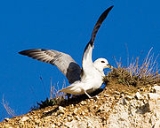
Fulmar

Encyclopedia
Fulmars are seabird
s of the family
Procellariidae
. The family consists of two extant species
and two that are extinct.
Procellariiformes
, they share certain traits. First, they have nasal passages that attach to the upper bill called naricorns. Although the nostrils on the Albatross are on the sides of the bill. The bills of Procellariiformes are also unique in that they are split into between 7 and 9 horny plates. Finally, they produce a stomach oil made up of wax ester
s and triglycerides that is stored in the proventriculus
. This is used against predators as well as an energy rich food source for chicks and for the adults during their long flights. It will matt the plumage
of avian predators, and can lead to their death. They also have a salt gland that is situated above the nasal passage and helps desalinate their bodies, due to the high amount of ocean water that they imbibe. It excretes a high saline solution from their nose.
Two prehistoric species have been described from fossil
bones found on the Pacific coast of California
: Fulmarus miocaenus from the Middle and Fulmarus hammeri from the Late Miocene
.
word full meaning foul, and mar meaning gull. This foul-gull is in reference to their stomach oil.
s occupying the same niche in different oceans. The Northern Fulmar
(Fulmarus glacialis) or just Fulmar lives in the north Atlantic and north Pacific, whereas the Southern Fulmar
, (Fulmarus glacialoides) is, as its name implies, a bird of the southern oceans. These birds look superficially like gull
s, but are unrelated, and are in fact petrel
s. The northern species
is grey and white with a yellow bill, 43 to 52 cm (16.9 to 20.5 in) in length with a 102 to 112 cm (40.2 to 44.1 in) wingspan. The southern form is a paler bird with dark wing
tips, 45 to 50 cm (17.7 to 19.7 in) long, with a 115 to 120 cm (45.3 to 47.2 in) wingspan.
. Unlike many small to medium birds in the Procellariiformes
, they are neither nocturnal breeders, nor do they use burrow
s; their eggs are laid on the bare rock or in shallow depressions lined with plant material.
In Britain, Northern Fulmars historically bred on St. Kilda, and spread into northern Scotland
in the 19th century, and to the rest of the United Kingdom
by 1930. For example, establishment of colonies at the Fowlsheugh Reserve in Scotland was one of the first areas to be developed for new permanent Fulmar breeding areas.
The expansion has continued further South; the Fulmar can now often be seen in the English Channel and in France along the Northern and Western coasts, with breeding pairs or small colonies in Nord, Picardy, Normandy and along the Atlantic coast in Brittany.
, feeding on fish
, oil or offal
. Recent studies in the North Sea
have shown them especially susceptible to plastic
discards. The range of these species increased greatly last century due to the availability of fish offal from commercial fleets, but may contract because of less food from this source and climatic change. The population increase has been especially notable in the British Isles
.
Like other petrels, their walking ability is limited, but they are strong fliers, with a stiff wing
action quite unlike the gulls. They look bull-necked compared to gulls, and have short stubby bills. They are long-lived, with a lifespan of 40 years not uncommon.
Seabird
Seabirds are birds that have adapted to life within the marine environment. While seabirds vary greatly in lifestyle, behaviour and physiology, they often exhibit striking convergent evolution, as the same environmental problems and feeding niches have resulted in similar adaptations...
s of the family
Family (biology)
In biological classification, family is* a taxonomic rank. Other well-known ranks are life, domain, kingdom, phylum, class, order, genus, and species, with family fitting between order and genus. As for the other well-known ranks, there is the option of an immediately lower rank, indicated by the...
Procellariidae
Procellariidae
The family Procellariidae is a group of seabirds that comprises the fulmarine petrels, the gadfly petrels, the prions, and the shearwaters. This family is part of the bird order Procellariiformes , which also includes the albatrosses, the storm-petrels, and the diving petrels.The procellariids are...
. The family consists of two extant species
Species
In biology, a species is one of the basic units of biological classification and a taxonomic rank. A species is often defined as a group of organisms capable of interbreeding and producing fertile offspring. While in many cases this definition is adequate, more precise or differing measures are...
and two that are extinct.
Taxonomy
As members of Procellaridae and then the orderOrder (biology)
In scientific classification used in biology, the order is# a taxonomic rank used in the classification of organisms. Other well-known ranks are life, domain, kingdom, phylum, class, family, genus, and species, with order fitting in between class and family...
Procellariiformes
Procellariiformes
Procellariiformes is an order of seabirds that comprises four families: the albatrosses, petrels and shearwaters, storm petrels, and diving petrels...
, they share certain traits. First, they have nasal passages that attach to the upper bill called naricorns. Although the nostrils on the Albatross are on the sides of the bill. The bills of Procellariiformes are also unique in that they are split into between 7 and 9 horny plates. Finally, they produce a stomach oil made up of wax ester
Wax ester
An ester of a fatty acid and a long-chain alcohol. These oils have similar properties as triglycerides, but are indigestible. They are found in some fish such as orange roughy, oilfish, escolar, black oreo, smooth oreo and other deep water fish. They are also present in marine copepods. Wax...
s and triglycerides that is stored in the proventriculus
Proventriculus
The proventriculus is part of the digestive system of birds, invertebrates and insects.-Birds:The proventriculus is a standard part of avian anatomy...
. This is used against predators as well as an energy rich food source for chicks and for the adults during their long flights. It will matt the plumage
Plumage
Plumage refers both to the layer of feathers that cover a bird and the pattern, colour, and arrangement of those feathers. The pattern and colours of plumage vary between species and subspecies and can also vary between different age classes, sexes, and season. Within species there can also be a...
of avian predators, and can lead to their death. They also have a salt gland that is situated above the nasal passage and helps desalinate their bodies, due to the high amount of ocean water that they imbibe. It excretes a high saline solution from their nose.
Two prehistoric species have been described from fossil
Fossil
Fossils are the preserved remains or traces of animals , plants, and other organisms from the remote past...
bones found on the Pacific coast of California
California
California is a state located on the West Coast of the United States. It is by far the most populous U.S. state, and the third-largest by land area...
: Fulmarus miocaenus from the Middle and Fulmarus hammeri from the Late Miocene
Miocene
The Miocene is a geological epoch of the Neogene Period and extends from about . The Miocene was named by Sir Charles Lyell. Its name comes from the Greek words and and means "less recent" because it has 18% fewer modern sea invertebrates than the Pliocene. The Miocene follows the Oligocene...
.
Etymology
The genus name Fulmarus is derived from the Old NorseOld Norse
Old Norse is a North Germanic language that was spoken by inhabitants of Scandinavia and inhabitants of their overseas settlements during the Viking Age, until about 1300....
word full meaning foul, and mar meaning gull. This foul-gull is in reference to their stomach oil.
Description
The two Fulmars are closely related seabirdSeabird
Seabirds are birds that have adapted to life within the marine environment. While seabirds vary greatly in lifestyle, behaviour and physiology, they often exhibit striking convergent evolution, as the same environmental problems and feeding niches have resulted in similar adaptations...
s occupying the same niche in different oceans. The Northern Fulmar
Northern Fulmar
The Northern Fulmar, Fulmarus glacialis, Fulmar, or Arctic Fulmar is a highly abundant sea bird found primarily in subarctic regions of the north Atlantic and north Pacific oceans. Fulmars come in one of two color morphs: a light one which is almost entirely white, and a dark one which is...
(Fulmarus glacialis) or just Fulmar lives in the north Atlantic and north Pacific, whereas the Southern Fulmar
Southern Fulmar
The Southern Fulmar, Fulmarus glacialoides, is a seabird of the Southern Hemisphere. Along with the Northern Fulmar, F. glacialis, it belongs to the fulmar genus Fulmarus in the family Procellariidae, the true petrels...
, (Fulmarus glacialoides) is, as its name implies, a bird of the southern oceans. These birds look superficially like gull
Gull
Gulls are birds in the family Laridae. They are most closely related to the terns and only distantly related to auks, skimmers, and more distantly to the waders...
s, but are unrelated, and are in fact petrel
Petrel
Petrels are tube-nosed seabirds in the bird order Procellariiformes. The common name does not indicate relationship beyond that point, as "petrels" occur in three of the four families within that group...
s. The northern species
Species
In biology, a species is one of the basic units of biological classification and a taxonomic rank. A species is often defined as a group of organisms capable of interbreeding and producing fertile offspring. While in many cases this definition is adequate, more precise or differing measures are...
is grey and white with a yellow bill, 43 to 52 cm (16.9 to 20.5 in) in length with a 102 to 112 cm (40.2 to 44.1 in) wingspan. The southern form is a paler bird with dark wing
Wing
A wing is an appendage with a surface that produces lift for flight or propulsion through the atmosphere, or through another gaseous or liquid fluid...
tips, 45 to 50 cm (17.7 to 19.7 in) long, with a 115 to 120 cm (45.3 to 47.2 in) wingspan.
Breeding
Both recent species breed on cliffs, laying a single white eggEgg (biology)
An egg is an organic vessel in which an embryo first begins to develop. In most birds, reptiles, insects, molluscs, fish, and monotremes, an egg is the zygote, resulting from fertilization of the ovum, which is expelled from the body and permitted to develop outside the body until the developing...
. Unlike many small to medium birds in the Procellariiformes
Procellariiformes
Procellariiformes is an order of seabirds that comprises four families: the albatrosses, petrels and shearwaters, storm petrels, and diving petrels...
, they are neither nocturnal breeders, nor do they use burrow
Burrow
A burrow is a hole or tunnel dug into the ground by an animal to create a space suitable for habitation, temporary refuge, or as a byproduct of locomotion. Burrows provide a form of shelter against predation and exposure to the elements, so the burrowing way of life is quite popular among the...
s; their eggs are laid on the bare rock or in shallow depressions lined with plant material.
In Britain, Northern Fulmars historically bred on St. Kilda, and spread into northern Scotland
Scotland
Scotland is a country that is part of the United Kingdom. Occupying the northern third of the island of Great Britain, it shares a border with England to the south and is bounded by the North Sea to the east, the Atlantic Ocean to the north and west, and the North Channel and Irish Sea to the...
in the 19th century, and to the rest of the United Kingdom
United Kingdom
The United Kingdom of Great Britain and Northern IrelandIn the United Kingdom and Dependencies, other languages have been officially recognised as legitimate autochthonous languages under the European Charter for Regional or Minority Languages...
by 1930. For example, establishment of colonies at the Fowlsheugh Reserve in Scotland was one of the first areas to be developed for new permanent Fulmar breeding areas.
The expansion has continued further South; the Fulmar can now often be seen in the English Channel and in France along the Northern and Western coasts, with breeding pairs or small colonies in Nord, Picardy, Normandy and along the Atlantic coast in Brittany.
Feeding
They are highly pelagic outside the breeding season, like most tubenosesProcellariiformes
Procellariiformes is an order of seabirds that comprises four families: the albatrosses, petrels and shearwaters, storm petrels, and diving petrels...
, feeding on fish
Fish
Fish are a paraphyletic group of organisms that consist of all gill-bearing aquatic vertebrate animals that lack limbs with digits. Included in this definition are the living hagfish, lampreys, and cartilaginous and bony fish, as well as various extinct related groups...
, oil or offal
Offal
Offal , also called, especially in the United States, variety meats or organ meats, refers to the internal organs and entrails of a butchered animal. The word does not refer to a particular list of edible organs, which varies by culture and region, but includes most internal organs other than...
. Recent studies in the North Sea
North Sea
In the southwest, beyond the Straits of Dover, the North Sea becomes the English Channel connecting to the Atlantic Ocean. In the east, it connects to the Baltic Sea via the Skagerrak and Kattegat, narrow straits that separate Denmark from Norway and Sweden respectively...
have shown them especially susceptible to plastic
Plastic
A plastic material is any of a wide range of synthetic or semi-synthetic organic solids used in the manufacture of industrial products. Plastics are typically polymers of high molecular mass, and may contain other substances to improve performance and/or reduce production costs...
discards. The range of these species increased greatly last century due to the availability of fish offal from commercial fleets, but may contract because of less food from this source and climatic change. The population increase has been especially notable in the British Isles
British Isles
The British Isles are a group of islands off the northwest coast of continental Europe that include the islands of Great Britain and Ireland and over six thousand smaller isles. There are two sovereign states located on the islands: the United Kingdom of Great Britain and Northern Ireland and...
.
Like other petrels, their walking ability is limited, but they are strong fliers, with a stiff wing
Wing
A wing is an appendage with a surface that produces lift for flight or propulsion through the atmosphere, or through another gaseous or liquid fluid...
action quite unlike the gulls. They look bull-necked compared to gulls, and have short stubby bills. They are long-lived, with a lifespan of 40 years not uncommon.
External links
- BTO BirdFacts - Fulmar
- Fulmar videos on the Internet Bird Collection