


Alborz

Encyclopedia
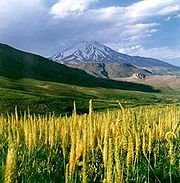
Mountain range
A mountain range is a single, large mass consisting of a succession of mountains or narrowly spaced mountain ridges, with or without peaks, closely related in position, direction, formation, and age; a component part of a mountain system or of a mountain chain...
in northern Iran
Iran
Iran , officially the Islamic Republic of Iran , is a country in Southern and Western Asia. The name "Iran" has been in use natively since the Sassanian era and came into use internationally in 1935, before which the country was known to the Western world as Persia...
stretching from the borders of Azerbaijan
Azerbaijan
Azerbaijan , officially the Republic of Azerbaijan is the largest country in the Caucasus region of Eurasia. Located at the crossroads of Western Asia and Eastern Europe, it is bounded by the Caspian Sea to the east, Russia to the north, Georgia to the northwest, Armenia to the west, and Iran to...
and Armenia
Armenia
Armenia , officially the Republic of Armenia , is a landlocked mountainous country in the Caucasus region of Eurasia...
in the northwest to the southern end of the Caspian Sea
Caspian Sea
The Caspian Sea is the largest enclosed body of water on Earth by area, variously classed as the world's largest lake or a full-fledged sea. The sea has a surface area of and a volume of...
, and ending in the east at the borders of Turkmenistan
Turkmenistan
Turkmenistan , formerly also known as Turkmenia is one of the Turkic states in Central Asia. Until 1991, it was a constituent republic of the Soviet Union, the Turkmen Soviet Socialist Republic . Turkmenistan is one of the six independent Turkic states...
and Afghanistan
Afghanistan
Afghanistan , officially the Islamic Republic of Afghanistan, is a landlocked country located in the centre of Asia, forming South Asia, Central Asia and the Middle East. With a population of about 29 million, it has an area of , making it the 42nd most populous and 41st largest nation in the world...
. The tallest mountain in West Asia, Mount Damavand
Mount Damavand
Mount Damāvand also known as Donbavand, a potentially active volcano and the highest peak in Iran, has a special place in Persian mythology and folklore...
,Amol
Amol
Amol is a city in and the capital of Amol County, Mazandaran Province, Iran. At the 2006 census, its population was 197,470, in 55,183 families.Amol and the old part of town is the first of the four towns that populate the world in which there is Nzamyh...
is located in the range.
The Alborz mountain range forms a barrier between the south Caspian and the Qazvin-Tehran plateau. It is only 60–130 km wide and consists of sedimentary series dating from Upper Devonian
Devonian
The Devonian is a geologic period and system of the Paleozoic Era spanning from the end of the Silurian Period, about 416.0 ± 2.8 Mya , to the beginning of the Carboniferous Period, about 359.2 ± 2.5 Mya...
to Oligocene
Oligocene
The Oligocene is a geologic epoch of the Paleogene Period and extends from about 34 million to 23 million years before the present . As with other older geologic periods, the rock beds that define the period are well identified but the exact dates of the start and end of the period are slightly...
, prevalently Jurassic
Jurassic
The Jurassic is a geologic period and system that extends from about Mya to Mya, that is, from the end of the Triassic to the beginning of the Cretaceous. The Jurassic constitutes the middle period of the Mesozoic era, also known as the age of reptiles. The start of the period is marked by...
limestone
Limestone
Limestone is a sedimentary rock composed largely of the minerals calcite and aragonite, which are different crystal forms of calcium carbonate . Many limestones are composed from skeletal fragments of marine organisms such as coral or foraminifera....
over a granite
Granite
Granite is a common and widely occurring type of intrusive, felsic, igneous rock. Granite usually has a medium- to coarse-grained texture. Occasionally some individual crystals are larger than the groundmass, in which case the texture is known as porphyritic. A granitic rock with a porphyritic...
core. Its higher elevations, in the Elburz Range forest steppe
Elburz Range forest steppe
The Elburz Range forest steppe ecoregion is an arid, mountainous 1,000-kilometer arc south of the Caspian Sea, stretching across northern Iran from the Azerbaijan border to near the Turkmenistan border. It covers and encompasses the southern and eastern slopes of the Alborz Mountains as well as...
ecoregion, are arid with few trees, but its northern slopes, in the Caspian Hyrcanian mixed forests
Caspian Hyrcanian mixed forests
The Caspian Hyrcanian Mixed Forests ecoregion, in the temperate broadleaf and mixed forests biome, is an area of lush lowland and montane forests covering about near the southern shores of the Caspian Sea of Azerbaijan and Iran.-Setting:...
ecoregion, are lush and forested.
Zoroastrians
Zoroastrianism
Zoroastrianism is a religion and philosophy based on the teachings of prophet Zoroaster and was formerly among the world's largest religions. It was probably founded some time before the 6th century BCE in Greater Iran.In Zoroastrianism, the Creator Ahura Mazda is all good, and no evil...
may identify the range with the dwelling place of the Peshyotan, and the Zoroastrian Ilm-e-Kshnoom
Ilm-e-Kshnoom
Ilm-e-Khshnoom is a school of Zoroastrian philosophy, practiced by a very small minority of the Indian Zoroastrians , based on a mystic and esoteric, rather than literal, interpretation of religious texts.-Principal belief:At the core of the philosophy is the belief that faith facilitates a...
sect identify Mount Davamand as the home of the Saheb-e-Dilan ('Masters of the Heart'). In his epic Shahnameh
Shahnameh
The Shahnameh or Shah-nama is a long epic poem written by the Persian poet Ferdowsi between c.977 and 1010 AD and is the national epic of Iran and related societies...
, the poet Ferdowsi
Ferdowsi
Ferdowsi was a highly revered Persian poet. He was the author of the Shahnameh, the national epic of Iran and related societies.The Shahnameh was originally composed by Ferdowsi for the princes of the Samanid dynasty, who were responsible for a revival of Persian cultural traditions after the...
speaks of the mountains "as though they lay in India." This could reflect older usage, for numerous high peaks were given the name and some even reflect it to this day, for example, Mount Elbrus
Mount Elbrus
Mount Elbrus is an inactive volcano located in the western Caucasus mountain range, in Kabardino-Balkaria and Karachay-Cherkessia, Russia, near the border of Georgia. Mt. Elbrus's peak is the highest in the Caucasus, in Russia...
in the Caucasus Mountains
Caucasus Mountains
The Caucasus Mountains is a mountain system in Eurasia between the Black Sea and the Caspian Sea in the Caucasus region .The Caucasus Mountains includes:* the Greater Caucasus Mountain Range and* the Lesser Caucasus Mountains....
, and Mount Elbariz (Albariz, Jebal Barez
Jebal Barez
The Jebal Barez are a mountain chain in the Kerman Province of Iran.They stretch for some 100 km north-west to south-east, parallel to the Halil Rud, to the north-east of Jiroft and to the south-west of Bam, rising to a maximal elevation of 3,400 m....
) in the Kirman area above the Straits of Hormuz. As recently as the 19th century, a peak in the northernmost range in the Hindu Kush
Hindu Kush
The Hindu Kush is an mountain range that stretches between central Afghanistan and northern Pakistan. The highest point in the Hindu Kush is Tirich Mir in the Chitral region of Khyber-Pakhtunkhwa, Pakistan.It is the westernmost extension of the Pamir Mountains, the Karakoram Range, and is a...
system, just south of Balkh
Balkh
Balkh , was an ancient city and centre of Zoroastrianism in what is now northern Afghanistan. Today it is a small town in the province of Balkh, about 20 kilometers northwest of the provincial capital, Mazar-e Sharif, and some south of the Amu Darya. It was one of the major cities of Khorasan...
, was recorded as Mount Elburz in British army maps. All these names reflect the same Iranian language compound, and share an identification as the legendary mountain Harā Bərəzaitī
Hara Berezaiti
Harā Bərəzaitī, literally meaning "High Watchpost", is the name given in the Avestan language to a legendary mountain around which the stars and planets revolve.-Etymology and derived names:...
of the Avesta
Avesta
The Avesta is the primary collection of sacred texts of Zoroastrianism, composed in the Avestan language.-Early transmission:The texts of the Avesta — which are all in the Avestan language — were composed over the course of several hundred years. The most important portion, the Gathas,...
.
Also due to its great snowy winters there are several ski resorts, some consider that a few of these are among the best in the world. Some of most important ones are Dizin
Dizin
Dizin is a ski resort situated to the north of Tehran in the Alborz mountain range.The huge Dizin ski resort was established in 1969 . The ski season in Dizin also lasts longer than European ski resorts because of its high altitude.The highest ski lift reaches , making it one of the 40 highest ski...
, Shemshak
Shemshak
Shemshak is a ski resort situated to the north-east of Tehran in the Alborz mountain range.Shemshak is the second largest ski area in Iran after Dizin and came into operation in 1958. It includes two ski lifts, three dish teleskis and two Hammer teleskis. The slopes lie at an altitude of 2550m to...
, Tochal
Tochal
Mount Tochal is a mountain in the Alborz range and a ski resort adjacent to metropolitan Tehran, Iran. The mountain has a 12 km long ridgeline...
, and Darbandsar.
Etymology
The name ElbrusMount Elbrus
Mount Elbrus is an inactive volcano located in the western Caucasus mountain range, in Kabardino-Balkaria and Karachay-Cherkessia, Russia, near the border of Georgia. Mt. Elbrus's peak is the highest in the Caucasus, in Russia...
is derived by metathesis
Metathesis (linguistics)
Metathesis is the re-arranging of sounds or syllables in a word, or of words in a sentence. Most commonly it refers to the switching of two or more contiguous sounds, known as adjacent metathesis or local metathesis:...
from Alborz. The name Alborz is derived from that of Harā Bərəzaitī
Hara Berezaiti
Harā Bərəzaitī, literally meaning "High Watchpost", is the name given in the Avestan language to a legendary mountain around which the stars and planets revolve.-Etymology and derived names:...
, a legendary mountain in the Avesta
Avesta
The Avesta is the primary collection of sacred texts of Zoroastrianism, composed in the Avestan language.-Early transmission:The texts of the Avesta — which are all in the Avestan language — were composed over the course of several hundred years. The most important portion, the Gathas,...
. Harā Bərəzaitī reflects Proto-Iranian *Harā Bṛzatī. *Bṛzatī is the feminine form of the adjective *bṛzant- "high", the ancestor of modern Persian boland (بلند) and Barz/Berazandeh. Harā may be interpreted as "watch" or "guard", from an Indo-European root *ser- "protect". In Middle Persian, Harā Bərəzaitī became Harborz, Modern Persian Alborz, which is cognate
Cognate
In linguistics, cognates are words that have a common etymological origin. This learned term derives from the Latin cognatus . Cognates within the same language are called doublets. Strictly speaking, loanwords from another language are usually not meant by the term, e.g...
with Elbrus.
Mounts, summits, alpine lakes and attractions
- Mount DamavandMount DamavandMount Damāvand also known as Donbavand, a potentially active volcano and the highest peak in Iran, has a special place in Persian mythology and folklore...
AmolAmolAmol is a city in and the capital of Amol County, Mazandaran Province, Iran. At the 2006 census, its population was 197,470, in 55,183 families.Amol and the old part of town is the first of the four towns that populate the world in which there is Nzamyh... - TochalTochalMount Tochal is a mountain in the Alborz range and a ski resort adjacent to metropolitan Tehran, Iran. The mountain has a 12 km long ridgeline...
mount and summit - Tangeh SavashiTangeh SavashiTangeh Savashi or Tangeh Vashi is a popular tourist attraction in the Tehran Province of Iran ....
, A popular attraction - Alam KuhAlam KuhʿAlam-Kūh - Mount Alam - is a mountain in the Alborz mountain range in the north of Iran, between Tehran and the Caspian sea, forming a peak of the Takht-e Suleyman Massif. At 4,850 m high, it is the second highest peak in Iran, only to Mount Damavand at 5,671 m...
- AlamutAlamutAlamut was a mountain fortress located in the South Caspian province of Daylam near the Rudbar region in Iran, approximately 100 kilometres from present-day Tehran, Iran...
- DizinDizinDizin is a ski resort situated to the north of Tehran in the Alborz mountain range.The huge Dizin ski resort was established in 1969 . The ski season in Dizin also lasts longer than European ski resorts because of its high altitude.The highest ski lift reaches , making it one of the 40 highest ski...
- Ovan lakeOvan LakeOvan lake is a small alpine lake in Alamut region of Arburz range, in Qazvin province of Iran. The centre point of the lake is approximately located at . The only tributary that flows into the lake, is a stream with the same name, Ovan, coming down from northern mounts...
- List of mountains in Iran
External links
- Alborz Mountains, Photos from Iran, Livius.
- Maps, Photos and a List of peaks
- Astronomy Picture of the Day: May 3, 2008