

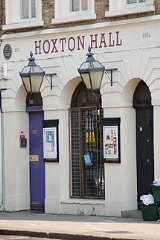
Hoxton

Encyclopedia
Hoxton is an area in the London Borough of Hackney
, immediately north of the financial district of the City of London
. The area of Hoxton is bordered by Regent's Canal
on the north side, Wharf Road and City Road
on the west, Old Street
on the south, and Kingsland Road
on the east.
Hoxton
is also a ward
, electing 3 councillors to the borough council. It forms part of the Hackney South and Shoreditch
constituency.
, meaning an Anglo-Saxon
farm (or fortified enclosure) belonging to Hoch, or Hocq. Little is recorded of the origins of the settlement, though there was Roman
activity around Ermine Street
, which ran to the east of the area from the 1st century. In medieval times, Hoxton formed a rural part of Shoreditch parish
. It achieved independent ecclesiastical status in 1826 with the founding of its own parish church dedicated to St John the Baptist, though civil jurisdiction was still invested in the Shoreditch vestry. The Worshipful Company of Haberdashers
remains patron of the advowson
of the parish
of St John's Hoxton.
In 1415, the Lord Mayor of London
"caused the wall of the City to be broken towards Moorfields, and built the postern called Moorgate
, for the ease of the citizens to walk that way upon causeways towards Islington
and Hoxton" – at that time, still marshy areas. The residents responded by harassing walkers to protect their fields. A century later, the hedges and ditches were destroyed, by order of the City, to enable City dwellers to take their leisure in Hoxton.
times many moated manor houses existed to provide ambassadors and courtiers country air close to the city. This included many Catholics, attracted by the house of the Portuguese ambassador, who, in his private chapel, celebrated the masses forbidden in a Protestant country. One such resident was Sir Thomas Tresham
, who was imprisoned here by Elizabeth I of England
for harbouring Catholic priests. The open fields to the north and west were used for archery practice, and on September 22, 1598 the playwright Ben Jonson
fought a fatal duel in Hoxton Fields, killing actor Gabriel Spencer. Jonson was able to prove his literacy, thereby claiming benefit of clergy
to escape a hanging.
Hoxton contained public gardens that were a popular resort from the crowded city streets on holidays, and are reputed to have gained their name of Pimlico
from the publican, Ben Pimlico, and his particular brew.
derives its name from its former use in Hoxton.
warning him not to attend the Parliament
summoned by James I
to convene on 5 November, because "yet I say they shall receive a terrible blow, the Parliament, and yet they shall not see who hurts them". The letter may have been sent by his brother-in-law Francis Tresham
, or he may have written it himself, to curry favour. The letter was read aloud at supper, in front of the company of prominent Catholics, and then he brought it personally to Robert Cecil
at Whitehall
. While the conspirators were alerted, by the public reading, to the existence of the letter they persevered with their plot as their gunpowder remained undiscovered. William Parker accompanied Thomas Howard
, the Lord Chamberlain
, in his visit to the undercroft of parliament, where Guy Fawkes
was found in the early hours of 5 November. Most of the conspirators fled on the discovery of the Gunpowder Plot, but Francis Tresham
was arrested a few days later at his house in Hoxton. A commemorative plaque is attached to modern flats on the site of Parker's house in Hoxton Street.
, with almshouses being built on the land between by City benefactors and guilds. Hoxton House, for example, became a private asylum in 1695. It was owned by the Miles family, and expanded rapidly into the surrounding streets being described by Coleridge
as the Hoxton madhouse. Here fee-paying 'gentle and middle class' people took their exercise in the extensive grounds between Pitfield Street and Kingsland Road; including the poet Charles Lamb
. Over 500 pauper lunatics resided in closed wards, and it remained the Naval Lunatic Asylum until 1818. The asylum closed in 1911; and the only remains are by Hackney Community College, where a part of the house was incorporated into the school that replaced it in 1921. Askes almshouses were founded on Pitfield Street in 1689 from an endowment from Robert Aske
for 20 poor Haberdashers
and a school for 20 children of freemen
.
At this time Hoxton Square
and Charles Square were laid out, forming a fashionable area. Non-conformist sects were attracted to the area, freed from the restrictions of the City. Hoxton Market, founded in 1687, was a once thriving market that lost its status to neighbouring markets such as those at Bethnal Green
and Dalston
. Student flats have now been built on much of the site. A small square remains.
 In the Victorian era
the railways made travelling to distant suburbs easier, and this combined with infill building and industrialisation to drive away the wealthier classes, leaving Hoxton a concentration of the poor with many slums. The area became a centre for the furniture trade.
Charles Booth
in Life and Labour of the People in London of 1902 gave the
following description:
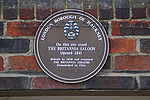 In Hoxton Street, a plaque marks the location of the Britannia Theatre
. This evolved from the former Pimlico tea gardens, a tavern and a saloon, into a 3,000-seat theatre, designed by Finch Hill. Together with the nearby Pollock's Toy Museum, it was destroyed in Second World War bombing. Hoxton Hall
, also in Hoxton Street, which survives as a community centre, began life in 1863 as a 'saloon style' music hall
. It remains largely in its original form, as for many years it was used as a Quaker meeting house. There was also the 1870 Varieties Music Hall (by C. J. Phipps) in nearby Pitfield Street, this became a cinema in 1910, closing in 1941. since 2003 it has remained empty, but in 2008 it was gutted and prepared for a refurb. But opposition to the design meant it was abandoned, and now remains empty and For Sale.
In the former Vestry of St Leonard Shoreditch Electric Light Station, just to the north of Hoxton Market, is based The Circus Space
. Inside, the "Generating Chamber" and "Combustion Chamber" provide facilities for circus training and production. The building was constructed by the Vestry in 1895 to burn local rubbish and generate electricity. It also provided steam to heat the public baths. This replaced an earlier facility providing gas-light, located in Shoreditch
.
Gainsborough Studios were located in a former power station, in Poole Street, by the Regents Canal. The film studios operated here from 1924 to 1951. An historical plaque is attached to the building, a modern apartment block, that occupies the site since the studios' demolition in 2002. The plaque reads
With a new found popularity, parts of Hoxton have been gentrified
, this has inevitably aroused hostility among some local residents, who believe they are being priced out of the area. Much of Hoxton, however, remains deprived with council housing dominating the landscape.
are often deliberately or unwittingly confused. The two districts have a historical link as part of the same manor
, and in the 19th century both formed part of the Metropolitan Borough of Shoreditch
. This was subsumed into the London Borough of Hackney
in 1965, but old street signs bearing the name are still to be found throughout the area.
Manufacturing developments in the years after the Second World War meant that many of the small industries that characterised Hoxton moved out. By the early 1980s, these industrial lofts and buildings came to be occupied by young artists as inexpensive live/work spaces, while exhibitions, raves
and clubs occupied former office and retail space at the beginning of the 1990s. During this time Joshua Compston
established his Factual Nonsense gallery on Charlotte Road in Shoreditch and organised art fetes in Hoxton Square
. Their presence gradually drew other creative industries into the area, especially magazines, design firms, and dot-com
s.
By the end of the 20th century, the southern half of Hoxton had become a vibrant arts and entertainment district boasting a large number of bars, nightclubs, restaurants, and art galleries. In this period, the new Hoxton residents could be identified by their obscurely fashionable (or "ironically
" unfashionable) clothes and their hair (the so-called "Hoxton Fin", as exemplified by Fran Healy
of Travis
). The excesses and fashion-centricity of Hoxton and Shoreditch denizens have been satirised in the satirical
magazine Shoreditch Twat
, on the TVGoHome
website, and in the sitcom Nathan Barley
. This fashionable area is centred on Hoxton Square, a small park bordered mainly by former industrial buildings.
By contrast, the northern half of the district consists primarily of council housing estates. Residents are predominantly older and the unemployment and crime rates, with the exceptions of drug offences, robbery and theft, are high even compared to the rest of the borough. Hoxton Street Market is the focal point of this end of the district. Nearby is the Geffrye Museum
.
As property developers moved in to cash in on the area's trendy image prices have risen steeply since the early years of the 21st century. Many galleries have, as a result, moved to nearby Shoreditch
, or have relocated further afield to cheaper districts such as London Fields
or Bethnal Green
. In response, the local council formed a not-for-profit corporation, Shoreditch Our Way (ShOW), to buy local buildings and lease them out as community facilities and housing. The extension of the East London Line
(completed in 2010), has provided the local rail access which was lost when the line from Broad Street closed to services.
 Nearest stations
Hoxton
is a National Rail station on the East London Line
of the London Overground
network. To the south-west of the district, the nearest London Underground station is Old Street on the Northern Line
. The station is also a stop on National Rail
's Northern City Line
, operated by First Capital Connect
.
London Borough of Hackney
The London Borough of Hackney is a London borough of North/North East London, and forms part of inner London. The local authority is Hackney London Borough Council....
, immediately north of the financial district of the City of London
City of London
The City of London is a small area within Greater London, England. It is the historic core of London around which the modern conurbation grew and has held city status since time immemorial. The City’s boundaries have remained almost unchanged since the Middle Ages, and it is now only a tiny part of...
. The area of Hoxton is bordered by Regent's Canal
Regent's Canal
Regent's Canal is a canal across an area just north of central London, England. It provides a link from the Paddington arm of the Grand Union Canal, just north-west of Paddington Basin in the west, to the Limehouse Basin and the River Thames in east London....
on the north side, Wharf Road and City Road
City Road
City Road or The City Road is a road that runs through inner north and central London. The northwestern extremity of the road is at the Angel, Islington where it forms a continuation of Pentonville Road. Pentonville Road itself is the modern name for London's first bypass, the New Road from...
on the west, Old Street
Old Street
Old Street is a street in east London that runs west to east from Goswell Road in Clerkenwell, in the London Borough of Islington, to the crossroads where it intersects with Shoreditch High Street , Kingsland Road and Hackney Road in Shoreditch in the London Borough of Hackney.The nearest...
on the south, and Kingsland Road
Kingsland Road
Kingsland Road is the name of a road, part of the A10, in the London Borough of Hackney in England. It runs from the junction with Old Street and Hackney Road north to the junction with Balls Pond Road and Dalston Lane, where it changes its name to Kingsland High Street...
on the east.
Hoxton
Hoxton (ward)
Hoxton is a ward in the London Borough of Hackney and forms part of the Hackney South and Shoreditch constituency.The ward stretches from Hoxton Street and Hoxton Square in the East to Old Street and City Road in the South and West and Shoreditch Park and the Regents Canal in the North.The ward...
is also a ward
Wards of the United Kingdom
A ward in the United Kingdom is an electoral district at sub-national level represented by one or more councillors. It is the primary unit of British administrative and electoral geography .-England:...
, electing 3 councillors to the borough council. It forms part of the Hackney South and Shoreditch
Hackney South and Shoreditch
Hackney South and Shoreditch is a borough constituency represented in the House of Commons of the Parliament of the United Kingdom. It elects one Member of Parliament by the first-past-the-post system of election.-History:...
constituency.
Origins
"Hogesdon" is first recorded in the Domesday BookDomesday Book
Domesday Book , now held at The National Archives, Kew, Richmond upon Thames in South West London, is the record of the great survey of much of England and parts of Wales completed in 1086...
, meaning an Anglo-Saxon
Old English language
Old English or Anglo-Saxon is an early form of the English language that was spoken and written by the Anglo-Saxons and their descendants in parts of what are now England and southeastern Scotland between at least the mid-5th century and the mid-12th century...
farm (or fortified enclosure) belonging to Hoch, or Hocq. Little is recorded of the origins of the settlement, though there was Roman
Ancient Rome
Ancient Rome was a thriving civilization that grew on the Italian Peninsula as early as the 8th century BC. Located along the Mediterranean Sea and centered on the city of Rome, it expanded to one of the largest empires in the ancient world....
activity around Ermine Street
Ermine Street
Ermine Street is the name of a major Roman road in England that ran from London to Lincoln and York . The Old English name was 'Earninga Straete' , named after a tribe called the Earningas, who inhabited a district later known as Armingford Hundred, around Arrington, Cambridgeshire and Royston,...
, which ran to the east of the area from the 1st century. In medieval times, Hoxton formed a rural part of Shoreditch parish
Shoreditch (parish)
Shoreditch was an ancient parish in the county of Middlesex. It was both a civil parish, used for administrative purposes, and an ecclesiastical parish of the Church of England...
. It achieved independent ecclesiastical status in 1826 with the founding of its own parish church dedicated to St John the Baptist, though civil jurisdiction was still invested in the Shoreditch vestry. The Worshipful Company of Haberdashers
Worshipful Company of Haberdashers
The Worshipful Company of Haberdashers is one of the senior Livery Companies of the City of London. The organisation, following on from the Mercers' Company, another Livery Company connected with clothing and haberdashery, received a Royal Charter in 1448...
remains patron of the advowson
Advowson
Advowson is the right in English law of a patron to present or appoint a nominee to a vacant ecclesiastical benefice or church living, a process known as presentation. In effect this means the right to nominate a person to hold a church office in a parish...
of the parish
Parish
A parish is a territorial unit historically under the pastoral care and clerical jurisdiction of one parish priest, who might be assisted in his pastoral duties by a curate or curates - also priests but not the parish priest - from a more or less central parish church with its associated organization...
of St John's Hoxton.
In 1415, the Lord Mayor of London
Lord Mayor of London
The Right Honourable Lord Mayor of London is the legal title for the Mayor of the City of London Corporation. The Lord Mayor of London is to be distinguished from the Mayor of London; the former is an officer only of the City of London, while the Mayor of London is the Mayor of Greater London and...
"caused the wall of the City to be broken towards Moorfields, and built the postern called Moorgate
Moorgate
Moorgate was a postern in the London Wall originally built by the Romans. It was turned into a gate in the 15th century. Though the gate was demolished in 1762, the name survives as a major street in the City of London...
, for the ease of the citizens to walk that way upon causeways towards Islington
Islington
Islington is a neighbourhood in Greater London, England and forms the central district of the London Borough of Islington. It is a district of Inner London, spanning from Islington High Street to Highbury Fields, encompassing the area around the busy Upper Street...
and Hoxton" – at that time, still marshy areas. The residents responded by harassing walkers to protect their fields. A century later, the hedges and ditches were destroyed, by order of the City, to enable City dwellers to take their leisure in Hoxton.
Tudor Hoxton
By TudorTudor period
The Tudor period usually refers to the period between 1485 and 1603, specifically in relation to the history of England. This coincides with the rule of the Tudor dynasty in England whose first monarch was Henry VII...
times many moated manor houses existed to provide ambassadors and courtiers country air close to the city. This included many Catholics, attracted by the house of the Portuguese ambassador, who, in his private chapel, celebrated the masses forbidden in a Protestant country. One such resident was Sir Thomas Tresham
Thomas Tresham II
Sir Thomas Tresham was a Catholic recusant politician at the end of the Tudor dynasty and the start of the Stuart dynasty in England....
, who was imprisoned here by Elizabeth I of England
Elizabeth I of England
Elizabeth I was queen regnant of England and Ireland from 17 November 1558 until her death. Sometimes called The Virgin Queen, Gloriana, or Good Queen Bess, Elizabeth was the fifth and last monarch of the Tudor dynasty...
for harbouring Catholic priests. The open fields to the north and west were used for archery practice, and on September 22, 1598 the playwright Ben Jonson
Ben Jonson
Benjamin Jonson was an English Renaissance dramatist, poet and actor. A contemporary of William Shakespeare, he is best known for his satirical plays, particularly Volpone, The Alchemist, and Bartholomew Fair, which are considered his best, and his lyric poems...
fought a fatal duel in Hoxton Fields, killing actor Gabriel Spencer. Jonson was able to prove his literacy, thereby claiming benefit of clergy
Benefit of clergy
In English law, the benefit of clergy was originally a provision by which clergymen could claim that they were outside the jurisdiction of the secular courts and be tried instead in an ecclesiastical court under canon law...
to escape a hanging.
Hoxton contained public gardens that were a popular resort from the crowded city streets on holidays, and are reputed to have gained their name of Pimlico
Pimlico
Pimlico is a small area of central London in the City of Westminster. Like Belgravia, to which it was built as a southern extension, Pimlico is known for its grand garden squares and impressive Regency architecture....
from the publican, Ben Pimlico, and his particular brew.
Have at thee, then, my merrie boyes, and beg for old Ben Pimlico’s nut-brown ale.The gardens appear to have been situated near Hoxton Street, known at that time, as Pimlico Path. The modern area of Pimlico
Pimlico
Pimlico is a small area of central London in the City of Westminster. Like Belgravia, to which it was built as a southern extension, Pimlico is known for its grand garden squares and impressive Regency architecture....
derives its name from its former use in Hoxton.
Gunpowder, treason and a letter
On 26 October 1605 Hoxton achieved notoriety, when a letter arrived at the home of local resident William Parker, Lord MonteagleWilliam Parker, 4th Baron Monteagle
William Parker, 13th Baron Morley, 4th Baron Monteagle was an English peer, Lord of Morley, Hingham, Hockering, &c., in Norfolk, the eldest son of Edward Parker, 12th Baron Morley , and of Elizabeth Stanley, daughter and heiress of William Stanley, 3rd Baron Monteagle .When quite a youth he...
warning him not to attend the Parliament
Parliament of England
The Parliament of England was the legislature of the Kingdom of England. In 1066, William of Normandy introduced a feudal system, by which he sought the advice of a council of tenants-in-chief and ecclesiastics before making laws...
summoned by James I
James I of England
James VI and I was King of Scots as James VI from 24 July 1567 and King of England and Ireland as James I from the union of the English and Scottish crowns on 24 March 1603...
to convene on 5 November, because "yet I say they shall receive a terrible blow, the Parliament, and yet they shall not see who hurts them". The letter may have been sent by his brother-in-law Francis Tresham
Francis Tresham
Francis Tresham , eldest son of Sir Thomas Tresham and Merial Throckmorton, was a member of the group of English provincial catholics who planned the failed Gunpowder Plot of 1605, a conspiracy to assassinate King James I of England...
, or he may have written it himself, to curry favour. The letter was read aloud at supper, in front of the company of prominent Catholics, and then he brought it personally to Robert Cecil
Robert Cecil, 1st Earl of Salisbury
Robert Cecil, 1st Earl of Salisbury, KG, PC was an English administrator and politician.-Life:He was the son of William Cecil, 1st Baron Burghley and Mildred Cooke...
at Whitehall
Whitehall
Whitehall is a road in Westminster, in London, England. It is the main artery running north from Parliament Square, towards Charing Cross at the southern end of Trafalgar Square...
. While the conspirators were alerted, by the public reading, to the existence of the letter they persevered with their plot as their gunpowder remained undiscovered. William Parker accompanied Thomas Howard
Thomas Howard, 1st Earl of Suffolk
Admiral Thomas Howard, 1st Earl of Suffolk, KG, PC was a son of Thomas Howard, 4th Duke of Norfolk by his second wife Margaret Audley, Duchess of Norfolk, the daughter and heiress of the 1st Baron Audley of Walden....
, the Lord Chamberlain
Lord Chamberlain
The Lord Chamberlain or Lord Chamberlain of the Household is one of the chief officers of the Royal Household in the United Kingdom and is to be distinguished from the Lord Great Chamberlain, one of the Great Officers of State....
, in his visit to the undercroft of parliament, where Guy Fawkes
Guy Fawkes
Guy Fawkes , also known as Guido Fawkes, the name he adopted while fighting for the Spanish in the Low Countries, belonged to a group of provincial English Catholics who planned the failed Gunpowder Plot of 1605.Fawkes was born and educated in York...
was found in the early hours of 5 November. Most of the conspirators fled on the discovery of the Gunpowder Plot, but Francis Tresham
Francis Tresham
Francis Tresham , eldest son of Sir Thomas Tresham and Merial Throckmorton, was a member of the group of English provincial catholics who planned the failed Gunpowder Plot of 1605, a conspiracy to assassinate King James I of England...
was arrested a few days later at his house in Hoxton. A commemorative plaque is attached to modern flats on the site of Parker's house in Hoxton Street.
Almshouses and madhouses
By the end of the 17th century the estates were being broken up. Many of the existing large houses were used as mad housesPsychiatric hospital
Psychiatric hospitals, also known as mental hospitals, are hospitals specializing in the treatment of serious mental disorders. Psychiatric hospitals vary widely in their size and grading. Some hospitals may specialise only in short-term or outpatient therapy for low-risk patients...
, with almshouses being built on the land between by City benefactors and guilds. Hoxton House, for example, became a private asylum in 1695. It was owned by the Miles family, and expanded rapidly into the surrounding streets being described by Coleridge
Samuel Taylor Coleridge
Samuel Taylor Coleridge was an English poet, Romantic, literary critic and philosopher who, with his friend William Wordsworth, was a founder of the Romantic Movement in England and a member of the Lake Poets. He is probably best known for his poems The Rime of the Ancient Mariner and Kubla...
as the Hoxton madhouse. Here fee-paying 'gentle and middle class' people took their exercise in the extensive grounds between Pitfield Street and Kingsland Road; including the poet Charles Lamb
Charles Lamb
Charles Lamb was an English essayist, best known for his Essays of Elia and for the children's book Tales from Shakespeare, which he produced with his sister, Mary Lamb . Lamb has been referred to by E.V...
. Over 500 pauper lunatics resided in closed wards, and it remained the Naval Lunatic Asylum until 1818. The asylum closed in 1911; and the only remains are by Hackney Community College, where a part of the house was incorporated into the school that replaced it in 1921. Askes almshouses were founded on Pitfield Street in 1689 from an endowment from Robert Aske
Robert Aske (merchant)
Robert Aske was a merchant in the City of London. He is chiefly remembered from the charitable foundation created from his estate, which operates two schools in Hertfordshire, Haberdashers' Aske's Boys' School and Haberdashers' Aske's School for Girls.Aske was the son of an affluent draper...
for 20 poor Haberdashers
Worshipful Company of Haberdashers
The Worshipful Company of Haberdashers is one of the senior Livery Companies of the City of London. The organisation, following on from the Mercers' Company, another Livery Company connected with clothing and haberdashery, received a Royal Charter in 1448...
and a school for 20 children of freemen
Freedom of the City
Freedom of the City is an honour bestowed by some municipalities in Australia, Canada, Ireland, France, Italy, New Zealand, South Africa, Spain, the United Kingdom, Gibraltar and Rhodesia to esteemed members of its community and to organisations to be honoured, often for service to the community;...
.
At this time Hoxton Square
Hoxton Square
Hoxton Square is a garden square situated in Hoxton in the London Borough of Hackney, in London's East End. Formerly home to industrial premises, since the 1990s it has become the heart of the Hoxton arts and media scene, as well as being a hub of the thriving local entertainment district...
and Charles Square were laid out, forming a fashionable area. Non-conformist sects were attracted to the area, freed from the restrictions of the City. Hoxton Market, founded in 1687, was a once thriving market that lost its status to neighbouring markets such as those at Bethnal Green
Bethnal Green
Bethnal Green is a district of the East End of London, England and part of the London Borough of Tower Hamlets, with the far northern parts falling within the London Borough of Hackney. Located northeast of Charing Cross, it was historically an agrarian hamlet in the ancient parish of Stepney,...
and Dalston
Dalston
Dalston is a district of north-east London, England, located in the London Borough of Hackney. It is situated northeast of Charing Cross. The area is identified in the London Plan as one of 35 major centres in Greater London...
. Student flats have now been built on much of the site. A small square remains.
Victorian era and 20th century
Victorian era
The Victorian era of British history was the period of Queen Victoria's reign from 20 June 1837 until her death on 22 January 1901. It was a long period of peace, prosperity, refined sensibilities and national self-confidence...
the railways made travelling to distant suburbs easier, and this combined with infill building and industrialisation to drive away the wealthier classes, leaving Hoxton a concentration of the poor with many slums. The area became a centre for the furniture trade.
Charles Booth
Charles Booth (philanthropist)
Charles Booth was an English philanthropist and social researcher. He is most famed for his innovative work on documenting working class life in London at the end of the 19th century, work that along with that of Benjamin Seebohm Rowntree influenced government intervention against poverty in the...
in Life and Labour of the People in London of 1902 gave the
following description:
The character of the whole locality is working-class. Poverty is everywhere, with a considerable admixture of the very poor and vicious ... Large numbers have been and are still being displaced by the encroachment of warehouses and factories ... Hoxton is known for its costers and Curtain criminals, for its furniture trade ... No servants
are kept except in the main Road shopping streets and in a few remaining middle class squares in the west.
Britannia Theatre
The Britannia Theatre was located at 115/117 High Street, Hoxton, London. The theatre was badly damaged by a fire in 1900. The site was reused as a Gaumont cinema from 1913 to 1940, when this too was destroyed...
. This evolved from the former Pimlico tea gardens, a tavern and a saloon, into a 3,000-seat theatre, designed by Finch Hill. Together with the nearby Pollock's Toy Museum, it was destroyed in Second World War bombing. Hoxton Hall
Hoxton Hall
Hoxton Hall is a community centre and performance space in Hoxton, at 130 Hoxton Street, in the London Borough of Hackney.A grade II* listed building, the theatre was first built as a Music hall in 1863, as MacDonald's Music hall. It is an unrestored example of the saloon-style...
, also in Hoxton Street, which survives as a community centre, began life in 1863 as a 'saloon style' music hall
Music hall
Music Hall is a type of British theatrical entertainment which was popular between 1850 and 1960. The term can refer to:# A particular form of variety entertainment involving a mixture of popular song, comedy and speciality acts...
. It remains largely in its original form, as for many years it was used as a Quaker meeting house. There was also the 1870 Varieties Music Hall (by C. J. Phipps) in nearby Pitfield Street, this became a cinema in 1910, closing in 1941. since 2003 it has remained empty, but in 2008 it was gutted and prepared for a refurb. But opposition to the design meant it was abandoned, and now remains empty and For Sale.
In the former Vestry of St Leonard Shoreditch Electric Light Station, just to the north of Hoxton Market, is based The Circus Space
The Circus Space
The Circus Space in the Hoxton area of London offers the UK's only university degree programme in circus. It supports the professional development of circus performers and circus companies and runs youth and adult evening classes every week...
. Inside, the "Generating Chamber" and "Combustion Chamber" provide facilities for circus training and production. The building was constructed by the Vestry in 1895 to burn local rubbish and generate electricity. It also provided steam to heat the public baths. This replaced an earlier facility providing gas-light, located in Shoreditch
Shoreditch
Shoreditch is an area of London within the London Borough of Hackney in England. It is a built-up part of the inner city immediately to the north of the City of London, located east-northeast of Charing Cross.-Etymology:...
.
Gainsborough Studios were located in a former power station, in Poole Street, by the Regents Canal. The film studios operated here from 1924 to 1951. An historical plaque is attached to the building, a modern apartment block, that occupies the site since the studios' demolition in 2002. The plaque reads
- London Borough of Hackney
- The Gainsborough Film Studios 1924–1949
- Alfred HitchcockAlfred HitchcockSir Alfred Joseph Hitchcock, KBE was a British film director and producer. He pioneered many techniques in the suspense and psychological thriller genres. After a successful career in British cinema in both silent films and early talkies, Hitchcock moved to Hollywood...
, Michael BalconMichael BalconSir Michael Elias Balcon was an English film producer, known for his work with Ealing Studios.-Background:...
, Ivor NovelloIvor NovelloDavid Ivor Davies , better known as Ivor Novello, was a Welsh composer, singer and actor who became one of the most popular British entertainers of the first half of the 20th century. Born into a musical family, his first successes were as a songwriter...
, Gracie FieldsGracie FieldsDame Gracie Fields, DBE , was an English-born, later Italian-based actress, singer and comedienne and star of both cinema and music hall.-Early life:...
, “The Lady VanishesThe Lady Vanishes (1938 film)The Lady Vanishes is a 1938 British thriller film directed by Alfred Hitchcock and adapted by Sidney Gilliat and Frank Launder from the 1936 novel The Wheel Spins by Ethel Lina White...
”, “The Wicked LadyThe Wicked LadyThe Wicked Lady is a 1945 film starring Margaret Lockwood in the title role as a nobleman's wife who secretly becomes a highwayman for the excitement...
” worked and were filmed here
With a new found popularity, parts of Hoxton have been gentrified
Gentrification
Gentrification and urban gentrification refer to the changes that result when wealthier people acquire or rent property in low income and working class communities. Urban gentrification is associated with movement. Consequent to gentrification, the average income increases and average family size...
, this has inevitably aroused hostility among some local residents, who believe they are being priced out of the area. Much of Hoxton, however, remains deprived with council housing dominating the landscape.
Today
Hoxton and ShoreditchShoreditch
Shoreditch is an area of London within the London Borough of Hackney in England. It is a built-up part of the inner city immediately to the north of the City of London, located east-northeast of Charing Cross.-Etymology:...
are often deliberately or unwittingly confused. The two districts have a historical link as part of the same manor
Manorialism
Manorialism, an essential element of feudal society, was the organizing principle of rural economy that originated in the villa system of the Late Roman Empire, was widely practiced in medieval western and parts of central Europe, and was slowly replaced by the advent of a money-based market...
, and in the 19th century both formed part of the Metropolitan Borough of Shoreditch
Metropolitan Borough of Shoreditch
The Metropolitan Borough of Shoreditch was a Metropolitan borough of the County of London between 1900 and 1965, when it was merged with the Metropolitan Borough of Stoke Newington and the Metropolitan Borough of Hackney to form the London Borough of Hackney....
. This was subsumed into the London Borough of Hackney
London Borough of Hackney
The London Borough of Hackney is a London borough of North/North East London, and forms part of inner London. The local authority is Hackney London Borough Council....
in 1965, but old street signs bearing the name are still to be found throughout the area.
Manufacturing developments in the years after the Second World War meant that many of the small industries that characterised Hoxton moved out. By the early 1980s, these industrial lofts and buildings came to be occupied by young artists as inexpensive live/work spaces, while exhibitions, raves
Raves
Raves can refer to:* Rave party* Raves, Vosges, a commune in the Vosges département in France* Raves , a 1980s power pop group from Atlanta, Georgia, United States...
and clubs occupied former office and retail space at the beginning of the 1990s. During this time Joshua Compston
Joshua Compston
Joshua Richard Compston was a London gallerist whose space, Factual Nonsense, was closely associated with the emergence of the Young British Artists . Compston graduated from the Courtauld Institute of Art in 1992...
established his Factual Nonsense gallery on Charlotte Road in Shoreditch and organised art fetes in Hoxton Square
Hoxton Square
Hoxton Square is a garden square situated in Hoxton in the London Borough of Hackney, in London's East End. Formerly home to industrial premises, since the 1990s it has become the heart of the Hoxton arts and media scene, as well as being a hub of the thriving local entertainment district...
. Their presence gradually drew other creative industries into the area, especially magazines, design firms, and dot-com
Dot-com company
A dot-com company, or simply a dot-com , is a company that does most of its business on the Internet, usually through a website that uses the popular top-level domain, ".com" .While the term can refer to present-day companies, it is also used specifically to refer to companies with...
s.
By the end of the 20th century, the southern half of Hoxton had become a vibrant arts and entertainment district boasting a large number of bars, nightclubs, restaurants, and art galleries. In this period, the new Hoxton residents could be identified by their obscurely fashionable (or "ironically
Irony
Irony is a rhetorical device, literary technique, or situation in which there is a sharp incongruity or discordance that goes beyond the simple and evident intention of words or actions...
" unfashionable) clothes and their hair (the so-called "Hoxton Fin", as exemplified by Fran Healy
Francis Healy
Francis "Fran" Healy is a Scottish musician. He is currently the lead singer and main songwriter of the Scottish band Travis, having written nearly all of the songs on their six studio albums. He is based in Berlin, Germany...
of Travis
Travis (band)
Travis are a post-Britpop band from Glasgow, Scotland, comprising Fran Healy , Dougie Payne , Andy Dunlop and Neil Primrose...
). The excesses and fashion-centricity of Hoxton and Shoreditch denizens have been satirised in the satirical
Satire
Satire is primarily a literary genre or form, although in practice it can also be found in the graphic and performing arts. In satire, vices, follies, abuses, and shortcomings are held up to ridicule, ideally with the intent of shaming individuals, and society itself, into improvement...
magazine Shoreditch Twat
Shoreditch twat
The Shoreditch Twat fanzine was published and edited by club promoter Neil Boorman on behalf of the Shoreditch nightclub 333 between 1999 and 2004....
, on the TVGoHome
TVGoHome
TVGoHome was a website which parodied the television listings style of the British magazine Radio Times. It was produced fortnightly from 1999 to 2001, and sporadically until 2003, by Charlie Brooker. The site now exists only in archive form...
website, and in the sitcom Nathan Barley
Nathan Barley
Nathan Barley is a Channel 4 sitcom written by Charlie Brooker and Chris Morris, starring Nicholas Burns, Julian Barratt and Claire Keelan. The series of six weekly episodes began broadcasting on 11 February 2005 on Channel 4...
. This fashionable area is centred on Hoxton Square, a small park bordered mainly by former industrial buildings.
By contrast, the northern half of the district consists primarily of council housing estates. Residents are predominantly older and the unemployment and crime rates, with the exceptions of drug offences, robbery and theft, are high even compared to the rest of the borough. Hoxton Street Market is the focal point of this end of the district. Nearby is the Geffrye Museum
Geffrye Museum
Founded in 1914, the Geffrye Museum is a museum specialising in the history of the English domestic interior. Named after Sir Robert Geffrye, former Lord Mayor of London and Master of the Ironmongers' Company, it is located on Kingsland Road in London...
.
As property developers moved in to cash in on the area's trendy image prices have risen steeply since the early years of the 21st century. Many galleries have, as a result, moved to nearby Shoreditch
Shoreditch
Shoreditch is an area of London within the London Borough of Hackney in England. It is a built-up part of the inner city immediately to the north of the City of London, located east-northeast of Charing Cross.-Etymology:...
, or have relocated further afield to cheaper districts such as London Fields
London Fields
London Fields is a park and the name of an area of London, situated in the eastern borough of Hackney. The park itself was first recorded in 1540. At this time it was common ground and was used by drovers to pasture their livestock before taking them to market in London.London Fields is just over ...
or Bethnal Green
Bethnal Green
Bethnal Green is a district of the East End of London, England and part of the London Borough of Tower Hamlets, with the far northern parts falling within the London Borough of Hackney. Located northeast of Charing Cross, it was historically an agrarian hamlet in the ancient parish of Stepney,...
. In response, the local council formed a not-for-profit corporation, Shoreditch Our Way (ShOW), to buy local buildings and lease them out as community facilities and housing. The extension of the East London Line
East London Line
The East London Line is a London Overground line which runs north to south through the East End, Docklands and South areas of London.Built in 1869 by the East London Railway Company, which reused the Thames Tunnel, originally intended for horse-drawn carriages, the line became part of the London...
(completed in 2010), has provided the local rail access which was lost when the line from Broad Street closed to services.
Individuals associated with Hoxton
- Frank ChappleFrank ChappleFrank Chapple was general secretary of the Electrical, Electronic, Telecommunications and Plumbing Union , a leading British trade union....
, union leader, was born and raised in Hoxton. He was ennobled as Lord Chapple of Hoxton in 1985 by Margaret ThatcherMargaret ThatcherMargaret Hilda Thatcher, Baroness Thatcher, was Prime Minister of the United Kingdom from 1979 to 1990...
. - Charles BradlaughCharles BradlaughCharles Bradlaugh was a political activist and one of the most famous English atheists of the 19th century. He founded the National Secular Society in 1866.-Early life:...
was born in Hoxton. - Alfred HitchcockAlfred HitchcockSir Alfred Joseph Hitchcock, KBE was a British film director and producer. He pioneered many techniques in the suspense and psychological thriller genres. After a successful career in British cinema in both silent films and early talkies, Hitchcock moved to Hollywood...
began his career at the Gainsborough Studios - Reggie & Ronnie KrayKray twinsReginald "Reggie" Kray and his twin brother Ronald "Ronnie" Kray were the foremost perpetrators of organised crime in London's East End during the 1950s and 1960s...
– East End gangsters born in Stene Street Hoxton (1933) - Marie LloydMarie LloydMatilda Alice Victoria Wood was an English music hall singer, best known as Marie Lloyd. Her ability to add lewdness to the most innocent of lyrics led to frequent clashes with the guardians of morality...
– Music hallMusic hallMusic Hall is a type of British theatrical entertainment which was popular between 1850 and 1960. The term can refer to:# A particular form of variety entertainment involving a mixture of popular song, comedy and speciality acts...
star, was born Matilda Alice Victoria Wood here on February 12, 1870. The eldest of nine children. She, and her sisters longed to go on the stage, and haunted the local Royal Eagle Tavern, Music hall, on City Road (where their father also worked, as a waiter). Seven of her siblings went onto professional stage careers, adopting the surname Lloyd, apart from Daisy, who had a successful career as Daisy WoodDaisy WoodDaisy Violet Rose Wood , was an English Music hall singer.-Life and career:The fifth of nine children, the oldest being Matilda Alice Victoria Wood , performing under the stage name Marie Lloyd. Seven of the siblings took up stage careers...
. - Lenny McLeanLenny McLeanLeonard John "Lenny" McLean , also known as "The Guv'nor," was an East End of London bareknuckle fighter, bouncer, criminal and prisoner, author, businessman, bodyguard, enforcer, weightlifter, television presenter and actor, and has been referred to as "the hardest man in Britain".McLean's...
, actor, bouncer, bare-knuckle boxer and 'hardest man in Britain' was born here - Jamie OliverJamie OliverJames "Jamie" Trevor Oliver, MBE , sometimes known as The Naked Chef, is an English chef, restaurateur and media personality, known for his food-focused television shows, cookbooks and more recently his campaign against the use of processed foods in national schools...
opened the original Fifteen restaurant in Hoxton in 2002 - James ParkinsonJames ParkinsonJames Parkinson was an English apothecary surgeon, geologist, paleontologist, and political activist. He is most famous for his 1817 work, An Essay on the Shaking Palsy in which he was the first to describe "paralysis agitans", a condition that would later be renamed Parkinson's disease by...
(physician and researcher on Parkinson's DiseaseParkinson's diseaseParkinson's disease is a degenerative disorder of the central nervous system...
, was a resident of Hoxton Square) - Abraham ReesAbraham ReesAbraham Rees was a Welsh nonconformist minister, and compiler of Rees's Cyclopaedia .- Life :He was the second son of Lewis Rees, by his wife Esther, daughter of Abraham Penry, and was born at born in Llanbrynmair, Montgomeryshire. Lewis Rees Abraham Rees (1743 – 9 June 1825) was a Welsh...
, (editor and UnitarianUnitarianismUnitarianism is a Christian theological movement, named for its understanding of God as one person, in direct contrast to Trinitarianism which defines God as three persons coexisting consubstantially as one in being....
minister was a tutor at Hoxton Academy) - Mary WollstonecraftMary WollstonecraftMary Wollstonecraft was an eighteenth-century British writer, philosopher, and advocate of women's rights. During her brief career, she wrote novels, treatises, a travel narrative, a history of the French Revolution, a conduct book, and a children's book...
(social reformer, writer, mother of Mary ShelleyMary ShelleyMary Shelley was a British novelist, short story writer, dramatist, essayist, biographer, and travel writer, best known for her Gothic novel Frankenstein: or, The Modern Prometheus . She also edited and promoted the works of her husband, the Romantic poet and philosopher Percy Bysshe Shelley...
, born and lived early years here) - Hoxton Tom McCourtHoxton Tom McCourtHoxton' Tom McCourt is the former bassist and bandleader of punk rock/Oi! band, The 4-Skins. He was one of the most influential members of the skinhead revival of 1977 to 1978, the mod revival of 1978 to 1979 and the Oi! movement from 1979 to 1984.McCourt moved to Hoxton, and was given the...
, influential in the late 1970s and early 1980s mod and oi/punk scenes and founder of the band, the 4-Skins - Peter Dean, who played Pete BealePete BealePeter "Pete" Beale is a fictional character from the BBC soap opera EastEnders, played by Peter Dean. He made his first appearance in the programme's first episode, on 19 February 1985. The character was created by Tony Holland, one of the creators of EasEnders; he was based on a member of...
in EastEndersEastEndersEastEnders is a British television soap opera, first broadcast in the United Kingdom on BBC One on 19 February 1985 and continuing to today. EastEnders storylines examine the domestic and professional lives of the people who live and work in the fictional London Borough of Walford in the East End...
from 1985 to 1993, was born at Hoxton in 1939. - Jason PierceJason PierceJason Pierce , also known as J. Spaceman or Spaceman, is an English musician. He was formerly the joint leader – with Peter Kember – of the alternative rock band Spacemen 3, and is now the leader and sole permanent member of the band Spiritualized.In between his work with Spiritualized...
, of the band Spaceman 3 and SpiritualizedSpiritualizedSpiritualized are an English space rock band formed in 1990 in Rugby, Warwickshire by Jason Pierce after the demise of his previous outfit, space-rockers Spacemen 3...
lives in Hoxton. - Post war variety star comedian Charlie Smithers was born in Hoxton.
- The Stage newspaper columnist Tommy Kane was born in bygone Harman Street Hoxton on 24 March 1933. In his column headed "Raising Kane", which ran from 1965 to 1981, he featured many unknowns who became famous. Amongst these were Charlie Smithers, Lennie Peters, Mike ReidMike ReidMichael or Mike Reid may refer to:*Mike Reid , English comedian and actor, best known for his role as Frank Butcher in the BBC soap opera EastEnders*Mike Reid , American golfer...
, Grace Kennedy, Carol Lee Scott (Grotbags), Michael BarrymoreMichael BarrymoreMichael Kieron Parker , better known by his stage name Michael Barrymore, is a British comedian who appeared as a presenter of game shows and light entertainment programmes on British television in the 1980s and 1990s. These included Strike It Lucky, My Kind of People, My Kind of Music and Kids Say...
, and Ray Donn, who became famed for his successful Publand Variety Shows from 1966 to 1980. - Jason DonovanJason DonovanJason Donovan is an Australian actor and singer. He initially achieved fame in the Australian soap opera Neighbours, before beginning a career in music in 1988. In the UK he has sold over 3 million records, and his début album Ten Good Reasons was one of the highest-selling albums of 1989...
, actor and singer, lived in Hoxton whilst appearing in numerous West End shows. - George SewellGeorge SewellGeorge Sewell was an English actor.-Early life and early career:The son of a Hoxton printer and a florist; Sewell left school at age 14 and worked briefly in the printing trade before switching to building work, specifically the repair of bomb-damaged houses...
, renowned TV actor was born in Hoxton.
Education
Transport
Hoxton
Hoxton railway station
Hoxton railway station is in the Hoxton district of the London Borough of Hackney. The station is located on the Kingsland Viaduct and is served by London Overground trains on the extended East London Line, under the control of the London Rail division of Transport for London...
is a National Rail station on the East London Line
East London Line
The East London Line is a London Overground line which runs north to south through the East End, Docklands and South areas of London.Built in 1869 by the East London Railway Company, which reused the Thames Tunnel, originally intended for horse-drawn carriages, the line became part of the London...
of the London Overground
London Overground
London Overground is a suburban rail network in London and Hertfordshire. It has been operated by London Overground Rail Operations since 2007 as part of the National Rail network, under the franchise control and branding of Transport for London...
network. To the south-west of the district, the nearest London Underground station is Old Street on the Northern Line
Northern Line
The Northern line is a London Underground line. It is coloured black on the Tube map.For most of its length it is a deep-level tube line. The line carries 206,734,000 passengers per year. This is the highest number of any line on the London Underground system, but the Northern line is unique in...
. The station is also a stop on National Rail
National Rail
National Rail is a title used by the Association of Train Operating Companies as a generic term to define the passenger rail services operated in Great Britain...
's Northern City Line
Northern City Line
The Northern City Line is a railway line from Moorgate to Finsbury Park in London, once part of the Great Northern Electrics line. It should not be confused with the City branch of the Northern line, nor with the North London Line...
, operated by First Capital Connect
First Capital Connect
First Capital Connect is a passenger train operating company in England that began operations on the National Rail network on 1 April 2006...
.
External links
- Hoxton Hall Unique Grade II* listed building VictorianVictorian eraThe Victorian era of British history was the period of Queen Victoria's reign from 20 June 1837 until her death on 22 January 1901. It was a long period of peace, prosperity, refined sensibilities and national self-confidence...
Music hallMusic hallMusic Hall is a type of British theatrical entertainment which was popular between 1850 and 1960. The term can refer to:# A particular form of variety entertainment involving a mixture of popular song, comedy and speciality acts...
– now used for community arts - Where have all the cool people gone? The Guardian 2003-11-21
- www.stjohnshoxton.org.uk