


First Capital Connect

Encyclopedia
First Capital Connect is a passenger train operating company in England that began operations on the National Rail
network on 1 April 2006. It is owned by FirstGroup and combines the service on the cross-London Thameslink
railway line between Brighton
and Bedford
with services along the East Coast Main Line
from King's Cross and Moorgate
to Peterborough
, Cambridge
, and King's Lynn
formerly operated by West Anglia Great Northern (WAGN), which is now often referred to as the Great Northern Route
.
First Capital Connect is in the process of overhauling its fleet of trains, painting them in the FCC livery and refreshing the interiors, as well as an £
8 million programme of upgrades for several major stations.
The full term of the franchise
is for nine years, finishing in 2015. However, this depends on it meeting performance targets at the end of the fourth year, which will give an automatic two-year extension, and an extension for up to three years after the sixth year at the discretion of the DfT.
The Thameslink
and WAGN franchises were amalgamated in preparation for the Thameslink Programme
(formerly Thameslink 2000), which will increase capacity on the Thameslink route and allow trains from King's Lynn, Cambridge and Peterborough to run via the Thameslink route. On 24 July 2007 the Secretary of State for Transport, Ruth Kelly
, formally announced that the Government was fully committed to funding the Thameslink Programme. Since the planning permission and legal powers associated with the project have already been granted, the project is now clear to proceed.
1,779 more seats have been provided during the morning peak and 2,490 during the evening peak, significantly reducing the number of rush hour commuters unable to find a seat.
On 19 June 2008 FCC started testing a Class 377 Electrostar train in anticipation of the introduction of 23 x 4-car units on the Bedford to Brighton route in March the following year. The Electrostar train started non-passenger operation for driver training, signal testing, gauge clearance, platform staff training and validating on-board passenger information. Other technical on-board and track tests also took place. The trains are part of the £5.5 billion Thameslink improvement programme. The first 377 (a unit borrowed from Southern) came into service on 19 March 2009. All 23 of the units are now in service.
In 2008, First Capital Connect opened three new training facilities. The old Red Star parcels area in Bedford station was re-developed by Martin Gregory, IS Retail Manager and Richard Farish, Compliance Manager as part of their Leadership Horizons project, In Kentish Town, a derelict station building was converted into new training rooms to deliver induction, customer service and revenue protection training to new recruits. It will also offer management development programmes and safety specific training to First Capital Connect's 2,150 staff. The centre will be able to run in-house BTEC & NVQ programmes.
In Hornsey, Sir Moir Lockhead
, Chief Executive of FirstGroup officially opened the Performance and Training Academy, and Simulator Centre. First Capital Connect invested £1.2m in the Academy that will be used to teach the new drivers required for the Thameslink Programme and help support the company's existing team of approximately 700 drivers. The Simulator Centre provides realistic working cabs for a class 319 electric multiple unit
and class 365
electric multiple unit, driving over a fictitious route.
Unlike the Thameslink route, there is only one control centre for FCC services on the Great Northern route. This is situated at London King's Cross, within the power signal box.
Giving a frequency of 10 tph between London Blackfriars and St Pancras Domestic. During the peaks this increases.
FCC has two control centres (or 'Service Delivery Centres' aka SDC) for the Thameslink route. Trains between Bedford & London Blackfriars are controlled by the control centre at West Hampstead
(based within the power signal box
). FCC trains between Blackfriars & Brighton, Wimbledon & Sutton are controlled by the control centre at Croydon, which is also home to other southern region TOC
controls.
Official figures released by the ORR (Office for Rail Regulation) for the fourth quarter of the financial year 2010-11 were 89.7% PPM, 2.3% up on last year whilst the MAA slipped to 89.3% up to 31 March 2011.
The disruptions were triggered by First Capital Connect drivers declining to work overtime or during their allotted rest days, following their rejection of a proposed pay increase of 0% (rising to 3% in 2010). Without access to overtime and rest day work, FCC were unable to provide enough drivers to maintain their standard Thameslink service. Disruption continued into January 2010 as a result of heavy snow in the south east of England; although snow was not the only problem, significant snow fall ended on 6 January yet FCC continued to run emergency timetables through to 11 January.
Trains returned to the normal timetables from Monday 18 January, but delays and cancellations are still common as a result of signalling problems on the route. It was revealed that First Capital Connect achieved 60% in their punctuality during the first half of January on the Thameslink route. First Capital Connect have since offered improved discount and refund packages for customers affected by the disruption.
On 23 December 2010 FCC introduced an emergency timetable on their Great Northern route, which reduced rush hour trains by 75%. This was due to snow which had damaged some of the trains, which meant they were unable to run and thus a timetable which required less trains to operate it was put into place.
, the former Secretary of State for Transport
, described the service offered by FCC on its Thameslink route as "shoddy" and "very substandard", and that if improvements were not made the company could be stripped of its franchise.
In its Autumn 2009 National Passenger Survey, Passenger Focus stated FCC had the lowest overall satisfaction rating of any UK train operator, at 75%.
Like First Great Western services from Paddington, in mid 2006 First Capital Connect introduced evening peak time fares for northbound travel out of London. Previously passengers who purchased an off-peak travel card were able to travel on any train after the morning peak had finished at 09.30. Now passengers can no longer use an off-peak ticket for trains leaving London stations between 16.30 and 19.01. Passengers who want to use these peak service trains will need to pay an additional charge to travel. The evening peak does not affect southbound travel. This was introduced due to severe peak overcrowding. A full review of Evening Peak Restrictions is planned when First Capital Connect receives all of its additional rolling stock.
Students at some sixth-form colleges
were hit by price increases of over £300 per annum, when First Capital Connect replaced a discount scheme introduced by previous franchise holders WAGN and Thameslink, with its own 'Student Connect' scheme. The level of discount is greatly reduced, and although in theory the scheme is fairer, in practice many students and parents were left out of pocket.
At a number of stations, First Capital Connect has replaced free to use cash machines
, with machines that charge for withdrawals.
Upon taking over the free shuttle bus service from Luton Airport Parkway station
to London Luton Airport
, First Capital Connect introduced a charge.
In October 2010, passengers trapped on a failed train near Cambridge
gave up waiting, forced the train doors open and walked up the line to the nearby Foxton
station.
On 26th May 2011 at 18:27, passengers were trapped on a failed Class 377 train between St Pancras International (Low Level) and Kentish Town stations which had formed the FCC 16:30 Brighton to Bedford service. Another train of the same type was sent to assist the failed train, and was eventually coupled to it at 20:20 hrs but by this time passengers had used the emergency release handles to open the train doors in an attempt to improve ventilation (the air conditioning and lighting systems were no longer functioning). The train began to move at 21:03 hrs but this movement was immediately stopped because passengers were getting out onto the railway from the carriages within the tunnel. The passengers were escorted back onto the train, which was then authorised to move forward again at 21:12 hrs. Three sets of doors towards the rear of the train were still fully open while it travelled approximately one mile to reach Kentish Town station, where all the passengers left the train. First Capital Connect admitted a number of failings in the way in which it handled this particular incident including a need to improve communications with customers
All Thameslink route rolling stock is electrically powered
dual-voltage four-car units using 25 kV AC
overhead power north of Farringdon and 750 V DC third rail
to the south, operated as either four or eight car trains.
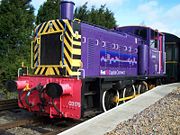
In addition to its EMU fleet FCC owns the sole surviving mainline-registered Class 03
, 03179 Clive.
in March 2009 to expand capacity on the Thameslink route, leaving FCC with all 86 of the 319s. The DfT also ordered 23 new dual voltage Class 377
units for Southern, which entered service in 2010 and are being used by FCC until the new Thameslink rolling stock is introduced, to further enhance capacity on the Thameslink services. FCC have also gained thirteen Class 321
units: 321401-406 in May 2009 and 321407-410 later on in 2009, with 321418-420 arriving in 2010. These units will enhance the capacity on the Peterborough - London King's Cross services, thus allowing more Class 365
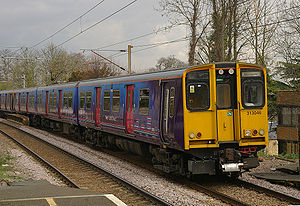
units to be available for the King's Lynn - Cambridge - London King's Cross services. Three Class 313
units from London Overground
moved to the Great Northern route for Inner Suburban services from London King's Cross/Moorgate - Welwyn Garden City/Hertford North/Letchworth Garden City once all of London Overground's new were delivered.
All of the Class 377/5
Electrostars used on the Thameslink route now received have full 'First Urban' branding. A full internal refurbishment and deep clean has also successfully been completed on some of the class 321s.
Separate from the government's rolling stock plan is the procurement of new rolling stock for use on the expanded Thameslink
route, which will replace the current units including the Thameslink routes Class 319
units and 377/5s as well as the Great Northern's routes older stock. Around 1200 dual voltage EMU
vehicles are planned, which are likely to be delivered in fixed formations operating in either 160m or 240m lengths. The new bid for trains is done on length rather than number of carriages to allow bidders to solve the problems of mass numbers of people leaving/boarding a train in under a minute. 160m is currently the length of an 8 car train and 240m a 12 car train. The new stock was due to enter service from late 2011, with the first being delivered for testing in spring 2011, however the project was delayed and Siemens Mobility was named preferred bidder on 16 June 2011, with its Siemens Desiro platform. Delivery is planned for 2015 to 2018.


went about refurbishing its units. The Class 319/1s were rebuilt by Railcare Wolverton into the Class 319/3s, which included removing First Class accommodation. These units are used mostly on Thameslink CityMetro services from Luton
/St Albans to Wimbledon around the Sutton loop. These units are numbered 319361-319386.
The Class 319/0s it owned were rebuilt into Class 319/4s (with First Class accommodation added) for dedicated use on Thameslink Cityflier services from Bedford to Brighton, and were subsequently renumbered 319421-319460. Since then the fleet had undergone a minor refurbishment and Thameslink also initiated a programme of technical improvements. FCC has continued the refurbishment initiated by Thameslink, although it has altered the cosmetic features to its specifications.
Both WAGN and Thameslink trains are being repainted into FCC livery, a light-blue-to-dark blue shading with pink doors and a striped motif. New blue upholstery, linoleum and carpeting have been fitted, and the onboard lavatories have been repainted. All ex-WAGN trains have now been done, and the Thameslink fleet is nearing completion.
|-
National Rail
National Rail is a title used by the Association of Train Operating Companies as a generic term to define the passenger rail services operated in Great Britain...
network on 1 April 2006. It is owned by FirstGroup and combines the service on the cross-London Thameslink
Thameslink
Thameslink is a fifty-station main-line route in the British railway system running north to south through London from Bedford to Brighton, serving both London Gatwick Airport and London Luton Airport. It opened as a through service in 1988 and by 1998 was severely overcrowded, carrying more than...
railway line between Brighton
Brighton
Brighton is the major part of the city of Brighton and Hove in East Sussex, England on the south coast of Great Britain...
and Bedford
Bedford
Bedford is the county town of Bedfordshire, in the East of England. It is a large town and the administrative centre for the wider Borough of Bedford. According to the former Bedfordshire County Council's estimates, the town had a population of 79,190 in mid 2005, with 19,720 in the adjacent town...
with services along the East Coast Main Line
East Coast Main Line
The East Coast Main Line is a long electrified high-speed railway link between London, Peterborough, Doncaster, Wakefield, Leeds, York, Darlington, Newcastle and Edinburgh...
from King's Cross and Moorgate
Moorgate station
Moorgate station is a central London railway terminus and London Underground station on Moorgate in the City of London; it provides National Rail services by First Capital Connect for Hertford, Welwyn Garden City and Letchworth and also serves the Circle, Hammersmith & City, Metropolitan Lines and...
to Peterborough
Peterborough
Peterborough is a cathedral city and unitary authority area in the East of England, with an estimated population of in June 2007. For ceremonial purposes it is in the county of Cambridgeshire. Situated north of London, the city stands on the River Nene which flows into the North Sea...
, Cambridge
Cambridge
The city of Cambridge is a university town and the administrative centre of the county of Cambridgeshire, England. It lies in East Anglia about north of London. Cambridge is at the heart of the high-technology centre known as Silicon Fen – a play on Silicon Valley and the fens surrounding the...
, and King's Lynn
King's Lynn
King's Lynn is a sea port and market town in the ceremonial county of Norfolk in the East of England. It is situated north of London and west of Norwich. The population of the town is 42,800....
formerly operated by West Anglia Great Northern (WAGN), which is now often referred to as the Great Northern Route
Great Northern Route
The Great Northern Route is the name of the suburban rail services run on the southern end of Britain's East Coast Main Line and associated branches. Services operate to or from and in London...
.
First Capital Connect is in the process of overhauling its fleet of trains, painting them in the FCC livery and refreshing the interiors, as well as an £
Pound sterling
The pound sterling , commonly called the pound, is the official currency of the United Kingdom, its Crown Dependencies and the British Overseas Territories of South Georgia and the South Sandwich Islands, British Antarctic Territory and Tristan da Cunha. It is subdivided into 100 pence...
8 million programme of upgrades for several major stations.
The full term of the franchise
Rail franchising in Great Britain
Rail franchising in Great Britain was created by the Railways Act 1993. Passenger services are franchised, for a limited period, to train operating companies...
is for nine years, finishing in 2015. However, this depends on it meeting performance targets at the end of the fourth year, which will give an automatic two-year extension, and an extension for up to three years after the sixth year at the discretion of the DfT.
The Thameslink
Thameslink (train operating company)
Thameslink was a train operating company in the United Kingdom, run by Govia . It operated the London commuter railway line known by the same name...
and WAGN franchises were amalgamated in preparation for the Thameslink Programme
Thameslink Programme
The Thameslink Programme, originally Thameslink 2000, is a £6 billion project in south-east England to upgrade and expand the Thameslink rail network to provide new and longer trains between a wider range of stations to the north and to the south of London without requiring passengers to change...
(formerly Thameslink 2000), which will increase capacity on the Thameslink route and allow trains from King's Lynn, Cambridge and Peterborough to run via the Thameslink route. On 24 July 2007 the Secretary of State for Transport, Ruth Kelly
Ruth Kelly
Ruth Maria Kelly is a British Labour Party politician of Irish descent who was the Member of Parliament for Bolton West from 1997 until she stood down in 2010...
, formally announced that the Government was fully committed to funding the Thameslink Programme. Since the planning permission and legal powers associated with the project have already been granted, the project is now clear to proceed.
News
In the early part of 2007 FCC conducted a study and undertook consultation on options for increasing the capacity of services to Peterborough and Cambridge. The final recommendations involve lengthening four peak services from 8 to 12 carriages from May 2009, and adding or removing a small number of stops to balance loads between trains.1,779 more seats have been provided during the morning peak and 2,490 during the evening peak, significantly reducing the number of rush hour commuters unable to find a seat.
On 19 June 2008 FCC started testing a Class 377 Electrostar train in anticipation of the introduction of 23 x 4-car units on the Bedford to Brighton route in March the following year. The Electrostar train started non-passenger operation for driver training, signal testing, gauge clearance, platform staff training and validating on-board passenger information. Other technical on-board and track tests also took place. The trains are part of the £5.5 billion Thameslink improvement programme. The first 377 (a unit borrowed from Southern) came into service on 19 March 2009. All 23 of the units are now in service.
In 2008, First Capital Connect opened three new training facilities. The old Red Star parcels area in Bedford station was re-developed by Martin Gregory, IS Retail Manager and Richard Farish, Compliance Manager as part of their Leadership Horizons project, In Kentish Town, a derelict station building was converted into new training rooms to deliver induction, customer service and revenue protection training to new recruits. It will also offer management development programmes and safety specific training to First Capital Connect's 2,150 staff. The centre will be able to run in-house BTEC & NVQ programmes.
In Hornsey, Sir Moir Lockhead
Moir Lockhead
Sir Moir Lockhead OBE is an English businessman and has been Chief Executive and Deputy Chairman of UK transport group FirstGroup since its formation in 1995...
, Chief Executive of FirstGroup officially opened the Performance and Training Academy, and Simulator Centre. First Capital Connect invested £1.2m in the Academy that will be used to teach the new drivers required for the Thameslink Programme and help support the company's existing team of approximately 700 drivers. The Simulator Centre provides realistic working cabs for a class 319 electric multiple unit
Electric multiple unit
An electric multiple unit or EMU is a multiple unit train consisting of self-propelled carriages, using electricity as the motive power. An EMU requires no separate locomotive, as electric traction motors are incorporated within one or a number of the carriages...
and class 365
British Rail Class 365
The British Rail Class 365 "Networker Express" are dual-voltage 25 kV AC and 750 V DC) electric multiple units built by ABB at York from 1994 to 1995. These were the last units to be built at the York factory before it closed...
electric multiple unit, driving over a fictitious route.
Current routes
The current routes operated by First Capital Connect off-peak Monday to Friday are:From King's Cross
- London King's Cross to Peterborough – 2 tph (one Semi-Fast, One Stopping)
- London King's Cross to Cambridge (Non Stop) – 2 tph (One tph extended to King's Lynn)
- London King's Cross to Cambridge – 2 tph (one Semi-Fast, One Stopping)
From Moorgate
- Moorgate to Hertford North via Gordon Hill – 3 tph (One tph extended to Letchworth Garden City)
- Moorgate to Welwyn Garden City – 3 tph
Unlike the Thameslink route, there is only one control centre for FCC services on the Great Northern route. This is situated at London King's Cross, within the power signal box.
Thameslink
- Sevenoaks to Kentish Town (off-peak) or Bedford (peak only)– 2 trains per hour (tph) (jointly operated with Southeastern)
- Bedford to Brighton– 4 tph (Two Semi-Fast, Two Stopping)
- Luton to Sutton (Surrey) via Wimbledon– 2 tph
- St Albans to Sutton (Surrey) via Mitcham Junction– 2 tph
Giving a frequency of 10 tph between London Blackfriars and St Pancras Domestic. During the peaks this increases.
FCC has two control centres (or 'Service Delivery Centres' aka SDC) for the Thameslink route. Trains between Bedford & London Blackfriars are controlled by the control centre at West Hampstead
West Hampstead Thameslink railway station
West Hampstead Thameslink is a National Rail station on the Midland Main Line and is served by First Capital Connect trains as part of the Thameslink Line service between Kentish Town and Cricklewood. The station is in Travelcard Zone 2. East Midlands Trains InterCity services from Leeds, Sheffield...
(based within the power signal box
Signal box
On a rail transport system, signalling control is the process by which control is exercised over train movements by way of railway signals and block systems to ensure that trains operate safely, over the correct route and to the proper timetable...
). FCC trains between Blackfriars & Brighton, Wimbledon & Sutton are controlled by the control centre at Croydon, which is also home to other southern region TOC
Train operating company
The term train operating company is used in the United Kingdom to describe the various businesses operating passenger trains on the railway system of Great Britain under the collective National Rail brand...
controls.
Performance
Performance figures for FCC covering the four week period from 17 August to 13 September 2008 were the best performance figures in the franchise history. Public Performance Measurement (PPM) reached 93.94% which is the highest level achieved in the two-and-a-half years of the First Capital Connect franchise and for the previous eight years of operating. During this period, 1.39% of services were cancelled, beating the previous low of 1.72% obtained in March 2008.Official figures released by the ORR (Office for Rail Regulation) for the fourth quarter of the financial year 2010-11 were 89.7% PPM, 2.3% up on last year whilst the MAA slipped to 89.3% up to 31 March 2011.
Major service disruptions
In November 2009, following a pay dispute with driving staff, First Capital Connect introduced a revised timetable for its Thameslink route: this resulted in a drastically reduced service, and an increase in short-notice delays, alterations and cancellations.The disruptions were triggered by First Capital Connect drivers declining to work overtime or during their allotted rest days, following their rejection of a proposed pay increase of 0% (rising to 3% in 2010). Without access to overtime and rest day work, FCC were unable to provide enough drivers to maintain their standard Thameslink service. Disruption continued into January 2010 as a result of heavy snow in the south east of England; although snow was not the only problem, significant snow fall ended on 6 January yet FCC continued to run emergency timetables through to 11 January.
Trains returned to the normal timetables from Monday 18 January, but delays and cancellations are still common as a result of signalling problems on the route. It was revealed that First Capital Connect achieved 60% in their punctuality during the first half of January on the Thameslink route. First Capital Connect have since offered improved discount and refund packages for customers affected by the disruption.
On 23 December 2010 FCC introduced an emergency timetable on their Great Northern route, which reduced rush hour trains by 75%. This was due to snow which had damaged some of the trains, which meant they were unable to run and thus a timetable which required less trains to operate it was put into place.
Criticism
Angry commuters started a petition on the Prime Minister's website to end First Capital Connect's franchise during 2009. Other people have asked for a full enquiry into the service, while Lord AdonisAndrew Adonis, Baron Adonis
Andrew Adonis, Baron Adonis is a British academic, journalist, Labour Party politician and Life Peer, who was Secretary of State for Transport between 2009-2010....
, the former Secretary of State for Transport
Secretary of State for Transport
The Secretary of State for Transport is the member of the cabinet responsible for the British Department for Transport. The role has had a high turnover as new appointments are blamed for the failures of decades of their predecessors...
, described the service offered by FCC on its Thameslink route as "shoddy" and "very substandard", and that if improvements were not made the company could be stripped of its franchise.
In its Autumn 2009 National Passenger Survey, Passenger Focus stated FCC had the lowest overall satisfaction rating of any UK train operator, at 75%.
Over-crowding
First Capital Connect has been criticised for running some of the country's most over-crowded trains; the 7.15am service from Cambridge to King's Cross frequently has 76 people standing for every 100 seated. This situation is recognised by FCC itself: "We recognise that overcrowding is the biggest issue affecting our customers. This is at an unacceptable level on some of our services". From 27 May 2009 FCC introduced extra carriages which meant that this service became a 12-car train rather than an 8-car.Fare rises
In January 2007, FCC's regulated fares increased by an average of 3.5% and unregulated fares by 4.3%. In January 2008 both regulated and unregulated fares went up by an average of 4.8%. In January 2009, the increases were 6% for regulated fares and 9% for unregulated fares.Like First Great Western services from Paddington, in mid 2006 First Capital Connect introduced evening peak time fares for northbound travel out of London. Previously passengers who purchased an off-peak travel card were able to travel on any train after the morning peak had finished at 09.30. Now passengers can no longer use an off-peak ticket for trains leaving London stations between 16.30 and 19.01. Passengers who want to use these peak service trains will need to pay an additional charge to travel. The evening peak does not affect southbound travel. This was introduced due to severe peak overcrowding. A full review of Evening Peak Restrictions is planned when First Capital Connect receives all of its additional rolling stock.
Students at some sixth-form colleges
Sixth form college
A sixth form college is an educational institution in England, Wales, Northern Ireland, Belize, Hong Kong or Malta where students aged 16 to 18 typically study for advanced school-level qualifications, such as A-levels, or school-level qualifications such as GCSEs. In Singapore and India, this is...
were hit by price increases of over £300 per annum, when First Capital Connect replaced a discount scheme introduced by previous franchise holders WAGN and Thameslink, with its own 'Student Connect' scheme. The level of discount is greatly reduced, and although in theory the scheme is fairer, in practice many students and parents were left out of pocket.
Charges
As well the increase in charges for rail travel, passengers are facing an increase in charges in several other areas. Car parking charges, which are not regulated by the passenger watchdog, have seen rises significantly above the rate of inflation for the past few years. St Albans city station has seen a rise in the daily parking charge from £4.20 in 2007 to £6.00 in 2009.At a number of stations, First Capital Connect has replaced free to use cash machines
Automated teller machine
An automated teller machine or automatic teller machine, also known as a Cashpoint , cash machine or sometimes a hole in the wall in British English, is a computerised telecommunications device that provides the clients of a financial institution with access to financial transactions in a public...
, with machines that charge for withdrawals.
Upon taking over the free shuttle bus service from Luton Airport Parkway station
Luton Airport Parkway railway station
| Luton Airport Parkway railway station is the railway station for London Luton Airport in Bedfordshire, England. The station opened in 1999 and is located south-east of Luton and west of the airport....
to London Luton Airport
London Luton Airport
London Luton Airport is an international airport located east of the town centre in the Borough of Luton in Bedfordshire, England and is north of Central London. The airport is from Junction 10a of the M1 motorway...
, First Capital Connect introduced a charge.
Incidents
In September 2010, First Capital Connect admitted in an email that staff, despite being trained in first aid, were not allowed to offer medical help to members of the public. An incident was reported by the BBC after a passenger collapsed and FCC's station staff could not help.In October 2010, passengers trapped on a failed train near Cambridge
Cambridge
The city of Cambridge is a university town and the administrative centre of the county of Cambridgeshire, England. It lies in East Anglia about north of London. Cambridge is at the heart of the high-technology centre known as Silicon Fen – a play on Silicon Valley and the fens surrounding the...
gave up waiting, forced the train doors open and walked up the line to the nearby Foxton
Foxton
Foxton is the name of several places in the world:New Zealand* Foxton, New Zealand, in the North Island* Foxton Beach, North IslandUnited Kingdom* Foxton, Cambridgeshire, England* Foxton, County Durham, England* Foxton, Leicestershire, England...
station.
On 26th May 2011 at 18:27, passengers were trapped on a failed Class 377 train between St Pancras International (Low Level) and Kentish Town stations which had formed the FCC 16:30 Brighton to Bedford service. Another train of the same type was sent to assist the failed train, and was eventually coupled to it at 20:20 hrs but by this time passengers had used the emergency release handles to open the train doors in an attempt to improve ventilation (the air conditioning and lighting systems were no longer functioning). The train began to move at 21:03 hrs but this movement was immediately stopped because passengers were getting out onto the railway from the carriages within the tunnel. The passengers were escorted back onto the train, which was then authorised to move forward again at 21:12 hrs. Three sets of doors towards the rear of the train were still fully open while it travelled approximately one mile to reach Kentish Town station, where all the passengers left the train. First Capital Connect admitted a number of failings in the way in which it handled this particular incident including a need to improve communications with customers
Current fleet
| Class | Image | Type | Top speed | Number | Routes operated | Built | |
|---|---|---|---|---|---|---|---|
| mph | km/h | ||||||
| Class 03 British Rail Class 03 The British Rail Class 03 locomotive is, together with Class 04, one of BR's most successful smaller 0-6-0 diesel-mechanical shunters. The class, numbering 230 examples, was built by British Railways' Swindon and Doncaster works in 1957-1962 and numbered D2000-D2199 and D2370-D2399... |
 |
diesel locomotive Diesel locomotive A diesel locomotive is a type of railroad locomotive in which the prime mover is a diesel engine, a reciprocating engine operating on the Diesel cycle as invented by Dr. Rudolf Diesel... |
28 | 46 | 1 | Shunting | 1957–1961 |
| Class 313 British Rail Class 313 British Rail Class 313 electric multiple units were built by BREL at York Works between February 1976 and April 1977 and were the first second-generation EMUs to be constructed for British Rail... |
 |
electric multiple unit Electric multiple unit An electric multiple unit or EMU is a multiple unit train consisting of self-propelled carriages, using electricity as the motive power. An EMU requires no separate locomotive, as electric traction motors are incorporated within one or a number of the carriages... |
75 | 120 | 44 | Inner suburban Great Northern Great Northern Route The Great Northern Route is the name of the suburban rail services run on the southern end of Britain's East Coast Main Line and associated branches. Services operate to or from and in London... ( - //) |
1976–1977 |
| Class 317/1 British Rail Class 317 The British Rail Class 317 alternating current electric multiple units were built by BREL York in two batches, from 1981-82 and 1985-87. They were the first of several classes of British Rail EMU to be based on the all-steel Mark 3 bodyshell, departing from the "PEP"-aluminium design which had... |
 |
electric multiple unit Electric multiple unit An electric multiple unit or EMU is a multiple unit train consisting of self-propelled carriages, using electricity as the motive power. An EMU requires no separate locomotive, as electric traction motors are incorporated within one or a number of the carriages... |
100 | 160 | 12 | Fast & Semi Fast Great Northern Great Northern Route The Great Northern Route is the name of the suburban rail services run on the southern end of Britain's East Coast Main Line and associated branches. Services operate to or from and in London... London to Peterborough Peterborough railway station Peterborough railway station serves the city of Peterborough, England. It is located approximately north of London Kings Cross on the East Coast Main Line... & King's Lynn King's Lynn railway station King's Lynn railway station serves the town of King's Lynn in Norfolk. The station is the terminus of the Fen Line from Cambridge, which is electrified at 25 kV AC overhead... via Cambridge Cambridge railway station Cambridge railway station is a railway station serving the city of Cambridge in Cambridgeshire, England. It is located at the end of Station Road, off Hills Road, 1 mile south-east of the city centre... |
1981–1982 |
| Class 319 British Rail Class 319 The British Rail Class 319 dual-voltage electric multiple units were built by BREL York in two batches in 1987–88 and 1990. The trains were introduced for new north-south cross-London services from Bedford to Brighton, and since privatisation these services have been operated by Thameslink and... |
electric multiple unit Electric multiple unit An electric multiple unit or EMU is a multiple unit train consisting of self-propelled carriages, using electricity as the motive power. An EMU requires no separate locomotive, as electric traction motors are incorporated within one or a number of the carriages... |
100 | 160 | 86 | Thameslink Thameslink Thameslink is a fifty-station main-line route in the British railway system running north to south through London from Bedford to Brighton, serving both London Gatwick Airport and London Luton Airport. It opened as a through service in 1988 and by 1998 was severely overcrowded, carrying more than... (Brighton - Bedford, Sutton - Luton Luton railway station Luton railway station is located in Luton, Bedfordshire, England. The station is near to the town centre, about three minutes' walk from the Arndale Shopping Centre. It is situated on the Midland Main Line and is operated by First Capital Connect.-History:... and Kentish Town Kentish Town Kentish Town is an area of north west London, England in the London Borough of Camden.-History:The most widely accepted explanation of the name of Kentish Town is that it derived from 'Ken-ditch' meaning the 'bed of a waterway'... - Sevenoaks Sevenoaks Sevenoaks is a commuter town situated on the London fringe of west Kent, England, some 20 miles south-east of Charing Cross, on one of the principal commuter rail lines from the capital... |
1987–1988 1990 |
|
| Class 321/4 British Rail Class 321 The British Rail Class 321 alternating current electric multiple units were built by BREL York in three batches from 1988-91. The design was successful and led to the development of the similar Class 320 and Class 322 units for use by Strathclyde PTE and Stansted Express respectively... |
electric multiple unit Electric multiple unit An electric multiple unit or EMU is a multiple unit train consisting of self-propelled carriages, using electricity as the motive power. An EMU requires no separate locomotive, as electric traction motors are incorporated within one or a number of the carriages... |
100 | 161 | 13 | Fast & Semi Fast Great Northern Great Northern Route The Great Northern Route is the name of the suburban rail services run on the southern end of Britain's East Coast Main Line and associated branches. Services operate to or from and in London... London to Peterborough Peterborough railway station Peterborough railway station serves the city of Peterborough, England. It is located approximately north of London Kings Cross on the East Coast Main Line... & Cambridge Cambridge railway station Cambridge railway station is a railway station serving the city of Cambridge in Cambridgeshire, England. It is located at the end of Station Road, off Hills Road, 1 mile south-east of the city centre... |
1989–1990 | |
| Class 365 Networker Express British Rail Class 365 The British Rail Class 365 "Networker Express" are dual-voltage 25 kV AC and 750 V DC) electric multiple units built by ABB at York from 1994 to 1995. These were the last units to be built at the York factory before it closed... |
electric multiple unit Electric multiple unit An electric multiple unit or EMU is a multiple unit train consisting of self-propelled carriages, using electricity as the motive power. An EMU requires no separate locomotive, as electric traction motors are incorporated within one or a number of the carriages... |
100 | 160 | 40 | Fast & Semi Fast Great Northern Great Northern Route The Great Northern Route is the name of the suburban rail services run on the southern end of Britain's East Coast Main Line and associated branches. Services operate to or from and in London... London to Peterborough Peterborough railway station Peterborough railway station serves the city of Peterborough, England. It is located approximately north of London Kings Cross on the East Coast Main Line... & King's Lynn King's Lynn railway station King's Lynn railway station serves the town of King's Lynn in Norfolk. The station is the terminus of the Fen Line from Cambridge, which is electrified at 25 kV AC overhead... via Cambridge Cambridge railway station Cambridge railway station is a railway station serving the city of Cambridge in Cambridgeshire, England. It is located at the end of Station Road, off Hills Road, 1 mile south-east of the city centre... |
1994–1995 | |
| Class 377/5 Electrostar British Rail Class 377 The Class 377 Electrostar is an electric multiple unit type built by Bombardier Transportation at their Derby Works, from 2001 to present. The Electrostar family, which also includes Classes 357, 375, 376, 378, and 379, is the most numerous type of EMU built in the post-privatisation period of... |
electric multiple unit Electric multiple unit An electric multiple unit or EMU is a multiple unit train consisting of self-propelled carriages, using electricity as the motive power. An EMU requires no separate locomotive, as electric traction motors are incorporated within one or a number of the carriages... |
100 | 160 | 23 | Thameslink Thameslink Thameslink is a fifty-station main-line route in the British railway system running north to south through London from Bedford to Brighton, serving both London Gatwick Airport and London Luton Airport. It opened as a through service in 1988 and by 1998 was severely overcrowded, carrying more than... (Brighton Brighton railway station Brighton railway station is the principal railway station in the city of Brighton and Hove, on the south coast of England. The station master is Mark Epsom... - Bedford and peak services: Bedford - Ashford International Ashford International railway station Ashford International railway station serves Ashford in Kent, England. Services are provided by Southeastern, Southern and Eurostar.International services use platforms 3 & 4, whilst domestic trains use the original platforms 1 & 2, and a new island built when the Channel Tunnel opened... /Gillingham Gillingham (Kent) railway station Gillingham railway station in the town of Gillingham , north Kent, is on the Chatham Main Line between and Rainham stations. Train services are provided by Southeastern.... ) |
2008–2009 Subleased from Southern Southern (train operating company) Southern is a train operating company in the United Kingdom. Officially named Southern Railway Ltd., it is a subsidiary of Govia, a joint venture between transport groups Go-Ahead Group and Keolis, and has operated the South Central rail franchise since October 2000 and the Gatwick Express service... |
|
All Thameslink route rolling stock is electrically powered
Railway electrification in Great Britain
Railway electrification in Great Britain started towards of the 19th century. A great range of voltages have been used in the intervening period using both overhead lines and third rails, however the most common standard for mainline services is now 25 kV AC using overhead lines and the...
dual-voltage four-car units using 25 kV AC
25 kV AC
The 25 kV Alternating current railway electrification system is commonly used in railways worldwide, especially for high-speed rail.-Overview:This electrification system is ideal for railways that cover long distances and/or carry heavy traffic...
overhead power north of Farringdon and 750 V DC third rail
Third rail
A third rail is a method of providing electric power to a railway train, through a semi-continuous rigid conductor placed alongside or between the rails of a railway track. It is used typically in a mass transit or rapid transit system, which has alignments in its own corridors, fully or almost...
to the south, operated as either four or eight car trains.
In addition to its EMU fleet FCC owns the sole surviving mainline-registered Class 03
British Rail Class 03
The British Rail Class 03 locomotive is, together with Class 04, one of BR's most successful smaller 0-6-0 diesel-mechanical shunters. The class, numbering 230 examples, was built by British Railways' Swindon and Doncaster works in 1957-1962 and numbered D2000-D2199 and D2370-D2399...
, 03179 Clive.
Additional Rolling Stock
An additional four Class 319 trains were transferred from SouthernSouthern (train operating company)
Southern is a train operating company in the United Kingdom. Officially named Southern Railway Ltd., it is a subsidiary of Govia, a joint venture between transport groups Go-Ahead Group and Keolis, and has operated the South Central rail franchise since October 2000 and the Gatwick Express service...
in March 2009 to expand capacity on the Thameslink route, leaving FCC with all 86 of the 319s. The DfT also ordered 23 new dual voltage Class 377
British Rail Class 377
The Class 377 Electrostar is an electric multiple unit type built by Bombardier Transportation at their Derby Works, from 2001 to present. The Electrostar family, which also includes Classes 357, 375, 376, 378, and 379, is the most numerous type of EMU built in the post-privatisation period of...
units for Southern, which entered service in 2010 and are being used by FCC until the new Thameslink rolling stock is introduced, to further enhance capacity on the Thameslink services. FCC have also gained thirteen Class 321
British Rail Class 321
The British Rail Class 321 alternating current electric multiple units were built by BREL York in three batches from 1988-91. The design was successful and led to the development of the similar Class 320 and Class 322 units for use by Strathclyde PTE and Stansted Express respectively...
units: 321401-406 in May 2009 and 321407-410 later on in 2009, with 321418-420 arriving in 2010. These units will enhance the capacity on the Peterborough - London King's Cross services, thus allowing more Class 365
British Rail Class 365
The British Rail Class 365 "Networker Express" are dual-voltage 25 kV AC and 750 V DC) electric multiple units built by ABB at York from 1994 to 1995. These were the last units to be built at the York factory before it closed...
units to be available for the King's Lynn - Cambridge - London King's Cross services. Three Class 313
British Rail Class 313
British Rail Class 313 electric multiple units were built by BREL at York Works between February 1976 and April 1977 and were the first second-generation EMUs to be constructed for British Rail...
units from London Overground
London Overground
London Overground is a suburban rail network in London and Hertfordshire. It has been operated by London Overground Rail Operations since 2007 as part of the National Rail network, under the franchise control and branding of Transport for London...
moved to the Great Northern route for Inner Suburban services from London King's Cross/Moorgate - Welwyn Garden City/Hertford North/Letchworth Garden City once all of London Overground's new were delivered.
All of the Class 377/5
British Rail Class 377
The Class 377 Electrostar is an electric multiple unit type built by Bombardier Transportation at their Derby Works, from 2001 to present. The Electrostar family, which also includes Classes 357, 375, 376, 378, and 379, is the most numerous type of EMU built in the post-privatisation period of...
Electrostars used on the Thameslink route now received have full 'First Urban' branding. A full internal refurbishment and deep clean has also successfully been completed on some of the class 321s.
Separate from the government's rolling stock plan is the procurement of new rolling stock for use on the expanded Thameslink
Thameslink
Thameslink is a fifty-station main-line route in the British railway system running north to south through London from Bedford to Brighton, serving both London Gatwick Airport and London Luton Airport. It opened as a through service in 1988 and by 1998 was severely overcrowded, carrying more than...
route, which will replace the current units including the Thameslink routes Class 319
British Rail Class 319
The British Rail Class 319 dual-voltage electric multiple units were built by BREL York in two batches in 1987–88 and 1990. The trains were introduced for new north-south cross-London services from Bedford to Brighton, and since privatisation these services have been operated by Thameslink and...
units and 377/5s as well as the Great Northern's routes older stock. Around 1200 dual voltage EMU
NXEMU
The Thameslink Rolling Stock Programme is a procurement program within the scope of the Thameslink rail improvement programme by the Department for Transport for the acquisition of a fleet of approximately 900 to 1300 passenger rail vehicles for services on Thameslink lines, an estimated 110 trains...
vehicles are planned, which are likely to be delivered in fixed formations operating in either 160m or 240m lengths. The new bid for trains is done on length rather than number of carriages to allow bidders to solve the problems of mass numbers of people leaving/boarding a train in under a minute. 160m is currently the length of an 8 car train and 240m a 12 car train. The new stock was due to enter service from late 2011, with the first being delivered for testing in spring 2011, however the project was delayed and Siemens Mobility was named preferred bidder on 16 June 2011, with its Siemens Desiro platform. Delivery is planned for 2015 to 2018.
Diagrams
Refurbishment
Under privatisation, ThameslinkThameslink (train operating company)
Thameslink was a train operating company in the United Kingdom, run by Govia . It operated the London commuter railway line known by the same name...
went about refurbishing its units. The Class 319/1s were rebuilt by Railcare Wolverton into the Class 319/3s, which included removing First Class accommodation. These units are used mostly on Thameslink CityMetro services from Luton
Luton railway station
Luton railway station is located in Luton, Bedfordshire, England. The station is near to the town centre, about three minutes' walk from the Arndale Shopping Centre. It is situated on the Midland Main Line and is operated by First Capital Connect.-History:...
/St Albans to Wimbledon around the Sutton loop. These units are numbered 319361-319386.
The Class 319/0s it owned were rebuilt into Class 319/4s (with First Class accommodation added) for dedicated use on Thameslink Cityflier services from Bedford to Brighton, and were subsequently renumbered 319421-319460. Since then the fleet had undergone a minor refurbishment and Thameslink also initiated a programme of technical improvements. FCC has continued the refurbishment initiated by Thameslink, although it has altered the cosmetic features to its specifications.
Both WAGN and Thameslink trains are being repainted into FCC livery, a light-blue-to-dark blue shading with pink doors and a striped motif. New blue upholstery, linoleum and carpeting have been fitted, and the onboard lavatories have been repainted. All ex-WAGN trains have now been done, and the Thameslink fleet is nearing completion.
External links
|-