

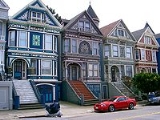
Gentrification

Encyclopedia
Gentrification and urban gentrification refer to the changes that result when wealthier people ("gentry") acquire or rent property in low income and working class communities. Urban gentrification is associated with movement
. Consequent to gentrification, the average income increases and average family size decreases in the community. It is commonly believed that this results in the poorer native residents of the neighborhood, being unable to pay increased rent
s, house prices, and property tax
es, being displaced. Often old industrial buildings are converted to residences and shops. In addition, new businesses, catering to a more affluent base of consumers, move in, further increasing the appeal to more affluent migrants and decreasing the accessibility to the poor.
Urban gentrification occasionally changes the culturally heterogeneous character of a community or neighborhood to a more economically homogeneous community that some describe as having a suburban character. This process is sometimes made feasible by government-sponsored private real estate investment repairing the local infrastructure
, via deferred taxes, mortgages for poor and for first-time house buyers, and financial incentives for the owners of decayed rental housing. Once in place, these economic development
actions tend to reduce local property crime, increase property values and prices, and increase tax revenues.
Political action, to either promote or oppose the gentrification, is often the community's response against unintended economic eviction caused by rising rents that make continued residence in their dwellings unfeasible. The rise in property values causes property tax
es based on property values to increase; resident owners unable to pay the taxes are forced to sell their dwellings and move to a cheaper community.
, which is derived from the Old French word genterise denoting "of gentle birth" (14th c.) and "people of gentle birth" (16th c.); which in England (Landed gentry
) denoted the social class
, consisting of "gentlemen". An early reference to the word "gentrification" can be found in "Memoirs and Proceedings of the Manchester Literary & Philosophical Society", written in 1888. In 1964 the British sociologist Ruth Glass
coined the term "gentrification" to denote the influx of middle-class people to cities and neighborhoods, displacing the lower-class worker residents; the example was London
, and its working-class districts such as Islington
:
In the US, the Centers for Disease Control and Prevention
report Health Effects of Gentrification defines the real estate
concept of gentrification as "the transformation of neighborhoods from low value to high value. This change has the potential to cause displacement of long-time residents and businesses ... when long-time or original neighborhood residents move from a gentrified area because of higher rents, mortgages, and property taxes. Gentrification is a housing, economic, and health issue that affects a community's history and culture and reduces social capital
. It often shifts a neighborhood's characteristics, e.g., racial-ethnic composition and household income, by adding new stores and resources in previously run-down neighborhoods."
In the Brookings Institution
report Dealing with Neighborhood Change: A Primer on Gentrification and Policy Choices (2001), Maureen Kennedy and Paul Leonard say that "the term 'gentrification' is both imprecise and quite politically charged", suggesting its redefinition as "the process by which higher income households displace lower income residents of a neighborhood, changing the essential character and flavor of that neighborhood", so distinguishing it from the different socio-economic process of "neighborhood (or urban) revitalization", although the terms are sometimes used interchangeably.
There are several approaches that attempt to explain the roots and the reasons behind the spread of gentrification. Bruce London and J. John Palen (1984) compiled a list of five explanations: (1) demographic-ecological, (2) sociocultural, (3) political-economical, (4) community networks, and (5) social movements.
The first theory, demographic-ecological, attempts to explain gentrification through the analysis of demographics: population, social organization, environment, and technology. This theory frequently refers to the growing number of people between the ages of 25 and 35 in the 1970s, or the baby boom generation. Because the number of people that sought housing increased, the demand for housing increased also. The supply could not keep up with the demand; therefore cities were "recycled" to meet such demands (London and Palen, 1984). The baby boomers in pursuit of housing were very different, demographically, from their house-hunting predecessors. They got married older, had fewer children, and the children they did have were born later. Women, both single and married, were entering the labor force at higher rates which led to an increase of dual wage-earner households. These households were typically composed of young, more affluent couples without children. Because these couples were child-free and were not concerned with the conditions of schools and playgrounds, they elected to live in the inner-city in close proximity to their jobs. These more affluent people usually had white-collar, not blue-collar jobs. Since these white-collar workers wanted to live closer to work, a neighborhood with more white-collar jobs was more likely to be invaded; the relationship between administrative activity and invasion was positively correlated (London and Palen, 1984).
The second theory proposed by London and Palen is based on a sociocultural explanation of gentrification. This theory argues that values, sentiments, attitudes, ideas, beliefs, and choices should be used to explain and predict human behavior, not demographics, or "structural units of analysis" (i.e., characteristics of populations) (London and Palen, 1984). This analysis focuses on the changing attitudes, lifestyles, and values of the middle- and upper-middle-class of the 1970s. They were becoming more pro-urban than before, opting not to live in rural or even suburban areas anymore. These new pro-urban values were becoming more salient, and more and more people began moving into the cities. London and Palen refer to the first people to invade the cities as "urban pioneers." These urban pioneers demonstrated that the inner-city was an "appropriate" and "viable" place to live, resulting in what is called "inner city chic" (London and Palen, 1984). The opposing side of this argument is that dominant, or recurring, American values determine where people decide to live, not the changing values previously cited. This means that people choose to live in a gentrified area to restore it, not to alter it, because restoration is a "new way to realize old values" (London and Palen, 1984).
The third theoretical explanation of gentrification is political-economic and is divided into two approaches: traditional and Marxist. The traditional approach argues that economic and political factors have led to the invasion of the inner-city, hence the name political-economic. The changing political and legal climate of the 1950s and 60s (new civil rights legislation, antidiscrimination laws in housing and employment, and desegregation) had an "unanticipated" role in the gentrification of neighborhoods. A decrease in prejudice led to more blacks moving to the suburbs and whites no longer rejected the idea of moving to the city. The decreasing availability of suburban land and inflation in suburban housing costs also inspired the invasion of the cities. The Marxist approach denies the notion that the political and economic influences on gentrification are invisible, but are intentional. This theory claims that "powerful interest groups follow a policy of neglect of the inner city until such time as they become aware that policy changes could yield tremendous profits" (London and Palen, 1984). Once the inner city becomes a source of revenue, the powerless residents are displaced with little or no regard from the powerful.
The community-network approach is the fourth proposed by London and Palen. This views the community as an "interactive social group." Two perspectives are noted: community lost and community saved. The community lost perspective argues that the role of the neighborhood is becoming more limited due to technological advances in transportation and communication. This means that the small-scale, local community is being replaced with more large-scale, political and social organizations (Greer, 1962). The opposing side, the community saved side, argues that community activity increases when neighborhoods are gentrified because these neighborhoods are being revitalized.
The fifth and final approach is social movements. This theoretical approach is focused on the analysis of ideologically based movements, usually in terms of leader-follower relationships. Those who support gentrification are encouraged by leaders (successful urban pioneers, political-economic elites, land developers, lending institutions, and even the Federal government in some instances) to revive the inner-city. Those who are in opposition are the people who currently reside in the deteriorated areas. They develop countermovements in order to gain the power necessary to defend themselves against the movements of the elite. These countermovements can be unsuccessful, though. The people who support reviving neighborhoods are also members, and their voices are the ones that the gentrifiers tend to hear (London and Palen, 1984).
an gentry
tire of the automobile-dependent urban sprawl
style of life; thus, professionals, empty nest
aged parents, and recent university graduates perceive the attractiveness of the city center — earlier abandoned during white flight
— especially if the poor community possesses a transport hub and its architecture sustains the pedestrian
traffic that allows the proper human relations impeded by (sub)urban sprawl.
, explaining gentrification as an economic
process consequent to the fluctuating relationships among capital
investments and the production of urban
space. Low rents in the city's periphery, during the two decades after the Second World War
(1939–1945), provoked continuous diversions of city housing capital for the development of suburb
s and rural areas. That spending of city money on suburbs then devalued
inner-city capital property, provoked the economic abandonment of the city in favor of peripheral rural property, consequently, the low price of inner-city land, relative to the high price of rural land. From this derives the Rent-gap Theory describing the disparity between "the actual capitalized ground rent (land price) of a plot of land given its present use, and the potential ground rent that might be gleaned under a 'higher and better' use".
The rent gap is fundamental to explaining gentrification as an economic process. When the gap is sufficiently wide, real estate developers, landlord
s, and other people with vested interests in the development of land perceive the potential profit
to be derived from re-investing in inner-city properties and redeveloping them for new tenants. Such redevelopment effectively closes the rent gap, leading to higher rents, mortgages, and lease rates affordable by the new tenants, but not by the original lower income tenants.
Furthermore, the de-industrialization of a city reduces the number of blue-collar jobs available to the urban working class
— lost investment capital needed to physically maintain the houses and buildings of the city. De-industrialization is often integral to the growth of a divided white collar
employment
tertiary sector of industry
, some of whom take the professional
and management
jobs that follow the spatial centralization of capital, i.e., corporation
s requiring that employees live near their workplace to reduce corporate decision-making time.
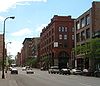 The consumption-side theory of urban gentrification posits that the "socio-cultural characteristics and motives" of the gentrifiers are most important to understanding the gentrification of the post-industrial city — characterised by an "employment profile focused on advanced services ... [a] profile that is materialized in a downtown skyline of office towers, arts and leisure sites, and political institutions. Its middle-class ambiance may be reflected in a distinctive politics, charged with a responsible social ethos ... the demand for more amenities, for greater beauty and a better quality of life in the arrangement of our cities".
As such, David Ley posits a rehabilitated post-industrial city influenced by a "new middle class
" containing a cultural sub-class denominated as a creative class
of artists, teachers, and cultural administrators. They are the first-stage gentrifiers economically preparing the inner city for gentrification — by introducing to the city the rich bourgeois
politics characterised by diminished public funding for housing affordable to middle- and low-income residents, draconian residency laws against the homeless and the poor displaced when "artists move into otherwise undesirable buildings, [and] usually make significant improvements to their spaces, and their surrounding areas. Everyone benefits from these tenuous and uneasy ... arrangements. Then, landlords becoming aware that they are sitting on gold mines, rush to cash in".
To wit, sociologist Sharon Zukin
reports the economic realities of the "artist loft" real estate business in Manhattan, when the owners of the building where she resided converted it to a "co-op"
administration in 1979, and she "bade good-bye to the manufacturers, an artist, and several residents who could not afford the market prices at which our lofts were sold". In the event, rich lawyers and accountants, retail business people and investment bankers replaced the suburban "starving artist" bohemian
"first-stage gentrifiers" who initiated the gentrification of Hell's Kitchen
, in mid-town New York City, Harlem
, Washington Heights
, Astoria
, and areas of West/Northwest Brooklyn
.
Professor Smith and Marxist sociologists explain gentrification as a structural
economic process; Ley explains gentrification as a natural outgrowth of increased professional employment in the central business district
(CBD), and the creative sub-class's predilection for city living. "Liberal Ideology and the Post-Industrial City" (1980) describes and deconstructs the TEAM committee's effort to rendering Vancouver, BC, Canada, a "livable city". The investigators Rose, Beauregard, Mullins, Moore et al., who base themselves upon Ley's ideas, posit that "gentrifiers and their social and cultural characteristics [are] of crucial importance for an understanding of gentrification" — theoretical work Chris Hamnett criticized as insufficiently comprehensive, for not incorporating the "supply of dwellings and the role of developers [and] speculators in the process".
of centralized, high-level services work — the "new urban economic core of banking and service activities that come to replace the older, typically manufacturing
-oriented, core" that displaces middle-class retail businesses so they might be "replaced by upmarket boutiques and restaurants catering to new high-income urban élites". In the context of globalization
, the city's importance is determined by its ability to function as a discrete socio-economic entity, given the lesser import of national borders, resulting in de-industrialized global cities and economic restructuring
.
To wit, the American urban theorist John Friedman's seven-part theory posits a bifurcated service industry in world cities
, composed of "a high percentage of professionals specialized in control functions and ... a vast army of low-skilled workers engaged in ... personal services ... [that] cater to the privileged classes, for those whose sake the world city primarily exists". The final three hypotheses detail (i) the increased immigration
of low-skill labourers needed to support the privileged classes, (ii) the class and caste conflict consequent to the city's inability to support the poor people who are the service class, and (iii) the world city
as a function of social class
struggle — matters expanded by Saskia Sassen
et al. The world city's inherent socio-economic inequality illustrates the causes of gentrification, reported in "Where Did They Go? The Decline of Middle-Income Neighborhoods in Metropolitan America" (2006) demonstrating geographical segregation
by income in US cities, wherein middle-income (middle class) neighborhoods decline, while poor neighborhoods and rich neighborhoods remain stable.
. From this perspective gentrification is merely the sociological reverse of white flight. The consumption-side theory of gentrification requires the existence of a service sector economic class of university-educated adults (aged 25–45) with disposable income who wish to live near their jobs in the city. This economic class arose when most Western economies transitioned from manufacturing
to post-industrial
service economies
.
Gentrification-increased property values are a positive economic development for cities when tax revenues increase consequent to increased property values, however existing residents experience the change as increased property tax
es. The increased taxes force many original property owners to either pay and stay (via higher rents for their tenants) or to sell and leave the gentrifying community. In gentrifying communities without strong rent-control laws poor residents are informally evicted when they cannot afford the increased rents. As a result, such economically limited people usually oppose gentrification.
, the phenomenon, called syrjäytyneiden akanvirta in Finnish
, meaning "migration of the disadvantaged" (literally "eddy
of the disadvantaged"), has begun at wider range in the beginning of 2000s, when living costs in larger cities have grown. The welfare support
isn't large enough to live in bigger cities when housing costs rise because housing situation is hard in the cities. Marginalized people have also many problems in living, so there is a constant fear of eviction from municipality-owned public housing
. People who are poor and suffer from many problems of controlling their lives, move out to private-owned housing very far away, where living is cheap. There are a number of businessmen who buy old school buildings and renovate them to housing: the businessmen then offer these apartments as "a place of last resort" for "difficult" cases that municipalities are reluctant to take into public housing apartments. Even the most marginalized people are welcomed to this kind of housing. Municipalities that have acknowledged the migration include Ilomantsi
, Luhanka
, Puolanka
, and Rääkkylä
.
 The suburban middle-class typically do not initiate gentrification of city neighborhoods; the process typically begins via "first-stage gentrifiers", economically and socially marginal "trend setters". Sociologically, these people are young and have low incomes while possessing the cultural capital
(education and a job), characteristic of the suburban bourgeois
. They often reside in communal (room-mate) households, and are more tolerant of the perceived evils of the city — crime, poor schools, insufficient public services, and few shops.
The gentrification of a city community proceeds when the number of trend-setters multiplies to the degree that business re-investment reappears in the form of the social amenities the bourgeoisie values — bars, restaurants, and commercial art galleries. The renewed business attracts other people of like socio-economic outlook, and investment capital follows, thus increasing local property values. Once the pioneer business entrepreneurs have taken the financial risk out of the gentrified city community the way is opened for more risk-averse investors and residents to enter the "new" city neighborhood. Upon full gentrification, the "first-stage gentrifiers" are often (informally) economically evicted via higher rents, mortgages and property taxes.
Urban gentrification does not always require the intermediate steps outlined. Central planning combined with investment can facilitate a more direct transition from under-development to gentrification as in the London Docklands, and other CBD
-adjacent urban renewal projects. The comprehensive redevelopment of the South Loop
in Chicago, Illinois in the US provides a pertinent example: government and large private developers invested in poor communities with capital sufficient to forgo the intermediate stages of gentrification, successfully stabilising a large area so that the middle class desired to live there.
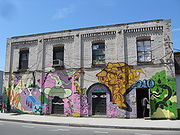
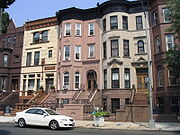
In the course of gentrification, an artist colony
in the city is transformed from a poor to a rich neighborhood when artists and sub-culture aficionados (e.g., hipster
s, hippie
s, et al.) live in poor neighborhoods of devalued real estate
, because of the low rents, central locale in the city proper, and "gritty" cultural "sense of authenticity", of being true to life. As the bohemian
character of the community grows, it appeals "not only to committed participants, but also to sporadic consumers" who eventually economically push out the earlier arrival sub-culture aficionados. Hence gentrification's economic eviction of hippies from the Greenwich Village, Manhattan, New York City, in the 1960s:
Throughout the 1960s and 1970s, Manhattan lofts in SoHo
were converted en masse into housing for artists and hippies, and then their sub-culture followers. As the price of living — and consequent social status — in those neighborhoods rose, the artists moved to Park Slope, Brooklyn
, Hoboken, New Jersey
and Williamsburg, Brooklyn
. Current areas of gentrification run the BMT Canarsie Line
( train) and IND Crosstown Line
( train) of the New York City Subway
system. Adjacent hipster enclaves include neighboring Bushwick, Bedford Stuyvesant and Flatbush
although these neighborhoods are also seeing higher rents. Similar gentrification occurred throughout the 1990s and 2000s in the East Village and the Lower East Side of New York City, economically pushing out theatres and performance-art spaces such as Collective:Unconscious, Surf Reality
, House of Candles, Piano's (Theater), and The Present Company
.
's seminal work about gay
men as "gentrifiers" in San Francisco, California, shows that "many gays were single men, did not have to raise a family, were young, and connected to a relatively prosperous service economy" is a pattern replicated in other North American cities. An illustration of this sociologic phenomenon is the film Quinceañera
(2006), directed by Richard Glatzer and Wash Westmoreland, containing a thematic sub-plot about the gentrification of the protagonists' inner-city neighborhood, Echo Park in Los Angeles, CA.
The documentary Flag Wars
(2003), directed by Linda Goode Bryant, shows the social, class, and gender tensions in the Old Towne East neighborhood in Columbus, Ohio, between an urban African-American community and the mostly white gays and lesbians moving in to the neighborhood, whom the original residents accused of gentrification and racism. In turn, the new residents accused the community of homophobia
.
In 2006, in Washington, D.C., a religious congregation in the black Shaw
neighborhood opposed the granting of a liquor license
to a gay bar
that was to open across the street from the church. The bar was successfully opened and has since been replaced by another gay bar at the same location.
Gay people are not always the gentrifiers: real estate valuation trends can push out poor gay people, as in the Polk District in San Francisco: radical gay
activists saw the value of a poor neighborhood as refuge for the economically and socially marginal.
themselves to develop the necessary socio-political strategies required to retain local affordable housing; many such organizations arose in the 1960s, and used the pragmatic
tactics advocated by Saul Alinsky
(1909–1972). In the late 1960s, the Young Lords
Chicago street gang — who were politically active in the then-Puerto Rican neighborhood of Lincoln Park
— practiced the direct-action techniques of sit-in protests and occupying vacant community lands. In Miami, Florida
, the Liberty City community organization "Take Back the Land" seized empty lands and built the Umoja Village
shantytown for the community's homeless people in October 2006. Like-wise, other communities established community development corporation
s that include the residents in actively developing their neighborhoods.
and arson
targeting the property of the gentrifiers. During the dot-com boom of the late 1990s, the gentrification of San Francisco's predominantly working class Mission District led some long-term neighborhood residents to create what they called the "Mission Yuppie Eradication Project." This group allegedly destroyed property and called for property destruction as part of a strategy to oppose gentrification. Their activities drew hostile responses from the San Francisco Police Department
, real estate interests, and "work-within-the-system" housing activists.
Meibion Glyndŵr (Welsh
: Sons of Glyndŵr
) was a Welsh nationalist movement violently opposed to the loss of Welsh culture and language
. They were formed in response to the housing crisis precipitated by large numbers of second homes being bought by the English which had pushed up house prices beyond the means of many locals. They were responsible for setting fire to English
-owned holiday homes in Wales
from 1979 to the mid 1990s. In the first wave of attacks, eight English-owned holiday homes were destroyed within the space of a month. In 1980 Welsh Police carried out a series of raids in Operation Tân
. Within the next ten years around 220 properties were damaged by the campaign. Since the mid-1990s the group has been inactive and Welsh nationalist violence has ceased.
to the fore of the community's politics. Cities, municipalities, and counties have countered gentrification with inclusionary zoning
(inclusionary housing) ordinances
requiring the apportionment of some new housing for the community's original low- and moderate-income residents. Because inclusionary zoning
is a new social
concept, there are few reports qualifying its effective or ineffective limitation of gentrification. In Los Angeles, California, inclusionary zoning apparently accelerated gentrification, as older, unprofitable buildings were razed and replaced with mostly high-rent housing, and a small percentage of affordable housing; the net result was less affordable housing.
of the community's poorer residents, another detrimental aspect of gentrification is its negative economic impact upon the community's commerce. Often, a neighborhood in mid-gentrification has marketable artist colony cachet that renders it popular, because of its nightlife, light industry, and arts-and-crafts businesses. In the event, the (ex-suburban) new-resident gentry
complain to local government about the artist-colony "noise", pressuring the authorities to impose financially onerous noise-limitation requirements that eventually (and informally) evict said urban pioneer businesses. In New Zealand
, this practice is called reverse sensitivity
, a novel approach whereby the local gentry
use land-use zones to identify feasible "reverse sensitivity" matters, i.e., "noisy neighbors" who then must meet zoning requirements mitigating their noise, or leave.
Zoning ordinances and other urban planning
tools can also be used to recognize and support local business and industries. This can include requiring developers to continue with a current commercial tenant or offering development incentives for keeping existing businesses, as well as creating and maintaining industrial zones. Designing zoning to allow new housing near to a commercial corridor but not on top of it increases foot traffic to local businesses without redeveloping them. Businesses can become more stable by securing long-term commercial leases.
tends to raise property values, removing real estate (houses, buildings, land) from the open market stabilises property values, and thereby prevents the economic eviction of the community's poorer residents. The most common, formal legal
mechanism for such stability is the community land trust
; moreover, many inclusionary zoning
ordinances formally place the "inclusionary" housing units in a land trust
.
regulations. Rent control restricts the rent that can be charged, so that incumbent tenants are not forced out by rising rents. If applicable to private landlords, it is a disincentive to speculating with property values, reduces the incidence of dwellings left empty, and limits availability of housing for new residents. If the law does not restrict the rent charged for dwellings that come onto the rental market (formerly owner-occupied or new build), rents in an area can still increase. The cities of southwestern Santa Monica
and eastern West Hollywood
in California
, United States gentrified despite — or perhaps, because of — rent control.
Occasionally, a housing black market develops, wherein landlords withdraw houses and apartments from the market, making them available only upon payment of additional key money
, fees, or bribes — thus undermining the rent control law. Many such laws allow "vacancy decontrol", releasing a dwelling from rent control upon the tenant's leaving — resulting in steady losses of rent-controlled housing, ultimately rendering rent control laws ineffective in communities with a high rate of resident turnover. In other cases social housing owned by local authorities may be sold to tenants
and then sold on. Vacancy decontrol encourages landlords to find ways of shortening their residents' tenure, most aggressively through landlord harassment
. To strengthen the rent control laws of New York City, New York, housing advocates active in rent control in New York
are attempting to repeal the vacancy decontrol clauses of rent control laws. The state of Massachusetts
abolished rent control in 1994; afterwards, rents rose, accelerating the pace of Boston
's gentrification; however, the laws protected few apartments, and confounding factors, such as a strong economy, had already been raising housing and rental prices.
Sharon Zukin
reports an apparently contradictory "Artistic Mode of Production", wherein patrician capitalists seek to increase the property values (i.e., gentrify) city communities by economically recruiting and retaining artists to reside in, and commercially occupy, the industrial
buildings (usually) converted into an "artist's loft complex". First renting to urban pioneer "poor artists" develops the marketable
artist colony cachet that appeals to suburban gentry
seeking to buy a city dwelling; the gentrification imparts a commercially
"hip" ambience to the surrounding community; in the event, property values rise.
Worldwide, cities with blighted communities effected public policy
using this economic development
model in poor neighborhoods; in the UK, the governments of Newcastle-upon-Tyne and Liverpool
, via their regional development agencies
, and in partnerships with private real estate speculators
, attempted to artificially stimulate gentrification as urban renewal
. In the US, the Jackson City, Michigan
, city council re-developed a closed nineteenth-century state prison building-complex with affordable housing
in the jail-house proper, and artist-loft spaces in the other buildings of the complex.
Economically, US municipal governments use tax increment financing
(TIF) to rehabilitate decayed city communities with real estate development partnerships, between the municipal governments and public-private partnership
s and non-profit organizations, and so offer subsidized
, discounted-interest-rate mortgages
to artists who buy property and reside in neighborhoods being gentrified, e.g., the Paducah Artist Relocation Program of Paducah
, Kentucky
. Per the TIF economic development
model, the infrastructure improvements, public subsidies to private business, and consequent high property values, should encourage additional private real estate investment to the once-blighted urban community. The government re-activates the economy of the poor community with a TIF program that rehabilitates the infrastructure
of the neighborhoods being gentrified; resultantly, property values and property tax revenues would rise. Moreover, for a fixed number of years, all of the TIF program-generated increased tax-revenues are paid to the TIF program-administration agency; to be spent only for improving the gentrified TIF district, and usually paid to the private real estate developer (a TIF program partner) responsible for improvements.
the shop-free forum was developed during the Roman Republic
an period, and in second- and third-century cities in Roman Britain
there is evidence of small shops being replaced by large villas
.
King's College London
academic Loretta Lees reported that much of inner-city London
was undergoing "super-gentrification", where "a new group of super-wealthy professionals, working in the City of London
, is slowly imposing its mark on this Inner London housing market, in a way that differentiates it, and them, from traditional gentrifiers, and from the traditional urban upper classes ... Super-gentrification is quite different from the classical version of gentrification. It's of a higher economic order; you need a much higher salary and bonuses to live in Barnsbury
" (some two miles north of central London).
Barnsbury was built around 1820, as a middle-class suburb
, but after the Second World War
(1939–1945), people moved to the suburbs. The upper and middle classes were fleeing from the working class
residents of London; the modern railway allowed it. At war's end, the great housing demand rendered Barnsbury the place of cheap housing, where most people shared accommodation
. In the late 1950s and early 1960s, people moving into the area had to finance house renovations with their money, because banks rarely financed loans for Barnsbury. Moreover, the rehabilitating spark was The 1959 Housing Purchase and Housing Act, investing £100 million to rehabilitating old properties and infrastructure
. Resultantly, the principal population influx occurred between 1961 and 1975; the UK Census reports that "between the years of 1961 and 1981, owner-occupation increased from 7 to 19 per cent, furnished rentals declined from 14 to 7 per cent, and unfurnished rentals declined from 61 to 6 per cent"; another example of urban gentrification is the super-gentrification, in the 1990s, of the neighbouring working-class London Borough
of Islington
, where Prime minister
Tony Blair
moved upon his election in 1997.
neighborhood. Darien Street was a "back street", because it did not (and does not) connect to any of the city's main arteries, and it was unpaved for most of its existence.
In its early days, Darien Street housed only Italian families, however, after the Second World War
(1939–1945), when the municipal government spoke of building a cross-town highway, the families moved out. In Darien Street, most of the houses date from 1885 (built for the artisans and craftsmen who worked and lived in the area), but, when the Italian Americans moved out, the community's low-rent houses went to poor Black American families. Moreover, by the early 1970s, blighted Darien Street was at its lowest point as a community, because the houses held little property value, many were abandoned, having broken heaters and collapsed roofs, et cetera. Furthermore, the houses were very small — approximately 15 feet (4.6 m) wide and 15 feet (4.6 m) deep, each had three one-room stories (locally known, and still currently advertised as a "Trinity" style house,) and the largest yard was 8 feet (2.4 m) deep. Despite the decay, Darien Street remained charmed with European echoes, each house was architecturally
different, contributing to the street's community character; children were safe, there was no car traffic. The closeness of the houses generated a closely knit community located just to the south of Center City
, an inexpensive residential neighborhood a short distance from the city-life amenities of Philadelphia; the city government did not hesitate to rehabilitate
it.
The gentrification began in 1977, the first house rehabilitated was a corner property that a school teacher re-modeled and occupied. The next years featured (mostly) white middle-class men moving into the abandoned houses; the first displacement of original Darien Street residents occurred in 1979. Two years later, five of seven families had been economically evicted with inflated housing prices; the two remaining families were renters, expecting eventual displacement. In five years, from 1977 to 1982, the gentrification of Darien Street reduced the original population from seven Black American households and one white household, to two Black households and eleven white households. The average rent increased 488 per cent — from $85 to $500 a month; by 1981, a house bought for $5,000 sold for $35,000. Of the five Black households displaced, three found better houses within two blocks of their original residence, one family left Pennsylvania, and one family moved into a public housing
apartment building five blocks from Darien Street. The benefits of the Darien Street gentrification included increased property tax revenues and better-quality housing. The principal detriment was residential displacement via higher priced housing.
, meaning "migration of the disadvantaged" (literally "eddy
of the disadvantaged"), has begun at wider range in the beginning of 2000s, when living costs in larger growth center cities have grown. The social support is not large enough to live in bigger cities when housing costs rise because housing situation is hard in the cities. Marginalized people have also many problems in living, so there is a constant fear of eviction from municipality-owned public housing
. People who are poor and suffer from many problems of controlling their lives, move out to cheap private-owned housing very far away, where living is cheap. There are a number of businessmen, who buy old school buildings and renovate them to housing. The businessmen then offer these apartments as "a place of last resort" for "difficult" cases, that municipalities are reluctant to take into public housing apartments. Even the most marginalized people are welcomed to this kind of housing.
The following municipalities have acknowledged the migration: Ilomantsi
, Luhanka
, Puolanka
and Rääkkylä
.
pocket of Cape Town
nestles against the slopes of Signal Hill. It has traditionally been occupied by members of South Africa's minority, mainly Muslim, Cape Malay community. These descendants of slaves, artisans and indentured workers, brought to the Cape as early as the 18th century, were housed in small barrack-like abodes on what used to be the outskirts of town. As the city limits increased, property in the Bo-Kaap became very sought after, not only for its location but also for its picturesque cobble-streets and narrow avenues. Increasingly, this close-knit community is "facing a slow dissolution of its distinctive character as wealthy outsiders move into the suburb to snap up homes in the City Bowl at cut-rate prices". Inter-community conflict has also arisen as some residents object to the sale of buildings and the resultant eviction of long-term residents.
Again we see the eternal confrontation: between heritage conservation and "speculative development" of a city. Since the last century, the people of Cabanyal have lived with the threat of the expansion of Blasco Ibáñez Avenue. With the construction of the railway station in Serrería Avenue, we felt that history of this avenue ended. It was the desired connection of Valencia with Sea Villages.
On July 24, 1998, in the congress of Valencia Council, the Popular Party, with its majority, approved the draft of extending Blasco Ibáñez Av. to the sea. The project involves the destruction of 1,651 homes and destruction of urban grid of Cabanyal–Canyamelar, a neighborhood declared Property with Cultural Interest. This project splits the former village into two halves completely isolated from each other.
The project of extending Blasco Ibáñez Avenue to the sea destroys a historic set of ancient buildings. Furthermore, the project also destroys a way of life, of social and human relationships, a culture of special character because of its relationship with the sea.
Since then the neighbors of Cabanyal–Canyamelar–Cap de França have not stopped fighting for their rights and homes, requesting a Plan of Conservation and Rehabilitation of the district without any response by the municipality of Valencia, which has not even agreed to meet the representatives from the neighborhood.
The citizen platform Salvem el Cabanyal tries to stop this gentrification process.
Population mobility
Population mobility, geographic mobility or more simply mobility is a statistic that measures migration within a population. It is most commonly used in demography and human geography, it may also be used to describe the movement of animals between populations.Mobility estimates in the Current...
. Consequent to gentrification, the average income increases and average family size decreases in the community. It is commonly believed that this results in the poorer native residents of the neighborhood, being unable to pay increased rent
Renting
Renting is an agreement where a payment is made for the temporary use of a good, service or property owned by another. A gross lease is when the tenant pays a flat rental amount and the landlord pays for all property charges regularly incurred by the ownership from landowners...
s, house prices, and property tax
Property tax
A property tax is an ad valorem levy on the value of property that the owner is required to pay. The tax is levied by the governing authority of the jurisdiction in which the property is located; it may be paid to a national government, a federated state or a municipality...
es, being displaced. Often old industrial buildings are converted to residences and shops. In addition, new businesses, catering to a more affluent base of consumers, move in, further increasing the appeal to more affluent migrants and decreasing the accessibility to the poor.
Urban gentrification occasionally changes the culturally heterogeneous character of a community or neighborhood to a more economically homogeneous community that some describe as having a suburban character. This process is sometimes made feasible by government-sponsored private real estate investment repairing the local infrastructure
Infrastructure
Infrastructure is basic physical and organizational structures needed for the operation of a society or enterprise, or the services and facilities necessary for an economy to function...
, via deferred taxes, mortgages for poor and for first-time house buyers, and financial incentives for the owners of decayed rental housing. Once in place, these economic development
Economic development
Economic development generally refers to the sustained, concerted actions of policymakers and communities that promote the standard of living and economic health of a specific area...
actions tend to reduce local property crime, increase property values and prices, and increase tax revenues.
Political action, to either promote or oppose the gentrification, is often the community's response against unintended economic eviction caused by rising rents that make continued residence in their dwellings unfeasible. The rise in property values causes property tax
Property tax
A property tax is an ad valorem levy on the value of property that the owner is required to pay. The tax is levied by the governing authority of the jurisdiction in which the property is located; it may be paid to a national government, a federated state or a municipality...
es based on property values to increase; resident owners unable to pay the taxes are forced to sell their dwellings and move to a cheaper community.
Origin and etymology
Gentrification has happened since ancient times; in Britain large villas were replacing small shops by the third century. The word gentrification is of much later origin. It derives from gentryGentry
Gentry denotes "well-born and well-bred people" of high social class, especially in the past....
, which is derived from the Old French word genterise denoting "of gentle birth" (14th c.) and "people of gentle birth" (16th c.); which in England (Landed gentry
Landed gentry
Landed gentry is a traditional British social class, consisting of land owners who could live entirely off rental income. Often they worked only in an administrative capacity looking after the management of their own lands....
) denoted the social class
Social class
Social classes are economic or cultural arrangements of groups in society. Class is an essential object of analysis for sociologists, political scientists, economists, anthropologists and social historians. In the social sciences, social class is often discussed in terms of 'social stratification'...
, consisting of "gentlemen". An early reference to the word "gentrification" can be found in "Memoirs and Proceedings of the Manchester Literary & Philosophical Society", written in 1888. In 1964 the British sociologist Ruth Glass
Ruth Glass
Ruth Glass was a German-born British sociologist.Glass's work reflected her belief "that the purpose of sociological research was to influence government policy and bring about social change"...
coined the term "gentrification" to denote the influx of middle-class people to cities and neighborhoods, displacing the lower-class worker residents; the example was London
London
London is the capital city of :England and the :United Kingdom, the largest metropolitan area in the United Kingdom, and the largest urban zone in the European Union by most measures. Located on the River Thames, London has been a major settlement for two millennia, its history going back to its...
, and its working-class districts such as Islington
Islington
Islington is a neighbourhood in Greater London, England and forms the central district of the London Borough of Islington. It is a district of Inner London, spanning from Islington High Street to Highbury Fields, encompassing the area around the busy Upper Street...
:
In the US, the Centers for Disease Control and Prevention
Centers for Disease Control and Prevention
The Centers for Disease Control and Prevention are a United States federal agency under the Department of Health and Human Services headquartered in Druid Hills, unincorporated DeKalb County, Georgia, in Greater Atlanta...
report Health Effects of Gentrification defines the real estate
Real estate
In general use, esp. North American, 'real estate' is taken to mean "Property consisting of land and the buildings on it, along with its natural resources such as crops, minerals, or water; immovable property of this nature; an interest vested in this; an item of real property; buildings or...
concept of gentrification as "the transformation of neighborhoods from low value to high value. This change has the potential to cause displacement of long-time residents and businesses ... when long-time or original neighborhood residents move from a gentrified area because of higher rents, mortgages, and property taxes. Gentrification is a housing, economic, and health issue that affects a community's history and culture and reduces social capital
Social capital
Social capital is a sociological concept, which refers to connections within and between social networks. The concept of social capital highlights the value of social relations and the role of cooperation and confidence to get collective or economic results. The term social capital is frequently...
. It often shifts a neighborhood's characteristics, e.g., racial-ethnic composition and household income, by adding new stores and resources in previously run-down neighborhoods."
In the Brookings Institution
Brookings Institution
The Brookings Institution is a nonprofit public policy organization based in Washington, D.C., in the United States. One of Washington's oldest think tanks, Brookings conducts research and education in the social sciences, primarily in economics, metropolitan policy, governance, foreign policy, and...
report Dealing with Neighborhood Change: A Primer on Gentrification and Policy Choices (2001), Maureen Kennedy and Paul Leonard say that "the term 'gentrification' is both imprecise and quite politically charged", suggesting its redefinition as "the process by which higher income households displace lower income residents of a neighborhood, changing the essential character and flavor of that neighborhood", so distinguishing it from the different socio-economic process of "neighborhood (or urban) revitalization", although the terms are sometimes used interchangeably.
There are several approaches that attempt to explain the roots and the reasons behind the spread of gentrification. Bruce London and J. John Palen (1984) compiled a list of five explanations: (1) demographic-ecological, (2) sociocultural, (3) political-economical, (4) community networks, and (5) social movements.
The first theory, demographic-ecological, attempts to explain gentrification through the analysis of demographics: population, social organization, environment, and technology. This theory frequently refers to the growing number of people between the ages of 25 and 35 in the 1970s, or the baby boom generation. Because the number of people that sought housing increased, the demand for housing increased also. The supply could not keep up with the demand; therefore cities were "recycled" to meet such demands (London and Palen, 1984). The baby boomers in pursuit of housing were very different, demographically, from their house-hunting predecessors. They got married older, had fewer children, and the children they did have were born later. Women, both single and married, were entering the labor force at higher rates which led to an increase of dual wage-earner households. These households were typically composed of young, more affluent couples without children. Because these couples were child-free and were not concerned with the conditions of schools and playgrounds, they elected to live in the inner-city in close proximity to their jobs. These more affluent people usually had white-collar, not blue-collar jobs. Since these white-collar workers wanted to live closer to work, a neighborhood with more white-collar jobs was more likely to be invaded; the relationship between administrative activity and invasion was positively correlated (London and Palen, 1984).
The second theory proposed by London and Palen is based on a sociocultural explanation of gentrification. This theory argues that values, sentiments, attitudes, ideas, beliefs, and choices should be used to explain and predict human behavior, not demographics, or "structural units of analysis" (i.e., characteristics of populations) (London and Palen, 1984). This analysis focuses on the changing attitudes, lifestyles, and values of the middle- and upper-middle-class of the 1970s. They were becoming more pro-urban than before, opting not to live in rural or even suburban areas anymore. These new pro-urban values were becoming more salient, and more and more people began moving into the cities. London and Palen refer to the first people to invade the cities as "urban pioneers." These urban pioneers demonstrated that the inner-city was an "appropriate" and "viable" place to live, resulting in what is called "inner city chic" (London and Palen, 1984). The opposing side of this argument is that dominant, or recurring, American values determine where people decide to live, not the changing values previously cited. This means that people choose to live in a gentrified area to restore it, not to alter it, because restoration is a "new way to realize old values" (London and Palen, 1984).
The third theoretical explanation of gentrification is political-economic and is divided into two approaches: traditional and Marxist. The traditional approach argues that economic and political factors have led to the invasion of the inner-city, hence the name political-economic. The changing political and legal climate of the 1950s and 60s (new civil rights legislation, antidiscrimination laws in housing and employment, and desegregation) had an "unanticipated" role in the gentrification of neighborhoods. A decrease in prejudice led to more blacks moving to the suburbs and whites no longer rejected the idea of moving to the city. The decreasing availability of suburban land and inflation in suburban housing costs also inspired the invasion of the cities. The Marxist approach denies the notion that the political and economic influences on gentrification are invisible, but are intentional. This theory claims that "powerful interest groups follow a policy of neglect of the inner city until such time as they become aware that policy changes could yield tremendous profits" (London and Palen, 1984). Once the inner city becomes a source of revenue, the powerless residents are displaced with little or no regard from the powerful.
The community-network approach is the fourth proposed by London and Palen. This views the community as an "interactive social group." Two perspectives are noted: community lost and community saved. The community lost perspective argues that the role of the neighborhood is becoming more limited due to technological advances in transportation and communication. This means that the small-scale, local community is being replaced with more large-scale, political and social organizations (Greer, 1962). The opposing side, the community saved side, argues that community activity increases when neighborhoods are gentrified because these neighborhoods are being revitalized.
The fifth and final approach is social movements. This theoretical approach is focused on the analysis of ideologically based movements, usually in terms of leader-follower relationships. Those who support gentrification are encouraged by leaders (successful urban pioneers, political-economic elites, land developers, lending institutions, and even the Federal government in some instances) to revive the inner-city. Those who are in opposition are the people who currently reside in the deteriorated areas. They develop countermovements in order to gain the power necessary to defend themselves against the movements of the elite. These countermovements can be unsuccessful, though. The people who support reviving neighborhoods are also members, and their voices are the ones that the gentrifiers tend to hear (London and Palen, 1984).
Causes
Two discrete, sociologic theories explain and justify gentrification as an economic process (production-side theory) and as a social process (consumption-side theory) that occurs when the suburbSuburb
The word suburb mostly refers to a residential area, either existing as part of a city or as a separate residential community within commuting distance of a city . Some suburbs have a degree of administrative autonomy, and most have lower population density than inner city neighborhoods...
an gentry
Gentry
Gentry denotes "well-born and well-bred people" of high social class, especially in the past....
tire of the automobile-dependent urban sprawl
Urban sprawl
Urban sprawl, also known as suburban sprawl, is a multifaceted concept, which includes the spreading outwards of a city and its suburbs to its outskirts to low-density and auto-dependent development on rural land, high segregation of uses Urban sprawl, also known as suburban sprawl, is a...
style of life; thus, professionals, empty nest
Empty nest syndrome
Empty nest syndrome is a general feeling of loneliness that parents or guardians may feel when one or more of their children leave home; it is more common in women...
aged parents, and recent university graduates perceive the attractiveness of the city center — earlier abandoned during white flight
White flight
White flight has been a term that originated in the United States, starting in the mid-20th century, and applied to the large-scale migration of whites of various European ancestries from racially mixed urban regions to more racially homogeneous suburban or exurban regions. It was first seen as...
— especially if the poor community possesses a transport hub and its architecture sustains the pedestrian
Pedestrian
A pedestrian is a person traveling on foot, whether walking or running. In some communities, those traveling using roller skates or skateboards are also considered to be pedestrians. In modern times, the term mostly refers to someone walking on a road or footpath, but this was not the case...
traffic that allows the proper human relations impeded by (sub)urban sprawl.
Production-side theory
The production-side theory of urban gentrification derives from the work of Professor Neil SmithNeil Smith (geographer)
Neil Smith was born 1954 in Leith, Scotland. he is a Distinguished Professor of Anthropology and Geography, at the Graduate Center department of the City University of New York. From 2008 he holds a twenty percent appointment as Sixth Century Professor of Geography and Social Theory, at the...
, explaining gentrification as an economic
Economics
Economics is the social science that analyzes the production, distribution, and consumption of goods and services. The term economics comes from the Ancient Greek from + , hence "rules of the house"...
process consequent to the fluctuating relationships among capital
Capital (economics)
In economics, capital, capital goods, or real capital refers to already-produced durable goods used in production of goods or services. The capital goods are not significantly consumed, though they may depreciate in the production process...
investments and the production of urban
Urban area
An urban area is characterized by higher population density and vast human features in comparison to areas surrounding it. Urban areas may be cities, towns or conurbations, but the term is not commonly extended to rural settlements such as villages and hamlets.Urban areas are created and further...
space. Low rents in the city's periphery, during the two decades after the Second World War
World War II
World War II, or the Second World War , was a global conflict lasting from 1939 to 1945, involving most of the world's nations—including all of the great powers—eventually forming two opposing military alliances: the Allies and the Axis...
(1939–1945), provoked continuous diversions of city housing capital for the development of suburb
Suburb
The word suburb mostly refers to a residential area, either existing as part of a city or as a separate residential community within commuting distance of a city . Some suburbs have a degree of administrative autonomy, and most have lower population density than inner city neighborhoods...
s and rural areas. That spending of city money on suburbs then devalued
Devaluation
Devaluation is a reduction in the value of a currency with respect to those goods, services or other monetary units with which that currency can be exchanged....
inner-city capital property, provoked the economic abandonment of the city in favor of peripheral rural property, consequently, the low price of inner-city land, relative to the high price of rural land. From this derives the Rent-gap Theory describing the disparity between "the actual capitalized ground rent (land price) of a plot of land given its present use, and the potential ground rent that might be gleaned under a 'higher and better' use".
The rent gap is fundamental to explaining gentrification as an economic process. When the gap is sufficiently wide, real estate developers, landlord
Landlord
A landlord is the owner of a house, apartment, condominium, or real estate which is rented or leased to an individual or business, who is called a tenant . When a juristic person is in this position, the term landlord is used. Other terms include lessor and owner...
s, and other people with vested interests in the development of land perceive the potential profit
Profit (economics)
In economics, the term profit has two related but distinct meanings. Normal profit represents the total opportunity costs of a venture to an entrepreneur or investor, whilst economic profit In economics, the term profit has two related but distinct meanings. Normal profit represents the total...
to be derived from re-investing in inner-city properties and redeveloping them for new tenants. Such redevelopment effectively closes the rent gap, leading to higher rents, mortgages, and lease rates affordable by the new tenants, but not by the original lower income tenants.
Furthermore, the de-industrialization of a city reduces the number of blue-collar jobs available to the urban working class
Working class
Working class is a term used in the social sciences and in ordinary conversation to describe those employed in lower tier jobs , often extending to those in unemployment or otherwise possessing below-average incomes...
— lost investment capital needed to physically maintain the houses and buildings of the city. De-industrialization is often integral to the growth of a divided white collar
White-collar worker
The term white-collar worker refers to a person who performs professional, managerial, or administrative work, in contrast with a blue-collar worker, whose job requires manual labor...
employment
Employment
Employment is a contract between two parties, one being the employer and the other being the employee. An employee may be defined as:- Employee :...
tertiary sector of industry
Tertiary sector of industry
The tertiary sector of the economy is one of the three economic sectors, the others being the secondary sector and the primary sector .The service sector consists of the "soft" parts of the economy, i.e...
, some of whom take the professional
Professional
A professional is a person who is paid to undertake a specialised set of tasks and to complete them for a fee. The traditional professions were doctors, lawyers, clergymen, and commissioned military officers. Today, the term is applied to estate agents, surveyors , environmental scientists,...
and management
Management
Management in all business and organizational activities is the act of getting people together to accomplish desired goals and objectives using available resources efficiently and effectively...
jobs that follow the spatial centralization of capital, i.e., corporation
Corporation
A corporation is created under the laws of a state as a separate legal entity that has privileges and liabilities that are distinct from those of its members. There are many different forms of corporations, most of which are used to conduct business. Early corporations were established by charter...
s requiring that employees live near their workplace to reduce corporate decision-making time.
Consumption-side theory
As such, David Ley posits a rehabilitated post-industrial city influenced by a "new middle class
Middle class
The middle class is any class of people in the middle of a societal hierarchy. In Weberian socio-economic terms, the middle class is the broad group of people in contemporary society who fall socio-economically between the working class and upper class....
" containing a cultural sub-class denominated as a creative class
Creative class
The Creative Class is a socioeconomic class that economist and social scientist Richard Florida, a professor and head of the Martin Prosperity Institute at the Rotman School of Management at the University of Toronto, identifies as a key driving force for economic development of post-industrial...
of artists, teachers, and cultural administrators. They are the first-stage gentrifiers economically preparing the inner city for gentrification — by introducing to the city the rich bourgeois
Bourgeoisie
In sociology and political science, bourgeoisie describes a range of groups across history. In the Western world, between the late 18th century and the present day, the bourgeoisie is a social class "characterized by their ownership of capital and their related culture." A member of the...
politics characterised by diminished public funding for housing affordable to middle- and low-income residents, draconian residency laws against the homeless and the poor displaced when "artists move into otherwise undesirable buildings, [and] usually make significant improvements to their spaces, and their surrounding areas. Everyone benefits from these tenuous and uneasy ... arrangements. Then, landlords becoming aware that they are sitting on gold mines, rush to cash in".
To wit, sociologist Sharon Zukin
Sharon Zukin
Sharon Zukin is a professor of sociology at Brooklyn College and the Graduate Center, City University of New York, who specializes in modern urban life. She writes about culture and real estate in New York City, and has also examines consumer society and culture, the new economic order in the...
reports the economic realities of the "artist loft" real estate business in Manhattan, when the owners of the building where she resided converted it to a "co-op"
Cooperative
A cooperative is a business organization owned and operated by a group of individuals for their mutual benefit...
administration in 1979, and she "bade good-bye to the manufacturers, an artist, and several residents who could not afford the market prices at which our lofts were sold". In the event, rich lawyers and accountants, retail business people and investment bankers replaced the suburban "starving artist" bohemian
Bohemianism
Bohemianism is the practice of an unconventional lifestyle, often in the company of like-minded people, with few permanent ties, involving musical, artistic or literary pursuits...
"first-stage gentrifiers" who initiated the gentrification of Hell's Kitchen
Hell's Kitchen, Manhattan
Hell's Kitchen, also known as Clinton and Midtown West, is a neighborhood of Manhattan in New York City between 34th Street and 59th Street, from 8th Avenue to the Hudson River....
, in mid-town New York City, Harlem
Harlem
Harlem is a neighborhood in the New York City borough of Manhattan, which since the 1920s has been a major African-American residential, cultural and business center. Originally a Dutch village, formally organized in 1658, it is named after the city of Haarlem in the Netherlands...
, Washington Heights
Washington Heights, Manhattan
Washington Heights is a New York City neighborhood in the northern reaches of the borough of Manhattan. It is named for Fort Washington, a fortification constructed at the highest point on Manhattan island by Continental Army troops during the American Revolutionary War, to defend the area from the...
, Astoria
Astoria, Queens
Astoria is a neighborhood in the northwestern corner of the borough of Queens in New York City. Located in Community Board 1, Astoria is bounded by the East River and is adjacent to three other Queens neighborhoods: Long Island City, Sunnyside , and Woodside...
, and areas of West/Northwest Brooklyn
Brooklyn
Brooklyn is the most populous of New York City's five boroughs, with nearly 2.6 million residents, and the second-largest in area. Since 1896, Brooklyn has had the same boundaries as Kings County, which is now the most populous county in New York State and the second-most densely populated...
.
Professor Smith and Marxist sociologists explain gentrification as a structural
Structuralism
Structuralism originated in the structural linguistics of Ferdinand de Saussure and the subsequent Prague and Moscow schools of linguistics. Just as structural linguistics was facing serious challenges from the likes of Noam Chomsky and thus fading in importance in linguistics, structuralism...
economic process; Ley explains gentrification as a natural outgrowth of increased professional employment in the central business district
Central business district
A central business district is the commercial and often geographic heart of a city. In North America this part of a city is commonly referred to as "downtown" or "city center"...
(CBD), and the creative sub-class's predilection for city living. "Liberal Ideology and the Post-Industrial City" (1980) describes and deconstructs the TEAM committee's effort to rendering Vancouver, BC, Canada, a "livable city". The investigators Rose, Beauregard, Mullins, Moore et al., who base themselves upon Ley's ideas, posit that "gentrifiers and their social and cultural characteristics [are] of crucial importance for an understanding of gentrification" — theoretical work Chris Hamnett criticized as insufficiently comprehensive, for not incorporating the "supply of dwellings and the role of developers [and] speculators in the process".
Economic globalization
Gentrification is integral to the new economyNew Economy
The New Economy is a term to describe the result of the transition from a manufacturing-based economy to a service-based economy. This particular use of the term was popular during the Dot-com bubble of the late 1990s...
of centralized, high-level services work — the "new urban economic core of banking and service activities that come to replace the older, typically manufacturing
Manufacturing
Manufacturing is the use of machines, tools and labor to produce goods for use or sale. The term may refer to a range of human activity, from handicraft to high tech, but is most commonly applied to industrial production, in which raw materials are transformed into finished goods on a large scale...
-oriented, core" that displaces middle-class retail businesses so they might be "replaced by upmarket boutiques and restaurants catering to new high-income urban élites". In the context of globalization
Globalization
Globalization refers to the increasingly global relationships of culture, people and economic activity. Most often, it refers to economics: the global distribution of the production of goods and services, through reduction of barriers to international trade such as tariffs, export fees, and import...
, the city's importance is determined by its ability to function as a discrete socio-economic entity, given the lesser import of national borders, resulting in de-industrialized global cities and economic restructuring
Economic restructuring
Economic restructuring refers to the phenomenon of Western urban areas shifting from a manufacturing to a service sector economic base. This transformation has affected demographics including income distribution, employment, and social hierarchy; institutional arrangements including the growth of...
.
To wit, the American urban theorist John Friedman's seven-part theory posits a bifurcated service industry in world cities
Global city
A global city is a city that is deemed to be an important node in the global economic system...
, composed of "a high percentage of professionals specialized in control functions and ... a vast army of low-skilled workers engaged in ... personal services ... [that] cater to the privileged classes, for those whose sake the world city primarily exists". The final three hypotheses detail (i) the increased immigration
Immigration
Immigration is the act of foreigners passing or coming into a country for the purpose of permanent residence...
of low-skill labourers needed to support the privileged classes, (ii) the class and caste conflict consequent to the city's inability to support the poor people who are the service class, and (iii) the world city
Global city
A global city is a city that is deemed to be an important node in the global economic system...
as a function of social class
Social class
Social classes are economic or cultural arrangements of groups in society. Class is an essential object of analysis for sociologists, political scientists, economists, anthropologists and social historians. In the social sciences, social class is often discussed in terms of 'social stratification'...
struggle — matters expanded by Saskia Sassen
Saskia Sassen
Saskia Sassen is a Dutch sociologist noted for her analyses of globalization and international human migration. She is currently Robert S. Lynd Professor of Sociology at Columbia University and Centennial visiting Professor at the London School of Economics. Sassen coined the term global city...
et al. The world city's inherent socio-economic inequality illustrates the causes of gentrification, reported in "Where Did They Go? The Decline of Middle-Income Neighborhoods in Metropolitan America" (2006) demonstrating geographical segregation
Geographical segregation
Geographical segregation exists whenever the proportions of population rates of two or more populations are not homogenous throughout a defined space...
by income in US cities, wherein middle-income (middle class) neighborhoods decline, while poor neighborhoods and rich neighborhoods remain stable.
Canada
, gentrification in Canada has proceeded quickly in older and denser cities such as Toronto, Montreal, and especially Vancouver, but has barely begun in places such as Calgary, Edmonton, or Winnipeg, where suburban expansion is still the primary type of growth. In Canada, gentrifiers from the suburbs are more likely to be from long-established families rather than new immigrants; however, since Canada did not experience nearly the same degree of "white flight" as in the U.S. during the 1960s and 70s, the term "gentrification" in Canada is not synonymous with white people moving into the neighbourhoods of people of colour, as it (nearly) is the United States. In fact in Toronto and Vancouver recent Asian immigrants are also major purchasers of downtown housing, leading to a major housing price spike in those cities in 2011.United States
In U.S. cities, the gentrifiers often resemble the populace who earlier abandoned the city in the phenomenon of white flightWhite flight
White flight has been a term that originated in the United States, starting in the mid-20th century, and applied to the large-scale migration of whites of various European ancestries from racially mixed urban regions to more racially homogeneous suburban or exurban regions. It was first seen as...
. From this perspective gentrification is merely the sociological reverse of white flight. The consumption-side theory of gentrification requires the existence of a service sector economic class of university-educated adults (aged 25–45) with disposable income who wish to live near their jobs in the city. This economic class arose when most Western economies transitioned from manufacturing
Manufacturing
Manufacturing is the use of machines, tools and labor to produce goods for use or sale. The term may refer to a range of human activity, from handicraft to high tech, but is most commonly applied to industrial production, in which raw materials are transformed into finished goods on a large scale...
to post-industrial
Post-industrial society
If a nation becomes "post-industrial" it passes through, or dodges, a phase of society predominated by a manufacturing-based economy and moves on to a structure of society based on the provision of information, innovation, finance, and services.-Characteristics:...
service economies
Service economy
Service economy can refer to one or both of two recent economic developments. One is the increased importance of the service sector in industrialized economies. Services account for a higher percentage of US GDP than 20 years ago...
.
Gentrification-increased property values are a positive economic development for cities when tax revenues increase consequent to increased property values, however existing residents experience the change as increased property tax
Property tax
A property tax is an ad valorem levy on the value of property that the owner is required to pay. The tax is levied by the governing authority of the jurisdiction in which the property is located; it may be paid to a national government, a federated state or a municipality...
es. The increased taxes force many original property owners to either pay and stay (via higher rents for their tenants) or to sell and leave the gentrifying community. In gentrifying communities without strong rent-control laws poor residents are informally evicted when they cannot afford the increased rents. As a result, such economically limited people usually oppose gentrification.
Finland
In FinlandFinland
Finland , officially the Republic of Finland, is a Nordic country situated in the Fennoscandian region of Northern Europe. It is bordered by Sweden in the west, Norway in the north and Russia in the east, while Estonia lies to its south across the Gulf of Finland.Around 5.4 million people reside...
, the phenomenon, called syrjäytyneiden akanvirta in Finnish
Finnish language
Finnish is the language spoken by the majority of the population in Finland Primarily for use by restaurant menus and by ethnic Finns outside Finland. It is one of the two official languages of Finland and an official minority language in Sweden. In Sweden, both standard Finnish and Meänkieli, a...
, meaning "migration of the disadvantaged" (literally "eddy
Eddy (fluid dynamics)
In fluid dynamics, an eddy is the swirling of a fluid and the reverse current created when the fluid flows past an obstacle. The moving fluid creates a space devoid of downstream-flowing fluid on the downstream side of the object...
of the disadvantaged"), has begun at wider range in the beginning of 2000s, when living costs in larger cities have grown. The welfare support
Nordic model
The Nordic model refers to the economic and social models of the Nordic countries . This particular adaptation of the mixed market economy is characterised by "universalist" welfare states , which are aimed specifically at enhancing individual autonomy, ensuring the universal provision of basic human...
isn't large enough to live in bigger cities when housing costs rise because housing situation is hard in the cities. Marginalized people have also many problems in living, so there is a constant fear of eviction from municipality-owned public housing
Public housing
Public housing is a form of housing tenure in which the property is owned by a government authority, which may be central or local. Social housing is an umbrella term referring to rental housing which may be owned and managed by the state, by non-profit organizations, or by a combination of the...
. People who are poor and suffer from many problems of controlling their lives, move out to private-owned housing very far away, where living is cheap. There are a number of businessmen who buy old school buildings and renovate them to housing: the businessmen then offer these apartments as "a place of last resort" for "difficult" cases that municipalities are reluctant to take into public housing apartments. Even the most marginalized people are welcomed to this kind of housing. Municipalities that have acknowledged the migration include Ilomantsi
Ilomantsi
Ilomantsi is municipality and a village of Finland.It is located in the province of Eastern Finland and is part of the North Karelia region. The municipality has a population of and covers an area of of which is water. The population density is...
, Luhanka
Luhanka
Luhanka is a municipality of Finland.It is located in the province of Western Finland and is part of the Central Finland region. The municipality has a population of and covers an area of of which is water. The population density is ....
, Puolanka
Puolanka
Puolanka is a municipality in Finland located in the Kainuu region. The municipality has a population of and covers an area of ofwhich is water. The population density is....
, and Rääkkylä
Rääkkylä
Rääkkylä is a municipality of Finland.It is located in the province of Eastern Finland and is part of the North Karelia region. The municipality has a population of and covers an area of of which is water. The population density is ....
.
Gentrifier types
Cultural capital
The term cultural capital refers to non-financial social assets; they may be educational or intellectual, which might promote social mobility beyond economic means....
(education and a job), characteristic of the suburban bourgeois
Bourgeoisie
In sociology and political science, bourgeoisie describes a range of groups across history. In the Western world, between the late 18th century and the present day, the bourgeoisie is a social class "characterized by their ownership of capital and their related culture." A member of the...
. They often reside in communal (room-mate) households, and are more tolerant of the perceived evils of the city — crime, poor schools, insufficient public services, and few shops.
The gentrification of a city community proceeds when the number of trend-setters multiplies to the degree that business re-investment reappears in the form of the social amenities the bourgeoisie values — bars, restaurants, and commercial art galleries. The renewed business attracts other people of like socio-economic outlook, and investment capital follows, thus increasing local property values. Once the pioneer business entrepreneurs have taken the financial risk out of the gentrified city community the way is opened for more risk-averse investors and residents to enter the "new" city neighborhood. Upon full gentrification, the "first-stage gentrifiers" are often (informally) economically evicted via higher rents, mortgages and property taxes.
Urban gentrification does not always require the intermediate steps outlined. Central planning combined with investment can facilitate a more direct transition from under-development to gentrification as in the London Docklands, and other CBD
Central business district
A central business district is the commercial and often geographic heart of a city. In North America this part of a city is commonly referred to as "downtown" or "city center"...
-adjacent urban renewal projects. The comprehensive redevelopment of the South Loop
Near South Side, Chicago
The Near South Side is a community area of Chicago in Cook County, Illinois, United States. It is located just south of the downtown central business district, the Loop, which is itself a community area...
in Chicago, Illinois in the US provides a pertinent example: government and large private developers invested in poor communities with capital sufficient to forgo the intermediate stages of gentrification, successfully stabilising a large area so that the middle class desired to live there.
Impact on artist colonies
In the course of gentrification, an artist colony
Art colony
right|300px|thumb|Artist houses in [[Montsalvat]] near [[Melbourne, Australia]].An art colony or artists' colony is a place where creative practitioners live and interact with one another. Artists are often invited or selected through a formal process, for a residency from a few weeks to over a year...
in the city is transformed from a poor to a rich neighborhood when artists and sub-culture aficionados (e.g., hipster
Hipster (contemporary subculture)
Hipsters are a subculture of young, recently settled urban middle class adults and older teenagers with musical interests mainly in alternative rock that appeared in the 1990s...
s, hippie
Hippie
The hippie subculture was originally a youth movement that arose in the United States during the mid-1960s and spread to other countries around the world. The etymology of the term 'hippie' is from hipster, and was initially used to describe beatniks who had moved into San Francisco's...
s, et al.) live in poor neighborhoods of devalued real estate
Real estate
In general use, esp. North American, 'real estate' is taken to mean "Property consisting of land and the buildings on it, along with its natural resources such as crops, minerals, or water; immovable property of this nature; an interest vested in this; an item of real property; buildings or...
, because of the low rents, central locale in the city proper, and "gritty" cultural "sense of authenticity", of being true to life. As the bohemian
Bohemianism
Bohemianism is the practice of an unconventional lifestyle, often in the company of like-minded people, with few permanent ties, involving musical, artistic or literary pursuits...
character of the community grows, it appeals "not only to committed participants, but also to sporadic consumers" who eventually economically push out the earlier arrival sub-culture aficionados. Hence gentrification's economic eviction of hippies from the Greenwich Village, Manhattan, New York City, in the 1960s:
Throughout the 1960s and 1970s, Manhattan lofts in SoHo
SoHo
SoHo is a neighborhood in Lower Manhattan, New York City, notable for being the location of many artists' lofts and art galleries, and also, more recently, for the wide variety of stores and shops ranging from trendy boutiques to outlets of upscale national and international chain stores...
were converted en masse into housing for artists and hippies, and then their sub-culture followers. As the price of living — and consequent social status — in those neighborhoods rose, the artists moved to Park Slope, Brooklyn
Park Slope, Brooklyn
Park Slope is a neighborhood in western Brooklyn, New York City's most populous borough. Park Slope is roughly bounded by Prospect Park West to the east, Fourth Avenue to the west, Flatbush Avenue to the north, and 15th Street to the south, though other definitions are sometimes offered. Generally...
, Hoboken, New Jersey
Hoboken, New Jersey
Hoboken is a city in Hudson County, New Jersey, United States. As of the 2010 United States Census, the city's population was 50,005. The city is part of the New York metropolitan area and contains Hoboken Terminal, a major transportation hub for the region...
and Williamsburg, Brooklyn
Williamsburg, Brooklyn
Williamsburg is a neighborhood in the New York City borough of Brooklyn, bordering Greenpoint to the north, Bedford-Stuyvesant to the south, Bushwick to the east and the East River to the west. The neighborhood is part of Brooklyn Community Board 1. The neighborhood is served by the NYPD's 90th ...
. Current areas of gentrification run the BMT Canarsie Line
BMT Canarsie Line
The Canarsie Line is a rapid transit line of the BMT Division of the New York City Subway system, named after its terminus in the Canarsie neighborhood of Brooklyn...
( train) and IND Crosstown Line
IND Crosstown Line
-External links:*...
( train) of the New York City Subway
New York City Subway
The New York City Subway is a rapid transit system owned by the City of New York and leased to the New York City Transit Authority, a subsidiary agency of the Metropolitan Transportation Authority and also known as MTA New York City Transit...
system. Adjacent hipster enclaves include neighboring Bushwick, Bedford Stuyvesant and Flatbush
Flatbush, Brooklyn
Flatbush is a community of the Borough of Brooklyn, a part of New York City, consisting of several neighborhoods.The name Flatbush is an Anglicization of the Dutch language Vlacke bos ....
although these neighborhoods are also seeing higher rents. Similar gentrification occurred throughout the 1990s and 2000s in the East Village and the Lower East Side of New York City, economically pushing out theatres and performance-art spaces such as Collective:Unconscious, Surf Reality
Surf Reality
Surf Reality's House of Urban Savages, also known as Surf Reality, was a 65 seat performance venue on Manhattan's Lower East Side from 1993-2003...
, House of Candles, Piano's (Theater), and The Present Company
The Present Company
The Present Company is a theater company in New York City and the producing organization of the New York International Fringe Festival....
.
Gay and lesbian people
Manuel CastellsManuel Castells
Manuel Castells is a sociologist especially associated with information society and communication research....
's seminal work about gay
Gay
Gay is a word that refers to a homosexual person, especially a homosexual male. For homosexual women the specific term is "lesbian"....
men as "gentrifiers" in San Francisco, California, shows that "many gays were single men, did not have to raise a family, were young, and connected to a relatively prosperous service economy" is a pattern replicated in other North American cities. An illustration of this sociologic phenomenon is the film Quinceañera
Quinceañera (film)
Quinceañera is a 2006 American drama film written and directed by Richard Glatzer and Wash Westmoreland. It was released as Echo Park, LA in UK. Set in Echo Park, Los Angeles, the film follows the lives of two young Mexican American cousins who become estranged from their families: Magdalena...
(2006), directed by Richard Glatzer and Wash Westmoreland, containing a thematic sub-plot about the gentrification of the protagonists' inner-city neighborhood, Echo Park in Los Angeles, CA.
The documentary Flag Wars
Flag Wars
Flag Wars is a 2003 American documentary film about the conflict between two communities during the gentrification of a Columbus, Ohio neighborhood. Filmed in a cinéma vérité style, the film is an account of the tension between the two historically oppressed communities of African-Americans and...
(2003), directed by Linda Goode Bryant, shows the social, class, and gender tensions in the Old Towne East neighborhood in Columbus, Ohio, between an urban African-American community and the mostly white gays and lesbians moving in to the neighborhood, whom the original residents accused of gentrification and racism. In turn, the new residents accused the community of homophobia
Homophobia
Homophobia is a term used to refer to a range of negative attitudes and feelings towards lesbian, gay and in some cases bisexual, transgender people and behavior, although these are usually covered under other terms such as biphobia and transphobia. Definitions refer to irrational fear, with the...
.
In 2006, in Washington, D.C., a religious congregation in the black Shaw
Shaw, Washington, D.C.
Shaw is a neighborhood located in the Northwest quadrant of Washington, D.C. It is roughly bounded by M Street, NW or Massachusetts Avenue NW to the south; New Jersey Avenue, NW to the east; Florida Avenue, NW to the north; and 11th Street, NW to the west...
neighborhood opposed the granting of a liquor license
Liquor license
-Alberta:In Alberta, liquor licences are issued by the Alberta Gaming and Liquor Commission.-United Kingdom:Throughout the United Kingdom, the sale of alcohol is restricted—pubs, restaurants, shops and other premises must be licensed by the local authority. The individual responsible for the...
to a gay bar
Gay bar
A gay bar is a drinking establishment that caters to an exclusively or predominantly gay, lesbian, bisexual, and transgender clientele; the term gay is used as a broadly inclusive concept for LGBT and queer communities...
that was to open across the street from the church. The bar was successfully opened and has since been replaced by another gay bar at the same location.
Gay people are not always the gentrifiers: real estate valuation trends can push out poor gay people, as in the Polk District in San Francisco: radical gay
Gay
Gay is a word that refers to a homosexual person, especially a homosexual male. For homosexual women the specific term is "lesbian"....
activists saw the value of a poor neighborhood as refuge for the economically and socially marginal.
Community organizing
To counter the gentrification of their mixed-populace communities, residents formally organizedCommunity organizing
Community organizing is a process where people who live in proximity to each other come together into an organization that acts in their shared self-interest. A core goal of community organizing is to generate durable power for an organization representing the community, allowing it to influence...
themselves to develop the necessary socio-political strategies required to retain local affordable housing; many such organizations arose in the 1960s, and used the pragmatic
Pragmatism
Pragmatism is a philosophical tradition centered on the linking of practice and theory. It describes a process where theory is extracted from practice, and applied back to practice to form what is called intelligent practice...
tactics advocated by Saul Alinsky
Saul Alinsky
Saul David Alinsky was a Jewish American community organizer and writer. He is generally considered to be the founder of modern community organizing, and has been compared in Playboy magazine to Thomas Paine as being "one of the great American leaders of the nonsocialist left." He is often noted...
(1909–1972). In the late 1960s, the Young Lords
Young Lords
The Young Lords, later Young Lords Organization and in New York , Young Lords Party, was a Puerto Rican nationalist group in several United States cities, notably New York City and Chicago.-Founding:...
Chicago street gang — who were politically active in the then-Puerto Rican neighborhood of Lincoln Park
Wicker Park, Chicago
Wicker Park is a Chicago neighborhood northwest of the Loop, south of Bucktown and west of Pulaski Park within West Town. Charles and Joel Wicker purchased of land along Milwaukee Avenue in 1870 and laid out a subdivision with a mix of lot sizes surrounding a park...
— practiced the direct-action techniques of sit-in protests and occupying vacant community lands. In Miami, Florida
Miami, Florida
Miami is a city located on the Atlantic coast in southeastern Florida and the county seat of Miami-Dade County, the most populous county in Florida and the eighth-most populous county in the United States with a population of 2,500,625...
, the Liberty City community organization "Take Back the Land" seized empty lands and built the Umoja Village
Umoja Village
The Umoja Village shantytown was founded on October 23, 2006, in the Liberty City section of Miami, Florida, in response to gentrification and a lack of low-income housing in Miami. The name Umoja is Swahili for "unity", hence "Unity Village"....
shantytown for the community's homeless people in October 2006. Like-wise, other communities established community development corporation
Community Development Corporation
Community Development Corporation is a broad term referring to not-for-profit organizations incorporated to provide programs, offer services and engage in other activities that promote and support community development. CDCs usually serve a geographic location such as a neighborhood or a town....
s that include the residents in actively developing their neighborhoods.
Direct action and sabotage
When wealthy people move into low-income working class neighborhoods, the resulting class conflict sometimes involves vandalismVandalism
Vandalism is the behaviour attributed originally to the Vandals, by the Romans, in respect of culture: ruthless destruction or spoiling of anything beautiful or venerable...
and arson
Arson
Arson is the crime of intentionally or maliciously setting fire to structures or wildland areas. It may be distinguished from other causes such as spontaneous combustion and natural wildfires...
targeting the property of the gentrifiers. During the dot-com boom of the late 1990s, the gentrification of San Francisco's predominantly working class Mission District led some long-term neighborhood residents to create what they called the "Mission Yuppie Eradication Project." This group allegedly destroyed property and called for property destruction as part of a strategy to oppose gentrification. Their activities drew hostile responses from the San Francisco Police Department
San Francisco Police Department
The San Francisco Police Department, also known as the SFPD and San Francisco Department Of Police, is the police department of the City and County of San Francisco, California...
, real estate interests, and "work-within-the-system" housing activists.
Meibion Glyndŵr (Welsh
Welsh language
Welsh is a member of the Brythonic branch of the Celtic languages spoken natively in Wales, by some along the Welsh border in England, and in Y Wladfa...
: Sons of Glyndŵr
Owain Glyndwr
Owain Glyndŵr , or Owain Glyn Dŵr, anglicised by William Shakespeare as Owen Glendower , was a Welsh ruler and the last native Welshman to hold the title Prince of Wales...
) was a Welsh nationalist movement violently opposed to the loss of Welsh culture and language
Welsh language
Welsh is a member of the Brythonic branch of the Celtic languages spoken natively in Wales, by some along the Welsh border in England, and in Y Wladfa...
. They were formed in response to the housing crisis precipitated by large numbers of second homes being bought by the English which had pushed up house prices beyond the means of many locals. They were responsible for setting fire to English
England
England is a country that is part of the United Kingdom. It shares land borders with Scotland to the north and Wales to the west; the Irish Sea is to the north west, the Celtic Sea to the south west, with the North Sea to the east and the English Channel to the south separating it from continental...
-owned holiday homes in Wales
Wales
Wales is a country that is part of the United Kingdom and the island of Great Britain, bordered by England to its east and the Atlantic Ocean and Irish Sea to its west. It has a population of three million, and a total area of 20,779 km²...
from 1979 to the mid 1990s. In the first wave of attacks, eight English-owned holiday homes were destroyed within the space of a month. In 1980 Welsh Police carried out a series of raids in Operation Tân
Operation Tân
Operation Tân was the name of a series of police raids in Wales between 1 October, 1979 and 30 September, 1980. The aim of the operation was to identify "Welsh extremists" responsible for burning second homes....
. Within the next ten years around 220 properties were damaged by the campaign. Since the mid-1990s the group has been inactive and Welsh nationalist violence has ceased.
Inclusionary zoning
The gentrification of a mixed-income community raises housing affordabilityAffordable housing
Affordable housing is a term used to describe dwelling units whose total housing costs are deemed "affordable" to those that have a median income. Although the term is often applied to rental housing that is within the financial means of those in the lower income ranges of a geographical area, the...
to the fore of the community's politics. Cities, municipalities, and counties have countered gentrification with inclusionary zoning
Inclusionary zoning
Inclusionary zoning, also known as inclusionary housing, is an American term which refers to municipal and county planning ordinances that require a given share of new construction to be affordable by people with low to moderate incomes...
(inclusionary housing) ordinances
Local ordinance
A local ordinance is a law usually found in a municipal code.-United States:In the United States, these laws are enforced locally in addition to state law and federal law.-Japan:...
requiring the apportionment of some new housing for the community's original low- and moderate-income residents. Because inclusionary zoning
Inclusionary zoning
Inclusionary zoning, also known as inclusionary housing, is an American term which refers to municipal and county planning ordinances that require a given share of new construction to be affordable by people with low to moderate incomes...
is a new social
Sociology
Sociology is the study of society. It is a social science—a term with which it is sometimes synonymous—which uses various methods of empirical investigation and critical analysis to develop a body of knowledge about human social activity...
concept, there are few reports qualifying its effective or ineffective limitation of gentrification. In Los Angeles, California, inclusionary zoning apparently accelerated gentrification, as older, unprofitable buildings were razed and replaced with mostly high-rent housing, and a small percentage of affordable housing; the net result was less affordable housing.
Zoning ordinances
Besides the informal, economic evictionEviction
How you doing???? Eviction is the removal of a tenant from rental property by the landlord. Depending on the laws of the jurisdiction, eviction may also be known as unlawful detainer, summary possession, summary dispossess, forcible detainer, ejectment, and repossession, among other terms...
of the community's poorer residents, another detrimental aspect of gentrification is its negative economic impact upon the community's commerce. Often, a neighborhood in mid-gentrification has marketable artist colony cachet that renders it popular, because of its nightlife, light industry, and arts-and-crafts businesses. In the event, the (ex-suburban) new-resident gentry
Gentry
Gentry denotes "well-born and well-bred people" of high social class, especially in the past....
complain to local government about the artist-colony "noise", pressuring the authorities to impose financially onerous noise-limitation requirements that eventually (and informally) evict said urban pioneer businesses. In New Zealand
New Zealand
New Zealand is an island country in the south-western Pacific Ocean comprising two main landmasses and numerous smaller islands. The country is situated some east of Australia across the Tasman Sea, and roughly south of the Pacific island nations of New Caledonia, Fiji, and Tonga...
, this practice is called reverse sensitivity
Reverse sensitivity
Reverse sensitivity is a term from the New Zealand planning system. It describes the impacts of newer uses on prior activities occurring in mixed-use areas. Some activities tend to have the effect of limiting the ability of established ones to continue...
, a novel approach whereby the local gentry
Gentry
Gentry denotes "well-born and well-bred people" of high social class, especially in the past....
use land-use zones to identify feasible "reverse sensitivity" matters, i.e., "noisy neighbors" who then must meet zoning requirements mitigating their noise, or leave.
Zoning ordinances and other urban planning
Urban planning
Urban planning incorporates areas such as economics, design, ecology, sociology, geography, law, political science, and statistics to guide and ensure the orderly development of settlements and communities....
tools can also be used to recognize and support local business and industries. This can include requiring developers to continue with a current commercial tenant or offering development incentives for keeping existing businesses, as well as creating and maintaining industrial zones. Designing zoning to allow new housing near to a commercial corridor but not on top of it increases foot traffic to local businesses without redeveloping them. Businesses can become more stable by securing long-term commercial leases.
Community land trusts
Because land speculationSpeculation
In finance, speculation is a financial action that does not promise safety of the initial investment along with the return on the principal sum...
tends to raise property values, removing real estate (houses, buildings, land) from the open market stabilises property values, and thereby prevents the economic eviction of the community's poorer residents. The most common, formal legal
Law
Law is a system of rules and guidelines which are enforced through social institutions to govern behavior, wherever possible. It shapes politics, economics and society in numerous ways and serves as a social mediator of relations between people. Contract law regulates everything from buying a bus...
mechanism for such stability is the community land trust
Community land trust
A community land trust is a nonprofit corporation which acquires and manages land on behalf of the residents of a place-based community, while preserving affordability and preventing foreclosures for any housing located upon its land.-Key features:...
; moreover, many inclusionary zoning
Inclusionary zoning
Inclusionary zoning, also known as inclusionary housing, is an American term which refers to municipal and county planning ordinances that require a given share of new construction to be affordable by people with low to moderate incomes...
ordinances formally place the "inclusionary" housing units in a land trust
Land trust
There are two distinct definitions of a land trust:* a private, nonprofit organization that, as all or part of its mission, actively works to conserve land by undertaking or assisting in land or conservation easement acquisition, or by its stewardship of such land or easements; or* an agreement...
.
Rent control
In jurisdictions where local or national government has these powers, there may be rent controlRent control
Rent control refers to laws or ordinances that set price controls on the renting of residential housing. It functions as a price ceiling.Rent control exists in approximately 40 countries around the world...
regulations. Rent control restricts the rent that can be charged, so that incumbent tenants are not forced out by rising rents. If applicable to private landlords, it is a disincentive to speculating with property values, reduces the incidence of dwellings left empty, and limits availability of housing for new residents. If the law does not restrict the rent charged for dwellings that come onto the rental market (formerly owner-occupied or new build), rents in an area can still increase. The cities of southwestern Santa Monica
Santa Monica, California
Santa Monica is a beachfront city in western Los Angeles County, California, US. Situated on Santa Monica Bay, it is surrounded on three sides by the city of Los Angeles — Pacific Palisades on the northwest, Brentwood on the north, West Los Angeles on the northeast, Mar Vista on the east, and...
and eastern West Hollywood
West Hollywood, California
West Hollywood, a city of Los Angeles County, California, was incorporated on November 29, 1984, with a population of 34,399 at the 2010 census. 41% of the city's population is made up of gay men according to a 2002 demographic analysis by Sara Kocher Consulting for the City of West Hollywood...
in California
California
California is a state located on the West Coast of the United States. It is by far the most populous U.S. state, and the third-largest by land area...
, United States gentrified despite — or perhaps, because of — rent control.
Occasionally, a housing black market develops, wherein landlords withdraw houses and apartments from the market, making them available only upon payment of additional key money
Key money
The term "key money" is used differently in different parts of the world. It sometimes means money paid to an existing tenant who assigns a lease to a new tenant where the rent is below market. It sometimes means a bribe to a landlord...
, fees, or bribes — thus undermining the rent control law. Many such laws allow "vacancy decontrol", releasing a dwelling from rent control upon the tenant's leaving — resulting in steady losses of rent-controlled housing, ultimately rendering rent control laws ineffective in communities with a high rate of resident turnover. In other cases social housing owned by local authorities may be sold to tenants
Right to buy scheme
The Right to buy scheme is a policy in the United Kingdom which gives tenants of council housing the right to buy the home they are living in. Currently, there is also a right to acquire for the tenants of housing associations...
and then sold on. Vacancy decontrol encourages landlords to find ways of shortening their residents' tenure, most aggressively through landlord harassment
Landlord Harassment
Landlord harassment is the willing creation, by a landlord or his agents, of conditions that are uncomfortable for one or more tenants in order to induce willing abandonment of a rental contract. Such a strategy is often sought because it avoids costly legal expenses and potential problems with...
. To strengthen the rent control laws of New York City, New York, housing advocates active in rent control in New York
Rent control in New York
Rent control in New York refers to rent control and rent stabilization programs in New York State, USA. Each city may choose whether to participate or not, and , 51 municipalities participated in the program, including Albany, Buffalo and most famously, New York City, where over one million...
are attempting to repeal the vacancy decontrol clauses of rent control laws. The state of Massachusetts
Massachusetts
The Commonwealth of Massachusetts is a state in the New England region of the northeastern United States of America. It is bordered by Rhode Island and Connecticut to the south, New York to the west, and Vermont and New Hampshire to the north; at its east lies the Atlantic Ocean. As of the 2010...
abolished rent control in 1994; afterwards, rents rose, accelerating the pace of Boston
Boston
Boston is the capital of and largest city in Massachusetts, and is one of the oldest cities in the United States. The largest city in New England, Boston is regarded as the unofficial "Capital of New England" for its economic and cultural impact on the entire New England region. The city proper had...
's gentrification; however, the laws protected few apartments, and confounding factors, such as a strong economy, had already been raising housing and rental prices.
Promotion
In Loft Living (1989), sociologistSociology
Sociology is the study of society. It is a social science—a term with which it is sometimes synonymous—which uses various methods of empirical investigation and critical analysis to develop a body of knowledge about human social activity...
Sharon Zukin
Sharon Zukin
Sharon Zukin is a professor of sociology at Brooklyn College and the Graduate Center, City University of New York, who specializes in modern urban life. She writes about culture and real estate in New York City, and has also examines consumer society and culture, the new economic order in the...
reports an apparently contradictory "Artistic Mode of Production", wherein patrician capitalists seek to increase the property values (i.e., gentrify) city communities by economically recruiting and retaining artists to reside in, and commercially occupy, the industrial
Land use
Land use is the human use of land. Land use involves the management and modification of natural environment or wilderness into built environment such as fields, pastures, and settlements. It has also been defined as "the arrangements, activities and inputs people undertake in a certain land cover...
buildings (usually) converted into an "artist's loft complex". First renting to urban pioneer "poor artists" develops the marketable
Marketing
Marketing is the process used to determine what products or services may be of interest to customers, and the strategy to use in sales, communications and business development. It generates the strategy that underlies sales techniques, business communication, and business developments...
artist colony cachet that appeals to suburban gentry
Gentry
Gentry denotes "well-born and well-bred people" of high social class, especially in the past....
seeking to buy a city dwelling; the gentrification imparts a commercially
Commerce
While business refers to the value-creating activities of an organization for profit, commerce means the whole system of an economy that constitutes an environment for business. The system includes legal, economic, political, social, cultural, and technological systems that are in operation in any...
"hip" ambience to the surrounding community; in the event, property values rise.
Worldwide, cities with blighted communities effected public policy
Public policy
Public policy as government action is generally the principled guide to action taken by the administrative or executive branches of the state with regard to a class of issues in a manner consistent with law and institutional customs. In general, the foundation is the pertinent national and...
using this economic development
Economic development
Economic development generally refers to the sustained, concerted actions of policymakers and communities that promote the standard of living and economic health of a specific area...
model in poor neighborhoods; in the UK, the governments of Newcastle-upon-Tyne and Liverpool
Liverpool
Liverpool is a city and metropolitan borough of Merseyside, England, along the eastern side of the Mersey Estuary. It was founded as a borough in 1207 and was granted city status in 1880...
, via their regional development agencies
Regional Development Agency
In the United Kingdom, a regional development agency is a non-departmental public body established for the purpose of development, primarily economic, of one of England's Government Office regions. There is one RDA for each of the NUTS level 1 regions of England...
, and in partnerships with private real estate speculators
Speculation
In finance, speculation is a financial action that does not promise safety of the initial investment along with the return on the principal sum...
, attempted to artificially stimulate gentrification as urban renewal
Urban renewal
Urban renewal is a program of land redevelopment in areas of moderate to high density urban land use. Renewal has had both successes and failures. Its modern incarnation began in the late 19th century in developed nations and experienced an intense phase in the late 1940s – under the rubric of...
. In the US, the Jackson City, Michigan
Jackson, Michigan
Jackson is a city located along Interstate 94 in the south central area of the U.S. state of Michigan, about west of Ann Arbor and south of Lansing. It is the county seat of Jackson County. As of the 2010 census, the city population was 33,534...
, city council re-developed a closed nineteenth-century state prison building-complex with affordable housing
Affordable housing
Affordable housing is a term used to describe dwelling units whose total housing costs are deemed "affordable" to those that have a median income. Although the term is often applied to rental housing that is within the financial means of those in the lower income ranges of a geographical area, the...
in the jail-house proper, and artist-loft spaces in the other buildings of the complex.
Economically, US municipal governments use tax increment financing
Tax increment financing
Tax Increment Financing, or TIF, is a public financing method which has been used as a subsidy for redevelopment and community improvement projects in many countries including the United States for more than 50 years...
(TIF) to rehabilitate decayed city communities with real estate development partnerships, between the municipal governments and public-private partnership
Public-private partnership
Public–private partnership describes a government service or private business venture which is funded and operated through a partnership of government and one or more private sector companies...
s and non-profit organizations, and so offer subsidized
Subsidy
A subsidy is an assistance paid to a business or economic sector. Most subsidies are made by the government to producers or distributors in an industry to prevent the decline of that industry or an increase in the prices of its products or simply to encourage it to hire more labor A subsidy (also...
, discounted-interest-rate mortgages
Mortgage loan
A mortgage loan is a loan secured by real property through the use of a mortgage note which evidences the existence of the loan and the encumbrance of that realty through the granting of a mortgage which secures the loan...
to artists who buy property and reside in neighborhoods being gentrified, e.g., the Paducah Artist Relocation Program of Paducah
Paducah
Paducah is the name of multiple places in the United States of America:* Paducah, Kentucky, a city on the Ohio River* Paducah, Texas, a small town named after the city in Kentucky...
, Kentucky
Kentucky
The Commonwealth of Kentucky is a state located in the East Central United States of America. As classified by the United States Census Bureau, Kentucky is a Southern state, more specifically in the East South Central region. Kentucky is one of four U.S. states constituted as a commonwealth...
. Per the TIF economic development
Economic development
Economic development generally refers to the sustained, concerted actions of policymakers and communities that promote the standard of living and economic health of a specific area...
model, the infrastructure improvements, public subsidies to private business, and consequent high property values, should encourage additional private real estate investment to the once-blighted urban community. The government re-activates the economy of the poor community with a TIF program that rehabilitates the infrastructure
Infrastructure
Infrastructure is basic physical and organizational structures needed for the operation of a society or enterprise, or the services and facilities necessary for an economy to function...
of the neighborhoods being gentrified; resultantly, property values and property tax revenues would rise. Moreover, for a fixed number of years, all of the TIF program-generated increased tax-revenues are paid to the TIF program-administration agency; to be spent only for improving the gentrified TIF district, and usually paid to the private real estate developer (a TIF program partner) responsible for improvements.
Inner London, England, United Kingdom
Gentrification is not a new phenomenon in Britain; in ancient RomeAncient Rome
Ancient Rome was a thriving civilization that grew on the Italian Peninsula as early as the 8th century BC. Located along the Mediterranean Sea and centered on the city of Rome, it expanded to one of the largest empires in the ancient world....
the shop-free forum was developed during the Roman Republic
Roman Republic
The Roman Republic was the period of the ancient Roman civilization where the government operated as a republic. It began with the overthrow of the Roman monarchy, traditionally dated around 508 BC, and its replacement by a government headed by two consuls, elected annually by the citizens and...
an period, and in second- and third-century cities in Roman Britain
Roman Britain
Roman Britain was the part of the island of Great Britain controlled by the Roman Empire from AD 43 until ca. AD 410.The Romans referred to the imperial province as Britannia, which eventually comprised all of the island of Great Britain south of the fluid frontier with Caledonia...
there is evidence of small shops being replaced by large villas
Roman villa
A Roman villa is a villa that was built or lived in during the Roman republic and the Roman Empire. A villa was originally a Roman country house built for the upper class...
.
King's College London
King's College London
King's College London is a public research university located in London, United Kingdom and a constituent college of the federal University of London. King's has a claim to being the third oldest university in England, having been founded by King George IV and the Duke of Wellington in 1829, and...
academic Loretta Lees reported that much of inner-city London
London
London is the capital city of :England and the :United Kingdom, the largest metropolitan area in the United Kingdom, and the largest urban zone in the European Union by most measures. Located on the River Thames, London has been a major settlement for two millennia, its history going back to its...
was undergoing "super-gentrification", where "a new group of super-wealthy professionals, working in the City of London
City of London
The City of London is a small area within Greater London, England. It is the historic core of London around which the modern conurbation grew and has held city status since time immemorial. The City’s boundaries have remained almost unchanged since the Middle Ages, and it is now only a tiny part of...
, is slowly imposing its mark on this Inner London housing market, in a way that differentiates it, and them, from traditional gentrifiers, and from the traditional urban upper classes ... Super-gentrification is quite different from the classical version of gentrification. It's of a higher economic order; you need a much higher salary and bonuses to live in Barnsbury
Barnsbury
Barnsbury is an area of north London in the London Borough of Islington, in the N1 postal districts.The name is a corruption of villa de Iseldon Berners , being so called after the Berners family: powerful medieval manorial lords who gained ownership of a large part of Islington after the Norman...
" (some two miles north of central London).
Barnsbury was built around 1820, as a middle-class suburb
Suburb
The word suburb mostly refers to a residential area, either existing as part of a city or as a separate residential community within commuting distance of a city . Some suburbs have a degree of administrative autonomy, and most have lower population density than inner city neighborhoods...
, but after the Second World War
World War II
World War II, or the Second World War , was a global conflict lasting from 1939 to 1945, involving most of the world's nations—including all of the great powers—eventually forming two opposing military alliances: the Allies and the Axis...
(1939–1945), people moved to the suburbs. The upper and middle classes were fleeing from the working class
Working class
Working class is a term used in the social sciences and in ordinary conversation to describe those employed in lower tier jobs , often extending to those in unemployment or otherwise possessing below-average incomes...
residents of London; the modern railway allowed it. At war's end, the great housing demand rendered Barnsbury the place of cheap housing, where most people shared accommodation
Accommodation
Accommodation may refer to:* A dwelling* A place of temporary lodging* Accommodation , a theological principle linked to divine revelation within the Christian church* Accommodation , a term used in United States contract law...
. In the late 1950s and early 1960s, people moving into the area had to finance house renovations with their money, because banks rarely financed loans for Barnsbury. Moreover, the rehabilitating spark was The 1959 Housing Purchase and Housing Act, investing £100 million to rehabilitating old properties and infrastructure
Infrastructure
Infrastructure is basic physical and organizational structures needed for the operation of a society or enterprise, or the services and facilities necessary for an economy to function...
. Resultantly, the principal population influx occurred between 1961 and 1975; the UK Census reports that "between the years of 1961 and 1981, owner-occupation increased from 7 to 19 per cent, furnished rentals declined from 14 to 7 per cent, and unfurnished rentals declined from 61 to 6 per cent"; another example of urban gentrification is the super-gentrification, in the 1990s, of the neighbouring working-class London Borough
London borough
The administrative area of Greater London contains thirty-two London boroughs. Inner London comprises twelve of these boroughs plus the City of London. Outer London comprises the twenty remaining boroughs of Greater London.-Functions:...
of Islington
Islington
Islington is a neighbourhood in Greater London, England and forms the central district of the London Borough of Islington. It is a district of Inner London, spanning from Islington High Street to Highbury Fields, encompassing the area around the busy Upper Street...
, where Prime minister
Prime minister
A prime minister is the most senior minister of cabinet in the executive branch of government in a parliamentary system. In many systems, the prime minister selects and may dismiss other members of the cabinet, and allocates posts to members within the government. In most systems, the prime...
Tony Blair
Tony Blair
Anthony Charles Lynton Blair is a former British Labour Party politician who served as the Prime Minister of the United Kingdom from 2 May 1997 to 27 June 2007. He was the Member of Parliament for Sedgefield from 1983 to 2007 and Leader of the Labour Party from 1994 to 2007...
moved upon his election in 1997.
Darien Street, Philadelphia, Pennsylvania, United States
Gentrification Amid Urban Decline: Strategies for America's Older Cities, by Michael Lang, reports the process and impact (social, economic, cultural) of gentrification upon the "Darien Street" community of Philadelphia, Pennsylvania, an alley in the populous Bella VistaBella Vista, Philadelphia, Pennsylvania
Bella Vista, Italian for "beautiful sight", is a neighborhood in the South Philadelphia section of Philadelphia, Pennsylvania.It is bounded by 6th Street, 11th Street, South Street, and Washington Avenue....
neighborhood. Darien Street was a "back street", because it did not (and does not) connect to any of the city's main arteries, and it was unpaved for most of its existence.
In its early days, Darien Street housed only Italian families, however, after the Second World War
World War II
World War II, or the Second World War , was a global conflict lasting from 1939 to 1945, involving most of the world's nations—including all of the great powers—eventually forming two opposing military alliances: the Allies and the Axis...
(1939–1945), when the municipal government spoke of building a cross-town highway, the families moved out. In Darien Street, most of the houses date from 1885 (built for the artisans and craftsmen who worked and lived in the area), but, when the Italian Americans moved out, the community's low-rent houses went to poor Black American families. Moreover, by the early 1970s, blighted Darien Street was at its lowest point as a community, because the houses held little property value, many were abandoned, having broken heaters and collapsed roofs, et cetera. Furthermore, the houses were very small — approximately 15 feet (4.6 m) wide and 15 feet (4.6 m) deep, each had three one-room stories (locally known, and still currently advertised as a "Trinity" style house,) and the largest yard was 8 feet (2.4 m) deep. Despite the decay, Darien Street remained charmed with European echoes, each house was architecturally
Architecture
Architecture is both the process and product of planning, designing and construction. Architectural works, in the material form of buildings, are often perceived as cultural and political symbols and as works of art...
different, contributing to the street's community character; children were safe, there was no car traffic. The closeness of the houses generated a closely knit community located just to the south of Center City
Center City, Philadelphia
Center City, or Downtown Philadelphia includes the central business district and central neighborhoods of the City of Philadelphia, Pennsylvania, United States. As of 2005, its population of over 88,000 made it the third most populous downtown in the United States, after New York City's and Chicago's...
, an inexpensive residential neighborhood a short distance from the city-life amenities of Philadelphia; the city government did not hesitate to rehabilitate
Urban renewal
Urban renewal is a program of land redevelopment in areas of moderate to high density urban land use. Renewal has had both successes and failures. Its modern incarnation began in the late 19th century in developed nations and experienced an intense phase in the late 1940s – under the rubric of...
it.
The gentrification began in 1977, the first house rehabilitated was a corner property that a school teacher re-modeled and occupied. The next years featured (mostly) white middle-class men moving into the abandoned houses; the first displacement of original Darien Street residents occurred in 1979. Two years later, five of seven families had been economically evicted with inflated housing prices; the two remaining families were renters, expecting eventual displacement. In five years, from 1977 to 1982, the gentrification of Darien Street reduced the original population from seven Black American households and one white household, to two Black households and eleven white households. The average rent increased 488 per cent — from $85 to $500 a month; by 1981, a house bought for $5,000 sold for $35,000. Of the five Black households displaced, three found better houses within two blocks of their original residence, one family left Pennsylvania, and one family moved into a public housing
Public housing
Public housing is a form of housing tenure in which the property is owned by a government authority, which may be central or local. Social housing is an umbrella term referring to rental housing which may be owned and managed by the state, by non-profit organizations, or by a combination of the...
apartment building five blocks from Darien Street. The benefits of the Darien Street gentrification included increased property tax revenues and better-quality housing. The principal detriment was residential displacement via higher priced housing.
Finland
The phenomenon called syrjäytyneiden akanvirta in FinnishFinnish language
Finnish is the language spoken by the majority of the population in Finland Primarily for use by restaurant menus and by ethnic Finns outside Finland. It is one of the two official languages of Finland and an official minority language in Sweden. In Sweden, both standard Finnish and Meänkieli, a...
, meaning "migration of the disadvantaged" (literally "eddy
Eddy (fluid dynamics)
In fluid dynamics, an eddy is the swirling of a fluid and the reverse current created when the fluid flows past an obstacle. The moving fluid creates a space devoid of downstream-flowing fluid on the downstream side of the object...
of the disadvantaged"), has begun at wider range in the beginning of 2000s, when living costs in larger growth center cities have grown. The social support is not large enough to live in bigger cities when housing costs rise because housing situation is hard in the cities. Marginalized people have also many problems in living, so there is a constant fear of eviction from municipality-owned public housing
Public housing
Public housing is a form of housing tenure in which the property is owned by a government authority, which may be central or local. Social housing is an umbrella term referring to rental housing which may be owned and managed by the state, by non-profit organizations, or by a combination of the...
. People who are poor and suffer from many problems of controlling their lives, move out to cheap private-owned housing very far away, where living is cheap. There are a number of businessmen, who buy old school buildings and renovate them to housing. The businessmen then offer these apartments as "a place of last resort" for "difficult" cases, that municipalities are reluctant to take into public housing apartments. Even the most marginalized people are welcomed to this kind of housing.
The following municipalities have acknowledged the migration: Ilomantsi
Ilomantsi
Ilomantsi is municipality and a village of Finland.It is located in the province of Eastern Finland and is part of the North Karelia region. The municipality has a population of and covers an area of of which is water. The population density is...
, Luhanka
Luhanka
Luhanka is a municipality of Finland.It is located in the province of Western Finland and is part of the Central Finland region. The municipality has a population of and covers an area of of which is water. The population density is ....
, Puolanka
Puolanka
Puolanka is a municipality in Finland located in the Kainuu region. The municipality has a population of and covers an area of ofwhich is water. The population density is....
and Rääkkylä
Rääkkylä
Rääkkylä is a municipality of Finland.It is located in the province of Eastern Finland and is part of the North Karelia region. The municipality has a population of and covers an area of of which is water. The population density is ....
.
Cape Town, South Africa
The Bo-KaapBo-Kaap
The Bo-Kaap is an area of Cape Town, South Africa formerly known as the Malay Quarter. It is quintessentially a Township, situated on the slopes of Signal Hill above the city centre and is an historical centre of Cape Malay culture in Cape Town...
pocket of Cape Town
Cape Town
Cape Town is the second-most populous city in South Africa, and the provincial capital and primate city of the Western Cape. As the seat of the National Parliament, it is also the legislative capital of the country. It forms part of the City of Cape Town metropolitan municipality...
nestles against the slopes of Signal Hill. It has traditionally been occupied by members of South Africa's minority, mainly Muslim, Cape Malay community. These descendants of slaves, artisans and indentured workers, brought to the Cape as early as the 18th century, were housed in small barrack-like abodes on what used to be the outskirts of town. As the city limits increased, property in the Bo-Kaap became very sought after, not only for its location but also for its picturesque cobble-streets and narrow avenues. Increasingly, this close-knit community is "facing a slow dissolution of its distinctive character as wealthy outsiders move into the suburb to snap up homes in the City Bowl at cut-rate prices". Inter-community conflict has also arisen as some residents object to the sale of buildings and the resultant eviction of long-term residents.
Cabanyal, Valencia, Spain
Since the end of the 19th century, Cabanyal–Canyamelar has been a district of Valencia, the neighborhood by the sea in Valencia City (Spain). It still retains a gridded urban system because of the "barracas", old typical buildings from Valencia.Again we see the eternal confrontation: between heritage conservation and "speculative development" of a city. Since the last century, the people of Cabanyal have lived with the threat of the expansion of Blasco Ibáñez Avenue. With the construction of the railway station in Serrería Avenue, we felt that history of this avenue ended. It was the desired connection of Valencia with Sea Villages.
On July 24, 1998, in the congress of Valencia Council, the Popular Party, with its majority, approved the draft of extending Blasco Ibáñez Av. to the sea. The project involves the destruction of 1,651 homes and destruction of urban grid of Cabanyal–Canyamelar, a neighborhood declared Property with Cultural Interest. This project splits the former village into two halves completely isolated from each other.
The project of extending Blasco Ibáñez Avenue to the sea destroys a historic set of ancient buildings. Furthermore, the project also destroys a way of life, of social and human relationships, a culture of special character because of its relationship with the sea.
Since then the neighbors of Cabanyal–Canyamelar–Cap de França have not stopped fighting for their rights and homes, requesting a Plan of Conservation and Rehabilitation of the district without any response by the municipality of Valencia, which has not even agreed to meet the representatives from the neighborhood.
The citizen platform Salvem el Cabanyal tries to stop this gentrification process.
Boston
In Boston's North End, the destruction of the noisy Central Artery elevated highway attracted younger, more affluent new residents, in place of the traditional Italian immigrant culture.See also
- Black flightBlack flightBlack flight is a term applied to the out-migration of African Americans from predominantly black or mixed inner-city areas in the United States to suburbs and outlying edge cities of newer home construction...
- Cingapura projectCingapura projectThe Cingapura project is a low-cost housing initiative in São Paulo, Brazil. It is designed to try to move the poor population from favelas , where one quarter of people in São Paulo now live, into more permanent structures. These structures are often called 'superblocks'.They were intended to...
- Community Displacement in PhiladelphiaCommunity Displacement in Philadelphia-Mantua:Mantua is a neighborhood located in West Philadelphia. It lies north of Hamilton Street and south of Mantua Avenue, bounded to the west by 40th Street and to the east by 31st Street. Mantua was originally an independent town, outside of Philadelphia city limits...
- Migration of the disadvantaged
- Population mobilityPopulation mobilityPopulation mobility, geographic mobility or more simply mobility is a statistic that measures migration within a population. It is most commonly used in demography and human geography, it may also be used to describe the movement of animals between populations.Mobility estimates in the Current...
- Principles of Intelligent UrbanismPrinciples of Intelligent UrbanismPrinciples of Intelligent Urbanism is a theory of urban planning composed of a set of ten axioms intended to guide the formulation of city plans and urban designs. They are intended to reconcile and integrate diverse urban planning and management concerns...
- RedliningRedliningRedlining is the practice of denying, or increasing the cost of services such as banking, insurance, access to jobs, access to health care, or even supermarkets to residents in certain, often racially determined, areas. The term "redlining" was coined in the late 1960s by John McKnight, a...
- Reverse sensitivityReverse sensitivityReverse sensitivity is a term from the New Zealand planning system. It describes the impacts of newer uses on prior activities occurring in mixed-use areas. Some activities tend to have the effect of limiting the ability of established ones to continue...
- Shrinking citiesShrinking citiesShrinking cities are cities that are experiencing acute population loss. Deindustrialisation and out-migration are some of the common reasons that cities shrink. In the United States, this problem is most commonly associated with the Rust Belt, while parts of Eastern Europe also experience similar...
- Thomas KramerThomas KramerThomas Kramer is a German real estate developer and venture capitalist noteworthy for his part in the redevelopment of South Beach, Miami, Florida. He is also a well-known high society figure and philanthropist, hosting charitable events at his Star Island mansion...
- Urban renewalUrban renewalUrban renewal is a program of land redevelopment in areas of moderate to high density urban land use. Renewal has had both successes and failures. Its modern incarnation began in the late 19th century in developed nations and experienced an intense phase in the late 1940s – under the rubric of...
- White flightWhite flightWhite flight has been a term that originated in the United States, starting in the mid-20th century, and applied to the large-scale migration of whites of various European ancestries from racially mixed urban regions to more racially homogeneous suburban or exurban regions. It was first seen as...
- YuppieYuppieYuppie is a term that refers to a member of the upper middle class or upper class in their 20s or 30s. It first came into use in the early-1980s and largely faded from American popular culture in the late-1980s, due to the 1987 stock market crash and the early 1990s recession...
External links
- Urban Geographer Tom Slater, PhD
- The Cleansing of San Francisco, San Francisco Bay GuardianSan Francisco Bay GuardianThe San Francisco Bay Guardian is a free alternative newspaper published weekly in San Francisco, California. The paper is owned mostly by its publisher, Bruce B...
, October 7, 1998. — Series of articles on the gentrification of San Francisco during the dot com boom. - "I'm the enemy!" by Carol Lloyd, Salon.comSalon.comSalon.com, part of Salon Media Group , often just called Salon, is an online liberal magazine, with content updated each weekday. Salon was founded by David Talbot and launched on November 20, 1995. It was the internet's first online-only commercial publication. The magazine focuses on U.S...
, October 29, 1999. - "Defending the barrio" by Cassi Feldman, San Francisco Bay Guardian, October 18, 2000.
- "Warning: Gentrification in Progress" by J.A. Lobbia, Village Voice, July 4, 2001.
- "Gentrification: Artists and Yuppies Working Together" by Dan Knauss, Riverwest CurrentsRiverwest CurrentsThe Riverwest Currents is a monthly newspaper published in Milwaukee, Wisconsin since 2001 by owner/publisher Vince Bushell. It has sometimes used the slogan "The Community Voice of Milwaukee's Left Bank," which was coined in 2001 by Dan Knauss as a reference to the generally liberal or leftist...
, July 2002. - "The New Harlem" by Rivka Gewirtz Little, Village Voice, September 18, 2002.
- "Loft Living" by Chanel Lee, Village Voice, November 13, 2002.
- "Hipsters Defend Brooklyn" by Sarah Ferguson, Village Voice, April 3, 2005.
- "After the Murmur" by Tim Kingston, San Francisco Bay Guardian, August 18, 2006.
- "Hipster Invasion" by David Downs, East Bay ExpressEast Bay ExpressThe East Bay Express is an Oakland-based weekly newspaper serving the Berkeley, Oakland, and East Bay region of the San Francisco Bay Area...
, August 30, 2006. - "Interview with Neil Smith about gentrification in Berlin and state revanchism in Germany" October 20, 2007