

History of the Jews in Syria

Encyclopedia
Syrian Jews
derive their origin from two groups: those who inhabited Syria
from early times and the Sephardim who fled to Syria after the expulsion of the Jews from Spain
(1492 AD). There were large communities in Aleppo
, Damascus
, and Qamishli
for centuries. In the early twentieth century a large percentage of Syrian Jews
emigrated to the U.S., Central and South America and Israel. Today only a few Jews still live in Syria. The largest Syrian-Jewish community is located in Brooklyn, New York, and estimated at 75,000.
(1000 BC), whose general Joab
occupied the area of Syria described in the Bible as Aram Zoba
: this name is taken by later tradition as referring to Aleppo
. (Modern scholarship locates Aram Zoba in Lebanon and the far south of Syria: the identification with Aleppo is not found in rabbinic literature prior to the 11th century.) Whether or not Jewish settlement goes back to a time as early as King David, both Aleppo and Damascus certainly had Jewish communities early in the Christian era
.
, governed by an ethnarch
. The attraction which Judaism exercised at that time over the pagans was so great that many men and women were converted to that religion. Paul of Tarsus
succeeded, after a first rebuff, in converting many of the Jews of Damascus to Christianity
(49 AD). This irritated the Jewish ethnarch to such a degree that he attempted to arrest Paul; and the latter's friends only saved his life by lowering him in a basket out of a window built in the wall of the city. Many Jews were murdered by the pagan inhabitants upon the outbreak of the First Jewish–Roman War. Later, Damascus, as the coins show, obtained the title of metropolis; and under Alexander Severus
, when the city was a Christian colony, it became the seat of a bishop, who enjoyed a rank next to that of the Patriarch of Antioch
. In the fifth century, under the rule of the Byzantine Empire
, being the Talmud
ic time, Jews were living at Damascus; for the rabbi Rafram bar Pappa went to pray in the synagogue of Jobar
.
An early Jewish community is likely to have existed in Aleppo during the 5th century, when a synagogue was constructed there. Also in the fifth century, Jerome
reports the presence in Beroea (Aleppo) of a congregation of Nazarenes
(Jewish Christians
) using a Hebrew gospel similar to that of Matthew
.
During the conflicts between the Byzantines and the Persians Damascus frequently suffered heavily. When Syria was conquered by the Persians (614), the Jews of Damascus, profiting by the presence of the invaders, joined with their coreligionists of Palestine to take vengeance on the Christians, especially those of Tyre. In 635 Damascus fell into the hands of the Muslims. The inhabitants voluntarily surrendered and succeeded in saving fifteen Christian churches.
, having lost all hope of becoming the chief rabbi of that city, went to Palestine in that year, and settled at Damascus". This period terminated with the advent of the Abbasid
s, and the city suffered during the following centuries from continuous wars. Fortunately for the Jews, it resisted the siege of the Second Crusade
(1147). Some time afterward a large number of Palestinian Jews sought refuge at Damascus from the enormous taxes imposed upon them by the Crusaders, thus increasing the community. Little information exists concerning the Jews in Damascus during the following centuries. The few data are given by travelers who visited the place. In 1128 Abraham ibn Ezra
visited Damascus (though compare the note of Harkavy
). According to Edelmann, Judah ha-Levi composed his famous poem on Zion in this city; but Harkavy has shown that "ash-Sham" here designates Palestine and not Damascus. In 1267 Nahmanides
visited Damascus and succeeded in leading a Jewish colony to Jerusalem.
Benjamin of Tudela
visited Damascus in 1170, while it was in the hands of the Seljukian prince Nur ad-Din Zangi. He found there 3,000 Rabbinite Jews and 200 Karaites
. Jewish studies flourished there much more than in Palestine; according to Bacher it is possible that during the twelfth century the seat of the Palestinian academy was transferred to the city. The principal rabbis of the city were: Rabbi Ezra and his brother Sar Shalom, president of the tribunal; Yussef ִHamsi, R. Matsliaִh, R. Meïr, Yussef ibn Piat, R. Heman, the parnas, and R. Tsadok, physician.
About the same time Petaִhiah of Regensburg
was there. He found "about 10,000 Jews, who have a prince. The head of their academy is Rabbi Ezra, who is full of the knowledge of the Law; for Rabbi Samuel, the head of the Academy of Babylon, ordained him". It was a Damascus rabbi, Judah ben Josiah, who, toward the end of the twelfth century, was "nagid" in Egypt. At a later period another nagid, David ben Joshua, also came from Damascus.
In 1210 a French Jew, Samuel ben Simson, visited the city. He speaks of the beautiful synagogue situated outside the city (Jobar) and said to have been constructed by Elisha
.
Under Saladin
the city again enjoyed considerable importance; but upon his death the disturbances began anew, until in 1516 the city fell into the hands of the Turks, since which time it has declined to the rank of a provincial town.
It seems probable that Yehuda Alharizi
also visited Damascus during the first decade of the thirteenth century. At least he mentions the city in the celebrated forty-sixth "Makamah".
Toward the end of the thirteenth century Jesse ben Hezekiah, a man full of energy, arose in Damascus. He was recognized by Sultan Qalawun
of Egypt as prince and exilarch
, and in 1289 and in June 1290, in conjunction with his twelve colleagues, he put the anti-Maimonists under the ban.
The letters of the rabbis of Damascus and of Acre have been collected in the "Minִhat Qena'ot " (a compilation made by Abba Mari
, grandson of Don Astruc of Lunel). No data are available for the fourteenth century. Estori Farִhi (1313) contents himself with the mere mention of Damascene Jews journeying to Jerusalem. A manuscript of David Kimhi
on Ezekiel was written by Nathan of Narbonne and collated with the original by R. ִHiyya in Damascus, Ab 18, 1375. The Jewish community of Damascus continued its existence under the sultans (Burjites
and Mamelukes
) of Egypt, who conquered Syria; for the Jewish refugees of Spain established themselves among their coreligionists in that city in 1492, constructing a synagogue which they called "Khata'ib." The anonymous author of the "Yiִhus ha-Abot" also speaks of the beauties of Damascus; and of the synagogue at Jobar
, "half of which was constructed by Elisha
, half by Eleazar ben Arach
".
Elijah of Ferrara (1438) had come to Jerusalem and had a certain jurisdiction in rabbinical matters over Damascus as well. He speaks of a great plague which devastated Egypt, Syria, and Jerusalem; but he does not say in how far the Jews of the firstnamed city suffered. Menaִhem ִHayyim of Volterra visited Damascus in 1481, and found 450 Jewish families, "all rich, honored, and merchants." The head of the community was a certain R. Joseph, a physician.
Obadiah of Bertinoro
(1488) speaks in one of his letters of the riches of the Jews in Damascus, of the beautiful houses and gardens. A few years later (1495) an anonymous traveler speaks in like eulogistic terms. He lived with a certain Moses Makran, and he relates that the Damascene Jews dealt in dress-goods or engaged in some handicraft. They lent money to the Venetians at 24 per cent interest.
, in his letter to the rabbis of Lunel, speaks of Aleppo as being the only community in Syria where some Torah learning survived, though the effort devoted to it was in his opinion less than impressive.
Benjamin of Tudela
visited Aleppo in 1173, when he found a Jewish community of 1,500 (or on another reading 5000) souls with three noteworthy rabbis attending to their spiritual needs: Moses Alconstantini, Israel, and Seth. Petaִhiah of Regensburg
was there between 1170 and 1180, and Alִharizi fifty years later. The former calls the citadel the palace of King Nour-ed-din, and says that there were 1,500 Jews in Aleppo, of whom the chief men were Rabbis Moses Alconstantini, Israel, and Seth. Yehuda Alharizi
, author of the Taִhkemoni has much to say in praise of the Aleppo Jews. In 1195 the leading Jew was Joseph ben Judah, who had migrated from the Maghreb by way of Egypt, where he was the friend of Maimonides, who wrote for him the Guide for the Perplexed
. Other men of learning were Azariah and his brother Samuel Nissim, the king's physician Eleazer, Jeshua, Jachin Hananiah, and Joseph ben ִHisdai. Although he respected them far more than their Damascene counterparts, Alharizi thought little of the Aleppo poets, of whom he mentions Moses Daniel and a certain Joseph; the best was Joseph ben Tsemah, who had good qualities but wrote bad verse. Their piety must have been extreme, for Eleazer is held up to scorn for having traveled on the Sabbath, although at the sultan's command. Alharizi died in Aleppo and was buried there.
In 1260 the Mongols conquered Aleppo, and massacred many of the inhabitants, but many of the Jews took refuge in the synagogue and were saved. In 1401 the Jewish quarter was pillaged, with the rest of the city, by Tamerlane
; and a Jewish saint died there after a fast of seven months.
settled in many of the Islamic countries bordering the Mediterranean, including Syria, which then formed part of the Mameluke
sultanate of Egypt
. For the most part they founded their own communities, but they often assumed positions of rabbinic and communal leadership in their new homes. A social distinction remained between the newly arrived Sephardim and the native communities, which took several decades to accept them. Aleppo Jews of Spanish descent have a special custom, not found elsewhere, of lighting an extra candle at Hanukkah
: it is said that this custom was established in gratitude for their acceptance by the local community. In both Aleppo and Damascus, the two communities supported a common Chief Rabbinate. Chief Rabbis were usually but not always from Spanish-descended families: in Aleppo there were five in a row from the Laniado family.
The Sephardic presence was greater in Damascus than in Aleppo, and Damascus also maintained closer ties to the Holy Land. In particular, the Damascus community was strongly influenced by the Safed
Kabbalistic
school of Isaac Luria
, and contributed several notable personalities, including ִHayim Vital
and Israel Najara
. This explains certain differences in customs between the two cities.
An anonymous Jewish traveler who arrived a few years after the Spanish immigration, found at Damascus 500 Jewish households; also a Karaite
community whose members called themselves "Muallim-Tsadaqah"; and a more important Rabbanite
community, composed of three groups and possessing three beautiful synagogues. One of these belonged to the Sephardim; another, to the Moriscos (Moorish Jews) or natives; and the third, to the Sicilians. In each synagogue there was a preacher, who read the works of Maimonides to the pious every day after the prayer. The preacher of the Sephardim was Isִhaq Mas'ud, that of the natives Shem-ִTob al-Furani, and that of the Sicilians Isaac ִHaber. There were also two small schools for young students of the Talmud, containing respectively thirty and forty pupils.
Sixty Jewish families were living in the village of Jobar, one mile from Damascus, who had a very beautiful synagogue. "I have never seen anything like it," says the author; "it is supported by thirteen columns. Tradition says that it dates from the time of the prophet Elisha, and that he here anointed King Hazael. R. Eleazar ben Arach (a tannaite
of the first century) repaired this synagogue." In order to indicate, finally, that the city was even then under the Ottoman rule, the narrator adds that the people of Damascus had just received a governor ("na'ib") from Constantinople.
defeated the Mamelukes and Syria became part of the Ottoman Empire
.
The "Chronicle" of Joseph Sambari (finished 1672) contains the names of a number of rabbis of note who lived in Damascus during the sixteenth century. He says that the Jewish community lived chiefly in Jobar, and he knows of the synagogue of Elisha (Central Synagogue of Aleppo
) and the cave of Elijah the Tishbite. At the head of the community was a certain Abu ִHatseirah (so-called from a peculiar kind of headdress which he wore), who was followed by 'Abd Allah ibn Naִsir. Of the rabbis of Damascus proper he mentions Joseph ִHayyaִt; Samuel Aripol, author of "Mizmor le-Todah"; Samuel ibn 'Imran; Joseph al-ִSa'iִh; Moses Najara, author of "Lekaִh ִTob"; ִHayim Alshaich; Joseph Maִtalon; Abraham Galante
. In this home of learning there was also a model-codex of the Bible called "Al-Taj" (the Crown). In 1547 Pierre Belon visited Damascus in the train of the French ambassador M. de Fumel. He speaks of the large number of Jews there; but makes the singular confusion of placing in this city the events connected with the famous Ahmad Shaitan of Egypt.
Among the spiritual leaders of Damascus in the sixteenth century may be mentioned: Jacob Berab
, who, in the interval between his sojourns in Egypt and at Safed
, lived there for some years (c. 1534); ִHayim Vital
the Calabrian (1526–1603), for many years chief rabbi of Damascus, and the author of various cabalistic
works, including "Etz ִHayim"; Samuel ben David the Karaite (not "Jemsel," as Eliakim Carmoly
has it), who visited Damascus in 1641, mentions the circumstance that the Karaites there do not read the Haftarah
after the Pentateuch section. Moses Najara; his son, the poet Israel Najara; Moses Galante
(died in 1608), the son of Mordecai Galante
; and Samuel Laniado ben Abraham of Aleppo were also among the prominent men of the sixteenth century.
The most celebrated rabbis of the seventeenth century were Josiah Pinto, a pupil of Jacob Abulafia, and author of the "Kesef-Nibִhar", and his son-in-law, Samuel Vital, who transcribed and circulated a large number of his father's Kabbalistic
manuscripts. At the same time in Aleppo ִHayyim Cohen ben Abraham wrote "Meqor ִHayyim", published at Constantinople in 1649, and at Amsterdam by Menasseh ben Israel
in 1650. Other Aleppo worthies are Samuel Dwek and Isaac Lopes in 1690 followed by Yehudah Kassin, Isaac Berachah and Isaac Atieh in the eighteenth century.
 From the seventeenth to the nineteenth century several Jews of Spanish and Italian origin settled in Syria for trading reasons. Whenever possible, they kept their European nationality in order to be under the jurisdiction of the consular courts under the Ottoman Capitulations
, rather than being treated as dhimmi
s under Islamic law. These European Jews were known as Señores Francos and maintained a sense of social superiority to the native Jews, both Musta'arabi and Sephardi. They did not form separate synagogues, but often held services of their own in private houses. There were also Jews of Baghdadi
origin who claimed British nationality through family connections in India.
Some information is obtainable from travellers who visited Damascus during the nineteenth century. Alfred von Kremer, in "Mittel-Syrien und Damaskus" (1853), states that in the municipal government of the city two Christians and one Jew had places; the number of Jews was 4,000, only 1,000 of whom, however, paid the poll-tax; the last Karaite had died there some fifty years previously, the Karaite synagogue being then sold to the Greeks, who turned it into a church. The traveller Benjamin II gives the same number of inhabitants.He describes the synagogue at Jobar
(to the north-east of the city) thus:
"The structure of this ancient building reminds one of the Mosque Moawiah; the interior is supported by 13 marble pillars, six on the right and seven on the left side, and is everywhere inlaid with marble. There is only one portal by which to enter. Under the holy shrine . . . is a grotto . . . the descent to which is by a flight of about 20 steps. According to the Jews, the Prophet Elisha is said to have found in this grotto a place of refuge. . . . At the entrance of the synagogue, toward the middle of the wall to the right, is an irregularly formed stone, on which can be observed the traces of several steps. Tradition asserts that upon this step sat King Hazael when the Prophet Elisha anointed him king".
Benjamin II also speaks of valuable copies of parts of the Bible to be found in Damascus; though the dates he gives (581 and 989) are unreliable. Neubauer mentions a copy of the Bible which belonged to Elisha ben Abraham ben Benvenisti, called "Crescas," and which was finished in 1382.
Damascus had eight chief rabbis during the nineteenth century, namely: (1) Joseph David Abulafia (1809–16). (2) Jacob Antebi (1816–1833). (3) Jacob Perez (1833–48). (4) Aaron Bagdadi (1848–66). (During the next two years the office of chief rabbi was vacant, owing to internal quarrels.) (5) ִHayim Qimִhi of Constantinople (1868–72). (6) Mercado Kilִhi of Nish (1872–76). (7) Isaac Abulafia (1876–88). (8) Solomon Eliezer Alfandari
, commonly called "Mercado Alfandari" of Constantinople, who was appointed by an imperial decree in 1888 (still in office in 1901). A more recent chief rabbi was Nissim Indibo, who died at the end of 1972. Other Damascus Rabbis are Mordechai Maslaton, Shaul Menaged and Zaki Assa.
During the nineteenth century the Jews of Damascus were several times made the victims of calumnies, the gravest being those of 1840 and 1860, in the reign of the sultan Abdülmecit I. That of 1840, commonly known as the Damascus affair
, was an accusation of ritual murder brought against the Jews in connection with the death of Father Thomas. The second accusation brought against the Jews, in 1860, was that of having taken part in the massacre of the Christians by the Druze
and the Muslim
s. Five hundred Muslims, who had been involved in the affair, were hanged by the grand vizier Fuad Pasha
. Two hundred Jews were awaiting the same fate, in spite of their innocence, and the whole Jewish community had been fined 4,000,000 piastres. The condemned Jews were saved only by the official intervention of Fuad Pasha himself; that of the Prussian consul, Dr. Johann G. Wetzstein
; of Sir Moses Montefiore
of London, and of the bankers Abraham Salomon Camondo
of Constantinople and Shemaya Angel of Damascus. From that time to the end of the nineteenth century, several further blood accusations were brought against the Jews; these, however, never provoked any great excitement.
Prominent Aleppo rabbis include Eliahu Shamah, Abraham Antebi and Mordechai Labaton in the nineteenth century, Jacob Saul Dwek who died in 1919, followed by Ezra Hamwi and Moses Mizrahi who was prepared to be burnt with the Torah Scrolls but was removed by the Arab mob from the Jamilieh Synagogue during the pogrom of 1947. He was followed by Moses Tawil, Shlomo Zafrani and Yomtob Yedid.
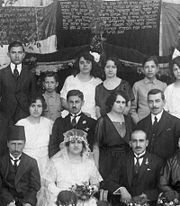 In the nineteenth century the commercial importance of Aleppo and Damascus underwent a marked decline. Beginning around 1850, and with increasing frequency until the First World War, many families left Syria for Egypt
, and later moved from there to Manchester
in England, often following the cotton trade. Later still a considerable number left Manchester for Latin America, in particular Mexico and Argentina. From around 1908, many Syrian Jews migrated to New York, where the Brooklyn community is now the world's largest single Syrian Jewish community. For these communities at the present day, see Syrian Jews
.
With anti-Jewish feeling reaching a climax in the late 1930s and early 1940s, many Jews considered emigrating. Between 1942 and 1947, around 4,500 Jews arrived in Palestine from Syria and Lebanon. In December 1947, a pogrom in Aleppo left the community devastated. In August 1949, the Menarsha synagogue was attacked
in Damascus. 12 people were killed and dozens injured.
community and the Jews of Qamishli
, were permitted under the regime of Hafez al-Assad
to leave Syria for the United States provided they did not emigrate to Israel. Within a few months, thousands of Syrian Jews made their way to Brooklyn with the help of philanthropic leaders of the Syrian Jewish community. The few remaining Jews in Syria live in Damascus
.
Syrian Jews
Syrian Jews are Jews who inhabit the region of the modern state of Syria, and their descendants born outside Syria. Syrian Jews derive their origin from two groups: from the Jews who inhabited the region of today's Syria from ancient times Syrian Jews are Jews who inhabit the region of the modern...
derive their origin from two groups: those who inhabited Syria
Syria
Syria , officially the Syrian Arab Republic , is a country in Western Asia, bordering Lebanon and the Mediterranean Sea to the West, Turkey to the north, Iraq to the east, Jordan to the south, and Israel to the southwest....
from early times and the Sephardim who fled to Syria after the expulsion of the Jews from Spain
Spain
Spain , officially the Kingdom of Spain languages]] under the European Charter for Regional or Minority Languages. In each of these, Spain's official name is as follows:;;;;;;), is a country and member state of the European Union located in southwestern Europe on the Iberian Peninsula...
(1492 AD). There were large communities in Aleppo
Aleppo
Aleppo is the largest city in Syria and the capital of Aleppo Governorate, the most populous Syrian governorate. With an official population of 2,301,570 , expanding to over 2.5 million in the metropolitan area, it is also one of the largest cities in the Levant...
, Damascus
Damascus
Damascus , commonly known in Syria as Al Sham , and as the City of Jasmine , is the capital and the second largest city of Syria after Aleppo, both are part of the country's 14 governorates. In addition to being one of the oldest continuously inhabited cities in the world, Damascus is a major...
, and Qamishli
Qamishli
Qamishli is a city in north eastern Syria on the border with Turkey, adjoining the Turkish city of Nusaybin, and close to Iraq. It is part of the Al-Hasakah Governorate, and is the administrative capital of the Al Qamishli District within the governorate....
for centuries. In the early twentieth century a large percentage of Syrian Jews
Syrian Jews
Syrian Jews are Jews who inhabit the region of the modern state of Syria, and their descendants born outside Syria. Syrian Jews derive their origin from two groups: from the Jews who inhabited the region of today's Syria from ancient times Syrian Jews are Jews who inhabit the region of the modern...
emigrated to the U.S., Central and South America and Israel. Today only a few Jews still live in Syria. The largest Syrian-Jewish community is located in Brooklyn, New York, and estimated at 75,000.
Second Temple period
The tradition of the community ascribes its founding to the time of King DavidDavid
David was the second king of the united Kingdom of Israel according to the Hebrew Bible and, according to the Gospels of Matthew and Luke, an ancestor of Jesus Christ through both Saint Joseph and Mary...
(1000 BC), whose general Joab
Joab
Joab the son of Zeruiah, was the nephew of King David and the commander of his army, according to the Hebrew Bible.- Name :...
occupied the area of Syria described in the Bible as Aram Zoba
Zobah
Zobah or Aram-Zobah was the capital of an early Aramean state in southern Syria, at one time of considerable importance. In I Samuel xiv...
: this name is taken by later tradition as referring to Aleppo
Aleppo
Aleppo is the largest city in Syria and the capital of Aleppo Governorate, the most populous Syrian governorate. With an official population of 2,301,570 , expanding to over 2.5 million in the metropolitan area, it is also one of the largest cities in the Levant...
. (Modern scholarship locates Aram Zoba in Lebanon and the far south of Syria: the identification with Aleppo is not found in rabbinic literature prior to the 11th century.) Whether or not Jewish settlement goes back to a time as early as King David, both Aleppo and Damascus certainly had Jewish communities early in the Christian era
Early Christianity
Early Christianity is generally considered as Christianity before 325. The New Testament's Book of Acts and Epistle to the Galatians records that the first Christian community was centered in Jerusalem and its leaders included James, Peter and John....
.
Post Second Temple
In Roman times about 10,000 Jews lived at DamascusDamascus
Damascus , commonly known in Syria as Al Sham , and as the City of Jasmine , is the capital and the second largest city of Syria after Aleppo, both are part of the country's 14 governorates. In addition to being one of the oldest continuously inhabited cities in the world, Damascus is a major...
, governed by an ethnarch
Ethnarch
Ethnarch, pronounced , the anglicized form of ethnarches refers generally to political leadership over a common ethnic group or homogeneous kingdom. The word is derived from the Greek words and ....
. The attraction which Judaism exercised at that time over the pagans was so great that many men and women were converted to that religion. Paul of Tarsus
Paul of Tarsus
Paul the Apostle , also known as Saul of Tarsus, is described in the Christian New Testament as one of the most influential early Christian missionaries, with the writings ascribed to him by the church forming a considerable portion of the New Testament...
succeeded, after a first rebuff, in converting many of the Jews of Damascus to Christianity
Christianity
Christianity is a monotheistic religion based on the life and teachings of Jesus as presented in canonical gospels and other New Testament writings...
(49 AD). This irritated the Jewish ethnarch to such a degree that he attempted to arrest Paul; and the latter's friends only saved his life by lowering him in a basket out of a window built in the wall of the city. Many Jews were murdered by the pagan inhabitants upon the outbreak of the First Jewish–Roman War. Later, Damascus, as the coins show, obtained the title of metropolis; and under Alexander Severus
Alexander Severus
Severus Alexander was Roman Emperor from 222 to 235. Alexander was the last emperor of the Severan dynasty. He succeeded his cousin Elagabalus upon the latter's assassination in 222, and was ultimately assassinated himself, marking the epoch event for the Crisis of the Third Century — nearly fifty...
, when the city was a Christian colony, it became the seat of a bishop, who enjoyed a rank next to that of the Patriarch of Antioch
Patriarch of Antioch
Patriarch of Antioch is a traditional title held by the Bishop of Antioch. As the traditional "overseer" of the first gentile Christian community, the position has been of prime importance in the church from its earliest period...
. In the fifth century, under the rule of the Byzantine Empire
Byzantine Empire
The Byzantine Empire was the Eastern Roman Empire during the periods of Late Antiquity and the Middle Ages, centred on the capital of Constantinople. Known simply as the Roman Empire or Romania to its inhabitants and neighbours, the Empire was the direct continuation of the Ancient Roman State...
, being the Talmud
Talmud
The Talmud is a central text of mainstream Judaism. It takes the form of a record of rabbinic discussions pertaining to Jewish law, ethics, philosophy, customs and history....
ic time, Jews were living at Damascus; for the rabbi Rafram bar Pappa went to pray in the synagogue of Jobar
Jobar Synagogue
The Jobar Synagogue is a 2,000 year-old synagogue located in the suburb of Jobar, Damascus. It was built in commemoration of the biblical prophet Elijah, and has been a place of Jewish pilgrimage for many centuries...
.
An early Jewish community is likely to have existed in Aleppo during the 5th century, when a synagogue was constructed there. Also in the fifth century, Jerome
Jerome
Saint Jerome was a Roman Christian priest, confessor, theologian and historian, and who became a Doctor of the Church. He was the son of Eusebius, of the city of Stridon, which was on the border of Dalmatia and Pannonia...
reports the presence in Beroea (Aleppo) of a congregation of Nazarenes
Nazarene (sect)
The Nazarene sect is used in two contexts:* Firstly of the New Testament early church where in Acts 24:5 Paul is accused before Felix at Caesarea by Tertullus of being "a ringleader of the sect of the Nazarenes."...
(Jewish Christians
Jewish Christians
Jewish Christians is a term which appears in historical texts contrasting Christians of Jewish origin with Gentile Christians, both in discussion of the New Testament church and the second and following centuries....
) using a Hebrew gospel similar to that of Matthew
Gospel of Matthew
The Gospel According to Matthew is one of the four canonical gospels, one of the three synoptic gospels, and the first book of the New Testament. It tells of the life, ministry, death, and resurrection of Jesus of Nazareth...
.
During the conflicts between the Byzantines and the Persians Damascus frequently suffered heavily. When Syria was conquered by the Persians (614), the Jews of Damascus, profiting by the presence of the invaders, joined with their coreligionists of Palestine to take vengeance on the Christians, especially those of Tyre. In 635 Damascus fell into the hands of the Muslims. The inhabitants voluntarily surrendered and succeeded in saving fifteen Christian churches.
Damascus
The rule of the Umayyads brought a new period of splendor to the city, which now became the capital of that califate. The Jewish community continued, and certainly existed in 970; "for," says a historian, "Joseph ben Abitur of CordobaCórdoba, Spain
-History:The first trace of human presence in the area are remains of a Neanderthal Man, dating to c. 32,000 BC. In the 8th century BC, during the ancient Tartessos period, a pre-urban settlement existed. The population gradually learned copper and silver metallurgy...
, having lost all hope of becoming the chief rabbi of that city, went to Palestine in that year, and settled at Damascus". This period terminated with the advent of the Abbasid
Abbasid
The Abbasid Caliphate or, more simply, the Abbasids , was the third of the Islamic caliphates. It was ruled by the Abbasid dynasty of caliphs, who built their capital in Baghdad after overthrowing the Umayyad caliphate from all but the al-Andalus region....
s, and the city suffered during the following centuries from continuous wars. Fortunately for the Jews, it resisted the siege of the Second Crusade
Second Crusade
The Second Crusade was the second major crusade launched from Europe. The Second Crusade was started in response to the fall of the County of Edessa the previous year to the forces of Zengi. The county had been founded during the First Crusade by Baldwin of Boulogne in 1098...
(1147). Some time afterward a large number of Palestinian Jews sought refuge at Damascus from the enormous taxes imposed upon them by the Crusaders, thus increasing the community. Little information exists concerning the Jews in Damascus during the following centuries. The few data are given by travelers who visited the place. In 1128 Abraham ibn Ezra
Abraham ibn Ezra
Rabbi Abraham ben Meir Ibn Ezra was born at Tudela, Navarre in 1089, and died c. 1167, apparently in Calahorra....
visited Damascus (though compare the note of Harkavy
Abraham Harkavy
Avraam/Albert Yakovlevich Harkavy , or Avraham Eliyahu ben Yaakov Harkavy was a Russian-Jewish historian and orientalist.-Biography:...
). According to Edelmann, Judah ha-Levi composed his famous poem on Zion in this city; but Harkavy has shown that "ash-Sham" here designates Palestine and not Damascus. In 1267 Nahmanides
Nahmanides
Nahmanides, also known as Rabbi Moses ben Naḥman Girondi, Bonastruc ça Porta and by his acronym Ramban, , was a leading medieval Jewish scholar, Catalan rabbi, philosopher, physician, kabbalist, and biblical commentator.-Name:"Nahmanides" is a Greek-influenced formation meaning "son of Naḥman"...
visited Damascus and succeeded in leading a Jewish colony to Jerusalem.
Benjamin of Tudela
Benjamin of Tudela
Benjamin of Tudela was a medieval Jewish traveler who visited Europe, Asia, and Africa in the 12th century. His vivid descriptions of western Asia preceded those of Marco Polo by a hundred years...
visited Damascus in 1170, while it was in the hands of the Seljukian prince Nur ad-Din Zangi. He found there 3,000 Rabbinite Jews and 200 Karaites
Karaite Judaism
Karaite Judaism or Karaism is a Jewish movement characterized by the recognition of the Tanakh alone as its supreme legal authority in Halakhah, as well as in theology...
. Jewish studies flourished there much more than in Palestine; according to Bacher it is possible that during the twelfth century the seat of the Palestinian academy was transferred to the city. The principal rabbis of the city were: Rabbi Ezra and his brother Sar Shalom, president of the tribunal; Yussef ִHamsi, R. Matsliaִh, R. Meïr, Yussef ibn Piat, R. Heman, the parnas, and R. Tsadok, physician.
About the same time Petaִhiah of Regensburg
Petachiah of Ratisbon
Petachiah of Ratisbon, also known as Petachiah ben Yakov, Moses Petachiah, and Petachiah of Regensburg, was a Bohemian rabbi of the late twelfth and early thirteenth centuries CE. He is best known for his extensive travels throughout Eastern Europe, the Caucasus, and the Middle East.Petachiah was...
was there. He found "about 10,000 Jews, who have a prince. The head of their academy is Rabbi Ezra, who is full of the knowledge of the Law; for Rabbi Samuel, the head of the Academy of Babylon, ordained him". It was a Damascus rabbi, Judah ben Josiah, who, toward the end of the twelfth century, was "nagid" in Egypt. At a later period another nagid, David ben Joshua, also came from Damascus.
In 1210 a French Jew, Samuel ben Simson, visited the city. He speaks of the beautiful synagogue situated outside the city (Jobar) and said to have been constructed by Elisha
Elisha
Elisha is a prophet mentioned in the Hebrew Bible and the Qur'an. His name is commonly transliterated into English as Elisha via Hebrew, Eliseus via Greek and Latin, or Alyasa via Arabic.-Biblical biography:...
.
Under Saladin
Saladin
Ṣalāḥ ad-Dīn Yūsuf ibn Ayyūb , better known in the Western world as Saladin, was an Arabized Kurdish Muslim, who became the first Sultan of Egypt and Syria, and founded the Ayyubid dynasty. He led Muslim and Arab opposition to the Franks and other European Crusaders in the Levant...
the city again enjoyed considerable importance; but upon his death the disturbances began anew, until in 1516 the city fell into the hands of the Turks, since which time it has declined to the rank of a provincial town.
It seems probable that Yehuda Alharizi
Yehuda Alharizi
Yehuda Alharizi, also Judah ben Solomon Harizi or al-Harizi was a rabbi, translator, poet and traveller active in Spain in the Middle Ages . He was supported by wealthy patrons, to whom he wrote poems and dedicated compositions.He was a rationalist, conveying the works of Maimonides and his...
also visited Damascus during the first decade of the thirteenth century. At least he mentions the city in the celebrated forty-sixth "Makamah".
Toward the end of the thirteenth century Jesse ben Hezekiah, a man full of energy, arose in Damascus. He was recognized by Sultan Qalawun
Qalawun
Saif ad-Dīn Qalawun aṣ-Ṣāliḥī was the seventh Mamluk sultan of Egypt...
of Egypt as prince and exilarch
Exilarch
Exilarch refers to the leaders of the Diaspora Jewish community in Babylon following the deportation of King Jeconiah and his court into Babylonian exile after the first fall of Jerusalem in 597 BCE and augmented after the further deportations following the destruction...
, and in 1289 and in June 1290, in conjunction with his twelve colleagues, he put the anti-Maimonists under the ban.
The letters of the rabbis of Damascus and of Acre have been collected in the "Minִhat Qena'ot " (a compilation made by Abba Mari
Abba Mari
Abba Mari ben Moses ben Joseph, was a Provençal rabbi, born at Lunel, near Montpellier, towards the end of the 13th century. He is also known as Yarhi from his birthplace Abba Mari ben Moses ben Joseph, was a Provençal rabbi, born at Lunel, near Montpellier, towards the end of the 13th century. He...
, grandson of Don Astruc of Lunel). No data are available for the fourteenth century. Estori Farִhi (1313) contents himself with the mere mention of Damascene Jews journeying to Jerusalem. A manuscript of David Kimhi
David Kimhi
David Kimhi , also known by the Hebrew acronym as the RaDaK , was a medieval rabbi, biblical commentator, philosopher, and grammarian. Born in Narbonne, Provence, he was the son of Rabbi Joseph Kimhi and the brother of Rabbi Moses Kimhi, both biblical commentators and grammarians...
on Ezekiel was written by Nathan of Narbonne and collated with the original by R. ִHiyya in Damascus, Ab 18, 1375. The Jewish community of Damascus continued its existence under the sultans (Burjites
Burji dynasty
The Burji dynasty المماليك البرجية ruled Egypt from 1382 until 1517. It proved especially turbulent, with short-lived sultans. Political power-plays often became important in designating a new sultan. During this time Mamluks fought Timur Lenk and conquered Cyprus. Constant bickering may have...
and Mamelukes
Mamluk
A Mamluk was a soldier of slave origin, who were predominantly Cumans/Kipchaks The "mamluk phenomenon", as David Ayalon dubbed the creation of the specific warrior...
) of Egypt, who conquered Syria; for the Jewish refugees of Spain established themselves among their coreligionists in that city in 1492, constructing a synagogue which they called "Khata'ib." The anonymous author of the "Yiִhus ha-Abot" also speaks of the beauties of Damascus; and of the synagogue at Jobar
Jobar Synagogue
The Jobar Synagogue is a 2,000 year-old synagogue located in the suburb of Jobar, Damascus. It was built in commemoration of the biblical prophet Elijah, and has been a place of Jewish pilgrimage for many centuries...
, "half of which was constructed by Elisha
Elisha
Elisha is a prophet mentioned in the Hebrew Bible and the Qur'an. His name is commonly transliterated into English as Elisha via Hebrew, Eliseus via Greek and Latin, or Alyasa via Arabic.-Biblical biography:...
, half by Eleazar ben Arach
Eleazar ben Arach
Eleazar ben Arach was one of the tannaim of the second generation . Being first among the disciples of Yochanan ben Zakai , he delighted his master with his wisdom and penetration, so that the most extravagant encomiums were lavished upon him...
".
Elijah of Ferrara (1438) had come to Jerusalem and had a certain jurisdiction in rabbinical matters over Damascus as well. He speaks of a great plague which devastated Egypt, Syria, and Jerusalem; but he does not say in how far the Jews of the firstnamed city suffered. Menaִhem ִHayyim of Volterra visited Damascus in 1481, and found 450 Jewish families, "all rich, honored, and merchants." The head of the community was a certain R. Joseph, a physician.
Obadiah of Bertinoro
Obadiah ben Abraham
Obadiah ben Abraham of Bertinoro was a 15th-century rabbi best known for his popular commentary on the Mishnah, commonly known as "The Bartenura".He was born and lived in the second half of the 15th-century in Italy and died in Jerusalem, Palestine about 1500...
(1488) speaks in one of his letters of the riches of the Jews in Damascus, of the beautiful houses and gardens. A few years later (1495) an anonymous traveler speaks in like eulogistic terms. He lived with a certain Moses Makran, and he relates that the Damascene Jews dealt in dress-goods or engaged in some handicraft. They lent money to the Venetians at 24 per cent interest.
Aleppo
MaimonidesMaimonides
Moses ben-Maimon, called Maimonides and also known as Mūsā ibn Maymūn in Arabic, or Rambam , was a preeminent medieval Jewish philosopher and one of the greatest Torah scholars and physicians of the Middle Ages...
, in his letter to the rabbis of Lunel, speaks of Aleppo as being the only community in Syria where some Torah learning survived, though the effort devoted to it was in his opinion less than impressive.
Benjamin of Tudela
Benjamin of Tudela
Benjamin of Tudela was a medieval Jewish traveler who visited Europe, Asia, and Africa in the 12th century. His vivid descriptions of western Asia preceded those of Marco Polo by a hundred years...
visited Aleppo in 1173, when he found a Jewish community of 1,500 (or on another reading 5000) souls with three noteworthy rabbis attending to their spiritual needs: Moses Alconstantini, Israel, and Seth. Petaִhiah of Regensburg
Petachiah of Ratisbon
Petachiah of Ratisbon, also known as Petachiah ben Yakov, Moses Petachiah, and Petachiah of Regensburg, was a Bohemian rabbi of the late twelfth and early thirteenth centuries CE. He is best known for his extensive travels throughout Eastern Europe, the Caucasus, and the Middle East.Petachiah was...
was there between 1170 and 1180, and Alִharizi fifty years later. The former calls the citadel the palace of King Nour-ed-din, and says that there were 1,500 Jews in Aleppo, of whom the chief men were Rabbis Moses Alconstantini, Israel, and Seth. Yehuda Alharizi
Yehuda Alharizi
Yehuda Alharizi, also Judah ben Solomon Harizi or al-Harizi was a rabbi, translator, poet and traveller active in Spain in the Middle Ages . He was supported by wealthy patrons, to whom he wrote poems and dedicated compositions.He was a rationalist, conveying the works of Maimonides and his...
, author of the Taִhkemoni has much to say in praise of the Aleppo Jews. In 1195 the leading Jew was Joseph ben Judah, who had migrated from the Maghreb by way of Egypt, where he was the friend of Maimonides, who wrote for him the Guide for the Perplexed
Guide for the Perplexed
The Guide for the Perplexed is one of the major works of Rabbi Moshe ben Maimon, better known as Maimonides or "the Rambam"...
. Other men of learning were Azariah and his brother Samuel Nissim, the king's physician Eleazer, Jeshua, Jachin Hananiah, and Joseph ben ִHisdai. Although he respected them far more than their Damascene counterparts, Alharizi thought little of the Aleppo poets, of whom he mentions Moses Daniel and a certain Joseph; the best was Joseph ben Tsemah, who had good qualities but wrote bad verse. Their piety must have been extreme, for Eleazer is held up to scorn for having traveled on the Sabbath, although at the sultan's command. Alharizi died in Aleppo and was buried there.
In 1260 the Mongols conquered Aleppo, and massacred many of the inhabitants, but many of the Jews took refuge in the synagogue and were saved. In 1401 the Jewish quarter was pillaged, with the rest of the city, by Tamerlane
Timur
Timur , historically known as Tamerlane in English , was a 14th-century conqueror of West, South and Central Asia, and the founder of the Timurid dynasty in Central Asia, and great-great-grandfather of Babur, the founder of the Mughal Dynasty, which survived as the Mughal Empire in India until...
; and a Jewish saint died there after a fast of seven months.
Arrival of Spanish Jews in Syria
After the expulsion of the Jews from Spain in 1492, Sephardi JewsSephardi Jews
Sephardi Jews is a general term referring to the descendants of the Jews who lived in the Iberian Peninsula before their expulsion in the Spanish Inquisition. It can also refer to those who use a Sephardic style of liturgy or would otherwise define themselves in terms of the Jewish customs and...
settled in many of the Islamic countries bordering the Mediterranean, including Syria, which then formed part of the Mameluke
Mamluk
A Mamluk was a soldier of slave origin, who were predominantly Cumans/Kipchaks The "mamluk phenomenon", as David Ayalon dubbed the creation of the specific warrior...
sultanate of Egypt
Egypt
Egypt , officially the Arab Republic of Egypt, Arabic: , is a country mainly in North Africa, with the Sinai Peninsula forming a land bridge in Southwest Asia. Egypt is thus a transcontinental country, and a major power in Africa, the Mediterranean Basin, the Middle East and the Muslim world...
. For the most part they founded their own communities, but they often assumed positions of rabbinic and communal leadership in their new homes. A social distinction remained between the newly arrived Sephardim and the native communities, which took several decades to accept them. Aleppo Jews of Spanish descent have a special custom, not found elsewhere, of lighting an extra candle at Hanukkah
Hanukkah
Hanukkah , also known as the Festival of Lights, is an eight-day Jewish holiday commemorating the rededication of the Holy Temple in Jerusalem at the time of the Maccabean Revolt of the 2nd century BCE...
: it is said that this custom was established in gratitude for their acceptance by the local community. In both Aleppo and Damascus, the two communities supported a common Chief Rabbinate. Chief Rabbis were usually but not always from Spanish-descended families: in Aleppo there were five in a row from the Laniado family.
The Sephardic presence was greater in Damascus than in Aleppo, and Damascus also maintained closer ties to the Holy Land. In particular, the Damascus community was strongly influenced by the Safed
Safed
Safed , is a city in the Northern District of Israel. Located at an elevation of , Safed is the highest city in the Galilee and of Israel. Due to its high elevation, Safed experiences warm summers and cold, often snowy, winters...
Kabbalistic
Kabbalah
Kabbalah/Kabala is a discipline and school of thought concerned with the esoteric aspect of Rabbinic Judaism. It was systematized in 11th-13th century Hachmei Provence and Spain, and again after the Expulsion from Spain, in 16th century Ottoman Palestine...
school of Isaac Luria
Isaac Luria
Isaac Luria , also called Yitzhak Ben Shlomo Ashkenazi acronym "The Ari" "Ari-Hakadosh", or "Arizal", meaning "The Lion", was a foremost rabbi and Jewish mystic in the community of Safed in the Galilee region of Ottoman Palestine...
, and contributed several notable personalities, including ִHayim Vital
Hayyim ben Joseph Vital
Hayyim ben Joseph Vital was a rabbi in Safed and the foremost disciple of Isaac Luria. He recorded much of his master's teachings...
and Israel Najara
Israel ben Moses Najara
Israel ben Moses Najara was a Jewish liturgical poet, preacher, Biblical commentator, kabbalist, and rabbi of Gaza.- Biography :...
. This explains certain differences in customs between the two cities.
An anonymous Jewish traveler who arrived a few years after the Spanish immigration, found at Damascus 500 Jewish households; also a Karaite
Karaite Judaism
Karaite Judaism or Karaism is a Jewish movement characterized by the recognition of the Tanakh alone as its supreme legal authority in Halakhah, as well as in theology...
community whose members called themselves "Muallim-Tsadaqah"; and a more important Rabbanite
Rabbinic Judaism
Rabbinic Judaism or Rabbinism has been the mainstream form of Judaism since the 6th century CE, after the codification of the Talmud...
community, composed of three groups and possessing three beautiful synagogues. One of these belonged to the Sephardim; another, to the Moriscos (Moorish Jews) or natives; and the third, to the Sicilians. In each synagogue there was a preacher, who read the works of Maimonides to the pious every day after the prayer. The preacher of the Sephardim was Isִhaq Mas'ud, that of the natives Shem-ִTob al-Furani, and that of the Sicilians Isaac ִHaber. There were also two small schools for young students of the Talmud, containing respectively thirty and forty pupils.
Sixty Jewish families were living in the village of Jobar, one mile from Damascus, who had a very beautiful synagogue. "I have never seen anything like it," says the author; "it is supported by thirteen columns. Tradition says that it dates from the time of the prophet Elisha, and that he here anointed King Hazael. R. Eleazar ben Arach (a tannaite
Tannaim
The Tannaim were the Rabbinic sages whose views are recorded in the Mishnah, from approximately 70-200 CE. The period of the Tannaim, also referred to as the Mishnaic period, lasted about 130 years...
of the first century) repaired this synagogue." In order to indicate, finally, that the city was even then under the Ottoman rule, the narrator adds that the people of Damascus had just received a governor ("na'ib") from Constantinople.
Under the Ottoman Empire
In 1515 Selim ISelim I
Selim I, Yavuz Sultân Selim Khan, Hâdim-ül Haramain-ish Sharifain , nicknamed Yavuz "the Stern" or "the Steadfast", but often rendered in English as "the Grim" , was the Sultan of the Ottoman Empire from 1512 to...
defeated the Mamelukes and Syria became part of the Ottoman Empire
Ottoman Empire
The Ottoman EmpireIt was usually referred to as the "Ottoman Empire", the "Turkish Empire", the "Ottoman Caliphate" or more commonly "Turkey" by its contemporaries...
.
The "Chronicle" of Joseph Sambari (finished 1672) contains the names of a number of rabbis of note who lived in Damascus during the sixteenth century. He says that the Jewish community lived chiefly in Jobar, and he knows of the synagogue of Elisha (Central Synagogue of Aleppo
Central Synagogue of Aleppo
The Central Synagogue of Aleppo, , also known as the Great Synagogue of Aleppo or Joab's Synagogue, has been a Jewish place of worship since the 5th century C.E. When it functioned, it was considered the main synagogue of the Syrian Jewish community. The synagogue is noted as being the location...
) and the cave of Elijah the Tishbite. At the head of the community was a certain Abu ִHatseirah (so-called from a peculiar kind of headdress which he wore), who was followed by 'Abd Allah ibn Naִsir. Of the rabbis of Damascus proper he mentions Joseph ִHayyaִt; Samuel Aripol, author of "Mizmor le-Todah"; Samuel ibn 'Imran; Joseph al-ִSa'iִh; Moses Najara, author of "Lekaִh ִTob"; ִHayim Alshaich; Joseph Maִtalon; Abraham Galante
Abraham ben Mordecai Galante
Abraham ben Mordecai Galante was an Italian kabbalist born in Rome at the beginning of the 16th-century. Abraham, like his father Mordecai and his brother Moses of Safed, is represented by his contemporaries as a man of high character who led a holy life...
. In this home of learning there was also a model-codex of the Bible called "Al-Taj" (the Crown). In 1547 Pierre Belon visited Damascus in the train of the French ambassador M. de Fumel. He speaks of the large number of Jews there; but makes the singular confusion of placing in this city the events connected with the famous Ahmad Shaitan of Egypt.
Among the spiritual leaders of Damascus in the sixteenth century may be mentioned: Jacob Berab
Jacob Berab
Jacob Berab, also spelled Yakov Berav or Bei Rav, was an influential rabbi and talmudist, born at Moqueda near Toledo, Castilian Spain, in 1474; died at Safed, Ottoman Palestine April 3, 1546.-Chosen rabbi at eighteen:Berab was a pupil of Isaac Aboab...
, who, in the interval between his sojourns in Egypt and at Safed
Safed
Safed , is a city in the Northern District of Israel. Located at an elevation of , Safed is the highest city in the Galilee and of Israel. Due to its high elevation, Safed experiences warm summers and cold, often snowy, winters...
, lived there for some years (c. 1534); ִHayim Vital
Hayyim ben Joseph Vital
Hayyim ben Joseph Vital was a rabbi in Safed and the foremost disciple of Isaac Luria. He recorded much of his master's teachings...
the Calabrian (1526–1603), for many years chief rabbi of Damascus, and the author of various cabalistic
Kabbalah
Kabbalah/Kabala is a discipline and school of thought concerned with the esoteric aspect of Rabbinic Judaism. It was systematized in 11th-13th century Hachmei Provence and Spain, and again after the Expulsion from Spain, in 16th century Ottoman Palestine...
works, including "Etz ִHayim"; Samuel ben David the Karaite (not "Jemsel," as Eliakim Carmoly
Eliakim Carmoly
Eliakim Carmoly was a French-Jewish scholar. He was born at Soultz-Haut-Rhin, then in the French department of Haut-Rhin. His real name was Goschel David Behr ; the name Carmoly, borne by his family in the fourteenth and fifteenth centuries, was adopted by him when quite young...
has it), who visited Damascus in 1641, mentions the circumstance that the Karaites there do not read the Haftarah
Haftarah
The haftarah or haftoroh is a series of selections from the books of Nevi'im of the Hebrew Bible that is publicly read in synagogue as part of Jewish religious practice...
after the Pentateuch section. Moses Najara; his son, the poet Israel Najara; Moses Galante
Moses Galante (the Elder)
Moses ben Mordecai Galante , was a 16th-century rabbi. He was a disciple of Joseph Caro, and was ordained by him when but twenty-two years of age. He wrote sermons for a wedding, for Passover, and for a thanksgiving service, printed with the younger Obadiah Bertinoro's commentary on the Book of...
(died in 1608), the son of Mordecai Galante
Galante (pedigree)
Galante was a Jewish family which flourished at the beginning of the 16th century in Rome, and the head of which, Mordecai, was a Spanish exile of the Angel family. His courteous manners won for him from the Roman nobles the surname "Galantuomo" , a name which the family retained...
; and Samuel Laniado ben Abraham of Aleppo were also among the prominent men of the sixteenth century.
The most celebrated rabbis of the seventeenth century were Josiah Pinto, a pupil of Jacob Abulafia, and author of the "Kesef-Nibִhar", and his son-in-law, Samuel Vital, who transcribed and circulated a large number of his father's Kabbalistic
Kabbalah
Kabbalah/Kabala is a discipline and school of thought concerned with the esoteric aspect of Rabbinic Judaism. It was systematized in 11th-13th century Hachmei Provence and Spain, and again after the Expulsion from Spain, in 16th century Ottoman Palestine...
manuscripts. At the same time in Aleppo ִHayyim Cohen ben Abraham wrote "Meqor ִHayyim", published at Constantinople in 1649, and at Amsterdam by Menasseh ben Israel
Menasseh Ben Israel
Manoel Dias Soeiro , better known by his Hebrew name Menasseh Ben Israel , was a Portuguese rabbi, kabbalist, scholar, writer, diplomat, printer and publisher, founder of the first Hebrew printing press in Amsterdam in...
in 1650. Other Aleppo worthies are Samuel Dwek and Isaac Lopes in 1690 followed by Yehudah Kassin, Isaac Berachah and Isaac Atieh in the eighteenth century.
Nineteenth century
Capitulations of the Ottoman Empire
Capitulations of the Ottoman Empire were contracts between the Ottoman Empire and European powers, particularly France. Turkish capitulations, or ahdnames, were generally bilateral acts whereby definite arrangements were entered into by each contracting party towards the other, not mere...
, rather than being treated as dhimmi
Dhimmi
A , is a non-Muslim subject of a state governed in accordance with sharia law. Linguistically, the word means "one whose responsibility has been taken". This has to be understood in the context of the definition of state in Islam...
s under Islamic law. These European Jews were known as Señores Francos and maintained a sense of social superiority to the native Jews, both Musta'arabi and Sephardi. They did not form separate synagogues, but often held services of their own in private houses. There were also Jews of Baghdadi
Baghdadi Jews
Baghdadi Jews, also known as Iraqi Jews, are Jewish emigrants from Baghdad and elsewhere in Iraq, who fled religious persecution and formed immigrant communities in their new homelands...
origin who claimed British nationality through family connections in India.
Some information is obtainable from travellers who visited Damascus during the nineteenth century. Alfred von Kremer, in "Mittel-Syrien und Damaskus" (1853), states that in the municipal government of the city two Christians and one Jew had places; the number of Jews was 4,000, only 1,000 of whom, however, paid the poll-tax; the last Karaite had died there some fifty years previously, the Karaite synagogue being then sold to the Greeks, who turned it into a church. The traveller Benjamin II gives the same number of inhabitants.He describes the synagogue at Jobar
Jobar Synagogue
The Jobar Synagogue is a 2,000 year-old synagogue located in the suburb of Jobar, Damascus. It was built in commemoration of the biblical prophet Elijah, and has been a place of Jewish pilgrimage for many centuries...
(to the north-east of the city) thus:
"The structure of this ancient building reminds one of the Mosque Moawiah; the interior is supported by 13 marble pillars, six on the right and seven on the left side, and is everywhere inlaid with marble. There is only one portal by which to enter. Under the holy shrine . . . is a grotto . . . the descent to which is by a flight of about 20 steps. According to the Jews, the Prophet Elisha is said to have found in this grotto a place of refuge. . . . At the entrance of the synagogue, toward the middle of the wall to the right, is an irregularly formed stone, on which can be observed the traces of several steps. Tradition asserts that upon this step sat King Hazael when the Prophet Elisha anointed him king".
Benjamin II also speaks of valuable copies of parts of the Bible to be found in Damascus; though the dates he gives (581 and 989) are unreliable. Neubauer mentions a copy of the Bible which belonged to Elisha ben Abraham ben Benvenisti, called "Crescas," and which was finished in 1382.
Damascus had eight chief rabbis during the nineteenth century, namely: (1) Joseph David Abulafia (1809–16). (2) Jacob Antebi (1816–1833). (3) Jacob Perez (1833–48). (4) Aaron Bagdadi (1848–66). (During the next two years the office of chief rabbi was vacant, owing to internal quarrels.) (5) ִHayim Qimִhi of Constantinople (1868–72). (6) Mercado Kilִhi of Nish (1872–76). (7) Isaac Abulafia (1876–88). (8) Solomon Eliezer Alfandari
Solomon Eliezer Alfandari
Solomon Eliezer Alfandari , also known as the Saba Kadisha , was a distinguished rabbi, kabbalist and rosh yeshiva in his native home of Constantinople, and later served as Chief Rabbi of Damascus, Syria, and Safed, Israel...
, commonly called "Mercado Alfandari" of Constantinople, who was appointed by an imperial decree in 1888 (still in office in 1901). A more recent chief rabbi was Nissim Indibo, who died at the end of 1972. Other Damascus Rabbis are Mordechai Maslaton, Shaul Menaged and Zaki Assa.
During the nineteenth century the Jews of Damascus were several times made the victims of calumnies, the gravest being those of 1840 and 1860, in the reign of the sultan Abdülmecit I. That of 1840, commonly known as the Damascus affair
Damascus affair
The Damascus affair was an 1840 incident in which the accusation of ritual murder was brought against members of the Jewish community of Damascus. Eight notable Jews of Damascus were falsely accused of murdering a Christian monk, imprisoned and tortured. Several of the imprisoned died of torture,...
, was an accusation of ritual murder brought against the Jews in connection with the death of Father Thomas. The second accusation brought against the Jews, in 1860, was that of having taken part in the massacre of the Christians by the Druze
Druze
The Druze are an esoteric, monotheistic religious community, found primarily in Syria, Lebanon, Israel, and Jordan, which emerged during the 11th century from Ismailism. The Druze have an eclectic set of beliefs that incorporate several elements from Abrahamic religions, Gnosticism, Neoplatonism...
and the Muslim
Muslim
A Muslim, also spelled Moslem, is an adherent of Islam, a monotheistic, Abrahamic religion based on the Quran, which Muslims consider the verbatim word of God as revealed to prophet Muhammad. "Muslim" is the Arabic term for "submitter" .Muslims believe that God is one and incomparable...
s. Five hundred Muslims, who had been involved in the affair, were hanged by the grand vizier Fuad Pasha
Keçecizade Mehmet Fuat Pasha
Mehmed Fuad Pasha was an Ottoman statesman known for his leadership during the Crimean War and in the Tanzimat reforms within the Ottoman Empire. He was also a noted Freemason.- Career :...
. Two hundred Jews were awaiting the same fate, in spite of their innocence, and the whole Jewish community had been fined 4,000,000 piastres. The condemned Jews were saved only by the official intervention of Fuad Pasha himself; that of the Prussian consul, Dr. Johann G. Wetzstein
Johann Gottfried Wetzstein
Dr. Johann Gottfried Wetzstein was a Prussian diplomat. He was the Prussian consul in Damascus, Syria, Ottoman Empire, and he was an Orientalist academic. He was consul from 1848 to 1862.He interceded on the behalf of Syrian Jews in 1860....
; of Sir Moses Montefiore
Moses Montefiore
Sir Moses Haim Montefiore, 1st Baronet, Kt was one of the most famous British Jews of the 19th century. Montefiore was a financier, banker, philanthropist and Sheriff of London...
of London, and of the bankers Abraham Salomon Camondo
Abraham Salomon Camondo
Count Abraham Camondo was a Jewish Ottoman-Italian financier and philanthropist and the patriarch of the Camondo family....
of Constantinople and Shemaya Angel of Damascus. From that time to the end of the nineteenth century, several further blood accusations were brought against the Jews; these, however, never provoked any great excitement.
Prominent Aleppo rabbis include Eliahu Shamah, Abraham Antebi and Mordechai Labaton in the nineteenth century, Jacob Saul Dwek who died in 1919, followed by Ezra Hamwi and Moses Mizrahi who was prepared to be burnt with the Torah Scrolls but was removed by the Arab mob from the Jamilieh Synagogue during the pogrom of 1947. He was followed by Moses Tawil, Shlomo Zafrani and Yomtob Yedid.
Leaving Syria
Egypt
Egypt , officially the Arab Republic of Egypt, Arabic: , is a country mainly in North Africa, with the Sinai Peninsula forming a land bridge in Southwest Asia. Egypt is thus a transcontinental country, and a major power in Africa, the Mediterranean Basin, the Middle East and the Muslim world...
, and later moved from there to Manchester
Manchester
Manchester is a city and metropolitan borough in Greater Manchester, England. According to the Office for National Statistics, the 2010 mid-year population estimate for Manchester was 498,800. Manchester lies within one of the UK's largest metropolitan areas, the metropolitan county of Greater...
in England, often following the cotton trade. Later still a considerable number left Manchester for Latin America, in particular Mexico and Argentina. From around 1908, many Syrian Jews migrated to New York, where the Brooklyn community is now the world's largest single Syrian Jewish community. For these communities at the present day, see Syrian Jews
Syrian Jews
Syrian Jews are Jews who inhabit the region of the modern state of Syria, and their descendants born outside Syria. Syrian Jews derive their origin from two groups: from the Jews who inhabited the region of today's Syria from ancient times Syrian Jews are Jews who inhabit the region of the modern...
.
With anti-Jewish feeling reaching a climax in the late 1930s and early 1940s, many Jews considered emigrating. Between 1942 and 1947, around 4,500 Jews arrived in Palestine from Syria and Lebanon. In December 1947, a pogrom in Aleppo left the community devastated. In August 1949, the Menarsha synagogue was attacked
Menarsha synagogue attack
The Menarsha synagogue attack took place on August 5, 1949, in the Jewish quarter of Damascus, Syria. The grenade attack resulted in 12 fatalities.-The attack:...
in Damascus. 12 people were killed and dozens injured.
Recent times
Beginning on the Passover Holiday of 1992, the 4,000 remaining members of the Damascus Jewish community (Arabic Yehud ash-Sham) as well as the AleppoAleppo
Aleppo is the largest city in Syria and the capital of Aleppo Governorate, the most populous Syrian governorate. With an official population of 2,301,570 , expanding to over 2.5 million in the metropolitan area, it is also one of the largest cities in the Levant...
community and the Jews of Qamishli
Qamishli
Qamishli is a city in north eastern Syria on the border with Turkey, adjoining the Turkish city of Nusaybin, and close to Iraq. It is part of the Al-Hasakah Governorate, and is the administrative capital of the Al Qamishli District within the governorate....
, were permitted under the regime of Hafez al-Assad
Hafez al-Assad
Hafez ibn 'Ali ibn Sulayman al-Assad or more commonly Hafez al-Assad was the President of Syria for three decades. Assad's rule consolidated the power of the central government after decades of coups and counter-coups, such as Operation Wappen in 1957 conducted by the Eisenhower administration and...
to leave Syria for the United States provided they did not emigrate to Israel. Within a few months, thousands of Syrian Jews made their way to Brooklyn with the help of philanthropic leaders of the Syrian Jewish community. The few remaining Jews in Syria live in Damascus
Damascus
Damascus , commonly known in Syria as Al Sham , and as the City of Jasmine , is the capital and the second largest city of Syria after Aleppo, both are part of the country's 14 governorates. In addition to being one of the oldest continuously inhabited cities in the world, Damascus is a major...
.
See also
- History of the Jews in Muslim landsHistory of the Jews in Muslim landsAside the regions of Israel and Judea Jews have lived in the Middle East at least since the Babylonian Captivity , about 2,600 years ago....
- Syrian JewsSyrian JewsSyrian Jews are Jews who inhabit the region of the modern state of Syria, and their descendants born outside Syria. Syrian Jews derive their origin from two groups: from the Jews who inhabited the region of today's Syria from ancient times Syrian Jews are Jews who inhabit the region of the modern...
- Sephardi JewsSephardi JewsSephardi Jews is a general term referring to the descendants of the Jews who lived in the Iberian Peninsula before their expulsion in the Spanish Inquisition. It can also refer to those who use a Sephardic style of liturgy or would otherwise define themselves in terms of the Jewish customs and...
- Mizrahi JewsMizrahi JewsMizrahi Jews or Mizrahiyim, , also referred to as Adot HaMizrach are Jews descended from the Jewish communities of the Middle East, North Africa and the Caucasus...
- History of the Jews in TurkeyHistory of the Jews in TurkeyTurkish Jews The history of the Jews in the Ottoman Empire and Turkey covers the 2,400 years that Jews have lived in what is now Turkey. There have been Jewish communities in Asia Minor since at least the 5th century BCE and many Spanish and Portuguese Jews expelled from Spain were welcomed to the...
- Central Synagogue of AleppoCentral Synagogue of AleppoThe Central Synagogue of Aleppo, , also known as the Great Synagogue of Aleppo or Joab's Synagogue, has been a Jewish place of worship since the 5th century C.E. When it functioned, it was considered the main synagogue of the Syrian Jewish community. The synagogue is noted as being the location...
- PizmonimPizmonimPizmonim are traditional Jewish songs and melodies with the intentions of praising God as well as learning certain aspects of traditional religious teachings. They are sung throughout religious rituals and festivities such as prayers, circumcisions, bar mitzvahs, weddings and other ceremonies...
- BaqashotBaqashotThe Baqashot are a collection of supplications, songs, and prayers that have been sung by the Sephardic Aleppian Jewish community and other congregations for centuries each week on Shabbat morning from midnight until dawn. Usually they are recited during the weeks of winter, when the nights are...
- Musta'arabi Jews
- Aleppo CodexAleppo CodexThe Aleppo Codex is a medieval bound manuscript of the Hebrew Bible. The codex was written in the 10th century A.D.The codex has long been considered to be the most authoritative document in the masorah , the tradition by which the Hebrew Scriptures have been preserved from generation to generation...
- Jewish exodus from Arab and Muslim lands
External links
- History: The Jews of Aleppo
- Ritual: Sephardic Pizmonim Project
- Bible: Aleppo Codex Website