

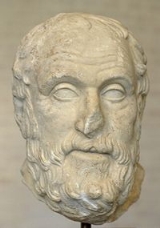
Carneades

Encyclopedia
Carneades was an Academic skeptic
born in Cyrene
. By the year 159 BC
, he had started to refute all previous dogmatic doctrines, especially Stoicism
, and even the Epicureans whom previous skeptics had spared. As head of the Academy
, he was one of three philosophers sent to Rome
in 155 BC
where his lectures on the uncertainty of justice
caused consternation among the leading politicians. He left no writings and many of his opinions are known only via his successor Clitomachus. He seems to have doubted the ability, not just of the senses but of reason
too, in acquiring truth
. His skepticism was, however, moderated by the belief that we can, nevertheless, ascertain probabilities of truth, to enable us to live and act correctly.
, North Africa
in 214/3 BC. He migrated early to Athens
, and attended the lectures of the Stoics, and learned their logic from Diogenes. He studied the works of Chrysippus
, and exerted his energy of a very acute and original mind in their refutation.
He attached himself to the Academy
, which had suffered from the attacks of the Stoics; and on the death of Hegesinus
, he was chosen to preside at the meetings of Academy, and was the fourth in succession from Arcesilaus
. His great eloquence and skill in argument revived the glories of his school; and, defending himself in the negative vacancy of asserting nothing (not even that nothing can be asserted), carried on a vigorous war against every position that had been maintained by other sects.
In the year 155 BC
, when he was fifty-eight years old, he was chosen with Diogenes the Stoic and Critolaus the Peripatetic
to go as ambassador to Rome
to deprecate the fine of 500 talents which had been imposed on the Athenians for the destruction of Oropus. During his stay at Rome, he attracted great notice from his eloquent speeches on philosophical subjects, and it was here that, in the presence of Cato the Elder
, he delivered his famous orations on Justice
. The first oration was in commendation of the virtue of Roman justice, and the next day the second was delivered, in which all the arguments he'd made on the first were refuted, as he persuasively attempted to prove that justice was inevitably problematic, and not a given when it came to virtue, but merely a compact device deemed necessary for the maintenance of a well ordered society. Recognizing the potential danger of the argument, Cato was shocked at this and he moved the Roman Senate
to send the philosopher home to his school, and prevent the Roman youth from the threat of re-examining all Roman doctrines. Carneades lived twenty-seven years after this at Athens
.
Carneades was succeeded, in his old age (137/6 BC), by his namesake Carneades, son of Polemarchus, but the younger Carneades died 131/0 BC and was succeeded by Crates of Tarsus. The elder Carneades died at the advanced age of 85 (although Cicero
says 90), in 129/8 BC. After the death of Crates of Tarsus in 127/6 BC Clitomachus became head of the Academy.
Carneades is described as a man of unwearied industry. He was so engrossed in his studies, that he let his hair and nails grow to an immoderate length, and was so absent at his own table (for he would never dine out), that his servant and concubine, Melissa, was constantly obliged to feed him. Valerius Maximus
, to whom we owe the last anecdote, tells us that Carneades, before discussing with Chrysippus
, was wont to purge himself with hellebore
, to have a sharper mind. In his old age, he suffered from cataract in his eyes, which he bore with great impatience, and was so little resigned to the decay of nature, that he used to ask angrily, if this was the way in which nature undid what she had done, and sometimes expressed a wish to poison himself.
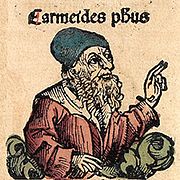 Carneades is known as an Academic skeptic
. Academic skeptics (so called because this was the type of Skepticism taught in Plato
's Academy in Athens
) hold that all knowledge is impossible, except for the knowledge that all other knowledge is impossible.
Carneades left no writings, and all that is known of his lectures is derived from his intimate friend and pupil, Clitomachus; but so true was he to his own principles of withholding assent, that Clitomachus confesses he never could ascertain what his master really thought on any subject. Carneades appears to have defended atheism
and to have denied that the world was the result of anything but chance. In ethics
, which more particularly were the subject of his long and laborious study, he seems to have denied the conformity of the moral ideas with nature. This he particularly insisted on in the second oration on Justice
, in which he manifestly wished to convey his own notions on the subject; and he there maintains that ideas of justice are not derived from nature, but that they are purely artificial for purposes of expediency.
All this, however, was nothing but the special application of his general theory, that people did not possess, and never could possess, any criterion of truth
.
Carneades argued that, if there were a criterion, it must exist either in reason
(logos), or sensation (aisthêsis), or concept
ion (phantasia). But then reason itself depends on conception, and this again on sensation; and we have no means of judging whether our sensations are true or false, whether they correspond to the objects that produce them, or carry wrong impressions to the mind, producing false conceptions and ideas, and leading reason also into error. Therefore sensation, conception, and reason, are alike disqualified for being the criterion of truth.
But after all, people must live and act, and must have some rule of practical life
; therefore, although it is impossible to pronounce anything as absolutely true, we may yet establish probabilities of various degrees. For, although we cannot say that any given conception or sensation is in itself true, yet some sensations appear to us more true than others, and we must be guided by that which seems the most true. Again, sensations are not single, but generally combined with others, which either confirm or contradict them; and the greater this combination the greater is the probability of that being true which the rest combine to confirm; and the case in which the greatest number of conceptions, each in themselves apparently most true, should combine to affirm that which also in itself appears most true, would present to Carneades the highest probability, and his nearest approach to truth.
Academic skepticism
Academic skepticism refers to the skeptical period of ancient Platonism dating from around 266 BC, when Arcesilaus became head of the Platonic Academy, until around 90 BC, when Antiochus of Ascalon rejected skepticism. Like their fellow Pyrrhonists, they maintained that knowledge of things is...
born in Cyrene
Cyrene, Libya
Cyrene was an ancient Greek colony and then a Roman city in present-day Shahhat, Libya, the oldest and most important of the five Greek cities in the region. It gave eastern Libya the classical name Cyrenaica that it has retained to modern times.Cyrene lies in a lush valley in the Jebel Akhdar...
. By the year 159 BC
159 BC
Year 159 BC was a year of the pre-Julian Roman calendar. At the time it was known as the Year of the Consulship of Dolabella and Nobilior...
, he had started to refute all previous dogmatic doctrines, especially Stoicism
Stoicism
Stoicism is a school of Hellenistic philosophy founded in Athens by Zeno of Citium in the early . The Stoics taught that destructive emotions resulted from errors in judgment, and that a sage, or person of "moral and intellectual perfection," would not suffer such emotions.Stoics were concerned...
, and even the Epicureans whom previous skeptics had spared. As head of the Academy
Platonic Academy
The Academy was founded by Plato in ca. 387 BC in Athens. Aristotle studied there for twenty years before founding his own school, the Lyceum. The Academy persisted throughout the Hellenistic period as a skeptical school, until coming to an end after the death of Philo of Larissa in 83 BC...
, he was one of three philosophers sent to Rome
Rome
Rome is the capital of Italy and the country's largest and most populated city and comune, with over 2.7 million residents in . The city is located in the central-western portion of the Italian Peninsula, on the Tiber River within the Lazio region of Italy.Rome's history spans two and a half...
in 155 BC
155 BC
Year 155 BC was a year of the pre-Julian Roman calendar. At the time it was known as the Year of the Consulship of Corculum and Marcellus...
where his lectures on the uncertainty of justice
Justice
Justice is a concept of moral rightness based on ethics, rationality, law, natural law, religion, or equity, along with the punishment of the breach of said ethics; justice is the act of being just and/or fair.-Concept of justice:...
caused consternation among the leading politicians. He left no writings and many of his opinions are known only via his successor Clitomachus. He seems to have doubted the ability, not just of the senses but of reason
Reason
Reason is a term that refers to the capacity human beings have to make sense of things, to establish and verify facts, and to change or justify practices, institutions, and beliefs. It is closely associated with such characteristically human activities as philosophy, science, language, ...
too, in acquiring truth
Truth
Truth has a variety of meanings, such as the state of being in accord with fact or reality. It can also mean having fidelity to an original or to a standard or ideal. In a common usage, it also means constancy or sincerity in action or character...
. His skepticism was, however, moderated by the belief that we can, nevertheless, ascertain probabilities of truth, to enable us to live and act correctly.
Life
Carneades, the son of Epicomus or Philocomiis, was born at CyreneCyrene, Libya
Cyrene was an ancient Greek colony and then a Roman city in present-day Shahhat, Libya, the oldest and most important of the five Greek cities in the region. It gave eastern Libya the classical name Cyrenaica that it has retained to modern times.Cyrene lies in a lush valley in the Jebel Akhdar...
, North Africa
North Africa
North Africa or Northern Africa is the northernmost region of the African continent, linked by the Sahara to Sub-Saharan Africa. Geopolitically, the United Nations definition of Northern Africa includes eight countries or territories; Algeria, Egypt, Libya, Morocco, South Sudan, Sudan, Tunisia, and...
in 214/3 BC. He migrated early to Athens
Athens
Athens , is the capital and largest city of Greece. Athens dominates the Attica region and is one of the world's oldest cities, as its recorded history spans around 3,400 years. Classical Athens was a powerful city-state...
, and attended the lectures of the Stoics, and learned their logic from Diogenes. He studied the works of Chrysippus
Chrysippus
Chrysippus of Soli was a Greek Stoic philosopher. He was a native of Soli, Cilicia, but moved to Athens as a young man, where he became a pupil of Cleanthes in the Stoic school. When Cleanthes died, around 230 BC, Chrysippus became the third head of the school...
, and exerted his energy of a very acute and original mind in their refutation.
He attached himself to the Academy
Platonic Academy
The Academy was founded by Plato in ca. 387 BC in Athens. Aristotle studied there for twenty years before founding his own school, the Lyceum. The Academy persisted throughout the Hellenistic period as a skeptical school, until coming to an end after the death of Philo of Larissa in 83 BC...
, which had suffered from the attacks of the Stoics; and on the death of Hegesinus
Hegesinus of Pergamon
Hegesinus , of Pergamon, an Academic philosopher, the successor of Evander and the immediate predecessor of Carneades as the leader of the Academy. He was scholarch for a period around 160 BC. Nothing else is known about him.-References:...
, he was chosen to preside at the meetings of Academy, and was the fourth in succession from Arcesilaus
Arcesilaus
Arcesilaus was a Greek philosopher and founder of the Second or Middle Academy—the phase of Academic skepticism. Arcesilaus succeeded Crates as the sixth head of the Academy c. 264 BC. He did not preserve his thoughts in writing, so his opinions can only be gleaned second-hand from what is...
. His great eloquence and skill in argument revived the glories of his school; and, defending himself in the negative vacancy of asserting nothing (not even that nothing can be asserted), carried on a vigorous war against every position that had been maintained by other sects.
In the year 155 BC
155 BC
Year 155 BC was a year of the pre-Julian Roman calendar. At the time it was known as the Year of the Consulship of Corculum and Marcellus...
, when he was fifty-eight years old, he was chosen with Diogenes the Stoic and Critolaus the Peripatetic
Critolaus
Critolaus of Phaselis was a Greek philosopher of the Peripatetic school. He was one of three philosophers sent to Rome in 155 BC , where their doctrines fascinated the citizens, but scared the more conservative statesmen. None of his writings survive...
to go as ambassador to Rome
Rome
Rome is the capital of Italy and the country's largest and most populated city and comune, with over 2.7 million residents in . The city is located in the central-western portion of the Italian Peninsula, on the Tiber River within the Lazio region of Italy.Rome's history spans two and a half...
to deprecate the fine of 500 talents which had been imposed on the Athenians for the destruction of Oropus. During his stay at Rome, he attracted great notice from his eloquent speeches on philosophical subjects, and it was here that, in the presence of Cato the Elder
Cato the Elder
Marcus Porcius Cato was a Roman statesman, commonly referred to as Censorius , Sapiens , Priscus , or Major, Cato the Elder, or Cato the Censor, to distinguish him from his great-grandson, Cato the Younger.He came of an ancient Plebeian family who all were noted for some...
, he delivered his famous orations on Justice
Justice
Justice is a concept of moral rightness based on ethics, rationality, law, natural law, religion, or equity, along with the punishment of the breach of said ethics; justice is the act of being just and/or fair.-Concept of justice:...
. The first oration was in commendation of the virtue of Roman justice, and the next day the second was delivered, in which all the arguments he'd made on the first were refuted, as he persuasively attempted to prove that justice was inevitably problematic, and not a given when it came to virtue, but merely a compact device deemed necessary for the maintenance of a well ordered society. Recognizing the potential danger of the argument, Cato was shocked at this and he moved the Roman Senate
Roman Senate
The Senate of the Roman Republic was a political institution in the ancient Roman Republic, however, it was not an elected body, but one whose members were appointed by the consuls, and later by the censors. After a magistrate served his term in office, it usually was followed with automatic...
to send the philosopher home to his school, and prevent the Roman youth from the threat of re-examining all Roman doctrines. Carneades lived twenty-seven years after this at Athens
Athens
Athens , is the capital and largest city of Greece. Athens dominates the Attica region and is one of the world's oldest cities, as its recorded history spans around 3,400 years. Classical Athens was a powerful city-state...
.
Carneades was succeeded, in his old age (137/6 BC), by his namesake Carneades, son of Polemarchus, but the younger Carneades died 131/0 BC and was succeeded by Crates of Tarsus. The elder Carneades died at the advanced age of 85 (although Cicero
Cicero
Marcus Tullius Cicero , was a Roman philosopher, statesman, lawyer, political theorist, and Roman constitutionalist. He came from a wealthy municipal family of the equestrian order, and is widely considered one of Rome's greatest orators and prose stylists.He introduced the Romans to the chief...
says 90), in 129/8 BC. After the death of Crates of Tarsus in 127/6 BC Clitomachus became head of the Academy.
Carneades is described as a man of unwearied industry. He was so engrossed in his studies, that he let his hair and nails grow to an immoderate length, and was so absent at his own table (for he would never dine out), that his servant and concubine, Melissa, was constantly obliged to feed him. Valerius Maximus
Valerius Maximus
Valerius Maximus was a Latin writer and author of a collection of historical anecdotes. He worked during the reign of Tiberius .-Biography:...
, to whom we owe the last anecdote, tells us that Carneades, before discussing with Chrysippus
Chrysippus
Chrysippus of Soli was a Greek Stoic philosopher. He was a native of Soli, Cilicia, but moved to Athens as a young man, where he became a pupil of Cleanthes in the Stoic school. When Cleanthes died, around 230 BC, Chrysippus became the third head of the school...
, was wont to purge himself with hellebore
Hellebore
Commonly known as hellebores, members of the genus Helleborus comprise approximately 20 species of herbaceous perennial flowering plants in the family Ranunculaceae, within which it gave its name to the tribe of Helleboreae...
, to have a sharper mind. In his old age, he suffered from cataract in his eyes, which he bore with great impatience, and was so little resigned to the decay of nature, that he used to ask angrily, if this was the way in which nature undid what she had done, and sometimes expressed a wish to poison himself.
Philosophy
Academic skepticism
Academic skepticism refers to the skeptical period of ancient Platonism dating from around 266 BC, when Arcesilaus became head of the Platonic Academy, until around 90 BC, when Antiochus of Ascalon rejected skepticism. Like their fellow Pyrrhonists, they maintained that knowledge of things is...
. Academic skeptics (so called because this was the type of Skepticism taught in Plato
Plato
Plato , was a Classical Greek philosopher, mathematician, student of Socrates, writer of philosophical dialogues, and founder of the Academy in Athens, the first institution of higher learning in the Western world. Along with his mentor, Socrates, and his student, Aristotle, Plato helped to lay the...
's Academy in Athens
Athens
Athens , is the capital and largest city of Greece. Athens dominates the Attica region and is one of the world's oldest cities, as its recorded history spans around 3,400 years. Classical Athens was a powerful city-state...
) hold that all knowledge is impossible, except for the knowledge that all other knowledge is impossible.
Carneades left no writings, and all that is known of his lectures is derived from his intimate friend and pupil, Clitomachus; but so true was he to his own principles of withholding assent, that Clitomachus confesses he never could ascertain what his master really thought on any subject. Carneades appears to have defended atheism
Atheism
Atheism is, in a broad sense, the rejection of belief in the existence of deities. In a narrower sense, atheism is specifically the position that there are no deities...
and to have denied that the world was the result of anything but chance. In ethics
Ethics
Ethics, also known as moral philosophy, is a branch of philosophy that addresses questions about morality—that is, concepts such as good and evil, right and wrong, virtue and vice, justice and crime, etc.Major branches of ethics include:...
, which more particularly were the subject of his long and laborious study, he seems to have denied the conformity of the moral ideas with nature. This he particularly insisted on in the second oration on Justice
Justice
Justice is a concept of moral rightness based on ethics, rationality, law, natural law, religion, or equity, along with the punishment of the breach of said ethics; justice is the act of being just and/or fair.-Concept of justice:...
, in which he manifestly wished to convey his own notions on the subject; and he there maintains that ideas of justice are not derived from nature, but that they are purely artificial for purposes of expediency.
All this, however, was nothing but the special application of his general theory, that people did not possess, and never could possess, any criterion of truth
Truth
Truth has a variety of meanings, such as the state of being in accord with fact or reality. It can also mean having fidelity to an original or to a standard or ideal. In a common usage, it also means constancy or sincerity in action or character...
.
Carneades argued that, if there were a criterion, it must exist either in reason
Reason
Reason is a term that refers to the capacity human beings have to make sense of things, to establish and verify facts, and to change or justify practices, institutions, and beliefs. It is closely associated with such characteristically human activities as philosophy, science, language, ...
(logos), or sensation (aisthêsis), or concept
Concept
The word concept is used in ordinary language as well as in almost all academic disciplines. Particularly in philosophy, psychology and cognitive sciences the term is much used and much discussed. WordNet defines concept: "conception, construct ". However, the meaning of the term concept is much...
ion (phantasia). But then reason itself depends on conception, and this again on sensation; and we have no means of judging whether our sensations are true or false, whether they correspond to the objects that produce them, or carry wrong impressions to the mind, producing false conceptions and ideas, and leading reason also into error. Therefore sensation, conception, and reason, are alike disqualified for being the criterion of truth.
But after all, people must live and act, and must have some rule of practical life
Personal life
Personal life is the course of an individual's life, especially when viewed as the sum of personal choices contributing to one's personal identity. It is a common notion in modern existence—although more so in more prosperous parts of the world such as Western Europe and North America...
; therefore, although it is impossible to pronounce anything as absolutely true, we may yet establish probabilities of various degrees. For, although we cannot say that any given conception or sensation is in itself true, yet some sensations appear to us more true than others, and we must be guided by that which seems the most true. Again, sensations are not single, but generally combined with others, which either confirm or contradict them; and the greater this combination the greater is the probability of that being true which the rest combine to confirm; and the case in which the greatest number of conceptions, each in themselves apparently most true, should combine to affirm that which also in itself appears most true, would present to Carneades the highest probability, and his nearest approach to truth.
See also
- Anti-realismAnti-realismIn analytic philosophy, the term anti-realism is used to describe any position involving either the denial of an objective reality of entities of a certain type or the denial that verification-transcendent statements about a type of entity are either true or false...
- Moral relativismMoral relativismMoral relativism may be any of several descriptive, meta-ethical, or normative positions. Each of them is concerned with the differences in moral judgments across different people and cultures:...
- Plank of CarneadesPlank of CarneadesIn ethics, the plank of Carneades is a thought experiment first proposed by Carneades of Cyrene; it explores the concept of self-defense in relation to murder....
- Philosophical skepticismPhilosophical skepticismPhilosophical skepticism is both a philosophical school of thought and a method that crosses disciplines and cultures. Many skeptics critically examine the meaning systems of their times, and this examination often results in a position of ambiguity or doubt...
- PyrrhonismPyrrhonismPyrrhonism, or Pyrrhonian skepticism, was a school of skepticism founded by Aenesidemus in the 1st century BCE and recorded by Sextus Empiricus in the late 2nd century or early 3rd century CE. It was named after Pyrrho, a philosopher who lived from c. 360 to c. 270 BCE, although the relationship...
- SubjectivismSubjectivismSubjectivism is a philosophical tenet that accords primacy to subjective experience as fundamental of all measure and law. In extreme forms like Solipsism, it may hold that the nature and existence of every object depends solely on someone's subjective awareness of it...