

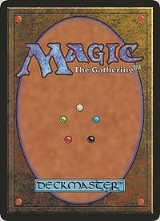
Magic: The Gathering

Encyclopedia
Magic: The Gathering also known as Magic, is the first collectible trading card game created by mathematics professor Richard Garfield
and introduced in 1993 by Wizards of the Coast
. Magic continues to thrive, with approximately twelve million players as of 2011. Magic can be played by two or more players each using a deck of printed cards or a deck of virtual cards through the Internet
-based Magic: The Gathering Online
or third-party programs.
Each game represents a battle between mighty wizards
, known as "planeswalker
s", who employ the magical spells, items, and fantastic creatures depicted on individual Magic cards to defeat their opponents. Although the original concept of the game drew heavily from the motifs of traditional fantasy
role-playing game
s such as Dungeons & Dragons
, the gameplay of Magic bears little similarity to pencil-and-paper adventure games, while having substantially more cards and more complex rules than many other card games.
An organized tournament system and a community of professional Magic players
has developed, as has a secondary market
for Magic cards. Magic cards can be valuable due to their rarity and utility in game play.
, the creator of the game, was a doctoral candidate at University of Pennsylvania
when he first started to design the game. During his free time he worked with local volunteer playtesters to help refine the game. He had been brought on as an adjunct professor at Whitman College
in 1993 when Peter Adkison
(then CEO of Wizards of the Coast
games company) first met with Garfield to discuss Garfield's new game RoboRally
. Adkison saw the game as very promising, but decided that Wizards of the Coast lacked the resources to produce it at that point. He did like Garfield's ideas and mentioned that he was looking for a portable game that could be played in the downtime that frequently occurs at gaming convention
s. Garfield returned and presented the general outline of the concept of a Trading Card Game. Adkison immediately saw the potential of this idea and agreed to produce it. Magic: The Gathering underwent a general release on 5 August 1993.
While the game was simply called "Magic" through most of playtesting, when the game had to be officially named, a lawyer informed them that Magic was too generic to be trademarked. "Mana Clash" was instead chosen to be the name used in the first solicitation of the game. Still, everybody involved with the game continued to refer to it as Magic. After further consultation with the lawyer it was decided to rename the game to Magic: The Gathering, thus enabling the name to be trademarked.
A patent
was granted to Wizards of the Coast in 1997 for "a novel method of game play and game components that in one embodiment are in the form of trading cards" that includes claims covering games whose rules include many of Magic's elements in combination, including concepts such as changing orientation of a game component to indicate use (referred to in the Magic and Vampire: The Eternal Struggle
rules as "tapping") and constructing a deck by selecting cards from a larger pool. The patent has aroused criticism from some observers, who believe some of its claims to be invalid. In 2003, the patent was an element of a larger legal dispute between Wizards of the Coast and Nintendo
, regarding trade secrets related to Nintendo's Pokémon Trading Card Game
. The legal action was settled out of court, and its terms were not disclosed.
The success of the initial edition prompted a reissue later in 1993, along with expansions to the game. Arabian Nights
was released as the first expansion in December 1993. New expansions and revisions of the base game ("Core Sets") have since been released on a regular basis, amounting to four releases a year.Until the release of Mirage
in 1996 expansions were released on an irregular basis. Beginning in 2009 one revision of the core set and three expansions are released every year. While the essence of the game has always stayed the same, the rules of Magic have undergone three major revisions with the release of the Revised Edition in 1994, Classic Edition
in 1999, and Magic 2010
in July 2009. With the release of the Eighth Edition
in 2003, Magic also received a major visual redesign.
In 1996, Wizards of the Coast established the "Pro Tour
", a circuit of tournaments where players can compete for sizable cash prizes over the course of a single weekend-long tournament. In 2009 the top prize at a single tournament was US$
40,000. Sanctioned through The DCI, the tournaments added an element of prestige to the game by virtue of the cash payouts and media coverage from within the community. As of 2009 Wizards of the Coast has given out more than $30,000,000 in prizes at various professional tournaments, including Pro Tours, Grand Prix, and national championships.
While unofficial methods of online play existed previously,Notably, the Apprentice
program. See Magic: The Gathering video games
. Magic Online
("MTGO" or "Modo"), an official online version of the game, was released in 2002. A new, updated version of Magic Online was released in April 2008.
players, but the following included all types of other people as well. The success of the game quickly led to the creation of similar games by other companies as well as Wizards of the Coast themselves. While TSR
's Spellfire
did become very popular (5 Editions, 6 languages, and 12 expansion sets to its name), Wizards of the Coast tried to follow up Magic' s success with Jyhad
(now called Vampire: The Eternal Struggle), a game about modern-day vampires, which appeared to do poorly, overall. Other similar games included Trading Card Games based on Star Trek
and Star Wars
.
In addition several individuals including Richard Garfield
and Donato Giancola
won personal awards for their contributions to Magic.
s". A player starts the game with twenty "life points" and loses when he or she is reduced to zero or less. Players lose life when they are dealt "damage" by being attacked with summoned creatures or when spells or other cards cause them to lose life directly. Although reducing an opponent to zero life is the most common way of ending a game, a player also loses if he or she must draw from an empty deck (called the "library" during the game), or if they have acquired 10 "poison counters." In addition, some cards specify other ways to win or lose the game.
Players begin the game by shuffling their decks and then drawing seven cards. Players also draw one card at the beginning of each of their turns, except the first player on their first turn. Players take turns consisting of several phases. Certain cards can only be played during certain phases or during the player's own turn, and the player whose turn it is has the first chance to play cards. At the end of a player's turn, if that player has more than seven cards in hand, the player discards until their hand contains seven cards. The contents of other players' decks and hands are not usually known to players.
The two basic card types in Magic are "spells" and "lands". Lands provide "mana
", or magical energy, which is used as magical fuel when the player attempts to cast spells. Players may only play one land per turn. More powerful spells generally cost more mana, so as the game progresses and more mana becomes available, the quantity and relative power of the spells played tends to increase. Some spells also require the payment of additional resources, such as cards in play or life points. Spells come in several varieties: "sorceries" and "instants" have a single, one-time effect before they go to the "graveyard" (discard pile); "enchantments" and "artifacts" are "permanents" that remain in play after being cast to provide a lasting magical effect; "creature" spells summon monsters that can attack and damage an opponent. The set Lorwyn introduced the new "planeswalker" card type, which represent powerful allies who fight with their own magic abilities depending on their loyalty to the player who summoned them. Spells can be of more than one type. For example, an "artifact creature" has all the benefits and drawbacks of being both an artifact and a creature.
Some spells have effects that override normal game rules. The "Golden Rules of Magic" state that "Whenever a card's text directly contradicts the rules, the card takes precedence." This allows Wizards of the Coast great flexibility in creating cards, but can cause problems when attempting to reconcile a card with the rules (or two cards with each other). The Comprehensive Rules, a detailed rulebook, exists to clarify these conflicts.
s". In most tournament formats, decks are required to be a minimum of sixty cards, with no upper limit. Players may use no more than four copies of any named card, with the exception of "basic lands", which act as a standard resource in Magic. Both these rules are loosened in "limited" tournament formats, where a small number of cards are opened for play from booster packs or tournament packs, with a minimum deck size of forty cards and no "four of" rule. Depending on the type of play, some cards have been "restricted" (the card is limited to a single copy per deck) or "banned" (the card is no longer legal for tournament play). These limitations are usually for balance of power reasons, but have been occasionally made because of gameplay mechanics.
Deck building requires much strategy as players must choose among thousands of cards which they want to play. This requires players to evaluate the power of their cards, as well as the possible synergies between them, and their possible interactions with the cards they expect to play against (this "metagame" can vary in different locations or time periods). The choice of cards is usually narrowed by the player deciding which colors they want to include in the deck. This decision is a key part of creating a deck. In general, reducing the number of colors used increases the statistical likelihood
of drawing the lands needed to cast one's spells while a player utilizing more colors has access to a greater arsenal of cards.
al design, called the "Color Wheel" or "Pentagon of Colors". Clockwise from the top, they are: white, blue, black, red, and green, respectively abbreviated WUBRG (often pronounced "woo-berg" by players and designers)."U" stands for "blue" because "B" denotes Black and "L" land; see Anatomy of a Magic Card To play a spell of a given color, at least one mana of that color is required. This mana is normally generated by a basic land: plains for white, island for blue, swamp for black, mountain for red, and forest for green. The balances and distinctions among the five colors form one of the defining aspects of the game. Each color has strengths and weaknesses based on the "style" of magic it represents.
The colors adjacent to each other on the pentagon are "allied" and often have similar, complementary abilities. For example, Blue has a relatively large number of flying creatures, which it shares with White and Black, which are next to it. The two non-adjacent colors to a particular color are "enemy" colors, and are thematically opposed. For instance, Red tends to be very aggressive, while White and Blue are often more defensive in nature. The Research and Development (R&D) team at Wizards of the Coast seeks to balance power and abilities among the five colors by using the "Color Pie" to differentiate each.
This guideline lays out the capabilities, themes, and mechanics of each color and allows for every color to have its own distinct attributes and gameplay. The Color Pie is used to ensure new cards are thematically in the correct color and do not infringe on the territory of other colors.
A "mulligan" rule was later introduced into the game, first informally in casual play and then in the official game rules. The modern "Paris mulligan" allows players to shuffle an unsatisfactory opening hand back into the deck at the start of the game, draw a new hand with one fewer card, and repeat until satisfied. In multiplayer, a player may take one mulligan without penalty, while subsequent mulligans will still cost one card (a rule known as "Partial Paris mulligan"). The original mulligan allowed a player a single redraw of seven new cards if that player's initial hand contained seven or zero lands. A variation of this rule called a "forced mulligan" is still used in some casual play circles and in multiplayer formats on Magic Online, and allows a single "free" redraw of seven new cards if a player's initial hand contains seven, six, one or zero lands.
. Each player would remove a card at random from the deck they wished to play with and the two cards would be set aside. At the end of the match, the winner would take and keep both cards. Early sets included a few cards with rules designed to interact with this gambling
aspect, allowing replacements of cards up for ante, adding more cards to the ante, or even permanently trading cards in play. The cards came with the instruction that they should be removed from the deck in a game that was not being played for ante.
The ante concept became controversial because many regions had restrictions on games of chance. The rule was later made optional because of these restrictions and because of players' reluctance to possibly lose a card that they owned. The gambling rule is forbidden at sanctioned events and is now mostly a relic of the past, though it still sees occasional usage in friendly games as well as the "five color" format. The last card to mention ante was printed in the 1995 expansion set Homelands
.
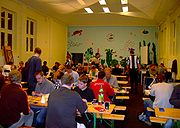 Magic tournament
s regularly occur in gaming stores and other venues. Larger tournaments with hundreds of competitors from around the globe sponsored by Wizards of the Coast are arranged many times every year, with substantial cash prizes for the top finishers. A number of websites report on tournament news, give complete lists for the most currently popular decks, and feature articles on current issues of debate about the game. The DCI, which is owned and operated by Wizards of the Coast
, is the organizing body for sanctioned Magic events. The two major categories of tournament play are "Constructed" and "Limited".
Different formats of Constructed Magic exist, each allowing different cards. They include "Vintage", "Legacy", "Extended", "Standard", "Block Constructed" and "Modern". The DCI maintains a "Banned and Restricted List" for each format; players may not use banned cards at all, and restricted cards are limited to one copy per deck. The DCI bans cards that it determines are damaging the health of a format; it seeks to use this remedy as infrequently as possible, and only a handful of cards have been banned in recent years. Currently, the only format with a Restricted List is Vintage.
Constructed is also the name of a rating category, more narrowly defined as to include only Block Constructed, Standard, and Extended tournaments.
Vintage, Legacy, and most recently Modern, are considered "Eternal Constructed" formats because the card pool never rotates. This means that all the sets that are currently legal will continue to be legal and any new sets will automatically be included in the legal card pool. The only banned cards in Vintage are cards using the "ante" mechanic and a few other cards that the DCI considers inappropriate for competitive Magic. Because of the expense in acquiring the scarce old cards to play competitive Vintage, many Vintage tournaments permit players to proxy
a certain number of cards.
In "Sealed Deck" tournaments, each player receives six booster packs (each containing 15 cards) from which to build his or her deck. They may then add as many basic lands of their choice to their deck, as needed.
In a "Booster Draft", several players (usually eight) are seated around a table and each player is given three booster packs. Each player opens a pack, selects a card from it, and passes the remaining cards to the next player. Each player then selects one of the remaining cards from the pack he or she just received, and passes the remaining cards again. This continues until all of the cards are depleted. Players pass left for the first and third packs, and right for the second. Players then build decks out of any of the cards that they selected during the drafting. Talking, signaling, and showing cards is forbidden during the drafting process, except for double faced cards from the Innistrad block, which must be shown openly to other players.
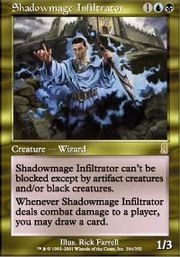
" tournaments as a stepstone to more competitive play.
The DCI runs the Pro Tour
as a series of major tournaments to attract interest. The right to compete in a Pro Tour has to be earned by either winning a Pro Tour Qualifier Tournament or being successful in a previous tournament on a similar level. A Pro Tour is usually structured into two days of individual competition played in the Swiss format
. On the final day, the top eight players compete with each other in an elimination format to select the winner.
At the end of the competition in a Pro Tour, a player is awarded Pro Points depending on their finishing place. If the player finishes high enough, they will also be awarded prize money. Frequent winners of these events have made names for themselves in the Magic community, such as Gabriel Nassif
, Kai Budde
and Jon Finkel
. As a promotional tool, the DCI launched the Hall of Fame
in 2005 to honor selected players.
At the end of the year the Magic World Championship
is held. The World Championship functions like a Pro Tour, except that competitors have to present their skill in three different formats (usually Standard, booster draft and a second constructed format) rather than one. Another difference is that invitation to the World Championship can be gained not through Pro Tour Qualifiers, but via the national championship of a country. Most countries sends the top four players of the tournament as representatives, though nations with minor Magic playing communities may send just one player. There are also other means to be invited to the tournament. The World Championship also has a team-based competition, where the national teams compete with each other.
At the beginning of the World Championship, new members are inducted into the Hall of Fame. The tournament also concludes the current season of tournament play and at the end of the event, the player who earned the most Pro Points during the year is awarded the title "Pro Player of the Year". The player who earned the most Pro Points and did not compete in any previous season is awarded the title "Rookie of the Year".
Invitation to a Pro Tour, Pro Points and prize money can also be earned in lesser tournaments called Grand Prix
that are open to the general public and are held more frequently throughout the year. Grand Prix events are usually the largest Magic tournaments, sometimes drawing more than 1,000 players. The largest Magic tournament ever held was a Grand Prix held in Madrid in 2010.
s. Each Magic card, approximately 63 x 88 mm in size (2 by 3 inches), has a face which displays the card's name and rules text as well as an illustration appropriate to the card's concept. 12,246 unique cards have been produced for the game as of October 2011,
many of them with variant editions, artwork, or layouts, and 600–1000 new ones are added each year. The first Magic cards were printed exclusively in English
, but current sets are also printed in Simplified Chinese, Traditional Chinese, French
, German
, Italian
, Japanese
, Korean
, Portuguese
, Russian
, and Spanish
.
The overwhelming majority of Magic cards are issued and marketed in the form of sets, of which there are currently two types, the core set and the themed expansion sets. Under Wizards of the Coast's current production and marketing scheme, a new set is released quarterly. If recent history is a guide, however, the actual releases in a given year will differ from the template discussed below, at least in some particulars, more often than they will conform to it.
The Core Set, started to be released annually (previously biennially) in July as of 2009 coinciding with the name format change from 10th Edition
to Magic 2010
. This shift also introduced new, never before printed cards into the core set, something that previously had never been done. As of the previous set, Magic 2011
, 140 of the 249 cards in the Core Sets are reprints of previously introduced cards and 109 are newly created. The current Core Set, Magic 2012, was released on July 15, 2011.
The expansion sets are released in a three-set block starting in October, typically with a large initial set (that gives its name to the block) and then two smaller follow-ups at three-month intervals. These sets consist almost exclusively of newly-designed cards. Contrasted with the wide-ranging Core Set, each expansion is thematically narrower and deeper in both storyline and design. Expansions also dedicate several cards to a handful of particular, often newly introduced, game mechanics which do not appear in other sets. Expansion sets are released in a yearly three-set "block," starting with a large, ~250 card set in October which is followed by two small, ~150 card sets the following winter and spring. The follow-up sets typically continue the storyline established in the block's opening set and have related gameplay mechanics.
In addition to the quarterly set releases, Magic cards are released in other products as well, such as the recent Planechase
and Archenemy
spin-off games. These combine reprinted Magic cards with new, oversize cards with new functionality.
Magic cards are normally divided into four rarities, which can be differentiated by the color of the expansion symbol (in sets released after the Stronghold
expansion; for cards released prior to Exodus
, rarities must be checked against an external cardlist or database, as all expansion symbols were black). These rarities are Common (Black), Uncommon (Silver), Rare (Gold), and, starting in Shards of Alara in October 2008, Mythic Rare (Copper-Red). Basic lands are their own rarity and are colored black as Commons. Most new cards are purchased in the form of Booster Packs. A fifteen-card Booster Pack will typically contain one Rare, three Uncommons, ten Commons, and one Basic Land (this is a change starting with Shards of Alara; in previous sets there were typically eleven Commons and no Basic Land). On average, a Mythic Rare replaces one in eight Rare cards. There are also premium versions of every card with holographic foil, randomly inserted into some boosters, which replace about every seventieth card. Previously cards were also sold in Tournament Packs typically containing three Rares, ten Uncommons, thirty-two Commons, and thirty Basic Lands."Typically" is used due to a change in card distribution in Time Spiral
which allows premium cards of any rarity to replace Common cards instead of cards of their own rarity. See Purple Reign for more information. Tournament Packs were discontinued after Shards of Alara.
In 2003, starting with the Eighth Edition
Core Set, the game went through its biggest visual change since its creation—a new card frame layout was developed to allow more rules text and larger art on the cards, while reducing the thick, colored border to a minimum. The new frame design aimed to improve contrast and readability using black type instead of the previous white, a new font, and partitioned areas for the name, card type, and power and toughness.
For the first few years of its production, Magic: The Gathering featured a small number of cards with names or artwork with demon
ic or occult
ist themes, in 1995 the company elected to remove such references from the game. In 2002, believing that the depiction of demons was becoming less controversial and that the game had established itself sufficiently, Wizards of the Coast reversed this policy and resumed printing cards with "demon" in their names.
. While comics and books have mostly been supplements to develop a background story for the game several video games have been produced which lean in varying degree on the original game. For the first computer games Wizards of the Coast
had sold licenses to Acclaim
and MicroProse
roughly at the same time. While MicroProse's Magic: The Gathering
received favorable reviews, Acclaim's Magic: The Gathering: BattleMage was mostly dismissed with negative reaction
In Magic: The Gathering Online
Wizards has released a computer version of the game themselves, that allows players to compete online against other players using the original Magic cards and rules. The latest computer implementation of Magic is Magic: The Gathering - Duels of the Planeswalkers developed by Stainless Games
for the Playstation 3
, as well as the Xbox 360
. Duels of the Planeswalkers simplifies much of the gameplay to be more accessible to newer players but otherwise follows the standard Magic rules. The game was the most-played Xbox Live
title for two weeks after its release. Duels of the Planeswalkers was also released for the PC in June 2010.
, which was a parody of Magic: The Gathering. Wizards of the Coast, which owned the rights to Magic: The Gathering, took active steps to hinder the distribution of the game and successfully shut out PGI Limited from attending GenCon in July 1998. In an unsuccessful attempt to circumvent copyright
issues and the infringement of Richard Garfield
’s patented trading card game foundations, two steps were taken. First of all each starter deck of Havic had printed on the back side, “This is a Parody.” The second step taken was to include on the bottom of the rule card, "Do not have each player: construct their own library of predetermined number of game components by examining and selecting [the] game components from [a] reservoir of game components or you may infringe on U.S. Patent No. 5,662,332 to Garfield."
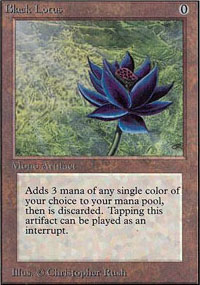 There is an active secondary market in individual cards among players and game shops. Many physical and online stores also sell single cards or "playsets" of four of a card. Common cards rarely sell for more than a few cents and are usually sold in bulk. Uncommon cards and weak rares typically cost around US$1. The most expensive cards in Standard tournament play usually cost approximately $40–50. On rare occasions, some have sold for $60–100. Foil versions of rare and mythic rare cards are typically about twice as valuable as the regular versions.
A few of the oldest cards –from Alpha to Urza's Destiny
, due to smaller printings and limited distribution and are highly valued and extremely rare. This is in part due to the "Reserve List", a list of cards created starting in 1995 that are Wizards has promised never to reprint.
The most expensive card which was in regular print (as opposed to being a promotional or special printing) is Black Lotus— in 2005, a "Pristine 10 grade" Beckett Grading Services graded Beta Black Lotus was bought by Darren Adams, owner of West Coast Sports Cards & Gaming Distributors in Federal Way, Washington, for a record $20,000. A small number of cards of similar age, rarity, and playability —chiefly among them the other cards in the so-called "Power Nine
"— routinely reach prices of several hundred dollars as well.
' s early artwork was commissioned with little specific direction or concern for visual cohesion. One infamous example was the printing of the creature Whippoorwill without the "flying" ability even though its art showed a bird in flight. The art direction team later decided to impose a few constraints so that the artistic vision more closely aligned with the design and development of the cards. Each block of cards now has its own style guide
with sketches and descriptions of the various races and places featured in the setting.
A few early sets experimented with alternate art for cards. However, Wizards came to believe that this impeded easy recognition of a card and that having multiple versions caused confusion when identifying a card at a glance. Consequently, alternate art is now only used sparingly and mostly for promotional cards.A notable exception are Basic Land cards, but those are easily identifiable due to the oversized mana symbol in their text boxes. When older cards are reprinted in new sets, however, Wizards of the Coast has guaranteed that they will be printed with new art to make them more collectible.
Ever since 1995, the copyright on all artwork commissioned is transferred to Wizards of the Coast once a contract is signed. However, the artist is allowed to sell the original piece and printed reproductions of it, and for established and prolific Magic artists, this can be a lucrative source of revenue.
As Magic has expanded across the globe, its artwork has had to change for its international audience. Artwork has been edited or given alternate art to comply with the governmental standards. For example, the portrayal of skeletons and most undead in artwork was prohibited by the Chinese government
until 2008.
of the cards, as well as in novels and anthologies published by Wizards of the Coast
(and formerly by HarperPrism). Important storyline characters or objects often appear as cards in Magic sets, usually as "Legendary" creatures.
The expansion sets from Antiquities
through Scourge
(with the exception of Homelands
) revolve around the plane of Dominaria and are a roughly chronological timeline of that plane's history (with the exception of the Urza's Saga
block). Major recurring characters include Urza
and his brother Mishra. The sets from Weatherlight through Apocalypse
follow in particular the story of the crew of the Weatherlight, allies of Urza against Yawgmoth
. Odyssey
through Scourge
are an unconnected storyline set 100 years later on the continent of Otaria, where multiple factions battle for control of the Mirari, a powerful magical artifact.
After Scourge
, Magic ventured out of Dominaria into the new planes of Mirrodin, a metallic artificial plane watched over and ruled by an animated Mirari; Kamigawa, a Japanese-themed plane set in the time of a great war between spirits and mortals; and Ravnica, a completely urbanised plane headed by ten guilds, at a time when their pact is at a turning point. It then returned to Dominaria, in a devastated apocalyptic state, for the Time Spiral
block, but left it again upon the block's conclusion. The focus of the following block lay on the Lorwyn plane, inspired by Celtic mythology, which shifts from a utopic and bucolic paradise to a shadowy and creepy land of darkness. The subsequent block was situated on Alara, a world split in five but later reunited. A recent block focuses on Zendikar, a world used as a prison to entrap a race of interplanar parasitic monsters called the Eldrazi. The next set, which follows the Zendikar block, revisits the plane of Mirrodin in a set called Scars of Mirrodin
, where the original inhabitants of Mirrodin have to battle the invading Phyrexian aberrations. On September 30th, 2011, Innistrad was released and is the most recent set. Innistrad focuses on a plane filled with Humans, werewolves, Vampires, Zombies, and spirits. As such it uses a large number of horror tropes.
Richard Garfield
Richard Channing Garfield is a mathematics professor and game designer who created the card games Magic: The Gathering, Netrunner, BattleTech CCG, Vampire: The Eternal Struggle , The Great Dalmuti, Star Wars Trading Card Game, and the board game RoboRally...
and introduced in 1993 by Wizards of the Coast
Wizards of the Coast
Wizards of the Coast is an American publisher of games, primarily based on fantasy and science fiction themes, and formerly an operator of retail stores for games...
. Magic continues to thrive, with approximately twelve million players as of 2011. Magic can be played by two or more players each using a deck of printed cards or a deck of virtual cards through the Internet
Internet
The Internet is a global system of interconnected computer networks that use the standard Internet protocol suite to serve billions of users worldwide...
-based Magic: The Gathering Online
Magic: The Gathering Online
Magic: The Gathering Online or Magic Online is a direct video game adaptation of Magic: The Gathering, utilizing the concept of a virtual economy in order to preserve the collectible aspect of the card game. It is played through an Internet service operated by Wizards of the Coast, which went...
or third-party programs.
Each game represents a battle between mighty wizards
Magician (fantasy)
A magician, mage, sorcerer, sorceress, wizard, enchanter, enchantress, thaumaturge or a person known under one of many other possible terms is someone who uses or practices magic that derives from supernatural or occult sources...
, known as "planeswalker
Planeswalker
In the collectible card game Magic: The Gathering, a planeswalker is a mage with the ability to travel to different planes of existence.-Magic: The Gathering:...
s", who employ the magical spells, items, and fantastic creatures depicted on individual Magic cards to defeat their opponents. Although the original concept of the game drew heavily from the motifs of traditional fantasy
Fantasy
Fantasy is a genre of fiction that commonly uses magic and other supernatural phenomena as a primary element of plot, theme, or setting. Many works within the genre take place in imaginary worlds where magic is common...
role-playing game
Role-playing game
A role-playing game is a game in which players assume the roles of characters in a fictional setting. Players take responsibility for acting out these roles within a narrative, either through literal acting, or through a process of structured decision-making or character development...
s such as Dungeons & Dragons
Dungeons & Dragons
Dungeons & Dragons is a fantasy role-playing game originally designed by Gary Gygax and Dave Arneson, and first published in 1974 by Tactical Studies Rules, Inc. . The game has been published by Wizards of the Coast since 1997...
, the gameplay of Magic bears little similarity to pencil-and-paper adventure games, while having substantially more cards and more complex rules than many other card games.
An organized tournament system and a community of professional Magic players
Pro Tour (Magic: The Gathering)
The Pro Tour is the highest form of competitive play for the Magic: The Gathering collectible card game. It consists of a series of payout tournaments held throughout the world, each requiring an invitation to participate. Every PT awards a total of $230,000 in cash prizes, with $40,000 going to...
has developed, as has a secondary market
Secondary market
The page applies to the finanical term; For the merchandising concept, see Aftermarket .The secondary market, also called aftermarket, is the financial market where previously issued securities and financial instruments such as stock, bonds, options, and futures are bought and sold....
for Magic cards. Magic cards can be valuable due to their rarity and utility in game play.
History
Richard GarfieldRichard Garfield
Richard Channing Garfield is a mathematics professor and game designer who created the card games Magic: The Gathering, Netrunner, BattleTech CCG, Vampire: The Eternal Struggle , The Great Dalmuti, Star Wars Trading Card Game, and the board game RoboRally...
, the creator of the game, was a doctoral candidate at University of Pennsylvania
University of Pennsylvania
The University of Pennsylvania is a private, Ivy League university located in Philadelphia, Pennsylvania, United States. Penn is the fourth-oldest institution of higher education in the United States,Penn is the fourth-oldest using the founding dates claimed by each institution...
when he first started to design the game. During his free time he worked with local volunteer playtesters to help refine the game. He had been brought on as an adjunct professor at Whitman College
Whitman College
Whitman College is a private, co-educational, non-sectarian, residential undergraduate liberal arts college located in Walla Walla, Washington. Initially founded as a seminary by a territorial legislative charter in 1859, the school became a four year degree granting institution in 1883...
in 1993 when Peter Adkison
Peter Adkison
Peter D. Adkison is the founder and first CEO of Wizards of the Coast , as well as a hobby game professional.During Adkison's tenure, Wizards of the Coast rose to the status of a major publisher in the hobby game industry. Wizards achieved runaway success with its creation of "Magic: the...
(then CEO of Wizards of the Coast
Wizards of the Coast
Wizards of the Coast is an American publisher of games, primarily based on fantasy and science fiction themes, and formerly an operator of retail stores for games...
games company) first met with Garfield to discuss Garfield's new game RoboRally
RoboRally
RoboRally is a board game originally published in 1994 by Wizards of the Coast . It was designed in 1985 by Richard Garfield, who would later create the card game Magic: The Gathering. The game and its expansions received a total of four Origins Awards...
. Adkison saw the game as very promising, but decided that Wizards of the Coast lacked the resources to produce it at that point. He did like Garfield's ideas and mentioned that he was looking for a portable game that could be played in the downtime that frequently occurs at gaming convention
Gaming convention
A gaming convention is a gathering that centered on role-playing games, collectible card games, miniatures wargames, board games, video games, or other types of games. These conventions are typically two or three days long, and often held at either a university or in a convention center hotel...
s. Garfield returned and presented the general outline of the concept of a Trading Card Game. Adkison immediately saw the potential of this idea and agreed to produce it. Magic: The Gathering underwent a general release on 5 August 1993.
While the game was simply called "Magic" through most of playtesting, when the game had to be officially named, a lawyer informed them that Magic was too generic to be trademarked. "Mana Clash" was instead chosen to be the name used in the first solicitation of the game. Still, everybody involved with the game continued to refer to it as Magic. After further consultation with the lawyer it was decided to rename the game to Magic: The Gathering, thus enabling the name to be trademarked.
A patent
Patent
A patent is a form of intellectual property. It consists of a set of exclusive rights granted by a sovereign state to an inventor or their assignee for a limited period of time in exchange for the public disclosure of an invention....
was granted to Wizards of the Coast in 1997 for "a novel method of game play and game components that in one embodiment are in the form of trading cards" that includes claims covering games whose rules include many of Magic's elements in combination, including concepts such as changing orientation of a game component to indicate use (referred to in the Magic and Vampire: The Eternal Struggle
Vampire: The Eternal Struggle
Vampire: The Eternal Struggle, published as Jyhad in the first or "Limited" edition and often abbreviated as VTES, V:TES or V:tES, is a multiplayer collectible card game set in the World of Darkness. It is published by White Wolf, Inc....
rules as "tapping") and constructing a deck by selecting cards from a larger pool. The patent has aroused criticism from some observers, who believe some of its claims to be invalid. In 2003, the patent was an element of a larger legal dispute between Wizards of the Coast and Nintendo
Nintendo
is a multinational corporation located in Kyoto, Japan. Founded on September 23, 1889 by Fusajiro Yamauchi, it produced handmade hanafuda cards. By 1963, the company had tried several small niche businesses, such as a cab company and a love hotel....
, regarding trade secrets related to Nintendo's Pokémon Trading Card Game
Pokémon Trading Card Game
The Pokémon Trading Card Game is a collectible card game based on the Pokémon video game series, first introduced in Japan in October 1996, then North America in December 1998...
. The legal action was settled out of court, and its terms were not disclosed.
The success of the initial edition prompted a reissue later in 1993, along with expansions to the game. Arabian Nights
Arabian Nights (Magic: The Gathering)
Arabian Nights was the fourth Magic: The Gathering set and the first expansion set. The set is composed entirely of new cards. The setting of Arabian Nights is inspired by the themes and characters of the Thousand and One Arabian Nights with some of the characters and places coming directly from...
was released as the first expansion in December 1993. New expansions and revisions of the base game ("Core Sets") have since been released on a regular basis, amounting to four releases a year.Until the release of Mirage
Mirage (Magic: The Gathering)
Mirage was the fifteenth Magic: The Gathering set and ninth expert level set, released in October 1996. This expansion began the first official block set with one large expansion being followed by two smaller expansions all tied together through card mechanics and setting. This expansion also...
in 1996 expansions were released on an irregular basis. Beginning in 2009 one revision of the core set and three expansions are released every year. While the essence of the game has always stayed the same, the rules of Magic have undergone three major revisions with the release of the Revised Edition in 1994, Classic Edition
6th Edition (Magic: The Gathering)
The Sixth Edition core set of Magic: The Gathering, also known as Classic, was released on April 27, 1999. It contains 350 cards, with reprints of cards from previous core sets, as well as some new reprints from expansion sets through the Weatherlight expansion.-Rule changes:The release of Sixth...
in 1999, and Magic 2010
Magic 2010
Magic 2010 is a Magic: The Gathering expansion set, that was released on July 17, 2009. It is the eleventh core set for Magic: the Gathering...
in July 2009. With the release of the Eighth Edition
8th Edition (Magic: The Gathering)
Eighth Edition or Core Set was the standard base set for the collectible trading card game, Magic: The Gathering from its release in 2003 until 9th Edition's release in 2005...
in 2003, Magic also received a major visual redesign.
In 1996, Wizards of the Coast established the "Pro Tour
Pro Tour (Magic: The Gathering)
The Pro Tour is the highest form of competitive play for the Magic: The Gathering collectible card game. It consists of a series of payout tournaments held throughout the world, each requiring an invitation to participate. Every PT awards a total of $230,000 in cash prizes, with $40,000 going to...
", a circuit of tournaments where players can compete for sizable cash prizes over the course of a single weekend-long tournament. In 2009 the top prize at a single tournament was US$
United States dollar
The United States dollar , also referred to as the American dollar, is the official currency of the United States of America. It is divided into 100 smaller units called cents or pennies....
40,000. Sanctioned through The DCI, the tournaments added an element of prestige to the game by virtue of the cash payouts and media coverage from within the community. As of 2009 Wizards of the Coast has given out more than $30,000,000 in prizes at various professional tournaments, including Pro Tours, Grand Prix, and national championships.
While unofficial methods of online play existed previously,Notably, the Apprentice
Apprentice (software)
Apprentice is a program that assists in playing Magic: The Gathering over the Internet and maintains a searchable database of Magic cards. It was developed by Dragonstar Studios from 1996-1999 and based on an earlier program from 1995 by Tan Thor Jen...
program. See Magic: The Gathering video games
Magic: The Gathering video games
Several video games based on the Magic: The Gathering franchise exist for multiple systems. Some have attempted to translate the card game to electronic play nearly exactly; others have taken more liberties and drawn more from the setting than the actual rules of the card game. Benefits of...
. Magic Online
Magic: The Gathering Online
Magic: The Gathering Online or Magic Online is a direct video game adaptation of Magic: The Gathering, utilizing the concept of a virtual economy in order to preserve the collectible aspect of the card game. It is played through an Internet service operated by Wizards of the Coast, which went...
("MTGO" or "Modo"), an official online version of the game, was released in 2002. A new, updated version of Magic Online was released in April 2008.
Reception
Magic was an immediate success for Wizards of the Coast. Early on they were even reluctant to advertise the game because they were unable to keep pace with existing demand. Initially Magic attracted many Dungeons & DragonsDungeons & Dragons
Dungeons & Dragons is a fantasy role-playing game originally designed by Gary Gygax and Dave Arneson, and first published in 1974 by Tactical Studies Rules, Inc. . The game has been published by Wizards of the Coast since 1997...
players, but the following included all types of other people as well. The success of the game quickly led to the creation of similar games by other companies as well as Wizards of the Coast themselves. While TSR
TSR, Inc.
Blume and Gygax, the remaining owners, incorporated a new company called TSR Hobbies, Inc., with Blume and his father, Melvin Blume, owning the larger share. The former assets of the partnership were transferred to TSR Hobbies, Inc....
's Spellfire
Spellfire
Spellfire: Master the Magic is a collectible card game created by Tactical Studies Rules and based on their popular Dungeons & Dragons role playing game. The game first appeared in 1994, shortly after the introduction of Magic: The Gathering, and was created as a response to the success of...
did become very popular (5 Editions, 6 languages, and 12 expansion sets to its name), Wizards of the Coast tried to follow up Magic
Vampire: The Eternal Struggle
Vampire: The Eternal Struggle, published as Jyhad in the first or "Limited" edition and often abbreviated as VTES, V:TES or V:tES, is a multiplayer collectible card game set in the World of Darkness. It is published by White Wolf, Inc....
(now called Vampire: The Eternal Struggle), a game about modern-day vampires, which appeared to do poorly, overall. Other similar games included Trading Card Games based on Star Trek
Star Trek Customizable Card Game
The Star Trek Customizable Card Game is a collectible card game based on the Star Trek universe. The name is commonly abbreviated as STCCG or ST:CCG. It was first introduced in 1994 by Decipher, Inc., under the name Star Trek: The Next Generation Customizable Card Game...
and Star Wars
Star Wars Customizable Card Game
Star Wars: Customizable Card Game is a customizable card game based on the Star Wars fictional universe. It was created by Decipher, Inc., which also produced the Star Trek Customizable Card Game and The Lord of the Rings Trading Card Game. The game was produced from December 1995 until December...
.
Awards
- 1994: Mensa Select Award winner
- 1994: Origins Awards for Best Fantasy or Science Fiction Board game of 1993 and Best Graphic Presentation of a Board game of 1993
- 1994: Origins Award for the LegendsLegends (Magic: The Gathering)Legends was the seventh Magic: The Gathering set and the third expansion set, released in June 1994. It was the first expansion set to be sold in packs of 15 . The set was designed by Wizards of the Coast co-founder Steve Conard and friend Robin Herbert in Canada before the game was initially...
expansion as Best Game Accessory - 1995: Italian Gaming Society Gioco dell'Anno award winner
- 1996: Super As d'Or award for "Best New Game Concept and Genre Introduced in France"
- 1997: InQuestInQuest GamerInQuest Gamer is a discontinued monthly magazine for game reviews and news that was published from 1995 to 2007. Originally, the magazine was named InQuest and focused solely on collectible card games ; InQuest, along with its competitor Scrye, were the two major CCG magazines...
Fan Award for Best CCG Expansion for the Weatherlight expansion - 1998 Origins Award for the Urza's SagaUrza's SagaUrza's Saga is the 15th expert level set, a 350-card Magic: The Gathering expansion set that debuted in October 1998. Some employees of Wizards consider it one of the most powerful sets ever released, with many cards now banned in tournament formats...
expansion as Collectible Card Game Expansion of the Year - 1999: Inducted alongside Richard Garfield into the Origins Hall of Fame
- 2003: Games Magazine selected Magic for its Games Hall of Fame
- 2005: Origins Award for the Ravnica: City of GuildsRavnica: City of GuildsThis article is about the Magic: The Gathering set known as Ravnica: City of Guilds. For an article about the plane and the guilds mentioned below, see Ravnica ....
expansion as Collectible Card Game Expansion of the Year - 2009: Origins Award for the Shards of AlaraShards of AlaraShards of Alara is an expansion set from the trading card game Magic: The Gathering. It is the 47th limited-edition expansion set for Magic and was released on October 3, 2008. On Magic Online Shards was released on October 20, 2008....
expansion as Collectible Card Game Expansion of the Year
In addition several individuals including Richard Garfield
Richard Garfield
Richard Channing Garfield is a mathematics professor and game designer who created the card games Magic: The Gathering, Netrunner, BattleTech CCG, Vampire: The Eternal Struggle , The Great Dalmuti, Star Wars Trading Card Game, and the board game RoboRally...
and Donato Giancola
Donato Giancola
Donato Giancola is an American artist specializing in science fiction and fantasy illustration.-Biography:Donato Giancola was born in 1967 and raised in Colchester, Vermont, near Burlington, Vermont...
won personal awards for their contributions to Magic.
Gameplay
In a game of Magic, two or more players are engaged in a battle as powerful wizards called "planeswalkerPlaneswalker
In the collectible card game Magic: The Gathering, a planeswalker is a mage with the ability to travel to different planes of existence.-Magic: The Gathering:...
s". A player starts the game with twenty "life points" and loses when he or she is reduced to zero or less. Players lose life when they are dealt "damage" by being attacked with summoned creatures or when spells or other cards cause them to lose life directly. Although reducing an opponent to zero life is the most common way of ending a game, a player also loses if he or she must draw from an empty deck (called the "library" during the game), or if they have acquired 10 "poison counters." In addition, some cards specify other ways to win or lose the game.
Players begin the game by shuffling their decks and then drawing seven cards. Players also draw one card at the beginning of each of their turns, except the first player on their first turn. Players take turns consisting of several phases. Certain cards can only be played during certain phases or during the player's own turn, and the player whose turn it is has the first chance to play cards. At the end of a player's turn, if that player has more than seven cards in hand, the player discards until their hand contains seven cards. The contents of other players' decks and hands are not usually known to players.
The two basic card types in Magic are "spells" and "lands". Lands provide "mana
Magic point
Magic points are units of magical power that are used in many role-playing, computer role-playing and similar games as an expendable resource that is needed to pay for magic spells and other abilities, such as special attacks...
", or magical energy, which is used as magical fuel when the player attempts to cast spells. Players may only play one land per turn. More powerful spells generally cost more mana, so as the game progresses and more mana becomes available, the quantity and relative power of the spells played tends to increase. Some spells also require the payment of additional resources, such as cards in play or life points. Spells come in several varieties: "sorceries" and "instants" have a single, one-time effect before they go to the "graveyard" (discard pile); "enchantments" and "artifacts" are "permanents" that remain in play after being cast to provide a lasting magical effect; "creature" spells summon monsters that can attack and damage an opponent. The set Lorwyn introduced the new "planeswalker" card type, which represent powerful allies who fight with their own magic abilities depending on their loyalty to the player who summoned them. Spells can be of more than one type. For example, an "artifact creature" has all the benefits and drawbacks of being both an artifact and a creature.
Some spells have effects that override normal game rules. The "Golden Rules of Magic" state that "Whenever a card's text directly contradicts the rules, the card takes precedence." This allows Wizards of the Coast great flexibility in creating cards, but can cause problems when attempting to reconcile a card with the rules (or two cards with each other). The Comprehensive Rules, a detailed rulebook, exists to clarify these conflicts.
Deck construction
Each player needs a deck to play a game of Magic. Beginners often start with an initial "Intro Pack", which can then be modified using cards from "booster packBooster pack
In collectible card games and collectible miniature wargames, a booster pack is a sealed package of cards or figurines, designed to add to a player's collection....
s". In most tournament formats, decks are required to be a minimum of sixty cards, with no upper limit. Players may use no more than four copies of any named card, with the exception of "basic lands", which act as a standard resource in Magic. Both these rules are loosened in "limited" tournament formats, where a small number of cards are opened for play from booster packs or tournament packs, with a minimum deck size of forty cards and no "four of" rule. Depending on the type of play, some cards have been "restricted" (the card is limited to a single copy per deck) or "banned" (the card is no longer legal for tournament play). These limitations are usually for balance of power reasons, but have been occasionally made because of gameplay mechanics.
Deck building requires much strategy as players must choose among thousands of cards which they want to play. This requires players to evaluate the power of their cards, as well as the possible synergies between them, and their possible interactions with the cards they expect to play against (this "metagame" can vary in different locations or time periods). The choice of cards is usually narrowed by the player deciding which colors they want to include in the deck. This decision is a key part of creating a deck. In general, reducing the number of colors used increases the statistical likelihood
Probability
Probability is ordinarily used to describe an attitude of mind towards some proposition of whose truth we arenot certain. The proposition of interest is usually of the form "Will a specific event occur?" The attitude of mind is of the form "How certain are we that the event will occur?" The...
of drawing the lands needed to cast one's spells while a player utilizing more colors has access to a greater arsenal of cards.
Colors of Magic
Most spells come in one of five colors. The colors can be seen on the back of the cards, in a pentagonPentagon
In geometry, a pentagon is any five-sided polygon. A pentagon may be simple or self-intersecting. The sum of the internal angles in a simple pentagon is 540°. A pentagram is an example of a self-intersecting pentagon.- Regular pentagons :In a regular pentagon, all sides are equal in length and...
al design, called the "Color Wheel" or "Pentagon of Colors". Clockwise from the top, they are: white, blue, black, red, and green, respectively abbreviated WUBRG (often pronounced "woo-berg" by players and designers)."U" stands for "blue" because "B" denotes Black and "L" land; see Anatomy of a Magic Card To play a spell of a given color, at least one mana of that color is required. This mana is normally generated by a basic land: plains for white, island for blue, swamp for black, mountain for red, and forest for green. The balances and distinctions among the five colors form one of the defining aspects of the game. Each color has strengths and weaknesses based on the "style" of magic it represents.
- White is the color of order, equality, righteousness, healing, law, community, peace, absolutism/totalitarianism, and light, although not necessarily "good". White's strengths are a roster of small creatures that are strong collectively; protecting those creatures with enchantments; gaining life; preventing damage to creatures or players; imposing restrictions on players; reducing the capabilities of opposing creatures, and powerful spells that "equalize" the playing field by destroying all cards of a given type. White creatures are known for their "Protection" from various other colors or even types of card, rendering them nearly impervious to harm from those things. Numerous white creatures also have "First Strike", "Lifelink", and "Vigilance". White's weaknesses include a focus on creatures, its unwillingness to simply kill creatures outright (instead hobbling them with restrictions that can be undone), and the fact that many of its most powerful spells affect all players equally—including the casting player.
- Blue is the color of intellect, reason, illusion, logic, knowledge, manipulation, and trickery, as well as the classical elements of airAir (classical element)Air is often seen as a universal power or pure substance. Its supposed fundamental importance to life can be seen in words such as aspire, inspire, perspire and spirit, all derived from the Latin spirare.-Greek and Roman tradition:...
and waterWater (classical element)Water is one of the elements in ancient Greek philosophy, in the Asian Indian system Panchamahabhuta, and in the Chinese cosmological and physiological system Wu Xing...
. Blue's cards are best at letting a player draw additional cards; permanently taking control of an opponent's cards; returning cards to their owner's hand; and countering spells, causing them to be discarded and the mana used to pay them wasted. Blue's creatures tend to be weaker than creatures of other colors, but commonly have abilities and traits which make them difficult to damage or block, particularly "Flying" and to a lesser extent "Shroud". Blue's weaknesses include having trouble permanently dealing with spells that have already been played, the reactive nature of most of its spells, and a small (and expensive) roster of creatures.
- Black is the color of power, ambition, greed, death, corruption, selfishness, and amorality; it is not necessarily evilEvilEvil is the violation of, or intent to violate, some moral code. Evil is usually seen as the dualistic opposite of good. Definitions of evil vary along with analysis of its root motive causes, however general actions commonly considered evil include: conscious and deliberate wrongdoing,...
, though many of its cards refer directly and indirectly to this concept. Black cards are best at destroying creatures, forcing players to discard cards from their hand, making players lose life, and returning creatures from the dead. Furthermore, because Black seeks to win at all costs, it has limited access to many abilities or effects that are normally available only to one of the other colors; but these abilities often require large sacrifices of life totals, creatures, cards in hand, cards in library, and other difficult-to-replace resources. Black is known for having creatures with the ability "Intimidate", making them difficult to block. Lesser black abilities include "Deathtouch" and "Regeneration". Black's main weaknesses are an almost complete inability to deal with enchantments and artifacts, its tendency to hurt itself almost as badly as it hurts the opponent, and difficulties in removing other Black creatures.
- Red is the color of freedom, chaos, passion, creativity, impulse, fury, warfare, lightningLightningLightning is an atmospheric electrostatic discharge accompanied by thunder, which typically occurs during thunderstorms, and sometimes during volcanic eruptions or dust storms...
, the classical element of fireFire (classical element)Fire has been an important part of all cultures and religions from pre-history to modern day and was vital to the development of civilization. It has been regarded in many different contexts throughout history, but especially as a metaphysical constant of the world.-Greek and Roman tradition:Fire...
, and the non-living geological aspects of the classical element earthEarth (classical element)Earth, home and origin of humanity, has often been worshipped in its own right with its own unique spiritual tradition.-European tradition:Earth is one of the four classical elements in ancient Greek philosophy and science. It was commonly associated with qualities of heaviness, matter and the...
. Red's strengths include destroying opposing lands and artifacts, sacrificing permanent resources for temporary but great power, and playing spells that deal "direct damage" to creatures or players, usually via applications of fire. Red has a wide array of creatures, but with the exception of extremely powerful dragons, most are fast and weak, or with low toughness, rendering them easier to destroy. Some of Red's cards can turn against or hurt their owner in return for being more powerful for their cost. Red also shares the trickery theme with Blue and can temporarily steal opponents' creatures or divert spells, although generally not permanently. Many of Red's most famous creatures have the "Haste" trait, which lets them attack and use many abilities earlier. The ability to raise a creature's power temporarily is also common among Red's creatures. Red's weaknesses include its inability to destroy enchantments, the self-destructive nature of many of its spells, and the way in which it trades early-game speed at the cost of late-game staying power. Red also has the vast majority of cards that involve random chance.
- Green is the color of life, instinct, nature, reality, evolution, ecology and interdependence. Green has a large number of creatures, which tend to be the largest in the game for their cost. Many of its spells make them stronger temporarily. It can also destroy "unnatural" artifacts and enchantments, increase a player's life total, get extra lands or other mana sources into play, and produce the other four colors of mana. Green creatures often have "Trample", an ability which lets them deal attack damage to an opponent if blocked by a weaker creature. Green's weaknesses include its difficulty destroying creatures directly; a distinct shortage of flying creatures (though some of its creatures have "Reach", making them able to block flying creatures); and a lack of strategic options other than its signature large creatures.
The colors adjacent to each other on the pentagon are "allied" and often have similar, complementary abilities. For example, Blue has a relatively large number of flying creatures, which it shares with White and Black, which are next to it. The two non-adjacent colors to a particular color are "enemy" colors, and are thematically opposed. For instance, Red tends to be very aggressive, while White and Blue are often more defensive in nature. The Research and Development (R&D) team at Wizards of the Coast seeks to balance power and abilities among the five colors by using the "Color Pie" to differentiate each.
This guideline lays out the capabilities, themes, and mechanics of each color and allows for every color to have its own distinct attributes and gameplay. The Color Pie is used to ensure new cards are thematically in the correct color and do not infringe on the territory of other colors.
- Multi-color cards were introduced in the LegendsLegends (Magic: The Gathering)Legends was the seventh Magic: The Gathering set and the third expansion set, released in June 1994. It was the first expansion set to be sold in packs of 15 . The set was designed by Wizards of the Coast co-founder Steve Conard and friend Robin Herbert in Canada before the game was initially...
set and typically use a gold frame to distinguish them from mono-color cards. These cards require mana from two or more different colors to be played and count as each of the colors used to play them. Multi-color cards tend to combine the philosophy and mechanics of all the colors used in the spell's cost. Multi-color cards tend to be proportionally more powerful compared to single-color or hybrid cards, as requiring multiple colors of mana makes them harder to cast. More recently, two-color "hybrid" cards were introduced in the RavnicaRavnica: City of GuildsThis article is about the Magic: The Gathering set known as Ravnica: City of Guilds. For an article about the plane and the guilds mentioned below, see Ravnica ....
set, and appeared extensively throughout the ShadowmoorShadowmoorShadowmoor is an expansion set, codenamed "Jelly", from the trading card game Magic: The Gathering. It was released on May 2, 2008. The pre-release events for this set were held on April 19-20, 2008.-Set Details:...
and EventideEventideEventide is an expansion set, codenamed "Doughnut", from the trading card game Magic: The Gathering. It was released on July 25, 2008. The pre-release events for this set were held on July 12–13, 2008.- Set Details :...
sets. Hybrid cards are distinguished by a gradientGradientIn vector calculus, the gradient of a scalar field is a vector field that points in the direction of the greatest rate of increase of the scalar field, and whose magnitude is the greatest rate of change....
frame with those two colors, and can be paid with either of the card's colors (as opposed to requiring both); for instance, a card with two hybrid-red/white icons can be cast using two red mana, two white mana, or one of each.
- Colorless cards belong to no color, and most often appear in the form of Lands and Artifacts. Unlike the five colors, Colorless cards do not have a specific personality or style of play. Sometimes, colorless cards will imitate the mechanics of a particular color, though in a less-efficient manner than a similar colored card. Often colorless cards are linked to one or more colors via their abilities, through story references, or through flavor text on the cards themselves. With the Rise of the EldraziRise of the EldraziRise of the Eldrazi is a Magic: The Gathering expansion released on April 23, 2010. It is the third set of the Zendikar block. It is a large set consisting of 228 cards plus 20 basic lands...
expansion, however, colorless cards that are neither artifacts nor lands have been introduced for the first time in larger quantities.
Luck vs. skill
Magic, like many other games, combines chance and skill. One frequent complaint about the game involves the notion that there is too much luck involved, especially concerning possessing too many or too few lands. Early in the game especially, too many or too few lands could ruin a player's chance at victory without the player having made a mistake. This in-game statistical variance can be minimized by proper deck construction, as an appropriate land count can reduce mana problems. The standard land count in most 60-card decks ranges from 18 to 28, although the use of special spells or lands and the relative costs of the main spells within the deck can substantially increase or decrease the number of lands required. Other cards can minimize the player's dependence on mana.A "mulligan" rule was later introduced into the game, first informally in casual play and then in the official game rules. The modern "Paris mulligan" allows players to shuffle an unsatisfactory opening hand back into the deck at the start of the game, draw a new hand with one fewer card, and repeat until satisfied. In multiplayer, a player may take one mulligan without penalty, while subsequent mulligans will still cost one card (a rule known as "Partial Paris mulligan"). The original mulligan allowed a player a single redraw of seven new cards if that player's initial hand contained seven or zero lands. A variation of this rule called a "forced mulligan" is still used in some casual play circles and in multiplayer formats on Magic Online, and allows a single "free" redraw of seven new cards if a player's initial hand contains seven, six, one or zero lands.
Gambling
The original set of rules prescribed that all games were to be played for anteBetting (poker)
In the game of poker, the play largely centers on the act of betting, and as such, a protocol has been developed to speed up play, lessen confusion, and increase security while playing...
. Each player would remove a card at random from the deck they wished to play with and the two cards would be set aside. At the end of the match, the winner would take and keep both cards. Early sets included a few cards with rules designed to interact with this gambling
Gambling
Gambling is the wagering of money or something of material value on an event with an uncertain outcome with the primary intent of winning additional money and/or material goods...
aspect, allowing replacements of cards up for ante, adding more cards to the ante, or even permanently trading cards in play. The cards came with the instruction that they should be removed from the deck in a game that was not being played for ante.
The ante concept became controversial because many regions had restrictions on games of chance. The rule was later made optional because of these restrictions and because of players' reluctance to possibly lose a card that they owned. The gambling rule is forbidden at sanctioned events and is now mostly a relic of the past, though it still sees occasional usage in friendly games as well as the "five color" format. The last card to mention ante was printed in the 1995 expansion set Homelands
Homelands (Magic: The Gathering)
Homelands was the thirteenth Magic: The Gathering set and seventh expert level set, released in October 1995. It was considered to be part of the Ice Age block until the announcement of Coldsnap in October 2005.- Storyline :...
.
Variant rules
While the primary method of Magic play is one-on-one using standard deck construction rules, there are many alternative formats for playing the game. The most popular alternatives describe ways of playing with more than two players (with teams or free-for-all) or change the rules about how decks can be built.Benefits
According to an article in USA Today playing Magic could possibly lead to benefits and help improve social skills of many of the players, especially those that are young. Because so many players that are attracted to the game are young in age, the parents of these younger players often feel that the game actually helps their children learn better social skills, as well as teach them how to more gracefully win, and lose. Magic also contains a great amount of strategy and vocabulary that children may not be exposed to on a regular basis which can be beneficial to developing minds. Parents of these children also go as far as to say that playing a game such as Magic has helped keep their children out of trouble, and not picking up bad habits, such as doing drugs and joining gangs. Also, until 2007, those that proved themselves good enough at the game could compete for scholarships.Organized play
Tournament
A tournament is a competition involving a relatively large number of competitors, all participating in a sport or game. More specifically, the term may be used in either of two overlapping senses:...
s regularly occur in gaming stores and other venues. Larger tournaments with hundreds of competitors from around the globe sponsored by Wizards of the Coast are arranged many times every year, with substantial cash prizes for the top finishers. A number of websites report on tournament news, give complete lists for the most currently popular decks, and feature articles on current issues of debate about the game. The DCI, which is owned and operated by Wizards of the Coast
Wizards of the Coast
Wizards of the Coast is an American publisher of games, primarily based on fantasy and science fiction themes, and formerly an operator of retail stores for games...
, is the organizing body for sanctioned Magic events. The two major categories of tournament play are "Constructed" and "Limited".
Constructed
In "Constructed" tournaments, each player arrives with a pre-built deck, which must have a minimum of sixty cards and follow other deck construction rules. The deck may also have a fifteen card sideboard, which allows players to modify their deck: following the first game of each match, each player is permitted to replace any number of cards in his or her deck with an equal number of cards from his or her sideboard. The original deck configuration is restored before the start of the next match. Normally the first player to win two games is the winner of the match.Different formats of Constructed Magic exist, each allowing different cards. They include "Vintage", "Legacy", "Extended", "Standard", "Block Constructed" and "Modern". The DCI maintains a "Banned and Restricted List" for each format; players may not use banned cards at all, and restricted cards are limited to one copy per deck. The DCI bans cards that it determines are damaging the health of a format; it seeks to use this remedy as infrequently as possible, and only a handful of cards have been banned in recent years. Currently, the only format with a Restricted List is Vintage.
Constructed is also the name of a rating category, more narrowly defined as to include only Block Constructed, Standard, and Extended tournaments.
- Block Constructed formats are defined by the cycle of three sets of cards in a given block. For example, the Ravnica block format consists of Ravnica: City of GuildsRavnica: City of GuildsThis article is about the Magic: The Gathering set known as Ravnica: City of Guilds. For an article about the plane and the guilds mentioned below, see Ravnica ....
, GuildpactGuildpactGuildpact is a Magic: The Gathering set, second in the Ravnica Block. Guildpact was released on February 3, 2006.-Design:Ravnica was conceived following the success of Invasion. Invasion, released in 2000, emphasized interactions between the colors, and it was one of Magics most popular releases...
, and DissensionDissension (Magic: The Gathering)Dissension is the 60th Magic: The Gathering set, 38th expert level set, and the third and final set in the Ravnica Block, released on May 5, 2006.-Design:...
. Only cards that were printed in one of the sets in the appropriate block can be used in these formats.
- Standard contains the current block, the last completed block, and the most recent core set (except in the intervening months between the core set release in summer and rotation in October, wherein the most recent core set and previous core set are both Standard legal). The Standard card pool undergoes a "rotation" each year in October. Currently the Standard card pool consists of the Scars of MirrodinScars of MirrodinScars of Mirrodin is a Magic: The Gathering expansion that was released on October 1, 2010. It is the first set of the Scars of Mirrodin block. This block will mark the return to the plane of Mirrodin. This plane was last visited in the Mirrodin block that concluded in 2004...
block, the "InnistradInnistradInnistrad is a Magic: The Gathering expansion set released September 30, 2011. It is the first set of the Innistrad block. Innistrad is a "top-down" designed set based around Gothic horror. The sets mechanics and effects are mainly based around graveyard themes, with a minor focus on tribal...
" block and the Magic 2012Magic 2012Magic 2012 is a Magic: The Gathering expansion set that was released on July 15, 2011. It is the thirteenth core set for Magic: the Gathering.-Mechanics:...
core set.
- Extended is the format where all Magic blocks and core sets issued during the last four years are legal.Prior to July 15, 2010, Extended format was different in the fact that Extended was the past seven years were legal instead of four. As in Standard, the pool rotates once a year in October.Prior to March 1, 2008, Extended format rotation system was different and more complicated: three Magic blocks rotated out every three years. The current Extended format consists of LorwynLorwynLorwyn is the 66th Magic: The Gathering set, 43rd expert level set, and the first set in the Lorwyn Block, released in October 2007. It is codenamed "Peanut"...
, ShadowmoorShadowmoorShadowmoor is an expansion set, codenamed "Jelly", from the trading card game Magic: The Gathering. It was released on May 2, 2008. The pre-release events for this set were held on April 19-20, 2008.-Set Details:...
, Shards of AlaraShards of AlaraShards of Alara is an expansion set from the trading card game Magic: The Gathering. It is the 47th limited-edition expansion set for Magic and was released on October 3, 2008. On Magic Online Shards was released on October 20, 2008....
, ZendikarZendikarZendikar is a Magic: The Gathering expansion set, that was released on October 2, 2009. It consists of 249 cards.-Set details:Zendikar is the first set in the Zendikar block...
, Scars of MirrodinScars of MirrodinScars of Mirrodin is a Magic: The Gathering expansion that was released on October 1, 2010. It is the first set of the Scars of Mirrodin block. This block will mark the return to the plane of Mirrodin. This plane was last visited in the Mirrodin block that concluded in 2004...
, and their corresponding blocks; and the Magic 2010Magic 2010Magic 2010 is a Magic: The Gathering expansion set, that was released on July 17, 2009. It is the eleventh core set for Magic: the Gathering...
, and Magic 2011Magic 2011Magic 2011 is a Magic: The Gathering expansion set that was released on July 16, 2010. It was the twelfth core set for Magic: the Gathering. As its predecessor, Magic 2010, the set has new cards in it, but to a lesser extent.-Set Details:...
and Magic 2012Magic 2012Magic 2012 is a Magic: The Gathering expansion set that was released on July 15, 2011. It is the thirteenth core set for Magic: the Gathering.-Mechanics:...
core sets.
- Modern is an experimental format that will be played at the Magic Online 2011 Community Cup, a response to players' desire for a non-rotating format that is more accessible to newer players. Modern consists of every block and core set using the modern card frame, currently consisting of MirrodinMirrodinMirrodin was the 50th Magic: The Gathering set, the 30th expert level set, and the first set in the Mirrodin Block, released in October 2003. It is a 306-card expansion set. It is also the name of the block containing the Mirrodin, Darksteel and Fifth Dawn expansion sets...
, Kamigawa, Ravnica, Time SpiralTime SpiralTime Spiral is a Magic: The Gathering expansion set, released October 6, 2006. The set is laden with references to previous Magic: the Gathering sets and is the first to take place in Dominaria since the May 2003 set Scourge...
, LorwynLorwynLorwyn is the 66th Magic: The Gathering set, 43rd expert level set, and the first set in the Lorwyn Block, released in October 2007. It is codenamed "Peanut"...
, ShadowmoorShadowmoorShadowmoor is an expansion set, codenamed "Jelly", from the trading card game Magic: The Gathering. It was released on May 2, 2008. The pre-release events for this set were held on April 19-20, 2008.-Set Details:...
, Shards of AlaraShards of AlaraShards of Alara is an expansion set from the trading card game Magic: The Gathering. It is the 47th limited-edition expansion set for Magic and was released on October 3, 2008. On Magic Online Shards was released on October 20, 2008....
, ZendikarZendikarZendikar is a Magic: The Gathering expansion set, that was released on October 2, 2009. It consists of 249 cards.-Set details:Zendikar is the first set in the Zendikar block...
, Scars of MirrodinScars of MirrodinScars of Mirrodin is a Magic: The Gathering expansion that was released on October 1, 2010. It is the first set of the Scars of Mirrodin block. This block will mark the return to the plane of Mirrodin. This plane was last visited in the Mirrodin block that concluded in 2004...
and their corresponding blocks, as well as the stand-alone expansion ColdsnapColdsnapFor other uses of this term, see Cold snap.Coldsnap is the third set in the Ice Age block for the Magic:The Gathering collectible card game. It was released on July 21, 2006 by Wizards of the Coast. The set came out over ten years after Ice Age was released in June 1995, the longest period of time...
, and the core sets Eighth Edition, Ninth Edition, Tenth Edition, Magic 2010Magic 2010Magic 2010 is a Magic: The Gathering expansion set, that was released on July 17, 2009. It is the eleventh core set for Magic: the Gathering...
, Magic 2011Magic 2011Magic 2011 is a Magic: The Gathering expansion set that was released on July 16, 2010. It was the twelfth core set for Magic: the Gathering. As its predecessor, Magic 2010, the set has new cards in it, but to a lesser extent.-Set Details:...
, and Magic 2012Magic 2012Magic 2012 is a Magic: The Gathering expansion set that was released on July 15, 2011. It is the thirteenth core set for Magic: the Gathering.-Mechanics:...
.
Vintage, Legacy, and most recently Modern, are considered "Eternal Constructed" formats because the card pool never rotates. This means that all the sets that are currently legal will continue to be legal and any new sets will automatically be included in the legal card pool. The only banned cards in Vintage are cards using the "ante" mechanic and a few other cards that the DCI considers inappropriate for competitive Magic. Because of the expense in acquiring the scarce old cards to play competitive Vintage, many Vintage tournaments permit players to proxy
Proxy card
A proxy card is an easily acquired or home-made substitute for a collectible card. A proxy is used when a collectible card game player does not own a card, and it would be impractical for such purposes to acquire the card. This usually occurs when a player desires a card that is cost-prohibitive,...
a certain number of cards.
Limited
In "Limited" tournaments players construct decks using some measure of sealed booster packs and basic lands. The decks in Limited tournaments must be a minimum of forty cards, and all unused cards function as the sideboard. In contrast to "Constructed" tournaments, the player is not restricted to exchange cards on a one-for-one basis when sideboarding, so long as the player adheres to the forty card minimum. The rule that a player may use only four copies of any given card does not apply.In "Sealed Deck" tournaments, each player receives six booster packs (each containing 15 cards) from which to build his or her deck. They may then add as many basic lands of their choice to their deck, as needed.
In a "Booster Draft", several players (usually eight) are seated around a table and each player is given three booster packs. Each player opens a pack, selects a card from it, and passes the remaining cards to the next player. Each player then selects one of the remaining cards from the pack he or she just received, and passes the remaining cards again. This continues until all of the cards are depleted. Players pass left for the first and third packs, and right for the second. Players then build decks out of any of the cards that they selected during the drafting. Talking, signaling, and showing cards is forbidden during the drafting process, except for double faced cards from the Innistrad block, which must be shown openly to other players.
Tournament structure
The DCI maintains a set of rules for being able to sanction tournaments, as well as runs its own circuit. Some hobby shops offer "Gateway" tournaments as a "casual" entrance to structured play. The same shops often offer "Friday Night MagicFriday Night Magic
Friday Night Magic is a format of Magic: The Gathering tournaments, held on Friday nights in gaming stores and associations all across the world...
" tournaments as a stepstone to more competitive play.
The DCI runs the Pro Tour
Pro Tour (Magic: The Gathering)
The Pro Tour is the highest form of competitive play for the Magic: The Gathering collectible card game. It consists of a series of payout tournaments held throughout the world, each requiring an invitation to participate. Every PT awards a total of $230,000 in cash prizes, with $40,000 going to...
as a series of major tournaments to attract interest. The right to compete in a Pro Tour has to be earned by either winning a Pro Tour Qualifier Tournament or being successful in a previous tournament on a similar level. A Pro Tour is usually structured into two days of individual competition played in the Swiss format
Swiss system tournament
A Swiss-system tournament is a commonly used type of tournament where players or teams need to be paired to face each other for several rounds of competition. This type of tournament was first used in a Zurich chess tournament in 1895, hence the name "Swiss system". The Swiss system is used when...
. On the final day, the top eight players compete with each other in an elimination format to select the winner.
At the end of the competition in a Pro Tour, a player is awarded Pro Points depending on their finishing place. If the player finishes high enough, they will also be awarded prize money. Frequent winners of these events have made names for themselves in the Magic community, such as Gabriel Nassif
Gabriel Nassif
Gabriel Nassif is a French professional card player. He is known for his continuous success on the Magic: The Gathering Pro Tour and was the 2004 Pro Tour Player of the Year. He also enjoys playing poker, having moderate success at the World Series of Poker in recent years...
, Kai Budde
Kai Budde
Kai Budde , is a professional Magic: The Gathering player, who holds the records for earnings, Pro Tour victories and lifetime Pro Points. His performances earned him the nicknames "The Juggernaut" and "King of the Grand Prix"...
and Jon Finkel
Jon Finkel
Jon Finkel is an American Magic: The Gathering and poker player. In the year 2000, he became the world champion of Magic, as well as being on the team that became the team world champion.-Career:...
. As a promotional tool, the DCI launched the Hall of Fame
Magic: The Gathering Hall of Fame
The Magic: The Gathering Pro Tour Hall of Fame was started in 2005 to honor the most successful Magic: The Gathering Pro Tour players. The first inductions came on the tenth anniversary of the first Pro Tour event, and new Hall of Famers will be determined annually...
in 2005 to honor selected players.
At the end of the year the Magic World Championship
Magic: The Gathering World Championship
The Magic: The Gathering World Championships have been held annually since 1994. It is the most important tournament in the game of Magic: The Gathering, offering to the winner a cash prize of $45,000. Originally open to all competitors, Worlds is now an invitation-only event and the last Pro Tour...
is held. The World Championship functions like a Pro Tour, except that competitors have to present their skill in three different formats (usually Standard, booster draft and a second constructed format) rather than one. Another difference is that invitation to the World Championship can be gained not through Pro Tour Qualifiers, but via the national championship of a country. Most countries sends the top four players of the tournament as representatives, though nations with minor Magic playing communities may send just one player. There are also other means to be invited to the tournament. The World Championship also has a team-based competition, where the national teams compete with each other.
At the beginning of the World Championship, new members are inducted into the Hall of Fame. The tournament also concludes the current season of tournament play and at the end of the event, the player who earned the most Pro Points during the year is awarded the title "Pro Player of the Year". The player who earned the most Pro Points and did not compete in any previous season is awarded the title "Rookie of the Year".
Invitation to a Pro Tour, Pro Points and prize money can also be earned in lesser tournaments called Grand Prix
Grand Prix (Magic: The Gathering)
Grands Prix are professional Magic: The Gathering tournaments, awarding cash prizes, Pro Points and invitations to Pro Tours. They are open to all players and are usually the biggest Magic tournaments. The first Grand Prix was held on 22–23 March 1997 in Amsterdam...
that are open to the general public and are held more frequently throughout the year. Grand Prix events are usually the largest Magic tournaments, sometimes drawing more than 1,000 players. The largest Magic tournament ever held was a Grand Prix held in Madrid in 2010.
Product and marketing
Magic: The Gathering cards are produced in much the same way as normal playing cardPlaying card
A playing card is a piece of specially prepared heavy paper, thin cardboard, plastic-coated paper, cotton-paper blend, or thin plastic, marked with distinguishing motifs and used as one of a set for playing card games...
s. Each Magic card, approximately 63 x 88 mm in size (2 by 3 inches), has a face which displays the card's name and rules text as well as an illustration appropriate to the card's concept. 12,246 unique cards have been produced for the game as of October 2011,
many of them with variant editions, artwork, or layouts, and 600–1000 new ones are added each year. The first Magic cards were printed exclusively in English
English language
English is a West Germanic language that arose in the Anglo-Saxon kingdoms of England and spread into what was to become south-east Scotland under the influence of the Anglian medieval kingdom of Northumbria...
, but current sets are also printed in Simplified Chinese, Traditional Chinese, French
French language
French is a Romance language spoken as a first language in France, the Romandy region in Switzerland, Wallonia and Brussels in Belgium, Monaco, the regions of Quebec and Acadia in Canada, and by various communities elsewhere. Second-language speakers of French are distributed throughout many parts...
, German
German language
German is a West Germanic language, related to and classified alongside English and Dutch. With an estimated 90 – 98 million native speakers, German is one of the world's major languages and is the most widely-spoken first language in the European Union....
, Italian
Italian language
Italian is a Romance language spoken mainly in Europe: Italy, Switzerland, San Marino, Vatican City, by minorities in Malta, Monaco, Croatia, Slovenia, France, Libya, Eritrea, and Somalia, and by immigrant communities in the Americas and Australia...
, Japanese
Japanese language
is a language spoken by over 130 million people in Japan and in Japanese emigrant communities. It is a member of the Japonic language family, which has a number of proposed relationships with other languages, none of which has gained wide acceptance among historical linguists .Japanese is an...
, Korean
Korean language
Korean is the official language of the country Korea, in both South and North. It is also one of the two official languages in the Yanbian Korean Autonomous Prefecture in People's Republic of China. There are about 78 million Korean speakers worldwide. In the 15th century, a national writing...
, Portuguese
Portuguese language
Portuguese is a Romance language that arose in the medieval Kingdom of Galicia, nowadays Galicia and Northern Portugal. The southern part of the Kingdom of Galicia became independent as the County of Portugal in 1095...
, Russian
Russian language
Russian is a Slavic language used primarily in Russia, Belarus, Uzbekistan, Kazakhstan, Tajikistan and Kyrgyzstan. It is an unofficial but widely spoken language in Ukraine, Moldova, Latvia, Turkmenistan and Estonia and, to a lesser extent, the other countries that were once constituent republics...
, and Spanish
Spanish language
Spanish , also known as Castilian , is a Romance language in the Ibero-Romance group that evolved from several languages and dialects in central-northern Iberia around the 9th century and gradually spread with the expansion of the Kingdom of Castile into central and southern Iberia during the...
.
The overwhelming majority of Magic cards are issued and marketed in the form of sets, of which there are currently two types, the core set and the themed expansion sets. Under Wizards of the Coast's current production and marketing scheme, a new set is released quarterly. If recent history is a guide, however, the actual releases in a given year will differ from the template discussed below, at least in some particulars, more often than they will conform to it.
The Core Set, started to be released annually (previously biennially) in July as of 2009 coinciding with the name format change from 10th Edition
10th Edition (Magic: The Gathering)
Tenth Edition is a "Core Set" for the collectible trading card game Magic: The Gathering. It was released on July 13, 2007, replacing Ninth Edition as the core set of cards for standard tournament play...
to Magic 2010
Magic 2010
Magic 2010 is a Magic: The Gathering expansion set, that was released on July 17, 2009. It is the eleventh core set for Magic: the Gathering...
. This shift also introduced new, never before printed cards into the core set, something that previously had never been done. As of the previous set, Magic 2011
Magic 2011
Magic 2011 is a Magic: The Gathering expansion set that was released on July 16, 2010. It was the twelfth core set for Magic: the Gathering. As its predecessor, Magic 2010, the set has new cards in it, but to a lesser extent.-Set Details:...
, 140 of the 249 cards in the Core Sets are reprints of previously introduced cards and 109 are newly created. The current Core Set, Magic 2012, was released on July 15, 2011.
The expansion sets are released in a three-set block starting in October, typically with a large initial set (that gives its name to the block) and then two smaller follow-ups at three-month intervals. These sets consist almost exclusively of newly-designed cards. Contrasted with the wide-ranging Core Set, each expansion is thematically narrower and deeper in both storyline and design. Expansions also dedicate several cards to a handful of particular, often newly introduced, game mechanics which do not appear in other sets. Expansion sets are released in a yearly three-set "block," starting with a large, ~250 card set in October which is followed by two small, ~150 card sets the following winter and spring. The follow-up sets typically continue the storyline established in the block's opening set and have related gameplay mechanics.
In addition to the quarterly set releases, Magic cards are released in other products as well, such as the recent Planechase
Planechase
Planechase is a variant of Magic: The Gathering with an emphasis on multiplayer games. The set utilizes new oversized Plane cards, cards that are based on various locations within the Magic multiverse, to modify the rules of gameplay. Four game packs were released on September 4, 2009: Elemental...
and Archenemy
Archenemy (Magic: The Gathering)
Archenemy is a variant of Magic: The Gathering with an emphasis on one vs. many multiplayer games. The set utilizes new oversized Scheme cards. Four game packs were released on June 18th, 2010: , , , . The cards within each preconstructed deck have all been reprinted from various Magic sets, with...
spin-off games. These combine reprinted Magic cards with new, oversize cards with new functionality.
Magic cards are normally divided into four rarities, which can be differentiated by the color of the expansion symbol (in sets released after the Stronghold
Stronghold (Magic: The Gathering)
Stronghold was the 21st Magic: The Gathering set and thirteenth expert level set, and the second set in the Rath Block, released in March 1998. The block includes Tempest and Exodus. Stronghold contains 143 cards...
expansion; for cards released prior to Exodus
Exodus (Magic: The Gathering)
Exodus was the 22nd Magic: The Gathering set, fourteenth expert level set, and the third and final set in the Rath Block, released on 15 June 1998. Its expansion symbol is a bridge...
, rarities must be checked against an external cardlist or database, as all expansion symbols were black). These rarities are Common (Black), Uncommon (Silver), Rare (Gold), and, starting in Shards of Alara in October 2008, Mythic Rare (Copper-Red). Basic lands are their own rarity and are colored black as Commons. Most new cards are purchased in the form of Booster Packs. A fifteen-card Booster Pack will typically contain one Rare, three Uncommons, ten Commons, and one Basic Land (this is a change starting with Shards of Alara; in previous sets there were typically eleven Commons and no Basic Land). On average, a Mythic Rare replaces one in eight Rare cards. There are also premium versions of every card with holographic foil, randomly inserted into some boosters, which replace about every seventieth card. Previously cards were also sold in Tournament Packs typically containing three Rares, ten Uncommons, thirty-two Commons, and thirty Basic Lands."Typically" is used due to a change in card distribution in Time Spiral
Time Spiral
Time Spiral is a Magic: The Gathering expansion set, released October 6, 2006. The set is laden with references to previous Magic: the Gathering sets and is the first to take place in Dominaria since the May 2003 set Scourge...
which allows premium cards of any rarity to replace Common cards instead of cards of their own rarity. See Purple Reign for more information. Tournament Packs were discontinued after Shards of Alara.
In 2003, starting with the Eighth Edition
8th Edition (Magic: The Gathering)
Eighth Edition or Core Set was the standard base set for the collectible trading card game, Magic: The Gathering from its release in 2003 until 9th Edition's release in 2005...
Core Set, the game went through its biggest visual change since its creation—a new card frame layout was developed to allow more rules text and larger art on the cards, while reducing the thick, colored border to a minimum. The new frame design aimed to improve contrast and readability using black type instead of the previous white, a new font, and partitioned areas for the name, card type, and power and toughness.
For the first few years of its production, Magic: The Gathering featured a small number of cards with names or artwork with demon
Demon
call - 1347 531 7769 for more infoIn Ancient Near Eastern religions as well as in the Abrahamic traditions, including ancient and medieval Christian demonology, a demon is considered an "unclean spirit" which may cause demonic possession, to be addressed with an act of exorcism...
ic or occult
Occult
The word occult comes from the Latin word occultus , referring to "knowledge of the hidden". In the medical sense it is used to refer to a structure or process that is hidden, e.g...
ist themes, in 1995 the company elected to remove such references from the game. In 2002, believing that the depiction of demons was becoming less controversial and that the game had established itself sufficiently, Wizards of the Coast reversed this policy and resumed printing cards with "demon" in their names.
Spin-offs
Magic: The Gathering video games, comics, and books have been produced under licensing or directly by Wizards of the CoastWizards of the Coast
Wizards of the Coast is an American publisher of games, primarily based on fantasy and science fiction themes, and formerly an operator of retail stores for games...
. While comics and books have mostly been supplements to develop a background story for the game several video games have been produced which lean in varying degree on the original game. For the first computer games Wizards of the Coast
Wizards of the Coast
Wizards of the Coast is an American publisher of games, primarily based on fantasy and science fiction themes, and formerly an operator of retail stores for games...
had sold licenses to Acclaim
Acclaim Entertainment
Acclaim Entertainment was an American video game developer and publisher. It developed, published, marketed and distributed interactive entertainment software for a variety of hardware platforms, including Sega's Mega Drive/Genesis, Saturn, Dreamcast, and Game Gear, Nintendo's NES, SNES, Nintendo...
and MicroProse
MicroProse
MicroProse was a video game publisher and developer, founded by Wild Bill Stealey and Sid Meier in 1982 as Microprose Software. In 1993, the company became a subsidiary of Spectrum HoloByte and has remained a subsidiary or brand name under several other corporations since...
roughly at the same time. While MicroProse's Magic: The Gathering
Magic: The Gathering (MicroProse)
Magic: The Gathering is a computer game published by MicroProse in April 1997 based on the collectible card game Magic: The Gathering....
received favorable reviews, Acclaim's Magic: The Gathering: BattleMage was mostly dismissed with negative reaction
In Magic: The Gathering Online
Magic: The Gathering Online
Magic: The Gathering Online or Magic Online is a direct video game adaptation of Magic: The Gathering, utilizing the concept of a virtual economy in order to preserve the collectible aspect of the card game. It is played through an Internet service operated by Wizards of the Coast, which went...
Wizards has released a computer version of the game themselves, that allows players to compete online against other players using the original Magic cards and rules. The latest computer implementation of Magic is Magic: The Gathering - Duels of the Planeswalkers developed by Stainless Games
Stainless Games
Stainless Games is a British video game developer based on the Isle of Wight that specialises in developing downloadable games for Microsoft Windows and the Xbox 360's Xbox Live Arcade...
for the Playstation 3
PlayStation 3
The is the third home video game console produced by Sony Computer Entertainment and the successor to the PlayStation 2 as part of the PlayStation series. The PlayStation 3 competes with Microsoft's Xbox 360 and Nintendo's Wii as part of the seventh generation of video game consoles...
, as well as the Xbox 360
Xbox 360
The Xbox 360 is the second video game console produced by Microsoft and the successor to the Xbox. The Xbox 360 competes with Sony's PlayStation 3 and Nintendo's Wii as part of the seventh generation of video game consoles...
. Duels of the Planeswalkers simplifies much of the gameplay to be more accessible to newer players but otherwise follows the standard Magic rules. The game was the most-played Xbox Live
Xbox Live
Xbox Live is an online multiplayer gaming and digital media delivery service created and operated by Microsoft Corporation. It is currently the only online gaming service on consoles that charges users a fee to play multiplayer gaming. It was first made available to the Xbox system in 2002...
title for two weeks after its release. Duels of the Planeswalkers was also released for the PC in June 2010.
Knock-offs
In 1998 PGI Limited created Havic: The BotheringHavic: The Bothering
Havic: The Bothering is a parody of the collectible card game Magic: The Gathering...
, which was a parody of Magic: The Gathering. Wizards of the Coast, which owned the rights to Magic: The Gathering, took active steps to hinder the distribution of the game and successfully shut out PGI Limited from attending GenCon in July 1998. In an unsuccessful attempt to circumvent copyright
Copyright
Copyright is a legal concept, enacted by most governments, giving the creator of an original work exclusive rights to it, usually for a limited time...
issues and the infringement of Richard Garfield
Richard Garfield
Richard Channing Garfield is a mathematics professor and game designer who created the card games Magic: The Gathering, Netrunner, BattleTech CCG, Vampire: The Eternal Struggle , The Great Dalmuti, Star Wars Trading Card Game, and the board game RoboRally...
’s patented trading card game foundations, two steps were taken. First of all each starter deck of Havic had printed on the back side, “This is a Parody.” The second step taken was to include on the bottom of the rule card, "Do not have each player: construct their own library of predetermined number of game components by examining and selecting [the] game components from [a] reservoir of game components or you may infringe on U.S. Patent No. 5,662,332 to Garfield."
Secondary market
A few of the oldest cards –from Alpha to Urza's Destiny
Urza's Destiny
Urza's Destiny is a Magic: The Gathering set, third in the Urza Block. Urza's Destiny was released on June 23, 1999. It was released in digital form on Magic Online on April 13, 2011.- Storyline :...
, due to smaller printings and limited distribution and are highly valued and extremely rare. This is in part due to the "Reserve List", a list of cards created starting in 1995 that are Wizards has promised never to reprint.
The most expensive card which was in regular print (as opposed to being a promotional or special printing) is Black Lotus— in 2005, a "Pristine 10 grade" Beckett Grading Services graded Beta Black Lotus was bought by Darren Adams, owner of West Coast Sports Cards & Gaming Distributors in Federal Way, Washington, for a record $20,000. A small number of cards of similar age, rarity, and playability —chiefly among them the other cards in the so-called "Power Nine
Power Nine
The term Power Nine refers to a set of nine specific cards in the game of Magic: The Gathering. These cards were only printed early in the game's history and consist of Black Lotus, Ancestral Recall, Time Walk, Mox Sapphire, Mox Jet, Mox Ruby, Mox Emerald, Mox Pearl, and Timetwister.The Power Nine...
"— routinely reach prices of several hundred dollars as well.
Artwork
Each card has an illustration to represent the flavor of the card, often reflecting the setting of the expansion for which it was designed. Much of MagicStyle guide
A style guide or style manual is a set of standards for the writing and design of documents, either for general use or for a specific publication, organization or field...
with sketches and descriptions of the various races and places featured in the setting.
A few early sets experimented with alternate art for cards. However, Wizards came to believe that this impeded easy recognition of a card and that having multiple versions caused confusion when identifying a card at a glance. Consequently, alternate art is now only used sparingly and mostly for promotional cards.A notable exception are Basic Land cards, but those are easily identifiable due to the oversized mana symbol in their text boxes. When older cards are reprinted in new sets, however, Wizards of the Coast has guaranteed that they will be printed with new art to make them more collectible.
Ever since 1995, the copyright on all artwork commissioned is transferred to Wizards of the Coast once a contract is signed. However, the artist is allowed to sell the original piece and printed reproductions of it, and for established and prolific Magic artists, this can be a lucrative source of revenue.
As Magic has expanded across the globe, its artwork has had to change for its international audience. Artwork has been edited or given alternate art to comply with the governmental standards. For example, the portrayal of skeletons and most undead in artwork was prohibited by the Chinese government
Government of the People's Republic of China
All power within the government of the People's Republic of China is divided among three bodies: the People's Republic of China, State Council, and the People's Liberation Army . This article is concerned with the formal structure of the state, its departments and their responsibilities...
until 2008.
Storyline
An intricate storyline underlies the cards released in each expansion and is shown in the art and flavor textFlavor text
Flavor text is the name given to text for action figure character backgrounds, playing cards, or within the pages of a role-playing game's rulebook. While appropriate to the product's or game's story concept, it usually has no effect on the mechanics of the game, but instead serves to add realism...
of the cards, as well as in novels and anthologies published by Wizards of the Coast
Wizards of the Coast
Wizards of the Coast is an American publisher of games, primarily based on fantasy and science fiction themes, and formerly an operator of retail stores for games...
(and formerly by HarperPrism). Important storyline characters or objects often appear as cards in Magic sets, usually as "Legendary" creatures.
The expansion sets from Antiquities
Antiquities (Magic: The Gathering)
Antiquities was the fifth Magic: The Gathering set and the second expansion set. It was the first set to have an original backstory that explores the mythos of the Magic universe . The story is primarily about the brothers Urza and Mishra who are inseparable at first, but become sworn enemies over...
through Scourge
Scourge (Magic: The Gathering)
Scourge is a Magic: The Gathering expansion set. It is the third set of the Onslaught block. There are 143 cards overall. The expansion symbol is a dragon's skull.-Mechanics:...
(with the exception of Homelands
Homelands (Magic: The Gathering)
Homelands was the thirteenth Magic: The Gathering set and seventh expert level set, released in October 1995. It was considered to be part of the Ice Age block until the announcement of Coldsnap in October 2005.- Storyline :...
) revolve around the plane of Dominaria and are a roughly chronological timeline of that plane's history (with the exception of the Urza's Saga
Urza's Saga
Urza's Saga is the 15th expert level set, a 350-card Magic: The Gathering expansion set that debuted in October 1998. Some employees of Wizards consider it one of the most powerful sets ever released, with many cards now banned in tournament formats...
block). Major recurring characters include Urza
Urza
Urza Planeswalker is a fictional character from the universe of Magic: The Gathering, best known for his millennia-long struggle with Yawgmoth and the plane of Phyrexia...
and his brother Mishra. The sets from Weatherlight through Apocalypse
Apocalypse (Magic: The Gathering)
Apocalypse is the name of a Magic: The Gathering expansion set, released in June 2001. It is the third set of the Invasion Block.-Storyline:...
follow in particular the story of the crew of the Weatherlight, allies of Urza against Yawgmoth
Yawgmoth
Yawgmoth, known as the "Father of Machines" and called the Ineffable by his underlings, is a fictional being from Magic, The Gathering, and is the unabated god of the plane of Phyrexia, a universe of untold corruption and mechanical monstrosity. He wields nearly unlimited magical might and...
. Odyssey
Odyssey (Magic: The Gathering)
Odyssey is the 24th Magic: The Gathering expert-level expansion set. Released in September, 2001, Odyssey is the first set in the Odyssey Block. Its expansion symbol is a small image of the Mirari .-Storyline:...
through Scourge
Scourge (Magic: The Gathering)
Scourge is a Magic: The Gathering expansion set. It is the third set of the Onslaught block. There are 143 cards overall. The expansion symbol is a dragon's skull.-Mechanics:...
are an unconnected storyline set 100 years later on the continent of Otaria, where multiple factions battle for control of the Mirari, a powerful magical artifact.
After Scourge
Scourge (Magic: The Gathering)
Scourge is a Magic: The Gathering expansion set. It is the third set of the Onslaught block. There are 143 cards overall. The expansion symbol is a dragon's skull.-Mechanics:...
, Magic ventured out of Dominaria into the new planes of Mirrodin, a metallic artificial plane watched over and ruled by an animated Mirari; Kamigawa, a Japanese-themed plane set in the time of a great war between spirits and mortals; and Ravnica, a completely urbanised plane headed by ten guilds, at a time when their pact is at a turning point. It then returned to Dominaria, in a devastated apocalyptic state, for the Time Spiral
Time Spiral
Time Spiral is a Magic: The Gathering expansion set, released October 6, 2006. The set is laden with references to previous Magic: the Gathering sets and is the first to take place in Dominaria since the May 2003 set Scourge...
block, but left it again upon the block's conclusion. The focus of the following block lay on the Lorwyn plane, inspired by Celtic mythology, which shifts from a utopic and bucolic paradise to a shadowy and creepy land of darkness. The subsequent block was situated on Alara, a world split in five but later reunited. A recent block focuses on Zendikar, a world used as a prison to entrap a race of interplanar parasitic monsters called the Eldrazi. The next set, which follows the Zendikar block, revisits the plane of Mirrodin in a set called Scars of Mirrodin
Scars of Mirrodin
Scars of Mirrodin is a Magic: The Gathering expansion that was released on October 1, 2010. It is the first set of the Scars of Mirrodin block. This block will mark the return to the plane of Mirrodin. This plane was last visited in the Mirrodin block that concluded in 2004...
, where the original inhabitants of Mirrodin have to battle the invading Phyrexian aberrations. On September 30th, 2011, Innistrad was released and is the most recent set. Innistrad focuses on a plane filled with Humans, werewolves, Vampires, Zombies, and spirits. As such it uses a large number of horror tropes.
External links
- MagicTheGathering.com Official site for Magic: The Gathering
- Magic Academy, a strategy archive for beginners and intermediate players
- Gatherer Official Magic: The Gathering card database
- The DCI.com Official site for Wizards of the Coast organized play
- Official site for Magic Online