


George Anson's voyage around the world

Encyclopedia
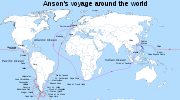
Kingdom of Great Britain
The former Kingdom of Great Britain, sometimes described as the 'United Kingdom of Great Britain', That the Two Kingdoms of Scotland and England, shall upon the 1st May next ensuing the date hereof, and forever after, be United into One Kingdom by the Name of GREAT BRITAIN. was a sovereign...
was at war
War of Jenkins' Ear
The War of Jenkins' Ear was a conflict between Great Britain and Spain that lasted from 1739 to 1748, with major operations largely ended by 1742. Its unusual name, coined by Thomas Carlyle in 1858, relates to Robert Jenkins, captain of a British merchant ship, who exhibited his severed ear in...
with Spain
Spain
Spain , officially the Kingdom of Spain languages]] under the European Charter for Regional or Minority Languages. In each of these, Spain's official name is as follows:;;;;;;), is a country and member state of the European Union located in southwestern Europe on the Iberian Peninsula...
in 1740, Commodore George Anson
George Anson, 1st Baron Anson
Admiral of the Fleet George Anson, 1st Baron Anson PC, FRS, RN was a British admiral and a wealthy aristocrat, noted for his circumnavigation of the globe and his role overseeing the Royal Navy during the Seven Years' War...
led a squadron of eight ships on a mission to disrupt or capture Spain's Pacific possessions. Returning to England in 1744 by way of China
China
Chinese civilization may refer to:* China for more general discussion of the country.* Chinese culture* Greater China, the transnational community of ethnic Chinese.* History of China* Sinosphere, the area historically affected by Chinese culture...
and thus completing a circumnavigation
Circumnavigation
Circumnavigation – literally, "navigation of a circumference" – refers to travelling all the way around an island, a continent, or the entire planet Earth.- Global circumnavigation :...
, the voyage was notable for the capture of an Acapulco galleon but also horrific losses to disease with only 188 men of the original 1854 surviving.
Prelude
In 1739, the riches that Spain derived from the New WorldNew World
The New World is one of the names used for the Western Hemisphere, specifically America and sometimes Oceania . The term originated in the late 15th century, when America had been recently discovered by European explorers, expanding the geographical horizon of the people of the European middle...
were well known throughout Europe. Huge quantities of silver were shipped from Peru, carried over the isthmus at Panama
Panama
Panama , officially the Republic of Panama , is the southernmost country of Central America. Situated on the isthmus connecting North and South America, it is bordered by Costa Rica to the northwest, Colombia to the southeast, the Caribbean Sea to the north and the Pacific Ocean to the south. The...
and then loaded on another ship at Portobelo bound for Spain. Other ships carried luxury goods from Manila
Manila
Manila is the capital of the Philippines. It is one of the sixteen cities forming Metro Manila.Manila is located on the eastern shores of Manila Bay and is bordered by Navotas and Caloocan to the north, Quezon City to the northeast, San Juan and Mandaluyong to the east, Makati on the southeast,...
to Acapulco
Acapulco
Acapulco is a city, municipality and major sea port in the state of Guerrero on the Pacific coast of Mexico, southwest from Mexico City. Acapulco is located on a deep, semi-circular bay and has been a port since the early colonial period of Mexico’s history...
from where they were taken to Vera Cruz
Veracruz, Veracruz
Veracruz, officially known as Heroica Veracruz, is a major port city and municipality on the Gulf of Mexico in the Mexican state of Veracruz. The city is located in the central part of the state. It is located along Federal Highway 140 from the state capital Xalapa, and is the state's most...
and loaded along with Mexica
Mexica
The Mexica were a pre-Columbian people of central Mexico.Mexica may also refer to:*Mexica , a board game designed by Wolfgang Kramer and Michael Kiesling*Mexica , a 2005 novel by Norman Spinrad...
n silver. Spain's Caribbean
Caribbean
The Caribbean is a crescent-shaped group of islands more than 2,000 miles long separating the Gulf of Mexico and the Caribbean Sea, to the west and south, from the Atlantic Ocean, to the east and north...
possessions provided sugar, tobacco, dyes and spices.
Britain had negotiated a treaty that allowed the South Sea Company to send one trading vessel per year to Spanish territory plus supply slaves but private British vessels, many operating out of Jamaica
Jamaica
Jamaica is an island nation of the Greater Antilles, in length, up to in width and 10,990 square kilometres in area. It is situated in the Caribbean Sea, about south of Cuba, and west of Hispaniola, the island harbouring the nation-states Haiti and the Dominican Republic...
, carried illegal cargoes which the Spanish attempted to intercept. After numerous incidents and with old rivalry, tensions increased leading to the War of Jenkins' Ear
War of Jenkins' Ear
The War of Jenkins' Ear was a conflict between Great Britain and Spain that lasted from 1739 to 1748, with major operations largely ended by 1742. Its unusual name, coined by Thomas Carlyle in 1858, relates to Robert Jenkins, captain of a British merchant ship, who exhibited his severed ear in...
.
Various schemes were proposed to attack Spanish possessions. Edward Vernon
Edward Vernon
Edward Vernon was an English naval officer. Vernon was born in Westminster, England and went to Westminster School. He joined the Navy in 1700 and was promoted to Lieutenant in 1702 and served on several different ships for the next five years...
captured Portobelo in November 1739 with just six ships and a second squadron, to be led by George Anson, was to sail around Cape Horn with six warships carrying 500 troops with instructions that might be described as ambitious. These were to capture Callao
Callao
Callao is the largest and most important port in Peru. The city is coterminous with the Constitutional Province of Callao, the only province of the Callao Region. Callao is located west of Lima, the country's capital, and is part of the Lima Metropolitan Area, a large metropolis that holds almost...
in Peru
Peru
Peru , officially the Republic of Peru , is a country in western South America. It is bordered on the north by Ecuador and Colombia, on the east by Brazil, on the southeast by Bolivia, on the south by Chile, and on the west by the Pacific Ocean....
(the port that served the nearby capital Lima
Lima
Lima is the capital and the largest city of Peru. It is located in the valleys of the Chillón, Rímac and Lurín rivers, in the central part of the country, on a desert coast overlooking the Pacific Ocean. Together with the seaport of Callao, it forms a contiguous urban area known as the Lima...
) and if possible take Lima as well), capture Panama with its treasure, seize the galleon from Acapulco and lead a revolt of the Peruvians to Spanish colonial power. An earlier proposal to also capture Manilla was dropped.
It appears that a conflict of interest was, at least in part, behind the unreasonable orders given to Anson by the Duke of Newcastle on 28 June 1740. The attacks were suggested by Hubert Tassell and Henry Hutchison, previously factor
Factor (agent)
A factor, from the Latin "he who does" , is a person who professionally acts as the representative of another individual or other legal entity, historically with his seat at a factory , notably in the following contexts:-Mercantile factor:In a relatively large company, there could be a hierarchy,...
s (agents) of the South Sea Company who had a significant recent information about the area which the government lacked but who also stood to gain if the area was opened up to British trade. Supporting this view was that the squadron was to carry £15,000 of trade goods. Given the length of the voyage, it was expected that it would be necessary to buy provisions along the way. In friendly ports, bills of exchange would have been used. In enemy ports it may not have been possible to buy anything, though outright seizure would be possible if the town was captured. The relationship of Tassell and Hutchison to the squadron was further complicated by them supplying victuals (food) and that they would come along on one of the ships to oversee the trade goods.
The squadron based in Portsmouth
Portsmouth
Portsmouth is the second largest city in the ceremonial county of Hampshire on the south coast of England. Portsmouth is notable for being the United Kingdom's only island city; it is located mainly on Portsea Island...
was composed of six warships:
- CenturionHMS Centurion (1732)HMS Centurion was a 60-gun fourth rate ship of the line of the Royal Navy, built at Portsmouth Dockyard and launched on 6 January 1732. At the time of Centurion's construction, the 1719 Establishment dictated the dimensions of almost every ship being built...
(a fourth-rateFourth-rateIn the British Royal Navy, a fourth rate was, during the first half of the 18th century, a ship of the line mounting from 46 up to 60 guns. While the number of guns stayed subsequently in the same range up until 1817, after 1756 the ships of 50 guns and below were considered too weak to stand in...
ship of 1,005 tons, 60 guns, 400 men and the flagshipFlagshipA flagship is a vessel used by the commanding officer of a group of naval ships, reflecting the custom of its commander, characteristically a flag officer, flying a distinguishing flag...
- see model) - Gloucester (853 tons, 50 guns, 300 men)
- Severn (853 tons, 50 guns, 300 men)
- PearlHMS PearlHMS Pearl may refer to:, a fourth-rate of 42 guns launched in 1708; a detachment of its crew under Lieutenant Robert Maynard killed Blackbeard in 1718; broken up in 1722, a fourth-rate of 42 guns launched in 1726 and sold in 1744, a fifth-rate of 44 guns launched in 1744 and sold in 1759, a...
(600 tons, 40 guns, 250 men) - WagerHMS Wager (1739)HMS Wager was a square-rigged sixth-rate Royal Navy ship of 28 guns. She was built as an East Indiaman in about 1734 and made two voyages to India before being purchased by the Royal Navy in 1739. She formed part of a squadron under Anson and was wrecked on the south coast of Chile on 14 May 1741...
(599 tons, 24 guns, 120 men) - Tryal (200 tons, 8 guns, 70 men)
Additionally, two merchant vessels, the Anna and Industry, would carry supplies. (The former is often referred to as the "Anna pink" where "pink" is a "small sailing vessel with sharply narrowed stern and an overhanging transom" http://dictionary.reference.com/browse/pink.)
The provision of 500 troops was farcical. No regular troops were made available so 500 invalids were to be collected from the Chelsea Hospital. In this case, the term invalid referred to soldiers that were too sick, wounded or old for active duty but might be able to perform lighter duties. In any case, on hearing details of the proposed voyage, those that could get away did and only 259 came aboard, many on stretchers. To make up for the 241 missing, marines were ordered aboard but these were such fresh recruits that few of them had yet been trained how to fire a gun.
The squadron was as ready as it was going to get by mid-August but strong winds kept the ships in harbour. Before heading to South America, Anson was required to escort a huge fleet of transports and merchant vessels out of the English Channel
English Channel
The English Channel , often referred to simply as the Channel, is an arm of the Atlantic Ocean that separates southern England from northern France, and joins the North Sea to the Atlantic. It is about long and varies in width from at its widest to in the Strait of Dover...
and the initial attempt to get to sea was abandoned as ships crashed into each other. Finally the squadron sailed from Spithead
Spithead
Spithead is an area of the Solent and a roadstead off Gilkicker Point in Hampshire, England. It is protected from all winds, except those from the southeast...
on 18 September 1740 overseeing a convoy of 152 ships.
Unfortunately, with the long delays, French agents had picked up word of the expedition and passed the information to Spain. In response, they sent five warships under Admiral Pizarro
José Alfonso Pizarro
José Alfonso Pizarro, Marqués del Villar was a Spanish naval officer and colonial administrator. From November 6, 1749 to November 24, 1753 he was viceroy of the Spanish Viceroyalty of New Granada.As a youth he entered the naval service of the Knights of Malta...
to lie in wait near Portuguese
Portugal
Portugal , officially the Portuguese Republic is a country situated in southwestern Europe on the Iberian Peninsula. Portugal is the westernmost country of Europe, and is bordered by the Atlantic Ocean to the West and South and by Spain to the North and East. The Atlantic archipelagos of the...
Madeira
Madeira
Madeira is a Portuguese archipelago that lies between and , just under 400 km north of Tenerife, Canary Islands, in the north Atlantic Ocean and an outermost region of the European Union...
which was neutral territory and to be Anson's first port of call.
At sea
The squadron reached Madeira on 25 October 1740, the journey taking four weeks longer than normal. Portuguese officials reported that warships, probably Spanish, had been seen at the western end of the island so Anson sent a boat out to investigate but it returned without sighting them. Fresh food and water were taken on with extra urgency and the ships slipped out without incident on 3 November. Had contact been made with Pizarro's squadron, the expedition likely would have ended since Anson's ships would need to throw overboard the huge quantity of provisions cluttering the decks and preventing the effective working of the guns.After taking three days at sea to transfer supplies, the Industry turned back on 20 November. By now, food had started to rot and the ships were infested with flies. There was a desperate need to provide additional ventilation to the lower decks. Normally the gun ports would be opened but since the ships were riding so low in the water with the weight of provisions, this was impossible so six air holes were cut in each ship.
However, this was only part of a bigger problem that was to have disastrous consequences. With the ships' regular crew, the conditions were crowded with hammocks placed 14" apart, though the rotating watch system meant that only half would be below at any one time so effectively each had 28". However, the invalids and marines boosted the number of men on board by about 25% and were forced to stay below most of the time as they would be in the way on deck. Typhus
Typhus
Epidemic typhus is a form of typhus so named because the disease often causes epidemics following wars and natural disasters...
, or ship fever, is spread by body lice which thrived in the hot, humid and unsanitary conditions. After two months at sea, this disease and dysentery
Dysentery
Dysentery is an inflammatory disorder of the intestine, especially of the colon, that results in severe diarrhea containing mucus and/or blood in the faeces with fever and abdominal pain. If left untreated, dysentery can be fatal.There are differences between dysentery and normal bloody diarrhoea...
raced through the crews.
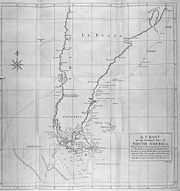
The squadron reached Isla de Santa Catarina
Santa Catarina (island)
Florianópolis Island is an island in the Brazilian state of Santa Catarina. It is located on the south coast of Brazil between the south 27° latitude and west 48° longitude...
(St Catherine's), a large island just off the coast of Portuguese southern Brazil on 21 December and the sick were sent ashore, eighty from the Centurion alone. A thorough cleaning then commenced with the below-deck areas first scrubbed clean, then fires lit inside and the hatches closed so that the smoke would kill rats and other vermin, then everything was washed down with vinegar.
Anson had hoped to stay only long enough to pick up firewood, fresh water and provisions but the main mast of the Tryal needed repairs that took almost a month. Meanwhile the men on shore in makeshift tents were exposed to mosquitos and malaria
Malaria
Malaria is a mosquito-borne infectious disease of humans and other animals caused by eukaryotic protists of the genus Plasmodium. The disease results from the multiplication of Plasmodium parasites within red blood cells, causing symptoms that typically include fever and headache, in severe cases...
soon appeared. Although 28 men from the Centurion had died while in port, the number of sick taken back on board when they left on 18 January 1741 had increased from 80 to 96.
A wide variety of fruits and vegetables were available but it is unclear how much actually came on board. The official account noted a "great plenty" but one journal keeper said it was enough only to feed all the crew for a single day.
Although Portugal was not at war with England and in theory was an ally under the Anglo-Portuguese Alliance
Anglo-Portuguese Alliance
The Anglo-Portuguese Alliance, ratified at the Treaty of Windsor in 1386, between England and Portugal is claimed to be the oldest alliance in the world which is still in force — with the earliest treaty dating back to the Anglo-Portuguese Treaty of 1373.This alliance, which goes back to the...
, the governor was later revealed to have notified Spanish Buenos Aires
Buenos Aires
Buenos Aires is the capital and largest city of Argentina, and the second-largest metropolitan area in South America, after São Paulo. It is located on the western shore of the estuary of the Río de la Plata, on the southeastern coast of the South American continent...
where Pizarro's squadron had arrived. Although waiting for provisions, Pizarro immediately put to sea sailing south to get around Cape Horn
Cape Horn
Cape Horn is the southernmost headland of the Tierra del Fuego archipelago of southern Chile, and is located on the small Hornos Island...
before the British.
Anson sailed 18 January 1741 intending to stop at Puerto San Julián (near the eastern entrance to the Strait of Magellan
Strait of Magellan
The Strait of Magellan comprises a navigable sea route immediately south of mainland South America and north of Tierra del Fuego...
) where there was no European presence but supposedly bountiful supplies of salt.
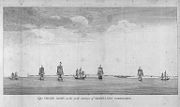
Four days later, in a storm, the repaired mast of the Tryal broke, forcing the Gloucester to take it in tow.
During the same storm, the Pearl was separated from the squadron and her captain died, with First Lieutenant Sampson Salt taking command. Sampson then sighted five ships with the lead ship bearing English colors, but was dismayed to find at the last moment it was the Spanish ships. The crew frantically threw overboard everything not immediately needed and hoisted extra sail. The Spanish ships held back from chasing believing the Pearl was headed for a shoal but it was spawning fish, not rocks, that were disturbing the water, and the Pearl was able to escape as darkness fell.
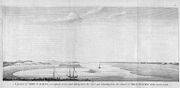
Even though the Spanish ships were known to be somewhere in the area, the squadron had no choice but to stop at St Julian, which was found to have no trees or fresh water and barely any salt. The Tryal's broken topmast was simply removed and a spare topmast used to replace the broken foremast, effectively reducing her rigging but probably the key to allowing her to weather the ferocious storms to come.
The ships reached Strait of Le Maire, the entrance to the path around Cape Horn
Cape Horn
Cape Horn is the southernmost headland of the Tierra del Fuego archipelago of southern Chile, and is located on the small Hornos Island...
, on 7 March 1741 in unseasonably fine weather but shortly afterwards it turned to a violent gale from the south. Having avoided being blown onto Staten Island
Isla de los Estados
Isla de los Estados is an Argentine island that lies off the eastern extremity of the Argentine portion of Tierra del Fuego, from which it is separated by the Le Maire Strait...
, Anson ordered the Tryal to lead, on the lookout for ice. However, carrying sufficient sail to keep ahead of the other ships left the ship dangerously unstable, with the men on deck frequently exposed to the freezing water. Since the deck cannon were getting continually doused, it would have been impossible to fire warning shots even if they had seen ice so the Tryal was removed from this duty and the Pearl took its place leaving her Captain Saumarez to write, 'that really life is not worth pursuing at the expense of such hardships'.
While fighting gale force winds and huge seas with a crew weakened by typhus and dysentery, scurvy
Scurvy
Scurvy is a disease resulting from a deficiency of vitamin C, which is required for the synthesis of collagen in humans. The chemical name for vitamin C, ascorbic acid, is derived from the Latin name of scurvy, scorbutus, which also provides the adjective scorbutic...
broke out. What little useful information available on its prevention was ignored and it is unlikely that the navy could have procured sufficient vitamin C
Vitamin C
Vitamin C or L-ascorbic acid or L-ascorbate is an essential nutrient for humans and certain other animal species. In living organisms ascorbate acts as an antioxidant by protecting the body against oxidative stress...
for 1,000 men even if it had recognized the need. Hundreds of men died of disease in the weeks during and immediately after battling around the Horn. In one incredible case, a man who had been wounded at the Battle of the Boyne
Battle of the Boyne
The Battle of the Boyne was fought in 1690 between two rival claimants of the English, Scottish and Irish thronesthe Catholic King James and the Protestant King William across the River Boyne near Drogheda on the east coast of Ireland...
in 1690 but had made a complete recovery, now found, 50 years later, that his wounds reopened and a broken bone fractured again.
At the beginning of April, the ships headed north believing that they were 300 miles (482.8 km) west of land. However, through lack of alternatives at that time, ships had to estimate their east-west position by dead reckoning
Dead reckoning
In navigation, dead reckoning is the process of calculating one's current position by using a previously determined position, or fix, and advancing that position based upon known or estimated speeds over elapsed time, and course...
- calculating the distance covered knowing the ship's speed and heading - which could not account for unknown ocean currents and so on the night of 13-14th, the crew of the Anna were alarmed to see the cliffs of Cape Noir just 2 miles (3.2 km) away. They fired cannon and lit lamps to warn the others and they were just able to claw their way out to sea although there was great concern that the Severn and Pearl were already lost as they had not been sighted since the 10th.
Another storm hit just as the Wager fell from sight and on 24 April, both the Centurion and Gloucester reported that every sail was torn or loose but the crew was too few and too weak to attempt repairs until the next day by which time the ships were scattered.
The sailing instructions included three rendezvous points if the ships were scattered and the Centurion reached the first, Socorro (Isla Guamblin, 45°S on Chilean coast) on 8 May. After waiting two weeks and seeing no other ships, Anson decided to sail for Juan Fernandez
Juan Fernández Islands
The Juan Fernández Islands are a sparsely inhabited island group reliant on tourism and fishing in the South Pacific Ocean, situated about off the coast of Chile, and is composed of three main volcanic islands; Robinson Crusoe Island, Alejandro Selkirk Island and Santa Clara Island, the first...
, the third rendezvous point, since the second, Valdivia
Valdivia, Chile
Valdivia is a city and commune in southern Chile administered by the Municipality of Valdivia. The city is named after its founder Pedro de Valdivia and is located at the confluence of the Calle-Calle, Valdivia and Cau-Cau Rivers, approximately east of the coastal towns of Corral and Niebla...
, was on the coast and would be too dangerous to find being on a lee shore.
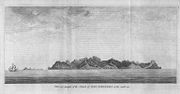
However, the charts carried by the squadron placed Juan Fernandez at 33°30'S and 135 miles (217.3 km) west of Valparaíso
Valparaíso
Valparaíso is a city and commune of Chile, center of its third largest conurbation and one of the country's most important seaports and an increasing cultural center in the Southwest Pacific hemisphere. The city is the capital of the Valparaíso Province and the Valparaíso Region...
on the South American coast. In fact, it is at 34°47'S and 360 miles (579.4 km) west. Anson, now unsure of his charts and his navigator's skills headed east and soon saw the coast of Chile. Turning back west, it took nine days to reach the area he had left during which time 70-80 men died. Juan Fernandez was then sighted at daybreak on 9 June. However, by now there were only eight men and the remaining officers and their servants able to work the ship. After anchoring for the night they were too weak to lift the anchor the following morning but were lucky to be blown free by a sudden squall. As they manoeuvered into the bay they were appalled to find no other ships waiting there but then sighted the tiny Tryal approaching. Of the 86 crew and marines, 46 had died and now only the captain, Charles Saunders, his lieutenant and three seamen were able to stand on deck. Those still able worked desperately to get the sick ashore.
Given the mortality rate on the Centurion and Tryal, it seemed likely that the crews of the other ships would all be dead if they were unable to reach Juan Fernandez in the next few days. On 21 June a ship was sighted with only one sail, apparently in trouble but it was another six days before the ship was close enough to be identified as the Gloucester. A long boat was sent out to meet the ship and but they were unable to get the ship into the anchorage at Cumberland Bay. The ship was then blown out to sea and it was not until 23 July that the Gloucester was finally able to make anchorage. Since leaving Port St Julian, 254 had died leaving 92 men, most debilitated by scurvy.
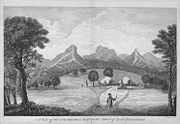
Fresh greens and fish allowed some to recover quickly but others were too weak and died ashore.
Remarkably, the Anna was sighted on 16 August and without apparent difficulty worked its way into Cumberland Bay. After losing sight of the other ships on 24 April, she had attempted to make the rendezvous at Socorro and had been blown ashore. Just as all hope seemed lost, they saw the entry to a harbour (now called Bahaia Anna Pink, Chile at 45.83S 74.83W) and were able to take refuge. For two months they stayed to perform makeshift repairs to the ship and allow the crew to recover their health before departing for Juan Fernandez. The harbour had a good fresh water supply, wild greens and game. Given the abundant provisions and minimal crew on the merchant ship, the crew was in much better health even than those on the warships at the time she was blown ashore. However, a survey after arrival at Juan Fernandez reported that she was so badly damaged that she was beyond repair so Anson had the ship broken up and the crew transferred to the Gloucester.
Anson prepared to sail in September 1741 but before leaving took a census which found that of the original 961 that had left England on the Centurion, Gloucester and Tryal, 626 or roughly two-thirds, had died. The fate of those on the other three ships was at that time unknown.
The Severn and Pearl
The Severn and Pearl lost sight of the other ships during the night of 10 April 1741 although it is not clear if they also lost sight of each other until morning. There were accusations later that Captain Edward Legge on the Severn had made some arrangement with Captain George Murray on the Pearl to break away from the group. Before the storm both captains reported severe problems with sickness with men dying every day and damage to ship but Anson brushed them off responding that their situation was no different from the others.The two ships headed north together attempting to rejoin the squadron but on the 13th they also sighted land which they believed to be hundreds of miles behind them. Luckily, they made landfall in daylight so they had better warning. As fog descended and not knowing what had become of the other ships, the Severn and Pearl headed west to get some sea room and the officers agreed that unless the winds became favorable, they would return around the Horn to safety. Then on the 17th violent gales from the north-west pushed them back toward the land and lookouts believed they saw land, so to save the ships and the crew, the order was given to turn the ships south and east and retreat around Cape Horn. In fact, mortality on the Pearl was not nearly as severe as that on the Severn; by the time that ship reached Rio de Janeiro
Rio de Janeiro
Rio de Janeiro , commonly referred to simply as Rio, is the capital city of the State of Rio de Janeiro, the second largest city of Brazil, and the third largest metropolitan area and agglomeration in South America, boasting approximately 6.3 million people within the city proper, making it the 6th...
on 6 June, 158 of the ship's crew had died and of the remainder, 114 were too sick to be of use leaving just 30 men and boys to work the ship. This does not count the invalids and marines, nearly all of whom died.
After a month in Rio, Murray wanted to make another attempt to reach the Pacific but Legge, the more senior officer overruled him saying that both ships still had insufficient able-bodied men and in any case, even if Anson had survived the storms, he may well be headed home by now. The two ships left Rio in December 1741, headed for England via the West Indies. Although in London there were some gossip of desertion, the official report of the voyage in 1748 made no such suggestion but instead spoke of the 'great joy' aboard the Centurion after it reached Canton
Guangzhou
Guangzhou , known historically as Canton or Kwangchow, is the capital and largest city of the Guangdong province in the People's Republic of China. Located in southern China on the Pearl River, about north-northwest of Hong Kong, Guangzhou is a key national transportation hub and trading port...
and learned that the two ships had survived.
The Wager
The Wager was more a freighter than a fighting ship and so even though only the Tryal was smaller, she carried the largest number of invalids and marines (142, outnumbering the crew of 106) plus substantial stores for the other ships and guns and ammunition for the soldiers to fight with on shore.David Cheap was her third captain since leaving England but had been sick during much of the voyage and was below decks, sick in his cabin, when the damaged ship lost sight of the others after the narrow escape off Cape Noir. After feeling they had made sufficient distance out to sea, he gave orders to head for the first rendezvous point, the island of Socorro just of the coast. His lieutenant Robert Baynes and the gunner John Bulkeley had argued that it was too dangerous to approach a target on the lee shore in a disabled ship with just 12 men fit for duty and so they should instead head toward Juan Fernandez in the open ocean. They were overruled.
On 13 May 1741, the carpenter John Cummins thought had glimpsed land to the west. This seemed unlikely as the mainland was to the east of them but they had no proper chart and so the report was ignored. As they were soon to realize, they had sailed into a large bay with a peninsula blocking their progress to the north. After a struggle to turn the ship around with so few men, they were struck by a large wave causing Cheap to fall down a ladder dislocating his shoulder. The surgeon gave opium to Cheap for the pain and he slept below. Instead of taking command, Baynes took to the bottle and also disappeared below. Lashed by the storm, the ship crashed on to rocks at 4am. For the next few hours she lurched from one rock to another and then just before sinking became completely stuck.
At this point there was a complete breakdown of discipline as the crew helped themselves to liquor and arms. The ship's boats were still serviceable and 140 made it to the exposed beach alive including Cheap, who was carried ashore. He tried to maintain control but naturally, most blamed him for the loss of the ship and their current awful situation by his insistence on making Socorro. Admiralty
Admiralty
The Admiralty was formerly the authority in the Kingdom of England, and later in the United Kingdom, responsible for the command of the Royal Navy...
regulations meant that wages would not be accrued after a wreck so most now held Cheap in contempt rather than authority. He now carried pistols at all times.
His hasty decision to shoot a drunken crew member on 10 June followed by his refusal to allow the doctor to treat him meant that the victim took two weeks to die and alienated most of his remaining supporters. After his death, about 100 remained alive on the beach with limited food salvaged from the wreck and little shelter against the ferocious winds and driving rain of winter.
There only likely hope was salvation was the 38 feet (11.6 m) longboat, 30 feet (9.1 m) cutter and two smaller boats. The carpenter lengthened the longboat to 50 feet (15.2 m) and added a deck so that most, though not all, would fit on board.
While the work was underway, arguments developed about where to go and a slow-motion mutiny was underway. Cheap still insisted on sailing north to uninhabited Socorro in the hope of finding Anson waiting there. Valdivia was 600 miles (965.6 km) north but as a Spanish town, they would not find relief there. Bulkeley read Narborough's account of the passage through the admittedly treacherous Strait of Magellan 400 miles (643.7 km) to the south and concluded it was their only viable option as they could then sail north to Brazil. He got 45 others to sign a paper agreeing to the plan.
Cheap, now acting through his purser Thomas Harvey, attempted to win support to head north with the uncommitted with bribes of liquor that he still had under his control. Bulkeley offered limited command to Cheap if he agreed to sail south and Cheap appeared to at least not reject it.
By the time the modified longboat was ready on 9 October 1741, Cheap still had not made a final commitment so Bulkeley had him arrested on the charge of murder and had him bound.
Four days later, the newly-christened Speedwell, now configured as a schooner, sailed south with 59 men aboard under the nominal command of Lieutenant Baynes, followed by the cutter with 12 men, a 'barge' with 10 and another small boat with Cheap, Lieutenant Hamilton and the surgeon. It appears that Bulkeley and the others intended that Cheap would be left to his fate in the smallest and presumably slowest boat. About a dozen men had fled the camp (to avoid the severe punishment Cheap so often ordered) and were left behind on the island.
However, after making only a few miles progress in two days, a sail on the cutter tore and so the men on the barge were sent to get canvas from the camp. On returning they chose to follow Captain Cheap. The larger boats once again headed south only to lose the cutter a few days later in a gale. There was not room on the Speedwell and 10 men, supposedly volunteers, were put ashore.
Without any small boat, the only way to get ashore to search for food was to swim through the icy water and soon those that were too weak or who could not swim started dying. With disputes over navigation, wild currents, rain and fog, it took a month to reach the Atlantic and they were still far from relief.
The Speedwell came in close to shore on 14 January 1742 at 38°40'S at Freshwater Bay, in what is today the resort city of Mar del Plata
Mar del Plata
Mar del Plata is an Argentine city located on the coast of the Atlantic Ocean, south of Buenos Aires. Mar del Plata is the second largest city of Buenos Aires Province. The name "Mar del Plata" had apparently the sense of "sea of the Río de la Plata region" or "adjoining sea to the Río de la Plata"...
. Those that swam ashore found fresh water and seals. Eight of them were dismayed to see the boat leaving without them and they would later accuse Bulkeley of abandoning them to save supplies while he claimed they were blown out to sea. Bulkeley, Baynes and 31 others sailed north, reaching the Portuguese waters of the Rio Grande on 28 January. Three men died during the journey and the rest were now close to it. Eventually some of the men made their way back to England by whatever route they could.
The eight men stayed for a month eating seal meat until they decided to make for Buenos Aires, 300 miles (482.8 km) further north. They twice ran out of food and water and were forced to return. One day Isaac Morris and three others returned to find two of the others stabbed to death and the remaining two missing. The guns, flints and the few other supplies they had were gone and their fire extinguished. After a failed third attempt on Buenos Aires, they were captured by a group of nomad Tehuelches who took them on as slaves and they were traded from one Indian group to another. In late 1743, an English merchant living in Buenos Aires paid for the release of three of them; the fourth of mixed race was kept by the Indians. However, the Spanish put them in jail and in early 1745 were put on board Pizarro's former flagship, the Asia, as prisoners of war.
Meanwhile, Captain Cheap back at Wager Island had a party of 19 men after the deserters rejoined the camp. This included the surgeon Elliot and Lieutenant Hamilton who had been cast adrift with him plus midshipmen Byron
John Byron
Vice Admiral The Hon. John Byron, RN was a Royal Navy officer. He was known as Foul-weather Jack because of his frequent bad luck with weather.-Early career:...
and Campbell who had been on the barge. They rowed up the coast but were punished by continuous rain, headwinds and waves that threatened the boats. Sometimes they were able to get ashore but often they had to sleep in the boats. One night while on shore, one of the boats was capsized while at anchor and was swept out to sea with its two boatkeepers. One of the men was able to get ashore but the other drowned. Since it was now impossible for them all to fit in the remaining boat, four marines were left ashore with muskets to fend for themselves. However, the winds prevented them from getting around the headland so they returned to pick up the marines only to find them gone so they returned to Wager Island in early February 1742. With one death on the journey, there were now 13 in the group.
A local Indian agreed to guide the men up the coast to Chiloe Island
Chiloé Island
Chiloé Island , also known as Greater Island of Chiloé , is the largest island of the Chiloé Archipelago off the coast of Chile, in the Pacific Ocean...
on promise of keeping the boat on arrival so they set out again. Two men died and after burying the bodies, the six seaman rowed off in the boat never to be seen again while Cheap, Hamilton, Byron, Campbell and the dying Elliot were on shore looking for food. The Indian then agreed to take the remaining four on by canoe for their only remaining possession, a musket. Eventually they made it to be taken prisoner by the Spanish. Fortunately the Spaniards treated them well and they were eventually taken to the inland capital of Santiago where they were released on parole. They heard that Anson had been generous in the treatment of the prisoners he had taken and so this kindness was returned.
The four men stayed in Santiago
Santiago, Chile
Santiago , also known as Santiago de Chile, is the capital and largest city of Chile, and the center of its largest conurbation . It is located in the country's central valley, at an elevation of above mean sea level...
till late 1744 and were offered passage on a French ship bound for Spain. Campbell elected not to take the offer but took a mule across the Andes and joined Admiral Pizarro in Montevideo
Montevideo
Montevideo is the largest city, the capital, and the chief port of Uruguay. The settlement was established in 1726 by Bruno Mauricio de Zabala, as a strategic move amidst a Spanish-Portuguese dispute over the platine region, and as a counter to the Portuguese colony at Colonia del Sacramento...
on the Asia only to find Isaac Morris and the two seamen that had been abandoned in Freshwater Bay. After some further time in prison in Spain, Campbell reached England in May 1746, followed by the other three two months later.
Now that the major players were all back in England, accusations flew but the official court martial only examined the loss of the Wager in which Baynes, in nominal charge at the time, was acquitted of blame but reprimanded for omissions of duty. Disputes over what happened after the wreck were instead played out as Bulkeley and Cummins, Campbell, Morris, the cooper Young and later Byron published their own accounts, the last of which was the only one that in any way defended Cheap who had since died.
Twenty nine crew members plus seven marines made it back to England.
Attacks in Spanish America
By September 1741 back at Juan Fernandez, most of Anson's men were on the way to recovery and as their health returned, they were set to work carrying out much needed repairs on the ships - as best they could with limited materials and without port facilities. The big question for Anson though was what to do next. Given that his force had been so drastically reduced and that in the nine months since they had been at St. Catherines and received any news, the strategic situation may have changed so that perhaps England and Spain were no longer at war. There was also no way of knowing what had become of Pizarro's squadron that had attempted to intercept them though he assumed that although they likely had troubles getting around the Horn, they had probably been repaired and resupplied and were now on the lookout for him.While contemplating an attack on Panama, a single ship was sighted on 8 September but it sailed past the island. Presuming it to be Spanish, Anson had the Centurion readied for sea and set after it but it disappeared into the night. They continued searching two more days but as they were about to give up, another ship was spotted coming directly towards them causing some alarm as they feared it might have been one of Pizarro's squadron but it turned out to be a lightly armed merchant vessel. After the Centurion fired four shots into the rigging, she surrendered. The cargo of the Nuestra Señora del Monte Carmelo (henceforth, the Carmelo) was of little interest to Anson but the passengers carried £18,000 of bullion.
Of far greater value was the information obtained from documents found aboard. Spain was still at war with England and a British attack in the Caribbean had been repelled so there was now no hope of linking with friendly forces for a combined attack on Panama, nor could they be resupplied.
However, there was no immediate danger from Pizarro as his squadron had suffered even more terribly in their attempt to get around Cape Horn ahead of Anson. Expecting a relatively quick voyage and with access to Spanish-held ports in Chile, Pizarro's ships had set out with only four months provisions but were hit by ferocious storms after rounding the Horn and were gradually pushed backwards. The paths of the British and Spanish ships must have crossed but while concentrating on survival and in minimal visibility, neither sighted the other.
At some point, the Hermiona (54 guns) sank without a trace while on the other ships, the crews began to starve. Pizarro's flagship, the Asia (66 guns) and the San Estevan (40 guns) made it back to the River Plate
Río de la Plata
The Río de la Plata —sometimes rendered River Plate in British English and the Commonwealth, and occasionally rendered [La] Plata River in other English-speaking countries—is the river and estuary formed by the confluence of the Uruguay River and the Paraná River on the border between Argentina and...
with only half the crew still alive. On the Esperenza (50 guns), just 58 out of 450 reached safety. The hull of the Guipuscoa (74 guns) began to leak, and eventually she lost all three masts, by which time 250 of the 700 crew had died. Fortunately the wind blew the broken ship north past the Rio Plata rather than into the Atlantic. The largely helpless vessel ran aground near St. Catherine's.
On arrival in Buenos Aires, Pizarro sent a message overland to Peru warning of Anson's likely arrival in the Pacific and in response, four armed vessels were sent from Callao
Callao
Callao is the largest and most important port in Peru. The city is coterminous with the Constitutional Province of Callao, the only province of the Callao Region. Callao is located west of Lima, the country's capital, and is part of the Lima Metropolitan Area, a large metropolis that holds almost...
supposedly with orders to kill rather than capture. Three were stationed off Concepción
Concepción, Chile
Concepción is a city in Chile, capital of Concepción Province and of the Biobío Region or Region VIII. Greater Concepción is the second-largest conurbation in the country, with 889,725 inhabitants...
while the fourth was sent to Juan Fernandez. They gave up waiting in early June, concluding that Anson's ships had either been lost at sea or had gone elsewhere. As it happened then, the chart that incorrectly placed Juan Fernandez saved Anson's squadron : the nine days Anson wasted trying to find the island delayed his arrival until after the Spanish ship had left.
Furthermore, the ships from Callao had also been badly damaged by storms and would be in port for another two months so there were now no Spanish ship looking for them, though suspicions would be raised again when the Carmelo failed to arrive within a reasonable period. In the meantime, Anson's ships could capture unsuspecting merchant vessels sailing along the coast.
The Gloucester was sent north to hunt outside Paita
Paita
Paita is a city in northwestern Peru. It is the capital of the Paita Province which is in the Piura Region. It is a leading seaport in that region...
but to stay sufficiently far out to sea that she could not be seen from land. Twenty nine Spanish prisoners were sent aboard to help man her, although only seven were of any use but all had to be guarded.
The Centurion, Carmelo and the little Tryal waited off Valparaiso. The Tryal took the Arranzazu, an unarmed merchant ship three times her size carrying cargo of little use except for £5,000 in silver. The Tryal had been badly damaged by storms, so her guns were transferred to the prize vessel and she was allowed to sink. The Centurion captured the Santa Teresa de Jesus whose cargo was near worthless but the passengers included three women. Anson intended to demonstrate that he was a disciplined military officer rather than a ruthless buccaneer, and so treated his prisoners well, including assigning a guard for the women and allowing them to keep their cabins. The Nuestra Señora de Carmin was then seized and an Irish sailor on board revealed that Gloucester had been sighted by a ship entering Paita, and that the authorities has been alerted.
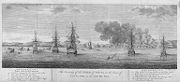
With their cover blown, Anson decided to attack Paita immediately in the hope of intercepting treasure that was to be shipped to Mexico the next day. Given its small size, the town was lightly defended. But with limited forces, Anson had no hope of conquering any of the major Spanish settlements. Sixty men went ashore at night in the ships' boats and took the town with hardly a shot being fired by the Spaniards. One sailor was killed but it was believed to be 'friendly fire'. Most of the residents simply fled to a hill overlooking the town. Anson's men remained in the town for three days ferrying the contents of the custom's house out to the ships, along with livestock to feed the crew. On the way out, Anson ordered that the prisoners be sent ashore and that town be burned, with the notable exception of two churches. One Spanish vessel in harbour was towed away and the rest were sunk. The tally of prize money came to £30,000 which, according to the rules, was to be distributed by rank regardless of who had actually gone ashore. This was one of many disputes over allocation of prize money.
Meanwhile, the Gloucester had captured two small vessels netting another £19,000.
The squadron of Centurion and Gloucester plus six prize ships then set off toward Acapulco
Acapulco
Acapulco is a city, municipality and major sea port in the state of Guerrero on the Pacific coast of Mexico, southwest from Mexico City. Acapulco is located on a deep, semi-circular bay and has been a port since the early colonial period of Mexico’s history...
in the hope of intercepting the galleon from Manila. It would be two months before it would arrive which would normally be ample time, but both the Centurion and Gloucester were towing prize ships and the winds were against them. With water running short, they stopped at the island of Quibo (Isla de Coiba) where they also captured giant turtles for food, some of which were kept alive until needed. With good nutrition since leaving Juan Fernandez seven months earlier, only two of the crew had died.
Upon reaching what was thought to be the latitude of Acapulco on 26 January 1742 they turned east and seeing a light in the distance through the darkness, the Centurion and Gloucester set after it believing it to be the galleon. Dawn revealed it was merely a fire on a mountain. Anson needed to know if the galleon was already in port but Acapulco was nowhere in sight so, while keeping the ships well out to sea to avoid detection, he sent one of the ship's boats inshore to search for the port and to see if the ship had arrived. After five days they returned unable to even locate the port. After sailing further along the coast the boat was sent out again and this time they found Acapulco but also captured three fishermen who confirmed that the galleon had arrived three weeks earlier but the outbound galleon, loaded with silver, was to sail on 3 March, in two weeks. It had a crew of 400 and 58 guns.
The plan was that the Centurion and Gloucester would take part in any action so Anson's men were concentrated on these ships, supplemented by slaves taken from the Spanish who were trained how to use the guns and promised their freedom. They would stay far enough offshore during the day to avoid being sighted but come in close at night in case the galleon tried to escape under cover of darkness. The three prize ships had minimal crew but were still useful to maintain a lookout further out.
Nothing happened. The Spanish had spotted the ship's boat as it had sailed along the coast and had decided not to send the galleon, rightly suspecting that a trap had been set. There was no hope of a successful attack on the well-defended city so Anson gave up his frustrating wait at the start of April as water was running dangerously low and headed north-east to Zihuatanejo
Zihuatanejo
Zihuatanejo or Ixtapa-Zihuatanejo, is the fourth-largest city in the Mexican state of Guerrero. Politically the city belongs to the municipality of Zihuatanejo de Azueta in the western part of Guerrero, but both are commonly referred to as Zihuatanejo...
where William Dampier
William Dampier
William Dampier was an English buccaneer, sea captain, author and scientific observer...
had reported a good water source. He left seven men in a cutter on patrol outside Acapulco to report later just in case the galleon sailed.
Watering proved much more difficult than expected as the river had reshaped the landscape since Dampier's visit in 1685 so the men had to walk a half-mile inland to reach water of barely acceptable quality.
Since the Spanish were now on alert for his squadron, it was obvious that the way home would be by way of China to either the Portuguese colony at Macau
Macau
Macau , also spelled Macao , is, along with Hong Kong, one of the two special administrative regions of the People's Republic of China...
or further up the river to Canton
Guangzhou
Guangzhou , known historically as Canton or Kwangchow, is the capital and largest city of the Guangdong province in the People's Republic of China. Located in southern China on the Pearl River, about north-northwest of Hong Kong, Guangzhou is a key national transportation hub and trading port...
, a base for the English East India company, rather than back around Cape Horn. Before leaving though, there was still the question of what to do with the prize ships. Anson had already decided to destroy the Carmelo and Carmin and given the severe shortage of men on the Centurion and Gloucestor, he concluded there was no choice but to also sacrifice the Arranzazu, now renamed the Tryal's Prize and transfer the men, even though the impressive 600-ton ship was "in good repair and fit for sea". This was against the determined argument of the officers from the Tryal since their transfer would mean loss of seniority and therefore pay and prize money.
The cutter had no reappeared so Anson sailed back toward Acapulco in the hope of finding his men. Concluding that they had been captured, he sent six Spanish prisoners ashore in a small boat with a note saying he would release the rest if his men were set free. On the third day waiting for a reply, the cutter appeared but not from out of the harbour. The crew were in very poor health after being unable to land to find water and suffering from severe sunburn after six weeks in an open boat. On their arrival, Anson sent 57 of his prisoners ashore including all the Spaniards but kept 43 of other races. On 6 May 1742 they headed west into the Pacific.
Pacific Crossing
Based on earlier accounts, Anson expected the Pacific crossing to be an easy one, taking about two months. Other voyagers had dropped south from Acapulco at 15°51'N to pick up the tradewinds that blew constantly to the west between 10° and 14°N. However, none of them had left in May by which time the band of favorable wind had moved further north as summer approached. The Centurion and Gloucester wasted seven weeks in constant heat and variable light wind, or no wind at all, getting as far south as 6°40'N before giving up and heading north again.Under normal circumstances, such a delay would be a nuisance but with ships and crew in poor condition, disaster soon unfolded. The foremast of the Centurion split just days out from Acapulco and the Gloucester lost its mainmast in the mid-June and although improvised repairs were made, she was now much slower. Scurvy broke out first amongst the prisoners captured from the Spanish prize vessels and then at the end of June, amongst the regular crew members.
During July, the Gloucester lost most of its remaining rigging and a large leak opened so that by 13 August the water inside was seven feet deep despite continuous pumping. Captain Mitchell sent a distress signal to Anson but the initial response was that leaks in the Centurion were now so serious that she too was in danger of sinking. However, when the full details emerged, Anson saw there were no alternative but to salvage whatever possible from the Gloucester (not much except the captured bullion), transfer the crew and then set the ship on fire to ensure that the hulk did not drift into Spanish-held Guam
Guam
Guam is an organized, unincorporated territory of the United States located in the western Pacific Ocean. It is one of five U.S. territories with an established civilian government. Guam is listed as one of 16 Non-Self-Governing Territories by the Special Committee on Decolonization of the United...
.
Eight to ten men were dying every day and the leak became so severe that even Anson had to take his turn at the pump. It was now a race to find land, even Guam, before the ship sunk. Tinian
Tinian
Tinian is one of the three principal islands of the Commonwealth of the Northern Mariana Islands.-Geography:Tinian is about 5 miles southwest of its sister island, Saipan, from which it is separated by the Saipan Channel. It has a land area of 39 sq.mi....
lies to the north and a little east of Guam and was sighted on 23 August but it took four days to find safe anchorage. Anson had a Spanish flag hoisted in the hope of gaining a better reception and a proa
Proa
A proa, also seen as prau, perahu, and prahu, is a type of multihull sailing vessel.While the word perahu and proa are generic terms meaning boat their native language, proa in Western languages has come to describe a vessel consisting of two unequal length parallel hulls...
carrying four native people and one Spaniard came out to meet them. Fortunately they were the only ones on the island so the Centurion came inshore and anchored. The sick were landed, 128 in all, a task that Anson and the crew of the proa helped but 21 died during the landing or immediately after.
The island was a lush tropical paradise with an abundance of fruit and other edible greens near the beach but also fresh water and cattle which had been brought there to provide meat for the Spanish garrison on Guam. Within just a few days, the men showed clear signs of improvement. Of particular note was the breadfruit
Breadfruit
Breadfruit is a species of flowering tree in the mulberry family, Moraceae, growing throughout Southeast Asia and most Pacific Ocean islands...
tree. The fruit is high in starch and when boiled and then baked has a taste between potato and bread. The high praise given it by Dampier's earlier expedition and the crew of the Centurion later prompted Joseph Banks
Joseph Banks
Sir Joseph Banks, 1st Baronet, GCB, PRS was an English naturalist, botanist and patron of the natural sciences. He took part in Captain James Cook's first great voyage . Banks is credited with the introduction to the Western world of eucalyptus, acacia, mimosa and the genus named after him,...
to send HMS Bounty
HMS Bounty
HMS Bounty , famous as the scene of the Mutiny on the Bounty on 28 April 1789, was originally a three-masted cargo ship, the Bethia, purchased by the British Admiralty, then modified and commissioned as His Majesty's Armed Vessel the...
to take the plant to the Caribbean to feed plantation slaves.
Having avoided drowning, the next priority was to repair the Centurion. The crew shifted the cannon and later the powder barrels aft to lift the bow out of the water and the carpenters found much to replace and caulk but when the cannon and barrels were put back, the water rushed in again. The leak was apparently not going to be found and fixed without proper port facilities.
The one major short-coming of Tinian was the lack of a protected anchorage and so when a violent storm blew up at night on 18 September, the ship was blown out to sea. For the skeleton crew of 109 men and boys on board the ship and the 107 men on the island, this event was profoundly distressing. Although Lieutenant Saumarez on the Centurion had lit flares and fired the signal cannon, the fury of the storm meant that nobody on shore was even aware of what had happened until the following morning.
Given the state of the ship and continuing easterly winds, it was assumed by those on shore that the Centurion had been blown so far west that if the crew were lucky, they might be able to make Macau where they would have to refit, or more likely, that she had sunk. In either case, they were now on their own.
There was a small bark
Barque
A barque, barc, or bark is a type of sailing vessel with three or more masts.- History of the term :The word barque appears to have come from the Greek word baris, a term for an Egyptian boat. This entered Latin as barca, which gave rise to the Italian barca, Spanish barco, and the French barge and...
on the island, a boat built to carry beef back to Guam, which could perhaps hold 30 men and so in its present state was clearly inadequate. Not wishing to go to Guam where they would rot in prison, or worse, it was decided to lengthen and refit the bark and attempt the 2200 miles (3,540.5 km) voyage to Macau. As work progressed, there were mounting concerns about the ability to fit all aboard, the lack of provisions that would keep on a long voyage and the lack of navigational instruments. Many privately expressed a preference to remain on the island preferring a secure, if lonely, existence to the prospect of perishing at sea.
To everyone's astonishment, the Centurion reappeared after 19 days causing even Anson to show emotion. The crew had battled heroically to keep her afloat contending with unlashed cannons rolling about, open gun ports allowing the ocean to surge in, the anchor dangling below and only having the mizen mast rigged, all the while dealing with the original leak in the hull. Gradually control was regained and the ship was able to sail upwind to regain Tinian.
A few days later she was blown off again, this time with most of the men aboard and they were able to get back five days later. Although still not seaworthy, on 20 October, after taking on fresh water and fruit, the Centurion set sail for Macau, arriving after some difficulties finding and then getting into port, on 11 November.
The Portuguese had established the settlement in 1557 but in the years since, much of the European commercial activity had moved up the Pearl River to Canton. In both areas though, the Chinese maintained firm control as Anson would soon learn to his frustration. His cause was not helped by his refusal to pay port charges in keeping with standard European practise at the time where merchant vessels were inspected and charged but visiting naval vessels were exempt. The Chinese drew no such distinction and as such considered the refusal as an attack on their sovereignty.
The Portuguese governor of Macau said he could do nothing to help without instructions from the Chinese provincial chuntuck, or Viceroy, in Canton but when Anson hired a boat to take him there, the Chinese initially prevented him from boarding. On arrival, he was told to let the local merchants act as intermediaries but no progress was made after a waiting a month.
Amongst the Chinese merchants, the Centurion was regarded as some sort of pirate vessel and having destroyed other ships and disrupted Pacific trade by keeping the Acapulco galleon in port, a view apparently promoted by European rivals. The activities of the British East India Company
British East India Company
The East India Company was an early English joint-stock company that was formed initially for pursuing trade with the East Indies, but that ended up trading mainly with the Indian subcontinent and China...
were at the mercy of the Chinese authorities and so their interest was to keep Anson at some distance, at least until their four ships had left port for the season.
Anson was able to have extra provisions smuggled on to the East India ships that would be dropped off at the Centurion as they passed Macau but that did not address the urgent need to have the ship itself refitted. Now back in Macau, Anson wrote directly to the Viceroy noting that his attempts to contact him through normal channels had failed and issuing a "demand" for help of all kind. Two days later, a high-ranking mandarin arrived with other officials and carpenters to make an inspection. When touring the ship, the mandarin was impressed by the 24-pounders and the implicit threat of damage they could inflict. Permission to work on the ship was granted most likely because the Chinese realized it was in their interest to refit the vessel to get rid of her. Soon the ship was completely unloaded and a hundred men set to work while the ship was careened
Careening
Careening a sailing vessel is the practice of beaching it at high tide. This is usually done in order to expose one side or another of the ship's hull for maintenance and repairs below the water line when the tide goes out....
.
Capture of the Acapulco Galleon
Although Anson had made it known that the ship would be leaving for JakartaJakarta
Jakarta is the capital and largest city of Indonesia. Officially known as the Special Capital Territory of Jakarta, it is located on the northwest coast of Java, has an area of , and a population of 9,580,000. Jakarta is the country's economic, cultural and political centre...
and thence to England, he had decided that having failed so dismally to fulfil the ambitious orders given to him, he would attempt to salvage something of the expedition and seize the galleon just before it arrived in the Philippines. It was a huge gamble as there were likely to be two ships this season since his arrival off Acapulco had kept the previous galleon in port.
Shortly after leaving Macau on 19 April 1743, Anson informed the crew who were delighted at the news. All had suffered terribly and lost friends so the capture would at least provide immense financial reward.
Upon reaching Cape Espiritu Santo, the normal landfall of the galleon, on 20 May, the top sails were taken down to prevent the ship being spotted from land and the ship began a routine of tacking
Tacking
Tacking may refer to:*Tacking or coming about, a sailing maneuver*Tacking , a technical legal concept relating to competing priorities between security interests arising over the same asset...
backwards and forwards to remain on station and practicing on the guns. There were 227 men aboard compared with the normal 400 so what they lacked in numbers would have to be compensate for in speed and accuracy.
Just as they were giving up hope, the galleon was spotted on the morning of 20 June. There was only one.
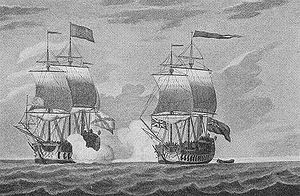
Grapeshot
In artillery, a grapeshot is a type of shot that is not a one solid element, but a mass of small metal balls or slugs packed tightly into a canvas bag. It was used both in land and naval warfare. When assembled, the balls resembled a cluster of grapes, hence the name...
across the galleon's deck and smash cannon balls into her hull.
After ninety minutes, the Spanish surrendered and it was all over. Anson sent Philip Saumarez and 10 men over and they found a ghastly scene with the decks of the Neustra Señora de Covadonga "covered with carcasses, entrails and dismembered limbs". On the Centurion one man had died, two more would later of their wounds and 17 had been injured. The ship had been hit by perhaps 30 shots. On the Covadonga, the grim figures were 67 dead, 84 wounded and 150 shots. It was carrying 1,313,843 pieces of eight
Spanish dollar
The Spanish dollar is a silver coin, of approximately 38 mm diameter, worth eight reales, that was minted in the Spanish Empire after a Spanish currency reform in 1497. Its purpose was to correspond to the German thaler...
and 35,682 ounces of silver.
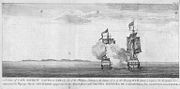
The Spanish had learned of Anson's presence in the Pacific when they had called in at Guam and though the Portuguese captain had suggested an alternative but longer route to Manila, he had been overruled by the Spanish officers. A merchant in Canton had sent two letters to the governor of the Philippines, the first noting the dreadful condition of the Centurion on arrival but the second, noting that the ship had been repaired and voicing suspicion that Anson might be aiming to intercept the galleon. Despite this, only a half-hearted effort was made, sending a guard ship which ran aground, leaving the galleon unprotected.
The galleon itself at 700 tons was smaller than the Centurion but was shockingly unprepared for attack. There were 44 cannon aboard but 12 of those were packed away. The rest were only 6 to 12 pounders and were mounted on exposed decks. There were also 28 swivel gun
Swivel gun
The term swivel gun usually refers to a small cannon, mounted on a swiveling stand or fork which allows a very wide arc of movement. Another type of firearm referred to as a swivel gun was an early flintlock combination gun with two barrels that rotated along their axes to allow the shooter to...
s but since the men on the Centurion made no attempt to board these were of little concern and in any case, those manning them would have been killed by the marksmen or the grapeshot.
Anson needed to get away as soon as possible in case any Spanish ships appeared and had decided to return to Macau. He sent another 40 men to the galleon and by nightfall, the most urgent repairs had been completed. Three hundred prisoners were transferred to the Centurion and forced into the hold with two hatches left open to provide some air but four swivel guns pointed at each to prevent escape. They were limited to one pint of water each per day and though none died on the trip to Macau, conditions below were appalling.
They arrived in Macau on 11 July.
Back in Canton
Anson's reappearance in China was greeted with disbelief and alarm by both the Chinese authorities and the European merchants. On his previous visit, the Centurion was clearly in distress but now with the battered Covadonga in tow, it confirmed Chinese fears that he was using their port as a base for piracy or warfare while the Europeans worried that their trading privileges might be revoked and that the loss of the galleon's cargo would ruin the trade with Manilla.On reaching Macau, Anson sent 60 or 70 prisoners ashore before the Chinese stopped him unloading the rest and then made way for Canton, intending this time not to be trifled with by the Chinese. The mandarin in charge of the fort at Bocca Tigris
Bocca Tigris
The Bocca Tigris, Bogue, or Humen is a narrow strait in the Pearl River Delta, Guangdong, People's Republic of China, where the Pearl River discharges into the South China Sea. The strait is formed by the islands of Chuenpee and Anunghoy on the eastern side and Tycocktow on the western side...
came aboard but was intimidated by the ships heavy guns and instead tried to persuade the hired pilots to misguide the ship through the shoals. On learning of this, Anson threatened to hang one of them if the ship ran aground.
Once past the forts, the ship waited for the permit to proceed upstream. Anson ordered that one of the heavy guns be fired twice a day to remind everyone that there was a new power to be dealt with. After two weeks and some politics, the permit arrived allowing him to get to Whampoa
Huangpu District, Guangzhou
Huangpu District is one of the ten districts in Guangzhou, Guangdong province, People's Republic of China.-History:...
, just short of Canton and most of the prisoners were put on to boats to be taken to Macau. He was able to secure fresh provisions but the merchants would not supply "sea provisions". Anson was anxious to put his case directly to the Viceroy and had issued a request on arrival but been told to wait till after summer. Anson sent a message saying he would arrive on 1 October but as they were about to set off one messenger said that the Viceroy wanted to postpone the meeting and then another came saying that he had waited all day and was offended that Anson had not showed up.
Anson then invited himself to stay at the English "factory
Thirteen Factories
The Thirteen Factories was an area of Canton , China, where the first foreign trade was allowed in the 18th century since the hai jin ban on maritime activities...
" in Canton which, like those of other nations, was just outside the city wall on the riverbank. Foreigners were forbidden to enter the city, to carry firearms and officially were only allowed contact with the Hong merchants. At the end of each trading season, they had to leave for Macau or leave China entirely. Although he was able to collect the stores he needed, he could not get permission to take them on to the ship.
Fate intervened and his crew won praise for fighting a major fire in the city. An invitation to see the Viceroy on 30 November arrived shortly thereafter.
In an occasion marked by great ceremony, Anson noted through an interpreter the many attempts he had made to secure an audience through intermediaries but since they had been insincere, he had been forced to send his officer to the city gate with a letter to be delivered directly to the Viceroy. The Viceroy assured him that the letter was indeed the first time he had been made aware of Anson's arrival. Anson then explained that the right season for returning to Europe had now arrived, that provisions were ready but he just needed the Viceroy's assent. This was immediately given. No mention was made of the unpaid port fees and Anson believed that a precedent had been set but the when the next British warship entered Canton in 1764, it paid normal duties.
Return to England
On 7 December 1743, they sailed from Canton and stopping at Macau, sold the galleon at the heavily discounted price of 6,000 dollars, allowing the Centurion to leave on the 15th. Anson was anxious to reach England before news of the treasure he was carrying reached France or Spain, lest they attempt to intercept him.The ship stopped on 8 January at Prince's Island in the Straits of Sunda between the Indonesia
Indonesia
Indonesia , officially the Republic of Indonesia , is a country in Southeast Asia and Oceania. Indonesia is an archipelago comprising approximately 13,000 islands. It has 33 provinces with over 238 million people, and is the world's fourth most populous country. Indonesia is a republic, with an...
n islands of Sumatra
Sumatra
Sumatra is an island in western Indonesia, westernmost of the Sunda Islands. It is the largest island entirely in Indonesia , and the sixth largest island in the world at 473,481 km2 with a population of 50,365,538...
and Java
Java
Java is an island of Indonesia. With a population of 135 million , it is the world's most populous island, and one of the most densely populated regions in the world. It is home to 60% of Indonesia's population. The Indonesian capital city, Jakarta, is in west Java...
for fresh water and other supplies and reached Cape Town
Cape Town
Cape Town is the second-most populous city in South Africa, and the provincial capital and primate city of the Western Cape. As the seat of the National Parliament, it is also the legislative capital of the country. It forms part of the City of Cape Town metropolitan municipality...
near the Cape of Good Hope
Cape of Good Hope
The Cape of Good Hope is a rocky headland on the Atlantic coast of the Cape Peninsula, South Africa.There is a misconception that the Cape of Good Hope is the southern tip of Africa, because it was once believed to be the dividing point between the Atlantic and Indian Oceans. In fact, the...
on 11 March. He left on 3 April after acquiring additional crew and reached home at Spithead on 15 June 1744, having slipped through fog and thus avoided a French squadron that was cruising the English Channel.
Of those on board, 188 were all that remained of the original crews of the Centurion, Gloucester, Tryal and Anna. Together with the survivors of the Severn, Pearl and Wager, about 500 had survived of the original 1900 that had sailed in September 1740, all but a handful falling to disease or starvation.
Anson became a celebrity on his return and was invited to meet the King. When the treasure was paraded through the streets of London it was greeted by huge crowds.
Disputes over prize money ended up in court and turned the officers against one another. The main question was the status of the officers from the Gloucester and Tryal once they came aboard the Centurion since Anson had not formally promoted them to be officers on the flagship. By the Admiralty rule books, they lost their rank and were effectively just ordinary seamen, but it seems obvious that without the transfer of experienced officers from the other ships, the Centurion would not have survived the Pacific or been able to capture the galleon. The difference for one officer was receiving either £500 or £6,000 and though the courts initially decided in favour of the officers of the Gloucester and Tryal, they lost on appeal, a decision that may have been influenced by now-Admiral Anson's victory over the French fleet at the Battle of Cape Finisterre
First battle of Cape Finisterre (1747)
The First Battle of Cape Finisterre saw 14 British ships of the line under Admiral George Anson attack a French 30-ship convoy commanded by Admiral de la Jonquière during the War of the Austrian Succession. The British captured 4 ships of the line, 2 frigates and 7 merchantmen, in a five-hour...
.
Anson took three-eighths of the prize money available for distribution from the Covadonga which by one estimate came to £91,000 compared with the £719 he earned as captain during the 3 year 9 month voyage. By contrast, a seaman would have received perhaps £300, although even that amounted to 20 years' wages.
Consequences
Anson was compared with Francis DrakeFrancis Drake
Sir Francis Drake, Vice Admiral was an English sea captain, privateer, navigator, slaver, and politician of the Elizabethan era. Elizabeth I of England awarded Drake a knighthood in 1581. He was second-in-command of the English fleet against the Spanish Armada in 1588. He also carried out the...
and was promoted accordingly, reaching First Lord of the Admiralty in 1751 but he assisted the careers of many of the officers that sailed with him. Immediately after his return though, Anson had promoted Philip Saumarez and Peircy Brett but after the Admiralty refused to confirm Brett, Anson declined his own promotion.
As a direct result of the ambiguous legal situation after the wreck of the Wager, the rules were changed to give Captains continuing authority over their crew and the crew would continued to be paid. Similarly, after Anson had felt a need to impress the mandarins that came aboard and to distinguish his crew from those of merchant vessels, naval uniforms were introduced. Previously, the officers and seamen made their own arrangements.
The return of Anson's expedition raised interest in the Pacific as an object of British trade and imperial power but given the treacherous conditions around Cape Horn and the Spanish hold of South America, there was hope that an alternative route to the Pacific might be found through a North-west passage over the top of North America. An expedition led by Middleton
Christopher Middleton (navigator)
Christopher Middleton was an English naval officer and navigator. He was elected a Fellow of the Royal Society on 7 April 1737....
had been mounted while Anson was away but has been blocked by ice. The government offered £20,000 to anyone that could find a navigable route but a private expedition by Moor and Smith in 1746-47 likewise returned empty-handed.
Anson pressed for follow-up expeditions of discovery after peace was reached with Spain but relations between the countries were still delicate and the voyages were canceled for fear of provoking a wider dispute.
Although several private journals of the voyage had been published, the official version of events, A Voyage Around the World by George Anson was eagerly awaited (abridged version). As well as detailing the adventures of the expedition, it contained a huge amount of useful information for future navigators and with 42 detailed charts and engravings, most based on drawings by Piercy Brett, it laid the basis for later scientific and survey expeditions by Captain Cook
James Cook
Captain James Cook, FRS, RN was a British explorer, navigator and cartographer who ultimately rose to the rank of captain in the Royal Navy...
and others. Spanish charts seized from the Covadonga added many islands to the British charts of the Pacific, and those in the Western North Pacific became known as the Anson Archipelago
Anson Archipelago
The Anson Archipelago was a designation for a widely scattered group of purported islands in the Western North Pacific Ocean between Japan and Hawaii...
.
Given the horrific losses to scurvy, it is surprising that one thing that did not happen was an official investigation into its cause and possible cures. That it could be cured was obvious from the rapid improvements shown by Anson's men after reaching both Juan Fernandez and Tinian. Unofficially, James Lind made his own investigations on the Salisbury in 1747. Working with twelve victims he separated them into six pairs and tried something different on each pair. The pair that received oranges and lemons showed dramatic positive change but it would be another 50 years before Lind's recommendations were accepted.
The final words from the authorized account, "Thus was this expedition finished, when it had lasted three years and nine months, after having, by its event, strongly evinced this important truth: That though prudence, intrepidity, and perseverance united are not exempted from the blows of adverse fortune, yet in a long series of transactions they usually rise superior to its power, and in the end rarely fail of proving successful."
It also trained some of the finest naval commanders of the generation, including Augustus Keppel
Augustus Keppel, 1st Viscount Keppel
Admiral Augustus Keppel, 1st Viscount Keppel PC was an officer of the Royal Navy during the Seven Years' War and the War of American Independence...
, John Byron
John Byron
Vice Admiral The Hon. John Byron, RN was a Royal Navy officer. He was known as Foul-weather Jack because of his frequent bad luck with weather.-Early career:...
and John Campbell
John Campbell (governor)
John Campbell was born in or before 1720, parish of Kirkbean, near Dumfries, Kirkcudbrightshire, Scotland and died 16 December 1790, at his house at Charles Street, Berkeley Square, London, England. Campbell was a British naval officer, navigational expert and colonial governor.Campbell joined the...
.
The last known survivor of those that had accompanied Lord Anson was Joseph Allen
Joseph Allen (Doctor of Medicine)
Joseph Allen M.D. was a prominent eighteenth century physician, surgeon on Lord Anson's circumnavigation of the world, and Master of the College of God's Gift in Dulwich ....
, who had been a surgeon on the trip, and later went on to become Master of Dulwich College
Dulwich College
Dulwich College is an independent school for boys in Dulwich, southeast London, England. The college was founded in 1619 by Edward Alleyn, a successful Elizabethan actor, with the original purpose of educating 12 poor scholars as the foundation of "God's Gift". It currently has about 1,600 boys,...
. He died on 10 January 1796 in his eighty third year.