


Proa

Encyclopedia
A proa, also seen as prau, perahu, and prahu, is a type of multihull
sailing
vessel
.
While the word perahu and proa are generic terms meaning boat their native language, proa in Western languages has come to describe a vessel consisting of two (usually) unequal length parallel hull
s. It is sailed so that one hull is kept to windward
, and the other to leeward
, so that it needs "shunt" to reverse direction when tacking
.
The English term proa most likely specifically refers the South Pacific
proa as detailed by the analysis of a Micronesian proa by the British ship The Centurion.
The perahu traditional outrigger boat is most numerous in the various islands of Indonesia
, Malaysia, and the Philippines
. These differ from the South Pacific vessels. Traditional proas superficially resemble outrigger canoe
s, but have a buoyant lee hull and a denser, ballasted
hull to windward for stability.
To Americans, the boats of the Marianas Islands are arguably the most recognizable version.
The modern proa exists in a wide variety of forms, from the traditional archetype still common in areas described, to high-technology interpretations specifically designed for breaking speed-sailing records.
(paraw
in similar Borneo–Philippine languages), which are similar to the Micronesian language group
. Found in many configurations and forms, the proa was likely developed as a sailing vessel in Micronesia
(Pacific Ocean
). Variations may be found as distant as Madagascar
and Sri Lanka
, as far back as the first century. Such vessels go by many names, and "perahu" is a generic umbrella term for any boat smaller than a ship.
The so-called "proa" was documented by the Spanish Magellan expedition to the Philippines circa 1519 CE. It entered English lexicography later.
The use of the term proa in English with reference to the Micronesia
n craft dates back to at least 1742. (See below).
The first illustrations known to Europeans appeared around the middle 19th century in Europe
, ushering in a period of interest in the design. Working from the drawings and descriptions of explorers, western builders often took liberties with the traditional designs, merging their interpretation of native designs with Western boatbuilding methods. Thus this Western "proa" often diverged radically from the traditional "proa" to the point that the only shared feature was the windward/leeward hull arrangement.
Various native names of the various components of the proa have also entered the jargon
of sailing. The main hull of the proa is known as the vaka
, the outrigger as the ama
, and the outrigger supports as the akas
. The terms vaka, ama, and aka have been adopted in Western sailing to describe the analogous parts in trimaran
s.
becomes the bow
and vice versa. The same hull is kept windward
for ballast
.
The main hull, or vaka, is usually longer than the windward hull, or ama
. Crossbeams called aka
s connect the vaka to the ama. Traditional proa hulls are markedly asymmetrical along their length, and often curved in such a way as to produce lift
to counteract the lateral forces of the wind. Modern proa hulls are often symmetrical, and use leeboard
s for lateral resistance.
A number of other vessels use a similar layout with uneven hulls and a shunting sails, but are culturally and historically distinct from the Western interpreted-invented proa. Examples of these are the Fiji
an drua
and the Melanesia
n tepukei
.
, which can be up to 100 feet (30.5 m) long.
A model proa, called a riwuit, is often raced by children. Proas could be paddled or sailed. The traditional sail used on the proa was the crab-claw sail
, which generates far more lift than the more common triangular sloop
rig used on small boats, particularly when reaching
. The sloop rig only begins to show an advantage with small angles of attack, such as encountered when close-hauled
. This is the result of the higher aspect ratio of the sloop.
of the wind acting on the sail. The weight of the crew can provide considerable torque as they move out along the akas towards the ama. A skilled crew can balance the proa so that the ama leaves the water and skims over its surface; this is called "flying the ama", and gives the proa its nickname, the "flying proa". Flying the ama (the wetted surface) significantly reduces the drag
of the proa. The proa gets its great potential for speed by combining the long, narrow shape of the vaka with the large amount of torque that the crew can apply on the akas.
Vessels that have a bow at either end are found scattered throughout history, with the earliest mention being in Pliny the Elder
's Natural History. He describes double-ended vessels being used to transport cargo across the strait at Taprobane, or what is now the Palk Strait
between India
and Sri Lanka
, where the double-ended nature of the vessels allowed them to ferry cargo back and forth without turning around. Square rig
ged sailing proas are still in use in Sri Lanka as fishing boats, called Oruwa or Oru.
The written history of the Micronesian proa began when it was recorded after encounter by European explorers in the Micronesian islands. The earliest written accounts were by Antonio Pigafetta
, an Italian who was a passenger on Ferdinand Magellan
's 1519–1522 circumnavigation. Pigafetta's account of the stop at approximately 146 E, 12 N, (the Mariana Islands
, named the Ladrones by Magellan's men), describes the proa's outrigger layout, and ability to switch bow for stern, and also notes the proa's speed and maneuverability, noting, "And although the ships were under full sail, they passed between them and the small boats (fastened astern), very adroitly in those small boats of theirs." Pigafetta likened the proa to the Venetian
fisolere, a narrow variety of gondola
; this was an apt comparison due to both the long, thin shape and asymmetric nature of single-oar gondolas.
During his 1740–1744 circumnavigation
, Lord Anson
also saw the proa. His fleet captured one in 1742, and Lt. Peircy Brett
of the HMS Centurion
made a detailed sketch of the proa. Rev. Richard Walter, chaplain of the HMS Centurion, estimated the speed of the proa at twenty miles per hour (32 km/h). Since Pigafetta's account was not fully published until the late 18th century (though finished in 1525), the accounts from Anson's voyage were the first about the proa for most literate Europeans.
, one of the oldest watercraft and found in primitive cultures across the world. The design of the proa hints at its evolution from a canoe into the world's fastest sailboat. It likely held this position for many centuries.
made of a single large log constructed much like a dugout canoe. It is extended upwards with sewn planks
, to provide additional depth to the hull. The windward side of the hull is curved, similar to a typical canoe
, while the lee side is straight and flat to minimize leeway while sailing.
that can be used in a ballasted
keel
to counter the heeling moment
of the sail. Attaching two dugout canoes together to form a catamaran
hull provides stability, but this is an expensive operation. For men using nothing but fire and stone tools, building a hull is a long and labor-intensive process. The traditional proa's simple outrigger—a log hewn to a point at each end—can be produced with far less effort, and provides the needed stability to counter the force of a large sail.
, where the craft were traditionally built, there has been a resurgence of interest in the proa. People hold annual kor-kor races in the lagoon at Majuro
, along with events such as a children's riwut race. The kor-kors are built in traditional style out of traditional materials, though the sails are made with modern materials (often inexpensive polyethylene
tarpaulin
s, commonly known as polytarp).
A loose group of individuals from all over the world has formed from those interested in the proa, including people with a historical perspective and those with a scientific and engineering perspective. Many such individuals are members of the Amateur Yacht Research Society.
In the late 19th century and early 20th century, many in Europe and America became interested in the proa. Western boat builders such as R. M. Munroe
and Robert Barnwell Roosevelt (Theodore Roosevelt
's uncle) reflected its influence. Into the 20th century, the proa was one of the fastest sailing craft that existed. The proa design is still the basis for many boats involved in speed sailing
.
The first well-documented Western version of the proa was built in 1898 by Commodore Ralph M. Munroe of the Biscayne Bay
Yacht Club. Yacht-design giant Nathanael Herreshoff
, a friend of Munroe, may have also had an interest in the project. A small model of the Anson-Brett proa is collected at the Herreshoff Marine Museum in Rhode Island
; its maker is uncertain.
Over the following years, Munroe built several more. They were all destroyed by the mid-1930s, when a severe hurricane leveled Munroe's bayside boatshop. At least two of his designs were documented in articles in The Rudder, as was one by Robert B. Roosevelt. Small proas may have been brought back to the United States in the late 19th century, but documentation is sparse. Munroe and Roosevelt appeared to be the first two builders to adapt the proa to Western building techniques.
built a copy of a Micronesian proa. He used the traditional asymmetric hull, flat on the lee side, and a decked dugout ama. While no quantitative record was made of its speed, it was noted that the proa would run at speeds that would bury the bows of any other vessel. It carried three times the ratio of sail area to immersed midships section than the fastest yachts in the club and yet drew only 15 inches (38.1 cm).
during a Pacific crossing. Brett, the draftsman of the plan, misinterpreted one key element, showing it fixed vertically in the center of the boat. Traditional proa masts were raked end-to-end as the vessel shunted. A raking mast helps with helm balance by moving the center of effort of the sail fore and aft.
Munroe, however, was a talented boat designer who was able to work around the problems with the drawings. His adaptations can be seen in successive proas. Rather than the deep, asymmetric hull of a traditional proa, Munroe created flat-bottomed hulls (similar to the fisolera referred to by Pigafetta), with keels or centerboards for lateral resistance. His first iteration had an iron center fin with a half-oval profile. Rather than the traditional crab-claw sail's spars which meet at the front, Munroe's sails used what could be described as a triangular lugsail
or spritsail
with a boom, similar to the modern lateen
sail with a shorter upper spar.
Munroe's first proa was only 30 feet (9.1 m) long, yet was capable of speeds which Munroe estimated at 18 knots (35.3 km/h). His article in The Rudder describes what can only be planing
on the flat hull. As this was before the advent of planing power boats, this proa was one of the first boats capable of planing. This helped produce its amazing speed when most boats were limited to their hull speed
--they had too little power to achieve planing speed, and yet were not designed to exceed hull speed
without planing. For example, a 30 feet (9.1 m) boat with too little power to plane, and with a hull form and displacement that didn't permit it to exceed hull speed without planing, would have a maximum speed of about 7.3 knots (14.3 km/h); Munroe's proa could reach nearly 2.5 times that speed. This accomplishment was the nautical equivalent to the X-1
breaking the sound barrier.
It is not clear that traditional proas of the Pacific islanders could plane, though the long, slender hull would have a much higher speed/length ratio than other contemporary designs. Munroe was building a "cheap and dirty" sharpie
hull made of two 32 feet (9.8 m) planks, a couple of bulkheads and a crossplanked bottom. By lucky accident he may have been the first sailor to plane his boat.
Theodore Roosevelt
, also built a proa at about the same time. He used it sailing from Long Island
. It was significantly different but equally creative, and at 50 feet (15.2 m), much longer. From his 1898 article in The Rudder, it appeared the main hull of Roosevelt's proa was an open 4 feet (1.2 m) wide scow
hull; the ama was a smaller, fully decked scow which looked like it could rock on a single aka. The mast was a bipod arrangement with both masts stepped to windward, with a boomed, balanced lugsail suspended from the apex. A balanced rudder at each end managed itself by pivoting 180° when its end was the "bow", and leeboards were used.
Roosevelt's short article is accompanied by photographs showing his proa Mary & Lamb, at rest and under sail. It is not clear if the boat predated Munroe's 1898 proa.
s set fore and aft of the mast, which would allow adjustment of the center of lateral resistance to provide helm balance. From the drawings, it appears the mast is higher as well, allowing a larger sail. The sail design also changed, with the upper spar now being slightly longer than the upper edge of the sail, and projecting past the apex slightly to allow the apex to be attached to the hull. The sail was loose footed, with the boom attached to the upper spar near the sail apex, and to the clew of the sail. His article in a 1900 issue of The Rudder included more details on the construction of his second proa. A 1948 book of sailboat plans published by The Rudder includes the following specifications for the 1900 proa:
From the drawings, the distance from the center of the main hull to the center of the aka is about 12 feet (3.7 m).
For example, unconventional boat and yacht designer Phil Bolger
has drawn at least three proa designs; the smallest one (20 ft) has been built by several people while the larger two, including his Proa 60, have not been built. For additional examples, see here.
. Since trimarans are generally designed to sail with one ama out of the water, they are similar to an Atlantic proa, with the buoyant leeward ama providing the bulk of the stability for the long, relatively thin main hull. Some modern proa designers have borrowed trimaran design elements for use in proas. Trimarans often have main hulls that are very narrow at the waterline, and flare out and extend over a significant portion of the akas. This topheavy design is only practical in a multihull, and it has been adapted by some proa designers. Notable examples are the designs of Russell Brown, a boat-fittings maker who designed and built his first proa, Jzero, in the mid 1970s. He has created a number of proa designs, all of which follow the same theme.
One of the design elements which Brown used, and a number of other designers have copied, is the lee pod. The akas extend past the main hull and out to the lee side, and provide support for a cabin extending to the lee of the main hull. This is similar to the platform extending to the lee on some Micronesian proas. The lee pod serves two purposes—it can be used for bunk space or storage, and it provides additional buoyancy on the lee side to prevent a capsize should the boat heel too far. Crew can also be moved onto the lee pod to provide additional heeling force in light winds, allowing the ama to lift under circumstances when it would not otherwise. The Jzero also used water ballast in the ama to allow the righting moment to be significantly increased if needed. While Brown's proa was designed to be a cruising yacht, not a speed-sailing boat, the newer 36 feet (11 m) Jzerro is capable of speeds of up to 21 knots (41.2 km/h).
rig and hoist a jib on whichever end is the current "bow". Other designs use a schooner rig for the same effect.
One of the more practical rigs for small proas was invented by Euell Gibbons
around 1950 for a small, single handed proa. This rig was a loose footed lateen sail hung from a centered mast. The sail was symmetric across the yard, and to shunt, what was previously the top end of the yard was lowered and became the bottom end, reversing the direction of the sail. Proa enthusiast Gary Dierking modified this design further, using a curved yard and a boom perpendicular to the yard. This allows a greater control of the sail shape than the traditional Gibbons rig, while retaining the simple shunting method, and is often referred to as the Gibbons/Dierking rig.
to provide lift or downforce has been a popular idea recently in cutting-edge yacht building, and the proa is not immune to this influence.
The Bruce foil
is a foil that provides a lateral resistance with zero heeling moment by placing the foil to the windward side, angled so the direction of the force passes through the center of effort of the sail. Since proas already have an outrigger to the windward side, a simple angled foil mounted on the ama becomes a Bruce foil, making the already stable proa even more stable. Bruce foils are often combined with inclined rigs, which results in a total cancellation of heeling forces. Inclined rigs are also well suited to the proa, as the direction of incline remains constant during shunting.
Another use of foils is to provide lift, turning the boat into a hydrofoil
. Hydrofoils require significant speeds to work, but once the hull is lifted out of the water, the drag is significantly reduced. Many speed sailing designs have been based on a proa type configuration equipped with lifting foils.
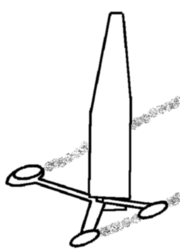 In a non-traditional variant, first seen among Western yacht racers, the "Atlantic proa" has an ama which is always to the lee side to provide buoyancy for stability, rather than ballast as in a traditional proa. Because the Atlantic ama is at least as long as the main hull, to reduce wave drag, this style can also be thought of as an asymmetric catamaran, that shunts rather than tacking. The first Atlantic proa was the Cheers, designed in 1968 by boat designer Dick Newick for the 1968 OSTAR solo translatlanic race, in which it placed third. Newkirk's designs are primarily trimarans, and the Atlantic proa's buoyant outrigger follows naturally from a conversion of a trimaran from a tacking to a shunting vessel.
Other proa designers blur the lines between Atlantic and Pacific style proas. The Harryproa from Australia
uses a long, thin hull to lee, and a short, fat hull, containing the cabin, to windward. This would normally be more like an Atlantic proa, but the rig is on the lee hull, leaving it technically a Pacific design. This and other similar proas place the bulk of the passenger accommodations on the ama, in an attempt to make the vaka as streamlined as possible, and put much of the mass in the lee side to provide a greater righting moment.
Perhaps the most extreme variants of the proa are the ones designed for pure speed. These often completely discard symmetry, and are designed to sail only in one direction relative to the wind; performance in the other direction is either seriously compromised or impossible. These are "one way" proas, such as world record speed holding Yellow Pages Endeavour
, or YPE. While the YPE is often called a trimaran, it would be more correct to call it a Pacific proa, because two of the planing/hydrofoil hulls are in line. This design has been considered by others as well, such as the Monomaran designs by "The 40 knot Sailboat" author Bernard Smith, and has been called a 3-point proa by some, a reference to the 3 point hulls used in hydroplanes. A previous record holding design, the Crossbow II, owned by Timothy Colman
was a proa/catamaran hybrid. Crossbow II was a "slewing" catamaran, able to slew her hulls to allow clear airflow to her leeward bipod sail. Although the hulls appeared identical, the boat had all crew and controls, cockpit etc. in her windward hull; the leeward hull was stripped bare for minimal weight.
On March 26, 2009, Simon McKeon and Tim Daddo set a new C class speed sailing record of 50.08 knots (98.1 km/h) over 500 meters in the Macquarie Innovation
, successor to their previous record holding Yellow Pages Endeavour, with a peak speed of 54 knots (105.8 km/h). The record was set in winds of 22 to 24 knots (47 km/h), and came close to taking the absolute speed record on water, currently held by l'Hydroptère. Conditions during the record setting run were less than ideal for the Maquarie Innovation, which is anticipated to have a top speed of 58 knots (113.7 km/h).
On March 27, 2009, Richard Jenkins set a world windpowered speed record, on land, of 126.1 miles per hour (202.9 km/h) in the Ecotricity Greenbird. This broke the previous record by 10 miles per hour (16 km/h). The Greenbird is based on an one-way proa design, with a long, thin two wheeled body with a third wheel to the lee acting as an ama. The aka, which is in the shape of a wing, provides a significant amount of downwards force at speed to counter the heeling force generated by the high aspect wing sail.
Multihull
A multihull is a ship, vessel, craft or boat with more than one hull.-Description:Multihulls include: Proas, which have two differently shaped or sized hulls with lateral symmetry; catamarans, which have two hulls with longitudinal symmetry; and trimarans, which have a main hull in the center and...
sailing
Sailboat
A sailboat or sailing boat is a boat propelled partly or entirely by sails. The term covers a variety of boats, larger than small vessels such as sailboards and smaller than sailing ships, but distinctions in the size are not strictly defined and what constitutes a sailing ship, sailboat, or a...
vessel
Ship
Since the end of the age of sail a ship has been any large buoyant marine vessel. Ships are generally distinguished from boats based on size and cargo or passenger capacity. Ships are used on lakes, seas, and rivers for a variety of activities, such as the transport of people or goods, fishing,...
.
While the word perahu and proa are generic terms meaning boat their native language, proa in Western languages has come to describe a vessel consisting of two (usually) unequal length parallel hull
Hull (watercraft)
A hull is the watertight body of a ship or boat. Above the hull is the superstructure and/or deckhouse, where present. The line where the hull meets the water surface is called the waterline.The structure of the hull varies depending on the vessel type...
s. It is sailed so that one hull is kept to windward
Windward and leeward
Windward is the direction upwind from the point of reference. Leeward is the direction downwind from the point of reference. The side of a ship that is towards the leeward is its lee side. If the vessel is heeling under the pressure of the wind, this will be the "lower side"...
, and the other to leeward
Windward and leeward
Windward is the direction upwind from the point of reference. Leeward is the direction downwind from the point of reference. The side of a ship that is towards the leeward is its lee side. If the vessel is heeling under the pressure of the wind, this will be the "lower side"...
, so that it needs "shunt" to reverse direction when tacking
Tack (sailing)
Tack is a term used in sailing that has different meanings in different contexts, variously a part of a sail, and an alignment with the wind. When using the latter sense, the maneuver of turning between starboard and port tack is either tacking or jibing....
.
The English term proa most likely specifically refers the South Pacific
Oceania
Oceania is a region centered on the islands of the tropical Pacific Ocean. Conceptions of what constitutes Oceania range from the coral atolls and volcanic islands of the South Pacific to the entire insular region between Asia and the Americas, including Australasia and the Malay Archipelago...
proa as detailed by the analysis of a Micronesian proa by the British ship The Centurion.
The perahu traditional outrigger boat is most numerous in the various islands of Indonesia
Indonesia
Indonesia , officially the Republic of Indonesia , is a country in Southeast Asia and Oceania. Indonesia is an archipelago comprising approximately 13,000 islands. It has 33 provinces with over 238 million people, and is the world's fourth most populous country. Indonesia is a republic, with an...
, Malaysia, and the Philippines
Philippines
The Philippines , officially known as the Republic of the Philippines , is a country in Southeast Asia in the western Pacific Ocean. To its north across the Luzon Strait lies Taiwan. West across the South China Sea sits Vietnam...
. These differ from the South Pacific vessels. Traditional proas superficially resemble outrigger canoe
Outrigger canoe
The outrigger canoe is a type of canoe featuring one or more lateral support floats known as outriggers, which are fastened to one or both sides of the main hull...
s, but have a buoyant lee hull and a denser, ballasted
Sailing ballast
Ballast is used in sailboats to provide moment to resist the lateral forces on the sail. Insufficiently ballasted boats will tend to tip, or heel, excessively in high winds. Too much heel may result in the boat capsizing. If a sailing vessel should need to voyage without cargo then ballast of...
hull to windward for stability.
To Americans, the boats of the Marianas Islands are arguably the most recognizable version.
The modern proa exists in a wide variety of forms, from the traditional archetype still common in areas described, to high-technology interpretations specifically designed for breaking speed-sailing records.
Etymology
The word proa comes from perahu, the word for "boat" in IndonesianIndonesian language
Indonesian is the official language of Indonesia. Indonesian is a normative form of the Riau Islands dialect of Malay, an Austronesian language which has been used as a lingua franca in the Indonesian archipelago for centuries....
(paraw
Paraw
The Paraw is a double outrigger sail boat found in the Philippines. The paraw is similar to a proa, however, the paraw has two outrigger or katig.-Etymology:The word paraw also parao is related to proa and may be used to denote a boat...
in similar Borneo–Philippine languages), which are similar to the Micronesian language group
Malayo-Polynesian languages
The Malayo-Polynesian languages are a subgroup of the Austronesian languages, with approximately 385.5 million speakers. These are widely dispersed throughout the island nations of Southeast Asia and the Pacific Ocean, with a smaller number in continental Asia...
. Found in many configurations and forms, the proa was likely developed as a sailing vessel in Micronesia
Micronesia
Micronesia is a subregion of Oceania, comprising thousands of small islands in the western Pacific Ocean. It is distinct from Melanesia to the south, and Polynesia to the east. The Philippines lie to the west, and Indonesia to the southwest....
(Pacific Ocean
Pacific Ocean
The Pacific Ocean is the largest of the Earth's oceanic divisions. It extends from the Arctic in the north to the Southern Ocean in the south, bounded by Asia and Australia in the west, and the Americas in the east.At 165.2 million square kilometres in area, this largest division of the World...
). Variations may be found as distant as Madagascar
Madagascar
The Republic of Madagascar is an island country located in the Indian Ocean off the southeastern coast of Africa...
and Sri Lanka
Sri Lanka
Sri Lanka, officially the Democratic Socialist Republic of Sri Lanka is a country off the southern coast of the Indian subcontinent. Known until 1972 as Ceylon , Sri Lanka is an island surrounded by the Indian Ocean, the Gulf of Mannar and the Palk Strait, and lies in the vicinity of India and the...
, as far back as the first century. Such vessels go by many names, and "perahu" is a generic umbrella term for any boat smaller than a ship.
The so-called "proa" was documented by the Spanish Magellan expedition to the Philippines circa 1519 CE. It entered English lexicography later.
The use of the term proa in English with reference to the Micronesia
Micronesia
Micronesia is a subregion of Oceania, comprising thousands of small islands in the western Pacific Ocean. It is distinct from Melanesia to the south, and Polynesia to the east. The Philippines lie to the west, and Indonesia to the southwest....
n craft dates back to at least 1742. (See below).
The first illustrations known to Europeans appeared around the middle 19th century in Europe
Europe
Europe is, by convention, one of the world's seven continents. Comprising the westernmost peninsula of Eurasia, Europe is generally 'divided' from Asia to its east by the watershed divides of the Ural and Caucasus Mountains, the Ural River, the Caspian and Black Seas, and the waterways connecting...
, ushering in a period of interest in the design. Working from the drawings and descriptions of explorers, western builders often took liberties with the traditional designs, merging their interpretation of native designs with Western boatbuilding methods. Thus this Western "proa" often diverged radically from the traditional "proa" to the point that the only shared feature was the windward/leeward hull arrangement.
Various native names of the various components of the proa have also entered the jargon
Jargon
Jargon is terminology which is especially defined in relationship to a specific activity, profession, group, or event. The philosophe Condillac observed in 1782 that "Every science requires a special language because every science has its own ideas." As a rationalist member of the Enlightenment he...
of sailing. The main hull of the proa is known as the vaka
Vaka (sailing)
The vaka is the main hull of a multihull vessel.-Origin and use of the term:The term vaka is used in the Polynesian, Malay and Micronesian languages for a 'canoe', 'ship' or 'boat.' Other parts of a traditional vaka can include the aka and ama .A proa consists of a vaka, the main canoe-like...
, the outrigger as the ama
Ama (sailing)
The term ama is a word in the Polynesian and Micronesian languages to describe the outrigger part of a canoe to provide stability. Today, among the various Polynesian countries, the word ama is often used together with the word vaka or waka or va'a , cognate words in various Polynesian languages...
, and the outrigger supports as the akas
Aka (sailing)
The aka of a multihull sailboat is a member of the framework that connects the hull to the ama . The term aka originated with the proa, but is also applied to modern trimarans....
. The terms vaka, ama, and aka have been adopted in Western sailing to describe the analogous parts in trimaran
Trimaran
A trimaran is a multihulled boat consisting of a main hull and two smaller outrigger hulls , attached to the main hull with lateral struts...
s.
Proa characteristics
The defining feature of the proa is that the vessel "shunts" when it changes tacks; the sternStern
The stern is the rear or aft-most part of a ship or boat, technically defined as the area built up over the sternpost, extending upwards from the counter rail to the taffrail. The stern lies opposite of the bow, the foremost part of a ship. Originally, the term only referred to the aft port section...
becomes the bow
Bow (ship)
The bow is a nautical term that refers to the forward part of the hull of a ship or boat, the point that is most forward when the vessel is underway. Both of the adjectives fore and forward mean towards the bow...
and vice versa. The same hull is kept windward
Windward and leeward
Windward is the direction upwind from the point of reference. Leeward is the direction downwind from the point of reference. The side of a ship that is towards the leeward is its lee side. If the vessel is heeling under the pressure of the wind, this will be the "lower side"...
for ballast
Sailing ballast
Ballast is used in sailboats to provide moment to resist the lateral forces on the sail. Insufficiently ballasted boats will tend to tip, or heel, excessively in high winds. Too much heel may result in the boat capsizing. If a sailing vessel should need to voyage without cargo then ballast of...
.
The main hull, or vaka, is usually longer than the windward hull, or ama
Ama (sailing)
The term ama is a word in the Polynesian and Micronesian languages to describe the outrigger part of a canoe to provide stability. Today, among the various Polynesian countries, the word ama is often used together with the word vaka or waka or va'a , cognate words in various Polynesian languages...
. Crossbeams called aka
Aka (sailing)
The aka of a multihull sailboat is a member of the framework that connects the hull to the ama . The term aka originated with the proa, but is also applied to modern trimarans....
s connect the vaka to the ama. Traditional proa hulls are markedly asymmetrical along their length, and often curved in such a way as to produce lift
Lift (force)
A fluid flowing past the surface of a body exerts a surface force on it. Lift is the component of this force that is perpendicular to the oncoming flow direction. It contrasts with the drag force, which is the component of the surface force parallel to the flow direction...
to counteract the lateral forces of the wind. Modern proa hulls are often symmetrical, and use leeboard
Leeboard
A leeboard is a lifting foil used by a sailboat, much like a centerboard, but located on the leeward side of the boat. The leeward side is used so that the leeboard isn't lifted from the water when the boat heels, or leans under the force of the wind....
s for lateral resistance.
A number of other vessels use a similar layout with uneven hulls and a shunting sails, but are culturally and historically distinct from the Western interpreted-invented proa. Examples of these are the Fiji
Fiji
Fiji , officially the Republic of Fiji , is an island nation in Melanesia in the South Pacific Ocean about northeast of New Zealand's North Island...
an drua
Drua
Drua, also known as Na Drua, N'drua, Ndrua or Vaka Tepu , is a double-hull sailing boat that originated in the south-western Pacific islands. Druas do not tack but rather shunt . Both ends of each hull are identical, but the hulls are of different sizes and the smaller one is always sailed to...
and the Melanesia
Melanesia
Melanesia is a subregion of Oceania extending from the western end of the Pacific Ocean to the Arafura Sea, and eastward to Fiji. The region comprises most of the islands immediately north and northeast of Australia...
n tepukei
Tepukei
A Tepukei is a very old Melanesian boat type, first reported by Spanish explorer Álvaro de Mendaña in 1595, on his visit to the Santa Cruz Islands...
.
Size and sail plan
The Micronesian proa is found in a variety of sizes, from the small, canoe-like kor-kor (about 15 feet (4.6 m) in length) to the medium-sized tipnol (20 to 30 ft (6.1 to 9.1 m)), to the tremendous walapWalap
The Walap is a traditional ocean-going sailboatfrom the Marshall Islands.It belongs to the Micronesian proa type whose main characteristics are: single main hull, outrigger-mounted float/ballast, and asymmetric hull profile...
, which can be up to 100 feet (30.5 m) long.
A model proa, called a riwuit, is often raced by children. Proas could be paddled or sailed. The traditional sail used on the proa was the crab-claw sail
Crab claw sail
The crab claw sail or, as it is sometimes known, Oceanic lateen or Oceanic sprit, is a triangular sail with spars along upper and lower edges. The crab claw sail is used in many traditional Pacific Ocean cultures, as can be seen by the traditional proa and tepukei.-Construction:The crab claw sail...
, which generates far more lift than the more common triangular sloop
Sloop
A sloop is a sail boat with a fore-and-aft rig and a single mast farther forward than the mast of a cutter....
rig used on small boats, particularly when reaching
Points of sail
Points of sail describes a sailing boat's course in relation to the wind direction.There is a distinction between the port tack and the starboard tack. If the wind is coming from anywhere on the port side, the boat is on port tack. Likewise if the wind is coming from the starboard side, the boat...
. The sloop rig only begins to show an advantage with small angles of attack, such as encountered when close-hauled
Points of sail
Points of sail describes a sailing boat's course in relation to the wind direction.There is a distinction between the port tack and the starboard tack. If the wind is coming from anywhere on the port side, the boat is on port tack. Likewise if the wind is coming from the starboard side, the boat...
. This is the result of the higher aspect ratio of the sloop.
Sailing the proa
When sailing in a strong wind, the crew of the proa act as ballast, providing a force to counteract the torqueTorque
Torque, moment or moment of force , is the tendency of a force to rotate an object about an axis, fulcrum, or pivot. Just as a force is a push or a pull, a torque can be thought of as a twist....
of the wind acting on the sail. The weight of the crew can provide considerable torque as they move out along the akas towards the ama. A skilled crew can balance the proa so that the ama leaves the water and skims over its surface; this is called "flying the ama", and gives the proa its nickname, the "flying proa". Flying the ama (the wetted surface) significantly reduces the drag
Drag (physics)
In fluid dynamics, drag refers to forces which act on a solid object in the direction of the relative fluid flow velocity...
of the proa. The proa gets its great potential for speed by combining the long, narrow shape of the vaka with the large amount of torque that the crew can apply on the akas.
Historical descriptions of the proa
- The Proa darted like a shooting star
- Lord ByronGeorge Gordon Byron, 6th Baron ByronGeorge Gordon Byron, 6th Baron Byron, later George Gordon Noel, 6th Baron Byron, FRS , commonly known simply as Lord Byron, was a British poet and a leading figure in the Romantic movement...
, "The Island", 1823
Vessels that have a bow at either end are found scattered throughout history, with the earliest mention being in Pliny the Elder
Pliny the Elder
Gaius Plinius Secundus , better known as Pliny the Elder, was a Roman author, naturalist, and natural philosopher, as well as naval and army commander of the early Roman Empire, and personal friend of the emperor Vespasian...
's Natural History. He describes double-ended vessels being used to transport cargo across the strait at Taprobane, or what is now the Palk Strait
Palk Strait
Palk Strait is a strait between the Tamil Nadu state of India and the Mannar district of the Northern Province of the island nation of Sri Lanka. It connects the Bay of Bengal in the northeast with the Palk Bay and thence with the Gulf of Mannar in the southwest. The strait is wide. Several...
between India
India
India , officially the Republic of India , is a country in South Asia. It is the seventh-largest country by geographical area, the second-most populous country with over 1.2 billion people, and the most populous democracy in the world...
and Sri Lanka
Sri Lanka
Sri Lanka, officially the Democratic Socialist Republic of Sri Lanka is a country off the southern coast of the Indian subcontinent. Known until 1972 as Ceylon , Sri Lanka is an island surrounded by the Indian Ocean, the Gulf of Mannar and the Palk Strait, and lies in the vicinity of India and the...
, where the double-ended nature of the vessels allowed them to ferry cargo back and forth without turning around. Square rig
Square rig
Square rig is a generic type of sail and rigging arrangement in which the primary driving sails are carried on horizontal spars which are perpendicular, or square, to the keel of the vessel and to the masts. These spars are called yards and their tips, beyond the last stay, are called the yardarms...
ged sailing proas are still in use in Sri Lanka as fishing boats, called Oruwa or Oru.
The written history of the Micronesian proa began when it was recorded after encounter by European explorers in the Micronesian islands. The earliest written accounts were by Antonio Pigafetta
Antonio Pigafetta
Antonio Pigafetta was an Italian scholar and explorer from the Republic of Venice. He travelled with the Portuguese explorer Ferdinand Magellan and his crew on their voyage to the Indies. During the expedition, he served as Magellan's assistant and kept an accurate journal which later assisted him...
, an Italian who was a passenger on Ferdinand Magellan
Ferdinand Magellan
Ferdinand Magellan was a Portuguese explorer. He was born in Sabrosa, in northern Portugal, and served King Charles I of Spain in search of a westward route to the "Spice Islands" ....
's 1519–1522 circumnavigation. Pigafetta's account of the stop at approximately 146 E, 12 N, (the Mariana Islands
Mariana Islands
The Mariana Islands are an arc-shaped archipelago made up by the summits of 15 volcanic mountains in the north-western Pacific Ocean between the 12th and 21st parallels north and along the 145th meridian east...
, named the Ladrones by Magellan's men), describes the proa's outrigger layout, and ability to switch bow for stern, and also notes the proa's speed and maneuverability, noting, "And although the ships were under full sail, they passed between them and the small boats (fastened astern), very adroitly in those small boats of theirs." Pigafetta likened the proa to the Venetian
Venice
Venice is a city in northern Italy which is renowned for the beauty of its setting, its architecture and its artworks. It is the capital of the Veneto region...
fisolere, a narrow variety of gondola
Gondola
The gondola is a traditional, flat-bottomed Venetian rowing boat, well suited to the conditions of the Venetian Lagoon. For centuries gondolas were the chief means of transportation and most common watercraft within Venice. In modern times the iconic boats still have a role in public transport in...
; this was an apt comparison due to both the long, thin shape and asymmetric nature of single-oar gondolas.
During his 1740–1744 circumnavigation
George Anson's voyage around the world
While Great Britain was at war with Spain in 1740, Commodore George Anson led a squadron of eight ships on a mission to disrupt or capture Spain's Pacific possessions...
, Lord Anson
George Anson, 1st Baron Anson
Admiral of the Fleet George Anson, 1st Baron Anson PC, FRS, RN was a British admiral and a wealthy aristocrat, noted for his circumnavigation of the globe and his role overseeing the Royal Navy during the Seven Years' War...
also saw the proa. His fleet captured one in 1742, and Lt. Peircy Brett
Peircy Brett
Sir Peircy Brett was an officer in the Royal Navy, who from 1740 to 1744 served on George Anson's voyage around the world. During this voyage he was appointed captain of the . He reached the rank of rear admiral in 1762, and thereafter served on land. In the Admiralty he was lord commissioner ,...
of the HMS Centurion
HMS Centurion (1732)
HMS Centurion was a 60-gun fourth rate ship of the line of the Royal Navy, built at Portsmouth Dockyard and launched on 6 January 1732. At the time of Centurion's construction, the 1719 Establishment dictated the dimensions of almost every ship being built...
made a detailed sketch of the proa. Rev. Richard Walter, chaplain of the HMS Centurion, estimated the speed of the proa at twenty miles per hour (32 km/h). Since Pigafetta's account was not fully published until the late 18th century (though finished in 1525), the accounts from Anson's voyage were the first about the proa for most literate Europeans.
Construction
Scholars believe the proa evolved from the dugout canoeDugout (boat)
A dugout or dugout canoe is a boat made from a hollowed tree trunk. Other names for this type of boat are logboat and monoxylon. Monoxylon is Greek -- mono- + ξύλον xylon -- and is mostly used in classic Greek texts. In Germany they are called einbaum )...
, one of the oldest watercraft and found in primitive cultures across the world. The design of the proa hints at its evolution from a canoe into the world's fastest sailboat. It likely held this position for many centuries.
Vaka (main hull)
The traditional Micronesian proa hull consists of a single long keelKeel
In boats and ships, keel can refer to either of two parts: a structural element, or a hydrodynamic element. These parts overlap. As the laying down of the keel is the initial step in construction of a ship, in British and American shipbuilding traditions the construction is dated from this event...
made of a single large log constructed much like a dugout canoe. It is extended upwards with sewn planks
Sewn boat
A sewn boat is a type of wooden boat which is clinker built and held together with tendons or flexible wood, such as roots and willow branches. Sewn boat construction techniques were used in many parts of the world prior to the development of metal fasteners, and continued to be used long after...
, to provide additional depth to the hull. The windward side of the hull is curved, similar to a typical canoe
Canoe
A canoe or Canadian canoe is a small narrow boat, typically human-powered, though it may also be powered by sails or small electric or gas motors. Canoes are usually pointed at both bow and stern and are normally open on top, but can be decked over A canoe (North American English) or Canadian...
, while the lee side is straight and flat to minimize leeway while sailing.
Ama (outrigger)
Adding a sail to a narrow hull like a canoe is a dangerous proposition, especially given the lack of dense materials like leadLead
Lead is a main-group element in the carbon group with the symbol Pb and atomic number 82. Lead is a soft, malleable poor metal. It is also counted as one of the heavy metals. Metallic lead has a bluish-white color after being freshly cut, but it soon tarnishes to a dull grayish color when exposed...
that can be used in a ballasted
Sailing ballast
Ballast is used in sailboats to provide moment to resist the lateral forces on the sail. Insufficiently ballasted boats will tend to tip, or heel, excessively in high winds. Too much heel may result in the boat capsizing. If a sailing vessel should need to voyage without cargo then ballast of...
keel
Keel
In boats and ships, keel can refer to either of two parts: a structural element, or a hydrodynamic element. These parts overlap. As the laying down of the keel is the initial step in construction of a ship, in British and American shipbuilding traditions the construction is dated from this event...
to counter the heeling moment
Moment of inertia
In classical mechanics, moment of inertia, also called mass moment of inertia, rotational inertia, polar moment of inertia of mass, or the angular mass, is a measure of an object's resistance to changes to its rotation. It is the inertia of a rotating body with respect to its rotation...
of the sail. Attaching two dugout canoes together to form a catamaran
Catamaran
A catamaran is a type of multihulled boat or ship consisting of two hulls, or vakas, joined by some structure, the most basic being a frame, formed of akas...
hull provides stability, but this is an expensive operation. For men using nothing but fire and stone tools, building a hull is a long and labor-intensive process. The traditional proa's simple outrigger—a log hewn to a point at each end—can be produced with far less effort, and provides the needed stability to counter the force of a large sail.
Rigging
The rigging of the proa also shows a high degree of elegance. By keeping the wind always to one side of the boat, the forces act on the sail, mast, rigging and akas always in the same direction. Where a tacking boat must have stays on both sides of the mast, with only one set under tension at a time, the layout of the proa requires stays on only one side, where they are under tension on all points of sail. Having the ama to the windward side also allows the use of materials like bamboo for the akas—the akas only need to be able to bear the weight of the ama, which is countered by the tension on the stays. Leeward akas, on the other hand, would need to bear the displacement of the ama, and cannot be assisted by tensioned rope.Modern variations
In the Marshall IslandsMarshall Islands
The Republic of the Marshall Islands , , is a Micronesian nation of atolls and islands in the middle of the Pacific Ocean, just west of the International Date Line and just north of the Equator. As of July 2011 the population was 67,182...
, where the craft were traditionally built, there has been a resurgence of interest in the proa. People hold annual kor-kor races in the lagoon at Majuro
Majuro
Majuro , is a large coral atoll of 64 islands in the Pacific Ocean, and forms a legislative district of the Ratak Chain of the Marshall Islands. The atoll itself has a land area of and encloses a lagoon of...
, along with events such as a children's riwut race. The kor-kors are built in traditional style out of traditional materials, though the sails are made with modern materials (often inexpensive polyethylene
Polyethylene
Polyethylene or polythene is the most widely used plastic, with an annual production of approximately 80 million metric tons...
tarpaulin
Tarpaulin
A tarpaulin, colloquially tarp, is a large sheet of strong, flexible, water-resistant or waterproof material, often cloth such as canvas or polyester coated with urethane, or made of plastics such as polyethylene. In some places such as Australia, and in military slang, a tarp may be known as a...
s, commonly known as polytarp).
A loose group of individuals from all over the world has formed from those interested in the proa, including people with a historical perspective and those with a scientific and engineering perspective. Many such individuals are members of the Amateur Yacht Research Society.
Early Western proas
- Sailing is no name for it – flying is better. Out into the bay she skipped, boys yelling with delight on the uplifted outrigger, spray from the lee bow and steering oar riven into vapor by the speed blowing to leeward.
- R. M. Munroe, "A Flying Proa", The Rudder, June 1898
In the late 19th century and early 20th century, many in Europe and America became interested in the proa. Western boat builders such as R. M. Munroe
Ralph Munroe
Ralph Middleton Munroe was an American yacht designer and early resident of Coconut Grove in south Florida. His home, now The Barnacle Historic State Park, is the oldest house in Miami-Dade County still standing in its original location.-Early life:Munroe was born to Thomas and Ellen Middleton...
and Robert Barnwell Roosevelt (Theodore Roosevelt
Theodore Roosevelt
Theodore "Teddy" Roosevelt was the 26th President of the United States . He is noted for his exuberant personality, range of interests and achievements, and his leadership of the Progressive Movement, as well as his "cowboy" persona and robust masculinity...
's uncle) reflected its influence. Into the 20th century, the proa was one of the fastest sailing craft that existed. The proa design is still the basis for many boats involved in speed sailing
Speed sailing
Speed sailing is the art of sailing a craft as fast as possible over a predetermined route, and having its overall or peak speed recorded and accredited by a regulatory body. The term usually refers to sailing on water, even though sailing on land and ice is progressively faster because of the...
.
The first well-documented Western version of the proa was built in 1898 by Commodore Ralph M. Munroe of the Biscayne Bay
Biscayne Bay
Biscayne Bay is a lagoon that is approximately 35 miles long and up to 8 miles wide located on the Atlantic coast of South Florida, United States. It is usually divided for purposes of discussion and analysis into three parts: North Bay, Central Bay, and South Bay. Its area is...
Yacht Club. Yacht-design giant Nathanael Herreshoff
Nathanael Herreshoff
Nathanael Greene Herreshoff I , was an American naval architect-mechanical engineer. "Captain Nat," as he was known, revolutionized yacht design, and produced a succession of undefeated America's Cup defenders between 1893–1920....
, a friend of Munroe, may have also had an interest in the project. A small model of the Anson-Brett proa is collected at the Herreshoff Marine Museum in Rhode Island
Rhode Island
The state of Rhode Island and Providence Plantations, more commonly referred to as Rhode Island , is a state in the New England region of the United States. It is the smallest U.S. state by area...
; its maker is uncertain.
Over the following years, Munroe built several more. They were all destroyed by the mid-1930s, when a severe hurricane leveled Munroe's bayside boatshop. At least two of his designs were documented in articles in The Rudder, as was one by Robert B. Roosevelt. Small proas may have been brought back to the United States in the late 19th century, but documentation is sparse. Munroe and Roosevelt appeared to be the first two builders to adapt the proa to Western building techniques.
Royal Mersey Yacht Club
In 1860 a member of the Royal Mersey Yacht Club in EnglandEngland
England is a country that is part of the United Kingdom. It shares land borders with Scotland to the north and Wales to the west; the Irish Sea is to the north west, the Celtic Sea to the south west, with the North Sea to the east and the English Channel to the south separating it from continental...
built a copy of a Micronesian proa. He used the traditional asymmetric hull, flat on the lee side, and a decked dugout ama. While no quantitative record was made of its speed, it was noted that the proa would run at speeds that would bury the bows of any other vessel. It carried three times the ratio of sail area to immersed midships section than the fastest yachts in the club and yet drew only 15 inches (38.1 cm).
Munroe's 1898 proa
Since Munroe had no direct experience with proas, all he had to work with was the widely distributed and incorrect plan drawing from about 1742, made during Admiral Lord Anson's circumnavigation of the globe. This drawing had been circulated in the press, for example in William Alden's articles in Harper's Magazine. (These were reprinted in a small book called The Canoe and the Flying Proa. This proa was one of several either captured or seen under sail when Anson stopped at TinianTinian
Tinian is one of the three principal islands of the Commonwealth of the Northern Mariana Islands.-Geography:Tinian is about 5 miles southwest of its sister island, Saipan, from which it is separated by the Saipan Channel. It has a land area of 39 sq.mi....
during a Pacific crossing. Brett, the draftsman of the plan, misinterpreted one key element, showing it fixed vertically in the center of the boat. Traditional proa masts were raked end-to-end as the vessel shunted. A raking mast helps with helm balance by moving the center of effort of the sail fore and aft.
Munroe, however, was a talented boat designer who was able to work around the problems with the drawings. His adaptations can be seen in successive proas. Rather than the deep, asymmetric hull of a traditional proa, Munroe created flat-bottomed hulls (similar to the fisolera referred to by Pigafetta), with keels or centerboards for lateral resistance. His first iteration had an iron center fin with a half-oval profile. Rather than the traditional crab-claw sail's spars which meet at the front, Munroe's sails used what could be described as a triangular lugsail
Lugger
A lugger is a class of boats, widely used as traditional fishing boats, particularly off the coasts of France, Scotland and England. It is a small sailing vessel with lugsails set on two or more masts and perhaps lug topsails.-Defining the rig:...
or spritsail
Spritsail
The spritsail is a form of three or four-sided, fore-aft sail and its rig. Unlike the gaff where the head hangs from a spar along its edge, this rig supports the leech of the sail by means of a spar or spars named a sprit...
with a boom, similar to the modern lateen
Lateen
A lateen or latin-rig is a triangular sail set on a long yard mounted at an angle on the mast, and running in a fore-and-aft direction....
sail with a shorter upper spar.
Munroe's first proa was only 30 feet (9.1 m) long, yet was capable of speeds which Munroe estimated at 18 knots (35.3 km/h). His article in The Rudder describes what can only be planing
Planing (sailing)
Planing is the mode of operation for a waterborne craft in which its weight is predominantly supported by hydrodynamic lift, rather than hydrostatic lift .-History:...
on the flat hull. As this was before the advent of planing power boats, this proa was one of the first boats capable of planing. This helped produce its amazing speed when most boats were limited to their hull speed
Hull speed
Hull speed, sometimes referred to as displacement speed, is the speed of a boat at which the bow and stern waves interfere constructively, creating relatively large waves, and thus a relatively large value of wave drag...
--they had too little power to achieve planing speed, and yet were not designed to exceed hull speed
Hull speed
Hull speed, sometimes referred to as displacement speed, is the speed of a boat at which the bow and stern waves interfere constructively, creating relatively large waves, and thus a relatively large value of wave drag...
without planing. For example, a 30 feet (9.1 m) boat with too little power to plane, and with a hull form and displacement that didn't permit it to exceed hull speed without planing, would have a maximum speed of about 7.3 knots (14.3 km/h); Munroe's proa could reach nearly 2.5 times that speed. This accomplishment was the nautical equivalent to the X-1
Bell X-1
The Bell X-1, originally designated XS-1, was a joint NACA-U.S. Army/US Air Force supersonic research project built by Bell Aircraft. Conceived in 1944 and designed and built over 1945, it eventually reached nearly 1,000 mph in 1948...
breaking the sound barrier.
It is not clear that traditional proas of the Pacific islanders could plane, though the long, slender hull would have a much higher speed/length ratio than other contemporary designs. Munroe was building a "cheap and dirty" sharpie
Sharpie (boat)
Sharpies are long, narrow sailboats with flat bottoms, extremely shallow draft, centerboards and straight, flaring sides. They are believed to have originated in the New Haven, Connecticut region of Long Island Sound, United States...
hull made of two 32 feet (9.8 m) planks, a couple of bulkheads and a crossplanked bottom. By lucky accident he may have been the first sailor to plane his boat.
Roosevelt's Mary & Lamb
Robert Barnwell Roosevelt, uncle of American PresidentPresident of the United States
The President of the United States of America is the head of state and head of government of the United States. The president leads the executive branch of the federal government and is the commander-in-chief of the United States Armed Forces....
Theodore Roosevelt
Theodore Roosevelt
Theodore "Teddy" Roosevelt was the 26th President of the United States . He is noted for his exuberant personality, range of interests and achievements, and his leadership of the Progressive Movement, as well as his "cowboy" persona and robust masculinity...
, also built a proa at about the same time. He used it sailing from Long Island
Long Island
Long Island is an island located in the southeast part of the U.S. state of New York, just east of Manhattan. Stretching northeast into the Atlantic Ocean, Long Island contains four counties, two of which are boroughs of New York City , and two of which are mainly suburban...
. It was significantly different but equally creative, and at 50 feet (15.2 m), much longer. From his 1898 article in The Rudder, it appeared the main hull of Roosevelt's proa was an open 4 feet (1.2 m) wide scow
Scow
A scow, in the original sense, is a flat-bottomed boat with a blunt bow, often used to haul bulk freight; cf. barge. The etymology of the word is from the Dutch schouwe, meaning such a boat.-Sailing scows:...
hull; the ama was a smaller, fully decked scow which looked like it could rock on a single aka. The mast was a bipod arrangement with both masts stepped to windward, with a boomed, balanced lugsail suspended from the apex. A balanced rudder at each end managed itself by pivoting 180° when its end was the "bow", and leeboards were used.
Roosevelt's short article is accompanied by photographs showing his proa Mary & Lamb, at rest and under sail. It is not clear if the boat predated Munroe's 1898 proa.
Munroe's 1900 Proa
Since Munroe wasn't aware of the raking mast, his 1900 model used two daggerboardDaggerboard
A daggerboard is a retractable centreboard used by various sailing craft. While other types of centreboard may pivot to retract, a daggerboard slides in a casing. The shape of the daggerboard converts the forward motion into a windward lift, countering the leeward push of the...
s set fore and aft of the mast, which would allow adjustment of the center of lateral resistance to provide helm balance. From the drawings, it appears the mast is higher as well, allowing a larger sail. The sail design also changed, with the upper spar now being slightly longer than the upper edge of the sail, and projecting past the apex slightly to allow the apex to be attached to the hull. The sail was loose footed, with the boom attached to the upper spar near the sail apex, and to the clew of the sail. His article in a 1900 issue of The Rudder included more details on the construction of his second proa. A 1948 book of sailboat plans published by The Rudder includes the following specifications for the 1900 proa:
- Length overall 30 feet (9.1 m)
- Beam (of main hull) 2 in 6 in (0.762 m)
- Draft of hull about 5 inches (12.7 cm)
- Draft with boards down 2 in 5 in (0.7366 m)
- Sail area 240 square feet (22.3 m²)
From the drawings, the distance from the center of the main hull to the center of the aka is about 12 feet (3.7 m).
Other Western Interpretations
Western designers often feel the need to tinker with the proa. They are attracted by the minimalist nature and amazing speeds that proas are capable of (they may still be the fastest sailboats per dollar spent for the home builder) but they often want the proa to do more; adding cabins, different sailing rigs, and bidirectional rudders are common changes made.For example, unconventional boat and yacht designer Phil Bolger
Phil Bolger
Philip C. Bolger , prolific boat designer, was born and lived in Gloucester, Massachusetts. He began work full time as a draftsman for boat designers Lindsay Lord and then John Hacker in the early 1950s. Bolger also cites being influenced by mentors L.F...
has drawn at least three proa designs; the smallest one (20 ft) has been built by several people while the larger two, including his Proa 60, have not been built. For additional examples, see here.
Lee pods
The terms ama and aka have been adopted for the modern trimaranTrimaran
A trimaran is a multihulled boat consisting of a main hull and two smaller outrigger hulls , attached to the main hull with lateral struts...
. Since trimarans are generally designed to sail with one ama out of the water, they are similar to an Atlantic proa, with the buoyant leeward ama providing the bulk of the stability for the long, relatively thin main hull. Some modern proa designers have borrowed trimaran design elements for use in proas. Trimarans often have main hulls that are very narrow at the waterline, and flare out and extend over a significant portion of the akas. This topheavy design is only practical in a multihull, and it has been adapted by some proa designers. Notable examples are the designs of Russell Brown, a boat-fittings maker who designed and built his first proa, Jzero, in the mid 1970s. He has created a number of proa designs, all of which follow the same theme.
One of the design elements which Brown used, and a number of other designers have copied, is the lee pod. The akas extend past the main hull and out to the lee side, and provide support for a cabin extending to the lee of the main hull. This is similar to the platform extending to the lee on some Micronesian proas. The lee pod serves two purposes—it can be used for bunk space or storage, and it provides additional buoyancy on the lee side to prevent a capsize should the boat heel too far. Crew can also be moved onto the lee pod to provide additional heeling force in light winds, allowing the ama to lift under circumstances when it would not otherwise. The Jzero also used water ballast in the ama to allow the righting moment to be significantly increased if needed. While Brown's proa was designed to be a cruising yacht, not a speed-sailing boat, the newer 36 feet (11 m) Jzerro is capable of speeds of up to 21 knots (41.2 km/h).
Sail rigs
One of the issues Western designers have with the proa is the need to manipulate the sail when shunting. Even Munroe's early sails discarded the curved yards of the traditional crabclaw for the more familiar straight yards of the lateen and lug sails. Munroe's designs likely lacked the tilting mast because he was unaware of it, but many designers since have use a fixed mast, and provided some other way of adjusting the center of effort. Most sailboats are designed with the center of effort of the sails slightly ahead of the center of area of the underwater plane; this difference is called "lead." In a proa hull, and in all fore and aft symmetric foils, the center of resistance is not at or even near the center of the boat, it is well forward of the geometric center of area. Thus the center of effort of the sails needs to also be well forward, or at least needs to have a sail which is well forward which can be sheeted in to start the boat moving, allowing the rudders to bite and keep the boat from heading up when the entire sail area is sheeted in. Jzero, for example, and all of Russell Brown's other designs, use a sloopSloop
A sloop is a sail boat with a fore-and-aft rig and a single mast farther forward than the mast of a cutter....
rig and hoist a jib on whichever end is the current "bow". Other designs use a schooner rig for the same effect.
One of the more practical rigs for small proas was invented by Euell Gibbons
Euell Gibbons
Euell Theophilus Gibbons was an outdoorsman and proponent of natural diets during the 1960s.He was born in Clarksville, Texas, on September 14, 1911, and spent much of his youth in the hilly terrain of New Mexico during the dust bowl era. His mother taught him about foods available in the wild...
around 1950 for a small, single handed proa. This rig was a loose footed lateen sail hung from a centered mast. The sail was symmetric across the yard, and to shunt, what was previously the top end of the yard was lowered and became the bottom end, reversing the direction of the sail. Proa enthusiast Gary Dierking modified this design further, using a curved yard and a boom perpendicular to the yard. This allows a greater control of the sail shape than the traditional Gibbons rig, while retaining the simple shunting method, and is often referred to as the Gibbons/Dierking rig.
Foils
While a proa is fairly efficient at minimizing the amount of wave drag and maximizing stability, there is at least one way to go even further. The use of underwater foilsFoil (fluid mechanics)
A foil is a solid object with a shape such that when placed in a moving fluid at a suitable angle of attack the lift is substantially larger than the drag...
to provide lift or downforce has been a popular idea recently in cutting-edge yacht building, and the proa is not immune to this influence.
The Bruce foil
Bruce foil
A Bruce foil is a variant of the leeboard, consisting of a foil typically mounted on an outrigger and always set at an angle to provide both lateral and downwards force...
is a foil that provides a lateral resistance with zero heeling moment by placing the foil to the windward side, angled so the direction of the force passes through the center of effort of the sail. Since proas already have an outrigger to the windward side, a simple angled foil mounted on the ama becomes a Bruce foil, making the already stable proa even more stable. Bruce foils are often combined with inclined rigs, which results in a total cancellation of heeling forces. Inclined rigs are also well suited to the proa, as the direction of incline remains constant during shunting.
Another use of foils is to provide lift, turning the boat into a hydrofoil
Hydrofoil
A hydrofoil is a foil which operates in water. They are similar in appearance and purpose to airfoils.Hydrofoils can be artificial, such as the rudder or keel on a boat, the diving planes on a submarine, a surfboard fin, or occur naturally, as with fish fins, the flippers of aquatic mammals, the...
. Hydrofoils require significant speeds to work, but once the hull is lifted out of the water, the drag is significantly reduced. Many speed sailing designs have been based on a proa type configuration equipped with lifting foils.
Variations on the theme
Other proa designers blur the lines between Atlantic and Pacific style proas. The Harryproa from Australia
Australia
Australia , officially the Commonwealth of Australia, is a country in the Southern Hemisphere comprising the mainland of the Australian continent, the island of Tasmania, and numerous smaller islands in the Indian and Pacific Oceans. It is the world's sixth-largest country by total area...
uses a long, thin hull to lee, and a short, fat hull, containing the cabin, to windward. This would normally be more like an Atlantic proa, but the rig is on the lee hull, leaving it technically a Pacific design. This and other similar proas place the bulk of the passenger accommodations on the ama, in an attempt to make the vaka as streamlined as possible, and put much of the mass in the lee side to provide a greater righting moment.
Perhaps the most extreme variants of the proa are the ones designed for pure speed. These often completely discard symmetry, and are designed to sail only in one direction relative to the wind; performance in the other direction is either seriously compromised or impossible. These are "one way" proas, such as world record speed holding Yellow Pages Endeavour
Yellow Pages Endeavour
The Yellow Pages Endeavour, or YPE, is an Australian sailboat designed for speed sailing, which held the outright 500 meter world record from October, 1993 to November, 2004, when it was taken by windsurfer Finian Maynard; the YPE still holds the C class record...
, or YPE. While the YPE is often called a trimaran, it would be more correct to call it a Pacific proa, because two of the planing/hydrofoil hulls are in line. This design has been considered by others as well, such as the Monomaran designs by "The 40 knot Sailboat" author Bernard Smith, and has been called a 3-point proa by some, a reference to the 3 point hulls used in hydroplanes. A previous record holding design, the Crossbow II, owned by Timothy Colman
Timothy Colman
Sir Timothy James Alan Colman KG is a British businessman and a previous Lord Lieutenant of Norfolk. He was appointed a Knight of the Order of the Garter in 1996. He is married to Lady Mary Colman , niece of HM Queen Elizabeth the Queen Mother, and lives in Bixley Manor near Norwich.Sir Timothy is...
was a proa/catamaran hybrid. Crossbow II was a "slewing" catamaran, able to slew her hulls to allow clear airflow to her leeward bipod sail. Although the hulls appeared identical, the boat had all crew and controls, cockpit etc. in her windward hull; the leeward hull was stripped bare for minimal weight.
Speed records
In March 2009, two new sailing speed records were set by vehicles based on the proa concept, one on land, and one on the water.On March 26, 2009, Simon McKeon and Tim Daddo set a new C class speed sailing record of 50.08 knots (98.1 km/h) over 500 meters in the Macquarie Innovation
Yellow Pages Endeavour
The Yellow Pages Endeavour, or YPE, is an Australian sailboat designed for speed sailing, which held the outright 500 meter world record from October, 1993 to November, 2004, when it was taken by windsurfer Finian Maynard; the YPE still holds the C class record...
, successor to their previous record holding Yellow Pages Endeavour, with a peak speed of 54 knots (105.8 km/h). The record was set in winds of 22 to 24 knots (47 km/h), and came close to taking the absolute speed record on water, currently held by l'Hydroptère. Conditions during the record setting run were less than ideal for the Maquarie Innovation, which is anticipated to have a top speed of 58 knots (113.7 km/h).
On March 27, 2009, Richard Jenkins set a world windpowered speed record, on land, of 126.1 miles per hour (202.9 km/h) in the Ecotricity Greenbird. This broke the previous record by 10 miles per hour (16 km/h). The Greenbird is based on an one-way proa design, with a long, thin two wheeled body with a third wheel to the lee acting as an ama. The aka, which is in the shape of a wing, provides a significant amount of downwards force at speed to counter the heeling force generated by the high aspect wing sail.
Sources of information on proas
- Russel Brown on Proas, and interview with the builder of Kauri, Cimba, Jzero, and Jzerro, sloop rigged Pacific proas of 30 to 37 feet in length.
- Guampedia, Guam's Online Encyclopedia Agadna, Chamorro Canoe Builders
- The Proa File by Michael Schacht.
- German proa website Information and links (mainly in German)
- A summary of American proa designs can be found on Craig O'Donnell's Cheap Pages.
- wikiproa a wiki dedicated to proas. Mostly home build smaller designs.
- A collection of links to Proa-related websites from PacificProa.com
- The University of Guam's Traditional Seafaring Society Webpage Micronesia.
- Canoes in Micronesia by Marvin Montvel-Cohen; Micronesian working papers number 2, University of Guam Gallery of Art, David Robinson, Director, April 1970
- Big collection of photos of ancient proas
- 2001 Marshall Island stamps, showing the Marshallese walap
- Canoe Craze In Marshall Islands, Pacific Magazine, By Giff Johnson. Shows modern kor-kor racers in traditional boats with polytarp sails
- Riwuit pictures, and detailed plans on building and tuning a riwuit
- The Vaka Taumako Project page on Polynesian proas and sailing
- Essay with photos of Kapingmarangi sailing canoes, Caroline Islands.
- Duckworks Magazine article on the R.B. Roosevelt and Monroe proas
Individual proa designs
- hinged vector fin proa
- World of Boats (EISCA) Collection ~ Ra Marama II, Fijian Proa
- Mbuli – A Pacific Proa
- P5 – a 5 m multichine proa
- Harryproa website, detailing history and current developments of the Harry type proas
- Dave Culp's untested unidirectional, single foil proa
- Slingshot and Crossbow I shunting ama trimaran/proas
- Gary Dierking's T2 proa design, showing the Gibbons/Dierking rig
- Cheers, the first Atlantic proa
- Rebuilding Cheers, by Vincent Besin
- Video of Cheers' relaunch in 2006
- Video of Jeremie Fischer's proa Equilibre shunting
- Video of Toroa Micronesian style proa, designed and built by Michael Toy and Harmen Hielkema
- Gizmo, an "experimental" minimalist proa by designer Jim Michalak
- Madness – a 31 feet (9.4 m) Proa designed by John Harris