

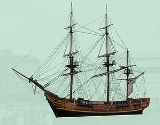
HMS Bounty

Encyclopedia
Her Majesty's Ship
Her or His Majesty's Ship is the ship prefix used for ships of the navy in some monarchies, either formally or informally.-HMS:* In the British Royal Navy, it refers to the king or queen of the United Kingdom as appropriate at the time...
Bounty (known to historians as HM Armed Vessel Bounty, popularly as HMAV Bounty, and to many simply as "The Bounty"), famous as the scene of the Mutiny on the Bounty
Mutiny on the Bounty
The mutiny on the Bounty was a mutiny that occurred aboard the British Royal Navy ship HMS Bounty on 28 April 1789, and has been commemorated by several books, films, and popular songs, many of which take considerable liberties with the facts. The mutiny was led by Fletcher Christian against the...
on 28 April 1789, was originally a three-masted
Full rigged ship
A full rigged ship or fully rigged ship is a sailing vessel with three or more masts, all of them square rigged. A full rigged ship is said to have a ship rig....
cargo ship, the Bethia, purchased by the British Admiralty
Admiralty
The Admiralty was formerly the authority in the Kingdom of England, and later in the United Kingdom, responsible for the command of the Royal Navy...
, then modified and commissioned as His Majesty's Armed Vessel the Bounty for a botanical mission to the Pacific Ocean
Pacific Ocean
The Pacific Ocean is the largest of the Earth's oceanic divisions. It extends from the Arctic in the north to the Southern Ocean in the south, bounded by Asia and Australia in the west, and the Americas in the east.At 165.2 million square kilometres in area, this largest division of the World...
.
Bounty began her career as the collier
Collier (ship type)
Collier is a historical term used to describe a bulk cargo ship designed to carry coal, especially for naval use by coal-fired warships. In the late 18th century a number of wooden-hulled sailing colliers gained fame after being adapted for use in voyages of exploration in the South Pacific, for...
Bethia, built in 1784 at the Blaydes shipyard in Hull
Kingston upon Hull
Kingston upon Hull , usually referred to as Hull, is a city and unitary authority area in the ceremonial county of the East Riding of Yorkshire, England. It stands on the River Hull at its junction with the Humber estuary, 25 miles inland from the North Sea. Hull has a resident population of...
. Later she was purchased by the Royal Navy
Royal Navy
The Royal Navy is the naval warfare service branch of the British Armed Forces. Founded in the 16th century, it is the oldest service branch and is known as the Senior Service...
for £2,600 (roughly £ / €
Euro
The euro is the official currency of the eurozone: 17 of the 27 member states of the European Union. It is also the currency used by the Institutions of the European Union. The eurozone consists of Austria, Belgium, Cyprus, Estonia, Finland, France, Germany, Greece, Ireland, Italy, Luxembourg,...
/ $
United States dollar
The United States dollar , also referred to as the American dollar, is the official currency of the United States of America. It is divided into 100 smaller units called cents or pennies....
in modern currency) on 26 May 1787 (JJ Colledge/D Lyon say 23 May), refit, and renamed Bounty. She was a relatively small sailing ship at 215 tons, three-masted and full-rigged. After conversion for the breadfruit
Breadfruit
Breadfruit is a species of flowering tree in the mulberry family, Moraceae, growing throughout Southeast Asia and most Pacific Ocean islands...
expedition, she mounted only four 4-pounders (2 kg cannon) and ten swivel gun
Swivel gun
The term swivel gun usually refers to a small cannon, mounted on a swiveling stand or fork which allows a very wide arc of movement. Another type of firearm referred to as a swivel gun was an early flintlock combination gun with two barrels that rotated along their axes to allow the shooter to...
s. Thus she was very small in comparison to other three-mast colliers used for similar expeditions: Cook's Endeavour
HM Bark Endeavour
HMS Endeavour, also known as HM Bark Endeavour, was a British Royal Navy research vessel commanded by Lieutenant James Cook on his first voyage of discovery, to Australia and New Zealand from 1769 to 1771....
displaced 368 tons and 462 tons.
Preparations
The ship had been purchased by the Royal NavyRoyal Navy
The Royal Navy is the naval warfare service branch of the British Armed Forces. Founded in the 16th century, it is the oldest service branch and is known as the Senior Service...
for a single mission in support of an experiment: she was to travel to Tahiti
Tahiti
Tahiti is the largest island in the Windward group of French Polynesia, located in the archipelago of the Society Islands in the southern Pacific Ocean. It is the economic, cultural and political centre of French Polynesia. The island was formed from volcanic activity and is high and mountainous...
, pick up breadfruit
Breadfruit
Breadfruit is a species of flowering tree in the mulberry family, Moraceae, growing throughout Southeast Asia and most Pacific Ocean islands...
plants, and transport them to the West Indies in hopes that they would grow well there and become a cheap source of food for slaves
Slavery
Slavery is a system under which people are treated as property to be bought and sold, and are forced to work. Slaves can be held against their will from the time of their capture, purchase or birth, and deprived of the right to leave, to refuse to work, or to demand compensation...
. The experiment was proposed by Sir Joseph Banks, who recommended William Bligh
William Bligh
Vice Admiral William Bligh FRS RN was an officer of the British Royal Navy and a colonial administrator. A notorious mutiny occurred during his command of HMAV Bounty in 1789; Bligh and his loyal men made a remarkable voyage to Timor, after being set adrift in the Bounty's launch by the mutineers...
as commander, and was promoted through a prize offered by the Royal Society of Arts
Royal Society of Arts
The Royal Society for the encouragement of Arts, Manufacturers and Commerce is a British multi-disciplinary institution, based in London. The name Royal Society of Arts is frequently used for brevity...
.
In June 1787, Bounty was refitted at Deptford
Deptford
Deptford is a district of south London, England, located on the south bank of the River Thames. It is named after a ford of the River Ravensbourne, and from the mid 16th century to the late 19th was home to Deptford Dockyard, the first of the Royal Navy Dockyards.Deptford and the docks are...
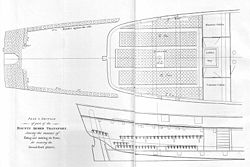
. The great cabin was converted to house the potted breadfruit plants, and gratings fitted to the upper deck. Her complement was 46 officers and men.
Bligh described the ship thus:
"The Burthen of the Ship was nearly 215 Tons; Her extreme length on deck 90Ft..10In. & breadth from outside to outside of the bends 24Ft..3 in. A Flush deckFlush deckIn naval architecture, a flush deck refers to when the upper deck of a vessel extends unbroken from stem to stern. There is no raised forecastle or lowered quarterdeck. Ships of this type may be referred to as "flush deckers", although this is often taken as referring to a series of United States...
& a pretty Figure Head of a Woman in Riding habitRiding habitA riding habit is women's clothing for horseback riding.Since the mid-17th century, a formal habit for riding sidesaddle usually consisted of:* A tailored jacket with a long skirt to match* A tailored shirt or chemisette...
; She mounted 4 four pounders & 10 SwivelsSwivel gunThe term swivel gun usually refers to a small cannon, mounted on a swiveling stand or fork which allows a very wide arc of movement. Another type of firearm referred to as a swivel gun was an early flintlock combination gun with two barrels that rotated along their axes to allow the shooter to...
& her Complement was,
1. Lieut & Commander 2. Masters Mates 1. Gunners Mate
1. Master 2. Midshipmen 1. Carpenters Mate
1. Boatswain 1. Clerk 1. Sailmaker
1. Gunner 2. Qr. Masters 1. Armourer
1. Carpenter 1. Qr.Masr.Mate 1. Carpenters Crew
1. Surgeon 1. Boatswains Mate 1. Corporal
24 Able Seamen
Total. 45 One of which is a Widow's man. There was likewise a Botanist & his Assistant."
William Bligh was appointed Commanding Lieutenant of Bounty on 16 August 1787, at the age of 33, after a career that included a tour as sailing master of James Cook
James Cook
Captain James Cook, FRS, RN was a British explorer, navigator and cartographer who ultimately rose to the rank of captain in the Royal Navy...
's during Cook's third and final voyage (1776–1779).
The voyage out
On 23 December 1787, Bounty sailed from SpitheadSpithead
Spithead is an area of the Solent and a roadstead off Gilkicker Point in Hampshire, England. It is protected from all winds, except those from the southeast...
for Tahiti
Tahiti
Tahiti is the largest island in the Windward group of French Polynesia, located in the archipelago of the Society Islands in the southern Pacific Ocean. It is the economic, cultural and political centre of French Polynesia. The island was formed from volcanic activity and is high and mountainous...
. For a full month, she attempted to round Cape Horn
Cape Horn
Cape Horn is the southernmost headland of the Tierra del Fuego archipelago of southern Chile, and is located on the small Hornos Island...
, but adverse weather blocked her. Bligh ordered her turned about, and proceeded east, rounding the Cape of Good Hope
Cape of Good Hope
The Cape of Good Hope is a rocky headland on the Atlantic coast of the Cape Peninsula, South Africa.There is a misconception that the Cape of Good Hope is the southern tip of Africa, because it was once believed to be the dividing point between the Atlantic and Indian Oceans. In fact, the...
and crossing the width of the Indian Ocean
Indian Ocean
The Indian Ocean is the third largest of the world's oceanic divisions, covering approximately 20% of the water on the Earth's surface. It is bounded on the north by the Indian Subcontinent and Arabian Peninsula ; on the west by eastern Africa; on the east by Indochina, the Sunda Islands, and...
. During the outward voyage, Bligh demoted Sailing Master John Fryer, replacing him with Fletcher Christian
Fletcher Christian
Fletcher Christian was a master's mate on board the Bounty during William Bligh's fateful voyage to Tahiti for breadfruit plants...
. This act seriously damaged the relationship between Bligh and Fryer, and Fryer would later claim Bligh's act was entirely personal.
Joseph Banks
Sir Joseph Banks, 1st Baronet, GCB, PRS was an English naturalist, botanist and patron of the natural sciences. He took part in Captain James Cook's first great voyage . Banks is credited with the introduction to the Western world of eucalyptus, acacia, mimosa and the genus named after him,...
, a wealthy botanist and influential figure in Britain at the time. That, and his experience sailing with Cook
James Cook
Captain James Cook, FRS, RN was a British explorer, navigator and cartographer who ultimately rose to the rank of captain in the Royal Navy...
and familiarity with navigation in the area and local customs, were probably important factors in his appointment.
Bounty reached Tahiti on 26 October 1788, after ten months at sea.
Bligh and his crew spent five months in Tahiti, then called "Otaheite", collecting and preparing a total of 1015 breadfruit plants. Bligh allowed the crew to live ashore and care for the potted breadfruit plants, and they became socialized to the customs and culture of the Tahitians. Many of the seamen and some of the "young gentlemen" had themselves tattooed in native fashion. Master's Mate
Master's mate
Master's mate is an obsolete rating which was used by the Royal Navy, United States Navy and merchant services in both countries for a senior petty officer who assisted the master...
and Acting Lieutenant Fletcher Christian married Maimiti, a Tahitian woman. Other warrant officers and seamen of the Bounty were also said to have formed "connections" with native women.
After five months in Tahiti, the Bounty set sail with its breadfruit cargo on 4 April 1789.
Mutiny and destruction of the ship
Some 1300 miles (2,092.1 km) west of Tahiti, near TongaTonga
Tonga, officially the Kingdom of Tonga , is a state and an archipelago in the South Pacific Ocean, comprising 176 islands scattered over of ocean in the South Pacific...
, mutiny broke out on 28 April 1789. Despite strong words and threats heard on both sides, the ship was taken bloodlessly and apparently without struggle by any of the loyalists except Bligh himself. Of the 42 men on board aside from Bligh and Christian, 18 joined Christian in mutiny, two were passive, and 22 remained loyal to Bligh. The mutineers ordered Bligh, the ship's master, two midshipmen, the surgeon's mate (Ledward), and the ship's clerk into Bounty's launch
Dinghy
A dinghy is a type of small boat, often carried or towed for use as a ship's boat by a larger vessel. It is a loanword from either Bengali or Urdu. The term can also refer to small racing yachts or recreational open sailing boats. Utility dinghies are usually rowboats or have an outboard motor,...
. Several more men voluntarily joined Bligh rather than remaining aboard. Bligh and the others in the launch sailed 30 nautical miles (55.6 km) to Tofua
Tofua
Tofua Caldera, in Tonga, is the summit caldera of a steep-sided composite cone that forms Tofua Island. Tofua Island is in Tonga's Ha'apai island group. Pre-caldera activity is recorded by a sequence of pyroclastic deposits and lavas constituting the older cone, followed on the northern part of the...
in search of supplies, but were forced to flee after attacks by hostile natives resulted in the death of one of the men. Bligh then undertook an arduous journey to the Dutch port of Coupang, located over 3500 nautical miles (6,482 km) from Tofua. He safely landed there 47 days later, having lost no men during the voyage except the one killed on Tofua.
The mutineers sailed for the island of Tubuai
Tubuai (Austral Islands)
Tubuai is the name of a group of islands and also the name of its main island, being part of the Austral Islands, French Polynesia, in the Pacific Ocean. Tubuai, the main island of the Tubuai Island group, is located at . It is south of Tahiti...
, where they tried to settle. After three months of being terrorized by the cannibalistic natives, however, they returned to Tahiti. Sixteen of the mutineers and the four loyalists who had been unable to accompany Bligh remained there, taking their chances that the Royal Navy would find them and bring them to justice.
Immediately after setting the sixteen men ashore in Tahiti in September 1789, Fletcher Christian, eight other crewmen, six Tahitian men, and 11 women, one with a baby, set sail in Bounty hoping to elude the Royal Navy. According to a journal kept by one of Christian's followers, the Tahitians were actually kidnapped when Christian set sail without warning them, the purpose of this being to acquire the women.
The mutineers passed through the Fiji
Fiji
Fiji , officially the Republic of Fiji , is an island nation in Melanesia in the South Pacific Ocean about northeast of New Zealand's North Island...
and Cook Islands
Cook Islands
The Cook Islands is a self-governing parliamentary democracy in the South Pacific Ocean in free association with New Zealand...
, but feared that they would be found there. Continuing their quest for a safe haven, on 15 January 1790 they rediscovered Pitcairn Island, which had been misplaced on the Royal Navy's charts. After the decision was made to settle on Pitcairn, livestock and other provisions were removed from the Bounty. To prevent the ship's detection, and anyone's possible escape, the ship was burned on 23 January 1790 in what is now called Bounty Bay
Bounty Bay
Bounty Bay is an embayment of the Pacific Ocean into Pitcairn Island.Bounty Bay is named after the Bounty, a British naval vessel whose 18th century mutiny was immortalized in the novel Mutiny on the Bounty, and the numerous subsequent motion pictures made of it...
.
Thirty-five years later in 1825, HMS Blossom on a voyage of exploration under Captain Frederick Beechey, arrived on Christmas Day off Pitcairn and spent 19 days there. Captain Beechey later recorded this in his 1831 published account of the voyage, as did one of his crew, John Bechervaise, in his 1839 Thirty-Six years of a Seafaring Life by an Old Quarter Master. Beechey prints a detailed account of the mutiny as recounted to him by the last survivor, Adams. Bechervaise, who gives a detailed account of the life of the islanders, says he found the remains of Bounty and took some pieces of wood from it which were turned into souvenirs such as snuff boxes.
(Beechey's account is rare; there is a copy in the Caird Library in Greenwich. The first volume is available for download at Google Books. Original copies of John Bechervaise's privately printed book are also rare but has been reprinted in facsimile by Kessinger).
Discovery of the wreck of the Bounty
Luis MardenLuis Marden
Luis Marden was an American photographer, explorer, writer, filmmaker, diver, navigator, and linguist who worked for National Geographic Magazine. He worked as a photographer and reporter before serving as chief of the National Geographic foreign editorial staff...
discovered the remains of the Bounty in January 1957. After spotting remains of the rudder,(which had been found in 1933 by Parkin Christian, and is still displayed in the Fiji Museum
Fiji Museum
The Fiji Museum is a museum in Suva, Fiji located in the capital city's botanical gardens, Thurston Gardens.The museum houses an extensive archaeological collection dating back 3,700 years and relics of Fiji's indigenous cultural history...
in Suva), he persuaded his editors and writers to let him dive off Pitcairn Island, where the rudder had been found. Despite the warnings of one islander – "Man, you gwen be dead as a hatchet!" – Marden dived for several days in the dangerous swells near the island, and found the remains of the fabled ship: a rudder pin, nails, a ships boat oarlock, fittings and a Bounty anchor which he raised. He subsequently met with Marlon Brando
Marlon Brando
Marlon Brando, Jr. was an American movie star and political activist. "Unchallenged as the most important actor in modern American Cinema" according to the St...
to counsel him on his role as Fletcher Christian
Fletcher Christian
Fletcher Christian was a master's mate on board the Bounty during William Bligh's fateful voyage to Tahiti for breadfruit plants...
in the 1962 film Mutiny on the Bounty
Mutiny on the Bounty (1962 film)
Mutiny on the Bounty is a 1962 film starring Marlon Brando and Trevor Howard based on the novel Mutiny on the Bounty by Charles Nordhoff and James Norman Hall. The film retells the 1789 real-life mutiny aboard HMAV Bounty led by Fletcher Christian against the ship's captain, William Bligh...
. Later in life, Marden wore cuff links made of nails from the Bounty. Marden also dived on the wreck of and left a Bounty nail with the Pandora.
Some of her remains, such as her ballast stones, are still partially visible in the waters of Bounty Bay.
The last of the Bountys 4-pounders was recovered in 1998 by an archaeological team from James Cook University and was sent to the Queensland Museum in Townsville to be stabilised through lengthy conservation treatment, i.e. nearly 40 months of electrolysis. The gun was subsequently returned to Pitcairn Island where it has been placed on display in a new community hall.
Modern Bounty reconstructions
When the 1935 film Mutiny on the BountyMutiny on the Bounty (1935 film)
Mutiny on the Bounty is a 1935 film starring Charles Laughton and Clark Gable, and directed by Frank Lloyd based on the Charles Nordhoff and James Norman Hall novel Mutiny on the Bounty.The film was one of the biggest hits of its time...
was made, sailing vessels were still in wide use: existing vessels were adapted to play Bounty and Pandora.
For the 1962 film
Mutiny on the Bounty (1962 film)
Mutiny on the Bounty is a 1962 film starring Marlon Brando and Trevor Howard based on the novel Mutiny on the Bounty by Charles Nordhoff and James Norman Hall. The film retells the 1789 real-life mutiny aboard HMAV Bounty led by Fletcher Christian against the ship's captain, William Bligh...
, a new vessel was constructed, the Bounty II
Bounty II
This article is about the replica ship. See for information on the original ship.The Bounty II is a reconstruction of the original sailing ship HMS Bounty, which served in the Royal Navy....
.
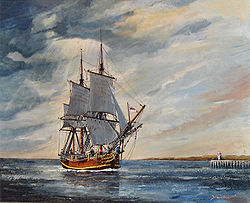
A second replica of Bounty, named H.M.A.V. Bounty, and informally known as "Bounty III", was built in New Zealand in 1979 and used in the 1984 Dino De Laurentiis
Dino De Laurentiis
Agostino "Dino" De Laurentiis was an Italian film producer.-Early life:He was born at Torre Annunziata in the province of Naples, and grew up selling spaghetti produced by his father...
film The Bounty
The Bounty
The Bounty is a 1984 British historical film directed by Roger Donaldson, starring Mel Gibson and Anthony Hopkins, and produced by Bernard Williams with Dino De Laurentiis as executive producer. It is the fifth film version of the story of the mutiny on the Bounty. The screenplay was by Robert Bolt...
. The hull is constructed of welded steel oversheathed with timber. For many years she served the tourist excursion market from Darling Harbour, Sydney
Sydney
Sydney is the most populous city in Australia and the state capital of New South Wales. Sydney is located on Australia's south-east coast of the Tasman Sea. As of June 2010, the greater metropolitan area had an approximate population of 4.6 million people...
, Australia
Australia
Australia , officially the Commonwealth of Australia, is a country in the Southern Hemisphere comprising the mainland of the Australian continent, the island of Tasmania, and numerous smaller islands in the Indian and Pacific Oceans. It is the world's sixth-largest country by total area...
, before being sold to HKR International Limited
HKR International
HKR International Limited short for Hong Kong Resort International Limited and commonly referred to as HKRI, is a Hong Kong-listed company best known for the Discovery Bay development on Lantau Island, Hong Kong; a project of its Hong Kong Resort subsidiary...
in October 2007
October 2007
October 2007 is the tenth month of that year. It began on a Monday and 31 days later, ended on a Wednesday.-International holidays:* October 2 – Gandhi Jayanti * October 3 – Last third of Ramadan which includes Laylat al-Qadr...
. She is now a tourist attraction (also used for charter, excursions and sail training) based in Discovery Bay
Discovery Bay
Discovery Bay is a mixed, primarily residential, development comprising a residential development and private and public recreational facilities in Hong Kong. It is situated on the north-eastern coast of Lantau Island in the New Territories. The development spans an area of 650 hectares , and...
, on Lantau Island
Lantau Island
Lantau Island , based on the old local name of Lantau Peak , is the largest island in Hong Kong, located at the mouth of the Pearl River. Administratively, most of Lantau Island is part of the Islands District of Hong Kong...
in Hong Kong
Hong Kong
Hong Kong is one of two Special Administrative Regions of the People's Republic of China , the other being Macau. A city-state situated on China's south coast and enclosed by the Pearl River Delta and South China Sea, it is renowned for its expansive skyline and deep natural harbour...
, and has an additional Chinese name
Ship prefix controversy
The Bounty was never referred to by the prefixes HMSHer Majesty's Ship
Her or His Majesty's Ship is the ship prefix used for ships of the navy in some monarchies, either formally or informally.-HMS:* In the British Royal Navy, it refers to the king or queen of the United Kingdom as appropriate at the time...
or HMAV while in service. The abbreviation
Abbreviation
An abbreviation is a shortened form of a word or phrase. Usually, but not always, it consists of a letter or group of letters taken from the word or phrase...
HMS came into common use only around the 1790s.
Although she was ship-rigged
Full rigged ship
A full rigged ship or fully rigged ship is a sailing vessel with three or more masts, all of them square rigged. A full rigged ship is said to have a ship rig....
, and commonly referred to as a ship
Ship
Since the end of the age of sail a ship has been any large buoyant marine vessel. Ships are generally distinguished from boats based on size and cargo or passenger capacity. Ships are used on lakes, seas, and rivers for a variety of activities, such as the transport of people or goods, fishing,...
, in the formal vocabulary
Vocabulary
A person's vocabulary is the set of words within a language that are familiar to that person. A vocabulary usually develops with age, and serves as a useful and fundamental tool for communication and acquiring knowledge...
of the Admiralty
Admiralty
The Admiralty was formerly the authority in the Kingdom of England, and later in the United Kingdom, responsible for the command of the Royal Navy...
the Bounty was not called a ship because she was unrated
Rating system of the Royal Navy
The rating system of the Royal Navy and its predecessors was used by the British Royal Navy between the beginning of the 17th century and the middle of the 19th century to categorise sailing warships, initially classing them according to their assigned complement of men, and later according to the...
. Equally, there was no organisation formally called the Admiralty - that name is a colloquialism
Colloquialism
A colloquialism is a word or phrase that is common in everyday, unconstrained conversation rather than in formal speech, academic writing, or paralinguistics. Dictionaries often display colloquial words and phrases with the abbreviation colloq. as an identifier...
for "The Commissioners for Executing the Office of Lord High Admiral of Great Britain and Ireland, etc.".
In the transcript of the 1792 trial of the ten crewmen returned in the Bounty is referred to as His Majesty's Ship "Bounty" or His Majesty's Armed Vessel "Bounty" three times each, and twice as His Majesty's Armed Vessel the "Bounty".
In the drawings for the 1787 conversion she is referred to as the "Bounty Armed Transport".
The contents page of the Bountys medical book is inscribed "His Britannic Majesty's Ship Bounty: Spithead 29th December 1787".
The title of William Bligh
William Bligh
Vice Admiral William Bligh FRS RN was an officer of the British Royal Navy and a colonial administrator. A notorious mutiny occurred during his command of HMAV Bounty in 1789; Bligh and his loyal men made a remarkable voyage to Timor, after being set adrift in the Bounty's launch by the mutineers...
's 1792 account of the mutiny refers to "His Majesty's Ship the Bounty".
Sir John Barrow's 1831 publication
The Eventful History of the Mutiny and Piratical Seizure of HMS Bounty
The Eventful History of the Mutiny and Piratical Seizure of H.M.S. Bounty: Its Cause and Consequences by Sir John Barrow is considered the classic account of the mutiny on the Bounty...
refers to "H.M.S. Bounty".
Academic institutions such as Britain's National Archives, National Maritime Museum
National Maritime Museum
The National Maritime Museum in Greenwich, England is the leading maritime museum of the United Kingdom and may be the largest museum of its kind in the world. The historic buildings forming part of the Maritime Greenwich World Heritage Site, it also incorporates the Royal Observatory, Greenwich,...
, Royal Naval Museum
Royal Naval Museum
The Royal Naval Museum is the museum of the history of the Royal Navy in the Portsmouth Historic Dockyard section of HMNB Portsmouth, Portsmouth, Hampshire, England. The museum is a non-departmental public body sponsored by the Ministry of Defence. Its current Acting Director is Graham Dobbin....
, and Australia's State Library of New South Wales
State Library of New South Wales
The State Library of New South Wales is a large public library owned by the state of New South Wales, Australia. It is located in Macquarie Street, Sydney near Shakespeare Place...
generally use "HMS".