

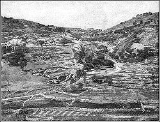
Gehenna

Encyclopedia
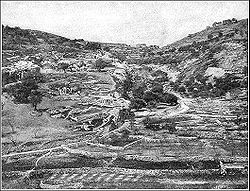
In the Hebrew Bible, the site was initially where apostate Israelites and followers of various Ba'als and Caananite gods, including Moloch
Moloch
Moloch — also rendered as Molech, Molekh, Molok, Molek, Molock, or Moloc — is the name of an ancient Semitic god...
, sacrificed their children by fire .
In both Jewish and Christian writing, Gehenna was a destination of the wicked. This is different from the more neutral Sheol
Sheol
Sheol |Hebrew]] Šʾôl) is the "grave", "pit", or "abyss" in Hebrew. She'ol is the earliest conception of the afterlife in the Jewish scriptures. It is a place of darkness to which all dead go, regardless of the moral choices made in life, and where they are "removed from the light of God"...
/Hades
Hades
Hades , Hadēs, originally , Haidēs or , Aidēs , meaning "the unseen") was the ancient Greek god of the underworld. The genitive , Haidou, was an elision to denote locality: "[the house/dominion] of Hades". Eventually, the nominative came to designate the abode of the dead.In Greek mythology, Hades...
, the abode of the dead, though the King James version of the Bible
King James Version of the Bible
The Authorized Version, commonly known as the King James Version, King James Bible or KJV, is an English translation of the Christian Bible by the Church of England begun in 1604 and completed in 1611...
traditionally translates both with the Anglo-Saxon word Hell
Hell
In many religious traditions, a hell is a place of suffering and punishment in the afterlife. Religions with a linear divine history often depict hells as endless. Religions with a cyclic history often depict a hell as an intermediary period between incarnations...
.
Etymology
English "Gehenna" represents the Greek Geenna found in the New TestamentNew Testament
The New Testament is the second major division of the Christian biblical canon, the first such division being the much longer Old Testament....
, a phonetic transcription of Aramaic
Aramaic language
Aramaic is a group of languages belonging to the Afroasiatic language phylum. The name of the language is based on the name of Aram, an ancient region in central Syria. Within this family, Aramaic belongs to the Semitic family, and more specifically, is a part of the Northwest Semitic subfamily,...
Gēhannā (ܓܗܢܐ), equivalent to the Hebrew Ge Hinnom, literally "Valley of Hinnom".
This was known in the Old Testament
Old Testament
The Old Testament, of which Christians hold different views, is a Christian term for the religious writings of ancient Israel held sacred and inspired by Christians which overlaps with the 24-book canon of the Masoretic Text of Judaism...
as Gai Ben-Hinnom, literally the "Valley of the son of Hinnom", and in the Talmud
Talmud
The Talmud is a central text of mainstream Judaism. It takes the form of a record of rabbinic discussions pertaining to Jewish law, ethics, philosophy, customs and history....
as Gehinnam or Gehinnom.
In the Qur'an
Qur'an
The Quran , also transliterated Qur'an, Koran, Alcoran, Qur’ān, Coran, Kuran, and al-Qur’ān, is the central religious text of Islam, which Muslims consider the verbatim word of God . It is regarded widely as the finest piece of literature in the Arabic language...
, Jahannam (جهنم) is a place of torment for sinners or the Islamic equivalent of Hell
Hell
In many religious traditions, a hell is a place of suffering and punishment in the afterlife. Religions with a linear divine history often depict hells as endless. Religions with a cyclic history often depict a hell as an intermediary period between incarnations...
.
Geography
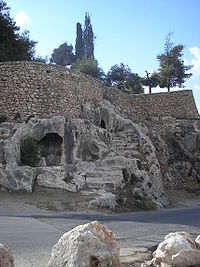
Mount Zion
Mount Zion is a place name for a site in Jerusalem, the location of which has shifted several times in history. According to the Hebrew Bible's Book of Samuel, it was the site of the Jebusite fortress called the "stronghold of Zion" that was conquered by King David, becoming his palace in the City...
eastward past the Tyropoeon
Tyropoeon Valley
Tyropoeon Valley is the name given by Josephus the historian to the valley or rugged ravine, in the Old City of Jerusalem, which in ancient times separated Mount Moriah from Mount Zion and emptied into the valley of Hinnom...
to the Kidron Valley
Kidron Valley
The Kidron Valley is the valley on the eastern side of The Old City of Jerusalem which features significantly in the Bible...
. However the Tyropoeon Valley is usually no longer associated with the Valley of Hinnom because during the period of Ahaz
Ahaz
Ahaz was king of Judah, and the son and successor of Jotham. He is one of the kings mentioned in the genealogy of Jesus in the Gospel of Matthew....
and Manasseh
Manasseh of Judah
Manasseh was a king of the Kingdom of Judah. He was the only son of Hezekiah with Hephzi-bah. He became king at an age 12 years and reigned for 55 years. Edwin Thiele has concluded that he commenced his reign as co-regent with his father Hezekiah in 697/696 BC, with his sole reign beginning in...
, the Tyropoeon lay within the city walls and child sacrifice would have been practiced outside the walls of the city. Smith (1907), Dalman (1930), Bailey (1986) and Watson (1992) identify the Wadi er-Rababi, which fits the data of Joshua that Hinnom ran East to West and lay outside the city walls. According to Joshua, the valley began in En-rogel. If the modern Bir Ayyub is En-rogel
En-rogel
En-rogel was a famous land-mark near Jerusalem. It was the hiding-place of David's spies, Jonathan and Ahimaaz , and lay close to the stone Zoheleth where Adonijah held a sacrificial feast when he attempted to assert his claims to the throne . In later times it was one of the boundary marks...
then the Wadi er-Rababi which begins there is Hinnom.
In the King James Version of the Bible, the term appears 13 times in 11 different verses as "valley of Hinnom," "valley of the son of Hinnom" or "valley of the children of Hinnom."
The Valley of Hinnom is at the base of Mount Zion.
Hebrew Bible
The oldest historical reference to the valley is found in , which describe tribal boundaries.The next chronological reference to the valley is at the time of King Ahaz
Ahaz
Ahaz was king of Judah, and the son and successor of Jotham. He is one of the kings mentioned in the genealogy of Jesus in the Gospel of Matthew....
of Judah who sacrificed his sons there according to . Since his legitimate son by the daughter of the High Priest Hezekiah
Hezekiah
Hezekiah was the son of Ahaz and the 14th king of Judah. Edwin Thiele has concluded that his reign was between c. 715 and 686 BC. He is also one of the most prominent kings of Judah mentioned in the Hebrew Bible....
succeeded him as king, this, if literal, is assumed to mean children by unrecorded pagan wives or concubines. The same is recorded of Ahaz' grandson Manasseh in . There remains debate about whether the phrase "cause his children to pass through the fire" meant a simple ceremony or the literal child sacrifice
Child sacrifice
Child sacrifice is the ritualistic killing of children in order to please, propitiate or force a god or supernatural beings in order to achieve a desired result...
.

Book of Isaiah
The Book of Isaiah is the first of the Latter Prophets in the Hebrew Bible, preceding the books of Ezekiel, Jeremiah and the Book of the Twelve...
does not mention Gehenna by name, but the "burning place" in which the Assyrian army is to be destroyed, may be read "Topheth", and the final verse of Isaiah which concerns the corpses of the same or a similar battle, , "where their worm does not die" is cited by Jesus in reference to Gehenna in , , and .
In the reign of Josiah
Josiah
Josiah or Yoshiyahu or Joshua was a king of Judah who instituted major reforms. Josiah is credited by most historians with having established or compiled important Jewish scriptures during the Deuteronomic reform that occurred during his rule.Josiah became king of Judah at the age of eight, after...
a call came from Jeremiah to destroy the shrines in Topheth and to end the practice , . It is recorded that King Josiah
Josiah
Josiah or Yoshiyahu or Joshua was a king of Judah who instituted major reforms. Josiah is credited by most historians with having established or compiled important Jewish scriptures during the Deuteronomic reform that occurred during his rule.Josiah became king of Judah at the age of eight, after...
destroyed the shrine of Molech on Topheth, to prevent anyone sacrificing children there in . Despite Josiah's ending of the practice, Jeremiah also included a prophecy that Jerusalem itself would be made like Gehenna and Topheth .
A final purely geographical reference is found in to the exiles returning from Babylon camping from Beersheba to Hinnom.
Targums
The ancient Aramaic paraphrase-translations of the Hebrew Bible supply the term Gehinnom frequently to verses touching upon resurrection, judgment, and the fate of the wicked. This may also include addition of the phrase "second deathSecond Death
The second death is an eschatological concept in Judaism and Christianity related to punishment after a first, natural, death.-Judaism:Although the term is not found in the Hebrew Bible, Sysling in his study of Teḥiyyat ha-metim in the Palestinian Targums identifies a consistent usage of the term...
", as in the final chapter of Isaiah, where the Hebrew version does not mention either Gehinnom or the Second Death, whereas the Targums add both. In this the Targums are parallel to the Gospel of Mark addition of "Gehenna" to the quotation of the Isaiah verses describing the corpses "where their worm does not die".
Extra-Biblical documents
Aside from the Targums, there is a lack of direct references to Gehenna in the ApocryphaApocrypha
The term apocrypha is used with various meanings, including "hidden", "esoteric", "spurious", "of questionable authenticity", ancient Chinese "revealed texts and objects" and "Christian texts that are not canonical"....
, Dead Sea Scrolls
Dead Sea scrolls
The Dead Sea Scrolls are a collection of 972 texts from the Hebrew Bible and extra-biblical documents found between 1947 and 1956 on the northwest shore of the Dead Sea, from which they derive their name...
, Pseudepigrapha and Philo
Philo
Philo , known also as Philo of Alexandria , Philo Judaeus, Philo Judaeus of Alexandria, Yedidia, "Philon", and Philo the Jew, was a Hellenistic Jewish Biblical philosopher born in Alexandria....
. Josephus
Josephus
Titus Flavius Josephus , also called Joseph ben Matityahu , was a 1st-century Romano-Jewish historian and hagiographer of priestly and royal ancestry who recorded Jewish history, with special emphasis on the 1st century AD and the First Jewish–Roman War, which resulted in the Destruction of...
does not deal with this aspect of the history of the Hinnom Valley in his descriptions of Jerusalem for a Roman audience. Nor does Josephus make any mention of the tradition commonly reported in older Christian commentaries that in Roman times fires were kept burning and the valley became the garbage dump of the city, where the dead bodies of criminal
Crime
Crime is the breach of rules or laws for which some governing authority can ultimately prescribe a conviction...
s, and the carcasses
Carrion
Carrion refers to the carcass of a dead animal. Carrion is an important food source for large carnivores and omnivores in most ecosystems. Examples of carrion-eaters include vultures, hawks, eagles, hyenas, Virginia Opossum, Tasmanian Devils, coyotes, Komodo dragons, and burying beetles...
of animal
Animal
Animals are a major group of multicellular, eukaryotic organisms of the kingdom Animalia or Metazoa. Their body plan eventually becomes fixed as they develop, although some undergo a process of metamorphosis later on in their life. Most animals are motile, meaning they can move spontaneously and...
s were thrown.
The southwestern gate of Jerusalem, overlooking the valley, came to be known as "The Gate of the Valley" .
Rabbinical Judaism
The picture of Gehenna as the place of punishment or destruction of the wicked occurs frequently in the MishnahMishnah
The Mishnah or Mishna is the first major written redaction of the Jewish oral traditions called the "Oral Torah". It is also the first major work of Rabbinic Judaism. It was redacted c...
in Kiddushin 4.14, Avot
Avot
Avot may refer to:* Pirkei Avot, a tractate of the Mishna composed of ethical maxims of the Rabbis of the Mishnaic period* The Patriarchs : Abraham, Isaac and Jacob* Avot, Côte-d'Or, a commune in France...
1.5; 5.19, 20, Tosefta
Tosefta
The Tosefta is a compilation of the Jewish oral law from the period of the Mishnah.-Overview:...
t.Bereshith 6.15, and Babylonian Talmud b.Rosh Hashanah
Rosh Hashanah
Rosh Hashanah , , is the Jewish New Year. It is the first of the High Holy Days or Yamim Nora'im which occur in the autumn...
16b:7a; b.Bereshith 28b. Gehenna is considered a Purgatory
Purgatory
Purgatory is the condition or process of purification or temporary punishment in which, it is believed, the souls of those who die in a state of grace are made ready for Heaven...
-like place where the wicked go to suffer until they have atoned for their sins. It is stated that the maximum amount of time a sinner can spend in Gehenna is one year, with the exception of five people who are there for all of eternity.
Due to Jewish religious tradition regarding the bloodiness of its history, Gehenna became a metonym for "Hell" or any similar place of punishment in the afterlife
Afterlife
The afterlife is the belief that a part of, or essence of, or soul of an individual, which carries with it and confers personal identity, survives the death of the body of this world and this lifetime, by natural or supernatural means, in contrast to the belief in eternal...
.
The traditional explanation that a burning rubbish heap in the Valley of Hinnom south of Jerusalem gave rise to the idea of a fiery Gehenna of judgment is attributed to Rabbi David Kimhi
David Kimhi
David Kimhi , also known by the Hebrew acronym as the RaDaK , was a medieval rabbi, biblical commentator, philosopher, and grammarian. Born in Narbonne, Provence, he was the son of Rabbi Joseph Kimhi and the brother of Rabbi Moses Kimhi, both biblical commentators and grammarians...
's commentary on Psalm 27:13 (ca. A.D. 1200). He maintained that in this loathsome valley fires were kept burning perpetually to consume the filth and cadavers thrown into it. However, Hermann Strack
Hermann Strack
Hermann Leberecht Strack was a German Protestant theologian and Orientalist; born at Berlin May 6, 1848. Since 1877 he was assistant professor of Old Testament exegesis and Semitic languages at the University of Berlin. He was the foremost Christian authority in Germany on Talmudic and rabbinic...
and Paul Billerbeck state that there is neither archaeological nor literary evidence in support of this claim, in either the earlier intertestamental or the later rabbinic sources. Also, Lloyd R. Bailey's "Gehenna: The Topography of Hell" from 1986 holds a similar view.
There is evidence however that the southwest shoulder of this valley (Ketef Hinnom
Ketef Hinnom
Ketef Hinnom is an archaeological site southwest of the Old City of Jerusalem, adjacent to St. Andrew's Church of Scotland. The site consists of a series of rock-hewn burial chambers based on natural caverns...
) was a burial location with numerous burial chambers that were reused by generations of families from as early as the seventh until the fifth century BCE. The use of this area for tombs continued into the first centuries BCE and CE. By 70 CE, the area was not only a burial site but also a place for cremation
Cremation
Cremation is the process of reducing bodies to basic chemical compounds such as gasses and bone fragments. This is accomplished through high-temperature burning, vaporization and oxidation....
of the dead with the arrival of the Tenth Roman Legion
Roman legion
A Roman legion normally indicates the basic ancient Roman army unit recruited specifically from Roman citizens. The organization of legions varied greatly over time but they were typically composed of perhaps 5,000 soldiers, divided into maniples and later into "cohorts"...
, who were the only group known to practice cremation in this region.
In time it became deemed to be accursed and an image of the place of destruction in Jewish folklore. However, Jewish folklore suggests the valley had a 'gate' which led down to a molten lake of fire.
Eventually the Hebrew term Gehinnom became a figurative name for the place of spiritual purification for the wicked dead in Judaism. According to most Jewish sources, the period of purification or punishment is limited to only 12 months and every shabbath day is excluded from punishment. After this the soul will ascend to Olam Ha-Ba, the world to come, or will be destroyed if it is severely wicked.
New Testament
Gehenna is cited in the New TestamentNew Testament
The New Testament is the second major division of the Christian biblical canon, the first such division being the much longer Old Testament....
. In early Christian writing it represents the final place where the wicked will be punished or destroyed after the Resurrection of the Dead
Resurrection of the dead
Resurrection of the Dead is a belief found in a number of eschatologies, most commonly in Christian, Islamic, Jewish and Zoroastrian. In general, the phrase refers to a specific event in the future; multiple prophesies in the histories of these religions assert that the dead will be brought back to...
.
In the synoptic gospels
Synoptic Gospels
The gospels of Matthew, Mark, and Luke are known as the Synoptic Gospels because they include many of the same stories, often in the same sequence, and sometimes exactly the same wording. This degree of parallelism in content, narrative arrangement, language, and sentence structures can only be...
Jesus uses the word Gehenna 11 times to describe the opposite to life in the Kingdom
Kingdom of God
The Kingdom of God or Kingdom of Heaven is a foundational concept in the Abrahamic religions: Judaism, Christianity and Islam.The term "Kingdom of God" is found in all four canonical gospels and in the Pauline epistles...
. It is a place where both soul and body could be destroyed in "unquenchable fire" .
Gehenna is also mentioned in the Epistle of James
Epistle of James
The Epistle of James, usually referred to simply as James, is a book in the New Testament. The author identifies himself as "James, a servant of God and of the Lord Jesus Christ", with "the earliest extant manuscripts of James usually dated to mid-to-late third century."There are four views...
, where it is said to set the tongue on fire, and the tongue in turn sets on fire the entire "course" or "wheel" of life.
The complete list of references is as follows:
- Matt.5:22 whoever calls someone "you fool" will be liable to Gehenna.
- Matt.5:29 better to lose one of your members than that your whole body go into Gehenna.
- Matt.5:30 better to lose one of your members than that your whole body go into Gehenna.
- Matt.10:28 rather fear him who can destroy both soul and body in Gehenna.
- Matt.18:9 better to enter life with one eye than with two eyes to be thrown into Gehenna.
- Matt.23:15 PhariseesPhariseesThe Pharisees were at various times a political party, a social movement, and a school of thought among Jews during the Second Temple period beginning under the Hasmonean dynasty in the wake of...
make a convert twice as much a child of Gehenna as themselves. - Matt.23:33 to Pharisees: you brood of vipers, how are you to escape being sentenced to Gehenna?
- Mark 9:43 better to enter life with one hand than with two hands to go to Gehenna.
- Mark 9:45 better to enter life lame than with two feet to be thrown into Gehenna.
- Mark 9:47 better to enter the kingdom of God with one eye than with two eyes to be thrown into Gehenna
- Luke 12:5 Fear him who, after he has killed, has authority to cast into Gehenna
- James 3:6 the tongue is set on fire by Gehenna.
Translations in Christian Bibles
The New Testament also refers to HadesHades in Christianity
According to various Christian faiths, Hades is "the place or state of departed spirits".-Hades in the Old Testament:In the Septuagint , the Greek term "ᾅδης" is used to translate the Hebrew term "שׁאול" in, for example,...
as a temporary destination of the dead. Hades is portrayed as a different place from the final judgement
Last Judgment
The Last Judgment, Final Judgment, Day of Judgment, Judgment Day, or The Day of the Lord in Christian theology, is the final and eternal judgment by God of every nation. The concept is found in all the Canonical gospels, particularly the Gospel of Matthew. It will purportedly take place after the...
of the damned in Gehenna. The Book of Revelation
Book of Revelation
The Book of Revelation is the final book of the New Testament. The title came into usage from the first word of the book in Koine Greek: apokalupsis, meaning "unveiling" or "revelation"...
describes Hades being cast into the Lake of Fire
Lake of Fire
A lake of fire appears, in both ancient Egyptian and Christian religion, as a place of after-death punishment of the wicked. The phrase is used in four verses of the Book of Revelation. The image was also used by the Early Christian Hippolytus of Rome in about the year 200 and has continued to be...
. Hades the temporary place of the dead is said to be removed for ever and cast into the Lake of Fire commonly understood to be synonymous with Gehenna or the final Hell of the unsaved. This indicating that any who die after this would never go to a temporary place, Hades, just instead a final judgement of saved or condemned. The King James Version is the only English translation in modern use to translate Sheol
Sheol
Sheol |Hebrew]] Šʾôl) is the "grave", "pit", or "abyss" in Hebrew. She'ol is the earliest conception of the afterlife in the Jewish scriptures. It is a place of darkness to which all dead go, regardless of the moral choices made in life, and where they are "removed from the light of God"...
, Hades
Hades
Hades , Hadēs, originally , Haidēs or , Aidēs , meaning "the unseen") was the ancient Greek god of the underworld. The genitive , Haidou, was an elision to denote locality: "[the house/dominion] of Hades". Eventually, the nominative came to designate the abode of the dead.In Greek mythology, Hades...
, and Gehenna as Hell. The New International Version, New Living Translation, New American Standard Bible (among others) all reserve the term hell
Hell
In many religious traditions, a hell is a place of suffering and punishment in the afterlife. Religions with a linear divine history often depict hells as endless. Religions with a cyclic history often depict a hell as an intermediary period between incarnations...
only for when Gehenna is used.
Treatment of Gehenna in Christianity is significantly affected by whether the distinction in Hebrew and Greek between Gehenna and Hades was maintained:
Translations with a distinction:
- The 4th century UlfilasCodex ArgenteusThe Codex Argenteus, "Silver Book", is a 6th century manuscript, originally containing bishop Ulfilas's 4th century translation of the Bible into the Gothic language. Of the original 336 folios, 188—including the Speyer fragment discovered in 1970—have been preserved, containing the...
(WulfilaUlfilasUlfilas, or Gothic Wulfila , bishop, missionary, and Bible translator, was a Goth or half-Goth and half-Greek from Cappadocia who had spent time inside the Roman Empire at the peak of the Arian controversy. Ulfilas was ordained a bishop by Eusebius of Nicomedia and returned to his people to work...
) or Gothic BibleGothic BibleThe Gothic Bible or Wulfila Bible is the Christian Bible as translated by Wulfila into the Gothic language spoken by the Eastern Germanic, or Gothic Tribes.- Codices :...
is the first Bible to use Hell's Proto-Germanic form Halja, and maintains a distinction between Hades and Gehenna. However, unlike later translations, Halja (Matt 11:23) is reserved for Hades, and Gehenna is transliterated to Gaiainnan (Matt 5:30), which surprisingly is the opposite to modern translations that translate Gehenna into Hell and leave Hades untranslated (see below). - The late 4th century Latin VulgateVulgateThe Vulgate is a late 4th-century Latin translation of the Bible. It was largely the work of St. Jerome, who was commissioned by Pope Damasus I in 382 to make a revision of the old Latin translations...
transliterates the Greek γέεννα "gehenna" with "gehennæ" (e.g. Matt 5:22) while using "infernus" ("coming from below, of the underworld") to translate ᾅδης (HadesHadesHades , Hadēs, originally , Haidēs or , Aidēs , meaning "the unseen") was the ancient Greek god of the underworld. The genitive , Haidou, was an elision to denote locality: "[the house/dominion] of Hades". Eventually, the nominative came to designate the abode of the dead.In Greek mythology, Hades...
). - The 19th century Young's Literal TranslationYoung's Literal TranslationYoung's Literal Translation is a translation of the Bible into English, published in 1862. The translation was made by Robert Young, compiler of Young's Analytical Concordance to the Bible and Concise Critical Comments on the New Testament. Young produced a "Revised Version" of the translation in...
and Rotherham's Emphasized BibleEmphasized BibleRotherham's Emphasized Bible is a translation of the Bible that uses various methods, such as "emphatic idiom" and special diacritical marks, to bring out nuances of the underlying Greek, Hebrew, and Aramaic texts...
both try to be as literal a translation as possible and do not use the word Hell at all, keeping the words Hades and Gehenna untranslated. - The 19th century Arabic Van DyckBible translations (Arabic)Translations of the Bible into Arabic are known from the early Christian churches in Syria, Egypt, Malta and Spain. Some of these translations are from Syriac , Coptic or Latin. The earliest fragment of the Old Testament in Arabic is a text of Psalm 77, found in the Umayyad Mosque, dating from the...
distinguishes Gehenna from SheolSheolSheol |Hebrew]] Šʾôl) is the "grave", "pit", or "abyss" in Hebrew. She'ol is the earliest conception of the afterlife in the Jewish scriptures. It is a place of darkness to which all dead go, regardless of the moral choices made in life, and where they are "removed from the light of God"...
. - The 20th century New International Version, New Living Translation and New American Standard Bible reserve the term HellHellIn many religious traditions, a hell is a place of suffering and punishment in the afterlife. Religions with a linear divine history often depict hells as endless. Religions with a cyclic history often depict a hell as an intermediary period between incarnations...
only for when Gehenna is used. All translate SheolSheolSheol |Hebrew]] Šʾôl) is the "grave", "pit", or "abyss" in Hebrew. She'ol is the earliest conception of the afterlife in the Jewish scriptures. It is a place of darkness to which all dead go, regardless of the moral choices made in life, and where they are "removed from the light of God"...
and HadesHadesHades , Hadēs, originally , Haidēs or , Aidēs , meaning "the unseen") was the ancient Greek god of the underworld. The genitive , Haidou, was an elision to denote locality: "[the house/dominion] of Hades". Eventually, the nominative came to designate the abode of the dead.In Greek mythology, Hades...
in a different fashion. The exception to this is the New International Version's translation in Luke 16:23, which is its singular rendering of Hades as Hell. - In texts in Greek, and consistently in the Eastern Orthodox ChurchEastern Orthodox ChurchThe Orthodox Church, officially called the Orthodox Catholic Church and commonly referred to as the Eastern Orthodox Church, is the second largest Christian denomination in the world, with an estimated 300 million adherents mainly in the countries of Belarus, Bulgaria, Cyprus, Georgia, Greece,...
, the distinctions present in the originals were often maintained. The Russian Synodal BibleRussian Synodal BibleRussian Synodal Bible is a Russian non-Church Slavonic translation of the Bible commonly used by the Russian Orthodox Church, Russian Baptists and other Protestant, as well as Roman Catholic communities in Russia....
(and one translation by the Old Church SlavonicOld Church SlavonicOld Church Slavonic or Old Church Slavic was the first literary Slavic language, first developed by the 9th century Byzantine Greek missionaries Saints Cyril and Methodius who were credited with standardizing the language and using it for translating the Bible and other Ancient Greek...
)also maintain the distinction. In modern Russian, the concept of Hell (Ад) is directly derived from Hades (Аид), separate and independent of Gehenna. Fire imagery is attributed primarily to Gehenna, which is most commonly mentioned as Gehenna the Fiery (Геенна огненная), and appears to be synonymous to the Lake of Fire. - The New World TranslationNew World Translation of the Holy ScripturesThe New World Translation of the Holy Scriptures is a translation of the Bible published by the Watch Tower Bible and Tract Society in 1961; it is used and distributed by Jehovah's Witnesses. Though it is not the first Bible to be published by the group, it is their first original translation of...
, used exclusively by Jehovah's WitnessesJehovah's WitnessesJehovah's Witnesses is a millenarian restorationist Christian denomination with nontrinitarian beliefs distinct from mainstream Christianity. The religion reports worldwide membership of over 7 million adherents involved in evangelism, convention attendance of over 12 million, and annual...
, maintains a distinction between Gehenna and Hades by transliterating them. The term "hell" is not used for Gehenna (Matthew 5:22) or Hades (Acts 2:31).
Translations without a distinction:
- The late 10th century Wessex Gospels and the 14th century Wycliffe BibleWyclif's BibleWycliffe's Bible is the name now given to a group of Bible translations into Middle English that were made under the direction of, or at the instigation of, John Wycliffe. They appeared over a period from approximately 1382 to 1395...
render both the Latin inferno and gehenna as HellHellIn many religious traditions, a hell is a place of suffering and punishment in the afterlife. Religions with a linear divine history often depict hells as endless. Religions with a cyclic history often depict a hell as an intermediary period between incarnations...
. - The 16th century Tyndale and later translators had access to the Greek, but Tyndale translated both Gehenna and Hades as same English word, Hell.
- The 17th century King James Version of the bible is the only English translation in modern use to translate SheolSheolSheol |Hebrew]] Šʾôl) is the "grave", "pit", or "abyss" in Hebrew. She'ol is the earliest conception of the afterlife in the Jewish scriptures. It is a place of darkness to which all dead go, regardless of the moral choices made in life, and where they are "removed from the light of God"...
, HadesHadesHades , Hadēs, originally , Haidēs or , Aidēs , meaning "the unseen") was the ancient Greek god of the underworld. The genitive , Haidou, was an elision to denote locality: "[the house/dominion] of Hades". Eventually, the nominative came to designate the abode of the dead.In Greek mythology, Hades...
, and Gehenna as HellHellIn many religious traditions, a hell is a place of suffering and punishment in the afterlife. Religions with a linear divine history often depict hells as endless. Religions with a cyclic history often depict a hell as an intermediary period between incarnations...
.
Many modern Christians understand Gehenna to be a place of eternal punishment called hell.
On the other hand, annihilationists understand Gehenna to be a place where sinners are eventually utterly destroyed, not tormented forever. Christian Universalists, who believe that God will eventually reconcile all souls to himself, interpret the New Testament references to Gehenna in the context of the Old Testament and conclude that it always refers to the imminent divine judgment
Divine Judgment
Divine judgment means the judgment of God or other supreme beings within a religion. The concept is prominent in Abrahamic religions, most significantly in the Last judgment.-Objective and subjective judgment:...
of Israel and not to everlasting torment for the unsaved.
The Valley of Hinnom is also the traditional location of the Potter's Field
Potter's field
A potter's field was an American term for a place for the burial of unknown or indigent people. The expression derives from the Bible, referring to a field used for the extraction of potter's clay, which was useless for agriculture but could be used as a burial site.-Origin:The term comes from...
bought by priests after Judas' suicide with the "blood money" with which Judas was paid for betraying Jesus.
Islam
The name given to Hell in Islam, JahannamJahannam
Jahannam is the Arabic language equivalent to Hell. The term comes from the Greek Gehenna, itself derived from the Hebrew geographical name for the Valley of Hinnom.-Jahannam in the Qur'an:...
, directly derives from Gehenna. The Quran contains 77 references to Gehenna (جهنم), but no references to Hades (هيدز).
Literary references
- John MiltonJohn MiltonJohn Milton was an English poet, polemicist, a scholarly man of letters, and a civil servant for the Commonwealth of England under Oliver Cromwell...
, "Paradise Lost", Book I
[Moloch] made his Grove
The pleasant Vally of HINNOM, TOPHET thence
And black GEHENNA call'd, the Type of Hell.
- Shalom AleichemShalom aleichemShalom aleikhem is a greeting version in Hebrew, literally meaning "peace be upon you". The appropriate response is "aleikhem shalom", or "upon you be peace"....
, "The Bubble Bursts", (The Tevya Stories)
'The fires of hell,' I tell him, 'the tortures of Gehenna are too good for you.'
- Edgar Allan PoeEdgar Allan PoeEdgar Allan Poe was an American author, poet, editor and literary critic, considered part of the American Romantic Movement. Best known for his tales of mystery and the macabre, Poe was one of the earliest American practitioners of the short story and is considered the inventor of the detective...
, "Morella"
And thus, joy suddenly faded into horror, and the most beautiful became the most hideous, as Hinnom became Gehenna.
- Rudyard KiplingRudyard KiplingJoseph Rudyard Kipling was an English poet, short-story writer, and novelist chiefly remembered for his celebration of British imperialism, tales and poems of British soldiers in India, and his tales for children. Kipling received the 1907 Nobel Prize for Literature...
, "Story of Gadsby"
Down to Gehenna or up to the Throne,
He travels the fastest who travels alone.
Popular music and TV
- "Gehenna" is a song by the metal band SlipknotSlipknot (band)Slipknot is an American heavy metal band from Des Moines, Iowa. Formed in 1995, the group was founded by percussionist Shawn Crahan and bassist Paul Gray...
from their album All Hope Is Gone. - "Gates Of Gehenna" is a song by the heavy metal band Cloven HoofCloven Hoof (band)Cloven Hoof are a heavy metal band from Wolverhampton that was active from 1979 to 1990, and again from around 2000 onwards. The band were associated with the New Wave of British Heavy Metal movement, alongside bands such as Iron Maiden and Diamond Head...
. This song was covered by White WizzardWhite WizzardWhite Wizzard are an American heavy metal band from Los Angeles, California, formed in 2007. The band has released two EP's and two albums, Over the Top released in 2010, and Flying Tigers released in 2011.-History:...
. - "Amidst Gehenna" is a song by the metal band Rose Funeral.
- "Returning to Gehenna" is a song by the band Fields of the NephilimFields of the NephilimFields of the Nephilim are an English gothic rock band formed in Stevenage, Hertfordshire in 1984. The original line-up consisted of vocalist Carl McCoy, saxophonist Gary Whisker, Tony Pettitt on bass, guitarist Paul Wright and drummer Alexander "Nod" Wright...
from the 1986 EP of the same name. - The TV series KingsKings (U.S. TV series)Kings is an American television drama series which aired on NBC. The series' narrative is loosely based on the Biblical story of King David, but set in a kingdom that culturally and technologically resembles the present-day United States....
, a modern-day retelling of the story of the Biblical King DavidDavidDavid was the second king of the united Kingdom of Israel according to the Hebrew Bible and, according to the Gospels of Matthew and Luke, an ancestor of Jesus Christ through both Saint Joseph and Mary...
, features several scenes set at a prison called Gehenna, which seems to have only one prisoner: the deposed former King of CarmelMount CarmelMount Carmel ; , Kármēlos; , Kurmul or جبل مار إلياس Jabal Mar Elyas 'Mount Saint Elias') is a coastal mountain range in northern Israel stretching from the Mediterranean Sea towards the southeast. Archaeologists have discovered ancient wine and oil presses at various locations on Mt. Carmel...
, Vesper AbaddonAbaddonAbaddon in the Revelation of St. John, is the king of tormenting locusts and the angel of the bottomless pit. The exact nature of Abaddon is debated, but the Hebrew word is related to the triliteral root אבד , which in verb form means "to perish."...
. - "Hinnom, TX" is a song by the indie band Bon IverBon IverBon Iver is a Grammy nominated folk band founded in 2007 by American indie folk singer-songwriter Justin Vernon. It includes Michael Noyce, Sean Carey, and Matthew McCaughan. Vernon released Bon Iver's debut album, For Emma, Forever Ago independently in July 2007. The majority of that album was...
from their self-titled albumBon Iver, Bon IverThe album received highly positive reviews from most music critics upon its release. At Metacritic, which assigns a normalized rating out of 100 to reviews from mainstream critics, the album received an average score of 86, based on 42 reviews, which indicates "universal acclaim." Paste Magazine...
.
Games and comics
- In the Vampire: the MasqueradeVampire: The MasqueradeVampire: The Masquerade is a role-playing game. Created by Mark Rein·Hagen, it was the first of White Wolf Game Studio's World of Darkness role-playing games, based on the Storyteller System and centered around vampires in a modern gothic-punk world....
roleplaying game, Gehenna is the term used to refer to the apocalyptic destruction of the world by ancient and evil forces. - Gehenna is an area of space in the galaxy where the Homeworld series takes place. It is the location of several battles between the Hiigarans and Vaygr during Homeworld 2Homeworld 2Developed by Relic Entertainment and released in 2003 by now defunct publisher Sierra Entertainment, Homeworld 2 is a real-time strategy computer game sequel to Homeworld. It takes place after the events in Homeworld and concerns Hiigara's response to a new enemy called the Vaygr. Its gameplay...
. - Gehenna is the bottom underworld set of 20–24 dungeon levels of the roguelikeRoguelikeThe roguelike is a sub-genre of role-playing video games, characterized by randomization for replayability, permanent death, and turn-based movement. Most roguelikes feature ASCII graphics, with newer ones increasingly offering tile-based graphics. Games are typically dungeon crawls, with many...
game NetHackNetHackNetHack is a single-player roguelike video game originally released in 1987. It is a descendant of an earlier game called Hack , which is a descendant of Rogue...
. - Is the name of the forty-eighth book of Y: The Last ManY: The Last ManY: The Last Man is a comic book series by Brian K. Vaughan and Pia Guerra published by Vertigo beginning in 2002. The series is about the only man to survive the apparent simultaneous death of every male mammal on Earth...
. - GehennaGehenna (Dungeons & Dragons)In the Dungeons and Dragons fantasy role-playing game, Gehenna , is a plane of existence of neutral evil/lawful evil alignment...
is an outer plane in the Planescape campaign setting of Advanced Dungeons & Dragons. - In Vampire: The Masquerade – Bloodlines, Gehenna is referenced, not as a physical place, but as the name of an event of Armageddon in vampire mythology, which begins upon the waking of a dormant vampire elder.
- Gehenna is the realm of demons in the manga series Blue Exorcist.
- There is a weapon called "Gehenna" in an add-on for the game Fallout: New VegasFallout: New VegasFallout: New Vegas is a first person action role-playing video game in the Fallout series developed by Obsidian Entertainment, and published by Bethesda Softworks. The game is based in a post-apocalyptic environment in and around Las Vegas, Nevada...
- Gei Hinnom is a planet that can be visited in Mass Effect 2Mass Effect 2Mass Effect 2 is an action role-playing game developed by BioWare and published by Electronic Arts for Microsoft Windows, Xbox 360 and PlayStation 3. The game was released for Microsoft Windows and Xbox 360 on January 26, 2010 and for PlayStation 3 on January 18, 2011...
.
See also
- Hell in Christian beliefsHell in Christian beliefsChristian views on Hell vary, but in general traditionally agree that hell is a place or a state in which the souls of the unsaved suffer the consequences of sin....
- Outer darknessOuter darknessIn Christianity, the outer darkness is a place referred to three times in the Gospel of Matthew into which a person may be "cast out", and where there is "weeping and gnashing of teeth"...
- Spirit prison
- Spirits in prisonSpirits in prison-New Testament:The subject takes its starting point from one obscure Bible reference:-Early Christian interpretations:According to Augustine the spirits are the unbelieving contemporaries of Noah, to whom the spirit of Christ in Noah, preached, or to whom pre-existent Christ himself...
- Tzoah RotachatTzoah RotachatTzoah rotakhat in the Talmud and Zohar is a location in Gehinnom where the soul of a Jew who committed certain sins is sent for punishment...
External links
- Columbia Encyclopedia on the Valley of Hinnom
- Biblical Proper Names on the Valley of Hinnom
- Gehenna from the 1901-1906 Jewish Encyclopedia
- The Jewish view of Hell on chabad.org
- A Christian Universalist perspective from Tentmaker.org