


First Republic of Czechoslovakia

Encyclopedia
Independence
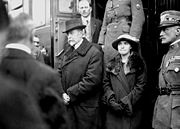
Czechoslovak declaration of independence
The Czechoslovak Declaration of Independence was drafted by Thomas Masaryk and published by the nation's Paris based Provisional Government on October 18, 1918...
was published by the Czechoslovak National Council, signed by Masaryk, Štefánik and Beneš
Edvard Beneš
Edvard Beneš was a leader of the Czechoslovak independence movement, Minister of Foreign Affairs and the second President of Czechoslovakia. He was known to be a skilled diplomat.- Youth :...
on October 18, 1918 in Paris
Paris
Paris is the capital and largest city in France, situated on the river Seine, in northern France, at the heart of the Île-de-France region...
, and proclaimed on October 28 in Prague
Prague
Prague is the capital and largest city of the Czech Republic. Situated in the north-west of the country on the Vltava river, the city is home to about 1.3 million people, while its metropolitan area is estimated to have a population of over 2.3 million...
. Towards the end of the First World War which led to the collapse of the Austrian-Hungarian Empire, several ethnic groups and territories with different historical, political, and economic traditions were blended into new state structures. In the face of such obstacles, the creation of Czechoslovak democracy
Democracy
Democracy is generally defined as a form of government in which all adult citizens have an equal say in the decisions that affect their lives. Ideally, this includes equal participation in the proposal, development and passage of legislation into law...
was indeed a triumph.
Initial authority within Czechoslovakia
Czechoslovakia
Czechoslovakia or Czecho-Slovakia was a sovereign state in Central Europe which existed from October 1918, when it declared its independence from the Austro-Hungarian Empire, until 1992...
was assumed by the newly created National Assembly
National Assembly
National Assembly is either a legislature, or the lower house of a bicameral legislature in some countries. The best known National Assembly, and the first legislature to be known by this title, was that established during the French Revolution in 1789, known as the Assemblée nationale...
on November 14, 1918. Because territorial demarcations were uncertain and elections impossible, the provisional National Assembly was constituted on the basis of the 1911 election
Election
An election is a formal decision-making process by which a population chooses an individual to hold public office. Elections have been the usual mechanism by which modern representative democracy operates since the 17th century. Elections may fill offices in the legislature, sometimes in the...
s to the Austrian parliament
Reichsrat (Austria)
The Imperial Council of Austria from 1867 to 1918 was the parliament of the Cisleithanian part of the Austro-Hungarian Empire. It was a bicameral legislature, consisting of the Herrenhaus and the Abgeordnetenhaus...
with the addition of fifty-four representatives from Slovakia
Slovakia
The Slovak Republic is a landlocked state in Central Europe. It has a population of over five million and an area of about . Slovakia is bordered by the Czech Republic and Austria to the west, Poland to the north, Ukraine to the east and Hungary to the south...
. National minorities were not represented. Hungarians remained loyal to Hungary
Hungary
Hungary , officially the Republic of Hungary , is a landlocked country in Central Europe. It is situated in the Carpathian Basin and is bordered by Slovakia to the north, Ukraine and Romania to the east, Serbia and Croatia to the south, Slovenia to the southwest and Austria to the west. The...
, and on November 12, 1918, ethnic Germans of the former Empire declared the short-lived Republic of German Austria
German Austria
Republic of German Austria was created following World War I as the initial rump state for areas with a predominantly German-speaking population within what had been the Austro-Hungarian Empire, without the Kingdom of Hungary, which in 1918 had become the Hungarian Democratic Republic.German...
with the intent of unifying with Germany
Germany
Germany , officially the Federal Republic of Germany , is a federal parliamentary republic in Europe. The country consists of 16 states while the capital and largest city is Berlin. Germany covers an area of 357,021 km2 and has a largely temperate seasonal climate...
, relying on President Wilson
Woodrow Wilson
Thomas Woodrow Wilson was the 28th President of the United States, from 1913 to 1921. A leader of the Progressive Movement, he served as President of Princeton University from 1902 to 1910, and then as the Governor of New Jersey from 1911 to 1913...
's principle of self-determination
Self-determination
Self-determination is the principle in international law that nations have the right to freely choose their sovereignty and international political status with no external compulsion or external interference...
. The National Assembly elected Tomáš Garrigue Masaryk as its first president, chose a provisional government headed by Karel Kramář
Karel Kramár
Karel Kramář was a Czech politician.- Biography :Leader of the Young Czech Party in Austria-Hungary and later of the National Democratic Party in Czechoslovakia...
, and drafted a provisional constitution
Constitution
A constitution is a set of fundamental principles or established precedents according to which a state or other organization is governed. These rules together make up, i.e. constitute, what the entity is...
.
The Paris Peace Conference
Paris Peace Conference, 1919
The Paris Peace Conference was the meeting of the Allied victors following the end of World War I to set the peace terms for the defeated Central Powers following the armistices of 1918. It took place in Paris in 1919 and involved diplomats from more than 32 countries and nationalities...
convened in January 1919. The Czech
Czech people
Czechs, or Czech people are a western Slavic people of Central Europe, living predominantly in the Czech Republic. Small populations of Czechs also live in Slovakia, Austria, the United States, the United Kingdom, Chile, Argentina, Canada, Germany, Russia and other countries...
delegation was led by Kramář and Beneš
Edvard Beneš
Edvard Beneš was a leader of the Czechoslovak independence movement, Minister of Foreign Affairs and the second President of Czechoslovakia. He was known to be a skilled diplomat.- Youth :...
, premier and foreign minister respectively, of the Czechoslovak provisional government. The conference approved the establishment of the Czechoslovak Republic, to encompass the historic Bohemian Kingdom (including Bohemia
Bohemia
Bohemia is a historical region in central Europe, occupying the western two-thirds of the traditional Czech Lands. It is located in the contemporary Czech Republic with its capital in Prague...
, Moravia
Moravia
Moravia is a historical region in Central Europe in the east of the Czech Republic, and one of the former Czech lands, together with Bohemia and Silesia. It takes its name from the Morava River which rises in the northwest of the region...
, and Silesia
Silesia
Silesia is a historical region of Central Europe located mostly in Poland, with smaller parts also in the Czech Republic, and Germany.Silesia is rich in mineral and natural resources, and includes several important industrial areas. Silesia's largest city and historical capital is Wrocław...
), Slovakia, and Carpathian Ruthenia
Carpathian Ruthenia
Carpathian Ruthenia is a region in Eastern Europe, mostly located in western Ukraine's Zakarpattia Oblast , with smaller parts in easternmost Slovakia , Poland's Lemkovyna and Romanian Maramureş.It is...
. The inclusion of Ruthenia provided a common frontier with Romania
Romania
Romania is a country located at the crossroads of Central and Southeastern Europe, on the Lower Danube, within and outside the Carpathian arch, bordering on the Black Sea...
, an important ally against Hungary. In January 1920 Czechoslovakian army breaking prior agreements with Poland
Second Polish Republic
The Second Polish Republic, Second Commonwealth of Poland or interwar Poland refers to Poland between the two world wars; a period in Polish history in which Poland was restored as an independent state. Officially known as the Republic of Poland or the Commonwealth of Poland , the Polish state was...
, crossed the demarcation line and by force of arms occupied the Zaolzie
Zaolzie
Zaolzie is the Polish name for an area now in the Czech Republic which was disputed between interwar Poland and Czechoslovakia. The name means "lands beyond the Olza River"; it is also called Śląsk zaolziański, meaning "trans-Olza Silesia". Equivalent terms in other languages include Zaolší in...
, where a 60 % majority of the population was Polish, compared to 25 % Czechs. After brief fights they made a truce on the power of which Czechoslovakia occupied areas to the west of Olza River
Olza River
is a river in Poland and the Czech Republic, the right tributary of the Oder River. It flows from the Silesian Beskids through southern Cieszyn Silesia in Poland and Frýdek-Místek and Karviná districts of the Czech Republic, often forming the border with Poland. It flows into the Oder River north...
. The Czech claim to Lusatia
Lusatia
Lusatia is a historical region in Central Europe. It stretches from the Bóbr and Kwisa rivers in the east to the Elbe valley in the west, today located within the German states of Saxony and Brandenburg as well as in the Lower Silesian and Lubusz voivodeships of western Poland...
, which had been part of the Bohemian Kingdom until the Thirty Years' War
Thirty Years' War
The Thirty Years' War was fought primarily in what is now Germany, and at various points involved most countries in Europe. It was one of the most destructive conflicts in European history....
, was rejected. On September 10, 1919, Czechoslovakia signed the Minorities Treaty, placing its ethnic minorities under the protection of the League of Nations
League of Nations
The League of Nations was an intergovernmental organization founded as a result of the Paris Peace Conference that ended the First World War. It was the first permanent international organization whose principal mission was to maintain world peace...
.
Statehood
The establishment of the Constitution of 1920Czechoslovak Constitution of 1920
After World War I, Czechoslovakia established itself and as a republic and democracy with the establishment of the Constitution of 1920. The constitution was adopted by the National Assembly on 29 February 1920 and replaced the provisional constitution adopted on 13 November 1918.The introduction...
installed a parliamentary system
Parliamentary system
A parliamentary system is a system of government in which the ministers of the executive branch get their democratic legitimacy from the legislature and are accountable to that body, such that the executive and legislative branches are intertwined....
and representative democracy
Representative democracy
Representative democracy is a form of government founded on the principle of elected individuals representing the people, as opposed to autocracy and direct democracy...
with relatively few constituents
Electoral district
An electoral district is a distinct territorial subdivision for holding a separate election for one or more seats in a legislative body...
for each representative. This allowed a great variety of political parties
Political party
A political party is a political organization that typically seeks to influence government policy, usually by nominating their own candidates and trying to seat them in political office. Parties participate in electoral campaigns, educational outreach or protest actions...
to emerge, with no clear front runner or leading political entity.
Tomáš Garrigue Masaryk
Tomáš Masaryk
Tomáš Garrigue Masaryk , sometimes called Thomas Masaryk in English, was an Austro-Hungarian and Czechoslovak politician, sociologist and philosopher, who as an eager advocate of Czechoslovak independence during World War I became the founder and first President of Czechoslovakia, also was...
was elected the country's first president in the 1920 election and his guidance helped to hold the country together. A coalition of five Czechoslovak parties, which became known as the "Pětka
Petka
Petka may refer to:* Pětka or Committee of Five, a Czechoslovak organization* Saint Petka, an ascetic female saint from the Eastern Roman Empire* Petka , a village in Serbia* Petka, Belgrade, a suburb of Lazarevac, Belgrade, Serbia...
" (The Five), constituted the backbone of the government and maintained stability. Prime Minister Antonin Svehla
Antonín Švehla
Antonín Švehla was a Czechoslovakian politician. He served three terms as the prime minister of Czechoslovakia. He is regarded as one of the most important political figures of the First Czechoslovak Republic; he was the leader of the Agrarian Party, which was dominant within the Pětka, which was...
led the Pětka for most of the 1920s and designed a pattern of coalition politics that survived until 1938. Masaryk was re-elected in 1925 and 1929, serving as President until December 14, 1935 when he resigned due to poor health. He was succeeded by Edvard Beneš
Edvard Beneš
Edvard Beneš was a leader of the Czechoslovak independence movement, Minister of Foreign Affairs and the second President of Czechoslovakia. He was known to be a skilled diplomat.- Youth :...
.
Foreign minister
A Minister of Foreign Affairs, or foreign minister, is a cabinet minister who helps form the foreign policy of a sovereign state. The foreign minister is often regarded as the most senior ministerial position below that of the head of government . It is often granted to the deputy prime minister in...
from 1918 to 1935, and created the system of alliances that determined the republic's international stance until 1938. A democratic statesman of Western orientation, Beneš relied heavily on the League of Nations
League of Nations
The League of Nations was an intergovernmental organization founded as a result of the Paris Peace Conference that ended the First World War. It was the first permanent international organization whose principal mission was to maintain world peace...
as guarantor of the post war status quo
Status quo
Statu quo, a commonly used form of the original Latin "statu quo" – literally "the state in which" – is a Latin term meaning the current or existing state of affairs. To maintain the status quo is to keep the things the way they presently are...
and the security of newly formed states. He negotiated the Little Entente
Little Entente
The Little Entente was an alliance formed in 1920 and 1921 by Czechoslovakia, Romania and Yugoslavia with the purpose of common defense against Hungarian revision and the prevention of a Habsburg restoration...
(an alliance with Yugoslavia
Yugoslavia
Yugoslavia refers to three political entities that existed successively on the western part of the Balkans during most of the 20th century....
and Romania
Romania
Romania is a country located at the crossroads of Central and Southeastern Europe, on the Lower Danube, within and outside the Carpathian arch, bordering on the Black Sea...
) in 1921 to counter Hungarian
Hungary
Hungary , officially the Republic of Hungary , is a landlocked country in Central Europe. It is situated in the Carpathian Basin and is bordered by Slovakia to the north, Ukraine and Romania to the east, Serbia and Croatia to the south, Slovenia to the southwest and Austria to the west. The...
revanchism
Revanchism
Revanchism is a term used since the 1870s to describe a political manifestation of the will to reverse territorial losses incurred by a country, often following a war or social movement. Revanchism draws its strength from patriotic and retributionist thought and is often motivated by economic or...
and Habsburg
Habsburg
The House of Habsburg , also found as Hapsburg, and also known as House of Austria is one of the most important royal houses of Europe and is best known for being an origin of all of the formally elected Holy Roman Emperors between 1438 and 1740, as well as rulers of the Austrian Empire and...
restoration.
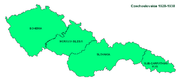
The leaders of Czechoslovakia needed to find solutions for the multiplicity of cultures living within one country. From 1928 and 1940, Czechoslovakia was divided into the four "lands" (Czech
Czech language
Czech is a West Slavic language with about 12 million native speakers; it is the majority language in the Czech Republic and spoken by Czechs worldwide. The language was known as Bohemian in English until the late 19th century...
: "země", Slovak
Slovak language
Slovak , is an Indo-European language that belongs to the West Slavic languages .Slovak is the official language of Slovakia, where it is spoken by 5 million people...
: "krajiny"); Bohemia, Moravia-Silesia, Slovakia and Carpathian Ruthenia. Although in 1927 assemblies were provided for Bohemia, Slovakia, and Ruthenia, their jurisdiction was limited to adjusting laws and regulations of the central government to local needs. National minorities were assured special protection; in districts where they constituted 20% of the population, members of minority groups were granted full freedom to use their language in everyday life, in schools, and in matters dealing with authorities. German
Germany
Germany , officially the Federal Republic of Germany , is a federal parliamentary republic in Europe. The country consists of 16 states while the capital and largest city is Berlin. Germany covers an area of 357,021 km2 and has a largely temperate seasonal climate...
parties also participated in the government in the beginning of 1926. Hungarian parties, influenced by irredentist propaganda from Hungary, never joined the Czechoslovak government but were not openly hostile.
Growing conflict
Due to Czechoslovakia's centralized political structure, nationalism arose in the non-Czech nationalities, and several parties and movements were formed with the aim of broader political autonomy. The Slovak People's Party led by Andrej HlinkaAndrej Hlinka
Andrej Hlinka was a Slovak politician and Catholic priest, one of the most important Slovak public activists in Czechoslovakia before Second World War...
is an example.
When German dictator Adolf Hitler
Adolf Hitler
Adolf Hitler was an Austrian-born German politician and the leader of the National Socialist German Workers Party , commonly referred to as the Nazi Party). He was Chancellor of Germany from 1933 to 1945, and head of state from 1934 to 1945...
came to power in 1933, fear of German aggression became widespread in eastern Central Europe. Beneš ignored the possibility of a stronger Central European alliance system, remaining faithful to his Western policy. He did, however, seek the participation of the Soviet Union
Soviet Union
The Soviet Union , officially the Union of Soviet Socialist Republics , was a constitutionally socialist state that existed in Eurasia between 1922 and 1991....
in an alliance to include France
France
The French Republic , The French Republic , The French Republic , (commonly known as France , is a unitary semi-presidential republic in Western Europe with several overseas territories and islands located on other continents and in the Indian, Pacific, and Atlantic oceans. Metropolitan France...
. (Beneš's earlier attitude towards the Soviet regime had been one of caution.) In 1935 the Soviet Union signed treaties with France and Czechoslovakia. In essence, the treaties provided that the Soviet Union would come to Czechoslovakia's aid only if French assistance came first. Hitler himself remarked to his foreign minister Neurath and top military officials in 1937 that he intended to absorb Bohemia and Austria, with vogue sentence about the need to expel 2 million Czechs and eventual elimination of Czech nation
The German minority
Germans in Czechoslovakia (1918-1938)
From 1918 to 1938, after the breakup of the Austro-Hungarian Empire, more than 3 million ethnic Germans were living in what became the Czech lands of the newly created state of Czechoslovakia. Ethnic Germans had lived in Bohemia, a part of the Holy Roman Empire, since the 14th century , mostly in...
living in Sudetenland
Sudetenland
Sudetenland is the German name used in English in the first half of the 20th century for the northern, southwest and western regions of Czechoslovakia inhabited mostly by ethnic Germans, specifically the border areas of Bohemia, Moravia, and those parts of Silesia being within Czechoslovakia.The...
demanded autonomy from the Czech government, claiming they were oppressed by the Czech government. In the 1935 Parliamentary elections, the newly founded Sudeten German Party under leadership of Konrad Henlein
Konrad Henlein
Konrad Ernst Eduard Henlein was a leading pro-Nazi ethnic German politician in Czechoslovakia and leader of Sudeten German separatists...
, financed with Nazi money, won an upset victory, securing over 2/3 of the Sudeten German vote, which worsened the diplomatic relations between the Germans and the Czechs. Henlein met with Hitler in Berlin on March 28, 1938, where he was instructed to raise demands unacceptable to the Czechoslovak government led by president Edvard Beneš
Edvard Beneš
Edvard Beneš was a leader of the Czechoslovak independence movement, Minister of Foreign Affairs and the second President of Czechoslovakia. He was known to be a skilled diplomat.- Youth :...
. On April 24, the SdP issued the Carlsbad Decrees
Carlsbad Decrees
The Carlsbad Decrees were a set of reactionary restrictions introduced in the states of the German Confederation by resolution of the Bundesversammlung on 20 September 1819 after a conference held in the spa town of Carlsbad, Bohemia...
, demanding autonomy
Autonomy
Autonomy is a concept found in moral, political and bioethical philosophy. Within these contexts, it is the capacity of a rational individual to make an informed, un-coerced decision...
for the Sudetenland and the freedom to profess Nazi ideology
Nazism
Nazism, the common short form name of National Socialism was the ideology and practice of the Nazi Party and of Nazi Germany...
. If Henlein's demands were granted, the Sudetenland would then be able to align itself with Nazi Germany.
See also
- Germans in Czechoslovakia (1918-1938)Germans in Czechoslovakia (1918-1938)From 1918 to 1938, after the breakup of the Austro-Hungarian Empire, more than 3 million ethnic Germans were living in what became the Czech lands of the newly created state of Czechoslovakia. Ethnic Germans had lived in Bohemia, a part of the Holy Roman Empire, since the 14th century , mostly in...
- Poles in Czechoslovakia
- Ruthenians and Ukrainians in Czechoslovakia (1918-1938)Ruthenians and Ukrainians in Czechoslovakia (1918-1938)Subcarpathian Ruthenia was economically Czechoslovakia’s poorest region. In 1914 the region was referred to by one historian as "little more than a Magyar deer park." Its people were wretchedly poor, having for centuries supplemented the meagre living the mountainous area afforded with seasonal...
- Slovaks in Czechoslovakia (1918-1938)Slovaks in Czechoslovakia (1918-1938)Whereas Czechs wished to create a Czechoslovak nation, Slovaks sought a federal republic in 1918. The new Czechoslovak republic , with its predominantly Czech administrative apparatus, hardly responded to Slovak aspirations for at least some form of autonomy...
- Hungarians in Czechoslovakia (Slovakia)