

Tu Bishvat

Encyclopedia
Tu Bishvat or Tu B'Shevat is a minor Jewish holiday
, occurring on the 15th day of the Hebrew month
of Shevat
(in 2011 this occurred from sunset on January 19 through sunset on January 20). It is also called "The New Year of the Trees" or . Tu Bishvat is one of four "New Years" mentioned in the Mishnah
.
. "Tu" stands for the Hebrew letters Tet and Vav, which together have the numerical value
of 9 and 6, adding up to 15. Tu Bishvat is a relatively recent name; the date was originally "Ḥamisha Asar BiShvat" (חמשה-עשר בשבט), also meaning "Fifteenth of Shevat".
in Tractate Rosh Hashanah
as one of the four new years in the Jewish calendar. The discussion of when the New Year occurs was a source of debate among the rabbis: "And there are four new year dates: - The first of Nisan
- new year for kings and festivals - The first of Elul
- new year for animal tithes. Rabbi Elazar and Rabbi Shimon say: the first of Tishrei. - The first of Tishrei
- new year for calculation of the calendar, sabbatical years and jubilees, for planting and sowing - The first of Shevat
, according to the school of Shamai; The school of Hillel
say: the fifteenth of Shevat" (Rosh Hashana:1a)
The rabbis of the Talmud
ruled in favor of Hillel
on this issue. Thus the 15th of Shevat became the date for calculating when the agricultural cycle began or ended for the purpose of biblical tithes.
remains to this day in essentially the same form it had in talmudic times and uses Tu Bishvat in the same way. In the Orthodox Jewish world, these practices are still observed today as part of Halacha, Jewish law. Orlah fruit is not considered kosher, and Tu Bishvat is still used as the cut-off date. For a tree in its final year, fruit ripening before Tu Bishvat is considered orlah, while fruit ripening on or after Tu Bishvat in the final year is permitted. In the 1st, 2nd, 4th and 5th years of the Shmita cycle Maaser Sheni
is observed today by a ceremony redeeming tithing obligations with a coin; in the 3rd and 6th years, Maaser Ani is substituted, and no coin is needed for redeeming it. Tu Bishvat is the cut-off date for determining to which year the tithes belong.
Tu Bishvat generally falls on the second full moon before Passover
, or, in a leap year, the third full moon before Passover.
In the synagogue, the penitential prayer of Tachanun
is omitted on Tu Bishvat (and at the afternoon service
of the day before), as is the custom on minor Jewish holidays. There are no other special recitations or blessings in the prayer service.
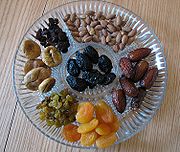 In the Middle Ages, Tu Bishvat was celebrated with a feast of fruits in keeping with the Mishnaic description of the holiday as a "New Year." In the 16th century, the kabbalist Rabbi Yitzchak Luria
of Safed
and his disciples instituted a Tu Bishvat seder in which the fruits and trees of the Land of Israel
were given symbolic meaning. The main idea was that eating ten specific fruits and drinking four cups of wine in a specific order while reciting the appropriate blessings would bring human beings, and the world, closer to spiritual perfection.
In Israel, the kabbalistic Tu Bishvat seder
has been revived, and is now celebrated by many Jews, religious and secular. Special haggadot have been written for this purpose.
(citron
) from Sukkot
and eat it on Tu Bishvat. Some pray that they will be worthy of a beautiful etrog on the following Sukkot.
movement, took his students to plant trees in the agricultural colony of Zichron Yaakov. This custom was adopted in 1908 by the Jewish Teachers Union and later by the Jewish National Fund
(Keren HaKayemet L’Israel), established in 1901 to oversee land reclamation and afforestation of the Land of Israel
. In the early 20th century, the Jewish National Fund devoted the day to planting eucalyptus
trees to stop the plague of malaria
in the Hula Valley; today the Fund schedules major tree-planting events in large forests every Tu Bishvat. Over a million Israelis take part in the Jewish National Fund's Tu Bishvat tree-planting activities.
In keeping with the idea of Tu Bishvat marking the revival of nature, many of Israel's major institutions have chosen this day for their inauguration. The cornerstone-laying of the Hebrew University of Jerusalem
took place on Tu Bishvat 1918; the Technion in Haifa, on Tu Bishvat 1925; and the Knesset
, on Tu Bishvat 1949.
, and it is often referred to by that name in international media. Ecological organizations in Israel and the diaspora have adopted the holiday to further environmental-awareness programs. On Israeli kibbutz
im, Tu Bishvat is celebrated as an agricultural holiday.
Jewish holiday
Jewish holidays are days observed by Jews as holy or secular commemorations of important events in Jewish history. In Hebrew, Jewish holidays and festivals, depending on their nature, may be called yom tov or chag or ta'anit...
, occurring on the 15th day of the Hebrew month
Hebrew calendar
The Hebrew calendar , or Jewish calendar, is a lunisolar calendar used today predominantly for Jewish religious observances. It determines the dates for Jewish holidays and the appropriate public reading of Torah portions, yahrzeits , and daily Psalm reading, among many ceremonial uses...
of Shevat
Shevat
Shevat is the fifth month of the civil year and the eleventh month of the ecclesiastical year on the Hebrew calendar. It is a winter month of 30 days...
(in 2011 this occurred from sunset on January 19 through sunset on January 20). It is also called "The New Year of the Trees" or . Tu Bishvat is one of four "New Years" mentioned in the Mishnah
Mishnah
The Mishnah or Mishna is the first major written redaction of the Jewish oral traditions called the "Oral Torah". It is also the first major work of Rabbinic Judaism. It was redacted c...
.
Etymology
The name Tu Bishvat is derived from the Hebrew date of the holiday, which occurs on the fifteenth day of ShevatShevat
Shevat is the fifth month of the civil year and the eleventh month of the ecclesiastical year on the Hebrew calendar. It is a winter month of 30 days...
. "Tu" stands for the Hebrew letters Tet and Vav, which together have the numerical value
Gematria
Gematria or gimatria is a system of assigning numerical value to a word or phrase, in the belief that words or phrases with identical numerical values bear some relation to each other, or bear some relation to the number itself as it may apply to a person's age, the calendar year, or the like...
of 9 and 6, adding up to 15. Tu Bishvat is a relatively recent name; the date was originally "Ḥamisha Asar BiShvat" (חמשה-עשר בשבט), also meaning "Fifteenth of Shevat".
In the Talmud
Tu Bishvat appears in the MishnahMishnah
The Mishnah or Mishna is the first major written redaction of the Jewish oral traditions called the "Oral Torah". It is also the first major work of Rabbinic Judaism. It was redacted c...
in Tractate Rosh Hashanah
Rosh Hashanah (Talmud)
Rosh Hashanah is the name of a text of Jewish law originating in the Mishnah which formed the basis of tractates in both the Babylonian Talmud and the Jerusalem Talmud of the same name. It is the eighth tractate of the order Moed...
as one of the four new years in the Jewish calendar. The discussion of when the New Year occurs was a source of debate among the rabbis: "And there are four new year dates: - The first of Nisan
Nisan
Nisan is the first month of the ecclesiastical year and the seventh month of the civil year, on the Hebrew calendar. The name of the month is Babylonian; in the Torah it is called the month of the Aviv, referring to the month in which barley was ripe. It is a spring month of 30 days...
- new year for kings and festivals - The first of Elul
Elul
Elul is the twelfth month of the Jewish civil year and the sixth month of the ecclesiastical year on the Hebrew calendar. It is a summer month of 29 days...
- new year for animal tithes. Rabbi Elazar and Rabbi Shimon say: the first of Tishrei. - The first of Tishrei
Tishrei
Tishrei or Tishri , Tiberian: ; from Akkadian "Beginning", from "To begin") is the first month of the civil year and the seventh month of the ecclesiastical year in the Hebrew calendar. The name of the month is Babylonian. It is an autumn month of 30 days...
- new year for calculation of the calendar, sabbatical years and jubilees, for planting and sowing - The first of Shevat
Shevat
Shevat is the fifth month of the civil year and the eleventh month of the ecclesiastical year on the Hebrew calendar. It is a winter month of 30 days...
, according to the school of Shamai; The school of Hillel
House of Hillel
The House of Hillel , also known as the Academy of Hillel, founded by the famed Hillel the Elder, is a school of Jewish law and thought that thrived in 1st century B.C.E.Jerusalem. The House of Hillel is most widely known for its hundreds of disputes with the Beit Shammai, founded by Shammai, a...
say: the fifteenth of Shevat" (Rosh Hashana:1a)
The rabbis of the Talmud
Talmud
The Talmud is a central text of mainstream Judaism. It takes the form of a record of rabbinic discussions pertaining to Jewish law, ethics, philosophy, customs and history....
ruled in favor of Hillel
Hillel the Elder
Hillel was a famous Jewish religious leader, one of the most important figures in Jewish history. He is associated with the development of the Mishnah and the Talmud...
on this issue. Thus the 15th of Shevat became the date for calculating when the agricultural cycle began or ended for the purpose of biblical tithes.
Biblical tithes
- OrlahOrlahOrlah is the tenth tractate of Seder Zeraim of the Mishnah and of the Talmud. It discusses the laws pertaining to any fruit bearing tree, whose fruits cannot be eaten during the first three years the tree produces fruit...
refers to a biblical prohibition (LeviticusLeviticusThe Book of Leviticus is the third book of the Hebrew Bible, and the third of five books of the Torah ....
19:23) on eating the fruit of trees produced during the first three years after they are planted. - Neta Reva'i refers to the biblical commandment (Leviticus 19:24) to bring fourth-year fruit crops to Jerusalem as a tithe.
- Maaser SheniMaaser SheniThe second tithe is a tithe mentioned in the Hebrew Bible and continued in Orthodox Judaism. It is distinguished from the first tithe , the poor tithe, and the terumat ma'aser...
was a tithe which was eaten in Jerusalem and Maaser AniMaaser AniThe poor tithe reflects an obligation to set aside one tenth of produce grown in the third and sixth years of the seven-year sabbatical year agricultural cycle for the poor, in the days of the Temple in Jerusalem....
was a tithe given to the poor (DeuteronomyDeuteronomyThe Book of Deuteronomy is the fifth book of the Hebrew Bible, and of the Jewish Torah/Pentateuch...
14:22-29) that were also calculated by whether the fruit ripened before or after Tu Bishvat.
In contemporary Jewish law
Of the talmudic requirements for fruit trees which used Tu Bishvat as the cut-off date in the Hebrew calendar for calculating the age of a fruit-bearing tree, OrlahOrlah
Orlah is the tenth tractate of Seder Zeraim of the Mishnah and of the Talmud. It discusses the laws pertaining to any fruit bearing tree, whose fruits cannot be eaten during the first three years the tree produces fruit...
remains to this day in essentially the same form it had in talmudic times and uses Tu Bishvat in the same way. In the Orthodox Jewish world, these practices are still observed today as part of Halacha, Jewish law. Orlah fruit is not considered kosher, and Tu Bishvat is still used as the cut-off date. For a tree in its final year, fruit ripening before Tu Bishvat is considered orlah, while fruit ripening on or after Tu Bishvat in the final year is permitted. In the 1st, 2nd, 4th and 5th years of the Shmita cycle Maaser Sheni
Maaser Sheni
The second tithe is a tithe mentioned in the Hebrew Bible and continued in Orthodox Judaism. It is distinguished from the first tithe , the poor tithe, and the terumat ma'aser...
is observed today by a ceremony redeeming tithing obligations with a coin; in the 3rd and 6th years, Maaser Ani is substituted, and no coin is needed for redeeming it. Tu Bishvat is the cut-off date for determining to which year the tithes belong.
Tu Bishvat generally falls on the second full moon before Passover
Passover
Passover is a Jewish holiday and festival. It commemorates the story of the Exodus, in which the ancient Israelites were freed from slavery in Egypt...
, or, in a leap year, the third full moon before Passover.
In the synagogue, the penitential prayer of Tachanun
Tachanun
Tachanun or , also called nefillat apayim is part of Judaism's morning and afternoon services, after the recitation of the Amidah, the central part of the daily Jewish prayer services...
is omitted on Tu Bishvat (and at the afternoon service
Mincha
Mincha, מנחה is the afternoon prayer service in Judaism.-Etymology:The name "Mincha" is derived from the meal offering that accompanied each sacrifice.-Origin:...
of the day before), as is the custom on minor Jewish holidays. There are no other special recitations or blessings in the prayer service.
Kabbalistic customs
Isaac Luria
Isaac Luria , also called Yitzhak Ben Shlomo Ashkenazi acronym "The Ari" "Ari-Hakadosh", or "Arizal", meaning "The Lion", was a foremost rabbi and Jewish mystic in the community of Safed in the Galilee region of Ottoman Palestine...
of Safed
Safed
Safed , is a city in the Northern District of Israel. Located at an elevation of , Safed is the highest city in the Galilee and of Israel. Due to its high elevation, Safed experiences warm summers and cold, often snowy, winters...
and his disciples instituted a Tu Bishvat seder in which the fruits and trees of the Land of Israel
Land of Israel
The Land of Israel is the Biblical name for the territory roughly corresponding to the area encompassed by the Southern Levant, also known as Canaan and Palestine, Promised Land and Holy Land. The belief that the area is a God-given homeland of the Jewish people is based on the narrative of the...
were given symbolic meaning. The main idea was that eating ten specific fruits and drinking four cups of wine in a specific order while reciting the appropriate blessings would bring human beings, and the world, closer to spiritual perfection.
In Israel, the kabbalistic Tu Bishvat seder
Tu Bishvat seder
A Tu Bishvat seder is a festive meal featuring fruits in honor of the Jewish holiday of Tu Bishvat.During the Middle Ages or possibly a little before that, this day started to be celebrated with a minor ceremony of eating fruits, since the Mishnah called it "Rosh Hashanah" , and that was later...
has been revived, and is now celebrated by many Jews, religious and secular. Special haggadot have been written for this purpose.
Chassidic customs
In the Chassidic community, some Jews pickle or candy the etrogEtrog
Etrog refers to the yellow citron or Citrus medica used by Jews on the week-long holiday of Sukkot.While in modern Hebrew this is the name for any variety of citron, its English usage applies to those varieties and specimens used as one of the Four Species...
(citron
Citron
Not to be confused with Cintron.The citron is a fragrant citrus fruit, botanically classified as Citrus medica by both the Swingle and Tanaka systems...
) from Sukkot
Sukkot
Sukkot is a Biblical holiday celebrated on the 15th day of the month of Tishrei . It is one of the three biblically mandated festivals Shalosh regalim on which Hebrews were commanded to make a pilgrimage to the Temple in Jerusalem.The holiday lasts seven days...
and eat it on Tu Bishvat. Some pray that they will be worthy of a beautiful etrog on the following Sukkot.
Customs in Israel
On Tu Bishvat 1890, Rabbi Zeev Yavetz, one of the founders of the MizrachiMizrachi (Religious Zionism)
The Mizrachi is the name of the religious Zionist organization founded in 1902 in Vilnius at a world conference of religious Zionists called by Rabbi Yitzchak Yaacov Reines. Bnei Akiva, which was founded in 1929, is the youth movement associated with Mizrachi...
movement, took his students to plant trees in the agricultural colony of Zichron Yaakov. This custom was adopted in 1908 by the Jewish Teachers Union and later by the Jewish National Fund
Jewish National Fund
The Jewish National Fund was founded in 1901 to buy and develop land in Ottoman Palestine for Jewish settlement. The JNF is a quasi-governmental, non-profit organisation...
(Keren HaKayemet L’Israel), established in 1901 to oversee land reclamation and afforestation of the Land of Israel
Land of Israel
The Land of Israel is the Biblical name for the territory roughly corresponding to the area encompassed by the Southern Levant, also known as Canaan and Palestine, Promised Land and Holy Land. The belief that the area is a God-given homeland of the Jewish people is based on the narrative of the...
. In the early 20th century, the Jewish National Fund devoted the day to planting eucalyptus
Eucalyptus
Eucalyptus is a diverse genus of flowering trees in the myrtle family, Myrtaceae. Members of the genus dominate the tree flora of Australia...
trees to stop the plague of malaria
Malaria
Malaria is a mosquito-borne infectious disease of humans and other animals caused by eukaryotic protists of the genus Plasmodium. The disease results from the multiplication of Plasmodium parasites within red blood cells, causing symptoms that typically include fever and headache, in severe cases...
in the Hula Valley; today the Fund schedules major tree-planting events in large forests every Tu Bishvat. Over a million Israelis take part in the Jewish National Fund's Tu Bishvat tree-planting activities.
In keeping with the idea of Tu Bishvat marking the revival of nature, many of Israel's major institutions have chosen this day for their inauguration. The cornerstone-laying of the Hebrew University of Jerusalem
Hebrew University of Jerusalem
The Hebrew University of Jerusalem ; ; abbreviated HUJI) is Israel's second-oldest university, after the Technion – Israel Institute of Technology. The Hebrew University has three campuses in Jerusalem and one in Rehovot. The world's largest Jewish studies library is located on its Edmond J...
took place on Tu Bishvat 1918; the Technion in Haifa, on Tu Bishvat 1925; and the Knesset
Knesset
The Knesset is the unicameral legislature of Israel, located in Givat Ram, Jerusalem.-Role in Israeli Government :The legislative branch of the Israeli government, the Knesset passes all laws, elects the President and Prime Minister , approves the cabinet, and supervises the work of the government...
, on Tu Bishvat 1949.
Ecological interpretation
Tu Bishvat is considered by secular Israeli Jews and organizations to be the Jewish equivalent of Arbor DayArbor Day
Arbor Day is a holiday in which individuals and groups are encouraged to plant and care for trees. It originated in Nebraska City, Nebraska, United States during 1872 by J. Sterling Morton. The first Arbor Day was held on April 10, 1872, and an estimated 1 million trees were planted that day.Many...
, and it is often referred to by that name in international media. Ecological organizations in Israel and the diaspora have adopted the holiday to further environmental-awareness programs. On Israeli kibbutz
Kibbutz
A kibbutz is a collective community in Israel that was traditionally based on agriculture. Today, farming has been partly supplanted by other economic branches, including industrial plants and high-tech enterprises. Kibbutzim began as utopian communities, a combination of socialism and Zionism...
im, Tu Bishvat is celebrated as an agricultural holiday.
See also
- Hebrew numeralsHebrew numeralsThe system of Hebrew numerals is a quasi-decimal alphabetic numeral system using the letters of the Hebrew alphabet.In this system, there is no notation for zero, and the numeric values for individual letters are added together...
- List of Jewish prayers and blessings
- Judaism and ecology
External links
- Judaism 101 Description of Tu B'Shevat
- Tu Bishvat Seder Haggadah and Seder guidebook
- Traditions, Seder, Blessings for Tu B'Shvat
- Coalition on the Environment and Jewish Life's extensive resources – learning resources and seder ideas
- Neohasid.org: resources for making the seder, texts to learn, and deeper explanations of the Kabbalah of Tu Bishvat—even the blessing from the original Tu Bishvat seder!