

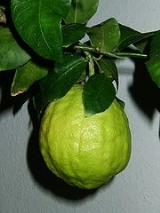
Citron

Encyclopedia
Not to be confused with Cintron.
The citron is a fragrant citrus fruit, botanically classified as Citrus medica by both the Swingle
and Tanaka
systems. The designation medica given it by Linnaeus is apparently derived from its ancient name "Median or Persian apple" that was reported by Theophrastus
, who believed it to be native to Persia or the land of the Medes
; there is no relation to medicinal uses of the fruit. Theophrastus notes its smooth sharp thorns, like those of a pear
, the very fragrant but inedible 'apple', which keeps moths from clothes, and the fact that "it bears its 'apples' at all season; for when some have been gathered, the flower of others is on the tree and it is ripening others.... This tree, as has been said, grows in Persia and Media." Citron was the first of the citrus fruits to appear in the Mediterranean Basin
.
The fruit's name derives ultimately from Latin, and as a result it has many similar names in many European languages, e.g. cederat, cédrat, cedro, etc. This can also be a source of confusion to English speakers, as the word "citron" is a false friend
in Czech
, Slovak
, French
, Dutch
, German
, Yiddish and Scandinavian
, in which it actually refers to the lemon
.
; Main Article: Etrog
The citron is unlike the more common citrus species, such as the lemon
or orange
. While those more popular fruits are peeled to consume their pulpy and juicy
segments, the citron's pulp is dry, containing a small quantity of insipid juice, if any. The main content of a citron fruit is the thick white rind, which adheres to the segments, and cannot be separated from them easily.
Thus, from ancient through medieval times, the citron was used mainly for medical purposes: to combat seasickness, pulmonary troubles, intestinal
ailments, and other disorders. The essential oil
of the flavedo (the outermost, pigmented layer of rind) was also regarded as an antibiotic
. Citron juice with wine
was considered an effective antidote
to poison
, as Theophrastus reported.
Today the citron is used for the fragrance or zest
of its flavedo, but the most important part is still the inner rind (known as pith
or albedo), which is a fairly important article in international trade
and is widely employed in the food industry as succade
, as it is known when it is candied in sugar
. There is a rising market for the citron in the United States
for the use of its soluble fiber found in its thick albedo.
The citron is also used by Jews (the word for it in Hebrew is etrog
) for a religious ritual
during the Feast of Tabernacles; therefore is considered as a Jewish symbol, and is found on various Hebrew antiques and archeological findings. Citrons used for ritual purposes cannot be grown by grafting branches.
In Iran, the citron's thick white rind is used to make jam; in Pakistan
the fruit is used to make jam as well as pickled; in South Indian cuisine
, the citron is widely used in pickles and preserves.
In Korea
, it is used to create yujacha
, a type of Korean tea
. The fruit is thinly sliced (peel, pith and pulp) and soaked or cooked in honey or sugar to create a chunky syrup. This syrupy candied fruit is mixed with hot water as a fragrant tea, where the fruit at the bottom of the cup is eaten as well. Often preserved in the syrup for the cold months, yujacha is served as a source of fruit in winter. It is also popular in Taiwan
and Japan
, where it is known by its Chinese/Japanese name 柚子茶 (Pinyin: youzi cha, Japanese: yuzucha).
Most citron varieties contain a large number of monoembryonic seeds. They are white, with dark innercoats and red-purplish chalazal spots for the acidic varieties, and colorless for the sweet ones. Some citron varieties are also distinct, having persistent styles, that do not fall off after fecundation. Those are usually promoted for etrog
use.
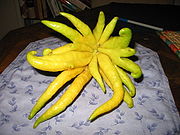 Some citrons have medium-sized oil bubbles at the outer surface, medially distant to each other. Some varieties are ribbed and faintly warted on the outer surface. There is also a fingered citron variety called Buddha's hand
.
The color varies from green, when unripe, to a yellow-orange when overripe. The citron does not fall off the tree and can reach 8–10 pounds (4–5 kg) if not picked before fully mature. However, they should be picked before the winter, as the branches might bend or break to the ground, and may cause numerous fungal diseases for the tree.
or small tree that reaches a height of about 8 to 15 ft (2.4 to 4.6 m). It has irregular straggling branches and stiff twigs and long spines at the leaf
axils. The evergreen leaves are green and lemon-scented with slightly serrate edges, ovate-lanceolate or ovate elliptic 2.5 to 7.0 inches long. Petioles are usually wingless or with minor wings. The flowers are generally unisexual providing self-pollination
, but some male individuals could be found due to pistil abortion. The clustered flowers of the acidic varieties are purplish tinted from outside, but the sweet ones are white-yellowish.
The acid
ic varieties include the Florentine
and Diamante citron
from Italy
, the Greek citron
and the Balady citron
from Israel
. The sweet varieties include the Corsican
and Moroccan citron
s. Between the pulpless are also some fingered varieties and the Yemenite citron
.
The citron tree is very vigorous with almost no dormancy, blooming several times a year, and is therefore fragile and extremely sensitive to frost.
, mandarin
and papeda
.
The citron is believed to be the purest of them all, since it is usually fertilized by self-pollination
, and is therefore generally considered to be a male parent of any citrus hybrid rather than a female one.
Today, authorities agree that all citrus species are native to Southeast Asia
where they are found wild and in an uncultivated form. The story of how they spread to the Mediterranean has been reported by Francesco Calabrese, Henri Chapot, Samuel Tolkowsky, Elizabetta Nicolisi, and others.
The citron could also be native to India
where it borders on Burma, and Pakistan
where it is found in valleys at the foot of the Himalayas
, and in the Indian Western Ghats
. It is thought that by the time of Theophrastus, the citron was mostly cultivated in the Persian Gulf on its way to the Mediterranean basin, where it was cultivated during the later centuries in different areas as described by Erich Isaac. Many mention the role of Alexander the Great and his armies as they attacked Persia and what is today Pakistan
, as being responsible for the spread of the citron westward, reaching the Europe
an countries such as Greece
and Italy
.
The citron is mentioned in the Torah as being required for ritual use during the Feast of Tabernacles (Lev. 23:40). It is considered that the Jews brought it in The Exodus
from Egypt
, where the Egyptologist and archaeologist Victor Loret
found it depicted on the walls of the botanical garden
at the Karnak Temple, which dates back to the time of Thutmosis III.
The opinion that the citron was the forbidden fruit
in the Hesperides
or Eden
does not assist in locating its origin, since the location of the Hesperides is unclear. In any case, there are enough reasons to conclude that it was in the Far East
, for example India
or Yemen
, that the citron is likely to have originated.
. Despite its minor importance today being hardly consumed as picked, it seems that at different times it played a big role in life. We can see that from the way it has been described by numerous writers and poets. It is likely that when the other citrus species became available, citron lost its popularity, since most of its benefits could be found in the lemon, which is much easier to cultivate.
, who called it nata Assyria malus. The following is from his book Natural History.
The citron is a fragrant citrus fruit, botanically classified as Citrus medica by both the Swingle
Walter Tennyson Swingle
Walter Tennyson Swingle was an American agricultural botanist who was born in Canaan, Pennsylvania and moved with his family to Kansas two years later. He graduated from the Kansas State Agricultural College in 1890, and studied in Bonn in 1895-96 and 1898...
and Tanaka
Chōzaburō Tanaka
or often Romanized as Tyôzaburô Tanaka was a Japanese botanist and mycologist. He established one of the two major taxonomic classifications system for citrus and related genera currently in use, and is now considered to be a taxonomic "splitter"...
systems. The designation medica given it by Linnaeus is apparently derived from its ancient name "Median or Persian apple" that was reported by Theophrastus
Theophrastus
Theophrastus , a Greek native of Eresos in Lesbos, was the successor to Aristotle in the Peripatetic school. He came to Athens at a young age, and initially studied in Plato's school. After Plato's death he attached himself to Aristotle. Aristotle bequeathed to Theophrastus his writings, and...
, who believed it to be native to Persia or the land of the Medes
Medes
The MedesThe Medes...
; there is no relation to medicinal uses of the fruit. Theophrastus notes its smooth sharp thorns, like those of a pear
Pear Tree
Pear Tree is an inner city suburb of Derby, England. It is situated next to the areas of Normanton, Rose Hill and Osmaston. Pear Tree could be described as a suburb within a suburb because the people of Derby would identify it as an area in its own right, but it could also be described as forming...
, the very fragrant but inedible 'apple', which keeps moths from clothes, and the fact that "it bears its 'apples' at all season; for when some have been gathered, the flower of others is on the tree and it is ripening others.... This tree, as has been said, grows in Persia and Media." Citron was the first of the citrus fruits to appear in the Mediterranean Basin
Mediterranean Basin
In biogeography, the Mediterranean Basin refers to the lands around the Mediterranean Sea that have a Mediterranean climate, with mild, rainy winters and hot, dry summers, which supports characteristic Mediterranean forests, woodlands, and scrub vegetation...
.
The fruit's name derives ultimately from Latin, and as a result it has many similar names in many European languages, e.g. cederat, cédrat, cedro, etc. This can also be a source of confusion to English speakers, as the word "citron" is a false friend
False friend
False friends are pairs of words or phrases in two languages or dialects that look or sound similar, but differ in meaning....
in Czech
Czech language
Czech is a West Slavic language with about 12 million native speakers; it is the majority language in the Czech Republic and spoken by Czechs worldwide. The language was known as Bohemian in English until the late 19th century...
, Slovak
Slovak language
Slovak , is an Indo-European language that belongs to the West Slavic languages .Slovak is the official language of Slovakia, where it is spoken by 5 million people...
, French
French language
French is a Romance language spoken as a first language in France, the Romandy region in Switzerland, Wallonia and Brussels in Belgium, Monaco, the regions of Quebec and Acadia in Canada, and by various communities elsewhere. Second-language speakers of French are distributed throughout many parts...
, Dutch
Dutch language
Dutch is a West Germanic language and the native language of the majority of the population of the Netherlands, Belgium, and Suriname, the three member states of the Dutch Language Union. Most speakers live in the European Union, where it is a first language for about 23 million and a second...
, German
German language
German is a West Germanic language, related to and classified alongside English and Dutch. With an estimated 90 – 98 million native speakers, German is one of the world's major languages and is the most widely-spoken first language in the European Union....
, Yiddish and Scandinavian
North Germanic languages
The North Germanic languages or Scandinavian languages, the languages of Scandinavians, make up one of the three branches of the Germanic languages, a sub-family of the Indo-European languages, along with the West Germanic languages and the extinct East Germanic languages...
, in which it actually refers to the lemon
Lemon
The lemon is both a small evergreen tree native to Asia, and the tree's ellipsoidal yellow fruit. The fruit is used for culinary and non-culinary purposes throughout the world – primarily for its juice, though the pulp and rind are also used, mainly in cooking and baking...
.
Uses
Succade
Succade is the candied peel of any of the citrus species, especially from the citron or Citrus medica which is distinct with its extra thick peel; in addition, the taste of the inner rind of the citron is less bitter than those of the other citrus...
; Main Article: Etrog
Etrog
Etrog refers to the yellow citron or Citrus medica used by Jews on the week-long holiday of Sukkot.While in modern Hebrew this is the name for any variety of citron, its English usage applies to those varieties and specimens used as one of the Four Species...
The citron is unlike the more common citrus species, such as the lemon
Lemon
The lemon is both a small evergreen tree native to Asia, and the tree's ellipsoidal yellow fruit. The fruit is used for culinary and non-culinary purposes throughout the world – primarily for its juice, though the pulp and rind are also used, mainly in cooking and baking...
or orange
Orange (fruit)
An orange—specifically, the sweet orange—is the citrus Citrus × sinensis and its fruit. It is the most commonly grown tree fruit in the world....
. While those more popular fruits are peeled to consume their pulpy and juicy
Juice
Juice is the liquid that is naturally contained in fruit or vegetable tissue.Juice is prepared by mechanically squeezing or macerating fruit or vegetable flesh without the application of heat or solvents. For example, orange juice is the liquid extract of the fruit of the orange tree...
segments, the citron's pulp is dry, containing a small quantity of insipid juice, if any. The main content of a citron fruit is the thick white rind, which adheres to the segments, and cannot be separated from them easily.
Thus, from ancient through medieval times, the citron was used mainly for medical purposes: to combat seasickness, pulmonary troubles, intestinal
Intestine
In human anatomy, the intestine is the segment of the alimentary canal extending from the pyloric sphincter of the stomach to the anus and, in humans and other mammals, consists of two segments, the small intestine and the large intestine...
ailments, and other disorders. The essential oil
Essential oil
An essential oil is a concentrated hydrophobic liquid containing volatile aroma compounds from plants. Essential oils are also known as volatile oils, ethereal oils or aetherolea, or simply as the "oil of" the plant from which they were extracted, such as oil of clove...
of the flavedo (the outermost, pigmented layer of rind) was also regarded as an antibiotic
Antibiotic
An antibacterial is a compound or substance that kills or slows down the growth of bacteria.The term is often used synonymously with the term antibiotic; today, however, with increased knowledge of the causative agents of various infectious diseases, antibiotic has come to denote a broader range of...
. Citron juice with wine
Wine
Wine is an alcoholic beverage, made of fermented fruit juice, usually from grapes. The natural chemical balance of grapes lets them ferment without the addition of sugars, acids, enzymes, or other nutrients. Grape wine is produced by fermenting crushed grapes using various types of yeast. Yeast...
was considered an effective antidote
Antidote
An antidote is a substance which can counteract a form of poisoning. The term ultimately derives from the Greek αντιδιδοναι antididonai, "given against"....
to poison
Poison
In the context of biology, poisons are substances that can cause disturbances to organisms, usually by chemical reaction or other activity on the molecular scale, when a sufficient quantity is absorbed by an organism....
, as Theophrastus reported.
Today the citron is used for the fragrance or zest
Zest (ingredient)
Zest is a food ingredient that is prepared by scraping or cutting from the outer, colorful skin of citrus fruits such as lemon, orange, citron, and lime. Zest is used to add flavor to foods....
of its flavedo, but the most important part is still the inner rind (known as pith
Pith
Pith, or medulla, is a tissue in the stems of vascular plants. Pith is composed of soft, spongy parenchyma cells, which store and transport nutrients throughout the plant. In eudicots, pith is located in the center of the stem. In monocots, it extends also into flowering stems and roots...
or albedo), which is a fairly important article in international trade
International trade
International trade is the exchange of capital, goods, and services across international borders or territories. In most countries, such trade represents a significant share of gross domestic product...
and is widely employed in the food industry as succade
Succade
Succade is the candied peel of any of the citrus species, especially from the citron or Citrus medica which is distinct with its extra thick peel; in addition, the taste of the inner rind of the citron is less bitter than those of the other citrus...
, as it is known when it is candied in sugar
Sugar
Sugar is a class of edible crystalline carbohydrates, mainly sucrose, lactose, and fructose, characterized by a sweet flavor.Sucrose in its refined form primarily comes from sugar cane and sugar beet...
. There is a rising market for the citron in the United States
United States
The United States of America is a federal constitutional republic comprising fifty states and a federal district...
for the use of its soluble fiber found in its thick albedo.
The citron is also used by Jews (the word for it in Hebrew is etrog
Etrog
Etrog refers to the yellow citron or Citrus medica used by Jews on the week-long holiday of Sukkot.While in modern Hebrew this is the name for any variety of citron, its English usage applies to those varieties and specimens used as one of the Four Species...
) for a religious ritual
Ritual
A ritual is a set of actions, performed mainly for their symbolic value. It may be prescribed by a religion or by the traditions of a community. The term usually excludes actions which are arbitrarily chosen by the performers....
during the Feast of Tabernacles; therefore is considered as a Jewish symbol, and is found on various Hebrew antiques and archeological findings. Citrons used for ritual purposes cannot be grown by grafting branches.
In Iran, the citron's thick white rind is used to make jam; in Pakistan
Pakistan
Pakistan , officially the Islamic Republic of Pakistan is a sovereign state in South Asia. It has a coastline along the Arabian Sea and the Gulf of Oman in the south and is bordered by Afghanistan and Iran in the west, India in the east and China in the far northeast. In the north, Tajikistan...
the fruit is used to make jam as well as pickled; in South Indian cuisine
South Indian cuisine
South Indian Cuisine is a term used to refer to the cuisines found in the four southern states of India: Andhra Pradesh, Karnataka, Kerala and Tamil Nadu.-Similarities and differences in "Four states' cuisines":...
, the citron is widely used in pickles and preserves.
In Korea
Korea
Korea ) is an East Asian geographic region that is currently divided into two separate sovereign states — North Korea and South Korea. Located on the Korean Peninsula, Korea is bordered by the People's Republic of China to the northwest, Russia to the northeast, and is separated from Japan to the...
, it is used to create yujacha
Yujacha
Yujacha or yuja cha is a traditional Korean tea made from citron. Yuja fruit is thinly sliced with its peel and combined with honey or sugar, prepared as fruit preserves...
, a type of Korean tea
Korean tea
Korean tea refers to various types of tisane that can be served hot or cold. Not necessarily related to "common" tea, they are made from diverse substances including fruits, leaves, roots, and grains used in traditional Korean medicine....
. The fruit is thinly sliced (peel, pith and pulp) and soaked or cooked in honey or sugar to create a chunky syrup. This syrupy candied fruit is mixed with hot water as a fragrant tea, where the fruit at the bottom of the cup is eaten as well. Often preserved in the syrup for the cold months, yujacha is served as a source of fruit in winter. It is also popular in Taiwan
Taiwan
Taiwan , also known, especially in the past, as Formosa , is the largest island of the same-named island group of East Asia in the western Pacific Ocean and located off the southeastern coast of mainland China. The island forms over 99% of the current territory of the Republic of China following...
and Japan
Japan
Japan is an island nation in East Asia. Located in the Pacific Ocean, it lies to the east of the Sea of Japan, China, North Korea, South Korea and Russia, stretching from the Sea of Okhotsk in the north to the East China Sea and Taiwan in the south...
, where it is known by its Chinese/Japanese name 柚子茶 (Pinyin: youzi cha, Japanese: yuzucha).
Fruit
The citron fruit is usually ovate or oblong, narrowing towards the stylar end. However, the citron's fruit shape is highly variable, due to the large quantity of albedo, which forms independently according to the fruits' position on the tree, twig orientation, and many other factors. The rind is leathery, furrowed, and adherent. The inner portion is thick, white and fleshy; the outer is uniformly thin and very fragrant. The pulp is usually acidic, but also can be sweet, and even pulpless varieties are found.Most citron varieties contain a large number of monoembryonic seeds. They are white, with dark innercoats and red-purplish chalazal spots for the acidic varieties, and colorless for the sweet ones. Some citron varieties are also distinct, having persistent styles, that do not fall off after fecundation. Those are usually promoted for etrog
Etrog
Etrog refers to the yellow citron or Citrus medica used by Jews on the week-long holiday of Sukkot.While in modern Hebrew this is the name for any variety of citron, its English usage applies to those varieties and specimens used as one of the Four Species...
use.
Buddha's hand
Buddha's hand, Citrus medica var. sarcodactylis , is a fragrant citron variety whose fruit is segmented into finger-like sections. The origin of Buddha's hand plant is traced back to Northeastern India or China.-Description:Citrus medica var...
.
The color varies from green, when unripe, to a yellow-orange when overripe. The citron does not fall off the tree and can reach 8–10 pounds (4–5 kg) if not picked before fully mature. However, they should be picked before the winter, as the branches might bend or break to the ground, and may cause numerous fungal diseases for the tree.
Plant
Citrus medica is a slow-growing shrubShrub
A shrub or bush is distinguished from a tree by its multiple stems and shorter height, usually under 5–6 m tall. A large number of plants may become either shrubs or trees, depending on the growing conditions they experience...
or small tree that reaches a height of about 8 to 15 ft (2.4 to 4.6 m). It has irregular straggling branches and stiff twigs and long spines at the leaf
Leaf
A leaf is an organ of a vascular plant, as defined in botanical terms, and in particular in plant morphology. Foliage is a mass noun that refers to leaves as a feature of plants....
axils. The evergreen leaves are green and lemon-scented with slightly serrate edges, ovate-lanceolate or ovate elliptic 2.5 to 7.0 inches long. Petioles are usually wingless or with minor wings. The flowers are generally unisexual providing self-pollination
Self-pollination
Self-pollination is a form of pollination that can occur when a flower has both stamen and a carpel in which the cultivar or species is self fertile and the stamens and the sticky stigma of the carpel contact each other in order to accomplish pollination...
, but some male individuals could be found due to pistil abortion. The clustered flowers of the acidic varieties are purplish tinted from outside, but the sweet ones are white-yellowish.
The acid
Acid
An acid is a substance which reacts with a base. Commonly, acids can be identified as tasting sour, reacting with metals such as calcium, and bases like sodium carbonate. Aqueous acids have a pH of less than 7, where an acid of lower pH is typically stronger, and turn blue litmus paper red...
ic varieties include the Florentine
Florentine citron
The citron of Florence is a very fragrant citrus fruit, which is named after its most known origin of cultivation.-History:It was first carefully described by Johann Christoph Volkamer in his Hesperides as well as by others....
and Diamante citron
Diamante citron
The Diamante citron is a variety of citron named after the city of Diamante which is its most known cultivation point. Diamante is located in the province of Cosenza, Calabria, on the south-western coast of Italy...
from Italy
Italy
Italy , officially the Italian Republic languages]] under the European Charter for Regional or Minority Languages. In each of these, Italy's official name is as follows:;;;;;;;;), is a unitary parliamentary republic in South-Central Europe. To the north it borders France, Switzerland, Austria and...
, the Greek citron
Greek citron
The Greek citron variety of citrus medica was botanically classified by Adolf Engler as the "variety etrog". This is remarking on its major use for the Jewish ritual during Sukkot, due to its supposedly extraordinary natural beauty. It was also called Pitima, or the Cedro - Citron with a Pigolo -...
and the Balady citron
Balady citron
Balady Citron , is a variety of citron, or etrog, grown in Israel for Jewish ritual purposes. Balady is Arabic for "native." Local Arab farmers began using this name in the mid-19th century to distinguish this variety from the Greek citron, which was cultivated along the Jaffa seashore.The Balady...
from Israel
Israel
The State of Israel is a parliamentary republic located in the Middle East, along the eastern shore of the Mediterranean Sea...
. The sweet varieties include the Corsican
Corsican citron
The Corsican citron is a sweet pulp citron, which was traditionally one of the most important varieties employed in Succade production. The name is from its most original cultivation center which is even today, at the French Island of Corsica or Corse...
and Moroccan citron
Moroccan citron
The Moroccan sweet citron was first described in detail by Professor Henri Chapot, in his article named Un curieux cedrat Marocain . He discovered that the acidity in the more common citrons or lemons, is represented by violet pigmentation on the outer side of the flower blossom, and also by the...
s. Between the pulpless are also some fingered varieties and the Yemenite citron
Yemenite citron
The Yemenite citron is a distinct variety, usually containing no juice vesicles in its fruit's segments. The bearing tree is fairly bigger than the trees of the different varieties of citron, and the fruit's albedo is notably juicier.- Classification :...
.
The citron tree is very vigorous with almost no dormancy, blooming several times a year, and is therefore fragile and extremely sensitive to frost.
Origin and distribution
Despite the variation among the cultivars, authorities agree the citron is an old and original species. There is molecular evidence that all other cultivated citrus species arose by hybridization among the ancestral types, which are the citron, pomeloPomelo
The pomelo is a citrus fruit native to Southeast Asia. It is usually pale green to yellow when ripe, with sweet white flesh and very thick albedo . It is the largest citrus fruit, 15–25 cm in diameter, and usually weighing 1–2 kg...
, mandarin
Mandarin orange
The orange, also known as the ' or mandarine , is a small citrus tree with fruit resembling other oranges. Mandarin oranges are usually eaten plain or in fruit salads...
and papeda
Citrus subg. Papeda
Citrus subg. Papeda indicates the subgenus Papeda of the genus Citrus, with citrus species native to Asia.The papeda group includes some of the most tropical, and also some of the most frost-tolerant citrus plants. They are cultivated far less often than other citrus, though they will all...
.
The citron is believed to be the purest of them all, since it is usually fertilized by self-pollination
Self-pollination
Self-pollination is a form of pollination that can occur when a flower has both stamen and a carpel in which the cultivar or species is self fertile and the stamens and the sticky stigma of the carpel contact each other in order to accomplish pollination...
, and is therefore generally considered to be a male parent of any citrus hybrid rather than a female one.
Today, authorities agree that all citrus species are native to Southeast Asia
Asia
Asia is the world's largest and most populous continent, located primarily in the eastern and northern hemispheres. It covers 8.7% of the Earth's total surface area and with approximately 3.879 billion people, it hosts 60% of the world's current human population...
where they are found wild and in an uncultivated form. The story of how they spread to the Mediterranean has been reported by Francesco Calabrese, Henri Chapot, Samuel Tolkowsky, Elizabetta Nicolisi, and others.
The citron could also be native to India
India
India , officially the Republic of India , is a country in South Asia. It is the seventh-largest country by geographical area, the second-most populous country with over 1.2 billion people, and the most populous democracy in the world...
where it borders on Burma, and Pakistan
Pakistan
Pakistan , officially the Islamic Republic of Pakistan is a sovereign state in South Asia. It has a coastline along the Arabian Sea and the Gulf of Oman in the south and is bordered by Afghanistan and Iran in the west, India in the east and China in the far northeast. In the north, Tajikistan...
where it is found in valleys at the foot of the Himalayas
Himalayas
The Himalaya Range or Himalaya Mountains Sanskrit: Devanagari: हिमालय, literally "abode of snow"), usually called the Himalayas or Himalaya for short, is a mountain range in Asia, separating the Indian subcontinent from the Tibetan Plateau...
, and in the Indian Western Ghats
Western Ghats
The Western Ghats, Western Ghauts or the Sahyādri is a mountain range along the western side of India. It runs north to south along the western edge of the Deccan Plateau, and separates the plateau from a narrow coastal plain along the Arabian Sea. The Western Ghats block rainfall to the Deccan...
. It is thought that by the time of Theophrastus, the citron was mostly cultivated in the Persian Gulf on its way to the Mediterranean basin, where it was cultivated during the later centuries in different areas as described by Erich Isaac. Many mention the role of Alexander the Great and his armies as they attacked Persia and what is today Pakistan
Pakistan
Pakistan , officially the Islamic Republic of Pakistan is a sovereign state in South Asia. It has a coastline along the Arabian Sea and the Gulf of Oman in the south and is bordered by Afghanistan and Iran in the west, India in the east and China in the far northeast. In the north, Tajikistan...
, as being responsible for the spread of the citron westward, reaching the Europe
Europe
Europe is, by convention, one of the world's seven continents. Comprising the westernmost peninsula of Eurasia, Europe is generally 'divided' from Asia to its east by the watershed divides of the Ural and Caucasus Mountains, the Ural River, the Caspian and Black Seas, and the waterways connecting...
an countries such as Greece
Greek citron
The Greek citron variety of citrus medica was botanically classified by Adolf Engler as the "variety etrog". This is remarking on its major use for the Jewish ritual during Sukkot, due to its supposedly extraordinary natural beauty. It was also called Pitima, or the Cedro - Citron with a Pigolo -...
and Italy
Diamante citron
The Diamante citron is a variety of citron named after the city of Diamante which is its most known cultivation point. Diamante is located in the province of Cosenza, Calabria, on the south-western coast of Italy...
.
The citron is mentioned in the Torah as being required for ritual use during the Feast of Tabernacles (Lev. 23:40). It is considered that the Jews brought it in The Exodus
The Exodus
The Exodus is the story of the departure of the Israelites from ancient Egypt described in the Hebrew Bible.Narrowly defined, the term refers only to the departure from Egypt described in the Book of Exodus; more widely, it takes in the subsequent law-givings and wanderings in the wilderness...
from Egypt
Egypt
Egypt , officially the Arab Republic of Egypt, Arabic: , is a country mainly in North Africa, with the Sinai Peninsula forming a land bridge in Southwest Asia. Egypt is thus a transcontinental country, and a major power in Africa, the Mediterranean Basin, the Middle East and the Muslim world...
, where the Egyptologist and archaeologist Victor Loret
Victor Loret
Victor Clement Georges Philippe Loret was a French Egyptologist.-Biography:Loret studied with Gaston Maspero at the École des Hautes Études. In 1897 he became the head of the Egyptian Antiquities Service. In March 1898, he discovered KV35, the tomb of Amenhotep II in the Valley of the Kings...
found it depicted on the walls of the botanical garden
Botanical garden
A botanical garden The terms botanic and botanical, and garden or gardens are used more-or-less interchangeably, although the word botanic is generally reserved for the earlier, more traditional gardens. is a well-tended area displaying a wide range of plants labelled with their botanical names...
at the Karnak Temple, which dates back to the time of Thutmosis III.
The opinion that the citron was the forbidden fruit
Forbidden fruit
Forbidden fruit is any object of desire whose appeal is a direct result of knowledge that cannot or should not be obtained or something that someone may want but is forbidden to have....
in the Hesperides
Hesperides
In Greek mythology, the Hesperides are nymphs who tend a blissful garden in a far western corner of the world, located near the Atlas mountains in North Africa at the edge of the encircling Oceanus, the world-ocean....
or Eden
Garden of Eden
The Garden of Eden is in the Bible's Book of Genesis as being the place where the first man, Adam, and his wife, Eve, lived after they were created by God. Literally, the Bible speaks about a garden in Eden...
does not assist in locating its origin, since the location of the Hesperides is unclear. In any case, there are enough reasons to conclude that it was in the Far East
Far East
The Far East is an English term mostly describing East Asia and Southeast Asia, with South Asia sometimes also included for economic and cultural reasons.The term came into use in European geopolitical discourse in the 19th century,...
, for example India
India
India , officially the Republic of India , is a country in South Asia. It is the seventh-largest country by geographical area, the second-most populous country with over 1.2 billion people, and the most populous democracy in the world...
or Yemen
Yemen
The Republic of Yemen , commonly known as Yemen , is a country located in the Middle East, occupying the southwestern to southern end of the Arabian Peninsula. It is bordered by Saudi Arabia to the north, the Red Sea to the west, and Oman to the east....
, that the citron is likely to have originated.
The citron in antiquity
The citron has been cultivated since ancient times, predating the cultivation of other citrus speciesSpecies
In biology, a species is one of the basic units of biological classification and a taxonomic rank. A species is often defined as a group of organisms capable of interbreeding and producing fertile offspring. While in many cases this definition is adequate, more precise or differing measures are...
. Despite its minor importance today being hardly consumed as picked, it seems that at different times it played a big role in life. We can see that from the way it has been described by numerous writers and poets. It is likely that when the other citrus species became available, citron lost its popularity, since most of its benefits could be found in the lemon, which is much easier to cultivate.
Theophrastus
The following is from the writings of TheophrastusTheophrastus
Theophrastus , a Greek native of Eresos in Lesbos, was the successor to Aristotle in the Peripatetic school. He came to Athens at a young age, and initially studied in Plato's school. After Plato's death he attached himself to Aristotle. Aristotle bequeathed to Theophrastus his writings, and...
Pliny the Elder
About 400 years later it was also described by Pliny the ElderPliny the Elder
Gaius Plinius Secundus , better known as Pliny the Elder, was a Roman author, naturalist, and natural philosopher, as well as naval and army commander of the early Roman Empire, and personal friend of the emperor Vespasian...
, who called it nata Assyria malus. The following is from his book Natural History.