

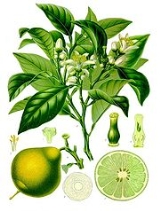
Bergamot orange

Encyclopedia
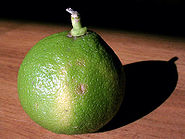
Citrus bergamia, the Bergamot orange, is a fragrant fruit the size of an orange
, with a yellow colour similar to a lemon
. Genetic research into the ancestral origins of extant citrus cultivars recently matched the bergamot as a likely hybrid of Citrus limetta
and Citrus aurantium
. Citrus bergamot is a native hybrid of and commercially grown in Calabria
, southern Italy
, where more than 80% are found. It is also grown in southern France
and in Côte d'Ivoire
for the essential oil
. The fruit is not grown for juice consumption.
s during the winter. The juice tastes less sour than lemon, but more bitter than grapefruit
. The distinctive aroma of the bergamot is most commonly known for its use in Earl Grey tea
. The juice of the fruit has also been used in Calabrian indigenous medicine
to treat malaria
, and its essential oil
is popular in aromatherapy
applications.
The bergamot orange is unrelated to the herbs of the same name, Monarda didyma
and Monarda fistulosa
, which are in the mint family. The active ingredients in bergamot juice are neoeriocitrin, naringin
, neohesperidin, ponceritin, melitidin, and brutieridin. Melitidin and brutieridin, only recently discovered, exist only in citrus bergamot, and exhibit statin-like properties. Synephrine
is not present in citrus bergamot.
Citrus bergamia has also been classified as Citrus aurantium subsp. bergamia (i.e. a subspecies of bitter orange
).
Citrus bergamia is sometimes confused with (but is not the same as) Citrus medica
(citron, the yellow fruit of which is also known as etrog
).
 Production mostly is limited to the Ionian Sea
coastal areas of the province of Reggio Calabria
in Italy
, to such an extent that it is a symbol of the entire city. Most of the bergamot comes from a short stretch of land there where the temperature is favourable. It is also cultivated in Ivory Coast, but the quality of the obtained essence is not comparable with the essence produced from the bergamots of Reggio Calabria due to the argillite
, limestone
and alluvial deposits found there.
Adulteration with cheaper products such as oil of rosewood
has been a problem for consumers. To protect the reputation of their produce, the Italian government introduced tight controls, including testing and certificates of purity. During World War II, Italy was unable to export to countries such as the Allied powers
. Rival products from Brazil and Mexico came on to the market as a substitute, but these were produced from other citrus fruits such as sweet lime.
and Lady Grey
tea
s, and confectionery
. An Italian food manufacturer, Caffé Sicilia in Noto
, Syracuse
, Sicily
, produces a commercial marmalade
using the fruit as its principal ingredient. It is also popular in Turkey, Greece and Cyprus as a preserve, made with bergamot peel boiled in sugar syrup. In Sweden and Norway, bergamot is a very common flavorant in snus
, a smokeless tobacco product. Likewise in dry nasal snuff
it is also a common aroma in traditional blends.
The actual fruit of the bergamot orange itself is not known to be edible.
composed by Farina at the beginning of 18th century Germany
. The first record of bergamot oil as fragrance ingredient is 1714, to be found in the Farina Archive in Cologne
. One hundred bergamot oranges will yield about three ounces of bergamot oil.
Bergamot peel is also used in aromatherapy
to treat depression
and as a digestive aid.
in vegetable gardens.
effect of increasing redness after exposure to ultraviolet
light (due to the chemical bergapten
, and possibly also citropten, bergamottin
, geranial, and neral
). This is a property shared by many other citrus fruits. Bergapten has also been implicated as a potassium channel
blocker; in one case study, a patient who consumed four liters of Earl Grey tea per day suffered muscle cramps.
Bergamot is also a source of bergamottin
which, along with the chemically related compound 6’,7’-dihydroxybergamottin, is believed to be responsible for the grapefruit juice effect in which the consumption of the juice affects the metabolism of a variety of pharmaceutical drugs.
In the past, psoralen
extracted from bergamot oil has been used in tanning accelerators and sunscreen
s. Psoralens penetrate the skin, where they increase the amount of direct DNA damage
. This damage is responsible for sunburn and for an increased melanin production. It can also lead to phytophotodermatitis
, a darkening of the skin as a result of a chemical reaction that makes the skin extra sensitive to ultraviolet
light.
These substances were known to be photocarcinogen
ic since 1959,
but they were only banned from sunscreens in 1995. These photocarcinogenic substances were banned years after they had caused many cases of malignant melanoma and deaths.
Psoralen is now used only in the treatment of certain skin disorders, as part of PUVA
therapy.
Bergapten
and citropten are strong inhibitors of IL-8
expression and may have potential to reduce lung inflammation in people with Cystic fibrosis
.
Citropten and bergapten are powerful inducers of differentiation and γ-globin gene expression in human erythroid cells, a potential therapeutic approach in hematological disorders, including β-thalassemia and sickle cell anemia.
Peel waste from oil extraction contains pectins and flavonoids a potential source of natural antioxidant/anti-inflammatory phytochemicals.
activity.
Orange (fruit)
An orange—specifically, the sweet orange—is the citrus Citrus × sinensis and its fruit. It is the most commonly grown tree fruit in the world....
, with a yellow colour similar to a lemon
Lemon
The lemon is both a small evergreen tree native to Asia, and the tree's ellipsoidal yellow fruit. The fruit is used for culinary and non-culinary purposes throughout the world – primarily for its juice, though the pulp and rind are also used, mainly in cooking and baking...
. Genetic research into the ancestral origins of extant citrus cultivars recently matched the bergamot as a likely hybrid of Citrus limetta
Citrus limetta
Citrus limetta is a species of citrus. Common names for varieties of this species include sweet limetta, Mediterranean sweet lemon, sweet lemon, and sweet lime. In Iran it is called Limu Shirin لیمو شیرین...
and Citrus aurantium
Bitter orange
The name "bitter orange", also known as Seville orange, sour orange, bigarade orange, and marmalade orange, refers to a citrus tree and its fruit. Many varieties of bitter orange are used for their essential oil, which is used in perfume and as a flavoring...
. Citrus bergamot is a native hybrid of and commercially grown in Calabria
Calabria
Calabria , in antiquity known as Bruttium, is a region in southern Italy, south of Naples, located at the "toe" of the Italian Peninsula. The capital city of Calabria is Catanzaro....
, southern Italy
Italy
Italy , officially the Italian Republic languages]] under the European Charter for Regional or Minority Languages. In each of these, Italy's official name is as follows:;;;;;;;;), is a unitary parliamentary republic in South-Central Europe. To the north it borders France, Switzerland, Austria and...
, where more than 80% are found. It is also grown in southern France
France
The French Republic , The French Republic , The French Republic , (commonly known as France , is a unitary semi-presidential republic in Western Europe with several overseas territories and islands located on other continents and in the Indian, Pacific, and Atlantic oceans. Metropolitan France...
and in Côte d'Ivoire
Côte d'Ivoire
The Republic of Côte d'Ivoire or Ivory Coast is a country in West Africa. It has an area of , and borders the countries Liberia, Guinea, Mali, Burkina Faso and Ghana; its southern boundary is along the Gulf of Guinea. The country's population was 15,366,672 in 1998 and was estimated to be...
for the essential oil
Essential oil
An essential oil is a concentrated hydrophobic liquid containing volatile aroma compounds from plants. Essential oils are also known as volatile oils, ethereal oils or aetherolea, or simply as the "oil of" the plant from which they were extracted, such as oil of clove...
. The fruit is not grown for juice consumption.
Description
Citrus bergamia is a small tree which blossomBlossom
In botany, blossom is a term given to the flowers of stone fruit trees and of some other plants with a similar appearance that flower profusely for a period of time in spring...
s during the winter. The juice tastes less sour than lemon, but more bitter than grapefruit
Grapefruit
The grapefruit , is a subtropical citrus tree known for its sour fruit, an 18th-century hybrid first bred in Barbados. When found, it was named the "forbidden fruit"; it has also been misidentified with the pomelo or shaddock , one of the parents of this hybrid, the other being sweet orange The...
. The distinctive aroma of the bergamot is most commonly known for its use in Earl Grey tea
Earl Grey tea
Earl Grey tea is a tea blend with a distinctive flavour and aroma derived from the addition of oil extracted from the rind of the bergamot orange, a fragrant citrus fruit....
. The juice of the fruit has also been used in Calabrian indigenous medicine
Traditional medicine
Traditional medicine comprises unscientific knowledge systems that developed over generations within various societies before the era of modern medicine...
to treat malaria
Malaria
Malaria is a mosquito-borne infectious disease of humans and other animals caused by eukaryotic protists of the genus Plasmodium. The disease results from the multiplication of Plasmodium parasites within red blood cells, causing symptoms that typically include fever and headache, in severe cases...
, and its essential oil
Essential oil
An essential oil is a concentrated hydrophobic liquid containing volatile aroma compounds from plants. Essential oils are also known as volatile oils, ethereal oils or aetherolea, or simply as the "oil of" the plant from which they were extracted, such as oil of clove...
is popular in aromatherapy
Aromatherapy
Aromatherapy is a form of alternative medicine that uses volatile plant materials, known as essential oils, and other aromatic compounds for the purpose of altering a person's mind, mood, cognitive function or health....
applications.
The bergamot orange is unrelated to the herbs of the same name, Monarda didyma
Monarda didyma
Monarda didyma is an aromatic herb in the family Lamiaceae, native to eastern North America from Maine west to Ohio and south to northern Georgia. Its name is derived from its odor, which is considered similar to that of the bergamot orange...
and Monarda fistulosa
Monarda fistulosa
Wild bergamot or Bee Balm is a wildflower in the mint family widespread and abundant as a native plant in much of North America. This plant, with showy summer-blooming white flowers, is often used as a honey plant, medicinal plant, and garden ornamental...
, which are in the mint family. The active ingredients in bergamot juice are neoeriocitrin, naringin
Naringin
Naringin is a flavanone glycoside. It is a major flavonoid in grapefruit and gives the grapefruit juice its bitter taste. It is metabolized to the flavanone naringenin in humans...
, neohesperidin, ponceritin, melitidin, and brutieridin. Melitidin and brutieridin, only recently discovered, exist only in citrus bergamot, and exhibit statin-like properties. Synephrine
Synephrine
Synephrine is a drug commonly used for weight loss. While its effectiveness is widely debated, synephrine has gained significant popularity as an alternative to ephedrine, a related substance which has been made illegal or restricted in many countries due to health risks and its use as a precursor...
is not present in citrus bergamot.
Citrus bergamia has also been classified as Citrus aurantium subsp. bergamia (i.e. a subspecies of bitter orange
Bitter orange
The name "bitter orange", also known as Seville orange, sour orange, bigarade orange, and marmalade orange, refers to a citrus tree and its fruit. Many varieties of bitter orange are used for their essential oil, which is used in perfume and as a flavoring...
).
Citrus bergamia is sometimes confused with (but is not the same as) Citrus medica
Citron
Not to be confused with Cintron.The citron is a fragrant citrus fruit, botanically classified as Citrus medica by both the Swingle and Tanaka systems...
(citron, the yellow fruit of which is also known as etrog
Etrog
Etrog refers to the yellow citron or Citrus medica used by Jews on the week-long holiday of Sukkot.While in modern Hebrew this is the name for any variety of citron, its English usage applies to those varieties and specimens used as one of the Four Species...
).
Production
Ionian Sea
The Ionian Sea , is an arm of the Mediterranean Sea, south of the Adriatic Sea. It is bounded by southern Italy including Calabria, Sicily and the Salento peninsula to the west, southern Albania to the north, and a large number of Greek islands, including Corfu, Zante, Kephalonia, Ithaka, and...
coastal areas of the province of Reggio Calabria
Reggio Calabria
Reggio di Calabria , commonly known as Reggio Calabria or Reggio, is the biggest city and the most populated comune of Calabria, southern Italy, and is the capital of the Province of Reggio Calabria and seat of the Council of Calabrian government.Reggio is located on the "toe" of the Italian...
in Italy
Italy
Italy , officially the Italian Republic languages]] under the European Charter for Regional or Minority Languages. In each of these, Italy's official name is as follows:;;;;;;;;), is a unitary parliamentary republic in South-Central Europe. To the north it borders France, Switzerland, Austria and...
, to such an extent that it is a symbol of the entire city. Most of the bergamot comes from a short stretch of land there where the temperature is favourable. It is also cultivated in Ivory Coast, but the quality of the obtained essence is not comparable with the essence produced from the bergamots of Reggio Calabria due to the argillite
Argillite
An argillite is a fine-grained sedimentary rock composed predominantly of indurated clay particles. Argillaceous rocks are basically lithified muds and oozes. They contain variable amounts of silt-sized particles. The argillites grade into shale when the fissile layering typical of shale is...
, limestone
Limestone
Limestone is a sedimentary rock composed largely of the minerals calcite and aragonite, which are different crystal forms of calcium carbonate . Many limestones are composed from skeletal fragments of marine organisms such as coral or foraminifera....
and alluvial deposits found there.
Adulteration with cheaper products such as oil of rosewood
Rosewood
Rosewood refers to any of a number of richly hued timbers, often brownish with darker veining, but found in many different hues. All rosewoods are strong and heavy, taking an excellent polish, being suitable for guitars, marimbas, turnery , handles, furniture, luxury flooring, etc.In general,...
has been a problem for consumers. To protect the reputation of their produce, the Italian government introduced tight controls, including testing and certificates of purity. During World War II, Italy was unable to export to countries such as the Allied powers
Allies of World War II
The Allies of World War II were the countries that opposed the Axis powers during the Second World War . Former Axis states contributing to the Allied victory are not considered Allied states...
. Rival products from Brazil and Mexico came on to the market as a substitute, but these were produced from other citrus fruits such as sweet lime.
In food
An essence extracted from the aromatic skin of this sour fruit is used to flavour Earl GreyEarl Grey tea
Earl Grey tea is a tea blend with a distinctive flavour and aroma derived from the addition of oil extracted from the rind of the bergamot orange, a fragrant citrus fruit....
and Lady Grey
Lady Grey (tea)
Lady Grey tea is a delicate, fragrant variation on the more famous Earl Grey blend. It consists of black tea scented with oil of bergamot, lemon peel and orange peel....
tea
Tea
Tea is an aromatic beverage prepared by adding cured leaves of the Camellia sinensis plant to hot water. The term also refers to the plant itself. After water, tea is the most widely consumed beverage in the world...
s, and confectionery
Confectionery
Confectionery is the set of food items that are rich in sugar, any one or type of which is called a confection. Modern usage may include substances rich in artificial sweeteners as well...
. An Italian food manufacturer, Caffé Sicilia in Noto
Noto
Noto is a city and comune in the Province of Syracuse, Sicily . Its located 32 km southwest of the city of Syracuse at the foot of the Iblean Mountains and gives its name to the surrounding valley, Val di Noto...
, Syracuse
Province of Syracuse
The Province of Syracuse is a province in the autonomous island region of Sicily in Italy. Its capital is the city of Syracuse.It has an area of 2,109 km², and a total population of 396,167 ....
, Sicily
Sicily
Sicily is a region of Italy, and is the largest island in the Mediterranean Sea. Along with the surrounding minor islands, it constitutes an autonomous region of Italy, the Regione Autonoma Siciliana Sicily has a rich and unique culture, especially with regard to the arts, music, literature,...
, produces a commercial marmalade
Marmalade
Marmalade is a fruit preserve made from the juice and peel of citrus fruits, boiled with sugar and water. The benchmark citrus fruit for marmalade production in Britain is the "Seville orange" from Spain, Citrus aurantium var...
using the fruit as its principal ingredient. It is also popular in Turkey, Greece and Cyprus as a preserve, made with bergamot peel boiled in sugar syrup. In Sweden and Norway, bergamot is a very common flavorant in snus
Snus
Snus , or Swedish snuff, is a moist powder tobacco product originated from a variant of dry snuff in the early 19th century in Sweden, consumed by placing it under the lip for extended periods of time. The precursor of snus, the dry form of snuff inhaled through the nose, was introduced in Europe...
, a smokeless tobacco product. Likewise in dry nasal snuff
Snuff
Snuff is a product made from ground or pulverised tobacco leaves. It is an example of smokeless tobacco. It originated in the Americas and was in common use in Europe by the 17th century...
it is also a common aroma in traditional blends.
The actual fruit of the bergamot orange itself is not known to be edible.
As a fragrance
Bergamot peel is used in perfumery for its ability to combine with an array of scents to form a bouquet of aromas which complement each other. Approximately one third of all men's and about half of women’s perfumes contain bergamot essential oil. Bergamot is a major component of the original Eau de CologneEau de Cologne
Eau de Cologne or simply Cologne is a toiletry, a perfume in a style that originated from Cologne, Germany. It is nowadays a generic term for scented formulations in typical concentration of 2-5% essential oils. However as of today cologne is a blend of extracts, alcohol, and water...
composed by Farina at the beginning of 18th century Germany
Germany
Germany , officially the Federal Republic of Germany , is a federal parliamentary republic in Europe. The country consists of 16 states while the capital and largest city is Berlin. Germany covers an area of 357,021 km2 and has a largely temperate seasonal climate...
. The first record of bergamot oil as fragrance ingredient is 1714, to be found in the Farina Archive in Cologne
Cologne
Cologne is Germany's fourth-largest city , and is the largest city both in the Germany Federal State of North Rhine-Westphalia and within the Rhine-Ruhr Metropolitan Area, one of the major European metropolitan areas with more than ten million inhabitants.Cologne is located on both sides of the...
. One hundred bergamot oranges will yield about three ounces of bergamot oil.
Bergamot peel is also used in aromatherapy
Aromatherapy
Aromatherapy is a form of alternative medicine that uses volatile plant materials, known as essential oils, and other aromatic compounds for the purpose of altering a person's mind, mood, cognitive function or health....
to treat depression
Depression (mood)
Depression is a state of low mood and aversion to activity that can affect a person's thoughts, behaviour, feelings and physical well-being. Depressed people may feel sad, anxious, empty, hopeless, helpless, worthless, guilty, irritable, or restless...
and as a digestive aid.
Companion plant
Citrus bergamia has aromatic roots that are thought to mask other nearby plants from pests that attack their roots, and so are sometimes grown as a companionCompanion planting
Companion planting is the planting of different crops in proximity , on the theory that they assist each other in nutrient uptake, pest control, pollination, and other factors necessary to increasing crop productivity...
in vegetable gardens.
Toxicology
In several studies, application of some sources of bergamot oil directly to the skin was shown to have a concentration-dependent phototoxicPhototoxic
Phototoxicity is a chemically induced skin irritation requiring light . The skin response resembles an exaggerated sunburn. The involved chemical may enter into the skin by topical administration or it may reach the skin via systemic circulation following ingestion or parenteral administration...
effect of increasing redness after exposure to ultraviolet
Ultraviolet
Ultraviolet light is electromagnetic radiation with a wavelength shorter than that of visible light, but longer than X-rays, in the range 10 nm to 400 nm, and energies from 3 eV to 124 eV...
light (due to the chemical bergapten
Bergapten
Bergapten is a psoralen found in bergamot essential oil, in other citrus essential oils, and in grapefruit juice. It is the chemical in bergamot oil that causes phototoxicity. Bergapten-free bergamot essential oil or synthetics are now used in perfumery....
, and possibly also citropten, bergamottin
Bergamottin
Bergamottin is a natural furanocoumarin found principally in grapefruit juice. It is also found in the oil of bergamot, from which it was first isolated and from which its name is derived. To a lesser extent, bergamottin is also present in the essential oils of other citrus fruits...
, geranial, and neral
Citral
Citral, or 3,7-dimethyl-2,6-octadienal or lemonal, is either of, or a mixture of, a pair of terpenoids with the molecular formula C10H16O. The two compounds are double bond isomers. The E-isomer is known as geranial or citral A...
). This is a property shared by many other citrus fruits. Bergapten has also been implicated as a potassium channel
Potassium channel
In the field of cell biology, potassium channels are the most widely distributed type of ion channel and are found in virtually all living organisms. They form potassium-selective pores that span cell membranes...
blocker; in one case study, a patient who consumed four liters of Earl Grey tea per day suffered muscle cramps.
Bergamot is also a source of bergamottin
Bergamottin
Bergamottin is a natural furanocoumarin found principally in grapefruit juice. It is also found in the oil of bergamot, from which it was first isolated and from which its name is derived. To a lesser extent, bergamottin is also present in the essential oils of other citrus fruits...
which, along with the chemically related compound 6’,7’-dihydroxybergamottin, is believed to be responsible for the grapefruit juice effect in which the consumption of the juice affects the metabolism of a variety of pharmaceutical drugs.
Skin care
Bergamot is used in many skin care creams and lotions which harness its cooling, refreshing nature. Bergamot is ideally suited to help calm inflamed skin, and as such is contained in some creams for skin conditions such as psoriasis. It also has antiseptic properties which help ward off infection and aid recovery.In the past, psoralen
Psoralen
Psoralen is the parent compound in a family of natural products known as furocoumarins. It is structurally related to coumarin by the addition of a fused furan ring, and may be considered as a derivative of umbelliferone...
extracted from bergamot oil has been used in tanning accelerators and sunscreen
Sunscreen
Sunblock is a lotion, spray, gel or other topical product that absorbs or reflects some of the sun's ultraviolet radiation on the skin exposed to sunlight and thus helps protect against sunburn...
s. Psoralens penetrate the skin, where they increase the amount of direct DNA damage
Direct DNA damage
Direct DNA damage can occur when DNA directly absorbs the UV-B-photon. UVB light causes thymine base pairs next to each other in genetic sequences to bond together into thymine dimers, a disruption in the strand, which reproductive enzymes cannot copy...
. This damage is responsible for sunburn and for an increased melanin production. It can also lead to phytophotodermatitis
Phytophotodermatitis
Phytophotodermatitis is a chemical reaction which makes skin hypersensitive to ultraviolet light. It is frequently mistaken for hereditary conditions such as atopic dermatitis or chemical burns, but it is caused by contact with the photosensitizing compounds found naturally in some plants and...
, a darkening of the skin as a result of a chemical reaction that makes the skin extra sensitive to ultraviolet
Ultraviolet
Ultraviolet light is electromagnetic radiation with a wavelength shorter than that of visible light, but longer than X-rays, in the range 10 nm to 400 nm, and energies from 3 eV to 124 eV...
light.
These substances were known to be photocarcinogen
Photocarcinogen
A photocarcinogen is a substance which causes cancer following illumination. This destructive effect often results from free radicals generated by the photocarcinogen. Many chemicals that are not carcinogenic can be photocarcinogenic...
ic since 1959,
but they were only banned from sunscreens in 1995. These photocarcinogenic substances were banned years after they had caused many cases of malignant melanoma and deaths.
Psoralen is now used only in the treatment of certain skin disorders, as part of PUVA
PUVA
PUVA is a psoralen + UVA treatment for eczema, psoriasis, graft-versus-host disease and vitiligo, and mycosis fungoides. The psoralen is applied or taken orally to sensitize the skin, then the skin is exposed to UVA. Long term use has been associated with higher rates of skin cancer.Psoralens are...
therapy.
Potential medicinal properties
Bergamot essential oil has been found to reduce excitotoxic damage to cultured human neuronal cells in vitro, and may therefore have neuroprotective properties.Bergapten
Bergapten
Bergapten is a psoralen found in bergamot essential oil, in other citrus essential oils, and in grapefruit juice. It is the chemical in bergamot oil that causes phototoxicity. Bergapten-free bergamot essential oil or synthetics are now used in perfumery....
and citropten are strong inhibitors of IL-8
IL-8
IL-8 can refer to:* Interleukin 8, a chemokine of the immune system* Illinois' 8th congressional district* Illinois Route 8...
expression and may have potential to reduce lung inflammation in people with Cystic fibrosis
Cystic fibrosis
Cystic fibrosis is a recessive genetic disease affecting most critically the lungs, and also the pancreas, liver, and intestine...
.
Citropten and bergapten are powerful inducers of differentiation and γ-globin gene expression in human erythroid cells, a potential therapeutic approach in hematological disorders, including β-thalassemia and sickle cell anemia.
Peel waste from oil extraction contains pectins and flavonoids a potential source of natural antioxidant/anti-inflammatory phytochemicals.
Hypolipidemic effects
Bergamot juice seems to have hypolipidemicHypolipidemic agent
Hypolipidemic agents, or antihyperlipidemic agents, are a diverse group of pharmaceuticals that are used in the treatment of hyperlipidemias. They are called lipid-lowering drugs or agents.- Classes of hypolipidemic drugs :...
activity.
External links
- Citrus bergamia
- Bergamot essential oil in aromatherapy - possible therapeutic uses
- BBC news story on the farming of Bergamot in the Calabria region of Italy
- Information about the hard candy bergamote de Nancy