

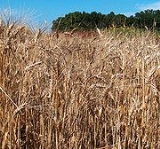
Durum

Encyclopedia
Durum wheat or macaroni wheat (also spelled Durhum;Triticum durum or Triticum turgidum durum) is the only tetraploid species of wheat
of commercial importance that is widely cultivated today. It was developed by artificial selection
of the domesticated emmer
wheat (like emmer, durum wheat is awned) strains formerly grown in Central Europe and the Near East around 7000 B.C., which developed a naked, free-threshing form. Durum in Latin
means "hard", and the species is the hardest of all wheats. Its high protein
content, as well as its strength, make durum good for special uses.. Durum wheat is used extensively in breadmaking. However, it is unusual in that, despite very high protein content, it is low in desirable gluten
needed to form a glutinous web necessary for bread to rise. As a result, although 100 percent durum wheat breads do exist, such as pagnotte di Enna from Sicily, as well as others, in most instances bread doughs contain only a portion of durum wheat and are supplemented substantially with commercial white flours, oftentimes those higher in gluten necessary to offset the poor gluten contribution of durum flour. When durum flour is used as the sole flour in bread, substantial additions of isolated wheat gluten are necessary to effect rising. Without it, 100 percent durum wheat breads are often heavy, with very close grain, and will split easily when risen for baking.
and hard red spring wheats, which are hexaploid and have 42 chromosomes each.
Durum wheat originated through intergeneric hybridization and polyploidization involving two diploid grass species: T. urartu (2n = 2x = 14, AA genome) and a B-genome diploid related to Aegilops speltoides
(2n = 2x = 14, SS genome) and is thus an allotetraploid species.
is made exclusively from durum semolina
.
Husked but unground, or coarsely ground, it is used for semoules in the couscous
of North Africa, and other parts of the Arab world
. It is also used for Levant
ine dishes such as tabbula, kishk, kibba, bitfun and the bulghur
for pilaf
s. In Arab cuisine
, it forms the basis of many soup
s, gruels, stuffings, pudding
s and pastries
.
When ground as fine as flour
, it is used for making bread
. In the Middle East, it is used for flat round breads
, and in Europe and elsewhere, it can be used for pizza
, torte, etc. It is not, however, good for cake
s, which are made from soft wheat to prevent toughness.
The use of wheat to produce pasta was described as early as the 10th century by Ibn Wahshīya
of Cairo
. The Arabs called the product itrīya, from which Italian
sources derived the term tria (or aletria in the case of Spanish sources) during the 15th century.
Another type of pasta, al-fidawsh (called "dry pasta"), was popular in al-Andalus
. From there it was transmitted to Christian Spain, and it frequently appears in Hispano-Muslim
cookbooks. From al-fidawsh was derived the Spanish word for noodles, fideos, and the Italian fidelli or fidellini.
In the American Great Plains
, durum wheat is used almost exclusively for making pasta products such as spaghetti
and macaroni.
endosperm
, which gives pasta its color. When durum is milled
, the endosperm is ground into a granular product called semolina
. Semolina made from durum is used for premium pasta
s and bread
s. There is also a red durum, used mostly for livestock feed
.
The cultivation of durum generates greater yield than other wheats in areas of low precipitation
(300-500 mm). Good yields can be obtained by irrigation
, but this is rarely done. In the first half of the 20th century, the crop was widely grown in Russia
. Durum is one of the most important food crops in West Asia. Although the variety of the wheat there is diverse, it is not extensively grown there, and thus must be imported. West amber durum produced in Canada
is used mostly as semolina/pasta, but some is also exported to Italy
for bread production.
In the Middle East and North Africa, local bread-making accounts for half the consumption of durum. Some flour is even imported. On the other hand, many countries in Europe produce durum in commercially significant quantities.
ing and sieving
. Proper purifying results in maximum semolina yield and the least amount of bran powder.
To produce bread, durum wheat is ground into flour. The flour is mixed with water to produce dough
. The quantities mixed vary, depending on the acidity of the mixture. The dough is mixed with yeast
and lukewarm water, and then fermented
for hours. The quality of the bread produced depends on the viscoelastic
properties of gluten, the protein content and protein composition.
Wheat
Wheat is a cereal grain, originally from the Levant region of the Near East, but now cultivated worldwide. In 2007 world production of wheat was 607 million tons, making it the third most-produced cereal after maize and rice...
of commercial importance that is widely cultivated today. It was developed by artificial selection
Artificial selection
Artificial selection describes intentional breeding for certain traits, or combination of traits. The term was utilized by Charles Darwin in contrast to natural selection, in which the differential reproduction of organisms with certain traits is attributed to improved survival or reproductive...
of the domesticated emmer
Emmer
Emmer wheat , also known as farro especially in Italy, is a low yielding, awned wheat. It was one of the first crops domesticated in the Near East...
wheat (like emmer, durum wheat is awned) strains formerly grown in Central Europe and the Near East around 7000 B.C., which developed a naked, free-threshing form. Durum in Latin
Latin
Latin is an Italic language originally spoken in Latium and Ancient Rome. It, along with most European languages, is a descendant of the ancient Proto-Indo-European language. Although it is considered a dead language, a number of scholars and members of the Christian clergy speak it fluently, and...
means "hard", and the species is the hardest of all wheats. Its high protein
Protein
Proteins are biochemical compounds consisting of one or more polypeptides typically folded into a globular or fibrous form, facilitating a biological function. A polypeptide is a single linear polymer chain of amino acids bonded together by peptide bonds between the carboxyl and amino groups of...
content, as well as its strength, make durum good for special uses.. Durum wheat is used extensively in breadmaking. However, it is unusual in that, despite very high protein content, it is low in desirable gluten
Gluten
Gluten is a protein composite found in foods processed from wheat and related grain species, including barley and rye...
needed to form a glutinous web necessary for bread to rise. As a result, although 100 percent durum wheat breads do exist, such as pagnotte di Enna from Sicily, as well as others, in most instances bread doughs contain only a portion of durum wheat and are supplemented substantially with commercial white flours, oftentimes those higher in gluten necessary to offset the poor gluten contribution of durum flour. When durum flour is used as the sole flour in bread, substantial additions of isolated wheat gluten are necessary to effect rising. Without it, 100 percent durum wheat breads are often heavy, with very close grain, and will split easily when risen for baking.
Genealogy
Durum wheat is a tetraploid wheat, having 28 chromosomes, unlike hard red winterWinter wheat
Winter wheat is a type of wheat that is planted from September to December in the Northern Hemisphere. Winter wheat sprouts before freezing occurs, then becomes dormant until the soil warms in the spring. Winter wheat needs a few weeks of cold before being able to flower, however persistent snow...
and hard red spring wheats, which are hexaploid and have 42 chromosomes each.
Durum wheat originated through intergeneric hybridization and polyploidization involving two diploid grass species: T. urartu (2n = 2x = 14, AA genome) and a B-genome diploid related to Aegilops speltoides
Aegilops speltoides
Aegilops speltoides is an edible plant in the Poaceae family native to Southeastern Europe and Western Asia, which is often used for animal feed, and it has grown in cultivated beds...
(2n = 2x = 14, SS genome) and is thus an allotetraploid species.
Uses
PastaPasta
Pasta is a staple food of traditional Italian cuisine, now of worldwide renown. It takes the form of unleavened dough, made in Italy, mostly of durum wheat , water and sometimes eggs. Pasta comes in a variety of different shapes that serve for both decoration and to act as a carrier for the...
is made exclusively from durum semolina
Semolina
Semolina is the coarse, purified wheat middlings of durum wheat used in making pasta, and also used for breakfast cereals and puddings. Semolina is also used to designate coarse middlings from other varieties of wheat, and from other grains such as rice and corn.-Name:The term semolina derives from...
.
Husked but unground, or coarsely ground, it is used for semoules in the couscous
Couscous
Couscous is a Berber dish of semolina traditionally served with a meat or vegetable stew spooned over it. Couscous is a staple food throughout Algeria, Morocco and Tunisia.-Etymology:...
of North Africa, and other parts of the Arab world
Arab world
The Arab world refers to Arabic-speaking states, territories and populations in North Africa, Western Asia and elsewhere.The standard definition of the Arab world comprises the 22 states and territories of the Arab League stretching from the Atlantic Ocean in the west to the Arabian Sea in the...
. It is also used for Levant
Levant
The Levant or ) is the geographic region and culture zone of the "eastern Mediterranean littoral between Anatolia and Egypt" . The Levant includes most of modern Lebanon, Syria, Jordan, Israel, the Palestinian territories, and sometimes parts of Turkey and Iraq, and corresponds roughly to the...
ine dishes such as tabbula, kishk, kibba, bitfun and the bulghur
Bulgur
Bulgur is a cereal food made from several different wheat species, most often from durum wheat. In the United States it is most often made from white wheat. Its use is most common in Middle Eastern cuisine, Iran, Turkey, Greece, Armenia and Bulgaria...
for pilaf
Pilaf
Pilaf is a dish in which rice is cooked in a seasoned broth . In some cases, the rice may also attain its brown color by being stirred with bits of cooked onion, as well as a large mix of spices...
s. In Arab cuisine
Arab cuisine
Arab cuisine is defined as the various regional cuisines spanning the Arab World, from Morocco and Tunisia to Saudi Arabia, and incorporating Levantine, Egyptian .-History:...
, it forms the basis of many soup
Soup
Soup is a generally warm food that is made by combining ingredients such as meat and vegetables with stock, juice, water, or another liquid. Hot soups are additionally characterized by boiling solid ingredients in liquids in a pot until the flavors are extracted, forming a broth.Traditionally,...
s, gruels, stuffings, pudding
Pudding
Pudding most often refers to a dessert, but it can also be a savory dish.In the United States, pudding characteristically denotes a sweet milk-based dessert similar in consistency to egg-based custards, though it may also refer to other types such as bread and rice pudding.In the United Kingdom and...
s and pastries
Pastry
Pastry is the name given to various kinds of baked products made from ingredients such as flour, sugar, milk, butter, shortening, baking powder and/or eggs. Small cakes, tarts and other sweet baked products are called "pastries."...
.
When ground as fine as flour
Flour
Flour is a powder which is made by grinding cereal grains, other seeds or roots . It is the main ingredient of bread, which is a staple food for many cultures, making the availability of adequate supplies of flour a major economic and political issue at various times throughout history...
, it is used for making bread
Bread
Bread is a staple food prepared by cooking a dough of flour and water and often additional ingredients. Doughs are usually baked, but in some cuisines breads are steamed , fried , or baked on an unoiled frying pan . It may be leavened or unleavened...
. In the Middle East, it is used for flat round breads
Flatbread
A flatbread is a simple bread made with flour, water, and salt and then thoroughly rolled into flattened dough. Many flatbreads are unleavened: made without yeast or sourdough culture: although some flatbread is made with yeast, such as pita bread....
, and in Europe and elsewhere, it can be used for pizza
Pizza
Pizza is an oven-baked, flat, disc-shaped bread typically topped with a tomato sauce, cheese and various toppings.Originating in Italy, from the Neapolitan cuisine, the dish has become popular in many parts of the world. An establishment that makes and sells pizzas is called a "pizzeria"...
, torte, etc. It is not, however, good for cake
Cake
Cake is a form of bread or bread-like food. In its modern forms, it is typically a sweet and enriched baked dessert. In its oldest forms, cakes were normally fried breads or cheesecakes, and normally had a disk shape...
s, which are made from soft wheat to prevent toughness.
The use of wheat to produce pasta was described as early as the 10th century by Ibn Wahshīya
Ibn Wahshiyya
Ibn Wahshiyya was an Iraqi alchemist, agriculturalist, farm toxicologist, egyptologist and historian born at Qusayn near Kufa in Iraq.Ibn Wahshiyya was one of the first historians to be able to at least partly decipher what was written in the ancient Egyptian hieroglyphs, by relating them to the...
of Cairo
Cairo
Cairo , is the capital of Egypt and the largest city in the Arab world and Africa, and the 16th largest metropolitan area in the world. Nicknamed "The City of a Thousand Minarets" for its preponderance of Islamic architecture, Cairo has long been a centre of the region's political and cultural life...
. The Arabs called the product itrīya, from which Italian
Italy
Italy , officially the Italian Republic languages]] under the European Charter for Regional or Minority Languages. In each of these, Italy's official name is as follows:;;;;;;;;), is a unitary parliamentary republic in South-Central Europe. To the north it borders France, Switzerland, Austria and...
sources derived the term tria (or aletria in the case of Spanish sources) during the 15th century.
Another type of pasta, al-fidawsh (called "dry pasta"), was popular in al-Andalus
Al-Andalus
Al-Andalus was the Arabic name given to a nation and territorial region also commonly referred to as Moorish Iberia. The name describes parts of the Iberian Peninsula and Septimania governed by Muslims , at various times in the period between 711 and 1492, although the territorial boundaries...
. From there it was transmitted to Christian Spain, and it frequently appears in Hispano-Muslim
Islam in Spain
Islam in Spain has had a fundamental presence in the culture and history of the nation. The religion was present in modern Spanish soil from 711 until 1492 under the rule of the Arabs and Moors of al-Andalus. For key historical dates, see Timeline of the Muslim presence in the Iberian peninsula...
cookbooks. From al-fidawsh was derived the Spanish word for noodles, fideos, and the Italian fidelli or fidellini.
In the American Great Plains
Great Plains
The Great Plains are a broad expanse of flat land, much of it covered in prairie, steppe and grassland, which lies west of the Mississippi River and east of the Rocky Mountains in the United States and Canada. This area covers parts of the U.S...
, durum wheat is used almost exclusively for making pasta products such as spaghetti
Spaghetti
Spaghetti is a long, thin, cylindrical pasta of Italian origin. Spaghetti is made of semolina or flour and water. Italian dried spaghetti is made from durum wheat semolina, but outside of Italy it may be made with other kinds of flour...
and macaroni.
Production
Most of the durum grown today is amber durum, the grains of which are amber-colored and larger than those of other types of wheat. Durum has a yellowYellow
Yellow is the color evoked by light that stimulates both the L and M cone cells of the retina about equally, with no significant stimulation of the S cone cells. Light with a wavelength of 570–590 nm is yellow, as is light with a suitable mixture of red and green...
endosperm
Endosperm
Endosperm is the tissue produced inside the seeds of most flowering plants around the time of fertilization. It surrounds the embryo and provides nutrition in the form of starch, though it can also contain oils and protein. This makes endosperm an important source of nutrition in human diet...
, which gives pasta its color. When durum is milled
Mill (grinding)
A grinding mill is a unit operation designed to break a solid material into smaller pieces. There are many different types of grinding mills and many types of materials processed in them. Historically mills were powered by hand , working animal , wind or water...
, the endosperm is ground into a granular product called semolina
Semolina
Semolina is the coarse, purified wheat middlings of durum wheat used in making pasta, and also used for breakfast cereals and puddings. Semolina is also used to designate coarse middlings from other varieties of wheat, and from other grains such as rice and corn.-Name:The term semolina derives from...
. Semolina made from durum is used for premium pasta
Pasta
Pasta is a staple food of traditional Italian cuisine, now of worldwide renown. It takes the form of unleavened dough, made in Italy, mostly of durum wheat , water and sometimes eggs. Pasta comes in a variety of different shapes that serve for both decoration and to act as a carrier for the...
s and bread
Bread
Bread is a staple food prepared by cooking a dough of flour and water and often additional ingredients. Doughs are usually baked, but in some cuisines breads are steamed , fried , or baked on an unoiled frying pan . It may be leavened or unleavened...
s. There is also a red durum, used mostly for livestock feed
Fodder
Fodder or animal feed is any agricultural foodstuff used specifically to feed domesticated livestock such as cattle, goats, sheep, horses, chickens and pigs. Most animal feed is from plants but some is of animal origin...
.
The cultivation of durum generates greater yield than other wheats in areas of low precipitation
Precipitation (meteorology)
In meteorology, precipitation In meteorology, precipitation In meteorology, precipitation (also known as one of the classes of hydrometeors, which are atmospheric water phenomena is any product of the condensation of atmospheric water vapor that falls under gravity. The main forms of precipitation...
(300-500 mm). Good yields can be obtained by irrigation
Irrigation
Irrigation may be defined as the science of artificial application of water to the land or soil. It is used to assist in the growing of agricultural crops, maintenance of landscapes, and revegetation of disturbed soils in dry areas and during periods of inadequate rainfall...
, but this is rarely done. In the first half of the 20th century, the crop was widely grown in Russia
Russia
Russia or , officially known as both Russia and the Russian Federation , is a country in northern Eurasia. It is a federal semi-presidential republic, comprising 83 federal subjects...
. Durum is one of the most important food crops in West Asia. Although the variety of the wheat there is diverse, it is not extensively grown there, and thus must be imported. West amber durum produced in Canada
Canada
Canada is a North American country consisting of ten provinces and three territories. Located in the northern part of the continent, it extends from the Atlantic Ocean in the east to the Pacific Ocean in the west, and northward into the Arctic Ocean...
is used mostly as semolina/pasta, but some is also exported to Italy
Italy
Italy , officially the Italian Republic languages]] under the European Charter for Regional or Minority Languages. In each of these, Italy's official name is as follows:;;;;;;;;), is a unitary parliamentary republic in South-Central Europe. To the north it borders France, Switzerland, Austria and...
for bread production.
In the Middle East and North Africa, local bread-making accounts for half the consumption of durum. Some flour is even imported. On the other hand, many countries in Europe produce durum in commercially significant quantities.
| Area under cultivation and production of durum wheat | |||||||
| Region | Area (1000 ha) | Production (1000 tonnes) | |||||
|---|---|---|---|---|---|---|---|
| Western Europe Western Europe Western Europe is a loose term for the collection of countries in the western most region of the European continents, though this definition is context-dependent and carries cultural and political connotations. One definition describes Western Europe as a geographic entity—the region lying in the... |
2,490 | 5,730 | |||||
| North America North America North America is a continent wholly within the Northern Hemisphere and almost wholly within the Western Hemisphere. It is also considered a northern subcontinent of the Americas... |
2,960 | 5,756 | |||||
| South America South America South America is a continent situated in the Western Hemisphere, mostly in the Southern Hemisphere, with a relatively small portion in the Northern Hemisphere. The continent is also considered a subcontinent of the Americas. It is bordered on the west by the Pacific Ocean and on the north and east... |
102 | 196 | |||||
| Middle East Middle East The Middle East is a region that encompasses Western Asia and Northern Africa. It is often used as a synonym for Near East, in opposition to Far East... |
4,462 | 6,950 | |||||
| North Africa North Africa North Africa or Northern Africa is the northernmost region of the African continent, linked by the Sahara to Sub-Saharan Africa. Geopolitically, the United Nations definition of Northern Africa includes eight countries or territories; Algeria, Egypt, Libya, Morocco, South Sudan, Sudan, Tunisia, and... |
3,290 | 3,214 | |||||
| Others | 3,756 | 3,540 | |||||
| World World World is a common name for the whole of human civilization, specifically human experience, history, or the human condition in general, worldwide, i.e. anywhere on Earth.... |
17,060 | 25,360 | |||||
| Source: | |||||||
Processing
Durum wheat is subject to four processes: cleaning, tempering, milling and purifying. First, durum wheat is cleaned to remove foreign material and shrunken and broken kernels. Then it is tempered to a moisture content, toughening the seed coat for efficient separation of bran and endosperm. Durum milling is a complex procedure involving repetitive grindGrind
The grind of a blade refers to the shape of the cross-section of the blade. It is distinct from the type of blade , though different tools and blades may have lent their name to a particular grind.Grinding involves removing significant portions of metal from the blade and is thus distinct from...
ing and sieving
Sieve
A sieve, or sifter, separates wanted elements from unwanted material using a woven screen such as a mesh or net. However, in cooking, especially with flour, a sifter is used to aerate the substance, among other things. A strainer is a type of sieve typically used to separate a solid from a liquid...
. Proper purifying results in maximum semolina yield and the least amount of bran powder.
To produce bread, durum wheat is ground into flour. The flour is mixed with water to produce dough
Dough
Dough is a paste made out of any cereals or leguminous crops by mixing flour with a small amount of water and/or other liquid. This process is a precursor to making a wide variety of foodstuffs, particularly breads and bread-based items , flatbreads, noodles, pastry, and similar items)...
. The quantities mixed vary, depending on the acidity of the mixture. The dough is mixed with yeast
Yeast
Yeasts are eukaryotic micro-organisms classified in the kingdom Fungi, with 1,500 species currently described estimated to be only 1% of all fungal species. Most reproduce asexually by mitosis, and many do so by an asymmetric division process called budding...
and lukewarm water, and then fermented
Fermentation (food)
Fermentation in food processing typically is the conversion of carbohydrates to alcohols and carbon dioxide or organic acids using yeasts, bacteria, or a combination thereof, under anaerobic conditions. Fermentation in simple terms is the chemical conversion of sugars into ethanol...
for hours. The quality of the bread produced depends on the viscoelastic
Viscoelasticity
Viscoelasticity is the property of materials that exhibit both viscous and elastic characteristics when undergoing deformation. Viscous materials, like honey, resist shear flow and strain linearly with time when a stress is applied. Elastic materials strain instantaneously when stretched and just...
properties of gluten, the protein content and protein composition.
External links
- United States Durum Growers Association
- Durum Wheat Research - Grain research Laboratory, Canadian Grain Commission