


Pasta

Encyclopedia
Italian cuisine
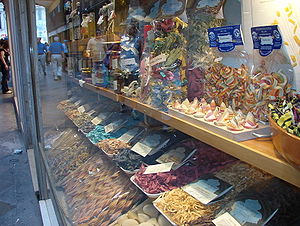
Italian cuisine has developed through centuries of social and political changes, with roots as far back as the 4th century BCE. Italian cuisine in itself takes heavy influences, including Etruscan, ancient Greek, ancient Roman, Byzantine, Jewish and Arab cuisines...
, now of worldwide renown. It takes the form of unleavened dough
Dough
Dough is a paste made out of any cereals or leguminous crops by mixing flour with a small amount of water and/or other liquid. This process is a precursor to making a wide variety of foodstuffs, particularly breads and bread-based items , flatbreads, noodles, pastry, and similar items)...
, made in Italy, mostly of durum wheat (more rarely buckwheat
Buckwheat
Buckwheat refers to a variety of plants in the dicot family Polygonaceae: the Eurasian genus Fagopyrum, the North American genus Eriogonum, and the Northern Hemisphere genus Fallopia. Either of the latter two may be referred to as "wild buckwheat"...
flour), water and sometimes eggs. Pasta comes in a variety of different shapes that serve for both decoration and to act as a carrier for the different types of sauce. Pasta also includes varieties, such as ravioli
Ravioli
Ravioli are a traditional type of Italian filled pasta. They are composed of a filling sealed between two layers of thin egg pasta dough and are served either in broth or with a pasta sauce. The word ravioli is reminiscent of the Italian verb riavvolgere , though the two words are not...
and tortellini
Tortellini
Tortellini are ring-shaped pasta. They are typically stuffed with a mix of meat or cheese. Originally from the Italian region of Emilia , they are usually served in broth, meat broth, either of beef, chicken, or both...
, that are filled with other ingredients, such as ground meat or cheese. Pasta is eaten in Italy only as first course or nowadays as "piatto unico".
There are hundreds of different shapes of pasta with at least locally recognised names. Examples include spaghetti
Spaghetti
Spaghetti is a long, thin, cylindrical pasta of Italian origin. Spaghetti is made of semolina or flour and water. Italian dried spaghetti is made from durum wheat semolina, but outside of Italy it may be made with other kinds of flour...
(thin strings), maccheroni (tubes or cylinders), fusilli
Fusilli
Fusilli are long, thick, corkscrew shaped pasta. The word fusilli presumably comes from fusile, archaic or dialectal word for "rifle" , referring to the spiral-grooved barrel of the latter...
(swirls), and lasagne (sheets). Gnocchi
Gnocchi
Gnocchi are various thick, soft dumplings. They may be made from semolina, ordinary wheat flour, flour and egg, flour, egg, and cheese, potato, bread crumbs, or similar ingredients. The smaller forms are called gnocchetti....
and spätzle
Spätzle
Spätzle are a type of egg noodle of soft texture found in the cuisine of Germany and of Austria, Switzerland, Hungary, Alsace and South Tyrol.-History:The geographic origin of spätzle is not precisely...
are sometimes considered pasta; they are both traditional in parts of Italy.
Pasta is categorized in two basic styles: dried and fresh. Dried pasta made without eggs can be stored for up to two years under ideal conditions, while fresh pasta will keep for a few days under refrigeration. Pasta is generally cooked by boiling
Boiling
Boiling is the rapid vaporization of a liquid, which occurs when a liquid is heated to its boiling point, the temperature at which the vapor pressure of the liquid is equal to the pressure exerted on the liquid by the surrounding environmental pressure. While below the boiling point a liquid...
.
Etymology
First attested in English in 1874, the word pasta comes from ItalianItalian language
Italian is a Romance language spoken mainly in Europe: Italy, Switzerland, San Marino, Vatican City, by minorities in Malta, Monaco, Croatia, Slovenia, France, Libya, Eritrea, and Somalia, and by immigrant communities in the Americas and Australia...
pasta, in turn from Latin
Latin
Latin is an Italic language originally spoken in Latium and Ancient Rome. It, along with most European languages, is a descendant of the ancient Proto-Indo-European language. Although it is considered a dead language, a number of scholars and members of the Christian clergy speak it fluently, and...
pasta "dough, pastry cake", itself the latinisation
Latinisation (literature)
Latinisation is the practice of rendering a non-Latin name in a Latin style. It is commonly met with for historical personal names, with toponyms, or for the standard binomial nomenclature of the life sciences. It goes further than Romanisation, which is the writing of a word in the Latin alphabet...
of the Greek
Greek language
Greek is an independent branch of the Indo-European family of languages. Native to the southern Balkans, it has the longest documented history of any Indo-European language, spanning 34 centuries of written records. Its writing system has been the Greek alphabet for the majority of its history;...
παστά (pasta) "barley porridge
Porridge
Porridge is a dish made by boiling oats or other cereal meals in water, milk, or both. It is usually served hot in a bowl or dish...
", in turn from παστός (pastos), "sprinkled with salt, salted".
Ingredients
Durum
Durum wheat or macaroni wheat is the only tetraploid species of wheat of commercial importance that is widely cultivated today...
wheat flour or durum wheat semolina
Semolina
Semolina is the coarse, purified wheat middlings of durum wheat used in making pasta, and also used for breakfast cereals and puddings. Semolina is also used to designate coarse middlings from other varieties of wheat, and from other grains such as rice and corn.-Name:The term semolina derives from...
. Durum flour and durum semolina have a yellow tinge in colour. Italian pasta is traditionally cooked al dente
Al dente
In cooking, the Italian expression al dente describes pasta and rice or beansthat have been cooked so as to be firm but not hard. "Al dente" also describes vegetables that are cooked to the "tender crisp" phase - still offering resistance to the bite, but cooked through...
(Italian: "firm to the bite", meaning not too soft). Outside Italy, dry pasta is frequently made from other types of flour (such as wheat flour
Wheat flour
Wheat flour is a powder made from the grinding of wheat used for human consumption. More wheat flour is produced than any other flour. Wheat varieties are called "clean," "white," or "brown" if they have high gluten content, and they are called "soft" or "weak" flour if gluten content is low...
), but this yields a softer product that cannot be cooked al dente the same way. There are many types of wheat flour with varying gluten and protein content depending on variety of grain used.
Particular varieties of pasta may also use other grains and milling methods to make the flour, as specified by Italian law. Some pasta varieties, such as pizzoccheri
Pizzoccheri
Pizzoccheri are a type of short tagliatelle, a flat ribbon pasta, made with 80% buckwheat flour and 20% wheat flour. When classically prepared in Valtellina or in Graubünden, they are cooked along with greens , and cubed potatoes...
, are made from buckwheat
Buckwheat
Buckwheat refers to a variety of plants in the dicot family Polygonaceae: the Eurasian genus Fagopyrum, the North American genus Eriogonum, and the Northern Hemisphere genus Fallopia. Either of the latter two may be referred to as "wild buckwheat"...
flour.
Fresh pasta may include eggs
Egg (food)
Eggs are laid by females of many different species, including birds, reptiles, amphibians, and fish, and have probably been eaten by mankind for millennia. Bird and reptile eggs consist of a protective eggshell, albumen , and vitellus , contained within various thin membranes...
(pasta all'uovo 'egg pasta') and in Italy must be made with durum wheat semolina but a maximum of 3% of the cheaper wheat flour
Wheat flour
Wheat flour is a powder made from the grinding of wheat used for human consumption. More wheat flour is produced than any other flour. Wheat varieties are called "clean," "white," or "brown" if they have high gluten content, and they are called "soft" or "weak" flour if gluten content is low...
is tolerated.
Whole wheat pasta, which generally contains more fibre and more nutrients than refined pasta, has become increasingly popular. Whole wheat pasta designed to appeal to people familiar with refined grain pastas may have a mixture of whole grain and refined grain ingredients.
History
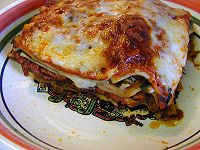
Lasagna
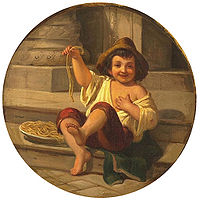
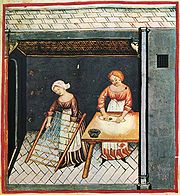
Lasagna is a wide and flat type of pasta and possibly one of the oldest shapes. As with most other pasta shapes, the word is generally used in its plural form lasagne in Italy and the U.K. Traditionally, the dough was prepared in Southern Italy with semolina and water and in the northern regions,...
. However, the method of cooking these sheets of dough does not correspond to our modern definition of either a fresh or dry pasta product.
Historians have noted several lexical milestones relevant to pasta, none of which changes these basic characteristics. For example, the works of the 2nd century AD Greek physician Galen
Galen
Aelius Galenus or Claudius Galenus , better known as Galen of Pergamon , was a prominent Roman physician, surgeon and philosopher...
mention itrion, homogeneous compounds made up of flour and water. The Jerusalem Talmud
Jerusalem Talmud
The Jerusalem Talmud, talmud meaning "instruction", "learning", , is a collection of Rabbinic notes on the 2nd-century Mishnah which was compiled in the Land of Israel during the 4th-5th century. The voluminous text is also known as the Palestinian Talmud or Talmud de-Eretz Yisrael...
records that itrium, a kind of boiled dough, was common in Israel
Israel
The State of Israel is a parliamentary republic located in the Middle East, along the eastern shore of the Mediterranean Sea...
from the 3rd to 5th centuries AD, A dictionary compiled by the 9th century Arab physician and lexicographer Isho bar Ali defines itriyya, the Arabic cognate, as string-like shapes made of semolina and dried before cooking. The geographical text of Muhammad al-Idrisi
Muhammad al-Idrisi
Abu Abd Allah Muhammad al-Idrisi al-Qurtubi al-Hasani al-Sabti or simply Al Idrisi was a Moroccan Muslim geographer, cartographer, Egyptologist and traveller who lived in Sicily, at the court of King Roger II. Muhammed al-Idrisi was born in Ceuta then belonging to the Almoravid Empire and died in...
, compiled for the Norman King of Sicily Roger II
Roger II of Sicily
Roger II was King of Sicily, son of Roger I of Sicily and successor to his brother Simon. He began his rule as Count of Sicily in 1105, later became Duke of Apulia and Calabria , then King of Sicily...
in 1154 mentions itriyya manufactured and exported from Norman Sicily:
Itriyya gives rise to trie in Italian, signifying long strips such as tagliatelle and trenette. One form of itriyya with a long history is laganum (plural lagana), which in Latin refers to a thin sheet of dough, and gives rise to Italian lasagna.
According to historians like Charles Perry, the Arabs adapted noodles for long journeys in the 5th century, the first written record of dry pasta. Durum wheat pasta was introduced by Libyian Arabs
Libya
Libya is an African country in the Maghreb region of North Africa bordered by the Mediterranean Sea to the north, Egypt to the east, Sudan to the southeast, Chad and Niger to the south, and Algeria and Tunisia to the west....
during their conquest of Sicily
Sicily
Sicily is a region of Italy, and is the largest island in the Mediterranean Sea. Along with the surrounding minor islands, it constitutes an autonomous region of Italy, the Regione Autonoma Siciliana Sicily has a rich and unique culture, especially with regard to the arts, music, literature,...
in the late 7th century
In North Africa, a food similar to pasta, known as couscous
Couscous
Couscous is a Berber dish of semolina traditionally served with a meat or vegetable stew spooned over it. Couscous is a staple food throughout Algeria, Morocco and Tunisia.-Etymology:...
, has been eaten for centuries. However, it lacks the distinguishing malleable nature of pasta, couscous being more akin to droplets of dough. At first, dry pasta was a luxury item in Italy because of high labor costs, durum wheat semolina had to be kneaded for a long time. Only after the industrial revolution in Naples, when a mechanical die process allowed for large scale production of dry pasta, did it become affordable and popular among the common people.
Marco Polo
Marco Polo was a Venetian merchant traveler from the Venetian Republic whose travels are recorded in Il Milione, a book which did much to introduce Europeans to Central Asia and China. He learned about trading whilst his father and uncle, Niccolò and Maffeo, travelled through Asia and apparently...
importing pasta from China which originated with the Macaroni Journal, published by an association of food industries with the goal of promoting the use of pasta in the United States
United States
The United States of America is a federal constitutional republic comprising fifty states and a federal district...
. Marco Polo describes a food similar to "lagana" in his Travels
The Travels of Marco Polo
Books of the Marvels of the World or Description of the World , also nicknamed Il Milione or Oriente Poliano and commonly called The Travels of Marco Polo, is a 13th-century travelogue written down by Rustichello da Pisa from stories told by Marco Polo, describing the...
, but he uses a term with which he was already familiar. Some historians believe that in 1295 Marco Polo brought rice flour pasta, the type used to make Chinese dumplings. Now known as dumpling style or soft pasta, which manifested into ravioli, gnocchi and other similar preparations.
The first concrete information concerning pasta products in Italy dates from the 13th or 14th century.
Accompaniments
Northern Italy
Northern Italy is a wide cultural, historical and geographical definition, without any administrative usage, used to indicate the northern part of the Italian state, also referred as Settentrione or Alta Italia...
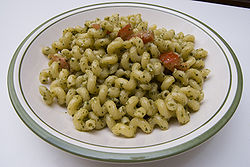
has fewer traditionally tomato-based pasta sauces (though tomatoes are still used in recipes) including pesto
Pesto
Pesto is a sauce originating in Genoa in the Liguria region of northern Italy , and traditionally consists of crushed garlic, basil and pine nuts blended with olive oil and Parmigiano Reggiano and Fiore Sardo...
and ragù alla bolognese. In Central Italy
Central Italy
Central Italy is one of the five official statistical regions of Italy used by the National Institute of Statistics , a first level NUTS region and a European Parliament constituency...
, there are sauces such as tomato sauce
Tomato sauce
A tomato sauce is any of a very large number of sauces made primarily from tomatoes, usually to be served as part of a dish...
, amatriciana, arrabiata and the egg based carbonara
Carbonara
Pasta alla carbonara is an Italian pasta dish based on eggs, cheese , bacon , and black pepper...
.
Tomato sauces are also present in Southern Italian cuisine, where they originated. In Southern Italy more complex variations include pasta paired with fresh vegetables, olives, capers or seafood. A lighter, more quickly prepared version of a tomato dish dish is called pomodoro
Pasta Pomodoro
Pasta Pomodoro is an Italian food typically prepared with pasta, olive oil, fresh tomatoes, basil, and other fresh ingredients that may vary. It is intended to be a quick light dish, rather than a dish in a heavy sauce.Pomodoro means tomato in Italian....
. Varieties include puttanesca, pasta alla norma (tomatoes, eggplant and fresh or baked cheese), pasta con le sarde (fresh sardines, pine nuts, fennel and olive oil), spaghetti aglio, olio e peperoncino (literally with garlic, [olive] oil and hot chili peppers).
Fettuccine alfredo with cream, cheese and butter, and spaghetti with tomato sauce (with or without meat) are popular Italian-style dishes in the United States
United States
The United States of America is a federal constitutional republic comprising fifty states and a federal district...
.
International adaptations
As pasta was introduced elsewhere in the world, it became incorporated into a number of local cuisines, which often have significantly different ways of preparation from those of Italy. In Hong KongHong Kong
Hong Kong is one of two Special Administrative Regions of the People's Republic of China , the other being Macau. A city-state situated on China's south coast and enclosed by the Pearl River Delta and South China Sea, it is renowned for its expansive skyline and deep natural harbour...
, the local Chinese have adopted pasta, primarily spaghetti
Spaghetti
Spaghetti is a long, thin, cylindrical pasta of Italian origin. Spaghetti is made of semolina or flour and water. Italian dried spaghetti is made from durum wheat semolina, but outside of Italy it may be made with other kinds of flour...
and macaroni
Macaroni
Macaroni is a variety of moderately extended, machine-made, dry pasta made with durum wheat. Macaroni noodles do not contain eggs, and are normally cut in short, hollow shapes; however, the term refers not to the shape of the pasta, but to the kind of dough from which the noodle is made...
, as an ingredient in the Hong Kong-style Western cuisine.
In Cha chaan teng
Cha chaan teng
A cha chaan teng means tea diner, also called Chinese diner, is commonly found in Hong Kong, China, and Taiwan, known for its Chinese food, eclectic and affordable menus, which include many dishes from Hong Kong cuisine and Hong Kong-style Western cuisine. Cha chaan tengs are also popular in Macau...
(茶餐廳), macaroni is cooked in water and served in broth with ham
Ham
Ham is a cut of meat from the thigh of the hind leg of certain animals, especiallypigs. Nearly all hams sold today are fully cooked or cured.-Etymology:...
or frankfurter sausages
Sausage
A sausage is a food usually made from ground meat , mixed with salt, herbs, and other spices, although vegetarian sausages are available. The word sausage is derived from Old French saussiche, from the Latin word salsus, meaning salted.Typically, a sausage is formed in a casing traditionally made...
, peas, black mushrooms
Shiitake
The Shiitake is an edible mushroom native to East Asia, which is cultivated and consumed in many Asian countries, as well as being dried and exported to many countries around the world. It is a feature of many Asian cuisines including Vietnamese, Chinese, Japanese, Korean and Thai...
, and optionally eggs
Egg (food)
Eggs are laid by females of many different species, including birds, reptiles, amphibians, and fish, and have probably been eaten by mankind for millennia. Bird and reptile eggs consist of a protective eggshell, albumen , and vitellus , contained within various thin membranes...
, reminiscent of noodle soup
Noodle soup
Noodle soup refers to a variety of soups with noodles and other ingredients served in a light broth. Noodle soup is an East and Southeast Asian staple. Less well known, a form of fresh noodle is used in soup in certain parts of Europe , and in northern China; usually, it is served for breakfast...
dishes. This is often a course for breakfast or light lunch fare. These affordable dining shops evolved from American food rations after World War II due to lack of supplies, and they continue to be popular for people with modest means so any comparison to Italy or Hong Kong's more authentic Italian eateries is irrelevant.
Two common spaghetti dishes served in Japan
Japan
Japan is an island nation in East Asia. Located in the Pacific Ocean, it lies to the east of the Sea of Japan, China, North Korea, South Korea and Russia, stretching from the Sea of Okhotsk in the north to the East China Sea and Taiwan in the south...
are the Bolognese (ミートソース) and the Napolitan
Naporitan
Naporitan or Napolitan is the name of a pasta dish, which is popular in Japan. The dish consists of spaghetti, tomato ketchup or a tomato-based sauce, onion, button mushrooms, green peppers, sausage, bacon and Tabasco sauce. Naporitan is claimed to be from Yokohama...
(ナポリタン). In India
India
India , officially the Republic of India , is a country in South Asia. It is the seventh-largest country by geographical area, the second-most populous country with over 1.2 billion people, and the most populous democracy in the world...
, macaroni has been adopted and cooked in an Indianized way. Boiled macaroni is sautéed along with cumin
Cumin
Cumin is a flowering plant in the family Apiaceae, native from the east Mediterranean to India. Its seeds are used in the cuisines of many different cultures, in both whole and ground form.-Etymology:...
, turmeric
Turmeric
Turmeric is a rhizomatous herbaceous perennial plant of the ginger family, Zingiberaceae. It is native to tropical South Asia and needs temperatures between 20 °C and 30 °C and a considerable amount of annual rainfall to thrive...
, finely chopped green chillies, onions & cabbage. In Greece
Greece
Greece , officially the Hellenic Republic , and historically Hellas or the Republic of Greece in English, is a country in southeastern Europe....
hilopittes is considered one of the finest types of dried egg pasta. It is cooked either in tomato sauce or with various kinds of casserole meat. It is usually served with Greek cheese of any type.
Pasta is also widespread in Argentina
Argentina
Argentina , officially the Argentine Republic , is the second largest country in South America by land area, after Brazil. It is constituted as a federation of 23 provinces and an autonomous city, Buenos Aires...
and Brazil
Brazil
Brazil , officially the Federative Republic of Brazil , is the largest country in South America. It is the world's fifth largest country, both by geographical area and by population with over 192 million people...
, especially in the areas with strong Italian roots, like Buenos Aires
Buenos Aires
Buenos Aires is the capital and largest city of Argentina, and the second-largest metropolitan area in South America, after São Paulo. It is located on the western shore of the estuary of the Río de la Plata, on the southeastern coast of the South American continent...
and São Paulo
São Paulo
São Paulo is the largest city in Brazil, the largest city in the southern hemisphere and South America, and the world's seventh largest city by population. The metropolis is anchor to the São Paulo metropolitan area, ranked as the second-most populous metropolitan area in the Americas and among...
. The local names for the pasta are varieties of the Italian names, such as ñoquis/nhoque for gnocchi, ravioles/ravióli for ravioli, or tallarines/talharim for tagliatelle. In Sweden
Sweden
Sweden , officially the Kingdom of Sweden , is a Nordic country on the Scandinavian Peninsula in Northern Europe. Sweden borders with Norway and Finland and is connected to Denmark by a bridge-tunnel across the Öresund....
, spaghetti is traditionally served with köttfärssås (Bolognese sauce
Bolognese sauce
Bolognese sauce is a meat-based sauce for pasta originating in Bologna, Italy. It is traditionally used to dress tagliatelle and is one of the two sauces used to prepare "lasagne alla Bolognese"...
), which is minced meat in a thick tomato soup. In the Philippines
Philippines
The Philippines , officially known as the Republic of the Philippines , is a country in Southeast Asia in the western Pacific Ocean. To its north across the Luzon Strait lies Taiwan. West across the South China Sea sits Vietnam...
, spaghetti is often served with a distinct, slightly sweet yet flavorful meat sauce, frequently containing diced hot dogs. In Malta
Malta
Malta , officially known as the Republic of Malta , is a Southern European country consisting of an archipelago situated in the centre of the Mediterranean, south of Sicily, east of Tunisia and north of Libya, with Gibraltar to the west and Alexandria to the east.Malta covers just over in...
, baked pasta is commonly served.
External links
- Pasta Facts – Facts about pasta